EP0742301B1 - Weaving method for textured patterns - Google Patents
Weaving method for textured patterns Download PDFInfo
- Publication number
- EP0742301B1 EP0742301B1 EP96107486A EP96107486A EP0742301B1 EP 0742301 B1 EP0742301 B1 EP 0742301B1 EP 96107486 A EP96107486 A EP 96107486A EP 96107486 A EP96107486 A EP 96107486A EP 0742301 B1 EP0742301 B1 EP 0742301B1
- Authority
- EP
- European Patent Office
- Prior art keywords
- fluctuation
- warp yarns
- texture
- healds
- weaving
- Prior art date
- Legal status (The legal status is an assumption and is not a legal conclusion. Google has not performed a legal analysis and makes no representation as to the accuracy of the status listed.)
- Expired - Lifetime
Links
Images


Classifications
-
- D—TEXTILES; PAPER
- D03—WEAVING
- D03D—WOVEN FABRICS; METHODS OF WEAVING; LOOMS
- D03D1/00—Woven fabrics designed to make specified articles
-
- D—TEXTILES; PAPER
- D03—WEAVING
- D03D—WOVEN FABRICS; METHODS OF WEAVING; LOOMS
- D03D13/00—Woven fabrics characterised by the special disposition of the warp or weft threads, e.g. with curved weft threads, with discontinuous warp threads, with diagonal warp or weft
- D03D13/004—Woven fabrics characterised by the special disposition of the warp or weft threads, e.g. with curved weft threads, with discontinuous warp threads, with diagonal warp or weft with weave pattern being non-standard or providing special effects
Definitions
- the invention relates to a weaving method to obtain woven fabrics with a textured pattern which comprises a combination of a number of different types of textured designs.
- a large number of warp yarns are threaded through a plurality of healds and reed dents of a reed in a parallel array. Thereafter, while the healds are moved up and down in accordance with the desired texture design, the warp yarns are separated into two sets and the weft yarns are passed through the shed formed between the two sets of warp yarns in order to produce a woven fabric having a given warp and weft texture.
- a number of different types of texture designs are utilized in the operation of the healds in order to weave the texture pattern into the fabric.
- the textured patterns are of uniform design, and therefore they do not have a natural, irregular feel. Rather, the goods obtained thereby have an artificial texture with very little natural feel which is not particularly comfortable for the wearer.
- EP-A-0 686 716 constitutes prior art under Article 54(3) EPC and discloses a wearing method wherein warp yarns in an arrangement having a 1/f fluctuation are passed through a reed.
- the object underlying the present invention is to provide a weaving method for producing woven goods or fabrics which provide a natural, comfortable feel to the wearer.
- the invention according to claim 1 provides a weaving method by means of which woven fabric is produced in which the pattern is obtained by combining different types of textures having a specific correlation, in particular a 1/f fluctuation.
- One advantage of the present invention resides in that woven fabric is provided in which the texture pattern does not change randomly but according to a specific correlation with a 1/f fluctuation.
- the woven fabric imparts a natural, irregular feel of comfort and esthetic beauty to the wearer.
- Another advantage of the present invention resides in that the woven fabrics obtained have the same natural irregular feel as hand-woven goods, but can be manufactured at low cost on an industrial scale.
- 1/f fluctuation is defined and understood as a power spectrum, with a frequency component f, which is proportional to 1/f k , wherein k is approximately 1.
- a weaving method for weaving woven fabric from warp yarns and weft yarns in which the warp yarns are threaded through a plurality of healds, the warp yarns are separated into two sets to form a shed between the two sets, and the weft yarn is passed through the shed, and wherein the processes are performed in such a manner that the plurality of texture patterns obtained therein vary so as to have a 1/f fluctuation.
- a weaving method for weaving woven fabric from warp yarns and weft yarns in which the warp yarns are threaded through a plurality of healds, the warp yarns are separated into two sets to form a shed beetween the two sets, and the weft yarn is passed through the shed; and wherein for one texture pattern, warp yarns are threaded in groups in numbers corresponding to the values of a numerical sequence with a 1/f fluctuation through one set of healds, whereas for another texture pattern, the warp yarns are threaded in groups through another set of healds so as to alternate with the first groups, thereby weaving a plurality of texture patterns into the woven fabric, wherein the overall texture design has a 1/f fluctuation.
- a weaving method for weaving woven fabrics from warp yarns and weft yarns in which warp yarns are passed through a plurality of healds, the warp yarns are separated into two sets to form a shed between the two sets, and the weft yarn is passed through the shed; wherein for one texture pattern, the warp yarns are threaded in groups in numbers corresponding to every other value of a numerical sequence with a 1/f fluctuation through one set of healds, whereas for another texture pattern, the warp yarns are threaded in groups in numbers corresponding to the alternate values of the numerical sequence through another set of healds, so as to alternate with the first groups, thereby weaving a plurality of texture patterns into the woven fabric, wherein the overall texture design has a 1/f fluctuation.
- a weaving method for weaving woven fabric from warp yarns and weft yarns in which the warp yarns are passed through a plurality of healds, the warp yarns are separated into two sets to form a shed between the two sets, and the weft yarn is passed through the shed; wherein for one texture pattern, the warp yarns are threaded in groups in numbers corresponding to the values of a numerical sequence with a 1/f fluctuation through one set of healds, whereas for another texture pattern, the warp yarns are threaded in groups in numbers corresponding to the values of another numerical sequence with a 1/f fluctuation through another set of healds, so as to alternate with the first groups, thereby weaving a plurality of texture patterns into the woven fabric, wherein the overall texture design has a 1/f fluctuation.
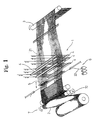
- FIG. 1 of the drawings An overview diagram of the principal components of a weaving machine 1 used in the weaving methods according to the invention is shown in Fig. 1 of the drawings.
- the weaving machine 1 weaves spun yarn into woven goods or fabric 2 through the primary movements of opening a shed formed by two sets of warp yarns 21, inserting a weft yarn 22, and beating the weft, and the secondary movements of letting off warp yarns 21 from a let-off device 3, and taking up woven fabric 2 by means of a take-up device 7.
- the construction is shown in a diagrammatic manner in Fig. 1.
- the action of opening the shed divides all the warp yarns 21 into two sets, forming an opening through which weft yarn 22 passes transversely, wherein the warp yarns 21 and the weft yarns 22 are intersecting and crossing over each other.
- the warp yarns 21 are drawn-in through a plurality of healds 4 in a prescribed order, and the up and down action of these healds 4 separates the warp yarns 21 vertically from each other.
- the weave obtained thereby can be changed to provide a plain weave, twill weave, satin weave or any other type of texture by varying the manner in which the warp yarns 21 are divided into two sets.
- the weft yarn 22 is wound around a wooden tube, that is inserted into a rapier 6 which carries the weft yarn 22 through the shed formed by the warp yarns 21.
- a rapier 6 which carries the weft yarn 22 through the shed formed by the warp yarns 21.
- other means of weft insertion may be used which include the use of air, water, shuttles or grippers.
- Weft beating is the procedure in which the reed 5 moves forwardly and backwardly in order to press and force the weft yarn 22, which has passed through the inside of the shed formed by the warp yarns 21, up to a prescribed position, where the warp yarns 21 and the weft yarns 22 crossing each other form a desired pattern.
- the let-off device 3 gradually feeds the warp yarns 21, while the take-up device 7 rolls up the woven fabric 2.
- 1/f fluctuation signals are derived from a numerical sequence y1, y2, y3, ... formed by multiplying n coefficients a1, a2, a3, ... an, on a random sequence of numbers x1, x2, x3 .
- yj can be expressed by equation 1 indicated below. It should be noted herein that the sequence of numerical values forming y1, y2, y3, ... has a 1/f spectrum. For further details, reference is made to "Biological Signaling", Chapter 10, in “Biological Rhythms and Fluctuations", published by Corona Publishers, Ltd..
- the sequence of numerical values having a 1/f fluctuation is obtained in two steps.
- a computer for example, generates a sequence of random numbers, x.
- a certain number n of coefficients a stored in a storage device are successively multiplied on the random numbers, and then a sequence of numerical values y is obtained by a linear transformation.
- This numerical sequence y has a 1/f spectrum and can be used as a sequence of numerical values having a 1/f fluctuation.
- three examples of numerical sequences with a 1/f fluctuation are provided which are obtained in such a manner.
- Other numerical sequences with a 1/f fluctuation can be derived, for example, from a sound, melody or a breeze of wind, the strengths of which vary with a 1/f fluctuation.
- the following example illustrates a weaving method in order to impart a 1/f fluctuation to a texture pattern of a combined plain weave and satin weave.
- No. 105 two-fold yarn is used both for the warp yarns 21 and the weft yarns 22 in a shuttle weaving machine which is equipped with, for example, 12 healds.
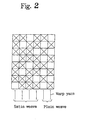
- a texture pattern consisting of a combined plain weave and satin weave is illustrated in Fig. 2.
- the four rows to the left are a satin weave
- the two rows to the right are a plain weave.
- a satin weave can be obtained by repeating the design of the four left rows
- a plain weave can be obtained by repeating the design of the two right rows.
- the "X" marks in the diagram indicate that the warp yarns 21 are on top of the weft yarns 22.
- plain weaving and satin weaving are alternated, wherein for example the number of plain weave rows are changed in accordance with the numerical sequence No. 1 (32, 18, ...) as described above, while the number of rows of satin weave remains fixed, for example at 16.
- the following example illustrates a weaving method in order to impart a 1/f fluctuation to a combined twill right (wherein the diagonal runs upward to the right) and twill left (wherein the diagonal runs upward to the left) pattern.
- No. 105 two-fold yarn is used for both the warp yarns 21 and the weft yarns 22 in a shuttle weaving machine which is equipped, for example, with 8 healds.
- Fig. 4 illustrates such twill textures, wherein Fig. 4(A) shows a twill left pattern and Fig. 4(B) shows a twill right pattern. These twill patterns can be obtained by controlling the up and down movements of the 8 healds in accordance with the respective twill designs.
- the following example illustrates a piqué texture using No. 105 two-fold yarn for both the warp yarns 21 and the weft yarns 22 in a shuttle weaving machine which is equipped with, for example, 8 healds.
- Fig. 6 of the drawigns illustrates a piqué texture design indicating the crossover state of the warp yarns 21 and the weft yarns 22.
- the up and down movements of the 8 healds is controlled in accordance with the design of the two right rows and the two left rows as shown in Fig. 6 of the drawings.
- the numerical sequence No. 2 is used for the right design
- the numerical sequence No. 3 is used for the left design of Fig. 6. That is, 4 warp yarns (numerical sequence No. 2) are allocated for the right design, then 20 yarns (numerical sequence No. 3) for the left design, then 8 yarns for the right design, then 20 yarns for the left design, then 10 yarns for the right design, then 26 yarns for the left design and so forth.
- the piqué texture so obtained has a 1/f fluctuation as shown in Fig. 7 of the drawings.
Landscapes
- Engineering & Computer Science (AREA)
- Textile Engineering (AREA)
- Woven Fabrics (AREA)
- Laminated Bodies (AREA)
- Looms (AREA)
Applications Claiming Priority (3)
| Application Number | Priority Date | Filing Date | Title |
|---|---|---|---|
| JP13618895 | 1995-05-10 | ||
| JP136188/95 | 1995-05-10 | ||
| JP7136188A JP2917106B2 (ja) | 1995-05-10 | 1995-05-10 | 織成方法 |
Publications (2)
| Publication Number | Publication Date |
|---|---|
| EP0742301A1 EP0742301A1 (en) | 1996-11-13 |
| EP0742301B1 true EP0742301B1 (en) | 2000-11-02 |
Family
ID=15169409
Family Applications (1)
| Application Number | Title | Priority Date | Filing Date |
|---|---|---|---|
| EP96107486A Expired - Lifetime EP0742301B1 (en) | 1995-05-10 | 1996-05-10 | Weaving method for textured patterns |
Country Status (7)
| Country | Link |
|---|---|
| US (1) | US5727600A (enExample) |
| EP (1) | EP0742301B1 (enExample) |
| JP (1) | JP2917106B2 (enExample) |
| KR (1) | KR100260462B1 (enExample) |
| CN (1) | CN1048054C (enExample) |
| DE (1) | DE69610790T2 (enExample) |
| TW (1) | TW385345B (enExample) |
Families Citing this family (7)
| Publication number | Priority date | Publication date | Assignee | Title |
|---|---|---|---|---|
| KR101106896B1 (ko) | 2010-03-17 | 2012-01-25 | (주) 배명 | 아무젠 직물 및 그 제직 방법 |
| CN101982593A (zh) * | 2010-11-16 | 2011-03-02 | 江苏省衣维新投资发展有限公司 | 竖斜纹面料 |
| CN103060992B (zh) * | 2013-01-24 | 2014-07-02 | 嘉兴学院 | 一种基于二进制算法的机织物交织规律构造方法 |
| CN103114368A (zh) * | 2013-02-21 | 2013-05-22 | 嘉兴学院 | 一种随机机织物的织造方法 |
| US9175509B2 (en) | 2013-03-15 | 2015-11-03 | Aedes Technologies | Screen with visible marker |
| CN104404690B (zh) * | 2014-12-26 | 2016-03-30 | 孚日集团股份有限公司 | 一种两面正面提花缎档毛巾及其织造工艺 |
| AT516961B1 (de) * | 2015-03-30 | 2016-10-15 | Hofstetter Kurt | Aperiodisch gewebte Textilien mit höherer Zugkraft |
Family Cites Families (13)
| Publication number | Priority date | Publication date | Assignee | Title |
|---|---|---|---|---|
| US416225A (en) * | 1889-12-03 | Woven fabric | ||
| US2925832A (en) * | 1958-07-18 | 1960-02-23 | Ernest R Bowser | Satin weave with twill effect |
| FR1324430A (fr) * | 1962-03-09 | 1963-04-19 | Spriet Hennion & Cie | Perfectionnements apportés aux tissus dits <<écossais>> destinés au plissage |
| DE6903060U (de) * | 1969-01-28 | 1969-07-03 | Jakob Acker & Soehne | Gardine |
| JPS5761738A (en) * | 1980-09-25 | 1982-04-14 | Masashi Miyashita | Cloth weaving method |
| US4497570A (en) * | 1983-02-02 | 1985-02-05 | Xerox Corporation | Printing machine employing an operator replaceable interposition web and photoconductive member |
| JPS6088153A (ja) * | 1983-10-14 | 1985-05-17 | 樽井繊維工業株式会社 | チエツク状平織物とその繊製方法 |
| JPS62156335A (ja) * | 1985-12-26 | 1987-07-11 | 西川産業株式会社 | 柄織物およびその製造方法 |
| JPS63235544A (ja) * | 1987-03-20 | 1988-09-30 | 合資会社 橋詰研究所 | 緯糸密度に変化がある織布、及びその製織方法、並びに同織布を製織する織機 |
| JP3124358B2 (ja) * | 1992-01-13 | 2001-01-15 | 株式会社日立製作所 | 回転機器の制御装置とそれを利用した洗濯機 |
| US5243267A (en) * | 1992-10-06 | 1993-09-07 | Tachi-S Co., Ltd. | Method for controlling a lumbar support device in a powered seat and motor control device provided therein in association therewith |
| FR2716464B1 (fr) * | 1994-02-22 | 1996-08-23 | Dollfus Mieg Cie Sa | Procédé de formation d'une armure pour renforcer la résistance à la déchirure d'un tissu à armure de base serge ou satin et leurs dérivés. |
| JP2651892B2 (ja) * | 1994-05-17 | 1997-09-10 | 日清紡績株式会社 | 織成方法 |
-
1995
- 1995-05-10 JP JP7136188A patent/JP2917106B2/ja not_active Expired - Lifetime
-
1996
- 1996-03-22 CN CN96100997A patent/CN1048054C/zh not_active Expired - Fee Related
- 1996-05-03 KR KR1019960014396A patent/KR100260462B1/ko not_active Expired - Fee Related
- 1996-05-03 TW TW085105309A patent/TW385345B/zh not_active IP Right Cessation
- 1996-05-08 US US08/646,951 patent/US5727600A/en not_active Expired - Fee Related
- 1996-05-10 DE DE69610790T patent/DE69610790T2/de not_active Expired - Fee Related
- 1996-05-10 EP EP96107486A patent/EP0742301B1/en not_active Expired - Lifetime
Also Published As
| Publication number | Publication date |
|---|---|
| DE69610790T2 (de) | 2001-06-21 |
| KR960041446A (ko) | 1996-12-19 |
| US5727600A (en) | 1998-03-17 |
| JPH08302539A (ja) | 1996-11-19 |
| CN1141973A (zh) | 1997-02-05 |
| DE69610790D1 (de) | 2000-12-07 |
| JP2917106B2 (ja) | 1999-07-12 |
| KR100260462B1 (ko) | 2000-07-01 |
| CN1048054C (zh) | 2000-01-05 |
| EP0742301A1 (en) | 1996-11-13 |
| TW385345B (en) | 2000-03-21 |
| HK1011060A1 (en) | 1999-07-02 |
Similar Documents
| Publication | Publication Date | Title |
|---|---|---|
| EP0742302B1 (en) | Weaving method | |
| EP0686716B1 (en) | Weaving method for weaving woven goods | |
| EP0742301A1 (en) | Weaving method for textured patterns | |
| US5570725A (en) | Weaving method and reed used with 1/F fluctuations | |
| HK1011060B (en) | Weaving method for textured patterns | |
| CN118756406A (zh) | 植绒式毛圈花纹毛巾及其织造工艺 | |
| HK1011059B (en) | Weaving method | |
| JP2860445B2 (ja) | 織機及び織成方法 | |
| CN116837517A (zh) | 一种菱形格纬弹面料 | |
| CN108893830A (zh) | 一种具有褶皱表面的弹性双层织物 | |
| HK1011058A1 (en) | Weaving method for weaving woven goods | |
| HK1011058B (en) | Weaving method for weaving woven goods | |
| CN224296770U (zh) | 一种抗静电印花布 | |
| CN108251947A (zh) | 一种无绒处将绒经转换成经网目曲经的提花丝绒及其织造方法 | |
| CN118166466A (zh) | 在双梭口织机上织造双面纬起花面料的方法 | |
| HK1011057B (en) | Weaving method and reed for weaving | |
| JP2019183308A (ja) | シボ織物およびその製造方法 | |
| JPH01104856A (ja) | 起毛織物 |
Legal Events
| Date | Code | Title | Description |
|---|---|---|---|
| PUAI | Public reference made under article 153(3) epc to a published international application that has entered the european phase |
Free format text: ORIGINAL CODE: 0009012 |
|
| AK | Designated contracting states |
Kind code of ref document: A1 Designated state(s): DE FR GB |
|
| 17P | Request for examination filed |
Effective date: 19970415 |
|
| 17Q | First examination report despatched |
Effective date: 19981216 |
|
| GRAG | Despatch of communication of intention to grant |
Free format text: ORIGINAL CODE: EPIDOS AGRA |
|
| GRAG | Despatch of communication of intention to grant |
Free format text: ORIGINAL CODE: EPIDOS AGRA |
|
| GRAG | Despatch of communication of intention to grant |
Free format text: ORIGINAL CODE: EPIDOS AGRA |
|
| GRAH | Despatch of communication of intention to grant a patent |
Free format text: ORIGINAL CODE: EPIDOS IGRA |
|
| GRAH | Despatch of communication of intention to grant a patent |
Free format text: ORIGINAL CODE: EPIDOS IGRA |
|
| GRAA | (expected) grant |
Free format text: ORIGINAL CODE: 0009210 |
|
| AK | Designated contracting states |
Kind code of ref document: B1 Designated state(s): DE FR GB |
|
| REF | Corresponds to: |
Ref document number: 69610790 Country of ref document: DE Date of ref document: 20001207 |
|
| ET | Fr: translation filed | ||
| PGFP | Annual fee paid to national office [announced via postgrant information from national office to epo] |
Ref country code: GB Payment date: 20010503 Year of fee payment: 6 |
|
| PGFP | Annual fee paid to national office [announced via postgrant information from national office to epo] |
Ref country code: FR Payment date: 20010529 Year of fee payment: 6 |
|
| PGFP | Annual fee paid to national office [announced via postgrant information from national office to epo] |
Ref country code: DE Payment date: 20010727 Year of fee payment: 6 |
|
| PLBE | No opposition filed within time limit |
Free format text: ORIGINAL CODE: 0009261 |
|
| STAA | Information on the status of an ep patent application or granted ep patent |
Free format text: STATUS: NO OPPOSITION FILED WITHIN TIME LIMIT |
|
| 26N | No opposition filed | ||
| REG | Reference to a national code |
Ref country code: GB Ref legal event code: IF02 |
|
| PG25 | Lapsed in a contracting state [announced via postgrant information from national office to epo] |
Ref country code: GB Free format text: LAPSE BECAUSE OF NON-PAYMENT OF DUE FEES Effective date: 20020510 |
|
| PG25 | Lapsed in a contracting state [announced via postgrant information from national office to epo] |
Ref country code: DE Free format text: LAPSE BECAUSE OF NON-PAYMENT OF DUE FEES Effective date: 20021203 |
|
| GBPC | Gb: european patent ceased through non-payment of renewal fee |
Effective date: 20020510 |
|
| PG25 | Lapsed in a contracting state [announced via postgrant information from national office to epo] |
Ref country code: FR Free format text: LAPSE BECAUSE OF NON-PAYMENT OF DUE FEES Effective date: 20030131 |
|
| REG | Reference to a national code |
Ref country code: FR Ref legal event code: ST |