EP0739233B1 - Verfahren zur abtrennung von trägerfreien radionukliden aus targetflüssigkeit, dessen anwendung und dafür geeignete anordnung - Google Patents
Verfahren zur abtrennung von trägerfreien radionukliden aus targetflüssigkeit, dessen anwendung und dafür geeignete anordnung Download PDFInfo
- Publication number
- EP0739233B1 EP0739233B1 EP95905045A EP95905045A EP0739233B1 EP 0739233 B1 EP0739233 B1 EP 0739233B1 EP 95905045 A EP95905045 A EP 95905045A EP 95905045 A EP95905045 A EP 95905045A EP 0739233 B1 EP0739233 B1 EP 0739233B1
- Authority
- EP
- European Patent Office
- Prior art keywords
- process according
- electrode
- flow cell
- radionuclide
- liquid
- Prior art date
- Legal status (The legal status is an assumption and is not a legal conclusion. Google has not performed a legal analysis and makes no representation as to the accuracy of the status listed.)
- Expired - Lifetime
Links
Images


Classifications
-
- G—PHYSICS
- G21—NUCLEAR PHYSICS; NUCLEAR ENGINEERING
- G21G—CONVERSION OF CHEMICAL ELEMENTS; RADIOACTIVE SOURCES
- G21G1/00—Arrangements for converting chemical elements by electromagnetic radiation, corpuscular radiation or particle bombardment, e.g. producing radioactive isotopes
- G21G1/0005—Isotope delivery systems
-
- A—HUMAN NECESSITIES
- A61—MEDICAL OR VETERINARY SCIENCE; HYGIENE
- A61K—PREPARATIONS FOR MEDICAL, DENTAL OR TOILETRY PURPOSES
- A61K51/00—Preparations containing radioactive substances for use in therapy or testing in vivo
- A61K51/12—Preparations containing radioactive substances for use in therapy or testing in vivo characterised by a special physical form, e.g. emulsion, microcapsules, liposomes, characterized by a special physical form, e.g. emulsions, dispersions, microcapsules
-
- B—PERFORMING OPERATIONS; TRANSPORTING
- B01—PHYSICAL OR CHEMICAL PROCESSES OR APPARATUS IN GENERAL
- B01D—SEPARATION
- B01D59/00—Separation of different isotopes of the same chemical element
- B01D59/38—Separation by electrochemical methods
-
- C—CHEMISTRY; METALLURGY
- C07—ORGANIC CHEMISTRY
- C07B—GENERAL METHODS OF ORGANIC CHEMISTRY; APPARATUS THEREFOR
- C07B59/00—Introduction of isotopes of elements into organic compounds ; Labelled organic compounds per se
-
- G—PHYSICS
- G21—NUCLEAR PHYSICS; NUCLEAR ENGINEERING
- G21G—CONVERSION OF CHEMICAL ELEMENTS; RADIOACTIVE SOURCES
- G21G1/00—Arrangements for converting chemical elements by electromagnetic radiation, corpuscular radiation or particle bombardment, e.g. producing radioactive isotopes
- G21G1/001—Recovery of specific isotopes from irradiated targets
- G21G2001/0015—Fluorine
Definitions
- the invention relates to a Process for the separation of carrier-free radionuclides made of liquid or liquefiable target material with low electrical conductivity, by a nuclear process, especially by cyclotron radiation, in ionizable or polarizable Form arise within an electrode arrangement by applying an electric field for electrofixing of the nuclide on one of the electrodes, from the nuclide after removal of the target liquid and addition of solvent for further processing when the field is switched off or in a field opposite polarity is brought back into solution, and it includes the application of this method and a suitable flow cell.
- Radiotracer compounds that especially in medical diagnostics play an important role, especially short-lived Radionuclides used, which are also possible in strapless form can be provided.
- a particularly elegant method for obtaining radionuclides for radiotracer technology is the cyclotron irradiation of target material, for which the generation of 18 F from 18 OH 2 O can serve as an example: 18 F has a half-life of approx. 110 min and will used for the synthesis of 18 F-fluorodeoxyglucose for positron emission tomography. It is formed by cyclotron radiation from 18 OH 2 O, which is included in the process costs at a price of around DM 150.00 / g.
- the 18 F-fluoride formed in the cyclotron is separated from the 18 OH 2 O by ion exchange, whereby on the one hand [ 18 O] H 2 O losses and contamination thereof by organic constituents of the ion exchange resins and [ 16 O] H 2 O admixture can occur due to the presence of moisture.
- the technique according to the invention allows smooth coupling the radionuclide / target liquid separation in the radiotracer synthesis process with particularly good economy by minimizing target losses with high nuclide yield and rapid procedure, which is perfectly adapted to automatic operation.
- the method according to the invention is based on the following Principle: polarizable or ionogenic, carrier-free radionuclides, dissolved in liquids with low electrical Conductivity will be out of solution in the way isolates that in an electric field each Radioisotope in polarized or ionic Shape migrates to the oppositely charged electrode and there through a kind of "electrosorption" is fixed.
- This proves to be a coaxial geometry with a relatively large fixation electrode and avoidance of field strength peaks as particularly useful for the carrier-free collection of the radionuclide from the Target liquid free of ionic additives.
- the radionuclide is fixed to the electrode can target liquid practically quantitatively from Radionuclide - while maintaining the electrical Field - to be removed.
- radioisotopanion or cation can again electrodes to be brought into solution, especially for high purity "normal” water is used. Then the on-line Distribution of the aqueous active solution to the synthesis boxes respectively.
- the flow cell according to the invention is, in particular, directly connected in the transport path from the radiation station to the radiotracer synthesis (eg production of [ 18 F] -fluorodesoxyglucose) or synthesis apparatus, or possibly even forms part of the transport line or the synthesis apparatus itself.
- Substances which, on the one hand, preclude a chemical reaction or irreversible insertion of the radionuclide into the electrode material under the given conditions and, on the other hand, ensure that the radionuclide goes into solution when the polarity of the system is reversed are considered.
- Glassy carbon (Sigradur (R) ) and platinum meet the requirements.
- High-purity water or, if appropriate, the solvent intended for the subsequent synthesis of the radiotracer can serve as the solvent.
- a DC voltage source is used as the voltage source, which gradually emits a voltage of up to approximately 30 V. Field strengths are preferred for the deposition, which preferably do not exceed 100 V / cm. A "closed" surface of the fixing electrode that is leveled out as possible appears expedient.
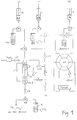
- an arrangement for the separation of 18 F from cyclotron-irradiated H 2 18 O comprises a flow cell 1 with an electrode 2 designed as an inlet capillary and an essentially cylindrical anode 3 forming the wall of the vessel.
- the scheme is given on the basis of the following Process steps of the radionuclide / target liquid separation can be easily understood:
- the aqueous phase is pressed out of the target through the valves V2 and V6 into the flow cell 1.
- the controlled, slow transport prevents the 18 O water flowing in at the lower end of the cell via the capillary 2 from splashing inside the cell.
- the negatively charged fluoride ion is deposited or fixed on the cylindrical Sigradur (R) jacket 3, which is anodically connected to the capillary 2 as the cathode, within about 6 minutes.
- the 18 O water which is free of ionogenic additives, is transported into the collecting vessel 4 with a weak, controllable helium current which maintains the electric field and which is accessed via the valves V11 and V10. The water used for the radiation is almost quantitatively recovered.
- the water is preferably heated during the polarity reversal of the electric field (the platinum capillary 2 now forms the anode).
- the Sigradur (R) jacket 3 is brought to about 50 ° C. by resistance heating.
- the field created for the fixation and maintained during the removal of the H 2 18 O from the cell and possibly subsequent “intermediate rinsing” can only be reversed for a short time and then switched off or only switched off.
- the 18 F-containing water is transported with the help of a helium stream via valves V8 and V9 through a polypropylene line to the synthesis modules (boxes).
- the emptied cell 1 is dried by a stream of helium while the Sigradur (R) jacket 3 is heated, so that refilling the cell with 18 F / 18 O water does not lead to thinning of the target water and thus to a reduction in its quality.
- helium is introduced through the platinum capillary via valves V13 and V6 and discharged to the outside via valve V7 and the coupled Al 2 O 3 cartridge.
- the purpose of the cartridge is to fix any gaseous 18 F that escapes and thus prevent contamination of the surroundings. Drying takes about 15 minutes. (The valve V7 is open during every filling process and during electrosorption and desorption).
- Steps 1 to 3 take about 15 minutes in total Claim.
- the flow cell essentially consists of the jacket 3 and an axial platinum capillary 2, through which the cylindrical vessel is filled or through which inert gas can be introduced into the chamber.
- the height of the cylinder is such that the fill level of the 18 F / H 2 18 O-Sol. is about 50-70% of the total volume.
- the inner volume of the Pt capillary is 35 ⁇ l.
- the volume of liquid within the capillary is approximately 20 ⁇ l, so that the amount of liquid not available for 18 F-fluoride separation corresponds to only 1 - 2% of the total volume.
- the system is fixed and sealed by a plastic bracket 5.
- a flat funnel is incorporated, which opens into the water drainage pipe.
- the head part of the holder 5 made of PEEK there is a He feed line 6 and an opening 7 through which gas can be discharged to the outside.
- a controllable gas flow enables the cell to be emptied in a controlled manner.
- the Sigradur cylinder 3 and the platinum capillary are connected to a direct current source 8 and can be switched either as a cathode or anode.
- the flow cell can be heated by a flow of warm air or an electrical heater, such as a heating coil.
- the arrangement is particularly expediently supplemented by a program control which ensures the voltage supply and heating of the cell.
- the Sigradur (R) cylinder had a length of 70 mm and an inner diameter of 7 mm.
- the inner diameter of the platinum capillary was 0.8 mm and the electrode spacing was 2.7 mm.
- FIG. 3 An alternative flow cell for the 18 F / H 2 18 O separation is indicated in FIG. 3. It comprises two Sigradur plates 9, 10 arranged in parallel, which have a distance of about 2 mm. According to FIG. 3, the plates functioning as electrodes are separated from one another by a circumferential plastic strip 11, which ensures both electrical insulation and a seal of the centrally arranged rectangular channel through which the 18 F-solution. can be routed continuously when there is an adjacent field.
- the cell can be rinsed with an organic solvent and thus freed of residual water.
- the fluoride can be converted into the organic phase in anhydrous form in the presence of a solution of phase transfer catalyst in organic solvent and is thus - without thermal dewatering - available for nucleophilic synthesis of 18 F-radiopharmaceuticals, as described, for example, in EP 0167103B1 .
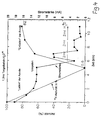
- the diagram in FIG. 4 shows an example of the result of the separation of 18 F-fluoride from H 2 18 O.
- 18 F was quantitatively fixed to the sigraduranode.
- a time-dependent current decrease can be seen in the course of the deposition, which comes to a standstill after about 5 minutes.
- the desorption of the radionuclide after reversing the polarity of the field in the presence of normal water was measured as a function of time.
- the activity yield of 82% achieved in this case after changing the water 3 times (2 ml each) does not correspond to the practically achievable result.
- a single addition of water and opposite polarity while heating the flow cell resulted in an 18F recovery of about 90%.
Landscapes
- Chemical & Material Sciences (AREA)
- Organic Chemistry (AREA)
- Health & Medical Sciences (AREA)
- Chemical Kinetics & Catalysis (AREA)
- Physics & Mathematics (AREA)
- Animal Behavior & Ethology (AREA)
- Dispersion Chemistry (AREA)
- Pharmacology & Pharmacy (AREA)
- Epidemiology (AREA)
- Life Sciences & Earth Sciences (AREA)
- Medicinal Chemistry (AREA)
- General Health & Medical Sciences (AREA)
- Public Health (AREA)
- Veterinary Medicine (AREA)
- Optics & Photonics (AREA)
- General Chemical & Material Sciences (AREA)
- Engineering & Computer Science (AREA)
- General Engineering & Computer Science (AREA)
- High Energy & Nuclear Physics (AREA)
- Electrochemistry (AREA)
- Physical Or Chemical Processes And Apparatus (AREA)
- Medicines Containing Antibodies Or Antigens For Use As Internal Diagnostic Agents (AREA)
Description
Die Gleichspannungsquelle war von 0 bis 20V regulierbar bei Stromstärken bis 1 Ampère. Soweit ersichtlich, wurden Feldstärken von 100 - 300 V/cm angewandt.
Als Spannungsquelle dient zweckmäßigerweise eine Gleichspannungsquelle, die stufenweise bis etwa 30 V Spannung abgibt. Für die Abscheidung werden Feldstärken angestrebt, die vorzugsweise nicht über 100 V/cm hinausgehen. Eine möglichst eingeebnete, "geschlossene" Oberfläche der Fixierungselektrode erscheint zweckmäßig.
- Figur 1
- ein Schema für eine Trennapparatur mit Durchflußzelle;
- Figur 2
- eine dafür geeignete Durchflußzelle im Detail;
- Figur 3
- ein Schema für eine als Leitungsteil fungierende Durchflußzelle und
- Figur 4
- ein Kurvenbild für ein Beispiel der Elektrofixierung und -wiederauflösung eines Radionuklids.
Claims (13)
- Verfahren zur Abtrennung von trägerfreien Radionukliden aus flüssigem bzw. verflüssigbarem Targetmaterial mit geringer elektrischer Leitfähigkeit, die durch einen Nuklearprozeß, insbesondere durch Zyklotronstrahlung, in ionisierbarer bzw. polarisierbarer Form entstehen, innerhalb einer Elektrodenanordnung durch Anlegen eines elektrischen Feldes zur Elektrofixierung des Nuklids an einer der Elektroden, von der das Nuklid nach Entfernung der Targetflüssigkeit und Zugabe von Lösungsmittel für die weitere Verarbeitung bei abgeschaltetem Feld oder in einem Feld entgegengesetzter Polung wieder in Lösung gebracht wird,
dadurch gekennzeichnet,
daß man in einer Durchflußzelle mit permanenter Elektrodenanordnung arbeitet und die Abtrennung der Targetflüssigkeit unter Aufrechterhaltung der Fixierungsspannung vornimmt. - Verfahren nach Anspruch 1,
dadurch gekennzeichnet,
daß man eine Elektrodenanordnung mit porenfreier inerter Oberfläche, insbesondere aus Glaskohlenstoff oder Edelmetall, insbesondere Platin, wählt. - Verfahren nach Anspruch 2,
dadurch gekennzeichnet,
daß man als Elektrode für die Elektrofixierung des Radionuklids die Gefäßwand wählt. - Verfahren nach Anspruch 3,
dadurch gekennzeichnet,
daß die Elektrofixierung des Radionuklids in einem koaxialen Feld mit Anreicherung des Radionuklids an der zylindrischen Außenelektrode erfolgt. - Verfahren nach Anspruch 4,
dadurch gekennzeichnet,
daß die Flüssigkeitszufuhr zur Zelle über die als Kapillare ausgebildete axiale Elektrode erfolgt. - Verfahren nach einem der vorangehenden Ansprüche,
dadurch gekennzeichnet,
daß die Elektrofixierung des Radionuklids bei Feldstärken von 10 - 100 V/cm erfolgt. - Verfahren nach einem der vorangehenden Ansprüche,
dadurch gekennzeichnet,
daß mit Fixierungselektrodenflächen von ≥ 3 cm2 gearbeitet wird. - Verfahren nach einem der vorangehenden Ansprüche,
dadurch gekennzeichnet,
daß die Ablösung des Nuklids von der Elektrode unter Erwärmung erfolgt. - Verfahren nach einem der vorangehenden Ansprüche
dadurch gekennzeichnet,
daß die Flüssigkeit aus der Durchflußzelle durch Inertgas, insb. Helium, ausgetrieben wird. - Verfahren nach einem der vorangehenden Ansprüche,
dadurch gekennzeichnet,
daß die Durchflußzelle durch die Transportleitung von der Bestrahlungsstation zur Markierungsapparatur oder Teile derselben oder durch das Reaktionsgefäß der Markierungsapparatur gebildet wird. - Verwendung des Verfahrens nach einem der vorangehenden Ansprüche für die Radioisotop-, insbesondere 18F-Markierung von organischen Verbindungen durch nukleophilen Austausch.
- Durchflußzelle zur Durchführung des Verfahrens nach einem der vorangehenden Ansprüche,
gekennzeichnet durch
einen Glaskohlenstoffzylinder (3) als Außenwand und Fixierungselektrode und eine über dessen Gesamtlänge reichende Platinkapillare (2) als Gegenelektrode, der über einen flachen Konus mit geringer Steigung in einer kurzen zu einem Ventil führenden Kapillare endet und am oberen Ende durch eine die Gegenelektrode halternde Kappe mit Helium-Anschluß (6) und Druckausgleichsöffnung (7) abgeschlossen wird. - Durchflußzelle nach Anspruch 12,
gekennzeichnet durch
eine Heizwicklung auf der Zylinderaußenwand sowie eine Steuerung für die Spannungsversorgung und Beheizung der Zelle.
Applications Claiming Priority (3)
| Application Number | Priority Date | Filing Date | Title |
|---|---|---|---|
| DE4400539 | 1994-01-11 | ||
| DE4400539 | 1994-01-11 | ||
| PCT/DE1995/000025 WO1995018668A1 (de) | 1994-01-11 | 1995-01-10 | Verfahren zur abtrennung von trägerfreien radionukliden aus targetflüssigkeit, dessen anwendung und dafür geeignete anordnung |
Publications (2)
| Publication Number | Publication Date |
|---|---|
| EP0739233A1 EP0739233A1 (de) | 1996-10-30 |
| EP0739233B1 true EP0739233B1 (de) | 1998-09-23 |
Family
ID=6507699
Family Applications (1)
| Application Number | Title | Priority Date | Filing Date |
|---|---|---|---|
| EP95905045A Expired - Lifetime EP0739233B1 (de) | 1994-01-11 | 1995-01-10 | Verfahren zur abtrennung von trägerfreien radionukliden aus targetflüssigkeit, dessen anwendung und dafür geeignete anordnung |
Country Status (5)
| Country | Link |
|---|---|
| US (1) | US5770030A (de) |
| EP (1) | EP0739233B1 (de) |
| JP (1) | JP3732856B2 (de) |
| DE (1) | DE19500428C2 (de) |
| WO (1) | WO1995018668A1 (de) |
Families Citing this family (28)
| Publication number | Priority date | Publication date | Assignee | Title |
|---|---|---|---|---|
| WO2001058572A1 (en) | 2000-02-09 | 2001-08-16 | Riken | Method for separating and collecting ?18f in 18¿o water |
| US6599484B1 (en) | 2000-05-12 | 2003-07-29 | Cti, Inc. | Apparatus for processing radionuclides |
| US8332553B2 (en) * | 2000-09-21 | 2012-12-11 | Hewlett-Packard Development Company, L.P. | Method and apparatus for accessing a contacts database and telephone services |
| US6567492B2 (en) * | 2001-06-11 | 2003-05-20 | Eastern Isotopes, Inc. | Process and apparatus for production of F-18 fluoride |
| US7692667B2 (en) * | 2001-08-17 | 2010-04-06 | Palm, Inc. | Handheld computer having moveable segments that are interactive with an integrated display |
| KR100423740B1 (ko) * | 2001-09-14 | 2004-03-22 | 한국원자력연구소 | 방사성 인 핵종 제조를 위한 황의 증류방법 |
| DE10208668A1 (de) * | 2002-02-28 | 2003-09-18 | Forschungszentrum Juelich Gmbh | Durchflusszelle sowie Verfahren zur Abtrennung von trägerfreien Radionukliden und deren radiochemische Umsetzung |
| US7018614B2 (en) * | 2002-11-05 | 2006-03-28 | Eastern Isotopes, Inc. | Stabilization of radiopharmaceuticals labeled with 18-F |
| US7865180B2 (en) * | 2003-06-23 | 2011-01-04 | Palm, Inc. | Automated telephone conferencing method and system |
| US20060062342A1 (en) * | 2004-09-17 | 2006-03-23 | Cyclotron Partners, L.P. | Method and apparatus for the production of radioisotopes |
| JP2006110533A (ja) * | 2004-10-15 | 2006-04-27 | Institute Of Physical & Chemical Research | ハロゲン由来の陽電子放出核種の分離回収方法、18F標識化合物の合成方法およびNa18Fの合成方法。 |
| ES2434849T3 (es) * | 2005-04-29 | 2013-12-17 | The Australian National University | Método de formación de una composición radioactiva injectable de partículas radioactivas encapsuladas en carbono |
| KR100742639B1 (ko) * | 2006-01-19 | 2007-07-25 | 한국원자력안전기술원 | 방사성핵종 분리용 다수 시료 동시자동분리장치 및 그를이용한 우라늄 (u) 자동분리방법 |
| US8492671B2 (en) * | 2006-04-28 | 2013-07-23 | Ge Healthcare Limited | Production of [18F]-F2 from [18F]-fluoride using a plasma induced scrambling procedure |
| US8206571B2 (en) * | 2006-06-27 | 2012-06-26 | Ge Healthcare Limited | Formation of [18F] fluoride complexes suitable for [18F] fluorinations |
| WO2008001098A1 (en) * | 2006-06-30 | 2008-01-03 | Ge Healthcare Limited | Electrochemical separation of [18f] fluoride from [180] water |
| EP1933330A1 (de) * | 2006-12-11 | 2008-06-18 | Trasis S.A. | Elektrochemisches 18F-Extraktions-, Konzentrations- und Reformulierungsverfahren zur radioaktiven Markierung |
| WO2008117388A1 (ja) * | 2007-03-26 | 2008-10-02 | Shimadzu Corporation | 放射性フッ素アニオン濃縮装置及び方法 |
| ATE532580T1 (de) * | 2007-08-31 | 2011-11-15 | Shimadzu Corp | Strömungszelle, vorrichtung zum aufkonzentrieren von radioaktivem fluoranion und verfahren zum aufkonzentrieren von radioaktivem fluoranion |
| US8126519B2 (en) * | 2007-08-31 | 2012-02-28 | Hewlett-Packard Development Company, L.P. | Housing for mobile computing device having construction to slide and pivot into multiple positions |
| US8257681B2 (en) | 2008-12-26 | 2012-09-04 | Clear Vascular Inc. | Compositions of high specific activity SN-117M and methods of preparing the same |
| DE102009023544A1 (de) | 2009-05-30 | 2010-12-09 | Forschungszentrum Jülich GmbH | Elektrochemische Zelle und Verfahren zur Abtrennung von trägerfreiem 18F-aus einer Lösung an einer Elektrode |
| KR20120089428A (ko) * | 2009-07-10 | 2012-08-10 | 제너럴 일렉트릭 캄파니 | 전기화학적 상전이 장치 및 방법 |
| CN103055528A (zh) * | 2011-10-20 | 2013-04-24 | 宜都市华阳化工有限责任公司 | 高温蒸馏釜电加热控制装置 |
| GB201418899D0 (en) | 2014-10-23 | 2014-12-10 | Univ Hull | System for radiopharmaceutical production |
| GB201418897D0 (en) | 2014-10-23 | 2014-12-10 | Univ Hull | Methods and apparatus for the analysis of compounds |
| GB201418893D0 (en) | 2014-10-23 | 2014-12-10 | Univ Hull | Monolithic body |
| KR102233112B1 (ko) | 2019-07-25 | 2021-03-29 | 한국원자력의학원 | 액체 타겟을 이용한 핵종 생산 장치 |
Family Cites Families (5)
| Publication number | Priority date | Publication date | Assignee | Title |
|---|---|---|---|---|
| EP0045142B1 (de) * | 1980-07-24 | 1985-03-27 | The Secretary of State for Defence in Her Britannic Majesty's Government of the United Kingdom of Great Britain and | Adsorption an einem Aktivkohlegewebe |
| DE3521109A1 (de) * | 1985-06-12 | 1986-12-18 | INTERATOM GmbH, 5060 Bergisch Gladbach | Verfahren und vorrichtung zur galvanomagnetischen entfernung von ionen aus einer fluessigkeit |
| US5183542A (en) * | 1990-01-05 | 1993-02-02 | Westinghouse Electric Corp. | Apparatus and method for separating zirconium isotopes using balanced ion electromigration |
| US5425858A (en) * | 1994-05-20 | 1995-06-20 | The Regents Of The University Of California | Method and apparatus for capacitive deionization, electrochemical purification, and regeneration of electrodes |
| US5454924A (en) * | 1994-09-09 | 1995-10-03 | Agfa-Gevaert N.V. | Apparatus for the electrolytic recovery of silver from solutions containing silver |
-
1995
- 1995-01-10 EP EP95905045A patent/EP0739233B1/de not_active Expired - Lifetime
- 1995-01-10 DE DE19500428A patent/DE19500428C2/de not_active Expired - Fee Related
- 1995-01-10 US US08/676,135 patent/US5770030A/en not_active Expired - Lifetime
- 1995-01-10 WO PCT/DE1995/000025 patent/WO1995018668A1/de not_active Ceased
- 1995-01-10 JP JP51826995A patent/JP3732856B2/ja not_active Expired - Fee Related
Also Published As
| Publication number | Publication date |
|---|---|
| WO1995018668A1 (de) | 1995-07-13 |
| DE19500428C2 (de) | 1996-05-30 |
| JP3732856B2 (ja) | 2006-01-11 |
| JPH09507162A (ja) | 1997-07-22 |
| US5770030A (en) | 1998-06-23 |
| DE19500428A1 (de) | 1995-07-13 |
| EP0739233A1 (de) | 1996-10-30 |
Similar Documents
| Publication | Publication Date | Title |
|---|---|---|
| DE19500428C2 (de) | Verfahren zur Abtrennung von trägerfreien Radionukliden aus Targetflüssigkeit, dessen Anwendung und dafür geeignete Anordnung | |
| DE2231976C3 (de) | Verfahren zur Herstellung von hochreinem, radioaktivem Molybdan-99-Spaltprodukt | |
| EP2059931B1 (de) | Elektrochemisches 18f-extraktions-, konzentrations- und reformulierungsverfahren zur radioaktiven markierung | |
| DE69629960T2 (de) | Verfahren zum chromatographischen Nachweis von Probenionen durch Regenerierung einer stationären Phase | |
| DE60215939T2 (de) | Verfahren und vorrichtung zur erzeugung vom fluor-isotop f-18 | |
| US6827838B2 (en) | Method of separating and collecting 18F in 18O water | |
| EP1479084B1 (de) | Vorrichtung sowie verfahren zur abtrennung von trägerfreien radionukliden und deren radiochemische umsetzung | |
| JPWO2001058572A1 (ja) | 18o水中の18fを分離回収する方法 | |
| DE19951642A1 (de) | Verfahren und Vorrichtung zum Reduzieren von kationischen Verunreinigungen und zum Dosieren von Lithium im Kühlwasser eines Leichtwasserreaktors und Kühlwassersystem eines Leichtwasserreaktors mit einer solchen Vorrichtung | |
| DE69227065T2 (de) | Elektrolysezelle und Verfahren zur Markierung von Proteinen und Peptiden | |
| DE2324521C3 (de) | ||
| DE1913411B2 (de) | Membranzelle zur elektrophorese von substanzgemischen | |
| DE3913814A1 (de) | Verfahren zur elektrischen elution von auf trenngelen gebundenen, elektrisch geladenen substanzen und eine anordnung zur durchfuehrung des verfahrens | |
| DE68920611T2 (de) | Elektrolytischer Reaktor. | |
| Chakravarty et al. | A novel electrochemical 99 Mo/99m Tc generator | |
| Short | Measurement of all radium isotopes at environmental levels on a single electrodeposited source | |
| Da Cruz et al. | Alpha-source preparation by electrodeposition | |
| EP2438598A1 (de) | Elektrochemische zelle und verfahren zur abtrennung von trägerfreiem 18f- aus einer lösung an einer elektrode | |
| US20250269327A1 (en) | Electro-amalgamation apparatus and method for separating product and non-product lanthanides | |
| CN217173912U (zh) | 一种用于批量化制备α源的电沉积装置 | |
| DE2460468C3 (de) | Verfahren zur elektrolytischen Herstellung von Hexafluorpropenepoxid | |
| Rane et al. | Electrodeposition of carrier-free manganese-54, technetium-99 and actinium-288 from aqueous baths | |
| Ismail et al. | Separation and purification of yttrium from strontium through barium sulfate membrane under electric potential | |
| De Wet | Selective method for the complete removal of sodium from samples in activation analysis | |
| DE1165880B (de) | Schmelzelektrolytisches Verfahren und Vorrichtung zum Herstellen von hochreinem Gallium |
Legal Events
| Date | Code | Title | Description |
|---|---|---|---|
| PUAI | Public reference made under article 153(3) epc to a published international application that has entered the european phase |
Free format text: ORIGINAL CODE: 0009012 |
|
| 17P | Request for examination filed |
Effective date: 19960710 |
|
| AK | Designated contracting states |
Kind code of ref document: A1 Designated state(s): BE |
|
| GRAG | Despatch of communication of intention to grant |
Free format text: ORIGINAL CODE: EPIDOS AGRA |
|
| 17Q | First examination report despatched |
Effective date: 19971106 |
|
| GRAG | Despatch of communication of intention to grant |
Free format text: ORIGINAL CODE: EPIDOS AGRA |
|
| GRAH | Despatch of communication of intention to grant a patent |
Free format text: ORIGINAL CODE: EPIDOS IGRA |
|
| GRAH | Despatch of communication of intention to grant a patent |
Free format text: ORIGINAL CODE: EPIDOS IGRA |
|
| GRAA | (expected) grant |
Free format text: ORIGINAL CODE: 0009210 |
|
| AK | Designated contracting states |
Kind code of ref document: B1 Designated state(s): BE |
|
| PLBE | No opposition filed within time limit |
Free format text: ORIGINAL CODE: 0009261 |
|
| STAA | Information on the status of an ep patent application or granted ep patent |
Free format text: STATUS: NO OPPOSITION FILED WITHIN TIME LIMIT |
|
| 26N | No opposition filed | ||
| PGFP | Annual fee paid to national office [announced via postgrant information from national office to epo] |
Ref country code: BE Payment date: 20120123 Year of fee payment: 18 |
|
| BERE | Be: lapsed |
Owner name: FORSCHUNGSZENTRUM *JULICH G.M.B.H. Effective date: 20130131 |
|
| PG25 | Lapsed in a contracting state [announced via postgrant information from national office to epo] |
Ref country code: BE Free format text: LAPSE BECAUSE OF NON-PAYMENT OF DUE FEES Effective date: 20130131 |