EP0738263B1 - Phenylimidazolidines substituees a activite antiandrogene - Google Patents
Phenylimidazolidines substituees a activite antiandrogene Download PDFInfo
- Publication number
- EP0738263B1 EP0738263B1 EP95906361A EP95906361A EP0738263B1 EP 0738263 B1 EP0738263 B1 EP 0738263B1 EP 95906361 A EP95906361 A EP 95906361A EP 95906361 A EP95906361 A EP 95906361A EP 0738263 B1 EP0738263 B1 EP 0738263B1
- Authority
- EP
- European Patent Office
- Prior art keywords
- formula
- product
- trifluoromethyl
- products
- imidazolidinyl
- Prior art date
- Legal status (The legal status is an assumption and is not a legal conclusion. Google has not performed a legal analysis and makes no representation as to the accuracy of the status listed.)
- Expired - Lifetime
Links
- 0 CC(*)(C(N1c(cc2C(F)(F)F)ccc2[N+]([O-])=O)=O)NC1=O Chemical compound CC(*)(C(N1c(cc2C(F)(F)F)ccc2[N+]([O-])=O)=O)NC1=O 0.000 description 1
Classifications
-
- C—CHEMISTRY; METALLURGY
- C07—ORGANIC CHEMISTRY
- C07D—HETEROCYCLIC COMPOUNDS
- C07D235/00—Heterocyclic compounds containing 1,3-diazole or hydrogenated 1,3-diazole rings, condensed with other rings
- C07D235/02—Heterocyclic compounds containing 1,3-diazole or hydrogenated 1,3-diazole rings, condensed with other rings condensed with carbocyclic rings or ring systems
-
- A—HUMAN NECESSITIES
- A61—MEDICAL OR VETERINARY SCIENCE; HYGIENE
- A61P—SPECIFIC THERAPEUTIC ACTIVITY OF CHEMICAL COMPOUNDS OR MEDICINAL PREPARATIONS
- A61P17/00—Drugs for dermatological disorders
-
- A—HUMAN NECESSITIES
- A61—MEDICAL OR VETERINARY SCIENCE; HYGIENE
- A61P—SPECIFIC THERAPEUTIC ACTIVITY OF CHEMICAL COMPOUNDS OR MEDICINAL PREPARATIONS
- A61P35/00—Antineoplastic agents
-
- A—HUMAN NECESSITIES
- A61—MEDICAL OR VETERINARY SCIENCE; HYGIENE
- A61P—SPECIFIC THERAPEUTIC ACTIVITY OF CHEMICAL COMPOUNDS OR MEDICINAL PREPARATIONS
- A61P43/00—Drugs for specific purposes, not provided for in groups A61P1/00-A61P41/00
-
- A—HUMAN NECESSITIES
- A61—MEDICAL OR VETERINARY SCIENCE; HYGIENE
- A61P—SPECIFIC THERAPEUTIC ACTIVITY OF CHEMICAL COMPOUNDS OR MEDICINAL PREPARATIONS
- A61P5/00—Drugs for disorders of the endocrine system
- A61P5/24—Drugs for disorders of the endocrine system of the sex hormones
- A61P5/26—Androgens
-
- C—CHEMISTRY; METALLURGY
- C07—ORGANIC CHEMISTRY
- C07D—HETEROCYCLIC COMPOUNDS
- C07D233/00—Heterocyclic compounds containing 1,3-diazole or hydrogenated 1,3-diazole rings, not condensed with other rings
- C07D233/54—Heterocyclic compounds containing 1,3-diazole or hydrogenated 1,3-diazole rings, not condensed with other rings having two double bonds between ring members or between ring members and non-ring members
- C07D233/66—Heterocyclic compounds containing 1,3-diazole or hydrogenated 1,3-diazole rings, not condensed with other rings having two double bonds between ring members or between ring members and non-ring members with hetero atoms or with carbon atoms having three bonds to hetero atoms with at the most one bond to halogen, e.g. ester or nitrile radicals, directly attached to ring carbon atoms
- C07D233/72—Two oxygen atoms, e.g. hydantoin
- C07D233/76—Two oxygen atoms, e.g. hydantoin with substituted hydrocarbon radicals attached to the third ring carbon atom
-
- C—CHEMISTRY; METALLURGY
- C07—ORGANIC CHEMISTRY
- C07D—HETEROCYCLIC COMPOUNDS
- C07D233/00—Heterocyclic compounds containing 1,3-diazole or hydrogenated 1,3-diazole rings, not condensed with other rings
- C07D233/54—Heterocyclic compounds containing 1,3-diazole or hydrogenated 1,3-diazole rings, not condensed with other rings having two double bonds between ring members or between ring members and non-ring members
- C07D233/66—Heterocyclic compounds containing 1,3-diazole or hydrogenated 1,3-diazole rings, not condensed with other rings having two double bonds between ring members or between ring members and non-ring members with hetero atoms or with carbon atoms having three bonds to hetero atoms with at the most one bond to halogen, e.g. ester or nitrile radicals, directly attached to ring carbon atoms
- C07D233/72—Two oxygen atoms, e.g. hydantoin
- C07D233/76—Two oxygen atoms, e.g. hydantoin with substituted hydrocarbon radicals attached to the third ring carbon atom
- C07D233/78—Radicals substituted by oxygen atoms
-
- C—CHEMISTRY; METALLURGY
- C07—ORGANIC CHEMISTRY
- C07D—HETEROCYCLIC COMPOUNDS
- C07D233/00—Heterocyclic compounds containing 1,3-diazole or hydrogenated 1,3-diazole rings, not condensed with other rings
- C07D233/54—Heterocyclic compounds containing 1,3-diazole or hydrogenated 1,3-diazole rings, not condensed with other rings having two double bonds between ring members or between ring members and non-ring members
- C07D233/66—Heterocyclic compounds containing 1,3-diazole or hydrogenated 1,3-diazole rings, not condensed with other rings having two double bonds between ring members or between ring members and non-ring members with hetero atoms or with carbon atoms having three bonds to hetero atoms with at the most one bond to halogen, e.g. ester or nitrile radicals, directly attached to ring carbon atoms
- C07D233/86—Oxygen and sulfur atoms, e.g. thiohydantoin
-
- C—CHEMISTRY; METALLURGY
- C07—ORGANIC CHEMISTRY
- C07D—HETEROCYCLIC COMPOUNDS
- C07D233/00—Heterocyclic compounds containing 1,3-diazole or hydrogenated 1,3-diazole rings, not condensed with other rings
- C07D233/54—Heterocyclic compounds containing 1,3-diazole or hydrogenated 1,3-diazole rings, not condensed with other rings having two double bonds between ring members or between ring members and non-ring members
- C07D233/66—Heterocyclic compounds containing 1,3-diazole or hydrogenated 1,3-diazole rings, not condensed with other rings having two double bonds between ring members or between ring members and non-ring members with hetero atoms or with carbon atoms having three bonds to hetero atoms with at the most one bond to halogen, e.g. ester or nitrile radicals, directly attached to ring carbon atoms
- C07D233/88—Nitrogen atoms, e.g. allantoin
Definitions
- the present invention relates to new phenylimidazolidines optionally substituted, their process and preparation intermediates, their application as drugs and pharmaceutical compositions containing them.
- the patent FR 2329276 describes imidazolidines having antiandrogenic activity.
- Patent EP 0305270 describes imidazolidines substituted by a hydroxymethyl radical having a anti-androgenic activity.
- Patent EP 0580 459 describes phenylimidazolidines substituted with anti-androgenic activity.
- alkyl having at most 4 carbon atoms denotes a linear or branched radical methyl, ethyl, propyl, isopropyl, butyl, isobutyl, secbutyl, or tert-butyl.
- halogen it is understood of course, the atoms of fluorine, chlorine, bromine or iodine.
- Fluorine, chlorine or bromine atoms are preferred.
- substituted alkyl radicals by one or more halogens mention may be made of radicals monofluoro, chloro, bromo or iodomethyl, difluoro, dichloro or dibromomethyl and trifluoromethyl.
- acyl radical having at most 7 carbon atoms is preferably meant a radical such as the acetyl radical, propionyl, butyryl or benzoyl, but can also represent a valeryl, hexanoyl, acryloyl, crotonoyl radical or carbamoyl: mention may also be made of the formyl radical.
- the hydroxyl radical protection group which P can represent can be chosen from the list below: for example formyl, acetyl, chloroacetyl, bromoacetyl, dichloroacetyl, trichloroacetyl, trifluoroacetyl, methoxyacetyl, phenoxyacetyl, benzoyl, benzoylformyl, p-nitro-benzoyl.
- P can in particular represent the radical or a silicon derivative such as trimethylsilyl.
- the action of the products of formula (II) with the products of formula (III) is preferably carried out in a solvent organic such as tetrahydrofuran or dichloroethane 5 but it is also possible to use ethyl ether or ether isopropyl.
- a tertiary base such as the triethylamine or also pyridine or methylethyl-pyridine.
- reaction of the product of formula (II) as defined above with the product of formula (VII) as defined above to give the product of formula (VIII) such that defined above can be carried out in particular in the presence methylene chloride at a temperature of about -30 ° C.
- the present invention also relates to a process for preparing the products of formula (I "): in which Z 1 , Z 2 , X, Y, R 3 , R 4 and R 5 are defined as above, it being understood that when -CX-NR 3 - represents a group -CO-N (R "' 3 ) - in which R "' 3 represents a hydrogen atom or a linear or branched alkyl radical having at most 4 carbon atoms and Y represents an oxygen atom, Z 1 represents a cyano radical, process characterized in that one reacts a product of formula (V): in which Z 1 and Z 2 have the above meanings and Hal represents a halogen atom with a product of formula (VI): in which -CX-NR 3 -, R 4 , R 5 and Y have the meaning indicated above, the reaction taking place in the presence of a catalyst and optionally a solvent.
- Hal preferably indicates the chlorine atom, but can also represent a bromine or iodine atom.
- the role of the catalyst is probably to trap the hydrogen halide which is given off and thus facilitate the condensation reaction of the product of formula (V) with the product of formula (VI) to give the desired product.
- the invention more specifically relates to a method such as defined above in which the catalyst is a metal in native or oxidized form or a base.
- this metal can be copper or nickel. It can be in native form, in the form of metal oxide or in the form of salts metallic.
- the metal salts can be a chloride or a acetate.
- this base can be for example soda or potash and you can, if desired, add dimethyl sulfoxide to the reaction medium.
- the invention more specifically relates to a method such as defined above in which the catalyst is chosen among cuprous oxide, cupric oxide, copper under native form and a base such as soda or potash.
- the copper in native form used as a catalyst is preferably in powder form.
- the invention particularly relates to a method such as defined above in which the catalyst is the oxide copper.
- the solvent used is preferably chosen from high boiling point ethers such as, for example, phenyl oxide, diglyme, triglyme and dimethyl sulfoxide but can also be, for example, an oil with high boiling point such as paraffin or petroleum jelly.
- the invention more particularly relates to a method as defined above characterized in that one operates in the presence of an ether type solvent such as oxide phenyl, diglyme, triglyme or dimethylsulfoxide.
- an ether type solvent such as oxide phenyl, diglyme, triglyme or dimethylsulfoxide.
- the invention particularly relates to a method as defined above in which the solvent used is phenyl oxide or triglyme.
- the process for preparing the defined product defined above can be done under pressure or pressure atmospheric, at a preferably high temperature.
- the subject of the invention is therefore a method as defined above characterized in that the reaction is carried out at a temperature higher than 100 ° C and preferably higher at 150 ° C.
- the invention more specifically relates to a method such as defined above characterized in that the reaction is performed for more than 2 hours.
- the subject of the invention is very precisely a process such as defined above characterized in that the reaction is performed in the presence of cuprous oxide, in the triglyme, to a temperature greater than or equal to 200 ° C and for longer 3 hours.
- the products which are the subject of the present invention have interesting pharmacological properties, in particular they are bind to the androgen receptor and they have a anti-androgenic activity.
- radioactive form in radioactive form (tritium, carbon 14, iodine 125 or fluorine 18) can still be used as a specific marker androgen receptors. They can also be used in diagnostic medical imaging.
- the products of formula (I) as defined above can also be used in the veterinary field for the treatment of behavioral disorders such as aggression, androgen-dependent disease, such as circum analum in dogs and tumors with androgen receptors. They can also be used to cause chemical castration in animals.
- behavioral disorders such as aggression, androgen-dependent disease, such as circum analum in dogs and tumors with androgen receptors. They can also be used to cause chemical castration in animals.
- the subject of the invention is therefore the application, as drugs, products of formula (I) as defined above, pharmaceutically acceptable.
- the products can be administered parenterally, buccal, perlingual, rectal or topical.
- a subject of the invention is also pharmaceutical compositions, characterized in that they contain, by way of of active ingredient, at least one of the drugs of formula (I) as defined above.
- compositions can be presented in the form of solutions or suspensions for injection, tablets, coated tablets, capsules, syrups, suppositories, creams, ointments and lotions.
- These pharmaceutical forms are prepared according to the usual methods.
- the principle active can be incorporated into excipients usually used in such compositions, such as vehicles aqueous or not, talc, gum arabic, lactose, starch, magnesium stearate, cocoa butter, bodies fat of animal or vegetable origin, paraffinic derivatives, glycols, various wetting agents, dispersants or emulsifiers, preservatives.
- the usual dose which varies depending on the subject treated and the condition may be, for example, from 10 mg to 500 mg daily in humans, orally.
- Stage B 2- (trifluoromethyl) 4- [5-imino 3,4-dimethyl 4 - [[(tetrahydro 2-H-pyran 2-yl) oxy] methyl] 2-thioxo 1-imidazolidinyl] benzonitrile
- Stage C 4- (3,4-dimethyl) 4- (hydroxymethyl) 5-oxo 2-thioxo 1-imidazolidinyl) 2- (trifluoromethyl) benzonitrile
- Example 2 The procedure is as in 1) of Example 2 above, replacing in this preparation the product of Example 1 by 870 mg of the product obtained as in Example 2 of European patent application EP 0305270 in 13 ml of tetrahydrofuran, 40 mg of paratoluene sulfonic acid, H 2 O, 2.6 ml of dihydropyran. After approximately 15 minutes, the reaction mixture is poured onto 10 ml of a saturated sodium bicarbonate solution and 1 ml of triethylamine and extracted with chloroform. The organic phase is washed with salt water, dried, the solvent is evaporated off under reduced pressure and purified on silica (eluent CH 2 Cl 2 -MeOH (95-5)) and the expected product is obtained.
- silica eluent CH 2 Cl 2 -MeOH (95-5)
- Stage C Hydrolysis of tetrahydropyranic ether.
- 1 ml of tetrahydrofuran is introduced, cooled to about -60 ° C, add 0.09 ml of diethylaminosulfide trifluoride and drop by drop a cooled solution to about -60 ° C of 210 mg of the product of Example 5 and 2.5 ml of tetrahydrofuran.
- Rinsed with 0.5 ml of tetrahydrofuran lets rise to room temperature, brings to a temperature of about -60 ° C and add 0.1 ml of diethylaminosulfide trifluoride.
- Example 6 The procedure is as for the preparation of Example 6, in replacing the product of Example 2 with the product of Example 16 and thus obtains the expected product. Mp 175 ° C.
- Stage B ( ⁇ ) 4- [2-oxo 5-imino [[(4-fluorophenyl) thio] methyl] 4-methyl 1-imidazolidinyl 2-trilfluoromethyl benzonitrile
- the solution of 0.254 g of the product obtained, as in Example 19 is poured in 2.2 cm 3 of dimethyl sulfoxide in approximately 10 min. Agitation is maintained for approximately 40 min. Then the solution of 0.54 cm 3 of 1-bromo 2-fluoroethane in 0.7 cm 3 of dimethyl sulfoxide is added dropwise in approximately 5 minutes.
- Stage B 2- (trifluoromethyl) 4- [4,4-bis - [[(tetrahydro 2-H-pyran 2-yl) oxy] methyl] 5-imino 3-methyl 2-thioxo 1-imidazolidinyl] benzonitrile
- Example 21 200 mg of the product of Example 21 are introduced into 2 ml of pyridine and 25 mg of 4-dimethylamino pyridine and then 16 ml of propionic anhydride are added. After 25 min of reaction, pour onto 20 ml of sodium bicarbonate and extract with methylene chloride, wash the organic phase with salt water, dry, evaporate the solvent and distill 3 times with 30 ml of toluene. Purification is carried out on silica (eluent CH 2 Cl 2 ), then crystallization from ether and 239 mg of expected product is obtained (white crystals). Mp 117-118 ° C.
- Example 21 360 mg of the product of Example 21 are introduced into 5 ml of tetrahydrofuran, 1 ml of 3,4-dihydro 2H pyran, and 15 mg of para-toluene sulfonic acid, H 2 O.
- 600 mg of the diether obtained in 1) are introduced into 4 ml of dimethylformamide and 55 mg of 50% sodium hydride are added, then 0.09 ml of methyl iodide after cessation of evolution of hydrogen. About 40 minutes later, 110 mg of 50% sodium hydride are successively added, then 10 minutes after 0.18 ml of methyl iodide.
- the reaction mixture is poured onto 10 ml of ice water containing 1.3 g of monopotassium phosphate and extracted with ether. The organic phase is washed with salt water, dried and the solvent is evaporated. Purification is carried out on silica (eluent CH 2 Cl 2 -ethyl acetate (92.5-7.5)) and 370 mg of expected product is obtained, used as it is for the following stage.
- Example 22 The procedure is as in Example 22 using 376 mg of product obtained in Example 28, 3.8 ml of pyridine, 25 mg of dimethylaminopyridine, add 2.2 ml of a toluene solution of chloroformate at 0 ° C. 'isopropyl (1M / l). After 30 minutes of stirring at 0 ° C. and then 3 hours at room temperature, 0.4 ml of the isopropyl chloroformate solution is added and stirring is continued at room temperature for 2 and a half hours. Poured onto 20 g of ice water, extracted with ether, the organic solution is washed with salt water, dried and the solvents are removed under reduced pressure.
- Example 24 The operation is carried out as in Example 24, Stage 1, using 331 mg of product obtained in Example 26. It is extracted with methylene chloride, washed with salt water, dried, the solvent is evaporated and obtained, after chromatography on silica (eluent: CH 2 Cl 2 -MeOH 9-1), 500 mg of the expected product used as it is for the following stage.
- Example 3 stage a The procedure is as in Example 3 stage a, using at least departure 5 g of the tetrahydropyran diether prepared as indicated in Example 31 stage 1, and 1.1 ml of 2-bromo 1-fluoroethane. 5.31 g of expected product are obtained.
- Example 3 stage b The procedure is as in Example 3 stage b using at the start 550 mg of product obtained above, 6 ml of methanol and 2 ml of 2N hydrochloric acid. 351 mg of expected product is obtained after chromatography on silica (eluent CH 2 Cl 2 -Me 2 CO 8-2). Mp 138-139 ° C.
- EXAMPLE 35 Bis (1-methylethyl) and (3- (4-cyano 3- (trifluoromethyl) phenyl) 2,4-dioxo 1- (2-fluoroethyl) 5-imidazolidinyl) bis (methylene) and ⁇ racemic carbonate (3- (4-cyano 3- (trifluoromethyl) phenyl) 2,4-dioxo 1- (2-fluoroethyl) 5- (hydroxymethyl) 5-imidazolidinyl) methyl and 1-methylethyl carbonate
- the intersections of the straight line I 50 and the curves make it possible to evaluate the concentrations of the cold reference hormone (CH) and of the cold product tested (CX) which inhibit by 50% the binding of the tritiated hormone to the receptor .
Landscapes
- Organic Chemistry (AREA)
- Chemical & Material Sciences (AREA)
- Health & Medical Sciences (AREA)
- General Health & Medical Sciences (AREA)
- Veterinary Medicine (AREA)
- Nuclear Medicine, Radiotherapy & Molecular Imaging (AREA)
- General Chemical & Material Sciences (AREA)
- Pharmacology & Pharmacy (AREA)
- Life Sciences & Earth Sciences (AREA)
- Animal Behavior & Ethology (AREA)
- Chemical Kinetics & Catalysis (AREA)
- Public Health (AREA)
- Medicinal Chemistry (AREA)
- Engineering & Computer Science (AREA)
- Bioinformatics & Cheminformatics (AREA)
- Diabetes (AREA)
- Endocrinology (AREA)
- Dermatology (AREA)
- Pharmaceuticals Containing Other Organic And Inorganic Compounds (AREA)
- Medicines That Contain Protein Lipid Enzymes And Other Medicines (AREA)
- Plural Heterocyclic Compounds (AREA)
- Heterocyclic Carbon Compounds Containing A Hetero Ring Having Nitrogen And Oxygen As The Only Ring Hetero Atoms (AREA)
Description
par exemple formyle, acétyle, chloroacétyle, bromoacétyle, dichloroacétyle, trichloroacétyle, trifluoroacétyle, méthoxyacétyle, phénoxyacétyle, benzoyle, benzoylformyle, p-nitro-benzoyle. On peut citer également les groupements éthoxycarbonyle, méthoxycarbonyle, propoxycarbonyle, βββ-trichloro-éthoxycarbonyle, benzyloxycarbonyle, tert-butoxycarbonyle, 1-cyclo propyléthoxycarbonyle, tétrahydropyrannyle, tétrahydrothiopyrannyle, méthoxytétrahydropyrannyle, trityle, benzyle, 4-méthoxybenzyle, benzhydryle, trichloroéthyle, 1-méthyl 1-méthoxyéthyle, phtaloyle, propionyle, butyryle, isobutyryle, valéryle, isovaléryle, oxalyle, succinyle et pivaloyle, phénylacétyle, phénylpropionyle, mésyle, chlorobenzoyle, para-nitrobenzoyle, para-tert-butylbenzoyle, caprylyle, acryloyle, méthylcarbamoyle, phénylcarbamoyle, naphtylcarbamoyle.

- 2-(trifluorométhyl) 4-(4-(hydroxyméthyl) 4-méthyl 2,5-dioxo 1-imidazolidinyl) benzonitrile,
- 4-(3,4-diméthyl) 4-(hydroxyméthyl) 5-oxo 2-thioxo 1-imidazolidinyl) 2-(trifluorométhyl) benzonitrile,
- 2-(trifluorométhyl) 4-(4-(hydroxyméthyl) 3,4-diméthyl 2,5-dioxo 1-imidazolidinyl) benzonitrile,
- 4-(2,5-dioxo 3-(2-fluoroéthyl) 4-(hydroxyméthyl) 4-méthyl 1-imidazolidinyl) 2-(trifluorométhyl) benzonitrile,
- 4- (4,4-bis (hydroxyméthyl)-2,5-dioxo-1-imidazolidinyl) -2-(trifluorométhyl)-benzonitrile,
- 4- (4- (fluorométhyl) 3,4-diméthyl) 2,5-dioxo 1-imidazolidinyl) 2-(trifluorométhyl) benzonitrile,
- 4-(3,4-diméthyl) 4-(fluorométhyl) 5-oxo 2-thioxo 1-imidazolidinyl) 2-(trifluorométhyl) benzonitrile,
- 4-(2,5-dioxo 3-(2-fluoroéthyl) 4-(fluorométhyl) 4-méthyl 1-imidazolidinyl) 2-(trifluorométhyl) benzonitrile,
- 1,5-diméthyl 5-(fluorométhyl) 3-(4-nitro 3-(trifluorométhyl) phényl) 2,4-imidazolidinedione,
- 3-(4-cyano 3-(trifluorométhyl) phényl) 2,4-dioxo 5-(fluorométhyl) 5-méthyl 1-imidazolidinacétonitrile,
- 4-(4,4-bis-(fluorométhyl) 3-méthyl 5-oxo 2-thioxo 1-imidazolidinyl 2-(trifluorométhyl) benzonitrile.



produit de formule (VIII) dont si nécessaire et si désiré, l'on peut libérer de OP le radical OH que l'on peut alors si nécessaire et si désiré, estérifier ou transformer en radical halogène, produits de formules (IV) et (VIII) que, si nécessaire ou si désiré l'on soumet à l'une quelconque ou plusieurs des réactions suivantes, dans un ordre quelconque :

b) réaction de transformation du groupement >C=O en groupements >C=S, les dits produits de formule (I) ainsi obtenus étant sous toutes les formes isomères possibles racémiques, énantiomères et diastéréoisomères.


- le traitement des adénomes et des néoplasies de la prostate ainsi que dans l'hypertrophie bénigne de la prostate, seul ou en association avec des analogues de la LHRH. Ils peuvent également être utilisés dans le traitement de tumeurs bénignes ou malignes possédant des récepteurs aux androgènes et plus particulièrement les cancers du sein, de la peau, des ovaires, de la vessie, du système lymphatique, du rein et du foie,
- le traitement d'affections cutanées tel que l'acné, l'hyperséborrhée, l'alopécie ou l'hirsutisme. Ces produits peuvent donc être utilisés en dermatologie seuls ou en association avec des antibiotiques tels que les dérivés des acides azélaique et fusidique, l'érythromycine, ainsi que des dérivés de l'acide rétinoïque ou un inhibiteur de la 5α-réductase tel que le (5α, 17β)-1,1-diméthyléthyl 3-oxo 4-aza-androst-1-ène 17-carboxamide (ou Finastéride, Merck 11ème ed.) pour le traitement de l'acné, l'alopécie ou l'hirsutisme. Ils peuvent également être associés à un produit stimulant la croissance des cheveux tel que le Minoxidil pour le traitement de l'alopécie.
- 2-(trifluorométhyl) 4-(4-(hydroxyméthyl) 4-méthyl 2,5-dioxo 1-imidazolidinyl) benzonitrile,
- 4-(3,4-diméthyl) 4-(hydroxyméthyl) 5-oxo 2-thioxo 1-imidazolidinyl) 2-(trifluorométhyl) benzonitrile,
- 2-(trifluorométhyl) 4-(4-(hydroxyméthyl) 3,4-diméthyl 2,5-dioxo 1-imidazolidinyl) benzonitrile,
- 4-(2,5-dioxo 3-(2-fluoroéthyl) 4-(hydroxyméthyl) 4-méthyl 1-imidazolidinyl) 2-(trifluorométhyl) benzonitrile,
- 4-(4,4-bis(hydroxyméthyl)-2,5-dioxo-1-imidazolidinyl)-2-(trifluorométhyl) -benzonitrile,
- 4-(4-(fluorométhyl) 3,4-diméthyl) 2,5-dioxo 1-imidazolidinyl) 2-(trifluorométhyl) benzonitrile,
- 4-(3,4-diméthyl) 4-(fluorométhyl) 5-oxo 2-thioxo 1-imidazolidinyl) 2-(trifluorométhyl) benzonitrile,
- 4-(2,5-dioxo 3-(2-fluoroéthyl) 4-(fluorométhyl) 4-méthyl 1-imidazolidinyl) 2-(trifluorométhyl) benzonitrile,
- 1,5-diméthyl 5-(fluorométhyl) 3-(4-nitro 3-(trifluorométhyl) phényl) 2,4-imidazolidinedione,
- 3-(4-cyano 3-(trifluorométhyl) phényl) 2,4-dioxo 5-(fluorométhyl) 5-méthyl 1-imidazolidinacétonitrile,
- 4-(4,4-bis-(fluorométhyl) 3-méthyl 5-oxo 2-thioxo 1-imidazolidinyl 2-(trifluorométhyl) benzonitrile.

- Jilek et Coll. Collect. Czech. Chem. Comm. 54(8) 2248 (1989).
- Zhur. Préklad. Khim. 28, 969-75 (1955) (CA 50, 4881a, 1956)
- Tétrahédron 43, 1753 (1987)
- J. Org. 52, 2407 (1987)
- Zh. Org. Khim. 21, 2006 (1985)
- J. Fluor. Chem. 17, 345 (1981)
- allemand DRP 637.318 (1935)
- européen EP 0.130.875
- japonais JP 81.121.524.
- J. Pharm. Pharmacol., 67, Vol. 19(4), p. 209-16 (1967)
- Khim. Farm. Zh., 67, Vol. 1 (5) p. 51-2
- Brevet allemand 2.217.914
- Brevet européen 0.091.596
- J. Chem. Soc. Perkin. Trans. 1, p. 219-21 (1974).
Spectre IR : CHCl3
| C≡N | 2230 |
| NH | 3393 |
| 3330 |
| Microanalyse : | ||
| Théorie | Produit séché à 60°C | |
| C % | 49,85 | 49,7 |
| N % | 13,4 | 13,4 |
| F % | 18,19 | 18,0 |
| H % | 3,22 | 3,2 |
| IR Absorption complexe région OH/NH | |
| -C≡N | ~ 2230 cm-1 |
| >=O | 1780 - 1735 cm-1 |
| Aromatiques | 1604 - 1575 - 1503 cm-1 |
| Micro-analyse | ||||
| C | H | F | N | |
| % calculés | 51,38 | 3,70 | 17,41 | 12,84 |
| % trouvés | 51,5 | 3,7 | 17,5 | 12,8 |
| IR CHCL3 | |
| OH | 3620 cm-1 |
| >=O | 1781 - 1728 cm-1 |
| C≡N | 2235 cm-1 |
| Aromatiques | 1615 - 1576 - 1505 cm-1 |
| UV EtOH | ||
| Max | 262 nm | ε = 13900 |
| Infl | 278 nm | ε = 7200 |
| Infl | 286 nm | ε = 3800 |
| Micro-analyse | ||||
| C | H | F | N | |
| % calculés | 50,15 | 3,65 | 21,15 | 11,70 |
| % trouvés | 50,1 | 3,50 | 20,9 | 11,7 |
| IR CHCL3 | |
| OH | 3612 cm-1 |
| >=O | 1782 (m) - 1727 (f) cm-1 |
| C≡N | 2235 cm-1 |
| UV EtOH | ||
| Max | 260 nm | ε = 15500 |
| Infl | 278 nm | ε = 6700 |
| Infl | 286 nm | ε = 3300 |
| IR CHCL3 | |
| NH | ~ 3345 cm-1 |
| C≡N | ~ 2230 cm-1 |
| IR CHCl3 | |
| >C=NH | 3308 cm-1 |
| -C≡N | 2236 cm-1 |
| >C=N | 1679 cm-1 |
| >C=S | 1614 cm-1 |
| Aromatique | 1575 cm-1 |
| 1505 cm-1 | |
| 1496 cm-1 |
| Micro-analyse | |||||
| C | H | N | F | S | |
| % calculés | 48,98 | 3,52 | 12,24 | 16,60 | 9,34 |
| % trouvés | 48,9 | 3,6 | 12,1 | 16,7 | 9,1 |
| IR CHCl3 | |
| Absence de C=NH | |
| -OH | 3620 cm-1 |
| >C=O | 1759 cm-1 |
| >C≡N | 2238 cm-1 |
| Aromatique | 1610 cm-1 |
| + | 1576 cm-1 |
| Syst. conjugué | 1505 cm-1 |
| 1494 cm-1 |
| Micro-analyse | ||||
| C | H | F | N | |
| % calculés | 44,96 | 3,48 | 16,41 | 12,10 |
| % trouvés | 45,0 | 3,50 | 16,3 | 12,1 |
| IR CHCl3 | |
| OH | 3620 cm-1 |
| >C=O | 1682 - 1727 cm-1 |
| Aromatique et bande NO2 | 1618 - 1596 - 1545 - 1498 cm-1 |
| UV EtOH | ||
| Infl | 214 nm | ε = 13000 |
| Max | 277 nm | ε = 6100 |
| Infl | 320 nm |
| Micro-analyse | ||||
| C | H | F | N | |
| % calculés | 51,07 | 3,37 | 23,08 | 12,76 |
| % trouvés | 50,8 | 3,2 | 25,0 | 12,7 |
| IR CHCl3 | |
| C=N | 2240 cm-1 |
| >C=O | 1785 - 1733 cm-1 |
| Aromatique | 1616 - 1575 - 1505 cm-1 |
| UV EtOH | ||
| Max | 259 nm | ε = 15200 |
| Infl | 278 nm | ε = 5800 |
| Infl | 286 nm | ε = 2900 |
| Micro-analyse | |||||
| C | H | F | N | S | |
| % calculés | 48,69 | 3,21 | 22,01 | 12,17 | 9,28 |
| % trouvés | 48,6 | 3,10 | 22,2 | 12,1 | 9,5 |
| IR CHCl3 | |
| Absence d' OH | |
| N=C | ~ 2238 cm-1 |
| >C=O | 1762 cm-1 |
| Syst. conjugué + | 1615 - 1580 cm-1 |
| Aromatique | 1505 - 1491 cm-1 |
| UV EtOH | ||
| Max | 235 nm | ε = 19200 |
| Max | 253 nm | ε = 23000 |
| Infl | 265 nm | ε = 18300 |
| Micro-analyse | ||||
| C | H | F | N | |
| % calculés | 49,87 | 3,35 | 26,29 | 11,63 |
| % trouvés | 49,8 | 3,4 | 26,2 | 11,6 |
| IR CHCl3 | |
| C≡N | 2235 cm-1 |
| >=O | 1786 - 1730 cm-1 |
| Aromatique | 1616 - 1575 - 1505 cm-1 |
| UV EtOH | ||
| Max | 258 nm | ε = 16000 |
| Infl | 277 nm | ε = 5300 |
| Infl | 285 nm | ε = 2700 |
| Micro-analyse | ||||
| C | H | F | N | |
| % calculés | 44,71 | 3,17 | 21,76 | 12,03 |
| % trouvés | 44,9 | 3,1 | 21,42 | 11,9 |
| IR CHCl3 | |
| -C=O | 1786 - 1732 cm-1 |
| Aromatique et | 1618 - 1597 - 1546 - 1498 cm-1 |
| UV EtOH | ||
| Infl | 214 nm | ε = 13400 |
| Max | 267 nm | ε = 6200 |
| Infl | 320 nm |
| IR CHCl3 | |
| Absorption NM | 3382 - 3327 cm-1 |
| Aromatique | 1591 - 1491 cm-1 |
| - C≡N | 2228 cm-1 |
| Micro-analyse | |||||
| C | H | F | N | S | |
| % calculés | 54,03 | 3,34 | 17,99 | 13,26 | 7,59 |
| % trouvés | 54,1 | 3,30 | 17,9 | 13,1 | 7,7 |
| IR CHCl3 | |
| C=O | 1756 cm-1 |
| C=N | 1669 cm-1 |
| NH | 3444 cm-1 |
| Aromatique | 1614 - 1591 - 1505 - 1491 cm-1 |
| C≡N existe |
| Micro-analyse | |||||
| C | H | F | N | S | |
| % calculés | 53,9 | 3,09 | 17,95 | 9,92 | 7,57 |
| % trouvés | 53,9 | 3,1 | 18,3 | 9,8 | 7,8 |
| IR CHCl3 | |
| C=O | 1791 - 1734 cm-1 |
| NH | 3439 cm-1 |
| C=N | 2236 cm-1 |
| Aromatiques | 1615 - 1591 - 1505 - 1492 cm-1 |
| Micro-analyse | |||||
| C | H | F | N | S | |
| % calculés | 53,73 | 3,43 | 20,23 | 8,95 | 6,83 |
| % trouvés | 53,5 | 3,2 | 20,5 | 9,0 | 7,1 |
| IR CHCl3 | |
| Absence de =C-NH | |
| C≡N | ∼ 2235 cm-1 |
| >C=O | 1780 - 1727 cm-1 |
| Aromatiques | 1616 - 1591 - 1505 - 1492 cm-1 |
| UV EtOH | ||
| Max | 255 nm | ε = 18600 |
| Infl | 278 nm | ε = 8000 |
| Infl | 287 nm | ε = 4400 |
| IR CHCl3 | |
| NH | 3346 cm-1 |
| C≡N | 2230 cm-1 |
| C=O | 1732 cm-1 |
| IR CHCl3 | |
| >C=NH | 3314 cm-1 |
| C≡N | 2230 cm-1 |
| C=N | 1678 - 1670 - 1876 |
| C=S | 1505 - 1495 cm-1 |
| Aromatiques |
| Micro-analyse | |||||
| C | H | F | N | S | |
| % calculés | 46,80 | 3,37 | 15,86 | 11,69 | 8,92 |
| % trouvés | 46,8 | 3,3 | 15,9 | 11,5 | 9,0 |
| IR Nujol | |
| OH/NH | 3410 - 3385 cm-1 |
| C≡N | 2240 cm-1 |
| C=O | 1720 cm-1 |
| Aromatiques | 1608 - 1580 - 1568 cm-1 |
| UV EtOH | ||
| Max | 234 nm | ε = 17600 |
| Max | 256 nm | ε = 23200 |
| Micro-analyse | |||||
| C | H | F | N | S | |
| % calculés | 50,95 | 4,27 | 12,09 | 8,91 | 6,80 |
| % trouvés | 51,2 | 4,5 | 12,1 | 8,8 | 6,9 |
| IR CHCl3 | |
| >C=O | 1755 - 1762 cm-1 |
| C≡N | 2235 cm-1 |
| Aromatiques et C=S | 1615 - 1580 - 1504 - 1488 cm-1 |
| UV EtOH | ||
| Infl | 236 nm | ε = 18800 |
| Max | 253 nm | ε = 22600 |
| Infl | 265 nm | ε = 18200 |
| Micro-analyse | |||||
| C | H | F | N | S | |
| % calculés | 46,28 | 2,77 | 26,15 | 11,56 | 8,82 |
| % trouvés | 46,3 | 2,7 | 25,7 | 11,25 | 8,8 |
| IR CHCl3 | |
| C≡N | 2236 cm-1 |
| C=O | 1763 cm-1 |
| Aromatiques | 1615 - 1580 - 1504 - 1487 cm-1 |
| UV EtOH | ||
| Infl | 237 nm | ε = 20300 |
| Max | 250 nm | ε = 22000 |
| Infl | 266 nm | ε = 17100 |
| UV EtOH | ||
| Max | 263 nm | ε = 14600 |
| Infl | 237, 278, 287 nm |
| IR | |
| C≡N | 2230 cm-1 |
| C=N, C=S | 1680 - 1614 - 1580 - 1510 cm-1 |
| Aromatiques |
| ANALYSES : | |
| IR CHCl3 (cm-1) | |
| Absence | OH |
| O=C | 1736 |
| ANALYSES : | |
| IR CHCl3 (cm-1) | |
| -CN | 2235 |
| NH2 | 3390-3317 |
| ANALYSES : | |
| IR CHCl3 (cm-1) | |
| NH | 3442-3317 |
| -CN | 2235 |
| C=O | 1757 |
| C=N | 1670 |
| Aromatique | 1614-1575-1505 |
| ANALYSES : | |
| IR NUJOL | |
| OH/NH | 3525-3365-3250 cm-1 |
| CN | 2240 cm-1 |
| C=O | 1778-1738 cm-1 |
| Aromatique | 1618-1578-1506 cm-1 |
| ANALYSES : | |
| IR CHCl3 | |
| C≡N | 2235 cm-1 |
| C=O | 1790-1735 cm-1 |
| Aromatique | 1617-1580-1505 cm-1 |
| ANALYSES : | |
| IR CHCl3 | |
| OH | 3616 cm-1 |
| C≡N | 2236 cm-1 |
| C=O | 1779 (m)-1725 (F) cm-1 |
| Aromatique | 1617-1506 cm-1 |
| ANALYSES : | |
| IR CHCl3 | |
| C≡N | 2235 cm-1 |
| C=O | 1781 (m)-1728 (F) cm-1 |
| Aromatique | 1615-1575-1505 cm-1 |
| ANALYSES : | |
| IR CHCl3 | |
| C≡N | 2235 cm-1 |
| C=O | 1782-1744-1729 cm-1 |
| Aromatique | 1616-1578-1505 cm-1 |
| ANALYSES : | |
| UV EtOH | |
| Max. 237 nm | ∈ = 8600 |
| Max. 263 nm | ∈ = 14000 |
| Infl. 278 nm | ∈ = 8400 |
| Infl. 287 nm | ∈ = 4200 |
| ANALYSES : | |
| IR NUJOL | |
| OH/NH | 3580-3505 cm-1 |
| C≡N | 2245 cm-1 |
| C=O | 1778-1716 cm-1 |
| Aromatique | 1616-1580-1512 cm-1 |
| UV EtOH | |
| Max. 260 nm | ∈ = 15300 |
| Infl. 280 nm | ∈ = 3400 |
| ANALYSES : | |
| IR CHCl3 | |
| C≡N | 2235 cm-1 |
| C=O | 1787-1736 cm-1 |
| Aromatique | 1617-1577-1505 cm-1 |
| ANALYSES : | |
| IR CHCl3 | |
| C≡N | 2236 cm-1 |
| C=O | 1789-1733 cm-1 |
| Aromatique | 1616-1505 cm-1 |
| UV EtOH | |
| Max. 257 nm | ∈ = 17000 |
| Infl. 285 nm | ∈ = 2600 |
| ANALYSES : | |
| . Dicarbonate | |
| IR CHCl3 | |
| C≡N | 2238 cm-1 |
| C=O | 1789-1749-1734 cm-1 |
| Aromatique | 1615-1578-1505 cm-1 |
| UV EtOH | |
| Max. 256 nm | ∈= 15400 |
| Infl. 285 nm | ∈ = 2500 |
| . Monocarbonate | |
| IR (Nujol) | |
| OH/NH | 3450 cm-1 |
| C≡N | 2250 cm-1 |
| C=O | 1789-1736 cm-1 |
| Aromatique | 1616-1576-1506 cm-1 |
| ANALYSES : | |
| IR CHCl3 | |
| C≡N | 2236 cm-1 |
| C=O | 1790-1754-1734 cm-1 |
| Aromatique | 1615-1578-1505 cm-1 |
| UV EtOH | |
| Max. 256 nm | ∈ = 15500 |
| Infl. 285 nm | ∈ = 2700 |
- Produit de l'exemple 3 100 mg
- Excipient q.s. pour un comprimé terminé à 300 mg
(Détail de l'excipient : lactose, amidon, talc, stéarate de magnésium).
- Produit de l'exemple 26 100 mg
- Excipient q.s. pour un comprimé terminé à 300 mg
(Détail de l'excipient : lactose, amidon, talc, stéarate de magnésium).
B/T max= % de l'hormone tritiée liée pour une incubation de cette hormone tritiée à la concentration (T).
B/T min= % de l'hormone tritiée liée pour une incubation de cette hormone tritiée à la concentration (T) en présence d'un grand excès d'hormone froide (2500.10-9M).
| Produit des exemples | Incubation : 24 heures |
| 3 | 6 |
| 6 | 16 |
| 26 | 4 |
- Protocole de traitementDes souris mâles SWISS âgées de 6 semaines, et castrées de 24 heures, reçoivent par voie orale ou percutanée les produits à étudier (suspension en méthyl cellulose à 0,5 % ou en solution dans l'éthanol), simultanément avec une injection sous-cutanée de Propionate de testostérone 3 mg/kg (solution dans l'huile de maïs) pour déterminer l'activité anti-androgène. L'activité agoniste est déterminée en l'absence de propionate de testostérone.Le Propionate de testostérone est administré sous un volume de 10 ml/kg.20 heures après les traitements, les animaux sont sacrifiés, les reins prélevés, puis homogénéisés à 0°C , à l'aide d'un broyeur téflon-verre dans 10 volumes de tampon Tris-HCl 50 mM (pH 7,4) contenant 250 uM de phosphate de pyridoxal, 0,1 mM EDTA, et 5 mM de dithiothreitol. L'homogenat est ensuite centrifugé à 209000 g pendant 30 mn.
- Principe de dosageA 37°C, l'ornithine décarboxylase rénale transforme un
mélange isotopique d'ornithine froide et d'ornithine tritiée
en putrescine froide et putrescine tritiée.La putrescine est ensuite recueillie sur des papiers
sélectifs, échangeurs d'ions. Après séchage, l'excès d'ornithine
tritiée et froide non transformée est éliminé, par 3
lavages d'ammoniaque 0,1 M. Les papiers sont séchés, puis la
radioactivité est comptée après addition de scintillant Aqualite.Les résultats sont exprimés en fmoles (10-15 M) de
putrescine tritiée formée/heure/mg de protéines.Les résultats sont exprimés en % d'inhibition de l'ODC
des témoins ne recevant que le propionate de testostérone.
Test : les produits sont administrés par voie percutanée à
1,5 mg/kg sous un volume de 10 µl.
Produits des exemples Test 3 47 6 84
Claims (5)
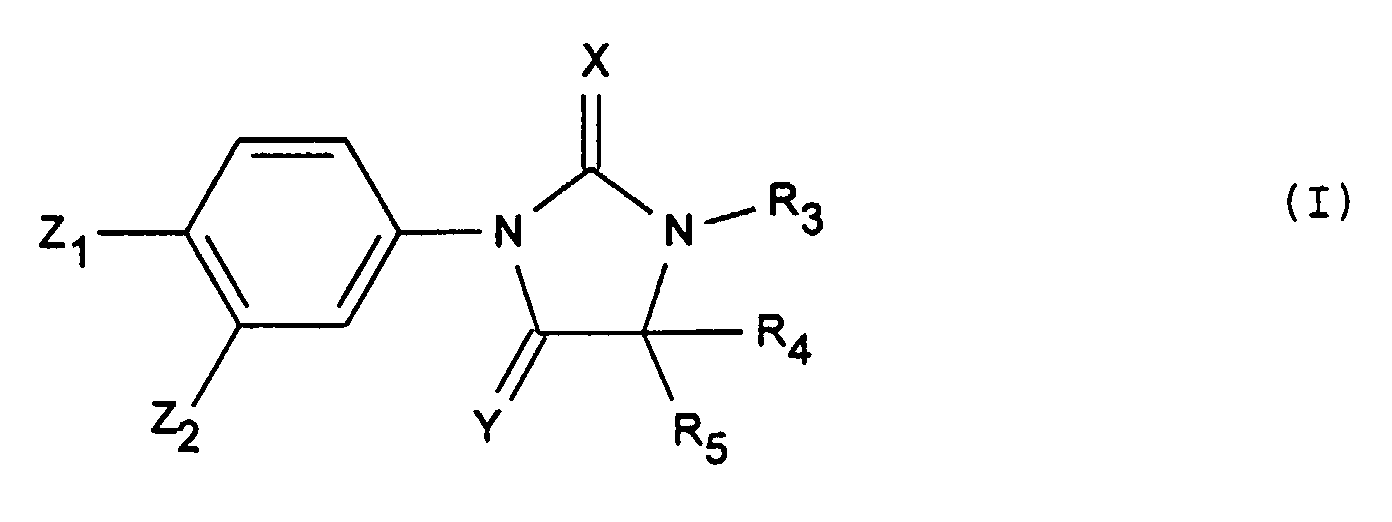
- Les produits de formule générale (I) :dans laquelle :
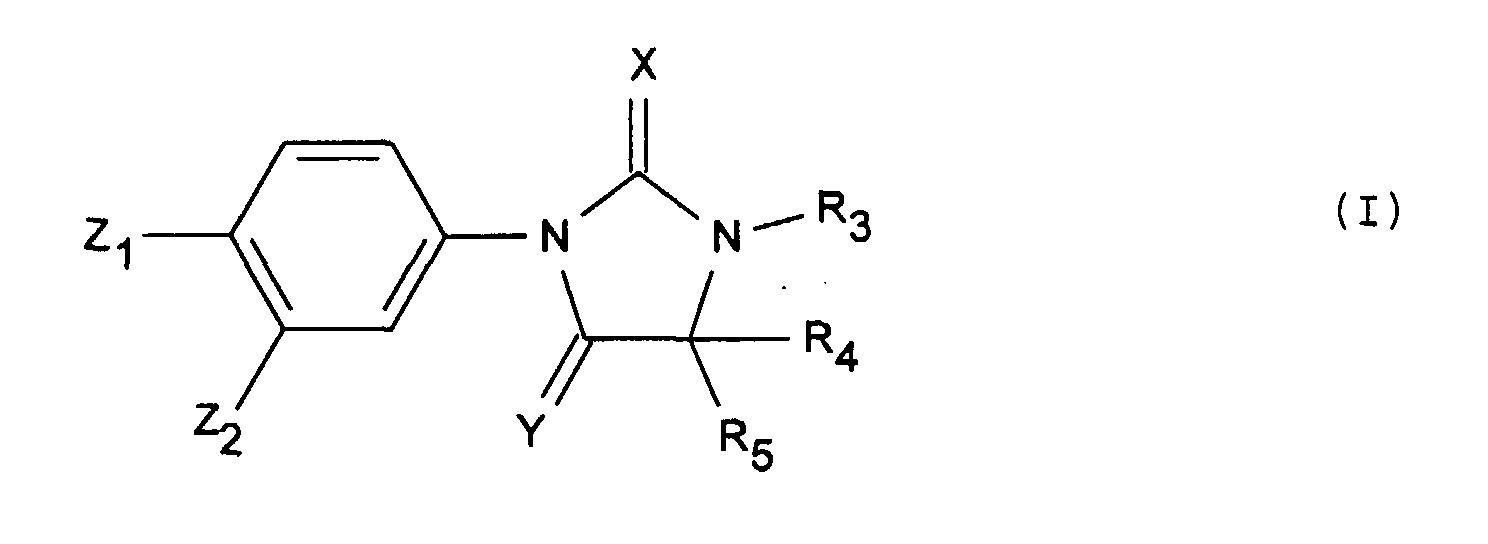 Y représente un atome d'oxygène ou un radical NH, Z2 représente un radical trifluorométhyle et Z1 représente un radical cyano ou nitro,X représente un atome d'oxygène ou de soufre,R3 représente un atome d'hydrogène ou un radical alkyle ayant au plus 4 atomes de carbone, éventuellement substitué par un ou plusieurs radicaux choisis parmi les atomes d'halogène ou le radical cyano,R4 et R5 sont tels que :soit l'un représente méthyle et l'autre est choisi parmi les valeurs de R4 et R5 ci-aprés,soit R4 et R5 identiques ou différents représentent un radical alkyle linéaire ou ramifié renfermant au plus 4 atomes de carbone substitué par un radical hydroxyle éventuellement substitué par un radical phényle, alkyle renfermant au plus 4 atomes de carbone ou acyle renfermant au plus 7 atomes de carbone ; un atome d'halogène ; ou un radical phénylthio éventuellement substitué par un atome d'halogène ou un radical hydroxyle,étant entendu que R4 et R5 ne représentent pas l'un méthyle et l'autre hydroxyméthyle ou tertiobutyloxymethyle lorsque Z1 représente nitro, Z2 représente CF3, R3 représente hydrogène, X représente oxygène et Y représente oxygène ou NH,lesdits produits de formule (I) étant sous toutes les formes isomères racémiques, énantiomères et diastéréoisomères possibles, ainsi que les sels d'addition avec les acides minéraux et organiques ou avec les bases minérales et organiques desdits produits de formule (I).
 - Les produits de formule (I) telle que définie à la revendication 1, dont les noms suivent :lesdits produits de formule (I) étant sous toutes les formes isomères racémiques, énantiomères et diastéréoisomères possibles, ainsi que les sels d'addition avec les acides minéraux et organiques ou avec les bases minérales et organiques desdits produits de formule (I).2-(trifluorométhyl) 4-(4-(hydroxyméthyl) 4-méthyl 2,5-dioxo 1-imidazolidinyl) benzonitrile,4-(3,4-diméthyl) 4-(hydroxyméthyl) 5-oxo 2-thioxo 1-imidazolidinyl) 2-(trifluorométhyl) benzonitrile,2-(trifluorométhyl) 4-(4-(hydroxyméthyl) 3,4-diméthyl 2,5-dioxo 1-imidazolidinyl) benzonitrile,4-(2,5-dioxo 3-(2-fluoroéthyl) 4-(hydroxyméthyl) 4-méthyl 1-imidazolidinyl) 2-(trifluorométhyl) benzonitrile,4-(4,4-bis(hydroxyméthyl)-2,5-dioxo-1-imidazolidinyl)-2-(trifluorométhyl)-benzonitrile,4-(4-(fluorométhyl) 3,4-diméthyl) 2,5-dioxo 1-imidazolidinyl) 2-(trifluorométhyl) benzonitrile,4-(3,4-diméthyl) 4-(fluorométhyl) 5-oxo 2-thioxo 1-imidazolidinyl) 2-(trifluorométhyl) benzonitrile,4-(2,5-dioxo 3-(2-fluoroéthyl) 4-(fluorométhyl) 4-méthyl 1-imidazolidinyl) 2-(trifluorométhyl) benzonitrile,1,5-diméthyl 5-(fluorométhyl) 3-(4-nitro 3-(trifluorométhyl) phényl) 2,4-imidazolidinedione,3-(4-cyano 3-(trifluorométhyl) phényl) 2,4-dioxo 5-(fluorométhyl) 5-méthyl 1-imidazolidinacétonitrile,4-(4,4-bis-(fluorométhyl) 3-méthyl 5-oxo 2-thioxo 1-imidazolidinyl 2-(trifluorométhyl) benzonitrile,
- Procédé de préparation des produits de formule (I), tels que définis à la revendication 1 ou 2,caractérisé en ce que :soit l'on fait agir en présence d'une base tertiaire un produit de formule (II) :dans laquelle Z1, Z2 et X ont la signification indiquée ci-dessus, avec un produit de formule (III) :
 dans laquelle R3,R4 et R5 ont la signification indiquée à la revendication 1 pour obtenir un produit de formule (IV) :
 dans laquelle Z1, Z2, X, R 3, R4 et R5 ont la signification précédente,
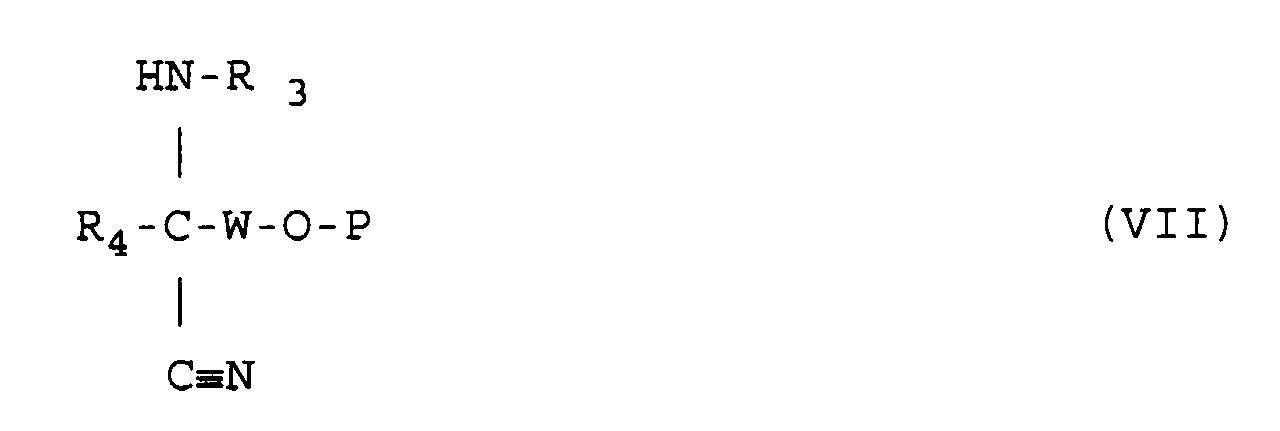
 soit l'on fait agir en présence d'une base tertiaire le produit de formule (II), telle que définie ci-dessus, avec un produit de formule (VII) :dans laquelle W a la signification indiquée ci-dessus pour R5 à l'exception du radical alkyle substitué par un radical hydroxyle libres ou substitué par un radical phényle, alkyle renfermant au plus 4 atomes de carbone, ou acyle renfermant au plus 7 atomes de carbone et P représente un groupement protecteur de OH et R 3 et R4 ont la signification indiquée ci-dessus, pour obtenir un produit de formule (VIII) :
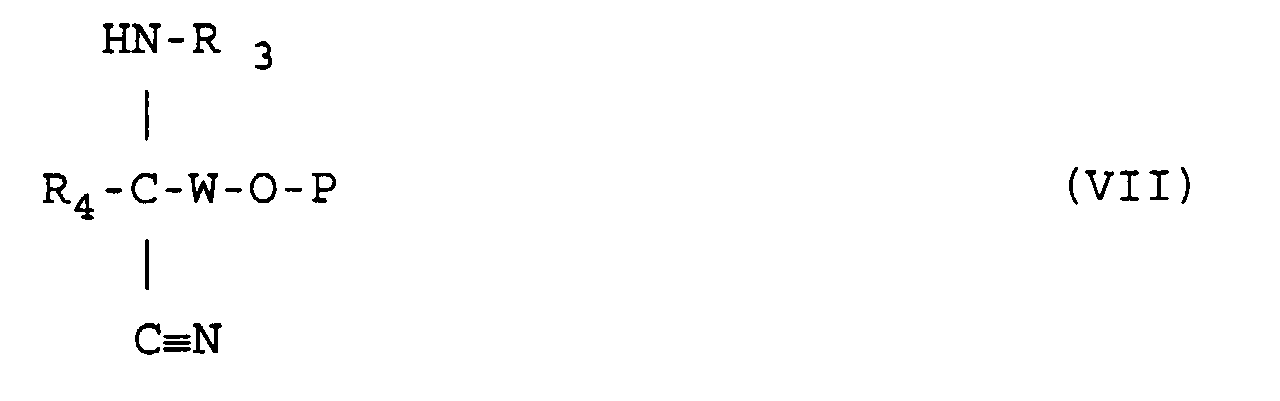 dans laquelle X, Z1, Z2, R 3, R4, W et P ont la signification indiquée ci-dessus,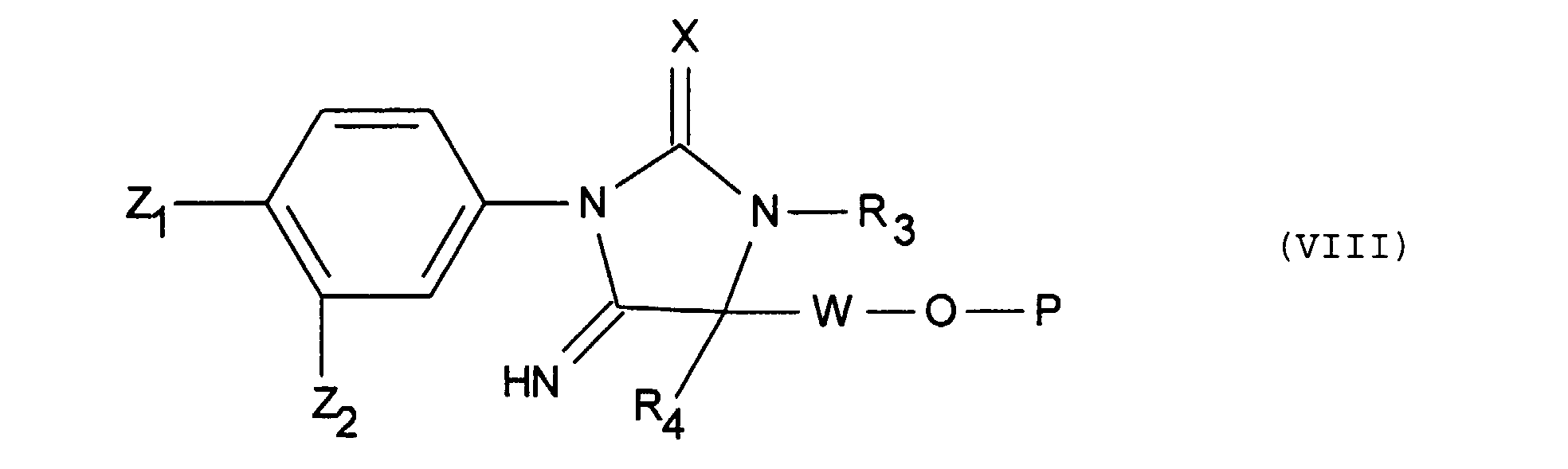
produit de formule (VIII) dont si nécessaire et si désiré, l'on peut libérer de OP le radical OH que l'on peut alors si nécessaire et si désiré, estérifier ou transformer en radical halogène,
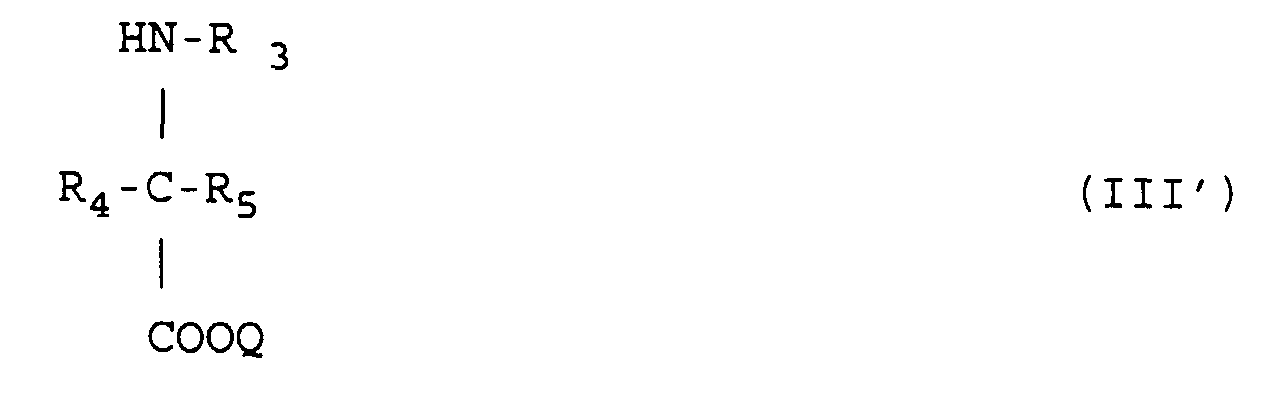
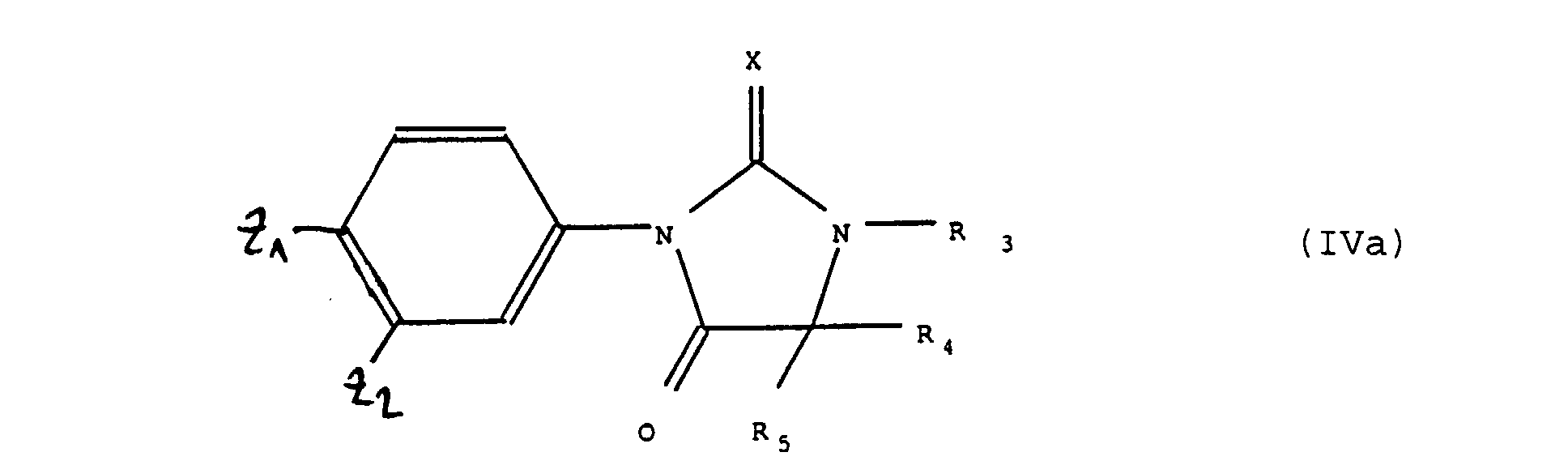
produits de formules (IV) et (VIII) que, si nécessaire ou si désiré l'on soumet à l'une quelconque ou plusieurs des réactions suivantes, dans un ordre quelconque :b) réaction d'hydrolyse du groupement >C=NH en fonction carbonyle et le cas échéant transformation du groupement >C=S en groupement >C=O ;c) réaction de transformation du groupement >C=O en groupement >C=S ;d) action sur les produits de formule (IV) ou (VIII) dans laquelle R 3 représente un atome d'hydrogène, et après hydrolyse du groupement >C=NH en fonction carbonyle d'un réactif de formule Hal-R"3 dans laquelle R"3 a les valeurs de R 3 à l'exception de la valeur hydrogène et Hal représente un atome d'halogène pour obtenir des produits de formule (I), tels que définis à la revendication 1 ou 2,soit l'on fait agir en présence d'une base tertiaire un produit de formule (II) tel que défini ci-dessus, avec un produit de formule (III') :dans laquelle R 3, R4 et R5 ont la signification indiquée ci-dessus et Q représente soit un atome de métal alcalin ou un radical alkyle renfermant de 1 à 6 atomes de carbone, pour obtenir un produit de formule (IVa) : dans laquelle X, Z1, Z2, R 3, R4 et R5 ont la signification indiquée ci-dessus, que si désiré l'on soumet à l'une quelconque ou plusieurs des réactions suivantes, dans un ordre quelconque :
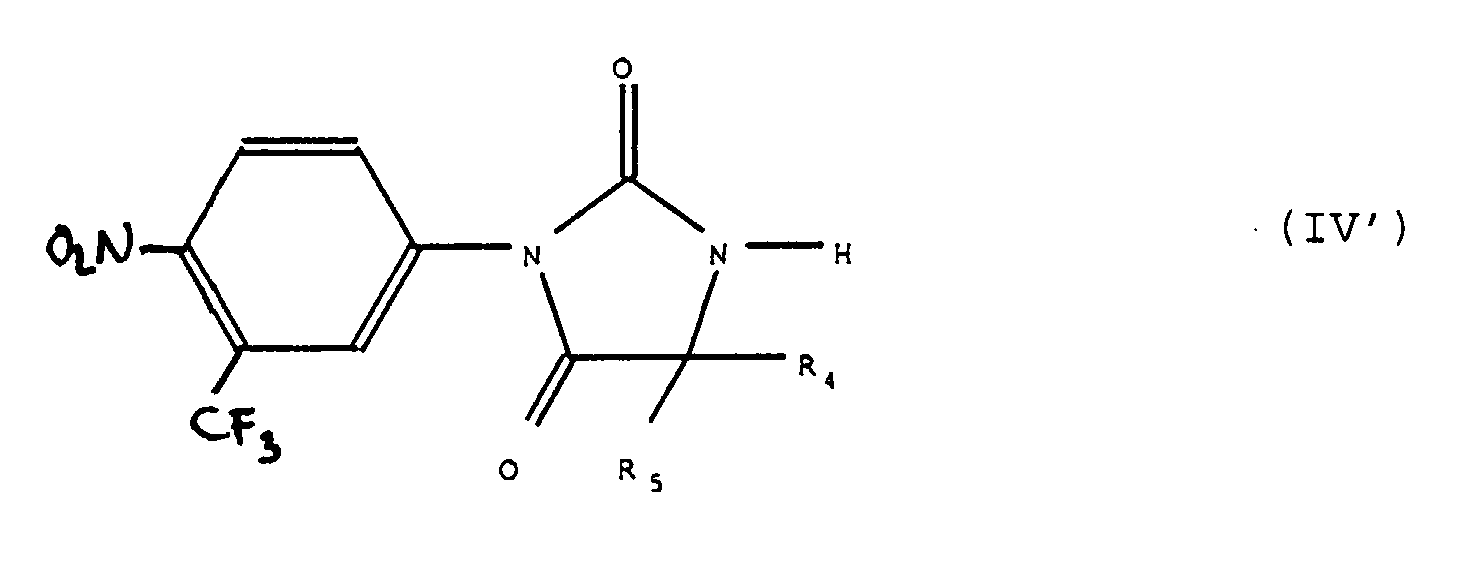
 b) réaction de transformation du groupement >C=O en groupement >C=S ou le cas échéant du groupement >C=S en groupement >C=O ;c) action sur les produits de formule (IVa) dans laquelle R 3 représente un atome d'hydrogène, d'un réactif de formule Hal-R"3 dans laquelle R"3 a les valeurs de R 3 à l'exception de la valeur hydrogène et Hal représente un atome d'halogène pour obtenir des produits de formule (I),tels que définis ci-dessus,soit l'on fait agir un réactif de formule Hal-R"3 dans laquelle Hal et R"3 ont les valeurs indiquées précédemment sur un produit de formule (IV') :pour obtenir un produit de formule (IV") :
 produit de formule (IV") qui représente ou ne représente pas un produit de formule (I) et que, pour obtenir si nécessaire ou si désiré un produit de formule (I), l'on soumet à l'une quelconque ou plusieurs des réactions suivantes dans un ordre quelconque :
b) réaction de transformation du groupement >C=O en groupements >C=S, les dits produits de formule (I) ainsi obtenus étant sous toutes les formes isomères possibles racémiques, énantiomères et diastéréoisomères. - A titre de médicaments, les produits de formule (I) tels que définis à la revendication 1 ou 2, ainsi que leurs sels pharmaceutiquement acceptables.
- Les compositions pharmaceutiques contenant, à titre de principe actif, l'un au moins des médicaments tels que définis à la revendication 4.
Applications Claiming Priority (5)
| Application Number | Priority Date | Filing Date | Title |
|---|---|---|---|
| FR9400042A FR2715402B1 (fr) | 1994-01-05 | 1994-01-05 | Nouvelles phénylimidazolines éventuellement substituées, leur procédé et des intermédiaires de préparation, leur application comme médicaments et les compositions pharmaceutiques les renfermant. |
| FR9400042 | 1994-01-05 | ||
| FR9410660 | 1994-09-06 | ||
| FR9410660A FR2724169B1 (fr) | 1994-09-06 | 1994-09-06 | Nouvelles phenylimidazolidines eventuellement substituees, leur procede et des intermediaires de preparation, leur application comme medicaments et les compositions pharmaceutiques les renfermant |
| PCT/FR1995/000004 WO1995018794A1 (fr) | 1994-01-05 | 1995-01-04 | Nouvelles phenylimidazolidines eventuellement substituees, leur procede et des intermediaires de preparation, leur application comme medicaments et les compositions pharmaceutiques les renfermant |
Publications (2)
| Publication Number | Publication Date |
|---|---|
| EP0738263A1 EP0738263A1 (fr) | 1996-10-23 |
| EP0738263B1 true EP0738263B1 (fr) | 2001-04-04 |
Family
ID=26230882
Family Applications (1)
| Application Number | Title | Priority Date | Filing Date |
|---|---|---|---|
| EP95906361A Expired - Lifetime EP0738263B1 (fr) | 1994-01-05 | 1995-01-04 | Phenylimidazolidines substituees a activite antiandrogene |
Country Status (20)
| Country | Link |
|---|---|
| US (1) | US5750553A (fr) |
| EP (1) | EP0738263B1 (fr) |
| JP (1) | JPH09507241A (fr) |
| KR (1) | KR100372065B1 (fr) |
| CN (1) | CN1113873C (fr) |
| AT (1) | ATE200281T1 (fr) |
| AU (1) | AU687152B2 (fr) |
| BR (1) | BR9506457A (fr) |
| CA (1) | CA2180379A1 (fr) |
| DE (1) | DE69520560T2 (fr) |
| DK (1) | DK0738263T3 (fr) |
| ES (1) | ES2156204T3 (fr) |
| FI (1) | FI112475B (fr) |
| GR (1) | GR3035853T3 (fr) |
| HU (1) | HUT76299A (fr) |
| IL (1) | IL111908A (fr) |
| MA (1) | MA23423A1 (fr) |
| PT (1) | PT738263E (fr) |
| TW (1) | TW521073B (fr) |
| WO (1) | WO1995018794A1 (fr) |
Families Citing this family (56)
| Publication number | Priority date | Publication date | Assignee | Title |
|---|---|---|---|---|
| FR2741342B1 (fr) * | 1995-11-22 | 1998-02-06 | Roussel Uclaf | Nouvelles phenylimidazolidines fluorees ou hydroxylees, procede, intermediaires de preparation, application comme medicaments, nouvelle utilisation et compositions pharmaceutiques |
| FR2742749B1 (fr) * | 1995-12-22 | 1998-02-06 | Roussel Uclaf | Nouvelles phenylimidazolidines comportant notamment un radical nitrooxy ou carbonyloxy, procede et intermediaires de preparation, application comme medicaments, nouvelles utilisations et compositions pharmaceutiques |
| ES2191286T3 (es) * | 1997-03-03 | 2003-09-01 | Boehringer Ingelheim Pharma | Moleculas pequeñas, utiles en el tratamiento de enfermedades inflamatorias. |
| USRE38132E1 (en) | 1997-03-03 | 2003-06-03 | Boehringer Ingelheim Pharmaceuticals, Inc. | Phenylpyrrolidines, phenylimidazolidines,3-phenyl-1,3-oxizolidines and 3-phenyl-1,3-thiazolidines and their use in the treatment of inflammatory disease |
| US6355664B1 (en) | 1997-03-03 | 2002-03-12 | Boehringer Ingelheim Pharmaceuticals, Inc. | Phenylpyrrolidines, phenylimidazolidines, 3-phenyl-1,3-oxizolidines and 3-phenyl-1,3-thiazolidines and their use in the treatment of inflammatory disease |
| IL142598A0 (en) * | 1998-10-23 | 2002-03-10 | Aventis Pharma Gmbh | Preparations for topical application of substances having antiandrogenic effect |
| US6184249B1 (en) * | 1998-12-18 | 2001-02-06 | Biophysica, Inc. | Androgen receptor suppressors in the therapy and diagnosis of prostate cancer, alopecia and other hyper-androgenic syndromes |
| WO2001007052A1 (fr) | 1999-07-21 | 2001-02-01 | Boehringer Ingelheim Pharmaceuticals, Inc. | Petites molecules des plus utiles dans le traitement de maladies inflammatoires |
| US6492408B1 (en) * | 1999-07-21 | 2002-12-10 | Boehringer Ingelheim Pharmaceuticals, Inc. | Small molecules useful in the treatment of inflammatory disease |
| WO2001007044A1 (fr) | 1999-07-21 | 2001-02-01 | Boehringer Ingelheim Pharmaceuticals, Inc. | Petites molecules utiles pour le traitement de maladies inflammatoires |
| JP3833532B2 (ja) | 1999-07-21 | 2006-10-11 | ベーリンガー インゲルハイム ファーマシューティカルズ インコーポレイテッド | 炎症性疾患の治療において有用な小分子 |
| US6828458B2 (en) | 2000-05-25 | 2004-12-07 | Biophysica, Inc. | Topical antiandrogen for hair loss and other hyperandrogenic conditions |
| US7001911B2 (en) * | 2000-06-28 | 2006-02-21 | Bristol-Myers Squibb Company | Fused cyclic modulators of nuclear hormone receptor function |
| US20040077605A1 (en) | 2001-06-20 | 2004-04-22 | Salvati Mark E. | Fused heterocyclic succinimide compounds and analogs thereof, modulators of nuclear hormone receptor function |
| MXPA02012605A (es) | 2000-06-28 | 2003-05-14 | Squibb Bristol Myers Co | Moduladores selectivos del receptor androgeno y metodo para su identificacion, dise°o y uso. |
| US6953679B2 (en) | 2000-09-19 | 2005-10-11 | Bristol-Myers Squibb Company | Method for the preparation of fused heterocyclic succinimide compounds and analogs thereof |
| EP1854798A3 (fr) * | 2000-09-19 | 2007-11-28 | Bristol-Myers Squibb Company | Composés de succinimide hétérocyclique fondu et leurs analogies, modulateurs de la fonction de récepteur d'hormone nucléaire |
| US20040087548A1 (en) | 2001-02-27 | 2004-05-06 | Salvati Mark E. | Fused cyclic succinimide compounds and analogs thereof, modulators of nuclear hormone receptor function |
| DE10141443B4 (de) * | 2001-08-23 | 2007-02-01 | Christos C. Prof. Dr. Zouboulis | Verwendung von molekularbiologisch hergestellten, nicht-viralen Wirkstoffen zur Behandlung der Akne |
| HRP20040311A2 (en) * | 2001-10-01 | 2005-02-28 | Bristol-Myers Squibb Company Cerep SA | Spiro-hydantoin compounds useful as anti-inflammatory agents |
| US7087636B2 (en) | 2001-12-19 | 2006-08-08 | Bristol-Myers Squibb Company | Fused heterocyclic compounds and analogs thereof, modulators of nuclear hormone receptor function |
| US6875438B2 (en) * | 2002-04-27 | 2005-04-05 | Aventis Pharma Deutschland Gmbh | Preparations for topical administration of substances having antiandrogenic activity |
| ATE502298T1 (de) * | 2003-12-19 | 2011-04-15 | Univ California | Verfahren und materialien zur beurteilung von prostatakrebstherapien |
| AU2011202578B2 (en) * | 2004-02-24 | 2012-03-22 | The Regents Of The University Of California | Methods and materials for assessing prostate cancer therapies and compounds |
| NZ550102A (en) * | 2004-02-24 | 2010-10-29 | Univ California | Methods and materials for assessing prostate cancer therapies and compounds (thiohydantoine derivatives) |
| US8470829B2 (en) | 2004-09-09 | 2013-06-25 | Chugai Seiyaku Kabushiki Kaisha | Imidazolidine derivative and use thereof |
| CA2579514A1 (fr) * | 2004-09-10 | 2006-03-23 | Janssen Pharmaceutica N.V. | Derives d'imidazolidine-2-one en tant que modulateurs selectifs du recepteur androgenique |
| TW200616634A (en) * | 2004-10-01 | 2006-06-01 | Bristol Myers Squibb Co | Crystalline forms and process for preparing spiro-hydantoin compounds |
| US20060142319A1 (en) * | 2004-12-14 | 2006-06-29 | Bang-Chi Chen | Pyridyl-substituted spiro-hydantoin crystalline forms and process |
| US7186727B2 (en) * | 2004-12-14 | 2007-03-06 | Bristol-Myers Squibb Company | Pyridyl-substituted spiro-hydantoin compounds and use thereof |
| US7709517B2 (en) * | 2005-05-13 | 2010-05-04 | The Regents Of The University Of California | Diarylhydantoin compounds |
| US7709516B2 (en) | 2005-06-17 | 2010-05-04 | Endorecherche, Inc. | Helix 12 directed non-steroidal antiandrogens |
| SI2656842T1 (sl) | 2006-03-27 | 2016-10-28 | The Regents Of The University Of California | Modulator androgenih receptorjev za zdravljenje raka prostate in bolezni, povezanih z androgenimi receptorji |
| WO2007127010A2 (fr) | 2006-03-29 | 2007-11-08 | The Regents Of The University Of California | Composés de diarylthiohydantoïne |
| GB0610765D0 (en) * | 2006-05-31 | 2006-07-12 | Proskelia Sas | Imidazolidine derivatives, uses therefor, preparation thereof and compositions comprising such |
| US8168667B2 (en) * | 2006-05-31 | 2012-05-01 | Galapagos Nv | Imidazolidine derivatives, uses therefor, preparation thereof and compositions comprising such |
| US9284345B2 (en) | 2007-04-12 | 2016-03-15 | Endorecherche, Inc. | 17alpha-substituted steroids as systemic antiandrogens and selective androgen receptor modulators |
| EP2620432A3 (fr) | 2007-10-26 | 2013-12-18 | The Regents Of the University of California | Composés de diarylhydantoïne |
| MX2010004995A (es) * | 2007-11-29 | 2010-05-20 | Boehringer Ingelheim Int | Derivados de amidas del acido 6,7-dihidro-5h-imidazo[1,2-a]imidazo l-3-carboxilico. |
| GB2463514C (en) * | 2008-09-11 | 2018-09-26 | Galapagos Nv | Imidazolidine compounds and uses therefor |
| FR2944524B1 (fr) * | 2009-04-17 | 2012-11-30 | Ipsen Pharma Sas | Derives d'imidazolidine-2,4-dione et leur utilisation comme medicament |
| WO2010141330A1 (fr) | 2009-06-02 | 2010-12-09 | Boehringer Ingelheim International Gmbh | Dérivés d'amides d'acide 6,7-dihydro-5h-imidazo [1,2-a] imidazole-3-carboxylique |
| BRPI1012581A2 (pt) | 2009-06-02 | 2016-03-29 | Boehringer Ingelheim Int | derivados de amidas de ácido 6, 7-di-hidro-5h-imidazol[1,2-a]imidazol-3-carboxílico |
| RU2012114770A (ru) | 2009-09-04 | 2013-10-10 | Вандербилт Юниверсити | АЛЛОСТЕРИЧЕСКИЕ СРЕДСТВА ПОТЕНЦИРОВАНИЯ mGluR4, КОМПОЗИЦИИ И СПОСОБЫ ЛЕЧЕНИЯ НЕВРОЛОГИЧЕСКИХ ДИСФУНКЦИЙ |
| US8809550B2 (en) | 2009-09-10 | 2014-08-19 | Youzhi Tong | Androgen receptor antagonists and uses thereof |
| TW201111378A (en) | 2009-09-11 | 2011-04-01 | Bayer Schering Pharma Ag | Substituted (heteroarylmethyl) thiohydantoins |
| AU2011218173C1 (en) | 2010-02-16 | 2015-04-16 | Aragon Pharmaceuticals, Inc. | Androgen receptor modulators and uses thereof |
| RU2434851C1 (ru) * | 2010-07-22 | 2011-11-27 | Александр Васильевич Иващенко | Циклические n, n'-диарилтиомочевины или n, n'-диарилмочевины - антагонисты андрогенных рецепторов, противораковое средство, способ получения и применения |
| EP2683694B1 (fr) | 2011-03-10 | 2016-04-27 | Suzhou Kintor Pharmaceuticals, Inc. | Antagonistes des récepteurs d'androgènes et leurs utilisations |
| UY34646A (es) | 2012-03-02 | 2013-10-31 | Novartis Ag | Compuestos de espirohidantoína y su uso como moduladores selectivos del receptor de andrógenos |
| NZ744456A (en) | 2012-09-26 | 2019-09-27 | Aragon Pharmaceuticals Inc | Anti-androgens for the treatment of non-metastatic castrate-resistant prostate cancer |
| PL2945628T3 (pl) | 2013-01-15 | 2020-09-21 | Aragon Pharmaceuticals, Inc. | Modulator receptorów androgenowych w skojarzeniu z octanem abirateronu i prednizonem do leczenia nowotworu stercza |
| US9682960B2 (en) | 2013-12-19 | 2017-06-20 | Endorecherche, Inc. | Non-steroidal antiandrogens and selective androgen receptor modulators with a pyridyl moiety |
| TWI726969B (zh) | 2016-01-11 | 2021-05-11 | 比利時商健生藥品公司 | 用作雄性激素受體拮抗劑之經取代之硫尿囊素衍生物 |
| US10702508B2 (en) | 2017-10-16 | 2020-07-07 | Aragon Pharmaceuticals, Inc. | Anti-androgens for the treatment of non-metastatic castration-resistant prostate cancer |
| US11981660B2 (en) | 2018-03-21 | 2024-05-14 | University Of Miami | Neurite outgrowth promoters and uses thereof |
Family Cites Families (21)
| Publication number | Priority date | Publication date | Assignee | Title |
|---|---|---|---|---|
| DE1032258B (de) * | 1956-12-20 | 1958-06-19 | Kali Chemie Ag | Verfahren zur Herstellung von in 5-Stellung mono- und disubstituierten 1-Aryl-hydantoinen |
| GB997037A (en) * | 1962-03-19 | 1965-06-30 | Ici Ltd | New hydrantoin derivatives |
| DK123717B (da) * | 1968-11-25 | 1972-07-24 | Sumitomo Chemical Co | 3-(3',5'-Dihalogenphenyl)-imidazolidin-2,4-dionderivater med mirobicid virkning. |
| JPS5136332B1 (fr) * | 1970-12-09 | 1976-10-07 | ||
| US4093444A (en) * | 1973-05-22 | 1978-06-06 | Pepro, Societe Pour Le Developpement Et La Vente De Specialites Chimiques | Hydantoin derivatives and methods for regulating plant-growth |
| FR2329276A1 (fr) * | 1975-10-29 | 1977-05-27 | Roussel Uclaf | Nouvelles imidazolidines substituees, procede de preparation, application comme medicament et compositions les renfermant |
| DE2540872A1 (de) * | 1975-09-13 | 1977-03-24 | Basf Ag | Hydantoin-derivate |
| JPS52113965A (en) * | 1976-03-22 | 1977-09-24 | Nippon Soda Co Ltd | Hydantoin derivatives, their preparation, fungicides for agriculture a nd gardening use containing the same |
| JPS53112875A (en) * | 1977-03-15 | 1978-10-02 | Sumitomo Chem Co Ltd | 1-chlorocarbonylmethyl-3-(3,5-dichlorophenyl)hydantoin, its preparation and industrial bactericide containing the same |
| JPS53124267A (en) * | 1977-04-06 | 1978-10-30 | Sumitomo Chem Co Ltd | 1-alkoxyacyl-3-(3,5-dihalogenophenyl)hydantoin derivatives, their preparation and bactericides for agricultural and horticultural uses containing the same as active agent |
| JPS5427564A (en) * | 1977-08-02 | 1979-03-01 | Sumitomo Chem Co Ltd | 1-branched alkylcarbonyl-3-(3,5-dihalogenophenyl) hydantoins, their preparation, and bactericides for pomicultural and horticultural uses containing the same as active agent. |
| MC1220A1 (fr) * | 1977-10-28 | 1979-07-20 | Hoffmann La Roche | Nouveaux derives d'imidazolidine |
| FI801184A7 (fi) * | 1979-04-24 | 1981-01-01 | F Hoffmann La Roche & Co | Menetelmä imidatsolidiini-johdannaisten valmistamiseksi. |
| BE884897R (fr) * | 1980-08-22 | 1981-02-23 | Hoffmann La Roche | Preparations pharmaceutiques |
| US4753957A (en) * | 1981-09-28 | 1988-06-28 | Rohm And Haas Company | Substituted 2,4-imidazolidinediones and fungicidal compositions |
| EP0091596B1 (fr) * | 1982-04-08 | 1991-09-11 | Shell Internationale Researchmaatschappij B.V. | Hydantoins, préparation et application |
| FR2619381B1 (fr) * | 1987-08-13 | 1989-12-08 | Roussel Uclaf | Nouvelles imidazolidines substituees par un radical hydroxymethyle et un radical phenyl substitue, leur procede de preparation, leur application comme medicaments, les compositions pharmaceutiques les renfermant et un intermediaire pour leur preparation |
| FR2671348B1 (fr) * | 1991-01-09 | 1993-03-26 | Roussel Uclaf | Nouvelles phenylimidazolidines, leur procede de preparation, leur application comme medicaments et les compositions pharmaceutiques les renfermant. |
| US5411981A (en) * | 1991-01-09 | 1995-05-02 | Roussel Uclaf | Phenylimidazolidines having antiandrogenic activity |
| FR2693461B1 (fr) * | 1992-07-08 | 1994-09-02 | Roussel Uclaf | Nouvelles phénylimidazolidines substituées, leur procédé de préparation, leur application comme médicaments et les compositions pharmaceutiques les renfermant. |
| FR2694290B1 (fr) * | 1992-07-08 | 1994-09-02 | Roussel Uclaf | Nouvelles phénylimidazolidines éventuellement substituées, leur procédé de préparation, leur application comme médicaments et les compositions pharmaceutiques les renfermant. |
-
1994
- 1994-12-05 TW TW083111272A patent/TW521073B/zh not_active IP Right Cessation
- 1994-12-07 IL IL11190894A patent/IL111908A/xx not_active IP Right Cessation
-
1995
- 1995-01-03 MA MA23750A patent/MA23423A1/fr unknown
- 1995-01-04 PT PT95906361T patent/PT738263E/pt unknown
- 1995-01-04 KR KR1019960703612A patent/KR100372065B1/ko not_active Expired - Fee Related
- 1995-01-04 US US08/669,419 patent/US5750553A/en not_active Expired - Fee Related
- 1995-01-04 WO PCT/FR1995/000004 patent/WO1995018794A1/fr not_active Ceased
- 1995-01-04 AT AT95906361T patent/ATE200281T1/de not_active IP Right Cessation
- 1995-01-04 ES ES95906361T patent/ES2156204T3/es not_active Expired - Lifetime
- 1995-01-04 EP EP95906361A patent/EP0738263B1/fr not_active Expired - Lifetime
- 1995-01-04 CA CA002180379A patent/CA2180379A1/fr not_active Abandoned
- 1995-01-04 HU HU9601836A patent/HUT76299A/hu unknown
- 1995-01-04 DK DK95906361T patent/DK0738263T3/da active
- 1995-01-04 JP JP7518337A patent/JPH09507241A/ja active Pending
- 1995-01-04 BR BR9506457A patent/BR9506457A/pt not_active IP Right Cessation
- 1995-01-04 AU AU14573/95A patent/AU687152B2/en not_active Ceased
- 1995-01-04 DE DE69520560T patent/DE69520560T2/de not_active Expired - Fee Related
- 1995-01-04 CN CN95191761A patent/CN1113873C/zh not_active Expired - Fee Related
-
1996
- 1996-07-04 FI FI962754A patent/FI112475B/fi not_active IP Right Cessation
-
2001
- 2001-05-11 GR GR20010400704T patent/GR3035853T3/el not_active IP Right Cessation
Also Published As
| Publication number | Publication date |
|---|---|
| AU1457395A (en) | 1995-08-01 |
| DE69520560T2 (de) | 2001-09-13 |
| HUT76299A (en) | 1997-07-28 |
| DK0738263T3 (da) | 2001-06-18 |
| EP0738263A1 (fr) | 1996-10-23 |
| HU9601836D0 (en) | 1996-09-30 |
| ES2156204T3 (es) | 2001-06-16 |
| IL111908A0 (en) | 1995-03-15 |
| US5750553A (en) | 1998-05-12 |
| WO1995018794A1 (fr) | 1995-07-13 |
| FI112475B (fi) | 2003-12-15 |
| AU687152B2 (en) | 1998-02-19 |
| IL111908A (en) | 2003-05-29 |
| CN1141631A (zh) | 1997-01-29 |
| CA2180379A1 (fr) | 1995-07-13 |
| DE69520560D1 (de) | 2001-05-10 |
| KR100372065B1 (ko) | 2003-05-12 |
| GR3035853T3 (en) | 2001-08-31 |
| MA23423A1 (fr) | 1995-10-01 |
| TW521073B (en) | 2003-02-21 |
| FI962754L (fi) | 1996-07-04 |
| PT738263E (pt) | 2001-08-30 |
| CN1113873C (zh) | 2003-07-09 |
| ATE200281T1 (de) | 2001-04-15 |
| JPH09507241A (ja) | 1997-07-22 |
| BR9506457A (pt) | 1997-10-07 |
| FI962754A0 (fi) | 1996-07-04 |
Similar Documents
| Publication | Publication Date | Title |
|---|---|---|
| EP0738263B1 (fr) | Phenylimidazolidines substituees a activite antiandrogene | |
| EP0494819B1 (fr) | Nouvelles phénylimidazolidines, leur procédé de préparation, leur application comme médicaments et les compositions pharmaceutiques les renfermant | |
| EP0580459B1 (fr) | Phénylimidazolidines substituées, leur application comme médicaments et les compositions pharmaceutiques les renfermant | |
| FR2694290A1 (fr) | Nouvelles phénylimidazolidines éventuellement substituées, leur procédé de préparation, leur application comme médicaments et les compositions pharmaceutiques les renfermant. | |
| EP0704448B1 (fr) | Nouvelles imidazolidines substituées par un hétérocycle, leur procédé et des intermédiaires de préparation, leur application comme médicaments et les compositions pharmaceutiques les renfermant | |
| CA1304093C (fr) | Imidazolidines substituees par un radical hydroxymethyle et un radical phenyle substitue, leur procede de preparation, leur application comme medicaments, lescompositions pharmaceutiques les renfermant et un intermediaire pour leur preparation | |
| EP0869946B1 (fr) | Phenylimidazolidines et leur utilisation comme agent anti-androgene | |
| EP0070767B1 (fr) | Nouveaux dérivés de la quinoléine, leurs sels, leur préparation, leur application comme médicaments et les compositions les renfermant | |
| EP0862559A1 (fr) | Nouvelles phenylimidazolidines fluorees ou hydroxylees ayant une activite anti-androgenique, leur procede de preparation, intermediaires obtenus et compositions pharmaceutiques | |
| FR2715402A1 (fr) | Nouvelles phénylimidazolines éventuellement substituées, leur procédé et des intermédiaires de préparation, leur application comme médicaments et les compositions pharmaceutiques les renfermant. | |
| EP0606024A1 (fr) | Nouveaux dérivés de l'érythromycine, leur procédé de préparation et leur application comme médicaments | |
| EP0117771B1 (fr) | Imino-2 pyrrolidines, leur procédé de préparation et leurs applications en thérapeutique | |
| CH649994A5 (fr) | Derives du 4h-1,2,4-triazole, procedes de preparation et compositions les renfermant. | |
| EP0136198B1 (fr) | Dérivés de triazolo pyrimidine, leur procédé de préparation et leur application thérapeutique en tant que toni-cardiaques | |
| EP0021924B1 (fr) | Dérivés de l'indole, procédé pour leur préparation, leur application comme médicaments et compositions pharmaceutiques les contenant | |
| CH630382A5 (fr) | Pyrroloquinoxalines et leurs sels. | |
| EP0231709A2 (fr) | Nouvelles phényl-naphtyridines fonctionnalisées en position-3, leur procédé de préparation, médicaments les contenant, notamment anti-ulcères | |
| EP0652214A1 (fr) | Nouveaux dérivés N-aryl 2-cyano 3-hydroxy propénamides, leur procédé de préparation, leur application comme médicaments et les compositions pharmaceutiques les renfermant | |
| EP0176444B1 (fr) | Nouveau procédé de préparation de dérivés du 4 H-1,2-4-triazole, nouveaux triazoles ainsi obtenus, leur applicication comme médicaments et les compositions pharmaceutiques les renfermant | |
| EP0502110B1 (fr) | Derives d'(hetero) arylmethyloxy-4 phenyl diazole, leur procede de preparation et leur application en therapeutique | |
| CA1286318C (fr) | Derive de cyanoguanidine, et sa preparation | |
| FR2724169A1 (fr) | Nouvelles phenylimidazolidines eventuellement substituees, leur procede et des intermediaires de preparation, leur application comme medicaments et les compositions pharmaceutiques les renfermant | |
| EP0233801B1 (fr) | Nouveaux amides substitués, leur préparation et les compositions pharmaceutiques qui les contiennent | |
| EP0412014A1 (fr) | Dérivés benzothiaziniques, leur préparation et leurs applications comme médicaments ou comme intermédiaires de synthèse de médicaments | |
| CH636350A5 (fr) | Derives de l'acide 2-/(4-quinoleinyl) amino/ 5-fluorobenzoique, leurs procedes de preparation et les compositions pharmaceutiques les renfermant. |
Legal Events
| Date | Code | Title | Description |
|---|---|---|---|
| PUAI | Public reference made under article 153(3) epc to a published international application that has entered the european phase |
Free format text: ORIGINAL CODE: 0009012 |
|
| 17P | Request for examination filed |
Effective date: 19960805 |
|
| AK | Designated contracting states |
Kind code of ref document: A1 Designated state(s): AT BE CH DE DK ES FR GB GR IE IT LI LU MC NL PT SE |
|
| 17Q | First examination report despatched |
Effective date: 19971215 |
|
| RAP1 | Party data changed (applicant data changed or rights of an application transferred) |
Owner name: HOECHST MARION ROUSSEL |
|
| GRAG | Despatch of communication of intention to grant |
Free format text: ORIGINAL CODE: EPIDOS AGRA |
|
| RTI1 | Title (correction) |
Free format text: SUBSTITUTED PHENYLIMIDAZOLIDINES HAVING ANTIANDROGEN ACTIVITY |
|
| GRAG | Despatch of communication of intention to grant |
Free format text: ORIGINAL CODE: EPIDOS AGRA |
|
| GRAH | Despatch of communication of intention to grant a patent |
Free format text: ORIGINAL CODE: EPIDOS IGRA |
|
| GRAH | Despatch of communication of intention to grant a patent |
Free format text: ORIGINAL CODE: EPIDOS IGRA |
|
| GRAA | (expected) grant |
Free format text: ORIGINAL CODE: 0009210 |
|
| AK | Designated contracting states |
Kind code of ref document: B1 Designated state(s): AT BE CH DE DK ES FR GB GR IE IT LI LU MC NL PT SE |
|
| RAP1 | Party data changed (applicant data changed or rights of an application transferred) |
Owner name: AVENTIS PHARMA S.A. |
|
| REF | Corresponds to: |
Ref document number: 200281 Country of ref document: AT Date of ref document: 20010415 Kind code of ref document: T |
|
| REG | Reference to a national code |
Ref country code: CH Ref legal event code: EP |
|
| REG | Reference to a national code |
Ref country code: IE Ref legal event code: FG4D Free format text: FRENCH |
|
| ITF | It: translation for a ep patent filed | ||
| REF | Corresponds to: |
Ref document number: 69520560 Country of ref document: DE Date of ref document: 20010510 |
|
| GBT | Gb: translation of ep patent filed (gb section 77(6)(a)/1977) |
Effective date: 20010504 |
|
| REG | Reference to a national code |
Ref country code: ES Ref legal event code: FG2A Ref document number: 2156204 Country of ref document: ES Kind code of ref document: T3 |
|
| REG | Reference to a national code |
Ref country code: DK Ref legal event code: T3 |
|
| REG | Reference to a national code |
Ref country code: CH Ref legal event code: NV Representative=s name: A. BRAUN, BRAUN, HERITIER, ESCHMANN AG PATENTANWAE |
|
| REG | Reference to a national code |
Ref country code: GB Ref legal event code: IF02 |
|
| PLBE | No opposition filed within time limit |
Free format text: ORIGINAL CODE: 0009261 |
|
| STAA | Information on the status of an ep patent application or granted ep patent |
Free format text: STATUS: NO OPPOSITION FILED WITHIN TIME LIMIT |
|
| 26N | No opposition filed | ||
| PGFP | Annual fee paid to national office [announced via postgrant information from national office to epo] |
Ref country code: MC Payment date: 20051220 Year of fee payment: 12 |
|
| PGFP | Annual fee paid to national office [announced via postgrant information from national office to epo] |
Ref country code: NL Payment date: 20051222 Year of fee payment: 12 Ref country code: DK Payment date: 20051222 Year of fee payment: 12 Ref country code: BE Payment date: 20051222 Year of fee payment: 12 Ref country code: AT Payment date: 20051222 Year of fee payment: 12 |
|
| PGFP | Annual fee paid to national office [announced via postgrant information from national office to epo] |
Ref country code: PT Payment date: 20051227 Year of fee payment: 12 Ref country code: GR Payment date: 20051227 Year of fee payment: 12 |
|
| PGFP | Annual fee paid to national office [announced via postgrant information from national office to epo] |
Ref country code: SE Payment date: 20051228 Year of fee payment: 12 |
|
| PGFP | Annual fee paid to national office [announced via postgrant information from national office to epo] |
Ref country code: IE Payment date: 20051230 Year of fee payment: 12 |
|
| PGFP | Annual fee paid to national office [announced via postgrant information from national office to epo] |
Ref country code: LU Payment date: 20060102 Year of fee payment: 12 |
|
| PG25 | Lapsed in a contracting state [announced via postgrant information from national office to epo] |
Ref country code: IE Free format text: LAPSE BECAUSE OF NON-PAYMENT OF DUE FEES Effective date: 20070104 |
|
| PG25 | Lapsed in a contracting state [announced via postgrant information from national office to epo] |
Ref country code: SE Free format text: LAPSE BECAUSE OF NON-PAYMENT OF DUE FEES Effective date: 20070105 |
|
| PG25 | Lapsed in a contracting state [announced via postgrant information from national office to epo] |
Ref country code: MC Free format text: LAPSE BECAUSE OF NON-PAYMENT OF DUE FEES Effective date: 20070131 |
|
| PG25 | Lapsed in a contracting state [announced via postgrant information from national office to epo] |
Ref country code: PT Free format text: LAPSE BECAUSE OF NON-PAYMENT OF DUE FEES Effective date: 20070704 |
|
| REG | Reference to a national code |
Ref country code: PT Ref legal event code: MM4A Free format text: LAPSE DUE TO NON-PAYMENT OF FEES Effective date: 20070704 |
|
| EUG | Se: european patent has lapsed | ||
| NLV4 | Nl: lapsed or anulled due to non-payment of the annual fee |
Effective date: 20070801 |
|
| REG | Reference to a national code |
Ref country code: DK Ref legal event code: EBP |
|
| REG | Reference to a national code |
Ref country code: IE Ref legal event code: MM4A |
|
| PG25 | Lapsed in a contracting state [announced via postgrant information from national office to epo] |
Ref country code: AT Free format text: LAPSE BECAUSE OF NON-PAYMENT OF DUE FEES Effective date: 20070104 |
|
| BERE | Be: lapsed |
Owner name: S.A. *AVENTIS PHARMA Effective date: 20070131 |
|
| PG25 | Lapsed in a contracting state [announced via postgrant information from national office to epo] |
Ref country code: BE Free format text: LAPSE BECAUSE OF NON-PAYMENT OF DUE FEES Effective date: 20070131 |
|
| PG25 | Lapsed in a contracting state [announced via postgrant information from national office to epo] |
Ref country code: NL Free format text: LAPSE BECAUSE OF NON-PAYMENT OF DUE FEES Effective date: 20070801 Ref country code: DK Free format text: LAPSE BECAUSE OF NON-PAYMENT OF DUE FEES Effective date: 20070131 |
|
| REG | Reference to a national code |
Ref country code: CH Ref legal event code: PFA Owner name: AVENTIS PHARMA S.A. Free format text: AVENTIS PHARMA S.A.#20, AVENUE RAYMOND ARON#92160 ANTONY (FR) -TRANSFER TO- AVENTIS PHARMA S.A.#20, AVENUE RAYMOND ARON#92160 ANTONY (FR) |
|
| PG25 | Lapsed in a contracting state [announced via postgrant information from national office to epo] |
Ref country code: GR Free format text: LAPSE BECAUSE OF NON-PAYMENT OF DUE FEES Effective date: 20070802 |
|
| PGFP | Annual fee paid to national office [announced via postgrant information from national office to epo] |
Ref country code: ES Payment date: 20090218 Year of fee payment: 15 |
|
| PGFP | Annual fee paid to national office [announced via postgrant information from national office to epo] |
Ref country code: DE Payment date: 20090102 Year of fee payment: 15 |
|
| PGFP | Annual fee paid to national office [announced via postgrant information from national office to epo] |
Ref country code: GB Payment date: 20081231 Year of fee payment: 15 Ref country code: CH Payment date: 20090114 Year of fee payment: 15 |
|
| PG25 | Lapsed in a contracting state [announced via postgrant information from national office to epo] |
Ref country code: LU Free format text: LAPSE BECAUSE OF NON-PAYMENT OF DUE FEES Effective date: 20070104 |
|
| PGFP | Annual fee paid to national office [announced via postgrant information from national office to epo] |
Ref country code: IT Payment date: 20090128 Year of fee payment: 15 |
|
| PGFP | Annual fee paid to national office [announced via postgrant information from national office to epo] |
Ref country code: FR Payment date: 20090113 Year of fee payment: 15 |
|
| REG | Reference to a national code |
Ref country code: CH Ref legal event code: PL |
|
| GBPC | Gb: european patent ceased through non-payment of renewal fee |
Effective date: 20100104 |
|
| REG | Reference to a national code |
Ref country code: FR Ref legal event code: ST Effective date: 20100930 |
|
| PG25 | Lapsed in a contracting state [announced via postgrant information from national office to epo] |
Ref country code: LI Free format text: LAPSE BECAUSE OF NON-PAYMENT OF DUE FEES Effective date: 20100131 Ref country code: FR Free format text: LAPSE BECAUSE OF NON-PAYMENT OF DUE FEES Effective date: 20100201 Ref country code: CH Free format text: LAPSE BECAUSE OF NON-PAYMENT OF DUE FEES Effective date: 20100131 |
|
| PG25 | Lapsed in a contracting state [announced via postgrant information from national office to epo] |
Ref country code: DE Free format text: LAPSE BECAUSE OF NON-PAYMENT OF DUE FEES Effective date: 20100803 |
|
| PG25 | Lapsed in a contracting state [announced via postgrant information from national office to epo] |
Ref country code: GB Free format text: LAPSE BECAUSE OF NON-PAYMENT OF DUE FEES Effective date: 20100104 |
|
| REG | Reference to a national code |
Ref country code: ES Ref legal event code: FD2A Effective date: 20110224 |
|
| PG25 | Lapsed in a contracting state [announced via postgrant information from national office to epo] |
Ref country code: IT Free format text: LAPSE BECAUSE OF NON-PAYMENT OF DUE FEES Effective date: 20100104 |
|
| PG25 | Lapsed in a contracting state [announced via postgrant information from national office to epo] |
Ref country code: ES Free format text: LAPSE BECAUSE OF NON-PAYMENT OF DUE FEES Effective date: 20110223 |
|
| PG25 | Lapsed in a contracting state [announced via postgrant information from national office to epo] |
Ref country code: ES Free format text: LAPSE BECAUSE OF NON-PAYMENT OF DUE FEES Effective date: 20100105 |