EP0733689A1 - Chloroprene rubber adhesive composition - Google Patents
Chloroprene rubber adhesive composition Download PDFInfo
- Publication number
- EP0733689A1 EP0733689A1 EP96104358A EP96104358A EP0733689A1 EP 0733689 A1 EP0733689 A1 EP 0733689A1 EP 96104358 A EP96104358 A EP 96104358A EP 96104358 A EP96104358 A EP 96104358A EP 0733689 A1 EP0733689 A1 EP 0733689A1
- Authority
- EP
- European Patent Office
- Prior art keywords
- group
- adhesive composition
- sulfonium
- set forth
- epoxy resin
- Prior art date
- Legal status (The legal status is an assumption and is not a legal conclusion. Google has not performed a legal analysis and makes no representation as to the accuracy of the status listed.)
- Granted
Links
- 230000001070 adhesive effect Effects 0.000 title claims abstract description 121
- 239000000853 adhesive Substances 0.000 title claims abstract description 113
- 239000000203 mixture Substances 0.000 title claims abstract description 85
- 229920001084 poly(chloroprene) Polymers 0.000 title claims abstract description 22
- -1 ketimine compound Chemical class 0.000 claims abstract description 108
- 239000003822 epoxy resin Substances 0.000 claims abstract description 52
- 229920000647 polyepoxide Polymers 0.000 claims abstract description 52
- 239000003795 chemical substances by application Substances 0.000 claims abstract description 48
- 229920000098 polyolefin Polymers 0.000 claims abstract description 37
- 229920005989 resin Polymers 0.000 claims abstract description 26
- 239000011347 resin Substances 0.000 claims abstract description 26
- RAXXELZNTBOGNW-UHFFFAOYSA-N imidazole Natural products C1=CNC=N1 RAXXELZNTBOGNW-UHFFFAOYSA-N 0.000 claims abstract description 25
- 229910000077 silane Inorganic materials 0.000 claims abstract description 24
- 239000002904 solvent Substances 0.000 claims abstract description 21
- 125000004432 carbon atom Chemical group C* 0.000 claims abstract description 16
- 150000001875 compounds Chemical class 0.000 claims abstract description 11
- 150000004658 ketimines Chemical class 0.000 claims abstract description 10
- 125000001997 phenyl group Chemical group [H]C1=C([H])C([H])=C(*)C([H])=C1[H] 0.000 claims abstract description 10
- 125000000217 alkyl group Chemical group 0.000 claims abstract description 9
- 150000002460 imidazoles Chemical class 0.000 claims abstract description 7
- IAYPIBMASNFSPL-UHFFFAOYSA-N Ethylene oxide Chemical group C1CO1 IAYPIBMASNFSPL-UHFFFAOYSA-N 0.000 claims abstract description 6
- 125000003545 alkoxy group Chemical group 0.000 claims abstract description 6
- 125000003700 epoxy group Chemical group 0.000 claims abstract description 6
- 125000002887 hydroxy group Chemical group [H]O* 0.000 claims abstract description 6
- 150000004010 onium ions Chemical class 0.000 claims abstract description 6
- 125000000391 vinyl group Chemical group [H]C([*])=C([H])[H] 0.000 claims abstract description 5
- 125000002947 alkylene group Chemical group 0.000 claims abstract description 4
- QGBSISYHAICWAH-UHFFFAOYSA-N dicyandiamide Chemical group NC(N)=NC#N QGBSISYHAICWAH-UHFFFAOYSA-N 0.000 claims abstract description 4
- 239000004743 Polypropylene Substances 0.000 claims description 16
- YXFVVABEGXRONW-UHFFFAOYSA-N Toluene Chemical compound CC1=CC=CC=C1 YXFVVABEGXRONW-UHFFFAOYSA-N 0.000 claims description 15
- 229920001155 polypropylene Polymers 0.000 claims description 15
- RWSOTUBLDIXVET-UHFFFAOYSA-O sulfonium Chemical compound [SH3+] RWSOTUBLDIXVET-UHFFFAOYSA-O 0.000 claims description 12
- CSCPPACGZOOCGX-UHFFFAOYSA-N Acetone Chemical compound CC(C)=O CSCPPACGZOOCGX-UHFFFAOYSA-N 0.000 claims description 10
- XEKOWRVHYACXOJ-UHFFFAOYSA-N Ethyl acetate Chemical compound CCOC(C)=O XEKOWRVHYACXOJ-UHFFFAOYSA-N 0.000 claims description 10
- IISBACLAFKSPIT-UHFFFAOYSA-N bisphenol A Chemical compound C=1C=C(O)C=CC=1C(C)(C)C1=CC=C(O)C=C1 IISBACLAFKSPIT-UHFFFAOYSA-N 0.000 claims description 10
- VLKZOEOYAKHREP-UHFFFAOYSA-N n-Hexane Chemical compound CCCCCC VLKZOEOYAKHREP-UHFFFAOYSA-N 0.000 claims description 10
- RWSOTUBLDIXVET-UHFFFAOYSA-N Dihydrogen sulfide Chemical class S RWSOTUBLDIXVET-UHFFFAOYSA-N 0.000 claims description 7
- 125000001424 substituent group Chemical group 0.000 claims description 7
- ZWEHNKRNPOVVGH-UHFFFAOYSA-N 2-Butanone Chemical compound CCC(C)=O ZWEHNKRNPOVVGH-UHFFFAOYSA-N 0.000 claims description 6
- YMWUJEATGCHHMB-UHFFFAOYSA-N Dichloromethane Chemical compound ClCCl YMWUJEATGCHHMB-UHFFFAOYSA-N 0.000 claims description 6
- 125000002723 alicyclic group Chemical group 0.000 claims description 6
- 239000002253 acid Substances 0.000 claims description 5
- 150000003839 salts Chemical class 0.000 claims description 5
- CUFXMPWHOWYNSO-UHFFFAOYSA-N 2-[(4-methylphenoxy)methyl]oxirane Chemical compound C1=CC(C)=CC=C1OCC1OC1 CUFXMPWHOWYNSO-UHFFFAOYSA-N 0.000 claims description 4
- XDLMVUHYZWKMMD-UHFFFAOYSA-N 3-trimethoxysilylpropyl 2-methylprop-2-enoate Chemical compound CO[Si](OC)(OC)CCCOC(=O)C(C)=C XDLMVUHYZWKMMD-UHFFFAOYSA-N 0.000 claims description 4
- AQRKTZSNRMHPRR-UHFFFAOYSA-N 4-(naphthalen-2-ylmethylsulfanylmethyl)phenol Chemical compound C1=CC(O)=CC=C1CSCC1=CC=C(C=CC=C2)C2=C1 AQRKTZSNRMHPRR-UHFFFAOYSA-N 0.000 claims description 4
- RSWGJHLUYNHPMX-UHFFFAOYSA-N Abietic-Saeure Natural products C12CCC(C(C)C)=CC2=CCC2C1(C)CCCC2(C)C(O)=O RSWGJHLUYNHPMX-UHFFFAOYSA-N 0.000 claims description 4
- OFBQJSOFQDEBGM-UHFFFAOYSA-N Pentane Chemical compound CCCCC OFBQJSOFQDEBGM-UHFFFAOYSA-N 0.000 claims description 4
- KHPCPRHQVVSZAH-HUOMCSJISA-N Rosin Natural products O(C/C=C/c1ccccc1)[C@H]1[C@H](O)[C@@H](O)[C@@H](O)[C@@H](CO)O1 KHPCPRHQVVSZAH-HUOMCSJISA-N 0.000 claims description 4
- AWMVMTVKBNGEAK-UHFFFAOYSA-N Styrene oxide Chemical compound C1OC1C1=CC=CC=C1 AWMVMTVKBNGEAK-UHFFFAOYSA-N 0.000 claims description 4
- 125000001797 benzyl group Chemical group [H]C1=C([H])C([H])=C(C([H])=C1[H])C([H])([H])* 0.000 claims description 4
- 229910052799 carbon Inorganic materials 0.000 claims description 4
- LGAFSNPDXPCFRR-UHFFFAOYSA-N dibenzyl(hydroxy)sulfanium Chemical compound C=1C=CC=CC=1C[S+](O)CC1=CC=CC=C1 LGAFSNPDXPCFRR-UHFFFAOYSA-N 0.000 claims description 4
- 125000004464 hydroxyphenyl group Chemical group 0.000 claims description 4
- 229910044991 metal oxide Inorganic materials 0.000 claims description 4
- 150000004706 metal oxides Chemical class 0.000 claims description 4
- 229920003986 novolac Polymers 0.000 claims description 4
- 239000005011 phenolic resin Substances 0.000 claims description 4
- 150000002989 phenols Chemical class 0.000 claims description 4
- LFQCEHFDDXELDD-UHFFFAOYSA-N tetramethyl orthosilicate Chemical compound CO[Si](OC)(OC)OC LFQCEHFDDXELDD-UHFFFAOYSA-N 0.000 claims description 4
- KHPCPRHQVVSZAH-UHFFFAOYSA-N trans-cinnamyl beta-D-glucopyranoside Natural products OC1C(O)C(O)C(CO)OC1OCC=CC1=CC=CC=C1 KHPCPRHQVVSZAH-UHFFFAOYSA-N 0.000 claims description 4
- CJAGRJAFLCPABV-UHFFFAOYSA-N 2-(4-methylpentan-2-ylideneamino)-n-[2-(4-methylpentan-2-ylideneamino)ethyl]ethanamine Chemical compound CC(C)CC(C)=NCCNCCN=C(C)CC(C)C CJAGRJAFLCPABV-UHFFFAOYSA-N 0.000 claims description 3
- KBQVDAIIQCXKPI-UHFFFAOYSA-N 3-trimethoxysilylpropyl prop-2-enoate Chemical compound CO[Si](OC)(OC)CCCOC(=O)C=C KBQVDAIIQCXKPI-UHFFFAOYSA-N 0.000 claims description 3
- 239000004709 Chlorinated polyethylene Substances 0.000 claims description 3
- BOTDANWDWHJENH-UHFFFAOYSA-N Tetraethyl orthosilicate Chemical compound CCO[Si](OCC)(OCC)OCC BOTDANWDWHJENH-UHFFFAOYSA-N 0.000 claims description 3
- 125000001931 aliphatic group Chemical group 0.000 claims description 3
- PXKLMJQFEQBVLD-UHFFFAOYSA-N bisphenol F Chemical class C1=CC(O)=CC=C1CC1=CC=C(O)C=C1 PXKLMJQFEQBVLD-UHFFFAOYSA-N 0.000 claims description 3
- FWDBOZPQNFPOLF-UHFFFAOYSA-N ethenyl(triethoxy)silane Chemical compound CCO[Si](OCC)(OCC)C=C FWDBOZPQNFPOLF-UHFFFAOYSA-N 0.000 claims description 3
- NKSJNEHGWDZZQF-UHFFFAOYSA-N ethenyl(trimethoxy)silane Chemical compound CO[Si](OC)(OC)C=C NKSJNEHGWDZZQF-UHFFFAOYSA-N 0.000 claims description 3
- WOXXJEVNDJOOLV-UHFFFAOYSA-N ethenyl-tris(2-methoxyethoxy)silane Chemical compound COCCO[Si](OCCOC)(OCCOC)C=C WOXXJEVNDJOOLV-UHFFFAOYSA-N 0.000 claims description 3
- BFXIKLCIZHOAAZ-UHFFFAOYSA-N methyltrimethoxysilane Chemical compound CO[Si](C)(OC)OC BFXIKLCIZHOAAZ-UHFFFAOYSA-N 0.000 claims description 3
- ISWSIDIOOBJBQZ-UHFFFAOYSA-N phenol group Chemical group C1(=CC=CC=C1)O ISWSIDIOOBJBQZ-UHFFFAOYSA-N 0.000 claims description 3
- DQZNLOXENNXVAD-UHFFFAOYSA-N trimethoxy-[2-(7-oxabicyclo[4.1.0]heptan-4-yl)ethyl]silane Chemical compound C1C(CC[Si](OC)(OC)OC)CCC2OC21 DQZNLOXENNXVAD-UHFFFAOYSA-N 0.000 claims description 3
- BPSIOYPQMFLKFR-UHFFFAOYSA-N trimethoxy-[3-(oxiran-2-ylmethoxy)propyl]silane Chemical compound CO[Si](OC)(OC)CCCOCC1CO1 BPSIOYPQMFLKFR-UHFFFAOYSA-N 0.000 claims description 3
- KPAPHODVWOVUJL-UHFFFAOYSA-N 1-benzofuran;1h-indene Chemical compound C1=CC=C2CC=CC2=C1.C1=CC=C2OC=CC2=C1 KPAPHODVWOVUJL-UHFFFAOYSA-N 0.000 claims description 2
- STMDPCBYJCIZOD-UHFFFAOYSA-N 2-(2,4-dinitroanilino)-4-methylpentanoic acid Chemical compound CC(C)CC(C(O)=O)NC1=CC=C([N+]([O-])=O)C=C1[N+]([O-])=O STMDPCBYJCIZOD-UHFFFAOYSA-N 0.000 claims description 2
- NOJHYEMRGGBHOI-UHFFFAOYSA-N 2-(butan-2-ylideneamino)-n-[2-(butan-2-ylideneamino)ethyl]ethanamine Chemical compound CCC(C)=NCCNCCN=C(C)CC NOJHYEMRGGBHOI-UHFFFAOYSA-N 0.000 claims description 2
- YSUQLAYJZDEMOT-UHFFFAOYSA-N 2-(butoxymethyl)oxirane Chemical compound CCCCOCC1CO1 YSUQLAYJZDEMOT-UHFFFAOYSA-N 0.000 claims description 2
- CLSFJOSFPTTYLQ-UHFFFAOYSA-N 2-(methylideneamino)-n-[2-(methylideneamino)ethyl]ethanamine Chemical compound C=NCCNCCN=C CLSFJOSFPTTYLQ-UHFFFAOYSA-N 0.000 claims description 2
- YWYQDZVBTQIBAL-UHFFFAOYSA-N 2-(pentan-3-ylideneamino)-n-[2-(pentan-3-ylideneamino)ethyl]ethanamine Chemical compound CCC(CC)=NCCNCCN=C(CC)CC YWYQDZVBTQIBAL-UHFFFAOYSA-N 0.000 claims description 2
- FPHDXPRLWRPJNS-UHFFFAOYSA-N 2-(propan-2-ylideneamino)-n-[2-(propan-2-ylideneamino)ethyl]ethanamine Chemical compound CC(C)=NCCNCCN=C(C)C FPHDXPRLWRPJNS-UHFFFAOYSA-N 0.000 claims description 2
- GQTBMBMBWQJACJ-UHFFFAOYSA-N 2-[(4-butan-2-ylphenoxy)methyl]oxirane Chemical compound C1=CC(C(C)CC)=CC=C1OCC1OC1 GQTBMBMBWQJACJ-UHFFFAOYSA-N 0.000 claims description 2
- HDPLHDGYGLENEI-UHFFFAOYSA-N 2-[1-(oxiran-2-ylmethoxy)propan-2-yloxymethyl]oxirane Chemical compound C1OC1COC(C)COCC1CO1 HDPLHDGYGLENEI-UHFFFAOYSA-N 0.000 claims description 2
- SHKUUQIDMUMQQK-UHFFFAOYSA-N 2-[4-(oxiran-2-ylmethoxy)butoxymethyl]oxirane Chemical compound C1OC1COCCCCOCC1CO1 SHKUUQIDMUMQQK-UHFFFAOYSA-N 0.000 claims description 2
- WTYYGFLRBWMFRY-UHFFFAOYSA-N 2-[6-(oxiran-2-ylmethoxy)hexoxymethyl]oxirane Chemical compound C1OC1COCCCCCCOCC1CO1 WTYYGFLRBWMFRY-UHFFFAOYSA-N 0.000 claims description 2
- KUAUJXBLDYVELT-UHFFFAOYSA-N 2-[[2,2-dimethyl-3-(oxiran-2-ylmethoxy)propoxy]methyl]oxirane Chemical compound C1OC1COCC(C)(C)COCC1CO1 KUAUJXBLDYVELT-UHFFFAOYSA-N 0.000 claims description 2
- 125000001731 2-cyanoethyl group Chemical group [H]C([H])(*)C([H])([H])C#N 0.000 claims description 2
- BCNOAJWYLBZGNK-UHFFFAOYSA-N 3-(1-phenylethylideneamino)-n-[(1-phenylethylideneamino)methyl]propan-1-amine Chemical compound C=1C=CC=CC=1C(C)=NCCCNCN=C(C)C1=CC=CC=C1 BCNOAJWYLBZGNK-UHFFFAOYSA-N 0.000 claims description 2
- ZGMQJOYUICXLDZ-UHFFFAOYSA-N 6-(4-methylpentan-2-ylideneamino)-n-[6-(4-methylpentan-2-ylideneamino)hexyl]hexan-1-amine Chemical compound CC(C)CC(C)=NCCCCCCNCCCCCCN=C(C)CC(C)C ZGMQJOYUICXLDZ-UHFFFAOYSA-N 0.000 claims description 2
- 229930185605 Bisphenol Natural products 0.000 claims description 2
- DKPFZGUDAPQIHT-UHFFFAOYSA-N Butyl acetate Natural products CCCCOC(C)=O DKPFZGUDAPQIHT-UHFFFAOYSA-N 0.000 claims description 2
- XDTMQSROBMDMFD-UHFFFAOYSA-N Cyclohexane Chemical compound C1CCCCC1 XDTMQSROBMDMFD-UHFFFAOYSA-N 0.000 claims description 2
- WPYCRFCQABTEKC-UHFFFAOYSA-N Diglycidyl resorcinol ether Chemical compound C1OC1COC(C=1)=CC=CC=1OCC1CO1 WPYCRFCQABTEKC-UHFFFAOYSA-N 0.000 claims description 2
- CTQNGGLPUBDAKN-UHFFFAOYSA-N O-Xylene Chemical compound CC1=CC=CC=C1C CTQNGGLPUBDAKN-UHFFFAOYSA-N 0.000 claims description 2
- 239000005062 Polybutadiene Substances 0.000 claims description 2
- VYGUBTIWNBFFMQ-UHFFFAOYSA-N [N+](#[C-])N1C(=O)NC=2NC(=O)NC2C1=O Chemical class [N+](#[C-])N1C(=O)NC=2NC(=O)NC2C1=O VYGUBTIWNBFFMQ-UHFFFAOYSA-N 0.000 claims description 2
- 150000003868 ammonium compounds Chemical class 0.000 claims description 2
- 239000003849 aromatic solvent Substances 0.000 claims description 2
- LLEMOWNGBBNAJR-UHFFFAOYSA-N biphenyl-2-ol Chemical compound OC1=CC=CC=C1C1=CC=CC=C1 LLEMOWNGBBNAJR-UHFFFAOYSA-N 0.000 claims description 2
- 239000013522 chelant Substances 0.000 claims description 2
- 150000008280 chlorinated hydrocarbons Chemical class 0.000 claims description 2
- GYZLOYUZLJXAJU-UHFFFAOYSA-N diglycidyl ether Chemical class C1OC1COCC1CO1 GYZLOYUZLJXAJU-UHFFFAOYSA-N 0.000 claims description 2
- 239000000539 dimer Substances 0.000 claims description 2
- 125000003438 dodecyl group Chemical group [H]C([H])([H])C([H])([H])C([H])([H])C([H])([H])C([H])([H])C([H])([H])C([H])([H])C([H])([H])C([H])([H])C([H])([H])C([H])([H])C([H])([H])* 0.000 claims description 2
- 239000003759 ester based solvent Substances 0.000 claims description 2
- LDLDYFCCDKENPD-UHFFFAOYSA-N ethenylcyclohexane Chemical compound C=CC1CCCCC1 LDLDYFCCDKENPD-UHFFFAOYSA-N 0.000 claims description 2
- 125000001495 ethyl group Chemical group [H]C([H])([H])C([H])([H])* 0.000 claims description 2
- VOZRXNHHFUQHIL-UHFFFAOYSA-N glycidyl methacrylate Chemical compound CC(=C)C(=O)OCC1CO1 VOZRXNHHFUQHIL-UHFFFAOYSA-N 0.000 claims description 2
- 125000005843 halogen group Chemical group 0.000 claims description 2
- 125000000623 heterocyclic group Chemical group 0.000 claims description 2
- FUZZWVXGSFPDMH-UHFFFAOYSA-N hexanoic acid Chemical compound CCCCCC(O)=O FUZZWVXGSFPDMH-UHFFFAOYSA-N 0.000 claims description 2
- 125000002768 hydroxyalkyl group Chemical group 0.000 claims description 2
- 125000002960 margaryl group Chemical group [H]C([*])([H])C([H])([H])C([H])([H])C([H])([H])C([H])([H])C([H])([H])C([H])([H])C([H])([H])C([H])([H])C([H])([H])C([H])([H])C([H])([H])C([H])([H])C([H])([H])C([H])([H])C([H])([H])C([H])([H])[H] 0.000 claims description 2
- 125000002496 methyl group Chemical group [H]C([H])([H])* 0.000 claims description 2
- 125000000449 nitro group Chemical group [O-][N+](*)=O 0.000 claims description 2
- 239000003208 petroleum Substances 0.000 claims description 2
- 229920002857 polybutadiene Polymers 0.000 claims description 2
- KGMXPXPXPAAUMD-UHFFFAOYSA-N propane;dihydrochloride Chemical compound Cl.Cl.CCC KGMXPXPXPAAUMD-UHFFFAOYSA-N 0.000 claims description 2
- 125000002948 undecyl group Chemical group [H]C([*])([H])C([H])([H])C([H])([H])C([H])([H])C([H])([H])C([H])([H])C([H])([H])C([H])([H])C([H])([H])C([H])([H])C([H])([H])[H] 0.000 claims description 2
- 239000008096 xylene Substances 0.000 claims description 2
- 125000002883 imidazolyl group Chemical group 0.000 claims 5
- XJKRDAXPDGFSQU-UHFFFAOYSA-N 4-(naphthalen-1-ylmethylsulfanylmethyl)phenol Chemical compound C1=CC(O)=CC=C1CSCC1=CC=CC2=CC=CC=C12 XJKRDAXPDGFSQU-UHFFFAOYSA-N 0.000 claims 3
- 239000004841 bisphenol A epoxy resin Substances 0.000 claims 2
- 239000004842 bisphenol F epoxy resin Substances 0.000 claims 2
- 239000004844 aliphatic epoxy resin Substances 0.000 claims 1
- 150000001412 amines Chemical class 0.000 claims 1
- YACLQRRMGMJLJV-UHFFFAOYSA-N chloroprene Chemical compound ClC(=C)C=C YACLQRRMGMJLJV-UHFFFAOYSA-N 0.000 abstract description 15
- 229920001971 elastomer Polymers 0.000 abstract description 4
- 239000005060 rubber Substances 0.000 abstract description 4
- 238000001723 curing Methods 0.000 description 19
- 239000004615 ingredient Substances 0.000 description 12
- 238000003860 storage Methods 0.000 description 12
- 230000000052 comparative effect Effects 0.000 description 10
- 239000000463 material Substances 0.000 description 9
- 239000000126 substance Substances 0.000 description 8
- 230000001464 adherent effect Effects 0.000 description 7
- XLOMVQKBTHCTTD-UHFFFAOYSA-N Zinc monoxide Chemical compound [Zn]=O XLOMVQKBTHCTTD-UHFFFAOYSA-N 0.000 description 6
- 239000006260 foam Substances 0.000 description 6
- 150000004756 silanes Chemical class 0.000 description 6
- 230000000694 effects Effects 0.000 description 5
- 238000000034 method Methods 0.000 description 5
- 238000013008 moisture curing Methods 0.000 description 5
- 239000003054 catalyst Substances 0.000 description 4
- 238000006243 chemical reaction Methods 0.000 description 4
- 238000013007 heat curing Methods 0.000 description 4
- 208000005156 Dehydration Diseases 0.000 description 3
- 230000003712 anti-aging effect Effects 0.000 description 3
- 239000011248 coating agent Substances 0.000 description 3
- 238000000576 coating method Methods 0.000 description 3
- 230000018044 dehydration Effects 0.000 description 3
- 238000006297 dehydration reaction Methods 0.000 description 3
- 238000001035 drying Methods 0.000 description 3
- 230000007062 hydrolysis Effects 0.000 description 3
- 238000006460 hydrolysis reaction Methods 0.000 description 3
- 125000001841 imino group Chemical group [H]N=* 0.000 description 3
- 229940079865 intestinal antiinfectives imidazole derivative Drugs 0.000 description 3
- CPLXHLVBOLITMK-UHFFFAOYSA-N magnesium oxide Inorganic materials [Mg]=O CPLXHLVBOLITMK-UHFFFAOYSA-N 0.000 description 3
- 239000000395 magnesium oxide Substances 0.000 description 3
- AXZKOIWUVFPNLO-UHFFFAOYSA-N magnesium;oxygen(2-) Chemical compound [O-2].[Mg+2] AXZKOIWUVFPNLO-UHFFFAOYSA-N 0.000 description 3
- 239000002075 main ingredient Substances 0.000 description 3
- 239000007921 spray Substances 0.000 description 3
- 239000011787 zinc oxide Substances 0.000 description 3
- 229910001209 Low-carbon steel Inorganic materials 0.000 description 2
- BPQQTUXANYXVAA-UHFFFAOYSA-N Orthosilicate Chemical compound [O-][Si]([O-])([O-])[O-] BPQQTUXANYXVAA-UHFFFAOYSA-N 0.000 description 2
- 239000004698 Polyethylene Substances 0.000 description 2
- 239000012298 atmosphere Substances 0.000 description 2
- 125000003178 carboxy group Chemical group [H]OC(*)=O 0.000 description 2
- 230000006835 compression Effects 0.000 description 2
- 238000007906 compression Methods 0.000 description 2
- 239000007822 coupling agent Substances 0.000 description 2
- 238000004132 cross linking Methods 0.000 description 2
- 238000006073 displacement reaction Methods 0.000 description 2
- 125000000524 functional group Chemical group 0.000 description 2
- 238000010438 heat treatment Methods 0.000 description 2
- 239000012046 mixed solvent Substances 0.000 description 2
- 238000002156 mixing Methods 0.000 description 2
- 239000002808 molecular sieve Substances 0.000 description 2
- 229920000573 polyethylene Polymers 0.000 description 2
- 238000002360 preparation method Methods 0.000 description 2
- 230000001737 promoting effect Effects 0.000 description 2
- 239000002516 radical scavenger Substances 0.000 description 2
- URGAHOPLAPQHLN-UHFFFAOYSA-N sodium aluminosilicate Chemical compound [Na+].[Al+3].[O-][Si]([O-])=O.[O-][Si]([O-])=O URGAHOPLAPQHLN-UHFFFAOYSA-N 0.000 description 2
- 230000008719 thickening Effects 0.000 description 2
- XLYOFNOQVPJJNP-UHFFFAOYSA-N water Substances O XLYOFNOQVPJJNP-UHFFFAOYSA-N 0.000 description 2
- NLSFWPFWEPGCJJ-UHFFFAOYSA-N 2-methylprop-2-enoyloxysilicon Chemical compound CC(=C)C(=O)O[Si] NLSFWPFWEPGCJJ-UHFFFAOYSA-N 0.000 description 1
- JOYRKODLDBILNP-UHFFFAOYSA-N Ethyl urethane Chemical compound CCOC(N)=O JOYRKODLDBILNP-UHFFFAOYSA-N 0.000 description 1
- 239000004952 Polyamide Substances 0.000 description 1
- PMZURENOXWZQFD-UHFFFAOYSA-L Sodium Sulfate Chemical compound [Na+].[Na+].[O-]S([O-])(=O)=O PMZURENOXWZQFD-UHFFFAOYSA-L 0.000 description 1
- ATJFFYVFTNAWJD-UHFFFAOYSA-N Tin Chemical compound [Sn] ATJFFYVFTNAWJD-UHFFFAOYSA-N 0.000 description 1
- RTAQQCXQSZGOHL-UHFFFAOYSA-N Titanium Chemical class [Ti] RTAQQCXQSZGOHL-UHFFFAOYSA-N 0.000 description 1
- 241001147388 Uncia Species 0.000 description 1
- UKLDJPRMSDWDSL-UHFFFAOYSA-L [dibutyl(dodecanoyloxy)stannyl] dodecanoate Chemical compound CCCCCCCCCCCC(=O)O[Sn](CCCC)(CCCC)OC(=O)CCCCCCCCCCC UKLDJPRMSDWDSL-UHFFFAOYSA-L 0.000 description 1
- XQBCVRSTVUHIGH-UHFFFAOYSA-L [dodecanoyloxy(dioctyl)stannyl] dodecanoate Chemical compound CCCCCCCCCCCC(=O)O[Sn](CCCCCCCC)(CCCCCCCC)OC(=O)CCCCCCCCCCC XQBCVRSTVUHIGH-UHFFFAOYSA-L 0.000 description 1
- 229920000122 acrylonitrile butadiene styrene Polymers 0.000 description 1
- 125000005370 alkoxysilyl group Chemical group 0.000 description 1
- 150000001399 aluminium compounds Chemical class 0.000 description 1
- 229940077746 antacid containing aluminium compound Drugs 0.000 description 1
- OSGAYBCDTDRGGQ-UHFFFAOYSA-L calcium sulfate Chemical compound [Ca+2].[O-]S([O-])(=O)=O OSGAYBCDTDRGGQ-UHFFFAOYSA-L 0.000 description 1
- 238000010276 construction Methods 0.000 description 1
- 238000002425 crystallisation Methods 0.000 description 1
- 230000008025 crystallization Effects 0.000 description 1
- KPUWHANPEXNPJT-UHFFFAOYSA-N disiloxane Chemical class [SiH3]O[SiH3] KPUWHANPEXNPJT-UHFFFAOYSA-N 0.000 description 1
- 125000001301 ethoxy group Chemical group [H]C([H])([H])C([H])([H])O* 0.000 description 1
- LNEPOXFFQSENCJ-UHFFFAOYSA-N haloperidol Chemical class C1CC(O)(C=2C=CC(Cl)=CC=2)CCN1CCCC(=O)C1=CC=C(F)C=C1 LNEPOXFFQSENCJ-UHFFFAOYSA-N 0.000 description 1
- 239000011810 insulating material Substances 0.000 description 1
- 238000004898 kneading Methods 0.000 description 1
- 238000004519 manufacturing process Methods 0.000 description 1
- 125000005641 methacryl group Chemical group 0.000 description 1
- 125000000956 methoxy group Chemical group [H]C([H])([H])O* 0.000 description 1
- 125000000466 oxiranyl group Chemical group 0.000 description 1
- 229920002647 polyamide Polymers 0.000 description 1
- 229920000768 polyamine Polymers 0.000 description 1
- MOVRCMBPGBESLI-UHFFFAOYSA-N prop-2-enoyloxysilicon Chemical compound [Si]OC(=O)C=C MOVRCMBPGBESLI-UHFFFAOYSA-N 0.000 description 1
- 238000011160 research Methods 0.000 description 1
- 102220001588 rs28937908 Human genes 0.000 description 1
- FZHAPNGMFPVSLP-UHFFFAOYSA-N silanamine Chemical group [SiH3]N FZHAPNGMFPVSLP-UHFFFAOYSA-N 0.000 description 1
- 238000003756 stirring Methods 0.000 description 1
- 239000012974 tin catalyst Substances 0.000 description 1
- 150000003606 tin compounds Chemical class 0.000 description 1
Classifications
-
- C—CHEMISTRY; METALLURGY
- C09—DYES; PAINTS; POLISHES; NATURAL RESINS; ADHESIVES; COMPOSITIONS NOT OTHERWISE PROVIDED FOR; APPLICATIONS OF MATERIALS NOT OTHERWISE PROVIDED FOR
- C09J—ADHESIVES; NON-MECHANICAL ASPECTS OF ADHESIVE PROCESSES IN GENERAL; ADHESIVE PROCESSES NOT PROVIDED FOR ELSEWHERE; USE OF MATERIALS AS ADHESIVES
- C09J163/00—Adhesives based on epoxy resins; Adhesives based on derivatives of epoxy resins
-
- C—CHEMISTRY; METALLURGY
- C08—ORGANIC MACROMOLECULAR COMPOUNDS; THEIR PREPARATION OR CHEMICAL WORKING-UP; COMPOSITIONS BASED THEREON
- C08G—MACROMOLECULAR COMPOUNDS OBTAINED OTHERWISE THAN BY REACTIONS ONLY INVOLVING UNSATURATED CARBON-TO-CARBON BONDS
- C08G59/00—Polycondensates containing more than one epoxy group per molecule; Macromolecules obtained by polymerising compounds containing more than one epoxy group per molecule using curing agents or catalysts which react with the epoxy groups
- C08G59/18—Macromolecules obtained by polymerising compounds containing more than one epoxy group per molecule using curing agents or catalysts which react with the epoxy groups ; e.g. general methods of curing
- C08G59/40—Macromolecules obtained by polymerising compounds containing more than one epoxy group per molecule using curing agents or catalysts which react with the epoxy groups ; e.g. general methods of curing characterised by the curing agents used
- C08G59/4007—Curing agents not provided for by the groups C08G59/42 - C08G59/66
- C08G59/4014—Nitrogen containing compounds
- C08G59/4042—Imines; Imides
-
- C—CHEMISTRY; METALLURGY
- C09—DYES; PAINTS; POLISHES; NATURAL RESINS; ADHESIVES; COMPOSITIONS NOT OTHERWISE PROVIDED FOR; APPLICATIONS OF MATERIALS NOT OTHERWISE PROVIDED FOR
- C09J—ADHESIVES; NON-MECHANICAL ASPECTS OF ADHESIVE PROCESSES IN GENERAL; ADHESIVE PROCESSES NOT PROVIDED FOR ELSEWHERE; USE OF MATERIALS AS ADHESIVES
- C09J111/00—Adhesives based on homopolymers or copolymers of chloroprene
-
- C—CHEMISTRY; METALLURGY
- C08—ORGANIC MACROMOLECULAR COMPOUNDS; THEIR PREPARATION OR CHEMICAL WORKING-UP; COMPOSITIONS BASED THEREON
- C08K—Use of inorganic or non-macromolecular organic substances as compounding ingredients
- C08K5/00—Use of organic ingredients
- C08K5/16—Nitrogen-containing compounds
- C08K5/29—Compounds containing one or more carbon-to-nitrogen double bonds
-
- C—CHEMISTRY; METALLURGY
- C08—ORGANIC MACROMOLECULAR COMPOUNDS; THEIR PREPARATION OR CHEMICAL WORKING-UP; COMPOSITIONS BASED THEREON
- C08K—Use of inorganic or non-macromolecular organic substances as compounding ingredients
- C08K5/00—Use of organic ingredients
- C08K5/54—Silicon-containing compounds
-
- C—CHEMISTRY; METALLURGY
- C08—ORGANIC MACROMOLECULAR COMPOUNDS; THEIR PREPARATION OR CHEMICAL WORKING-UP; COMPOSITIONS BASED THEREON
- C08K—Use of inorganic or non-macromolecular organic substances as compounding ingredients
- C08K5/00—Use of organic ingredients
- C08K5/54—Silicon-containing compounds
- C08K5/541—Silicon-containing compounds containing oxygen
- C08K5/5425—Silicon-containing compounds containing oxygen containing at least one C=C bond
-
- C—CHEMISTRY; METALLURGY
- C08—ORGANIC MACROMOLECULAR COMPOUNDS; THEIR PREPARATION OR CHEMICAL WORKING-UP; COMPOSITIONS BASED THEREON
- C08L—COMPOSITIONS OF MACROMOLECULAR COMPOUNDS
- C08L23/00—Compositions of homopolymers or copolymers of unsaturated aliphatic hydrocarbons having only one carbon-to-carbon double bond; Compositions of derivatives of such polymers
- C08L23/26—Compositions of homopolymers or copolymers of unsaturated aliphatic hydrocarbons having only one carbon-to-carbon double bond; Compositions of derivatives of such polymers modified by chemical after-treatment
- C08L23/28—Compositions of homopolymers or copolymers of unsaturated aliphatic hydrocarbons having only one carbon-to-carbon double bond; Compositions of derivatives of such polymers modified by chemical after-treatment by reaction with halogens or halogen-containing compounds
-
- C—CHEMISTRY; METALLURGY
- C08—ORGANIC MACROMOLECULAR COMPOUNDS; THEIR PREPARATION OR CHEMICAL WORKING-UP; COMPOSITIONS BASED THEREON
- C08L—COMPOSITIONS OF MACROMOLECULAR COMPOUNDS
- C08L2666/00—Composition of polymers characterized by a further compound in the blend, being organic macromolecular compounds, natural resins, waxes or and bituminous materials, non-macromolecular organic substances, inorganic substances or characterized by their function in the composition
- C08L2666/02—Organic macromolecular compounds, natural resins, waxes or and bituminous materials
-
- C—CHEMISTRY; METALLURGY
- C08—ORGANIC MACROMOLECULAR COMPOUNDS; THEIR PREPARATION OR CHEMICAL WORKING-UP; COMPOSITIONS BASED THEREON
- C08L—COMPOSITIONS OF MACROMOLECULAR COMPOUNDS
- C08L2666/00—Composition of polymers characterized by a further compound in the blend, being organic macromolecular compounds, natural resins, waxes or and bituminous materials, non-macromolecular organic substances, inorganic substances or characterized by their function in the composition
- C08L2666/02—Organic macromolecular compounds, natural resins, waxes or and bituminous materials
- C08L2666/04—Macromolecular compounds according to groups C08L7/00 - C08L49/00, or C08L55/00 - C08L57/00; Derivatives thereof
-
- C—CHEMISTRY; METALLURGY
- C08—ORGANIC MACROMOLECULAR COMPOUNDS; THEIR PREPARATION OR CHEMICAL WORKING-UP; COMPOSITIONS BASED THEREON
- C08L—COMPOSITIONS OF MACROMOLECULAR COMPOUNDS
- C08L2666/00—Composition of polymers characterized by a further compound in the blend, being organic macromolecular compounds, natural resins, waxes or and bituminous materials, non-macromolecular organic substances, inorganic substances or characterized by their function in the composition
- C08L2666/02—Organic macromolecular compounds, natural resins, waxes or and bituminous materials
- C08L2666/04—Macromolecular compounds according to groups C08L7/00 - C08L49/00, or C08L55/00 - C08L57/00; Derivatives thereof
- C08L2666/08—Homopolymers or copolymers according to C08L7/00 - C08L21/00; Derivatives thereof
-
- C—CHEMISTRY; METALLURGY
- C08—ORGANIC MACROMOLECULAR COMPOUNDS; THEIR PREPARATION OR CHEMICAL WORKING-UP; COMPOSITIONS BASED THEREON
- C08L—COMPOSITIONS OF MACROMOLECULAR COMPOUNDS
- C08L63/00—Compositions of epoxy resins; Compositions of derivatives of epoxy resins
-
- C—CHEMISTRY; METALLURGY
- C08—ORGANIC MACROMOLECULAR COMPOUNDS; THEIR PREPARATION OR CHEMICAL WORKING-UP; COMPOSITIONS BASED THEREON
- C08L—COMPOSITIONS OF MACROMOLECULAR COMPOUNDS
- C08L93/00—Compositions of natural resins; Compositions of derivatives thereof
- C08L93/04—Rosin
Definitions
- the present invention relates to a chloroprene rubber adhesive composition. More particularly, the present invention relates to an adhesive composition having the good adhering properties to an adherent difficult to be adhered such as polyolefins in particular, polypropylene, and having the heat resistance.
- chloroprene rubber When a chloroprene rubber is used as an adhesive, it exhibits the excellent initial adhesive strength due to fast crystallization, and also manifests the excellent adhesive properties to various adherents. Therefore, it is used for a variety of adhesive uses, and a number of chloroprene adhesives have been developed.
- the chloroprene adhesive has a variety of uses, it hardly adheres the materials having small polarizability such as polyolefins which have no polar groups on their surface.
- the polyolefin materials such as polyethylene, polypropylene and the like are used for various molded products such as insulating materials and donrdasheries due to water resistance and chemical resistance as well as toughness.
- polypropylene has the wide industrial use due to the excellent appearances and the like. Therefore, it would be inconvenient if such the useful polyolefins can not be adhered because of restricted steps for manufacturing products unless.
- chloroprene rubber adhesive modified with aminosilane which is disclosed in Japanese Laid-Open Patent Application of KOKAI No.(JP-A) 1-301776 and an adhesive containing a condensate obtained by condensing chloroprene rubber and chlorinated polypropylene with aminoalkylalkoxysilane which is disclosed in Japanese Laid-Opn Patent Application of KOKAI No.(JP-A) 6-306341.
- an adhesive utilizing modified chloroprene obtained by modifying carboxy-group-containing chloroprene with epoxysilane in Japanese Laid-Open Patent Application of KOKAI No.(JP-A) 4-309586.
- the adhesives disclosed in the publication documents of No. 1-301776 and No. 4-309586 have the insufficient adhesive strength to polypropylene.
- the adhesive disclosed in the publication document of No. 306341 tried to improve the adhesive strength and heat resistance.
- this adhesive requires a step of heating it with a solvent upon preparation. Therefore, from a viewpoint of working step, there is a demand for an adhesive which can be prepared by more safe step.
- the present invention has been accomplished in view of the above-described circumstances.
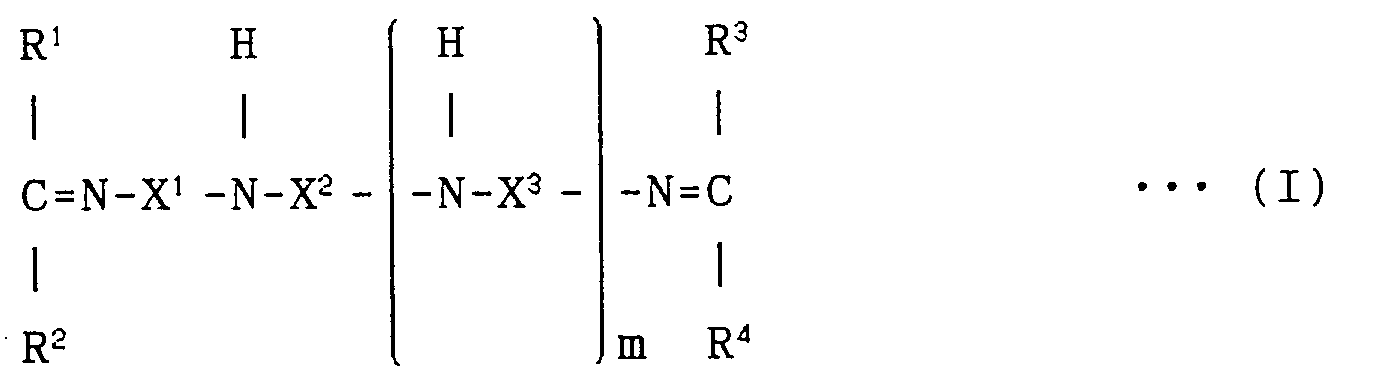
- an adhesive composition according to the present invention comprises: a chloroprene rubber; a tackifier resin; a chlorinated polyolefin; a solvent; and a component which is selected from the group consisting of (A) combination of an epoxy resin and a curing agent, the curing agent being selected from the group consisting of dicyandiamide, imidazole, imidazole derivatives, onium compounds, ketimine compounds represented by the formula (I) and derivatives of the ketimine compound with a compound having an ethylene oxide group, wherein R 1 , R 2 , R 3 and R 4 are the same or different and are selected respectively from the group consisting of alkyl groups having 1 to 6 carbon atoms, a phenyl group and phenyl groups substituted with alkyl group having 1 to 6 carbon atoms, X 1 , X 2 and X 3 are the same or different and are respectively an alkylene group having 2 to 6 carbon atom
- the adhesive composition of the present invention has the excellent adhesive properties to polyolefin materials, and it is quite available in the industrial field.
- the present adhesive composition since the present adhesive composition has the heat resistance, the adhesive composition is useful.
- the inventors of the present invention have found, as the result of various researches, that heat resistance of a chloroprene adhesive can be improved without losing the adhesive properties to polyolefins by selecting a curing agent.
- Polyolefin materials such as polypropylene and the like have small polarizability. Therefore, these materials are extremely difficult to be adhered.
- a tackifier resin, a chlorinated polyolefin and a solvent are incorporated in the the adhesive composition. Further, an ingredient for improving the heat resistance is incorporated therein.
- the ingredient for improving the heat resistance includes many embodiments, and the are classified into two types, one of which is (A) a combination of an epoxy resin and a curing agent and the other of which is (B) a silane compound having a functional group and a hydrolyzable alkoxy group.
- the curing agent in the combination (A) acts on the epoxy resin as a potential curing agent and includes a plurality of examples which are further classified into (1) a heat-curing agent which cures with heat and (2) a moisture-curing agent which cures with moisture.
- the potential curing agent is not cured only in the presence of the epoxy resin, which is different from the normal curing agent, therefore the adhesive composition retains the storage stability when the potential curing agent can be incorporated therein together with the epoxy resin. In other words, it is possible to produce an one-pack type adhesive with employment of the combination (A) for the ingredient for improving the heat resistance.
- heat-curing agent (1) includes dicyandiamide, imidazole compound and onium compound, and either one of which can be introduced in a chloroprene adhesive in combination with the epoxy resin to improve the heat resistance of the adhesive composition.
- the moisture-curing agent (2) is selected from ketimine compounds (I) having the following structure and derivatives thereof.
- the ketimine derivatives are obtained by reacting imino group of the ketimine compounds (I) with a compound having an ethylene oxide group.
- R 1 , R 2 , R 3 and R 4 are the same or different and are selected respectively from the group consisting of alkyl groups having 1 to 6 carbon atoms, a phenyl group and phenyl groups substituted with alkyl group having 1 to 6 carbon atoms
- X 1 , X 2 and X 3 are the same or different and are respectively an alkylene group having 2 to 6 carbon atoms
- m is 0 or 1.
- the chloroprene adhesive is improved in the heat resistance.
- the ketimine derivative is preferably used since it improves the storage stability more effectively than the ketimine compound (I).
- the silane compound (B) used in the present invention has two or more cross-linkable reactive groups. Addition of the silane compound (B), proceeds the cross-linking reaction in the chloroprene adhesive, which imparts the heat resistance to the adhesive composition without losing the adhesive properties. In particular, the use of the silane compound together with the combination (A) can remarkably improve the heat resistance of the adhesive composition.
- the adhesive composition manifests the excellent adhesive properties to the polyolefin adherents.
- the adhesive composition can be hardly used for adhering polyolefins.
- the tackifier resin included are petroleum resin, alkylphenol resin, phenylphenol resin, coumarone-indene resin, terpene-modified phenol resin, rosin-modified phenol resin, rosin resin, chelate compounds of alkylphenol resin and metal oxide, and the like.
- the tackifier resin is appropriately used at an amount of 5 to 100 parts by weight, preferably 20 to 80 parts by weight relative to 100 parts by weight of the chloroprene rubber.
- the amount of the tackifier exceeds 20 parts by weight, the strength at an elevated temperature is improved.
- the amount is desirably not greater than 80 parts by weight.
- the chlorinated polyolefin plays a role in improving the adhesive properties to polyolefins.
- Examples of the chlorinated polyolefin include chlorinated polyethylene, chlorinated polypropylene and the like.
- the nature of the chlorinated polyolefin varies depending upon the chlorinated rate. For example, chlorinated polyethylene having about 30 % of the chlorinated rate is more flexible than polyethylene, and is rubber-like and soluble in a solvent. Then, as the chlorinated rate grows larger, the chlorinated product becomes harder.
- chlorinated polyolefin with a chlorinated ratio of 10 to 45 % is preferably used and incorporated in the adhesive composition at an amount of 0.1 to 30 parts by weight relative to 100 parts by weight of the chloroprene rubber.
- the amount exceeds 30 parts by weight, the self-adhesion property which is a characteristic feature of the chloroprene rubber is lost.
- the solvent included are aromatic solvents such as toluene, xylene and the like; ketone compounds such as acetone, methyl ethyl ketone and the like; aliphatic solvents such as n-pentane, hexane and the like; alicyclic solvents such as cyclohexane and the like; ester solvents such as ethyl acetate, butyl acetate and the like; chlorinated hydrocarbon compounds such as dichloromethane, propane dichloride and the like.
- An amount of the solvent is selected in view of handling of the adhesive composition. It is of course possible to use a mixture of a plural kinds of solvents.
- epoxy resin included are bisphenol A type epoxy resin, bisphenol F type epoxy resin, bisphenol AD type epoxy resin and hydrogenated epoxy resin of the above, cresolic novolak type epoxy resin, phenolic novolak type epoxy resin, epoxy resin obtained by glycidylating an amine compound, aliphatic or alicyclic epoxy resin, heterocycle-containing epoxy resin, urethane-modified epoxy resin having urethane linkage, modified epoxy resin obtained by partially epoxidizing a rubber such as polybutadiene and NBR, acrylic compound having an oxirane ring such as glycidyl methacrylate, various brominated epoxy resins, siloxane linkage-containing epoxy resin and the like.
- the epoxy resin as described above is preferably used at an amount of 0.2 to 150 parts by weight relative to 100 parts by weight of the chloroprene rubber. When the amount is 10 parts by weight or more, tacky-adhesive properties are manifested in the adhesive composition. However, if the amount of the epoxy resin exceeds 150 parts by weight, the adhesive properties to polyolefins of the resulting adhesive composition is reduced.
- imidazole and various imidazole derivatives having a substituent can be used.
- imidazole derivatives included are the substituted imidazoles in which the carbon atom at 2, 4 or 5 position is connected with a group selected from alkyl groups such as a methyl group, an ethyl group, an undecyl group, a heptadecyl and the like, a phenyl group, a hydroxyalkyl group, a cyanoalkoxymethyl group; the substituted imidazoles in which the carbon atom at 1 or 3 position is connected with a group selected from a dodecyl group, a benzyl group, a cyanoethyl group, a 2-(2,4-diamino-6-triazinyl)ethyl group and the like; the tremellitic salts of the foregoing; and the isocyanuric salts of the for the for
- an ammonium compound, a phosphonium compound and a sulfonium compound can be utilized.
- the sulfonium compound is preferable.
- the sulfonium compound hexafluoroantimonate, hexafluorophosphate and hexafluoroarsenate of a sulfonium which is selected from benzylhydroxyphenylmethyl sulfonium, ⁇ - or ⁇ -naphthylmethyl-p-hydroxyphenylmethyl sulfonium and benzyltetramethylene sulfonium; sulfonium compounds obtained by substituting the benzyl group or the hydroxyphenyl group of the foregoing sulfonium compounds with nitro group, hydroxy group or halogen group; and sulfonium compounds obtained by alkoxylating or acetoxylating the hydroxyphenyl group of foregoing sulf
- the above heat-curing agent (1) is preferably used at an amount of 0.1 to 10 parts by weight relative to 100 parts by weight of the epoxy resin. If the amount exceeds 10 parts by weight, the reaction proceeds rapidly and, therefore, sufficient working time is not obtained.
- ketimine compound (I) of moisture-curing agent (2) included are 2,5,8-triaza-1,8-nonadiene, 2,10-dimethyl-3,6,9-triaza-2,9-undecadiene, 2,10-diphenyl-3,5,9-triaza-2,9-undecadiene, 3,11-dimethyl-4,7,10-triaza-3,10-tridecadiene, 3,11-diethyl-4,7,10-triaza-3,10-tridecadiene, 2,4,12,14-tetramethyl-5,8,11-triaza-4,11-pentadecadiene, 2,4,20,22-tetramethyl-5,12,19-triaza-4,19-trieicosadiene, 2,4,15,17-tetramethyl-5,8,11,14-tetraaza-4,14-octadecadiene and the like.
- a ketimine derivative for the compound having an ethylene oxide group which reacts with imino group of the ketimine compound (I) to give a ketimine derivative, styrene oxide, butyl glycidyl ether, allyl glycidyl ether, p-ter-butylphenyl glycidyl ether, p-sec-butylphenyl glycidyl ether, m,p-cresyl glycidyl ether, p-cresyl glycidyl ether, vinylcyclohexane dioxide, bersatic acid glycidyl ester, cardanol-modified glycidyl ether, dimer acid glycidyl ester, 1,6-hexanediol diglycidyl ether, resorcinol glycidyl ether, propylene glycol diglycidyl ether, 1,4-butane
- a derivative derived from styrene oxide is preferable. It is also possible to use the ketimine derivative which is obtained by reacting one of two imino groups of the ketimine compound (I) with the compound having ethylene oxide group.
- the above moisture-curing agent (2) is preferably used at an amount of 2 to 80 parts by weight relative to 100 parts by weight of the epoxy resin. If the amount exceeds 80 parts by weight, curing reaction is insufficient, with the result that good properties are not obtained.
- the reactive group in the above silane compound (B) which proceeds the cross-linking reaction included are functional groups such as an epoxy group, a vinyl group, a hydroxy group, an acryloxy group and methacyloxy group; and hydrolyzable alkoxy groups.
- functional groups such as an epoxy group, a vinyl group, a hydroxy group, an acryloxy group and methacyloxy group
- hydrolyzable alkoxy groups For examples of alkoxy group, methoxy group and ethoxy group can be given.
- silane compound (B) included are epoxyalkoxysilane such as 3-glycidoxypropyltrimethoxysilane, 2-(3,4-epoxycyclohexyl)ethyltrimethoxysilane and the like; vinylalkoxysilane such as vinyltrimethoxysilane, vinyltriethoxysilane, vinyltris(2-methoxyethoxy)silane and the like; acryloxy- or methacryloxysilane such as 3-acryloxypropyltrimethoxysilane, 3-methacryloxypropyltrimethoxysilane and the like; alkylalkoxysilane such as methyltrimethoxysilane and the like; alkoxysilane such as tetramethoxysilane, tetraethoxysilane and the like; and oligomers thereof.
- epoxyalkoxysilane such as 3-glycidoxypropyltrimethoxysilane, 2-(3,4-ep
- MKC Silicate MS51 (trade name) manufactured by Mitsubishi Chemical Corp. of Chiyoda-ku, Tokyo, Japane and the like are commercially available.
- macromolecular type silane compounds having a reactive group therein may be also used and an example of commercially available one is macromolecular coupling agent MMCA (trade name) manufactured by Nippon Unica K.K. of Chiyoda-ku, Tokyo, Japan.
- MMCA macromolecular coupling agent manufactured by Nippon Unica K.K. of Chiyoda-ku, Tokyo, Japan.
- silane compounds having an epoxy group such as ⁇ -plycidoxypropyl-trimethoxysilane and di- ⁇ -glycidoxypropyl-dimethoxysilane are preferable.
- the silane compounds (B) are preferably used at an amount of 0.3 to 30 parts by weight relative to 100 parts by weight of the chloroprene rubber. If the amount exceeds 30 parts by weight, the initial heat resistance of the resulting adhesive composition remarkably deteriorates.
- the silane compound (B) is used for the ingredient for improving the heat resistance described above, it is convenient to further add to the chloroprene adhesive a catalyst for promoting hydrolysis of the alkoxysilyl group.
- a catalyst for promoting hydrolysis of the alkoxysilyl group include organic tin compounds such as dibutyltin laurate, dioctyltin laurate, tin octionate and the like; organic aluminium compounds; organic titanate compounds and the like.
- the addition of the catalyst as described above facilitates the initial increase of the adhesive strength. If both of the combination (A) of the moisture-curing agent (2) and the epoxy resin and the silane compound (B) are used, the dehydration proceeds in the adhesive composition by the silane compound.
- a conventional anti-aging agent an acid scavenger and the like
- an acid scavenger magnesium oxide, zinc oxide and the like
- various dehydrating agents such as molecular sieve (trade name) manufactured by Union Showa K.K. of Minato-ku, Tokyo, Japan, orthosilicate, anhydrous sodium sulfate, anhydrous gypsum and the like can be used.
- the curing agent in the combination (A) with a conventional curing agent for the epoxy resin, such as polyamine, polyamide and the like.
- a conventional curing agent for the epoxy resin such as polyamine, polyamide and the like.
- the conventional curing agent like these can not inhibit the adhesive composition before use from being cured, the adhesive composition must be formulated into a two-pack type in order to isolate the epoxy resin from the curing agent.
- the adhesive composition according to the present invention is obtained by mixing the above ingredients in the solvent.
- the solvent and other ingredients must be suitably dehydrated before preparation of the adhesive composition, because the ketimine compound (I) easily reacts with water.
- the dehydration can be also carried out by using the above silane compound (B). Therefore, if both of the ketimine compound or derivative thereof and the silane compound (B) are utilized while the order of mixing is appropriately selected, the effects of the ketimine compound can be efficiently exhibited.
- the present adhesive composition can be, of course, used for adhering the materials which are easily adhered such as ABS resin and the like.
- Toluene, acetone, ethyl acetate and n-hexane as a solvent to be used were subjected to pre-dehydration treatment using molecular sieve.
- the dehydrated solvents were mixed at a ratio shown in Table 1 to give a mixed solvent.
- magnesium oxide (trade name: Kyowa Magu #150; manufactured by Kyowa Chemical Industry Co., Ltd. of Takamatsu City, Kagawa Pref., Japan) and zinc oxide (manufactured by Seido Chemical Industrial Co., Ltd. of Higashi-ku, Osaka, Japan) as a metal oxide were added to a chloroprene rubber (trade name: Denka Chloroprene M40T; manufactured by Denki Kagaku Kogyo K.K. of Chiyoda-ku, Tokyo, Japan), followed by kneading using an open roll to obtain a rubber compound.
- a chloroprene rubber (trade name: Denka Chloroprene M40T; manufactured by Denki Kagaku Kogyo K.K. of Chiyoda-ku, Tokyo, Japan), followed by kneading using an open roll to obtain a rubber compound.
- alkylphenol resin (trade name: Phenolite TD773; manufactured by Dainippon Ink & Chemicals, Inc. of Chuo-ku, Tokyo, Japan), and a phenol anti-aging agent were completely dissolved in the above mixed solvent.
- polymerized rosin resin (trade name: Pensel PH-A; manufactured by Arakawa Chemical Industries, Ltd. of Chu-o-ku, Osaka, Japan)
- chlorinated polyolefin trade name: Super Chron; manufactured by Nippon Paper Industries Co., Ltd.
- Example 2 In each of the cases, the same procedure as that in Example 1 except that the ingredients and amounts thereof were changed according to Table 1 was repeated to obtain the adhesive composition.
- the alicyclic epoxy resin used was ERL4221 (trade name; manufactured by Union Carbide Japan).
- the sulfonium salt compound used was San-eido SI-60L (trade name; manufactured by Sanshin Chemical Industry Co., Ltd. of Yamaguchi City, Yamaguchi Pref, Japan).
- a ketimine derivative the product obtained by reacting 1 mole of 2,4,12,14-tetramethyl-5,8,11-triaza-4,11-pentadecadiene and 1 mole of styrene oxide at 150 °C for two hours was used.
- each of the adhesive compositions obtained in the above Examples and Comparative Example was coated on a wooden base board at an coating ratio of 150 g/m 2 , followed by drying at 60 °C for two minutes and left to stand at a room temperature for two minutes.
- a polyolefin foam main ingredient: polypropylene; manufactured by Toray Industries, Inc. of Chuo-ku, Tokyo, Japan
- test strip was then allowed to stand at room temperature for one day, the wooden base boad was fixed while keeping the test strip in the perpendicular direction in the atmosphere of at 80 °C, and 100 g of the weight was hung from the lower tip of the polyolefin foam. After keeping this situation for 24 hours, the displacement of polyolefin foam was measured to assess the creep resistance at elevated temperature.
- the viscosity (V 0 ⁇ ) of the adhesive composition and the viscosity (V 1 ) after storage at 40 °C for two weeks were measured to calculate a thickening ratio (V 1 /V 0 ⁇ ).
- the estimation standards were as follows: A (when the thickening ratio is not higher than 2.0) and B (when the ratio is 2.0 to 4.0).
- MAC-2101 and MAC-2301 (trade names; manufactured by Nippon Unika K.K.) were used.
- tin catalyst a hydrolysis promoting agent for the silane compound
- No. 2584 (trade name; manufactured by Sankyo Organic Chemicals Co., Ltd. of Takatu-ku, Kawasaki-shi, Kanagawa Pref., Japan) was used.
- Each of the adhesive compositions obtained in the above Examples 5 to 14 and Comparative Example 2 was coated on a polypropylene base boad at a coating ratio of 150 g/m 2 by using an air spray, followed by drying at 60 °C for two minutes and allowed to stand at room temperature for two minutes.
- a polyolefin foam main ingredient: polypropylene; manufactured by Toray Industries, Inc.
- test strip was allowed to stand at room temperature for three days, the polypropylene base board was fixed while keeping the test strip in the perpendicular direction in the atmosphere of at 80 °C, and 200 g of the weight was hung from the lower tip of polyolefin foam. After keeping this situation for 24 hours, the displacement of polyolefin foam was measured to estimate the creep resistance at elevated temperature.
- the viscosity of the adhesive composition was measure to estimate the storage stability.
- Examples 10 and 11 From the results of Examples 10 and 11, it is understood that the addition of the silane compounds improves the heat resistance. Further, Examples 5 and 7 show that the use of silane compounds together with the ketimine derivative have the extremely higher effects. In addition, in Examples 6, 8 to 10 and 12 and 13, the effects of the catalyst which promotes the hydrolysis of the silane compound are seen.
- Example 1 The procedure of Example 1 except that the ingredients and amounts thereof were changed according to Table 3 was repeated to obtain an adhesive compositions.
- the chloroprene rubber containing a carboxyl group Denka Chloroprene DC12L (trade name; manufactured by Denki Kagakukogyo K.K.) was used.
- Each of the adhesive compositions obtained in Examples 15 to 19 and Comparative Examples 3 to 5 was coated on the surface, to be adhered, of a sailcloth having the width of 25 mm to seal it. Moreover, another portion of the adhesive composition was coated on a polypropylene plate having the width of 25 mm and on the sealed sailcloth, respectively, at a coating ratio of 150 g/m 2 using an air spray, followed by drying at 60 °C for two minutes to allow to stand at room temperature for 15 minutes. Thereafter, both adherents were laminated and the sufficient pressure was applied thereto using a hand roller. Further, the laminated adherents were cured at room temperature for three days, followed by heating at 120 °C for 30 minutes to obtain a test sample of PP/sailcloth.
- Peel strength was measured on each of the resulting test samples at a tensile rate of 200 mm/min.
Landscapes
- Chemical & Material Sciences (AREA)
- Organic Chemistry (AREA)
- Health & Medical Sciences (AREA)
- Chemical Kinetics & Catalysis (AREA)
- Medicinal Chemistry (AREA)
- Polymers & Plastics (AREA)
- Adhesives Or Adhesive Processes (AREA)
- Epoxy Resins (AREA)
Abstract
Description
- The present invention relates to a chloroprene rubber adhesive composition. More particularly, the present invention relates to an adhesive composition having the good adhering properties to an adherent difficult to be adhered such as polyolefins in particular, polypropylene, and having the heat resistance.
- When a chloroprene rubber is used as an adhesive, it exhibits the excellent initial adhesive strength due to fast crystallization, and also manifests the excellent adhesive properties to various adherents. Therefore, it is used for a variety of adhesive uses, and a number of chloroprene adhesives have been developed.
- Although the chloroprene adhesive has a variety of uses, it hardly adheres the materials having small polarizability such as polyolefins which have no polar groups on their surface. However, the polyolefin materials such as polyethylene, polypropylene and the like are used for various molded products such as insulating materials and haberdasheries due to water resistance and chemical resistance as well as toughness. In particular, polypropylene has the wide industrial use due to the excellent appearances and the like. Therefore, it would be inconvenient if such the useful polyolefins can not be adhered because of restricted steps for manufacturing products unless. For that reason, there is proposed an adhering method by improving the surface of a polyolefin adherent, using a primer or the like, so as to impart the adherability thereto. However, it is desirable to directly adhere the polyolefin materials using an adhesive and, therefore, many attempts have been made to further improve a chloroprene adhesive having a variety of uses.
- For example, there are proposed a chloroprene rubber adhesive modified with aminosilane which is disclosed in Japanese Laid-Open Patent Application of KOKAI No.(JP-A) 1-301776 and an adhesive containing a condensate obtained by condensing chloroprene rubber and chlorinated polypropylene with aminoalkylalkoxysilane which is disclosed in Japanese Laid-Opn Patent Application of KOKAI No.(JP-A) 6-306341. In addition, there is proposed an adhesive utilizing modified chloroprene obtained by modifying carboxy-group-containing chloroprene with epoxysilane in Japanese Laid-Open Patent Application of KOKAI No.(JP-A) 4-309586.
- However, the adhesives disclosed in the publication documents of No. 1-301776 and No. 4-309586 have the insufficient adhesive strength to polypropylene. On the other hand, the adhesive disclosed in the publication document of No. 306341 tried to improve the adhesive strength and heat resistance. However, this adhesive requires a step of heating it with a solvent upon preparation. Therefore, from a viewpoint of working step, there is a demand for an adhesive which can be prepared by more safe step.
- The present invention has been accomplished in view of the above-described circumstances.
- With the above problems in mind, therefore, it is an object of the present invention to provide a novel adhesive composition which has the excellent adhesive strenght to polyolefins, which has heat resistance, which can be easily prepared and which has general-purpose properties.
- In order to achieve the above-mentioned object, an adhesive composition according to the present invention comprises: a chloroprene rubber; a tackifier resin; a chlorinated polyolefin; a solvent; and a component which is selected from the group consisting of (A) combination of an epoxy resin and a curing agent, the curing agent being selected from the group consisting of dicyandiamide, imidazole, imidazole derivatives, onium compounds, ketimine compounds represented by the formula (I) and derivatives of the ketimine compound with a compound having an ethylene oxide group,

- In accordance with the above construction, the adhesive composition of the present invention has the excellent adhesive properties to polyolefin materials, and it is quite available in the industrial field. In addition, since the present adhesive composition has the heat resistance, the adhesive composition is useful.
- The features and advantages of the adhesive composition according to the present invention over the conventional adhesive materials will be more clearly understood from the following description of the preferred embodiments of the present invention.
- The inventors of the present invention have found, as the result of various researches, that heat resistance of a chloroprene adhesive can be improved without losing the adhesive properties to polyolefins by selecting a curing agent.
- Now, preferred embodiments of the chloroprene adhesive according to the present invention will be described.
- Polyolefin materials such as polypropylene and the like have small polarizability. Therefore, these materials are extremely difficult to be adhered. In the present invention, for making an adhesive composition containing chloroprene rubber as a main ingredient to effectively act on adherents made of the material which is difficult to be adhered, a tackifier resin, a chlorinated polyolefin and a solvent are incorporated in the the adhesive composition. Further, an ingredient for improving the heat resistance is incorporated therein.
- The ingredient for improving the heat resistance includes many embodiments, and the are classified into two types, one of which is (A) a combination of an epoxy resin and a curing agent and the other of which is (B) a silane compound having a functional group and a hydrolyzable alkoxy group.
- The curing agent in the combination (A) acts on the epoxy resin as a potential curing agent and includes a plurality of examples which are further classified into (1) a heat-curing agent which cures with heat and (2) a moisture-curing agent which cures with moisture. The potential curing agent is not cured only in the presence of the epoxy resin, which is different from the normal curing agent, therefore the adhesive composition retains the storage stability when the potential curing agent can be incorporated therein together with the epoxy resin. In other words, it is possible to produce an one-pack type adhesive with employment of the combination (A) for the ingredient for improving the heat resistance.
- Specific examples of the heat-curing agent (1) includes dicyandiamide, imidazole compound and onium compound, and either one of which can be introduced in a chloroprene adhesive in combination with the epoxy resin to improve the heat resistance of the adhesive composition.
- The moisture-curing agent (2) is selected from ketimine compounds (I) having the following structure and derivatives thereof. The ketimine derivatives are obtained by reacting imino group of the ketimine compounds (I) with a compound having an ethylene oxide group.

- By addition of the ketimine compound (I) or the derivative, the chloroprene adhesive is improved in the heat resistance. In particular, the ketimine derivative is preferably used since it improves the storage stability more effectively than the ketimine compound (I).
- The silane compound (B) used in the present invention has two or more cross-linkable reactive groups. Addition of the silane compound (B), proceeds the cross-linking reaction in the chloroprene adhesive, which imparts the heat resistance to the adhesive composition without losing the adhesive properties. In particular, the use of the silane compound together with the combination (A) can remarkably improve the heat resistance of the adhesive composition.
- When the silane compound (B) and the chlorinated polyolefin are present together, the adhesive composition manifests the excellent adhesive properties to the polyolefin adherents. In other words, if the chlorinated polyolefin is absent, the adhesive composition can be hardly used for adhering polyolefins.
- Specific examples of the respective ingredients in the chloroprene adhesive composition and suitable contents thereof are described in detail below.
- Among the examples of the tackifier resin included are petroleum resin, alkylphenol resin, phenylphenol resin, coumarone-indene resin, terpene-modified phenol resin, rosin-modified phenol resin, rosin resin, chelate compounds of alkylphenol resin and metal oxide, and the like. The tackifier resin is appropriately used at an amount of 5 to 100 parts by weight, preferably 20 to 80 parts by weight relative to 100 parts by weight of the chloroprene rubber. When the amount of the tackifier exceeds 20 parts by weight, the strength at an elevated temperature is improved. However, from a viewpoint of the workability, the amount is desirably not greater than 80 parts by weight.
- The chlorinated polyolefin plays a role in improving the adhesive properties to polyolefins. Examples of the chlorinated polyolefin include chlorinated polyethylene, chlorinated polypropylene and the like. The nature of the chlorinated polyolefin varies depending upon the chlorinated rate. For example, chlorinated polyethylene having about 30 % of the chlorinated rate is more flexible than polyethylene, and is rubber-like and soluble in a solvent. Then, as the chlorinated rate grows larger, the chlorinated product becomes harder. In the present invention, chlorinated polyolefin with a chlorinated ratio of 10 to 45 % is preferably used and incorporated in the adhesive composition at an amount of 0.1 to 30 parts by weight relative to 100 parts by weight of the chloroprene rubber. When the amount exceeds 30 parts by weight, the self-adhesion property which is a characteristic feature of the chloroprene rubber is lost.
- Among the examples of the solvent included are aromatic solvents such as toluene, xylene and the like; ketone compounds such as acetone, methyl ethyl ketone and the like; aliphatic solvents such as n-pentane, hexane and the like; alicyclic solvents such as cyclohexane and the like; ester solvents such as ethyl acetate, butyl acetate and the like; chlorinated hydrocarbon compounds such as dichloromethane, propane dichloride and the like. An amount of the solvent is selected in view of handling of the adhesive composition. It is of course possible to use a mixture of a plural kinds of solvents.
- Among the examples of the epoxy resin included are bisphenol A type epoxy resin, bisphenol F type epoxy resin, bisphenol AD type epoxy resin and hydrogenated epoxy resin of the above, cresolic novolak type epoxy resin, phenolic novolak type epoxy resin, epoxy resin obtained by glycidylating an amine compound, aliphatic or alicyclic epoxy resin, heterocycle-containing epoxy resin, urethane-modified epoxy resin having urethane linkage, modified epoxy resin obtained by partially epoxidizing a rubber such as polybutadiene and NBR, acrylic compound having an oxirane ring such as glycidyl methacrylate, various brominated epoxy resins, siloxane linkage-containing epoxy resin and the like. The epoxy resin as described above is preferably used at an amount of 0.2 to 150 parts by weight relative to 100 parts by weight of the chloroprene rubber. When the amount is 10 parts by weight or more, tacky-adhesive properties are manifested in the adhesive composition. However, if the amount of the epoxy resin exceeds 150 parts by weight, the adhesive properties to polyolefins of the resulting adhesive composition is reduced.
- As the imidazole compound of the heat-curing agent (1), imidazole and various imidazole derivatives having a substituent can be used. Among the examples of imidazole derivatives included are the substituted imidazoles in which the carbon atom at 2, 4 or 5 position is connected with a group selected from alkyl groups such as a methyl group, an ethyl group, an undecyl group, a heptadecyl and the like, a phenyl group, a hydroxyalkyl group, a cyanoalkoxymethyl group; the substituted imidazoles in which the carbon atom at 1 or 3 position is connected with a group selected from a dodecyl group, a benzyl group, a cyanoethyl group, a 2-(2,4-diamino-6-triazinyl)ethyl group and the like; the tremellitic salts of the foregoing; and the isocyanuric salts of the foregoing.
- For the onium compound, an ammonium compound, a phosphonium compound and a sulfonium compound can be utilized. Among them, the sulfonium compound is preferable. For examples of the sulfonium compound, hexafluoroantimonate, hexafluorophosphate and hexafluoroarsenate of a sulfonium which is selected from benzylhydroxyphenylmethyl sulfonium, α- or β-naphthylmethyl-p-hydroxyphenylmethyl sulfonium and benzyltetramethylene sulfonium; sulfonium compounds obtained by substituting the benzyl group or the hydroxyphenyl group of the foregoing sulfonium compounds with nitro group, hydroxy group or halogen group; and sulfonium compounds obtained by alkoxylating or acetoxylating the hydroxyphenyl group of foregoing sulfonium compounds are given.
- The above heat-curing agent (1) is preferably used at an amount of 0.1 to 10 parts by weight relative to 100 parts by weight of the epoxy resin. If the amount exceeds 10 parts by weight, the reaction proceeds rapidly and, therefore, sufficient working time is not obtained.
- Among the examples of the ketimine compound (I) of moisture-curing agent (2) included are 2,5,8-triaza-1,8-nonadiene, 2,10-dimethyl-3,6,9-triaza-2,9-undecadiene, 2,10-diphenyl-3,5,9-triaza-2,9-undecadiene, 3,11-dimethyl-4,7,10-triaza-3,10-tridecadiene, 3,11-diethyl-4,7,10-triaza-3,10-tridecadiene, 2,4,12,14-tetramethyl-5,8,11-triaza-4,11-pentadecadiene, 2,4,20,22-tetramethyl-5,12,19-triaza-4,19-trieicosadiene, 2,4,15,17-tetramethyl-5,8,11,14-tetraaza-4,14-octadecadiene and the like. For the compound having an ethylene oxide group which reacts with imino group of the ketimine compound (I) to give a ketimine derivative, styrene oxide, butyl glycidyl ether, allyl glycidyl ether, p-ter-butylphenyl glycidyl ether, p-sec-butylphenyl glycidyl ether, m,p-cresyl glycidyl ether, p-cresyl glycidyl ether, vinylcyclohexane dioxide, bersatic acid glycidyl ester, cardanol-modified glycidyl ether, dimer acid glycidyl ester, 1,6-hexanediol diglycidyl ether, resorcinol glycidyl ether, propylene glycol diglycidyl ether, 1,4-butanediol diglycidyl ether, neopentyl glycol diglycidyl ether and the like can be given. In particular, a derivative derived from styrene oxide is preferable. It is also possible to use the ketimine derivative which is obtained by reacting one of two imino groups of the ketimine compound (I) with the compound having ethylene oxide group.
- The above moisture-curing agent (2) is preferably used at an amount of 2 to 80 parts by weight relative to 100 parts by weight of the epoxy resin. If the amount exceeds 80 parts by weight, curing reaction is insufficient, with the result that good properties are not obtained.
- Among the examples of the reactive group in the above silane compound (B) which proceeds the cross-linking reaction included are functional groups such as an epoxy group, a vinyl group, a hydroxy group, an acryloxy group and methacyloxy group; and hydrolyzable alkoxy groups. For examples of alkoxy group, methoxy group and ethoxy group can be given. Among the examples of the silane compound (B) included are epoxyalkoxysilane such as 3-glycidoxypropyltrimethoxysilane, 2-(3,4-epoxycyclohexyl)ethyltrimethoxysilane and the like; vinylalkoxysilane such as vinyltrimethoxysilane, vinyltriethoxysilane, vinyltris(2-methoxyethoxy)silane and the like; acryloxy- or methacryloxysilane such as 3-acryloxypropyltrimethoxysilane, 3-methacryloxypropyltrimethoxysilane and the like; alkylalkoxysilane such as methyltrimethoxysilane and the like; alkoxysilane such as tetramethoxysilane, tetraethoxysilane and the like; and oligomers thereof. For the oligomers of tetramethoxysilane, MKC Silicate MS51 (trade name) manufactured by Mitsubishi Chemical Corp. of Chiyoda-ku, Tokyo, Japane and the like are commercially available. Alternatively, macromolecular type silane compounds having a reactive group therein may be also used and an example of commercially available one is macromolecular coupling agent MMCA (trade name) manufactured by Nippon Unica K.K. of Chiyoda-ku, Tokyo, Japan. Among the above silane compounds, silane compounds having an epoxy group such as γ-plycidoxypropyl-trimethoxysilane and di-γ-glycidoxypropyl-dimethoxysilane are preferable. The silane compounds (B) are preferably used at an amount of 0.3 to 30 parts by weight relative to 100 parts by weight of the chloroprene rubber. If the amount exceeds 30 parts by weight, the initial heat resistance of the resulting adhesive composition remarkably deteriorates.
- In a case where the silane compound (B) is used for the ingredient for improving the heat resistance described above, it is convenient to further add to the chloroprene adhesive a catalyst for promoting hydrolysis of the alkoxysilyl group. Among the examples of the catalyst included are organic tin compounds such as dibutyltin laurate, dioctyltin laurate, tin octionate and the like; organic aluminium compounds; organic titanate compounds and the like. The addition of the catalyst as described above facilitates the initial increase of the adhesive strength. If both of the combination (A) of the moisture-curing agent (2) and the epoxy resin and the silane compound (B) are used, the dehydration proceeds in the adhesive composition by the silane compound.
- It is also possible to add a conventional anti-aging agent, an acid scavenger and the like to the above ingredients, as occasion arises. As the acid scavenger, magnesium oxide, zinc oxide and the like can be used. In addition, in order to dry the solvent, various dehydrating agents such as molecular sieve (trade name) manufactured by Union Showa K.K. of Minato-ku, Tokyo, Japan, orthosilicate, anhydrous sodium sulfate, anhydrous gypsum and the like can be used.
- It is still possible to replace the curing agent in the combination (A) with a conventional curing agent for the epoxy resin, such as polyamine, polyamide and the like. However, since the conventional curing agent like these can not inhibit the adhesive composition before use from being cured, the adhesive composition must be formulated into a two-pack type in order to isolate the epoxy resin from the curing agent.
- The adhesive composition according to the present invention is obtained by mixing the above ingredients in the solvent. However, it is to be noted that, if the ketimine compound (I) is to be utilized, the solvent and other ingredients must be suitably dehydrated before preparation of the adhesive composition, because the ketimine compound (I) easily reacts with water. The dehydration can be also carried out by using the above silane compound (B). Therefore, if both of the ketimine compound or derivative thereof and the silane compound (B) are utilized while the order of mixing is appropriately selected, the effects of the ketimine compound can be efficiently exhibited.
- The present adhesive composition can be, of course, used for adhering the materials which are easily adhered such as ABS resin and the like.
- The following Examples and Comparative Examples illustrate the present invention in detail.
- Toluene, acetone, ethyl acetate and n-hexane as a solvent to be used were subjected to pre-dehydration treatment using molecular sieve. The dehydrated solvents were mixed at a ratio shown in Table 1 to give a mixed solvent.
- Then, according to a ratio shown in Table 1, magnesium oxide (trade name: Kyowa Magu #150; manufactured by Kyowa Chemical Industry Co., Ltd. of Takamatsu City, Kagawa Pref., Japan) and zinc oxide (manufactured by Seido Chemical Industrial Co., Ltd. of Higashi-ku, Osaka, Japan) as a metal oxide were added to a chloroprene rubber (trade name: Denka Chloroprene M40T; manufactured by Denki Kagaku Kogyo K.K. of Chiyoda-ku, Tokyo, Japan), followed by kneading using an open roll to obtain a rubber compound. The resulting rubber compound, alkylphenol resin (trade name: Phenolite TD773; manufactured by Dainippon Ink & Chemicals, Inc. of Chuo-ku, Tokyo, Japan), and a phenol anti-aging agent were completely dissolved in the above mixed solvent. To this solution were added polymerized rosin resin (trade name: Pensel PH-A; manufactured by Arakawa Chemical Industries, Ltd. of Chu-o-ku, Osaka, Japan), a 20 % solution of chlorinated polyolefin (trade name: Super Chron; manufactured by Nippon Paper Industries Co., Ltd. of Chiyoda-ku, Tokyo, Japan) in toluene, bisphenol A type epoxy resin (trade name: Epicoat 828; manufactured by Uka Shell Epoxy Co., Ltd. of Chiyoda-ku, Tokyo, Japan) and an imidazole compound as a potential curing agent (trade name: 2MZ-AZINE; manufactured by Shikoku Chemicals Corp. of Marugame City, Kagawa Pref., Japan), followed by stirring to dissolve, to obtain an adhesive composition.
- In each of the cases, the same procedure as that in Example 1 except that the ingredients and amounts thereof were changed according to Table 1 was repeated to obtain the adhesive composition. In connection with indication of Table 1, as the alicyclic epoxy resin used was ERL4221 (trade name; manufactured by Union Carbide Japan). As the sulfonium salt compound used was San-eido SI-60L (trade name; manufactured by Sanshin Chemical Industry Co., Ltd. of Yamaguchi City, Yamaguchi Pref, Japan). As a ketimine derivative, the product obtained by reacting 1 mole of 2,4,12,14-tetramethyl-5,8,11-triaza-4,11-pentadecadiene and 1 mole of styrene oxide at 150 °C for two hours was used.
- Using an air spray, each of the adhesive compositions obtained in the above Examples and Comparative Example was coated on a wooden base board at an coating ratio of 150 g/m2, followed by drying at 60 °C for two minutes and left to stand at a room temperature for two minutes. On the other hand, a polyolefin foam (main ingredient: polypropylene; manufactured by Toray Industries, Inc. of Chuo-ku, Tokyo, Japan) was heated to 120 °C, overlaid on the adhesive composition on the wooden base board, followed by tight compression for 20 seconds at a pressure of 2 kgf/cm2 to obtain a test strip.
- The test strip was then allowed to stand at room temperature for one day, the wooden base boad was fixed while keeping the test strip in the perpendicular direction in the atmosphere of at 80 °C, and 100 g of the weight was hung from the lower tip of the polyolefin foam. After keeping this situation for 24 hours, the displacement of polyolefin foam was measured to assess the creep resistance at elevated temperature.
- With respect to each of the adhesive compositions of Examples and Comparative Example, the viscosity (V0̸) of the adhesive composition and the viscosity (V1) after storage at 40 °C for two weeks were measured to calculate a thickening ratio (V1/V0̸). The estimation standards were as follows: A (when the thickening ratio is not higher than 2.0) and B (when the ratio is 2.0 to 4.0).
- The results of creep resistance under high temperatures and storage stability are shown in Table 1.
Table 1 Ingredient (parts by weight) Ex. 1 Ex. 2 Ex. 3 Ex. 4 Com. Ex. 1 Solvent Toluene 200 200 200 200 200 Acetone 100 100 100 100 100 Ethyl acetat 100 100 100 100 100 n-Hexane 200 200 200 200 200 Chloroprene rubber 100 100 100 100 100 Metal oxide Magnesium oxide 3 3 3 3 3 Zinc oxide 2 2 2 2 2 Tackifier resin Alkylphenol resin 50 50 50 50 50 Polymerized rosin resin 10 - 10 10 10 Anti-aging agent 2 2 2 2 2 Chlorinated polyolefin 5 5 5 5 5 Epoxy resin Bisphenol A type epoxy resin 7 7 - 7 7 Alicyclic epoxy resin - - 7 - - Potential curing agent Imidazole 0.14 - - - - Sulfonium salt compound - 0.14 0.14 - - Ketimine derivative - - - 2.1 - Storage stability A A A A A Creep resistance under high temp. (mm/25mm) 6 2 5 6 15 - From the results of Examples 1 to 4 and Comparative Example 1, it is apparent that heat resistance varies depending upon whether a curing agent is present or not. Since these curing agents react with the epoxy resin, the effects by introducing the epoxy resin in combination with these curing agents into an adhesive will be understood. In addition, it is suggested from Example 3 that the epoxy resin can be appropriately selected.
- In each of the cases, the same procedure as that in Example 1 except that the ingredients and amounts thereof were changed according to Table 2 was repeated to obtain an adhesive composition. In connection with indication in Table 2, as the vinyl group-containing silane compound, KBM1003 (trade name, manufactured by Shin-Etsu Chemical Co., Ltd. of Chiyoda-ku, Tokyo, Japan) was used. As the methacryl-group-containing silane compound, KBM503 (trade name; manufactured by Shin-Etsu Chemical Co., Ltd.) was used. As the epoxy-group-containing silane compound, KBM403 (trade name; manufactured by Shin-Etsu Chmical Co., Ltd.) was used. As the macromolecular coupling agents (1) and (2), MAC-2101 and MAC-2301 (trade names; manufactured by Nippon Unika K.K.) were used. As the tin catalyst (a hydrolysis promoting agent for the silane compound), No. 2584 (trade name; manufactured by Sankyo Organic Chemicals Co., Ltd. of Takatu-ku, Kawasaki-shi, Kanagawa Pref., Japan) was used.
- Each of the adhesive compositions obtained in the above Examples 5 to 14 and Comparative Example 2 was coated on a polypropylene base boad at a coating ratio of 150 g/m2 by using an air spray, followed by drying at 60 °C for two minutes and allowed to stand at room temperature for two minutes. On the other hand, a polyolefin foam (main ingredient: polypropylene; manufactured by Toray Industries, Inc.) was heated to 120 °C, overlaid on the adhesive composition on the polypropylene base board, followed by tight compression for 10 seconds at a pressure of 0.5 kgf/cm2 to obtain a test strip.
- The test strip was allowed to stand at room temperature for three days, the polypropylene base board was fixed while keeping the test strip in the perpendicular direction in the atmosphere of at 80 °C, and 200 g of the weight was hung from the lower tip of polyolefin foam. After keeping this situation for 24 hours, the displacement of polyolefin foam was measured to estimate the creep resistance at elevated temperature.
- According to the same procedure as in Example 1, the viscosity of the adhesive composition was measure to estimate the storage stability.
- The results of estimation of the creep resistance under elavated temperature and storage stability of the adhesive compositions are shown in Table 2.

- From the results of Examples 10 and 11, it is understood that the addition of the silane compounds improves the heat resistance. Further, Examples 5 and 7 show that the use of silane compounds together with the ketimine derivative have the extremely higher effects. In addition, in Examples 6, 8 to 10 and 12 and 13, the effects of the catalyst which promotes the hydrolysis of the silane compound are seen.
- The procedure of Example 1 except that the ingredients and amounts thereof were changed according to Table 3 was repeated to obtain an adhesive compositions. As the chloroprene rubber containing a carboxyl group, Denka Chloroprene DC12L (trade name; manufactured by Denki Kagakukogyo K.K.) was used.
- Each of the adhesive compositions obtained in Examples 15 to 19 and Comparative Examples 3 to 5 was coated on the surface, to be adhered, of a sailcloth having the width of 25 mm to seal it. Moreover, another portion of the adhesive composition was coated on a polypropylene plate having the width of 25 mm and on the sealed sailcloth, respectively, at a coating ratio of 150 g/m2 using an air spray, followed by drying at 60 °C for two minutes to allow to stand at room temperature for 15 minutes. Thereafter, both adherents were laminated and the sufficient pressure was applied thereto using a hand roller. Further, the laminated adherents were cured at room temperature for three days, followed by heating at 120 °C for 30 minutes to obtain a test sample of PP/sailcloth.
- Likewise, another portion of the adhesive composition was coated on a sailcloth, having the width of 25 mm, pre-sealed with the adhesive composition and on a mild steel sheet, respectively, to obtain a test sample of mild steel sheet/sailcloth.
- Peel strength was measured on each of the resulting test samples at a tensile rate of 200 mm/min.
- According to the same manner as that in Example 1, the viscosity of the adhesive composition was measured to estimate the storage stability.
- The results of the adhesive strength and storage stability on each adhesive composition are shown in Table 3.

- From the results of Comparative Examples 3 to 5, it is understood that, in the present adhesive composition, the addition of chlorinated polyolefin have the effects on adhesive properties to polypropylene. Comparing them with the results of Examples 15 to 17, the excess addition of the epoxy resin reduces the adhesive properties to polyolefin.
- It must be understood that the invention is in no way limited to the above embodiments and that many changes may be brought about therein without departing from the scope of the invention as defined by the appended claims.
Claims (27)
- An adhesive composition, comprising:a chloroprene rubber;a tackifier resin;a chlorinated polyolefin;a solvent; anda component which is selected from the group consisting ofcombination of an epoxy resin and a curing agent, the curing agent being selected from the group consisting of dicyandiamide, imidazole, imidazole derivative, onium compound, ketimine compound which is represented by the formula (I) and ketimine derivative to which the ketimine compound is derived with a compound having an ethylene oxide group,
 a silane compound having at least two reactive groups, the reactive group being selected from the group consisting of an epoxy group, a vinyl group, a hydroxy group, an acryloxy group, a methacryloxy group and alkoxy groups.
 - The adhesive composition as set forth in claim 1, wherein the tackifier resin is selected from the group consisting of petroleum resin, alkylphenol resin, phenylphenol resin, coumarone-indene resin, terpene-modified phenol resin, rosin-modified phenol resin, rosin resin, chelate compounds of alkylphenol resin and metal oxide.
- The adhesive composition as set forth in claim 1, wherein the tackifier resin is contained in the adhesive composition at an amount of 5 to 100 parts by weight relative to 100 parts by weight of the chloroprene rubber.
- The adhesive composition as set forth in claim 1, wherein the tackifier resin is contained in the adhesive composition at an amount of 20 to 80 parts by weight relative to 100 parts by weight of the chloroprene rubber.
- The adhesive composition as set forth in claim 1, wherein the chlorinated polyolefin is selected from the group consisting of chlorinated polyethylene and chlorinated polypropylene.
- The adhesive composition as set forth in claim 1, wherein the chlorinated polyolefin is chlorinated at a ratio of 10 to 45 %.
- The adhesive composition as set forth in claim 1, wherein the chlorinated polyolefin is contained in the adhesive composition at an amount of 0.1 to 30 parts by weight relative to 100 parts by weight of the chloroprene rubber.
- The adhesive composition as set forth in claim 1, wherein the solvent is selected from the group consisting of aromatic solvents, ketone compounds, aliphatic solvents, alicyclic solvents, ester solvents, and chlorinated hydrocarbon compounds.
- The adhesive composition as set forth in claim 1, wherein the solvent is selected from the group consisting of toluene, xylene, acetone, methyl ethyl ketone, n-pentane, hexane, cyclohexane, ethyl acetate, butyl acetate, dichloromethane, and propane dichloride.
- The adhesive composition as set forth in claim 1, wherein said component inclues the combination of the epoxy resin and the curing agent.
- The adhesive composition as set forth in claim 10, wherein the epoxy resin is selected from the group consisting of bisphenol A epoxy resin, bisphenol F epoxy resin, bisphenol AD epoxy resin, hydrogenated bisphenol A epoxy resin , hydrogenated bisphenol F epoxy resin, hydrogenated bisphenol AD epoxy resin, cresolic novolak epoxy resin, phenolic novolak epoxy resin, epoxy resin of glycidylated amine, aliphatic epoxy resin, alicyclic epoxy resin, heterocycle-containing epoxy resin, urethane-modified epoxy resin, partially epoxidized polybutadiene, partially epoxidized NBR, glycidyl methacrylate, brominated epoxy resin, and siloxane-linkage-containing epoxy resin.
- The adhesive composition as set forth in claim 10, wherein the epoxy resin is contained in the adhesive composition at an amount of 0.2 to 150 parts by weight relative to 100 parts by weight of the chloroprene rubber.
- The adhesive composition as set forth in claim 10, wherein the curing agent is an imidazole derivative to which the carbon atom at 2, 4 or 5 position of imidazole is derived with a substituent, and the substituent is selected from the group consisting of a methyl group, an ethyl group, an undecyl group, a heptadecyl, a phenyl group, a hydroxyalkyl group, a cyanoalkoxymethyl group
- The adhesive composition as set forth in claim 10, wherein the curing agent is an imidazole derivative to which the carbon atom at 1 or 3 position of imidazole is derived with a substituent, and the substituent is selected from the group consisting of a dodecyl group, a benzyl group, a cyanoethyl group and a 2-(2,4-diamino-6-triazinyl)ethyl group.
- The adhesive composition as set forth in claim 10, wherein the curing agent is an imidazole derivative in a form of a trimellitic salt or an isocyanuric salt.
- The adhesive composition as set forth in claim 10, wherein the onium compound of the curing agent includes ammonium compound, phosphonium compound and sulfonium compound.
- The adhesive composition as set forth in claim 10, wherein the curing agent is the sulfonium compound, and the sulfonium compound includes a sulfonium salt having a sulfonium element in a salt form which is selected from the group consisting of hexafluoroantimonate, hexafluorophosphate and hexafluoroarsenate, and the sulfonium element is selected from the group consisting of benzylhydroxyphenylmethyl sulfonium, α-naphthylmethyl-p-hydroxyphenylmethyl sulfonium, β-naphthylmethyl-p-hydroxyphenylmethyl sulfonium, and benzyltetramethylene sulfonium.
- The adhesive composition as set forth in claim 10, wherein the curing agent is the sulfonium compound, and the sulfonium compound includes a sulfonium salt having a sulfonium element in a salt form which is selected from the group consisting of hexafluoroantimonate, hexafluorophosphate and hexafluoroarsenate, and the sulfonium element is a substituted sulfonium with a substituent for the benzyl group or the hydroxyphenyl group of a sulfonium structure which is selected from the group consisting of benzylhydroxyphenylmethyl sulfonium, α-naphthylmethyl-p-hydroxyphenylmethyl sulfonium, β-naphthylmethyl-p-hydroxyphenylmethyl sulfonium, and benzyltetramethylene sulfonium, and the substituent is selected from the group consisting of a nitro group, a hydroxy group and a halogen group.
- The adhesive composition as set forth in claim 10, wherein the curing agent is the sulfonium compound, and the sulfonium compound includes a sulfonium salt having a sulfonium element in a salt form which is selected from the group consisting of hexafluoroantimonate, hexafluorophosphate and hexafluoroarsenate, and the sulfonium element is either an alkoxylated sulfonium or an acetoxylated sulfonium for the hydroxyphenyl group of a sulfonium structure which is selected from the group consisting of benzylhydroxyphenylmethyl sulfonium, α-naphthylmethyl-p-hydroxyphenylmethyl sulfonium, β-naphthylmethyl-p-hydroxyphenylmethyl sulfonium, and benzyltetramethylene sulfonium.
- The adhesive composition as set forth in claim 10, wherein the curing agent is contained in the adhesive composition at an amount of 0.1 to 10 parts by weight relative to 100 parts by weight of the epoxy resin.
- The adhesive composition as set forth in claim 10, wherein the curing agent is the ketimine compound which includes 2,5,8-triaza-1,8-nonadiene, 2,10-dimethyl-3,6,9-triaza-2,9-undecadiene, 2,10-diphenyl-3,5,9-triaza-2,9-undecadiene, 3,11-dimethyl-4,7,10-triaza-3,10-tridecadiene, 3,11-diethyl-4,7,10-triaza-3,10-tridecadiene, 2,4,12,14-tetramethyl-5,8,11-triaza-4,11-pentadecadiene, 2,4,20,22-tetramethyl-5,12,19-triaza-4,19-trieicosadiene and 2,4,15,17-tetramethyl-5,8,11,14-tetraaza-4,14-octadecadiene.
- The adhesive composition as set forth in claim 10, wherein the curing agent is the ketimine derivative, and said compound of the ketimine derivative is selected from the group consisting of styrene oxide, butyl glycidyl ether, allyl glycidyl ether, p-ter-butylphenyl glycidyl ether, p-sec-butylphenyl glycidyl ether, m,p-cresyl glycidyl ether, p-cresyl glycidyl ether, vinylcyclohexane dioxide, bersatic glycidyl ester, cardanol-modified glycidyl ether, dimer acid glycidyl ester, 1,6-hexanediol diglycidyl ether, resorcinol glycidyl ether, propylene glycol diglycidyl ether, 1,4-butanediol diglycidyl ether and neopentyl glycol diglycidyl ether
- The adhesive composition as set forth in claim 10, wherein the curing agent is contained in the adhesive composition at an amount of 2 to 80 parts by weight relative to 100 parts by weight of the epoxy resin.
- The adhesive composition as set forth in claim 1, wherein said component includes the silane compound.
- The adhesive composition as set forth in claim 24, wherein the reactive group of the silane compound is selected from the group consisting of 3-glycidoxypropyltrimethoxysilane, 2-(3,4-epoxycyclohexyl)ethyltrimethoxysilane, vinyltrimethoxysilane, vinyltriethoxysilane, vinyltris(2-methoxyethoxy)silane, 3-acryloxypropyltrimethoxysilane, 3-methacryloxypropyltrimethoxysilane, methyltrimethoxysilane, tetramethoxysilane and tetraethoxysilane.
- The adhesive composition as set forth in claim 24, wherein the silane compound is an oligomer of an element which is selected from the group consisting of 3-glycidoxypropyltrimethoxysilane, 2-(3,4-epoxycyclohexyl)ethyltrimethoxysilane, vinyltrimethoxysilane, vinyltriethoxysilane, vinyltris(2-methoxyethoxy)silane, 3-acryloxypropyltrimethoxysilane, 3-methacryloxypropyltrimethoxysilane, methyltrimethoxysilane, tetramethoxysilane and tetraethoxysilane.
- The adhesive composition as set forth in claim 24, wherein the silane compound is contained in the adhesive composition at an amount of 0.3 to 30 parts by weight relative to 100 parts by weight of the chloroprene rubber.
Applications Claiming Priority (2)
| Application Number | Priority Date | Filing Date | Title |
|---|---|---|---|
| JP06093195A JP3435250B2 (en) | 1995-03-20 | 1995-03-20 | Adhesive composition |
| JP60931/95 | 1995-03-20 |
Publications (2)
| Publication Number | Publication Date |
|---|---|
| EP0733689A1 true EP0733689A1 (en) | 1996-09-25 |
| EP0733689B1 EP0733689B1 (en) | 1998-10-07 |
Family
ID=13156628
Family Applications (1)
| Application Number | Title | Priority Date | Filing Date |
|---|---|---|---|
| EP96104358A Expired - Lifetime EP0733689B1 (en) | 1995-03-20 | 1996-03-19 | Chloroprene rubber adhesive composition |
Country Status (4)
| Country | Link |
|---|---|
| US (1) | US5753727A (en) |
| EP (1) | EP0733689B1 (en) |
| JP (1) | JP3435250B2 (en) |
| DE (1) | DE69600737T2 (en) |
Cited By (22)
| Publication number | Priority date | Publication date | Assignee | Title |
|---|---|---|---|---|
| EP0969067A4 (en) * | 1998-01-09 | 2003-06-18 | Matsushita Electric Industrial Co Ltd | SYNTHETIC CHLOROPRENE RUBBER ADHESIVE COMPOSITION AND METHOD FOR PRODUCING SPEAKER USING THE SAME |
| EP1282660A4 (en) * | 2000-04-21 | 2003-06-18 | Henkel Loctite Corp | RHEOLOGICALLY REGULATED EPOXIDE RESIN COMPOSITIONS |
| WO2004024843A1 (en) * | 2002-08-30 | 2004-03-25 | Asahi Glass Company, Limited | Adhesive composition and glass plate with thermoplastic elastomer molding |
| RU2250916C1 (en) * | 2003-09-24 | 2005-04-27 | Волгоградский государственный технический университет (ВолгГТУ) | Adhesive composition |
| RU2252237C1 (en) * | 2003-09-24 | 2005-05-20 | Волгоградский государственный технический университет (ВолгГТУ) | Adhesive composition |
| RU2261883C1 (en) * | 2004-03-15 | 2005-10-10 | Волгоградский государственный технический университет (ВолгГТУ) | Gluing composition |
| RU2261884C1 (en) * | 2004-03-15 | 2005-10-10 | Волгоградский государственный технический университет (ВолгГТУ) | Gluing composition |
| RU2263128C1 (en) * | 2004-03-15 | 2005-10-27 | Волгоградский государственный технический университет (ВолгГТУ) | Gluing composition |
| RU2270223C1 (en) * | 2005-01-11 | 2006-02-20 | Государственное образовательное учреждение высшего профессионального образованяи Волгоградский государственный технический университет (ВолгГТУ) | Glue composition (options) |
| RU2270224C1 (en) * | 2005-01-11 | 2006-02-20 | Государственное образовательное учреждение высшего профессионального образования Волгоградский государственный технический университет (ВолгГТУ) | Glue composition (options) |
| RU2277112C1 (en) * | 2005-01-11 | 2006-05-27 | Государственное образовательное учреждение Высшего профессионального образования Волгоградский государственный технический университет (ВолГТУ) | Glue composition (versions) |
| RU2278885C1 (en) * | 2005-01-11 | 2006-06-27 | Государственное образовательное учреждение высшего профессионального образования Волгоградский государственный технический университет (ВолгГТУ) | Gluing composition |
| RU2279461C1 (en) * | 2005-03-09 | 2006-07-10 | Государственное образовательное учреждение высшего профессионального образования Волгоградский государственный технический университет (ВолгГТУ) | Gluing composition |
| RU2279459C1 (en) * | 2005-03-09 | 2006-07-10 | Государственное образовательное учреждение высшего профессионального образования Волгоградский государственный технический университет (ВолгГТУ) | Gluing composition |
| RU2279460C1 (en) * | 2005-03-09 | 2006-07-10 | Государственное образовательное учреждение высшего профессионального образования Волгоградский государственный технический университет (ВолгГТУ) | Gluing composition |
| WO2013093037A1 (en) * | 2011-12-23 | 2013-06-27 | Sika Technology Ag | One-component contact adhesive having improved stability |
| DE102015222027A1 (en) | 2015-11-09 | 2017-05-11 | Tesa Se | Barrier adhesive with polymeric getter material |
| CN107858119A (en) * | 2017-11-04 | 2018-03-30 | 舒城宏峰纸板有限公司 | A kind of glue pasted for carton board |
| CN108048032A (en) * | 2017-11-04 | 2018-05-18 | 舒城宏峰纸板有限公司 | A kind of glue manufacture craft pasted for carton board |
| WO2018211019A1 (en) * | 2017-05-17 | 2018-11-22 | Rema Tip Top Ag | Chloroprene adhesive system |
| EP3508547A4 (en) * | 2016-09-02 | 2019-07-10 | Denka Company Limited | CHLOROPRENE RUBBER LATEX ADHESIVE COMPOSITION |
| BE1026925B1 (en) * | 2018-12-27 | 2020-07-27 | Fourny Nv | Solvent-borne blocking adhesive and method for making this adhesive |
Families Citing this family (22)
| Publication number | Priority date | Publication date | Assignee | Title |
|---|---|---|---|---|
| US6306943B1 (en) * | 1997-07-18 | 2001-10-23 | Polymer Solvents, Llc | Zero volitile organic solvent compositions |
| DE19840361A1 (en) * | 1998-09-04 | 2000-03-09 | Beiersdorf Ag | Adhesive film and its use |
| JP2001342446A (en) * | 2000-05-30 | 2001-12-14 | Aron Ever-Grip Ltd | Adhesive composition |
| JP4865303B2 (en) * | 2005-11-11 | 2012-02-01 | 昭和電工株式会社 | Chloroprene rubber adhesive composition |
| JP4757075B2 (en) * | 2006-03-31 | 2011-08-24 | ノガワケミカル株式会社 | Adhesive composition for polyolefin adhesion |
| US8393842B2 (en) * | 2009-11-19 | 2013-03-12 | Konishi Co., Ltd. | Strip of metallic fasteners adhered to each other |
| US20120299216A1 (en) * | 2010-07-01 | 2012-11-29 | Westech Aerosol Corporation | Vacuum Infusion Adhesive and Methods Related Thereto |
| US9624411B2 (en) | 2010-07-01 | 2017-04-18 | David W. Carnahan | Vacuum infusion adhesive and methods related thereto |
| JP5890103B2 (en) * | 2011-03-23 | 2016-03-22 | コニシ株式会社 | Moisture curable adhesive composition excellent in adhesiveness of polyethylene resin or polypropylene resin and adherend or bonding method using the same |
| JP5991523B2 (en) * | 2011-08-25 | 2016-09-14 | セメダイン株式会社 | Room temperature moisture curable adhesive composition |
| JP5959827B2 (en) * | 2011-11-02 | 2016-08-02 | ノガワケミカル株式会社 | Adhesive composition |
| FR2993892B1 (en) * | 2012-07-25 | 2014-08-08 | Michelin & Cie | RUBBER COMPOSITION COMPRISING AN EPOXY RESIN AND A POLY-IMINE HARDENER |
| US10047254B2 (en) | 2013-09-23 | 2018-08-14 | Bondek Corporation | Curable composite manufacturing adhesive |
| CN104277732B (en) * | 2014-09-24 | 2016-08-24 | 安徽省中彩印务有限公司 | A kind of for make wine case to the glue mounting paper |
| CN104388012B (en) * | 2014-10-31 | 2016-09-07 | 山东鑫海矿业技术装备股份有限公司 | A kind of efficient adhesive of cold curing and preparation method thereof |
| JP2018168227A (en) * | 2017-03-29 | 2018-11-01 | 日立化成株式会社 | Adhesive composition and method for producing the same |
| CN107365439B (en) * | 2017-07-30 | 2020-02-18 | 华南理工大学 | A Novel Neoprene Vulcanization Method |
| JP7072069B2 (en) * | 2017-12-29 | 2022-05-19 | ヘンケル・アクチェンゲゼルシャフト・ウント・コムパニー・コマンディットゲゼルシャフト・アウフ・アクチェン | Acid-resistant adhesive composition |
| JP7248397B2 (en) * | 2018-09-13 | 2023-03-29 | アイカ工業株式会社 | Chloroprene rubber adhesive |
| JP2021105091A (en) * | 2019-12-26 | 2021-07-26 | スリーエム イノベイティブ プロパティズ カンパニー | Two-component solvent-free adhesive and main agent of two-component solvent-free adhesive |
| JP7659970B2 (en) * | 2020-03-30 | 2025-04-10 | 株式会社Adeka | Composition, cured product, and method for producing the cured product |
| JP2024512458A (en) | 2021-03-17 | 2024-03-19 | ヘンケル・アクチェンゲゼルシャフト・ウント・コムパニー・コマンディットゲゼルシャフト・アウフ・アクチェン | Chloroprene rubber contact adhesive composition |
Citations (3)
| Publication number | Priority date | Publication date | Assignee | Title |
|---|---|---|---|---|
| JPS5197640A (en) * | 1975-02-25 | 1976-08-27 | SETSUCHAKUZA ISOSEIBUTSU | |
| JPH01301776A (en) * | 1988-05-30 | 1989-12-05 | Sunstar Eng Inc | Chloroprene-based adhesive of one-pack type |
| JPH06306341A (en) * | 1993-04-26 | 1994-11-01 | Sunstar Eng Inc | One-component self-crosslinking chloroprene adhesive |
Family Cites Families (9)
| Publication number | Priority date | Publication date | Assignee | Title |
|---|---|---|---|---|
| US3542639A (en) * | 1967-01-26 | 1970-11-24 | Lord Corp | Rubber-to-metal adhesive and its use |
| DE2228544C3 (en) * | 1972-06-12 | 1984-01-19 | Henkel KGaA, 4000 Düsseldorf | Adhesion promoter based on polyisocyanates for vulcanizing rubber compounds onto metals or other stable substrates |
| JPS5817552B2 (en) * | 1978-05-24 | 1983-04-07 | 大阪曹達株式会社 | Manufacturing method of chlorinated polyethylene water-based emulsion paint |
| EP0008110B1 (en) * | 1978-08-16 | 1983-04-06 | Ciba-Geigy Ag | Adhesives or adhesive constituents and their use for bonding two surfaces |
| JPS55102644A (en) * | 1979-01-29 | 1980-08-06 | Osaka Soda Co Ltd | Resin composition |
| US4342843A (en) * | 1979-03-01 | 1982-08-03 | National Starch And Chemical Corp. | Neoprene latex contact adhesives |
| JPH0314888A (en) * | 1989-06-13 | 1991-01-23 | Nichiban Co Ltd | Thermosetting self-adhesive article in sheet form |
| JPH04189886A (en) * | 1990-11-22 | 1992-07-08 | Modern Plast Kogyo Kk | Thermosetting tacky adhesive composition |
| US5310796A (en) * | 1993-03-23 | 1994-05-10 | Lord Corporation | Adhesive with polyesterurethane, halogenated polyolefin and Diels-Alder adduct |
-
1995
- 1995-03-20 JP JP06093195A patent/JP3435250B2/en not_active Expired - Fee Related
-
1996
- 1996-03-18 US US08/617,261 patent/US5753727A/en not_active Expired - Lifetime
- 1996-03-19 DE DE69600737T patent/DE69600737T2/en not_active Expired - Lifetime
- 1996-03-19 EP EP96104358A patent/EP0733689B1/en not_active Expired - Lifetime
Patent Citations (4)
| Publication number | Priority date | Publication date | Assignee | Title |
|---|---|---|---|---|
| JPS5197640A (en) * | 1975-02-25 | 1976-08-27 | SETSUCHAKUZA ISOSEIBUTSU | |
| JPH01301776A (en) * | 1988-05-30 | 1989-12-05 | Sunstar Eng Inc | Chloroprene-based adhesive of one-pack type |
| US5252668A (en) * | 1988-05-30 | 1993-10-12 | Sunstar Giken Kabushiki Kaisha | One-pack chloroprene adhesive |
| JPH06306341A (en) * | 1993-04-26 | 1994-11-01 | Sunstar Eng Inc | One-component self-crosslinking chloroprene adhesive |
Non-Patent Citations (2)
| Title |
|---|
| DATABASE WPI Section Ch Week 7641, Derwent World Patents Index; Class A81, AN 76-76800X, XP002007524 * |
| DATABASE WPI Section Ch Week 9503, Derwent World Patents Index; Class A18, AN 95-019479, XP002007523 * |
Cited By (27)
| Publication number | Priority date | Publication date | Assignee | Title |
|---|---|---|---|---|
| EP0969067A4 (en) * | 1998-01-09 | 2003-06-18 | Matsushita Electric Industrial Co Ltd | SYNTHETIC CHLOROPRENE RUBBER ADHESIVE COMPOSITION AND METHOD FOR PRODUCING SPEAKER USING THE SAME |
| EP1282660A4 (en) * | 2000-04-21 | 2003-06-18 | Henkel Loctite Corp | RHEOLOGICALLY REGULATED EPOXIDE RESIN COMPOSITIONS |
| US7560157B2 (en) | 2002-08-30 | 2009-07-14 | Asahi Glass Company, Limited | Adhesive composition and glass plate with thermoplastic elastomer molding |
| WO2004024843A1 (en) * | 2002-08-30 | 2004-03-25 | Asahi Glass Company, Limited | Adhesive composition and glass plate with thermoplastic elastomer molding |
| RU2250916C1 (en) * | 2003-09-24 | 2005-04-27 | Волгоградский государственный технический университет (ВолгГТУ) | Adhesive composition |
| RU2252237C1 (en) * | 2003-09-24 | 2005-05-20 | Волгоградский государственный технический университет (ВолгГТУ) | Adhesive composition |
| RU2261884C1 (en) * | 2004-03-15 | 2005-10-10 | Волгоградский государственный технический университет (ВолгГТУ) | Gluing composition |
| RU2263128C1 (en) * | 2004-03-15 | 2005-10-27 | Волгоградский государственный технический университет (ВолгГТУ) | Gluing composition |
| RU2261883C1 (en) * | 2004-03-15 | 2005-10-10 | Волгоградский государственный технический университет (ВолгГТУ) | Gluing composition |
| RU2270223C1 (en) * | 2005-01-11 | 2006-02-20 | Государственное образовательное учреждение высшего профессионального образованяи Волгоградский государственный технический университет (ВолгГТУ) | Glue composition (options) |
| RU2270224C1 (en) * | 2005-01-11 | 2006-02-20 | Государственное образовательное учреждение высшего профессионального образования Волгоградский государственный технический университет (ВолгГТУ) | Glue composition (options) |
| RU2277112C1 (en) * | 2005-01-11 | 2006-05-27 | Государственное образовательное учреждение Высшего профессионального образования Волгоградский государственный технический университет (ВолГТУ) | Glue composition (versions) |
| RU2278885C1 (en) * | 2005-01-11 | 2006-06-27 | Государственное образовательное учреждение высшего профессионального образования Волгоградский государственный технический университет (ВолгГТУ) | Gluing composition |
| RU2279461C1 (en) * | 2005-03-09 | 2006-07-10 | Государственное образовательное учреждение высшего профессионального образования Волгоградский государственный технический университет (ВолгГТУ) | Gluing composition |
| RU2279459C1 (en) * | 2005-03-09 | 2006-07-10 | Государственное образовательное учреждение высшего профессионального образования Волгоградский государственный технический университет (ВолгГТУ) | Gluing composition |
| RU2279460C1 (en) * | 2005-03-09 | 2006-07-10 | Государственное образовательное учреждение высшего профессионального образования Волгоградский государственный технический университет (ВолгГТУ) | Gluing composition |
| WO2013093037A1 (en) * | 2011-12-23 | 2013-06-27 | Sika Technology Ag | One-component contact adhesive having improved stability |
| DE102015222027A1 (en) | 2015-11-09 | 2017-05-11 | Tesa Se | Barrier adhesive with polymeric getter material |
| WO2017080813A1 (en) | 2015-11-09 | 2017-05-18 | Tesa Se | Barrier adhesive mass with polymer getter material |
| US10633563B2 (en) | 2015-11-09 | 2020-04-28 | Tesa Se | Barrier adhesive mass with polymer getter material |
| EP3508547A4 (en) * | 2016-09-02 | 2019-07-10 | Denka Company Limited | CHLOROPRENE RUBBER LATEX ADHESIVE COMPOSITION |
| US11479698B2 (en) | 2016-09-02 | 2022-10-25 | Denka Company Limited | Chloroprene rubber latex adhesive composition |
| CN110997850A (en) * | 2017-05-17 | 2020-04-10 | 雷玛蒂普拓普公司 | Neoprene Adhesive System |
| WO2018211019A1 (en) * | 2017-05-17 | 2018-11-22 | Rema Tip Top Ag | Chloroprene adhesive system |
| CN108048032A (en) * | 2017-11-04 | 2018-05-18 | 舒城宏峰纸板有限公司 | A kind of glue manufacture craft pasted for carton board |
| CN107858119A (en) * | 2017-11-04 | 2018-03-30 | 舒城宏峰纸板有限公司 | A kind of glue pasted for carton board |
| BE1026925B1 (en) * | 2018-12-27 | 2020-07-27 | Fourny Nv | Solvent-borne blocking adhesive and method for making this adhesive |
Also Published As
| Publication number | Publication date |
|---|---|
| EP0733689B1 (en) | 1998-10-07 |
| JPH08259916A (en) | 1996-10-08 |
| DE69600737D1 (en) | 1998-11-12 |
| DE69600737T2 (en) | 1999-06-10 |
| JP3435250B2 (en) | 2003-08-11 |
| US5753727A (en) | 1998-05-19 |
Similar Documents
| Publication | Publication Date | Title |
|---|---|---|
| EP0733689B1 (en) | Chloroprene rubber adhesive composition | |
| US4562237A (en) | One component room temperature curable sealant composition | |
| EP1279709B1 (en) | Method of bonding adherend | |
| EP0319896B1 (en) | A curable composition | |
| US6528595B1 (en) | Adhesive of thiirane and oxirane-containing compound and oxirane-containing compound | |
| US4463129A (en) | Process for improving adhesion of rubbery polymers by reacting with silanes in two stages | |
| EP0186191B1 (en) | Curable resinous composition comprising epoxy resin and silicon-containing elastomeric polymer | |
| US4808483A (en) | Primer compositions | |
| US5500464A (en) | Two pack type curable composition comprising epoxy resin and silicon-containing elastomeric polymer | |
| JPH07242737A (en) | Curable resin composition | |
| JPWO2000046317A1 (en) | resin composition | |
| EP0309903B1 (en) | Epoxide and rubber based curable compositions having good adhesion direct to metal | |
| US5541266A (en) | Curable composition | |
| JPH07188634A (en) | One-pack hardenable pressure-sensitive adhesive based on epoxy resin and hardenable pressure-sensitive adhesive tape made by using the same | |
| EP0341322B1 (en) | Polyether end-blocked with hydrolyzable silyl groups, method of manufacturing and room temperature curable composition using the polyether | |
| Rolando | Solvent-free adhesives | |
| EP1034321A2 (en) | Corrosion-inhibiting polysulfide sealants | |
| JP3892269B2 (en) | One-part moisture-curing flexible resin composition | |
| JPH0623369B2 (en) | Epoxy resin adhesive composition | |
| KR100358330B1 (en) | Epoxy resin hardering composition improving weather resistance and working | |
| US4950707A (en) | Polyether end-blocked with hydrolyzable silyl groups, method of manufacturing and room temperature curable composition using the polyether | |
| US4847357A (en) | Polyether end-blocked with hydrolyzable silyl groups, method of manufacturing and room temperature curable composition thereof | |
| JPH03195724A (en) | Flexible epoxy resin composition | |
| EP0309904B1 (en) | Epoxide and rubber based curable compositions | |
| JP2002256248A (en) | Adhesive composition |
Legal Events
| Date | Code | Title | Description |
|---|---|---|---|
| PUAI | Public reference made under article 153(3) epc to a published international application that has entered the european phase |
Free format text: ORIGINAL CODE: 0009012 |
|
| 17P | Request for examination filed |
Effective date: 19960319 |
|
| AK | Designated contracting states |
Kind code of ref document: A1 Designated state(s): BE CH DE FR GB IT LI NL |
|
| 17Q | First examination report despatched |
Effective date: 19970404 |
|
| GRAG | Despatch of communication of intention to grant |
Free format text: ORIGINAL CODE: EPIDOS AGRA |
|
| GRAG | Despatch of communication of intention to grant |
Free format text: ORIGINAL CODE: EPIDOS AGRA |
|
| GRAH | Despatch of communication of intention to grant a patent |
Free format text: ORIGINAL CODE: EPIDOS IGRA |
|
| GRAH | Despatch of communication of intention to grant a patent |
Free format text: ORIGINAL CODE: EPIDOS IGRA |
|
| GRAA | (expected) grant |
Free format text: ORIGINAL CODE: 0009210 |
|
| AK | Designated contracting states |
Kind code of ref document: B1 Designated state(s): BE CH DE FR GB IT LI NL |
|
| REG | Reference to a national code |
Ref country code: CH Ref legal event code: EP |
|
| REF | Corresponds to: |
Ref document number: 69600737 Country of ref document: DE Date of ref document: 19981112 |
|
| ET | Fr: translation filed | ||
| REG | Reference to a national code |
Ref country code: CH Ref legal event code: NV Representative=s name: BOVARD AG PATENTANWAELTE |
|
| PLBE | No opposition filed within time limit |
Free format text: ORIGINAL CODE: 0009261 |
|
| STAA | Information on the status of an ep patent application or granted ep patent |
Free format text: STATUS: NO OPPOSITION FILED WITHIN TIME LIMIT |
|
| 26N | No opposition filed | ||
| REG | Reference to a national code |
Ref country code: GB Ref legal event code: IF02 |
|
| PGFP | Annual fee paid to national office [announced via postgrant information from national office to epo] |
Ref country code: CH Payment date: 20100305 Year of fee payment: 15 |
|
| PGFP | Annual fee paid to national office [announced via postgrant information from national office to epo] |
Ref country code: IT Payment date: 20100224 Year of fee payment: 15 Ref country code: FR Payment date: 20100303 Year of fee payment: 15 |
|
| PGFP | Annual fee paid to national office [announced via postgrant information from national office to epo] |
Ref country code: GB Payment date: 20100209 Year of fee payment: 15 |
|
| PGFP | Annual fee paid to national office [announced via postgrant information from national office to epo] |
Ref country code: NL Payment date: 20100407 Year of fee payment: 15 Ref country code: DE Payment date: 20100330 Year of fee payment: 15 Ref country code: BE Payment date: 20100330 Year of fee payment: 15 |
|
| REG | Reference to a national code |
Ref country code: CH Ref legal event code: PFA Owner name: KONISHI CO., LTD. Free format text: KONISHI CO., LTD.#6-10, DOSHOMACHI 1-CHOME, CHUO-KU#OSAKA-SHI, OSAKA (JP) -TRANSFER TO- KONISHI CO., LTD.#6-10, DOSHOMACHI 1-CHOME, CHUO-KU#OSAKA-SHI, OSAKA (JP) |
|
| BERE | Be: lapsed |
Owner name: *KONISHI CO. LTD Effective date: 20110331 |
|
| REG | Reference to a national code |
Ref country code: NL Ref legal event code: V1 Effective date: 20111001 |
|
| REG | Reference to a national code |
Ref country code: CH Ref legal event code: PL |
|
| GBPC | Gb: european patent ceased through non-payment of renewal fee |
Effective date: 20110319 |
|
| REG | Reference to a national code |
Ref country code: FR Ref legal event code: ST Effective date: 20111130 |
|
| PG25 | Lapsed in a contracting state [announced via postgrant information from national office to epo] |
Ref country code: BE Free format text: LAPSE BECAUSE OF NON-PAYMENT OF DUE FEES Effective date: 20110331 |
|
| PG25 | Lapsed in a contracting state [announced via postgrant information from national office to epo] |
Ref country code: DE Free format text: LAPSE BECAUSE OF NON-PAYMENT OF DUE FEES Effective date: 20111001 Ref country code: FR Free format text: LAPSE BECAUSE OF NON-PAYMENT OF DUE FEES Effective date: 20110331 Ref country code: LI Free format text: LAPSE BECAUSE OF NON-PAYMENT OF DUE FEES Effective date: 20110331 Ref country code: CH Free format text: LAPSE BECAUSE OF NON-PAYMENT OF DUE FEES Effective date: 20110331 Ref country code: NL Free format text: LAPSE BECAUSE OF NON-PAYMENT OF DUE FEES Effective date: 20111001 |
|
| REG | Reference to a national code |
Ref country code: DE Ref legal event code: R119 Ref document number: 69600737 Country of ref document: DE Effective date: 20111001 |
|
| PG25 | Lapsed in a contracting state [announced via postgrant information from national office to epo] |
Ref country code: GB Free format text: LAPSE BECAUSE OF NON-PAYMENT OF DUE FEES Effective date: 20110319 Ref country code: IT Free format text: LAPSE BECAUSE OF NON-PAYMENT OF DUE FEES Effective date: 20110319 |