EP0733239B1 - Datenbanksystem mit lokalen informationen, mit dynamischen informationen kombiniert - Google Patents
Datenbanksystem mit lokalen informationen, mit dynamischen informationen kombiniert Download PDFInfo
- Publication number
- EP0733239B1 EP0733239B1 EP95931382A EP95931382A EP0733239B1 EP 0733239 B1 EP0733239 B1 EP 0733239B1 EP 95931382 A EP95931382 A EP 95931382A EP 95931382 A EP95931382 A EP 95931382A EP 0733239 B1 EP0733239 B1 EP 0733239B1
- Authority
- EP
- European Patent Office
- Prior art keywords
- information
- key
- carrier
- database system
- decryption
- Prior art date
- Legal status (The legal status is an assumption and is not a legal conclusion. Google has not performed a legal analysis and makes no representation as to the accuracy of the status listed.)
- Expired - Lifetime
Links
Images
Classifications
-
- H—ELECTRICITY
- H04—ELECTRIC COMMUNICATION TECHNIQUE
- H04H—BROADCAST COMMUNICATION
- H04H20/00—Arrangements for broadcast or for distribution combined with broadcast
- H04H20/53—Arrangements specially adapted for specific applications, e.g. for traffic information or for mobile receivers
- H04H20/55—Arrangements specially adapted for specific applications, e.g. for traffic information or for mobile receivers for traffic information
-
- G—PHYSICS
- G11—INFORMATION STORAGE
- G11B—INFORMATION STORAGE BASED ON RELATIVE MOVEMENT BETWEEN RECORD CARRIER AND TRANSDUCER
- G11B20/00—Signal processing not specific to the method of recording or reproducing; Circuits therefor
- G11B20/00086—Circuits for prevention of unauthorised reproduction or copying, e.g. piracy
- G11B20/00137—Circuits for prevention of unauthorised reproduction or copying, e.g. piracy involving measures which result in a restriction to contents recorded on or reproduced from a record carrier to authorised users
-
- G—PHYSICS
- G11—INFORMATION STORAGE
- G11B—INFORMATION STORAGE BASED ON RELATIVE MOVEMENT BETWEEN RECORD CARRIER AND TRANSDUCER
- G11B20/00—Signal processing not specific to the method of recording or reproducing; Circuits therefor
- G11B20/00086—Circuits for prevention of unauthorised reproduction or copying, e.g. piracy
- G11B20/0021—Circuits for prevention of unauthorised reproduction or copying, e.g. piracy involving encryption or decryption of contents recorded on or reproduced from a record carrier
- G11B20/00217—Circuits for prevention of unauthorised reproduction or copying, e.g. piracy involving encryption or decryption of contents recorded on or reproduced from a record carrier the cryptographic key used for encryption and/or decryption of contents recorded on or reproduced from the record carrier being read from a specific source
- G11B20/00253—Circuits for prevention of unauthorised reproduction or copying, e.g. piracy involving encryption or decryption of contents recorded on or reproduced from a record carrier the cryptographic key used for encryption and/or decryption of contents recorded on or reproduced from the record carrier being read from a specific source wherein the key is stored on the record carrier
-
- G—PHYSICS
- G11—INFORMATION STORAGE
- G11B—INFORMATION STORAGE BASED ON RELATIVE MOVEMENT BETWEEN RECORD CARRIER AND TRANSDUCER
- G11B20/00—Signal processing not specific to the method of recording or reproducing; Circuits therefor
- G11B20/00086—Circuits for prevention of unauthorised reproduction or copying, e.g. piracy
- G11B20/0021—Circuits for prevention of unauthorised reproduction or copying, e.g. piracy involving encryption or decryption of contents recorded on or reproduced from a record carrier
- G11B20/00485—Circuits for prevention of unauthorised reproduction or copying, e.g. piracy involving encryption or decryption of contents recorded on or reproduced from a record carrier characterised by a specific kind of data which is encrypted and recorded on and/or reproduced from the record carrier
- G11B20/00492—Circuits for prevention of unauthorised reproduction or copying, e.g. piracy involving encryption or decryption of contents recorded on or reproduced from a record carrier characterised by a specific kind of data which is encrypted and recorded on and/or reproduced from the record carrier wherein content or user data is encrypted
- G11B20/00528—Circuits for prevention of unauthorised reproduction or copying, e.g. piracy involving encryption or decryption of contents recorded on or reproduced from a record carrier characterised by a specific kind of data which is encrypted and recorded on and/or reproduced from the record carrier wherein content or user data is encrypted wherein each title is encrypted with a separate encryption key for each title, e.g. title key for movie, song or data file
-
- G—PHYSICS
- G11—INFORMATION STORAGE
- G11B—INFORMATION STORAGE BASED ON RELATIVE MOVEMENT BETWEEN RECORD CARRIER AND TRANSDUCER
- G11B20/00—Signal processing not specific to the method of recording or reproducing; Circuits therefor
- G11B20/00086—Circuits for prevention of unauthorised reproduction or copying, e.g. piracy
- G11B20/00731—Circuits for prevention of unauthorised reproduction or copying, e.g. piracy involving a digital rights management system for enforcing a usage restriction
- G11B20/0084—Circuits for prevention of unauthorised reproduction or copying, e.g. piracy involving a digital rights management system for enforcing a usage restriction wherein the usage restriction can be expressed as a specific time or date
-
- H—ELECTRICITY
- H04—ELECTRIC COMMUNICATION TECHNIQUE
- H04H—BROADCAST COMMUNICATION
- H04H60/00—Arrangements for broadcast applications with a direct linking to broadcast information or broadcast space-time; Broadcast-related systems
- H04H60/09—Arrangements for device control with a direct linkage to broadcast information or to broadcast space-time; Arrangements for control of broadcast-related services
- H04H60/14—Arrangements for conditional access to broadcast information or to broadcast-related services
- H04H60/16—Arrangements for conditional access to broadcast information or to broadcast-related services on playing information
-
- H—ELECTRICITY
- H04—ELECTRIC COMMUNICATION TECHNIQUE
- H04H—BROADCAST COMMUNICATION
- H04H60/00—Arrangements for broadcast applications with a direct linking to broadcast information or broadcast space-time; Broadcast-related systems
- H04H60/09—Arrangements for device control with a direct linkage to broadcast information or to broadcast space-time; Arrangements for control of broadcast-related services
- H04H60/14—Arrangements for conditional access to broadcast information or to broadcast-related services
- H04H60/23—Arrangements for conditional access to broadcast information or to broadcast-related services using cryptography, e.g. encryption, authentication, key distribution
-
- G—PHYSICS
- G06—COMPUTING OR CALCULATING; COUNTING
- G06F—ELECTRIC DIGITAL DATA PROCESSING
- G06F2211/00—Indexing scheme relating to details of data-processing equipment not covered by groups G06F3/00 - G06F13/00
- G06F2211/007—Encryption, En-/decode, En-/decipher, En-/decypher, Scramble, (De-)compress
-
- G—PHYSICS
- G11—INFORMATION STORAGE
- G11B—INFORMATION STORAGE BASED ON RELATIVE MOVEMENT BETWEEN RECORD CARRIER AND TRANSDUCER
- G11B20/00—Signal processing not specific to the method of recording or reproducing; Circuits therefor
- G11B20/10—Digital recording or reproducing
- G11B20/12—Formatting, e.g. arrangement of data block or words on the record carriers
- G11B20/1217—Formatting, e.g. arrangement of data block or words on the record carriers on discs
- G11B2020/1259—Formatting, e.g. arrangement of data block or words on the record carriers on discs with ROM/RAM areas
-
- H—ELECTRICITY
- H04—ELECTRIC COMMUNICATION TECHNIQUE
- H04H—BROADCAST COMMUNICATION
- H04H60/00—Arrangements for broadcast applications with a direct linking to broadcast information or broadcast space-time; Broadcast-related systems
- H04H60/68—Systems specially adapted for using specific information, e.g. geographical or meteorological information
- H04H60/70—Systems specially adapted for using specific information, e.g. geographical or meteorological information using geographical information, e.g. maps, charts or atlases
Definitions
- the invention relates to a database system comprising an optically readable information carrier with local information and an individual station having berth means for receiving said carrier, read means for reading said carrier, receiving means for receiving remotely supplied secondary information, processing means for processing said local information and also said secondary information to produce output information, and user interface means for presenting said output information to a user.
- a typical environment wherein a local and individual station accesses both local information and remotely supplied secondary information is found in a car information, or more specifically, car navigation environment, such as discussed for example in European Patent Application 0 707 704 (A1), corresponding US Patent 5,598,167 (PHN 14.843), and European Patent Application 0 787 413 (A1), corresponding US Patent 5,771,459 (PHN 14.900) to the same assignee.
- the local database is CD-ROM that generally contains static map data in the broadest sense
- the remote supplier is a broadcast organization that provides dynamic secondary information on actual traffic conditions such as adverse weather conditions, traffic jams or recent changes to the road network.
- the processing combines the two types of information for optimum routeplanning that provides the shortest or quickest route between user-presented start and destination items.
- Other usages in a land vehicle environment may have time-limited events specified in the secondary information, such as sports games or shows. The user may want to have such events displayed on the map; alternatively, these could be taken in consideration for the routeplanning method.
- the present invention can be used in other environments, for example guided tours that use portable CD-ROM players, together with a broadcast personal address organization.
- the discussion hereinafter will center on the car navigation embodiment, which should not be considered as an implied limitation.
- the map data varies on a slow timescale that is typically months; on the other hand, the traffic conditions vary on a fast timescale of hours or even faster.
- Commercial exploitation and associated distribution of the database require an appropriate system for acquiring adequate remuneration, with respect to providing the map data and/or with respect to providing the traffic condition data. It has proven unfeasible to record actual usage of the data base by each individual user, especially in the case where the secondary information is broadcast.
- it would be advantageous to signal that either the map data as stored is stale, or that it can no longer be used in combination with the actual secondary information. In the latter case a particular signalization of traffic conditions could optimally lead to selecting a particular route deviation from the stationary database, which however would not be present anymore in the actual physical situation. Both types of situations should compel the user to quickly acquire an updated version of the data base.
- the invention is characterized in that its carrier is an hybrid carrier having a read-only part, and furthermore a write part adapted for storing a plurality of respective decryption keys at a plurality of locations, and in that its individual station comprises an individual station key, every one of said plurality of decryption keys being privy to said individual station key, and wherein said processing means are arranged for decrypting said secondary information using said at least one decryption key and said individual station key.
- optical carriers such as Compact Disc have been presented with a partial write area, allowing an extended field of use of such carriers.
- the provider of the secondary information may choose a different encryption key, so that the decrypting key may no longer be valid. In this way, the disc is personalized versus the station in question.
- a decryption key is selected from said plurality of decryption keys according to a predetermined selecting time schedule, wherein the selected decryption key is used for decrypting said secondary information in a time limited manner.
- This may be used for further discrimination among validity periods of the optical carrier, or alternatively, for discrimination among various services or levels of service. Again, each particular decryption key may be limited in its validity period.
- said processing means are arranged for decrypting said secondary information using a first aggregate of said individual station key and said plurality of decryption keys, which first aggregate varies with the selected decryption key.
- the secondary information can only be accessed through a valid data carrier.
- said station is arranged for decrypting said local information using a second aggregate of the station key and a decryption key present on said carrier, which second aggregate does not vary with said actually selected decryption key.
- both local and secondary informations need to be presented at any instant in only a single version.
- the invention also relates to a database supersystem comprising a multitude of individual database systems according to the above, wherein said second aggregate is constant while using a single said carrier and to a motor vehicle comprising such database system.
- US Patent 5,247,575 discloses an information system for providing information to a user.
- the information is stored on a storage medium (e.g. a CD-ROM) or transmitted by broadcast transmission.
- the encrypted information is decrypted with time-variant decryption keys.
- US Patent 5,172,321 discloses a vehicle route planning system. In this system local data from a CD-ROM is combined with remotely supplied data.
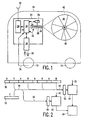
- FIG. 1 shows a motor vehicle provided with a database system according to the invention.
- the vehicle is depicted schematically by means of car body 70 and wheels 72, 74.
- block 20 represents the individual station.
- the database system may be used in various other environments.
- the station is provided with a player for a CDROM disc 38 that is shown inserted in an appropriate berth 40. This berth may be constructed in a way known for commercially available CDROMs; the CDROM disc is removable.
- a mechanical drive motor 36 with a bidirectional connection 34 to central processor 26 for exchanging drive control commands and driving speed sensor signals with the processor.
- Element 32 represents a reading head mechanism with associated servo subsystems for track following, focusing, signal amplification, and bit discrimination, and possibly code byte reconstruction, so that processor 26 receives a stream of formatted code bytes possibly provided with erasure flags or other qualification information.
- reading head mechanism from processor 26 receives control signals such as track addresses for accessing from the CDROM exactly the necessary information.
- the information received from CDROM 36 therewith represents road map information of a region that is suitably chosen under control of processor 26.
- Processor 26 has a bidirectional communication with a symbolically indicated user interface mechanism 28 that has actuators such as keyboard or mouse, and a user output mechanism such as display or speech channel, thereby constituting bidirectional channel 30.
- antenna 22 receives secondary information such as dynamic traffic data.
- the medium for transfer may be cellular radio, other types of broadcast or otherwise.
- the content of the secondary information may be traffic information.
- the secondary information may be amendments on the map data that have occurred through road reconstruction, road damage or changed traffic regulations.
- the secondary information is provisionally processed in block 24 that may contain RAM facilities, in similar way as described for the CDROM information. It may be organized in a secondary database.
- the contents of the primary database may be supplemented and/or updated, first, by changes in road or traffic conditions, second in case of persistent changes with respect to the CDROM data, by a more or less cyclic organization of the broadcasting.
- the processor may then take up the change information according to need.
- the secondary information may be limited to the information considered relevant to the actual radio cell, for example, limited to no more than a predetermined set of surrounding cells thereof.
- the secondary information so taken up is selectively sent to processor 26 under control of processor request signals.
- a user person may now input present position and destination.
- the processor selects adequate map data from CDROM and calculates a global route.
- any dynamic traffic data is selected as far as necessary for complementing the static map data.
- the combined informations now allow the processor to calculate an optimum route for the vehicle. Qualifications to the route may be given on grounds of easy driving, fuel economy, early arrival, scenic roadsides, but also for reasons of fleet management, such as the realization of a rendez vous with another vehicle, or an intermediate visit to a particular customer.
- the calculations take the map data, together with the secondary information to get the optimum route. If no route is possible, a default indication is given.
- the progress of the vehicle along this route is ascertained by means of odometer, compass, and possibly other facilities, to determine actual position. This has been symbolically represented by means of interconnection 76 for the case of an odometer. As based on such actual position, the system by means of audio or video indications directs the driver actions that must be executed next.
- the data from the map, as well as the secondary information are in cleartext, so that no decryption thereof should be necessary other than by a generally known key.
- a certain amount of data is presented in encrypted form. This may pertain to all data, to critical data only, or to a more or less arbitrary selection amongst the data.
- the secondary data may be encrypted.
- the key may be provided in various ways.
- the station in question has a station key, for example, a four-digit number that is stored inside processor 26, and which identifies the station in question. This key is loaded upon manufacturing of the system, but need not be unique to the station. The station key may have an infinitely long validity interval.
- the CDROM disc 42 shown once more, has two distinct regions. The first region is a relatively large read-only region 44 that is shown divided into sectors. Such read-only field is realized by first writing the information serially into a master carrier. Next, some kind of press-type mechanism is used for producing multiple replicas of the master carrier. This technology is in wide use.
- the second region is a relatively small writable region 46, that allows for the writing of one or more decryption keys.
- write part corresponds to the serial write part of the master-type carrier. The difference is, first that two different types of information area are present on the carrier, and second, that the write part must now be able to survive in the less controlled environment of everyday life.
- a 'write part' refers to one or more carrier tracks that allow serial writing.
- Various different technologies have been proposed: the simplest is write-once, wherein a bit, once written, can no more be reversed. A somewhat more complicated technology allows the bits to be reversed, so that new decryption keys and/or new non-key information may be overwritten over old information. The rewriting may be done at special apparatus that are located at some category of vendor. In other cases such rewriting could even be done within the remote station such as the vehicle in question.
- each decryption key may have a unique and prespecified validity interval. If a plurality of decryption keys is present, during a predetermined rather extended time always at least one decryption key thereof may be valid. By way of example, the validity of each separate decryption key may be for two uniquely prespecified months, whilst 18 different keys are present in total, yielding an overall validity of 36 months. Alternatively, a single key with a validity period of three years could have been written.
- the decryption keys are written at delivery time of ne CDROM disc and are specific, but not necessarily unique to the intended user station as represented by the station key thereof: various stations could have the same station key, although the number of stations having a particular station key should be a small fraction of all stations.
- An elementary type of decryption organization is that the single decryption key is read from the write part of the disc. To this effect the key proper may be packetized in a standard data format. The key extracted therefrom may be used in a standard decryption method, such as RSA, DES, or otherwise.
- the key is tested by the processor on actual validity.
- a simple feature is that the key package contains in the clear an indication on its validity period. In case of an invalid key, this is signalled to the user person. Thereupon, the system may either prove unusable completely, or the intended service is only rendered on a lower level. If a plurality of decryption keys is present on the write part, the correct one is accessed by the processor, for example, by searching for the correct validity period. After the correct one has been found, the system is rendered operative. If no correct one can be found the system reacts as explained for a single invalid key.
- the process is as follows. Upon loading the CDROM in the station, first the station key is combined with the actually valid decryption key from the disc. The combining may be done in any way known in digital mathematics, such as finite field addition, multiplication, or a combination thereof, thereby constituting an actual aggregate key.
- the actual aggregate key is now used for decrypting the secondary information that had been encrypted in a variable manner, as determined by the actual instant in time. Note that the validity of the secondary information is of the order of one hour or so.
- the standard information is decrypted by means of a combination of the station key and further decryption key information from the CDROM disc.
- the encryption of the information on the disc is generally uniform in time, so that the aggregate decryption key in this respect must be invariable. Also here, the required decryption may be limited to a particular fraction of the information.
- the aggregate keys, both for the disc information, and for the secondary information must be uniform for the respective stations and discs. A particular realization is that the time-variant aggregate key is produced by the addition of the actual decryption key from the disc to the station key.
- the first one is that a new disc must be acquired, that has new decryption codes thereon, and if applicable, updated standard information.
- a second one is that the standard information is maintained as is, but new decryption codes are overwritten over, or in addition to, the old ones. This may require full rewriting facility for the write part of the disc.
- Figure 2 shows a decryption key system for the invention, together with the two categories of data.
- Block 50 represents four successive decryption keys stored in the write part of the CDROM in question.
- the fields comprise an address A that may indicate the period of validity, and a data subfield B that comprises the key proper.
- Block C represents the station key.
- Indication 54 represents the combining of the station key with an invariable part of the information of the write part. This may be one of the normal decryption codes, or another code.
- the result is a steady key that is stored in register 58 of the station.
- Information from read element 32 may in processing cell 60 be decrypted to yield the necessary information to processor 26.
- the information from the successive decryption key fields 50 is combined with the fixed station key 52 to result 66 that is stored in register 62 of the station.
- Information received on antenna 22, or information selected therefrom as present in element 24 in Figure 1 may then in processing cell 64 be decrypted to yield the necessary information to processor 26.
- Processing cells 60, 64 and associated registers may be mapped on appropriate hardware of the station.
- the combining of the keys may be by digital addition, multiplication, division, and other in a finite field.
Landscapes
- Engineering & Computer Science (AREA)
- Signal Processing (AREA)
- Computer Security & Cryptography (AREA)
- Theoretical Computer Science (AREA)
- Traffic Control Systems (AREA)
- Navigation (AREA)
- Information Retrieval, Db Structures And Fs Structures Therefor (AREA)
- Storage Device Security (AREA)
- Management, Administration, Business Operations System, And Electronic Commerce (AREA)
- Mobile Radio Communication Systems (AREA)
Claims (9)
- Datenbanksystem, bestehend aus einem optisch lesbaren Informationsträger (38) mit lokalen Informationen und einer Einzelstation (20) mit Aufnahmemitteln (40), um den genannten Träger (38) aufzunehmen, Lesemitteln, um den genannten Träger zu lesen, Empfangsmitteln (32), um entfernt bereitgestellte Sekundärinformationen zu empfangen, Verarbeitungsmitteln (24, 26), um die genannten lokalen Informationen und auch die genannten Sekundärinformationen zu verarbeiten und Ausgabeinformationen zu erzeugen, und Benutzeroberflächenmitteln (28), um die genannten Ausgabeinformationen einem Benutzer zu präsentieren, wobei die genannte Einzelstation (20) einen Einzelstationsschlüssel umfasst, dadurch gekennzeichnet, dass der genannte Träger ein Hybridträger mit einem Nur-Lese-Teil ist, und weiterhin ein Schreibteil vorhanden ist, um an mehreren Stellen eine Vielzahl entsprechender Decodierungsschlüssel zu speichern, wobei jeder aus der genannten Vielzahl von Decodierungsschlüsseln an dem genannten Einzelstationsschlüssel beteiligt ist, und wobei die genannten Verarbeitungsmittel dafür eingerichtet sind, die genannten Sekundärinformationen unter Verwendung des genannten mindestens einen Decodierungsschlüssels und des genannten Einzelstationsschlüssels zu decodieren.
- Datenbanksystem nach Anspruch 1, bei dem aus der genannten Vielzahl von Decodierungsschlüsseln gemäß einem vorgegebenen Auswahlzeitplan ein Decodierungsschlüssel ausgewählt wird, wobei der gewählte Decodierungsschlüssel benutzt wird, um die genannten Sekundärinformationen in einer zeitlich begrenzten Weise zu decodieren.
- Datenbanksystem nach Anspruch 2, bei dem die genannten Verarbeitungsmittel (24, 26) dafür eingerichtet sind, die genannten Sekundärinformationen unter Verwendung einer ersten Zusammenstellung aus dem genannten Einzelstationsschlüssel und der genannten Vielzahl von Decodierungsschlüsseln zu decodieren, wobei sich die erste Zusammenstellung mit dem gewählten Decodierungsschlüssel verändert.
- Datenbanksystem nach einem der Ansprüche 1 bis 3, bei dem der genannte Schreibteil nur einmal beschreibbar ist.
- Datenbanksystem nach einem der Ansprüche 1 bis 4, bei dem die genannten Verarbeitungsmittel (24, 26) dafür vorgesehen sind, die genannten lokalen Informationen und die genannten Sekundärinformationen in einem Kraftfahrzeuginformationssystem zu benutzen.
- Datenbanksystem nach einem der Ansprüche 1 bis 5, bei dem die genannte Station (20) dafür eingerichtet ist, die genannten lokalen Informationen unter Verwendung einer zweiten Zusammenstellung aus dem Stationsschlüssel und einem auf dem genannten Träger vorhandenen Decodierungsschlüssel zu decodieren, wobei sich die zweite Zusammenstellung nicht mit dem tatsächlich gewählten Decodierungsschlüssel verändert.
- Datenbanksystem nach einem der Ansprüche 1 bis 6 und mit Schreibmitteln, um eine Auswahl aus den genannten Sekundärinformationen in den genannten Schreibteil zu schreiben.
- Datenbank-Supersystem, bestehend aus einer Vielzahl einzelner Datenbanksysteme nach Anspruch 6, wobei die genannte zweite Zusammenstellung konstant ist, während ein einzelner der genannten Träger benutzt wird.
- Kraftfahrzeug (70) mit einem Datenbanksystem nach einem der Ansprüche 1 bis 7.
Priority Applications (1)
| Application Number | Priority Date | Filing Date | Title |
|---|---|---|---|
| EP95931382A EP0733239B1 (de) | 1994-10-10 | 1995-10-02 | Datenbanksystem mit lokalen informationen, mit dynamischen informationen kombiniert |
Applications Claiming Priority (4)
| Application Number | Priority Date | Filing Date | Title |
|---|---|---|---|
| EP94202918 | 1994-10-10 | ||
| EP94202918 | 1994-10-10 | ||
| EP95931382A EP0733239B1 (de) | 1994-10-10 | 1995-10-02 | Datenbanksystem mit lokalen informationen, mit dynamischen informationen kombiniert |
| PCT/IB1995/000823 WO1996011446A2 (en) | 1994-10-10 | 1995-10-02 | Database system with local information remotely supported with dynamic information |
Publications (2)
| Publication Number | Publication Date |
|---|---|
| EP0733239A1 EP0733239A1 (de) | 1996-09-25 |
| EP0733239B1 true EP0733239B1 (de) | 2003-08-06 |
Family
ID=8217263
Family Applications (1)
| Application Number | Title | Priority Date | Filing Date |
|---|---|---|---|
| EP95931382A Expired - Lifetime EP0733239B1 (de) | 1994-10-10 | 1995-10-02 | Datenbanksystem mit lokalen informationen, mit dynamischen informationen kombiniert |
Country Status (6)
| Country | Link |
|---|---|
| US (1) | US5787170A (de) |
| EP (1) | EP0733239B1 (de) |
| JP (1) | JPH09507598A (de) |
| KR (1) | KR100415872B1 (de) |
| DE (1) | DE69531447T2 (de) |
| WO (1) | WO1996011446A2 (de) |
Families Citing this family (33)
| Publication number | Priority date | Publication date | Assignee | Title |
|---|---|---|---|---|
| JP3743037B2 (ja) * | 1995-11-01 | 2006-02-08 | 株式会社日立製作所 | 移動端末への情報提供方法、情報提供システム及び移動端末 |
| JP4599657B2 (ja) * | 1999-07-07 | 2010-12-15 | ソニー株式会社 | データ提供システム、コンテンツ提供装置、およびコンテンツ処理装置 |
| DE19946870B4 (de) * | 1999-09-30 | 2006-08-03 | Robert Bosch Gmbh | Abspielgerät |
| EP1338943A3 (de) * | 2000-03-30 | 2006-09-27 | Siemens Aktiengesellschaft | Verfahren zur Freischaltung einer Datei in einem Navigationssystem |
| US7412598B1 (en) * | 2000-12-29 | 2008-08-12 | Cisco Technology, Inc. | Method and system for real-time insertion of service during a call session over a communication network |
| WO2002101593A2 (en) * | 2001-06-08 | 2002-12-19 | Idcomm, Inc. | System and method for managing historical information on an object on an electronic tag |
| JP4422372B2 (ja) * | 2001-10-23 | 2010-02-24 | トヨタ自動車株式会社 | 地図データ処理装置 |
| DE10155485B4 (de) * | 2001-11-13 | 2018-05-09 | Robert Bosch Gmbh | Informationsträger, Fahrerinformationsvorrichtung und Verfahren zur Freischaltung von Daten |
| FI114063B (fi) * | 2002-09-02 | 2004-07-30 | Tekla Corp | Järjestely ja menetelmä liikuteltavan kenttälaitteen sovittamiseksi |
| KR100999769B1 (ko) * | 2003-06-18 | 2010-12-08 | 파나소닉 주식회사 | 암호화 가상패키지의 재생장치, 재생방법 및 프로그램 |
| EP1524659A1 (de) * | 2003-10-13 | 2005-04-20 | Deutsche Thomson-Brandt Gmbh | Verfahren und Vorrichtung um einen verschlüsselten Zusatzdatensatz zu entschlüsseln |
| WO2005048603A1 (en) * | 2003-11-13 | 2005-05-26 | Koninklijke Philips Electronics N.V. | Conditional access method and devices |
| EP1624287B1 (de) * | 2004-07-06 | 2015-04-08 | Harman Becker Automotive Systems GmbH | Datensicherheitssystem für ein Fahrzeugnavigationssystem und Verfahren zur Datenübertragung zum Fahrzeugnavigationssystem |
| CN101872633B (zh) * | 2004-07-22 | 2012-11-28 | 松下电器产业株式会社 | 重放装置和重放方法 |
| US7609945B2 (en) | 2004-08-17 | 2009-10-27 | Lg Electronics Inc. | Recording medium, and method and apparatus for reproducing data from the recording medium |
| US7725010B2 (en) | 2004-08-17 | 2010-05-25 | Lg Electronics, Inc. | Method and apparatus of reproducing data recorded on recording medium and local storage |
| US7609939B2 (en) | 2004-08-17 | 2009-10-27 | Lg Electronics Inc. | Method and apparatus of reproducing data recorded on recording medium and local storage |
| US7613384B2 (en) | 2004-08-17 | 2009-11-03 | Lg Electronics Inc. | Method for configuring composite file structure for data reproduction, and method and apparatus for reproducing data using the composite file structure |
| KR20060065474A (ko) * | 2004-09-13 | 2006-06-14 | 엘지전자 주식회사 | 로컬스토리지를 이용한 기록매체 재생방법 및 재생장치 |
| US7599611B2 (en) | 2004-09-13 | 2009-10-06 | Lg Electronics Co. | Recording medium, and method and apparatus of reproducing data recorded on the same |
| RU2383946C2 (ru) * | 2004-09-13 | 2010-03-10 | Эл Джи Электроникс Инк. | Способ и устройство для воспроизведения данных, записанных на носителе записи, используя локальный накопитель |
| WO2006041257A2 (en) * | 2004-10-12 | 2006-04-20 | Lg Electronics Inc. | Method and apparatus for reproducing data from recording medium using local storage |
| KR20060047549A (ko) | 2004-10-12 | 2006-05-18 | 엘지전자 주식회사 | 로컬 스토리지를 이용한 기록매체 재생방법 및 재생장치 |
| US7783161B2 (en) | 2004-11-08 | 2010-08-24 | Lg Electronics Inc. | Method and apparatus for reproducing data from recording medium using local storage |
| KR20060063601A (ko) * | 2004-12-03 | 2006-06-12 | 엘지전자 주식회사 | 로컬 스토리지에 데이터를 다운로드/업데이트 하는 방법 및장치 |
| KR20060065476A (ko) | 2004-12-10 | 2006-06-14 | 엘지전자 주식회사 | 기록매체, 기록매체 내의 콘텐츠 서치방법 및 기록매체재생방법과 재생장치 |
| KR20060081323A (ko) | 2005-01-07 | 2006-07-12 | 엘지전자 주식회사 | 로컬 스토리지를 이용한 기록매체 재생방법 및 재생장치 |
| WO2006078100A2 (en) * | 2005-01-19 | 2006-07-27 | Lg Electronics Inc. | Recording medium, apparatus for decrypting data and method thereof |
| KR101147763B1 (ko) | 2005-01-19 | 2012-05-25 | 엘지전자 주식회사 | 데이터 복호방법 및 복호장치, 기록매체 |
| DE102005029594B4 (de) | 2005-06-23 | 2007-04-05 | Bury Sp.Z.O.O | Navigationsanlage und Verfahren zur Extraktion von verschlüsselt übertragenen Informationen |
| JP4633747B2 (ja) | 2007-01-17 | 2011-02-16 | アイシン・エィ・ダブリュ株式会社 | 情報配信システム及び情報配信方法 |
| US8334891B2 (en) | 2007-03-05 | 2012-12-18 | Cisco Technology, Inc. | Multipoint conference video switching |
| US8264521B2 (en) * | 2007-04-30 | 2012-09-11 | Cisco Technology, Inc. | Media detection and packet distribution in a multipoint conference |
Family Cites Families (9)
| Publication number | Priority date | Publication date | Assignee | Title |
|---|---|---|---|---|
| ES8305961A1 (es) * | 1980-09-26 | 1983-04-16 | Loefberg Bo | Procedimiento para procesar una senal de informacion codifi-cada |
| US5247575A (en) * | 1988-08-16 | 1993-09-21 | Sprague Peter J | Information distribution system |
| US5185857A (en) * | 1989-12-13 | 1993-02-09 | Rozmanith A Martin | Method and apparatus for multi-optional processing, storing, transmitting and retrieving graphical and tabular data in a mobile transportation distributable and/or networkable communications and/or data processing system |
| GB9012601D0 (en) * | 1990-06-06 | 1990-07-25 | Poulter Graham Plc | Display system and method |
| US5172321A (en) * | 1990-12-10 | 1992-12-15 | Motorola, Inc. | Vehicle route planning system |
| JP2942837B2 (ja) * | 1992-01-31 | 1999-08-30 | 株式会社セガ・エンタープライゼス | セキュリティチェック方法及びゲーム装置並びにそれらに用いられる情報記憶媒体 |
| EP0711479A4 (de) * | 1993-07-26 | 1996-10-02 | Elonex Technologies Inc | Verschlüsselungssystem für ein cd-prom |
| US5450489A (en) * | 1993-10-29 | 1995-09-12 | Time Warner Entertainment Co., L.P. | System and method for authenticating software carriers |
| US5394469A (en) * | 1994-02-18 | 1995-02-28 | Infosafe Systems, Inc. | Method and apparatus for retrieving secure information from mass storage media |
-
1995
- 1995-10-02 KR KR1019960703031A patent/KR100415872B1/ko not_active Expired - Fee Related
- 1995-10-02 WO PCT/IB1995/000823 patent/WO1996011446A2/en not_active Ceased
- 1995-10-02 JP JP8512451A patent/JPH09507598A/ja not_active Withdrawn
- 1995-10-02 DE DE69531447T patent/DE69531447T2/de not_active Expired - Fee Related
- 1995-10-02 EP EP95931382A patent/EP0733239B1/de not_active Expired - Lifetime
-
1997
- 1997-10-06 US US08/944,111 patent/US5787170A/en not_active Expired - Fee Related
Also Published As
| Publication number | Publication date |
|---|---|
| DE69531447T2 (de) | 2004-07-01 |
| WO1996011446A2 (en) | 1996-04-18 |
| US5787170A (en) | 1998-07-28 |
| KR960706661A (ko) | 1996-12-09 |
| KR100415872B1 (ko) | 2004-04-30 |
| EP0733239A1 (de) | 1996-09-25 |
| DE69531447D1 (de) | 2003-09-11 |
| WO1996011446A3 (en) | 1996-06-20 |
| JPH09507598A (ja) | 1997-07-29 |
Similar Documents
| Publication | Publication Date | Title |
|---|---|---|
| US5787170A (en) | Database system with local information remotely supported with dynamic information | |
| AU782849B2 (en) | Motor vehicle navigation system, method and storage medium | |
| US7640595B2 (en) | Computing system with decryption functions and secure data product | |
| US6360167B1 (en) | Vehicle navigation system with location-based multi-media annotation | |
| JP4711994B2 (ja) | ナビゲーション装置及びその地図データ更新方法 | |
| US6978021B1 (en) | Encryption method for distribution of data | |
| US6694251B2 (en) | Information processing apparatus and method, recording medium, and program | |
| CN101540111B (zh) | 在交通消息旁边提供赞助信息 | |
| EP0290679A1 (de) | Einrichtung für Empfang und Verarbeitung von Strassennachrichtenmeldungen | |
| JPH0786737B2 (ja) | 車載ナビゲーション装置 | |
| US6970782B2 (en) | System for updating navigation information and apparatus for distributing updated navigation information | |
| US20060190507A1 (en) | Method of generating map update process data, map update method, and map update apparatus | |
| US6233521B1 (en) | Map database apparatus | |
| US20050021510A1 (en) | Data search apparatus and method, navigation apparatus and method, data set and computer program product for data search | |
| JPH0786738B2 (ja) | 車載ナビゲーション装置 | |
| US8209113B2 (en) | Programmable route specific dynamic traffic warning system with segmentation identifiers | |
| US7945380B2 (en) | Method for navigation of a vehicle | |
| US7617045B2 (en) | Programmable route specific dynamic traffic warning system | |
| KR101167307B1 (ko) | 네비게이션 데이터를 차량 네비게이션 시스템에 전송하기위한 차량 네비게이션 시스템 및 방법용의 데이터 보안시스템 | |
| Thoone et al. | Application of the Compact Disc in Car Information and Navigation Systems | |
| US20050169472A1 (en) | Prepaid card type data recording medium, recording apparatus thereof, apparatus for providing contents, and method used for authenticating the data recording medium | |
| JP2009294890A (ja) | 配信システム及び車載器 | |
| KR19980023112A (ko) | 자동차용 항법시스템 | |
| JP3377099B2 (ja) | ナビゲーション装置 | |
| JP2003029770A (ja) | レンタカーシステム及びその車両装置 |
Legal Events
| Date | Code | Title | Description |
|---|---|---|---|
| PUAI | Public reference made under article 153(3) epc to a published international application that has entered the european phase |
Free format text: ORIGINAL CODE: 0009012 |
|
| AK | Designated contracting states |
Kind code of ref document: A1 Designated state(s): DE FR GB IT |
|
| 17P | Request for examination filed |
Effective date: 19961018 |
|
| 17Q | First examination report despatched |
Effective date: 19991209 |
|
| GRAH | Despatch of communication of intention to grant a patent |
Free format text: ORIGINAL CODE: EPIDOS IGRA |
|
| GRAH | Despatch of communication of intention to grant a patent |
Free format text: ORIGINAL CODE: EPIDOS IGRA |
|
| GRAA | (expected) grant |
Free format text: ORIGINAL CODE: 0009210 |
|
| AK | Designated contracting states |
Designated state(s): DE FR GB IT |
|
| REG | Reference to a national code |
Ref country code: GB Ref legal event code: FG4D |
|
| REF | Corresponds to: |
Ref document number: 69531447 Country of ref document: DE Date of ref document: 20030911 Kind code of ref document: P |
|
| PGFP | Annual fee paid to national office [announced via postgrant information from national office to epo] |
Ref country code: DE Payment date: 20031215 Year of fee payment: 9 |
|
| ET | Fr: translation filed | ||
| PLBE | No opposition filed within time limit |
Free format text: ORIGINAL CODE: 0009261 |
|
| STAA | Information on the status of an ep patent application or granted ep patent |
Free format text: STATUS: NO OPPOSITION FILED WITHIN TIME LIMIT |
|
| 26N | No opposition filed |
Effective date: 20040507 |
|
| PGFP | Annual fee paid to national office [announced via postgrant information from national office to epo] |
Ref country code: FR Payment date: 20041027 Year of fee payment: 10 |
|
| PGFP | Annual fee paid to national office [announced via postgrant information from national office to epo] |
Ref country code: GB Payment date: 20041028 Year of fee payment: 10 |
|
| PG25 | Lapsed in a contracting state [announced via postgrant information from national office to epo] |
Ref country code: DE Free format text: LAPSE BECAUSE OF NON-PAYMENT OF DUE FEES Effective date: 20050503 |
|
| PG25 | Lapsed in a contracting state [announced via postgrant information from national office to epo] |
Ref country code: IT Free format text: LAPSE BECAUSE OF NON-PAYMENT OF DUE FEES Effective date: 20051002 Ref country code: GB Free format text: LAPSE BECAUSE OF NON-PAYMENT OF DUE FEES Effective date: 20051002 |
|
| GBPC | Gb: european patent ceased through non-payment of renewal fee |
Effective date: 20051002 |
|
| PG25 | Lapsed in a contracting state [announced via postgrant information from national office to epo] |
Ref country code: FR Free format text: LAPSE BECAUSE OF NON-PAYMENT OF DUE FEES Effective date: 20060630 |
|
| REG | Reference to a national code |
Ref country code: FR Ref legal event code: ST Effective date: 20060630 |