EP0730855A2 - Patientenhebevorrichtung geeignet für die horizontale Beförderung - Google Patents
Patientenhebevorrichtung geeignet für die horizontale Beförderung Download PDFInfo
- Publication number
- EP0730855A2 EP0730855A2 EP96103696A EP96103696A EP0730855A2 EP 0730855 A2 EP0730855 A2 EP 0730855A2 EP 96103696 A EP96103696 A EP 96103696A EP 96103696 A EP96103696 A EP 96103696A EP 0730855 A2 EP0730855 A2 EP 0730855A2
- Authority
- EP
- European Patent Office
- Prior art keywords
- seat
- lifting apparatus
- frame portion
- holding
- lifting
- Prior art date
- Legal status (The legal status is an assumption and is not a legal conclusion. Google has not performed a legal analysis and makes no representation as to the accuracy of the status listed.)
- Withdrawn
Links
Images



Classifications
-
- A—HUMAN NECESSITIES
- A61—MEDICAL OR VETERINARY SCIENCE; HYGIENE
- A61G—TRANSPORT, PERSONAL CONVEYANCES, OR ACCOMMODATION SPECIALLY ADAPTED FOR PATIENTS OR DISABLED PERSONS; OPERATING TABLES OR CHAIRS; CHAIRS FOR DENTISTRY; FUNERAL DEVICES
- A61G7/00—Beds specially adapted for nursing; Devices for lifting patients or disabled persons
- A61G7/05—Parts, details or accessories of beds
- A61G7/053—Aids for getting into, or out of, bed, e.g. steps, chairs, cane-like supports
-
- A—HUMAN NECESSITIES
- A61—MEDICAL OR VETERINARY SCIENCE; HYGIENE
- A61G—TRANSPORT, PERSONAL CONVEYANCES, OR ACCOMMODATION SPECIALLY ADAPTED FOR PATIENTS OR DISABLED PERSONS; OPERATING TABLES OR CHAIRS; CHAIRS FOR DENTISTRY; FUNERAL DEVICES
- A61G5/00—Chairs or personal conveyances specially adapted for patients or disabled persons, e.g. wheelchairs
- A61G5/10—Parts, details or accessories
- A61G5/1091—Cushions, seats or abduction devices
-
- A—HUMAN NECESSITIES
- A61—MEDICAL OR VETERINARY SCIENCE; HYGIENE
- A61G—TRANSPORT, PERSONAL CONVEYANCES, OR ACCOMMODATION SPECIALLY ADAPTED FOR PATIENTS OR DISABLED PERSONS; OPERATING TABLES OR CHAIRS; CHAIRS FOR DENTISTRY; FUNERAL DEVICES
- A61G5/00—Chairs or personal conveyances specially adapted for patients or disabled persons, e.g. wheelchairs
- A61G5/10—Parts, details or accessories
- A61G5/1094—Tables, working plates or trays
-
- A—HUMAN NECESSITIES
- A61—MEDICAL OR VETERINARY SCIENCE; HYGIENE
- A61G—TRANSPORT, PERSONAL CONVEYANCES, OR ACCOMMODATION SPECIALLY ADAPTED FOR PATIENTS OR DISABLED PERSONS; OPERATING TABLES OR CHAIRS; CHAIRS FOR DENTISTRY; FUNERAL DEVICES
- A61G5/00—Chairs or personal conveyances specially adapted for patients or disabled persons, e.g. wheelchairs
- A61G5/10—Parts, details or accessories
- A61G5/12—Rests specially adapted therefor, e.g. for the head or the feet
- A61G5/128—Rests specially adapted therefor, e.g. for the head or the feet for feet
-
- A—HUMAN NECESSITIES
- A61—MEDICAL OR VETERINARY SCIENCE; HYGIENE
- A61G—TRANSPORT, PERSONAL CONVEYANCES, OR ACCOMMODATION SPECIALLY ADAPTED FOR PATIENTS OR DISABLED PERSONS; OPERATING TABLES OR CHAIRS; CHAIRS FOR DENTISTRY; FUNERAL DEVICES
- A61G7/00—Beds specially adapted for nursing; Devices for lifting patients or disabled persons
- A61G7/10—Devices for lifting patients or disabled persons, e.g. special adaptations of hoists thereto
- A61G7/1013—Lifting of patients by
- A61G7/1015—Cables, chains or cords
-
- A—HUMAN NECESSITIES
- A61—MEDICAL OR VETERINARY SCIENCE; HYGIENE
- A61G—TRANSPORT, PERSONAL CONVEYANCES, OR ACCOMMODATION SPECIALLY ADAPTED FOR PATIENTS OR DISABLED PERSONS; OPERATING TABLES OR CHAIRS; CHAIRS FOR DENTISTRY; FUNERAL DEVICES
- A61G7/00—Beds specially adapted for nursing; Devices for lifting patients or disabled persons
- A61G7/10—Devices for lifting patients or disabled persons, e.g. special adaptations of hoists thereto
- A61G7/104—Devices carried or supported by
- A61G7/1046—Mobile bases, e.g. having wheels
-
- A—HUMAN NECESSITIES
- A61—MEDICAL OR VETERINARY SCIENCE; HYGIENE
- A61G—TRANSPORT, PERSONAL CONVEYANCES, OR ACCOMMODATION SPECIALLY ADAPTED FOR PATIENTS OR DISABLED PERSONS; OPERATING TABLES OR CHAIRS; CHAIRS FOR DENTISTRY; FUNERAL DEVICES
- A61G7/00—Beds specially adapted for nursing; Devices for lifting patients or disabled persons
- A61G7/10—Devices for lifting patients or disabled persons, e.g. special adaptations of hoists thereto
- A61G7/1049—Attachment, suspending or supporting means for patients
- A61G7/1051—Flexible harnesses or slings
-
- A—HUMAN NECESSITIES
- A61—MEDICAL OR VETERINARY SCIENCE; HYGIENE
- A61G—TRANSPORT, PERSONAL CONVEYANCES, OR ACCOMMODATION SPECIALLY ADAPTED FOR PATIENTS OR DISABLED PERSONS; OPERATING TABLES OR CHAIRS; CHAIRS FOR DENTISTRY; FUNERAL DEVICES
- A61G7/00—Beds specially adapted for nursing; Devices for lifting patients or disabled persons
- A61G7/10—Devices for lifting patients or disabled persons, e.g. special adaptations of hoists thereto
- A61G7/1073—Parts, details or accessories
- A61G7/1078—Clamps for flexible harnesses
-
- A—HUMAN NECESSITIES
- A61—MEDICAL OR VETERINARY SCIENCE; HYGIENE
- A61G—TRANSPORT, PERSONAL CONVEYANCES, OR ACCOMMODATION SPECIALLY ADAPTED FOR PATIENTS OR DISABLED PERSONS; OPERATING TABLES OR CHAIRS; CHAIRS FOR DENTISTRY; FUNERAL DEVICES
- A61G7/00—Beds specially adapted for nursing; Devices for lifting patients or disabled persons
- A61G7/10—Devices for lifting patients or disabled persons, e.g. special adaptations of hoists thereto
- A61G7/1073—Parts, details or accessories
- A61G7/1082—Rests specially adapted for
- A61G7/1092—Rests specially adapted for the arms
-
- A—HUMAN NECESSITIES
- A61—MEDICAL OR VETERINARY SCIENCE; HYGIENE
- A61G—TRANSPORT, PERSONAL CONVEYANCES, OR ACCOMMODATION SPECIALLY ADAPTED FOR PATIENTS OR DISABLED PERSONS; OPERATING TABLES OR CHAIRS; CHAIRS FOR DENTISTRY; FUNERAL DEVICES
- A61G7/00—Beds specially adapted for nursing; Devices for lifting patients or disabled persons
- A61G7/10—Devices for lifting patients or disabled persons, e.g. special adaptations of hoists thereto
- A61G7/1073—Parts, details or accessories
- A61G7/1082—Rests specially adapted for
- A61G7/1098—Ankle or foot
-
- A—HUMAN NECESSITIES
- A61—MEDICAL OR VETERINARY SCIENCE; HYGIENE
- A61G—TRANSPORT, PERSONAL CONVEYANCES, OR ACCOMMODATION SPECIALLY ADAPTED FOR PATIENTS OR DISABLED PERSONS; OPERATING TABLES OR CHAIRS; CHAIRS FOR DENTISTRY; FUNERAL DEVICES
- A61G2200/00—Information related to the kind of patient or his position
- A61G2200/30—Specific positions of the patient
- A61G2200/34—Specific positions of the patient sitting
-
- A—HUMAN NECESSITIES
- A61—MEDICAL OR VETERINARY SCIENCE; HYGIENE
- A61G—TRANSPORT, PERSONAL CONVEYANCES, OR ACCOMMODATION SPECIALLY ADAPTED FOR PATIENTS OR DISABLED PERSONS; OPERATING TABLES OR CHAIRS; CHAIRS FOR DENTISTRY; FUNERAL DEVICES
- A61G5/00—Chairs or personal conveyances specially adapted for patients or disabled persons, e.g. wheelchairs
- A61G5/10—Parts, details or accessories
- A61G5/1056—Arrangements for adjusting the seat
- A61G5/1059—Arrangements for adjusting the seat adjusting the height of the seat
-
- A—HUMAN NECESSITIES
- A61—MEDICAL OR VETERINARY SCIENCE; HYGIENE
- A61G—TRANSPORT, PERSONAL CONVEYANCES, OR ACCOMMODATION SPECIALLY ADAPTED FOR PATIENTS OR DISABLED PERSONS; OPERATING TABLES OR CHAIRS; CHAIRS FOR DENTISTRY; FUNERAL DEVICES
- A61G7/00—Beds specially adapted for nursing; Devices for lifting patients or disabled persons
- A61G7/10—Devices for lifting patients or disabled persons, e.g. special adaptations of hoists thereto
- A61G7/1001—Devices for lifting patients or disabled persons, e.g. special adaptations of hoists thereto specially adapted for specific applications
- A61G7/1007—Devices for lifting patients or disabled persons, e.g. special adaptations of hoists thereto specially adapted for specific applications mounted on or in combination with a toilet
Definitions
- the present invention relates to a floor-traveling lifting apparatus for use in helping aged bedridden disabled persons, for example, to keep a sitting position and in transferring those disabled or having difficulty in walking from beds to other places so that they may relieve themselves, take meals and a rest in a sitting position while they are taken care of at home, or nursed at hospitals or welfare facilities.
- lifting apparatus of the sort intended for transferring disabled persons who are bedridden or have difficulty in walking have been classified broadly into three types.
- a typical conventional lifting apparatus is intended primarily to transfer disabled persons when they need transferring to another chair or a wheelchair so as to sustain them in a sitting position in any other place other than the bed and therefore two steps have been followed; namely, steps of fitting the disabled person with a sling seat for supporting the body (by slipping belts and the seat under the loin and the back, and securing then to the lifting apparatus) and subsequently removing the sling seat from him/her on the chair thus moved (by removing the belts from the lifting apparatus and pulling the seat and the belts from under the loin).
- steps of fitting the disabled person with a sling seat for supporting the body by slipping belts and the seat under the loin and the back, and securing then to the lifting apparatus
- subsequently removing the sling seat from him/her on the chair thus moved (by removing the belts from the lifting apparatus and pulling the seat and the belts from under the loin).
- the aforementioned two steps have been followed likewise.
- the problem is that attendants using such conventional lifting
- the conventional sling seat is a soft sewn product
- the thighs, loin, back and like of the disabled person thus lifted tends to become accustomed therewith and the advantage is that the curved condition of a hammock set him/her free from being hurt by the load, whereas the disadvantage is that he/she has no freedom to move the body because of the pressure applied from both sides and is unable to stand this condition for hours.
- a floor-traveling lifting apparatus comprises:
- the body of the lifting apparatus is of a floor-traveling type with casters and the two upper frames are each provided with arms for holding a disabled person in a sitting position from both sides.
- a buckle fixing part is formed in two places on the front side and two places on the rear side, that is, four places in total, so that a sling seat is detachably fitted to these arms.
- a table and a handle are integrally formed with the lifting apparatus, whereby the disabled person can have meals thereon, whereas an attendant is able to move the lifting apparatus with that handle.
- the whole upper frame portion is made vertically slidable with respect to the lower frame portion.
- the sling seat for sustaining the sitting position incorporates seat, back and lifting belts with buckles and back-holding belts for holding the angle of the seat back.
- the seat and back portions each contain hard members resistant to a load and soft members for placing the contact side of the body in position with ease. Further, the seat and back portions are capable of bending to any angle.
- the upper frame portion is provided with detachable thigh-holding fixtures and a waist-holding sewn product capable of holding the waist in such a manner as to wrapping the whole waist, the sewn product having a metal fixture an both sides.
- the thigh-holding fixtures and the waist-holding sewn product can be fastened while the disabled person is sitting on the sling seat for sustaining the sitting position and even when the sling seat therefor is removed after the fixtures and sewn product have been fastened, the body of the disabled person is held for excreting purposes.
- a procedure for transferring the aged disabled person laid on the bed to the sling seat comprises the steps of: turning the face of the disabled person sideways and flatly laying out the sling seat for sustaining the sitting position in the place where he/she has lain on his/her back on the bed; returning the disabled person to the original upward position and placing him/her on the sling seat for sustaining the sitting position; letting an attendant raise the back portion of the sling seat and the back of the disabled person with one hand and pushing his/her legs with the other hand to turn the sling seat together with the legs by 90° and making him/her sit on the edge of the bed.
- the seat portion is easily turnable since it is hard in the lateral direction; fastening together the buckles of the belts for holding the back of the sling seat.
- the sling seat for sustaining the sitting position is of a truss structure as laterally viewed and only by letting the disabled person lean against its back, he/she may be able to sustain the sitting position on the edge of the bed); moving the lifting apparatus body from the front side of the bed edge where the disabled person is sitting and locking the casters; lowering the whole upper frame portion and setting the lifting belts in an easy-to-fit position; fastening the buckles of the four lifting belts attached to the sling seat to the respective arms of the lifting apparatus body one after another; elevating the whole upper frame portion and making the disabled person float above the bed; moving the lifting apparatus the bed while holding the its handle; sliding the whole upper frame portion vertically to adjust its height suitably as the disabled person desires; and moving the lifting apparatus inside the bed room to transfer it to any other
- the above steps are followed to ensure that the disabled person is allowed to sustain a truly-intended sitting position with his/her lower legs kept in the upright position which is never attainable on the bed and the waist is set free from any lateral pressure. Since the seat and back faces for supporting the body are made of soft material, the equipment is capable of offering the sitting position for hours. Further, the two arms suspending the seat serve as armrests, so that such a comfortable sitting position is offered.
- the whole seat Since the whole seat is in the suspended condition, it follows a variable balance even when the body of the disabled person is tilted to the left or right, and he/she may feel a great deal of comfortable sitting.
- a disabled person who is half paralyzed may be allowed to sustain the sitting position without any increase in a care work load on the part of the attendant for reasons including having the balance of the seat followed, allowing the two arms to be used as armrests, and making the back-holding belts receive the lateral load.
- the nursing work which has conventionally necessitated two steps of fitting the sling seat to the disabled person when he/she is made to sit in the seat and removing it from him/her when he/she is dropped in a chair is reducible as the work can be done with only one step.
- the care work load is halved with the effect of not solely making the attendant feel relieved but also letting the use of equipment last longer.
- An excretory procedure comprises the following steps of: fitting the thigh-holding fixtures into the fixing portion for fixing the thigh-holding fixtures of the lifting apparatus body one by one while the disabled person is sitting in the sling seat for sustaining the sitting position; winding the sewn product for holding the waist of the disabled person on his/her waist and fitting both fixing hooks to the handle while slightly tilting himself/herself forward; unfastening the buckles of the sling seat for sustaining the sitting position mounted until then and removing the whole sling seat; moving the lifting apparatus up to a household toilet when it can be moved thereto or up to a portable toilet when it is difficult to move thereto in view of housing environment; stripping off clothing in the lower half of the disabled person' body up to the thigh-holding fixtures and lowering the whole upper frame portion until it contacts the sitting position of the toilet for excreting purposes.
- the posture of holding the disabled person at this time is not so effective as to sustain him/her for hours, it is only necessary for him/her to be held during the time he/she is moved to a toilet seat before being undressed and redressed. Therefore, the disabled person is set free from dependence (i.e., free from diapers).
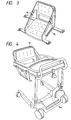
- a lifting apparatus body 1 is, as shown in Fig. 1, U-shaped in construction and its lower frame portion 3 is allowed to slide under a bed even when a disabled person is lifted to ensure safety in view of not only strength but also the gravity position (in this case, the U-shaped coupled rod side is called the "front side” and the open side the “rear side”).
- the lower frame portion 3 is provided with wheels so as to make the lifting apparatus capable of traveling on the floor. Further, there are four wheels as casters 4 fitted to a lifting apparatus body 1 so as to render the body 1 stable and turnable even in a small room.
- Arms 5 for the respective rear wheels in the lower frame portion 3 are situated closer to the floor so that they can correspond to a narrow space under the bed and the small-sized casters 4 are fitted to the respective arms 5, whereas the large-sized casters 4 are used as the front wheels to increase their traveling force and to make them easily turnable.
- Two lower sliding frames 6 for making an upper frame portion 2 vertically slidable from both sides of the upper frame portion 2 are provided in such a manner that these frames are slightly tilted forward and integral with the lower frame portion 3.
- the reason for the provision of the lower sliding frame 6 on both sides is to secure a space sufficient for the disabled person in a sitting position to put his/her feet thereon.
- the reason for the provision of the lower frame portion 3 tilted forward is to secure a stepping space sufficient for an attendant to be set free from hitting his/her foot against the lower frame portion 3 while holding the handle 11 to move the lifting apparatus.
- the reason for the provision of the lower frame portion 3 tilted forward is also to make the gravity slightly close to the rear wheel side in a lower position when the disabled person placed on the lifting apparatus is lifted and to make the gravity slightly close to the front wheel side in a high position when he/she placed thereon is lifted; this is intended to shorten the distance between the front and rear wheels (the wheel base), that is, to provide a compact, easy-to-turn construction.
- the upper frame portion 2 is equipped with the sling arm 7 on both sides so that the sling seat for sustaining the sitting position of the disabled person is readily stabilized during the time he/she is held from both sides in that sitting position, a table 9 for letting the disabled person take meals, for example, by himself/herself and a handle 11 which the attendant uses for moving the lifting apparatus, the table 9 and the handle 11 being integral with the upper frame portion 2.
- the sling arm portion 7 is provided with a buckle fixing portion for fixedly slinging the seat for sustaining the sitting position and a fixing portion 10 for fixing thigh-holding fixtures at the time of excretion.
- Upper sliding frames 13 with rollers corresponding to the respective lower sliding frames 6 are integrally formed with the lower portion of the upper frame portion 2 on the handle side, the whole upper free portion 2 being vertically slidable.
- a foot step 14 for securing a predetermined height with respect to the upper frame portion 2 is provided under the upper sliding frames 13, whereby a space 14a for receiving feet is formed.
- the aforementioned height is generally set so that the soles of any disabled person's feet can totally contact the foot step 14 when he/she takes a sling seat for keeping the sitting position. Since the disabled person's feet are always in contact with the ground even when the surface of the seat is lifted or lowered, he/she is able to feel free from anxiety.
- the foot step 14 is also structured so that it is pushed forward by the tilted face of the lowered frame when the upper frame portion 2 is lowered up to a predetermined height and lowered further after it abuts against the lower frame portion 3; this is because toilet seats are generally low in height, it has been arranged that the knees of disabled persons are prevented from hitting the upper frame portion 2 at the time of excretion.
- FIG. 6 is a theoretic mechanism drawing illustrating an inexpensive mechanical method of lifting and lowering the upper frame portion 2 employed according to this embodiment of the invention.
- the lifting/lowering principle will subsequently be described.
- the aforementioned mechanism comprises a lift operating handle 12, a worm gear 25, a belt-winding roller 32 with a gear, a lifting belt 26, a roller A 30 and a roller B 31.
- the lifting belt 26 is passed through a slot provided in the belt-winding roller 32, bilaterally symmetrically turned by 90° and passed by the rollers B 31, A 30 before being anchored to the respective lower sliding frames 6.
- the upper frame portion 2 is set in the lowermost position in this state.
- the roller A 30 acts as a pulley for halving the winding force and when the lift operating handle 12 is turned with a force of about 2 kgs.
- a disabled person weighing 60 kgs. can be lifted and lowered.
- the upper frame portion 2 is set in the lowermost position first when the attendant is a left-handed person and then the lift operating handle 12 is turned counterclockwise to lift the upper frame portion 2.
- the purpose of lifting the upper frame portion 2 can be achieved by turning the lift operating handle 12 clockwise or counterclockwise.
- the use of the worm gear 25 allows that any desired height to be kept without mechanically locking the lift operating handle 12.
- a motor may be added to the aforementioned construction to facilitate the operation.
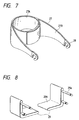
- the sling seat for sustaining the sitting position of the disabled person includes: a seat portion 19, a back portion 20, belts 17, 18 with lifting buckles, and detachable back-holding belts 16, 16a, 16b for holding the angle between the seat and the back, these being integral with the sling seat.
- the seat portion 19 and the back portion 20 are so structured as to form any desired angle.
- the seat portion 19 and the back portion 20 each contain hard members 22 for preventing both the portions from bending even when the body weight is put thereon and when the leaning force is applied thereto, and soft members 23 made of foamed urethane, for example, for placing the contact side of the body in position with ease.
- surface covers are attached by sewing to cover the seat portion 19 and the back portion 20 respectively, and the belts are rigidly secured by sewing to the designated places.
- a moisture-absorption plywood board is used as the hard member 22 in the seat portion 19, and a combination of metal pipes and a plywood board is used in the back portion 20 because there exists an open hip portion 21.
- the provision of the open hip portion 21 has two objects: (1) one object is to provide a relief for the hip portion because the disabled person tends to sit deep and lean against the back portion 20 so as to sustain the sitting position for hours; and (2) the other object is to improve air permeability in the sultry summer season.
- the surface cover 24 has the back made of smooth cloth and a non-slippery seat side intermittently made of rubber. This is because the disabled person is prevented from tumbling down forward while in the sitting position and because the sling seat itself is made easily turnable with respect to the bed while transferred on the bed.
- the back-holding belts 16 are used to tie the seat and back sides rigidly.
- a length-adjusting mechanism is provided on the seat side, whereby the back angle is made adjustable.
- a high back type capable of holding the neck and the head may be used as another variation of the sling seat for sustaining the sitting position.
- waist-holding fixtures 27 and thigh-holding fixtures 29 are employed at the time of excretion.
- the thigh-holding fixtures 29 include a plurality of fixed pins 29a and thigh-mounting members 29b, and metal members whose surfaces are each covered with soft material, whereby part of the body weight is supported with the thigh portion.
- An excretory sling seat conventionally employed for lifting and moving the body of the disabled person from the bed directly for excreting purposes is needless to say prepared, the excretory sling seat being in the form of a cloth hammock for hanging the waist, the loin and the thighs of the disabled person.
- the disabled person is allowed actually to keep a sitting position with the lower legs set upright and the soles in touch with the ground, that position being never attainable on the bed. It is the first step to recover the physical strength.
- the seat and back sides for use in holding the body are made of soft material and open in structure so as to allow anyone to sit deep therein, whereby it is possible to provide equipment fit for keeping a sitting position for hours.
- the two arms suspending the seat serve as armrests, so that a comfortable sitting position is maintainable.
- the whole seat Since the whole seat is pending, further, it follows the balance even when the body is tilted to the left or right, it has the effect of rendering the seat considerably comfortable to sit in.
- a disabled person who is half paralyzed may be allowed to sustain the sitting position without any increase in the care work load on the part of the attendant for reasons such as the balance follow-up of the seat, the use of the two arms as means of suspending the seat and also as armrests, and the provision of the back-holding belts 16a, 16b for receiving the lateral load.
- the care work which has conventionally necessitated two steps of fitting the sling seat to the disabled person when he/she is made to sit in the seat and removing it from him/her when he/she is dropped in a chair is reducible as the work can be done with only one step.
- the care work is halved with the effect of not solely making the attendant feel relieved but also letting the use of equipment last longer.
- the lifting apparatus body and the four-wheel casters With the compact lifting apparatus body and the four-wheel casters, the lifting apparatus becomes easy to handle during movement.
- the lifting apparatus is simple in construction, it is available less costly, so that domiciliary care can be strengthened in view of social welfare.
- the truly-intended sitting position that is not possible on the bed can be sustained and muscular force necessary for daily life is recoverable even while the sitting position is sustained for a short time.
- the formation of the table 9 integrally with the upper frame portion 2 contributes to mental improvement as the same feeling as what is derived from the time meals are taken on an ordinary dining table can be enjoyed.
- the lifting apparatus is movable to any room other than the bed room because the lifting apparatus itself is movable on the floor with the disabled person kept in the sitting position, whereby the disabled person is allowed to take meals together with any one of his/her family members in the dining room.
- the lilting apparatus is readily adjustable to the height of the portable toilet and besides the frame-to-frame space for accommodating the portable toilet permits its use with ease.
- the recovery of mental potential capability is considerably accelerated as a slight change in environment gives a stimulus to the bedridden disabled person. This also proves that the effect of the lifting apparatus with the sitting-position sustaining function is conspicuous.
Landscapes
- Health & Medical Sciences (AREA)
- Life Sciences & Earth Sciences (AREA)
- Animal Behavior & Ethology (AREA)
- General Health & Medical Sciences (AREA)
- Public Health (AREA)
- Veterinary Medicine (AREA)
- Nursing (AREA)
- Invalid Beds And Related Equipment (AREA)
Applications Claiming Priority (2)
| Application Number | Priority Date | Filing Date | Title |
|---|---|---|---|
| JP7051391A JPH08243123A (ja) | 1995-03-10 | 1995-03-10 | 床走行型昇降機 |
| JP51391/95 | 1995-03-10 |
Publications (2)
| Publication Number | Publication Date |
|---|---|
| EP0730855A2 true EP0730855A2 (de) | 1996-09-11 |
| EP0730855A3 EP0730855A3 (de) | 1996-12-11 |
Family
ID=12885648
Family Applications (1)
| Application Number | Title | Priority Date | Filing Date |
|---|---|---|---|
| EP96103696A Withdrawn EP0730855A3 (de) | 1995-03-10 | 1996-03-08 | Patientenhebevorrichtung geeignet für die horizontale Beförderung |
Country Status (2)
| Country | Link |
|---|---|
| EP (1) | EP0730855A3 (de) |
| JP (1) | JPH08243123A (de) |
Cited By (5)
| Publication number | Priority date | Publication date | Assignee | Title |
|---|---|---|---|---|
| WO2017001528A1 (en) * | 2015-06-30 | 2017-01-05 | Arjohuntleigh Ab | Configurable patient sling |
| CN106963586A (zh) * | 2017-04-06 | 2017-07-21 | 宏涛 | 托抱移动车 |
| CN108524202A (zh) * | 2018-04-28 | 2018-09-14 | 天津科技大学 | 可升降多功能助行器 |
| CN110876666A (zh) * | 2018-09-06 | 2020-03-13 | 许征文 | 一种人工智能助老助残多功能伺服车 |
| CN113633489A (zh) * | 2021-09-14 | 2021-11-12 | 上海木星云健康科技有限公司 | 一种老人护理用转运装置 |
Families Citing this family (1)
| Publication number | Priority date | Publication date | Assignee | Title |
|---|---|---|---|---|
| KR20010087303A (ko) * | 1999-07-02 | 2001-09-15 | 추후제출 | 이승장치 |
Family Cites Families (7)
| Publication number | Priority date | Publication date | Assignee | Title |
|---|---|---|---|---|
| US841702A (en) * | 1905-11-06 | 1907-01-22 | Thomas Augustus Martin | Device for handling, lifting, or supporting invalids or the like. |
| DE8903536U1 (de) * | 1989-03-21 | 1989-05-11 | Schick, Roland, 6725 Römerberg | Rollstuhl |
| US5112076A (en) * | 1990-02-23 | 1992-05-12 | Wilson Harold R | Wheelchair with removable seat |
| US5380034A (en) * | 1992-09-11 | 1995-01-10 | Love Lift, L.P. | Wheelchair with convertible seat-stretcher |
| DE4304757A1 (de) * | 1993-02-17 | 1994-08-18 | Hans Peter Baranowski | Vorrichtung zum Anheben und Transportieren von Patienten sowie als Geh-, Steh- und/oder Aufstehhilfe |
| GB9311216D0 (en) * | 1993-05-29 | 1993-07-14 | Morritt Colin N | Wheeled carriage especially for conveying an infant or invalid |
| US5423562A (en) * | 1993-11-05 | 1995-06-13 | Pearce, Jr.; Fredric C. | Chair lift |
-
1995
- 1995-03-10 JP JP7051391A patent/JPH08243123A/ja active Pending
-
1996
- 1996-03-08 EP EP96103696A patent/EP0730855A3/de not_active Withdrawn
Cited By (9)
| Publication number | Priority date | Publication date | Assignee | Title |
|---|---|---|---|---|
| WO2017001528A1 (en) * | 2015-06-30 | 2017-01-05 | Arjohuntleigh Ab | Configurable patient sling |
| CN108260345A (zh) * | 2015-06-30 | 2018-07-06 | 安究有限公司 | 可配置式患者悬带 |
| CN108260345B (zh) * | 2015-06-30 | 2020-08-25 | 安究有限公司 | 可配置式患者悬带 |
| AU2016286285B2 (en) * | 2015-06-30 | 2021-05-13 | Arjohuntleigh Ab | Configurable patient sling |
| US11877970B2 (en) | 2015-06-30 | 2024-01-23 | Arjo Ip Holding Ab | Configurable patient sling |
| CN106963586A (zh) * | 2017-04-06 | 2017-07-21 | 宏涛 | 托抱移动车 |
| CN108524202A (zh) * | 2018-04-28 | 2018-09-14 | 天津科技大学 | 可升降多功能助行器 |
| CN110876666A (zh) * | 2018-09-06 | 2020-03-13 | 许征文 | 一种人工智能助老助残多功能伺服车 |
| CN113633489A (zh) * | 2021-09-14 | 2021-11-12 | 上海木星云健康科技有限公司 | 一种老人护理用转运装置 |
Also Published As
| Publication number | Publication date |
|---|---|
| EP0730855A3 (de) | 1996-12-11 |
| JPH08243123A (ja) | 1996-09-24 |
Similar Documents
| Publication | Publication Date | Title |
|---|---|---|
| US4981307A (en) | Suspension harness/body jacket arrangement | |
| US3788695A (en) | Sitting/standing table/walker combination | |
| US5526893A (en) | Physical therapy apparatus | |
| US4985947A (en) | Patient assist device | |
| EP1036552A1 (de) | Lift mit Beckenstützvorrichtung | |
| CN211244150U (zh) | 看护机器人 | |
| US5526541A (en) | Patient transfer stand | |
| KR20010021783A (ko) | 자동 정체용 거꾸로 매달기, 거꾸로 서기 베드 | |
| GB2192125A (en) | A harness for use in lifting a disabled person or patient | |
| JP6578081B2 (ja) | 起立着座移動支援装置 | |
| US10080700B1 (en) | Walker harness | |
| KR102027863B1 (ko) | 환자의 트랜스퍼용 이동장치 | |
| US20020084617A1 (en) | Ambulation device | |
| EP0565529B1 (de) | Rollstuhl mit längsgeteiltem sitz | |
| EP0730855A2 (de) | Patientenhebevorrichtung geeignet für die horizontale Beförderung | |
| WO2008065230A1 (es) | Dispositivo para bipedestación y rehabilitación de marcha, para personas con minusválidas motoras | |
| CN212090001U (zh) | 人体复健扶助装置 | |
| US20200268578A1 (en) | Hydro-chair | |
| JP2001029401A (ja) | 介護用品 | |
| US20170189253A1 (en) | Hydro-chair | |
| JP3091690U (ja) | 肩掛け式担架 | |
| Blower | The advantages of the early use of wheelchairs in the treatment of hemiplegia | |
| CA2314596A1 (en) | The wheelchair guirney | |
| JP2004514503A (ja) | 身体障害者を着座姿勢から直立姿勢へと引き起こす方法 | |
| US20030188751A1 (en) | Inflatable support apparatus |
Legal Events
| Date | Code | Title | Description |
|---|---|---|---|
| PUAI | Public reference made under article 153(3) epc to a published international application that has entered the european phase |
Free format text: ORIGINAL CODE: 0009012 |
|
| AK | Designated contracting states |
Kind code of ref document: A2 Designated state(s): DE DK FR GB SE |
|
| PUAL | Search report despatched |
Free format text: ORIGINAL CODE: 0009013 |
|
| AK | Designated contracting states |
Kind code of ref document: A3 Designated state(s): DE DK FR GB SE |
|
| STAA | Information on the status of an ep patent application or granted ep patent |
Free format text: STATUS: THE APPLICATION IS DEEMED TO BE WITHDRAWN |
|
| 18D | Application deemed to be withdrawn |
Effective date: 19970512 |