EP0730739B1 - Verfahren zur beschichtung von oberflächen mit biomolekülen und anderen rezeptormolekülen - Google Patents
Verfahren zur beschichtung von oberflächen mit biomolekülen und anderen rezeptormolekülen Download PDFInfo
- Publication number
- EP0730739B1 EP0730739B1 EP94928791A EP94928791A EP0730739B1 EP 0730739 B1 EP0730739 B1 EP 0730739B1 EP 94928791 A EP94928791 A EP 94928791A EP 94928791 A EP94928791 A EP 94928791A EP 0730739 B1 EP0730739 B1 EP 0730739B1
- Authority
- EP
- European Patent Office
- Prior art keywords
- molecules
- matrix
- groups
- substrate
- film
- Prior art date
- Legal status (The legal status is an assumption and is not a legal conclusion. Google has not performed a legal analysis and makes no representation as to the accuracy of the status listed.)
- Expired - Lifetime
Links
- 238000000034 method Methods 0.000 title claims description 27
- 239000011248 coating agent Substances 0.000 title description 2
- 238000000576 coating method Methods 0.000 title description 2
- 102000016979 Other receptors Human genes 0.000 title 1
- 239000000126 substance Substances 0.000 claims description 43
- 239000000758 substrate Substances 0.000 claims description 31
- 239000011159 matrix material Substances 0.000 claims description 11
- 230000000694 effects Effects 0.000 claims description 6
- 125000000879 imine group Chemical group 0.000 claims description 4
- 239000000203 mixture Substances 0.000 claims description 4
- 238000001074 Langmuir--Blodgett assembly Methods 0.000 claims description 3
- 238000006275 Lemieux oxidation reaction Methods 0.000 claims description 2
- 125000000524 functional group Chemical group 0.000 claims 2
- WSFSSNUMVMOOMR-UHFFFAOYSA-N Formaldehyde Chemical group O=C WSFSSNUMVMOOMR-UHFFFAOYSA-N 0.000 claims 1
- 125000002915 carbonyl group Chemical group [*:2]C([*:1])=O 0.000 claims 1
- 239000003960 organic solvent Substances 0.000 claims 1
- 125000000475 sulfinyl group Chemical group [*:2]S([*:1])=O 0.000 claims 1
- 238000012546 transfer Methods 0.000 description 16
- 238000004132 cross linking Methods 0.000 description 14
- 239000011521 glass Substances 0.000 description 10
- 238000006243 chemical reaction Methods 0.000 description 9
- 102000004169 proteins and genes Human genes 0.000 description 9
- 108090000623 proteins and genes Proteins 0.000 description 9
- 239000007787 solid Substances 0.000 description 9
- 238000002965 ELISA Methods 0.000 description 8
- HZAXFHJVJLSVMW-UHFFFAOYSA-N 2-Aminoethan-1-ol Chemical compound NCCO HZAXFHJVJLSVMW-UHFFFAOYSA-N 0.000 description 7
- 102000004190 Enzymes Human genes 0.000 description 7
- 108090000790 Enzymes Proteins 0.000 description 7
- 230000002209 hydrophobic effect Effects 0.000 description 6
- 239000010410 layer Substances 0.000 description 6
- 230000003647 oxidation Effects 0.000 description 6
- 238000007254 oxidation reaction Methods 0.000 description 6
- 229920000642 polymer Polymers 0.000 description 6
- 108090000765 processed proteins & peptides Proteins 0.000 description 6
- JQWHASGSAFIOCM-UHFFFAOYSA-M sodium periodate Chemical compound [Na+].[O-]I(=O)(=O)=O JQWHASGSAFIOCM-UHFFFAOYSA-M 0.000 description 6
- 239000000243 solution Substances 0.000 description 6
- 239000005556 hormone Substances 0.000 description 5
- 229940088597 hormone Drugs 0.000 description 5
- 230000006855 networking Effects 0.000 description 5
- 239000012285 osmium tetroxide Substances 0.000 description 5
- 229910000489 osmium tetroxide Inorganic materials 0.000 description 5
- MHAJPDPJQMAIIY-UHFFFAOYSA-N Hydrogen peroxide Chemical compound OO MHAJPDPJQMAIIY-UHFFFAOYSA-N 0.000 description 4
- 230000004913 activation Effects 0.000 description 4
- 150000001299 aldehydes Chemical group 0.000 description 4
- 125000003277 amino group Chemical group 0.000 description 4
- 230000008901 benefit Effects 0.000 description 4
- 239000007853 buffer solution Substances 0.000 description 4
- 239000012634 fragment Substances 0.000 description 4
- 238000003018 immunoassay Methods 0.000 description 4
- 238000006116 polymerization reaction Methods 0.000 description 4
- 102000004196 processed proteins & peptides Human genes 0.000 description 4
- 241000283707 Capra Species 0.000 description 3
- 229920001213 Polysorbate 20 Polymers 0.000 description 3
- 125000000217 alkyl group Chemical group 0.000 description 3
- 239000000427 antigen Substances 0.000 description 3
- 102000036639 antigens Human genes 0.000 description 3
- 108091007433 antigens Proteins 0.000 description 3
- 230000000903 blocking effect Effects 0.000 description 3
- 238000001514 detection method Methods 0.000 description 3
- 238000005259 measurement Methods 0.000 description 3
- 125000004043 oxo group Chemical group O=* 0.000 description 3
- 239000000256 polyoxyethylene sorbitan monolaurate Substances 0.000 description 3
- 238000002360 preparation method Methods 0.000 description 3
- 239000000523 sample Substances 0.000 description 3
- 239000002356 single layer Substances 0.000 description 3
- 239000007790 solid phase Substances 0.000 description 3
- 238000001179 sorption measurement Methods 0.000 description 3
- 238000012360 testing method Methods 0.000 description 3
- 238000005406 washing Methods 0.000 description 3
- XLYOFNOQVPJJNP-UHFFFAOYSA-N water Chemical compound O XLYOFNOQVPJJNP-UHFFFAOYSA-N 0.000 description 3
- -1 Antigene Proteins 0.000 description 2
- RTZKZFJDLAIYFH-UHFFFAOYSA-N Diethyl ether Chemical compound CCOCC RTZKZFJDLAIYFH-UHFFFAOYSA-N 0.000 description 2
- VEXZGXHMUGYJMC-UHFFFAOYSA-N Hydrochloric acid Chemical compound Cl VEXZGXHMUGYJMC-UHFFFAOYSA-N 0.000 description 2
- 108060003951 Immunoglobulin Proteins 0.000 description 2
- BLRPTPMANUNPDV-UHFFFAOYSA-N Silane Chemical compound [SiH4] BLRPTPMANUNPDV-UHFFFAOYSA-N 0.000 description 2
- DKGAVHZHDRPRBM-UHFFFAOYSA-N Tert-Butanol Chemical compound CC(C)(C)O DKGAVHZHDRPRBM-UHFFFAOYSA-N 0.000 description 2
- 125000003172 aldehyde group Chemical group 0.000 description 2
- 230000008033 biological extinction Effects 0.000 description 2
- 230000015572 biosynthetic process Effects 0.000 description 2
- 229910052799 carbon Inorganic materials 0.000 description 2
- 238000012512 characterization method Methods 0.000 description 2
- 239000003153 chemical reaction reagent Substances 0.000 description 2
- 230000003247 decreasing effect Effects 0.000 description 2
- 238000004925 denaturation Methods 0.000 description 2
- 230000036425 denaturation Effects 0.000 description 2
- 235000014113 dietary fatty acids Nutrition 0.000 description 2
- 239000000194 fatty acid Substances 0.000 description 2
- 229930195729 fatty acid Natural products 0.000 description 2
- 150000004665 fatty acids Chemical class 0.000 description 2
- 229920000370 gamma-poly(glutamate) polymer Polymers 0.000 description 2
- 125000002887 hydroxy group Chemical group [H]O* 0.000 description 2
- 102000018358 immunoglobulin Human genes 0.000 description 2
- 229940027941 immunoglobulin g Drugs 0.000 description 2
- 229940072221 immunoglobulins Drugs 0.000 description 2
- 238000011534 incubation Methods 0.000 description 2
- 239000007788 liquid Substances 0.000 description 2
- 230000007774 longterm Effects 0.000 description 2
- 239000000463 material Substances 0.000 description 2
- KHIWWQKSHDUIBK-UHFFFAOYSA-N periodic acid Chemical compound OI(=O)(=O)=O KHIWWQKSHDUIBK-UHFFFAOYSA-N 0.000 description 2
- 150000003904 phospholipids Chemical group 0.000 description 2
- 239000004033 plastic Substances 0.000 description 2
- 229920003023 plastic Polymers 0.000 description 2
- 230000035945 sensitivity Effects 0.000 description 2
- 229910000077 silane Inorganic materials 0.000 description 2
- 241000894007 species Species 0.000 description 2
- 238000003892 spreading Methods 0.000 description 2
- 230000006641 stabilisation Effects 0.000 description 2
- 238000011105 stabilization Methods 0.000 description 2
- 238000003860 storage Methods 0.000 description 2
- 229910001868 water Inorganic materials 0.000 description 2
- 241000251468 Actinopterygii Species 0.000 description 1
- 108010032595 Antibody Binding Sites Proteins 0.000 description 1
- OKTJSMMVPCPJKN-UHFFFAOYSA-N Carbon Chemical group [C] OKTJSMMVPCPJKN-UHFFFAOYSA-N 0.000 description 1
- 241000700198 Cavia Species 0.000 description 1
- 229920000858 Cyclodextrin Polymers 0.000 description 1
- 108020004414 DNA Proteins 0.000 description 1
- RWSOTUBLDIXVET-UHFFFAOYSA-N Dihydrogen sulfide Chemical compound S RWSOTUBLDIXVET-UHFFFAOYSA-N 0.000 description 1
- SXRSQZLOMIGNAQ-UHFFFAOYSA-N Glutaraldehyde Chemical compound O=CCCCC=O SXRSQZLOMIGNAQ-UHFFFAOYSA-N 0.000 description 1
- 108010021625 Immunoglobulin Fragments Proteins 0.000 description 1
- 102000008394 Immunoglobulin Fragments Human genes 0.000 description 1
- 241000283973 Oryctolagus cuniculus Species 0.000 description 1
- 229910019142 PO4 Inorganic materials 0.000 description 1
- VYPSYNLAJGMNEJ-UHFFFAOYSA-N Silicium dioxide Chemical compound O=[Si]=O VYPSYNLAJGMNEJ-UHFFFAOYSA-N 0.000 description 1
- XUIMIQQOPSSXEZ-UHFFFAOYSA-N Silicon Chemical compound [Si] XUIMIQQOPSSXEZ-UHFFFAOYSA-N 0.000 description 1
- FAPWRFPIFSIZLT-UHFFFAOYSA-M Sodium chloride Chemical compound [Na+].[Cl-] FAPWRFPIFSIZLT-UHFFFAOYSA-M 0.000 description 1
- 241000700605 Viruses Species 0.000 description 1
- 238000002835 absorbance Methods 0.000 description 1
- NIXOWILDQLNWCW-UHFFFAOYSA-N acrylic acid group Chemical group C(C=C)(=O)O NIXOWILDQLNWCW-UHFFFAOYSA-N 0.000 description 1
- 150000001336 alkenes Chemical class 0.000 description 1
- 125000003368 amide group Chemical group 0.000 description 1
- 239000012491 analyte Substances 0.000 description 1
- 230000033228 biological regulation Effects 0.000 description 1
- 210000000988 bone and bone Anatomy 0.000 description 1
- 229940097362 cyclodextrins Drugs 0.000 description 1
- 230000006378 damage Effects 0.000 description 1
- 239000008367 deionised water Substances 0.000 description 1
- 229910021641 deionized water Inorganic materials 0.000 description 1
- 230000001419 dependent effect Effects 0.000 description 1
- 239000003599 detergent Substances 0.000 description 1
- 238000011161 development Methods 0.000 description 1
- 238000010586 diagram Methods 0.000 description 1
- OGQYPPBGSLZBEG-UHFFFAOYSA-N dimethyl(dioctadecyl)azanium Chemical compound CCCCCCCCCCCCCCCCCC[N+](C)(C)CCCCCCCCCCCCCCCCCC OGQYPPBGSLZBEG-UHFFFAOYSA-N 0.000 description 1
- LIKFHECYJZWXFJ-UHFFFAOYSA-N dimethyldichlorosilane Chemical compound C[Si](C)(Cl)Cl LIKFHECYJZWXFJ-UHFFFAOYSA-N 0.000 description 1
- 239000000975 dye Substances 0.000 description 1
- 230000002255 enzymatic effect Effects 0.000 description 1
- 125000004185 ester group Chemical group 0.000 description 1
- DQYBDCGIPTYXML-UHFFFAOYSA-N ethoxyethane;hydrate Chemical compound O.CCOCC DQYBDCGIPTYXML-UHFFFAOYSA-N 0.000 description 1
- 239000000835 fiber Substances 0.000 description 1
- 239000007850 fluorescent dye Substances 0.000 description 1
- 239000011888 foil Substances 0.000 description 1
- 150000004676 glycans Chemical class 0.000 description 1
- 229910000037 hydrogen sulfide Inorganic materials 0.000 description 1
- 230000003100 immobilizing effect Effects 0.000 description 1
- 230000001900 immune effect Effects 0.000 description 1
- 239000007943 implant Substances 0.000 description 1
- 238000010348 incorporation Methods 0.000 description 1
- 239000003999 initiator Substances 0.000 description 1
- 238000009434 installation Methods 0.000 description 1
- 238000011835 investigation Methods 0.000 description 1
- 150000002500 ions Chemical class 0.000 description 1
- 238000002372 labelling Methods 0.000 description 1
- 239000007791 liquid phase Substances 0.000 description 1
- GQYHUHYESMUTHG-UHFFFAOYSA-N lithium niobate Chemical compound [Li+].[O-][Nb](=O)=O GQYHUHYESMUTHG-UHFFFAOYSA-N 0.000 description 1
- 239000012528 membrane Substances 0.000 description 1
- QSHDDOUJBYECFT-UHFFFAOYSA-N mercury Chemical compound [Hg] QSHDDOUJBYECFT-UHFFFAOYSA-N 0.000 description 1
- 229910052753 mercury Inorganic materials 0.000 description 1
- 229910052751 metal Inorganic materials 0.000 description 1
- 239000002184 metal Substances 0.000 description 1
- 150000002739 metals Chemical class 0.000 description 1
- 239000000178 monomer Substances 0.000 description 1
- 230000000269 nucleophilic effect Effects 0.000 description 1
- 239000003921 oil Substances 0.000 description 1
- JRZJOMJEPLMPRA-UHFFFAOYSA-N olefin Natural products CCCCCCCC=C JRZJOMJEPLMPRA-UHFFFAOYSA-N 0.000 description 1
- 230000003287 optical effect Effects 0.000 description 1
- 210000000056 organ Anatomy 0.000 description 1
- 238000007248 oxidative elimination reaction Methods 0.000 description 1
- 239000002245 particle Substances 0.000 description 1
- 239000000575 pesticide Substances 0.000 description 1
- 239000012071 phase Substances 0.000 description 1
- NBIIXXVUZAFLBC-UHFFFAOYSA-K phosphate Chemical compound [O-]P([O-])([O-])=O NBIIXXVUZAFLBC-UHFFFAOYSA-K 0.000 description 1
- 239000010452 phosphate Substances 0.000 description 1
- 239000008363 phosphate buffer Substances 0.000 description 1
- 239000008055 phosphate buffer solution Substances 0.000 description 1
- 238000006552 photochemical reaction Methods 0.000 description 1
- 229920006254 polymer film Polymers 0.000 description 1
- 235000010486 polyoxyethylene sorbitan monolaurate Nutrition 0.000 description 1
- 229920001282 polysaccharide Polymers 0.000 description 1
- 239000005017 polysaccharide Substances 0.000 description 1
- 229920001296 polysiloxane Polymers 0.000 description 1
- 239000013641 positive control Substances 0.000 description 1
- 230000005855 radiation Effects 0.000 description 1
- 230000002285 radioactive effect Effects 0.000 description 1
- 230000009467 reduction Effects 0.000 description 1
- 238000011160 research Methods 0.000 description 1
- 239000012266 salt solution Substances 0.000 description 1
- 150000003839 salts Chemical class 0.000 description 1
- 229910052710 silicon Inorganic materials 0.000 description 1
- 239000010703 silicon Substances 0.000 description 1
- 239000011780 sodium chloride Substances 0.000 description 1
- 238000003756 stirring Methods 0.000 description 1
- 125000001424 substituent group Chemical group 0.000 description 1
- 125000004149 thio group Chemical group *S* 0.000 description 1
Classifications
-
- C—CHEMISTRY; METALLURGY
- C12—BIOCHEMISTRY; BEER; SPIRITS; WINE; VINEGAR; MICROBIOLOGY; ENZYMOLOGY; MUTATION OR GENETIC ENGINEERING
- C12N—MICROORGANISMS OR ENZYMES; COMPOSITIONS THEREOF; PROPAGATING, PRESERVING, OR MAINTAINING MICROORGANISMS; MUTATION OR GENETIC ENGINEERING; CULTURE MEDIA
- C12N11/00—Carrier-bound or immobilised enzymes; Carrier-bound or immobilised microbial cells; Preparation thereof
- C12N11/02—Enzymes or microbial cells immobilised on or in an organic carrier
- C12N11/06—Enzymes or microbial cells immobilised on or in an organic carrier attached to the carrier via a bridging agent
-
- G—PHYSICS
- G01—MEASURING; TESTING
- G01N—INVESTIGATING OR ANALYSING MATERIALS BY DETERMINING THEIR CHEMICAL OR PHYSICAL PROPERTIES
- G01N33/00—Investigating or analysing materials by specific methods not covered by groups G01N1/00 - G01N31/00
- G01N33/48—Biological material, e.g. blood, urine; Haemocytometers
- G01N33/50—Chemical analysis of biological material, e.g. blood, urine; Testing involving biospecific ligand binding methods; Immunological testing
- G01N33/53—Immunoassay; Biospecific binding assay; Materials therefor
- G01N33/543—Immunoassay; Biospecific binding assay; Materials therefor with an insoluble carrier for immobilising immunochemicals
- G01N33/54353—Immunoassay; Biospecific binding assay; Materials therefor with an insoluble carrier for immobilising immunochemicals with ligand attached to the carrier via a chemical coupling agent
-
- G—PHYSICS
- G01—MEASURING; TESTING
- G01N—INVESTIGATING OR ANALYSING MATERIALS BY DETERMINING THEIR CHEMICAL OR PHYSICAL PROPERTIES
- G01N33/00—Investigating or analysing materials by specific methods not covered by groups G01N1/00 - G01N31/00
- G01N33/48—Biological material, e.g. blood, urine; Haemocytometers
- G01N33/50—Chemical analysis of biological material, e.g. blood, urine; Testing involving biospecific ligand binding methods; Immunological testing
- G01N33/53—Immunoassay; Biospecific binding assay; Materials therefor
- G01N33/543—Immunoassay; Biospecific binding assay; Materials therefor with an insoluble carrier for immobilising immunochemicals
- G01N33/54393—Improving reaction conditions or stability, e.g. by coating or irradiation of surface, by reduction of non-specific binding, by promotion of specific binding
Definitions
- the present invention describes a novel immobilization technique with which DNA, Antibody. Antigens. Enzymes. Hormones or other peptides covalently or non-covalently to one - using the Langmuir-Blodgett technique on a solid hydrophobized substrate transferred - non-amphiphilic photopolymer can be bound.
- the so represented Layers can be used as measuring probes for solid phase sensors and thus for example for the quantitative detection of biomolecules, pesticides or other Serve analytes.
- the most important The method here is the silane-glutaraldehyde method, in which a silane is covalent is fixed on a solid substrate previously activated with regard to its hydroxyl groups.
- a silane is covalent is fixed on a solid substrate previously activated with regard to its hydroxyl groups.
- the link between the silane film and the biomolecule to be immobilized then serves as glutaraldehyde.
- a disadvantage of conventional immobilization techniques is the potential for education inhomogeneous globular surface structures [p. Seeger, K Bierbaum, R. Dahint, C. L. Feng, M. Mantar, and M. Grunze: Synthetic Microstructures in Biological Research, J.M. Schnur, M. Peckerar (ed.), Plenum Press New York, 53-66, 1992].
- LB Langmuir-Blodgett
- the main advantage of LB technology is the ability to choose a desired one Number of monolayers to be transferred to the substrate and by the area transfer ratio Used to control the quality of the film transfer directly during the transfer then only the coated substrates in which the film transfer is complete are obtained a high reproducibility of the test results when carrying out the remaining steps of an immunoassay.
- An example of this are polyglutamates with flexible side chains, which are able to accommodate guest molecules in to take up the liquid side chain matrix [G. Duda and G. Wegner, Makromol. Chem. Rapid Commun., 9 (1989 495)].
- IgG immobilized immunoglobulin G
- V. Turko et al. describe the stabilization a preferred direction of IgG on an LB trough with protein A [I. V. Turko, S. Yurkevich and V. L. Chashchin, Thin Solid Films, 210 (1992) 710]. You can also use the From heart method a protein from the LB trough by horizontal stripping in a defined manner Transfer orientation to a solid substrate [T. Nakagawa and M. Kakimoto, T. Miwa and M. Aizawa, Thin Solid Films, 202 (1991) 151].
- H. Gaub published the oriented formation of a monolayer of an F ab fragment that is covalently bound to a phospholipid [M. Egger, SP Heyn and HE Gaub, Biophys. J., Vol. 57 (1990) 669].
- the shelf life of such immobilized biomolecules is limited in that the non-crosslinked phospholipid films, together with the immobilized bio-layer, detach from the substrate when stored in buffer solution.
- the present invention presented in claim 1 relates to a new immobilization concept with the biomolecule (Antibodies, antigens, enzymes, DNA, hormones etc.) covalently attached to a cross-linked one amphiphilic LB film substance can be bound.
- a non-amphiphilic polymerizable LB film is - either before and / or after the LB transfer to the specially pretreated Substrate - cross-linked and then with regard to biomolecule binding functions activated if this has not already been done in a previous step, or biomolecule binding functions already exist in the original film substance. This Activation step is also omitted if the biomolecule together with the film substance was spread on the trough so that it was built into the matrix of the photopolymer becomes.
- the biomolecule is after another possible crosslinking period immobilized by either transferring it to the substrate using the LB technique and then automatically reacts with the film substance or the substrate in a solution of the biomolecule incubated.
- LB film substances and / or several biomolecules can also be used can be used in combination. Further preferred embodiments can be found in the subclaims.
- the immobilization of biological receptor molecules on amphiphilic LB films to develop an optical biosensor based on the fluorescence energy transfer has been described by Hugl and co-workers [H. Hugl et al., German Patent Office: DE 4013713].
- the present invention describes the immobilization of biomolecules on non- amphiphilic LB films which are mounted on a hydrophobic substrate. Because of the "rod-hair concept", such LB films do not tend to form domains, as is the case with amphiphilic films [E. Orthmann, G. Wegner, Angew. Chem., 98 (1986) 1114]. Therefore, the film surfaces made according to the present invention have a more homogeneous structure.
- Non-dimensional linked polymers which have the property of being photochemically crosslinkable are suitable as film substances.
- Non-amphiphilic LB films are preferably used here, since they imply the possibility of molecular orientation as rod-hair polymers, and thus LB films of targeted architecture can be transferred to the substrate [G. Wegner, Thin Solid Films, 216 (1992) 105-116].
- An example of this is a phthalocyaninatopolysiloxane derivative substituted with alkyl chains [E. Orthmann. G.
- Non-amphiphilic film polymers are polyglutamates [G. You there. AJ Schouten, T. Arndt, G. Lieser, GF Schmidt, C. Bubeck and G. Wegner, Thin Solid Films, 159 (1988) 221], which also form rod-hair polymers (see Formula II).
- End groups other photochemically cross-linkable groups contain e.g. Carbonyl. Thionyl, imine groups or carbon triple bonds.
- crosslinkable group is not necessarily at the end of the alkyl side chains. she can also be located elsewhere.
- non-amphiphilic films leave such amphiphilic nature, for example fatty acid molecules with crosslinkable use olefinic double bonds [J. P.K. Peltonen, H. Pingsheng and J.B. Rosenholm, Thin Solid Films, 210/211 (1992) 372] (see Formula III).
- films that can be used are cyclodextrins, polysaccharide films, polysiloxane films and the like. al., all of which are substituted with alkyl side chains and bear on these substituents, which make them polymerizable.
- the substances suitable for combination with the LB film substances previously discussed are either such film substances themselves, or they act as sensitizers, that absorb the light necessary for photochemical crosslinking and onto the crosslinkable film substance transferred.
- the sensitizer can also be networked itself his.
- a suitable combination is, for example, copolyglutamate and Pcps. Copolyglutamate is not cross-linkable due to the lack of light-absorbing groups, but can be under Photochemically polymerize the presence of Pcps at 254 nm or other sensitizers (see example 6).
- the Langmuir-Blodgett technique is suitable for transferring the films to the substrate. It does not matter whether the substrate is immersed vertically or the film is pulled up by horizontal stripping. Suitable as a subphase for the film substances ideally deionized water that has been cleaned with a Millipore system. But also Salt and buffer solutions are possible, depending on the film substance used. The carry over takes place at surface tensions of 10 to 50 mN / m and at temperatures between 0 ° C and 50 ° C.
- the photopolymers can be crosslinked before the film is transferred. in this connection it is recommended to irradiate the film substance (s) directly on the trough with a UV lamp.
- a UV lamp In principle, any UV lamp is suitable as a light source.
- the film substances have to be activated with regard to biomolecule-binding functions, the oxidative cleavage of carbon double bonds with osmium tetroxide and sodium periodate in the manner of the Lemieux reaction is suitable. Used osmium tetroxide is always reproduced by the excess periodate during the reaction.
- the literature [R. Pappo, DS Allen, RU Lemieux, and WS Johnson, J. Org. Chem. 21 , 478 (1956)] describes working with a solution of the olefin in an ether-water mixture. This variant can be adopted directly for the oxidation of the film substance before transfer to the carrier.
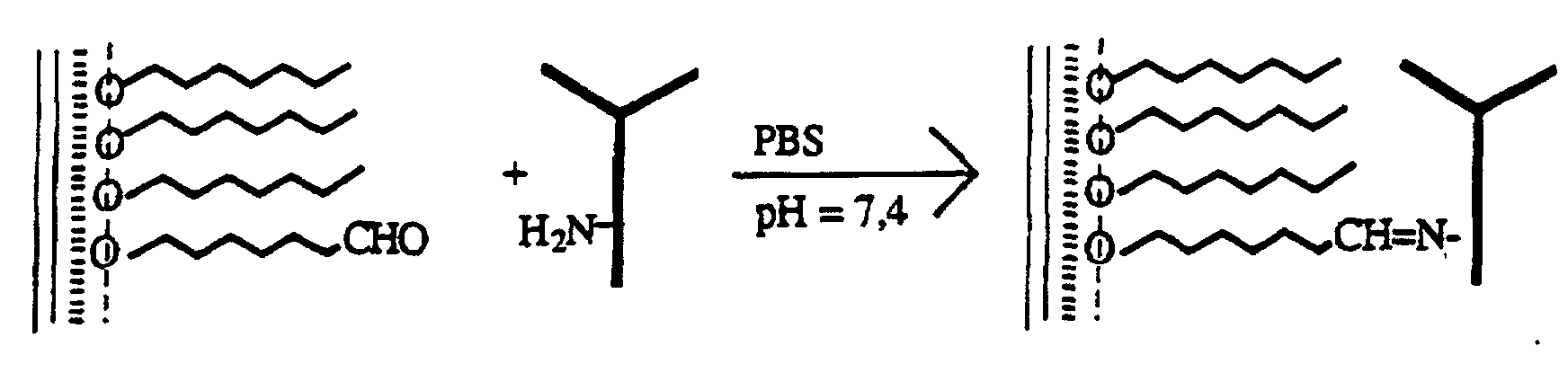
- Immunoglobulins are proteins and accordingly have building blocks containing amino groups. These react in a known manner with aldehyde groups of the film substances to form imine groups. A reduction of the imine groups to amine groups leads to an additional stabilization of the bond. Amide groups are even more stable, which is why ester groups of the film substances are also allowed to react with the aldeyd groups. This has already been described in the literature [H. Wetall, M. Lynn “immobil. Enzymes, antibodies, cells and peptides, preparation and characterization", M. Dekkar, Inc., New York. (1975) 497].
- biomolecules can - if they belong to the proteins - be immobilized analogously. If the biomolecules are to be spread with the film substances, they must be appropriately substituted.
- f ab ' fragments of the IgG are suitable which are substituted on their thio groups with a longer-chain carbon residue, as already described by Gaub et al. have described [M. Egger, SP Heyn, and HE Gaub: "Two-dimensional recognition pattern of lipid-anchored f ab ' fragments", Biophys. J., VoL 57 (1990) 669].
- Such a substituted biomolecule fragment should coexist on the LB trough let a photochemically cross-linkable substance spread.
- the film is then cross-linked onto the substrate, whereby the biomolecule is fixed.
- Oxidation of a monolayer Pcps on glass 0.9 ml of osmium tetroxide in tert-butanol (1 ng / ml) and the substrate are added to 1.6 ml of water (Milipore cleaned) and the mixture is stirred for 5 minutes. Then 0.05 g of sodium periodate is added at room temperature and the mixture is left to stand for about 2 hours, with occasional shaking. It is then rinsed with a phosphate buffer solution and Tween-20 (a detergent).
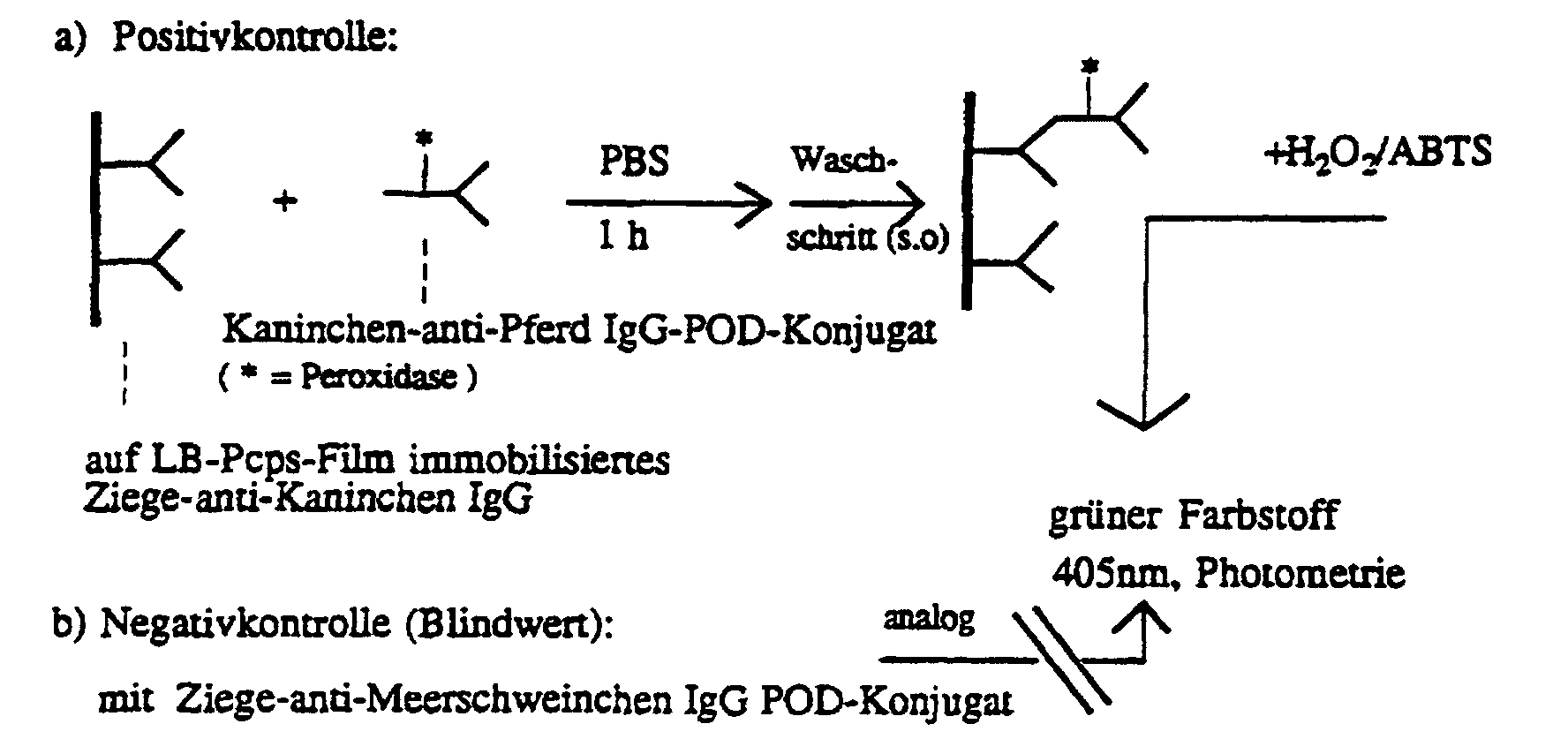
- the substrates prepared in this way show a high affinity for nucleophilic amino groups of antibodies, which was checked with an enzyme-linked immunosorbent assay (ELISA) was (see below).
- ELISA enzyme-linked immunosorbent assay
- Immobilization of immunoglobulin G, blocking, ELISA IgG was immobilized in accordance with regulations known to those skilled in the art: The oxidized polymer films on glass are placed in a solution of 5 ⁇ l of goat anti-rabbit IgG in 1 ml of PBS and then left at 4 ° C. for about an hour.
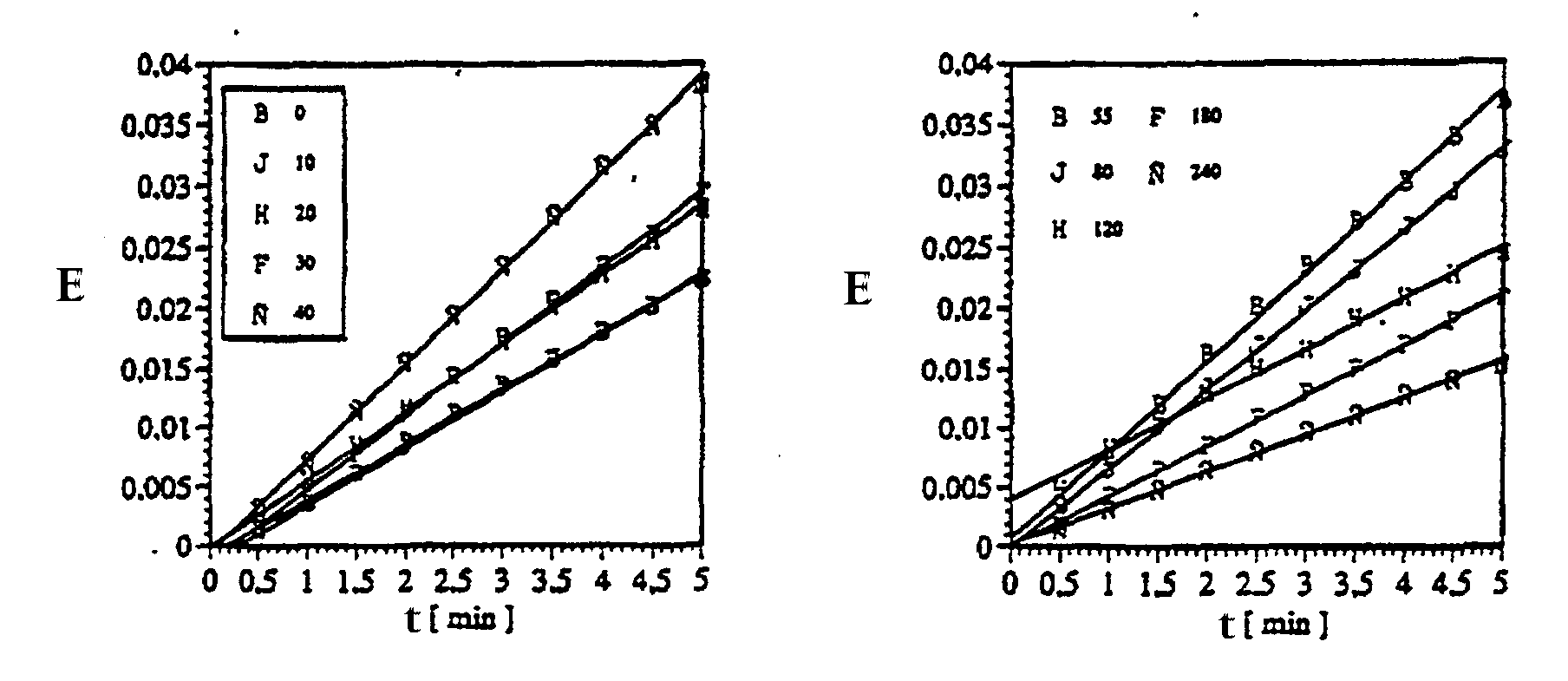
- the active occupancy densities are obtained the dependence on the irradiation time.
- the amount of the length of exposure to light dependent degree of crosslinking determines the stability of the film. So the longer it was irradiated, the less antibody is lost if after immobilization (e.g. in the Washing steps) parts of the film substance with IgG on it from the glass surface peel off.
- the activity of the antibody films therefore remains constant for a period of two weeks.
- the Films have obviously been sufficiently stabilized by photochemical cross-linking.
- an examination of the stability in air reveals a drastic loss of activity within a few days as the antibodies are denatured in air.
- Pcps acts as a sensitizer, ie it serves to absorb the UV light, which it then transmits to the copolyglutamate.
- sensitizers can also be added.
Landscapes
- Health & Medical Sciences (AREA)
- Life Sciences & Earth Sciences (AREA)
- Immunology (AREA)
- Engineering & Computer Science (AREA)
- Chemical & Material Sciences (AREA)
- Biomedical Technology (AREA)
- Urology & Nephrology (AREA)
- Hematology (AREA)
- Molecular Biology (AREA)
- Microbiology (AREA)
- Biotechnology (AREA)
- Biochemistry (AREA)
- General Health & Medical Sciences (AREA)
- Organic Chemistry (AREA)
- Bioinformatics & Cheminformatics (AREA)
- Pathology (AREA)
- Zoology (AREA)
- Cell Biology (AREA)
- Wood Science & Technology (AREA)
- Genetics & Genomics (AREA)
- General Physics & Mathematics (AREA)
- Food Science & Technology (AREA)
- Medicinal Chemistry (AREA)
- Physics & Mathematics (AREA)
- Analytical Chemistry (AREA)
- General Engineering & Computer Science (AREA)
- Chemical Kinetics & Catalysis (AREA)
- Immobilizing And Processing Of Enzymes And Microorganisms (AREA)
- Peptides Or Proteins (AREA)
Description




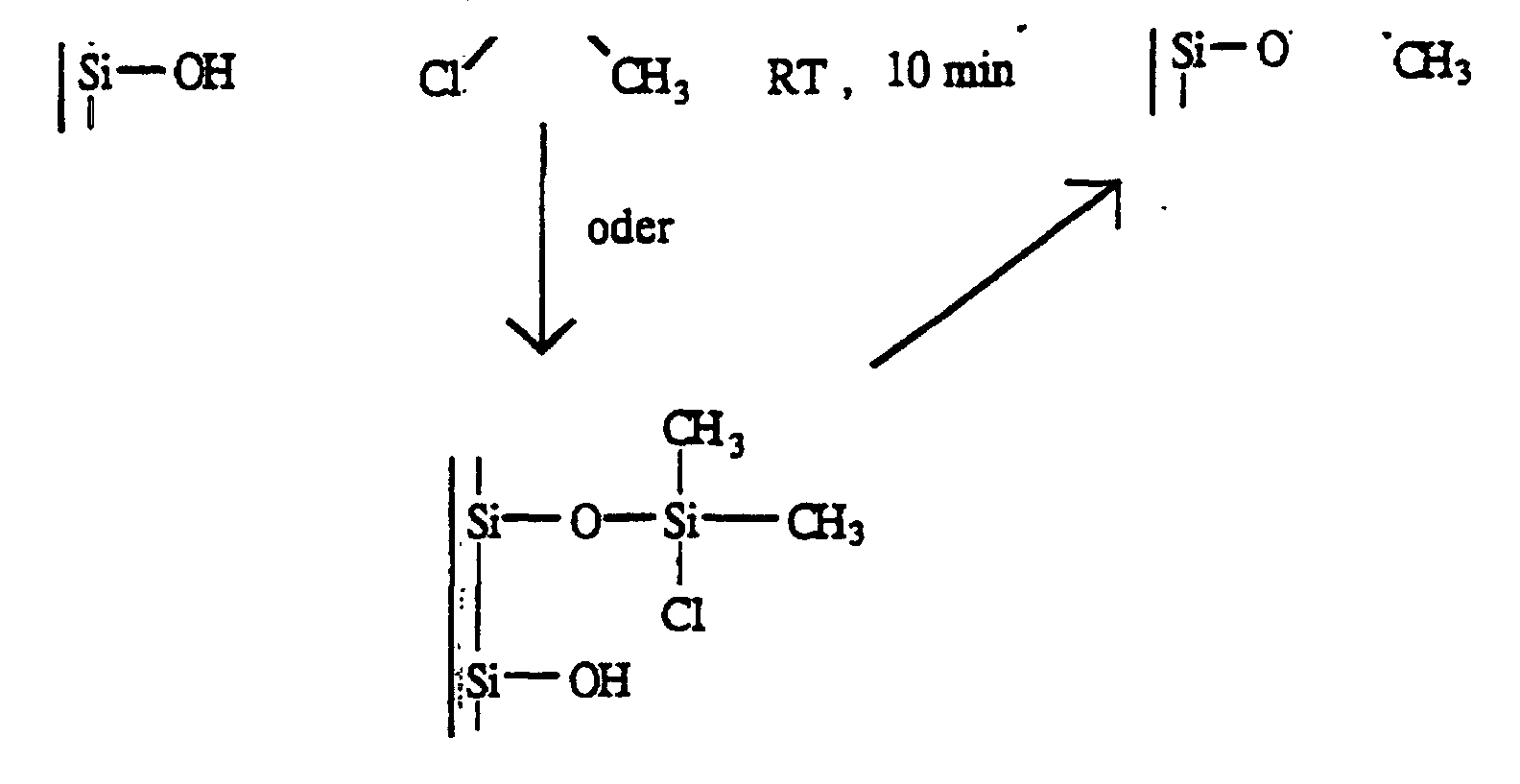
Zu 1,6 ml Wasser (Milipore gereinigt) fügt man 0,9 µl Osmiumtetroxid in tert-Butanol (1 ng/µl) und das Substrat zu und rührt 5 Minuten. Dann gibt man bei Raumtemperatur 0,05g Natriumperjodat zu und läßt ca 2 Stunden - unter gelegentlichem Schütteln - ruhen. Danach wird mit einer Phosphatpufferlösung und Tween-20 (einem Detergens) gespült.
Die Immobilisierung von IgG erfolgte gemäß dem Fachmann bekannter Vorschriften:
Die oxidierten Polymerfilme auf Glas werden in eine Lösung von 5 µl Ziege-anti-Kaninchen IgG in 1 ml PBS gestellt und dann ca. eine Stunde darin bei 4° C belassen.
Um die Haltbarkeit der immobilisierten Antikörper zu testen, wurden aktivierte hydrophobisierte Glasstückchen mit 10 LB-Monolagen Pcps III (25 mN/m) beschichtet, 55 Minuten bei 254 nm vernetzt, dann mit Osmiumtetroxid / Perjodat oxidiert, schließlich Ziege-anti-Kaninchen IgG immobilisiert und - nach der Blockierungsreaktion -in Phosphatpuffersalzlösung eingefroren. Nach verschiedenen Lagerzeiten wurden per ELISA-Test die aktiven Belegungsdichten bestimmt wobei in der Abbildung M = Menge an aktivem IgG und t = Zeit in Tagen bedentet :

Durch Arbeiten bei tieferen Temperaturen (15 °C: Anschluß eines Kryostaten an den LB-Trog) konnte der Kollapsdruck des Copolyglutamats auf 30 mN/m erhöht werden . Ferner bewirkte der Zusatz von 15 Masseprozent Pcps einen weiteren Anstieg auf insgesamt 33 mN/m. Dies ermöglichte den erneuten Versuch einer Vernetzung bei nunmehr 28 mN/m auszuführen. In der Tat wurden Folgende Ergebnisse beobachtet: die Filmfläche nahm während der Bestrahlung kontinuierlich ab und der Kollapsdruck entsprechend zu. Dem gemäß gelang die photochemische Vernetzung. Ein Grund dafür ist einerseits die durch die erhöhte Oberflächenspannung bewirkte Annäherung der olefinischen Doppelbindungen, wodurch sie eher vernetzbar werden. Andererseits wirkt Pcps als Sensibilisator, d. h. es dient zur Aufnahme des UV-Lichts, welches es dann auf das Copolyglutamat überträgt. Selbstverständlich können auch andere Sensibilisatoren hunzugegeben werden.


Claims (6)
- Verfahren zur Immobilisierung von Biomolekülen auf oder in photochemisch vernetzbaren nicht-amphiphilen Langmuir-Blodgett-Filmen, dadurch gekennzeichnet, daß als Matrix eine nicht-amphiphile zwei- oder dreidimensional vernetzbare Substanz mit Hilfe der Langmuir-Blodgett-Technika) auf das Substrat aufgebracht wird und anschließend Rezeptor- oder Biomoleküle kovalent immobilisiert werden, oderb) auf das Substrat aufgebracht wird, die Rezeptor- oder Biomoleküle jedoch zuvor mit der Matrixsubstanz cogespreitet wurden, oderc) auf das Substrat aufgebracht wird, die Rezeptor- oder Biomoleküle jedoch so chemisch modifiziert wurden, daß sich ein an die Rezeptor- oder Biomoleküle angefügter weiterer Molekülteil derart in die Matrixsubstanz einlagert, daß die Rezeptor- oder Biomoleküle mit ihren bindungsfähigen Gruppen aus der Matrixsubstanz herausragen und zwar derart, daß sie ihre Aktivität noch besitzen.
- Verfahren nach Anspruch 1, dadurch gekennzeichnet, daß die Matrix photochemisch vernetzbar ist.
- Verfahren nach Anspruch 1 oder 2, dadurch gekennzeichnet, daß die Moleküle der Matrix funktionelle Gruppen an Seitengruppen aus der Gruppe Carbonyl-, Thionyl-, Imingruppen, C-C-Dreifachbindungen, bevorzugt C-C-Doppelbindungen besitzen, um Rezeptor- oder Biomoleküle zu binden.
- Verfahren nach einem der Ansprüche 1 bis 3, dadurch gekennzeichnet, daß die Matrix aus mehreren unterschiedlichen nicht-amphiphilen Substanzen oder einer Mischung aus amphiphilen und nicht-amphiphilen Substanzen besteht.
- Verfahren nach einem der Ansprüche 1 bis 4, dadurch gekennzeichnet, daß die als funktionelle Gruppen der Matrixmoleküle vorliegenden C-C-Doppelbindungen oxidativ nach der Art der Lemieux-Reaktion gespalten und damit auf dem Substrat zu Aldehydgruppen oxidiert werden, jedoch kein organisches Lösungsmittel zugesetzt wird.
- Verfahren nach einem der Ansprüche 1 bis 5, dadurch gekennzeichnet, daß Rezeptor- oder Biomoleküle unterschiedlicher Bindungsspezifität in oder an ein und demselben Film gebunden sein können.
Applications Claiming Priority (3)
| Application Number | Priority Date | Filing Date | Title |
|---|---|---|---|
| DE4332003 | 1993-09-21 | ||
| DE4332003A DE4332003C2 (de) | 1993-09-21 | 1993-09-21 | Verfahren zur Beschichtung von Oberflächen mit Biomolekülen und anderen Rezeptormolekülen |
| PCT/EP1994/003137 WO1995008770A1 (de) | 1993-09-21 | 1994-09-20 | Verfahren zur beschichtung von oberflächen mit biomolekülen und anderen rezeptormolekülen |
Publications (2)
| Publication Number | Publication Date |
|---|---|
| EP0730739A1 EP0730739A1 (de) | 1996-09-11 |
| EP0730739B1 true EP0730739B1 (de) | 2002-02-06 |
Family
ID=6498172
Family Applications (1)
| Application Number | Title | Priority Date | Filing Date |
|---|---|---|---|
| EP94928791A Expired - Lifetime EP0730739B1 (de) | 1993-09-21 | 1994-09-20 | Verfahren zur beschichtung von oberflächen mit biomolekülen und anderen rezeptormolekülen |
Country Status (4)
| Country | Link |
|---|---|
| EP (1) | EP0730739B1 (de) |
| AU (1) | AU1604095A (de) |
| DE (2) | DE4332003C2 (de) |
| WO (1) | WO1995008770A1 (de) |
Families Citing this family (7)
| Publication number | Priority date | Publication date | Assignee | Title |
|---|---|---|---|---|
| IL125517A0 (en) * | 1996-01-26 | 1999-03-12 | Univ California | Polymeric film assay and method for direct colorimetric detection of analytes |
| DE19631413A1 (de) * | 1996-08-05 | 1998-02-12 | Stefan Prof Dr Seeger | Verfahren und Vorrichtung zur Präparierung von Molekülen und Partikeln |
| US6897073B2 (en) | 1998-07-14 | 2005-05-24 | Zyomyx, Inc. | Non-specific binding resistant protein arrays and methods for making the same |
| US6682942B1 (en) | 1998-07-14 | 2004-01-27 | Zyomyx, Inc. | Microdevices for screening biomolecules |
| US6406921B1 (en) | 1998-07-14 | 2002-06-18 | Zyomyx, Incorporated | Protein arrays for high-throughput screening |
| US6576478B1 (en) | 1998-07-14 | 2003-06-10 | Zyomyx, Inc. | Microdevices for high-throughput screening of biomolecules |
| DE19853640C2 (de) * | 1998-11-20 | 2002-01-31 | Molecular Machines & Ind Gmbh | Mehrgefäßanordnung mit verbesserter Empfindlichkeit für die optische Analytik, Verfahren zu ihrer Herstellung sowie ihre Verwendung in optischen Analyseverfahren |
Family Cites Families (1)
| Publication number | Priority date | Publication date | Assignee | Title |
|---|---|---|---|---|
| US5102798A (en) * | 1988-09-08 | 1992-04-07 | Allage Associates | Surface functionalized Langmuir-Blodgett films for immobilization of active moieties |
-
1993
- 1993-09-21 DE DE4332003A patent/DE4332003C2/de not_active Expired - Fee Related
-
1994
- 1994-09-20 EP EP94928791A patent/EP0730739B1/de not_active Expired - Lifetime
- 1994-09-20 AU AU16040/95A patent/AU1604095A/en not_active Abandoned
- 1994-09-20 WO PCT/EP1994/003137 patent/WO1995008770A1/de not_active Ceased
- 1994-09-20 DE DE59410042T patent/DE59410042D1/de not_active Expired - Fee Related
Also Published As
| Publication number | Publication date |
|---|---|
| AU1604095A (en) | 1995-04-10 |
| EP0730739A1 (de) | 1996-09-11 |
| DE59410042D1 (de) | 2002-03-21 |
| DE4332003A1 (de) | 1995-04-27 |
| DE4332003C2 (de) | 1996-02-22 |
| WO1995008770A1 (de) | 1995-03-30 |
Similar Documents
| Publication | Publication Date | Title |
|---|---|---|
| DE69526747T2 (de) | Elektrobiochemisches Verfahren, System und Elektroden zur Bestimmung eines Mitgliedes eines Bindungspaares | |
| DE69829089T2 (de) | Vorrichtung und Apparat zur gleichzeitigen Detektion von mehreren Analyten | |
| DE2536572C2 (de) | Diagnostisches Verfahren zum Nachweisen der An- oder Abwesenheit eines ausgewählten Antigens oder Antikörpers in einer biologischen Flüssigkeitsprobe | |
| DE68911674T2 (de) | Testverfahren und reagenzsatz dazu. | |
| DE68926255T2 (de) | Fühleroberflächen, fähig zur selektiven biomolekularen interaktionen zur verwendung in biosensorsystemen | |
| DE69030811T2 (de) | Rezeptormembranen und selektive steuerung des ionenflusses durch ionophoren | |
| DE69412137T2 (de) | Sensoreinrichtung zum sandwichtest | |
| DE69406920T2 (de) | Analyt-reagierende ktp zusammensetzung und verfahren | |
| DE68925426T2 (de) | Oberflächen-plasmon-resonanz-sensor-einheit und deren verwendung in biosensor-systemen | |
| DE69117067T2 (de) | Verbesserung bei festphasenbindungs-analysenverfahren | |
| DE69611373T2 (de) | Bestimmung eines analyten in einer flüssigkeit | |
| DE69106002T2 (de) | Testverfahren und reagenziensatz dafür. | |
| EP0561239A1 (de) | Optischer Festphasenbiosensor auf Basis fluoreszenzfarbstoffmarkierter polyionischer Schichten | |
| CH650592A5 (de) | Reagenz zur verwendung bei immunoassays sowie verfahren zur durchfuehrung des immunoassays. | |
| WO1991016425A1 (de) | Verfahren zur lichtinduzierten immobilisierung von biomolekülen an chemisch 'inerten' oberflächen | |
| DE69028851T2 (de) | Analytische vorrichtung und verfahren | |
| EP0730739B1 (de) | Verfahren zur beschichtung von oberflächen mit biomolekülen und anderen rezeptormolekülen | |
| Wiegand et al. | Heterogeneous surfaces of structured hairy-rod polymer films: Preparation and methods of functionalization | |
| WO2003021253A2 (de) | Bionalytische erkennungsoberfläche mit optimierter dichte der erkennungselemente | |
| DE60037734T2 (de) | Photo-pfropfungs-elektropolymere, ihre herstellung und deren verwendung als träger für erkennungssonden spezifisch in biosensorsystemen | |
| EP1073895A1 (de) | Dextranbeschichtete oberfläche | |
| DE68918643T2 (de) | Artikel zur Durchführung von Immuntests unter Verwendung von organischen Farbstoffen sowie Methoden zu seiner Herstellung und seiner Verwendung. | |
| WO1999027355A1 (de) | Verfahren zur bildung lateral organisierter strukturen auf trägeroberflächen | |
| DE69615766T2 (de) | Vorrichtung mit einer durch einen bifunktionellen Kuppler auf einer Nitridsubstrat kovalent gebundene biologisch aktiven Substanz | |
| DE2440367C2 (de) | Verfahren zum Herstellen multimolekularer Schichten aus immunologisch komplexierten Proteinen auf einem Substrat |
Legal Events
| Date | Code | Title | Description |
|---|---|---|---|
| PUAI | Public reference made under article 153(3) epc to a published international application that has entered the european phase |
Free format text: ORIGINAL CODE: 0009012 |
|
| 17P | Request for examination filed |
Effective date: 19960518 |
|
| AK | Designated contracting states |
Kind code of ref document: A1 Designated state(s): DE FR GB IT NL |
|
| RAP1 | Party data changed (applicant data changed or rights of an application transferred) |
Owner name: HARTMANN, ANDREAS, DR. Owner name: SEEGER, STEFAN, DR. |
|
| 17Q | First examination report despatched |
Effective date: 19990319 |
|
| RAP1 | Party data changed (applicant data changed or rights of an application transferred) |
Owner name: MOLECULAR MACHINES & INDUSTRIES GMBH |
|
| RIN1 | Information on inventor provided before grant (corrected) |
Inventor name: HARTMANN, ANDREAS, DR. Inventor name: SEEGER, STEFAN, DR. |
|
| GRAG | Despatch of communication of intention to grant |
Free format text: ORIGINAL CODE: EPIDOS AGRA |
|
| GRAG | Despatch of communication of intention to grant |
Free format text: ORIGINAL CODE: EPIDOS AGRA |
|
| GRAH | Despatch of communication of intention to grant a patent |
Free format text: ORIGINAL CODE: EPIDOS IGRA |
|
| GRAH | Despatch of communication of intention to grant a patent |
Free format text: ORIGINAL CODE: EPIDOS IGRA |
|
| GRAA | (expected) grant |
Free format text: ORIGINAL CODE: 0009210 |
|
| REG | Reference to a national code |
Ref country code: GB Ref legal event code: IF02 |
|
| AK | Designated contracting states |
Kind code of ref document: B1 Designated state(s): DE FR GB IT NL |
|
| GBT | Gb: translation of ep patent filed (gb section 77(6)(a)/1977) |
Effective date: 20020206 |
|
| REF | Corresponds to: |
Ref document number: 59410042 Country of ref document: DE Date of ref document: 20020321 |
|
| ET | Fr: translation filed | ||
| PLBE | No opposition filed within time limit |
Free format text: ORIGINAL CODE: 0009261 |
|
| STAA | Information on the status of an ep patent application or granted ep patent |
Free format text: STATUS: NO OPPOSITION FILED WITHIN TIME LIMIT |
|
| 26N | No opposition filed |
Effective date: 20021107 |
|
| PGFP | Annual fee paid to national office [announced via postgrant information from national office to epo] |
Ref country code: NL Payment date: 20030917 Year of fee payment: 10 |
|
| PG25 | Lapsed in a contracting state [announced via postgrant information from national office to epo] |
Ref country code: NL Free format text: LAPSE BECAUSE OF NON-PAYMENT OF DUE FEES Effective date: 20050401 |
|
| NLV4 | Nl: lapsed or anulled due to non-payment of the annual fee |
Effective date: 20050401 |
|
| PGFP | Annual fee paid to national office [announced via postgrant information from national office to epo] |
Ref country code: GB Payment date: 20060922 Year of fee payment: 13 Ref country code: FR Payment date: 20060922 Year of fee payment: 13 |
|
| PGFP | Annual fee paid to national office [announced via postgrant information from national office to epo] |
Ref country code: IT Payment date: 20060930 Year of fee payment: 13 |
|
| PGFP | Annual fee paid to national office [announced via postgrant information from national office to epo] |
Ref country code: DE Payment date: 20061130 Year of fee payment: 13 |
|
| GBPC | Gb: european patent ceased through non-payment of renewal fee |
Effective date: 20070920 |
|
| PG25 | Lapsed in a contracting state [announced via postgrant information from national office to epo] |
Ref country code: DE Free format text: LAPSE BECAUSE OF NON-PAYMENT OF DUE FEES Effective date: 20080401 |
|
| REG | Reference to a national code |
Ref country code: FR Ref legal event code: ST Effective date: 20080531 |
|
| PG25 | Lapsed in a contracting state [announced via postgrant information from national office to epo] |
Ref country code: FR Free format text: LAPSE BECAUSE OF NON-PAYMENT OF DUE FEES Effective date: 20071001 |
|
| PG25 | Lapsed in a contracting state [announced via postgrant information from national office to epo] |
Ref country code: GB Free format text: LAPSE BECAUSE OF NON-PAYMENT OF DUE FEES Effective date: 20070920 |
|
| PG25 | Lapsed in a contracting state [announced via postgrant information from national office to epo] |
Ref country code: IT Free format text: LAPSE BECAUSE OF NON-PAYMENT OF DUE FEES Effective date: 20070920 |