EP0730360A2 - Faires verteiltes Umlaufprotokoll mit zwei Prioritäten für ein Netz mit kaskadierten Knoten - Google Patents
Faires verteiltes Umlaufprotokoll mit zwei Prioritäten für ein Netz mit kaskadierten Knoten Download PDFInfo
- Publication number
- EP0730360A2 EP0730360A2 EP96101897A EP96101897A EP0730360A2 EP 0730360 A2 EP0730360 A2 EP 0730360A2 EP 96101897 A EP96101897 A EP 96101897A EP 96101897 A EP96101897 A EP 96101897A EP 0730360 A2 EP0730360 A2 EP 0730360A2
- Authority
- EP
- European Patent Office
- Prior art keywords
- level hub
- hub
- lower level
- network packet
- end node
- Prior art date
- Legal status (The legal status is an assumption and is not a legal conclusion. Google has not performed a legal analysis and makes no representation as to the accuracy of the status listed.)
- Withdrawn
Links
Images




Classifications
-
- H—ELECTRICITY
- H04—ELECTRIC COMMUNICATION TECHNIQUE
- H04L—TRANSMISSION OF DIGITAL INFORMATION, e.g. TELEGRAPHIC COMMUNICATION
- H04L1/00—Arrangements for detecting or preventing errors in the information received
- H04L1/0078—Avoidance of errors by organising the transmitted data in a format specifically designed to deal with errors, e.g. location
- H04L1/0083—Formatting with frames or packets; Protocol or part of protocol for error control
-
- H—ELECTRICITY
- H04—ELECTRIC COMMUNICATION TECHNIQUE
- H04L—TRANSMISSION OF DIGITAL INFORMATION, e.g. TELEGRAPHIC COMMUNICATION
- H04L1/00—Arrangements for detecting or preventing errors in the information received
- H04L1/12—Arrangements for detecting or preventing errors in the information received by using return channel
- H04L1/16—Arrangements for detecting or preventing errors in the information received by using return channel in which the return channel carries supervisory signals, e.g. repetition request signals
- H04L1/1607—Details of the supervisory signal
-
- H—ELECTRICITY
- H04—ELECTRIC COMMUNICATION TECHNIQUE
- H04L—TRANSMISSION OF DIGITAL INFORMATION, e.g. TELEGRAPHIC COMMUNICATION
- H04L1/00—Arrangements for detecting or preventing errors in the information received
- H04L1/12—Arrangements for detecting or preventing errors in the information received by using return channel
- H04L1/16—Arrangements for detecting or preventing errors in the information received by using return channel in which the return channel carries supervisory signals, e.g. repetition request signals
- H04L1/18—Automatic repetition systems, e.g. Van Duuren systems
- H04L1/1812—Hybrid protocols; Hybrid automatic repeat request [HARQ]
- H04L1/1819—Hybrid protocols; Hybrid automatic repeat request [HARQ] with retransmission of additional or different redundancy
-
- H—ELECTRICITY
- H04—ELECTRIC COMMUNICATION TECHNIQUE
- H04L—TRANSMISSION OF DIGITAL INFORMATION, e.g. TELEGRAPHIC COMMUNICATION
- H04L1/00—Arrangements for detecting or preventing errors in the information received
- H04L1/12—Arrangements for detecting or preventing errors in the information received by using return channel
- H04L1/16—Arrangements for detecting or preventing errors in the information received by using return channel in which the return channel carries supervisory signals, e.g. repetition request signals
- H04L1/18—Automatic repetition systems, e.g. Van Duuren systems
- H04L1/1829—Arrangements specially adapted for the receiver end
- H04L1/1848—Time-out mechanisms
-
- H—ELECTRICITY
- H04—ELECTRIC COMMUNICATION TECHNIQUE
- H04L—TRANSMISSION OF DIGITAL INFORMATION, e.g. TELEGRAPHIC COMMUNICATION
- H04L1/00—Arrangements for detecting or preventing errors in the information received
- H04L1/12—Arrangements for detecting or preventing errors in the information received by using return channel
- H04L1/16—Arrangements for detecting or preventing errors in the information received by using return channel in which the return channel carries supervisory signals, e.g. repetition request signals
- H04L1/18—Automatic repetition systems, e.g. Van Duuren systems
- H04L1/1867—Arrangements specially adapted for the transmitter end
- H04L1/188—Time-out mechanisms
-
- H—ELECTRICITY
- H04—ELECTRIC COMMUNICATION TECHNIQUE
- H04L—TRANSMISSION OF DIGITAL INFORMATION, e.g. TELEGRAPHIC COMMUNICATION
- H04L12/00—Data switching networks
- H04L12/28—Data switching networks characterised by path configuration, e.g. LAN [Local Area Networks] or WAN [Wide Area Networks]
- H04L12/44—Star or tree networks
-
- H—ELECTRICITY
- H04—ELECTRIC COMMUNICATION TECHNIQUE
- H04L—TRANSMISSION OF DIGITAL INFORMATION, e.g. TELEGRAPHIC COMMUNICATION
- H04L69/00—Network arrangements, protocols or services independent of the application payload and not provided for in the other groups of this subclass
- H04L69/40—Network arrangements, protocols or services independent of the application payload and not provided for in the other groups of this subclass for recovering from a failure of a protocol instance or entity, e.g. service redundancy protocols, protocol state redundancy or protocol service redirection
-
- H—ELECTRICITY
- H04—ELECTRIC COMMUNICATION TECHNIQUE
- H04L—TRANSMISSION OF DIGITAL INFORMATION, e.g. TELEGRAPHIC COMMUNICATION
- H04L9/00—Cryptographic mechanisms or cryptographic arrangements for secret or secure communications; Network security protocols
- H04L9/40—Network security protocols
-
- H—ELECTRICITY
- H04—ELECTRIC COMMUNICATION TECHNIQUE
- H04L—TRANSMISSION OF DIGITAL INFORMATION, e.g. TELEGRAPHIC COMMUNICATION
- H04L1/00—Arrangements for detecting or preventing errors in the information received
- H04L2001/0092—Error control systems characterised by the topology of the transmission link
- H04L2001/0093—Point-to-multipoint
Definitions
- the present invention concerns a two priority fair distributed round robin protocol for a network having cascaded hubs.
- a hub may be directly connected to several network stations, called end nodes.
- Each end node connected to the hub communicates to other end nodes connected to the hub by sending network packets to the hub which the hub forwards to one or more of the other end nodes.
- a fair arbitration scheme is one which treats requests by all end nodes in an even-handed manner. That is, no end nodes are put at a disadvantage because they are connected to one hub and not to another hub.
- an effective arbitration scheme is one in which network throughput is maximized. That is, when end nodes are contending for network resources, the amount of time the network is idle or in arbitration is minimized.
- Fair and efficient arbitration schemes for a network with cascaded hubs have generally handled requests within only a single priority level. See, for example, U.S. Patent Number 5,018,139, cited above. When requests with a second priority level have been allowed, this has resulted in arbitration schemes which are less fair and/or less efficient. For example, such two priority arbitration schemes have handled only one network packet per hub per cycle. This results in end nodes connected to hubs with fewer active end nodes having a larger share of network bandwidth than end nodes on hubs with many active end nodes. Additionally, arbitration schemes which handle only one network packet per hub per cycle require more overhead for each network packet sent across the network. This reduces network throughput.
- a network system includes end nodes which are connected to a plurality of cascaded hubs.
- a two priority protocol is provided for selecting end nodes to send network packets over the network.
- Network packets are, for example, high priority network packets or normal priority network packets.
- the end node waits for an acknowledgment from the hub before transmitting the packet.
- each end node with a high priority network packet is acknowledged in turn.
- Each end node when acknowledged, sends its high priority network packet through the network.
- normal priority network packets are sent. While at least one end node in the network system has a normal priority network packet to send and no end nodes have a high priority network packet to send, each end node with a normal priority network packet is acknowledged in turn.
- a lower level hub forwards a normal priority network packet to a higher level hub. After forwarding the normal priority network packet to the higher level hub, the lower level hub sends a signal to the higher level hub.
- the signal indicates one of the following: (1) the lower level hub will immediately send another normal priority network packet; (2) the lower level hub has no more normal priority network packets to send; or (3) sending of normal priority network packets by the lower level hub has been preempted, but the lower level hub has additional normal priority network packets to send.
- the sending of normal priority network packets is preempted by an end node in the network system having a high priority network packet to send.
- the signal is a two tone signal sequence.
- a first tone signal of the two tone signal sequence indicates whether the lower level hub will immediately send another normal priority network packet.
- a second tone signal of the two tone signal sequence indicates whether the lower level hub has no more normal priority network packets to send.
- the second tone signal of the two tone signal sequence can also indicate whether sending of normal priority network packets by the lower level hub has been preempted, but the lower level hub has not completed acknowledging in turn each end node with a normal priority network packet.
- the second tone is return (signaled by silence).
- the first tone signal is a normal priority request signal.
- the first tone signal is an idle signal.
- the second tone signal is an idle signal.
- the use of a two tone handshake as set out by the present invention allows for an increase in the fairness and efficiency of a two priority fair distributed round robin protocol in a network having cascaded hubs.
- the invention assures that a higher level hub is made aware that a lower level hub still had not completed acknowledging in turn each end node with a normal priority network packet, when the lower level hub was preempted.
- the protocol described herein provides fair and efficient control of she transfer of network packets for a two priority system operating on a network architecture which includes cascaded hubs.
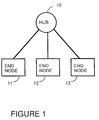
- Figure 1 shows end nodes connected to a single hub in a network configuration.
- Figure 2 illustrates the basic operation of a protocol for the network configuration shown in Figure 1.
- Figure 3 illustrates the further operation of a protocol for the network configuration shown in Figure 1.
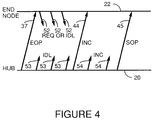
- FIG. 4 illustrates in more detail operation of the protocol shown in Figure 3.
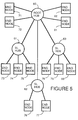
- Figure 5 shows end nodes connected to a plurality of cascaded hubs in accordance with a preferred embodiment of the present invention.
- Figure 6 illustrates the operation of a protocol for the network configuration shown in Figure 5 in accordance with a preferred embodiment of the present invention.
- Figure 7 further illustrates the operation of a protocol for the network configuration shown in Figure 5 in accordance with a preferred embodiment of the present invention.
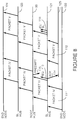
- Figure 8 additionally illustrates the operation of a protocol for the network configuration shown in Figure 5 in accordance with a preferred embodiment of the present invention.
- Figure 1 shows a hub 10 connected to an end node 11, an end node 12 and an end node 13.
- each of end nodes 11, 12, and 13 is connected to hub 10 using four twisted wire pairs.
- copending patent serial number 07/972,694 filed on November 6, 1992 by Alan Albrecht, Steven Harold Goody, Michael Peter Spratt, Joseph Anthony Curcio, Jr. and Daniel Joseph Dove for HIGH SPEED DATA TRANSFER OVER TWISTED PAIR CABLING, which is hereby incorporated by reference.
- the protocol for sending messages is summarized as follows. Each four twisted wire pair link between hub 10 and each end node has three stable states.
- hub 10 is sending a packet to the end node on all four twisted wire pairs. In the preferred embodiment, in this transmission there is a total bandwidth of 100 megabits per second (Mb/s). In the second stable state, the end node is sending a packet on all four twisted pairs. In the preferred embodiment, in this transmission there is also a total bandwidth of 100 Mb/s. In the third stable state, the end node is sending low frequency tones on two twisted wire pairs (twisted wire pair one and twisted wire pair two) and the hub is sending low frequency tones on the other two twisted wire pairs (twisted wire pair three and twisted wire pair four).
- Mb/s megabits per second
- the end node can transmit four possible tone combinations on twisted wire pair one and twisted wire pair two.
- a first possible tone combination is to send a one megahertz (MHz) tone on twisted wire pair one and a one MHz tone on twisted wire pair two.
- a second possible tone combination is to send a one MHz tone on twisted wire pair one and a two MHz tone on twisted wire pair two.
- a third possible tone combination is to send a two MHz tone on twisted wire pair one and a one MHz tone on twisted wire pair two.
- a fourth possible tone combination is to send a two MHz tone on twisted wire pair one and a two MHz tone on twisted wire pair two.
- the hub can transmit four possible tone combinations on twisted wire pair three and twisted wire pair four.
- a first possible tone combination is to send a one megahertz (MHz) tone on twisted wire pair three and a one MHz tone on twisted wire pair four.
- a second possible tone combination is to send a one MHz tone on twisted wire pair three and a two MHz tone on twisted wire pair four.
- a third possible tone combination is to send a two MHz tone on twisted wire pair three and a one MHz tone on twisted wire pair four.
- a fourth possible tone combination is to send a two MHz tone on twisted wire pair three and a two MHz tone on twisted wire pair four.
- tone combinations are selected of a low enough frequency to avoid contributing in any significant way to crosstalk. These tone combinations are used to convey certain well defined information.
- tone combinations from end nodes 11, 12 or 13 to hub 10 indicate one of the following: “Idle”, “ReqH” (high priority request) or “ReqN” (normal priority request).
- the fourth tone combination is reserved for future use.
- the tone combinations from hub 10 to end nodes 11, 12 or 13 indicate one of the following: “Idle”, "Incoming” or "Preempt” message.
- the remaining tone combination is reserved for future use.
- the message signal is used as described below.
- a special tone combination from hub 10 to end nodes 10, 11, 12 is "Ready to Receive”. This special tone combination is signaled by silence (no tones) on twisted wire pair three and twisted wire pair four.
- the Ready to Receive functions as an acknowledge (Ack) by hub 10 to a request received from one of end nodes 10, 11 or 12.
- FIG. 2 illustrates the operation of the protocol for use in the transfer of a network packet.
- a first end node represented by a line 21, sends to hub 10, represented by a line 20, a request, as represented by an arrow 31.
- the request is either a ReqH or ReqN depending on the priority of the network packet.
- hub 10 After receiving the request, hub 10 sends an acknowledge in response, as represented by an arrow 32. As discussed above, this is silence on twisted wire pair three and twisted wire pair four.
- the end node actively transmits the request (ReqH or ReqN) on twisted wire pair one and twisted wire pair two.
- the first end node Upon detecting the acknowledge on twisted wire pair three and twisted wire pair four, the first end node starts sending the network packet to hub 10, as represented by a start of packet (SOP) arrow 33.
- SOP start of packet
- Hub 10 starts receiving the network packet and temporarily stores the first part of the network packet until the destination address is completely received by hub 10. At this time, the destination port to which the packet is to be sent can be quickly ascertained.
- hub 10 Upon receiving the start of the network packet, hub 10 sends the Incoming message tone combination to all other end nodes, as represented by an arrow 34. This causes the other end nodes to stop sending request (ReqH or ReqN) or Idle on their twisted wire pair one and twisted wire pair two.
- ReqH or ReqN Sender the network packet on all four twisted wire pairs to a destination end node, as represented by arrow 35, the destination end node is not actively transmitting on any twisted wire pair.
- the destination end node is represented by a line 22.
- An arrow 36 represents the end of packet (EOP) sent from the first end node to hub 10.
- An arrow 37 represents the end of packet (EOP) sent from hub 10 to the destination end node.
- FIG 3 After the first end node has completed sending the first network packet, as described in the discussion of Figure 2 above, the first end node sends to hub 10 another request, as represented by an arrow 41.
- the request is either a ReqH or ReqN depending on the priority of the second network packet.
- hub 10 Immediately upon sending the end of the network packet to the destination end node, as represented by arrow 37, hub 10 sends another acknowledgment to the first node, as represented by an arrow 42. (In the preferred embodiment, when hubs are cascaded, the second message is not immediately sent, but rather the end node must wait for its next turn to send the second message).
- hub 10 acknowledges the first node by silence on twisted wire pair three and twisted wire pair four.
- the first end node Upon detecting the acknowledge on twisted wire pair three and twisted wire pair four, the first end node starts sending the second network packet to hub 10, as represented by a start of packet (SOP) arrow 43.
- SOP start of packet
- Hub 10 starts receiving the second network packet and temporarily stores the first part of the second network packet until the destination address is completely received by hub 10. At this time, the destination port to which the second network packet is to be sent can be quickly ascertained.
- the second network packet is sent to the same destination; however, the destination may be any end node, other than the first end node, connected to hub 10.
- hub 10 Upon receiving the start of the second network packet, hub 10 sends the Incoming message tone combination to all other end nodes, as represented by an arrow 44. This causes the other end nodes to stop sending request (ReqH or ReqN) or Idle on their twisted wire pair one and twisted wire pair two. Thus, when hub 10 starts sending the second network packet on all four twisted wire pairs to a destination end node, as represented by arrow 45, the destination end node is not actively transmitting on any twisted wire pair.
- An arrow 46 represents the end of the second network packet sent from the first end node to hub 10.
- An arrow 47 represents the end of the second network packet sent from hub 10 to the destination end node.
- FIG 4 shows additional detail of network operation in the interpacket gap between the end of the first network packet and the start of the second network packet.
- the interpacket gap has two parallel functions. First, in order to determine which end node the second network packet should be sent to, hub 10 uses the interpacket gap to temporarily store the start of the second network packet, and look up the destination address for the second network packet.
- the interpacket gap allows the destination end node to send a request to hub 10, before the request is cut off by the Incoming signal from hub 10. This is represented by arrows 52. If the destination end node does not desire to send a network packet, the destination node forwards an Idle signal to hub 10. End nodes which do not receive the first network packet also can send a request to hub 10 during the interpacket gap. However, in addition, the end nodes which do not receive the first network packet can also send a request to hub 10 at the same time the first network packet is being sent to the destination end node.
- the request window extends from the time hub 10 transmits the end of the first packet, represented by arrow 37, until time hub 10 begins sending the incoming signal, represented by arrow 44.
- hub 10 continuously sends the idle signal, as represented by arrows 53 to the end nodes.
- hub 54 sends the incoming signal represented by arrow 44 and arrows 54, to all the end nodes except the end node which will transmit the network packet.
- Each end node upon receiving the incoming signal from hub 10 stops sending the idle signal or the request signal in order to be ready to receive a network packet from hub 10.
- the request window needs only to be long enough to allow the destination end Node to send out a request of sufficient duration for hub 10 to recognize the request.
- the request window duration is therefore largely determined by the time for the hub to acquire the request, and is independent of the propagation time required to send a message from hub 10 to an end node.
- the request window has a duration of approximately 850 nS.
- the period during which hub 10 sends the incoming signal to the end nodes, called the line turnaround period is determined largely by the maximum round-trip propagation delay between hub 10 and the end node, plus the time to receive enough of the incoming packet to determine the destination address.
- the round-trip propagation delay from hub 10 to an end node in the preferred embodiment, is approximately 1.8 microsecond for a cable distance of 180 meters.
- the request window and the line turnaround period are only important for embodiments of the present invention which utilize half-duplex links.
- the connection will be dual simplex, and so there is no requirement to allow additional time for a second level hub to pass a request to a root hub. This is because while the root hub is sending a packet to the second level hub, the second level hub can pass requests back to the root hub.
- hub 10 sends the "Incoming” signal at the same time the "Acknowledgment” signal is sent.
- any end node with a packet sends a "Request” immediately at the end of a last packet, even though it is receiving an "Incoming” signal.
- the end node continues sending the "Request” signal only for a short time, and then removes the "Request” in preparation to receiving a packet.
- Figure 5 shows an example of a network system with cascaded hubs according to the preferred embodiment on the present invention.
- a root hub 60 is connected to an end node 71, an end node 72, an end node 81 and an end node 82.
- Root hub 60 is also connected to a second level hub 61, a second level hub 62 and a second level hub 63.
- Second level hub 61 is connected to an end node 73, an end node 74 and an end node 75.
- Second level hub 62 is connected to an end node 76 and an end node 77.
- Second level hub 63 is connected to an end node 78, an end node 79 and an end node 80.
- the interconnections are with non-bundled four-pair Category 3, or better, unshielded twisted pair cable, two-pair shielded twisted pair cable or optical fiber.
- a second level hub will communicate on half-duplex links with root hub 60, using the protocol illustrated by Figure 3 and Figure 4. Alternately, dual simplex fiber optic links may be used when longer distances separate root hub 60 from the second level hubs.
- the interhub connections are not through bundled cable.
- the protocol used to transfer network packets from end nodes 71, 72, 81 and 82 is the same as in the single hub case described above.
- the protocol used to transfer network packets from end nodes 73, 74 and 75 to second level hub 61, to transfer network packets from end nodes 76 and 77 to second level hub 62, and to transfer network packets from end nodes 78, 79 and 80 to second level hub 63 is also the same as in the single hub case described above.
- the protocol used to transfer network packets from second level hubs 61, 62 and 63 to root hub 60 is also the same as in the single hub case described above, with slight modifications, as described below.
- the cascaded hubs maintain an enhanced two priority round robin arbitration.
- end nodes send a request at either high priority or normal priority. Once requests have been received, proceeding to each in turn, each end node with a high priority network packet is allowed to send the network packet. This continues until all high priority network packets have been sent. Then, while there are no requests to send high priority network packets, proceeding it each in turn, each end node with a normal priority network packet is allowed to send one network packet. In the preferred embodiment, only one network packet is sent, however, it is contemplated that in alternate embodiments of the present invention, more than one network packet may be sent.
- all network packets are sent to root hub 60 which relays them onto the attached second level hubs.
- Request and other tone combinations can be sent between end nodes and the root hub, between end nodes and the second level hub, and between the second level hub and root hub 60 during interpacket gaps.
- the interpacket gaps are forced by the protocol to be at least a minimum time duration sufficient to allow requests and tone combinations to be sent and received.
- each second level hub will send to the second level hub request tone combinations.
- Each second level hub which receives a request forwards the request to root hub 60.
- the request forwarded by a second level hub to root hub 60 reflects the highest priority level of the requests the second level hub received from its end nodes. If a second level hub receives one or more high priority requests from one or more end nodes, the second level hub sends a high priority request to root hub 60. If the second level hub receives no high level requests from its end nodes, but receives one or more normal priority requests from one or more of its end nodes, the second level host will forward to root hub 60 a normal priority request. If the second level hub is not receiving any requests from attached end nodes, then the second level hub sends an idle during the request window of the interpacket gap.
- the second level hub When root hubs 60 sends an acknowledge (i.e., silence) to a second level hub, the second level hub becomes the acknowledged second level hub. If the acknowledged second level hub has been sending high priority requests to root hub 60, then the second level hub sends an acknowledge to one of its end nodes which has made a high priority request. The end node receiving the acknowledge will send a network packet which the second level hub will send to root hub and to any end node connected to the second level hub to whom the network packet is addressed. When the acknowledged end node has completed sending the network packet, the second level hub will continue a sweep of its end nodes until all its end nodes that have made a high priority request have had a single opportunity to send a high priority network packet.
- an acknowledge i.e., silence
- the second level hub sends a two tone signal sequence to an upper level hub upon completion of sending a network packet.
- the two-toned sequence lets an upper level hub know the state of the round robin in the lower level hub. This allows for an increase in fairness and efficiency.
- the two-toned sequence communicates to the upper level hub whether the lower level hub has finished a sweep of end nodes with normal priority network packets when transmission of packets of normal priority by the lower level hub is preempted so that a high level packet may be transmitted.
- the information in the two tone signal sequence will communicate to the upper level hub whether, when all the high priority network packets have been sent, it is necessary to return to the lower level hub which was preempted, or to continue processing normal priority network packets with another lower level hub.
- the two tone signal sequences includes two tones.
- the first tone is sent for seventy-two clock cycles.
- the second tone is sent until the lower level hub receives incoming or grant from the higher level hub. In the case of an error, the sequence is repeated.
- the clock used to time the seventy-two clock cycles operates at 30 megahertz.
- the lower level hub When the lower level hub is processing high priority network packets, as long as there are still high level packets left to be sent, the lower level hub passes up to the higher level hub, after each high priority network packet a two-toned sequence which is a ReqH followed by a ReqH.
- the lower level hub When the lower level hub is processing normal priority network packets, as long as there are still normal level packets left to be sent and the lower level hub is not preempted, the lower level hub passes up to the higher level hub, after each normal priority network packet a two-toned sequence which is a ReqN followed by a ReqN.
- the two-toned sequence passed from the lower level hub to the higher level hub is an Idle followed by an Idle.
- the two-toned sequence passed from lower level hub to the higher level hub is an Idle followed by a ReqH. This indicates to the higher level hub that the lower level hub has completed the sweep, but there are still additional high priority network packets to send. After all other hubs have conducted a sweep of high priority network packets, the higher level hub will return the grant to the lower level hub.
- the two-toned sequence passed from lower level hub to the higher level hub is an Idle followed by a ReqN. This indicates to the higher level hub that the lower level hub has completed the sweep, but there are still additional normal priority network packets to send. After other hubs have had a chance to perform a sweep of pending normal priority requests, the higher level hub will return the grant to the lower level hub.
- the two-toned sequence passed from lower level hub to the higher level hub is an Idle followed by a return signal.
- the return signal is signaled by silence (no tones) on twisted wire pair one and twisted wire pair two. This indicates to the higher level hub that the normal priority network packet sweep by the lower level hub was interrupted before it was completed. Therefore when all pending high priority network packets have been attended to, the higher level hub will acknowledge the lower level hub in order to allow the lower level hub to complete a sweep of normal priority network packets.
- the second level hub forwards to the root hub a two-tone high level request sequence, as discussed above.
- the second level hub also sends an acknowledge to the next end node to send a high priority network packet, without waiting for an acknowledge from root hub 60.
- the second level hub will return a two-tone idle sequence to root hub 60, as discussed above.
- root hub 60 recognizes that the second level hub has finished its part of the high priority round robin sequence.
- Root hub 60 then continues by sending an acknowledge to the next (in turn) second level hub or end node directly coupled to the root hub that has made a high priority request. This will proceed until all high priority network packets have been sent. Then, while there are no requests to send a high priority network packet, proceeding in turn, each end node with a normal priority network packet is allowed to send the network packet.
- end node 71, end node 73, end node 75, end node 77 and end node 81 each request to send a network packet with high priority.
- end node 72, end node 74, end node 76, end node 78, end node 79, end node 80 and end node 81 each request to send a network packet with normal priority.
- the order in which the high priority requests will be serviced is end node 71, end node 73, end node 75, end node 77 and end node 81.
- the normal priority requests will be serviced in the following order: end node 72, end node 74, end node 76, end node 78, end node 79, end node 80 and end node 81.
- root hub 60 will first grant an acknowledge to end node 71. After end node 71 has sent its high priority network packet, end node 71 will send an idle signal to root hub 60. Root hub 60 will then send an acknowledge to second level hub 61. Second level hub 61 will then send an acknowledge to end node 73.
- Figure 6 illustrates what happens next.
- Line 93 represents end node 73.
- End node 73 forwards a network packet 98 to second level hub 61.
- Second level hub 61 is represented by a line 91.
- Second level hub 61 forwards network packet 98 to root hub 60.
- Root hub 60 is represented by a line 90.
- Root hub 60 will forward network packet 98 to second level hub 62 and second level hub 63.
- the end node on the network which is the destination for network packet 98 will receive network packet 98.
- the end node which is addressed by the network packet is represented by line 94 and the second level hub to which the destination hub is addressed is represented by line 92.
- Second level hub 61 After second level hub 61 has completed forwarding the message to root hub 60, second level hub will send an acknowledge 96 to end node 75. End node 75 is represented by a line 95. Second level hub 61 will also send a two-tone high level request sequence 97, as described above, to root hub 60 indicating another high level priority network packet will follow. End node 75 will send a network packet 99 to second level hub 61. Second level hub 61 forwards network packet 99 to root hub 60. Root hub 60 will forward network packet 99 to second level hub 62 and second level hub 63. Also the end node on the network which is the destination for network packet 99 will receive network packet 99. The end node which is addressed by the network packet is represented by line 94 and the second level hub to which the destination hub is addressed is represented by line 92.
- second level hub 61 forwards network packet 99 to root hub 60
- second level hub 61 will forward a two-tone idle sequence 101, indicating that second level hub 61 has finished the sweep of all its end nodes which had a high priority network packet to send.
- two-tone idle sequence 101 will consist of an Idle followed by a ReqN. This indicates to root hub 60 that second level hub 61 has no more high priority network packets to send, but has normal priority network packets to send. If before or during the sending of network packet 99, one of end nodes 73, 74 or 75 newly requests to send a high priority network packet, two-tone idle sequence 101 will consist of an Idle followed by a ReqH.
- root hub 60 Upon receiving two-tone idle sequence 101, root hub 60 will send an acknowledge signal 102 to second level hub 62.
- second level hub 62 is represented by a line 105.
- Second level hub 62 will send an acknowledge 103 to end node 77.
- End node 77 is represented by a line 104.
- End node 77 will then send its high priority network packet 100 to second level hub 62.
- Second level hub 62 forwards network packet 100 to root hub 60.
- Root hub 60 will forward network packet 100 to second level hub 61 and second level hub 63. Also the end node on the network which is the destination for network packet 100 will receive network packet 100.
- root hub 60 will first grant an acknowledge to end node 72. After end node 72 has sent its normal priority network packet, end node 72 will send an idle signal to root hub 60. Root hub 60 will then send an acknowledge to second level hub 61. Second level hub 61 will then send an acknowledge to end node 74. After end node 74 has sent its normal priority network packet, end node 74 will send an idle signal to second level hub 61. Second level hub 61 will send a two-tone idle sequence signal to root hub 60.
- the two-tone idle sequence will consist of an Idle followed by an Idle. This indicates to root hub 60 that second level hub 61 has no more packets to send. If before, during or immediately after the time end node 74 is sending the normal priority network packets, one of end nodes 73 or 74 newly requests to send a normal priority network packet, the two-tone idle sequence will consist of an Idle followed by a ReqN. After root hub 60 receives the two-tone idle sequence from second level hub 61, root hub 60 will then send an acknowledge to second level hub 62.
- root hub 62 If in middle of a second level hub serving normal priority network packets, root hub 62 becomes aware of an end node sending high priority request (ReqH) or of a second level hub sending a high priority request (which would have originated from one of the end nodes of the second level hub), root hub 60 needs to ensure that the high priority request is serviced quickly. It does this by sending a burst of Preempt during the request window of the inter packet gap to the second level hub. This is different than the silence root hub 60 normally sends to an acknowledged second level hub during the interpacket gap.
- the "Preempt" signal is used, in an alternate embodiment, the "Idle” signal may be used instead of the "Preempt” signal. The burst of Preempt forces the second level hub to send control back to the root hub after the current packet has been sent.
- Figure 8 illustrates this.
- second level hub 63 represented by a line 121
- second level hub 63 acknowledges end node 78.
- End node 78 forwards a normal priority network packet 111 to second level hub 63.
- Second level hub 63 forwards network packet 111 to root hub 60.
- Root hub 60 is represented by line 90.
- Root hub 60 will forward network packet 111 to second level hub 61 and second level hub 62.
- the end node on the network which is the destination for network packet 111 will receive network packet 111.
- the end node which is addressed by the network packet is represented by line 124 and the second level hub to which the destination hub is addressed is represented by line 123.
- second level hub 63 After second level hub 63 has completed forwarding network packet 111 to root hub 60, second level hub 63 will send an acknowledge 114 to end node 79. End node 79 is represented by a line 125. Second level hub 63 will also send a normal level request 113 to root hub 60 indicating another normal level priority network packet will follow. If root hub 60 is aware of an end node which desires to send a high priority network packet, root hub 60 will send a burst preempt signal 115 to second level hub 63 at the completion of receipt of network packet 111.
- end node 79 Because end node 79 has already been acknowledged, end node 79 will send a network packet 112 to second level hub 63. Second level hub 63 forwards network packet 112 to root hub 60. Root hub 60 will forward network packet 112 to second level hub 61 and second level hub 62. Also the end node on the network which is the destination for network packet 112 will receive network packet 112. The end node which is addressed by the network packet is represented by line 124 and the second level hub to which the destination hub is addressed is represented by line 123.
- second level hub 63 After second level hub 63 has forwarded network packet 112 to root hub 60, second level hub 63 sends a two-tone idle sequence 116 to root hub 60. Even though second level hub 63 has not serviced the normal priority network packet from end node 80, second level hub 63 gives two-tone idle sequence 116 to root hub 60 in response to preempt 115, sent in the previous inter packet gap. Receipt of two-tone idle sequence 116 allows root hub 60 to give an acknowledge for the high priority network packet.
- Two-tone idle sequence 116 will consist of an Idle followed by the return signal (silence). This indicates to root hub 60 that the sweep of normal priority network packets by second level hub 61 was interrupted before it was completed. Therefore, when all pending high priority network packets have been attended to, root hub 60 will acknowledge second level hub 61 allowing second level hub 61 to complete the sweep of normal priority network packets. If none of the end nodes 78, 79 and 80 had normal packets to send, then two-tone idle sequence 116 would have consisted of an Idle followed by another Idle.
Landscapes
- Engineering & Computer Science (AREA)
- Computer Networks & Wireless Communication (AREA)
- Signal Processing (AREA)
- Computer Security & Cryptography (AREA)
- Data Exchanges In Wide-Area Networks (AREA)
- Small-Scale Networks (AREA)
Applications Claiming Priority (2)
| Application Number | Priority Date | Filing Date | Title |
|---|---|---|---|
| US397829 | 1989-08-24 | ||
| US08/397,829 US5519709A (en) | 1994-05-04 | 1995-03-03 | Two priority fair distribution round robin protocol for a network having cascaded hubs |
Publications (2)
| Publication Number | Publication Date |
|---|---|
| EP0730360A2 true EP0730360A2 (de) | 1996-09-04 |
| EP0730360A3 EP0730360A3 (de) | 1997-04-16 |
Family
ID=23572822
Family Applications (1)
| Application Number | Title | Priority Date | Filing Date |
|---|---|---|---|
| EP96101897A Withdrawn EP0730360A3 (de) | 1995-03-03 | 1996-02-09 | Faires verteiltes Umlaufprotokoll mit zwei Prioritäten für ein Netz mit kaskadierten Knoten |
Country Status (3)
| Country | Link |
|---|---|
| US (1) | US5519709A (de) |
| EP (1) | EP0730360A3 (de) |
| JP (1) | JPH08265356A (de) |
Cited By (1)
| Publication number | Priority date | Publication date | Assignee | Title |
|---|---|---|---|---|
| US5664108A (en) * | 1993-09-23 | 1997-09-02 | Standard Microsystems Corporation | High bit rate CSMA/CD using multiple pairs |
Families Citing this family (17)
| Publication number | Priority date | Publication date | Assignee | Title |
|---|---|---|---|---|
| US5666488A (en) * | 1994-11-22 | 1997-09-09 | Lucent Technologies Inc. | Port expansion network and method for lAN hubs |
| JPH08307442A (ja) * | 1995-05-12 | 1996-11-22 | Toshiba Corp | データ伝送方式 |
| US5768256A (en) * | 1995-12-29 | 1998-06-16 | Mci Corporation | Communications system and method providing optimal restoration of failed-paths |
| US5933590A (en) * | 1996-04-18 | 1999-08-03 | Mci Communications Corporation | Restoration of multiple span cuts with priority hand-off using SHN |
| US5781535A (en) * | 1996-06-14 | 1998-07-14 | Mci Communications Corp. | Implementation protocol for SHN-based algorithm restoration platform |
| US5748611A (en) * | 1996-06-27 | 1998-05-05 | Mci Corporation | System and method for restoring a telecommunications network using conservative bandwidth reservation and selective message rebroadcast |
| US6069882A (en) | 1997-07-30 | 2000-05-30 | Bellsouth Intellectual Property Corporation | System and method for providing data services using idle cell resources |
| US7349333B2 (en) * | 1997-07-30 | 2008-03-25 | At&T Delaware Intellectual Property, Inc. | Associated systems and methods for providing data services using idle cell resources |
| US6338092B1 (en) * | 1998-09-24 | 2002-01-08 | International Business Machines Corporation | Method, system and computer program for replicating data in a distributed computed environment |
| JP2001313646A (ja) * | 2000-04-27 | 2001-11-09 | Sony Corp | 電子機器およびその物理層回路のステート制御方法 |
| US6748398B2 (en) * | 2001-03-30 | 2004-06-08 | Microsoft Corporation | Relevance maximizing, iteration minimizing, relevance-feedback, content-based image retrieval (CBIR) |
| US7283558B2 (en) * | 2002-06-04 | 2007-10-16 | Lucent Technologies Inc. | Distributed weighted fair arbitration and forwarding |
| US7187688B2 (en) * | 2002-06-28 | 2007-03-06 | International Business Machines Corporation | Priority arbitration mechanism |
| US20070263616A1 (en) * | 2006-05-15 | 2007-11-15 | Castro Paul C | Increasing link capacity via traffic distribution over multiple WI-FI access points |
| US8665882B2 (en) * | 2009-10-30 | 2014-03-04 | Honeywell International Inc. | Serialized enforced authenticated controller area network |
| KR102298829B1 (ko) | 2017-06-27 | 2021-09-06 | 미쓰비시덴키 가부시키가이샤 | 관리 장치, 통신 시스템, 관리 방법 및 기록 매체에 저장된 컴퓨터 프로그램 |
| EP3457637B1 (de) * | 2017-09-18 | 2022-12-21 | ABB Schweiz AG | Konfliktauflösungsverfahren für eine ferngesteuerte vorrichtung und konfliktlösungssystem |
Family Cites Families (8)
| Publication number | Priority date | Publication date | Assignee | Title |
|---|---|---|---|---|
| US4347498A (en) * | 1979-11-21 | 1982-08-31 | International Business Machines Corporation | Method and means for demand accessing and broadcast transmission among ports in a distributed star network |
| GB8310821D0 (en) * | 1983-04-21 | 1983-05-25 | Int Computers Ltd | Data communication systems |
| US4763329A (en) * | 1986-02-10 | 1988-08-09 | Techlan, Inc. | Modular data routing system |
| GB8606217D0 (en) * | 1986-03-13 | 1986-04-16 | Univ Strathclyde | Local area network priority control system |
| JP2584647B2 (ja) * | 1988-01-28 | 1997-02-26 | 株式会社リコー | 通信網のノード装置 |
| FR2649574B1 (fr) * | 1989-07-04 | 1991-10-18 | Rce Sa | Reseau de communication entre equipements utilisateurs |
| US5392285A (en) * | 1993-03-31 | 1995-02-21 | Intel Corporation | Cascading twisted pair ethernet hubs by designating one hub as a master and designating all other hubs as slaves |
| US5469439A (en) * | 1994-05-04 | 1995-11-21 | Hewlett Packard Company | Two priority fair distributed round robin protocol for a network having cascaded hubs |
-
1995
- 1995-03-03 US US08/397,829 patent/US5519709A/en not_active Expired - Lifetime
-
1996
- 1996-02-09 EP EP96101897A patent/EP0730360A3/de not_active Withdrawn
- 1996-03-04 JP JP8045904A patent/JPH08265356A/ja active Pending
Cited By (1)
| Publication number | Priority date | Publication date | Assignee | Title |
|---|---|---|---|---|
| US5664108A (en) * | 1993-09-23 | 1997-09-02 | Standard Microsystems Corporation | High bit rate CSMA/CD using multiple pairs |
Also Published As
| Publication number | Publication date |
|---|---|
| EP0730360A3 (de) | 1997-04-16 |
| JPH08265356A (ja) | 1996-10-11 |
| US5519709A (en) | 1996-05-21 |
Similar Documents
| Publication | Publication Date | Title |
|---|---|---|
| US5701305A (en) | Error recovery in a network having cascaded hubs | |
| US5519709A (en) | Two priority fair distribution round robin protocol for a network having cascaded hubs | |
| US5469439A (en) | Two priority fair distributed round robin protocol for a network having cascaded hubs | |
| US4750109A (en) | Method and system for expediting multi-packet messages in a computer network | |
| EP0422914B1 (de) | Station zu Station Vollduplexkommunikation bei Kommunikationsnetzwerken | |
| US4682324A (en) | Implicit preemptive lan | |
| US6411628B1 (en) | Distributed arbitration on a full duplex bus | |
| US5982779A (en) | Priority access for real-time traffic in contention-based networks | |
| US4598285A (en) | Scheme for reducing transmission delay following collision of transmissions in communication networks | |
| KR950014178B1 (ko) | 컴퓨터 시스템용 입/출력 네트워크 | |
| US4766591A (en) | Random multiple-access communication system | |
| US20070058661A1 (en) | Media access control architecture | |
| JPH06197107A (ja) | 同報リンク制御方式 | |
| US6501765B1 (en) | Distributed method and apparatus for allocating a communication medium | |
| US6359899B1 (en) | Priority access for real-time traffic in contention-based networks | |
| JPH06237256A (ja) | Fddiステーション・バイパス装置 | |
| US5768250A (en) | Error recovery in a network having cascaded hubs | |
| US5717862A (en) | Method and system for message status reporting in a multi-node network | |
| US6111890A (en) | Gigabuffer lite repeater scheme | |
| JPH03270432A (ja) | ローカル・エリア・ネットワーク | |
| JPH04127738A (ja) | ネットワークシステムと同報通信応答制御方法 | |
| JP3086246B2 (ja) | 通信網 | |
| Hoang et al. | Computer Communication Networks—Lecture Notes | |
| JPH0556062A (ja) | パケツト中継方式及び通信制御方式 | |
| JPS63114336A (ja) | バス・ネツトワ−ク優先権制御方式 |
Legal Events
| Date | Code | Title | Description |
|---|---|---|---|
| PUAI | Public reference made under article 153(3) epc to a published international application that has entered the european phase |
Free format text: ORIGINAL CODE: 0009012 |
|
| AK | Designated contracting states |
Kind code of ref document: A2 Designated state(s): DE FR GB IT |
|
| PUAL | Search report despatched |
Free format text: ORIGINAL CODE: 0009013 |
|
| AK | Designated contracting states |
Kind code of ref document: A3 Designated state(s): DE FR GB IT |
|
| STAA | Information on the status of an ep patent application or granted ep patent |
Free format text: STATUS: THE APPLICATION HAS BEEN WITHDRAWN |
|
| 18W | Application withdrawn |
Withdrawal date: 19970512 |