EP0729705A2 - Verfahren zum Rösten und Vorrichtung zum Durchführen dieses Verfahrens - Google Patents
Verfahren zum Rösten und Vorrichtung zum Durchführen dieses Verfahrens Download PDFInfo
- Publication number
- EP0729705A2 EP0729705A2 EP95119058A EP95119058A EP0729705A2 EP 0729705 A2 EP0729705 A2 EP 0729705A2 EP 95119058 A EP95119058 A EP 95119058A EP 95119058 A EP95119058 A EP 95119058A EP 0729705 A2 EP0729705 A2 EP 0729705A2
- Authority
- EP
- European Patent Office
- Prior art keywords
- roasting
- machine according
- roasting machine
- container
- stirring tool
- Prior art date
- Legal status (The legal status is an assumption and is not a legal conclusion. Google has not performed a legal analysis and makes no representation as to the accuracy of the status listed.)
- Granted
Links
- 238000000034 method Methods 0.000 title claims abstract description 17
- 230000008569 process Effects 0.000 title claims abstract description 7
- 244000046052 Phaseolus vulgaris Species 0.000 claims abstract description 6
- 235000010627 Phaseolus vulgaris Nutrition 0.000 claims abstract description 6
- 244000299461 Theobroma cacao Species 0.000 claims abstract description 6
- 235000009470 Theobroma cacao Nutrition 0.000 claims abstract description 6
- 235000016213 coffee Nutrition 0.000 claims abstract description 5
- 235000013353 coffee beverage Nutrition 0.000 claims abstract description 5
- 238000003756 stirring Methods 0.000 claims description 22
- XLYOFNOQVPJJNP-UHFFFAOYSA-N water Substances O XLYOFNOQVPJJNP-UHFFFAOYSA-N 0.000 claims description 12
- 239000000463 material Substances 0.000 claims description 7
- 241000723382 Corylus Species 0.000 claims description 6
- 235000007466 Corylus avellana Nutrition 0.000 claims description 6
- 240000007154 Coffea arabica Species 0.000 claims description 3
- 230000015572 biosynthetic process Effects 0.000 claims description 3
- 230000009467 reduction Effects 0.000 claims description 3
- 230000007423 decrease Effects 0.000 claims 1
- 235000014571 nuts Nutrition 0.000 description 6
- 238000001816 cooling Methods 0.000 description 5
- 239000007789 gas Substances 0.000 description 5
- 230000003647 oxidation Effects 0.000 description 4
- 238000007254 oxidation reaction Methods 0.000 description 4
- 210000004027 cell Anatomy 0.000 description 3
- 230000003247 decreasing effect Effects 0.000 description 3
- 239000000047 product Substances 0.000 description 3
- 238000009792 diffusion process Methods 0.000 description 2
- 235000013305 food Nutrition 0.000 description 2
- 238000010438 heat treatment Methods 0.000 description 2
- 230000001590 oxidative effect Effects 0.000 description 2
- 235000009025 Carya illinoensis Nutrition 0.000 description 1
- 244000068645 Carya illinoensis Species 0.000 description 1
- 241000196324 Embryophyta Species 0.000 description 1
- 102000004190 Enzymes Human genes 0.000 description 1
- 108090000790 Enzymes Proteins 0.000 description 1
- 244000011752 Spanish peanut Species 0.000 description 1
- 235000001755 Spanish peanut Nutrition 0.000 description 1
- 238000004378 air conditioning Methods 0.000 description 1
- QVGXLLKOCUKJST-UHFFFAOYSA-N atomic oxygen Chemical compound [O] QVGXLLKOCUKJST-UHFFFAOYSA-N 0.000 description 1
- 244000052616 bacterial pathogen Species 0.000 description 1
- 230000004888 barrier function Effects 0.000 description 1
- 230000008901 benefit Effects 0.000 description 1
- 230000015556 catabolic process Effects 0.000 description 1
- 210000002421 cell wall Anatomy 0.000 description 1
- 210000003850 cellular structure Anatomy 0.000 description 1
- 230000008859 change Effects 0.000 description 1
- 239000007795 chemical reaction product Substances 0.000 description 1
- 230000003750 conditioning effect Effects 0.000 description 1
- 238000006731 degradation reaction Methods 0.000 description 1
- 238000001035 drying Methods 0.000 description 1
- 230000000694 effects Effects 0.000 description 1
- 150000002632 lipids Chemical class 0.000 description 1
- 238000002156 mixing Methods 0.000 description 1
- 210000000056 organ Anatomy 0.000 description 1
- 229910052760 oxygen Inorganic materials 0.000 description 1
- 239000001301 oxygen Substances 0.000 description 1
- 238000004806 packaging method and process Methods 0.000 description 1
- 229920000642 polymer Polymers 0.000 description 1
- 229920006395 saturated elastomer Polymers 0.000 description 1
- 229910000679 solder Inorganic materials 0.000 description 1
- 238000005507 spraying Methods 0.000 description 1
- 238000010025 steaming Methods 0.000 description 1
- 230000001954 sterilising effect Effects 0.000 description 1
- 238000004659 sterilization and disinfection Methods 0.000 description 1
- 238000009423 ventilation Methods 0.000 description 1
Images

Classifications
-
- A—HUMAN NECESSITIES
- A23—FOODS OR FOODSTUFFS; TREATMENT THEREOF, NOT COVERED BY OTHER CLASSES
- A23G—COCOA; COCOA PRODUCTS, e.g. CHOCOLATE; SUBSTITUTES FOR COCOA OR COCOA PRODUCTS; CONFECTIONERY; CHEWING GUM; ICE-CREAM; PREPARATION THEREOF
- A23G1/00—Cocoa; Cocoa products, e.g. chocolate; Substitutes therefor
- A23G1/02—Preliminary treatment, e.g. fermentation of cocoa
-
- A—HUMAN NECESSITIES
- A23—FOODS OR FOODSTUFFS; TREATMENT THEREOF, NOT COVERED BY OTHER CLASSES
- A23F—COFFEE; TEA; THEIR SUBSTITUTES; MANUFACTURE, PREPARATION, OR INFUSION THEREOF
- A23F5/00—Coffee; Coffee substitutes; Preparations thereof
- A23F5/04—Methods of roasting coffee
-
- A—HUMAN NECESSITIES
- A23—FOODS OR FOODSTUFFS; TREATMENT THEREOF, NOT COVERED BY OTHER CLASSES
- A23L—FOODS, FOODSTUFFS OR NON-ALCOHOLIC BEVERAGES, NOT OTHERWISE PROVIDED FOR; PREPARATION OR TREATMENT THEREOF
- A23L25/00—Food consisting mainly of nutmeat or seeds; Preparation or treatment thereof
- A23L25/20—Food consisting mainly of nutmeat or seeds; Preparation or treatment thereof consisting of whole seeds or seed fragments
-
- A—HUMAN NECESSITIES
- A23—FOODS OR FOODSTUFFS; TREATMENT THEREOF, NOT COVERED BY OTHER CLASSES
- A23N—MACHINES OR APPARATUS FOR TREATING HARVESTED FRUIT, VEGETABLES OR FLOWER BULBS IN BULK, NOT OTHERWISE PROVIDED FOR; PEELING VEGETABLES OR FRUIT IN BULK; APPARATUS FOR PREPARING ANIMAL FEEDING- STUFFS
- A23N12/00—Machines for cleaning, blanching, drying or roasting fruits or vegetables, e.g. coffee, cocoa, nuts
- A23N12/08—Machines for cleaning, blanching, drying or roasting fruits or vegetables, e.g. coffee, cocoa, nuts for drying or roasting
- A23N12/083—Machines for cleaning, blanching, drying or roasting fruits or vegetables, e.g. coffee, cocoa, nuts for drying or roasting with stirring, vibrating or grinding devices
Definitions
- the invention relates to a method for roasting oil seeds and an apparatus for performing this method.
- roasted oil seeds e.g. As is known, hazelnuts are subject to accelerated oxidative spoilage depending on the roasting process used and the roasting temperature. These oil seeds are usually roasted in different roasting processes, but in principle in a dry atmosphere, which accelerates the above spoilage.
- the object of the invention is to prevent the structural change in the oil seeds by the use of moist air in a first roasting stage.
- Another object of the invention is to propose a suitable roasting machine for this.
- the basic idea of the invention relates to the use of a moist roasting step and aims at maintaining the cellular structure and thus improving the oxidation stability of the products. This is achieved by heating the nuts to 130 ° C, for example, without the water content decreasing significantly. At 130 ° C, the physical state of the cell wall polymers changes, allowing water vapor to leave the cells without attacking the microstructure. This maintains a cell structure that is an optimal diffusion barrier for atmospheric oxygen.
- the method can preferably be carried out by means of a roasting machine as defined in claim 5.
- the oxidative stability of roasted hazelnuts can be increased by using a two-stage roasting process.
- the first roasting stage at a temperature between 90 and 150 ° C and at a partial water vapor pressure of 0.1 to 100 bar (corresponds to 100% relative humidity at 50 ° C) to 1.01 bar (corresponds to 100% relative humidity at 100) ° C) the hazelnuts pretreated for 4 to 20 minutes to be made up in a second stage in a dry atmosphere at a higher temperature (aroma and color formation, water content reduction).
- the oxidation stability of the end product can also be improved if the nuts are moistened to a water content of 3 to 10, preferably 5.5 to 7%, before roasting (also in order to compensate for the water distribution in a solder that has been stored for a long time). This is preferably done by spraying water on the raw hazelnuts or steaming them before roasting. Both process steps can be carried out simultaneously. These process steps have in common: Moistening of the nuts, a moist roasting stage and a packaging stage. This significantly improves the oxidation stability and the roasting aroma (compared to conventional roasting when using the same temperature profile).
- the proposed method can preferably be carried out by means of a roasting machine for oil seeds, which has a container and at least one stirring tool with nozzles emitting hot gas.
- the nozzle outlets are arranged in the roasted material, the distance between the nozzles decreasing in a tangential view of the stirring tool from the center of the container to the container wall.
- the axis of rotation of the stirring tool is arranged in the center of the container and if the stirring tool has at least two arms extending from the axis.
- the stirring arms are distributed approximately uniformly around the axis of rotation of the stirring tool and if these are designed as tubular pieces that taper towards their ends.
- a particularly expedient embodiment of the invention provides that the arms are arched in their vertical plan view and are arranged offset in height in the same plane or with respect to the roasted product level.
- a further expedient embodiment of the invention provides that the nozzles are designed as tubular pieces which run approximately parallel to the axis of rotation of the stirring tool.
- the proposed roasting machine is particularly well suited to roasting the oil seeds in two stages, the oil seeds being pretreated in the first roasting stage for between 3 and 20 minutes at a temperature of 70 to 150 ° C. and a relative humidity of 3 to 30%, while in the second stage they are packaged in a dry atmosphere and at a higher temperature (aroma formation and water content reduction).
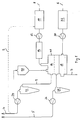
- the system for roasting shown in Fig. 1 consists of a fresh air supply 8, with which a hot air generator is supplied, from where this air via a Hot air fan 12 and a hot air conditioning 14 enters the container 40 of the roasting machine 16.
- the ventilation 20 and an exhaust pipe 9 of the separator roasting section 22 with an exhaust fan 24 and an exhaust air line 4 of the roasting section are connected to the container 40.
- a separator cooling section 28 with a suction fan 26 and an exhaust air line 5 is connected to the container 40.
- a cooling space 18 is arranged, which is connected on the one hand to a fresh air line 6 with a cooling air generator 32 and a cooling fan 30, on the other hand, the roasted material is transported away via a pipeline 7.
- the exhaust air line 4 also the hot air generator 10 is connected via a recirculation line 2.
- the roasting machine 16 shown in FIG. 1 for oil seeds, preferably hazelnuts and other types of nuts, and for coffee or cocoa beans, has the container 40 and a stirring tool 1 with nozzles 50, 52, 54 emitting hot gas (cf. FIG. 2).
- the nozzle outlets 3 are arranged in the roasted material 58, the distance between the nozzles 50, 52, 54 decreasing in a tangential view of the stirring tool 1 from the center 42 of the container 16 to the container wall 40.
- the container is circular in cross-section and that the axis of rotation of the stirring tool 1 is arranged in the center 42 of the container, the stirring tool 1 having four arms 46, 48 extending from the axis 42. These agitator arms are evenly distributed around the axis of rotation 42 of the agitator tool 1 and are designed as tubular pieces which taper towards their ends.
- the arms 46, 48 are arched in their vertical plan view and arranged in the same plane.
- the nozzles 50, 52, 54 (cf. FIGS. 2 and 3) are oriented vertically downward and are designed as tubular pieces which run approximately parallel to the axis of rotation 42 of the stirring tool 1.
- the nozzle outlets 3 are formed in the free ends of the nozzles.
- the roasting room 56 is separated from the cooling room 8 by a flat base plate 16. If the stirring tool 1 is now rotated and the nozzles 50, 52, 54 are pressurized with compressed gas, then the roasted material 58 is swirled in the roasting space 56 and for the most part evenly pressurized with gas.
- the design of the stirring tool ensures that the "density" of the roasted material 58 within the roasting space 56 is approximately constant.
Landscapes
- Life Sciences & Earth Sciences (AREA)
- Engineering & Computer Science (AREA)
- Chemical & Material Sciences (AREA)
- Food Science & Technology (AREA)
- Polymers & Plastics (AREA)
- Health & Medical Sciences (AREA)
- Nutrition Science (AREA)
- Biotechnology (AREA)
- Apparatuses For Bulk Treatment Of Fruits And Vegetables And Apparatuses For Preparing Feeds (AREA)
Abstract
Description
- Die Erfindung betrifft ein Verfahren zum Rösten von Ölsamen sowie eine Vorrichtung zum Durchführen dieses Verfahrens.
- Geröstete Ölsamen, z.B. Haselnüsse, unterliegen bekannterweise in Abhängigkeit vom angewendeten Röstverfahren und von der Rösttemperatur einem beschleunigten oxidativen Verderb. Üblicherweise werden diese Ölsamen in unterschiedlichen Röstverfahren, jedoch prinzipiell in einer trockenen Atmosphäre geröstet, was den obigen Verderb beschleunigt.
- Die Behandlung von Ölsamen mit Sattdampf zur Reduktion des Enzymgehaltes ist bekannt und z.B. in J.H. Mitchell, R.K. Malphrus, 1977, Lipid oxidation in spanish peanuts: The effect of moist heat treatment, J. Food Sci., 42 (6), 1457 - 1461; W.R. Forbus, S.D. Senter, 1976, Conditioning pecans with steam to improve shelling efficiency and storage stability, J. Food Sci. 41, 794 - 798. Die Behandlung von Kakaobohnen mit Wasserdampf oder Heißwasser zur Verbesserung der Schälbarkeit und zur Keimreduktion ist ebenfalls bekannt. Weiter ist es üblich, daß bei der Kakaoröstung Wasser zur Sterilisation am Ende der Röstung eingespritzt wird. Ferner ist auch die Verwendung von Dampf bei der Röstung von Kaffee zur Erhöhung der Aromaausbeute bekannt. Dies geschieht entweder während der gesamten Röstdauer oder in einer ersten Stufe unter Druck. Ziel der Anwendung von Dampf beziehungsweise einer feuchten Atmosphäre ist unter anderem eine verstärkte Expansion der Bohnen.
- Ausgehend von dem obigen Stand der Technik liegt der Erfindung die Aufgabe zugrunde, die strukturelle Veränderung der Ölsamen durch die Anwendung von feuchter Luft in einer ersten Röststufe zu verhindern.
Eine weitere Aufgabe der Erfindung besteht darin, hierfür eine geeignete Röstmaschine vorzuschlagen. - Die gestellte Aufgabe wird erfindungsgemäß durch die Merkmale des Anspruches 1 gelöst.
- Der tragende Gedanke der Erfindung bezieht sich auf die Anwendung einer feuchten Röststufe und bezweckt dabei die Erhaltung der zellulären Struktur und damit die Verbesserung der Oxidationsstabilität der Produkte. Dies wird erreicht, indem die Nüsse z.B. auf 130° C erhitzt werden, ohne daß der Wassergehalt stark abnimmt. Bei 130° C ändert sich der physikalische Zustand der Zellwandpolymere, wodurch Wasserdampf die Zellen verlassen kann, ohne die Mikrostruktur anzugreifen. Dadurch bleibt eine Zellstruktur erhalten, die für atmosphärischen Sauerstoff eine optimale Diffusionsbarriere darstellt.
- Findet eine Trocknung statt, bevor die Nüsse 130° C erreicht haben, oder werden die Nüsse schnell auf Temperaturen über 150° C erhitzt, werden die Zellorgane beschädigt, beziehungsweise führt das forcierte Austreten von Wasserdampf zu einer starken Expansion der Produkte und damit zu einem Abbau von Diffusionswiderständen.
- Das Verfahren kann vorzugsweise mittels einer Röstmaschine durchgeführt werden, wie sie im Anspruch 5 definiert ist.
- Durch die Anwendung eines Zwei-Stufen-Röstverfahrens kann die oxidative Stabilität von gerösteten Haselnüssen erhöht werden. In der ersten Röststufe werden bei einer Temperatur zwischen 90 und 150° C und bei einem partiellen Wasserdampfdruck der Luft von 0,1 bar (entspricht 100 % relativer Luftfeuchtigkeit bei 50° C) bis 1,01 bar (entspricht 100 % relativer Luftfeuchtigkeit bei 100° C) die Haselnüsse während 4 bis 20 Minuten vorbehandelt, um in einer zweiten Stufe in trockener Atmosphäre bei einer höheren Temperatur konfektioniert zu werden (Aroma- und Farbbildung, Wassergehaltsreduktion). Die Oxidationsstabilität des Endproduktes kann zusätzlich verbessert werden, wenn die Nüsse vor der Röstung auf einen Wassergehalt von 3 bis 10, vorzugsweise 5,5 bis 7 %, angefeuchtet werden (auch hinsichtlich eines Ausgleichs der Wasserverteilung in einem längere Zeit gelagerten Lot). Dies geschieht vorzugsweise durch das Aufsprühen von Wasser auf die rohen Haselnüsse oder Bedampfung derselben vor der Röstung. Beide Verfahrensschritte können gleichzeitig durchgeführt werden. Gemeinsam ist diesen Verfahrensschritten:
Anfeuchtung der Nüsse, eine Feuchtröst-Stufe und eine Konfektionierungsstufe. Hierdurch werden die Oxidationsstabilität sowie das Röstaroma (im Vergleich zu einer konventionellen Röstung bei Anwendung desselben Temperaturverlaufs) deutlich verbessert. - Das vorgeschlagene Verfahren kann vorzugsweise mittels einer Röstmaschine für Ölsamen durchgeführt werden, die einen Behälter sowie mindestens ein Rührwerkzeug mit Heißgas abgebenden Düsen aufweist. Die Düsenauslässe sind im Röstgut angeordnet, wobei der Abstand der Düsen voneinander in tangentialer Ansicht des Rührwerkzeuges von der Mitte des Behälters zur Behälterwand hin abnimmt. Durch diese Maßnahmen wird insbesondere der Vorteil erreicht, daß die Ölsamen zum größten Teil gleichmäßig vermischt und somit geröstet werden, und zwar unabhänig davon, ob sie sich näher zur oder weiter weg von der Mitte bzw. Außenwand des Behälters befinden.
- Weitere zweckmäßige und vorteilhafte Ausgestaltungen der Erfindung gehen aus den Unteransprüchen hervor.
- Handelt es sich um eine Röstmaschine mit einem im Querschnitt kreisrunden Behälter, dann ist es zweckmäßig, wenn die Drehachse des Rührwerkzeuges in der Mitte des Behälters angeordnet ist und wenn das Rührwerkzeug mindestens zwei von der Achse abgehende Arme aufweist. Im Rahmen dieses Erfindungsgedankens ist es besonders zweckmäßig, wenn die Rührarme in etwa gleichmäßig um die Drehachse des Rührwerkzeuges verteilt sind und wenn diese als Rohrstücke ausgebildet sind, die sich zu ihren Enden hin verjüngen. Durch die Gasbeaufschlagung der Ölsamen sowie Vermischung derselben mittels des Rührwerkzeuges ist sichergestellt, daß die Ölsamen im Behälter optimal geröstet werden, und zwar unabhängig davon, wo sie sich im Behälter befinden.
- Ferner sieht eine besonders zweckmäßige Ausgestaltung der Erfindung vor, daß die Arme in ihrer vertikalen Draufsicht bogenförmig ausgebildet sind und in derselben Ebene oder in bezug auf den Röstgut-Spiegel höhenversetzt angeordnet sind. Durch diese Maßnahmen wird der vorgeschlagene und gewünschte Abstand zwischen den Düsen in besonders einfacher Weise erreicht.
- Eine weitere zweckmäßige Ausgestaltung der Erfindung sieht vor, daß die Düsen als Rohrstücke ausgebildet sind, die etwa parallel zur Drehachse des Rührwerkzeuges verlaufen.
- Die vorgeschlagene Röstmaschine ist besonders gut dazu geeignet, die Ölsamen in zwei Stufen zu Rösten, wobei in der ersten Röststufe die Ölsamen zwischen 3 und 20 Minuten bei einer Temperatur von 70 bis 150° C und einer relativen Feuchtigkeit von 3 bis 30% vorbehandelt werden, während sie in der zweiten Stufe in einer trockenen Atmosphäre und bei einer höheren Temperatur konfektioniert werden (Aromabildung und Wassergehaltsreduktion).
- Ein Ausführungsbeispiel der Erfindung ist in der Zeichnung schematisch dargestellt und wird im folgenden näher erläutert. Es zeigen
- Fig. 1
- eine Anlage zum Rösten von Ölsamen,
- Fig. 2
- den in Fig. 1 dargestellten Behälter in vertikaler Draufsicht und
- Fig. 3
- einen Schnitt entlang der Linie A-A nach Fig. 2.
- Die in Fig. 1 dargestellte Anlage zum Rösten besteht aus einer Frischluftzufuhr 8, mit der ein Heißlufterzeuger versorgt wird, von wo aus diese Luft über einen Heißluftventilator 12 und eine Heißluftkonditionierung 14 in den Behälter 40 der Röstmaschine 16 gelangt. An den Behälter 40 sind die Belüftung 20 sowie ein Abluftrohr 9 der Abscheider-Röstsektion 22 mit einem Absaugventilator 24 und einer Fortluftleitung 4 der Röstsektion angeschlossen. Ferner ist an dem Behälter 40 eine Abscheider-Kühlsektion 28 mit einem Absaugventilator 26 und einer Fortluftleitung 5 angeschlossen. Unterhalb des Röstraumes 16 ist ein Kühlraum 18 angeordnet, der zum einen an eine Frischluftleitung 6 mit einem Kühllufterzeuger 32 und einen Kühlventilator 30 angeschlossen ist, zum anderen erfolgt der Abtransport des Röstgutes über eine Rohrleitung 7. Ferner ist zu erkennen, daß die Fortluftleitung 4 mit dem Heißlufterzeuger 10 über eine Rezirkulationsleitung 2 verbunden ist.
- Die in Fig. 1 dargestellte Röstmaschine 16 für Ölsamen, vorzugsweise Haselnüsse und andere Nußsorten, und für Kaffee- oder Kakaobohnen, weist den Behälter 40 sowie ein Rührwerkzeug 1 mit Heißgas abgebenden Düsen 50, 52, 54 auf (vgl. Fig. 2). Die Düsenauslässe 3 (Fig. 3) sind im Röstgut 58 angeordnet, wobei der Abstand der Düsen 50, 52, 54 voneinander in tangentialer Ansicht des Rührwerkzeuges 1 von der Mitte 42 des Behälters 16 zur Behälterwand 40 hin abnimmt.
- Man erkennt, daß der Behälter im Querschnitt kreisrund ist und daß die Drehachse des Rührwerkzeuges 1 in der Mitte 42 des Behälters angeordnet ist, wobei das Rührwerkzeug 1 vier von der Achse 42 abgehende Arme 46, 48 aufweist. Diese Rührarme sind gleichmäßig um die Drehachse 42 des Rührwerkzeuges 1 verteilt und als Rohrstücke ausgebildet, die sich zu ihren Enden hin verjüngen.
- Ferner ist zu erkennen, daß die Arme 46, 48 in ihrer vertikalen Draufsicht bogenförmig ausgebildet und in derselben Ebene angeordnet ist. Die Düsen 50, 52, 54 (vgl. Fig. 2 und 3) sind vertikal nach unten zu ausgerichtet und als Rohrstücke ausgebildet, die etwa parallel zur Drehachse 42 des Rührwerkzeuges 1 verlaufen. Die Düsenauslässe 3 sind in den freien Enden der Düsen ausgebildet. Der Röstraum 56 ist vom Kühlraum 8 durch eine ebene Bodenplatte 16 getrennt. Wird nun das Rührwerkzeug 1 verdreht und werden die Düsen 50, 52, 54 mit Druckgas beaufschlagt, dann wird das Röstgut 58 im Röstraum 56 verwirbelt und zum größten Teil gleichmäßig mit Druckgas beaufschlagt. Die Ausbildung des Rührwerkzeuges gewährleistet, daß die "Dichte" des Röstgutes 58 innerhalb des Röstraumes 56 in etwa konstant ist.
Claims (14)
- Verfahren zum Rösten von Ölsamen, z.B. Haselnüsse, und von Kaffee- oder Kakaobohnen,
gekennzeichnet durch
zwei Röststufen, wobei in der ersten Röststufe die Ölsamen zwischen 3 und 20 Minuten bei einer Temperatur von 70 bis 150° C und einer relativen Feuchtigkeit von 3 bis 30 % vorbehandelt werden, während sie in der zweiten Stufe in einer trockenen Atmosphäre und bei einer hohen Temperatur, z.B. 190° C konfektioniert werden (Aromabildung und Wassergehaltsreduktion). - Verfahren nach Anspruch 1,
dadurch gekennzeichnet,
daß die Ölsamen 4 bis 20 Minuten, vorzugsweise 6 bis 8 Minuten, vorbehandelt werden und daß die Vorröststufe in feuchter Atmosphäre nahe dem atmosphärischen Druck durchgeführt wird. - Verfahren nach Anspruch 1 oder 2,
dadurch gekennzeichnet,
daß die Temperatur während der Vorbehandlung 95 bis 130° C, vorzugsweise 100 bis 110° C, beträgt. - Verfahren nach einem der Ansprüche 1 bis 3,
dadurch gekennzeichnet,
daß die Luftfeuchtigkeit 6 bis 10 %, vorzugsweise 8 bis 9 %, beträgt. - Röstmaschine (16) für Ölsamen, z.B. Kaffee-, Kakaobohnen oder dgl., mit einem Behälter (40) sowie mindestens einem Rührwerkzeug (1) mit Heißgas abgebenden Düsen (50, 52, 54),
dadurch gekennzeichnet,
daß die Düsenauslässe (3) im Röstgut (58) angeordnet sind und daß der Abstand der Düsen (50, 52, 54) voneinander in tangentialer Ansicht des Rührwerkzeuges (1) von der Mitte (42) des Behälters (16) zur Behälterwand (40) hin abnimmt. - Röstmaschine nach Anspruch 5 mit einem im Querschnitt kreisrunden Behälter (40),
dadurch gekennzeichnet,
daß die Drehachse (42) des Rührwerkzeuges (1) in der Mitte (42) des Behälters (40) angeordnet ist und daß das Rührwerkzeug (1) mindestens zwei von der Achse abgehende Arme (46, 48) aufweist. - Röstmaschine nach Anspruch 5 oder 6,
dadurch gekennzeichnet,
daß die Rührarme (46, 48) in etwa gleichmäßig um die Drehachse (42) des Rührwerkzeuges (1) verteilt sind. - Röstmaschine nach einem der Ansprüche 5 bis 7,
dadurch gekennzeichnet,
daß die Arme (46, 48) als Rohrstücke ausgebildet sind, die sich zu ihrem Ende hin verjüngen. - Röstmaschine nach einem der Ansprüche 5 bis 8,
dadurch gekennzeichnet,
daß die Arme (46, 48) in ihrer vertikalen Draufsicht bogenförmig ausgebildet sind. - Röstmaschine nach einem der Ansprüche 5 bis 9,
dadurch gekennzeichnet,
daß die Arme (46, 48) in derselben Ebene oder in bezug auf das Röstgut (58) höhenversetzt angeordnet sind. - Röstmaschine nach einem der Ansprüche 5 bis 10,
dadurch gekennzeichnet,
daß die Düsen (50, 52, 54) vertikal nach unten ausgerichtet sind. - Röstmaschine nach einem der Ansprüche 5 bis 11,
dadurch gekennzeichnet,
daß die Düsen (50, 52, 54) als Rohrstücke ausgebildet sind, die etwa parallel zur Drehachse (42) des Rührwerkzeuges (1) verlaufen. - Röstmaschine nach einem der Ansprüche 5 bis 12,
dadurch gekennzeichnet,
daß die Düsenauslässe (3) in den freien Enden der Düsen (50, 52, 54) ausgebildet sind. - Röstmaschine nach einem der Ansprüche 5 bis 13 zum Durchführen des Verfahrens nach einem der Ansprüche 1 bis 4.
Applications Claiming Priority (2)
| Application Number | Priority Date | Filing Date | Title |
|---|---|---|---|
| DE4446788A DE4446788A1 (de) | 1994-12-24 | 1994-12-24 | Verfahren zum Rösten von Ölsamen und Vorrichtung zum Durchführen dieses Verfahrens |
| DE4446788 | 1994-12-24 |
Publications (3)
| Publication Number | Publication Date |
|---|---|
| EP0729705A2 true EP0729705A2 (de) | 1996-09-04 |
| EP0729705A3 EP0729705A3 (de) | 1997-05-28 |
| EP0729705B1 EP0729705B1 (de) | 2001-03-28 |
Family
ID=6537258
Family Applications (1)
| Application Number | Title | Priority Date | Filing Date |
|---|---|---|---|
| EP95119058A Expired - Lifetime EP0729705B1 (de) | 1994-12-24 | 1995-12-04 | Verfahren zum Rösten und Vorrichtung zum Durchführen dieses Verfahrens |
Country Status (2)
| Country | Link |
|---|---|
| EP (1) | EP0729705B1 (de) |
| DE (2) | DE4446788A1 (de) |
Cited By (8)
| Publication number | Priority date | Publication date | Assignee | Title |
|---|---|---|---|---|
| GB2355642A (en) * | 1999-09-02 | 2001-05-02 | David Mckernan | Coffee manufacturing process |
| EP0806147B1 (de) * | 1996-05-10 | 2002-12-04 | Kraft Foods, Inc. | Verfahren zum Entfernen von Beigeschmack aus Kakaoerzeignissen |
| WO2009003545A1 (de) * | 2007-07-02 | 2009-01-08 | BüHLER BARTH AG | Verfahren zum rösten und zur oberflächen-pasteurisation von partikulären lebensmittelprodukten |
| US9232817B2 (en) | 2007-07-02 | 2016-01-12 | Bühler Barth Gmbh | Method for the surface-pasteurization and-sterilization of pieces of food |
| WO2016196796A1 (en) * | 2015-06-03 | 2016-12-08 | Calico Cottage, Inc. | Roasting and glazing apparatus, roasting and glazing method, and method for cleaning a roasting and glazing apparatus |
| US9549570B2 (en) | 2015-06-03 | 2017-01-24 | Calico Cottage, Inc. | Roasting and glazing method |
| US10238138B2 (en) | 2015-06-03 | 2019-03-26 | Calico Cottage, Inc. | Roasting and glazing apparatus employing electronic techniques for detecting boiling of water during steam cleaning operation |
| US11311144B2 (en) | 2015-06-03 | 2022-04-26 | Calico Cottage, Inc. | Roasting and glazing apparatus |
Families Citing this family (2)
| Publication number | Priority date | Publication date | Assignee | Title |
|---|---|---|---|---|
| DE102014019593A1 (de) * | 2014-12-30 | 2016-06-30 | Elisabeth Lange | Verfahren zur Verarbeitung von kernartigen Lebensmitteln |
| CN108968113B (zh) * | 2018-06-13 | 2021-06-08 | 合肥久多农业科技有限公司 | 一种农业用芝麻表面水分去除装置 |
Family Cites Families (14)
| Publication number | Priority date | Publication date | Assignee | Title |
|---|---|---|---|---|
| US2558854A (en) * | 1948-06-22 | 1951-07-03 | Gen Foods Corp | Cacao process and product |
| FR1106126A (fr) * | 1954-08-02 | 1955-12-12 | Perfectionnement apporté à la torréfaction du café | |
| DE1692234A1 (de) * | 1966-01-03 | 1972-04-06 | Karl Beil | Verfahren und Vorrichtung zum Veredeln von Kaffeebohnen |
| JPS5217107B2 (de) * | 1971-12-25 | 1977-05-13 | ||
| US4161549A (en) * | 1973-12-07 | 1979-07-17 | Gallon & Company | Method of improving the flavor of previously dried green coffee beans |
| FR2390202A1 (fr) * | 1977-05-11 | 1978-12-08 | Anvar | Procede et dispositif de traitement d'un produit se presentant sous forme de grains et application a la torrefaction |
| US4322447A (en) * | 1980-09-29 | 1982-03-30 | Hills Bros. Coffee, Inc. | High speed process for roasting coffee |
| DE3266662D1 (en) * | 1981-06-24 | 1985-11-07 | Buehler Ag Geb | Process and apparatus for treating unshelled shell fruits, particularly cocoa beans |
| DE3217055A1 (de) * | 1982-05-06 | 1983-11-10 | Bosch-Siemens Hausgeräte GmbH, 7000 Stuttgart | Verfahren und vorrichtung zum roesten insbesondere kleiner mengen gruener kaffeebohnen |
| CH656779A5 (de) * | 1982-09-30 | 1986-07-31 | Escher Wyss Gmbh | Konditionierung von sojabohnenbruch. |
| US4522833A (en) * | 1984-01-13 | 1985-06-11 | Warner-Lambert Company | Roasted coated nut product and process therefor |
| DE3430103A1 (de) * | 1984-08-16 | 1986-02-27 | Tchibo Frisch-Röst-Kaffee AG, 2000 Hamburg | Verfahren zum roesten von kaffee mittels eines laden-kleinroesters |
| US4615123A (en) * | 1984-11-23 | 1986-10-07 | Brown Ernest C | Apparatus for the continuous treatment of solid particles in a fluidized state |
| ES2008445A6 (es) * | 1988-04-11 | 1989-07-16 | Pons Espona Carlos | Procedimiento de tueste de frutos y semillas. |
-
1994
- 1994-12-24 DE DE4446788A patent/DE4446788A1/de not_active Withdrawn
-
1995
- 1995-12-04 DE DE59509133T patent/DE59509133D1/de not_active Expired - Lifetime
- 1995-12-04 EP EP95119058A patent/EP0729705B1/de not_active Expired - Lifetime
Cited By (19)
| Publication number | Priority date | Publication date | Assignee | Title |
|---|---|---|---|---|
| EP0806147B1 (de) * | 1996-05-10 | 2002-12-04 | Kraft Foods, Inc. | Verfahren zum Entfernen von Beigeschmack aus Kakaoerzeignissen |
| GB2355642A (en) * | 1999-09-02 | 2001-05-02 | David Mckernan | Coffee manufacturing process |
| GB2355642B (en) * | 1999-09-02 | 2003-04-23 | David Mckernan | A coffee manufacturing process |
| WO2009003545A1 (de) * | 2007-07-02 | 2009-01-08 | BüHLER BARTH AG | Verfahren zum rösten und zur oberflächen-pasteurisation von partikulären lebensmittelprodukten |
| AU2008271668B2 (en) * | 2007-07-02 | 2012-03-01 | Bühler AG | Process for roasting and surface pasteurization of particulate food products |
| US9179704B2 (en) | 2007-07-02 | 2015-11-10 | Buhler Barth Ag | Method for roasting and surface-pasteurization of foods products |
| US9232817B2 (en) | 2007-07-02 | 2016-01-12 | Bühler Barth Gmbh | Method for the surface-pasteurization and-sterilization of pieces of food |
| US9549570B2 (en) | 2015-06-03 | 2017-01-24 | Calico Cottage, Inc. | Roasting and glazing method |
| WO2016196796A1 (en) * | 2015-06-03 | 2016-12-08 | Calico Cottage, Inc. | Roasting and glazing apparatus, roasting and glazing method, and method for cleaning a roasting and glazing apparatus |
| US9549637B2 (en) | 2015-06-03 | 2017-01-24 | Calico Cottage, Inc | Roasting and glazing apparatus and method of cleaning thereof |
| US9578987B2 (en) | 2015-06-03 | 2017-02-28 | Calico Cottage, Inc. | Roasting and glazing apparatus |
| US9642392B2 (en) | 2015-06-03 | 2017-05-09 | Calico Cottage, Inc. | Roasting and glazing apparatus |
| US10238138B2 (en) | 2015-06-03 | 2019-03-26 | Calico Cottage, Inc. | Roasting and glazing apparatus employing electronic techniques for detecting boiling of water during steam cleaning operation |
| US10264918B2 (en) | 2015-06-03 | 2019-04-23 | Calico Cottage, Inc. | Roasting and glazing apparatus and method of cleaning thereof |
| US10299505B2 (en) | 2015-06-03 | 2019-05-28 | Calico Cottage, Inc. | Method of cleaning a roaster bowl employing electronic techniques for detecting boiling of water during steam cleaning operation |
| US11311144B2 (en) | 2015-06-03 | 2022-04-26 | Calico Cottage, Inc. | Roasting and glazing apparatus |
| US11832760B2 (en) | 2015-06-03 | 2023-12-05 | Calico Cottage, Inc. | Roasting and glazing method |
| US11896157B2 (en) | 2015-06-03 | 2024-02-13 | Calico Cottage, Inc. | Roasting and glazing apparatus |
| US12285132B2 (en) | 2015-06-03 | 2025-04-29 | Calico Cottage, Inc. | Roasting and glazing apparatus |
Also Published As
| Publication number | Publication date |
|---|---|
| DE4446788A1 (de) | 1996-06-27 |
| EP0729705B1 (de) | 2001-03-28 |
| DE59509133D1 (de) | 2001-05-03 |
| EP0729705A3 (de) | 1997-05-28 |
Similar Documents
| Publication | Publication Date | Title |
|---|---|---|
| EP0252394B1 (de) | Verfahren zum Trocknen von pflanzlichen oder tierischen Materialien | |
| DE3725309A1 (de) | Verfahren und vorrichtung zum expandieren von tabak | |
| EP0729705B1 (de) | Verfahren zum Rösten und Vorrichtung zum Durchführen dieses Verfahrens | |
| DE3128596A1 (de) | Vorrichtung zur behandlung von flockigem oder gekoerntem material mit gasen oder daempfen im kontinuierlichen betrieb im gegenstrom | |
| EP0455976B1 (de) | Verfahren zum Trocknen von stückigen, biologischen Produkten | |
| DE3544387C2 (de) | ||
| CH686546A5 (de) | Verfahren zum Entkeimen und Trocknen von rohen Kakaobohnen oder Kakaokernbruch. | |
| DE19627227C2 (de) | Verfahren zum Räuchern von Lebensmitteln sowie Vorrichtung hierfür | |
| EP0068221B1 (de) | Verfahren und Vorrichtung zum Behandeln von ungeschälten Schalenfrüchten, insbesondere von Kakaobohnen | |
| DE2731932A1 (de) | Vorrichtung und verfahren zum gleichmaessigen anfeuchten von ganzen tabakstielen | |
| DE2313224C3 (de) | Verfahren zur Wärmebehandlung von ölfruchtsamen | |
| DE2731931A1 (de) | Verfahren und vorrichtung zur erzeugung von expandiertem tabak aus ganzen tabakstengeln | |
| DE112017005696B4 (de) | Verbesserte Vorrichtungen zum Desolventieren der Extraktionsrückstände | |
| DE809994C (de) | Verfahren und Vorrichtung zum Aufschliessen von pflanzlichen Stoffen, wie Samen, Stengeln, Rinden, Wurzeln o. dgl., sowie Halbfabrikaten aus diesen | |
| CH644997A5 (de) | Desorptionsverfahren. | |
| EP0185036B1 (de) | Verfahren und vorrichtung zur aufbereitung von kakao- und kaffeebohnen | |
| DE3785930T2 (de) | Verfahren und vorrichtung zur schnellen rehydratation von gemuesen und dergleichen. | |
| DE1010362B (de) | Verfahren zum Pasteurisieren oder Sterilisieren von fluessigen Naehrprodukten | |
| EP0736163A1 (de) | Verfahren und vorrichtung zum entzug von wasser aus frischgras und zum nachtrocknen des vorbehandelten grases | |
| CH317991A (de) | Verfahren zum Trochnen von Teigwaren | |
| DE276211C (de) | ||
| EP2940414B1 (de) | Verfahren und Vorrichtung zum Trocknen von pflanzlichen Produkten | |
| EP0848591B1 (de) | Verfahren zur behandlung von rohkaffee | |
| DE102019101926A1 (de) | Verfahren zum Behandeln gerösteter Kaffeebohnen | |
| DE630736C (de) | Verfahren und Einrichtung zum Befeuchten von Blattabak |
Legal Events
| Date | Code | Title | Description |
|---|---|---|---|
| PUAI | Public reference made under article 153(3) epc to a published international application that has entered the european phase |
Free format text: ORIGINAL CODE: 0009012 |
|
| AK | Designated contracting states |
Kind code of ref document: A2 Designated state(s): CH DE ES FR GB IT LI NL PT |
|
| PUAL | Search report despatched |
Free format text: ORIGINAL CODE: 0009013 |
|
| AK | Designated contracting states |
Kind code of ref document: A3 Designated state(s): CH DE ES FR GB IT LI NL PT |
|
| 17P | Request for examination filed |
Effective date: 19971128 |
|
| 17Q | First examination report despatched |
Effective date: 19990113 |
|
| GRAG | Despatch of communication of intention to grant |
Free format text: ORIGINAL CODE: EPIDOS AGRA |
|
| GRAG | Despatch of communication of intention to grant |
Free format text: ORIGINAL CODE: EPIDOS AGRA |
|
| GRAH | Despatch of communication of intention to grant a patent |
Free format text: ORIGINAL CODE: EPIDOS IGRA |
|
| ITF | It: translation for a ep patent filed | ||
| GRAH | Despatch of communication of intention to grant a patent |
Free format text: ORIGINAL CODE: EPIDOS IGRA |
|
| GRAA | (expected) grant |
Free format text: ORIGINAL CODE: 0009210 |
|
| AK | Designated contracting states |
Kind code of ref document: B1 Designated state(s): CH DE ES FR GB IT LI NL PT |
|
| PG25 | Lapsed in a contracting state [announced via postgrant information from national office to epo] |
Ref country code: NL Free format text: LAPSE BECAUSE OF FAILURE TO SUBMIT A TRANSLATION OF THE DESCRIPTION OR TO PAY THE FEE WITHIN THE PRESCRIBED TIME-LIMIT Effective date: 20010328 Ref country code: GB Free format text: LAPSE BECAUSE OF FAILURE TO SUBMIT A TRANSLATION OF THE DESCRIPTION OR TO PAY THE FEE WITHIN THE PRESCRIBED TIME-LIMIT Effective date: 20010328 Ref country code: FR Free format text: LAPSE BECAUSE OF FAILURE TO SUBMIT A TRANSLATION OF THE DESCRIPTION OR TO PAY THE FEE WITHIN THE PRESCRIBED TIME-LIMIT Effective date: 20010328 |
|
| REG | Reference to a national code |
Ref country code: CH Ref legal event code: NV Representative=s name: FELBER & PARTNER AG PATENTANWAELTE Ref country code: CH Ref legal event code: EP |
|
| REF | Corresponds to: |
Ref document number: 59509133 Country of ref document: DE Date of ref document: 20010503 |
|
| PG25 | Lapsed in a contracting state [announced via postgrant information from national office to epo] |
Ref country code: PT Free format text: LAPSE BECAUSE OF FAILURE TO SUBMIT A TRANSLATION OF THE DESCRIPTION OR TO PAY THE FEE WITHIN THE PRESCRIBED TIME-LIMIT Effective date: 20010628 |
|
| EN | Fr: translation not filed | ||
| NLV1 | Nl: lapsed or annulled due to failure to fulfill the requirements of art. 29p and 29m of the patents act | ||
| GBV | Gb: ep patent (uk) treated as always having been void in accordance with gb section 77(7)/1977 [no translation filed] |
Effective date: 20010328 |
|
| PG25 | Lapsed in a contracting state [announced via postgrant information from national office to epo] |
Ref country code: ES Free format text: LAPSE BECAUSE OF FAILURE TO SUBMIT A TRANSLATION OF THE DESCRIPTION OR TO PAY THE FEE WITHIN THE PRESCRIBED TIME-LIMIT Effective date: 20010927 |
|
| PLBE | No opposition filed within time limit |
Free format text: ORIGINAL CODE: 0009261 |
|
| STAA | Information on the status of an ep patent application or granted ep patent |
Free format text: STATUS: NO OPPOSITION FILED WITHIN TIME LIMIT |
|
| 26N | No opposition filed | ||
| REG | Reference to a national code |
Ref country code: CH Ref legal event code: PFA Owner name: BUEHLER BARTH AG Free format text: MASCHINENFABRIK G.W. BARTH LUDWIGSBURG GMBH & CO.#DAIMLERSTRASSE 6#D-71691 FREIBERG (DE) -TRANSFER TO- BUEHLER BARTH AG#DAIMLERSTR. 6#71691 FREIBERG (DE) Ref country code: CH Ref legal event code: NV Representative=s name: HEPP WENGER RYFFEL AG |
|
| REG | Reference to a national code |
Ref country code: DE Ref legal event code: R082 Ref document number: 59509133 Country of ref document: DE Representative=s name: ISARPATENT PATENTANWAELTE BEHNISCH, BARTH, CHA, DE Effective date: 20110811 Ref country code: DE Ref legal event code: R082 Ref document number: 59509133 Country of ref document: DE Representative=s name: ISARPATENT GBR PATENT- UND RECHTSANWAELTE, DE Effective date: 20110811 Ref country code: DE Ref legal event code: R081 Ref document number: 59509133 Country of ref document: DE Owner name: BUEHLER BARTH GMBH, DE Free format text: FORMER OWNER: MASCHINENFABRIK G. W. BARTH LUDWIGSBURG GMBH & CO., 71691 FREIBERG, DE Effective date: 20120426 |
|
| REG | Reference to a national code |
Ref country code: CH Ref legal event code: PFA Owner name: BUEHLER BARTH GMBH Free format text: BUEHLER BARTH AG#DAIMLERSTR. 6#71691 FREIBERG (DE) -TRANSFER TO- BUEHLER BARTH GMBH#DAIMLERSTRASSE 6#71691 FREIBERG (DE) |
|
| REG | Reference to a national code |
Ref country code: DE Ref legal event code: R082 Ref document number: 59509133 Country of ref document: DE Representative=s name: ISARPATENT GBR PATENT- UND RECHTSANWAELTE, DE |
|
| REG | Reference to a national code |
Ref country code: DE Ref legal event code: R082 Ref document number: 59509133 Country of ref document: DE Representative=s name: ISARPATENT PATENTANWAELTE BEHNISCH, BARTH, CHA, DE Effective date: 20130312 Ref country code: DE Ref legal event code: R082 Ref document number: 59509133 Country of ref document: DE Representative=s name: ISARPATENT GBR PATENT- UND RECHTSANWAELTE, DE Effective date: 20130312 Ref country code: DE Ref legal event code: R081 Ref document number: 59509133 Country of ref document: DE Owner name: BUEHLER BARTH GMBH, DE Free format text: FORMER OWNER: BUEHLER BARTH AG, 71691 FREIBERG, DE Effective date: 20130312 |
|
| PGFP | Annual fee paid to national office [announced via postgrant information from national office to epo] |
Ref country code: DE Payment date: 20141218 Year of fee payment: 20 Ref country code: CH Payment date: 20141216 Year of fee payment: 20 |
|
| PGFP | Annual fee paid to national office [announced via postgrant information from national office to epo] |
Ref country code: IT Payment date: 20141218 Year of fee payment: 20 |
|
| REG | Reference to a national code |
Ref country code: DE Ref legal event code: R071 Ref document number: 59509133 Country of ref document: DE |
|
| REG | Reference to a national code |
Ref country code: CH Ref legal event code: PL |