EP0726002B1 - Digitale übertragungsstrecke zum effizienten transport von gemischten paketklassen - Google Patents
Digitale übertragungsstrecke zum effizienten transport von gemischten paketklassen Download PDFInfo
- Publication number
- EP0726002B1 EP0726002B1 EP94929422A EP94929422A EP0726002B1 EP 0726002 B1 EP0726002 B1 EP 0726002B1 EP 94929422 A EP94929422 A EP 94929422A EP 94929422 A EP94929422 A EP 94929422A EP 0726002 B1 EP0726002 B1 EP 0726002B1
- Authority
- EP
- European Patent Office
- Prior art keywords
- packet
- priority
- packets
- card
- data
- Prior art date
- Legal status (The legal status is an assumption and is not a legal conclusion. Google has not performed a legal analysis and makes no representation as to the accuracy of the status listed.)
- Expired - Lifetime
Links
Images

Classifications
-
- H—ELECTRICITY
- H04—ELECTRIC COMMUNICATION TECHNIQUE
- H04L—TRANSMISSION OF DIGITAL INFORMATION, e.g. TELEGRAPHIC COMMUNICATION
- H04L47/00—Traffic control in data switching networks
- H04L47/10—Flow control; Congestion control
- H04L47/34—Flow control; Congestion control ensuring sequence integrity, e.g. using sequence numbers
-
- H—ELECTRICITY
- H04—ELECTRIC COMMUNICATION TECHNIQUE
- H04L—TRANSMISSION OF DIGITAL INFORMATION, e.g. TELEGRAPHIC COMMUNICATION
- H04L12/00—Data switching networks
- H04L12/64—Hybrid switching systems
-
- H—ELECTRICITY
- H04—ELECTRIC COMMUNICATION TECHNIQUE
- H04L—TRANSMISSION OF DIGITAL INFORMATION, e.g. TELEGRAPHIC COMMUNICATION
- H04L12/00—Data switching networks
- H04L12/64—Hybrid switching systems
- H04L12/6418—Hybrid transport
-
- H—ELECTRICITY
- H04—ELECTRIC COMMUNICATION TECHNIQUE
- H04L—TRANSMISSION OF DIGITAL INFORMATION, e.g. TELEGRAPHIC COMMUNICATION
- H04L47/00—Traffic control in data switching networks
- H04L47/10—Flow control; Congestion control
- H04L47/24—Traffic characterised by specific attributes, e.g. priority or QoS
- H04L47/245—Traffic characterised by specific attributes, e.g. priority or QoS using preemption
-
- H—ELECTRICITY
- H04—ELECTRIC COMMUNICATION TECHNIQUE
- H04L—TRANSMISSION OF DIGITAL INFORMATION, e.g. TELEGRAPHIC COMMUNICATION
- H04L49/00—Packet switching elements
- H04L49/20—Support for services
-
- H—ELECTRICITY
- H04—ELECTRIC COMMUNICATION TECHNIQUE
- H04Q—SELECTING
- H04Q11/00—Selecting arrangements for multiplex systems
- H04Q11/04—Selecting arrangements for multiplex systems for time-division multiplexing
- H04Q11/0428—Integrated services digital network, i.e. systems for transmission of different types of digitised signals, e.g. speech, data, telecentral, television signals
- H04Q11/0478—Provisions for broadband connections
-
- H—ELECTRICITY
- H04—ELECTRIC COMMUNICATION TECHNIQUE
- H04L—TRANSMISSION OF DIGITAL INFORMATION, e.g. TELEGRAPHIC COMMUNICATION
- H04L12/00—Data switching networks
- H04L12/54—Store-and-forward switching systems
- H04L12/56—Packet switching systems
- H04L12/5601—Transfer mode dependent, e.g. ATM
- H04L2012/5629—Admission control
- H04L2012/563—Signalling, e.g. protocols, reference model
-
- H—ELECTRICITY
- H04—ELECTRIC COMMUNICATION TECHNIQUE
- H04L—TRANSMISSION OF DIGITAL INFORMATION, e.g. TELEGRAPHIC COMMUNICATION
- H04L12/00—Data switching networks
- H04L12/54—Store-and-forward switching systems
- H04L12/56—Packet switching systems
- H04L12/5601—Transfer mode dependent, e.g. ATM
- H04L2012/5638—Services, e.g. multimedia, GOS, QOS
- H04L2012/5646—Cell characteristics, e.g. loss, delay, jitter, sequence integrity
- H04L2012/5651—Priority, marking, classes
-
- H—ELECTRICITY
- H04—ELECTRIC COMMUNICATION TECHNIQUE
- H04L—TRANSMISSION OF DIGITAL INFORMATION, e.g. TELEGRAPHIC COMMUNICATION
- H04L12/00—Data switching networks
- H04L12/54—Store-and-forward switching systems
- H04L12/56—Packet switching systems
- H04L12/5601—Transfer mode dependent, e.g. ATM
- H04L2012/5638—Services, e.g. multimedia, GOS, QOS
- H04L2012/5671—Support of voice
-
- H—ELECTRICITY
- H04—ELECTRIC COMMUNICATION TECHNIQUE
- H04L—TRANSMISSION OF DIGITAL INFORMATION, e.g. TELEGRAPHIC COMMUNICATION
- H04L12/00—Data switching networks
- H04L12/54—Store-and-forward switching systems
- H04L12/56—Packet switching systems
- H04L12/5601—Transfer mode dependent, e.g. ATM
- H04L2012/5678—Traffic aspects, e.g. arbitration, load balancing, smoothing, buffer management
-
- H—ELECTRICITY
- H04—ELECTRIC COMMUNICATION TECHNIQUE
- H04L—TRANSMISSION OF DIGITAL INFORMATION, e.g. TELEGRAPHIC COMMUNICATION
- H04L12/00—Data switching networks
- H04L12/64—Hybrid switching systems
- H04L12/6418—Hybrid transport
- H04L2012/6464—Priority
-
- H—ELECTRICITY
- H04—ELECTRIC COMMUNICATION TECHNIQUE
- H04L—TRANSMISSION OF DIGITAL INFORMATION, e.g. TELEGRAPHIC COMMUNICATION
- H04L12/00—Data switching networks
- H04L12/64—Hybrid switching systems
- H04L12/6418—Hybrid transport
- H04L2012/6489—Buffer Management, Threshold setting, Scheduling, Shaping
-
- H—ELECTRICITY
- H04—ELECTRIC COMMUNICATION TECHNIQUE
- H04L—TRANSMISSION OF DIGITAL INFORMATION, e.g. TELEGRAPHIC COMMUNICATION
- H04L49/00—Packet switching elements
- H04L49/30—Peripheral units, e.g. input or output ports
Definitions
- This invention relates generally to high speed transmission of digital data in packets from one node to another.
- the invention is directed to a novel transmission technique by which digital data of different classes can be effectively transmitted through a single link.
- Multimedia is being touted as telecommunications of the future.
- Telecommunication networks are required to handle a variety of traffic such as voice, video, data etc.; in other words, the bandwidth must be shared by many different classes of traffic.
- different classes of traffic call for different qualities of service from the network, with respect to, for example, speed of transmission, probability of transmission error, network delay etc.
- the network delay interactive data, voice and video traffic are delay sensitive and sensitivity is characterized by full duplex operation where users expect timely service. Considering the consequences of slow turn-around on customer satisfaction, slow interactive operations are deemed to be inadequate.
- Non-delay-sensitive traffic indudes bulk down-load, non-real time video. This traffic can sustain relatively large delays because the end users don't see the delay. Typically, these services are simplex and delay is transparent to the user.
- ATM and Fast Packet switching architectures are being proposed for integrated switching applications. These broadband technologies are characterized by cell switched data.
- the main advantage of cell switching is that it minimizes switching delays caused by voice/video/data interactions and it is suitable for hardware accelerated routing. Cell switching provides a predictable and controllable delay. Long data packets do not adversely interfere with delay sensitive voice packets.
- Cell switching provides a connection oriented routing algorithm which prevents packet mis-ordering. By establishing an explicit path, cells are guaranteed to arrive in sequence. Under normal circumstances, all cells associated with a connection follow an explicit path.
- Packet switching connectionless data services over a broadband cell switch results in out of sequence cells due to multi-path delay variance.
- the re-assembly of out of sequence cells into packets poses a significant processing requirement on the network end stations.
- the transport of large (10-20 Kbyte) data packets requires processor intensive packet fragmentation into cells and re-assembly of cells into packets.
- bandwidth sharing schemes have been proposed for integrated packet switching over a switching network.
- One scheme for an integrated voice and data network is described in U.S. Patent 4,914,650, issued on April 3, 1990 to Sriram.
- This network has a multiplexer arranged with a voice queue for storing received voice packets and a data queue for storing received data packets. Voice packets are transmitted for a predetermined interval T1 and data packets are transmitted for a predetermined interval T2. Predetermined intervals T1 and T2 may be of different duration.
- the multiplexer may be additionally arranged with a separate signaling queue for storing received signaling messages.
- a signaling message is moved into the separate signaling queue during either interval T1 or T2, that interval is suspended and transmission of voice or data packets is interrupted from the end of a packet until the signaling message is transmitted. Then transmission of the interrupted voice or data packets is resumed for the remainder of the suspended interval T1 or T2.
- a multiplexer may be arranged with a separate signaling queue for storing received signaling messages at any time.
- Signaling message transmission intervals are reserved either between intervals T1 and T2, between intervals T2 and T1, or both. These signaling intervals are of a flexible duration that is sufficiently long for transmitting all of the signaling messages waiting to be transmitted.
- the multiplexer allocates a certain minimum bandwidth for voice and data traffic. This protects each type of traffic from congestion caused by the other type. Concurrently, the multiplexer also allocates to each type of traffic any spare bandwidth momentarily available because it is not being utilized by the other type of traffic. Signaling messages are serviced with very low delay and zero packet loss.
- both speech and data are transmitted as packets over virtual connections set up in a fully digital network.
- a virtual connection is set up from a calling party to a called party at a call setup.
- Each packet contains source address, destination address, routing information of the switching network etc., in addition to payload and other network management information.
- Each packet stays intact while being transported through the network except for network management information and routing information.
- Each packet is transmitted through the network to the destination along the route specified in the routing information. Therefore, if the customer desires to send voice to a destination while data packets are being transmitted to a different destination over the same loop, the voice packet must interrupt the transmission of data packets because it requires minimum delay.
- the patent achieves this by adding a tail to the interrupted data packet and storing the remaining un-transmitted part of the data packet in a buffer.
- a voice packet also contains addresses, routing information etc., but is 64 bytes long instead of 1024 bytes for a data packet.
- the voice packet While the data packet is being interrupted, the voice packet must seize a channel in a synchronous TDM slot and is transmitted immediately when one is found. When the loop becomes available, the remaining part of the data in the buffer is sent as a separate packet containing addresses, routing information etc.
- transmission is byte oriented and requires byte overheads because of channelized (timeslotted) design. As described above, packets are transported through a virtual connection from end to end.
- each packet must contain addresses, routing information, etc.
- the patent does not support multiple interruptions of a data packet. This means that the patent cannot guarantee delay of high priority packets. For example, if a link has a 16K packet to emit and is stopped after only 1 data byte is emitted in order to insert voice, 64 bytes of voice are now emitted and the remaining 15,999 bytes of data must then be played out, which will also delay any future voice packets. Because the patent limits the data packet to 1K and voice to 64 bytes, this may not be a problem for a loop circuit. However, in a high density network, this technique cannot be used without severe performance restrictions.
- the present invention is directed to a digital telecommunication system for serially transmitting in packets of various sizes digital data of two or more different priorities from a source card to a destination card over a link.
- the system comprises the link connecting the cards, each of the cards having two or more buffers, each buffer being assigned with a priority for individually buffering packets of digital data according to their priority.
- a link controller serves the buffers for transmission of a packet buffered therein to the destination card according to their priorities so that a packet of one priority in its assigned buffer is able to interrupt the transmission of a packet of other priorities from their respectively assigned buffers and to fragment it to one or more packet fragments.
- the link controller adds to each of the packets and the fragments, a flag, priority bits, sequence bits, a complete bit and CRC bits.
- the present invention is directed to a method of serially transmitting in packets of various sizes digital data of two or more different priorities over a link from a source card to a destination card contained in a digital telecommunication system.
- the method comprises steps of individually buffering, at each card, packets of digital data according to their priority in two or more respectively assigned buffers, and serving the buffers at the source card for transmission of packets to the destination card according to their priorities so that a higher priority packet in a higher priority buffer interrupts at any time the transmission of a lower priority packet from a lower priority buffer by fragmenting the lower priority packet into one or more packet fragments.
- the method further indudes a step of adding to each of the packets and the fragments, priority bits, sequence bits, and a complete bit to indicate respectively the priority, sequence number and completeness of each packet.
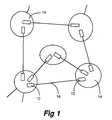
- Figure 1 is a schematic illustration of a telecommunication network in which links or trunks are shown to connect a switching node. The present invention is applied to the links.
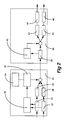
- Figure 2 is a schematic block diagram of a link connecting a source card and a destination card.
- Figure 3 is an illustration of data flow from buffers to a link.
- Figure 4 is a protocol format according to one embodiment of the present invention.
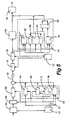
- Figure 5 shows in more detail the source and destination cards.
- FIG. 1 shows a schematic illustration of a typical network application using a novel link protocol which is designed to transport a payload from a source card 10 to a destination card 12 and which includes packet fragmentation capability.
- the network is formed by more than one switching node 14 connected by links or trunks 16. Switching (packet, circuit, cell etc.) takes place at each node 14 and is outside the protocol of the present invention.
- mixed traffic such as, for example, voice and data is transported over a link in which voice traffic has higher priority over data traffic because of the shorter delay requirement.
- more than two classes of traffic can be handled, each having a differing priority based on other criteria or preferences than the delay requirement.
- two queues 20 and 22 are provided at the source card 24 on the left to store the packeted data to be transmitted. These queues are followed by buffers 26 and 28 which store packets or partially disassembled packets, as the case may be.
- the buffers 26 and 28 are serviced on a first come first served basis, however, the high priority buffer 26 is always serviced before the low priority buffer 28, in fact, the high priority buffer will pre-empt the low priority buffer whenever any high priority packets are waiting to be sent.
- a priority encoder 30 reads the priority of packets stored in the queues. Packets serviced out of the queues are first stored in respective buffers 26 and 28 waiting for a header and a tail to be appended.
- a header generator 32 receives priority indication from the priority encoder 30 and other information such as sequence number, flag, CRC etc. from the emission context 34 and attaches the header and tail to each packet. If no packets are queued to be sent, the flag delimiter is sent.
- the priority encoder 30, buffers 26 and 28, header generator 32 and emission context 34 are built into a custom ASIC.
- the disassembly process begins when a low priority packet is temporarily suspended while a high priority packet is emitted. High priority packets will continue to be emitted as long as the high priority transmit buffer has data to send. When the high priority buffer is emptied, the low priority packet is restarted and the remainder of the low priority packet is sent. It is possible for a low priority packet to be interrupted as often as required and to be fragmented to any size, depending on the arrival of high priority packets at the transmit queue.
- the received packets or fragmented packets are stripped off the header at a header reader 38.
- a protocol checker 40 monitors the priority and sequence number of the packets and directs them to their respective buffers 42 and 44 which are followed by queues 46 and 48. Low priority packets are assembled while high priority packets are simply queued. High priority packets are never fragmented, therefore they need not be assembled or disassembled.
- FIG. 3 shows the form of the link data stream according to the present invention.
- Data is depicted as moving from right to left, that is, the bits on the left are emitted first.
- a low priority packet D1 has been started and then a high priority packet D2 interrupts it.
- the low priority packet is fragmented and its transmission is suspended until all high priority packets have been sent.
- the high priority packets have been sent, the low priority packet is resumed.
- another high priority packet D3 arrives at t1 after the end of D2 and thus it also interrupts D1.
- D3 is resumed until all the remaining packet fragments have been sent. Note that each fragment is delimited by a flag F.
- Figure 4 shows in detail the protocol according to one embodiment of the present invention.
- this is a link protocol which is designed to transport a payload from a source card to a destination card.
- the protocol defines a packet transport system with two delay classes.
- the format of the protocol is based on the HDLC format with the addition of a new 1-bit field (Priority) and 4-bit field (SEQuence) between the opening flag and the payload and a new 1-bit field (Complete) immediately before the CRC field.
- the first 1-bit field identifies the priority of the packet as HIGH (1) or LOW (0).
- the four-bit field identifies the sequence (SEQ) number.
- the one-bit field (C) added at the end of the payload indicates whether the packet is complete (1) or will be continued (0) in the subsequent packet.
- the above protocol in this embodiment supports two levels of priority (P).
- a low priority packet may be interrupted by one or more high priority packets; a high priority packet may not be interrupted.
- the complete bit (C) will always be set to one (1) for a high priority packet.
- any number of priority levels may be provided at the expense of hardware and software complexity.
- the description thus far refers to the priority levels of traffic with respect to their delay sensitivity. However, traffic can be categorized according to other criteria and the priority field of the protocol can be used to treat certain traffic preferentially over others.
- the sequence field contains a four-bit number, sent LSB first, whose value in each packet of high priority data or each packet fragment of low priority data should be one greater than the sequence number of the previous packet.
- the sequence number will roll over from 15 to 0. This sequence number is used to determine if packets are repeated or skipped whenever a high priority packet interrupts a low priority packet. Whenever a packet is repeated or skipped as indicated in SEQ, all low priority packets or packet fragments following the high priority packet will be discarded.
- the packet fragmentation protocol of the present invention is bit oriented and can be used on any transparent link facility. Additionally, it is possible to use this protocol on DS1/E1 facilities where bit stuffing may be required to maintain the ones density. Zero bit insertion and deletion are applied outside the packet fragment protocol and as a result are transparent.
- the protocol of this invention allows delay sensitive packets to be routed with a predictable store and forward delay. Delay sensitive packets are emitted in preference to non-delay sensitive packets.
- the protocol provides error protection in the form of CRC and sequence numbers, incorrect fragments are marked as bad (stored in the block descriptor) and are discarded by software. In the worst case, the protocol overhead on the packet fragments is 46 bits per payload, exduding flag bits.
- a memory 50 stores different categories (or priority) of data to be transmitted at different locations, that is to say, in the present embodiment the memory can be partitioned to a high priority queue and buffer for high priority data, and a low priority queue and buffer for low priority data. Of course, separate queues and buffers may be provided for different categories of data.
- a transmit control block 52 generates the timing, which signals by a line 54 a staging register 56 and data register 58 to properly align 8-bit words of payload data to transmit.
- the transmit control block 52 also signals a protocol/seq block 60 to insert the new bit fields (priority, sequence and complete fields) which have been described above into payload data at the appropriate time to form TXDATA 62.
- the protocol/seq block 60 consists of priority (P) and complete (C) 1-bit storage registers 64 and 66, sequence generator (SEQ) 68 which is a 4-bit parallel in/serial out storage register, and 4-bit incrementer 70.
- the transmit control block 52 receives the priority of payload data stored in the common memory 50 and sends it to the priority register 64.
- the sequence generator 68 and incrementer 70 count up and insert the sequence number of packets. The sequence number rolls over from 15 to 0.
- the priority (P) and sequence (SEQ) bits are transmitted over TXDATA.
- the payload immediately follows this opening bit field provided via the data register 58. Whenever a low priority packet is interrupted, the complete (C) bit is set to 0, indicating the current packet has been interrupted and is incomplete.
- control and protocol/seq blocks are brought to a known state whenever the reset input is asserted.
- priority (P), complete (C) and sequence (SEQ) bits are set to 0. This is a synchronous circuit relative to CLK.
- Input priority and EOP End-Of-Packet or Complete
- the combination of the sequence generator and incrementer generates the sequence number for each transmitted packet.
- the control block provides control via combinational logic and a finite state machine to properly insert the additional fields into the protocol.
- FIG. 5 also shows the receive data path on the right.
- the receiver control block 72 generates the timing which signals the protocol/seq checking block 74 to extract the added bit fields from RXDATA at the appropriate time.
- the priority (P) and sequence (SEQ) bits are extracted from RXDATA and sent to the protocol/seq block 74.
- the payload immediately follows the opening P and SEQ bit fields and is diverted to the common memory 80 via the 8-bit staging register 82.
- protocol/seq block 74 The protocol bits are tested at protocol/seq block 74 for a priority change (P), an out of sequence error in the sequence field (SEQ), and an incomplete or interrupted packet indicated by the complete (C) field.
- the protocol/seq block 74 consists of 4-bit storage registers OLD SEQ 84 and SEQ 86, 1-bit storage registers for Priority 88 and Complete 90, and a 4-bit comparator 92.
- control and protocol/seq blocks are brought to a known state whenever the reset input is asserted.
- storage registers OLD SEQ 84, SEQ 86, Priority 88 and Complete 90 are set to 0. This is a synchronous circuit relative to CLK.
- the control block provides control via combinatorial logic and a finite state machine to properly extract the added fields from the input RXDATA.
- the comparator 92 determines if a packet has been skipped or repeated by monitoring the number in the SEQ field. This information will be stored for later processing.
- the protocol checker at the destination card detects repeated fragments whenever the sequence number of an arriving packet fragment is 1 to 4 smaller than expected. The checker discards all repeated packet fragments. When the packet fragment with the expected sequence number arrives, the checker passes the packet fragment to its respective buffer.
- the protocol checker detects skipped packet fragments whenever the sequence number of an arriving packet fragment is 1 to 4 greater than expected. If a skipped packet fragment is detected, the protocol checker will update its expected sequence number so that it equals the sequence number of the latest packet fragment that has arrived. The protocol checker will use the new sequence number when testing all subsequent packet fragments.
- the upper layer packet protocol should perform a packet level CRC check on the latest packets received.
- the packet level CRC is required in order to determine if the packet has lost data. Fragment level CRCs are insufficient for determining if a lost fragment has occurred. Note the high priority packets are entirely encapsulated within a fragment, therefore the fragment level CRC is equal to a packet level CRC (only for high priority packets).
- Replicated or lost packet fragments can occur when using DS1/E1 facilities which use frame slips to adjust small differences between the receive and transmit clock frequencies.
- DS1/E1 facilities which use frame slips to adjust small differences between the receive and transmit clock frequencies.
- the transmitter periodically deletes a frame of 24 bytes (193 bits). The deletion of 24 bytes may cause the loss of entire packet fragments; this occurs if the fragment fits entirely within the 24 byte slip. Without sequence numbers, this loss would go undetected.
- T1 facilities introduce an extra 24 byte frame of data to prevent underruns.
- the added frame is a replica of the previous frame, therefore there is a potential to replicate entire packet segments.
- the protocol sequence numbers detect fragment replication.
- the minimum packet fragment size is 38 bits. This assumes that there is no CRC and that the interface does not perform zero stuffing. When a T1 frame is replicated, 193 bits are replicated and therefore there is the potential to replicate as many as 5 packet fragments (193 divided by 38). For the protocol to uniquely identify the replicated fragments, at least 11 sequence numbers are required (Nyquist criteria). An 11 state sequence number will prevent packets from aliasing due to the modulus counter wrapping. Given that the protocol of the present invention is bit oriented, the logical sequence number size has been selected as 16, which is the smallest binary sequence number greater than 11.
- the packet fragment contains an octet aligned payload that is being sent from a source card to a destination card.
- the payload consists of a user packet which may include a software routing address. Leading bytes of the first fragment payload are used by the software routing system to route the user data. The length of the payload is an integer number of bytes.
- the protocol according to the present invention breaks the packet into octet aligned fragments that are actually transported in the payload field.
- the payload carried in a fragment may include the entire packet or some part of the packet, depending upon whether or not fragmentation has occurred. High emission priority packets always contain the entire user packet in the payload.
- the delay that a particular packet fragment experiences is based on the packet length divided by the link speed.
- High emission priority packets should be length limited so that the emission delay does not exceed the maximum packet delay that is tolerable for high priority data.
- Packets within the broadband network are of fixed or variable length. In order to maintain a reasonable switching delay for voice and video applications, two maximum packet sizes are used in the present invention. Voice and video packets will have a maximum packet size that ensures minimal switching and assembly delays, while data packets will have a larger maximum packet size reflecting their insensitivity to delay.
- the maximum packet size can be, for example, approximately 64 bytes for high priority data, and 16 Kbytes for low priority data. However, these numbers are examples only and in practice the maximum packet sizes are calculated based on link speed. Therefore, it is possible to use different packet sizes for different links among nodes in a network where some links are faster than others.
- Voice delay is maintained by keeping the voice packet size small relative to the link speed. Interrupting low priority data packets effectively fragments the packet being transported, requiring the destination to reassemble packets. Fragmentation also introduces the potential for fragment mis-ordering. This undesirable characteristic is eliminated in the present invention by only allowing packets to be fragmented on a trunk or link. A single link acts like a first-in first-out buffer in which mis-ordering is not possible.
Landscapes
- Engineering & Computer Science (AREA)
- Computer Networks & Wireless Communication (AREA)
- Signal Processing (AREA)
- Computer Security & Cryptography (AREA)
- Data Exchanges In Wide-Area Networks (AREA)
Claims (7)
- Digitales Telekommunikationssystem zur seriellen Übertragung von digitalen Daten mit zwei oder mehr unterschiedlichen Prioritäten in Paketen mit verschiedenen Größen von einer Quellenkarte (24) zu einer Zielkarte (36) über eine Übertragungsstrecke (16), die die die Quellen- und Ziel-Karten verbindende Übertragungsstrecke, ein Übertragungsstrecken-Steuergerät an die Quellen-Karte und eine Protokoll-Prüfeinrichtung an der Zielkarte umfasst und routinemäßig Datenrahmen-Frequenzabweichungen verwendet, um Unterschiede zwischen den Takten in dem System während der Übertragung von digitalen Daten abzugleichen, wobei die Erfindung dadurch gekennzeichnet ist, daß:jede der Karten zwei oder mehr Puffer (26 und 28) und zwei oder mehr Warteschlangen (20,22,46 und 48) aufweist, wobei jede Warteschlange und Puffer miteinander verbunden sind und diesen eine Priorität zugeordnet ist, um einzelne Pakete oder fragmentierte Pakete von digitalen Daten mit irgendeiner Anzahl von Bytes entsprechend deren Priorität zu speichern,das Übertragungsstrecken-Steuergerät an der Quellen-karte so ausgebildet ist, daß es die Puffer zur Übertragung eines darin befindlichen Paketes zu der Zielkarte entsprechend seiner Prioritäten bedient, so daß ein Paket mit höherer Priorität in seinem zugeordneten Puffer zu jeder Zeit in der Lage ist, die Übertragung eines Paketes mit niedrigerer Priorität von dessen zugeordnetem Puffer zu unterbrechen und dieses in ein oder mehrere Paket fragmente mit irgendeiner Anzahl von Bytes zu fragmentieren,das Übertragungsstrecken-Steuergerät so ausgebildet ist, daß es zu jedem Paket und zu jedem fragmentierten Paket Prioritätsbits, Sequenzbits, CRC-Bits und ein abgeschlossen-Bit hinzufügt, um jeweils die Priorität, die Sequenznummer, CRC und die Abgeschlossenheit jedes Paketes und fragmentierten Paketes anzuzeigen, unddie Protokoll-Prüfeinrichtung (74) an der Zielkarte so ausgebildet ist, daß sie die Sequenznummern von Paketen auf übersprungene oder wiederholte Paketfragmente überwacht, die durch die Datenrahmen-Frequenzabweichungen hervorgerufen sein können.
- Digitales Telekommunikationssystem nach Anspruch 1, bei dem das Übertragungsstrecken-Steuergerät Folgendes umfaßt:einen Prioritätskodierer (30), der mit den Warteschlangen verbunden ist, um die Priorität von darin gespeicherten Paketen auszulesen,einen Anfangsblock-Generator (32) zum Hinzufügen einer Flagge, von Prioritätbits, von Sequenzbits, einem Abgeschlossen-Bit und CRC-Bits zu jedem der Pakete und Paketfragmente, undeine Sendesteuerung (34) zum Koordinieren des Prioritätskodierers und des Anfangs-Block-Generators.
- Digitales Telekommunikationssystem nach Anspruch 2, das weiterhin einen gemeinsamen Speicher umfaßt, der in geeigneter Weise unterteilt ist, um für die Warteschlangen und Puffer verwendet zu werden, die jeweils einer anderen Priorität zugeordnet sind.
- Digitales Telekommunikationssystem nach Anspruch 3, bei dem eine Paketlänge irgendeine Größe innerhalb der jeweiligen maximalen Länge für jede Priorität aufweist, wobei die maximale Länge durch die Geschwindigkeit der Übertragungsstrecke bestimmt ist.
- Verfahren zur seriellen Übertragung digitaler Daten in einem digitalen Telekommunikationssystem zur seriellen Übertragung von digitalen Daten mit zwei oder mehr unterschiedlichen Prioritäten in Paketen mit veränderlichen Größen von einer Quellenkarte (24) zu einer Zielkarte (36) über eine Übertragungsstecke (16), die die die Quellen- und Zielkarte verbindende Übertragungsstrecke, ein Übertragungsstrecken-Steuergerät an der Quellenkarte und eine Protokoll-Prüfeinrichtung an der Zielkarte umfaßt und die routinemäßig Datenrahmen-Frequenzabweichungen verwendet, um Unterschiede zwischen Takten in dem System während der Übertragung der digitalen Daten abzugleichen, wobei das Verfahren durch die folgenden Schritte gekennzeichnet ist:Unterbrechung der Übertragung von Datenpaketen einer Priorität durch Datenpakete einer anderen Priorität,getrenntes Speichern von digitalen Daten mit irgendeiner Anzahl von Bytes entsprechend ihrer Priorität an jeder Karte in zwei oder mehr jeweils zugeordneten Warteschlangen,getrenntes Übertragen digitaler Daten mit irgendeiner Anzahl von Bytes und Puffern von Paketen von digitalen Daten mit irgendeiner Anzahl von Bytes an jeder Karte entsprechend ihrer Priorität in zwei oder mehr jeweils zugeordneten Puffern,Bedienen der Puffer an der Quellenkarte zur Übertragung von Paketen entsprechend ihrer Prioritäten, so daß ein Paket höherer Priorität in einem Puffer höherer Priorität zu jeder Zeit die Übertragung eines Paketes niedrigerer Priorität von einem Puffer niedrigerer Priorität durch Fragmentieren des Paketes niedrigerer Priorität in ein oder mehrere Paketfragmente mit irgendeiner Anzahl von Bytes unterbricht,Hinzufügen von Prioritätsbits, Sequenzbits, CRC-Bits und eines Abgeschlossen-Bits zu jedem Paket und Paketfragment, um jeweils die Priorität, die Sequenznummer, die Fehlerprüfung bzw. die Abgeschlossenheit jedes Paketes und fragmentierten Paketes anzuzeigen,serielles Empfangen der über die Übertragungsstrecke übertragenen Pakete an der Zielkarte,getrenntes Puffern empfangener Pakete und Paketfragmente entsprechend ihrer Priorität an ihren jeweils zugeordneten Puffern, undÜberwachen der Sequenzbits der Paket fragmente auf die richtige Sequenz der Paket fragmente und auf übersprungene oder wiederholte Paketfragmente, die durch die Datenrahmen-Frequenzabweichungen hervorgerufen sein können.
- Verfahren zur seriellen Übertragung digitaler Daten gemäß Anspruch 5,
bei dem der Schritt zur Bedienung der Puffer an der Quellenkarte für die Übertragung eines Paketes höherer Priorität jedesmal dann ausgeführt wird, wenn sich ein auszusendendes Paket in dem jeweiligen Puffer befindet, wodurch die Übertragung eines Paketes niedrigerer Priorität jedesmal dann unterbrochen wird, wenn ein Paket höherer Priorität ausgesandt wird, und das Paket niedrigerer Priorität in ein oder mehrere Paket fragmente mit irgendeiner Größe fragmentiert wird. - Verfahren zur seriellen Übertragung digitaler Daten gemäß Anspruch 6,
das weiterhin den Schritt der Speicherung von Paketen von digitalen Daten in jeweiligen Warteschlangen entsprechend ihrer Priorität vor dem Schritt der einzelnen Pufferung umfaßt.
Applications Claiming Priority (3)
| Application Number | Priority Date | Filing Date | Title |
|---|---|---|---|
| US14100793A | 1993-10-26 | 1993-10-26 | |
| US141007 | 1993-10-26 | ||
| PCT/CA1994/000554 WO1995012265A1 (en) | 1993-10-26 | 1994-10-12 | Digital telecommunication link for efficiently transporting mixed classes of packets |
Publications (2)
| Publication Number | Publication Date |
|---|---|
| EP0726002A1 EP0726002A1 (de) | 1996-08-14 |
| EP0726002B1 true EP0726002B1 (de) | 1999-03-03 |
Family
ID=22493739
Family Applications (1)
| Application Number | Title | Priority Date | Filing Date |
|---|---|---|---|
| EP94929422A Expired - Lifetime EP0726002B1 (de) | 1993-10-26 | 1994-10-12 | Digitale übertragungsstrecke zum effizienten transport von gemischten paketklassen |
Country Status (6)
| Country | Link |
|---|---|
| US (1) | US5497371A (de) |
| EP (1) | EP0726002B1 (de) |
| JP (1) | JP2942875B2 (de) |
| CA (1) | CA2172263C (de) |
| DE (1) | DE69416849T2 (de) |
| WO (1) | WO1995012265A1 (de) |
Cited By (3)
| Publication number | Priority date | Publication date | Assignee | Title |
|---|---|---|---|---|
| DE102004052692A1 (de) * | 2004-10-29 | 2006-05-04 | Siemens Ag | Verfahren zur Übermittlung von in Form von Datenpaketen zur Verfügung stehenden Daten |
| US7251767B2 (en) | 2000-07-31 | 2007-07-31 | Siemens Aktiengesellschaft | Method for correcting errors in a packet-oriented data transmission |
| DE102008039580A1 (de) * | 2008-08-25 | 2010-03-04 | Siemens Aktiengesellschaft | Verfahren zum Übertragen von Datenpaketen in einem Kommunikationsnetz und Schaltvorrichtung |
Families Citing this family (135)
| Publication number | Priority date | Publication date | Assignee | Title |
|---|---|---|---|---|
| US5694428A (en) * | 1992-03-12 | 1997-12-02 | Ntp Incorporated | Transmitting circuitry for serial transmission of encoded information |
| GB2288947B (en) * | 1994-04-20 | 1999-01-06 | Roke Manor Research | Improvements in or relating to ATM communication systems |
| JP3277694B2 (ja) * | 1994-05-25 | 2002-04-22 | ソニー株式会社 | 通信方法 |
| JP3129143B2 (ja) * | 1994-05-31 | 2001-01-29 | 松下電器産業株式会社 | データ転送方法 |
| US5764918A (en) * | 1995-01-23 | 1998-06-09 | Poulter; Vernon C. | Communications node for transmitting data files over telephone networks |
| JP3435244B2 (ja) * | 1995-02-03 | 2003-08-11 | 株式会社東芝 | 通信制御装置 |
| KR970004518A (ko) * | 1995-06-09 | 1997-01-29 | 김광호 | 광대역 정보통신 시스템에서 패킷전송을 위한 경로를 찾는 방법 |
| EP0751639A1 (de) * | 1995-06-30 | 1997-01-02 | STMicroelectronics S.r.l. | Verfahren, Sender und Empfänger für die Übertragung und die Empfang von Informationen; Informationsrundfunk und insbesondere Radiodatensystem |
| US6147996A (en) | 1995-08-04 | 2000-11-14 | Cisco Technology, Inc. | Pipelined multiple issue packet switch |
| US5761191A (en) * | 1995-11-28 | 1998-06-02 | Telecommunications Techniques Corporation | Statistics collection for ATM networks |
| US5996018A (en) * | 1995-12-06 | 1999-11-30 | International Business Machines Corporation | Method and apparatus to reduce jitter and end-to-end delay for multimedia data signalling |
| US6452927B1 (en) | 1995-12-29 | 2002-09-17 | Cypress Semiconductor Corporation | Method and apparatus for providing a serial interface between an asynchronous transfer mode (ATM) layer and a physical (PHY) layer |
| US5857009A (en) * | 1996-01-18 | 1999-01-05 | Telefonaktiebolaget Lm Ericsson | Method and apparatus for propagation delay determination |
| US6600745B1 (en) * | 1996-02-02 | 2003-07-29 | Marconi Communications Limited | Cell aligners |
| US5935213A (en) * | 1996-05-02 | 1999-08-10 | Fore Systems, Inc. | System and method for generating explicit rate value information for flow control in ATAM network |
| US6308148B1 (en) | 1996-05-28 | 2001-10-23 | Cisco Technology, Inc. | Network flow data export |
| DE69739531D1 (de) * | 1996-05-29 | 2009-09-24 | Nippon Telegraph & Telephone | Einrichtung zur Übertragung von ATM-Zellen |
| US5926459A (en) * | 1996-06-27 | 1999-07-20 | Xerox Corporation | Rate shaping in per-flow queued routing mechanisms for available bit rate service |
| GB2357020B (en) * | 1996-07-31 | 2001-08-22 | Inmarsat Ltd | Method and apparatus for transmitting data |
| US6111870A (en) * | 1996-11-07 | 2000-08-29 | Interdigital Technology Corporation | Method and apparatus for compressing and transmitting high speed data |
| US5848055A (en) * | 1996-11-19 | 1998-12-08 | Northern Telecom Limited | Bandwidth correlation means for paths in connection-oriented packet switching networks |
| US6104802A (en) | 1997-02-10 | 2000-08-15 | Genesys Telecommunications Laboratories, Inc. | In-band signaling for routing |
| US7031442B1 (en) | 1997-02-10 | 2006-04-18 | Genesys Telecommunications Laboratories, Inc. | Methods and apparatus for personal routing in computer-simulated telephony |
| US6480600B1 (en) | 1997-02-10 | 2002-11-12 | Genesys Telecommunications Laboratories, Inc. | Call and data correspondence in a call-in center employing virtual restructuring for computer telephony integrated functionality |
| AU762209B2 (en) * | 1997-08-01 | 2003-06-19 | Rovi Guides, Inc. | System and method for transmitting and receiving data |
| IL125571A0 (en) * | 1997-08-01 | 1999-03-12 | Comverse Network Syst Inc | A packet-switched-network telephone system |
| US6085253A (en) | 1997-08-01 | 2000-07-04 | United Video Properties, Inc. | System and method for transmitting and receiving data |
| EP0905949A1 (de) * | 1997-09-26 | 1999-03-31 | X-Way Rights B.V. | Verfahren und Vorrichtung zur prioritätsabhängigen parallelen Nachrichtenübermittlung |
| US6711611B2 (en) | 1998-09-11 | 2004-03-23 | Genesis Telecommunications Laboratories, Inc. | Method and apparatus for data-linking a mobile knowledge worker to home communication-center infrastructure |
| US6985943B2 (en) | 1998-09-11 | 2006-01-10 | Genesys Telecommunications Laboratories, Inc. | Method and apparatus for extended management of state and interaction of a remote knowledge worker from a contact center |
| US6122670A (en) * | 1997-10-30 | 2000-09-19 | Tsi Telsys, Inc. | Apparatus and method for constructing data for transmission within a reliable communication protocol by performing portions of the protocol suite concurrently |
| USRE46528E1 (en) | 1997-11-14 | 2017-08-29 | Genesys Telecommunications Laboratories, Inc. | Implementation of call-center outbound dialing capability at a telephony network level |
| US6157655A (en) * | 1998-02-17 | 2000-12-05 | Genesys Telecommunications Laboratories, Inc. | Method for estimating telephony system-queue waiting time in an agent level routing environment |
| US7907598B2 (en) | 1998-02-17 | 2011-03-15 | Genesys Telecommunication Laboratories, Inc. | Method for implementing and executing communication center routing strategies represented in extensible markup language |
| US6332154B2 (en) | 1998-09-11 | 2001-12-18 | Genesys Telecommunications Laboratories, Inc. | Method and apparatus for providing media-independent self-help modules within a multimedia communication-center customer interface |
| FI108192B (fi) * | 1998-03-19 | 2001-11-30 | Nokia Networks Oy | Menetelmä ja laitteisto palvelun laadun kontrolloimiseksi matkaviestinjärjestelmässä |
| US6366589B1 (en) * | 1998-04-27 | 2002-04-02 | 3Com Corporation | Multiple parallel asymmetric interfaces with reversed asymmetric links |
| US5987021A (en) * | 1998-06-02 | 1999-11-16 | Motorola, Inc. | Method and apparatus for allocating resources between queued and non-queued services |
| US6570890B1 (en) | 1998-06-10 | 2003-05-27 | Merlot Communications | Method for the transmission and control of audio, video, and computer data over a single network fabric using ethernet packets |
| US6952416B1 (en) | 1998-06-22 | 2005-10-04 | Nortel Networks Limited | Treatments in a distributed communications system |
| US6324265B1 (en) | 1998-06-22 | 2001-11-27 | Nortel Networks Limited | Originator disposition options for communications session termination |
| DE69840947D1 (de) | 1998-09-10 | 2009-08-13 | Ibm | Paketvermittlunganpassungseinrichtung für Datenpaketen mit variabler Länge |
| USRE46153E1 (en) | 1998-09-11 | 2016-09-20 | Genesys Telecommunications Laboratories, Inc. | Method and apparatus enabling voice-based management of state and interaction of a remote knowledge worker in a contact center environment |
| GB2344029A (en) * | 1998-10-02 | 2000-05-24 | Gen Datacomm Adv Res | Transmission of data packets of different size and priority |
| EP0996248A1 (de) * | 1998-10-21 | 2000-04-26 | Telefonaktiebolaget L M Ericsson (Publ) | ARQ Protokoll mit Packetbasierten Zuverlässigkeits Einstellung |
| KR100279622B1 (ko) * | 1998-10-28 | 2001-02-01 | 구자홍 | 음성 패킷 전송 제어 방법 및 장치 |
| JP4004669B2 (ja) * | 1998-11-26 | 2007-11-07 | 株式会社日立コミュニケーションテクノロジー | 音声パケット多重化方法及び装置 |
| US6885657B1 (en) | 1998-11-30 | 2005-04-26 | Broadcom Corporation | Network telephony system |
| US6917617B2 (en) * | 1998-12-16 | 2005-07-12 | Cisco Technology, Inc. | Use of precedence bits for quality of service |
| US6643260B1 (en) | 1998-12-18 | 2003-11-04 | Cisco Technology, Inc. | Method and apparatus for implementing a quality of service policy in a data communications network |
| US6798789B1 (en) * | 1999-01-27 | 2004-09-28 | Motorola, Inc. | Priority enhanced messaging and method therefor |
| SE516571C2 (sv) * | 1999-03-12 | 2002-01-29 | Ericsson Telefon Ab L M | Förfarande för att åstadkomma förbättrad överföringseffektiviti ett mobilt paketdatakomunikationssystem |
| DE69939401D1 (de) | 1999-04-12 | 2008-10-02 | Nokia Corp | Paketlängenklassifizierung |
| US6667967B1 (en) | 1999-05-14 | 2003-12-23 | Omninet Capital, Llc | High-speed network of independently linked nodes |
| US6631132B1 (en) | 1999-10-04 | 2003-10-07 | Veraz Networks Ltd. | Urgent packet transmission |
| US7929978B2 (en) | 1999-12-01 | 2011-04-19 | Genesys Telecommunications Laboratories, Inc. | Method and apparatus for providing enhanced communication capability for mobile devices on a virtual private network |
| US7447229B2 (en) * | 1999-12-16 | 2008-11-04 | Intel Corporation | Method for providing prioritized data movement between endpoints connected by multiple logical channels |
| GB9929794D0 (en) * | 1999-12-16 | 2000-02-09 | Nokia Networks Oy | Data transmission apparatus |
| US6798746B1 (en) | 1999-12-18 | 2004-09-28 | Cisco Technology, Inc. | Method and apparatus for implementing a quality of service policy in a data communications network |
| GB9930849D0 (en) * | 1999-12-24 | 2000-02-16 | Koninkl Philips Electronics Nv | Data communications |
| US6931003B2 (en) * | 2000-02-09 | 2005-08-16 | Bookline Flolmstead Llc | Packet prioritization protocol for a large-scale, high speed computer network |
| JP2001230810A (ja) * | 2000-02-16 | 2001-08-24 | Fujitsu Ltd | パケット流量制御装置および方法 |
| DE60038538T2 (de) * | 2000-02-28 | 2009-06-25 | Alcatel Lucent | Vermittlungseinrichtung und Vermittlungsverfahren |
| JP2001292164A (ja) * | 2000-04-06 | 2001-10-19 | Nec Corp | パケット・スイッチおよびその切替方法 |
| JP3557998B2 (ja) * | 2000-04-28 | 2004-08-25 | 日本電気株式会社 | フラグメンテーション処理デバイスおよびこれを用いたフラグメンテーション処理装置 |
| US6775232B1 (en) * | 2000-05-11 | 2004-08-10 | Cisco Technology, Inc. | Method for scheduling data for communication on a digital subscriber line |
| US6850980B1 (en) | 2000-06-16 | 2005-02-01 | Cisco Technology, Inc. | Content routing service protocol |
| JP3584859B2 (ja) * | 2000-06-29 | 2004-11-04 | 日本電気株式会社 | パケットスケジューリング装置 |
| US6891855B2 (en) * | 2000-07-27 | 2005-05-10 | Corrigent Systems, Ltd. | Dynamic packet fragmentation |
| WO2002028057A2 (en) * | 2000-09-29 | 2002-04-04 | Telefonaktiebolaget Lm Ericsson (Publ) | Method and system for transmitting data |
| US20020041595A1 (en) * | 2000-10-05 | 2002-04-11 | Marc Delvaux | System and method for suspending and resuming transmission of information without creating significant additional overhead |
| US6856628B1 (en) * | 2000-10-26 | 2005-02-15 | Motorola, Inc. | Method and apparatus for tunneling packets in a packet data system |
| US7088738B1 (en) * | 2000-10-30 | 2006-08-08 | Lucent Technologies Inc. | Dynamic fragmentation of information |
| US7321557B1 (en) * | 2000-10-30 | 2008-01-22 | Lucent Technologies Inc. | Dynamic latency assignment methodology for bandwidth optimization of packet flows |
| US7154905B2 (en) * | 2000-11-22 | 2006-12-26 | Silicon Image | Method and system for nesting of communications packets |
| US7551554B2 (en) * | 2000-11-29 | 2009-06-23 | Intel Corporation | Fragmenting a packet |
| US20020078341A1 (en) * | 2000-12-14 | 2002-06-20 | Genty Denise M. | System and method for applying quality of service policies to internet protocol security to avoid bandwidth limitations on a computer network |
| US7095741B1 (en) * | 2000-12-20 | 2006-08-22 | Cisco Technology, Inc. | Port isolation for restricting traffic flow on layer 2 switches |
| US7292530B2 (en) * | 2000-12-29 | 2007-11-06 | Intel Corporation | Method and apparatus to manage packet fragmentation |
| US6876669B2 (en) * | 2001-01-08 | 2005-04-05 | Corrigent Systems Ltd. | Packet fragmentation with nested interruptions |
| US7002985B2 (en) * | 2001-01-16 | 2006-02-21 | Motorola, Inc. | Method and apparatus for organizing and scheduling multimedia data transfers over a wireless channel |
| EP1354450A2 (de) * | 2001-01-17 | 2003-10-22 | Broadcom Corporation | System und verfahren für die garantie der grenze des verzögerungszitterns während der bandbreite-zugriffserteilung für sprachrufe über ein kabelnetz |
| US20020150100A1 (en) * | 2001-02-22 | 2002-10-17 | White Timothy Richard | Method and apparatus for adaptive frame fragmentation |
| GB2373671B (en) * | 2001-03-23 | 2004-04-07 | Vodafone Ltd | Telecommunications systems and methods |
| US20020143988A1 (en) * | 2001-03-30 | 2002-10-03 | Jensen Bent S. | System and method to implement an improved frame fragmentation protocol to facilitate efficient transmission of prioritized data |
| US6904057B2 (en) * | 2001-05-04 | 2005-06-07 | Slt Logic Llc | Method and apparatus for providing multi-protocol, multi-stage, real-time frame classification |
| US6944168B2 (en) * | 2001-05-04 | 2005-09-13 | Slt Logic Llc | System and method for providing transformation of multi-protocol packets in a data stream |
| US6901052B2 (en) | 2001-05-04 | 2005-05-31 | Slt Logic Llc | System and method for policing multiple data flows and multi-protocol data flows |
| US6973529B2 (en) * | 2001-09-28 | 2005-12-06 | International Business Machines Corporation | Multiple I/O path selection among disparate channel paths |
| US7464180B1 (en) * | 2001-10-16 | 2008-12-09 | Cisco Technology, Inc. | Prioritization and preemption of data frames over a switching fabric |
| US7187654B1 (en) * | 2001-11-13 | 2007-03-06 | Nortel Networks Limited | Rate-controlled optical burst switching |
| JP3914036B2 (ja) * | 2001-11-19 | 2007-05-16 | 富士通株式会社 | Pon通信の親機及び子機 |
| US8045565B1 (en) | 2001-11-20 | 2011-10-25 | Brookline Flolmstead Llc | Method and apparatus for an environmentally hardened ethernet network system |
| CA2369432A1 (en) | 2002-01-24 | 2003-07-24 | Alcatel Canada Inc. | System and method for reassembling packets in a network element |
| EP1331770A1 (de) * | 2002-01-24 | 2003-07-30 | Alcatel Canada Inc. | System und Verfahren zum Wiederzusammenfügen von Paketen in einem Netzwerkelement |
| US7602809B2 (en) * | 2002-03-22 | 2009-10-13 | Telefonaktiebolaget L M Ericsson (Publ) | Reducing transmission time for data packets controlled by a link layer protocol comprising a fragmenting/defragmenting capability |
| US7167476B1 (en) * | 2002-04-12 | 2007-01-23 | Juniper Networks, Inc. | Systems and methods for routing data in a network device |
| US6907453B2 (en) * | 2002-09-18 | 2005-06-14 | Broadcom Corporation | Per CoS memory partitioning |
| US7263329B2 (en) * | 2002-09-20 | 2007-08-28 | Xm Satellite Radio Inc. | Method and apparatus for navigating, previewing and selecting broadband channels via a receiving user interface |
| US7701949B1 (en) * | 2003-06-24 | 2010-04-20 | Cisco Technology, Inc. | System and method for switching high priority traffic with low latency |
| ATE382223T1 (de) * | 2003-08-26 | 2008-01-15 | Nxp Bv | Datentrennung und fragmentierung in einem drahtlosen netzwerk zur verbesserung der video- leistungsfähigkeit |
| US20050117571A1 (en) * | 2003-12-01 | 2005-06-02 | Dyke Robert G. | Distribution of time division multiplexed data through packet connections |
| US7545745B1 (en) * | 2004-01-16 | 2009-06-09 | At&T Intellectual Property Ii, L.P. | Method and apparatus for controlling the quality of service of voice and data services over variable bandwidth access networks |
| US7451381B2 (en) * | 2004-02-03 | 2008-11-11 | Phonex Broadband Corporation | Reliable method and system for efficiently transporting dynamic data across a network |
| US8582567B2 (en) * | 2005-08-09 | 2013-11-12 | Avaya Inc. | System and method for providing network level and nodal level vulnerability protection in VoIP networks |
| US9531873B2 (en) * | 2004-08-13 | 2016-12-27 | Avaya Inc. | System, method and apparatus for classifying communications in a communications system |
| GB2412815B (en) * | 2004-08-18 | 2006-03-22 | Wecomm Ltd | Transmitting data over a network |
| US20060106929A1 (en) * | 2004-10-15 | 2006-05-18 | Kenoyer Michael L | Network conference communications |
| US20060095922A1 (en) * | 2004-11-03 | 2006-05-04 | Oracle International Corporation | Response Time to Process Desired Transaction Requests in Event Based Network Servers |
| US7751324B2 (en) * | 2004-11-19 | 2010-07-06 | Nokia Corporation | Packet stream arrangement in multimedia transmission |
| US7701976B2 (en) * | 2004-12-22 | 2010-04-20 | Exar Corporation | Communications system with segmenting and framing of segments |
| US7797463B2 (en) * | 2005-06-30 | 2010-09-14 | Intel Corporation | Hardware assisted receive channel frame handling via data offset comparison in SAS SSP wide port applications |
| US9008075B2 (en) | 2005-12-22 | 2015-04-14 | Genesys Telecommunications Laboratories, Inc. | System and methods for improving interaction routing performance |
| US20070156955A1 (en) * | 2005-12-30 | 2007-07-05 | Royer Robert J Jr | Method and apparatus for queuing disk drive access requests |
| US7873047B2 (en) * | 2006-04-19 | 2011-01-18 | Motorola, Inc. | Method and apparatus for quality of service for packet communications |
| EP2050199B1 (de) * | 2006-07-19 | 2016-08-24 | Dragonwave, Inc. | Vorrichtungen und verfahren zur beschleunigten kommunikationsverkehrsbehandlung |
| EP1953959A1 (de) * | 2007-02-01 | 2008-08-06 | British Telecommunications Public Limited Company | Datenkommunikation |
| US8964734B2 (en) * | 2007-07-26 | 2015-02-24 | The Directv Group, Inc. | Method and system for communicating content having modified packet headers through a satellite |
| US9564988B2 (en) * | 2007-07-26 | 2017-02-07 | The Directv Group, Inc. | Method and system for forming a formatted content stream and using a cyclic redundancy check |
| DE102007053255B4 (de) * | 2007-11-08 | 2009-09-10 | Continental Automotive Gmbh | Verfahren zum Bearbeiten von Nachrichten und Nachrichtenbearbeitungsvorrichtung |
| US9013999B1 (en) * | 2008-01-02 | 2015-04-21 | Marvell International Ltd. | Method and apparatus for egress jitter pacer |
| US9773130B2 (en) | 2010-05-12 | 2017-09-26 | Northrop Grumman Systems Corporation | Embedded guard-sanitizer |
| US9288150B2 (en) * | 2010-08-19 | 2016-03-15 | Lantiq Beteiligungs-GmbH & Co. KG | Method and apparatus for supporting class of service over bonded digital subscriber line (DSL) links |
| KR20120138604A (ko) | 2011-06-14 | 2012-12-26 | 삼성전자주식회사 | 멀티미디어 시스템에서 복합 미디어 컨텐츠를 송수신하는 방법 및 장치 |
| EP2579511A1 (de) * | 2011-09-27 | 2013-04-10 | Siemens Aktiengesellschaft | Verfahren zum Betrieb eines Automatisierungsgeräts zur Priorisierung von Telegrammen und entsprechendes Datenübertragungsverfahren |
| WO2013135279A1 (de) * | 2012-03-14 | 2013-09-19 | Siemens Aktiengesellschaft | Verfahren und vorrichtung zum übertragen von informationspaketen teilweise unter echtzeitbedingungen |
| DE102012210243B4 (de) | 2012-06-18 | 2017-12-28 | Siemens Aktiengesellschaft | Verfahren zum Übertragen von Datenpaketen in einem Kommunikationsnetzwerk und Kommunikationsnetzwerk |
| US9973596B2 (en) | 2013-06-19 | 2018-05-15 | Cisco Technology, Inc. | Dynamically adjusting frame MTU to support low-latency communication |
| US10348635B2 (en) | 2014-12-08 | 2019-07-09 | Huawei Technologies Co., Ltd. | Data transmission method and device |
| EP3032785B1 (de) * | 2014-12-12 | 2022-04-06 | Net Insight AB | Transportverfahren in einem kommunikationsnetz |
| JP6291516B2 (ja) * | 2016-03-18 | 2018-03-14 | 本田技研工業株式会社 | リング型ネットワークを用いた通信システム |
| DE102018129813A1 (de) * | 2018-11-26 | 2020-05-28 | Beckhoff Automation Gmbh | Datenübertragungsverfahren und Automatisierungskommunikationsnetzwerk |
| DE102019125545B3 (de) * | 2019-09-23 | 2021-03-25 | Beckhoff Automation Gmbh | Datenübertragungsverfahren, segment-telegramm und automatisierungskommunikationsnetzwerk |
| IT202100015488A1 (it) * | 2021-06-14 | 2022-12-14 | St Microelectronics Srl | Microcontrollore e procedimento di funzionamento corrispondente |
| DE102024205718A1 (de) * | 2024-06-20 | 2025-12-24 | Siemens Mobility GmbH | Passives Überwachen von Paketverzögerung und -verlust in einem Netzwerk-System |
Family Cites Families (11)
| Publication number | Priority date | Publication date | Assignee | Title |
|---|---|---|---|---|
| JPS58173932A (ja) * | 1982-04-05 | 1983-10-12 | Oki Electric Ind Co Ltd | パケツト伝送方式 |
| US4542380A (en) * | 1982-12-28 | 1985-09-17 | At&T Bell Laboratories | Method and apparatus for graceful preemption on a digital communications link |
| GB2166320B (en) * | 1984-10-25 | 1988-10-12 | Stc Plc | Packet switching system |
| US4748620A (en) * | 1986-02-28 | 1988-05-31 | American Telephone And Telegraph Company, At&T Bell Laboratories | Time stamp and packet virtual sequence numbering for reconstructing information signals from packets |
| JPS63226151A (ja) * | 1986-10-15 | 1988-09-20 | Fujitsu Ltd | 多重パケット通信システム |
| DE3777797D1 (de) * | 1987-01-28 | 1992-04-30 | Ibm | Vorrichtung zur vermittlung zwischen kanaelen fuer synchronen nachrichtenverkehr und zur vermittlung von asynchronen datenpaketen. |
| DE3742939A1 (de) * | 1987-12-18 | 1989-07-06 | Standard Elektrik Lorenz Ag | Verfahren zur hybriden paketvermittlung und einrichtungen hierzu |
| JPH01221042A (ja) * | 1988-02-29 | 1989-09-04 | Toshiba Corp | パケット交換機の輻輳制御方法 |
| US4914650A (en) * | 1988-12-06 | 1990-04-03 | American Telephone And Telegraph Company | Bandwidth allocation and congestion control scheme for an integrated voice and data network |
| DE3942977A1 (de) * | 1989-12-23 | 1991-06-27 | Standard Elektrik Lorenz Ag | Verfahren zum wiederherstellen der richtigen zellfolge, insbesondere in einer atm-vermittlungsstelle, sowie ausgangseinheit hierfuer |
| US5268900A (en) * | 1991-07-05 | 1993-12-07 | Codex Corporation | Device and method for implementing queueing disciplines at high speeds |
-
1994
- 1994-10-12 CA CA002172263A patent/CA2172263C/en not_active Expired - Fee Related
- 1994-10-12 JP JP7512324A patent/JP2942875B2/ja not_active Expired - Fee Related
- 1994-10-12 EP EP94929422A patent/EP0726002B1/de not_active Expired - Lifetime
- 1994-10-12 DE DE69416849T patent/DE69416849T2/de not_active Expired - Lifetime
- 1994-10-12 WO PCT/CA1994/000554 patent/WO1995012265A1/en not_active Ceased
-
1995
- 1995-02-16 US US08/389,449 patent/US5497371A/en not_active Expired - Lifetime
Cited By (4)
| Publication number | Priority date | Publication date | Assignee | Title |
|---|---|---|---|---|
| US7251767B2 (en) | 2000-07-31 | 2007-07-31 | Siemens Aktiengesellschaft | Method for correcting errors in a packet-oriented data transmission |
| DE102004052692A1 (de) * | 2004-10-29 | 2006-05-04 | Siemens Ag | Verfahren zur Übermittlung von in Form von Datenpaketen zur Verfügung stehenden Daten |
| DE102004052692B4 (de) * | 2004-10-29 | 2008-04-24 | Siemens Ag | Verfahren zur Übermittlung von in Form von Datenpaketen zur Verfügung stehenden Daten |
| DE102008039580A1 (de) * | 2008-08-25 | 2010-03-04 | Siemens Aktiengesellschaft | Verfahren zum Übertragen von Datenpaketen in einem Kommunikationsnetz und Schaltvorrichtung |
Also Published As
| Publication number | Publication date |
|---|---|
| CA2172263A1 (en) | 1995-05-04 |
| US5497371A (en) | 1996-03-05 |
| JPH08510888A (ja) | 1996-11-12 |
| DE69416849T2 (de) | 1999-07-08 |
| DE69416849D1 (de) | 1999-04-08 |
| EP0726002A1 (de) | 1996-08-14 |
| WO1995012265A1 (en) | 1995-05-04 |
| CA2172263C (en) | 2000-05-30 |
| JP2942875B2 (ja) | 1999-08-30 |
Similar Documents
| Publication | Publication Date | Title |
|---|---|---|
| EP0726002B1 (de) | Digitale übertragungsstrecke zum effizienten transport von gemischten paketklassen | |
| US5557608A (en) | Method and apparatus for transmission of high priority traffic on low speed communication links | |
| US5343473A (en) | Method of determining whether to use preempt/resume or alternate protocol for data transmission | |
| CA2134017C (en) | Network bridge | |
| AU693427B2 (en) | Flow control system for packet switches | |
| US6947450B2 (en) | Method and a device for determining packet transmission priority between a plurality of data streams | |
| CA2156771C (en) | Controller for atm segmentation and reassembly | |
| US20130094370A1 (en) | Methods and Apparatus for Selecting the Better Cell From Redundant Streams Within A Cell-Oriented Environment. | |
| US20090185582A1 (en) | Unified data packet for encapsulating data packets having diverse formats | |
| US6356561B1 (en) | Method and apparatus for the fair and efficient transfer of variable length packets using fixed length segments | |
| US5199028A (en) | Asynchronous time division network | |
| US6359887B1 (en) | Transparent circuit emulation for packet switching network | |
| EP0845918B1 (de) | System und Verfahren zur Segmentierung und Wiederzusammensetzung von ATM-Zellen zur Bereitstellung von einem Datenstrom | |
| US6195346B1 (en) | Method and system for processing an HDLC message | |
| US20020067695A1 (en) | Method for interfacing an atm network to a pc by implementing the atm segmentation and reassembly functions in pc system software | |
| US5606553A (en) | Cell processing for voice transmission | |
| US5528763A (en) | System for admitting cells of packets from communication network into buffer of attachment of communication adapter | |
| US6487198B1 (en) | Method and system for unloading T1 payloads from ATM cells | |
| JPH10126421A (ja) | 固定サイズパケットでのデータの伝送用通信リンク | |
| US5781554A (en) | Method and apparatus for communicating between nodes in a communications network | |
| US6898647B2 (en) | Parallel byte processing engines shared among multiple data channels | |
| US7203198B2 (en) | System and method for switching asynchronous transfer mode cells | |
| US6618374B1 (en) | Method for inverse multiplexing of ATM using sample prepends | |
| EP0979566B1 (de) | Datenunterdrückung und -regenerierung | |
| EP1052808A1 (de) | Kommunikationsnetz das Prioritätsklassen benutzt |
Legal Events
| Date | Code | Title | Description |
|---|---|---|---|
| PUAI | Public reference made under article 153(3) epc to a published international application that has entered the european phase |
Free format text: ORIGINAL CODE: 0009012 |
|
| 17P | Request for examination filed |
Effective date: 19960425 |
|
| AK | Designated contracting states |
Kind code of ref document: A1 Designated state(s): DE FR GB |
|
| GRAG | Despatch of communication of intention to grant |
Free format text: ORIGINAL CODE: EPIDOS AGRA |
|
| GRAG | Despatch of communication of intention to grant |
Free format text: ORIGINAL CODE: EPIDOS AGRA |
|
| GRAH | Despatch of communication of intention to grant a patent |
Free format text: ORIGINAL CODE: EPIDOS IGRA |
|
| 17Q | First examination report despatched |
Effective date: 19980811 |
|
| GRAH | Despatch of communication of intention to grant a patent |
Free format text: ORIGINAL CODE: EPIDOS IGRA |
|
| GRAA | (expected) grant |
Free format text: ORIGINAL CODE: 0009210 |
|
| AK | Designated contracting states |
Kind code of ref document: B1 Designated state(s): DE FR GB |
|
| REF | Corresponds to: |
Ref document number: 69416849 Country of ref document: DE Date of ref document: 19990408 |
|
| ET | Fr: translation filed | ||
| RAP4 | Party data changed (patent owner data changed or rights of a patent transferred) |
Owner name: NORTEL NETWORKS CORPORATION |
|
| PLBE | No opposition filed within time limit |
Free format text: ORIGINAL CODE: 0009261 |
|
| STAA | Information on the status of an ep patent application or granted ep patent |
Free format text: STATUS: NO OPPOSITION FILED WITHIN TIME LIMIT |
|
| 26N | No opposition filed | ||
| REG | Reference to a national code |
Ref country code: GB Ref legal event code: IF02 |
|
| REG | Reference to a national code |
Ref country code: FR Ref legal event code: CD |
|
| PGFP | Annual fee paid to national office [announced via postgrant information from national office to epo] |
Ref country code: FR Payment date: 20101004 Year of fee payment: 17 |
|
| PGFP | Annual fee paid to national office [announced via postgrant information from national office to epo] |
Ref country code: GB Payment date: 20100923 Year of fee payment: 17 |
|
| PGFP | Annual fee paid to national office [announced via postgrant information from national office to epo] |
Ref country code: DE Payment date: 20101029 Year of fee payment: 17 |
|
| GBPC | Gb: european patent ceased through non-payment of renewal fee |
Effective date: 20111012 |
|
| REG | Reference to a national code |
Ref country code: FR Ref legal event code: ST Effective date: 20120629 |
|
| PG25 | Lapsed in a contracting state [announced via postgrant information from national office to epo] |
Ref country code: DE Free format text: LAPSE BECAUSE OF NON-PAYMENT OF DUE FEES Effective date: 20120501 |
|
| REG | Reference to a national code |
Ref country code: DE Ref legal event code: R119 Ref document number: 69416849 Country of ref document: DE Effective date: 20120501 |
|
| PG25 | Lapsed in a contracting state [announced via postgrant information from national office to epo] |
Ref country code: GB Free format text: LAPSE BECAUSE OF NON-PAYMENT OF DUE FEES Effective date: 20111012 Ref country code: FR Free format text: LAPSE BECAUSE OF NON-PAYMENT OF DUE FEES Effective date: 20111102 |