EP0724201A2 - Bilderzeugungsgerät - Google Patents
Bilderzeugungsgerät Download PDFInfo
- Publication number
- EP0724201A2 EP0724201A2 EP96300567A EP96300567A EP0724201A2 EP 0724201 A2 EP0724201 A2 EP 0724201A2 EP 96300567 A EP96300567 A EP 96300567A EP 96300567 A EP96300567 A EP 96300567A EP 0724201 A2 EP0724201 A2 EP 0724201A2
- Authority
- EP
- European Patent Office
- Prior art keywords
- image
- photosensitive layer
- forming apparatus
- substrate
- ray
- Prior art date
- Legal status (The legal status is an assumption and is not a legal conclusion. Google has not performed a legal analysis and makes no representation as to the accuracy of the status listed.)
- Withdrawn
Links
Images


Classifications
-
- G—PHYSICS
- G03—PHOTOGRAPHY; CINEMATOGRAPHY; ANALOGOUS TECHNIQUES USING WAVES OTHER THAN OPTICAL WAVES; ELECTROGRAPHY; HOLOGRAPHY
- G03G—ELECTROGRAPHY; ELECTROPHOTOGRAPHY; MAGNETOGRAPHY
- G03G15/00—Apparatus for electrographic processes using a charge pattern
-
- G—PHYSICS
- G03—PHOTOGRAPHY; CINEMATOGRAPHY; ANALOGOUS TECHNIQUES USING WAVES OTHER THAN OPTICAL WAVES; ELECTROGRAPHY; HOLOGRAPHY
- G03G—ELECTROGRAPHY; ELECTROPHOTOGRAPHY; MAGNETOGRAPHY
- G03G21/00—Arrangements not provided for by groups G03G13/00 - G03G19/00, e.g. cleaning, elimination of residual charge
- G03G21/06—Eliminating residual charges from a reusable imaging member
-
- G—PHYSICS
- G03—PHOTOGRAPHY; CINEMATOGRAPHY; ANALOGOUS TECHNIQUES USING WAVES OTHER THAN OPTICAL WAVES; ELECTROGRAPHY; HOLOGRAPHY
- G03G—ELECTROGRAPHY; ELECTROPHOTOGRAPHY; MAGNETOGRAPHY
- G03G15/00—Apparatus for electrographic processes using a charge pattern
- G03G15/02—Apparatus for electrographic processes using a charge pattern for laying down a uniform charge, e.g. for sensitising; Corona discharge devices
-
- Y—GENERAL TAGGING OF NEW TECHNOLOGICAL DEVELOPMENTS; GENERAL TAGGING OF CROSS-SECTIONAL TECHNOLOGIES SPANNING OVER SEVERAL SECTIONS OF THE IPC; TECHNICAL SUBJECTS COVERED BY FORMER USPC CROSS-REFERENCE ART COLLECTIONS [XRACs] AND DIGESTS
- Y10—TECHNICAL SUBJECTS COVERED BY FORMER USPC
- Y10S—TECHNICAL SUBJECTS COVERED BY FORMER USPC CROSS-REFERENCE ART COLLECTIONS [XRACs] AND DIGESTS
- Y10S430/00—Radiation imagery chemistry: process, composition, or product thereof
- Y10S430/001—Electric or magnetic imagery, e.g., xerography, electrography, magnetography, etc. Process, composition, or product
- Y10S430/102—Electrically charging radiation-conductive surface
Definitions
- the present invention relates to an image-forming apparatus such as facsimile machine, copier, or laser printer which, based on input information, forms a visible image on the surface of a flexible recording medium such as paper.
- an image-forming apparatus such as facsimile machine, copier, or laser printer which, based on input information, forms a visible image on the surface of a flexible recording medium such as paper.
- a drum 8 which has a semiconductor layer called "photosensitive body” on its outer surface
- the photosensitive body is electrically charged in a dark place by a corona charger 1 utilizing corona discharge.
- an exposure device 2 an original to be copied (input information) is irradiated with light so as to form an electrostatic latent image, which has the same pattern as that of the original, on the photosensitive body.
- a developing device 3 a coloring fine opposite to that of the electrostatic latent image, is sprinkled on the photosensitive body.
- This toner is constituted by resin powder whose particle size is about a few ⁇ m to 50 ⁇ m.
- Carbon black or the like is added to the surface or the whole of the powder, and magnetic powder whose particle size is about 0.1 ⁇ m to 0.5 ⁇ m is dispersed in the resin.
- a transfer device 4 the copied image on the photosensitive body formed by the toner is copied on white recording paper by means of electrostatic force.
- a fixing device 5 the toner is melted with heat so as to be impregnated between fibers of the recording paper and fixed onto the latter.
- a static eliminator 6 constituting a cleaning device the photosensitive body is destaticized.
- a cleaner 7 constituting the cleaning device, the remaining toner is cleaned.
- the photosensitive body presumes its initial state. In this manner, the photosensitive body is repeatedly used. Such a series of processing is completed within a few seconds.
- the object of the present invention is to provide an image-forming apparatus which does not unfavorably influence its surrounding environment when in use and is excellent in durability of use and safety.
- apparatus comprising a substrate which is formed like a closed loop and movable along this closed loop, charge means for electrically charging a photosensitive layer surface which is formed on an outer peripheral surface of this substrate, exposure means for exposing the charged photosensitive layer surface with light to form an electrostatic latent image corresponding to an image to be formed, developing means for attaching a coloring fine particle to the electrostatic latent image, transfer means for transferring the coloring fine particle attached to an area of the electrostatic latent image to a recording medium, fixing means for fixing the coloring fine particle transferred to the recording medium, and cleaning means for cleaning the coloring fine particle remaining on the photosensitive layer surface.
- the substrate is made of a light element.
- the charge means is constituted by charging X-ray generation means, which is disposed within the closed loop such that the air on the photosensitive layer surface is electrolytically dissociated by an X-ray transmitted through the substrate and photosensitive layer, and electric-field application means which guides, by means of an electric field, a gaseous ion formed by this electrolytic dissociation to the photosensitive layer surface.
- the cleaning means is disposed within the closed loop such that the air on the photosensitive layer in which the coloring fine particle remains is ionized by irradiation of an X-ray transmitted through the substrate and photosensitive layer, while generating a carrier within the photosensitive layer.
- the X-ray emitted from the charging X-ray generation means in the charge means is transmitted through the substrate to generate a gaseous ion on the photosensitive layer.
- This gaseous ion is guided, by an electric field generated by the electric-field application means, to the photosensitive layer surface, thereby electrically charging the latter.
- the X-ray emitted from the erasure X-ray generation means in the cleaning means is transmitted through the substrate to generate a gaseous ion on the photosensitive layer. This gaseous ion neutralizes the coloring fine particle remaining on the photosensitive layer surface. Also, the X-ray emitted from the erasure X-ray generation means generates a carrier within the photosensitive layer. This carrier extinguishes the electrostatic latent image formed in the photosensitive layer.
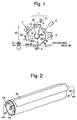
- Fig. 2 is a perspective view showing charge means 11 and cleaning means 12 which are characterizing parts of this image-forming apparatus. While being characterized by the charge means 11 and cleaning means 12, the image-forming apparatus in accordance with this embodiment uses the exposure device 2, developing device 3, transfer device 4, and fixing device 5 which are similar to those of the conventional apparatus shown in Fig. 5. Also, as a recording medium for forming an image, a flexible material such as paper is used. Further, when control means for irradiating light is altered in the exposure device 2, the image-forming apparatus can be used as such machines as copier, facsimile machine, and laser printer.
- the image-forming apparatus can be used as a copier.
- the exposure device 2 is connected to a telephone line by way of a modem so as to irradiate light corresponding to an electric signal be used as a facsimile machine.
- the exposure device 2 is enabled to irradiate a laser beam corresponding to an external electric signal, the image-forming apparatus can be used as a laser printer.
- a substrate drum 13 is made of a light element such as beryllium or carbon and in a cylindrical shape forming a closed loop.
- This substrate drum 13 is rotated around the axis of its cylinder. Due to this rotation, the substrate drum 13 moves along the closed loop.
- a photosensitive layer 14 made of a semiconductor layer is formed on the outer surface of the closed loop of the substrate drum 13, a photosensitive layer 14 made of a semiconductor layer is formed.
- the charge means 11 is used for electrically charging the surface of this photosensitive layer 14 and comprises an X-ray tube 15 disposed within the above-mentioned closed loop, an external fixed charging electrode 16, and a power supply 17.
- the X-ray tube 15 is surrounded by an X-ray shielding plate 20 which divides the X-rays emitted from the X-ray tube 15 into a first X-ray 18a directed toward the charge means 11 and a second X-ray 18b directed toward the cleaning means 12. Since the substrate drum 13 is made of a light element, the X-rays 18a and 18b emitted from the X-ray tube 15 are efficiently transmitted through the substrate drum 13 electrode 16 is made of a metal plate and disposed outside of the closed loop of the photosensitive layer 14 so as to face the X-ray tube 15 by way of the substrate drum 13 and photosensitive layer 14. To this fixed charging electrode 16, voltage V 0 is applied from the power supply 17.
- the fixed charging electrode 16 and the power supply 17 constitute electric-field application means, whereby an electric field directed from the fixed charging electrode 16 to the surface of the photosensitive layer 14 is formed as the voltage is applied to the fixed charging electrode 16.
- the X-ray tube 15 constituting charging X-ray generation means also constitutes erasure X-ray generation means in a static eliminator portion which constitutes the cleaning means 12.
- a fixed erasure electrode 19 is disposed outside of the closed loop so as to face the X-ray tube 15 by way of the substrate drum 13 and photosensitive layer 14. This fixed erasure electrode 19 is grounded.
- a brush cleaner 7 is disposed at a position which is close to the fixed erasure electrode 19 in the direction of the rotation of the substrate drum 13.
- the above-mentioned X-ray tube 15 constituting the charging and erasure X-ray generation means is disposed along the central axis of the cylindrical substrate the surface of the photosensitive layer 14, it is desirable for the X-ray tube 15 to be constituted by a long-type X-ray tube as in this embodiment rather than by a plurality of short X-ray tubes arranged in a row along the central axis of the substrate drum 13.
- This X-ray tube 15 generates X-rays within the energy range of 1 to 20 keV.
- the air between the fixed charging electrode 16 in the charge means 11 and the photosensitive layer 14 is electrolytically dissociated, thereby generating gaseous ions.
- these gaseous ions those charged to positive polarity (+) are guided to the surface of the photosensitive layer 14 by the electric field generated by the electric-field application means. Accordingly, the surface of the photosensitive layer 14 is charged with a positive electric charge 31.
- the long-type X-ray tube is used as the X-ray tube 15 as mentioned layer 14 is uniformly irradiated with the X-rays, thereby uniformly generating gaseous ions in the air held between the fixed charging electrode 16 and the photosensitive layer 14. Therefore, the surface of the photosensitive layer 14 is uniformly charged with the positive electric charge (+).
- the electric charge on the surface of the photosensitive layer 14 can be set to a desirable polarity depending on the polarity of the voltage applied to the fixed charging electrode 16. Accordingly, the polarity of the charge on the surface of the photosensitive layer 14 can be arbitrarily selected with reference to the polarity (+) or (-) of the toner used. Also, as the voltage value applied to the fixed charging electrode 16 is selected, the surface electric potential of the photosensitive layer 14 can be set to a desirable charge potential. Accordingly, as this voltage value is selected, the electric charge amount Q of the charged gaseous ions on the surface of the photosensitive layer 14 can be freely controlled. Also, since the charge potential of the photosensitive layer 14 can be strictly controlled, the quality of the formed image can be improved. The surface of the photosensitive layer 14 is electrically charged by such a charging mechanism. electric charge in the image-forming apparatus will be explained with reference to Fig. 3B.
- the air on the photosensitive layer 14 rotated from the fixing device 15 to reach the cleaning means 12 is irradiated with the second X-ray 18b from the X-ray tube 15 transmitted through the substrate drum 13 and photosensitive layer 14.
- the air on the photosensitive layer 14 is electrolytically dissociated, thereby generating gaseous ions.
- gaseous ions those charged to positive polarity neutralize the electric charge of a toner 32 which has been charged to negative polarity and remains on the surface of the photosensitive layer 14.
- the X-ray 18b emitted from the X-ray tube 15 generates a carrier within the photosensitive layer 14, thereby neutralizing and extinguishing the latent image formed in the photosensitive layer 14.
- the neutralized toner remaining on the photosensitive layer 14 is removed by the brush cleaner 7, whereby the surface of the photosensitive layer 14 is cleaned.
- the surface of the photosensitive layer 14 is destaticized and cleaned by such an erasure mechanism.
- the charge means 11 is actuated such that the surface of the photosensitive layer 14 disposed on the outer surface of the substrate drum 13 is uniformly electrically charged by the above-mentioned charging mechanism.
- electrostatic latent images corresponding to images to be formed are sequentially formed on its surface upon exposure to the light emitted from the exposure device 2.
- a toner which is a coloring fine particle charged to a polarity different from that of the electrostatic latent image, is attached to the area of such an electrostatic latent image.
- While a black toner is usually used therefor, it may be in other colors as well.
- a recording medium is supplied, in synchronization with this movement, between the substrate drum 13 and the transfer device 4, whereby the toner on the photosensitive layer 14 is transferred to the recording medium due to the electrostatic force from the transfer device 4.
- the recording medium is toner is fixed to the recording medium upon heating at the fixing device 5 so as to form a desirable image on the recording medium.
- the cleaning means 12 as mentioned above, whereby the photosensitive layer 14 resumes its initial state. Then, after the photosensitive layer 14 is electrically charged by the charge means 11, the steps of exposure, development, transfer, and cleaning are repeated so as to form an image.
- the cylindrical substrate drum 13 is used as a substrate for moving the photosensitive layer 14 in the image-forming apparatus in accordance with the first embodiment explained in the foregoing, the substrate should not be restricted thereto.
- a sheet film belt 41 made of a light element forming a closed loop may be used as the substrate.
- a photosensitive body 42 made of an organic optical semiconductor is formed on the surface of the sheet film belt 41 outside of closed loop, while a driving roller 43 moves the belt 41 along the closed loop.
- means and X-ray erasure means is disposed within the closed loop.
- the fixed charging electrode 16 and the fixed erasure electrode 19 are disposed outside of the closed loop so as to face the X-ray tube 15 by way of the belt 41 and photosensitive body 42, thereby respectively constituting the charge means 11 and the cleaning means 12.
- the surface of the photosensitive body 42 is charged with an electric charge 44 as well.
- the electric charge of the toner remaining on the surface of the photosensitive body 42 is neutralized while the electrostatic latent image remaining in the photosensitive body 42 is extinguished.
- flash lamps 45a and 45b constitute an exposure device, while a developing device 46 sprinkles the toner on the electrostatic latent image formed by this exposure device. The resulting image is transferred to a recording medium by a transfer device 47.
- This gaseous ion is guided, by an electric field generated by the electric-field application means, to the photosensitive layer surface, thereby electrically charging the latter.
- the X-ray emitted by the erasure X-ray generation means in the cleaning means is transmitted through the substrate to generate a gaseous ion on the photosensitive layer.
- This gaseous ion neutralizes the coloring fine particle remaining on the photosensitive layer surface.
- this X-ray emitted from the erasure X-ray generation means generates a carrier within the photosensitive layer. This carrier extinguishes, in a non-contact manner, the electrostatic latent image formed in the photosensitive layer.
- the charging and destaticizing of the photosensitive layer can be effected without using the conventional corona discharge and, accordingly, such matters as ozone, NOx, and dust are not generated by the image-forming apparatus in accordance with the present invention.
- electrodes which are peripheral parts of the charge means and static eliminator means, may be oxidized to deteriorate the possibility of a fire being generated due to corona discharge.
- an image-forming apparatus which is preferable for the environment of the earth can be realized.
- the X-ray generation means is disposed within the closed loop of the substrate, there is no need for providing corona discharge means which has conventionally had to be disposed outside of the closed loop. Accordingly, an image-forming apparatus having a small size can be realized.
Landscapes
- Physics & Mathematics (AREA)
- General Physics & Mathematics (AREA)
- Engineering & Computer Science (AREA)
- Plasma & Fusion (AREA)
- Elimination Of Static Electricity (AREA)
- Combination Of More Than One Step In Electrophotography (AREA)
- Electrostatic Charge, Transfer And Separation In Electrography (AREA)
- Printers Or Recording Devices Using Electromagnetic And Radiation Means (AREA)
Applications Claiming Priority (2)
| Application Number | Priority Date | Filing Date | Title |
|---|---|---|---|
| JP1101695 | 1995-01-26 | ||
| JP11016/95 | 1995-01-26 |
Publications (2)
| Publication Number | Publication Date |
|---|---|
| EP0724201A2 true EP0724201A2 (de) | 1996-07-31 |
| EP0724201A3 EP0724201A3 (de) | 1998-04-29 |
Family
ID=11766322
Family Applications (1)
| Application Number | Title | Priority Date | Filing Date |
|---|---|---|---|
| EP96300567A Withdrawn EP0724201A3 (de) | 1995-01-26 | 1996-01-26 | Bilderzeugungsgerät |
Country Status (4)
| Country | Link |
|---|---|
| US (1) | US5604571A (de) |
| EP (1) | EP0724201A3 (de) |
| KR (1) | KR960029920A (de) |
| CN (1) | CN1082680C (de) |
Cited By (1)
| Publication number | Priority date | Publication date | Assignee | Title |
|---|---|---|---|---|
| EP0724200A3 (de) * | 1995-01-26 | 1998-04-29 | Hamamatsu Photonics K.K. | Bilderzeugungsgerät |
Families Citing this family (5)
| Publication number | Priority date | Publication date | Assignee | Title |
|---|---|---|---|---|
| US6058003A (en) * | 1996-02-08 | 2000-05-02 | Hamamatsu Photonics K.K. | Electrostatic charger and discharger |
| US6356726B1 (en) | 2000-06-15 | 2002-03-12 | Lexmark International, Inc. | Electrophotographic printer with compact pre-transfer erase assembly |
| US7585829B1 (en) | 2002-11-06 | 2009-09-08 | Taylor Lawnie H | Products, methods and equipment for removing stains from fabrics |
| US7109157B2 (en) * | 2003-02-27 | 2006-09-19 | Lawnie Taylor | Methods and equipment for removing stains from fabrics using a composition comprising hydroxide and hypochlorite |
| CN102039720A (zh) * | 2010-10-09 | 2011-05-04 | 苏州工业园区天势科技有限公司 | 标签五色印刷机 |
Family Cites Families (5)
| Publication number | Priority date | Publication date | Assignee | Title |
|---|---|---|---|---|
| US3481669A (en) * | 1965-03-01 | 1969-12-02 | Xerox Corp | Photo-charging of xerographic plates |
| US3646351A (en) * | 1971-02-16 | 1972-02-29 | Eastman Kodak Co | Gas-cushion corona charger |
| JPS59228683A (ja) * | 1983-06-10 | 1984-12-22 | Fuji Xerox Co Ltd | 電子複写機 |
| JPH03212658A (ja) * | 1990-01-18 | 1991-09-18 | Matsushita Electric Ind Co Ltd | 画像形成装置 |
| JP2719091B2 (ja) * | 1993-06-18 | 1998-02-25 | 浜松ホトニクス株式会社 | 静電気除電装置および静電気除電方法 |
-
1996
- 1996-01-26 EP EP96300567A patent/EP0724201A3/de not_active Withdrawn
- 1996-01-26 CN CN96105703A patent/CN1082680C/zh not_active Expired - Fee Related
- 1996-01-26 KR KR1019960002190A patent/KR960029920A/ko not_active Withdrawn
- 1996-01-26 US US08/592,714 patent/US5604571A/en not_active Expired - Fee Related
Cited By (1)
| Publication number | Priority date | Publication date | Assignee | Title |
|---|---|---|---|---|
| EP0724200A3 (de) * | 1995-01-26 | 1998-04-29 | Hamamatsu Photonics K.K. | Bilderzeugungsgerät |
Also Published As
| Publication number | Publication date |
|---|---|
| US5604571A (en) | 1997-02-18 |
| CN1082680C (zh) | 2002-04-10 |
| EP0724201A3 (de) | 1998-04-29 |
| KR960029920A (ko) | 1996-08-17 |
| CN1159612A (zh) | 1997-09-17 |
Similar Documents
| Publication | Publication Date | Title |
|---|---|---|
| EP0864936B1 (de) | Bilderzeugungsgerät | |
| EP0010375B1 (de) | Elektrostatographisches Gerät | |
| US4778740A (en) | Color electrophotographic method and apparatus | |
| US5604571A (en) | Image- forming apparatus having imaging x-ray generation means | |
| JP2820814B2 (ja) | トライレベルゼログラフィ用ハイブリッド現像装置及び方法 | |
| KR100367265B1 (ko) | 화상형성장치 | |
| EP0341900B1 (de) | Druckgerät mit photoleitfähigem Gitter | |
| US5666603A (en) | Image-forming apparatus using X-ray for charging and cleaning a photosensitive member | |
| JP2881129B2 (ja) | 画像形成装置 | |
| JP2881128B2 (ja) | 画像形成装置 | |
| GB1573928A (en) | Electrophotographic apparatus using an apertured screen | |
| US4325625A (en) | Electrophotographing method | |
| JP3710161B2 (ja) | 電子写真機 | |
| JPH03221979A (ja) | 電子写真画像形成装置 | |
| US5099282A (en) | Variable magnification image forming apparatus | |
| JPH08334948A (ja) | 電子写真印刷装置の作動方法 | |
| EP0411574A2 (de) | Elektrofotografisches Bilderzeugungsverfahren | |
| JPS6064364A (ja) | 画像形成方法および装置 | |
| US5546169A (en) | Copying machine with image superposition capability | |
| JP3004063B2 (ja) | カラー電子写真装置 | |
| CN1161475A (zh) | 图象形成设备 | |
| JPS60117274A (ja) | トナ−像転写型ハ−ドコピ−装置 | |
| JPS62113184A (ja) | 合成画像形成装置 | |
| JPH01128078A (ja) | 電子写真プロセスの画像記録装置 | |
| JPH02170178A (ja) | 帯電装置 |
Legal Events
| Date | Code | Title | Description |
|---|---|---|---|
| PUAI | Public reference made under article 153(3) epc to a published international application that has entered the european phase |
Free format text: ORIGINAL CODE: 0009012 |
|
| AK | Designated contracting states |
Kind code of ref document: A2 Designated state(s): DE FR GB |
|
| PUAL | Search report despatched |
Free format text: ORIGINAL CODE: 0009013 |
|
| AK | Designated contracting states |
Kind code of ref document: A3 Designated state(s): DE FR GB |
|
| 17P | Request for examination filed |
Effective date: 19981022 |
|
| 17Q | First examination report despatched |
Effective date: 19991217 |
|
| RAP1 | Party data changed (applicant data changed or rights of an application transferred) |
Owner name: HAMAMATSU PHOTONICS K.K. |
|
| GRAP | Despatch of communication of intention to grant a patent |
Free format text: ORIGINAL CODE: EPIDOSNIGR1 |
|
| STAA | Information on the status of an ep patent application or granted ep patent |
Free format text: STATUS: THE APPLICATION IS DEEMED TO BE WITHDRAWN |
|
| 18D | Application deemed to be withdrawn |
Effective date: 20080111 |