EP0723937A2 - Verfahren zur Behandlung von industriellem Abwasser - Google Patents
Verfahren zur Behandlung von industriellem Abwasser Download PDFInfo
- Publication number
- EP0723937A2 EP0723937A2 EP96300401A EP96300401A EP0723937A2 EP 0723937 A2 EP0723937 A2 EP 0723937A2 EP 96300401 A EP96300401 A EP 96300401A EP 96300401 A EP96300401 A EP 96300401A EP 0723937 A2 EP0723937 A2 EP 0723937A2
- Authority
- EP
- European Patent Office
- Prior art keywords
- organic substances
- effluent
- sludge
- hydrophobic
- substances
- Prior art date
- Legal status (The legal status is an assumption and is not a legal conclusion. Google has not performed a legal analysis and makes no representation as to the accuracy of the status listed.)
- Withdrawn
Links
Images
Classifications
-
- C—CHEMISTRY; METALLURGY
- C02—TREATMENT OF WATER, WASTE WATER, SEWAGE, OR SLUDGE
- C02F—TREATMENT OF WATER, WASTE WATER, SEWAGE, OR SLUDGE
- C02F1/00—Treatment of water, waste water, or sewage
- C02F1/52—Treatment of water, waste water, or sewage by flocculation or precipitation of suspended impurities
- C02F1/5236—Treatment of water, waste water, or sewage by flocculation or precipitation of suspended impurities using inorganic agents
- C02F1/5245—Treatment of water, waste water, or sewage by flocculation or precipitation of suspended impurities using inorganic agents using basic salts, e.g. of aluminium and iron
-
- C—CHEMISTRY; METALLURGY
- C02—TREATMENT OF WATER, WASTE WATER, SEWAGE, OR SLUDGE
- C02F—TREATMENT OF WATER, WASTE WATER, SEWAGE, OR SLUDGE
- C02F1/00—Treatment of water, waste water, or sewage
- C02F1/72—Treatment of water, waste water, or sewage by oxidation
- C02F1/78—Treatment of water, waste water, or sewage by oxidation with ozone
-
- Y—GENERAL TAGGING OF NEW TECHNOLOGICAL DEVELOPMENTS; GENERAL TAGGING OF CROSS-SECTIONAL TECHNOLOGIES SPANNING OVER SEVERAL SECTIONS OF THE IPC; TECHNICAL SUBJECTS COVERED BY FORMER USPC CROSS-REFERENCE ART COLLECTIONS [XRACs] AND DIGESTS
- Y10—TECHNICAL SUBJECTS COVERED BY FORMER USPC
- Y10S—TECHNICAL SUBJECTS COVERED BY FORMER USPC CROSS-REFERENCE ART COLLECTIONS [XRACs] AND DIGESTS
- Y10S210/00—Liquid purification or separation
- Y10S210/902—Materials removed
- Y10S210/908—Organic
-
- Y—GENERAL TAGGING OF NEW TECHNOLOGICAL DEVELOPMENTS; GENERAL TAGGING OF CROSS-SECTIONAL TECHNOLOGIES SPANNING OVER SEVERAL SECTIONS OF THE IPC; TECHNICAL SUBJECTS COVERED BY FORMER USPC CROSS-REFERENCE ART COLLECTIONS [XRACs] AND DIGESTS
- Y10—TECHNICAL SUBJECTS COVERED BY FORMER USPC
- Y10S—TECHNICAL SUBJECTS COVERED BY FORMER USPC CROSS-REFERENCE ART COLLECTIONS [XRACs] AND DIGESTS
- Y10S210/00—Liquid purification or separation
- Y10S210/902—Materials removed
- Y10S210/908—Organic
- Y10S210/909—Aromatic compound, e.g. pcb, phenol
Definitions
- the present invention relates to the treatment of aqueous industrial effluent which contains relatively small concentrations of toxic organic substances and relatively large concentrations of less-toxic organic waste.
- concentrations of such substances in industrial effluents are often on the order of hundreds ppb, compared to on the order of thousands ppm (parts per million) of other organic substances.
- Current treatment processes such as activated carbon adsorption and oxidation are not selective to the red list substances, which are only degraded after most of the other organic substances have been destroyed.
- JP-A-50142466 (CA 84 (12) :79406c) discloses the oxidation with ozone and subsequent dewatering of an iron-containing sludge produced during flocculation of waste water with ferrous sulphate at pH 10.2.
- the ozonation oxidises the precipitated ferrous hydroxide to ferric oxide and thereby markedly decreases sludge formation compared with conventional treatment with hydrated lime.
- the volume of sludge formed was 70 cm 3 .
- the volume of the remaining sludge cake was 14 cm 3 . This compared with volumes of 210 cm 3 and 21 cm 3 , respectively, when the slurry was oxidized with 20% Ca(OH) 2 .
- US-A-4049545 discloses the treatment of waste water by addition of an alkaline coagulant aid to pH 9.0-10.5 and the subsequent addition of precipitating agents in at least two successive steps to lower the pH of the mixture by about pH 1 each step.
- Exemplified precipitating agents include aluminium and ferric salts. It is stated that, after the last precipitation step, the pH of the water should be between 6 and 8.5. There is no suggestion that selective precipitation should initially be carried out at pH 6 to 8 as required by the present invention. Further, there is no reference in the Application to oxidizing precipitated sludge.
- US-A-4717484 discloses a treatment of waste water in which a metal salt is added to form a flocculated mixture of metal hydroxide and organic sludge. After degasification and separation from the treated water, the metal salts in the flocculated mixture are dissolved by increasing pH and recycled as flocculant. Exemplified flocculants are aluminium and iron salts. There is no reference to selected precipitation of particular organic waste by control of pH prior to addition of the flocculant and no reference to oxidation of the precipitated sludge.
- red list substances are oxidizable, hydrophobic organic substances, especially halogenated compounds, which are selectively precipitated with an hydroxide sludge formed on the addition of a salt of a metal having an insoluble hydroxide to aqueous effluent of essentially neutral pH.
- This provides a means of separating "red list” substances from the bulk of hydrophilic organic substances in the effluent, thereby permitting the remaining effluent to be discharged for treatment as sewage and dramatically reducing the extent of oxidation required to remove the "red list” substances (compared with oxidation in the original effluent).
- the red list substances include aldrin, atrazine, cyfluthrin, DDT, dieldrin, dizenon, pentachlorophenols, permethrin, propetanphos, and simazine.
- the present invention provides a method of separating hydrophobic organic substances from aqueous industrial effluent containing said hydrophobic, organic substances and hydrophilic organic substances, comprising adding to the effluent at pH 6 to 8 a salt of a metal having an insoluble hydroxide thereby forming an hydroxide sludge entraining said hydrophobic, oxidizable organic substances, and separating the sludge from the treated effluent containing the hydrophilic organic substances.
- the present invention provides a method of destroying hydrophobic, oxidizable organic substances in aqueous industrial effluent containing said hydrophobic, organic substances and hydrophilic organic substances, comprising adding to the effluent at pH 6 to 8 a salt of a metal having an insoluble hydroxide thereby forming an hydroxide sludge entraining said hydrophobic, oxidizable organic substances; separating the sludge from the treated effluent containing the hydrophilic organic substances; and subjecting said sludge to oxidising conditions to oxidize said hydrophobic, oxidizable organic substances.
- the invention has particular application to the separation of hydrophobic organic substances from aqueous industrial effluent containing relatively small concentrations of said hydrophobic, organic substances and relatively large concentrations of hydrophilic organic substances.
- concentration of hydrophilic organic substances is often on the order of 10 or more times that of the hydrophobic, organic substances.
- concentration of hydrophobic, organic substances in the aqueous effluent is on the order of 1 to 1000 ppb, and the concentration of the hydrophilic organic substances in the effluent is on the order of 1,000 to 100,000 ppm.
- the invention provides the advantage that toxic substances from the effluent are separated and then degraded in a much reduced volume, leaving the bulk organic load, to be treated by the most cost effective way, for example in a municipal sewage treatment works.
- the metal salt is a water-soluble salt of a metal having two or more oxidation states, such as aluminum, chromium, iron, and manganese.
- a metal having two or more oxidation states such as aluminum, chromium, iron, and manganese.
- the most preferred metal salts are Fe(III) or Al(III) salts, especially chlorides or sulphates and particularly Fe 2 (SO 4 ) 3 .
- the effluent In order to avoid reaction of the metal salt with organic substances in the effluent to form insoluble salts by charge neutralization, the effluent must be maintained at substantially neutral pH (pH 6 to 8) during the salt is added. Thus, it may be necessary to adjust the pH of the effluent before or during addition of the metal salt by addition of a suitable acid or base. Preferably, the effluent is at about pH 7 during the salt addition.
- the hydrophilic, oxidizable, organic content of the hydroxide sludge will be destroyed by oxidation.
- the oxidised sludge can be disposed of by thickening and dewatering and discharging the dewatered sludge separately from the treated effluent, from which the toxic substances have been removed.
- the oxidised sludge may be disposed of on-site, and only the supernatant liquid from the oxidized and/or dewatered sludge disposed of to a municipal land drain.
- the oxidised sludge may be recombined with the treated effluent, and the combined effluent treated by the municipal sewage works to remove the hydrophilic organic substances to the relevant discharge consent level.
- at least a portion of the oxidized sludge, preferably after dewatering, can be treated to regenerate metal salt and thereafter recycled for mixing with further aqueous effluent.
- the sludge oxidation step usually will be conducted by ozonation, although other oxidative methods, such as with oxygen at elevated pressure and temperature, can be used. Usually, the ozonation will be conducted at ambient temperature and pressure.
- the metal cation of the salt is selected to catalyse the oxidation.
- the metal salt is added to the aqueous effluent in a mixing chamber with a residence time sufficient to permit formation of the sludge, usually 1 to 5 minutes.
- the resultant mixture can then be fed to a settling tank for sufficient time for the sludge to settle, usually 10 to 30 minutes, and the sludge and treated effluent separately removed from the tank.
- the mixture can be separating by dissolved air flotation or other conventional separation method.
- industrial aqueous effluent such as waste water from textile industry processes or landfill leachate
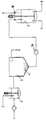
- an effluent inlet 1 the waste water contains hydrophobic, toxic organic substances such as halogenated pesticides at a level on the order of 1 to 1000 ppb, the main waste material in the effluent being hydrophilic relatively non-toxic organic substances which are present at a level on the order of 1,000 to 100,000 ppm, the latter presenting overwhelmingly the greater chemical oxygen demand (COD).
- Current treatment processes such as activated carbon adsorption and oxidation are not selective to the toxic materials, which can only be degraded after most of the organic substance content is destroyed.
- the treatment of the present embodiment selectively separates the toxic substances from the waste water and then degrades them in a much reduced volume, leaving the bulk organic load to be treated in the municipal sewage treatment works.
- the aqueous effluent to be treated is mixed with Fe 2 (SO 4 ) 3 supplied through a salt inlet 2 to a mixing chamber 3 in which the coagulation takes place.
- the pH of the effluent is adjusted to substantially neutral with, for example, either H 2 SO 4 or NaOH.
- the salt/effluent mixture is mixed by a rotary agitating paddle and there is rapid precipitation of ferric hydroxide. Toxic hydrophobic substances are entrained in the precipitate, leaving less-toxic hydrophilic substances in the effluent.
- the resulting mixture is fed to a settling tank 5, where the sludge 4 is settled and separated from the treated effluent.
- the sludge 4 is then pumped by pump 5A from the settling tank 5 to an ozonation reactor 6 where the toxic substances are destroyed by oxidation with ozone gas supplied via inlet 7.
- the oxidation by the ozone gas is catalysed by the iron species in the sludge.
- Spent gas exhausts from the reactor 6 through a outlet 10.
- the oxidized sludge is drawn off at an outlet 8 and, being free of toxic substances, can be mixed with the treated effluent drawn off from the settling tank 5 at an outlet 9 and then discharged to the municipal treatment works for conventional sewage treatment to remove the bulk of organic matter in the waste water.
- the oxidized sludge emerging at the outlet 8 can be thickened and dewatered by centrifuging, or other solid/liquid separation methods, in a separator (not shown). In such a case the treated effluent emerging at outlet 9, which is free from toxic substances, can be discharged directly to the municipal sewer.
- at least a portion of the dewatered sludge can be treated to regenerate the metal salt and then recycled to the mixing chamber 3 to reduce both the metal salt requirement and the amount of sludge requiring disposal.
- a 20 l sample of effluent from a composite dye house (textile industry with the following composition: chemical oxygen demand 3500 mg/l; red list substances such as dieldrin, dizenon, cyfluthrin, permethrin, and propetanphos at 10 to 200 ppb concentrations) was intensively (600 rpm) mixed with 10 cm 3 50% w/v Fe 2 (SO 4 ) 3 solution and 5 cm 3 40% w/v NaOH solution for 2 minutes. The mixture was left in the container to settle with mild mixing at 20 rpm for 30 minutes. The supernatant liquid was free from red list substances ( ⁇ 10 ppb; the detection limit) and hence was suitable for discharge to the municipal sewer.
- red list substances such as dieldrin, dizenon, cyfluthrin, permethrin, and propetanphos at 10 to 200 ppb concentrations
- the settled sludge (about 2 1), containing the red list substances from the initial effluent sample at concentrations ranging from 100 to 2000 ppb, was then treated with 1360 mg of ozone to decompose the red list substances to below 10 ppb.
- the resultant ozone treated sludge was suitable for discharge to the municipal sewer.
- the process described allows the toxic (red list) substances to be destroyed completely without much degradation of the bulk organic load, thereby significantly reducing the chemical oxygen demand at the municipal sewage works.
- the volumetric load of the hydrophobic substances precipitated with the sludge is only 5 to 10% of the total effluent load, the ozone (or other oxidant) consumption required to remove toxic substances by the process of the invention is very low and hence the process is very cost effective.
- the known unselective methods which oxidize both toxic and less-toxic substances, has substantial chemical oxygen demand, thus entailing excessive cost.
Landscapes
- Chemical & Material Sciences (AREA)
- Inorganic Chemistry (AREA)
- Life Sciences & Earth Sciences (AREA)
- Hydrology & Water Resources (AREA)
- Engineering & Computer Science (AREA)
- Environmental & Geological Engineering (AREA)
- Water Supply & Treatment (AREA)
- Organic Chemistry (AREA)
- Treatment Of Water By Oxidation Or Reduction (AREA)
- Treatment Of Sludge (AREA)
- Removal Of Specific Substances (AREA)
Applications Claiming Priority (2)
| Application Number | Priority Date | Filing Date | Title |
|---|---|---|---|
| GB9501401 | 1995-01-25 | ||
| GB9501401A GB2297322A (en) | 1995-01-25 | 1995-01-25 | Method for treating industrial effluent |
Publications (2)
| Publication Number | Publication Date |
|---|---|
| EP0723937A2 true EP0723937A2 (de) | 1996-07-31 |
| EP0723937A3 EP0723937A3 (de) | 1998-06-17 |
Family
ID=10768509
Family Applications (1)
| Application Number | Title | Priority Date | Filing Date |
|---|---|---|---|
| EP96300401A Withdrawn EP0723937A3 (de) | 1995-01-25 | 1996-01-22 | Verfahren zur Behandlung von industriellem Abwasser |
Country Status (4)
| Country | Link |
|---|---|
| US (1) | US5641407A (de) |
| EP (1) | EP0723937A3 (de) |
| BR (1) | BR9600209A (de) |
| GB (1) | GB2297322A (de) |
Cited By (2)
| Publication number | Priority date | Publication date | Assignee | Title |
|---|---|---|---|---|
| US9637403B2 (en) | 2012-05-23 | 2017-05-02 | Wetox Limited | Sludge treatment method |
| CN109179785A (zh) * | 2018-11-07 | 2019-01-11 | 无锡普力环保科技有限公司 | 一种臭氧催化氧化污水处理设备 |
Families Citing this family (2)
| Publication number | Priority date | Publication date | Assignee | Title |
|---|---|---|---|---|
| US7300585B1 (en) | 2004-07-15 | 2007-11-27 | Mays Chemical Company, Inc. | Method of treatment of effluent stream |
| SE0402178D0 (sv) * | 2004-09-10 | 2004-09-10 | Swedish Bioclean Engineering A | Anordning och metod relaterande processindustri |
Family Cites Families (12)
| Publication number | Priority date | Publication date | Assignee | Title |
|---|---|---|---|---|
| JPS5117345B2 (de) * | 1972-10-24 | 1976-06-01 | ||
| JPS50142466A (de) * | 1974-05-07 | 1975-11-17 | ||
| US4049545A (en) * | 1976-07-08 | 1977-09-20 | Rocky Carvalho | Chemical waste water treatment method |
| JPS5462655A (en) * | 1977-10-26 | 1979-05-19 | Mitsubishi Gas Chemical Co | Method of treating sludge |
| JPS5534136A (en) * | 1978-08-31 | 1980-03-10 | Kankyo Eng Kk | Treatment method of organic waste water |
| JPS5547197A (en) * | 1978-09-29 | 1980-04-03 | Kankyo Eng Kk | High grade treatment of organic waste water |
| JPS56168879A (en) * | 1980-05-29 | 1981-12-25 | Ebara Infilco Co Ltd | Flocculation sedimentation treatment |
| SU1130539A1 (ru) * | 1982-11-12 | 1984-12-23 | Таллинский Политехнический Институт | Способ очистки сточных вод |
| JPS61161197A (ja) * | 1985-01-11 | 1986-07-21 | Kankyo Eng Kk | 有機性排水の処理方法 |
| EP0195297B1 (de) * | 1985-03-06 | 1991-05-02 | Karl Clemens Käuffer | Verfahren und Vorrichtung zum Schliessen der Kreisläufe bei der Reinigung von Wasser und Abwasser |
| US5171453A (en) * | 1986-09-19 | 1992-12-15 | Rhone-Poulenc Chimie | Water clarification/purification |
| DE4125990A1 (de) * | 1991-08-06 | 1993-02-11 | Henkel Kgaa | Verfahren zum reinigen tensidhaltiger schmutzwaesser |
-
1995
- 1995-01-25 GB GB9501401A patent/GB2297322A/en not_active Withdrawn
-
1996
- 1996-01-22 EP EP96300401A patent/EP0723937A3/de not_active Withdrawn
- 1996-01-24 US US08/590,975 patent/US5641407A/en not_active Expired - Fee Related
- 1996-01-25 BR BR9600209A patent/BR9600209A/pt not_active Application Discontinuation
Cited By (2)
| Publication number | Priority date | Publication date | Assignee | Title |
|---|---|---|---|---|
| US9637403B2 (en) | 2012-05-23 | 2017-05-02 | Wetox Limited | Sludge treatment method |
| CN109179785A (zh) * | 2018-11-07 | 2019-01-11 | 无锡普力环保科技有限公司 | 一种臭氧催化氧化污水处理设备 |
Also Published As
| Publication number | Publication date |
|---|---|
| EP0723937A3 (de) | 1998-06-17 |
| GB9501401D0 (en) | 1995-03-15 |
| GB2297322A (en) | 1996-07-31 |
| US5641407A (en) | 1997-06-24 |
| BR9600209A (pt) | 1997-10-07 |
Similar Documents
| Publication | Publication Date | Title |
|---|---|---|
| JP3883445B2 (ja) | 汚水処理装置 | |
| US5051191A (en) | Method to detoxify sewage sludge | |
| WO2004094320A1 (en) | Method of treating digested sludge | |
| US6110379A (en) | Method for treating water containing sulfate | |
| WO1991007354A1 (en) | Water treatment method | |
| US5641407A (en) | Method for treating industrial effluent | |
| EP0062543A1 (de) | Verfahren und Vorrichtung zur physikalisch-chemischen Behandlung von Abfall | |
| US5075015A (en) | Method for color removal from thermally conditioned sludge liquors | |
| EP0723938A2 (de) | Verfahren zur Behandlung von industriellem Abwasser | |
| JP3680742B2 (ja) | ダイオキシン類を含む廃水の処理方法 | |
| JP2000301160A (ja) | 界面活性剤を含む含油排水の処理方法 | |
| KR100464872B1 (ko) | 가압부상분리시스템과 전기 반응장치를 모듈화한 음식물 쓰레기 탈리액 폐수처리시스템 | |
| JPS6339309B2 (de) | ||
| KR100385847B1 (ko) | 음식물 침출수 처리시스템 | |
| JP2003088877A (ja) | 有機性廃水の処理方法 | |
| RU2158236C1 (ru) | Способ очистки сульфидсодержащих растворов и сточных вод | |
| KR100225693B1 (ko) | 난분해성 유기물질 처리공법 | |
| JPH0433518B2 (de) | ||
| KR100315434B1 (ko) | 폐수중의 오염물질 처리방법 | |
| JPH0585240B2 (de) | ||
| Goronszy et al. | Wastewater (Part 2): A guide to industrial pretreatment | |
| KR910003005B1 (ko) | 산업폐수 처리방법 및 그 장치 | |
| US5372724A (en) | Process for removing toxic sulfur-containing compounds, ammonia, and oil and grease from an aqueous solution | |
| KR950002113B1 (ko) | 알칼리성 산업폐수의 처리방법 | |
| KR19990048131A (ko) | 폐수 처리 방법 |
Legal Events
| Date | Code | Title | Description |
|---|---|---|---|
| PUAI | Public reference made under article 153(3) epc to a published international application that has entered the european phase |
Free format text: ORIGINAL CODE: 0009012 |
|
| AK | Designated contracting states |
Kind code of ref document: A2 Designated state(s): DE ES GB IT |
|
| PUAL | Search report despatched |
Free format text: ORIGINAL CODE: 0009013 |
|
| AK | Designated contracting states |
Kind code of ref document: A3 Designated state(s): DE ES GB IT |
|
| STAA | Information on the status of an ep patent application or granted ep patent |
Free format text: STATUS: THE APPLICATION IS DEEMED TO BE WITHDRAWN |
|
| 18D | Application deemed to be withdrawn |
Effective date: 19980801 |