EP0723283A2 - Cadmiumentladungslampe vom Kurz-Bogen-Typ und Verfahren zum Erzeugen von UV-Licht damit - Google Patents
Cadmiumentladungslampe vom Kurz-Bogen-Typ und Verfahren zum Erzeugen von UV-Licht damit Download PDFInfo
- Publication number
- EP0723283A2 EP0723283A2 EP96100653A EP96100653A EP0723283A2 EP 0723283 A2 EP0723283 A2 EP 0723283A2 EP 96100653 A EP96100653 A EP 96100653A EP 96100653 A EP96100653 A EP 96100653A EP 0723283 A2 EP0723283 A2 EP 0723283A2
- Authority
- EP
- European Patent Office
- Prior art keywords
- cadmium
- kpa
- lighting operation
- discharge lamp
- stationary lighting
- Prior art date
- Legal status (The legal status is an assumption and is not a legal conclusion. Google has not performed a legal analysis and makes no representation as to the accuracy of the status listed.)
- Withdrawn
Links
- BDOSMKKIYDKNTQ-UHFFFAOYSA-N cadmium atom Chemical compound [Cd] BDOSMKKIYDKNTQ-UHFFFAOYSA-N 0.000 title claims abstract description 48
- 229910052793 cadmium Inorganic materials 0.000 title claims abstract description 46
- 238000000034 method Methods 0.000 title claims description 3
- 239000007789 gas Substances 0.000 claims abstract description 22
- XKRFYHLGVUSROY-UHFFFAOYSA-N Argon Chemical compound [Ar] XKRFYHLGVUSROY-UHFFFAOYSA-N 0.000 claims abstract description 16
- 229910052743 krypton Inorganic materials 0.000 claims abstract description 15
- DNNSSWSSYDEUBZ-UHFFFAOYSA-N krypton atom Chemical compound [Kr] DNNSSWSSYDEUBZ-UHFFFAOYSA-N 0.000 claims abstract description 15
- 238000001228 spectrum Methods 0.000 claims abstract description 9
- 229910052724 xenon Inorganic materials 0.000 claims abstract description 9
- FHNFHKCVQCLJFQ-UHFFFAOYSA-N xenon atom Chemical compound [Xe] FHNFHKCVQCLJFQ-UHFFFAOYSA-N 0.000 claims abstract description 9
- 229910052786 argon Inorganic materials 0.000 claims abstract description 8
- 229910052754 neon Inorganic materials 0.000 claims abstract description 8
- GKAOGPIIYCISHV-UHFFFAOYSA-N neon atom Chemical compound [Ne] GKAOGPIIYCISHV-UHFFFAOYSA-N 0.000 claims abstract description 8
- QSHDDOUJBYECFT-UHFFFAOYSA-N mercury Chemical compound [Hg] QSHDDOUJBYECFT-UHFFFAOYSA-N 0.000 claims description 4
- 229910052753 mercury Inorganic materials 0.000 claims description 4
- 230000008016 vaporization Effects 0.000 claims 1
- 238000009834 vaporization Methods 0.000 claims 1
- 238000005538 encapsulation Methods 0.000 description 10
- 230000003287 optical effect Effects 0.000 description 7
- 238000000295 emission spectrum Methods 0.000 description 6
- 238000009413 insulation Methods 0.000 description 6
- 230000003595 spectral effect Effects 0.000 description 5
- 239000007858 starting material Substances 0.000 description 5
- WLZRMCYVCSSEQC-UHFFFAOYSA-N cadmium(2+) Chemical compound [Cd+2] WLZRMCYVCSSEQC-UHFFFAOYSA-N 0.000 description 4
- 230000005855 radiation Effects 0.000 description 4
- 230000007423 decrease Effects 0.000 description 3
- 230000001105 regulatory effect Effects 0.000 description 3
- 238000005516 engineering process Methods 0.000 description 2
- 230000005283 ground state Effects 0.000 description 2
- 239000000126 substance Substances 0.000 description 2
- VYPSYNLAJGMNEJ-UHFFFAOYSA-N Silicium dioxide Chemical compound O=[Si]=O VYPSYNLAJGMNEJ-UHFFFAOYSA-N 0.000 description 1
- 238000003848 UV Light-Curing Methods 0.000 description 1
- 238000010521 absorption reaction Methods 0.000 description 1
- 238000004380 ashing Methods 0.000 description 1
- 238000010891 electric arc Methods 0.000 description 1
- 230000005281 excited state Effects 0.000 description 1
- 150000002500 ions Chemical class 0.000 description 1
- 229910044991 metal oxide Inorganic materials 0.000 description 1
- 150000004706 metal oxides Chemical class 0.000 description 1
- 230000002093 peripheral effect Effects 0.000 description 1
- 238000002407 reforming Methods 0.000 description 1
- 239000004065 semiconductor Substances 0.000 description 1
- 229920002050 silicone resin Polymers 0.000 description 1
- 239000007787 solid Substances 0.000 description 1
Images


Classifications
-
- G—PHYSICS
- G03—PHOTOGRAPHY; CINEMATOGRAPHY; ANALOGOUS TECHNIQUES USING WAVES OTHER THAN OPTICAL WAVES; ELECTROGRAPHY; HOLOGRAPHY
- G03F—PHOTOMECHANICAL PRODUCTION OF TEXTURED OR PATTERNED SURFACES, e.g. FOR PRINTING, FOR PROCESSING OF SEMICONDUCTOR DEVICES; MATERIALS THEREFOR; ORIGINALS THEREFOR; APPARATUS SPECIALLY ADAPTED THEREFOR
- G03F7/00—Photomechanical, e.g. photolithographic, production of textured or patterned surfaces, e.g. printing surfaces; Materials therefor, e.g. comprising photoresists; Apparatus specially adapted therefor
- G03F7/70—Microphotolithographic exposure; Apparatus therefor
- G03F7/70008—Production of exposure light, i.e. light sources
- G03F7/70016—Production of exposure light, i.e. light sources by discharge lamps
-
- H—ELECTRICITY
- H01—ELECTRIC ELEMENTS
- H01J—ELECTRIC DISCHARGE TUBES OR DISCHARGE LAMPS
- H01J61/00—Gas-discharge or vapour-discharge lamps
- H01J61/02—Details
- H01J61/12—Selection of substances for gas fillings; Specified operating pressure or temperature
- H01J61/18—Selection of substances for gas fillings; Specified operating pressure or temperature having a metallic vapour as the principal constituent
-
- H—ELECTRICITY
- H01—ELECTRIC ELEMENTS
- H01J—ELECTRIC DISCHARGE TUBES OR DISCHARGE LAMPS
- H01J61/00—Gas-discharge or vapour-discharge lamps
- H01J61/02—Details
- H01J61/30—Vessels; Containers
- H01J61/35—Vessels; Containers provided with coatings on the walls thereof; Selection of materials for the coatings
-
- H—ELECTRICITY
- H01—ELECTRIC ELEMENTS
- H01J—ELECTRIC DISCHARGE TUBES OR DISCHARGE LAMPS
- H01J61/00—Gas-discharge or vapour-discharge lamps
- H01J61/02—Details
- H01J61/52—Cooling arrangements; Heating arrangements; Means for circulating gas or vapour within the discharge space
-
- H—ELECTRICITY
- H01—ELECTRIC ELEMENTS
- H01J—ELECTRIC DISCHARGE TUBES OR DISCHARGE LAMPS
- H01J61/00—Gas-discharge or vapour-discharge lamps
- H01J61/84—Lamps with discharge constricted by high pressure
- H01J61/86—Lamps with discharge constricted by high pressure with discharge additionally constricted by close spacing of electrodes, e.g. for optical projection
Definitions
- the invention relates to a cadmium discharge lamp of the short arc type.
- Ultraviolet rays have different characteristics which are not exhibited by visible radiation and they are widely used for industrial applications. Recently, there has been a demand for a first-rate ultraviolet light source as a light source of an optical microscope which is combined with a CCD camera and which has high resolution.
- the image resolution r of an optical microscope and the depth of focus DOF can be computed using the following formulas, if the numerical aperture of the optical system is designated NA and the wavelength designated ⁇ .
- r K 1 ( ⁇ / NA)
- DOF K 2 ( ⁇ / (NA) 2 )
- K 1 and K 2 are coefficients which are determined by devices. It is, therefore, necessary to shorten the wavelength ⁇ in order to ensure the depth of focus and to increase the image resolution.
- ultraviolet rays especially ultraviolet rays with still shorter wavelengths, instead of visible radiation (sunlight), are being reviewed for use as the light source.
- a discharge lamp is suggested in which cadmium and rare gas, such as xenon, krypton, or the like, are encapsulated.
- cadmium ions as well as cadmium molecules are used and light with wavelengths from 210 nm to 230 nm is obtained.
- This technology is disclosed in Japanese unpublished patent specification HEI 7-21980 (U.S. Patent No. 5,471,278).
- This conventional lamp emits continuous light at wavelengths from 210 to 230 nm. It may, therefore, be effective for applications in which continuous light is needed, however, in the case in which high resolution is needed, as in an optical microscope, it is not an especially effective light source.
- a primary object of this invention is, therefore, to devise a cadmium discharge lamp by which line spectra with wavelengths of 214 ⁇ 2 nm can be emitted with high power.
- Another object is to devise a light source which is suitable for an optical microscope with high resolution and for other applications.
- the inventors have found by their vigorous research that by fixing the cadmium pressure in stationary lighting operation and the current value in stationary lighting operation that light with wavelengths of 214 nm ⁇ 2 nm can be emitted as line spectra with a small half-value width. They found that the light of these line spectra is based mainly on resonance lines of cadmium ions, and that the light reacts sensitively to changes of the cadmium pressure in stationary lighting operation and of the discharge current.
- J/P is in the range from 1.4 to 75, where the current value in stationary lighting operation is designated J (in amperes) and where the cadmium pressure in stationary lighting operation is designated P (kPa), as becomes apparent from the embodiments described below relative to the several embodiments shown in the drawing.
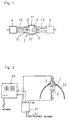
- Fig. 1 shows a specific arrangement of a cadmium discharge lamp of the short arc type according to the invention, which in the following is also called a "discharge lamp".
- reference numeral 1 designates an arc tube which forms the discharge lamp and which is made of quartz glass.
- the arc tube 1 has a roughly oval emission envelope 11 in the middle, and hermetically sealed portions 12 and 13 formed on both ends.
- cathode 2 and an anode 3 are closely positioned opposite each other with a distance of roughly 5 mm therebetween.
- the ends of hermetically sealed portions 12 and 13 are provided with bases 4 and 5 and heat insulation films 6 and 7 (represented as dashed lines) are applied to the outer surfaces of arc tube 1 in the root areas of cathode 2 and anode 3, such that the emergence of radiant light is not hindered.
- These heat insulation films regulate the temperature of the arc tube, and at the same time, keep the vapor pressure inside constant.
- These heat insulation films are formed, for example, of a metal oxide, with silicone resin as the main component.
- the heat insulation films have the property that the temperature of the outside surface of arc tube 1 can be stabilized by the arrangement of the heat insulation films at a temperature of 850 ⁇ 80 o C, while the temperature would change within a range of 650 ⁇ 100 o C without the heat insulation films.
- temperature control of the arc tube is extraordinarily important in order to suitably maintain the density of the distribution number of cadmium atoms, ions and molecules which are in a ground state or an excited state, and the cadmium pressure in stationary lighting operation.
- a double tube design or the like in which there is an outer bulb in a peripheral area of arc tube 1, is used as the temperature control process.
- cadmium in the state in which it is encapsulated in the arc tube, due to its solid state is called “metallic cadmium”
- cadmium in stationary lighting operation is called only “cadmium” because it is present as a vapor (gas).
- stationary lighting operation is used to mean a state in which, after the lamp has been put into operation by means of a starter, normally about 5 minutes later, the discharge voltage has reached a stationary state, i.e., the voltage has stabilized.
- a discharge lamp of this type is operated, for example, with a nominal wattage of 1 KW.
- Fig. 2 shows a circuit powering the discharge lamp according to the invention.
- the circuit comprises a constant power supply 20 and a starter 21.
- the output current from constant power supply 20 is connected via starter 21 to discharge lamp 1 which is inserted into a focussing mirror 22.
- By closing switch S1 of starter 21 a high voltage is generated in starter 21 and by applying the voltage to anode 3 of discharge lamp 1 a dielectric sparkover of arc tube 1 is formed.
- metallic cadmium is encapsulated together with at least one of the rare gases xenon, krypton, argon or neon. This metallic cadmium is encapsulated such that its pressure in stationary lighting operation is in the range from 2 kPa to 13.7 kPa.
- the luminous efficiency at a cadmium pressure in stationary lighting operation of greater than 13.7 kPa drops because, due to an excessively large amount of cadmium, the cadmium in the ground state increases in the arc formed between the electrodes, and because self-absorption is increased by the cadmium itself.
- the cadmium pressure in stationary lighting operation is less than 2.0 kPa, as a result of too little cadmium, the number of cadmium ions contributing to emission becomes too small. Consequently, the absolute emission intensity decreases.
- mercury is often encapsulated as an emission substance in a discharge lamp which emits ultraviolet rays.
- the discharge lamp according to the invention has the characteristic that mercury is not used as an emission substance and that emission is produced substantially by the cadmium.
- the rare gas is necessary to simplify starting of lighting operation of the discharge lamp.
- the emission is accomplished by cadmium, and the rare gas in itself does not contribute directly to emission.
- the rare gas performs a major function to stably maintain the arc temperature.
- Fig. 3 shows the result, the x-axis illustrating the value of J/P and the y-axis illustrating the radiant efficiency.
- the expression "radiant efficiency ⁇ " is defined as the ratio between the irradiation of light with wavelengths of 214 ⁇ 2 nm and the input electric power into the lamp. Specifically, it designates a value at which the total amount Q of irradiation in the wavelength range from 212 nm to 216 nm is divided by the input electric power W (product of luminous voltage V and input electric current I).
- the rare gas is, furthermore, not limited to krypton, and essentially the same action could be obtained with xenon, argon, or neon.
- Figs. 4 through 7 show the results, with Fig. 4 showing data for J/P of 1.4, Fig. 5 data for J/P of 11, Fig. 6 data for J/P of 50, and Fig. 7 data for J/P of 75, and with the y-axes illustrating the relative radiation intensity.
- Emission by cadmium is based on a subtle relative number of cadmium ions, atoms, molecules and electrons and is largely influenced by the value of J/P .
- J/P the value of J/P
- line spectra with a small half-value width are emitted if J/P is at least in the range from 1.4 to 75.0.
- the rare gas is not restricted to krypton, but essentially the same action could be obtained with xenon, argon, or neon.
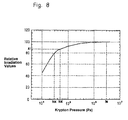
- krypton was encapsulated as the rare gas
- its encapsulation amount was changed from 30 kPa to 4 MPa and the irradiation at wavelengths of 214 ⁇ 2 nm was measured.
- Fig. 8 shows the results, the y-axis illustrating the irradiation at wavelengths of 214 ⁇ 2 nm as relative values, by designating the irradiation for encapsulation of krypton of 3 MPa as 100.
- the x-axis illustrates the encapsulation amount of the krypton.
- the encapsulation amount of the rare gas be less than or equal to 3 MPa.
- the rare gas in stationary lighting operation is influenced by the temperature of the arc tube. Its encapsulation amount is therefore extremely important.
- a suitable encapsulation amount is in the range from 30 kPa to 3 MPa and is even more advantageous in the range from 50 kPa to 3 MPa.
- the rare gas is furthermore not restricted to krypton, but essentially the same action could be obtained with xenon, argon, or neon.
- the discharge lamp according to the invention can accomplish line spectra emission with a small half-value width with wavelengths of 214 ⁇ 2 nm and can be used for different applications in which emission of this type is needed. Furthermore, when this discharge lamp is used as a light source of an optical microscope it was possible to increase the resolution up to 0.22 microns if K 1 was 0.6 and the numerical aperture NA was 0.58, as is described above.
- the line spectra with wavelengths of 214 ⁇ 2 nm with high power can be emitted by the measure by which the metallic cadmium is encapsulated in the range from 2 kPa to 13.7 kPa and the lamp current is regulated such that the value of J/P is in the range from 1.4 to 75.
- line spectra with wavelengths of 214 ⁇ 2 nm with high power can be emitted by the measure by which the metallic cadmium is encapsulated in the range from 2 kPa to 13.7 kPa and the lamp current is regulated such that the value of J/P is in the range from 1.4 to 75.
- It can be commonly used as a light source of an optical high resolution microscope, for the light source of a semi-conductor exposure device, for reforming of plastic surfaces, for photo-CVD, for ashing, and for UV curing, in which a certain wavelength is needed, and for similar purposes.
Landscapes
- Physics & Mathematics (AREA)
- Engineering & Computer Science (AREA)
- Plasma & Fusion (AREA)
- General Physics & Mathematics (AREA)
- Discharge Lamp (AREA)
- Microscoopes, Condenser (AREA)
Applications Claiming Priority (2)
| Application Number | Priority Date | Filing Date | Title |
|---|---|---|---|
| JP24461/95 | 1995-01-20 | ||
| JP7024461A JPH08195186A (ja) | 1995-01-20 | 1995-01-20 | ショートアーク型カドミウム希ガス放電ランプ |
Publications (2)
| Publication Number | Publication Date |
|---|---|
| EP0723283A2 true EP0723283A2 (de) | 1996-07-24 |
| EP0723283A3 EP0723283A3 (de) | 1998-06-03 |
Family
ID=12138817
Family Applications (1)
| Application Number | Title | Priority Date | Filing Date |
|---|---|---|---|
| EP96100653A Withdrawn EP0723283A3 (de) | 1995-01-20 | 1996-01-17 | Cadmiumentladungslampe vom Kurz-Bogen-Typ und Verfahren zum Erzeugen von UV-Licht damit |
Country Status (4)
| Country | Link |
|---|---|
| US (1) | US5739636A (de) |
| EP (1) | EP0723283A3 (de) |
| JP (1) | JPH08195186A (de) |
| KR (1) | KR960030304A (de) |
Cited By (2)
| Publication number | Priority date | Publication date | Assignee | Title |
|---|---|---|---|---|
| WO1998031043A3 (en) * | 1997-01-10 | 1998-12-17 | Ion Laser Technology Inc | High pressure arc lamp with internal reflector and applications therefor |
| EP1353357A3 (de) * | 2002-04-05 | 2006-05-03 | Ushiodenki Kabushiki Kaisha | Ultrahochdruck-Quecksilberlampe |
Families Citing this family (2)
| Publication number | Priority date | Publication date | Assignee | Title |
|---|---|---|---|---|
| JP2003130801A (ja) * | 2001-10-22 | 2003-05-08 | Ushio Inc | 蛍光体の検査方法および装置 |
| CN105738037A (zh) * | 2016-02-01 | 2016-07-06 | 武汉新芯集成电路制造有限公司 | 一种等离子反应腔体的渗漏检测方法 |
Family Cites Families (9)
| Publication number | Priority date | Publication date | Assignee | Title |
|---|---|---|---|---|
| US3234421A (en) * | 1961-01-23 | 1966-02-08 | Gen Electric | Metallic halide electric discharge lamps |
| JPS5510757A (en) * | 1978-07-11 | 1980-01-25 | Ushio Inc | Short arc type cadmium rare gas discharge lamp |
| JP3020397B2 (ja) * | 1992-11-20 | 2000-03-15 | ウシオ電機株式会社 | ショートアーク型カドミウム希ガス放電ランプおよびこれを搭載した投影露光装置 |
| JP2775694B2 (ja) * | 1993-05-07 | 1998-07-16 | ウシオ電機株式会社 | 放電ランプ |
| JPH0750152A (ja) * | 1993-08-03 | 1995-02-21 | Ushio Inc | ショートアーク型カドミウム・希ガス放電ランプ |
| EP0641015B1 (de) * | 1993-08-03 | 1997-04-16 | Ushiodenki Kabushiki Kaisha | Cadmiumentladungslampe |
| JPH0750154A (ja) * | 1993-08-03 | 1995-02-21 | Ushio Inc | ショートアーク型カドミウム・希ガス放電ランプ |
| JPH087835A (ja) * | 1994-06-21 | 1996-01-12 | Ushio Inc | 半導体露光用放電ランプ |
| JPH0845479A (ja) * | 1994-07-29 | 1996-02-16 | Ushio Inc | 金属蒸気放電ランプ |
-
1995
- 1995-01-20 JP JP7024461A patent/JPH08195186A/ja active Pending
-
1996
- 1996-01-17 EP EP96100653A patent/EP0723283A3/de not_active Withdrawn
- 1996-01-18 KR KR1019960001049A patent/KR960030304A/ko not_active Ceased
- 1996-01-22 US US08/589,703 patent/US5739636A/en not_active Expired - Fee Related
Cited By (3)
| Publication number | Priority date | Publication date | Assignee | Title |
|---|---|---|---|---|
| WO1998031043A3 (en) * | 1997-01-10 | 1998-12-17 | Ion Laser Technology Inc | High pressure arc lamp with internal reflector and applications therefor |
| EP1353357A3 (de) * | 2002-04-05 | 2006-05-03 | Ushiodenki Kabushiki Kaisha | Ultrahochdruck-Quecksilberlampe |
| CN1307680C (zh) * | 2002-04-05 | 2007-03-28 | 优志旺电机株式会社 | 超高压水银灯 |
Also Published As
| Publication number | Publication date |
|---|---|
| EP0723283A3 (de) | 1998-06-03 |
| KR960030304A (ko) | 1996-08-17 |
| JPH08195186A (ja) | 1996-07-30 |
| US5739636A (en) | 1998-04-14 |
Similar Documents
| Publication | Publication Date | Title |
|---|---|---|
| US5763999A (en) | Light source device using a double-tube dielectric barrier discharge lamp and output stabilizing power source | |
| US4983881A (en) | High-power radiation source | |
| US6124679A (en) | Discharge lamps and methods for making discharge lamps | |
| US7098598B2 (en) | Device for the backlighting of a liquid crystal display that includes at least one low-pressure gas discharge lamp | |
| JPH0353742B2 (de) | ||
| JPH06132018A (ja) | 無電極ランプ装置 | |
| US5541481A (en) | Cadmium ARC lamp with improved UV emission | |
| Uhrlandt et al. | Low-pressure mercury-free plasma light sources: experimental and theoretical perspectives | |
| RU2074454C1 (ru) | Способ получения оптического излучения и разрядная лампа для его осуществления | |
| US5920152A (en) | Mercury lamp of the short arc type and method for operation thereof | |
| EP0599229B1 (de) | Cadmium/Edelgase Entladungslampe vom Kurzbogen-Typ, und Projektions-Belichtungsvorrichtung unter Verwendung derselbe | |
| US5481159A (en) | Metal vapor discharge lamp | |
| US5739636A (en) | Cadmium discharge lamp of the short arc type and method of producing UV light therewith | |
| CN107836033A (zh) | 操作氙准分子灯的方法和包含准分子灯的灯系统 | |
| KR100349800B1 (ko) | 방전램프 | |
| JPH0750151A (ja) | エキシマ放電ランプ | |
| JPH09293482A (ja) | 金属蒸気放電ランプ | |
| JPH0750153A (ja) | 金属蒸気放電ランプ装置 | |
| WO2004114364A1 (ja) | 光照射装置 | |
| KR910007537B1 (ko) | 백열광 방전 시스템이 구비된 광 cvd장치 | |
| EP0066860A2 (de) | Temperaturgeregelte Metalldampfentladungslampe | |
| US5589735A (en) | Emission device with a cadmium lamp | |
| JP3175410B2 (ja) | 紫外線光源 | |
| US3921030A (en) | Radiation standard | |
| JP2002358924A (ja) | 放電灯 |
Legal Events
| Date | Code | Title | Description |
|---|---|---|---|
| PUAI | Public reference made under article 153(3) epc to a published international application that has entered the european phase |
Free format text: ORIGINAL CODE: 0009012 |
|
| AK | Designated contracting states |
Kind code of ref document: A2 Designated state(s): DE NL |
|
| PUAL | Search report despatched |
Free format text: ORIGINAL CODE: 0009013 |
|
| AK | Designated contracting states |
Kind code of ref document: A3 Designated state(s): DE NL |
|
| 17P | Request for examination filed |
Effective date: 19980612 |
|
| 17Q | First examination report despatched |
Effective date: 19990202 |
|
| STAA | Information on the status of an ep patent application or granted ep patent |
Free format text: STATUS: THE APPLICATION IS DEEMED TO BE WITHDRAWN |
|
| 18D | Application deemed to be withdrawn |
Effective date: 20010727 |