EP0718773A1 - Bus access arbiter - Google Patents
Bus access arbiter Download PDFInfo
- Publication number
- EP0718773A1 EP0718773A1 EP95308774A EP95308774A EP0718773A1 EP 0718773 A1 EP0718773 A1 EP 0718773A1 EP 95308774 A EP95308774 A EP 95308774A EP 95308774 A EP95308774 A EP 95308774A EP 0718773 A1 EP0718773 A1 EP 0718773A1
- Authority
- EP
- European Patent Office
- Prior art keywords
- bus
- priority
- devices
- arbiter
- value
- Prior art date
- Legal status (The legal status is an assumption and is not a legal conclusion. Google has not performed a legal analysis and makes no representation as to the accuracy of the status listed.)
- Withdrawn
Links
Images
Classifications
-
- G—PHYSICS
- G06—COMPUTING OR CALCULATING; COUNTING
- G06F—ELECTRIC DIGITAL DATA PROCESSING
- G06F13/00—Interconnection of, or transfer of information or other signals between, memories, input/output devices or central processing units
- G06F13/14—Handling requests for interconnection or transfer
- G06F13/36—Handling requests for interconnection or transfer for access to common bus or bus system
- G06F13/362—Handling requests for interconnection or transfer for access to common bus or bus system with centralised access control
Definitions
- a device with a very high priority gets frequent access to the bus while a device with a low priority will get infrequent access to the bus.
- This can present a problem when the devices are assigned their priorities during system initialization or boot-up such that the relative priorities of the devices do not change over time.
- a situation can exist where a low priority device needs access to the bus in order to continue functioning but cannot obtain access because a high priority device which does not necessarily need access happens to be requesting bus access coincidentally.
- the system is granting access on a priority basis, inefficiencies can result where low priority devices experience idle time.
- the arbiter to be described will utilize gauges indicating the fullness of memories, such as first-in first-out (FIFO) memories associated with the contending devices to determine the relative priorities of the contending devices.
- FIFO first-in first-out
- One embodiment of the present invention comprises a bus connected to a plurality of devices through an arbiter. At least one of the devices has a corresponding gauge indicating a value representing the fullness of an associated memory. The arbiter thus grants access to the bus based on the value of the gauge.
- This embodiment can be expanded to associate a memory and corresponding gauge to each device. This embodiment is applicable to situations where the devices are all input devices, all output devices, a mix of input devices and output devices, or include input/output devices.
- the gauge associated with each device indicates a percentile value which indicates the percentage of the associated memory that is full.
- the arbiter determines the priority of each device by calculating a need value for each device. For input devices and input/output devices in an input mode, the need value is calculated by subtracting the percentile value from 100. For output devices and input/output devices in an output mode the need value equals the percentile value. The arbiter then grants priority to the devices based on their respective need values.
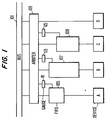
- Fig. 1 shows an example of the invention where four devices are connected to a bus via an arbiter.
- Fig. 1 shows four devices A, B, C and D connected to bus 101 through arbiter 103.
- Devices A, B, C and D can be any devices which communicate via bus 101. Each of these devices can be connected to bus 101 via a buffer.
- buffer 105, 107 and 109 are, for example, first-in first-out (FIFO) buffers.
- Buffer 105 is also connected to arbiter 101 through gauge 111.
- buffers 107 and 109 are connected to arbiter 103 via gauges 113 and 115 respectively.
- Gauges 111, 113 and 115 provide arbiter 103 with information on the respective status of buffers 105, 107 and 109. Specifically, gauges 111, 113 and 115 inform arbiter 103 of the fullness of buffers 105, 107 and 109 respectively.
- buffer 105 is a 16 byte FIFO and that device A periodically reads data through bus 101 to fill buffer 105.
- buffer 107 is a 1K byte FIFO that periodically writes through bus 101.
- buffer 109 is a 128 byte FIFO that periodically writes through bus 101.
- device D has no buffer because it does not transfer large amounts of information.
- gauges 111, 113 and 115 would indicate the fullness of buffers 105, 107 and 109. This indication can be in fractional terms, such as 1/2 full, 3/4 full, etc. or in percentage terms such as 50% full, 75% full, etc.
- Arbiter 103 provides access to bus 101 for devices A, B, C and D in accordance with a priority which is based on the gauge readings for the individual buffers. Thus, the relative priority of the devices changes over time.
- a traditional arbiter would be set upon system initialization to give, for example, buffer 107 the highest priority, buffer 109 the second highest priority, buffer 105 the third highest priority and device D the lowest priority.
- This priority scheme is based on the size of the respective buffers of the individual devices which is presumably related to the frequency with which the devices must communicate via the bus.
- a traditional arbiter may be preprogrammed with relative priorities for assignment to the devices. Either way, in a traditional arbiter the devices would maintain their relative priority such that the relative priority could not be dynamically updated over time.
- the present invention is aimed at minimizing the likelihood that any device is idle. Idleness can be viewed as a situation where a device wants to communicate via its buffer, but is unable to do so. For example, if a device wants to write data to bus 101, but its buffer is full, the device can not write the data and is thus idle until its buffer is granted access to buffer 101, at which time the buffer would write data to bus 101, yielding buffer capacity, to which the device can then write. Similarly, if a device wants to read data, but its buffer is empty, the device is idle.
- the arbiter of the present invention considers the device type (write device or read device) as well as the fullness of its buffer when assigning a relative priority to the device. Further, the arbiter of the present invention updates the relative priorities of the devices as the fullness of their buffers changes over time.
- priority can be set dynamically based on the status of the memories.
- priority is not always given to the same device, as in conventional systems where the device with the largest FIFO, for example, may receive priority.
- a conventional system using such a scheme would give buffer 107 (device B) the highest priority because it has the largest capacity, whereas the present invention grants highest priority to buffer 105 (device A).
- priority is not necessarily given to the fullest buffer, which would be buffer 109 (device C) in this example.
- buffer 109 device C
- the contending devices are of different types - device B is described in this example as a write device whereas devices A and C are read devices.
- the present invention grants priority to buffer 105 of device A. This is because device A is a read device and buffer 105 is 50% full. Buffer 105 is therefore 50% away from making device A idle, which would occur if device A wanted to read and buffer 105 were empty.
- Device C another read device is given second priority because buffer 109 is 75% full and thus 75% away from its idle point.
- Device B a write device, is given third priority because buffer 107 is 10% full and thus 90% from being 100% full - device B's idle point since when buffer 107 is full device B can't write.
- device B would be given the highest priority via a conventional arbiter due to buffer 107's large capacity, amongst devices A, B and C it is given the lowest priority since, due to the relative fullness of the buffers, it is the furthest of the three devices from reaching its idle point.
- the present arrangement assigns priority on the basis of need.
- a need value is calculated by subtracting the gauge reading (expressed as a percentile) from 100.
- a need value equals the gauge reading.
- the device with the highest need value receives the highest priority. This provides for a dynamic system which operates in a more efficient manner than a traditionally arbitrated system to minimize idle time of the devices.
- each of the devices was assumed to be either a read or a write device. Any or all of the devices may, alternatively, be input/output devices which, at any given time, would be in either an input mode or an output mode.
- the arbiter would initially determine the mode of the device to know whether the device's gauge reading equals its need (write mode) or whether 100 minus the device's gauge reading equals its need (read mode). In this case, the need, and therefore the relative priority, of a given device will likely change as a device shifts from a read mode to a write mode or from a write mode to a read mode.
- a device in a write mode with a 90% full FIFO would have a relatively high priority since its need would be 90. However, if this device shifted to the read mode, its priority would drop to a relatively low priority since its need would be 10 corresponding to the fact that there is 90% of buffer capacity remaining until it achieves an idle state.
- the speed with which a buffer fills or empties can also be a factor in dynamically determining the relative priority among the buffers associated with the devices.
- two devices are of the same type (for example, they are both write devices), each have the same size buffer, and each of the buffers is 50% full, the buffer whose device will fill it faster should be given priority.
- device X is a hard disk and device Y is a modem.
- both X and Y are writing data, via respective buffers, to a data bus.
- device X can fill its buffer much more rapidly than device Y, a modem, can fill its buffer.
- the first embodiment of the invention would view the buffers associated with devices X and Y equally, it would be prudent to grant priority to device X's buffer since it will be filled by device X (placing device X in an idle state) more rapidly than device Y's buffer will be filled by device Y.
- a way to view this alternative priority scheme relative to the priority scheme of the first embodiment is to view the basic question the arbiter will consider for each device as it sets priority.
- the arbiter will ask "How far is this buffer from placing its device in an idle state?" The arbiter will then grant access to the buffer which is the closest to placing its device in an idle state (the buffer with the greatest need).
- the arbiter will ask "How long until this buffer places its device in an idle state?" The arbiter should then grant access to the buffer which is closest in time to placing its device in an idle state.
- device X's buffer is closer in time to placing device X in an idle state since it gets filled faster than device Y's buffer.
- device X's buffer should be granted priority.
- both devices are reading data from the bus. Since device X can read from its buffer more quickly than device Y can read from its buffer, if both buffers are 50% full, device X is the closest in time to being idle. Device X's buffer should therefore be granted priority in the bus over device Y's buffer. It can thus be seen that, all other things being equal, the buffer associated with the faster device should be given priority over the buffer associated with the slower device. This is true for the devices being both in a read mode or in a write mode.
- the speeds at which the devices read from and/or write to their buffers can be stored in the arbiter.
- the arbiter could then calculate, for each device, the amount of time until the device becomes idle if its buffer is not granted access to the bus.
- the arbiter would then grant access priority to the bus associated with the device that would become idle the soonest if access were not granted.
- the arbiter can then update the relative priorities for the devices based on their speed and buffer capacity, thus minimizing the overall likelihood that any of the devices become idle.
- each of the devices has a single access speed at which it writes to and reads from its buffer.
- a device may write to its buffer at a different speed from that at which it reads from its buffer.
- both the write speed and the read speed can be stored in the arbiter so that the arbiter can properly calculate the amount of time until the device would become idle.
- a device can have a variable write speed or read speed.
- the device can be connected to the arbiter such that the device can inform the arbiter of its current speed. In this way, the arbiter can properly calculate the amount of time until the device would become idle.
Landscapes
- Engineering & Computer Science (AREA)
- Theoretical Computer Science (AREA)
- Physics & Mathematics (AREA)
- General Engineering & Computer Science (AREA)
- General Physics & Mathematics (AREA)
- Bus Control (AREA)
Applications Claiming Priority (2)
| Application Number | Priority Date | Filing Date | Title |
|---|---|---|---|
| US35928794A | 1994-12-19 | 1994-12-19 | |
| US359287 | 1994-12-19 |
Publications (1)
| Publication Number | Publication Date |
|---|---|
| EP0718773A1 true EP0718773A1 (en) | 1996-06-26 |
Family
ID=23413166
Family Applications (1)
| Application Number | Title | Priority Date | Filing Date |
|---|---|---|---|
| EP95308774A Withdrawn EP0718773A1 (en) | 1994-12-19 | 1995-12-05 | Bus access arbiter |
Country Status (4)
| Country | Link |
|---|---|
| US (1) | US5796961A (enExample) |
| EP (1) | EP0718773A1 (enExample) |
| JP (1) | JPH08263429A (enExample) |
| KR (1) | KR100382215B1 (enExample) |
Cited By (2)
| Publication number | Priority date | Publication date | Assignee | Title |
|---|---|---|---|---|
| WO2004003710A1 (en) * | 2002-06-27 | 2004-01-08 | Koninklijke Philips Electronics N.V. | Security processor with bus configuration |
| CN101930417A (zh) * | 2010-08-13 | 2010-12-29 | 北京飞利信科技股份有限公司 | 用于基于串行数据总线的流媒体传输系统终端设备中的仲裁器 |
Families Citing this family (23)
| Publication number | Priority date | Publication date | Assignee | Title |
|---|---|---|---|---|
| US6178475B1 (en) | 1994-12-19 | 2001-01-23 | Advanced Micro Devices Inc. | Multimedia system employing timers to properly allocate bus access |
| JP3519182B2 (ja) | 1995-09-05 | 2004-04-12 | 株式会社日立製作所 | 情報処理システムおよびバスアービタならびにバス制御方法 |
| US6141351A (en) * | 1996-12-20 | 2000-10-31 | International Business Machines Corporation | Radio frequency bus for broadband microprocessor communications |
| US6098124A (en) * | 1998-04-09 | 2000-08-01 | National Instruments Corporation | Arbiter for transferring largest accumulated data block output from data buffers over serial bus |
| US6199123B1 (en) * | 1998-07-30 | 2001-03-06 | Compaq Computer Corporation | Computer system for supporting increased PCI master devices without the requiring additional bridge chips |
| US6816934B2 (en) | 2000-12-22 | 2004-11-09 | Hewlett-Packard Development Company, L.P. | Computer system with registered peripheral component interconnect device for processing extended commands and attributes according to a registered peripheral component interconnect protocol |
| DE19842849C2 (de) * | 1998-09-18 | 2001-02-01 | Siemens Ag | Verfahren und Anordnung zum Übertragen von digitalen Daten |
| US6449702B1 (en) * | 1999-12-30 | 2002-09-10 | Intel Corporation | Memory bandwidth utilization through multiple priority request policy for isochronous data streams |
| KR100480605B1 (ko) * | 2002-07-25 | 2005-04-06 | 삼성전자주식회사 | 네트워크 제어기의 송신부 버퍼 및 수신부 버퍼를제어하는 방법 및 네트워크 제어기 |
| US20050160188A1 (en) * | 2004-01-20 | 2005-07-21 | Zohar Bogin | Method and apparatus to manage memory access requests |
| US8307147B2 (en) * | 2005-09-09 | 2012-11-06 | Freescale Semiconductor, Inc. | Interconnect and a method for designing an interconnect |
| US20070198730A1 (en) * | 2006-02-17 | 2007-08-23 | Via Technologies Inc. | Embedded system with a bus and arbitration method for same |
| KR100839494B1 (ko) | 2006-02-28 | 2008-06-19 | 삼성전자주식회사 | 버스 중재 시스템 및 버스 중재 방법 |
| US20070255874A1 (en) * | 2006-04-28 | 2007-11-01 | Jennings Kevin F | System and method for target device access arbitration using queuing devices |
| TWI324305B (en) * | 2006-06-14 | 2010-05-01 | Via Tech Inc | Embedded system and related buffer size determining method thereof |
| WO2008023219A1 (en) * | 2006-08-23 | 2008-02-28 | Freescale Semiconductor, Inc. | Pipelined device and a method for executing transactions in a pipelined device |
| US8078781B2 (en) * | 2006-08-23 | 2011-12-13 | Freescale Semiconductor, Inc. | Device having priority upgrade mechanism capabilities and a method for updating priorities |
| CN101087256B (zh) * | 2007-07-13 | 2011-08-17 | 杭州华三通信技术有限公司 | 报文传输方法及系统 |
| US20090310489A1 (en) * | 2008-06-17 | 2009-12-17 | Bennett Andrew M | Methods and apparatus using a serial data interface to transmit/receive data corresponding to each of a plurality of logical data streams |
| US9684633B2 (en) * | 2013-01-24 | 2017-06-20 | Samsung Electronics Co., Ltd. | Adaptive service controller, system on chip and method of controlling the same |
| US10298117B2 (en) * | 2017-06-30 | 2019-05-21 | Intel Corporation | Master-slave controller architecture |
| CN116431537A (zh) * | 2023-03-20 | 2023-07-14 | 黑芝麻智能科技(深圳)有限公司 | 数据传输方法及装置、终端设备、计算机可读存储介质 |
| CN117221227A (zh) * | 2023-09-20 | 2023-12-12 | 成都中科微信息技术研究院有限公司 | 一种基于fpga的自适应高效仲裁管理方法 |
Citations (3)
| Publication number | Priority date | Publication date | Assignee | Title |
|---|---|---|---|---|
| GB2001463A (en) * | 1977-07-19 | 1979-01-31 | Honeywell Inf Systems | Bus control in data processor |
| JPH05216694A (ja) * | 1992-02-06 | 1993-08-27 | Mitsubishi Electric Corp | Faコントローラ |
| WO1994000834A1 (en) * | 1992-06-22 | 1994-01-06 | Vlsi Technology, Inc. | Improved vga controller having frame buffer memory arbitration and method therefor |
Family Cites Families (5)
| Publication number | Priority date | Publication date | Assignee | Title |
|---|---|---|---|---|
| US4285038A (en) * | 1976-10-15 | 1981-08-18 | Tokyo Shibaura Electric Co., Ltd. | Information transfer control system |
| US5072420A (en) * | 1989-03-16 | 1991-12-10 | Western Digital Corporation | FIFO control architecture and method for buffer memory access arbitration |
| US5410652A (en) * | 1990-09-28 | 1995-04-25 | Texas Instruments, Incorporated | Data communication control by arbitrating for a data transfer control token with facilities for halting a data transfer by maintaining possession of the token |
| US5247617A (en) * | 1991-02-26 | 1993-09-21 | Digi International, Inc. | Method for supplying data to a buffered uart |
| US5392033A (en) * | 1993-01-05 | 1995-02-21 | International Business Machines Corporation | Priority generator for providing controllable guaranteed fairness in accessing a shared bus |
-
1995
- 1995-12-05 EP EP95308774A patent/EP0718773A1/en not_active Withdrawn
- 1995-12-13 JP JP7324394A patent/JPH08263429A/ja active Pending
- 1995-12-14 KR KR1019950049991A patent/KR100382215B1/ko not_active Expired - Lifetime
-
1997
- 1997-10-20 US US08/954,617 patent/US5796961A/en not_active Expired - Lifetime
Patent Citations (3)
| Publication number | Priority date | Publication date | Assignee | Title |
|---|---|---|---|---|
| GB2001463A (en) * | 1977-07-19 | 1979-01-31 | Honeywell Inf Systems | Bus control in data processor |
| JPH05216694A (ja) * | 1992-02-06 | 1993-08-27 | Mitsubishi Electric Corp | Faコントローラ |
| WO1994000834A1 (en) * | 1992-06-22 | 1994-01-06 | Vlsi Technology, Inc. | Improved vga controller having frame buffer memory arbitration and method therefor |
Non-Patent Citations (2)
| Title |
|---|
| "Programmable dynamically-alterable request priority levels", IBM TECHNICAL DISCLOSURE BULLETIN, vol. 37, no. 10, October 1994 (1994-10-01), NEW YORK, US, pages 461 - 462, XP000475738 * |
| PATENT ABSTRACTS OF JAPAN vol. 17, no. 662 (P - 1655) 7 December 1993 (1993-12-07) * |
Cited By (4)
| Publication number | Priority date | Publication date | Assignee | Title |
|---|---|---|---|---|
| WO2004003710A1 (en) * | 2002-06-27 | 2004-01-08 | Koninklijke Philips Electronics N.V. | Security processor with bus configuration |
| US7743257B2 (en) | 2002-06-27 | 2010-06-22 | Nxp B.V. | Security processor with bus configuration |
| CN101930417A (zh) * | 2010-08-13 | 2010-12-29 | 北京飞利信科技股份有限公司 | 用于基于串行数据总线的流媒体传输系统终端设备中的仲裁器 |
| CN101930417B (zh) * | 2010-08-13 | 2012-10-10 | 北京飞利信科技股份有限公司 | 用于基于串行数据总线的流媒体传输系统终端设备中的仲裁器 |
Also Published As
| Publication number | Publication date |
|---|---|
| US5796961A (en) | 1998-08-18 |
| JPH08263429A (ja) | 1996-10-11 |
| KR100382215B1 (ko) | 2003-07-18 |
| KR960025076A (ko) | 1996-07-20 |
Similar Documents
| Publication | Publication Date | Title |
|---|---|---|
| US5796961A (en) | Heuristic bus access arbiter | |
| US6178475B1 (en) | Multimedia system employing timers to properly allocate bus access | |
| EP1754229B1 (en) | System and method for improving performance in computer memory systems supporting multiple memory access latencies | |
| US5303382A (en) | Arbiter with programmable dynamic request prioritization | |
| JP3088241B2 (ja) | 割当要求を調整するシステムとその方法 | |
| US5377332A (en) | Bus arbitration algorithm and apparatus | |
| KR100288453B1 (ko) | 다수의관련데이타를참조하는데단일포인터를사용하는메모리버퍼시스템 | |
| US5794073A (en) | Arbitration system for a shared DMA logic on a network adapter with a large number of competing priority requests having predicted latency field | |
| US20070233923A1 (en) | Bus arbitration system and method thereof | |
| EP0301610A2 (en) | Data processing apparatus for connection to a common communication path in a data processing system | |
| US6594718B1 (en) | Arbitration scheme for equitable distribution of bandwidth for agents with different bandwidth requirements | |
| JPH0973430A5 (enExample) | ||
| US6104724A (en) | Asynchronous data transfer and source traffic control system | |
| US5890220A (en) | Address conversion apparatus accessible to both I/O devices and processor and having a reduced number of index buffers | |
| US20040044809A1 (en) | DMA controller and DMA transfer method | |
| KR20030090071A (ko) | 집적회로장치의 버스중재기 | |
| US20010034805A1 (en) | Data processing device accessing a memory in response to a request made by an external bus master | |
| HK1046459B (en) | Apparatus for memory resource arbitration based on dedicated time slot allocation | |
| US20060047874A1 (en) | Resource management apparatus | |
| US6076132A (en) | Arbitration method and circuit to increase access without increasing latency | |
| JP3317873B2 (ja) | データ転送制御装置 | |
| US20020078267A1 (en) | Scheduler for a data memory access having multiple channels | |
| JPH10149311A (ja) | メモリ制御装置 | |
| JPH02144652A (ja) | バス調停方式 | |
| JP2550868B2 (ja) | 通信制御lsi |
Legal Events
| Date | Code | Title | Description |
|---|---|---|---|
| PUAI | Public reference made under article 153(3) epc to a published international application that has entered the european phase |
Free format text: ORIGINAL CODE: 0009012 |
|
| AK | Designated contracting states |
Kind code of ref document: A1 Designated state(s): AT BE DE DK ES FR GB GR IE IT LU NL PT SE |
|
| 17P | Request for examination filed |
Effective date: 19961004 |
|
| 17Q | First examination report despatched |
Effective date: 19990915 |
|
| STAA | Information on the status of an ep patent application or granted ep patent |
Free format text: STATUS: THE APPLICATION IS DEEMED TO BE WITHDRAWN |
|
| 18D | Application deemed to be withdrawn |
Effective date: 20000126 |