EP0705207B1 - Method and article for protecting a container that holds a fluid - Google Patents
Method and article for protecting a container that holds a fluid Download PDFInfo
- Publication number
- EP0705207B1 EP0705207B1 EP94920670A EP94920670A EP0705207B1 EP 0705207 B1 EP0705207 B1 EP 0705207B1 EP 94920670 A EP94920670 A EP 94920670A EP 94920670 A EP94920670 A EP 94920670A EP 0705207 B1 EP0705207 B1 EP 0705207B1
- Authority
- EP
- European Patent Office
- Prior art keywords
- container
- sleeve
- nonwoven web
- tubular body
- conformable
- Prior art date
- Legal status (The legal status is an assumption and is not a legal conclusion. Google has not performed a legal analysis and makes no representation as to the accuracy of the status listed.)
- Expired - Lifetime
Links
Images


Classifications
-
- B—PERFORMING OPERATIONS; TRANSPORTING
- B01—PHYSICAL OR CHEMICAL PROCESSES OR APPARATUS IN GENERAL
- B01L—CHEMICAL OR PHYSICAL LABORATORY APPARATUS FOR GENERAL USE
- B01L9/00—Supporting devices; Holding devices
- B01L9/06—Test-tube stands; Test-tube holders
-
- B—PERFORMING OPERATIONS; TRANSPORTING
- B65—CONVEYING; PACKING; STORING; HANDLING THIN OR FILAMENTARY MATERIAL
- B65D—CONTAINERS FOR STORAGE OR TRANSPORT OF ARTICLES OR MATERIALS, e.g. BAGS, BARRELS, BOTTLES, BOXES, CANS, CARTONS, CRATES, DRUMS, JARS, TANKS, HOPPERS, FORWARDING CONTAINERS; ACCESSORIES, CLOSURES, OR FITTINGS THEREFOR; PACKAGING ELEMENTS; PACKAGES
- B65D81/00—Containers, packaging elements, or packages, for contents presenting particular transport or storage problems, or adapted to be used for non-packaging purposes after removal of contents
- B65D81/02—Containers, packaging elements, or packages, for contents presenting particular transport or storage problems, or adapted to be used for non-packaging purposes after removal of contents specially adapted to protect contents from mechanical damage
- B65D81/03—Wrappers or envelopes with shock-absorbing properties, e.g. bubble films
-
- B—PERFORMING OPERATIONS; TRANSPORTING
- B65—CONVEYING; PACKING; STORING; HANDLING THIN OR FILAMENTARY MATERIAL
- B65D—CONTAINERS FOR STORAGE OR TRANSPORT OF ARTICLES OR MATERIALS, e.g. BAGS, BARRELS, BOTTLES, BOXES, CANS, CARTONS, CRATES, DRUMS, JARS, TANKS, HOPPERS, FORWARDING CONTAINERS; ACCESSORIES, CLOSURES, OR FITTINGS THEREFOR; PACKAGING ELEMENTS; PACKAGES
- B65D81/00—Containers, packaging elements, or packages, for contents presenting particular transport or storage problems, or adapted to be used for non-packaging purposes after removal of contents
- B65D81/24—Adaptations for preventing deterioration or decay of contents; Applications to the container or packaging material of food preservatives, fungicides, pesticides or animal repellants
- B65D81/26—Adaptations for preventing deterioration or decay of contents; Applications to the container or packaging material of food preservatives, fungicides, pesticides or animal repellants with provision for draining away, or absorbing, or removing by ventilation, fluids, e.g. exuded by contents; Applications of corrosion inhibitors or desiccators
- B65D81/264—Adaptations for preventing deterioration or decay of contents; Applications to the container or packaging material of food preservatives, fungicides, pesticides or animal repellants with provision for draining away, or absorbing, or removing by ventilation, fluids, e.g. exuded by contents; Applications of corrosion inhibitors or desiccators for absorbing liquids
-
- D—TEXTILES; PAPER
- D04—BRAIDING; LACE-MAKING; KNITTING; TRIMMINGS; NON-WOVEN FABRICS
- D04H—MAKING TEXTILE FABRICS, e.g. FROM FIBRES OR FILAMENTARY MATERIAL; FABRICS MADE BY SUCH PROCESSES OR APPARATUS, e.g. FELTS, NON-WOVEN FABRICS; COTTON-WOOL; WADDING ; NON-WOVEN FABRICS FROM STAPLE FIBRES, FILAMENTS OR YARNS, BONDED WITH AT LEAST ONE WEB-LIKE MATERIAL DURING THEIR CONSOLIDATION
- D04H1/00—Non-woven fabrics formed wholly or mainly of staple fibres or like relatively short fibres
- D04H1/40—Non-woven fabrics formed wholly or mainly of staple fibres or like relatively short fibres from fleeces or layers composed of fibres without existing or potential cohesive properties
- D04H1/42—Non-woven fabrics formed wholly or mainly of staple fibres or like relatively short fibres from fleeces or layers composed of fibres without existing or potential cohesive properties characterised by the use of certain kinds of fibres insofar as this use has no preponderant influence on the consolidation of the fleece
-
- D—TEXTILES; PAPER
- D04—BRAIDING; LACE-MAKING; KNITTING; TRIMMINGS; NON-WOVEN FABRICS
- D04H—MAKING TEXTILE FABRICS, e.g. FROM FIBRES OR FILAMENTARY MATERIAL; FABRICS MADE BY SUCH PROCESSES OR APPARATUS, e.g. FELTS, NON-WOVEN FABRICS; COTTON-WOOL; WADDING ; NON-WOVEN FABRICS FROM STAPLE FIBRES, FILAMENTS OR YARNS, BONDED WITH AT LEAST ONE WEB-LIKE MATERIAL DURING THEIR CONSOLIDATION
- D04H1/00—Non-woven fabrics formed wholly or mainly of staple fibres or like relatively short fibres
- D04H1/40—Non-woven fabrics formed wholly or mainly of staple fibres or like relatively short fibres from fleeces or layers composed of fibres without existing or potential cohesive properties
- D04H1/54—Non-woven fabrics formed wholly or mainly of staple fibres or like relatively short fibres from fleeces or layers composed of fibres without existing or potential cohesive properties by welding together the fibres, e.g. by partially melting or dissolving
- D04H1/56—Non-woven fabrics formed wholly or mainly of staple fibres or like relatively short fibres from fleeces or layers composed of fibres without existing or potential cohesive properties by welding together the fibres, e.g. by partially melting or dissolving in association with fibre formation, e.g. immediately following extrusion of staple fibres
-
- B—PERFORMING OPERATIONS; TRANSPORTING
- B01—PHYSICAL OR CHEMICAL PROCESSES OR APPARATUS IN GENERAL
- B01L—CHEMICAL OR PHYSICAL LABORATORY APPARATUS FOR GENERAL USE
- B01L2200/00—Solutions for specific problems relating to chemical or physical laboratory apparatus
- B01L2200/18—Transport of container or devices
- B01L2200/185—Long distance transport, e.g. mailing
-
- Y—GENERAL TAGGING OF NEW TECHNOLOGICAL DEVELOPMENTS; GENERAL TAGGING OF CROSS-SECTIONAL TECHNOLOGIES SPANNING OVER SEVERAL SECTIONS OF THE IPC; TECHNICAL SUBJECTS COVERED BY FORMER USPC CROSS-REFERENCE ART COLLECTIONS [XRACs] AND DIGESTS
- Y10—TECHNICAL SUBJECTS COVERED BY FORMER USPC
- Y10S—TECHNICAL SUBJECTS COVERED BY FORMER USPC CROSS-REFERENCE ART COLLECTIONS [XRACs] AND DIGESTS
- Y10S428/00—Stock material or miscellaneous articles
- Y10S428/903—Microfiber, less than 100 micron diameter
-
- Y—GENERAL TAGGING OF NEW TECHNOLOGICAL DEVELOPMENTS; GENERAL TAGGING OF CROSS-SECTIONAL TECHNOLOGIES SPANNING OVER SEVERAL SECTIONS OF THE IPC; TECHNICAL SUBJECTS COVERED BY FORMER USPC CROSS-REFERENCE ART COLLECTIONS [XRACs] AND DIGESTS
- Y10—TECHNICAL SUBJECTS COVERED BY FORMER USPC
- Y10T—TECHNICAL SUBJECTS COVERED BY FORMER US CLASSIFICATION
- Y10T428/00—Stock material or miscellaneous articles
- Y10T428/13—Hollow or container type article [e.g., tube, vase, etc.]
- Y10T428/1334—Nonself-supporting tubular film or bag [e.g., pouch, envelope, packet, etc.]
-
- Y—GENERAL TAGGING OF NEW TECHNOLOGICAL DEVELOPMENTS; GENERAL TAGGING OF CROSS-SECTIONAL TECHNOLOGIES SPANNING OVER SEVERAL SECTIONS OF THE IPC; TECHNICAL SUBJECTS COVERED BY FORMER USPC CROSS-REFERENCE ART COLLECTIONS [XRACs] AND DIGESTS
- Y10—TECHNICAL SUBJECTS COVERED BY FORMER USPC
- Y10T—TECHNICAL SUBJECTS COVERED BY FORMER US CLASSIFICATION
- Y10T428/00—Stock material or miscellaneous articles
- Y10T428/13—Hollow or container type article [e.g., tube, vase, etc.]
- Y10T428/1334—Nonself-supporting tubular film or bag [e.g., pouch, envelope, packet, etc.]
- Y10T428/1345—Single layer [continuous layer]
-
- Y—GENERAL TAGGING OF NEW TECHNOLOGICAL DEVELOPMENTS; GENERAL TAGGING OF CROSS-SECTIONAL TECHNOLOGIES SPANNING OVER SEVERAL SECTIONS OF THE IPC; TECHNICAL SUBJECTS COVERED BY FORMER USPC CROSS-REFERENCE ART COLLECTIONS [XRACs] AND DIGESTS
- Y10—TECHNICAL SUBJECTS COVERED BY FORMER USPC
- Y10T—TECHNICAL SUBJECTS COVERED BY FORMER US CLASSIFICATION
- Y10T428/00—Stock material or miscellaneous articles
- Y10T428/13—Hollow or container type article [e.g., tube, vase, etc.]
- Y10T428/1352—Polymer or resin containing [i.e., natural or synthetic]
- Y10T428/1362—Textile, fabric, cloth, or pile containing [e.g., web, net, woven, knitted, mesh, nonwoven, matted, etc.]
-
- Y—GENERAL TAGGING OF NEW TECHNOLOGICAL DEVELOPMENTS; GENERAL TAGGING OF CROSS-SECTIONAL TECHNOLOGIES SPANNING OVER SEVERAL SECTIONS OF THE IPC; TECHNICAL SUBJECTS COVERED BY FORMER USPC CROSS-REFERENCE ART COLLECTIONS [XRACs] AND DIGESTS
- Y10—TECHNICAL SUBJECTS COVERED BY FORMER USPC
- Y10T—TECHNICAL SUBJECTS COVERED BY FORMER US CLASSIFICATION
- Y10T428/00—Stock material or miscellaneous articles
- Y10T428/13—Hollow or container type article [e.g., tube, vase, etc.]
- Y10T428/1352—Polymer or resin containing [i.e., natural or synthetic]
- Y10T428/1372—Randomly noninterengaged or randomly contacting fibers, filaments, particles, or flakes
-
- Y—GENERAL TAGGING OF NEW TECHNOLOGICAL DEVELOPMENTS; GENERAL TAGGING OF CROSS-SECTIONAL TECHNOLOGIES SPANNING OVER SEVERAL SECTIONS OF THE IPC; TECHNICAL SUBJECTS COVERED BY FORMER USPC CROSS-REFERENCE ART COLLECTIONS [XRACs] AND DIGESTS
- Y10—TECHNICAL SUBJECTS COVERED BY FORMER USPC
- Y10T—TECHNICAL SUBJECTS COVERED BY FORMER US CLASSIFICATION
- Y10T428/00—Stock material or miscellaneous articles
- Y10T428/13—Hollow or container type article [e.g., tube, vase, etc.]
- Y10T428/1352—Polymer or resin containing [i.e., natural or synthetic]
- Y10T428/1397—Single layer [continuous layer]
-
- Y—GENERAL TAGGING OF NEW TECHNOLOGICAL DEVELOPMENTS; GENERAL TAGGING OF CROSS-SECTIONAL TECHNOLOGIES SPANNING OVER SEVERAL SECTIONS OF THE IPC; TECHNICAL SUBJECTS COVERED BY FORMER USPC CROSS-REFERENCE ART COLLECTIONS [XRACs] AND DIGESTS
- Y10—TECHNICAL SUBJECTS COVERED BY FORMER USPC
- Y10T—TECHNICAL SUBJECTS COVERED BY FORMER US CLASSIFICATION
- Y10T428/00—Stock material or miscellaneous articles
- Y10T428/24—Structurally defined web or sheet [e.g., overall dimension, etc.]
- Y10T428/24777—Edge feature
-
- Y—GENERAL TAGGING OF NEW TECHNOLOGICAL DEVELOPMENTS; GENERAL TAGGING OF CROSS-SECTIONAL TECHNOLOGIES SPANNING OVER SEVERAL SECTIONS OF THE IPC; TECHNICAL SUBJECTS COVERED BY FORMER USPC CROSS-REFERENCE ART COLLECTIONS [XRACs] AND DIGESTS
- Y10—TECHNICAL SUBJECTS COVERED BY FORMER USPC
- Y10T—TECHNICAL SUBJECTS COVERED BY FORMER US CLASSIFICATION
- Y10T428/00—Stock material or miscellaneous articles
- Y10T428/24—Structurally defined web or sheet [e.g., overall dimension, etc.]
- Y10T428/24802—Discontinuous or differential coating, impregnation or bond [e.g., artwork, printing, retouched photograph, etc.]
- Y10T428/24893—Discontinuous or differential coating, impregnation or bond [e.g., artwork, printing, retouched photograph, etc.] including particulate material
Definitions
- This invention pertains to a method and article for protecting a fragile container from breakage.
- the method and article also allow a fluid, which leaked from a broken container, to be retained in a sorbent structure in the immediate vicinity of the broken container.
- EP-A-0 336 107 is directed to method of packaging vials with the steps of: wrapping a vial in shock absorbing material; inserting the vial wrapped in shock absorbing material in a pressure vessel, the pressure vessel having moisture absorbing material lining the bottom; wrapping the sides of the pressure vessel with a plurality of layers of cardboard; shielding the top and bottom of the pressure vessel with a plurality of layers of cardboard; and sealing the pressure vessel with cardboard wrap and shielding in a cardboard box.
- US-A-4 927 010 (which corresponds to the preambles of appended claims 10 and 15) describes a shipping bag for containers of potentially biohazardous materials wherein the bag has liquid impervious outer panels and pads within the bag to absorb any liquid should the container rupture.
- the present invention provides a method of protecting a container that holds a fluid as claimed in appended claim 1, and an article for protecting a container and a protected container as claimed in appended claims 10 and 15, respectively.
- the present invention provides a new method and article for protecting a container and sorbing fluid which is unintentionally released from the container.
- the method of the invention comprises:
- the conformable nonwoven web is configured in the shape of a sleeve.
- a nonwoven web configured as such embodies the article of the invention, which briefly comprises: a conformable sleeve that includes a tubular body that has an interior sized to receive the container that holds a fluid and an opening sized to permit the container to enter the interior of the tubular body, wherein the tubular body comprises a nonwoven web that contains at least 5 weight percent microfibers based on the weight of fibrous material in the nonwoven web.
- the method and article of the invention have the advantage of being simple yet versatile.
- Containers of various sizes and shapes can be protected from impact by wrapping a conformable nonwoven web that contains microfibers about the container.
- the conformable nonwoven web is dimensioned so that the whole container can be protected from impact when the conformable nonwoven web is wrapped thereabout.
- the sides of the container are protected by being surrounded by the wrapped nonwoven web, and the ends of the container are protected by the extra web length which projects axially from the ends of the container.
- the microfiber in the nonwoven web can sorb a hazardous liquid should the container fail.
- the method and article of the invention can protect fragile containers to a degree sufficient to pass the Federal Drop Test defined in 49 C.F.R. ⁇ 178.603 (October 1, 1992).
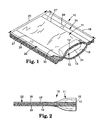
- FIG. 1 is a perspective view of a conformable sleeve 10 in accordance with the present invention.
- FIG. 2 is a side view of a conformable sleeve 10 in accordance with the present invention having a container 12 placed therein.
- FIG. 3 is a side view of a conformable sleeve 10 in accordance with the present invention having a container 12 placed therein and partially wrapped thereabout.
- FIG. 4 is a side view of a conformable sleeve 10 wrapped about a container 12 in accordance with the present invention.
- FIG. 5 is a end view of a conformable sleeve 10 in accordance with the present invention having a container 12 placed therein.
- FIG. 6 is a perspective view of sixteen sleeves 10 each wrapped about a container and placed in a box 14 in accordance with the present invention.
- a conformable nonwoven web that contains microfibers is wrapped at least one full turn about a container that holds a hazardous fluid to protect the container from impact and to sorb fluid from the container in the event the container fails.
- the conformable nonwoven web is wrapped at least one full turn about the container to surround the side of the container to protect the same from impact.
- portions of the nonwoven web project axially from each end of the container to protect those parts of the container from impact.
- the container is disposed centrally in the wrapped nonwoven web so that both ends are equally projected.
- the nonwoven web that is employed in this invention contains at least 5 weight percent microfibers based on the weight of fibrous material in the nonwoven web.
- a preferred nonwoven web comprises at least about 20 weight percent microfibers, more preferably at least about 50 weight percent microfibers, and up to 100 weight percent microfibers.
- microfiber means a fiber that has a diameter of less than approximately 10 micrometers.
- a preferred nonwoven web contains microfibers that have an average fiber diameter of about 5 to 8 micrometers. The fiber diameter can be calculated according to the method set forth in Davies, C. N., "The Separation of Airborne Dust and Particles", Institution of Mechanical Engineers, London, Proceedings 1B, (1952).
- the nonwoven web preferably has a substantially uniformly distributed microfibrous structure throughout the whole web.
- the nonwoven web that contains microfibers preferably has a solidity less than about 0.2 and generally greater than about 0.03.
- solidity means the volume of fibers per volume of web. Solidity can be calculated using the following formula: where:
- the thickness of the nonwoven web may vary depending on such factors as the size of the container desired to be protected, the weight of the container, the weight of the container's contents, and the number of wrappings. Typically, however, the nonwoven web has a thickness of about 0.2 to 5 cm, and more typically 0.5 to 2 cm.
- the nonwoven web that contains microfibers generally has a basis weight greater than 50 grams per square meter (g/m 2 ) and up to approximately 600 g/m 2 .
- the basis weight is in the range of about 100 to 400 g/m 2 .
- the sorbent capacity of the nonwoven web is generally in the range of about 5 to 40 grams H 2 O per gram web (gH 2 O/g web), and more typically in the range of about 15 to 20 gH 2 O/g web.
- the sorbent capacity can be measured according to the tests described in the Examples set forth below.
- the nonwoven web preferably has sufficient tensile strength to allow the web to maintain its integrity during handling.
- the web preferably demonstrates a tensile strength when wet which is essentially the same as the tensile strength when dry.
- the nonwoven web therefore does not significantly lose strength upon sorbing a liquid and thus can retain broken fragments of the container, as well as the escaped fluid.
- the nonwoven web's dry (and preferably wet) tensile strength is greater than about 0.5 Newtons per centimeter (N/cm), typically about 1 to 8 N/cm. Tensile strength can be determined using the test outlined in Examples below.
- the nonwoven web preferably has a flexural rigidity low enough to enable the sleeve 10 to be conformable.
- the flexural rigidity generally is less than about 40 gram-centimeters (g-cm), preferably less than about 20 g-cm. Flexural rigidity can be measured according to ASTM test method D1388-64 using option A, the Cantilever Test.
- the microfibers in the nonwoven web are entangled as a coherent mass of fibers.
- the fibers can be entangled by, for example, a melt-blowing process, where a molten polymer is forced through a die and the extruded fibers are attenuated by adjacent high velocity air streams to form an entangled mass of blown microfiber (BMF).
- BMF blown microfiber
- a nonwoven web of microfiber may also be made using solution blown techniques such as disclosed in U S Patent 4 011 067 to Carey or electrostatic techniques such as disclosed in U S Patent 4 069 026 to Simm et al.
- Polymeric components that may be used to form a BMF web include polyolefins such as polyethylene, polypropylene, polybutylene, poly(4-methylpentene-1), and polyolefin copolymers; polyesters such as polyethylene terephthalate (PET), polybutylene terephthalate, and polyether ester copolymers such as HYTREL available from Dupont Co., Elastomers Division, Wilmington, Delaware; polycarbonates; polyurethanes; polystyrene; polyamides such as nylon 6 and nylon 66; and thermoplastic elastomer block copolymers such as styrene-butadiene-styrene, styrene-isoprene-styrene, styrene-ethylene/butylene-styrene, available from Shell Oil Company, Houston, Texas, under the trademark KRATON.
- polyolefins such as polyethylene, polypropylene, polybutylene
- Combinations of the above polymeric microfibers, or blends of the polymeric components, may also be employed.
- a blend of polypropylene and poly(4-methyl-1-pentene) can be used to make a nonwoven web that contains microfiber (see U S Patent 4 874 399 to Reed et al.), or the web may contain bicomponent microfiber such as the polypropylene/polyester fibers (see U S Patent 4 547 420 to Krueger et al.)
- Polymers useful for forming microfibers from solution include polyvinyl chloride, acrylics and acrylic copolymers, polystyrene, and polysulfone.
- a nonwoven web preferably comprises microfibers made from polyolefins, particularly fibers that contain polypropylene as a major fiber component, for example, greater than ninety weight percent, because such fibers provide the web with good cushioning properties in conjunction with good sorptive properties.
- the nonwoven web may contain other fibers such as crimped or uncrimped staple fibers.
- staple fibers can impart better conformability and improved loft to the nonwoven web.
- Staple fibers are fibers of a given fineness, crimp, and cut length. Fineness is generally given in units of tex, grams per kilometer (g/km), a linear density. Crimp is characterized by the number of bends per unit length of fiber (crimps/centimeter). Cut length is the overall length of the cut filaments.
- Staple fibers employed in this invention generally have fineness of about 0.1 to 10 tex, preferably about 0.3 to 4 tex, crimp densities of about 1 to 10 crimps/cm, preferably at least 2 crimps/cm, and cut lengths in the range of about 2 to 15 centimeters, preferably about 2 to 10 centimeters.
- Webs that contain staple fibers may be prepared according to procedures discussed in U S Patent 4 988 560 to Meyer et al., U S Patent 4 118 531 to Hauser, and U S Patent 3 016 599 to Perry. When added to a nonwoven web that contains microfibers, staple fibers typically comprise approximately 10 to 50 weight percent of the fibrous material in the nonwoven web.
- a nonwoven web that contains microfibers as carrier fibers (and optionally staple fibers) may also contain microfiber microwebs as sorbent structures in the nonwoven web.
- microfiber microwebs can also impart better conformability to the nonwoven web.
- Microfiber microwebs have a relatively dense nucleus with numerous individual fibers and/or fiber bundles extending therefrom. The extended fibers and fiber bundles provide an anchoring means for the microfiber microwebs when they are incorporated into the nonwoven web.
- the nucleus of the microfiber microwebs preferably is in the range of about 0.2 to 2 mm.
- the extending fibers and/or fiber bundles preferably extend beyond the nucleus to provide an overall diameter of about 0.07 to 10 mm, more preferably about 0.2 to 5 mm.
- the diameter of the microfibers in the microfiber microweb can be similar in diameter to, or smaller than, the microfibers of the carrier microfiber web.
- the microfibers of the microfiber microwebs can be smaller in diameter than is normally considered suitable for use in microfiber webs because the staple fibers or the carrier microfibers in the nonwoven webs are major contributors to the strength of the nonwoven webs.
- the microfibers in the microfiber microwebs can be at least 20 percent smaller and more preferably at least 50 percent smaller than the carrier microfibers in the nonwoven web. Fibers having smaller diameters can increase the capillary action in the microfiber microwebs to enhance absorptive properties for retaining liquids.
- microfiber microwebs are generally present in the nonwoven web in the range of about 10 to 80 weight percent based on the weight of fibrous material. Microfiber microwebs and their manufacture are described in U S Patent 4 813 948 to Insley, the disclosure of which is incorporated here by reference.
- a nonwoven web that contains microfibers and optionally staple fibers and/or microfiber microwebs may also include other ingredients in addition to the fibrous material.
- the nonwoven web of microfibers may be loaded with discrete solid particles capable of interacting with (for example, chemically or physically reacting with) a fluid to which the particles are exposed. Such particles can remove a component from a fluid by sorption, chemical reaction, or amalgamation or a catalyst may be employed to convert a hazardous fluid to a harmless fluid.
- U S Patent 3 971 373 to Braun An example of a particle-loaded nonwoven web of microfiber is disclosed in U S Patent 3 971 373 to Braun, where discreet solid particles of activated carbon, alumina, sodium bicarbonate, and/or silver are uniformly dispersed throughout and are physically held in the web to adsorb a gaseous fluid; see also, U S Patent 4 100 324 to Anderson et al. and U S Patent 4 429 001 to Kolpin et al.
- additives such as dyes, pigments, fillers, surfactants, abrasive particles, light stabilizers, fire retardants, absorbents, medicaments, et cetera, may also be added to the web by introducing such components to the fiber-forming molten polymers or by spraying them onto the fibers after the web has been collected.
- the conformable nonwoven web that contains microfibers preferably is configured in the form of a conformable sleeve.
- a conformable sleeve 10 is shown which comprises a tubular body 11 that contains a nonwoven web 13, 13' that contains polymeric microfibers.
- An opening 16 is located at an end of tubular body 11 and is sized to permit a container 12 to be placed in the interior of sleeve 10.
- a second and similarly sized opening may be disposed at the opposite end of the tubular body 11 .
- the conformable sleeve 10 has lengthwise and crosswise dimensions 18 and 20, respectively, where the lengthwise dimension 18 is parallel to the axis of the tubular body, and the crosswise dimension 20 is normal thereto.
- At least one of the lengthwise and crosswise dimensions 18 and 20 has a length that is substantially greater than the length of the container 12 that is placed in the interior of the tubular body 11 .
- the conformable sleeve 10 has a length in the lengthwise 18 and/or crosswise dimension 20 that is at least about 130 percent, more preferably at least about 150 percent of the length of the container.
- the length of the sleeve 10 in the lengthwise 18 and/or crosswise dimension 20 typically is less than about 400 percent, and more typically less than about 300 percent of the length of the container.
- the sleeve 10 preferably has first and second bumper elements 22 and 24 located on an exterior of tubular body 11 .
- Bumper elements 22 and 24 project laterally from the tubular body 11 and extend longitudinally along its lengthwise dimension 18 .
- the bumper elements 22 and 24 are preferably integral with tubular body 11 ; that is, the bumper elements 22 and 24 and tubular body 11 are preferably made from the same web or webs of material at the same time and are not subsequently pieced together from separate components.
- Conformable sleeve 10 shown in FIG. 1 has two nonwoven webs 13, 13' joined together at longitudinal seams 27, 27 ' to form tubular body 11 and bumper elements 22 and 24 .
- a second longitudinal seam 29 , 29' spaced laterally from seams 27, 27' can be provided in each bumper element 22 and 24 for holding the ends of the web together and to provide additional structural integrity to the bumper elements 22 and 24 .
- two webs 13 , 13 ' are employed in the illustrated sleeve 10 , one web may be used to form the conformable sleeve or a number of nonwoven webs that contain microfibers may be layered upon each other to provide sufficient cushioning and sorptivity.
- a conformable sleeve 10 may comprise other layers such as a nonwoven scrim, a foamed plastic, a polymeric film, or the like.
- a scrim 30, for example, may be juxtaposed on one or both sides of the nonwoven web 13, 13' that contains microfibers to assist in maintaining the integrity of the web. Seam bonds 27, 27' , and 29, 29' in the form of ultrasonic welds may be used to secure the scrim 30 to the nonwoven web 13, 13' .
- Alternative methods of securement may include mechanical fastening such as sewing or adhesive bonding.
- the scrim 30 preferably adds significant tensile strength to the tubular body 11 over that provided by nonwoven web 13, 13' . An increase in tensile strength can be helpful in retaining fragments of a broken container.
- the tensile strength of the tubular body 11 preferably is greater than about 2 N/cm, more preferably in the range of about 3 to 20 N/cm.
- the tubular body 11 and bumper elements 22 and 24 preferably each have cushioning and sorptive properties to enable conformable sleeve 10 to protect a container placed therein and to sorb fluid that leaked from the container in the event of a breakage.
- the term "cushioning properties” means possessing a resiliency sufficient to allow the tubular body 11 or bumper element 22, 24 to be compacted and return substantially to its original dimensions, and the term “sorptive properties” means the ability to sorb and retain fluids.
- the above-described nonwoven web that contains microfibers can provide sufficient cushioning and sorptive properties for the tubular body 11 and bumper elements 22 and 24.
- a fragile container 12 for example, a glass container
- Container 12 is first placed in the conformable sleeve 10 by passing the container 12 through opening 16 in tubular body 11 . Opening 16 extends along the crosswise dimension 20 of sleeve 10 , and the container 12 is placed in sleeve 10 such that the container 12 is parallel to the crosswise dimension 20 .
- the crosswise dimension 20 is substantially greater in length than the length of the container 12 (FIGs. 1 and 5).
- the container preferably is positioned centrally along the crosswise dimension.
- the sleeve 10 is then wrapped about the container 12 by rolling the container 12 in the sleeve's lengthwise dimension.
- the container 12 thereby forms an axis about which the conformable sleeve 10 is wrapped, and this axis is generally parallel to the crosswise dimension 20 of sleeve 10 .
- the sleeve is shown to be wrapped one-half turn or 180 degrees about the container. To fully surround the container's side 21 (FIGs. 1 and 5), the wrapping continues until a wrapping of one full turn or 360 degrees is accomplished. Further wrappings may be needed to provide sufficient cushioning and sorptive properties to protect the container and sorb all the fluid should the container break.
- the sleeve is shown wrapped one and one-half turns or 540 degrees about the container. A wrapping of one and half turns can be more desirable because it allows the whole side 21 (FIGs. 1 and 5) to be protected by three layers of web.
- sleeve 10 illustrated in FIGs. 2-4 is wrapped about the container 12 along the lengthwise dimension
- a conformable sleeve may also be wrapped about the container along the crosswise dimension. In such a situation, sleeve 10 would have a length in the lengthwise dimension 18 which is greater than the length of the container 12 .
- the first and second bumper elements 22 and 24 each form a generally spirally-configured bumper element 31 at each end of article 10 .
- the spirally-configured bumper elements 31 project axially from each end to protect the same from impact.
- FIG. 5 it can be seen how the tubular body 11 is closed at seam 27 and the bumper elements 22 and 24 are located on the exterior of the tubular body 11 . This prevents the container 12 from entering the bumper elements 22 and 24 during movement or shifting of the wrapped containers. If the container 12 was able to enter a bumper element, the first and second ends 32 and 34 (top and bottom) of container 12 could lose protection from impact on that end of the container.
- the conformable sleeve 10 can be held in a wrapped condition about the container 12 using a fastener such as an adhesive, tape, a hook and loop fastener, string, cord, wire, twine, and the like.
- a fastener such as an adhesive, tape, a hook and loop fastener, string, cord, wire, twine, and the like.
- a number of wrapped sleeves 10 protecting containers may be placed in a second container such as box 14 to hold the sleeves 10 in their wrapped condition and to allow a number of containers to be transported together to a distant location.
- the wrapped containers preferably are placed upright in box 14 , with the axis of the wrapped container normal to the box bottom. Packing the wrapped containers in this manner allows the extra sleeve length, which projects axially from the ends of the container, to receive most of the impact if box 14 is dropped.
- Illustrative examples of hazardous fluids that may be present in containers protected by the method and article of the invention include those that may be flammable, poisonous, and/or corrosive, including acrylonitriles, alkaloids, bromine, caustic alkalis, 2-chloropropane, chlorosulphonic acid, cyanide solutions, diethyl ether, disinfectants, dyes, ethyl mercaptan, fluorosulphonic acid, furans, methyl formate, naptha, methanol, acetone, alcoholic beverages having high alcohol content (> 70 vol. %), battery fluids, benzene, carbon tetrachloride, chloroform, gasoline, n-Heptane, hexanes, isopropanol, nicotine, and sulfuric acid.
- acrylonitriles alkaloids, bromine, caustic alkalis, 2-chloropropane, chlorosulphonic acid, cyanide solutions, diethyl ether, disinfect
- Sorbent capacity was determined by lowering a sample of web, 21.6 x 27.9 centimeters (cm), on a tray with a drain screen into a oil bath.
- Mineral oil Kelarol white mineral oil available from Witco, Sonnebom Division, Petrolia, Louisiana
- the sample was allowed to rest on the surface of the oil for one minute and, if not saturated, submerged in the oil. After an additional two minutes, the sample was removed from the oil using the drain screen and allowed to drain for two minutes. The amount of oil remaining in the sample was determined. Oil sorption is the amount of oil remaining in the sample per dry sample weight and is reported in g/g.
- Tensile strength was determined using an INSTRON tensile tester Model 4302, available from Instron Corporation, having a jaw spacing of 25.4 cm and jaw faces 7.62 cm wide. A 2.54 cm wide dry sample is tested at a crosshead speed of 12.7 cm/min. Wet tensile strength is determined by saturating the web in water before placing the web in the tensile tester. The peak tensile is recorded in N/cm.
- Fabric stiffness was determined using ASTM Test Method D1388-64 using the option A, the Cantilever Test, and was reported as flexural rigidity in g-cm.
- Web density was determined by measuring the thickness and weight of a 10 cm X 12 cm sample of web. The thickness of samples was determined using a low-load caliper tester Model No. CS-49-051, available from Custom Scientific Instruments, Inc., with a 1.22 g balance weight. Sample weight was determined using a top loading balance Model No. PE 3600, available from Mettler Instrument Corporation. Sample volume is calculated by multiplying the sample thickness by the area of the sample. Density is determined by dividing the sample weight by the sample volume and is reported in g/cm 3 .
- Microfiber microwebs were prepared by first forming a nonwoven source web of polymeric microfibers and then mechanically divellicating the source web.
- the nonwoven source web was prepared according to a conventional melt blowing method, see supra Wente, Van A., using polypropylene (Fina 100 melt flow, available from Fina Oil and Chemical Co.).
- Microfibers in the nonwoven source web were treated with 10 wt% nonionic surfactant, (Hyonic OP-9, available from Henkel Corp.) using a melt injection method described in U S Patent 5 064 578.
- the microfibers of the nonwoven source web had an average fiber diameter of 8 micrometers, and the web had a basis weight of 407 g/m 2 and solidity of 0.08.
- the nonwoven source web was mechanically divellicated by use of a lickerin.
- the lickerin had a tooth density of 6.2 teeth/cm 2 , an outside diameter (to the tips of the teeth) of 35.6 cm, and a rotating speed of 1700 revolutions per minute (rpm).
- a nonwoven carrier web of microfibers was formed in the same manner as the nonwoven source web. During formation of the carrier web the microfiber microwebs were blown into the microfiber streams. The resulting nonwoven web was collected on a 17 g/m 2 polypropylene spunbonded scrim, (Fiberweb North America, Inc.) as it passed over a collection device. The microfiber microwebs comprised 38 weight percent of the fibrous material in the resulting nonwoven web. The resulting nonwoven web had a basis weight of 387 g/m 2 , a solidity of 0.06, a sorbency of 18 g/g, a tensile strength of 1.6 N/cm, and a flexural rigidity of 10.6 g-cm.
- the resulting nonwoven web was used to form a sleeve configured similar to the sleeve shown in Figure 1.
- the sleeve was produced by welding opposite edges of two 35 cm x 54 cm sheets of the resulting nonwoven web on the scrim.
- the sheets were ultrasonically welded with the scrim side facing out using a stationary welder, (Series 800, available from Branson Sonic Power Company).
- Linear density of the welds was 2.2 points/cm.
- Two parallel weld lines were placed along the 54 cm lengthwise dimension adjacent to the edges of the sheets. Welds were placed 3 cm and 6 cm from the edge of the sheets. A central opening having a circumference of 46 cm was provided to accept the bottle for testing.
- a test package was assembled by first placing the bottle crosswise (ends towards the welds) in the opening of the sleeve. The bottle was then rolled in the lengthwise direction of the sleeve. The sides of the bottle were surrounded by the nonwoven web and approximately 8.85 cm of web projected axially from each end of the container. Crosswise dimension of the sleeve was 202 percent of the length of the container. Wrapped in the sleeve, the bottle was placed into a 9.5 x 11.5 x 27 cm paper corrugated box of 1379 kilo Pascal (KPa) burst strength (Liberty Carton Co.). The box was taped closed and submitted to the prescribed series of drops.
- KPa kilo Pascal
- the sleeve was evaluated using drop tests specified for Packaging Group I liquids - 1.8 meter drops in several orientations as outlined in 49 C.F.R. ⁇ 178.603. Testing was done using a half liter Boston round bottle, (available from All-Pak Inc.) filled with water and fitted with a phenolic screw top cap. Including the cap, the bottle had a length of 17.3 cm and a diameter of 7.43 cm. The weight of the bottle and its contents was 750 g. Results of the drop tests are set forth below in Table 1.
- Example 1 A test package was assembled and tested as described in Example 1 with the exception that the filling fluid (fine steel shot filings in water) of the bottle had a density of 2.0 g/cm 3 . The weight of the bottle and its fill was 1225 g. Results of the drop tests are set forth below in Table 1.
- Nonwoven webs were prepared as described in Example 1.
- a sleeve was produced by welding opposite edges of two 35 cm x 54 cm sheets of nonwoven web. Sheets were ultrasonically welded with the scrim side facing out as described in Example 1. Single weld lines were placed lengthwise along the 35 cm edges of the sheets. Welds were placed 2 cm from the edge of the sheets. A central opening having a circumference of 98 cm was provided to accept the bottle for testing.
- the sleeve was evaluated using the bottle and drop tests outlined in Example 1.
- the weight of the bottle and its contents was 750 g.
- Lengthwise dimension of the sleeve was 202 percent of the length of the container.
- a test package was assembled by placing the bottle in the sleeve lengthwise -- top and bottom of the bottle towards the sleeve openings. The bottle was placed next to a welded seam midway between the openings and was rolled in the crosswise direction of the sleeve. The sides of the bottle were surrounded by the nonwoven web, and portions of the nonwoven web projected axially from each end of the container. The bottle, rolled in the sleeve, was then placed into a 9.5 x 11.5 x 27 cm paper corrugated box of 1379 KPa burst strength (Liberty Carton Co.). The box was then taped closed and submitted to the prescribed series of drops. Results of the drop tests are set forth below in Table 1.
- Example 3 A test package was assembled and tested as described in Example 3 with the exception that the filling fluid of the bottle had a density of 2.0 g/cm 3 . The weight of the bottle and its fill was 1225 g. Results of the drop tests are set forth below in Table 1.
- Nonwoven webs were prepared as described in Example 1.
- a sleeve was produced by welding opposite edges of two 42 cm x 60 cm sheets of finished web as described in Example 1. Parallel weld lines were placed lengthwise along the 60 cm edges of the sheets. Welds were placed 2 cm, 5 cm, and 8 cm from the top edge of the sheets with weld lines placed at 2 cm and 5 cm from the bottom edge. A central opening having a circumference of 58 cm was provided to accept the bottle for testing.
- the sleeve was evaluated using drop tests outlined in Example 1. Testing was done using a one liter Boston round bottle, (available from All-Pak Inc.) filled with water and fitted with a phenolic screw top cap. Including the cap, the bottle had a length of 21 cm and a diameter of 9.36 cm. The weight of the bottle and its contents was 1416 g. Crosswise dimension of the sleeve was 200% of the length of the container, and approximately 10.5 cm of web projected axially from each end of the container.
- a test package was assembled by first placing the bottle crosswise (top of the bottle towards the sleeve end with three welds) in the opening of the sleeve. The bottle was then rolled in the lengthwise direction of the sleeve approximately one full turn with an additional overlap of about 9 cm. Wrapped in the sleeve, the bottle was placed into a 12.5 x 12.5 x 32 cm paper corrugated box of 1379 KPa burst strength (Liberty Carton Co.). The box was taped closed and submitted to the prescribed series of drops. Results of the drop tests are set forth below in Table 1.
- test package was assembled and tested as described in Example 5, except the filling fluid of the bottle had a density of 2.0 g/cm 3 .
- the weight of the bottle and its fill was 2425 g. Results of the drop tests are set forth below in Table 1.
- Nonwoven webs were prepared as described in Example 1.
- a sleeve was produced by welding opposite edges of two 42 cm x 60 cm sheets of finished web. Sheets were ultrasonically welded using the means described in Example 1 with the scrim side facing out. Single weld lines were placed in the lengthwise dimension along the 42 cm edges of the sheets. Welds were placed 2 cm from the edge of the sheets. A central opening having a circumference of 112 cm was provided to accept the bottle for testing.
- the sleeve was evaluated using drop tests described in Example 1. Testing was done using a one liter Boston round bottle filled with water and fitted with a phenolic screw top cap as described in Example 5. Lengthwise dimension of the sleeve was 200 percent of the length of the container.
- a test package was assembled by placing the bottle in the sleeve lengthwise -- top and bottom of the bottle towards the sleeve openings.
- the top of the bottle was placed approximately 12 cm from the sleeve opening next to a weld seam and rolled in the crosswise direction of the sleeve one full turn with an additional overlap of about 1 cm.
- the bottle, rolled in the sleeve was then placed into a 12.5 x 12.5 x 32 cm paper corrugated box of 1379 KPa burst strength (Liberty Carton Co.). The box was then taped closed and submitted to the prescribed series of drops. Results of the drop tests are set forth below in Table 1.
- Example 7 A test package was assembled and tested as described in Example 7 with the exception that the filling fluid of the bottle had a density of 2.0 g/cm 3 . The weight of the bottle and its fill was 2425 g. Results of the drop tests are set forth below in Table 1.
- Nonwoven webs were prepared as described in Example 1. The webs measured 42 cm x 120 cm. Each web was laid flat with the scrim side facing downward, and a one liter bottle was placed centrally on and parallel to the 42 cm edge of the finished web. A bottle was rolled towards the opposite 42 cm edge while the nonwoven web was juxtaposed against the side of the bottle. All of the web was wrapped around the bottle to fully surround its side.
- the bottle used was a one liter Boston round bottle as described in Example 5 which had a length of 21 cm. Thus, the 42 cm dimension was 200 percent of the length of the container, and approximately 10.5 cm of the web projected axially from each end of the bottle.
- Example 1 The sleeve was evaluated using drop tests as outlined in Example 1.
- the test package was assembled by placing the bottle, wrapped in the sleeve, into a paper corrugated box described in Example 5. The box was taped closed and subjected to the prescribed series of drops. Results of the drop tests are set forth below in Table 1.
Landscapes
- Engineering & Computer Science (AREA)
- Mechanical Engineering (AREA)
- Textile Engineering (AREA)
- Food Science & Technology (AREA)
- Health & Medical Sciences (AREA)
- Clinical Laboratory Science (AREA)
- Chemical & Material Sciences (AREA)
- Chemical Kinetics & Catalysis (AREA)
- Buffer Packaging (AREA)
- Nonwoven Fabrics (AREA)
- Packages (AREA)
- Bag Frames (AREA)
Applications Claiming Priority (3)
| Application Number | Priority Date | Filing Date | Title |
|---|---|---|---|
| US08/080,875 US5451437A (en) | 1993-06-21 | 1993-06-21 | Method and article for protecting a container that holds a fluid |
| US80875 | 1993-06-21 | ||
| PCT/US1994/005189 WO1995000417A1 (en) | 1993-06-21 | 1994-05-10 | Method and article for protecting a container that holds a fluid |
Publications (2)
| Publication Number | Publication Date |
|---|---|
| EP0705207A1 EP0705207A1 (en) | 1996-04-10 |
| EP0705207B1 true EP0705207B1 (en) | 1999-02-10 |
Family
ID=22160204
Family Applications (1)
| Application Number | Title | Priority Date | Filing Date |
|---|---|---|---|
| EP94920670A Expired - Lifetime EP0705207B1 (en) | 1993-06-21 | 1994-05-10 | Method and article for protecting a container that holds a fluid |
Country Status (8)
| Country | Link |
|---|---|
| US (3) | US5451437A (es) |
| EP (1) | EP0705207B1 (es) |
| JP (1) | JP3345423B2 (es) |
| BR (1) | BR9406839A (es) |
| CA (1) | CA2163650C (es) |
| DE (1) | DE69416516T2 (es) |
| ES (1) | ES2127403T3 (es) |
| WO (1) | WO1995000417A1 (es) |
Families Citing this family (66)
| Publication number | Priority date | Publication date | Assignee | Title |
|---|---|---|---|---|
| US5647480A (en) * | 1995-01-27 | 1997-07-15 | Minnesota Mining And Manufacturing Company | Flexible pressure vessels for and method of transporting hazardous materials |
| US6391404B1 (en) | 1995-06-07 | 2002-05-21 | Baxter International Inc. | Coextruded multilayer film materials and containers made therefrom |
| US6083584A (en) * | 1998-01-30 | 2000-07-04 | Baxter International Inc. | Perimeter seals for multi-layer materials and method |
| US5785093A (en) * | 1996-07-01 | 1998-07-28 | Stanley Aviation Corporation | Vehicle including freeze stress resistant fluid conducting apparatuses |
| US5778942A (en) * | 1996-07-01 | 1998-07-14 | Stanley Aviation Corporation | Vehicle including freeze stress resistant fluid conducting apparatuses |
| US5733629A (en) * | 1996-10-28 | 1998-03-31 | Minnesota Mining And Manufacturing Company | Wet slip resistant sorbent article |
| US5833058A (en) * | 1996-12-09 | 1998-11-10 | Flexo Transparent, Inc. | Safety bags for fluid sample containers |
| US6390291B1 (en) | 1998-12-18 | 2002-05-21 | Smithkline Beecham Corporation | Method and package for storing a pressurized container containing a drug |
| US20030209453A1 (en) * | 2001-06-22 | 2003-11-13 | Herman Craig Steven | Method and package for storing a pressurized container containing a drug |
| US5984087A (en) * | 1999-02-10 | 1999-11-16 | Technicor, Inc. | Vial container |
| US6164482A (en) * | 1999-04-07 | 2000-12-26 | Calsonic Kansei Corporation | String-attached cap |
| US20040089561A1 (en) * | 1999-11-23 | 2004-05-13 | Herman Craig Steven | Method and package for storing a pressurized container containing a drug |
| US6631801B2 (en) | 2000-02-09 | 2003-10-14 | Inspiral, Llc | Transport package |
| GB0015043D0 (en) | 2000-06-21 | 2000-08-09 | Glaxo Group Ltd | Medicament dispenser |
| US6588586B2 (en) * | 2000-12-08 | 2003-07-08 | Biocrystal Ltd | Mailer for cell culture device |
| DE10061965B4 (de) * | 2000-12-13 | 2004-08-19 | Es-Plastic Gmbh & Co.Kg | Verpackungsschale für Lebensmittel und Verfahren zu dessen Herstellung |
| US20030049397A1 (en) * | 2001-09-12 | 2003-03-13 | Kimberly-Clark Worldwide, Inc. | Protective nonwoven web for sensitive surfaces |
| GB2385579A (en) * | 2002-02-21 | 2003-08-27 | John Firth | Liquid containment material |
| US7390670B2 (en) | 2003-02-20 | 2008-06-24 | Lumigen, Inc. | Signalling compounds and methods for detecting hydrogen peroxide |
| US8039091B2 (en) * | 2003-04-23 | 2011-10-18 | Owens Corning Intellectual Capital, Llc | Decorative panel with surface printing |
| US20050109655A1 (en) * | 2003-11-21 | 2005-05-26 | Vershum Raymond G. | Packaging apparatus and method |
| US20050142335A1 (en) * | 2003-12-30 | 2005-06-30 | Berdan Clarke Ii | Translating an aesthetically pleasing surface on an acoustic substrate to the edge of the finished acoustical product |
| US20050152624A1 (en) * | 2004-01-14 | 2005-07-14 | Versluys Robert T. | Pouch having expanded polymer edges |
| US7594904B2 (en) * | 2004-09-16 | 2009-09-29 | Mcneil-Ppc, Inc. | Drapeable sanitary absorbent napkin |
| US7615039B2 (en) | 2004-09-16 | 2009-11-10 | Mcneil-Ppc, Inc. | Body attachable drapeable sanitary absorbent napkin |
| US7695461B2 (en) * | 2004-09-16 | 2010-04-13 | Mcneil-Ppc, Inc. | Drapeable sanitary absorbent napkin |
| US7811270B2 (en) * | 2004-09-16 | 2010-10-12 | Mcneil-Ppc, Inc. | Disposable absorbent sanitary napkin with modified circular bending stiffness and absorbency index values for improved drapeability |
| US7578810B2 (en) * | 2004-09-16 | 2009-08-25 | Mcneil-Ppc, Inc. | Body attachable drapeable sanitary absorbent napkin with AI, MCB and BW values |
| US7582074B2 (en) * | 2004-09-16 | 2009-09-01 | Mcneil-Ppc, Inc. | Drapeable sanitary absorbent napkin |
| US7704241B2 (en) * | 2004-09-16 | 2010-04-27 | Mcneil-Ppc, Inc. | Drapeable sanitary absorbent napkin |
| US20060194892A1 (en) * | 2005-02-28 | 2006-08-31 | Sealed Air Corporation (Us) | Blended foam having improved flexibility at sub-freezing temperatures |
| US7943220B1 (en) * | 2005-06-27 | 2011-05-17 | Louisiana Binding Service, Inc. | Lay-flat archival polyester pocket |
| US7566329B2 (en) * | 2006-03-16 | 2009-07-28 | Mcneil-Ppc, Inc. | Drapeable absorbent article |
| US7753897B2 (en) * | 2006-03-16 | 2010-07-13 | Mcneil-Ppc, Inc. | Drapeable absorbent article |
| US7771404B2 (en) * | 2006-03-16 | 2010-08-10 | Mcneil-Ppc, Inc. | Drapeable absorbent article |
| US20080116101A1 (en) * | 2006-11-20 | 2008-05-22 | From The Source, Llc | Article for safely transporting wine and spirit glass bottles and the like |
| DE102007030193A1 (de) * | 2007-06-27 | 2009-01-08 | Helrik Bobke | Dekontaminationsschlauchbeutel zur Abtötung von Mikroorganismen auf Lebensmittelbestandteilen, wie z. B. Gewürze, Trockengemüse und getrocknete Pilze |
| USD656410S1 (en) | 2007-08-24 | 2012-03-27 | From The Source, Llc | Bottle wrapper |
| TW200925344A (en) * | 2007-12-12 | 2009-06-16 | Everest Textile Co Ltd | Electric heating fabric device |
| EP2357275B8 (en) * | 2010-02-11 | 2021-03-17 | Lautratex B.V. | Woven holder for laundry and method for manufacturing such woven holder |
| WO2012033998A2 (en) | 2010-09-10 | 2012-03-15 | Henkel Corporation | Improved adhesive having insulative properties |
| US9657200B2 (en) | 2012-09-27 | 2017-05-23 | Henkel IP & Holding GmbH | Waterborne adhesives for reduced basis weight multilayer substrates and use thereof |
| DE102010048051A1 (de) * | 2010-10-12 | 2012-04-12 | Rench Chemie Gmbh | Verpackungselement und seine Verwendung |
| US9827711B2 (en) * | 2011-04-21 | 2017-11-28 | Pregis Innovative Packaging Llc | Edge attached film-foam sheet |
| DE202016100510U1 (de) * | 2016-02-02 | 2016-02-11 | Nordpack Gmbh | Isolierverpackung und die Isolierverpackung beinhaltende Umverpackung |
| US20180186544A1 (en) * | 2016-12-29 | 2018-07-05 | Dow Global Technologies Llc | Process for Packaging Article with Three-Dimensional Loop Material |
| MX2019014565A (es) | 2017-07-18 | 2020-02-07 | Henkel IP & Holding GmbH | Calentamiento dielectrico de composiciones espumables. |
| MX2020001943A (es) | 2017-08-25 | 2020-09-28 | Henkel IP & Holding GmbH | Proceso para formar bolsa y empaque ecologicamente amigables protectores ecologicos y productos hechos de los mismos. |
| US12157619B2 (en) * | 2017-08-25 | 2024-12-03 | Henkel Ag & Co. Kgaa | Process for forming improved protective eco-friendly pouch and packaging and products made therefrom |
| EP3527361A1 (de) | 2018-02-16 | 2019-08-21 | Henkel AG & Co. KGaA | Verfahren zur herstellung eines mehrschichtigen substrats |
| US20220380716A1 (en) * | 2019-09-12 | 2022-12-01 | Corning Incorporated | Kits and methods for temperature maintenance and shipment integrity of cell cultures during transportation |
| US12070059B2 (en) | 2020-09-04 | 2024-08-27 | Nicoventures Trading Limited | Child-resistant container for tobacco-containing products |
| US12319183B2 (en) | 2021-03-31 | 2025-06-03 | Lear Corporation | Seat support |
| US12269384B2 (en) | 2021-03-31 | 2025-04-08 | Lear Corporation | Seat support |
| KR102545788B1 (ko) * | 2021-06-14 | 2023-06-20 | 도레이첨단소재 주식회사 | 멜트블로운 부직포, 이를 포함하는 다층구조 스펀본드 부직포 및 이의 제조방법 |
| US11807143B2 (en) | 2021-12-02 | 2023-11-07 | Lear Corporation | Vehicle seating system and method for producing same |
| US12479143B2 (en) | 2021-12-20 | 2025-11-25 | Lear Corporation | System and method of making a mesh cushion |
| US12325168B2 (en) | 2021-12-20 | 2025-06-10 | Lear Corporation | System and method of making a mesh cushion |
| US12384094B2 (en) | 2022-03-08 | 2025-08-12 | Lear Corporation | Method for producing a vehicle interior component |
| US12454111B2 (en) | 2022-05-11 | 2025-10-28 | Lear Corporation | Tool to manufacture a cushion |
| US20240208798A1 (en) * | 2022-12-23 | 2024-06-27 | Lear Corporation | Cushion assembly |
| US12509343B2 (en) | 2023-02-28 | 2025-12-30 | Lear Corporation | Automated trench manufacturing and assembly for attaching trim covers to a cushion assembly |
| US12325624B2 (en) | 2023-03-06 | 2025-06-10 | Lear Corporation | Seat assembly, cushion, and tool and method of forming |
| US12286044B2 (en) | 2023-05-12 | 2025-04-29 | Lear Corporation | Method and apparatus for producing a vehicle interior component |
| CN117568803A (zh) * | 2023-11-28 | 2024-02-20 | 光华科学技术研究院(广东)有限公司 | 铜制件粗化蚀刻液和铜制件的粗化方法 |
| US12454400B1 (en) * | 2024-04-26 | 2025-10-28 | The Glad Products Company | Thermoplastic bags with liquid absorption capabilities |
Family Cites Families (32)
| Publication number | Priority date | Publication date | Assignee | Title |
|---|---|---|---|---|
| US1873716A (en) * | 1932-04-09 | 1932-08-23 | Effie O Nickerson | Process of making and packaging pie crust dough |
| US1975253A (en) * | 1932-05-07 | 1934-10-02 | American Cyanamid & Chem Corp | Package |
| US3016599A (en) * | 1954-06-01 | 1962-01-16 | Du Pont | Microfiber and staple fiber batt |
| US2929425A (en) * | 1957-03-26 | 1960-03-22 | Stearns & Foster Company | Shipping pouch |
| US3164695A (en) * | 1961-10-09 | 1965-01-05 | Dominic A Sanni | Disposable packages |
| US3209977A (en) * | 1963-04-15 | 1965-10-05 | Reynolds Metals Co | Container |
| BE822385A (fr) * | 1973-11-29 | 1975-05-20 | Sac d'expedition renbourre et procede de fabrication | |
| US4100324A (en) * | 1974-03-26 | 1978-07-11 | Kimberly-Clark Corporation | Nonwoven fabric and method of producing same |
| US3948436A (en) * | 1974-11-04 | 1976-04-06 | Packaging Industries, Inc. | Multilayer bag |
| DE2758005A1 (de) * | 1977-12-24 | 1979-06-28 | Bayer Ag | Phosphonylureidobenzol-derivate, verfahren zu ihrer herstellung und ihre verwendung als arzneimittel |
| CA1148127A (en) * | 1978-01-09 | 1983-06-14 | Andrew K. Suter | Packaging |
| US4213528A (en) * | 1978-09-13 | 1980-07-22 | Becton Dickinson & Company | Package for acid container |
| US4429001A (en) * | 1982-03-04 | 1984-01-31 | Minnesota Mining And Manufacturing Company | Sheet product containing sorbent particulate material |
| EP0116535B1 (fr) * | 1982-08-30 | 1986-05-14 | WEBER, Jean-Pierre | Materiau d'emballage isothermique |
| US4874094A (en) * | 1984-05-08 | 1989-10-17 | Blanke Jr Richard H | Cushioned bag |
| US4598528A (en) * | 1984-11-16 | 1986-07-08 | Kimberly-Clark Corporation | Packaging of absorbent products |
| US4756937A (en) * | 1987-04-30 | 1988-07-12 | Mentzer Elizabeth A | Protective barriers, receptacles, liners and packaging for containers of hazardous chemicals |
| US4868025A (en) * | 1987-08-28 | 1989-09-19 | Packaging Industries Group, Inc. | Cushioned bag and apparatus and method of making a cushioned bag |
| US4813948A (en) * | 1987-09-01 | 1989-03-21 | Minnesota Mining And Manufacturing Company | Microwebs and nonwoven materials containing microwebs |
| US4793123A (en) * | 1987-11-16 | 1988-12-27 | Pharo Daniel A | Rolled-up packaging system and method |
| JPH07104572B2 (ja) * | 1987-12-15 | 1995-11-13 | 富士写真フイルム株式会社 | 感光物質用包装袋およびその製袋方法 |
| US4988560A (en) * | 1987-12-21 | 1991-01-29 | Minnesota Mining And Manufacturing Company | Oriented melt-blown fibers, processes for making such fibers, and webs made from such fibers |
| CA1284133C (en) * | 1988-02-26 | 1991-05-14 | Herbert Clifford Spencer | Container for the transport of diagnostic specimens |
| US4861632A (en) * | 1988-04-19 | 1989-08-29 | Caggiano Michael A | Laminated bag |
| US4884684A (en) * | 1988-05-06 | 1989-12-05 | Minnesota Mining And Manufacturing Company | Containment device for biological materials |
| US4927010A (en) * | 1988-12-27 | 1990-05-22 | Sealed Air Corporation | Shipping bag for containers of potentially biohazardous liquids |
| US5024865A (en) * | 1989-04-07 | 1991-06-18 | Minnesota Mining And Manufacturing Company | Sorbent, impact resistant container |
| US4949840A (en) * | 1989-12-11 | 1990-08-21 | Brown J Theodore | Specimen collection kit for mailing |
| US4964509A (en) * | 1990-02-09 | 1990-10-23 | Minnesota Mining And Manufacturing Co. | Universal shipping container for hazardous liquids |
| US4972945A (en) * | 1990-05-11 | 1990-11-27 | Minnesota Mining And Manufacturing Company | Container for transporting hazardous liquids |
| US5029699A (en) * | 1990-08-09 | 1991-07-09 | Minnesota Mining And Manufacturing Company | Impact resistant container for hazardous materials |
| US5360654A (en) * | 1993-01-28 | 1994-11-01 | Minnesota Mining And Manufacturing Company | Sorbent articles |
-
1993
- 1993-06-21 US US08/080,875 patent/US5451437A/en not_active Expired - Lifetime
-
1994
- 1994-05-10 DE DE69416516T patent/DE69416516T2/de not_active Expired - Fee Related
- 1994-05-10 CA CA002163650A patent/CA2163650C/en not_active Expired - Fee Related
- 1994-05-10 JP JP50279695A patent/JP3345423B2/ja not_active Expired - Fee Related
- 1994-05-10 WO PCT/US1994/005189 patent/WO1995000417A1/en not_active Ceased
- 1994-05-10 BR BR9406839-9A patent/BR9406839A/pt not_active IP Right Cessation
- 1994-05-10 EP EP94920670A patent/EP0705207B1/en not_active Expired - Lifetime
- 1994-05-10 ES ES94920670T patent/ES2127403T3/es not_active Expired - Lifetime
-
1995
- 1995-05-22 US US08/445,488 patent/US5697200A/en not_active Expired - Fee Related
- 1995-05-22 US US08/445,626 patent/US5620759A/en not_active Expired - Fee Related
Also Published As
| Publication number | Publication date |
|---|---|
| ES2127403T3 (es) | 1999-04-16 |
| DE69416516T2 (de) | 1999-10-07 |
| DE69416516D1 (de) | 1999-03-25 |
| BR9406839A (pt) | 1999-09-08 |
| US5451437A (en) | 1995-09-19 |
| WO1995000417A1 (en) | 1995-01-05 |
| JPH08512012A (ja) | 1996-12-17 |
| CA2163650C (en) | 2005-07-05 |
| JP3345423B2 (ja) | 2002-11-18 |
| CA2163650A1 (en) | 1995-01-05 |
| US5620759A (en) | 1997-04-15 |
| US5697200A (en) | 1997-12-16 |
| EP0705207A1 (en) | 1996-04-10 |
Similar Documents
| Publication | Publication Date | Title |
|---|---|---|
| US5697200A (en) | Method and article for protecting a container that holds a fluid | |
| US5024865A (en) | Sorbent, impact resistant container | |
| US5360654A (en) | Sorbent articles | |
| US4932155A (en) | Fumigant applicator | |
| US4964509A (en) | Universal shipping container for hazardous liquids | |
| US4921645A (en) | Process of forming microwebs and nonwoven materials containing microwebs | |
| EP0608884B1 (en) | Method of making sorbent articles | |
| US5219504A (en) | Method of making sorbent, impact resistant container | |
| EP0568033B1 (en) | Article for liquid containment and recovery | |
| AU662035B2 (en) | 100 per cent polyester reinforced material for the manufacture of alaminated film to form an applicator for holding a pest control agent process for the manufacture of a laminated film, reinforced laminated film and applicator containing a fumigating agent | |
| JPH0852832A (ja) | 吸油材 | |
| EP0391686B1 (en) | Sorbent, impact resistant container | |
| AU689044B2 (en) | Flexible dispenser and method for dispensing sorbent nonwoven webs containing microfibers | |
| JPH05501090A (ja) | 吸水袋 | |
| JP2014166876A (ja) | 袋体 | |
| JP5294608B2 (ja) | 無機質繊維充填袋体及びその梱包体 | |
| JPH07204505A (ja) | 流出油回収マット | |
| JPH10147919A (ja) | 消火用水用簡易堤防 | |
| JPH07100376A (ja) | 油吸着マット | |
| EP0479476A1 (en) | Spillage absorption | |
| CZ2011255A3 (cs) | Filtracní a/nebo sorpcní clen | |
| CZ9U1 (cs) | Sorpční plachetka | |
| TH6480A (th) | การเชื่อมแผ่นวัสดุและการนำมาใช้บรรจุสารระเหย | |
| TH5989B (th) | การเชื่อมแผ่นวัสดุและการนำมาใช้บรรจุสารระเหย |
Legal Events
| Date | Code | Title | Description |
|---|---|---|---|
| PUAI | Public reference made under article 153(3) epc to a published international application that has entered the european phase |
Free format text: ORIGINAL CODE: 0009012 |
|
| 17P | Request for examination filed |
Effective date: 19960119 |
|
| AK | Designated contracting states |
Kind code of ref document: A1 Designated state(s): DE ES FR GB IT |
|
| 17Q | First examination report despatched |
Effective date: 19960902 |
|
| GRAG | Despatch of communication of intention to grant |
Free format text: ORIGINAL CODE: EPIDOS AGRA |
|
| GRAG | Despatch of communication of intention to grant |
Free format text: ORIGINAL CODE: EPIDOS AGRA |
|
| GRAG | Despatch of communication of intention to grant |
Free format text: ORIGINAL CODE: EPIDOS AGRA |
|
| GRAH | Despatch of communication of intention to grant a patent |
Free format text: ORIGINAL CODE: EPIDOS IGRA |
|
| GRAH | Despatch of communication of intention to grant a patent |
Free format text: ORIGINAL CODE: EPIDOS IGRA |
|
| GRAH | Despatch of communication of intention to grant a patent |
Free format text: ORIGINAL CODE: EPIDOS IGRA |
|
| GRAH | Despatch of communication of intention to grant a patent |
Free format text: ORIGINAL CODE: EPIDOS IGRA |
|
| GRAA | (expected) grant |
Free format text: ORIGINAL CODE: 0009210 |
|
| AK | Designated contracting states |
Kind code of ref document: B1 Designated state(s): DE ES FR GB IT |
|
| REF | Corresponds to: |
Ref document number: 69416516 Country of ref document: DE Date of ref document: 19990325 |
|
| ET | Fr: translation filed | ||
| REG | Reference to a national code |
Ref country code: ES Ref legal event code: FG2A Ref document number: 2127403 Country of ref document: ES Kind code of ref document: T3 |
|
| ITF | It: translation for a ep patent filed | ||
| PLBE | No opposition filed within time limit |
Free format text: ORIGINAL CODE: 0009261 |
|
| STAA | Information on the status of an ep patent application or granted ep patent |
Free format text: STATUS: NO OPPOSITION FILED WITHIN TIME LIMIT |
|
| 26N | No opposition filed | ||
| REG | Reference to a national code |
Ref country code: GB Ref legal event code: IF02 |
|
| PGFP | Annual fee paid to national office [announced via postgrant information from national office to epo] |
Ref country code: FR Payment date: 20060517 Year of fee payment: 13 |
|
| PGFP | Annual fee paid to national office [announced via postgrant information from national office to epo] |
Ref country code: GB Payment date: 20060525 Year of fee payment: 13 |
|
| PGFP | Annual fee paid to national office [announced via postgrant information from national office to epo] |
Ref country code: ES Payment date: 20060526 Year of fee payment: 13 |
|
| PGFP | Annual fee paid to national office [announced via postgrant information from national office to epo] |
Ref country code: IT Payment date: 20060531 Year of fee payment: 13 |
|
| PGFP | Annual fee paid to national office [announced via postgrant information from national office to epo] |
Ref country code: DE Payment date: 20060630 Year of fee payment: 13 |
|
| GBPC | Gb: european patent ceased through non-payment of renewal fee |
Effective date: 20070510 |
|
| REG | Reference to a national code |
Ref country code: FR Ref legal event code: ST Effective date: 20080131 |
|
| PG25 | Lapsed in a contracting state [announced via postgrant information from national office to epo] |
Ref country code: DE Free format text: LAPSE BECAUSE OF NON-PAYMENT OF DUE FEES Effective date: 20071201 |
|
| PG25 | Lapsed in a contracting state [announced via postgrant information from national office to epo] |
Ref country code: GB Free format text: LAPSE BECAUSE OF NON-PAYMENT OF DUE FEES Effective date: 20070510 |
|
| PG25 | Lapsed in a contracting state [announced via postgrant information from national office to epo] |
Ref country code: FR Free format text: LAPSE BECAUSE OF NON-PAYMENT OF DUE FEES Effective date: 20070531 |
|
| REG | Reference to a national code |
Ref country code: ES Ref legal event code: FD2A Effective date: 20070511 |
|
| PG25 | Lapsed in a contracting state [announced via postgrant information from national office to epo] |
Ref country code: ES Free format text: LAPSE BECAUSE OF NON-PAYMENT OF DUE FEES Effective date: 20070511 |
|
| PG25 | Lapsed in a contracting state [announced via postgrant information from national office to epo] |
Ref country code: IT Free format text: LAPSE BECAUSE OF NON-PAYMENT OF DUE FEES Effective date: 20070510 |