EP0704761B1 - Process for forming a colored image - Google Patents
Process for forming a colored image Download PDFInfo
- Publication number
- EP0704761B1 EP0704761B1 EP95114112A EP95114112A EP0704761B1 EP 0704761 B1 EP0704761 B1 EP 0704761B1 EP 95114112 A EP95114112 A EP 95114112A EP 95114112 A EP95114112 A EP 95114112A EP 0704761 B1 EP0704761 B1 EP 0704761B1
- Authority
- EP
- European Patent Office
- Prior art keywords
- layer
- photosensitive
- colorant
- additional
- transfer
- Prior art date
- Legal status (The legal status is an assumption and is not a legal conclusion. Google has not performed a legal analysis and makes no representation as to the accuracy of the status listed.)
- Expired - Lifetime
Links
- 239000010410 layer Substances 0.000 claims description 339
- 239000000203 mixture Substances 0.000 claims description 144
- 238000012546 transfer Methods 0.000 claims description 144
- 239000003086 colorant Substances 0.000 claims description 128
- 238000000034 method Methods 0.000 claims description 109
- 239000012790 adhesive layer Substances 0.000 claims description 101
- 230000008569 process Effects 0.000 claims description 91
- 239000000463 material Substances 0.000 claims description 66
- 239000000049 pigment Substances 0.000 claims description 57
- XLYOFNOQVPJJNP-UHFFFAOYSA-N water Substances O XLYOFNOQVPJJNP-UHFFFAOYSA-N 0.000 claims description 44
- VGGSQFUCUMXWEO-UHFFFAOYSA-N Ethene Chemical compound C=C VGGSQFUCUMXWEO-UHFFFAOYSA-N 0.000 claims description 30
- 239000005977 Ethylene Substances 0.000 claims description 30
- 229920001577 copolymer Polymers 0.000 claims description 30
- 230000005855 radiation Effects 0.000 claims description 27
- 238000011161 development Methods 0.000 claims description 23
- 239000006185 dispersion Substances 0.000 claims description 23
- 239000007788 liquid Substances 0.000 claims description 22
- 239000002344 surface layer Substances 0.000 claims description 22
- 229940117958 vinyl acetate Drugs 0.000 claims description 17
- 229920000554 ionomer Polymers 0.000 claims description 16
- 229920002451 polyvinyl alcohol Polymers 0.000 claims description 14
- CERQOIWHTDAKMF-UHFFFAOYSA-N Methacrylic acid Chemical compound CC(=C)C(O)=O CERQOIWHTDAKMF-UHFFFAOYSA-N 0.000 claims description 13
- 238000010030 laminating Methods 0.000 claims description 12
- 239000004372 Polyvinyl alcohol Substances 0.000 claims description 11
- BZHJMEDXRYGGRV-UHFFFAOYSA-N Vinyl chloride Chemical compound ClC=C BZHJMEDXRYGGRV-UHFFFAOYSA-N 0.000 claims description 10
- 239000008365 aqueous carrier Substances 0.000 claims description 7
- 239000004716 Ethylene/acrylic acid copolymer Substances 0.000 claims description 6
- 238000005406 washing Methods 0.000 claims description 6
- XQIHFGYUMFFCFG-UHFFFAOYSA-N 4-methyl-2-methylidenepentanoic acid Chemical compound CC(C)CC(=C)C(O)=O XQIHFGYUMFFCFG-UHFFFAOYSA-N 0.000 claims description 5
- 150000001875 compounds Chemical class 0.000 claims description 5
- 229920006242 ethylene acrylic acid copolymer Polymers 0.000 claims description 5
- 229920003145 methacrylic acid copolymer Polymers 0.000 claims description 5
- QHZOMAXECYYXGP-UHFFFAOYSA-N ethene;prop-2-enoic acid Chemical compound C=C.OC(=O)C=C QHZOMAXECYYXGP-UHFFFAOYSA-N 0.000 claims description 4
- 229920001519 homopolymer Polymers 0.000 claims description 4
- 229920000728 polyester Polymers 0.000 claims description 4
- QQONPFPTGQHPMA-UHFFFAOYSA-N propylene Natural products CC=C QQONPFPTGQHPMA-UHFFFAOYSA-N 0.000 claims 1
- 125000004805 propylene group Chemical group [H]C([H])([H])C([H])([*:1])C([H])([H])[*:2] 0.000 claims 1
- 239000000976 ink Substances 0.000 description 57
- 239000011248 coating agent Substances 0.000 description 25
- 238000000576 coating method Methods 0.000 description 25
- 229920000642 polymer Polymers 0.000 description 25
- WSFSSNUMVMOOMR-UHFFFAOYSA-N Formaldehyde Chemical compound O=C WSFSSNUMVMOOMR-UHFFFAOYSA-N 0.000 description 24
- -1 polyethylene Polymers 0.000 description 23
- 239000000975 dye Substances 0.000 description 17
- 238000000926 separation method Methods 0.000 description 17
- MTHSVFCYNBDYFN-UHFFFAOYSA-N diethylene glycol Chemical compound OCCOCCO MTHSVFCYNBDYFN-UHFFFAOYSA-N 0.000 description 15
- 239000000243 solution Substances 0.000 description 14
- 239000000853 adhesive Substances 0.000 description 13
- 230000001070 adhesive effect Effects 0.000 description 13
- 239000011230 binding agent Substances 0.000 description 13
- 238000003475 lamination Methods 0.000 description 13
- 235000019422 polyvinyl alcohol Nutrition 0.000 description 11
- 239000004094 surface-active agent Substances 0.000 description 11
- 239000002270 dispersing agent Substances 0.000 description 10
- 239000004615 ingredient Substances 0.000 description 10
- SOGAXMICEFXMKE-UHFFFAOYSA-N Butylmethacrylate Chemical compound CCCCOC(=O)C(C)=C SOGAXMICEFXMKE-UHFFFAOYSA-N 0.000 description 9
- 238000003384 imaging method Methods 0.000 description 9
- 239000000126 substance Substances 0.000 description 9
- 230000015572 biosynthetic process Effects 0.000 description 8
- 229920002120 photoresistant polymer Polymers 0.000 description 8
- 239000000758 substrate Substances 0.000 description 8
- 230000003287 optical effect Effects 0.000 description 7
- 239000002245 particle Substances 0.000 description 7
- 229920000139 polyethylene terephthalate Polymers 0.000 description 7
- 239000005020 polyethylene terephthalate Substances 0.000 description 7
- VVQNEPGJFQJSBK-UHFFFAOYSA-N Methyl methacrylate Chemical compound COC(=O)C(C)=C VVQNEPGJFQJSBK-UHFFFAOYSA-N 0.000 description 6
- SECXISVLQFMRJM-UHFFFAOYSA-N N-Methylpyrrolidone Chemical compound CN1CCCC1=O SECXISVLQFMRJM-UHFFFAOYSA-N 0.000 description 6
- 239000004014 plasticizer Substances 0.000 description 6
- 229920000573 polyethylene Polymers 0.000 description 6
- 239000004698 Polyethylene Substances 0.000 description 5
- 239000000654 additive Substances 0.000 description 5
- 230000002411 adverse Effects 0.000 description 5
- 239000007864 aqueous solution Substances 0.000 description 5
- 230000008901 benefit Effects 0.000 description 5
- 238000006243 chemical reaction Methods 0.000 description 5
- 239000008367 deionised water Substances 0.000 description 5
- 229910021641 deionized water Inorganic materials 0.000 description 5
- 239000002609 medium Substances 0.000 description 5
- 229920001400 block copolymer Polymers 0.000 description 4
- 239000000839 emulsion Substances 0.000 description 4
- 229920002313 fluoropolymer Polymers 0.000 description 4
- 239000004811 fluoropolymer Substances 0.000 description 4
- 229910052751 metal Inorganic materials 0.000 description 4
- 239000002184 metal Substances 0.000 description 4
- 239000003960 organic solvent Substances 0.000 description 4
- 238000006116 polymerization reaction Methods 0.000 description 4
- 229920001296 polysiloxane Polymers 0.000 description 4
- 229920002689 polyvinyl acetate Polymers 0.000 description 4
- 239000011118 polyvinyl acetate Substances 0.000 description 4
- 238000002360 preparation method Methods 0.000 description 4
- JIAARYAFYJHUJI-UHFFFAOYSA-L zinc dichloride Chemical compound [Cl-].[Cl-].[Zn+2] JIAARYAFYJHUJI-UHFFFAOYSA-L 0.000 description 4
- NYDKFQNMGSEJFR-UHFFFAOYSA-K 4-anilinobenzenediazonium;phosphate Chemical compound [O-]P([O-])([O-])=O.C1=CC([N+]#N)=CC=C1NC1=CC=CC=C1.C1=CC([N+]#N)=CC=C1NC1=CC=CC=C1.C1=CC([N+]#N)=CC=C1NC1=CC=CC=C1 NYDKFQNMGSEJFR-UHFFFAOYSA-K 0.000 description 3
- QBAQKRUAIKKDST-UHFFFAOYSA-L 4-anilinobenzenediazonium;sulfate Chemical compound [O-]S([O-])(=O)=O.C1=CC([N+]#N)=CC=C1NC1=CC=CC=C1.C1=CC([N+]#N)=CC=C1NC1=CC=CC=C1 QBAQKRUAIKKDST-UHFFFAOYSA-L 0.000 description 3
- 208000034723 Amelia Diseases 0.000 description 3
- 208000006586 Ectromelia Diseases 0.000 description 3
- 206010024503 Limb reduction defect Diseases 0.000 description 3
- VYPSYNLAJGMNEJ-UHFFFAOYSA-N Silicium dioxide Chemical compound O=[Si]=O VYPSYNLAJGMNEJ-UHFFFAOYSA-N 0.000 description 3
- XTXRWKRVRITETP-UHFFFAOYSA-N Vinyl acetate Chemical compound CC(=O)OC=C XTXRWKRVRITETP-UHFFFAOYSA-N 0.000 description 3
- 238000010521 absorption reaction Methods 0.000 description 3
- 239000003795 chemical substances by application Substances 0.000 description 3
- 238000005260 corrosion Methods 0.000 description 3
- 230000007797 corrosion Effects 0.000 description 3
- 125000000664 diazo group Chemical group [N-]=[N+]=[*] 0.000 description 3
- 238000005538 encapsulation Methods 0.000 description 3
- 238000007641 inkjet printing Methods 0.000 description 3
- 239000001023 inorganic pigment Substances 0.000 description 3
- 239000006224 matting agent Substances 0.000 description 3
- 239000012860 organic pigment Substances 0.000 description 3
- 230000035515 penetration Effects 0.000 description 3
- 238000007639 printing Methods 0.000 description 3
- BDERNNFJNOPAEC-UHFFFAOYSA-N propan-1-ol Chemical compound CCCO BDERNNFJNOPAEC-UHFFFAOYSA-N 0.000 description 3
- 239000000985 reactive dye Substances 0.000 description 3
- 230000001988 toxicity Effects 0.000 description 3
- 231100000419 toxicity Toxicity 0.000 description 3
- 229920000428 triblock copolymer Polymers 0.000 description 3
- 239000002699 waste material Substances 0.000 description 3
- WOAHJDHKFWSLKE-UHFFFAOYSA-N 1,2-benzoquinone Chemical compound O=C1C=CC=CC1=O WOAHJDHKFWSLKE-UHFFFAOYSA-N 0.000 description 2
- 229920000178 Acrylic resin Polymers 0.000 description 2
- 239000004925 Acrylic resin Substances 0.000 description 2
- RTZKZFJDLAIYFH-UHFFFAOYSA-N Diethyl ether Chemical compound CCOCC RTZKZFJDLAIYFH-UHFFFAOYSA-N 0.000 description 2
- DGAQECJNVWCQMB-PUAWFVPOSA-M Ilexoside XXIX Chemical compound C[C@@H]1CC[C@@]2(CC[C@@]3(C(=CC[C@H]4[C@]3(CC[C@@H]5[C@@]4(CC[C@@H](C5(C)C)OS(=O)(=O)[O-])C)C)[C@@H]2[C@]1(C)O)C)C(=O)O[C@H]6[C@@H]([C@H]([C@@H]([C@H](O6)CO)O)O)O.[Na+] DGAQECJNVWCQMB-PUAWFVPOSA-M 0.000 description 2
- 229920000877 Melamine resin Polymers 0.000 description 2
- 239000004952 Polyamide Substances 0.000 description 2
- DHKHKXVYLBGOIT-UHFFFAOYSA-N acetaldehyde Diethyl Acetal Natural products CCOC(C)OCC DHKHKXVYLBGOIT-UHFFFAOYSA-N 0.000 description 2
- 125000002777 acetyl group Chemical class [H]C([H])([H])C(*)=O 0.000 description 2
- NIXOWILDQLNWCW-UHFFFAOYSA-N acrylic acid group Chemical group C(C=C)(=O)O NIXOWILDQLNWCW-UHFFFAOYSA-N 0.000 description 2
- 239000012736 aqueous medium Substances 0.000 description 2
- 230000008859 change Effects 0.000 description 2
- 230000001427 coherent effect Effects 0.000 description 2
- 239000003431 cross linking reagent Substances 0.000 description 2
- 230000001419 dependent effect Effects 0.000 description 2
- HYYYTIDWAIQGHI-UHFFFAOYSA-L disodium;5-azido-2-[2-(4-azido-2-sulfonatophenyl)ethenyl]benzenesulfonate Chemical compound [Na+].[Na+].[O-]S(=O)(=O)C1=CC(N=[N+]=[N-])=CC=C1C=CC1=CC=C(N=[N+]=[N-])C=C1S([O-])(=O)=O HYYYTIDWAIQGHI-UHFFFAOYSA-L 0.000 description 2
- 239000000986 disperse dye Substances 0.000 description 2
- 238000001035 drying Methods 0.000 description 2
- 238000005516 engineering process Methods 0.000 description 2
- 230000007613 environmental effect Effects 0.000 description 2
- 238000010348 incorporation Methods 0.000 description 2
- JDSHMPZPIAZGSV-UHFFFAOYSA-N melamine Chemical compound NC1=NC(N)=NC(N)=N1 JDSHMPZPIAZGSV-UHFFFAOYSA-N 0.000 description 2
- QSHDDOUJBYECFT-UHFFFAOYSA-N mercury Chemical compound [Hg] QSHDDOUJBYECFT-UHFFFAOYSA-N 0.000 description 2
- 230000000704 physical effect Effects 0.000 description 2
- 229920002647 polyamide Polymers 0.000 description 2
- 229920000515 polycarbonate Polymers 0.000 description 2
- 239000004417 polycarbonate Substances 0.000 description 2
- 229920001225 polyester resin Polymers 0.000 description 2
- 239000004645 polyester resin Substances 0.000 description 2
- 229920000098 polyolefin Polymers 0.000 description 2
- 229920006324 polyoxymethylene Polymers 0.000 description 2
- 238000012545 processing Methods 0.000 description 2
- 229920005604 random copolymer Polymers 0.000 description 2
- 229920005989 resin Polymers 0.000 description 2
- 239000011347 resin Substances 0.000 description 2
- 239000002356 single layer Substances 0.000 description 2
- 229910052708 sodium Inorganic materials 0.000 description 2
- 239000011734 sodium Substances 0.000 description 2
- 239000002904 solvent Substances 0.000 description 2
- 238000003786 synthesis reaction Methods 0.000 description 2
- 239000008399 tap water Substances 0.000 description 2
- 235000020679 tap water Nutrition 0.000 description 2
- 229920006345 thermoplastic polyamide Polymers 0.000 description 2
- JOXIMZWYDAKGHI-UHFFFAOYSA-N toluene-4-sulfonic acid Chemical compound CC1=CC=C(S(O)(=O)=O)C=C1 JOXIMZWYDAKGHI-UHFFFAOYSA-N 0.000 description 2
- 239000001052 yellow pigment Substances 0.000 description 2
- 235000005074 zinc chloride Nutrition 0.000 description 2
- 239000011592 zinc chloride Substances 0.000 description 2
- QLAJNZSPVITUCQ-UHFFFAOYSA-N 1,3,2-dioxathietane 2,2-dioxide Chemical compound O=S1(=O)OCO1 QLAJNZSPVITUCQ-UHFFFAOYSA-N 0.000 description 1
- KGWYICAEPBCRBL-UHFFFAOYSA-N 1h-indene-1-carboxylic acid Chemical compound C1=CC=C2C(C(=O)O)C=CC2=C1 KGWYICAEPBCRBL-UHFFFAOYSA-N 0.000 description 1
- SMZOUWXMTYCWNB-UHFFFAOYSA-N 2-(2-methoxy-5-methylphenyl)ethanamine Chemical compound COC1=CC=C(C)C=C1CCN SMZOUWXMTYCWNB-UHFFFAOYSA-N 0.000 description 1
- IYMZEPRSPLASMS-UHFFFAOYSA-N 3-phenylpyrrole-2,5-dione Chemical compound O=C1NC(=O)C(C=2C=CC=CC=2)=C1 IYMZEPRSPLASMS-UHFFFAOYSA-N 0.000 description 1
- BIHDOXAXFMXYDF-UHFFFAOYSA-N 4-anilinobenzenediazonium Chemical compound C1=CC([N+]#N)=CC=C1NC1=CC=CC=C1 BIHDOXAXFMXYDF-UHFFFAOYSA-N 0.000 description 1
- QGZKDVFQNNGYKY-UHFFFAOYSA-O Ammonium Chemical compound [NH4+] QGZKDVFQNNGYKY-UHFFFAOYSA-O 0.000 description 1
- 230000005653 Brownian motion process Effects 0.000 description 1
- 229920013683 Celanese Polymers 0.000 description 1
- DQFBYFPFKXHELB-UHFFFAOYSA-N Chalcone Natural products C=1C=CC=CC=1C(=O)C=CC1=CC=CC=C1 DQFBYFPFKXHELB-UHFFFAOYSA-N 0.000 description 1
- 229920003311 DuPont™ Surlyn® 1601 Polymers 0.000 description 1
- KCXVZYZYPLLWCC-UHFFFAOYSA-N EDTA Chemical compound OC(=O)CN(CC(O)=O)CCN(CC(O)=O)CC(O)=O KCXVZYZYPLLWCC-UHFFFAOYSA-N 0.000 description 1
- SJEYSFABYSGQBG-UHFFFAOYSA-M Patent blue Chemical compound [Na+].C1=CC(N(CC)CC)=CC=C1C(C=1C(=CC(=CC=1)S([O-])(=O)=O)S([O-])(=O)=O)=C1C=CC(=[N+](CC)CC)C=C1 SJEYSFABYSGQBG-UHFFFAOYSA-M 0.000 description 1
- ZLMJMSJWJFRBEC-UHFFFAOYSA-N Potassium Chemical compound [K] ZLMJMSJWJFRBEC-UHFFFAOYSA-N 0.000 description 1
- QAOWNCQODCNURD-UHFFFAOYSA-L Sulfate Chemical compound [O-]S([O-])(=O)=O QAOWNCQODCNURD-UHFFFAOYSA-L 0.000 description 1
- 235000010724 Wisteria floribunda Nutrition 0.000 description 1
- YKECWAFIZAOKTL-UHFFFAOYSA-M [Na+].[O-]C(=O)C(=Cc1ccc(cc1)N=[N+]=[N-])c1ccc(cc1)N=[N+]=[N-] Chemical compound [Na+].[O-]C(=O)C(=Cc1ccc(cc1)N=[N+]=[N-])c1ccc(cc1)N=[N+]=[N-] YKECWAFIZAOKTL-UHFFFAOYSA-M 0.000 description 1
- 238000005299 abrasion Methods 0.000 description 1
- 238000000862 absorption spectrum Methods 0.000 description 1
- 239000000980 acid dye Substances 0.000 description 1
- 230000009471 action Effects 0.000 description 1
- 230000000996 additive effect Effects 0.000 description 1
- 150000001298 alcohols Chemical class 0.000 description 1
- 150000003863 ammonium salts Chemical class 0.000 description 1
- 125000003118 aryl group Chemical group 0.000 description 1
- QFFVPLLCYGOFPU-UHFFFAOYSA-N barium chromate Chemical compound [Ba+2].[O-][Cr]([O-])(=O)=O QFFVPLLCYGOFPU-UHFFFAOYSA-N 0.000 description 1
- 239000000981 basic dye Substances 0.000 description 1
- 239000003139 biocide Substances 0.000 description 1
- 238000005282 brightening Methods 0.000 description 1
- 238000005537 brownian motion Methods 0.000 description 1
- 150000007942 carboxylates Chemical class 0.000 description 1
- 150000001768 cations Chemical class 0.000 description 1
- 235000005513 chalcones Nutrition 0.000 description 1
- 125000000490 cinnamyl group Chemical group C(C=CC1=CC=CC=C1)* 0.000 description 1
- GVPFVAHMJGGAJG-UHFFFAOYSA-L cobalt dichloride Chemical compound [Cl-].[Cl-].[Co+2] GVPFVAHMJGGAJG-UHFFFAOYSA-L 0.000 description 1
- 239000002131 composite material Substances 0.000 description 1
- 238000004132 cross linking Methods 0.000 description 1
- 230000002939 deleterious effect Effects 0.000 description 1
- 238000001212 derivatisation Methods 0.000 description 1
- 239000012954 diazonium Substances 0.000 description 1
- 239000000982 direct dye Substances 0.000 description 1
- 230000000694 effects Effects 0.000 description 1
- 150000002148 esters Chemical class 0.000 description 1
- AEDZKIACDBYJLQ-UHFFFAOYSA-N ethane-1,2-diol;hydrate Chemical compound O.OCCO AEDZKIACDBYJLQ-UHFFFAOYSA-N 0.000 description 1
- UIWXSTHGICQLQT-UHFFFAOYSA-N ethenyl propanoate Chemical compound CCC(=O)OC=C UIWXSTHGICQLQT-UHFFFAOYSA-N 0.000 description 1
- QUSNBJAOOMFDIB-UHFFFAOYSA-O ethylaminium Chemical class CC[NH3+] QUSNBJAOOMFDIB-UHFFFAOYSA-O 0.000 description 1
- 229920006226 ethylene-acrylic acid Polymers 0.000 description 1
- 238000001704 evaporation Methods 0.000 description 1
- 239000004744 fabric Substances 0.000 description 1
- 238000005189 flocculation Methods 0.000 description 1
- 230000016615 flocculation Effects 0.000 description 1
- 239000011888 foil Substances 0.000 description 1
- 239000000989 food dye Substances 0.000 description 1
- SLGWESQGEUXWJQ-UHFFFAOYSA-N formaldehyde;phenol Chemical compound O=C.OC1=CC=CC=C1 SLGWESQGEUXWJQ-UHFFFAOYSA-N 0.000 description 1
- 239000011521 glass Substances 0.000 description 1
- 229920000578 graft copolymer Polymers 0.000 description 1
- 230000005484 gravity Effects 0.000 description 1
- 239000001056 green pigment Substances 0.000 description 1
- 229910001385 heavy metal Inorganic materials 0.000 description 1
- 239000003906 humectant Substances 0.000 description 1
- 230000002209 hydrophobic effect Effects 0.000 description 1
- 125000002887 hydroxy group Chemical group [H]O* 0.000 description 1
- 239000003317 industrial substance Substances 0.000 description 1
- 238000007689 inspection Methods 0.000 description 1
- 125000003010 ionic group Chemical group 0.000 description 1
- 238000002386 leaching Methods 0.000 description 1
- 238000004519 manufacturing process Methods 0.000 description 1
- VSQYNPJPULBZKU-UHFFFAOYSA-N mercury xenon Chemical compound [Xe].[Hg] VSQYNPJPULBZKU-UHFFFAOYSA-N 0.000 description 1
- 238000002156 mixing Methods 0.000 description 1
- 239000000178 monomer Substances 0.000 description 1
- 125000005010 perfluoroalkyl group Chemical group 0.000 description 1
- 229920001568 phenolic resin Polymers 0.000 description 1
- IEQIEDJGQAUEQZ-UHFFFAOYSA-N phthalocyanine Chemical compound N1C(N=C2C3=CC=CC=C3C(N=C3C4=CC=CC=C4C(=N4)N3)=N2)=C(C=CC=C2)C2=C1N=C1C2=CC=CC=C2C4=N1 IEQIEDJGQAUEQZ-UHFFFAOYSA-N 0.000 description 1
- 229920000058 polyacrylate Polymers 0.000 description 1
- 229920001155 polypropylene Polymers 0.000 description 1
- 229910052700 potassium Inorganic materials 0.000 description 1
- 239000011591 potassium Substances 0.000 description 1
- 239000000843 powder Substances 0.000 description 1
- 229920001384 propylene homopolymer Polymers 0.000 description 1
- JUJWROOIHBZHMG-UHFFFAOYSA-O pyridinium Chemical compound C1=CC=[NH+]C=C1 JUJWROOIHBZHMG-UHFFFAOYSA-O 0.000 description 1
- 150000003839 salts Chemical class 0.000 description 1
- 239000003352 sequestering agent Substances 0.000 description 1
- 239000007787 solid Substances 0.000 description 1
- 230000003595 spectral effect Effects 0.000 description 1
- 238000002798 spectrophotometry method Methods 0.000 description 1
- 238000005507 spraying Methods 0.000 description 1
- 230000000087 stabilizing effect Effects 0.000 description 1
- 230000003068 static effect Effects 0.000 description 1
- 238000003860 storage Methods 0.000 description 1
- BDHFUVZGWQCTTF-UHFFFAOYSA-M sulfonate Chemical compound [O-]S(=O)=O BDHFUVZGWQCTTF-UHFFFAOYSA-M 0.000 description 1
- 230000008961 swelling Effects 0.000 description 1
- 238000012360 testing method Methods 0.000 description 1
- QEMXHQIAXOOASZ-UHFFFAOYSA-N tetramethylammonium Chemical class C[N+](C)(C)C QEMXHQIAXOOASZ-UHFFFAOYSA-N 0.000 description 1
- DQFBYFPFKXHELB-VAWYXSNFSA-N trans-chalcone Chemical compound C=1C=CC=CC=1C(=O)\C=C\C1=CC=CC=C1 DQFBYFPFKXHELB-VAWYXSNFSA-N 0.000 description 1
- 239000004034 viscosity adjusting agent Substances 0.000 description 1
- 229920003169 water-soluble polymer Polymers 0.000 description 1
- 239000012463 white pigment Substances 0.000 description 1
- 239000002023 wood Substances 0.000 description 1
Images


Classifications
-
- G—PHYSICS
- G03—PHOTOGRAPHY; CINEMATOGRAPHY; ANALOGOUS TECHNIQUES USING WAVES OTHER THAN OPTICAL WAVES; ELECTROGRAPHY; HOLOGRAPHY
- G03F—PHOTOMECHANICAL PRODUCTION OF TEXTURED OR PATTERNED SURFACES, e.g. FOR PRINTING, FOR PROCESSING OF SEMICONDUCTOR DEVICES; MATERIALS THEREFOR; ORIGINALS THEREFOR; APPARATUS SPECIALLY ADAPTED THEREFOR
- G03F3/00—Colour separation; Correction of tonal value
- G03F3/10—Checking the colour or tonal value of separation negatives or positives
Definitions
- This invention relates to the formation of colored images.
- this invention relates to the formation of a colored image, using an unpigmented photosensitive element and a colorant-containing composition applied thereon, and subsequent transfer of the image to any desired support.
- Photosensitive elements which can be used in image-reproduction processes are well-known in the graphics arts industry. Such elements are usually exposed to actinic radiation through an image-bearing transparency, such as a color separation transparency, to produce an image which is either a positive or negative with respect to the transparency used.
- Such photosensitive elements are widely used in off-press color proofing to simulate the images produced by printing.
- a surprint proof all of the colored images are superimposed, by, for example, multiple exposure, lamination, or transfer, onto a single support.
- the colored images cannot be separated and viewed individually.
- the tacky, unexposed image may now be selectively colored with a desired toner. All of these processes necessitate the use of specially treated final receptor sheets and are not applicable for obtaining a color proofing image on a paper stock.
- Toning provides greater color flexibility but is associated with environmental concerns because the fine powders are difficult to handle. Also, use of toners results in images having significant relief so that it is difficult to obtain high resolution images when it is necessary to superimpose images to make multicolored images.
- Precolored wash-off systems are known in the art. These include precolored diazo based imaging systems such as Van Beusekom, U.S. Patent 3,671,236; Cederburg, U.S. Patent 4,656,114; and Sachi, U.S. Patent 4,666,817 which are developed in a mixture of water and 1-propanol; Krech, U.S. Patent 4,260,673 which is developed in base; and Platzer, U.S. Patent 4,751,166, Mino, U.S. Patent 4,783,390 and Adolphson et al., U.S. Patent 5,075,722 which are developed in water. These systems provide improved resolution.
- precolored diazo based imaging systems such as Van Beusekom, U.S. Patent 3,671,236; Cederburg, U.S. Patent 4,656,114; and Sachi, U.S. Patent 4,666,817 which are developed in a mixture of water and 1-propanol; Krech, U.S. Patent 4,260,673 which is developed in base; and
- WO 92/02857 discloses precolored, water-developable, photosensitive elements comprising: (A) a support; (B) a colorant-containing layer consisting essentially of (1) a colorant, and (2) a polyvinyl alcohol binder, said binder being about 87-100 % hydrolyzed and being of sufficiently high molecular weight to be film-forming; and (C) a photosensitive layer consisting essentially of: (3) a photosensitive, water-soluble, polymeric diazo resin; and (4) a polyvinyl alcohol binder, said binder being about 87-100 % hydrolyzed and being of sufficiently high molecular weight to be film-forming; and (D) an adhesive layer; wherein said colorant-containing layer (B) and said photosensitive layer (C) may be combined into a single layer colorant-containing, photosensitive coating (E) which must be in contact with the adhesive layer (D) or alternatively, said colorant-containing layer (B) and said photosensitive layer (C) may be in separate but con
- This invention provides a process for forming a colored image, said process comprising, in order:
- this process can be employed to form a multi-colored image.
- a multi-colored image can be prepared by an expose-in-register process or by a laminate-in-register process.
- the process additionally comprises, in order following step (C) :
- steps (A) through (E) are repeated at least once using a different aqueous permeable, colorant-containing composition, a different photosensitive element, and the element from step (E) as the transfer element in step (D).
- the invention also provides an imaged element obtainable by the above process comprising, in order:
- the liquid for development is water
- the photosensitive material is an aqueous-processable derivative of polyvinyl alcohol containing photocrosslinkable groups selected from the group consisting of N-alkyl styrylpyridinium and N-alkyl styrylquinolinium
- the aqueous colorant-containing composition is an ink jet ink that is printed on or applied to the unpigmented, photosensitive layer using an ink jet printer.
- Figure 1 is a schematic illustration of the photosensitive element used in the process of the invention having applied thereon at least one aqueous permeable colorant-containing composition.
- FIG. 2 is a schematic illustration of the carrier element used in the process of the invention.
- FIGS 3 and 4 are schematic illustrations of alternate embodiments of the transfer element which may be used in the process of the invention.
- Figure 5 is a schematic illustration of a single-color intermediate imaged element.
- Figure 6 is a schematic illustration of a single-color image on a permanent support prior to removal of the transfer element.
- Figure 7 is a schematic illustration showing an additional photosensitive element having in order, an adhesive layer, a photosensitive layer and a carrier element present on the first colored pattern containing element after step (C) using the expose-in-register process.
- Figure 8 is a schematic illustration showing the first colored pattern containing element after step (C) having in order, an adhesive layer, a photosensitive layer and a aqueous permeable colorant-containing composition present on it using the expose-in-register process.
- Figure 9 is a schematic illustration of a multicolor intermediate imaged element using the expose-in-register process.
- Figure 10 is a schematic illustration of a multicolor image on a permanent support prior to removal of the transfer element using the expose-in-register process.
- Figure 11 is a schematic illustration of a final multicolor image on a permanent support formed using the expose-in-register process.
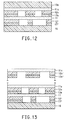
- Figure 12 is a schematic illustration of a two color intermediate element using the laminate-in-register process.
- Figure 13 is a schematic illustration of a multicolor intermediate element using the laminate-in-register process.
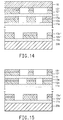
- Figure 14 is a schematic illustration of a multicolor image on a permanent support prior to removal of the transfer element using the laminate-in-register process.
- Figure 15 is a schematic illustration of a final multicolor image on a permanent support formed using the laminate-in-register process.
- a single colored image on a permanent support is formed by applying at least one aqueous permeable colorant-containing composition to a photosensitive element comprising a carrier element having a release surface, a first adhesive layer, and an unpigmented, first photosensitive layer consisting essentially of an aqueous liquid developable photosensitive composition, wherein the aqueous permeable colorant-containing composition is applied to the photosensitive layer; imagewise exposing to actinic radiation the photosensitive element having applied thereon the permeable colorant-containing composition to form imagewise exposed and unexposed regions in the unpigmented, first photosensitive layer and the overlying permeable colorant-containing composition; developing the exposed element by washing with an aqueous liquid, thereby removing either the imagewise exposed or imagewise unexposed regions, to produce a first colored pattern; laminating to the exposed and developed element a transfer element having a release surface, wherein the release surface is adjacent to the first colored pattern; removing said carrier element having a release surface, revealing the
- a carrier element is used to build up a multicolored image consisting of multiple imaged color layers, each interleaved and bonded together with an adhesive layer. Multiple color images are built up on the carrier element by executing multiple imaging steps, respectively. After the multicolored image has been formed, a transfer element is employed to effect a double transfer of the multicolored image, ending with transfer of the colored image from the transfer element (which image is wrong-reading) to the permanent support to afford a right-reading image. This process of forming a multicolored surprint proof is called an expose-in-register process.
- a multicolored surprint proof is formed by exposing and developing at least one additional photosensitive element comprising a carrier element having a release surface, an adhesive layer and an unpigmented photosensitive layer, and which has applied thereon at least one aqueous permeable colorant-containing composition, laminating in register the so formed colored image to a transfer element having a first colored image thereon, followed by removal of the carrier element having a release surface and lamination of the so formed multicolor image to a permanent support.
- This process of forming a multicolored surprint proof is called a laminate-in-register process.
- This invention provides for high resolution, high quality, full color surprint proofs on virtually any proofing paper stock or other permanent support. It also provides for development during imaging with tap water as the liquid developer to minimize or eliminate concerns regarding toxicity, waste treatment, and corrosion. It also provides for color flexibility and the capability for addition of the colorant-containing composition only to the approximate areas where an image is desired. It also provides for the addition of more than one color to a single layer.
- a photosensitive element comprising in order an adhesive layer and a photosensitive layer on a carrier element having a release surface
- an aqueous permeable colorant-containing composition comprising in order an adhesive layer and a photosensitive layer on a carrier element having a release surface
- an aqueous permeable colorant-containing composition comprising in order an adhesive layer and a photosensitive layer on a carrier element having a release surface
- an aqueous permeable colorant-containing composition comprising in order an adhesive layer and a photosensitive layer on a carrier element having a release surface
- an aqueous permeable colorant-containing composition comprising in order an adhesive layer and a photosensitive layer on a carrier element having a release surface
- an aqueous permeable colorant-containing composition comprising in order an adhesive layer and a photosensitive layer on a carrier element having a release surface
- an aqueous permeable colorant-containing composition comprising in order an adhesive layer and a photosensitive layer on a carrier element having a
- the photosensitive element is shown in Figure 1.
- the element comprises, in order, a carrier element having a release surface (10), an adhesive layer (11), and a photosensitive layer (12).
- the carrier element having a release surface (10) may comprise a carrier support (14) and a surface layer (15) which may be a release layer or a cushion layer. If the material used as the carrier support has a release surface, e.g., polyethylene or a fluoropolymer, no additional surface layer is needed.
- the carrier surface layer (15) should have sufficient adhesion to the carrier support (14) to remain affixed to that support throughout all the process steps in the processes of the invention.
- the carrier surface layer should have sufficient adhesion to the adhesive layer to remain affixed thereto during aqueous development of the photosensitive layer.
- the adhesion of the carrier surface layer to the adhesive layer should be low enough to allow for removal of the carrier support and the carrier surface layer, if present, subsequent to the aqueous development steps.
- the relative adhesion balances will be discussed in greater detail below.
- the carrier element serves as a temporary receptor upon which the colored image, comprising one or more imaged colored layers interleaved with adhesive layers, can be constructed.
- the photosensitive layer with its overlying aqueous permeable colorant-containing composition is exposed and developed while on the carrier element.
- the carrier support (14) can comprise almost any material which has reasonable stiffness, has dimensional stability, and is water resistant. Materials with sufficient stiffness and dimensional stability are those which are capable of supporting an image without allowing it to shift and misalign.
- the material used for the carrier support should have enough water resistance to allow for aqueous development of the photosensitive layer without warping or shrinking.
- the material used for the carrier support should also have sufficient heat and pressure resistance to withstand the various lamination steps.
- the support is generally smooth and flat. Examples of suitable materials which can be used include polymeric films such as polyesters, including polyethylene terephthalate and polyethylene naphthanate; polyamides; polycarbonates; fluoropolymers; polyacetals; polyolefins; etc.
- the carrier support can also be a thin metal sheet or a paper substrate or synthetic paper which has been treated to be water resistant.
- the carrier support can be transparent, translucent or opaque. It can be colored and can have incorporated within materials such as antihalation dyes,
- a preferred carrier support material is polyethylene terephthalate film.
- the carrier support can have an antistat layer coated on one or both sides. This can be useful in reducing static when the carrier support is removed from the photosensitive element by peeling off, as will be discussed below. It is generally preferred to have an antistat layer coated on the back side of the carrier support, i.e., the side opposite from that on which the photosensitive layer is present. Materials which can be used as antistat materials are well known in the art.
- the carrier support typically has a thickness of 20 to 250 micrometers (1.0 to 10 mils). A preferred thickness is 55 to 200 micrometers (2 to 8 mils).
- the release surface of the carrier element may be provided by a surface layer (15) which is selected from the group consisting of (i) a release layer and (ii) a cushion layer.
- Release layers are generally very thin layers which promote the separation of layers. Materials useful as release layers are well known in the art and include, for example, silicones; melamine acrylic resins; vinyl chloride polymers and copolymers; vinyl acetate polymers and copolymers; plasticized polyvinyl alcohols; ethylene and propylene polymers and copolymers.
- the layer When a separate release layer is coated onto the carrier support, the layer generally has a thickness in the range of 0.5 to 10 micrometers.
- the carrier release layer may also include materials such as antistats, colorants, antihalation dyes, optical brighteners, surfactants, plasticizers, coating aids, and matting agents.
- a second, and preferred, type of carrier surface layer is a cushion layer having a release surface.
- the cushion layer is a deformable layer which is generally thicker than a release layer.
- the carrier cushion layer should have a release surface to allow for separation of the carrier support and carrier cushion layer from the adhesive layer subsequent to aqueous development of the photosensitive layer.
- suitable materials which can be used as the carrier cushion layer include ethylene/methacrylic acid copolymers and ionomers; ethylene/acrylic acid copolymers and ionomers; ethylene/vinyl acetate copolymers; ethylene homopolymers; propylene homopolymers; ethylene/propylene copolymers; ethylene/methacrylate copolymers and ethylene/methacrylic acid/isobutylacrylic acid ionomers. Mixtures of materials can also be used.
- Preferred materials for the carrier cushion layer are ethylene/methacrylic acid and ethylene/acrylic acid copolymers and ionomers. Such materials are commercially available as, e.g., Surlyn® 1601 (E. I. du Pont de Nemours and Company, Wilmington, DE) and Iotek® 4080 (Exxon Chemical Co., Houston, TX).
- the carrier cushion layer may also include materials such as antistats, colorants, antihalation dyes, optical brighteners, surfactants, plasticizers and coating aids.
- these additional materials may constitute less than 10% by weight, based on the total weight of the carrier cushion layer; preferably less than 5% by weight. It can be advantageous to include a white pigment in the carrier cushion layer. This facilitates inspection of the colored image formed thereon.
- the carrier cushion layer generally has a thickness in the range of 12 to 150 micrometers (0.5 to 6 mils); preferably 35 to 65 micrometers (1.4 to 2.6 mils).
- anchor layer it is meant a layer that remains adhesively bonded to the layers on both sides, i.e., the layer above it and the layer below it.
- Adhesive materials for bonding different types of materials are well known in the art and discussions can be found in, e.g., Handbook of Adhesives, 2nd Edition, Irving Skeist, Ed. (Van Nostrand Reinhold Co., New York, 1977). Any conventional adhesive materials can be used in the anchor layer or layers so long as they are not adversely affected by the aqueous development step.
- Suitable materials for use as the carrier anchor layer include, for example, ethylene/vinyl acetate copolymers; vinyl chloride/vinyl acetate copolymers; vinyl chloride/vinylidene chloride copolymers and thermoplastic polyamides,
- the exact choice of adhesive will depend on the compositions of the carrier cushion layer and the carrier support.
- the anchor layer or layers can have incorporated therein materials such as antistats, colorants, antihalation dyes, optical brighteners, surfactants, plasticizers and coating aids.
- the carrier anchor layer generally has a thickness in the range of 0.01 to 10 micrometers; preferably 0.05 to 5 micrometers. When more than one anchor layer is present, the total thickness of the layers is generally in the above range.
- the carrier element may also be provided with a temporary coversheet (not shown).
- the temporary coversheet can comprise any material which affords adequate protection of the underlying adhesive layer and which cleanly releases from the adhesive layer by peeling.
- Preferred coversheets are self releasing films, such as polyethylene or polyethylene terephthalate. These films can be coated with release layers, such as silicone, so long as the release layer is removed cleanly with the film.
- the thickness of the temporary coversheet is not critical and typically is in the range of 25 to 250 micrometers (1 to 10 mils).
- the adhesive layer (11) remains affixed to the photosensitive layer throughout the process of the invention.
- This adhesive layer can be comprised of any suitable composition which has the necessary adhesion to the photosensitive layer and which does not interfere with the function of the photosensitive layer, such as, for example, might result from the leaching of components from the adhesive layer into the photosensitive layer or the resulting imaged layer.
- the adhesive layer be capable of holding onto a dot during processing; not stain the pigmented layer; and not block to'other layers, e.g. paper, both during and after proof assembly.
- the adhesive layer is transparent and does not have any yellowness which may shift the color balance. It should be capable of easy lamination without trapping air bubbles which reduce image quality.
- the adhesive layer be capable of sliding easily over other layers, but not so easily that registration problems occur.
- the adhesive layer should, preferably, heat seal to other color films and adhesive layers, be scratch and abrasion resistant, in wet or dry form, and not crack or become brittle over time, or when folded or bent. Sticking to components of the lamination or processing equipment is also undesirable.
- adhesive materials for bonding different types of materials are well known in the art and discussions can be found in, e.g., Handbook of Adhesives, 2nd Edition, Irving Skeist, Ed. (Van Nostrand Reinhold Co., New York, 1977).
- the exact choice of adhesive will depend on the nature of the photosensitive layer, the carrier support and the release or cushion layers. Examples of some suitable types of adhesives which can be used include polyester resins and vinylacetate copolymers with ethylene and/or vinyl chloride.
- additives listed earlier as additives for the cushioning and release layers may also be present in the adhesive layer.
- the adhesive layer (11) generally has a thickness in the range of 0.1 to 10 micrometers; preferably 0.5 to 3 micrometers.
- the photosensitive layer (12) comprises an aqueous liquid developable photosensitive composition for which exposure to actinic radiation results in a change in solubility.
- the photosensitive composition can be photoinsolubilizable, i.e., before exposure the photosensitive composition is removable from the carrier support by water or by aqueous solutions that consist essentially of water. After exposure, the composition is not removable from the carrier support by water or by aqueous solutions that consist essentially of water.
- the photosensitive composition can be photosolubilizable. In this latter case, before exposure the photosensitive composition is not removable from the support by water or by aqueous solutions that consist essentially of water. After exposure, the composition is removable from the support by water or by aqueous solutions that consist essentially of water.
- Photoinsolubilization is generally achieved by photoinitiated polymerization and/or crosslinking reactions.
- Photocrosslinkable polymers such as polyvinyl alcohol
- pendant photocrosslinkable groups can be used to advantage in the photosensitive layer. On exposure these groups react to form crosslinks between different polymer chains.
- Photocrosslinkable polymers are described in A. Reiser, Photoreactive Polymers: The Science and Technology of Resists , Wiley, New York, 1989, pp 24-32.
- Typical photocrosslinkable groups are, for example, the cinnamyl, chalcone, alpha -phenylmaleimide, N-alkyl styrylpyridinium, and N-alkyl styrylquinolinium groups.
- Other aqueous developable systems are disclosed in Briney et al., U.S. 4,485,167 issued November 27, 1984.
- polyvinyl alcohol which comprise photocrosslinkable groups
- Preferred polyvinyl alcohol derivatives are those which comprises N-alkyl styrylpyridinium or N-alkyl styrylquinolinium groups.
- Such polymers are described in K. Ichimura and S. Wantanabe, J. Polym. Sci., Polym. Lett. Ed., 18 , 613 (1980) and 20 , 1411, 1419 (1982) as well as in Ichimura, U.S. Patents: 4,272,620, 4,287,335, 4,339,524, 4,564,580 and 4,777,114.
- Substituted aqueous-processable polyvinyl alcohol polymers are typically prepared by derivatization of saponified polyvinyl acetate with the appropriate photocrosslinking group. It is desirable for the polyvinyl acetate to be at least 70% hydrolyzed. Typically 88% saponified polyvinyl acetate is used, but polyvinyl acetate which is more or less highly saponified can be used provided the photosensitive layer is aqueous-processable.
- the photocrosslinkable group can be attached to the polyvinyl alcohol by any appropriate chemical linkage, such as an ester, ether, or acetal linkage. The acetal linkage is preferred.
- the 0.5-10 mol% photocrosslinkable groups preferably 1-4 mol%
- polymers containing higher amounts of photocrosslinkable groups typically cannot be made to be aqueous-processable
- higher amounts of photocrosslinkable groups can be used, provided the photosensitive layer is aqueous-processable.
- the degree of polymerization of the polyvinyl alcohol i.e., the number of monomer units in the polymer chain, is advantageously in the range of 400 to 3,000. When the polymerization degree is too low, the exposure time required for insolubilization is lengthened. When the polymerization degree is too large, the viscosity of solutions containing the polymer becomes so large that they are difficult to prepare and handle.
- bis-azides Another class of polyfunctional photoactivatable crosslinking agents are bis-azides. These compounds are typically aromatic bis-azides substituted with one or more ionic groups, such as sulfonate, carboxylate and sulfate, to increase water solubility. Typical bis-azides are sodium 4,4'-diazidostilbene-2,2'-disulfonate, sodium 4,4'-diazidobenzalacetophenone-2-sulfonate, and sodium 4,4'-diazidostilbene- alpha -carboxylate. A preferred bis-azide is sodium 4,4'-diazidostilbene-2,2'-disulfonate.
- Photosensitive diazo resins are another class of photosensitive materials. These materials typically consist of aromatic diazonium salts crosslinked with formaldehyde. Representative materials are: the zinc chloride complex of the 4-(phenylamino)-benzenediazonium sulfate (1:1) formaldehyde polymer, the zinc chloride complex of the 4-(phenylamino)- benzenediazonium phosphate (1:1) formaldehyde polymer, the cobalt chloride complex of the 4-(phenylamino)- benzenediazonium (1:1) formaldehyde polymer, the uncomplexed 4-(phenylamino)-benzenediazonium phosphate (1:1) formaldehyde polymer, and the uncomplexed 4- (phenylamino)-benzenediazonium sulfate (1:1) formaldehyde polymer.
- Photosolubilization is generally achieved by photoinitiated conversion of materials to more soluble forms, plasticization reactions, depolymerization, uncoupling or uncrosslinking reactions.
- Systems based on o -quinone diazides and low molecular weight phenolformaldehyde polymers can be used to advantage. Upon exposure to ultraviolet radiation, the o -quinone diazide is converted to the readily dissolved indene carboxylic acid.
- a discussion of such systems can be found in A. Reiser, Photoreactive Polymers : The Science and Technology of Resists, Wiley, New York, 1989, pp 178-225.
- Useful photosolubilization chemistry is also disclosed in Chen et al., U.S. Patent 5,071,731.
- photosensitive layer can also be added to the photosensitive layer provided they are compatible with the other ingredients present in the layer, do not impart unwanted color to the final image, and do not adversely affect the action of the element required for the operation of either the imaging process or the multiple transfers required to transfer the image to a permanent support. In some cases separate photoinitiators are added.
- Other components can include, for example, polymeric binders, plasticizers, antihalation agents, optical brightening agents, release agents, surfactants, coating aids and matting agents.
- Additives may be included in the photosensitive composition to improve the aqueous permeable, colorant-containing composition's penetration, absorption and/or fixation to the photosensitive layer. Matting agents added to the unpigmented photosensitive layer would be expected to provide a matte appearance to the layer and may also provide improved diffusibility of the colorant-containing composition into the unpigmented photosensitive layer.
- the photosensitive material must be present in sufficient amount to solubilize or insolubilize the photosensitive layer on exposure to actinic radiation.
- the photosensitive composition must contain sufficient polymer, either as part of the photosensitive material and/or as added binder, to form a film when coated to form the photosensitive layer.
- Other ingredients may be present in amounts necessary to achieve their desired purposes, but not in such large amounts that they adversely affect the properties of the imaging system.
- the composition of the photosensitive layer is typically: binder 80-98%, preferably 85-96%; photosensitive material 2-10%, preferably 2-6% and other ingredients 0-10%. If no binder is present, i.e., the photosensitive material also functions as a binder, the composition is typically: photosensitive material 80-100%, preferably 90-100%; and other ingredients 0-20%.
- the photosensitive layer generally has a thickness in the range of 0.1 to 10 micrometers; preferably 0.5 to 2 micrometers.
- the photosensitive element may be made by coating all of the layers, in order, onto the carrier support using any conventional coating and/or lamination techniques. Such processes are well known in the art. If the adhesive layer is coatable from a non-aqueous solution, the layers may be coated on the temporary coversheet (not shown) and laminated to the carrier element. If so, the temporary cover sheet may have a matte finish on its surface adjacent the photosensitve layer to impart a matte finish to the photosensitive layer when the temporary cover sheet is peeled off.
- the preformed element may comprise the photosensitive layer and the adhesive layer sandwiched between a temporary coversheet (not shown) and a temporary support (not shown) .
- the adhesive layer (11) and the photosensitive layer (12) have the same composition as discussed above.
- the optional temporary coversheet is present to protect the element from being scratched or otherwise damaged prior to use.
- the temporary coversheet can be selected from the same materials described for the temporary coversheet in the carrier element.
- the temporary support can comprise any dimensionally stable sheet material. Typically a polymeric film is used.
- the support should be removable from the photosensitive layer prior to exposure to actinic radiation. At the same time, there must be sufficient adhesion between the photosensitive layer and the temporary support to allow for manufacture and handling of the photosensitive element.
- a separate release layer can be situated between the temporary support and the photosensitive layer, or a silicone release-treated film can be used. It is preferred to use a release layer. This allows for adjustment of the adhesion force between the photosensitive layer and the temporary support with respect to the other important adhesion forces which influence the process of the invention, as will be discussed in detail below.
- the thickness of the temporary support must be sufficient to impart the necessary stiffness for handling and dimensional stability, but beyond that it is not particularly critical.
- the thickness is generally in the range of 25 to 250 micrometers (1 to 10 mils).
- the element having a temporary support and a temporary coversheet is prepared by coating each of the individual layers onto the temporary support.
- the photosensitive layer is prepared by suspending or dissolving the ingredients in an appropriate solvent, preferably aqueous; coating onto the temporary support; and evaporating the solvent.
- the photosensitive element shown in Figure 1 may be prepared from the preformed element and the carrier element by laminating the two together.
- the two temporary coversheets are first removed and the two elements placed together such that the adhesive layer (11) is adjacent to the carrier element (10).
- the temperature and pressure used in the lamination step will depend on the composition of the adhesive layer (11) and the carrier element (10).
- the temporary support is then peeled off. When a release layer is present between the temporary support and the photosensitive layer, the release layer will be peeled off with the temporary support and will not remain on the photosensitive layer.
- the adhesion force between each of the temporary coversheets and their adjacent layers must be lower than the adhesion forces between all the other layers in their respective elements. It will also be clear that in order to remove the temporary support and the associated release layer, if present, after the lamination step, the adhesion force between the photosensitive layer and the temporary support or the release layer, if present, must be lower than the adhesion force between the photosensitive layer (12) and the adhesive layer (11), and the adhesion force between the adhesive layer (11) and the carrier element (10).
- the aqueous permeable colorant-containing composition (13) is is applied over the unpigmented photosensitive layer of the photosensitive element. It may be applied as a layer or may be absorbed into the photosensitive layer after its application.
- the colorant-containing composition (13) has to be aqueous permeable so as not to interfere with the development of the photosensitive layer after exposure. If present as a layer over the unpigmented photosensitive layer its thickness should be no greater than 4 micrometers, preferably no greater than 2 micrometers.
- the colorant used may be any material that is insoluble in the aqueous liquid used to develop the exposed, unpigmented photosensitive layer.
- the colorant can be one of the four standard colors, i.e., yellow, magenta, cyan, and black, or any other desired color.
- the colorants which can be used are well known to those skilled in the art.
- the colorant should be compatible with the photosensitive layer and preferably should not strongly absorb radiation in the spectral range in which the photosensitive composition absorbs radiation.
- Preferred colorants are pigments which are dispersible in water.
- the colorant must be present in a sufficient amount to uniformly color the image to a sufficient optical density, but not in such a large amount that if it were absorbed into the photosensitive layer after its application, would adversely affect the properties of the photosensitive layer, for example, photospeed, adhesion, etc., needed for the operation of the imaging system. For surprint proofs, optical densities between 0.5 and 2 are desirable.
- Other ingredients may be included in the colorant-containing composition to improve its penetration, absorption and or fixation to the photosensitive layer provided they do not adversely affect the photosensitive layer's imaging function or the colorant's desired color. Water insoluble binders may be present in the aqueous permeable colorant-containing composition to improve coatability and/or water-fastness of the image.
- the aqueous permeable colorant-containing composition (13) which typically comprises a colorant and water may be coated, laminated, sprayed or printed onto the unpigmented photosensitive layer.
- the aqueous permeable colorant-containing composition (13) is an ink jet ink and is applied using an ink jet printer.
- the ink jet ink comprises an aqueous carrier medium and a colorant which may be a pigment dispersion or a dye. If the colorant is a dye, it must be rendered insoluble by known techniques, e.g. encapsulation, so it is not washed away in the development step. Reactive dyes that are capable of reacting with the photosensitive material upon exposure to UV radiation are also useful in this invention.
- a dye dispersion may lso be used.
- the pigment dispersion comprises a pigment and a dispersing agent, which preferably is a polymeric compound.
- the aqueous permeable colorant-containing composition (13) which may be applied as an ink jet ink comprises an aqueous carrier medium and a colorant which may be a pigment dispersion or a dye.
- Aqueous Carrier Medium aqueous Carrier Medium
- the aqueous carrier medium is water or a mixture of water and at least one water-soluble organic component.
- Deionized water is commonly used.
- Representative examples of water-soluble organic solvents are disclosed in Ma et al., U.S. Patent 5,085,698,
- a suitable mixture of water and water-soluble organic solvent depends upon requirements of the specific application, such as desired surface tension and viscosity, the selected pigment, drying time of the pigmented ink jet ink, and the type of photosensitive layer onto which the ink will be printed.
- a mixture of a water-soluble organic solvent having at least 2 hydroxyl groups, e.g. diethylene glycol, and deionized water is preferred as the aqueous medium.
- water could be present in the amount of between 30% and 95%, preferably 60% to 95%, by weight based on the total weight of the aqueous carrier medium.
- the colorant useful in the invention may be a pigment dispersion or a dye.
- a pigment is a colorant that is applied in an insoluble particulate state.
- a dye is a colorant that is typically in a soluble state but will be insolubilized by known techniques such as encapsulation prior to use in this invention.
- Reactive dyes that are capable of reacting with the photosensitive material upon exposure to UV radiation are also useful in this invention.
- Disperse dyes may also be used.
- the term pigment dispersion refers to a mixture of a pigment and a dispersing agent.
- the dispersing agent is a polymeric compound.
- Useful pigments for the dispersion comprise a wide variety of organic and inorganic pigments, alone or in combination.
- the pigment particles need to be sufficiently small to permit free flow of the ink through the ink jet printing device, especially at the ejecting nozzles that usually have a diameter ranging from 10 to 50 ⁇ m.
- the particle size also has an influence on the pigment dispersion stability, which is critical throughout the life of the ink. Brownian motion of minute particles will help prevent the particles from flocculation. It is also desirable to use small particles for maximum color strength and gloss.
- the range of useful particle size is 0.005 to 15 ⁇ m.
- the pigment particle size should range from 0.005 to 1 ⁇ m.
- the selected pigment may be used in dry or wet form such as presscake.
- Representative commercial dry and presscake pigment that may be used in practicing the invention are disclosed by Ma et al. in US Patent 5,085,698.
- the ink may contain up to approximately 30% pigment by weight, but will generally be in the range of 0.1 to 15%, preferably 0.1 to 5%, by weight of the total ink composition. If an inorganic pigment is selected, the ink will tend to contain higher weight percentages of pigment because inorganic pigments generally have higher specific gravities than organic pigments.
- Polymeric dispersants are the preferred dispersants for pigments.
- Polymeric dispersants suitable for practicing this invention include random copolymers, block copolymers such as AB, BAB, and ABC block copolymers, and graft copolymers.
- the A block is a hydrophobic homopolymer or copolymer which serves to link with the pigment and the B block is a hydrophilic homopolymer or copolymer, or salts thereof, which serves to disperse the pigment in the aqueous medium.
- Such polymeric dispersants and their synthesis are disclosed in Ma et al., US Patent 5,085,698, issued February 4, 1992.
- ABC triblock copolymers are also useful as pigment dispersants.
- the A block is a polymer soluble in water
- the B block is capable of binding to the pigment
- the C block is compatible with the organic components in the ink.
- ABC triblock copolymers and their synthesis are disclosed in EP-A-0 556 649, claiming priority of USSN 07/838,181 filed February 20, 1992.
- random copolymers can be used as dispersing agents, they are not as effective in stabilizing pigment dispersions as the block copolymers, and therefore are not preferred.
- Dyes which are commonly used in aqueous ink jet inks such as, for example, acid dyes, basic dyes, direct dyes, food dyes, and reactive dyes are suitable colorants for the ink compositions of the present invention provided they are rendered insoluble by techniques known to those skilled in the art, e.g. encapsulation. Disperse dyes may also be suitable as colorants.
- the color and amount of dye used in the ink are largely a function of choice, being primarily dependent upon the desired color of the print achieved with the ink and the dye's strength. Low concentrations of dyes may not give adequate color vividness. High concentrations may result in poor printhead performance or unacceptably dark colors.
- the dye may be present in the amount of 0.01 to 20%, by weight, preferably 0.05 to 8%, by weight, more preferably 1 to 5% by weight, based on the total weight of the ink.
- any material that would provide swelling of the photosensitive layer without having a deleterious effect on it would be useful for improving diffusibility of the ink into the photosensitive layer, e.g. water and surfactants.
- Surfactants alter surface tension and would therefore be expected to maximize penetration of the ink into the photosensitive layer. However, they may also destabilize the pigment dispersion for pigmented inks.
- the choice of a specific surfactant is also highly dependent on the type of photosensitive layer in the photosensitive element to be printed. One skilled in the art can select the appropriate surfactant and the appropriate amount for a specific element to be printed.
- Thermal crosslinking agents may be added to the ink or the photosensitive layer to improve adhesion of the ink to the photosensitive layer and prevent it from being washed off during the development step.
- Biocides sequestering agents such as EDTA, humectants, viscosity modifiers, and other acrylic or non-acrylic polymers may also be added to improve various properties of the inks.
- aqueous permeable, colorant-containing ink compositions of the invention are prepared as described in Ma et al., U.S. Patent 5,085,698 issued February 4, 1992.
- Jet velocity, separation length of the droplets, drop size, and stream stability are greatly affected by the surface tension and the viscosity of the ink.
- Inks suitable for use with ink jet printing systems should have a surface tension in the range of 20•10 -5 to 70•10 -5 N/cm (20 dyne/cm to 70 dyne/cm) and, more preferably, in the range of 25•10 -5 to 70•10 -5 N/cm (25 dyne/cm to 70 dyne/cm) at 20 °C.
- Acceptable viscosities are not greater than 20 mPa•s (cP), and preferable below 10 mPa•s (cP) at 20 °C.
- the ink has physical properties compatible with a wide range of ejecting conditions, i.e., driving voltage, driving frequency, and pulse width for thermal ink jet printing devices, driving frequency for the piezo element for either a drop-on-demand device or a continuous device, and the shape and size of the nozzles, They may be used with a variety of ink jet printers such as continuous, piezoelectric drop-on-demand, and thermal drop-on-demand, and are particularly adapted for use in thermal ink jet printers.
- the inks have excellent storage stability for a long period and do not clog the nozzles. Drying of the ink on the photosensitive layer can be carried out rapidly and accurately by means known to those skilled in the art.
- the function of the transfer element having a release surface (16) is to serve as a temporary receptor to receive the colored image after it has been formed on the carrier support and to provide adequate support for the image to maintain its integrity until it has been transferred to the permanent support.
- the element may comprise, in order, an optional temporary coversheet (not shown), a transfer surface layer (18), and a transfer support (17).
- the transfer element may comprise a transfer support (17) and two transfer surface layers (18) and (19).
- a material having a release surface is used as the transfer support (e.g. polyethylene or a fluoropolymer) no additional release layer is needed.
- the transfer support (17) may comprise almost any material which has reasonable stiffness and dimensional stability. Materials with sufficient stiffness and dimensional stability are those which are capable of supporting an image without allowing it to shift and misalign.
- the support is generally smooth and flat. Examples of suitable materials which can be used include polymeric films such as polyesters, including polyethylene terephthalate and polyethylene naphthanate; polyamides; polycarbonates; fluoropolymers; polyacetals and polyolefins.
- the transfer support can also be a thin metal sheet or a paper substrate or synthetic paper.
- a preferred transfer support material is polyethylene terephthalate film.
- the transfer support typically has a thickness of 20 to 250 micrometers (1.0 to 10 mils). A preferred thickness is 75 to 200 micrometers (3 to 8 mils).
- the transfer surface layers (18) and (19) are selected from the group consisting of (i) a release layer and (ii) a cushion layer.
- the transfer surface layer (18) should have sufficient adhesion to the transfer support to remain affixed to that support throughout all the process steps in the process of the invention.
- the adhesiveness of the transfer surface layer should be carefully balanced with the adhesiveness of the carrier surface layer in order to carry out the transfer steps in the process of the invention. The relative adhesion balances will be discussed in greater detail below.
- adhesion of the layer (18) adjacent the support (17) may be greater than its adhesion to layer (19).
- Layer (19) may have greater adhesion to the exposed and developed photosensitive layer (12') having thereon the aqueous colorant-containing composition (13') so that when the transfer support is peeled off, layer (18) is removed with the support and layer (19) is left behind.
- the two layer transfer element may also be designed wherein both layers have greater adhesion to the support (17) than the developed photosensitive layer (12') having thereon the aqueous colorant-containing composition (13') so that when the transfer support (17) is peeled off both layers (18) and (19) are removed with it.
- the two layer transfer element may also be designed wherein both layers have greater adhesion to the developed photosensitive layer (12') having thereon the aqueous colorant-containing composition (13') than the support (17) so that when the transfer support (17) is peeled off both layers (18) and (19) are left behind on the developed photosensitive layer (12') having thereon the aqueous colorant-containing composition (13').
- release layers are generally very thin layers which promote the separation of layers.
- Materials useful as release layers are well known in the art. Release layers discussed earlier with regard to the carrier element are also useful here as long as the adhesion balances are met.
- Those which can be used as the transfer surface layer(s) include, for example, silicones; vinyl chloride polymers and copolymers; vinyl acetate polymers and copolymers; plasticized polyvinyl alcohols; etc.
- the release surface may constitute the transfer surface layer (18) or transfer surface layers (18) and (19). When a separate release layer or layers are coated onto the transfer support, the layer(s) generally has a thickness in the range of 1 to 10 micrometers.
- the preferred type of transfer surface layer is a cushion layer having a release surface.
- the transfer cushion layer is a deformable layer which is generally thicker than a release layer.
- the transfer cushion layer should have a release surface to allow for separation of the transfer support and transfer cushion layer from the temporary coversheet (not shown), and from any layers which are subsequently laminated to the transfer cushion layer.
- the composition of the transfer cushion layer should be chosen so as to produce the appropriate adhesiveness relative to the release surface of the carrier cushion layer.
- Examples of some suitable materials which can be used as the transfer cushion layer include ethylene/vinyl acetate copolymers; ethylene/methacrylic acid copolymers and ionomers, generally having a higher methacrylic acid content than when used as a carrier cushion layer; ethylene/acrylic acid copolymers and ionomers, generally having a higher acrylic acid content than when used as a carrier cushion layer; ethylene/methacrylate copolymers; ethylene/methacrylic acid/isobutylacrylic acid ionomers, generally having a higher methacrylic acid and isobutylacrylic acid content than when used as a carrier cushion layer; and the like. Mixtures of materials can also be used.
- Preferred materials for the transfer cushion layer are ethylene/vinyl acetate copolymers.
- the transfer cushion layer can also include materials such as surfactants, plasticizers and coating aids.
- colorants are not used in the transfer cushion layer as they serve no added purpose in this layer.
- the transfer cushion layer generally has a thickness in the range of 25 to 150 micrometers (1 to 6 mils) ; preferably 75 to 125 micrometers (3 to 5 mils).
- Adhesive materials for bonding different types of materials are well known in the art and discussions can be found in, e.g., Handbook of Adhesives, 2nd Edition, Irving Skeist, Ed. (Van Nostrand Reinhold Co., New York, 1977). Any conventional adhesive materials can be used in the anchor layer or layers. Suitable materials for use as the transfer anchor layer include, for example, ethylene/vinyl acetate copolymers; vinyl chloride/vinyl acetate copolymers; vinyl chloride/vinylidene chloride copolymers and thermoplastic polyamides. The exact choice of adhesive will depend on the compositions of the transfer cushion layer and the transfer support.
- the anchor layer or layers can have incorporated therein materials such as antistats, colorants, surfactants, plasticizers and coating aids.
- the transfer anchor layer generally has a thickness in the range of 0.1 to 10 micrometers; preferably 0.5 to 2 micrometers. When more than one anchor layer is present, the total thickness of the layers is generally in the above range.
- the optional temporary coversheet is present to protect the underlying layers, if necessary, and must be easily removable. It can be selected from any of the materials discussed above that are useful as the temporary coversheet for carrier element.
- the permanent support for the final colored image can be chosen from almost any sheet material desired.
- a paper support is used, preferably the same paper on which the image will ultimately be printed. Virtually any paper stock can be used.
- Other materials which can be used as the permanent support include cloth, wood, glass, china, most polymeric films, synthetic papers, thin metal sheets or foils, Almost any material which will adhere to the adhesive layer (11) can be used as the permanent support.
- the process of the invention may be used to produce a single color image on a permanent support or it may be used to make a multicolor image on a permanent support using either the exposure-in-register process or the laminate-in-register process.
- the colored image is first built up on the carrier support by exposing and developing by washout, an unpigmented photosensitive layer (12) having provided thereon at least one aqueous permeable, colorant-containing composition (13), a transfer element having a release surface (16) is laminated thereto, and the carrier element is peeled off and the element is laminated to the permanent support (20).
- Step A The element shown in Figure 1 is prepared by applying at least one aqueous permeable, colorant-containing composition (13) to a photosensitive element comprising, in order, a carrier element having a release surface (10), an adhesive layer (11), a first photosensitive layer (12), wherein the colorant-containing composition is adjacent to the first photosensitive layer (12).
- the colorant-containing composition (13) may be applied by coating, spraying, laminating or printing.
- the composition (13) is printed using an ink jet printer.
- Advantages of the invention are that the colorant-containing composition need not be applied to the whole surface of the first photosensitive layer and more than one colorant-containing composition can be applied to the first photosensitive layer.
- the colorant-containing composition need only be applied in the approximate areas where an image is to be formed in Steps B and C.
- Step B The element shown in Figure 1 is exposed to actinic radiation which is absorbed by the photosensitive composition to activate the imaging reaction in conventional fashion.
- Actinic radiation is any radiation which produces imaging.
- the radiation can be natural or artificial, monochromatic or polychromatic, incoherent or coherent.
- most of the actinic radiation should be absorbed by the photosensitive material.
- the absorption spectrum of the photosensitive material may be determined by conventional spectrophotometry.
- sources of actinic radiation that may be selected include fluorescent, mercury vapor, mercury-xenon, metal additive, and arc lamps.
- Useful sources of coherent radiation such as lasers whose emissions fall within or overlap the absorption bands of the photosensitive composition, may also be used.
- Exposure is ordinarily carried out through a halftone image-bearing transparency, preferably a halftone color separation transparency.
- other means such as a modulated scanning laser beam and CRT (cathode ray tube), may be used to imagewise expose the photosensitive elements.
- the element is exposed to actinic radiation, typically through a separation transparency with the emulsion side of the transparency in contact with the aqueous permeable, colorant-containing composition, if it is present as a layer on the photosensitive layer, or the photosensitive layer if the aqueous permeable, colorant-containing composition is absorbed into the photosensitive layer. Exposure is conveniently carried out in a standard vacuum frame to ensure good contact between the transparency and the photosensitive layer with its overlying aqueous permeable colorant-containing composition.
- Step C The next step is to develop the unpigmented photosensitive layer and its overlying aqueous permeable, colorant-containing composition by washing with an aqueous liquid.
- the aqueous liquid removes only the unexposed areas of the photosensitive layer and its overlying aqueous permeable, colorant-containing composition.
- the photosensitive layer is photosolubilizable, the aqueous liquid removes only the exposed areas of the photosensitive layer and its overlying aqueous permeable, colorant-containing composition.
- a first colored pattern comprised of (12') and (13') is formed.
- the development step be effected using ordinary tap water or the like to minimize concerns regarding toxicity, waste treatment, and corrosion. Development can either be done manually or using automated machines. It can be carried out at elevated temperatures, but in most cases room temperature is preferred.
- Step D The next step in the process is to laminate the transfer element (16), shown in Figures 3 and 4, to the element formed above, as shown in Figure 5.
- the temporary coversheet if present, is removed and the two elements are laminated together such that the transfer surface layer (18) in Figure 3, transfer surface layer (19) in Figure 4 or the transfer element having a release surface (16) shown in Figure 5 is adjacent to the first colored pattern, i.e., the developed photosensitive layer and its overlying aqueous permeable, colorant-containing composition comprised of (12') and (13') as illustrated in Figure 5.
- the resulting element has the structure shown in Figure 5.
- the adhesion forces between the individual layers have the following values:
- Step E The next step in the process is to remove the carrier element having a release surface (10). Thus the image is transferred to the transfer element. This step is accomplished by peeling the transfer element and the carrier element apart. In order to obtain the desired result, the adhesion values F2 and F3 must each individually be greater than the adhesion value F1.
- Step F The next step in the process is to laminate the permanent support (20) to the element from above, such that the permanent support (20) is adjacent to the adhesive layer (11) as illustrated in Figure 6.
- the adhesion force between the permanent support (20) and the adhesive layer (11) has a value F4.
- Step G The next step in the process is to remove the transfer element having a release surface (16), thereby transferring the image to the permanent support. This step is accomplished by peeling the transfer support and the permanent support apart. In order to obtain the desired result, the adhesion values F2 and F4 must each individually be greater than the adhesion value F3.
- steps A through C as described above, to form a first colored pattern. This is followed by steps C1 through C6 prior to step D.
- Step C1 The, next step in the process of forming a multicolor image is to laminate an additional unpigmented photosensitive element to the developed element from step C above.
- the additional element as shown in Figure 7, has an additional support (10a), an underlying additional photosensitive layer (12a), and an underlying additional adhesive layer (11a) which is adjacent to and overlying the first colored pattern comprised of the aqueous colorant containing composition (13') and its underlying photosensitive layer (12').
- the adhesion forces between the layers have the values F1 and F2 as defined above, and in addition:
- Step C2 The additional support (10a) is removed from the additional photosensitive layer (12a).
- the adhesion values F1, F2, F5, and F6, must each individually be greater than the adhesion value F7.
- Step C3 As shown in Figure 8, at least one additional aqueous permeable, colorant containing composition (13a) is then applied to the additional photosensitive layer (12a).
- Step C4 The next step in the process is to imagewise expose the additional photosensitive layer (12a) with its overlying additional aqueous permeable, colorant containing composition (13a) in register with the first colored pattern comprised of (12') and (13').
- Suitable registration techniques are well known in the art and include pin and bar registration. The exposure is carried out as described in Step B.
- Step C5 The next step in the process is to develop the element from step C4 using aqueous washout development as described in step C. This results in the formation of a second colored pattern comprised of (12a') and (13a').
- Step C6 Steps C1 to C5 are repeated in order, one or more times to provide additional colors to the image. These steps are carried out using additional unpigmented elements and additional aqueous permeable, colorant containing compositions.
- the unpigmented element has an additional adhesive layer (11b) and colored pattern (not shown), through the nth element having an additional adhesive layer (11n) and an overlying colored pattern comprised of (12n') and (13n') as shown in Figure 9.
- the unpigmented photosensitive element element described in Step C1 is laminated to the element from Step C5 such that the additional adhesive layer is adjacent to and overlying the outermost colored pattern. It will be appreciated that for each repetition of Step C3 in which the additional temporary support is removed, the adhesion force between the additional temporary support and the underlying unexposed additional photosensitive layer is less than the adhesion forces between all of the other layers in the element.
- Step D As illustrated in Figure 9, the element from Step C6 is then laminated to the transfer element having a release surface (16) such that its release surface is adjacent to the outermost colored pattern comprised of (12n') and (13n').
- the resulting laminated element has a first colored pattern (12') and (13') and n additional colored patterns.
- the adhesion forces between the layers have the values F1, F2, F3 as defined above, and in addition:
- the same photosensitive composition will be used for all the photosensitive layers, and the same adhesive composition will be used for all the adhesive layers.
- Step E The carrier element (10) is then removed.
- Adhesion values F2, F3, F2i, F3n, F5 and F5i must be greater than the adhesion value F1 to achieve this result.
- Step F Permanent support (20) is then laminated to the element from Step E, such that the permanent support is adjacent to the adhesive layer (11). This results in the structure shown in Figure 10.
- the adhesion force between the permanent support (20) and the adhesive layer (11) has a value F4, as previously defined.
- Step G Transfer element having a release surface 16 is then removed, thereby transferring the image to the permanent support as illustrated in Figure 11. This step is accomplished by peeling the transfer element and the permanent support apart.
- adhesion values F2, F2i, F4, F5, and F5i each are greater than the adhesion value F3n.
- the only layers present, other than the permanent support are colored pattern comprised of (12') and (13'), (12a') and (13b'), and (12n') and (13n') and associated adhesive layers (11), (11a) and (11n).
- the process begins with steps A through E as described above, to form a first colored pattern on a transfer element. This is shown in Figure 5 with the carrier element that is removed in Step E still intact.
- Steps A-E are repeated to transfer an additional colored pattern comprising at least one aqueous permeable colorant-containing composition (13a'), and its underlying unpigmented photosensitive layer (12a') formed by exposure and development of the element shown in Figure 1, and an underlying adhesive layer (11a) present on a carrier element (10a) to the transfer element containing a first colored pattern comprising at least one aqueous permeable colorant-containing composition (13'), and its overlying unpigmented photosensitive layer (12') and an overlying adhesive layer (11) as shown in Figure 12.
- Steps A-E may be repeated n times resulting in an element similar to that shown in Figure 13 with adhesive layer (11n) being the outermost layer and having an underlying colored pattern comprised of the developed unpigmented photosensitive layer (12n') and the developed aqueous premeable colorant-containing composition (13n').
- adhesive layer (11n) being the outermost layer and having an underlying colored pattern comprised of the developed unpigmented photosensitive layer (12n') and the developed aqueous premeable colorant-containing composition (13n').
- the multicolor image on the transfer element (16) is transferred to a permanent receptor (20) followed by the removal of the transfer element.
- the final multicolor proof formed is shown in Figure 15.
- the adhesion force F3 and adhesion forces between all colored patterns and adjacent adhesive layers is greater than the adhesion force F8.
- the adhesion force F4 and adhesion forces between all colored patterns and adjacent adhesive layers is greater than the adhesion force F3.
- both the carrier element and the transfer element of the present invention can be used repeatedly to form several colored or multicolored images.
- the elements of this invention are useful for preparing colored images. These images are particularly useful in the graphic arts field, especially in the area of color proofing wherein proofs are prepared to predict the images produced by printing.
- the photosensitive film element used in this example had in order, the following structure: (1) an 1 ⁇ m photosensitive layer, (2) a 1 ⁇ m adhesive layer, (3) and 3 ⁇ m release layer (4) a 102 ⁇ m (4 mil) polyethylene terephthalate support.
- the photosensitive layer was composed of SPP M-20.
- the adhesive layer was composed of a 30:70 mixture of Vylonal MD-1400 and Vylonal MD-1100.
- the release layer was composed of Tispeel XA51-824A (4.9 parts by weight), Ryuron ® QU-628 (93.2 parts by weight), Mizukasil ® SK7 (1.5 parts by weight), and Dryer 900 (0.4 parts by weight).
- Aqueous Permeable, Colorant-Containing Composition Applied or "Inked" Photosensitive Element The inked photosensitive element was prepared as described below.
- Transfer Element The transfer element used was a commercially available WaterProof ® Transfer Sheet (manufactured by E. I. du Pont de Nemours and Co., Wilmington, Delaware).
- Step 1 An aqueous permeable, colorant-containing composition comprising a solution of 1 part Sunsperse ® Blue BHD-6015 and 49 parts water was applied or "inked" onto the photosensitive layer by coating using a wire-wound rod.
- Step 2 The inked photosensitive element was placed in a vacuum frame with the ink layer up, i.e., facing the source of actinic radiation. A negative separation transparency for cyan was placed on top of the ink layer with the emulsion side of the transparency in contact with the ink layer and the base side up. A vacuum was drawn on the element and separation transparency for 90 s prior to exposure. The element was exposed for 20 s with the radiation from a 5 kW high pressure mercury vapor lamp, (Olec L1261 lamp, Olec Olix AL985 Integrator and Olite AL53-100 power supply, Olec, Inc., Irvine, California) 137 cm above the element and separation transparency. After exposure, the separation transparency was removed from the exposed photosensitive element.
- a 5 kW high pressure mercury vapor lamp (Olec L1261 lamp, Olec Olix AL985 Integrator and Olite AL53-100 power supply, Olec, Inc., Irvine, California) 137 cm above the element and separation transparency. After exposure, the separation transparency was removed
- Step 3 The element was then developed and dried using a WaterProof ® WashOff Unit (DuPont) which utilized a 24°C water stream and rotating brush to remove the non-exposed areas of the photosensitive and ink layers. The element was then dried at a dryer temperature of 110°C.
- DuPont WaterProof ® WashOff Unit
- Step 4 The coversheet of the transfer element was removed by peeling.
- the image-carrying element was placed on the revealed layer of the transfer element with the image down and then laminated using a WaterProof ® Laminator (DuPont) at 100°C, 68.0 kg (150 lbs), 400 mm/min.
- the photosensitive element support and release layer were next removed by peeling, and thus, effectively transferring the cyan image to the transfer element.
- the result was a wrong-reading cyan image on the transfer element.
- Step 5 The cyan image on the transfer element was placed image down on a piece of LOE paper stock and then laminated at 100°C, 204.1 kg (450 lbs), and 400 mm/min. The transfer element was then removed by peeling to reveal a stain-free cyan proof on LOE paper. The proof image results are shown in Table 1. Color Gain Color Density UGRA %Dots UGRA Resolution ( ⁇ m) UGRA 50% Dot Cyan 1.39 0.5-99.5 6 15
- Example 1 was repeated with the following differences: the aqueous permeable, colorant-containing composition used was a solution of 3.8 parts Aurora Pink ® EPX-11, 11.4 parts Eastman AQ ® 38D, and 34.8 parts water.
- the aqueous permeable, colorant-containing composition applied or "inked" element was exposed through a negative separation transparency for magenta for 10 seconds. A pink image was formed instead of a cyan image.
- the proof image results are shown in Table 2. Color Magenta Color Density UGRA %Dots UGRA Resolution ( ⁇ m) Pink 0.44 2-98 8
- Step 1 The photosensitive element was "inked” using a Hewlett Packard Desk Jet 550C ink jet printer. Three 2,5 x 17,8 cm (1"x7") single-color, solid ink strips of cyan, magenta and yellow inks were applied to the photosensitive layer using the ink jet printer.
- the inks used had the following compositions and were prepared using a procedure similar to that described in Example 1 of U.S. Patent 5,310,778 issued May 10, 1994: Cyan Ink: INGREDIENT AMOUNT (%) Monolite® Green 751 pigment, Zeneca, Inc., Wilmington, DE. 0.83 Endurophthal® Blue GF, Cookson Pigments, Inc., Newark, NJ. 1.67 Butyl methacrylate/methyl methacrylate/methacrylic acid, (BMA/MMA//MAA)(10/5//10) 1.67 Diethylene glycol 5.70 Liponics® EG-1, Lipo Chemical Co.,Paterson, NJ.
- Cyan Ink INGREDIENT AMOUNT (%) Monolite® Green 751 pigment, Zeneca, Inc., Wilmington, DE. 0.83 Endurophthal® Blue GF, Cookson Pigments, Inc., Newark, NJ. 1.67 Butyl methacrylate/methyl methacrylate/methacrylic acid, (BMA/MMA//MAA
- Step 2 The inked photosensitive element was exposed for 50 s , developed, and then transferred to the transfer element as described in Steps 2-4 of Example 1. The result was a set of wrong-reading cyan, magenta, and yellow images on the transfer element.
- Step 3 The images on the transfer element were transferred to LOE paper stock as described in Step 5 of Example 1. The result was a set of 3 single-color images on LOE. Proof image results are shown in Table 3. Color Color Density UGRA %Dots UGRA Resolution ( ⁇ m) Cyan 0.8 2-98 8 Magenta 0.6 2-99 6 Yellow 0.5 5-97 20
- Step 1 Four separate photosensitive elements were "inked” by individually coating the following solutions onto separate photosensitive layers using a wire-wound rod.
- the aqueous permeable, yellow pigment-containing solution was comprised of 1 g Sunsperse ® Yellow YHD-9439, 49 g water and 0.03 g Zonyl ® FSO-100.
- the aqueous permeable, magenta pigment-containing solution was comprised of 1 g Sunsperse ® Magenta QHD-6040, 49 g water and 0.03 g Zonyl ® FSO-100.
- the aqueous permeable, cyan pigment-containing solution was comprised of 1 g Sunsperse ® Blue BHD-6000, 49 g water and 0.03 g Zonyl ® FSO-100.
- the aqueous permeable, black pigment-containing solution was comprised of 1 g Sunsperse ® Black LHD-9303, 49 g water and 0.03 g Zonyl ® FSO-100.
- Step 2 The "inked" photosensitive elements were exposed for 14 (magenta), 20 (yellow), and 40 (cyan, black) s through the corresponding negative separation transparencies and then developed using a WaterProof ® WashOff Unit as described in Steps 2 and 3 of Example 1.
- Step 3 The black image was then transferred to the transfer element as described in Step 4 of Example 1. The result was a wrong-reading black image on the transfer element.
- Step 4 The cyan image was next registered over the wrong-reading black image on the transfer element followed by transfer lamination of the cyan image as described in Step 4 of Example 1. The result was a wrong-reading 2-color image on the transfer element.
- Step 5 was then repeated sequentially with each of the developed magenta and yellow images to obtain a wrong-reading 4-color image on the transfer element.
- Step 6 The wrong-reading 4-color image on the transfer element was then transferred to LOE paper stock as described in Step 5 of Example 1. The result was a right-reading 4-color proof on LOE paper stock.
- the first photosensitive element had the following structure: (1) an 1 ⁇ m photosensitive layer, (2) a 1 ⁇ m adhesive layer, (3) and 50 ⁇ m cushion layer with a release surface and (4) a 178 ⁇ m (7 mil) polyethylene terephthalate support.
- the photosensitive and adhesive layers were the same as those described in Example 1.
- the cushion layer was composed of Iotek ® 4080 98% by wt) and Irgalite ® Green GLN (about 2% by wt).
- the transfer element was the same as that described in Example 1.
- Step 1 The first photosensitive element was "inked” by coating a solution of 1 g Sunsperse ® Blue BHD-6000, 49 g water and 0.03 g Zonyl ® FSO-100 onto the photosensitive layer using a wire-wound rod.
- Step 2 The inked first photosensitive element was exposed for 40 s through a negative separation transparency for cyan and then developed using a WaterProof ® WashOff Unit as described in Steps 2 and 3 of Example 1.
- Step 3 A second photosensitive element comprised of of adhesive and photosensitive layers was then laminated, with the adhesive layer adjacent the developed image on the first photosensitive element.
- Step 4 The second photosensitive layer was "inked” using the aqueous permeable, yellow pigment-containing solution of Example 4.
- Step 5 The inked second photosensitive layer was next exposed for 40 s through a negative separation transparency for yellow in register over the cyan image and developed as described in Steps 2 and 3 of Example 1. The result was a right-reading 2-color image on the carrier element.
- Step 6 The right-reading 2-color image was then transferred to the transfer element using the same conditions as described in Step 5 of Example 1. The result was a wrong-reading 2-color image on the transfer element .
- Step 7 The wrong-reading 2-color image on the transfer element was then transferred to LOE paper stock as described in Step 5 of Example 1. The result was a right-reading 2-color proof on LOE paper stock.
- Step 1 Two separate photosensitive elements were "inked” by individually coating the following solutions onto separate photosensitive layers using a wire-wound rod.
- the aqueous permeable, magenta pigment-containing solution was comprised of 2 g Sunsperse ® Magenta QHD-6040, 48 g water and 0.03 g Zonyl ® FSO-100.
- the aqueous permeable, cyan pigment-containing solution was comprised of 1 g Sunsperse ® Blue BHD-6000, 49 g water and 0.03 g Zonyl ® FSO-100.
- Step 2 The "inked" photosensitive elements were each exposed for 40 s through the corresponding negative separation transparencies and then developed using a WaterProof ® WashOff Unit as described in Steps 2 and 3 of Example 1.
- Step 3 The cyan image was then transferred to the transfer element as described in Step 4 of Example 1. The result was a wrong-reading cyan image on the transfer element.
- Step 4 The magenta image was next registered over the wrong-reading cyan image on the transfer element followed by transfer lamination of the magenta image as described in Step 4 of Example 1. The result was a wrong-reading 2-color image on the transfer element.
- Step 5 The wrong-reading 2-color image on the transfer element was then.transferred to LOE paper stock as described in Step 5 of Example 1. At least one layer of the transfer element also transferred with the 2-color image, yielding a right-reading 2-color proof with high gloss on LOE paper stock.
Landscapes
- Physics & Mathematics (AREA)
- General Physics & Mathematics (AREA)
- Photosensitive Polymer And Photoresist Processing (AREA)
- Materials For Photolithography (AREA)
Applications Claiming Priority (2)
| Application Number | Priority Date | Filing Date | Title |
|---|---|---|---|
| US08/315,739 US5534387A (en) | 1994-09-30 | 1994-09-30 | Transfer process for forming a colored image utilizing a non-photosensitive/photosensitive combination |
| US315739 | 1994-09-30 |
Publications (2)
| Publication Number | Publication Date |
|---|---|
| EP0704761A1 EP0704761A1 (en) | 1996-04-03 |
| EP0704761B1 true EP0704761B1 (en) | 2000-01-12 |
Family
ID=23225839
Family Applications (1)
| Application Number | Title | Priority Date | Filing Date |
|---|---|---|---|
| EP95114112A Expired - Lifetime EP0704761B1 (en) | 1994-09-30 | 1995-09-08 | Process for forming a colored image |
Country Status (4)
| Country | Link |
|---|---|
| US (2) | US5534387A (enExample) |
| EP (1) | EP0704761B1 (enExample) |
| JP (1) | JPH08114913A (enExample) |
| DE (1) | DE69514465T2 (enExample) |
Families Citing this family (16)
| Publication number | Priority date | Publication date | Assignee | Title |
|---|---|---|---|---|
| JPH08194309A (ja) * | 1995-01-18 | 1996-07-30 | Konica Corp | 画像形成材料、受像シート材料及び離型性クッション層製造方法 |
| US6010573A (en) * | 1998-07-01 | 2000-01-04 | Virginia Commonwealth University | Apparatus and method for endothelial cell seeding/transfection of intravascular stents |
| US5959719A (en) * | 1998-10-07 | 1999-09-28 | Williams; Theodore Albert | Image registration process, an image control board and control board cover useful in the process |
| US6165654A (en) | 1999-10-15 | 2000-12-26 | E. I. Du Pont De Nemours And Company | Analog and digital proofing image combinations |
| US6514661B1 (en) | 1999-10-15 | 2003-02-04 | E. I Du Pont De Nemours And Company | Process for forming a colored image having a dominant attribute |
| US6818363B2 (en) | 2000-05-16 | 2004-11-16 | E. I. Du Pont De Nemours And Company | Aqueous dispersions for color imaging |
| DE60135507D1 (de) * | 2000-11-21 | 2008-10-02 | Du Pont | Thermisch bebilderbare Elemente mit verbesserter Festigkeit |
| AU3263102A (en) * | 2000-12-15 | 2002-06-24 | Du Pont | Donor element for adjusting the focus of an imaging laser |
| US6645681B2 (en) | 2000-12-15 | 2003-11-11 | E. I. Du Pont De Nemours And Company | Color filter |
| US6958202B2 (en) * | 2000-12-15 | 2005-10-25 | E.I. Du Pont De Nemours And Company | Donor element for adjusting the focus of an imaging laser |
| DE60129591T2 (de) * | 2000-12-15 | 2008-04-17 | E.I. Du Pont De Nemours And Co., Wilmington | Aufnahmeelement zur einstellung des brennpunktes eines bilderzeugungslasers |
| JP2005502074A (ja) | 2001-09-04 | 2005-01-20 | コダック ポリクロウム グラフィクス リミティド ライアビリティ カンパニー | ハイブリッド校正法 |
| EP1507667A1 (en) * | 2002-05-17 | 2005-02-23 | E.I. Du Pont De Nemours And Company | Planarizing element for thermal printing of color filter |
| US6857735B2 (en) * | 2003-04-29 | 2005-02-22 | Furukawa Ken-Ichi | Method for transferring a color image |
| US8062824B2 (en) | 2006-07-17 | 2011-11-22 | E. I. Du Pont De Nemours And Company | Thermally imageable dielectric layers, thermal transfer donors and receivers |
| US8308886B2 (en) | 2006-07-17 | 2012-11-13 | E I Du Pont De Nemours And Company | Donor elements and processes for thermal transfer of nanoparticle layers |
Family Cites Families (12)
| Publication number | Priority date | Publication date | Assignee | Title |
|---|---|---|---|---|
| US4272620A (en) * | 1978-08-09 | 1981-06-09 | Agency Of Industrial Science And Technology | Polyvinyl alcohol-styrylpyridinium photosensitive resins and method for manufacture thereof |
| GB2167572A (en) * | 1984-11-23 | 1986-05-29 | Colin George Thompson | Photo mechanical imaging |
| JPS62103636A (ja) * | 1985-05-28 | 1987-05-14 | Sanyo Kokusaku Pulp Co Ltd | 多色画像形成用材料 |
| JPH0664349B2 (ja) * | 1985-06-13 | 1994-08-22 | 日本製紙株式会社 | 多色画像形成方法 |
| JPS62247349A (ja) * | 1986-04-21 | 1987-10-28 | Konika Corp | 着色画像形成材料および画像形成方法 |
| US5094931A (en) * | 1987-04-15 | 1992-03-10 | Hoechst Celanese Corporation | Image transfer to diverse paper stocks |
| JPH01116539A (ja) * | 1987-10-29 | 1989-05-09 | Mitsubishi Kasei Corp | 画像形成法 |
| JPH01116540A (ja) * | 1987-10-29 | 1989-05-09 | Mitsubishi Kasei Corp | 画像形成方法 |
| US4937168A (en) * | 1988-10-21 | 1990-06-26 | Hoechst Celanese Corporation | Solid transfer negative- or positive-working color proofing method on diverse paper stocks |
| JP2864269B2 (ja) * | 1990-03-28 | 1999-03-03 | コニカ株式会社 | 画像形成材料及び画像形成材料の製造方法 |
| WO1992002857A1 (en) * | 1990-07-30 | 1992-02-20 | E.I. Du Pont De Nemours And Company | Aqueous developable precolored diazo imaging element |
| DE4311949A1 (de) * | 1993-04-10 | 1994-10-13 | Hoechst Ag | Photopolymerisierbares Material und Verfahren zur Herstellung eines farbigen Bildes |
-
1994
- 1994-09-30 US US08/315,739 patent/US5534387A/en not_active Expired - Lifetime
-
1995
- 1995-05-18 US US08/443,501 patent/US5616439A/en not_active Expired - Lifetime
- 1995-09-08 EP EP95114112A patent/EP0704761B1/en not_active Expired - Lifetime
- 1995-09-08 DE DE69514465T patent/DE69514465T2/de not_active Expired - Fee Related
- 1995-09-29 JP JP7253346A patent/JPH08114913A/ja active Pending
Also Published As
| Publication number | Publication date |
|---|---|
| EP0704761A1 (en) | 1996-04-03 |
| DE69514465D1 (de) | 2000-02-17 |
| JPH08114913A (ja) | 1996-05-07 |
| US5616439A (en) | 1997-04-01 |
| US5534387A (en) | 1996-07-09 |
| DE69514465T2 (de) | 2000-06-15 |
Similar Documents
| Publication | Publication Date | Title |
|---|---|---|
| CA1259848A (en) | Method for forming a multicolored image | |
| CA1259847A (en) | Method for forming a multicolored image | |
| CA1300957C (en) | Negative working color proofing system comprising polyvinyl acetal/polyvinyl alcohol/polyvinyl acetate resin | |
| US5534387A (en) | Transfer process for forming a colored image utilizing a non-photosensitive/photosensitive combination | |
| EP0339860B2 (en) | Low gain positive pre-press proofing system | |
| JPH0623845B2 (ja) | 感光性受像シート材料及び画像転写方法 | |
| US5213941A (en) | Solid transfer negative- or positive-working color proofing method | |
| EP0357325A2 (en) | Positive working color proofing system comprising polyvinyl acetal/polyvinyl alcohol/polyvinyl acetate resin | |
| US4751166A (en) | Negative working diazo color proofing method | |
| JPH02236551A (ja) | 変質性シート材料上にカラー画像を形成する方法 | |
| US5565301A (en) | Process for forming a colored image | |
| US5532115A (en) | Process for forming a colored image utilizing a non-photosensitive/photosensitive combination | |
| EP0357324A2 (en) | Optical brightener containing positive working color proofing system | |
| US5443937A (en) | Aqueous developable precolored diazo imaging element | |
| EP0616702B1 (en) | Aqueous-processable tonable imaging element | |
| EP0778494B1 (en) | Negative working diazo color proofing sheet with adhesive layer having reduced tackiness | |
| JPH02269349A (ja) | ネガ作用性、剥離現像性単一シート色試刷方法 | |
| JPS61286858A (ja) | 多色画像形成方法 | |
| EP0165031A2 (en) | Presensitized color-proofing sheet | |
| EP1093019B1 (en) | Process for forming a colored image having a dominant attribute | |
| EP0327883A2 (en) | Single coating positive or negative working color proofing system | |
| EP0286919A2 (de) | Verfahren zur Herstellung und Übertragung eines Mehrfarbenbilds | |
| EP0404522A2 (en) | Multilayer imaging article for transfer color proofing | |
| EP0732623A2 (en) | Positive-acting photosensitive element | |
| AU5278198A (en) | Transfer process for forming a colored image |
Legal Events
| Date | Code | Title | Description |
|---|---|---|---|
| PUAI | Public reference made under article 153(3) epc to a published international application that has entered the european phase |
Free format text: ORIGINAL CODE: 0009012 |
|
| AK | Designated contracting states |
Kind code of ref document: A1 Designated state(s): DE |
|
| 17P | Request for examination filed |
Effective date: 19960508 |
|
| K1C1 | Correction of patent application (title page) published |
Effective date: 19960403 |
|
| 17Q | First examination report despatched |
Effective date: 19960614 |
|
| GRAG | Despatch of communication of intention to grant |
Free format text: ORIGINAL CODE: EPIDOS AGRA |
|
| GRAG | Despatch of communication of intention to grant |
Free format text: ORIGINAL CODE: EPIDOS AGRA |
|
| GRAH | Despatch of communication of intention to grant a patent |
Free format text: ORIGINAL CODE: EPIDOS IGRA |
|
| GRAH | Despatch of communication of intention to grant a patent |
Free format text: ORIGINAL CODE: EPIDOS IGRA |
|
| GRAA | (expected) grant |
Free format text: ORIGINAL CODE: 0009210 |
|
| AK | Designated contracting states |
Kind code of ref document: B1 Designated state(s): DE |
|
| REF | Corresponds to: |
Ref document number: 69514465 Country of ref document: DE Date of ref document: 20000217 |
|
| PLBE | No opposition filed within time limit |
Free format text: ORIGINAL CODE: 0009261 |
|
| STAA | Information on the status of an ep patent application or granted ep patent |
Free format text: STATUS: NO OPPOSITION FILED WITHIN TIME LIMIT |
|
| 26N | No opposition filed | ||
| PGFP | Annual fee paid to national office [announced via postgrant information from national office to epo] |
Ref country code: DE Payment date: 20080919 Year of fee payment: 14 |
|
| PG25 | Lapsed in a contracting state [announced via postgrant information from national office to epo] |
Ref country code: DE Free format text: LAPSE BECAUSE OF NON-PAYMENT OF DUE FEES Effective date: 20100401 |