EP0700720B1 - Kunststoffartikel mit einer reduzierten Gasdurchlässigkeit und Verfahren dazu - Google Patents
Kunststoffartikel mit einer reduzierten Gasdurchlässigkeit und Verfahren dazu Download PDFInfo
- Publication number
- EP0700720B1 EP0700720B1 EP95305951A EP95305951A EP0700720B1 EP 0700720 B1 EP0700720 B1 EP 0700720B1 EP 95305951 A EP95305951 A EP 95305951A EP 95305951 A EP95305951 A EP 95305951A EP 0700720 B1 EP0700720 B1 EP 0700720B1
- Authority
- EP
- European Patent Office
- Prior art keywords
- container
- plastic
- polymer
- oxygen
- coating
- Prior art date
- Legal status (The legal status is an assumption and is not a legal conclusion. Google has not performed a legal analysis and makes no representation as to the accuracy of the status listed.)
- Expired - Lifetime
Links
Images




Classifications
-
- B—PERFORMING OPERATIONS; TRANSPORTING
- B01—PHYSICAL OR CHEMICAL PROCESSES OR APPARATUS IN GENERAL
- B01L—CHEMICAL OR PHYSICAL LABORATORY APPARATUS FOR GENERAL USE
- B01L3/00—Containers or dishes for laboratory use, e.g. laboratory glassware; Droppers
- B01L3/50—Containers for the purpose of retaining a material to be analysed, e.g. test tubes
- B01L3/508—Rigid containers without fluid transport within
- B01L3/5082—Test tubes per se
-
- C—CHEMISTRY; METALLURGY
- C08—ORGANIC MACROMOLECULAR COMPOUNDS; THEIR PREPARATION OR CHEMICAL WORKING-UP; COMPOSITIONS BASED THEREON
- C08J—WORKING-UP; GENERAL PROCESSES OF COMPOUNDING; AFTER-TREATMENT NOT COVERED BY SUBCLASSES C08B, C08C, C08F, C08G or C08H
- C08J7/00—Chemical treatment or coating of shaped articles made of macromolecular substances
- C08J7/04—Coating
- C08J7/06—Coating with compositions not containing macromolecular substances
-
- B—PERFORMING OPERATIONS; TRANSPORTING
- B05—SPRAYING OR ATOMISING IN GENERAL; APPLYING FLUENT MATERIALS TO SURFACES, IN GENERAL
- B05D—PROCESSES FOR APPLYING FLUENT MATERIALS TO SURFACES, IN GENERAL
- B05D7/00—Processes, other than flocking, specially adapted for applying liquids or other fluent materials to particular surfaces or for applying particular liquids or other fluent materials
- B05D7/02—Processes, other than flocking, specially adapted for applying liquids or other fluent materials to particular surfaces or for applying particular liquids or other fluent materials to macromolecular substances, e.g. rubber
-
- B—PERFORMING OPERATIONS; TRANSPORTING
- B29—WORKING OF PLASTICS; WORKING OF SUBSTANCES IN A PLASTIC STATE IN GENERAL
- B29C—SHAPING OR JOINING OF PLASTICS; SHAPING OF MATERIAL IN A PLASTIC STATE, NOT OTHERWISE PROVIDED FOR; AFTER-TREATMENT OF THE SHAPED PRODUCTS, e.g. REPAIRING
- B29C59/00—Surface shaping of articles, e.g. embossing; Apparatus therefor
- B29C59/16—Surface shaping of articles, e.g. embossing; Apparatus therefor by wave energy or particle radiation, e.g. infrared heating
-
- B—PERFORMING OPERATIONS; TRANSPORTING
- B29—WORKING OF PLASTICS; WORKING OF SUBSTANCES IN A PLASTIC STATE IN GENERAL
- B29C—SHAPING OR JOINING OF PLASTICS; SHAPING OF MATERIAL IN A PLASTIC STATE, NOT OTHERWISE PROVIDED FOR; AFTER-TREATMENT OF THE SHAPED PRODUCTS, e.g. REPAIRING
- B29C59/00—Surface shaping of articles, e.g. embossing; Apparatus therefor
- B29C59/16—Surface shaping of articles, e.g. embossing; Apparatus therefor by wave energy or particle radiation, e.g. infrared heating
- B29C59/165—Surface shaping of articles, e.g. embossing; Apparatus therefor by wave energy or particle radiation, e.g. infrared heating of profiled articles, e.g. hollow or tubular articles
-
- B—PERFORMING OPERATIONS; TRANSPORTING
- B29—WORKING OF PLASTICS; WORKING OF SUBSTANCES IN A PLASTIC STATE IN GENERAL
- B29C—SHAPING OR JOINING OF PLASTICS; SHAPING OF MATERIAL IN A PLASTIC STATE, NOT OTHERWISE PROVIDED FOR; AFTER-TREATMENT OF THE SHAPED PRODUCTS, e.g. REPAIRING
- B29C71/00—After-treatment of articles without altering their shape; Apparatus therefor
- B29C71/04—After-treatment of articles without altering their shape; Apparatus therefor by wave energy or particle radiation, e.g. for curing or vulcanising preformed articles
-
- B—PERFORMING OPERATIONS; TRANSPORTING
- B65—CONVEYING; PACKING; STORING; HANDLING THIN OR FILAMENTARY MATERIAL
- B65D—CONTAINERS FOR STORAGE OR TRANSPORT OF ARTICLES OR MATERIALS, e.g. BAGS, BARRELS, BOTTLES, BOXES, CANS, CARTONS, CRATES, DRUMS, JARS, TANKS, HOPPERS, FORWARDING CONTAINERS; ACCESSORIES, CLOSURES, OR FITTINGS THEREFOR; PACKAGING ELEMENTS; PACKAGES
- B65D1/00—Rigid or semi-rigid containers having bodies formed in one piece, e.g. by casting metallic material, by moulding plastics, by blowing vitreous material, by throwing ceramic material, by moulding pulped fibrous material or by deep-drawing operations performed on sheet material
- B65D1/02—Bottles or similar containers with necks or like restricted apertures, designed for pouring contents
- B65D1/0207—Bottles or similar containers with necks or like restricted apertures, designed for pouring contents characterised by material, e.g. composition, physical features
- B65D1/0215—Bottles or similar containers with necks or like restricted apertures, designed for pouring contents characterised by material, e.g. composition, physical features multilayered
-
- C—CHEMISTRY; METALLURGY
- C08—ORGANIC MACROMOLECULAR COMPOUNDS; THEIR PREPARATION OR CHEMICAL WORKING-UP; COMPOSITIONS BASED THEREON
- C08J—WORKING-UP; GENERAL PROCESSES OF COMPOUNDING; AFTER-TREATMENT NOT COVERED BY SUBCLASSES C08B, C08C, C08F, C08G or C08H
- C08J7/00—Chemical treatment or coating of shaped articles made of macromolecular substances
- C08J7/04—Coating
- C08J7/048—Forming gas barrier coatings
-
- C—CHEMISTRY; METALLURGY
- C23—COATING METALLIC MATERIAL; COATING MATERIAL WITH METALLIC MATERIAL; CHEMICAL SURFACE TREATMENT; DIFFUSION TREATMENT OF METALLIC MATERIAL; COATING BY VACUUM EVAPORATION, BY SPUTTERING, BY ION IMPLANTATION OR BY CHEMICAL VAPOUR DEPOSITION, IN GENERAL; INHIBITING CORROSION OF METALLIC MATERIAL OR INCRUSTATION IN GENERAL
- C23C—COATING METALLIC MATERIAL; COATING MATERIAL WITH METALLIC MATERIAL; SURFACE TREATMENT OF METALLIC MATERIAL BY DIFFUSION INTO THE SURFACE, BY CHEMICAL CONVERSION OR SUBSTITUTION; COATING BY VACUUM EVAPORATION, BY SPUTTERING, BY ION IMPLANTATION OR BY CHEMICAL VAPOUR DEPOSITION, IN GENERAL
- C23C16/00—Chemical coating by decomposition of gaseous compounds, without leaving reaction products of surface material in the coating, i.e. chemical vapour deposition [CVD] processes
- C23C16/22—Chemical coating by decomposition of gaseous compounds, without leaving reaction products of surface material in the coating, i.e. chemical vapour deposition [CVD] processes characterised by the deposition of inorganic material, other than metallic material
- C23C16/30—Deposition of compounds, mixtures or solid solutions, e.g. borides, carbides, nitrides
- C23C16/40—Oxides
- C23C16/401—Oxides containing silicon
-
- C—CHEMISTRY; METALLURGY
- C23—COATING METALLIC MATERIAL; COATING MATERIAL WITH METALLIC MATERIAL; CHEMICAL SURFACE TREATMENT; DIFFUSION TREATMENT OF METALLIC MATERIAL; COATING BY VACUUM EVAPORATION, BY SPUTTERING, BY ION IMPLANTATION OR BY CHEMICAL VAPOUR DEPOSITION, IN GENERAL; INHIBITING CORROSION OF METALLIC MATERIAL OR INCRUSTATION IN GENERAL
- C23C—COATING METALLIC MATERIAL; COATING MATERIAL WITH METALLIC MATERIAL; SURFACE TREATMENT OF METALLIC MATERIAL BY DIFFUSION INTO THE SURFACE, BY CHEMICAL CONVERSION OR SUBSTITUTION; COATING BY VACUUM EVAPORATION, BY SPUTTERING, BY ION IMPLANTATION OR BY CHEMICAL VAPOUR DEPOSITION, IN GENERAL
- C23C16/00—Chemical coating by decomposition of gaseous compounds, without leaving reaction products of surface material in the coating, i.e. chemical vapour deposition [CVD] processes
- C23C16/22—Chemical coating by decomposition of gaseous compounds, without leaving reaction products of surface material in the coating, i.e. chemical vapour deposition [CVD] processes characterised by the deposition of inorganic material, other than metallic material
- C23C16/30—Deposition of compounds, mixtures or solid solutions, e.g. borides, carbides, nitrides
- C23C16/40—Oxides
- C23C16/401—Oxides containing silicon
- C23C16/402—Silicon dioxide
-
- C—CHEMISTRY; METALLURGY
- C23—COATING METALLIC MATERIAL; COATING MATERIAL WITH METALLIC MATERIAL; CHEMICAL SURFACE TREATMENT; DIFFUSION TREATMENT OF METALLIC MATERIAL; COATING BY VACUUM EVAPORATION, BY SPUTTERING, BY ION IMPLANTATION OR BY CHEMICAL VAPOUR DEPOSITION, IN GENERAL; INHIBITING CORROSION OF METALLIC MATERIAL OR INCRUSTATION IN GENERAL
- C23C—COATING METALLIC MATERIAL; COATING MATERIAL WITH METALLIC MATERIAL; SURFACE TREATMENT OF METALLIC MATERIAL BY DIFFUSION INTO THE SURFACE, BY CHEMICAL CONVERSION OR SUBSTITUTION; COATING BY VACUUM EVAPORATION, BY SPUTTERING, BY ION IMPLANTATION OR BY CHEMICAL VAPOUR DEPOSITION, IN GENERAL
- C23C16/00—Chemical coating by decomposition of gaseous compounds, without leaving reaction products of surface material in the coating, i.e. chemical vapour deposition [CVD] processes
- C23C16/56—After-treatment
-
- A—HUMAN NECESSITIES
- A61—MEDICAL OR VETERINARY SCIENCE; HYGIENE
- A61J—CONTAINERS SPECIALLY ADAPTED FOR MEDICAL OR PHARMACEUTICAL PURPOSES; DEVICES OR METHODS SPECIALLY ADAPTED FOR BRINGING PHARMACEUTICAL PRODUCTS INTO PARTICULAR PHYSICAL OR ADMINISTERING FORMS; DEVICES FOR ADMINISTERING FOOD OR MEDICINES ORALLY; BABY COMFORTERS; DEVICES FOR RECEIVING SPITTLE
- A61J1/00—Containers specially adapted for medical or pharmaceutical purposes
-
- B—PERFORMING OPERATIONS; TRANSPORTING
- B29—WORKING OF PLASTICS; WORKING OF SUBSTANCES IN A PLASTIC STATE IN GENERAL
- B29C—SHAPING OR JOINING OF PLASTICS; SHAPING OF MATERIAL IN A PLASTIC STATE, NOT OTHERWISE PROVIDED FOR; AFTER-TREATMENT OF THE SHAPED PRODUCTS, e.g. REPAIRING
- B29C35/00—Heating, cooling or curing, e.g. crosslinking or vulcanising; Apparatus therefor
- B29C35/02—Heating or curing, e.g. crosslinking or vulcanizing during moulding, e.g. in a mould
- B29C35/08—Heating or curing, e.g. crosslinking or vulcanizing during moulding, e.g. in a mould by wave energy or particle radiation
- B29C35/0805—Heating or curing, e.g. crosslinking or vulcanizing during moulding, e.g. in a mould by wave energy or particle radiation using electromagnetic radiation
- B29C2035/085—Heating or curing, e.g. crosslinking or vulcanizing during moulding, e.g. in a mould by wave energy or particle radiation using electromagnetic radiation using gamma-ray
-
- B—PERFORMING OPERATIONS; TRANSPORTING
- B29—WORKING OF PLASTICS; WORKING OF SUBSTANCES IN A PLASTIC STATE IN GENERAL
- B29C—SHAPING OR JOINING OF PLASTICS; SHAPING OF MATERIAL IN A PLASTIC STATE, NOT OTHERWISE PROVIDED FOR; AFTER-TREATMENT OF THE SHAPED PRODUCTS, e.g. REPAIRING
- B29C35/00—Heating, cooling or curing, e.g. crosslinking or vulcanising; Apparatus therefor
- B29C35/02—Heating or curing, e.g. crosslinking or vulcanizing during moulding, e.g. in a mould
- B29C35/08—Heating or curing, e.g. crosslinking or vulcanizing during moulding, e.g. in a mould by wave energy or particle radiation
- B29C35/0866—Heating or curing, e.g. crosslinking or vulcanizing during moulding, e.g. in a mould by wave energy or particle radiation using particle radiation
- B29C2035/0877—Heating or curing, e.g. crosslinking or vulcanizing during moulding, e.g. in a mould by wave energy or particle radiation using particle radiation using electron radiation, e.g. beta-rays
-
- B—PERFORMING OPERATIONS; TRANSPORTING
- B29—WORKING OF PLASTICS; WORKING OF SUBSTANCES IN A PLASTIC STATE IN GENERAL
- B29L—INDEXING SCHEME ASSOCIATED WITH SUBCLASS B29C, RELATING TO PARTICULAR ARTICLES
- B29L2023/00—Tubular articles
-
- Y—GENERAL TAGGING OF NEW TECHNOLOGICAL DEVELOPMENTS; GENERAL TAGGING OF CROSS-SECTIONAL TECHNOLOGIES SPANNING OVER SEVERAL SECTIONS OF THE IPC; TECHNICAL SUBJECTS COVERED BY FORMER USPC CROSS-REFERENCE ART COLLECTIONS [XRACs] AND DIGESTS
- Y10—TECHNICAL SUBJECTS COVERED BY FORMER USPC
- Y10T—TECHNICAL SUBJECTS COVERED BY FORMER US CLASSIFICATION
- Y10T428/00—Stock material or miscellaneous articles
- Y10T428/13—Hollow or container type article [e.g., tube, vase, etc.]
- Y10T428/1352—Polymer or resin containing [i.e., natural or synthetic]
-
- Y—GENERAL TAGGING OF NEW TECHNOLOGICAL DEVELOPMENTS; GENERAL TAGGING OF CROSS-SECTIONAL TECHNOLOGIES SPANNING OVER SEVERAL SECTIONS OF THE IPC; TECHNICAL SUBJECTS COVERED BY FORMER USPC CROSS-REFERENCE ART COLLECTIONS [XRACs] AND DIGESTS
- Y10—TECHNICAL SUBJECTS COVERED BY FORMER USPC
- Y10T—TECHNICAL SUBJECTS COVERED BY FORMER US CLASSIFICATION
- Y10T428/00—Stock material or miscellaneous articles
- Y10T428/13—Hollow or container type article [e.g., tube, vase, etc.]
- Y10T428/1352—Polymer or resin containing [i.e., natural or synthetic]
- Y10T428/1379—Contains vapor or gas barrier, polymer derived from vinyl chloride or vinylidene chloride, or polymer containing a vinyl alcohol unit
-
- Y—GENERAL TAGGING OF NEW TECHNOLOGICAL DEVELOPMENTS; GENERAL TAGGING OF CROSS-SECTIONAL TECHNOLOGIES SPANNING OVER SEVERAL SECTIONS OF THE IPC; TECHNICAL SUBJECTS COVERED BY FORMER USPC CROSS-REFERENCE ART COLLECTIONS [XRACs] AND DIGESTS
- Y10—TECHNICAL SUBJECTS COVERED BY FORMER USPC
- Y10T—TECHNICAL SUBJECTS COVERED BY FORMER US CLASSIFICATION
- Y10T428/00—Stock material or miscellaneous articles
- Y10T428/13—Hollow or container type article [e.g., tube, vase, etc.]
- Y10T428/1352—Polymer or resin containing [i.e., natural or synthetic]
- Y10T428/1397—Single layer [continuous layer]
Definitions
- This invention relates to plastic articles, and more particularly relates to plastic containers of reduced gas permeation and method therefor.
- thermoplastic polymers have come to the fore as preferred materials for manufacture of various articles and have largely replaced glass and metal. Polymer molecules are, however, large and the surfaces of shaped plastic articles are somewhat porous. As a result, plastic soft drink bottles require protection against loss of carbonation due to permeation of carbon dioxide through the container walls. On the other hand, food containers require protection against the ingress of air and water vapor and spoilage therefrom.
- plastic in particular polyolefin
- plastic is used for the manufacture of a wide variety of articles, such as for example, syringes, flasks, vials and tubes. Many of these articles must be sterilized, after which they spend an indeterminate period of time on the shelf before use.
- the present invention refers to a method to reduce gas transmission by irradiating a plastic article.
- the method includes the steps of depositing a permeability-limiting coating on the surface of the article and irradiating.
- the depositing and irradiating steps may be done in any order, preferably in the sequence named.
- the invention provides a method for reducing gas transmission to levels which are not achieved by deposition of low permeability coatings alone.
- the radiation improves shelf life and may provide sterilization of the article. Since radiation sterilization is known in the art to cause degradation of the plastic over time due to radicals generated by the radiation, the invention converts a detriment to an attribute by using the radicals to react with incoming gas.
- the plastic article may be any article which would benefit from reduced gas transmission in its end use.
- the present disclosure contemplates reduced transmission of any gas, of which air, oxygen and carbon dioxide are the most pertinent.
- a representative but not limiting list of such articles includes films for packaging, containers such as bottles for storing liquids and medical devices contemplated for irradiation sterilization such as syringes, tubing, vials and tubes.
- the most preferred articles are soft drink bottles and devices, such as evacuated blood collection tubes, which are particularly susceptible to gas transmission due to the pressure differential across the article wall.
- the article may be made of any plastic such as PVC, PET, polyethylene naphthalate, polystyrene, polycarbonate, polyester, polyolefin, PVDC and polyamide.
- Preferred plastics are PET and polyolefins such as polyethylene and, most preferably, PP.
- the plastic may be shaped into the article by any conventional technique such as molding or extruding.
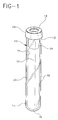
- Fig 1 illustrates a blood collection tube 10 of the invention having an open end 12, a closed end 14 and a stopper 16 in open end 12.
- Tube 10 has a bottom wall 18 defining the closed end and a side wall 20.
- Bottom wall 18, side wall 20 and stopper 16 enclose an interior volume 22 of the tube which preferably is evacuated.
- Stopper 16 preferably is puncturable by a needle or cannula and includes an upper annular portion 24 and a lower annular portion or skirt 26 which extends into and presses against the inside wall surface 28 of side wall 20 to maintain stopper 16 in place.
- a coating 30 of SiO x covers side wall 20 and bottom wall 18.
- Puncturable stoppers for evacuated sample collection tubes are standard in the art and may be made of any suitable material, such as KRATONTM (styrene-butadiene copolymer).
- the polyolefin preferably is of narrow molecular weight distribution.
- the molecular weight distribution of a polymer is defined by the ratio of the weight average molecular weight (Mw) and the number average molecular weight (Mn) wherein the minimum possible ratio of 1.0 defines a polymer having all the chains the same size.
- Suitable polyolefins for the composition of the invention may have a number average molecular weight of about 10,000 to 400,000, preferably 30,000 to 180,000 and a ratio of from 1 to 9 preferably 2 to 6 as determined by conventional gel permeation chromatography. Most preferably the ratio is 2 to 4.
- the preferred polyolefin is semicrystalline, and has a crystalline content of about 20 to 90, preferably about 40 to 80, most preferably about 45 to 65 percent.
- the degree of crystallinity is linearly proportional to the density of the sample and, as known in the art, may be measured with a conventional density gradient column.
- the polyolefin of the invention may optionally include conventional stabilizing and clarifying additives.
- a low molecular weight noncrystalline substance which is miscible with the polymeric material and which is also compatible therewith, i.e., does not adversely affect the properties of the polymer may be included.
- This additive known in the art as a mobilizing oil, increases the mobility of the polymer.
- mobilizers have a density of from 0.6 to 1.9g/cm 3 preferably from 0.6 to 1.1g/cm 3 .
- the mobilizer preferably has a low molecular weight, with the average molecular weight generally being in order of from 100 to 10,000, most preferably from 100 to 5,000.
- mobilizers are hydrocarbon oils, halogenated hydrocarbon oils, phthalic ester oils, vegetable oils, silicon oils, low molecular weight non-crystalline polymer greases, such as hydrocarbon polymer greases, low molecular weight polyester greases, polyarylether greases, etc. It is to be understood that the above examples are only illustrative and the use of other mobilizers should be apparent to one skilled in the art from the teaching herein.
- the preferred mobilizer is a liquid which is not highly viscous, most preferably a hydrocarbon oil or a phthalic ester oil.
- the mobilizing additive may be incorporated into the composition in a mobilizing amount, generally about 0.1 to 50, preferably about 1 to 20 percent by weight.
- the radiation stabilizing additive may be a conventional hindered amine, preferably a hindered piperidine. Any of the hindered amine stabilizers as known in the art and described in US-A-4,959,402 may be used. About 0.01 to 5.0, preferably abut 0.05 to 3.0 percent by weight of hindered amine may be used.
- the clarifying additive of the present invention may be a conventional dibenzylidene sorbitol. Clarifying properties are conferred when the additive of the invention is formulated into the polyolefin composition in a quantity within the range of about 0.005 to 0.5, most preferably about 0.1 to 0.3 percent by weight. Dibenzylidene sorbitol clarifying agents for polyolefins are well known in the art fully described in the aforementioned US Patent No. 4,959,402 and no further details with respect to this aspect of this invention are needed for a full understanding of the invention.
- additives as known in the art may be added to provide other desirable properties to the compositions.
- fillers, coloring agents, antistatic materials, wetting agents, antiacids, and the like may be added in suitable quantities providing no deleterious effects in the desired physical properties, clarity or radiation stability are introduced.
- clarifying additives as for example, organic acids and metal salts thereof, such as para-t-butylbenzioc acid, may be incorporated into the composition.
- Preparation of the polymer composition of the invention from its constituent parts is routine and may be carried out by any conventional mixing means. Generally, polyolefin pellets and the additives are thoroughly mixed by stirring or tumbling, the mixture melted and the melt pelletized and molded into the shape of the desired article.
- the polymeric article has a coating of a gas transmission limiting material thereon.
- the coating may be of a polymer having a low gas permeability such as PVDC, epoxy resin, polyvinyl alcohol or PVC.
- Polymeric coatings may conveniently be applied by conventional solution coating. In solution coating, the coating polymer may be dissolved in a solvent and the article dip coated, or the solvent solution or polymer may be sprayed onto the article.
- an inorganic coating such as aluminum oxide or high density carbon, either amorphous or diamond, or, most preferably, SiO x may be applied to the article surface.
- Aluminum oxide may be deposited conventionally by vaporizing and condensing on the article surface.
- Deposition of amorphous carbon and SiO x may be done by conventional plasma deposition in which the article surface is exposed to a glow discharge plasma formed in the chamber of a conventional plasma generator.
- a plasma may be generated from methane.
- SiO x deposition the plasma may be generated from a gas stream containing an organosilicon compound, oxygen and an inert gas.
- the organosilicon compound for the gas stream preferably is liquid at ambient temperature.
- suitable compounds includes methylsilane, dimethysilane, trimethylsilane, diethylsilane, propylsilane, phenylsilane, hexamethyldisilane, 1,1,2,2-tetramethyl disilane, bis (trimethylsilane) methane, bis (dimethylsilyl) methane, hexamethyldisiloxane, vinyl trimethoxy silane, vinyl triethoxy silane, ethylmethoxy silane, ethyltrimethoxy silane, divinyltetramethyldisiloxane, divinylhexamethyltrisiloxane, and trivinylpentamethyltrisiloxazane.
- Preferred organosilicon compounds are 1,1,3,3-tetramethyldisiloxane, hexamethyldisiloxane, vinyltrimethylsilane, methyltrimethoxysilane, vinyltrimethoxysilane, trimethlsilane and hexamethyldisilazane.
- the inert gas may be, for example, helium or argon, preferably helium.
- the organosilicon compound may be volatilized and combined with the inert gas and oxygen prior to being flowed into the plasma chamber.
- Flow controllers may advantageously be used to adjustably control the flow rates of the individual gases entering the gas stream. While any desired flow rate ratio of the organosilicon compound, inert gas and oxygen may be used, a preferred ratio is about 1 to 1.8 to 1.5.
- a typical plasma generator consists of a reaction chamber, a high frequency generator and matching network, gas delivery system, high vacuum system and temperature controllers.
- a wide range of power setting, radio frequency, gas stream pressure, temperature and duration of exposure may be used to generate the plasma. Ranges for these parameters which provide advantageous results are DC or AC power levels up to 1000 watts, 0.01 to 100 megahertz, 0.01 to 10 torr, 0 to 150 °C and 0.1 to 30 min. Preferred ranges are 20 to 500 watts, 0.04 megahertz, 0.02 to 1.0 torr, 25 °C and 5 minutes.
- the permeability limiting coating may be about 10 to 10,000, preferably about 200 to 2000, most preferably about 400-1000 angstroms thick.
- Plasma deposition of SiO x films is wholly conventional in the art and further details of this aspect of the invention, while not needed for a complete understanding of the invention, may be found in the aforementioned US-A-4,552,791 and EP-A-469,926.
- the coated articles of the invention may be further protected against gas transmission, particularly air, oxygen and carbon dioxide, and gain significantly better shelf time by treatment with ionizing radiation.
- the polymer either prior to or subsequent to coating, with or without barrier coating, is subjected to a total dose of 0.5 to 12 megarads (Mrads) of radiation from a high energy source such as electron beam radiation or gamma irradiation, such as from a 60 Co source.
- a high energy source such as electron beam radiation or gamma irradiation, such as from a 60 Co source.
- the scheme is auto-oxidative so that one primary radical R ⁇ formed by the radiation can neutralize any number of oxygen molecules since it is continually being regenerated.
- the oxygen is trapped in the polymer as stable peroxide compounds.
- one primary radical can consume 100 or more incoming oxygen molecules.
- t lag T 2 6D wherein t lag , T and D are in sec, cm and cm 2 /sec respectively.
- t lag T 2 6D
- t lag , T and D are in sec, cm and cm 2 /sec respectively.
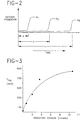
- the time lag to reach steady-state permeation is prolonged because incoming oxygen is consumed by the radicals generated by the ionizing radiation, as illustrated schematically in Fig 2.
- a, b and c represent tlag for a plastic irradiated with increasing Mrad dosages d 1 , d 2 and d 3 respectively.
- Increased t lag provides increased shelf life for the irradiated plastic article. Improved shelf life is most evident for articles having a barrier coating to limit the amount of incoming oxygen.
- Oxygen transmission through SiO x coated plastic tubes of the invention was determined before and after irradiation, using an OXTRANTM instrument (Mocon, Inc.) as described in Example II.
- OXTRANTM instrument Mocon, Inc.
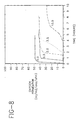
- solid and dotted lines show oxygen transmission before and after irradiation at 10.5 Mrad respectively; in Fig 9, irradiation was performed at the doses indicated.
- t lag for irradiated PVC is seen to increase with increasing irradiation dosage.
- Figs 4 and 5 illustrate oxygen transmission through 1 mil (0.0254 mm) thick PET. It is seen (curves A and B) that transmission was somewhat reduced in the absence of irradiation. Curves C and D show that oxygen transmission through 1 mil PET was reduced to 4.5 cc/m 2 /day/atm by a 300 nm SiO x film and further reduced to 2.0 cc/m 2 /day/atm by irradiation. Curves E and F show further improvement by a 450 nm coating of SiO x , but when the barrier was further increased to 600 nm, (curves G and H), no additional decrease in oxygen transmission was noted. Consideration of Figs 4 and 5 together shows that irradiation, in addition to providing sterilization, also reduces the thickness of SiO x required to achieve an optimum level of oxygen transmission, giving obvious economic advantages.
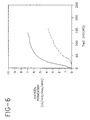
- Fig 6 provides data showing the long term beneficial effect of irradiation on SiO x coated 75 mil (1.9 mm) thick PP. It is seen that, after 150 hrs, the oxygen permeation for irradiated and non-irradiated samples was 3.5 and 7.0 cc/m 2 /day/atm respectively.
- Fig 7 shows reduced oxygen transmission through 1 mil polyamide (nylon-6) film with and without 10.5 Mrad irradiation.
- Figs 8 and 9 compare the time lag to steady-state transmission for non-irradiated 5 mil PVC film and 1 mil PVDC film with films irradiated with 0.5, 2.0, 3.5 and 10.5 Mrad.
- An enclosed plasma reaction chamber is evacuated to the desired base pressure.
- the load lock is vented to atmosphere while the chamber is maintained under high vacuum. Then the load lock is evacuated with the plastic article loaded therein.
- the chamber pressure is adjusted to a desired value by adjusting the baffle over the diffusion pump.
- the load lock diffusion pump is closed and the valve isolating the load lock and the chamber is opened.
- the power supply is turned on and adjusted to the desired value and a glow discharge plasma is established in the chamber.
- An emission spectrum from the control program is used to find the appropriate oxygen to inert gas ratio.
- the organosilicon flow into the chamber is then adjusted until the desired oxygen to inert gas ratio is obtained.
- the plastic article is then conveyed back and forth through the plasma region until the desired coating thickness is achieved while continuing to monitor the process conditions. Once the desired film thickness is obtained, the system is shut down and the coated tube is removed.
- PVC films 5 mil (0.127 mm) thick were gamma irradiated to 0.5, 2.0, 3.5 and 10.5 Mrad.
- the films were flushed on both sides with nitrogen, and the nitrogen on the upstream side was replaced with 1 atm. of oxygen.
- Oxygen permeation was measured at 25° using the OXTRANTM instrument, and t lag was measured at the x-axis intercept. The results are shown in Table 1 below and illustrated in Fig. 3.
- Mrad t lag (min.) 0 20 0.5 186 2.0 384 3.5 678 10.5 852
- PVDC films 1 mil (0.025 mm) thick were irradiated and oxygen permeation measured.
- the results are shown in Table III below and illustrated in Fig 8. Mrad t lag (min.) 0 20 0.5 36 2.0 90 3.5 138 10.5 288
Landscapes
- Chemical & Material Sciences (AREA)
- Chemical Kinetics & Catalysis (AREA)
- Engineering & Computer Science (AREA)
- Health & Medical Sciences (AREA)
- Organic Chemistry (AREA)
- Mechanical Engineering (AREA)
- General Chemical & Material Sciences (AREA)
- Materials Engineering (AREA)
- Metallurgy (AREA)
- Medicinal Chemistry (AREA)
- Polymers & Plastics (AREA)
- Inorganic Chemistry (AREA)
- Toxicology (AREA)
- Analytical Chemistry (AREA)
- General Health & Medical Sciences (AREA)
- Hematology (AREA)
- Clinical Laboratory Science (AREA)
- Life Sciences & Earth Sciences (AREA)
- Wood Science & Technology (AREA)
- Ceramic Engineering (AREA)
- Treatments Of Macromolecular Shaped Articles (AREA)
- Coating Of Shaped Articles Made Of Macromolecular Substances (AREA)
- Application Of Or Painting With Fluid Materials (AREA)
- Measurement Of The Respiration, Hearing Ability, Form, And Blood Characteristics Of Living Organisms (AREA)
- Medicines Containing Material From Animals Or Micro-Organisms (AREA)
Claims (4)
- Verfahren zum Verbessern der Lebensdauer eines Kunststoffprobensammelbehälters, wobei der Behälter umfaßt ein Polymer mit einem Strahlung stabilisierenden Additiv darin und einer Beschichtung eines Gasdurchlässigkeit beschränkenden Materials darauf, wobei das Verfahren umfaßt Aussetzen des beschichteten Behälters 0,5 bis 12 Megarad Hochenergie-gamma- oder Elektronenstrahlbestrahlung unter Bilden eines freien Radikals in dem Kunststoff, wobei das Radikal mit einem Gasmolekül reagiert, wodurch das Molekül davon abgehalten wird, durch den Kunststoff in den Behälter zu gehen, wodurch der Behälter eine geringere Gasdurchlässigkeitsrate als der ansonsten identische Behälter hat, welche nicht bestrahlt worden ist, so daß der Behälter eine verbesserte Lebensdauer hat.
- Verfahren nach Anspruch 1, wobei das Polymer aus der Gruppe, bestehend aus Polyethylenterephthalat, Polyethylennaphthalat, Polyvinylchlorid, Polyolefin und Polyvinylidenchlorid ausgewählt wird.
- Verfahren nach Anspruch 1, wobei der Behälter ferner ein Additiv in dem Polymeren umfaßt.
- Verfahren nach Anspruch 1, wobei die Beschichtung aus der Gruppe, bestehend aus Siliciumoxid, Aluminiumoxid, amorphem Kohlenstoff, diamantförmigem Kohlenstoff, Polyvinylchlorid, Polyvinylidenchlorid, Epoxyharz und Polyvinylalkohol ausgewählt wird.
Applications Claiming Priority (2)
| Application Number | Priority Date | Filing Date | Title |
|---|---|---|---|
| US301101 | 1981-09-10 | ||
| US08/301,101 US5510155A (en) | 1994-09-06 | 1994-09-06 | Method to reduce gas transmission |
Publications (2)
| Publication Number | Publication Date |
|---|---|
| EP0700720A1 EP0700720A1 (de) | 1996-03-13 |
| EP0700720B1 true EP0700720B1 (de) | 2000-08-09 |
Family
ID=23161947
Family Applications (1)
| Application Number | Title | Priority Date | Filing Date |
|---|---|---|---|
| EP95305951A Expired - Lifetime EP0700720B1 (de) | 1994-09-06 | 1995-08-25 | Kunststoffartikel mit einer reduzierten Gasdurchlässigkeit und Verfahren dazu |
Country Status (7)
| Country | Link |
|---|---|
| US (2) | US5510155A (de) |
| EP (1) | EP0700720B1 (de) |
| JP (1) | JPH0892397A (de) |
| AU (1) | AU694530B2 (de) |
| BR (1) | BR9503933A (de) |
| CA (1) | CA2155928C (de) |
| DE (1) | DE69518289T2 (de) |
Families Citing this family (51)
| Publication number | Priority date | Publication date | Assignee | Title |
|---|---|---|---|---|
| DE4438359C2 (de) * | 1994-10-27 | 2001-10-04 | Schott Glas | Behälter aus Kunststoff mit einer Sperrbeschichtung |
| NL1004059C2 (nl) * | 1996-09-18 | 1998-03-19 | Plastic Moulding Appliances B | Samenstel van houder en breeksluiting en werkwijze voor de vervaardiging daarvan. |
| US5691007A (en) * | 1996-09-30 | 1997-11-25 | Becton Dickinson And Company | Process for depositing barrier film on three-dimensional articles |
| US6223683B1 (en) | 1997-03-14 | 2001-05-01 | The Coca-Cola Company | Hollow plastic containers with an external very thin coating of low permeability to gases and vapors through plasma-assisted deposition of inorganic substances and method and system for making the coating |
| US5800880A (en) * | 1997-03-26 | 1998-09-01 | Tetra Laval Holdings & Finance, S.A. | Process for coating the interior wall of a container with a SiOx barrier layer |
| US6375871B1 (en) | 1998-06-18 | 2002-04-23 | 3M Innovative Properties Company | Methods of manufacturing microfluidic articles |
| US6251233B1 (en) | 1998-08-03 | 2001-06-26 | The Coca-Cola Company | Plasma-enhanced vacuum vapor deposition system including systems for evaporation of a solid, producing an electric arc discharge and measuring ionization and evaporation |
| US6428527B1 (en) * | 1998-11-10 | 2002-08-06 | Becton, Dickinson And Company | Method for coating a blood collection device |
| AU1439901A (en) | 1999-10-27 | 2001-05-08 | Coca-Cola Company, The | Process for reduction of acetaldehyde and oxygen in beverages contained in polyester-based packaging |
| US6274212B1 (en) | 2000-02-22 | 2001-08-14 | The Coca-Cola Company | Method to decrease the acetaldehyde content of melt-processed polyesters |
| US6749813B1 (en) | 2000-03-05 | 2004-06-15 | 3M Innovative Properties Company | Fluid handling devices with diamond-like films |
| JP4654481B2 (ja) * | 2000-03-22 | 2011-03-23 | 凸版印刷株式会社 | 真空採血管 |
| US6720052B1 (en) * | 2000-08-24 | 2004-04-13 | The Coca-Cola Company | Multilayer polymeric/inorganic oxide structure with top coat for enhanced gas or vapor barrier and method for making same |
| US6740378B1 (en) | 2000-08-24 | 2004-05-25 | The Coca-Cola Company | Multilayer polymeric/zero valent material structure for enhanced gas or vapor barrier and uv barrier and method for making same |
| JP2002154545A (ja) * | 2000-11-16 | 2002-05-28 | Toppan Printing Co Ltd | プラスチック容器 |
| JP2002154548A (ja) * | 2000-11-16 | 2002-05-28 | Toppan Printing Co Ltd | プラスチック容器 |
| US6599584B2 (en) * | 2001-04-27 | 2003-07-29 | The Coca-Cola Company | Barrier coated plastic containers and coating methods therefor |
| US6632874B2 (en) | 2001-05-01 | 2003-10-14 | The Coca-Cola Company | Method to decrease aldehyde content in polyolefin products |
| KR100402551B1 (ko) * | 2001-08-01 | 2003-10-17 | 주식회사 코오롱 | 혈액투석용 하우징 |
| WO2003089502A1 (en) * | 2002-04-15 | 2003-10-30 | The Coca-Cola Company | Coating composition containing an epoxide additive and structures coated therewith |
| US7041350B1 (en) | 2002-08-30 | 2006-05-09 | The Coca-Cola Company | Polyester composition and articles with reduced acetaldehyde content and method using hydrogenation catalyst |
| US6762275B1 (en) | 2003-05-27 | 2004-07-13 | The Coca-Cola Company | Method to decrease the acetaldehyde content of melt-processed polyesters |
| US20050049391A1 (en) * | 2003-08-28 | 2005-03-03 | Mark Rule | Polyester composition and articles with reduced acetaldehyde content and method using vinyl esterification catalyst |
| US20090281516A1 (en) * | 2004-07-02 | 2009-11-12 | Becton, Dickinson And Company | Multilayer containers |
| US20060177610A1 (en) * | 2005-02-09 | 2006-08-10 | Arrow International Limited | Sealing of Plastic Containers |
| GB0515357D0 (en) * | 2005-07-27 | 2005-08-31 | Psimedica Ltd | Silicon package material |
| DE102006024675A1 (de) * | 2006-05-26 | 2007-11-29 | Robert Bosch Gmbh | Verfahren und Vorrichtung zur Oberflächenbehandlung an Behältnissen oder Gegenständen |
| ATE510676T1 (de) * | 2006-12-21 | 2011-06-15 | Alpla Werke | Formulierung, daraus hergestellter preform und verfahren zur herstellung streckgeblasener opaker kunststoffbehälter |
| US7985188B2 (en) * | 2009-05-13 | 2011-07-26 | Cv Holdings Llc | Vessel, coating, inspection and processing apparatus |
| MX350703B (es) | 2009-05-13 | 2017-09-14 | Sio2 Medical Products Inc | Metodo de gasificacion para inspeccionar una superficie revestida. |
| WO2013170052A1 (en) | 2012-05-09 | 2013-11-14 | Sio2 Medical Products, Inc. | Saccharide protective coating for pharmaceutical package |
| US9458536B2 (en) | 2009-07-02 | 2016-10-04 | Sio2 Medical Products, Inc. | PECVD coating methods for capped syringes, cartridges and other articles |
| US11624115B2 (en) | 2010-05-12 | 2023-04-11 | Sio2 Medical Products, Inc. | Syringe with PECVD lubrication |
| US9878101B2 (en) | 2010-11-12 | 2018-01-30 | Sio2 Medical Products, Inc. | Cyclic olefin polymer vessels and vessel coating methods |
| US9272095B2 (en) | 2011-04-01 | 2016-03-01 | Sio2 Medical Products, Inc. | Vessels, contact surfaces, and coating and inspection apparatus and methods |
| US11116695B2 (en) | 2011-11-11 | 2021-09-14 | Sio2 Medical Products, Inc. | Blood sample collection tube |
| EP2776603B1 (de) | 2011-11-11 | 2019-03-06 | SiO2 Medical Products, Inc. | Passivierungs-, ph-schutz- oder schmierbeschichtung für arzneimittelverpackung, beschichtungsverfahren und vorrichtung |
| US20150297800A1 (en) | 2012-07-03 | 2015-10-22 | Sio2 Medical Products, Inc. | SiOx BARRIER FOR PHARMACEUTICAL PACKAGE AND COATING PROCESS |
| CA2890066C (en) | 2012-11-01 | 2021-11-09 | Sio2 Medical Products, Inc. | Coating inspection method |
| US9903782B2 (en) | 2012-11-16 | 2018-02-27 | Sio2 Medical Products, Inc. | Method and apparatus for detecting rapid barrier coating integrity characteristics |
| JP6382830B2 (ja) | 2012-11-30 | 2018-08-29 | エスアイオーツー・メディカル・プロダクツ・インコーポレイテッド | 医療シリンジ、カートリッジ等上でのpecvd堆積の均一性制御 |
| US9764093B2 (en) | 2012-11-30 | 2017-09-19 | Sio2 Medical Products, Inc. | Controlling the uniformity of PECVD deposition |
| US9662450B2 (en) | 2013-03-01 | 2017-05-30 | Sio2 Medical Products, Inc. | Plasma or CVD pre-treatment for lubricated pharmaceutical package, coating process and apparatus |
| EP2971228B1 (de) | 2013-03-11 | 2023-06-21 | Si02 Medical Products, Inc. | Beschichtete verpackung |
| US9937099B2 (en) | 2013-03-11 | 2018-04-10 | Sio2 Medical Products, Inc. | Trilayer coated pharmaceutical packaging with low oxygen transmission rate |
| US20160017490A1 (en) | 2013-03-15 | 2016-01-21 | Sio2 Medical Products, Inc. | Coating method |
| WO2015148471A1 (en) | 2014-03-28 | 2015-10-01 | Sio2 Medical Products, Inc. | Antistatic coatings for plastic vessels |
| EP3337915B1 (de) | 2015-08-18 | 2021-11-03 | SiO2 Medical Products, Inc. | Pharmazeutische und andere verpackungen mit niedriger sauerstoffübertragungsrate |
| DE102015118393A1 (de) * | 2015-10-28 | 2017-05-04 | STF Maschinen- & Anlagenbau GmbH | Verfahren zum Sortieren von Verpackungsbehälter aus Kunststoff |
| US11596948B2 (en) * | 2016-11-17 | 2023-03-07 | Enicor Gmbh | Coated articles for blood coagulation testing and methods of preparing the same |
| JP2024513061A (ja) * | 2021-03-31 | 2024-03-21 | エスアイオーツー・メディカル・プロダクツ・インコーポレイテッド | 原子層堆積コーティングされた医薬品パッケージ、並びに例えば、凍結乾燥/コールドチェーン薬物/ワクチン用の改善されたシリンジ及びバイアル |
Family Cites Families (15)
| Publication number | Priority date | Publication date | Assignee | Title |
|---|---|---|---|---|
| US4552791A (en) * | 1983-12-09 | 1985-11-12 | Cosden Technology, Inc. | Plastic container with decreased gas permeability |
| DE3584188D1 (de) * | 1984-05-11 | 1991-10-31 | Terumo Corp | Verfahren zur herstellung eines behaelters aus syntetischem harz. |
| JPS60236630A (ja) * | 1984-05-11 | 1985-11-25 | テルモ株式会社 | 減圧採血管の製造方法 |
| EP0297795A3 (de) * | 1987-07-02 | 1990-03-28 | The Standard Oil Company | Kleben von Nitrilpolymeren auf mit Plasma vorbehandelte Plastikoberflächen |
| US4803126A (en) * | 1987-10-19 | 1989-02-07 | Energy Sciences Inc. | Process to permit improvement of functional properties of polyolefin articles by electron-beam initiated polymerization |
| JPH0245040A (ja) * | 1988-08-03 | 1990-02-15 | Terumo Corp | 減圧採血管 |
| JPH0245895A (ja) * | 1988-08-06 | 1990-02-15 | Fujitsu Ltd | 紙幣入金機 |
| JPH02298521A (ja) * | 1989-02-08 | 1990-12-10 | Sekisui Chem Co Ltd | 被覆合成樹脂成形体およびその製造法 |
| US5077135A (en) * | 1989-04-12 | 1991-12-31 | Energy Sciences Inc. | Siloxane polymers and copolymers as barrier coatings and method of producing barrier coating properties therewith |
| US4959402A (en) | 1989-06-08 | 1990-09-25 | Becton, Dickinson And Company | High clarity radiation stable polymeric compostion and articles therefrom |
| US5047131A (en) * | 1989-11-08 | 1991-09-10 | The Boc Group, Inc. | Method for coating substrates with silicon based compounds |
| CA2048168A1 (en) * | 1990-08-03 | 1992-02-04 | John T. Felts | Silicon oxide based thin film vapour barriers |
| JP3175211B2 (ja) * | 1991-08-09 | 2001-06-11 | 凸版印刷株式会社 | ポリオレフィン包装材の酸素バリアー性の改良方法 |
| JPH0798872B2 (ja) * | 1992-01-13 | 1995-10-25 | 東洋紡績株式会社 | 酸化硅素系薄膜積層ガスバリアフィルム |
| CA2110761A1 (en) * | 1992-12-18 | 1994-06-19 | Yelena G. Tropsha | Barrier label |
-
1994
- 1994-09-06 US US08/301,101 patent/US5510155A/en not_active Expired - Lifetime
-
1995
- 1995-08-10 AU AU28480/95A patent/AU694530B2/en not_active Ceased
- 1995-08-11 CA CA002155928A patent/CA2155928C/en not_active Expired - Fee Related
- 1995-08-21 JP JP7212114A patent/JPH0892397A/ja active Pending
- 1995-08-25 DE DE69518289T patent/DE69518289T2/de not_active Expired - Lifetime
- 1995-08-25 EP EP95305951A patent/EP0700720B1/de not_active Expired - Lifetime
- 1995-09-05 BR BR9503933A patent/BR9503933A/pt not_active Application Discontinuation
- 1995-09-21 US US08/530,401 patent/US5547723A/en not_active Expired - Lifetime
Also Published As
| Publication number | Publication date |
|---|---|
| DE69518289T2 (de) | 2001-01-18 |
| AU2848095A (en) | 1996-03-21 |
| EP0700720A1 (de) | 1996-03-13 |
| CA2155928C (en) | 1999-12-07 |
| BR9503933A (pt) | 1997-10-14 |
| AU694530B2 (en) | 1998-07-23 |
| US5547723A (en) | 1996-08-20 |
| CA2155928A1 (en) | 1996-03-07 |
| JPH0892397A (ja) | 1996-04-09 |
| US5510155A (en) | 1996-04-23 |
| DE69518289D1 (de) | 2000-09-14 |
Similar Documents
| Publication | Publication Date | Title |
|---|---|---|
| EP0700720B1 (de) | Kunststoffartikel mit einer reduzierten Gasdurchlässigkeit und Verfahren dazu | |
| US20230092958A1 (en) | Vessels, containers, and surfaces coated with water barrier coatings | |
| EP0535810B1 (de) | Blutentnahmeröhrchen | |
| US5683771A (en) | Blood collection tube assembly | |
| US5545375A (en) | Blood collection tube assembly | |
| US5763033A (en) | Blood collection tube assembly | |
| US5738920A (en) | Blood collection tube assembly | |
| EP0787826B1 (de) | Blutentnahmröhrchen | |
| KR100186805B1 (ko) | 채혈 튜브 조립체 | |
| US5686157A (en) | Blood collection tube assembly | |
| CA2995225C (en) | Pharmaceutical and other packaging with low oxygen transmission rate | |
| CA2268719C (en) | Blood collection tube assembly | |
| CA2277679C (en) | Blood collection tube assembly | |
| CN1711310A (zh) | 在容器中沉积等离子体涂层的方法和设备 | |
| JP4654481B2 (ja) | 真空採血管 | |
| JP2001002135A (ja) | プラスチック容器 | |
| AU709857B2 (en) | Blood collection tube assembly | |
| JP2001146529A (ja) | プラスチック容器への薄膜成膜方法 | |
| JPH07149337A (ja) | 耐ガス透過性プラスチック容器 | |
| MXPA97000684A (en) | Pipe assembly for san collection | |
| MXPA97000635A (es) | Conjunto de tubo para la reccoleccion de sangre |
Legal Events
| Date | Code | Title | Description |
|---|---|---|---|
| PUAI | Public reference made under article 153(3) epc to a published international application that has entered the european phase |
Free format text: ORIGINAL CODE: 0009012 |
|
| AK | Designated contracting states |
Kind code of ref document: A1 Designated state(s): DE ES FR GB IT |
|
| 17P | Request for examination filed |
Effective date: 19960913 |
|
| 17Q | First examination report despatched |
Effective date: 19971114 |
|
| GRAG | Despatch of communication of intention to grant |
Free format text: ORIGINAL CODE: EPIDOS AGRA |
|
| 17Q | First examination report despatched |
Effective date: 19971114 |
|
| GRAG | Despatch of communication of intention to grant |
Free format text: ORIGINAL CODE: EPIDOS AGRA |
|
| GRAH | Despatch of communication of intention to grant a patent |
Free format text: ORIGINAL CODE: EPIDOS IGRA |
|
| GRAH | Despatch of communication of intention to grant a patent |
Free format text: ORIGINAL CODE: EPIDOS IGRA |
|
| GRAA | (expected) grant |
Free format text: ORIGINAL CODE: 0009210 |
|
| AK | Designated contracting states |
Kind code of ref document: B1 Designated state(s): DE ES FR GB IT |
|
| PG25 | Lapsed in a contracting state [announced via postgrant information from national office to epo] |
Ref country code: ES Free format text: THE PATENT HAS BEEN ANNULLED BY A DECISION OF A NATIONAL AUTHORITY Effective date: 20000809 |
|
| ITF | It: translation for a ep patent filed | ||
| REF | Corresponds to: |
Ref document number: 69518289 Country of ref document: DE Date of ref document: 20000914 |
|
| ET | Fr: translation filed | ||
| PLBE | No opposition filed within time limit |
Free format text: ORIGINAL CODE: 0009261 |
|
| STAA | Information on the status of an ep patent application or granted ep patent |
Free format text: STATUS: NO OPPOSITION FILED WITHIN TIME LIMIT |
|
| 26N | No opposition filed | ||
| REG | Reference to a national code |
Ref country code: GB Ref legal event code: IF02 |
|
| PGFP | Annual fee paid to national office [announced via postgrant information from national office to epo] |
Ref country code: GB Payment date: 20020821 Year of fee payment: 8 |
|
| PG25 | Lapsed in a contracting state [announced via postgrant information from national office to epo] |
Ref country code: GB Free format text: LAPSE BECAUSE OF NON-PAYMENT OF DUE FEES Effective date: 20030825 |
|
| GBPC | Gb: european patent ceased through non-payment of renewal fee | ||
| PG25 | Lapsed in a contracting state [announced via postgrant information from national office to epo] |
Ref country code: IT Free format text: LAPSE BECAUSE OF NON-PAYMENT OF DUE FEES;WARNING: LAPSES OF ITALIAN PATENTS WITH EFFECTIVE DATE BEFORE 2007 MAY HAVE OCCURRED AT ANY TIME BEFORE 2007. THE CORRECT EFFECTIVE DATE MAY BE DIFFERENT FROM THE ONE RECORDED. Effective date: 20050825 |
|
| PGFP | Annual fee paid to national office [announced via postgrant information from national office to epo] |
Ref country code: DE Payment date: 20140827 Year of fee payment: 20 |
|
| PGFP | Annual fee paid to national office [announced via postgrant information from national office to epo] |
Ref country code: FR Payment date: 20140818 Year of fee payment: 20 |
|
| REG | Reference to a national code |
Ref country code: DE Ref legal event code: R071 Ref document number: 69518289 Country of ref document: DE |