EP0698188B1 - Porous copper powder modified friction material - Google Patents
Porous copper powder modified friction material Download PDFInfo
- Publication number
- EP0698188B1 EP0698188B1 EP94915424A EP94915424A EP0698188B1 EP 0698188 B1 EP0698188 B1 EP 0698188B1 EP 94915424 A EP94915424 A EP 94915424A EP 94915424 A EP94915424 A EP 94915424A EP 0698188 B1 EP0698188 B1 EP 0698188B1
- Authority
- EP
- European Patent Office
- Prior art keywords
- friction
- rotor
- aluminum
- friction pads
- composition
- Prior art date
- Legal status (The legal status is an assumption and is not a legal conclusion. Google has not performed a legal analysis and makes no representation as to the accuracy of the status listed.)
- Expired - Lifetime
Links
Images




Classifications
-
- F—MECHANICAL ENGINEERING; LIGHTING; HEATING; WEAPONS; BLASTING
- F16—ENGINEERING ELEMENTS AND UNITS; GENERAL MEASURES FOR PRODUCING AND MAINTAINING EFFECTIVE FUNCTIONING OF MACHINES OR INSTALLATIONS; THERMAL INSULATION IN GENERAL
- F16D—COUPLINGS FOR TRANSMITTING ROTATION; CLUTCHES; BRAKES
- F16D69/00—Friction linings; Attachment thereof; Selection of coacting friction substances or surfaces
- F16D69/02—Composition of linings ; Methods of manufacturing
-
- F—MECHANICAL ENGINEERING; LIGHTING; HEATING; WEAPONS; BLASTING
- F16—ENGINEERING ELEMENTS AND UNITS; GENERAL MEASURES FOR PRODUCING AND MAINTAINING EFFECTIVE FUNCTIONING OF MACHINES OR INSTALLATIONS; THERMAL INSULATION IN GENERAL
- F16D—COUPLINGS FOR TRANSMITTING ROTATION; CLUTCHES; BRAKES
- F16D65/00—Parts or details
- F16D65/02—Braking members; Mounting thereof
- F16D65/12—Discs; Drums for disc brakes
- F16D65/125—Discs; Drums for disc brakes characterised by the material used for the disc body
-
- F—MECHANICAL ENGINEERING; LIGHTING; HEATING; WEAPONS; BLASTING
- F16—ENGINEERING ELEMENTS AND UNITS; GENERAL MEASURES FOR PRODUCING AND MAINTAINING EFFECTIVE FUNCTIONING OF MACHINES OR INSTALLATIONS; THERMAL INSULATION IN GENERAL
- F16D—COUPLINGS FOR TRANSMITTING ROTATION; CLUTCHES; BRAKES
- F16D69/00—Friction linings; Attachment thereof; Selection of coacting friction substances or surfaces
- F16D69/02—Composition of linings ; Methods of manufacturing
- F16D69/025—Compositions based on an organic binder
- F16D69/026—Compositions based on an organic binder containing fibres
-
- F—MECHANICAL ENGINEERING; LIGHTING; HEATING; WEAPONS; BLASTING
- F16—ENGINEERING ELEMENTS AND UNITS; GENERAL MEASURES FOR PRODUCING AND MAINTAINING EFFECTIVE FUNCTIONING OF MACHINES OR INSTALLATIONS; THERMAL INSULATION IN GENERAL
- F16D—COUPLINGS FOR TRANSMITTING ROTATION; CLUTCHES; BRAKES
- F16D69/00—Friction linings; Attachment thereof; Selection of coacting friction substances or surfaces
- F16D2069/003—Selection of coacting friction materials
-
- F—MECHANICAL ENGINEERING; LIGHTING; HEATING; WEAPONS; BLASTING
- F16—ENGINEERING ELEMENTS AND UNITS; GENERAL MEASURES FOR PRODUCING AND MAINTAINING EFFECTIVE FUNCTIONING OF MACHINES OR INSTALLATIONS; THERMAL INSULATION IN GENERAL
- F16D—COUPLINGS FOR TRANSMITTING ROTATION; CLUTCHES; BRAKES
- F16D2125/00—Components of actuators
- F16D2125/18—Mechanical mechanisms
- F16D2125/44—Mechanical mechanisms transmitting rotation
- F16D2125/56—Shafts for transmitting torque directly
- F16D2125/565—Shafts for transmitting torque directly flexible
-
- F—MECHANICAL ENGINEERING; LIGHTING; HEATING; WEAPONS; BLASTING
- F16—ENGINEERING ELEMENTS AND UNITS; GENERAL MEASURES FOR PRODUCING AND MAINTAINING EFFECTIVE FUNCTIONING OF MACHINES OR INSTALLATIONS; THERMAL INSULATION IN GENERAL
- F16D—COUPLINGS FOR TRANSMITTING ROTATION; CLUTCHES; BRAKES
- F16D2200/00—Materials; Production methods therefor
- F16D2200/0004—Materials; Production methods therefor metallic
- F16D2200/0026—Non-ferro
-
- F—MECHANICAL ENGINEERING; LIGHTING; HEATING; WEAPONS; BLASTING
- F16—ENGINEERING ELEMENTS AND UNITS; GENERAL MEASURES FOR PRODUCING AND MAINTAINING EFFECTIVE FUNCTIONING OF MACHINES OR INSTALLATIONS; THERMAL INSULATION IN GENERAL
- F16D—COUPLINGS FOR TRANSMITTING ROTATION; CLUTCHES; BRAKES
- F16D65/00—Parts or details
- F16D65/02—Braking members; Mounting thereof
- F16D65/12—Discs; Drums for disc brakes
- F16D65/127—Discs; Drums for disc brakes characterised by properties of the disc surface; Discs lined with friction material
Definitions
- This invention relates to a friction pad for a brake system having aluminum-based rotors wherein friction stability and wear are enhanced through the use of porous copper powder which smears and reacts to form a surface glaze to protect the aluminum rotors from scoring and excessive wear during a brake application when either low or high temperature is generated.
- Rotors made of such aluminum or aluminum alloys have been evaluated in the past for use as rotors in brake systems.
- such aluminum-based materials often soften and become weak during use, and as a result are not commonly used in a braking system except as bicycle rims against which soft rubber-based materials rub under low energy absorption conditions.
- Development of new materials known as aluminum metal-matrix composites (A1-MMC) are a type of aluminum alloy with either particulate or fibrous reinforcement have occurred which significantly increases the strength and hardness of a base aluminum alloy.
- the most common reinforcement for such an alloy is achieved through the addition of from 10 to 60 volume percent fine silicon carbide, although alumina and other ceramics may also be used.
- a known Al-MMC rotor which contains 20% SiC, is thermally treated to increase the Rockwell B hardness to be between 40 and 80.
- This Al-MMC rotor retains high thermal conductivity, hardness, and strength when exposea to high temperatures during a brake application.
- porous copper powder having a nominal diameter of less than 0.40 mm and preferably less than 0.20 mm would aid in the formation of a glaze on the A1-MMC rotor to maintain a stable coefficient of friction while avoiding scoring of the A1-MMC rotor at operational temperatures that approach 280°C.
- An advantage of the present composition for a friction pad is in its compatibility with aluminum and aluminum alloy, specifically A1-MMC, rotors giving a high and stable friction coefficient with low wear with operating rotor temperatures up to 450°C and pad surface temperatures that approach 350°C.
- Non-asbestos friction material formulations typically include metal powders, friction modifiers, elastomeric particles, carbonaceous materials, and glass fiber held in an organic resin matrix while semimetallic formulations contains a higher amount of metals and graphites, friction modifiers, elastomeric particles, and an organic resin matrix.
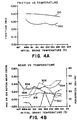
- a desired base line was established to initially evaluate the coefficient of friction for various formulation of materials. After an initial formula was identified, the coefficient of friction and wear of commercial friction pads as determined through an SAE D-212 test with a cast iron rotor was used as a baseline to evaluate the selected formula as a friction pads for use with an Al-MMC rotor. The average coefficient of friction for such a desired initial base line is shown by curve 100 in Figures 3a, 4a, 5a, 6a, 7a, 7c, and 8a.
- Inertia from a wheel load of 1020 lbs was used to simulated the braking energy for the brake system of such a compact automobile.
- the volume of a cast-iron rotor for the compact automobile was used to prepare a pattern to make sand casts and a molten slurry of aluminum alloy and silicon carbide particulate was poured into such sand casts to create Al-MMC castings.
- the Al-MMC castings were machined with diamond tools to produce ventilated rotors that were 234 mm in diameter with 24.0 mm thick rubbing surfaces.
- the tangential force of the weakened hot spots on the rotor going past the friction pads causes the hottest wear track on one or both of the rotor rubbing surface's to be disrupted, and then re-solidify on a cooler portion of the rubbing surface on the Al-MMC rotor.
- This re-solidification caused one or more surface projections or a macro-asperities to form on the rotor rubbing surface.
- These surface projections which are made up of hardened aluminum alloy material and SiC abrasive particles acts as a grinding wheel to immediately cut and grind away the rubbing surface on the friction pads and eliminate its protective glaze.
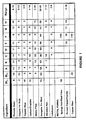
- composition A illustrated in Figure 1 was an initial formulation evaluated as a compatible friction pad for use in a friction coupling a to reduce the possibility of developing undesirable rapid degradation.
- the organic Friction Modifier of Composition A could be selected from rubber scrap, cellulose, latex, cork, and/or CNSL particles (polymerized cashew nut shell liquid).
- the rubber scrap which was selected makes up 13 percent by weight of the total composition and is at least twenty five percent greater than a typical organic based formula, but was considered necessary to assure the development of a glaze on engagement with the rubbing surfaces of the Al-MMC rotor to provide friction stability.
- Friction pads were constructed from Composition A and tested with an Al-MMC rotor, which included 20 percent silicon carbide, on an inertial dynamometer using a Schedule 112 procedure.
- Composition A could be modified through an increase in glassy fiber to produce Composition B illustrated in Figure 1.
- Friction pads were constructed from Composition B and tested with the Al-MMC rotor according to Schedule 112 on the inertial dynamometer. Information obtained from the inertial dynamometer was used to derive the a coefficient of friction as shown by curve 300 in Figure 4a and a wear rate for the inner pad and outer pad, inner and outer rotor surfaces roughness by curves 302, 304, 306, 308 and 310, respectively, in Figure 4a. Also included is the total rotor thickness trend as indicated by 312.
- Composition B was modified through a slight reduction in the glassy fiber content, an increase in the carbonaceous material which includes carbon, graphite and coke, with graphite being the preferred, additional abrasive particle which could be selected from a group consisting of silica, magnesium oxide, zircon, mullite, alumina, magnesia and iron oxide, with iron oxide being selected, and the addition of a lubricant particle which could be selected from a group consisting of molybdenum sulfide, calcium fluoride, antimony trisulfide, and molybdenum disulfide with calcium fluoride being selected to produce Composition C shown in Figure 1.
- Friction pads were constructed from Composition C and tested with an Al-MMC rotor in an according to Schedule 112 on the inertial dynamometer. Information obtained from the inertial dynamometer was used to derive the a coefficient of friction as shown by curve 400 in Figure 5a, and a wear rate for the inner pad and outer pad, inner and outer rotor surfaces roughness by curves 402, 404, 406 and 408 in Figure 5b. Curves 410 and 412 give the rotor wear and the overall rotor thickness trend.
- the metallic oxide abrasive particle therein was removed and the percentage of glass fiber increased over Composition B to provide strength while the inorganic friction modifier which could be selected from a group consisting of barytes, whiting, talc, rottenstone, vermiculite, and suzorite mica, with barytes and suzorite mica, being selected, to produce Composition D shown in Figure 1.
- Friction pads were constructed from Composition D and tested with the composite aluminum rotor according to Schedule 112 on the inertial dynamometer.
- Composition D was modified through the addition a porous copper powder for some of the inorganic friction modifiers to produce Composition E shown in Figure 1.
- the porous copper powder which had a nominal -150 mesh size, an apparent density of 2.7 and inherent irregular shape, as shown in Figure 2a and 2b, was selected to assist in the formation of the glaze on the rubbing surfaces, reduce wear and aid in the transfer of thermal energy from the engagement surfaces to the surrounding environment to maintain the operational temperature of the coupling below 450°C.
- the nominal size of the porous copper powder was defined to be less that 0.040 mm in diameter with at least 55-71 percent less that 0.10 mm.
- Friction pads were constructed from Composition E and tested with the composite aluminum rotor according to Schedule 112 on the inertial dynamometer. Information obtained from the inertial dynamometer was used to derive the a coefficient of friction as shown by curve 600 in Figure 7a and a wear rate for the inner pad and outer pad, and inner and outer rotor surface roughness as illustrated by curves 602, 604, 606 and 608 in Figure 7b.
- Curves 610 and 612 give rotor wear and overall rotor thickness trends. When compared with the desired optimum coefficient of friction illustrated by curve 100 and wear and the coefficient of friction for Compositions A, B, C and D, it should be evident that while Composition E produced an acceptable stable coefficient of friction which is slightly less than the desired optimum, acceptable wear resistance and good glazing without unacceptable noise during the Schedule 112 procedure occurred.
- the relatively soft and malleable features of the porous copper powder presented a very mild metallic surface and essentially non-abrasive surface to the Al-MMC rotor rubbing surfaces, which in turn does not cause intermetallic joining and pull-out, rather a good smearing of the pad reaction products over the Al-MMC rotor rubbing surfaces which leads to a protective glaze formation conducive with a high and stable friction and excellent compatibility leading to desirable wear resistance.
- a second test was performed using an Al-MMC rotor from a second manufacturer containing a higher SiC content(30% vs 20%).
- Friction pads were constructed from Composition F and tested with the composite aluminum rotor according to Schedule 112 on the inertial dynamometer. Information obtained from the inertial dynamometer was used to derive the a coefficient of friction as shown by curve 600 in Figure 7a and a wear rate for the inner pad and outer pad, illustrated by curves 602 and 604 in Figure 7b.
- an upper limit for the porous copper powder in a formulation is about 18 percent to prevent material transfer while maintaining stable and uniform wear with a preferred amount to be about 14 percent.
- Friction pads were constructed similar to Composition F but with copper fiber and brass fiber and tested with an composite aluminum rotor according to Schedule 112. Neither copper fiber or brass fiber provided any friction or wear improvements and actually gave a slightly poorer compatibility at the upper limit as compared with Composition F whereas the use of steel fiber resulted in scoring of the aluminum rotor. These test indicated that contact of essentially any concentration of a dense metal with the rubbing surface would not produce deformation or smearing comparably to fine porous copper powder and as a result detracted from the extended wear performance of the friction pad.
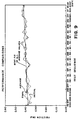
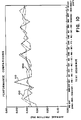
- Figure 9 illustrates information obtained from SAE D-212 friction test sequence for Composition H which includes the following test conditions: preburnish effectiveness at varying deceleration rates from 30 and 60 mph; 200 burnish stops from 40 mph at 12 feet per second per second; post-burnish or second effectiveness stops from 30, 60, and 80 mph; a reburnish of 35 stops; baseline stops from 30 mph; 10 stop fade from 60 mph at 15 feet per second per second deceleration at 35 second intervals between stops where the temperature rises rapidly, followed by a recovery sequence consisting of 30 mph stops and 120 second intervals between stops; baseline checks from 60 mph; a second reburnish; a second series baseline stops, a 15 stop fade and recovery portion, and the baseline checks; a third reburnish, and a third effectiveness (equivalent to the second).
- Curve 950 in Figure 10, illustrates the results of friction pads made from Composition H run with the lightweight A1-MMC rotor
- curve 120 in Figure 10 illustrates the results of friction pads made from a known semimetallic material formulation, identified in Figure 1 as baseline 1, run with a cast-iron rotor
- curve 150 in Figure 10, illustrates the results of friction pads made from a non-asbestos organic material formulation, identified in Figure 1 as baseline 2, run with a cast-iron rotor.
- compositions A-H From our investigations, studies and testing of Compositions A-H, we derived the following limitations with respect to ingredients in a composition of materials to produce an optimum compatible friction pad for use with an Al-MMC rotor:
- compositions E-H for friction pads may best be described as a non-asbestos organic material with a high abrasive content countered with a solid lubricant package and modified by a fine porous copper powder which smears and reacts over the rotor rubbing surfaces temperatures above -40°F (-40°C) to create a protective glaze and thereby control wear when coupled with an aluminum-metal matrix composite rotor which is reinforcement by silicon carbide particles in the range from 10 to 60%.
Landscapes
- Engineering & Computer Science (AREA)
- General Engineering & Computer Science (AREA)
- Mechanical Engineering (AREA)
- Braking Arrangements (AREA)
- Manufacture Of Macromolecular Shaped Articles (AREA)
- Powder Metallurgy (AREA)
Applications Claiming Priority (3)
| Application Number | Priority Date | Filing Date | Title |
|---|---|---|---|
| US57932 | 1979-07-16 | ||
| US08/057,932 US5339931A (en) | 1993-05-07 | 1993-05-07 | Porous copper powder modified friction material |
| PCT/US1994/004601 WO1994027058A1 (en) | 1993-05-07 | 1994-04-26 | Porous copper powder modified friction material |
Publications (2)
| Publication Number | Publication Date |
|---|---|
| EP0698188A1 EP0698188A1 (en) | 1996-02-28 |
| EP0698188B1 true EP0698188B1 (en) | 1997-06-11 |
Family
ID=22013634
Family Applications (1)
| Application Number | Title | Priority Date | Filing Date |
|---|---|---|---|
| EP94915424A Expired - Lifetime EP0698188B1 (en) | 1993-05-07 | 1994-04-26 | Porous copper powder modified friction material |
Country Status (6)
| Country | Link |
|---|---|
| US (1) | US5339931A (enExample) |
| EP (1) | EP0698188B1 (enExample) |
| JP (1) | JP3447739B2 (enExample) |
| AU (1) | AU678009B2 (enExample) |
| DE (1) | DE69403791T2 (enExample) |
| WO (1) | WO1994027058A1 (enExample) |
Families Citing this family (38)
| Publication number | Priority date | Publication date | Assignee | Title |
|---|---|---|---|---|
| US5556078A (en) * | 1992-12-16 | 1996-09-17 | Elephant Chain Block Company Limited | Manual hoist and traction machine |
| GB9401137D0 (en) * | 1994-01-21 | 1994-03-16 | Ferodo Ltd | Improvements in and relating to friction materials |
| EP0679818B1 (en) * | 1994-04-28 | 2000-01-12 | Nisshinbo Industries, Inc. | Friction material |
| EP0769635A1 (en) * | 1995-10-20 | 1997-04-23 | Tokyo Yogyo Kabushiki Kaisha | Brake lining material for heavy-load braking device |
| US5821282A (en) * | 1995-10-26 | 1998-10-13 | Westinghouse Air Brake Company | Self lubricating brake shoe material |
| JPH09286973A (ja) * | 1996-04-23 | 1997-11-04 | Akebono Brake Ind Co Ltd | 非石綿系摩擦材 |
| US5928070A (en) * | 1997-05-30 | 1999-07-27 | Minnesota Mining & Manufacturing Company | Abrasive article comprising mullite |
| CA2249122A1 (en) * | 1998-07-23 | 2000-01-23 | Westinghouse Air Brake Company | Wheel tread conditioning brake shoe |
| DE19859839A1 (de) * | 1998-12-23 | 2000-07-06 | Daimler Chrysler Ag | Bremseinheit |
| DE19859840B4 (de) * | 1998-12-23 | 2006-01-12 | Daimlerchrysler Ag | Bremseinheit |
| US6620860B2 (en) | 2000-03-31 | 2003-09-16 | Sumitomo Electric Industries, Ltd. | Friction material |
| JP2000290636A (ja) * | 1999-04-06 | 2000-10-17 | Akebono Brake Ind Co Ltd | 摩擦材 |
| DE10011018C2 (de) * | 2000-03-07 | 2003-06-18 | Deere & Co | Reibeingriffsvorrichtung |
| JP2003113368A (ja) * | 2001-10-02 | 2003-04-18 | Nisshinbo Ind Inc | 非石綿系摩擦材 |
| FR2863994B1 (fr) * | 2003-12-17 | 2006-03-17 | Bosch Gmbh Robert | Controle du serrage d'un frein de parking automatique pour vehicule automobile |
| US8689671B2 (en) | 2006-09-29 | 2014-04-08 | Federal-Mogul World Wide, Inc. | Lightweight armor and methods of making |
| AT505794B1 (de) * | 2007-10-10 | 2011-11-15 | Miba Frictec Gmbh | Sinterbremsbelag |
| US8960384B2 (en) * | 2008-08-08 | 2015-02-24 | Freni Brembo S.P.A. | Method for making a ceramic matrix material for friction components of brakes and ceramic matrix material made by such method |
| BR112012009466B1 (pt) | 2009-10-23 | 2020-03-31 | Federal-Mogul Products, Inc. | Material de atrito, e, pastilha de freio |
| BR112012009470B1 (pt) | 2009-10-23 | 2020-04-28 | Fed Mogul Products Inc | material de atrito para um freio, e, pastilha de freio |
| JP5462053B2 (ja) * | 2010-03-31 | 2014-04-02 | Jx日鉱日石金属株式会社 | ブレーキパッド用銅粉 |
| FR2959238B1 (fr) * | 2010-04-22 | 2014-03-14 | Astrium Sas | Materiau de protection thermique |
| CA2716139A1 (en) * | 2010-10-01 | 2012-04-01 | Torx Friction Corporation | Noise-damping friction pads |
| EP2641956B1 (en) * | 2010-11-19 | 2015-03-18 | Hitachi Chemical Company, Ltd. | Non-asbestos friction-material composition, and friction material and friction member using same |
| JP5057000B2 (ja) * | 2010-11-19 | 2012-10-24 | 日立化成工業株式会社 | ノンアスベスト摩擦材組成物、これを用いた摩擦材及び摩擦部材 |
| DE102011089918A1 (de) * | 2011-12-27 | 2013-06-27 | Robert Bosch Gmbh | Bremsscheibe |
| DE102013221737A1 (de) * | 2013-10-25 | 2015-04-30 | Ford Global Technologies, Llc | Verfahren zur Herstellung einer Bremsscheibe sowie Bremsscheibe |
| JP6474544B2 (ja) * | 2013-12-24 | 2019-02-27 | 日清紡ブレーキ株式会社 | 摩擦材 |
| CN105134843B (zh) * | 2015-08-26 | 2017-08-25 | 贵州宏安制动器科技有限公司 | 一种陶瓷摩擦材料及其原料混合方法 |
| US10233988B2 (en) | 2015-09-23 | 2019-03-19 | Akebono Brake Industry Co., Ltd | Friction material |
| US20180291974A1 (en) | 2017-04-06 | 2018-10-11 | Akebono Brake Industry Co., Ltd | Ferrous based friction material |
| DE202018105384U1 (de) * | 2018-05-18 | 2019-08-20 | Rockwool International A/S | Reibmaterial |
| CN109780106A (zh) * | 2019-01-31 | 2019-05-21 | 齐鲁工业大学 | 一种汽车刹车片用环保型高性能摩擦材料及其制备方法 |
| AT522255B1 (de) * | 2019-03-13 | 2022-01-15 | Miba Frictec Gmbh | Reibbelag |
| JP7626533B2 (ja) | 2019-06-27 | 2025-02-04 | テーエムデー フリクション サービシス ゲーエムベーハー | ブレーキシステム |
| CN111609065A (zh) * | 2020-04-13 | 2020-09-01 | 东营宝丰汽车配件有限公司 | 一种高性能商用车摩擦涂层的制作方法 |
| CN111592355A (zh) * | 2020-05-25 | 2020-08-28 | 海门市恒昌碳业有限公司 | 一种使用稳定的碳块及其制备工艺 |
| KR102571363B1 (ko) * | 2021-11-24 | 2023-08-25 | 강유영 | 에어컨 컴프레셔용 마찰 패드 및 그 제조방법 |
Family Cites Families (11)
| Publication number | Priority date | Publication date | Assignee | Title |
|---|---|---|---|---|
| US3221853A (en) * | 1962-08-29 | 1965-12-07 | Raybestos Manhattan Inc | Friction devices |
| US3191734A (en) * | 1962-10-26 | 1965-06-29 | Raybestos Manhattan Inc | Friction mechanism with fiber composition lining and mating metal layer |
| US4175070A (en) * | 1978-06-02 | 1979-11-20 | The Bendix Corporation | High carbon friction material |
| GB2192192A (en) * | 1985-07-09 | 1988-01-06 | Toyota Motor Co Ltd | Friction material composition for brake lining |
| JP2748406B2 (ja) * | 1988-06-03 | 1998-05-06 | 三菱瓦斯化学株式会社 | ディスクブレーキ・パッド. |
| JPH03109481A (ja) * | 1989-09-22 | 1991-05-09 | Hitachi Chem Co Ltd | 耐熱性摩擦材および耐熱性摩擦材の製造法 |
| JPH03134087A (ja) * | 1989-10-19 | 1991-06-07 | Hitachi Chem Co Ltd | 耐熱性摩擦材および耐熱性摩擦材の製造法 |
| JP2813060B2 (ja) * | 1990-11-28 | 1998-10-22 | 株式会社曙ブレーキ中央技術研究所 | ノンアスベスト摩擦材 |
| GB2258657A (en) * | 1991-08-14 | 1993-02-17 | Ferodo Ltd | Friction materials for railway brake pads |
| JP2807125B2 (ja) * | 1992-06-26 | 1998-10-08 | アイシン化工株式会社 | 摩擦材 |
| CA2099397A1 (en) * | 1992-07-07 | 1994-01-08 | Gerald S. Cole | Composite disk brake rotor and method of making |
-
1993
- 1993-05-07 US US08/057,932 patent/US5339931A/en not_active Expired - Lifetime
-
1994
- 1994-04-26 DE DE69403791T patent/DE69403791T2/de not_active Expired - Lifetime
- 1994-04-26 EP EP94915424A patent/EP0698188B1/en not_active Expired - Lifetime
- 1994-04-26 JP JP52546394A patent/JP3447739B2/ja not_active Expired - Fee Related
- 1994-04-26 WO PCT/US1994/004601 patent/WO1994027058A1/en not_active Ceased
- 1994-04-26 AU AU66690/94A patent/AU678009B2/en not_active Ceased
Also Published As
| Publication number | Publication date |
|---|---|
| JP3447739B2 (ja) | 2003-09-16 |
| AU6669094A (en) | 1994-12-12 |
| DE69403791T2 (de) | 1997-10-09 |
| WO1994027058A1 (en) | 1994-11-24 |
| AU678009B2 (en) | 1997-05-15 |
| DE69403791D1 (de) | 1997-07-17 |
| US5339931A (en) | 1994-08-23 |
| JPH08510003A (ja) | 1996-10-22 |
| EP0698188A1 (en) | 1996-02-28 |
Similar Documents
| Publication | Publication Date | Title |
|---|---|---|
| US5339931A (en) | Porous copper powder modified friction material | |
| JP2647164B2 (ja) | 摩擦材 | |
| JP4430468B2 (ja) | 銅系焼結摩擦材 | |
| US5028494A (en) | Brake disk material for railroad vehicle | |
| US11155733B2 (en) | Friction material composition, and friction material and friction member each obtained using friction material composition | |
| JP2018135446A (ja) | 摩擦材組成物 | |
| EP1338817A1 (en) | Non-asbestos-based friction materials | |
| US5712029A (en) | Friction material | |
| JP3855125B2 (ja) | 摩擦材 | |
| JP2009102583A (ja) | ブレーキ摩擦材 | |
| WO2019151390A1 (ja) | 摩擦材、摩擦材組成物、摩擦部材及び車両 | |
| WO2016103972A1 (ja) | 摩擦材組成物、該摩擦材組成物を用いた摩擦材および摩擦部材 | |
| Crosa et al. | Tribology of polymer composites used as frictional materials | |
| JPS61115986A (ja) | 鉄粉を用いた摩擦材 | |
| EP0679818B1 (en) | Friction material | |
| JP2000290636A (ja) | 摩擦材 | |
| JPH08291223A (ja) | 摩擦材 | |
| CA2209244A1 (en) | Noise abating components | |
| JP2722349B2 (ja) | 自動車用ブレーキディスク材、ブレーキライニング材およびディスクブレーキ装置 | |
| JP2019214732A (ja) | 摩擦材組成物、該摩擦材組成物を用いた摩擦材および摩擦部材 | |
| JPH08135703A (ja) | ステンレス製ロータ用摩擦材 | |
| JP7642995B2 (ja) | 摩擦部材、摩擦材組成物、摩擦材及び車両 | |
| JP2000355685A (ja) | 摩擦材料 | |
| KR100321291B1 (ko) | 브레이크 드럼용 재료 | |
| JP3553629B2 (ja) | 摩擦材 |
Legal Events
| Date | Code | Title | Description |
|---|---|---|---|
| PUAI | Public reference made under article 153(3) epc to a published international application that has entered the european phase |
Free format text: ORIGINAL CODE: 0009012 |
|
| 17P | Request for examination filed |
Effective date: 19951023 |
|
| AK | Designated contracting states |
Kind code of ref document: A1 Designated state(s): DE FR GB |
|
| GRAG | Despatch of communication of intention to grant |
Free format text: ORIGINAL CODE: EPIDOS AGRA |
|
| GRAG | Despatch of communication of intention to grant |
Free format text: ORIGINAL CODE: EPIDOS AGRA |
|
| 17Q | First examination report despatched |
Effective date: 19960805 |
|
| GRAH | Despatch of communication of intention to grant a patent |
Free format text: ORIGINAL CODE: EPIDOS IGRA |
|
| GRAH | Despatch of communication of intention to grant a patent |
Free format text: ORIGINAL CODE: EPIDOS IGRA |
|
| GRAA | (expected) grant |
Free format text: ORIGINAL CODE: 0009210 |
|
| AK | Designated contracting states |
Kind code of ref document: B1 Designated state(s): DE FR GB |
|
| ET | Fr: translation filed | ||
| REF | Corresponds to: |
Ref document number: 69403791 Country of ref document: DE Date of ref document: 19970717 |
|
| PLBE | No opposition filed within time limit |
Free format text: ORIGINAL CODE: 0009261 |
|
| STAA | Information on the status of an ep patent application or granted ep patent |
Free format text: STATUS: NO OPPOSITION FILED WITHIN TIME LIMIT |
|
| 26N | No opposition filed | ||
| REG | Reference to a national code |
Ref country code: GB Ref legal event code: IF02 |
|
| PGFP | Annual fee paid to national office [announced via postgrant information from national office to epo] |
Ref country code: FR Payment date: 20110331 Year of fee payment: 18 |
|
| PGFP | Annual fee paid to national office [announced via postgrant information from national office to epo] |
Ref country code: DE Payment date: 20110429 Year of fee payment: 18 Ref country code: GB Payment date: 20110328 Year of fee payment: 18 |
|
| GBPC | Gb: european patent ceased through non-payment of renewal fee |
Effective date: 20120426 |
|
| REG | Reference to a national code |
Ref country code: FR Ref legal event code: ST Effective date: 20121228 |
|
| PG25 | Lapsed in a contracting state [announced via postgrant information from national office to epo] |
Ref country code: GB Free format text: LAPSE BECAUSE OF NON-PAYMENT OF DUE FEES Effective date: 20120426 |
|
| REG | Reference to a national code |
Ref country code: DE Ref legal event code: R119 Ref document number: 69403791 Country of ref document: DE Effective date: 20121101 |
|
| PG25 | Lapsed in a contracting state [announced via postgrant information from national office to epo] |
Ref country code: FR Free format text: LAPSE BECAUSE OF NON-PAYMENT OF DUE FEES Effective date: 20120430 |
|
| PG25 | Lapsed in a contracting state [announced via postgrant information from national office to epo] |
Ref country code: DE Free format text: LAPSE BECAUSE OF NON-PAYMENT OF DUE FEES Effective date: 20121101 |