EP0697846B1 - Absorbierender artikel mit guten dochteigenschaften - Google Patents
Absorbierender artikel mit guten dochteigenschaften Download PDFInfo
- Publication number
- EP0697846B1 EP0697846B1 EP94917311A EP94917311A EP0697846B1 EP 0697846 B1 EP0697846 B1 EP 0697846B1 EP 94917311 A EP94917311 A EP 94917311A EP 94917311 A EP94917311 A EP 94917311A EP 0697846 B1 EP0697846 B1 EP 0697846B1
- Authority
- EP
- European Patent Office
- Prior art keywords
- absorbent article
- absorbent
- cover
- baffle
- longitudinal axis
- Prior art date
- Legal status (The legal status is an assumption and is not a legal conclusion. Google has not performed a legal analysis and makes no representation as to the accuracy of the status listed.)
- Expired - Lifetime
Links
- 230000002745 absorbent Effects 0.000 title claims abstract description 176
- 239000002250 absorbent Substances 0.000 title claims abstract description 176
- 210000001124 body fluid Anatomy 0.000 claims abstract description 32
- 239000010839 body fluid Substances 0.000 claims abstract description 32
- 230000000007 visual effect Effects 0.000 claims abstract description 18
- 239000000463 material Substances 0.000 claims description 28
- 239000000853 adhesive Substances 0.000 claims description 23
- 230000001070 adhesive effect Effects 0.000 claims description 23
- -1 polyethylene Polymers 0.000 claims description 14
- 239000004698 Polyethylene Substances 0.000 claims description 9
- 229920000573 polyethylene Polymers 0.000 claims description 9
- 239000004744 fabric Substances 0.000 claims description 7
- 239000006260 foam Substances 0.000 claims description 4
- 238000011179 visual inspection Methods 0.000 claims 1
- 238000009826 distribution Methods 0.000 abstract description 5
- 230000009897 systematic effect Effects 0.000 abstract description 2
- 239000012530 fluid Substances 0.000 description 45
- 239000000047 product Substances 0.000 description 26
- 210000004914 menses Anatomy 0.000 description 13
- 239000000835 fiber Substances 0.000 description 10
- 238000012360 testing method Methods 0.000 description 10
- 238000005259 measurement Methods 0.000 description 8
- 239000000975 dye Substances 0.000 description 7
- 239000004743 Polypropylene Substances 0.000 description 5
- 239000008280 blood Substances 0.000 description 5
- 210000004369 blood Anatomy 0.000 description 5
- 229920001155 polypropylene Polymers 0.000 description 5
- 238000010998 test method Methods 0.000 description 5
- 230000001143 conditioned effect Effects 0.000 description 4
- 238000004519 manufacturing process Methods 0.000 description 4
- 230000008859 change Effects 0.000 description 3
- 239000012153 distilled water Substances 0.000 description 3
- 239000007788 liquid Substances 0.000 description 3
- 239000000203 mixture Substances 0.000 description 3
- 239000011148 porous material Substances 0.000 description 3
- 238000012549 training Methods 0.000 description 3
- XLYOFNOQVPJJNP-UHFFFAOYSA-N water Chemical compound O XLYOFNOQVPJJNP-UHFFFAOYSA-N 0.000 description 3
- RZVAJINKPMORJF-UHFFFAOYSA-N Acetaminophen Chemical compound CC(=O)NC1=CC=C(O)C=C1 RZVAJINKPMORJF-UHFFFAOYSA-N 0.000 description 2
- 229910001369 Brass Inorganic materials 0.000 description 2
- 229920003043 Cellulose fiber Polymers 0.000 description 2
- 206010021639 Incontinence Diseases 0.000 description 2
- 239000004677 Nylon Substances 0.000 description 2
- 229920002472 Starch Polymers 0.000 description 2
- 238000010521 absorption reaction Methods 0.000 description 2
- 239000010951 brass Substances 0.000 description 2
- 239000013065 commercial product Substances 0.000 description 2
- 238000012986 modification Methods 0.000 description 2
- 230000004048 modification Effects 0.000 description 2
- 229920001778 nylon Polymers 0.000 description 2
- 230000037361 pathway Effects 0.000 description 2
- 230000035515 penetration Effects 0.000 description 2
- 229920000728 polyester Polymers 0.000 description 2
- 230000002028 premature Effects 0.000 description 2
- 239000005297 pyrex Substances 0.000 description 2
- 230000003014 reinforcing effect Effects 0.000 description 2
- 229920006395 saturated elastomer Polymers 0.000 description 2
- 239000011122 softwood Substances 0.000 description 2
- 239000008107 starch Substances 0.000 description 2
- 235000019698 starch Nutrition 0.000 description 2
- 229920002994 synthetic fiber Polymers 0.000 description 2
- 229920001169 thermoplastic Polymers 0.000 description 2
- 238000012546 transfer Methods 0.000 description 2
- 210000002700 urine Anatomy 0.000 description 2
- 229920002261 Corn starch Polymers 0.000 description 1
- 229920000742 Cotton Polymers 0.000 description 1
- 239000004831 Hot glue Substances 0.000 description 1
- 240000005809 Prunus persica Species 0.000 description 1
- 235000006040 Prunus persica var persica Nutrition 0.000 description 1
- 229920001131 Pulp (paper) Polymers 0.000 description 1
- 229920005822 acrylic binder Polymers 0.000 description 1
- 230000009471 action Effects 0.000 description 1
- XAGFODPZIPBFFR-UHFFFAOYSA-N aluminium Chemical compound [Al] XAGFODPZIPBFFR-UHFFFAOYSA-N 0.000 description 1
- 229910052782 aluminium Inorganic materials 0.000 description 1
- 230000009286 beneficial effect Effects 0.000 description 1
- 239000011230 binding agent Substances 0.000 description 1
- 230000015572 biosynthetic process Effects 0.000 description 1
- 230000000903 blocking effect Effects 0.000 description 1
- 239000001045 blue dye Substances 0.000 description 1
- HGAZMNJKRQFZKS-UHFFFAOYSA-N chloroethene;ethenyl acetate Chemical compound ClC=C.CC(=O)OC=C HGAZMNJKRQFZKS-UHFFFAOYSA-N 0.000 description 1
- 239000011248 coating agent Substances 0.000 description 1
- 238000000576 coating method Methods 0.000 description 1
- 238000010276 construction Methods 0.000 description 1
- 229920001577 copolymer Polymers 0.000 description 1
- 239000008120 corn starch Substances 0.000 description 1
- 230000007812 deficiency Effects 0.000 description 1
- 238000013461 design Methods 0.000 description 1
- 239000006185 dispersion Substances 0.000 description 1
- 235000013305 food Nutrition 0.000 description 1
- 239000011121 hardwood Substances 0.000 description 1
- 239000002655 kraft paper Substances 0.000 description 1
- 229920000092 linear low density polyethylene Polymers 0.000 description 1
- 239000004707 linear low-density polyethylene Substances 0.000 description 1
- 230000014759 maintenance of location Effects 0.000 description 1
- 239000003550 marker Substances 0.000 description 1
- 230000002175 menstrual effect Effects 0.000 description 1
- 230000003821 menstrual periods Effects 0.000 description 1
- 238000000034 method Methods 0.000 description 1
- 230000010355 oscillation Effects 0.000 description 1
- 239000000123 paper Substances 0.000 description 1
- 239000002245 particle Substances 0.000 description 1
- 229920000098 polyolefin Polymers 0.000 description 1
- 239000000843 powder Substances 0.000 description 1
- 230000008569 process Effects 0.000 description 1
- 230000001681 protective effect Effects 0.000 description 1
- 239000004627 regenerated cellulose Substances 0.000 description 1
- 230000000717 retained effect Effects 0.000 description 1
- 238000007789 sealing Methods 0.000 description 1
- 239000007921 spray Substances 0.000 description 1
- 230000007480 spreading Effects 0.000 description 1
- 238000003892 spreading Methods 0.000 description 1
- 229910001220 stainless steel Inorganic materials 0.000 description 1
- 239000010935 stainless steel Substances 0.000 description 1
- 239000000126 substance Substances 0.000 description 1
- 239000004094 surface-active agent Substances 0.000 description 1
- 230000002195 synergetic effect Effects 0.000 description 1
- 239000012209 synthetic fiber Substances 0.000 description 1
- 239000000454 talc Substances 0.000 description 1
- 229910052623 talc Inorganic materials 0.000 description 1
- 239000004416 thermosoftening plastic Substances 0.000 description 1
- 210000000689 upper leg Anatomy 0.000 description 1
- 210000001215 vagina Anatomy 0.000 description 1
- 230000037303 wrinkles Effects 0.000 description 1
Images

Classifications
-
- A—HUMAN NECESSITIES
- A61—MEDICAL OR VETERINARY SCIENCE; HYGIENE
- A61F—FILTERS IMPLANTABLE INTO BLOOD VESSELS; PROSTHESES; DEVICES PROVIDING PATENCY TO, OR PREVENTING COLLAPSING OF, TUBULAR STRUCTURES OF THE BODY, e.g. STENTS; ORTHOPAEDIC, NURSING OR CONTRACEPTIVE DEVICES; FOMENTATION; TREATMENT OR PROTECTION OF EYES OR EARS; BANDAGES, DRESSINGS OR ABSORBENT PADS; FIRST-AID KITS
- A61F13/00—Bandages or dressings; Absorbent pads
- A61F13/15—Absorbent pads, e.g. sanitary towels, swabs or tampons for external or internal application to the body; Supporting or fastening means therefor; Tampon applicators
- A61F13/53—Absorbent pads, e.g. sanitary towels, swabs or tampons for external or internal application to the body; Supporting or fastening means therefor; Tampon applicators characterised by the absorbing medium
- A61F13/534—Absorbent pads, e.g. sanitary towels, swabs or tampons for external or internal application to the body; Supporting or fastening means therefor; Tampon applicators characterised by the absorbing medium having an inhomogeneous composition through the thickness of the pad
- A61F13/53409—Absorbent pads, e.g. sanitary towels, swabs or tampons for external or internal application to the body; Supporting or fastening means therefor; Tampon applicators characterised by the absorbing medium having an inhomogeneous composition through the thickness of the pad having a folded core
- A61F13/53418—Absorbent pads, e.g. sanitary towels, swabs or tampons for external or internal application to the body; Supporting or fastening means therefor; Tampon applicators characterised by the absorbing medium having an inhomogeneous composition through the thickness of the pad having a folded core having a C-folded cross-section
-
- A—HUMAN NECESSITIES
- A61—MEDICAL OR VETERINARY SCIENCE; HYGIENE
- A61F—FILTERS IMPLANTABLE INTO BLOOD VESSELS; PROSTHESES; DEVICES PROVIDING PATENCY TO, OR PREVENTING COLLAPSING OF, TUBULAR STRUCTURES OF THE BODY, e.g. STENTS; ORTHOPAEDIC, NURSING OR CONTRACEPTIVE DEVICES; FOMENTATION; TREATMENT OR PROTECTION OF EYES OR EARS; BANDAGES, DRESSINGS OR ABSORBENT PADS; FIRST-AID KITS
- A61F13/00—Bandages or dressings; Absorbent pads
- A61F13/15—Absorbent pads, e.g. sanitary towels, swabs or tampons for external or internal application to the body; Supporting or fastening means therefor; Tampon applicators
- A61F13/45—Absorbent pads, e.g. sanitary towels, swabs or tampons for external or internal application to the body; Supporting or fastening means therefor; Tampon applicators characterised by the shape
- A61F13/47—Sanitary towels, incontinence pads or napkins
- A61F13/476—Sanitary towels, incontinence pads or napkins characterised by encircling the crotch region of the undergarment, e.g. with flaps
-
- A—HUMAN NECESSITIES
- A61—MEDICAL OR VETERINARY SCIENCE; HYGIENE
- A61F—FILTERS IMPLANTABLE INTO BLOOD VESSELS; PROSTHESES; DEVICES PROVIDING PATENCY TO, OR PREVENTING COLLAPSING OF, TUBULAR STRUCTURES OF THE BODY, e.g. STENTS; ORTHOPAEDIC, NURSING OR CONTRACEPTIVE DEVICES; FOMENTATION; TREATMENT OR PROTECTION OF EYES OR EARS; BANDAGES, DRESSINGS OR ABSORBENT PADS; FIRST-AID KITS
- A61F13/00—Bandages or dressings; Absorbent pads
- A61F13/15—Absorbent pads, e.g. sanitary towels, swabs or tampons for external or internal application to the body; Supporting or fastening means therefor; Tampon applicators
- A61F13/53—Absorbent pads, e.g. sanitary towels, swabs or tampons for external or internal application to the body; Supporting or fastening means therefor; Tampon applicators characterised by the absorbing medium
- A61F13/534—Absorbent pads, e.g. sanitary towels, swabs or tampons for external or internal application to the body; Supporting or fastening means therefor; Tampon applicators characterised by the absorbing medium having an inhomogeneous composition through the thickness of the pad
- A61F13/537—Absorbent pads, e.g. sanitary towels, swabs or tampons for external or internal application to the body; Supporting or fastening means therefor; Tampon applicators characterised by the absorbing medium having an inhomogeneous composition through the thickness of the pad characterised by a layer facilitating or inhibiting flow in one direction or plane, e.g. a wicking layer
- A61F13/53708—Absorbent pads, e.g. sanitary towels, swabs or tampons for external or internal application to the body; Supporting or fastening means therefor; Tampon applicators characterised by the absorbing medium having an inhomogeneous composition through the thickness of the pad characterised by a layer facilitating or inhibiting flow in one direction or plane, e.g. a wicking layer the layer having a promotional function on liquid propagation in at least one direction
- A61F13/53717—Absorbent pads, e.g. sanitary towels, swabs or tampons for external or internal application to the body; Supporting or fastening means therefor; Tampon applicators characterised by the absorbing medium having an inhomogeneous composition through the thickness of the pad characterised by a layer facilitating or inhibiting flow in one direction or plane, e.g. a wicking layer the layer having a promotional function on liquid propagation in at least one direction the layer having a promotional function on liquid propagation in the horizontal direction
-
- A—HUMAN NECESSITIES
- A61—MEDICAL OR VETERINARY SCIENCE; HYGIENE
- A61F—FILTERS IMPLANTABLE INTO BLOOD VESSELS; PROSTHESES; DEVICES PROVIDING PATENCY TO, OR PREVENTING COLLAPSING OF, TUBULAR STRUCTURES OF THE BODY, e.g. STENTS; ORTHOPAEDIC, NURSING OR CONTRACEPTIVE DEVICES; FOMENTATION; TREATMENT OR PROTECTION OF EYES OR EARS; BANDAGES, DRESSINGS OR ABSORBENT PADS; FIRST-AID KITS
- A61F13/00—Bandages or dressings; Absorbent pads
- A61F13/15—Absorbent pads, e.g. sanitary towels, swabs or tampons for external or internal application to the body; Supporting or fastening means therefor; Tampon applicators
- A61F13/15203—Properties of the article, e.g. stiffness or absorbency
- A61F2013/15284—Properties of the article, e.g. stiffness or absorbency characterized by quantifiable properties
- A61F2013/15292—Resistance, i.e. modulus or strength
- A61F2013/15308—Resistance, i.e. modulus or strength in wet conditions, i.e. wet strength
-
- A—HUMAN NECESSITIES
- A61—MEDICAL OR VETERINARY SCIENCE; HYGIENE
- A61F—FILTERS IMPLANTABLE INTO BLOOD VESSELS; PROSTHESES; DEVICES PROVIDING PATENCY TO, OR PREVENTING COLLAPSING OF, TUBULAR STRUCTURES OF THE BODY, e.g. STENTS; ORTHOPAEDIC, NURSING OR CONTRACEPTIVE DEVICES; FOMENTATION; TREATMENT OR PROTECTION OF EYES OR EARS; BANDAGES, DRESSINGS OR ABSORBENT PADS; FIRST-AID KITS
- A61F13/00—Bandages or dressings; Absorbent pads
- A61F13/15—Absorbent pads, e.g. sanitary towels, swabs or tampons for external or internal application to the body; Supporting or fastening means therefor; Tampon applicators
- A61F13/15203—Properties of the article, e.g. stiffness or absorbency
- A61F2013/15284—Properties of the article, e.g. stiffness or absorbency characterized by quantifiable properties
- A61F2013/15357—Stiffness, e.g. Taber rigidity
-
- A—HUMAN NECESSITIES
- A61—MEDICAL OR VETERINARY SCIENCE; HYGIENE
- A61F—FILTERS IMPLANTABLE INTO BLOOD VESSELS; PROSTHESES; DEVICES PROVIDING PATENCY TO, OR PREVENTING COLLAPSING OF, TUBULAR STRUCTURES OF THE BODY, e.g. STENTS; ORTHOPAEDIC, NURSING OR CONTRACEPTIVE DEVICES; FOMENTATION; TREATMENT OR PROTECTION OF EYES OR EARS; BANDAGES, DRESSINGS OR ABSORBENT PADS; FIRST-AID KITS
- A61F13/00—Bandages or dressings; Absorbent pads
- A61F13/15—Absorbent pads, e.g. sanitary towels, swabs or tampons for external or internal application to the body; Supporting or fastening means therefor; Tampon applicators
- A61F13/15203—Properties of the article, e.g. stiffness or absorbency
- A61F2013/15284—Properties of the article, e.g. stiffness or absorbency characterized by quantifiable properties
- A61F2013/15365—Dimensions
-
- A—HUMAN NECESSITIES
- A61—MEDICAL OR VETERINARY SCIENCE; HYGIENE
- A61F—FILTERS IMPLANTABLE INTO BLOOD VESSELS; PROSTHESES; DEVICES PROVIDING PATENCY TO, OR PREVENTING COLLAPSING OF, TUBULAR STRUCTURES OF THE BODY, e.g. STENTS; ORTHOPAEDIC, NURSING OR CONTRACEPTIVE DEVICES; FOMENTATION; TREATMENT OR PROTECTION OF EYES OR EARS; BANDAGES, DRESSINGS OR ABSORBENT PADS; FIRST-AID KITS
- A61F13/00—Bandages or dressings; Absorbent pads
- A61F13/15—Absorbent pads, e.g. sanitary towels, swabs or tampons for external or internal application to the body; Supporting or fastening means therefor; Tampon applicators
- A61F13/15203—Properties of the article, e.g. stiffness or absorbency
- A61F2013/15284—Properties of the article, e.g. stiffness or absorbency characterized by quantifiable properties
- A61F2013/15406—Basis weight
-
- A—HUMAN NECESSITIES
- A61—MEDICAL OR VETERINARY SCIENCE; HYGIENE
- A61F—FILTERS IMPLANTABLE INTO BLOOD VESSELS; PROSTHESES; DEVICES PROVIDING PATENCY TO, OR PREVENTING COLLAPSING OF, TUBULAR STRUCTURES OF THE BODY, e.g. STENTS; ORTHOPAEDIC, NURSING OR CONTRACEPTIVE DEVICES; FOMENTATION; TREATMENT OR PROTECTION OF EYES OR EARS; BANDAGES, DRESSINGS OR ABSORBENT PADS; FIRST-AID KITS
- A61F13/00—Bandages or dressings; Absorbent pads
- A61F13/15—Absorbent pads, e.g. sanitary towels, swabs or tampons for external or internal application to the body; Supporting or fastening means therefor; Tampon applicators
- A61F13/15203—Properties of the article, e.g. stiffness or absorbency
- A61F2013/15284—Properties of the article, e.g. stiffness or absorbency characterized by quantifiable properties
- A61F2013/15487—Capillary properties, e.g. wicking
-
- A—HUMAN NECESSITIES
- A61—MEDICAL OR VETERINARY SCIENCE; HYGIENE
- A61F—FILTERS IMPLANTABLE INTO BLOOD VESSELS; PROSTHESES; DEVICES PROVIDING PATENCY TO, OR PREVENTING COLLAPSING OF, TUBULAR STRUCTURES OF THE BODY, e.g. STENTS; ORTHOPAEDIC, NURSING OR CONTRACEPTIVE DEVICES; FOMENTATION; TREATMENT OR PROTECTION OF EYES OR EARS; BANDAGES, DRESSINGS OR ABSORBENT PADS; FIRST-AID KITS
- A61F13/00—Bandages or dressings; Absorbent pads
- A61F13/15—Absorbent pads, e.g. sanitary towels, swabs or tampons for external or internal application to the body; Supporting or fastening means therefor; Tampon applicators
- A61F13/15577—Apparatus or processes for manufacturing
- A61F2013/15821—Apparatus or processes for manufacturing characterized by the apparatus for manufacturing
- A61F2013/15934—Apparatus or processes for manufacturing characterized by the apparatus for manufacturing for making non-woven
- A61F2013/15967—Apparatus or processes for manufacturing characterized by the apparatus for manufacturing for making non-woven by meltblown technique
-
- A—HUMAN NECESSITIES
- A61—MEDICAL OR VETERINARY SCIENCE; HYGIENE
- A61F—FILTERS IMPLANTABLE INTO BLOOD VESSELS; PROSTHESES; DEVICES PROVIDING PATENCY TO, OR PREVENTING COLLAPSING OF, TUBULAR STRUCTURES OF THE BODY, e.g. STENTS; ORTHOPAEDIC, NURSING OR CONTRACEPTIVE DEVICES; FOMENTATION; TREATMENT OR PROTECTION OF EYES OR EARS; BANDAGES, DRESSINGS OR ABSORBENT PADS; FIRST-AID KITS
- A61F13/00—Bandages or dressings; Absorbent pads
- A61F13/15—Absorbent pads, e.g. sanitary towels, swabs or tampons for external or internal application to the body; Supporting or fastening means therefor; Tampon applicators
- A61F13/53—Absorbent pads, e.g. sanitary towels, swabs or tampons for external or internal application to the body; Supporting or fastening means therefor; Tampon applicators characterised by the absorbing medium
- A61F13/534—Absorbent pads, e.g. sanitary towels, swabs or tampons for external or internal application to the body; Supporting or fastening means therefor; Tampon applicators characterised by the absorbing medium having an inhomogeneous composition through the thickness of the pad
- A61F2013/53445—Absorbent pads, e.g. sanitary towels, swabs or tampons for external or internal application to the body; Supporting or fastening means therefor; Tampon applicators characterised by the absorbing medium having an inhomogeneous composition through the thickness of the pad from several sheets
-
- A—HUMAN NECESSITIES
- A61—MEDICAL OR VETERINARY SCIENCE; HYGIENE
- A61F—FILTERS IMPLANTABLE INTO BLOOD VESSELS; PROSTHESES; DEVICES PROVIDING PATENCY TO, OR PREVENTING COLLAPSING OF, TUBULAR STRUCTURES OF THE BODY, e.g. STENTS; ORTHOPAEDIC, NURSING OR CONTRACEPTIVE DEVICES; FOMENTATION; TREATMENT OR PROTECTION OF EYES OR EARS; BANDAGES, DRESSINGS OR ABSORBENT PADS; FIRST-AID KITS
- A61F13/00—Bandages or dressings; Absorbent pads
- A61F13/15—Absorbent pads, e.g. sanitary towels, swabs or tampons for external or internal application to the body; Supporting or fastening means therefor; Tampon applicators
- A61F13/84—Accessories, not otherwise provided for, for absorbent pads
- A61F2013/8488—Accessories, not otherwise provided for, for absorbent pads including testing apparatus
-
- A—HUMAN NECESSITIES
- A61—MEDICAL OR VETERINARY SCIENCE; HYGIENE
- A61F—FILTERS IMPLANTABLE INTO BLOOD VESSELS; PROSTHESES; DEVICES PROVIDING PATENCY TO, OR PREVENTING COLLAPSING OF, TUBULAR STRUCTURES OF THE BODY, e.g. STENTS; ORTHOPAEDIC, NURSING OR CONTRACEPTIVE DEVICES; FOMENTATION; TREATMENT OR PROTECTION OF EYES OR EARS; BANDAGES, DRESSINGS OR ABSORBENT PADS; FIRST-AID KITS
- A61F13/00—Bandages or dressings; Absorbent pads
- A61F13/15—Absorbent pads, e.g. sanitary towels, swabs or tampons for external or internal application to the body; Supporting or fastening means therefor; Tampon applicators
- A61F13/84—Accessories, not otherwise provided for, for absorbent pads
- A61F2013/8488—Accessories, not otherwise provided for, for absorbent pads including testing apparatus
- A61F2013/8491—Accessories, not otherwise provided for, for absorbent pads including testing apparatus including test methods
-
- A—HUMAN NECESSITIES
- A61—MEDICAL OR VETERINARY SCIENCE; HYGIENE
- A61F—FILTERS IMPLANTABLE INTO BLOOD VESSELS; PROSTHESES; DEVICES PROVIDING PATENCY TO, OR PREVENTING COLLAPSING OF, TUBULAR STRUCTURES OF THE BODY, e.g. STENTS; ORTHOPAEDIC, NURSING OR CONTRACEPTIVE DEVICES; FOMENTATION; TREATMENT OR PROTECTION OF EYES OR EARS; BANDAGES, DRESSINGS OR ABSORBENT PADS; FIRST-AID KITS
- A61F13/00—Bandages or dressings; Absorbent pads
- A61F13/15—Absorbent pads, e.g. sanitary towels, swabs or tampons for external or internal application to the body; Supporting or fastening means therefor; Tampon applicators
- A61F13/84—Accessories, not otherwise provided for, for absorbent pads
- A61F2013/8497—Accessories, not otherwise provided for, for absorbent pads having decorations or indicia means
Definitions
- This invention relates to an absorbent article for absorbing body fluid especially menses and blood. More particularly, this invention relates to an absorbent article having an absorbent which is constructed of three members, each having a predetermined wicking capability.
- An absorbent article refers to products such as diapers, sanitary napkins, training pants, incontinent garments, overnight pads, panty liners, underarm shields, and the like which are used to absorb body fluid, such as urine, menses, blood, perspiration, and other excrements discharged by a body.
- Sanitary napkins also referred to as catamenial pads, feminine pads, overnight pads, panty liners and panty shields are designed to be worn by a female to absorb menses and other body fluids discharged before, during and after a menstrual period.
- Such products are external devices which are generally held in position by a garment attachment adhesive or by a mechanical attachment to an adjacent undergarment.
- Such products differ from tampons which are classified as internal devices and which are designed to be physically inserted into a woman's vagina.
- sanitary napkins and overnight pads differ from panty liners and panty shields in that they are generally constructed to absorb a greater quantity of body fluid and are designed to be worn for a longer period of time.
- modern catamenial products are constructed of highly absorbent materials.
- any absorbent material is utilized up to the point where it becomes fully saturated, there is a possibility that leakage of body fluid could occur. Such leakage could stain the user's clothing.
- leakage occurs before the absorbent is near its maximum absorbent capacity because only a small portion of the absorbent is utilized. It is therefore desirable to construct an absorbent article which has the capability to rapidly wick the fluid to a large portion of the absorbent so as to prevent premature side leakage.
- an absorbent article which can supply a pre-use visual signal to the user that the body fluid which entered the article will stay in the center thereof.
- a post-use visual signal is also beneficial in letting the user know that the fluid has remained in the center of the absorbent article thereby reinforcing the pre-use visual signal.
- the post-use visual signal also lets the user know that the article may be approaching it's saturation limit and that it may be time to change the article. Therefore, there is a need to provide an absorbent article which can rapidly wick fluid throughout the absorbent and which can provide the user with a post-use visual signal to determine if it is near its absorption limits. If the absorbent article is close to its limit, the user could then replace the product before leakage occurs.
- Another important aspect of a catamenial product is its ability to wick menses. Menses is very viscous and can contain small particles of body tissue which tend to cling to the cover and can restrict the passage of additional body fluid into the absorbent article. Manufacturers of sanitary napkins are always on the lookout for a new material or a synergistic effect of rearranging known materials to obtain a structure which has improved wicking capabilities.
- EP 0 401 189 A1 describes an absorbent article with at least two superabsorbents having different liquid retention properties and absorption rates.
- the superabsorbent layers are separated by distance maintaining dispersion layers which can also be placed between the one superabsorbent layer and a fiber wadding and between the other superabsorbent and a liquid impermeable sheet.
- US 4 195 634 teaches a sanitary napkin with resilient stiffening means. Tissue paper layers for spreading the menstrual fluid are positioned on both sides of an absorbent core. A further such layer is interposed in the absorbent core which is thereby bipartite.
- EP 0 471 114 A2 another sanitary napkin in which a transfer member is positioned between the cover and an absorbent for facilitating movement of fluid downward and outward.
- a further layer, a pulp layer, is positioned between the absorbent and the baffle for facilitating movement lengthwise and for providing added stiffness.
- this invention relates to an absorbent article having an absorbent constructed of first, second and third members.
- Each member has a wicking capability for menses, blood and other fluids discharged by a human body.
- the first member has a high wicking capability and provides a pre-use visual signal showing that the fluid will stay in the center of the article.
- the second member has a lower wicking capability than the first member, and the third member has a higher wicking capability than the second member.
- the different wicking capabilities of the three members promotes a systematic distribution of body fluid away from the bodyside cover down into the absorbent article.
- the second member also has an equal or greater width than either the first or third members so as to provide a post-use visual signal indicating when the article is approaching it's saturation limit.
- the second member By changing the absorbent article when the second member appears to be soiled, the user can prevent side leakage and soiling of an adjacent undergarment.
- the second member also has a basis weight of less than about 300 grams per square meter (gsm) so that the user can visually observe that the fluid is being pulled into the third member.
- the general object of this invention is to provide an absorbent article for absorbing body fluids, especially menses and blood.
- a more specific object of this invention is to provide an absorbent article, such as a sanitary napkin, which provides both a pre-use and a post-use visual signal to the user.
- Another object of this invention is to provide a thin absorbent article having a thickness of less than 15 millimeters and which has a high level of comfort while providing rapid fluid intake.
- Still another object of this invention is to provide an absorbent article which exhibits enhanced wicking and control of body fluid within the absorbent article.
- a further object of this invention is to provide an absorbent article, such as a sanitary napkin or a panty liner, which provides a post-use visual signal to the user indicating when the article is approaching it's saturation limit.
- Still another object of this invention is to provide an absorbent article which has a line of flexure which allows the article to conform and stay in intimate contact with the user's body.
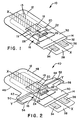
- an absorbent article 10 which is capable of absorbing body fluid.
- the absorbent article can be a diaper, a training pant, a sanitary napkin, a panty liner, an overnight pad, an incontinent garment, an underarm shield or any other known disposable product capable of absorbing urine, menses, blood, perspiration, excrement or other fluid discharged by a human body.
- the absorbent article 10 will be described in terms of a sanitary napkin.
- the absorbent article 10 includes a liquid-permeable cover 12, a liquid-impermeable baffle 14 and an absorbent 16 enclosed therebetween.
- the liquid-permeable cover 12 is designed to contact the body of the user and can be constructed of a woven or nonwoven material.
- the cover 12 can be constructed from natural or synthetic materials and should be easily penetrated by body fluid. Suitable materials include bonded carded webs of polyester, polypropylene, polyethylene, nylon or other heat-bondable fibers. Other polyolefins, such as copolymers of polypropylene and polyethylene, linear low-density polyethylene, finely-perforated film webs and net material, also work well.
- the cover 12 can also be constructed of a thermoplastic film which contains apertures and is flanked on both sides by a nonwoven material. This particular embodiment provides a soft feel against the user's thighs while allowing body fluid to rapidly pass therethrough.
- apertures 13 In order to facilitate movement of body fluid down into the absorbent article 10, one could form a plurality of apertures 13 in the cover 12.
- the apertures 13 can be randomly or uniformly arranged throughout the cover 12, or they can be located only in a narrow longitudinal band or strip arranged along the longitudinal axis X--X of the absorbent article 10.
- the apertures 13 permit rapid penetration of the body fluid down into the absorbent 16.
- the size, shape, diameter and number of apertures can vary to suit one's particular needs.
- the liquid-impermeable baffle 14 is designed to permit the passage of air or vapor out of the absorbent article 10 while blocking the passage of liquids.
- the baffle 14 can be made from any material having the above-identified properties.
- a good material is a micro-embossed, polymeric film, such as polyethylene or polypropylene. Bi-component films can also be used.
- a preferred material is polyethylene film.
- the baffle 14 will be a polyethylene film having a thickness in the range of about 0.2 to about 2.0 millimeters (mm), preferably about 0.3-1.0 mm.
- the cover 12 and the baffle 14 can be coextensive and in face to face contact around the periphery of the absorbent 16.
- the cover 12 and the baffle 14 can be sealed together about their peripheries by use of an adhesive, by heat sealing, by ultrasonics, or by any other process known to those in the art.
- the absorbent 16 consists of at least three separate and distinct members 18, 20 and 22, each having a predetermined wicking capability.
- the first member 18 is positioned immediately below the cover 12 and is aligned along the central longitudinal axis X--X of the absorbent article 10.
- the first member 18 provides a pre-use visual signal to the user that the body fluid will stay in the center of the absorbent article.
- the first member 18 can also have a high wicking capability, especially for menses, and can be comprised of a fine pore, highly pigmented fabric.
- the first member 18 is of a different color, and preferably darker, than the cover 12 and/or the second member 20. Peach, pink or blue offers a good pre-use visual signal that the fluid will stay in the center of the absorbent article 10.
- the first member 18 can alternatively be a coating or layer of ink deposited on a surface of the cover 12 or on a surface of the second member 20.
- the first member 18 will be described as an absorbent member having wicking
- meltblown works well for the first member 18, for it has excellent menses distribution properties.
- a description of meltblown is taught in U.S. Patent 4,798,603 issued to Meyer et al. and assigned to the present assignee.
- the first member 18 can be in the shape of a rectangular strip, having a length equal to or less than the overall length of the absorbent article 10, and a width less than the width of the absorbent article 10.
- a length of between about 6 to about 12 inches (about 152 to about 304 mm) and a width of between about 0.5 to about 2 inches (about 12 to about 25.4 mm) works well.
- the first member 18 has a length approximately equal to the length of the absorbent article 10, and a width of between about 1 to about 1.5 inches (about 25.4 mm to about 38.1 mm), most preferably about 1.25 inches (about 31.75 mm).
- the first member 18 should be capable of controlling the longitudinal and transverse movement of the body fluid which is delivered to the cover 12. Since the first member 18 is narrower than the absorbent article 10, the sides of the first member 18 are spaced away from the longitudinal side edges of the absorbent article 10, and the body fluid is restricted to the area within the periphery of the first member 18, before it passes down into the second member 20. This design enables the body fluid to be confined to the central area of the absorbent article 10, and to be wicked lengthwise so that a greater quantity of the second member 20 can be utilized.
- apertures 19 In order to facilitate movement of body fluid down into the absorbent article 10, one could form a plurality of apertures 19 in the first member 18. Some or all of the apertures 13 formed in the cover 12 and the apertures 19 formed through the first member 18 can be axially aligned so as to rapidly allow the body fluid to penetrate down into the absorbent 16.
- the size, shape, diameter and number of apertures 19 can vary to suit one's particular needs.
- the apertures 19 can be uniformly or randomly arranged throughout all or a portion of the upper surface of the first member 18.
- the second member 20 is positioned below the first member 18 and has a lower wicking capability, especially for menses, than the first member 18 when the first member 18 is an absorbent having wicking properties.
- the second member 20 can have a length of between about 6 to about 12 inches (about 152 to about 304 mm).
- the first member 18 has a length approximately equal to the length of the absorbent article 10.
- the second member 20 has a equal width greater than the width of the first member 18.
- the width of the second member 20 can be between about 2 to about 3 inches (about 50.8 to about 76.2 mm), preferably about 2.5 inches (about 63.5 mm). A width greater than about 3 inches (about 50.8 mm) can cause discomfort to some users.
- the second member 20 can be a hydrophilic material formed from various types of natural or synthetic fibers, including cellulose fibers, surfactant treated meltblown fibers, wood pulp fibers, regenerated cellulose or cotton fibers, or a blend of pulp and other fibers.
- the second member 20 is formed from a material having a large pore structure and exhibits both wet and dry resiliency to ensure comfort and protection.
- Coform and air-laid fabric are two materials that work well as the second member.
- Coform is an air-formed blend of meltblown fibers and pulp fibers. The formation of such material is disclosed in U.S. Patent 4,100,324 which issued to Anderson et al. A coform mixture of about 60 percent cellulose fibers with about 40 percent polypropylene meltblown fibers, works well.
- Airtex® 395 sold by James River Corporation located at 500 Day St., P.O. Box 23790, Green Bay, Wisconsin 54309-3790. Airtex® 395 is 100% virgin softwood held together by an acrylic binder.
- the second member 20 can also contain thermoplastic polymers which can be permanently deformed by the application of heat and pressure.
- thermoplastic polymers include polypropylene, nylon, polyethylene, polyesters, etc. Typical of such materials are bonded carded webs, spunbond fabrics, air-laid fabrics with thermally fusable binder fibers.
- the second member 20 is C-folded and has two oppositely aligned, longitudinal edges 24 and 26 which are spaced apart, and forming a longitudinal gap or groove 28 therebetween.
- the C-fold enables the second member 20 to flex thereby allowing the absorbent article 10 to conform and stay in intimate contact with a user's body, approximate the pudendum. It is a known fact, that if an absorbent article can be kept in constant contact with the body, that the likelihood of leakage is greatly minimized.
- Fig. 1 shows a gap 28, it should be noted that the two edges 24 and 26 can slightly overlap one another or even abut one another, and still accomplish the same function as when they are spaced slightly apart.
- the gap 28 can range between 0 to about .375 inches (about 10 mm).
- the gap 28 When the gap 28 is present, an added feature is provided in that body fluid, present in the first member 18, has a direct route to the third member 22, which is located within the C-folded second member 20.
- This unobstructive pathway is especially useful when the body fluid is menses, because there is provided a clear path to allow the movement of the viscous fluid from the first member 18 down into the third member 22.
- a pathway which allows for rapid penetration of the body fluid into the center of the absorbent 16, is highly advantageous in keeping the cover 12 dry and providing for a no leak product.
- the third member 22 is positioned within the C-folded second member 20 and has a higher wicking capability than the second member 20. Preferably, the third member 22 will have a wicking capability, even higher than the first member 18.
- the third member 22 can consist of one or more layers of tissue, a folded tissue or a meltblown material which exhibits excellent fluid distribution properties. As shown in Fig. 1, an E-folded, wet-laid and through-dried creped tissue works well in that it is easy to manufacture and fold.
- the tissue can be formed from hardwood and/or softwood fibers. The tissue has a fine pore structure and provides an excellent wicking capability, especially for menses.
- the third member 22 can have a width approximately equal to, less than or greater than the width of the first member 18.
- the third member 22 can have a width ranging from between about .75 to about 2.25 inches (about 19 mm to about 76.2 mm). It should be noted that the third member 22 can have a width equal to the width of the second member 20 if desired.
- the length of the third member 22 can range from between about 5 to about 12 inches (about 127 mm to about 304 mm). It should be noted that for an article larger than a sanitary napkin, the size of the third member 22 can be proportionally sized.
- the length of the third member 22, can be equal to or less than the length of the second member 20, preferably slightly less than the second member 20.
- the first absorbent member 18 can serve as a fluid distribution member to allow the body fluid to be distributed in a controlled manner along the length of the absorbent article 10.
- the second member 20 initially transfers fluid from the first member 18 into the third member 22.
- the third member 22 then wicks the fluid along its length and width before releasing the fluid to the second member 20. Therefore, the third member 22 can become completely saturated before the fluid is taken up by the second member 20.
- This action provides a good post-use visual signal to the user that the fluid is staying in the center of the absorbent article 10 thereby reinforcing the pre-use visual signal initially conveyed to the user.
- the fluid is therefore being wicked uniformly along both the first and third members, 18 and 22 respectively, keeping the fluid in the center of the absorbent article 10.
- the absorbent article 10 also contains a wet resilient member 30, which is positioned between the second member 20 and the liquid-impermeable baffle 14.
- the wet resilient member 30 can be a closed cell, polyethylene foam presently commercially sold by Sealed Air Corporation, 7110 Santa Fe Drive, Hodgkins, Illinois 60525.
- the foam is sold as Cell-Aire®, CA-30 having a thickness of about 1/32 of an inch (about 0.8 mm), with a density of 19.22 Kg/m 3 (1.2 pounds per cubic foot), a width of 1,52 m (60 inches), and on rolls having a linear length of 2000 feet (615 meters).
- Another polyethylene foam that is also suitable for the wet resilient member 30, is sold by Ametek Microfoam Division, Brandwine Four Building, Routes 1 and 202, Chadds Ford, Pennsylvania 19317.
- the wet resilient member 30 serves to resist bunching and twisting of the absorbent article 10 during use.
- wet resilient is meant that the member 30 is resilient even when wetted by body fluid.
- the wet resilient member 30 has a length and a width which can be coterminous with the length and width of the cover 12 and/or the baffle 14.
- the wet resilient member 30 should have a width equal to or greater than the width of the absorbent 16 and a length equal to or greater than the length of the absorbent 16.
- the wet resilient member 30 resists bunching and twisting of the absorbent article 10 and therefore cooperates with the gap 28 in keeping the absorbent article 10 in intimate contact with the user's body.
- garment attachment adhesive 34 and 36 Physically attached to an exterior surface 32 of the baffle 14, are two longitudinally extending strips of garment attachment adhesive 34 and 36. It should be noted that one wide strip, three or more narrow strips, or a spray pattern of adhesive can also be used.
- the garment attachment adhesive is commercially available from National Starch and Chemical Company, located at 10 Finderne Ave., Bridgewater, New Jersey 08807.
- the garment adhesive strips 34 and 36 are used to secure the absorbent article 10 to the inside of the crotch portion of an undergarment, when the absorbent article 10 is a catamenial product. If the absorbent article 10 is a diaper or a training pant, the garment adhesive strip 34 and 36 may not be needed.
- the garment adhesive strips 34 and 36 serve to properly align the absorbent article 10 over the vaginal opening.
- a releasable peel strip 38 is attached to the garment adhesive strips 34 and 36 and serves to prevent the adhesive from becoming contaminated prior to attachment to an undergarment.
- the peel strip 38 can be a white Kraft paper, coated on one side, so that it can be released from a hot melt adhesive, such as the garment adhesive strips 34 and 36.
- the peel strip 38 is designed to be removed ultimately by the consumer just prior to placement of the absorbent article 10 in the undergarment.
- Tests were conducted to determine the wicking capabilities of the various materials of different absorbent articles, specifically sanitary napkins.
- the test procedure determined the wicking capability of the various materials using a dye solution which was dispensed at a flow rate of 3 ⁇ .5 milliliters (ml)/30 seconds. Measurements were taken at two different times, at 30 seconds to establish an initial insult and at 5 minutes after initial insult.
- the equipment and materials needed for the test are as follows:
- each sample should be removed from a protective package, if the sample is retained in a package. Each sample should then be held at a temperature of 73°F ⁇ 1°F and at a relative humidity of 50% ⁇ 2% for at least 2 hours. After being conditioned, a 2 by 6 inch (52 mm x 152 mm) specimen is cut from the center of each sample. The longer dimension corresponds to the length of the article from which it is cut.
- each 2 by 6 inch specimen is laid on a table with it's body side surface facing up.
- the tip of the needle is centered over the specimen.
- the switch which controls the flow of the dye solution from the pump is turned on to allow the dye solution to flow onto the center of the specimen.
- the stopwatch is started as soon as the dye solution drips onto the specimen.
- the switch to the pump is turned off and the stopwatch is simultaneously stopped. This time period represents what is referred to in the Tables as the "initial insult" and the amount of fluid dispensed should be 3 ml. As quickly as possible, the cover is removed from the specimen.
- the length and width of the fluid stain on the first and second members, and each additional member if one is present, is measured with the metric ruler. Each member is carefully peeled apart from the adjacent member in order to measure the fluid stain. This measurement is denoted and recorded and represents the initial insult of the dye solution. All of the members and the cover are then returned to their original position and the stopwatch is started. Five minutes thereafter the stopwatch is stopped. As quickly as possible, the cover is removed from the specimen. The length and width of the fluid stain on the absorbent members, as described above, are measured and recorded. These measurements are denoted and recorded as the "5 minute after insult" reading. This is the final measurement.
- Prototypes 1 and 2 The data appearing in Table 1 below was obtained using the above described test procedure.
- Four commercially available sanitary napkins were tested along with two prototypes of the present invention.
- the two prototypes are labelled as Prototypes 1 and 2.
- the highest value for any of the commercially tested products was 95 mm, see (KUT 2nd member).
- the first and third absorbent members (18 and 22, respectively) in Prototypes 1 and 2 clearly had a higher wicking capability than the second absorbent member 20.
- Table 2 shows the ratios of fluid stain length of two adjacent absorbent members in a sanitary napkin for the four commercial products and the two prototypes identified in Table 1. The ratio was determined by dividing the length of the fluid stain in the absorbent member having the higher wicking capability by the length of the fluid stain in the absorbent member having the lower wicking capability. When the product contained three absorbent members (see Prototypes 1 and 2, KUT, and NF Maxi), the length of the fluid stain for each of the two absorbent members having the higher wicking capability was divided by the length of the fluid stain in the absorbent member having the lowest wicking capability.
- the ratios in Table 2 show that the stain length ratios 5 minutes after initial insult were 1.7, 2.0 and 2.0, 2.1, for Prototypes 1 and 2, respectively. These values are a representation of the relationship of the wicking capability of the higher wicking members to the lowest wicking member. A larger value indicates that the difference of wicking is more pronounced between the members. Another way of stating this is to say that the two higher wicking members have a wicking capability which is significantly greater than the wicking capability of the lowest wicking member. This feature enables the higher wicking members to wick the body fluid much more efficiently than the lowest wicking member.
- fluid stain lengths further support the fact that the first and third absorbent members in this invention have a greater wicking capability than the second member.
- the combination of ratio of fluid stain length of the highest wicking members divided by the fluid stain length of the lowest wicking member being greater than 1.7 along with the fluid stain being at least 76 mm, and preferably at least 99 mm, produces an unexpected result that enables the present invention to function much better than any of the tested products. It should be noted that the time period to determine the stain lengths is at 5 minutes after initial insult of 3 ml.
- the NF Maxi commercial product has a fluid stain length of 60 mm in the highest wicking member, well below 76 mm.
- AUM 1st member 45 50 2nd member 60 70 SFUP 1st member 55 60 2nd member 62 66 PROTOTYPE 1 1st member 83 110 2nd member 60 65 3rd member 98 129 PROTOTYPE 2 1st member 70 110 2nd member 50 55 3rd member 79 115 KUT 1st member 55 55 2nd member 70 95 3rd member 50 52 NF Maxi 1st member 38 40 2nd member 24 30 3rd member 32 60
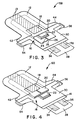
- an absorbent article 40 which is similar to that depicted in Fig. 1 except that it contains a pair of tabs 42 and 44 which are capable of being folded under the crotch portion of an undergarment.
- Each tab, 42 and 44 respectively extends outward from a longitudinal side edge, 46 and 48 respectively, of the absorbent article 40.
- the tabs 42 and 44 can have any desired configuration, but a rectangular or trapezoidal configuration works well.
- the sides of the tabs 42 and 44 can taper inward as they progress toward a distal end, 50 and 52 respectively, at an angle of about 1 degree to about 25 degrees. A preferred angle is about 12 degrees. The taper is measured relative to a central transverse axis Y--Y of the absorbent article 40.
- the tabs 42 and 44 can have a surface area of about 1.2 in. 2 (7.7 cm 2 ).
- the tabs 42 and 44 have a length measured parallel to the longitudinal axis X--X of the absorbent article 40, and a width, measured parallel to the transverse axis Y--Y of the absorbent article 40.
- the length of each tab 42 and 44 can be measured from the center of a radius, formed on one side of the tab to the center of a radius formed on an opposite side of the tab.
- the radii join the sides of the tabs 42 and 44 to the longitudinal side edges 46 and 48 of the absorbent article 40.
- each tab 42 and 44 should be between about 0.75 to about 2.0 inches (about 19 mm to about 51 mm), preferably about 1.5 inches (about 38 mm).
- the width of each tab 42 and 44 can be between about 0.5 to about 1.5 inches (about 13 mm to about 38 mm), preferably about 1 inch (about 25.4 mm).
- the size, shape and thickness of the tabs 42 and 44 can vary depending upon the size and configuration of the absorbent article they are attached to.
- the tabs 42 and 44 are constructed of the cover 12, the baffle 14 and the wet resilient member 30. Therefore, the tabs 42 and 44 are thinner and have a Gurley stiffness which is less than that of the absorbent 16.
- Each tab 42 and 44 also contains a patch or strip of garment adhesive (not shown) attached to the baffle side of each tab 42 and 44 which is covered by a releasable peel strip, 54 and 56 respectively.
- the garment adhesive should cover an area of at least 0.5 square inches (about 323 mm 2 ) of each tab 42 and 44, and preferably, at least 50% of each tab 42 and 44.
- the particular shape and configuration of the adhesive can vary.
- a garment adhesive which works well is adhesive NS 34-5516 which is commercially available from National Starch Company, located at 10 Finderne Ave., Bridgewater, New Jersey 08807.
- the tabs 42 and 44 should have a Gurley stiffness in the range of between about 50 milligrams (mg) to about 150 mg, preferably about 77 mg to about 115 mg when the peel strip is removed to provide optimum comfort and drapability.
- the tabs 42 and 44 should have a thickness of greater than about 0.5 mm, preferably about 0.7 mm to about 1.5 mm, and most preferably about 1.1 mm to about 1.2 mm when the peel strip is removed, see values for Prototype 1 in Table 4.
- Gurley Digital Stiffness Tester Model 4171-d. Five samples of each article should be tested. At least one tab on each article must be tested. The articles are removed from any pouch that they may be contained in and are unfolded. The articles are then conditioned by holding them at a temperature of 73°F ⁇ 1° and at a relative humidity of 50% ⁇ 2% for at least 2 hours before testing. A 12.7 mm x 25.4 mm sample is then cut from the center of one tab per article. It should be noted that if the article contains a single peel strip on only one tab, then the tab without the peel strip should be used for this portion of the test. It is also important to avoid testing those areas of a tab which contain Velcro® or other types of hook and loop fasteners. The articles should be carefully handled to avoid affecting the stiffness of the sample.
- the Gurley stiffness tester should be calibrated before use.
- the electronics of the tester should be calibrated as stated in the instruction manual.
- In setting up the Gurley stiffness tester one will have to attach the required weight and adjust the leveling screw, until the level's bubble is centered and the pendulum's pointer is indicating zero.
- the switches should be set for specified weight, specified weight position, width (0.5 inches) and length (1 inch).
- the test procedure involves the following steps:
- Ames Bulk Tester with a dial indicator, Model No. 482. At least one tab on each article must be tested. Five samples of each article should be tested. The articles are removed from any pouch that they may be contained in and are unfolded. The articles are then conditioned by holding them at a temperature of 73°F ⁇ 1° and at a relative humidity of 50% ⁇ 2% for at least 2 hours before testing. The center of the non-adhesive side of each tab is then marked using a marker and a ruler. The comparator gauge on the Ames Bulk Tester is zeroed. An 80.0 grams stainless steel weight is placed on the spindle extending above the comparator dial.
- the circular aluminum comparator foot (having a contact surface of 5.16 cm 2 and having a weight of 10 g) on the Ames Bulk Tester is then moved to its upper limit and a sample is placed on the base of the tester with the garment adhesives facing down. This position allows the foot of the tester to be lower onto the center of the tab. The lever on the tester is then gently released to lower the comparator foot onto the sample.
- the dial is read 30 seconds after the foot comes in contact with the material of which the tab is constructed. The measurement is recorded in inches, as indicated on the dial. The measurement can be converted to millimeters by multiplying the value by 25.4. The number should be recorded to two places to the right of the decimal point.
- the foot is then raised and the sample is removed so that subsequent samples can be tested. It is important that the base of the tester be cleaned after each sample.
- the peel strip is removed from the tab and the garment adhesive is dusted with talc or corn starch.
- This unique range of Gurley stiffness has been found to be the most suitable for the function of the tabs.
- Tabs that are in the range of stiffness of the WrapAround® pantiliner have been found to suffer from a lack of conformability. They have a tendency to lose their attachment to the undergarment during use in wear conditions. This stiffness range is also not optimum for comfort. For optimum performance and comfort, the tabs should have a Gurley stiffness of less than about 150 mg.
- these highly flexible tabs or wings will have a tendency to bunch and distort. This can be a functional problem, in that the bunched tabs will not do their job of holding the article in place.
- the bunching is also a comfort problem, in that the wrinkles resulting from bunching are uncomfortable.
- the tabs have a Gurley stiffness of about 50 mg or above they are sufficiently stiff that they do not stick to the absorbent article upon removal of the peel strip. Furthermore, the tabs exhibit greatly improved resistance to in use bunching relative to prior art tabs that are more flexible.
- tabs that have a Gurley stiffness greater than about 50 mg that the tabs also have a thickness greater than about 0.5 mm. This will insure that the tabs are comfortable. Tabs stiffer than about 50 mg and thinner than about 0.5 mm will present a side edge that can feel sharp to the user, and therefore can cause discomfort.
- an absorbent article 58 is shown which is similar to that depicted in Fig. 2, except that the second member 20 is C-folded such that the gap or groove 28 faces downward towards the baffle 14. Such an embodiment may be easier to manufacture on some equipment.
- an absorbent article 60 is shown which is similar to that depicted in Fig. 2 except that the third member 22 is positioned below the second member 20. In this arrangement, it is possible to make both the second and third members, 20 and 22 respectively, of the same width. By positioning the third member 22 below the second member 20 instead of within the C-fold, the absorbent article 60 may be easier to manufacture.
- an absorbent article 62 is shown which is similar to that depicted in Fig. 2, except that the third member 22 is positioned above the second member 20. In this arrangement, it is possible to make both the second and third members, 20 and 22 respectively, of the same width. By positioning the third member 22 above the second member 20 instead of within the C-fold, the absorbent article 60 may be easier to manufacture.
- an absorbent article 64 is shown which is similar to that depicted in Fig. 2, except that the second member 20 is not C-folded but instead consist of two separate members 66 and 68.
- the member 66 is positioned above the third member 22 while the member 68 is positioned below the third member 22.
- the members 66 and 68 would be made out of the same material and would have the same wicking capability. However, if one desired to change the material or wicking properties of the member 68, this could easily be done.
- the gap or groove 28 would still be present in the member 66 to facilitate movement of body fluid downward into the third member 22.
- the gap 28 can be formed by constructing the member 66 out of two separate strips of material and laying them parallel to one another and slightly spaced apart. Another way to obtain the gap 28 is to form a slit in the member 66 only along a portion of its length. The gap 28 should be in alignment with the longitudinal central axis X--X of the absorbent article 64.
Landscapes
- Health & Medical Sciences (AREA)
- Epidemiology (AREA)
- Life Sciences & Earth Sciences (AREA)
- Biomedical Technology (AREA)
- Heart & Thoracic Surgery (AREA)
- Vascular Medicine (AREA)
- Engineering & Computer Science (AREA)
- Animal Behavior & Ethology (AREA)
- General Health & Medical Sciences (AREA)
- Public Health (AREA)
- Veterinary Medicine (AREA)
- Absorbent Articles And Supports Therefor (AREA)
- Orthopedics, Nursing, And Contraception (AREA)
Claims (26)
- Absorbierender Artikel mit einer Längsachse, wobei der absorbierende Artikel erste (18), zweite (20) und dritte (22) Elemente umfasst, die jeweils eine Dochtwirkungsfähigkeit und jeweils eine vorherbestimmte Breite aufweisen
dadurch gekennzeichnet, dassdie zweiten und dritten Elemente unterhalb des ersten Elements angeordnet sind,das zweite Element (20) zwischen den ersten und dritten Elementen angeordnet ist und mit diesen in Kontakt steht,das erste Element entlang der Längsachse eine Dochtwirkungsfähigkeit aufweist und eine unterschiedliche Farbe hat als das zweite Element, um dem Benutzer ein visuelles Signal vor Gebrauch zu geben, dass Körperfluid in einem zentralen Bereich des Artikels bleiben wird, wobei das zweite Element entlang der Längsachse eine geringere Dochtwirkungsfähigkeit als das erste Element aufweist, und wobei das dritte Element entlang der Längsachse eine höhere Dochtwirkungsfähigkeit aufweist als das erste Element, wobei das zweite Element C-gefaltet ist und zwei gegenüberliegend angeordnete Kanten aufweist, die beabstandet sind, um dazwischen einen Spalt zu bilden, wobei die C-Falte das Biegen des zweiten Elements ermöglicht, wodurch sich der absorbierende Artikel an einen eine Breite aufweist, welche größer ist als die Breite des ersten Elements, und wobei das zweite Element ein Flächengewicht von weniger als 300 g/m2 (gsm) aufweist. - Absorbierender Artikel gemäß Anspruch 1, wobei das dritte Element (22) breiter ist als das erste Element.
- Absorbierender Artikel gemäß Anspruch 1, wobei das erste Element (18) schmelzgeblasen ist.
- Absorbierender Artikel gemäß Anspruch 1, wobei das zweite Element (20) zusammengesetzt ist.
- Absorbierender Artikel gemäß Anspruch 1, wobei das zweite Element (20) ein luftabgelegter Stoff ist.
- Absorbierender Artikel gemäß Anspruch 1, wobei das dritte Element (22) eine durchluftgetrocknetes, gekrepptes Tissue ist.
- Absorbierender Artikel gemäß Anspruch 1, wobei ein viertes Element unterhalb des dritten Elements (22) angeordnet ist, wobei das vierte Element eine geringere Dochtwirkungsfähigkeit aufweist als das erste (18) und dritte Element (22).
- Absorbierender Artikel umfassend:wobei die flüssigkeitsdurchlässige Abdeckung eine Öffnung äufweist, welche die visuelle Inspektion von wenigstens einem Teil von wenigstens dem ersten und zweiten Element gemäß Anspruch 1 ermöglicht, um das visuelle Signal vor Gebrauch zu überwachen.a) eine flüssigkeitsdurchlässige Abdeckung (12);b) eine flüssigkeitsundurchlässige Hemmschicht (14); undc) ein Absorbens gemäß Anspruch 1 eingefasst durch die Abdeckung und die Hemmschicht.
- Absorbierender Artikel gemäß Anspruch 8, wobei das Absorbens eine Dicke von weniger als etwa 7 Millimeter aufweist.
- Absorbierender Artikel gemäß Anspruch 9, wobei das Absorbens eine Dicke von weniger als etwa 5 Millimeter aufweist.
- Absorbierender Artikel gemäß Anspruch 8, wobei ein nässeelastisches Element (30) zwischen dem Absorbens und der Hemmschicht (14) angeordnet ist, wodurch eine Beständigkeit gegenüber Zusammenballen des absorbierenden Artikels bereitgestellt wird.
- Absorbierender Artikel gemäß Anspruch 11, wobei das nässeelastische Element (30) Polyethylenschaum ist.
- Absorbierender Artikel gemäß Anspruch 8, umfassend eine zentrale Längsachse, wobei das erste Element benachbart zu der Abdeckung angeordnet und entlang der zentralen Längsachse ausgerichtet ist, wobei das zweite Element benachbart zu dem ersten Element angeordnet ist, und wobei zusätzlich ein nässeelastisches Element (30) zwischen dem Absorbens und der Hemmschicht angeordnet ist, welches eine Beständigkeit gegenüber Zusammenballen des absorbierenden Artikels bereitgestellt.
- Absorbierender Artikel gemäß Anspruch 13, wobei die Abdeckung (12) und die Hemmschicht (14) eine Größe aufweisen und gestaltet sind, um ein Paar Streifen (42, 44) zu bilden, die sich falten lassen und die sich von dem Absorbens nahe eines mittleren Bereichs davon nach außen erstrecken, und wobei die Abdeckung und die Hemmschicht miteinander um die Peripherie des absorbierenden Artikels verschlossen sind.
- Absorbierender Artikel gemäß Anspruch 14, wobei jeder der Streifen (42, 44) Befestigungsmittel zum Haltern des Streifens an einer Unterbekleidung umfasst.
- Absorbierender Artikel gemäß Anspruch 15, wobei jeder der Streifen (42, 44) eine Gurley-Steifheit zwischen etwa 50 mg und etwa 150 mg und eine Dicke von mehr als etwa 0,5 mm aufweist.
- Absorbierender Artikel gemäß Anspruch 13, wobei der absorbierende Artikel eine zentrale Längsachse aufweist, und wobei das erste Element (18) benachbart zu der Abdeckung (12) angeordnet ist und entlang der zentralen Längsachse ausgerichtet ist.
- Absorbierender Artikel gemäß Anspruch 13, wobei das erste Element (18) schmelzgeblasen ist.
- Absorbierender Artikel gemäß Anspruch 13, wobei der Spalt benachbart zu dem ersten Element (18) angeordnet ist.
- Absorbierender Artikel gemäß Anspruch 13, wobei der Spalt benachbart zu dem nässeelastischen Element (30) angeordnet ist.
- Absorbierender Artikel gemäß Anspruch 8, mit einer zentralen Längsachse, wobei das erste Element (18) eine Lasche aus schmelzgeblasenem Material ist, das benachbart zu der Abdeckung (12) angeordnet ist und entlang der zentralen Längsachse ausgerichtet ist, und wobei ein zwischen dem Absorbens und der Hemmschicht (14) angeordnetes nässeelastisches Element (30) bereitgestellt ist, das eine Beständigkeit gegenüber Zusammenballen des absorbierenden Artikels bereitgestellt.
- Absorbierender Artikel gemäß Anspruch 8, mit einer zentralen Längsachse, einer zentralen Querachse und einem Paar Längsseitenkanten, wobei das erste Element (18) eine Lasche aus schmelzgeblasenem Material ist, das benachbart zu der Abdeckung (12) angeordnet ist und entlang der zentralen Längsachse ausgerichtet ist, umfassend ein zwischen dem Absorbens und der Hemmschicht (14) angeordnetes nässeelastisches Element (30), das eine Beständigkeit gegenüber Zusammenballen des absorbierenden Artikels bereitgestellt, und ein Paar Streifen (42, 44), die sich falten lassen und die entlang der zentralen Querachse angeordnet sind, die sich von den Längsseitenkanten des absorbierenden Artikels seitlich nach außen erstrecken, wobei die Streifen die Abdeckung, das nässeelastische Element und die Hemmschicht einfassen;Klebemitteln zum Haltern des absorbierenden Artikels an einer Unterbekleidung, wobei das Klebemittel auf der kleidungsstückseitigen Oberfläche der Hemmschicht an einer Stelle zwischen den Längsseitenkanten und auf jedem der Streifen vorhanden ist;und einem das Klebemittel abdeckende Loslösepapier (38).
- Absorbierender Artikel gemäß Anspruch 22, wobei das dritte Element benachbart zu dem zweiten Element angeordnet ist.
- Absorbierender Artikel gemäß Anspruch 1, wobei das zweite Element eine Breite aufweist, die größer ist als die Breite des dritten Elements.
- Absorbierender Artikel gemäß Anspruch 24, wobei das erste Element (18) eine andere Farbe aufweist als die Abdeckung (12).
- Absorbierender Artikel gemäß Anspruch 24, wobei das erste Element (18) eine dunklere Farbe aufweist als die Abdeckung (12).
Priority Applications (1)
| Application Number | Priority Date | Filing Date | Title |
|---|---|---|---|
| EP01122027A EP1161928B1 (de) | 1993-05-12 | 1994-05-05 | Saugfähiger Artikel |
Applications Claiming Priority (3)
| Application Number | Priority Date | Filing Date | Title |
|---|---|---|---|
| US5824793A | 1993-05-12 | 1993-05-12 | |
| US58247 | 1993-05-12 | ||
| PCT/US1994/005007 WO1994026220A1 (en) | 1993-05-12 | 1994-05-05 | Absorbent article having enhanced wicking capability |
Related Child Applications (1)
| Application Number | Title | Priority Date | Filing Date |
|---|---|---|---|
| EP01122027A Division EP1161928B1 (de) | 1993-05-12 | 1994-05-05 | Saugfähiger Artikel |
Publications (2)
| Publication Number | Publication Date |
|---|---|
| EP0697846A1 EP0697846A1 (de) | 1996-02-28 |
| EP0697846B1 true EP0697846B1 (de) | 2002-04-03 |
Family
ID=22015607
Family Applications (2)
| Application Number | Title | Priority Date | Filing Date |
|---|---|---|---|
| EP94917311A Expired - Lifetime EP0697846B1 (de) | 1993-05-12 | 1994-05-05 | Absorbierender artikel mit guten dochteigenschaften |
| EP01122027A Revoked EP1161928B1 (de) | 1993-05-12 | 1994-05-05 | Saugfähiger Artikel |
Family Applications After (1)
| Application Number | Title | Priority Date | Filing Date |
|---|---|---|---|
| EP01122027A Revoked EP1161928B1 (de) | 1993-05-12 | 1994-05-05 | Saugfähiger Artikel |
Country Status (12)
| Country | Link |
|---|---|
| US (1) | US5401267A (de) |
| EP (2) | EP0697846B1 (de) |
| JP (1) | JP3803111B2 (de) |
| KR (1) | KR100350200B1 (de) |
| CN (1) | CN1221224C (de) |
| AU (1) | AU684516B2 (de) |
| CA (1) | CA2104282C (de) |
| DE (2) | DE69430308T2 (de) |
| FR (1) | FR2705029B1 (de) |
| MY (1) | MY111518A (de) |
| TW (1) | TW329666U (de) |
| WO (1) | WO1994026220A1 (de) |
Families Citing this family (102)
| Publication number | Priority date | Publication date | Assignee | Title |
|---|---|---|---|---|
| US5454800A (en) * | 1993-05-12 | 1995-10-03 | Kimberly-Clark Corporation | Absorbent article |
| US6994698B2 (en) | 1994-12-28 | 2006-02-07 | Kimberly-Clark Worldwide, Inc. | Flexible mechanical fastening tab |
| CA2134279C (en) * | 1993-12-29 | 2006-11-07 | Takamitsu Igaue | Liquid absorbing sheet material, method of manufacturing the liquid absorbing sheet material, method of manufacturing a sheet material and sanitary articles produced thereby |
| PT748196E (pt) * | 1994-03-01 | 2000-11-30 | Procter & Gamble | Penso higienico com triseccoes |
| US5505719A (en) * | 1994-06-30 | 1996-04-09 | Mcneil-Ppc, Inc. | Multilayered absorbent structures |
| AU685986B2 (en) * | 1994-08-31 | 1998-01-29 | Kimberly-Clark Worldwide, Inc. | Thin absorbent article having wicking and crush resistant poperties |
| US5558658A (en) * | 1994-11-23 | 1996-09-24 | Kimberly-Clark Corporation | Disposable diaper having a humidity transfer area |
| USH1602H (en) * | 1995-03-31 | 1996-10-01 | Brock; Cheryl K. | Self-adhering disposable absorbent article |
| US5647863A (en) * | 1995-09-21 | 1997-07-15 | The Procter & Gamble Company | Absorbent article with clean appearance and capacity signal means |
| US6060638A (en) | 1995-12-22 | 2000-05-09 | Kimberly-Clark Worldwide, Inc. | Matched permeability liner/absorbent structure system for absorbent articles and the like |
| US6011195A (en) | 1996-10-10 | 2000-01-04 | Kimberly-Clark Worldwide, Inc. | Wet resilient absorbent article |
| US5843055A (en) * | 1996-07-24 | 1998-12-01 | The Procter & Gamble Company | Stratified, multi-functional fluid absorbent members |
| US5897516A (en) * | 1996-09-27 | 1999-04-27 | Bristol-Myers Squibb Company | Method of treating a wound by monitoring the swelling of a hydrocolloid layer in a wound dressing |
| US6152904A (en) | 1996-11-22 | 2000-11-28 | Kimberly-Clark Worldwide, Inc. | Absorbent articles with controllable fill patterns |
| US5820973A (en) | 1996-11-22 | 1998-10-13 | Kimberly-Clark Worldwide, Inc. | Heterogeneous surge material for absorbent articles |
| US5843063A (en) | 1996-11-22 | 1998-12-01 | Kimberly-Clark Worldwide, Inc. | Multifunctional absorbent material and products made therefrom |
| US5879343A (en) * | 1996-11-22 | 1999-03-09 | Kimberly-Clark Worldwide, Inc. | Highly efficient surge material for absorbent articles |
| DE19745878C1 (de) * | 1997-10-17 | 1998-12-10 | Hartmann Paul Ag | Windel mit Nässeindikator |
| US6183587B1 (en) | 1997-11-26 | 2001-02-06 | The Procter & Gamble Company | Method of making sanitary napkin comprising three dimensionally shaped tube of absorbent material |
| US5938995A (en) * | 1998-02-06 | 1999-08-17 | Air Products And Chemicals, Inc. | Compression resistant cellulosic-based fabrics having high rates of absorbency |
| JPH11299825A (ja) * | 1998-04-20 | 1999-11-02 | Uni Charm Corp | 使い捨ての体液吸収性物品 |
| US6127595A (en) | 1998-04-22 | 2000-10-03 | Air Products And Chemicals, Inc. | Cover sheet lamination for absorbent article and low temperature lamination process |
| US6316688B1 (en) | 1998-04-27 | 2001-11-13 | The Procter & Gamble Company | Sanitary napkin comprising three dimensionally shaped tube of absorbent material |
| US6475199B1 (en) | 1998-04-27 | 2002-11-05 | The Procter & Gamble Company | Method of individually packaging a three dimensionally-shaped absorbent article |
| US6667424B1 (en) * | 1998-10-02 | 2003-12-23 | Kimberly-Clark Worldwide, Inc. | Absorbent articles with nits and free-flowing particles |
| US6503233B1 (en) | 1998-10-02 | 2003-01-07 | Kimberly-Clark Worldwide, Inc. | Absorbent article having good body fit under dynamic conditions |
| US6562192B1 (en) | 1998-10-02 | 2003-05-13 | Kimberly-Clark Worldwide, Inc. | Absorbent articles with absorbent free-flowing particles and methods for producing the same |
| US6673982B1 (en) * | 1998-10-02 | 2004-01-06 | Kimberly-Clark Worldwide, Inc. | Absorbent article with center fill performance |
| US6706945B1 (en) | 1998-11-04 | 2004-03-16 | Kimberly-Clark Worldwide, Inc. | Absorbent article with improved, wet-formed absorbent |
| US6323388B1 (en) | 1998-11-04 | 2001-11-27 | Kimberly-Clark Worldwide, Inc. | Absorbent article with an improved, wet-formed absorbent |
| US6214274B1 (en) | 1999-05-14 | 2001-04-10 | Kimberly-Clark Worldwide, Inc. | Process for compressing a web which contains superabsorbent material |
| US6177607B1 (en) | 1999-06-25 | 2001-01-23 | Kimberly-Clark Worldwide, Inc. | Absorbent product with nonwoven dampness inhibitor |
| US6673980B1 (en) | 1999-07-16 | 2004-01-06 | Kimberly-Clark Worldwide, Inc. | Absorbent product with creped nonwoven dampness inhibitor |
| US6413338B1 (en) | 1999-09-15 | 2002-07-02 | Kimberly-Clark Worldwide, Inc. | Method for forming an absorbent structure having vertically orientated flow regulating walls |
| US6264776B1 (en) | 1999-09-15 | 2001-07-24 | Kimberly-Clark Worldwide, Inc. | Method for forming an absorbent structure having vertically orientated absorbent members |
| US6479728B1 (en) | 1999-09-15 | 2002-11-12 | Kimberly-Clark Worldwide, Inc. | Absorbent structure with angularly orientated absorbent members |
| US6436328B1 (en) | 1999-09-15 | 2002-08-20 | Kimberly-Clark Worldwide, Inc. | Method for forming an absorbent structure |
| US6689933B1 (en) | 1999-09-15 | 2004-02-10 | Kimberly-Clark Worldwide, Inc. | Absorbent article having vertically orientated absorbent members |
| US6645187B1 (en) | 1999-09-15 | 2003-11-11 | Kimberly-Clark Worldwide, Inc. | Absorbent article having vertically oriented flow regulating walls |
| US6663611B2 (en) | 1999-09-28 | 2003-12-16 | Kimberly-Clark Worldwide, Inc. | Breathable diaper with low to moderately breathable inner laminate and more breathable outer cover |
| US6492574B1 (en) | 1999-10-01 | 2002-12-10 | Kimberly-Clark Worldwide, Inc. | Center-fill absorbent article with a wicking barrier and central rising member |
| US6764477B1 (en) | 1999-10-01 | 2004-07-20 | Kimberly-Clark Worldwide, Inc. | Center-fill absorbent article with reusable frame member |
| US6700034B1 (en) | 1999-10-01 | 2004-03-02 | Kimberly-Clark Worldwide, Inc. | Absorbent article with unitary absorbent layer for center fill performance |
| US6660903B1 (en) | 1999-10-01 | 2003-12-09 | Kimberly-Clark Worldwide, Inc. | Center-fill absorbent article with a central rising member |
| US6486379B1 (en) | 1999-10-01 | 2002-11-26 | Kimberly-Clark Worldwide, Inc. | Absorbent article with central pledget and deformation control |
| US6613955B1 (en) | 1999-10-01 | 2003-09-02 | Kimberly-Clark Worldwide, Inc. | Absorbent articles with wicking barrier cuffs |
| US6723892B1 (en) | 1999-10-14 | 2004-04-20 | Kimberly-Clark Worldwide, Inc. | Personal care products having reduced leakage |
| US20030026945A1 (en) * | 1999-11-09 | 2003-02-06 | Vincent P. Lasko | Nonwoven material comprising an adhesive and apertures |
| US6509513B2 (en) * | 1999-11-12 | 2003-01-21 | Tyco Healthcare Retail Services Ag | Absorbent article with improved fluid acquisition system |
| US20030208175A1 (en) * | 2000-06-12 | 2003-11-06 | Gross James R. | Absorbent products with improved vertical wicking and rewet capability |
| JP4840895B2 (ja) * | 2001-02-20 | 2011-12-21 | 株式会社日本吸収体技術研究所 | 液体分配ユニットとそれを備えた吸収体製品 |
| ATE322975T1 (de) | 2001-09-19 | 2006-04-15 | Procter & Gamble | Farbbedruckte mehrschichtstruktur, ein damit hergestellter absorbierender artikel und verfahren zu deren herstellung |
| US20030114814A1 (en) * | 2001-12-17 | 2003-06-19 | Baker Andrew Thomas | Zoned absorbency with uniform basis weight core material |
| US7270651B2 (en) * | 2001-12-19 | 2007-09-18 | The Procter & Gamble Company | Absorbent article |
| US7402157B2 (en) * | 2001-12-19 | 2008-07-22 | The Procter & Gamble Company | Absorbent article having perception of depth |
| US7306582B2 (en) * | 2001-12-19 | 2007-12-11 | The Procter & Gamble Company | Absorbent article |
| US20050107759A1 (en) * | 2002-01-17 | 2005-05-19 | Andrew Waksmundzki | Absorbent article with three-dimensional extrudate forming sap containment wells |
| US20050101929A1 (en) * | 2002-01-17 | 2005-05-12 | Andrew Waksmundzki | Absorbent core with three-dimensional sub-layer |
| US20030158532A1 (en) | 2002-02-20 | 2003-08-21 | Magee Luke R. | Disposable absorbent article designed to facilitate an easy intuitive change |
| US8716548B2 (en) | 2002-02-20 | 2014-05-06 | The Procter & Gamble Company | Disposable absorbent article designed to facilitate an easy change |
| US7166094B2 (en) * | 2002-05-28 | 2007-01-23 | Tyco Healthcare Retail Services Ag | Multiple layer absorbent article |
| US20030225385A1 (en) * | 2002-05-28 | 2003-12-04 | Glaug Frank S. | Absorbent article with multiple core |
| US20030236512A1 (en) * | 2002-06-19 | 2003-12-25 | Baker Andrew A. | Absorbent core with folding zones for absorbency distribution |
| US20040024375A1 (en) * | 2002-08-02 | 2004-02-05 | John Litvay | Multi-functional tissue for absorbent articles |
| US20040127873A1 (en) * | 2002-12-31 | 2004-07-01 | Varona Eugenio Go | Absorbent article including porous separation layer with capillary gradient |
| SE0300877D0 (sv) * | 2003-03-26 | 2003-03-26 | Sca Hygiene Prod Ab | Absorbent article comprising an absorbent structure |
| US7662745B2 (en) | 2003-12-18 | 2010-02-16 | Kimberly-Clark Corporation | Stretchable absorbent composites having high permeability |
| US7772456B2 (en) | 2004-06-30 | 2010-08-10 | Kimberly-Clark Worldwide, Inc. | Stretchable absorbent composite with low superaborbent shake-out |
| US20060069367A1 (en) * | 2004-09-29 | 2006-03-30 | Andrew Waksmundzki | Absorbent core having two or more types of superabsorbent |
| US20060069375A1 (en) * | 2004-09-29 | 2006-03-30 | Andrew Waksmundzki | Absorbent article with C-folded moisture barrier and methods of manufacturing same |
| US8304597B2 (en) * | 2004-12-15 | 2012-11-06 | The Procter And Gamble Company | Method of using an absorbent article having a functional enhancement indicator |
| US8378165B2 (en) * | 2004-12-15 | 2013-02-19 | The Procter And Gamble Company | Array of absorbent articles having functional enhancement indicators |
| US8039685B2 (en) | 2004-12-15 | 2011-10-18 | The Procter & Gamble Company | Absorbent article having a functional enhancement indicator |
| US9579238B2 (en) | 2005-02-17 | 2017-02-28 | The Procter & Gamble Company | Sanitary napkins capable of taking complex three-dimensional shape in use |
| US8211078B2 (en) | 2005-02-17 | 2012-07-03 | The Procter And Gamble Company | Sanitary napkins capable of taking complex three-dimensional shape in use |
| BRPI0615715A2 (pt) | 2005-09-06 | 2011-05-24 | Tyco Healthcare | curativo de ferimento independente com microbomba |
| US7736688B2 (en) * | 2007-02-23 | 2010-06-15 | Procter & Gamble | Printed web and method for making |
| US8142876B2 (en) * | 2007-02-23 | 2012-03-27 | The Procter & Gamble Company | Printed nonwoven web and method for making |
| US8575417B2 (en) | 2007-02-23 | 2013-11-05 | The Procter And Gamble Company | Printed formed film web and method for making |
| US20080306464A1 (en) * | 2007-06-07 | 2008-12-11 | Arnold Bruckner | Disposable multilayered low friction double lubricated adult brief |
| US20080306462A1 (en) * | 2007-06-07 | 2008-12-11 | Arnold Bruckner | Disposable multilayered low friction double lubricated bed pad |
| DE102009029194A1 (de) | 2009-09-04 | 2011-04-07 | Kimberly-Clark Worldwide, Inc., Neenah | Abtrennung gefärbter Stoffe aus wasserhaltigen Flüssigkeiten |
| CN102695483B (zh) * | 2009-10-28 | 2016-05-25 | 瑞德科技控股有限公司 | 具有一定分布型式吸收芯部的一次性吸收物件 |
| DK2731564T3 (da) | 2011-07-14 | 2019-07-29 | Smith & Nephew | Sårbandage og fremgangsmåde til behandling dermed |
| EP2787947B1 (de) * | 2011-12-09 | 2018-05-30 | Sca Hygiene Products AB | Signalschicht für einen saugfähigen artikel |
| US9161869B2 (en) | 2012-03-30 | 2015-10-20 | Kimberly-Clark Worldwide, Inc. | Absorbent articles with decolorizing agents |
| EP3650055B1 (de) | 2012-05-23 | 2026-01-07 | Smith & Nephew plc | Vorrichtungen und verfahren für unterdruckwundtherapie |
| MX353782B (es) | 2012-08-01 | 2018-01-29 | Smith & Nephew | Apósito para heridas. |
| CN108186200B (zh) | 2012-08-01 | 2021-08-10 | 史密夫及内修公开有限公司 | 伤口敷料 |
| US20150057632A1 (en) | 2013-08-23 | 2015-02-26 | The Procter & Gamble Company | Absorbent Article |
| US9237975B2 (en) | 2013-09-27 | 2016-01-19 | Kimberly-Clark Worldwide, Inc. | Absorbent article with side barriers and decolorizing agents |
| JP6586431B2 (ja) | 2014-06-18 | 2019-10-02 | スミス アンド ネフュー ピーエルシーSmith & Nephew Public Limited Company | 創傷包帯および治療方法 |
| WO2016073694A1 (en) | 2014-11-06 | 2016-05-12 | The Procter & Gamble Company | Absorbent article with color effects |
| US10517775B2 (en) * | 2014-11-18 | 2019-12-31 | The Procter & Gamble Company | Absorbent articles having distribution materials |
| US20160136013A1 (en) * | 2014-11-18 | 2016-05-19 | The Procter & Gamble Company | Absorbent articles having distribution materials |
| US10765570B2 (en) | 2014-11-18 | 2020-09-08 | The Procter & Gamble Company | Absorbent articles having distribution materials |
| US9956123B2 (en) * | 2016-03-02 | 2018-05-01 | Alphal Engineering Technology Group, Inc. | Anti-microbial balanced weave wearable undergarment and process therefore |
| WO2017156203A1 (en) | 2016-03-11 | 2017-09-14 | The Procter & Gamble Company | A three-dimensional substrate comprising a tissue layer |
| GB2555584B (en) | 2016-10-28 | 2020-05-27 | Smith & Nephew | Multi-layered wound dressing and method of manufacture |
| CN107802410A (zh) * | 2017-11-06 | 2018-03-16 | 欣龙控股(集团)股份有限公司 | 一种折叠式吸收芯体 |
| WO2025122931A1 (en) * | 2023-12-07 | 2025-06-12 | ADA Science and Research Institute LLC | Devices, kits and methods for sample processing |
| CN223081859U (zh) * | 2024-05-17 | 2025-07-11 | 集体宝贝有限公司 | 吸收性系统及包括其的吸收性制品 |
Family Cites Families (113)
| Publication number | Priority date | Publication date | Assignee | Title |
|---|---|---|---|---|
| US1333081A (en) * | 1920-03-09 | Art of metal-working | ||
| US1910872A (en) * | 1929-02-06 | 1933-05-23 | Harrison R Williams | Catamenial napkin |
| US1863333A (en) * | 1929-12-10 | 1932-06-14 | Int Cellucotton Products | Absorbent pad |
| US2047054A (en) * | 1935-06-15 | 1936-07-07 | Jr Alfred M Beyer | Sanitary napkin |
| US2564689A (en) * | 1949-01-21 | 1951-08-21 | Int Cellucotton Products | Sanitary napkin |
| US2798271A (en) * | 1953-10-30 | 1957-07-09 | Tinnerman Products Inc | Separable fastener |
| US2900980A (en) * | 1954-09-30 | 1959-08-25 | Kimberly Clark Co | Cellulosic product |
| US2772678A (en) * | 1955-06-07 | 1956-12-04 | Leupold Curt Walter | Folded and compressed sanitary napkin |
| US3073308A (en) * | 1956-07-25 | 1963-01-15 | Stamberger Paul | Diaper inserts |
| US3088463A (en) * | 1960-05-09 | 1963-05-07 | Johnson & Johnson | Sanitary napkins |
| US3545442A (en) * | 1964-09-23 | 1970-12-08 | Huyck Corp | Bandaging and dressing material |
| US3344789A (en) * | 1964-12-29 | 1967-10-03 | Azur Associates | Diaper with film enclosed absorbent |
| US3345543A (en) * | 1965-03-11 | 1967-10-03 | Sato Toshio | Solid electrolytic capacitor with anodized aluminum electrode and method of making |
| US3375827A (en) * | 1965-03-30 | 1968-04-02 | Kimberly Clark Co | Sanitary napkin with flow control element |
| US3397697A (en) * | 1965-09-07 | 1968-08-20 | Kimberly Clark Co | Disposable sanitary shield for undergarments |
| US3403681A (en) * | 1965-09-23 | 1968-10-01 | Kendall & Co | Sanitary napkin |
| NO120085B (de) * | 1966-11-15 | 1970-08-24 | Svenska Cellulosa Ab | |
| US3525337A (en) * | 1967-10-30 | 1970-08-25 | Kimberly Clark Co | Absorbent accordion pleated shaped pad with backing sheet |
| FR2045623A1 (de) * | 1969-06-10 | 1971-03-05 | Ruby Ets | |
| US3654060A (en) * | 1969-12-29 | 1972-04-04 | Fibre Products Lab Inc | Absorbent slitted multi-ply films |
| GB1333081A (en) | 1970-01-17 | 1973-10-10 | Southalls Birmingham Ltd | Absorbent products |
| US3667468A (en) * | 1970-04-28 | 1972-06-06 | Paper Converting Machine Co | Sanitary napkin and method and means of producing |
| US3667668A (en) * | 1970-06-18 | 1972-06-06 | California Computer Products | Card punch system and process |
| US3686941A (en) * | 1970-11-23 | 1972-08-29 | Kodekey Electronics Inc | Vehicle mounted dynamometer and method |
| FR2119193A5 (de) * | 1970-12-23 | 1972-08-04 | Ruby Ets | |
| US3945386A (en) * | 1972-08-08 | 1976-03-23 | Domtar Limited | Disposable diaper |
| US3865112A (en) * | 1974-03-05 | 1975-02-11 | Kimberly Clark Co | Small size sanitary napkins with improved absorption capability |
| US4100324A (en) * | 1974-03-26 | 1978-07-11 | Kimberly-Clark Corporation | Nonwoven fabric and method of producing same |
| US3886941A (en) * | 1974-06-18 | 1975-06-03 | Union Carbide Corp | Diaper insert |
| DE2424988B2 (de) * | 1974-08-20 | 1976-07-22 | Taisei Kako Co., Ltd., Kawanoe, Ehime (Japan) | Hygienebinde |
| US3954107A (en) * | 1974-09-06 | 1976-05-04 | Colgate-Palmolive Company | Articulated sanitary napkin pad |
| US4029101A (en) * | 1974-09-06 | 1977-06-14 | Colgate-Palmolive Company | Absorbent article |
| US4057061A (en) * | 1974-12-18 | 1977-11-08 | Kabushiki Kaisha Angel | Sanitary napkin |
| US3929135A (en) * | 1974-12-20 | 1975-12-30 | Procter & Gamble | Absorptive structure having tapered capillaries |
| US3965906A (en) * | 1975-02-24 | 1976-06-29 | Colgate-Palmolive Company | Absorbent article with pattern and method |
| US3994299A (en) * | 1975-02-24 | 1976-11-30 | Colgate-Palmolive Company | Absorbent article |
| US4014341A (en) * | 1975-02-24 | 1977-03-29 | Colgate-Palmolive Company | Absorbent article and method |
| US3967623A (en) * | 1975-06-30 | 1976-07-06 | Johnson & Johnson | Disposable absorbent pad |
| GB1563697A (en) * | 1975-08-22 | 1980-03-26 | Unilever Ltd | Liquid absorption devices |
| US4069822A (en) * | 1975-10-30 | 1978-01-24 | The Procter & Gamble Company | Porous fibrous web to a substrate and articles therefrom |
| US4037602A (en) * | 1976-02-26 | 1977-07-26 | Hawthorne Janet R | Adaptable diaper |
| US4079739A (en) * | 1976-12-27 | 1978-03-21 | Kimberly-Clark Corporation | Die-cut contoured catamenial napkin of multi-layered construction |
| US4540414A (en) * | 1977-10-21 | 1985-09-10 | Phillips Petroleum Company | Method and apparatus for absorbing moisture |
| US4195634A (en) * | 1978-07-03 | 1980-04-01 | International Playtex, Inc. | Sanitary napkin with resilient stiffening means |
| US4323068A (en) * | 1978-07-24 | 1982-04-06 | The Procter & Gamble Company | Diaper with embossed textile sheet |
| US4223677A (en) * | 1979-05-11 | 1980-09-23 | Scott Paper Company | Absorbent fibrous structure and disposable diaper including same |
| US4551142A (en) * | 1979-10-05 | 1985-11-05 | Personal Products Company | Flexible absorbent boards |
| US4285343A (en) * | 1979-10-16 | 1981-08-25 | Mcnair Rosetta M | Sanitary napkin |
| US4323069A (en) * | 1980-05-12 | 1982-04-06 | The Procter & Gamble Company | Disposable absorbent article having an intermediate layer interposed between the topsheet and the absorbent core |
| US4324246A (en) * | 1980-05-12 | 1982-04-13 | The Procter & Gamble Company | Disposable absorbent article having a stain resistant topsheet |
| US4327731A (en) * | 1980-07-07 | 1982-05-04 | Powell Nelson B | Moisture indicator |
| US4357939A (en) * | 1980-12-24 | 1982-11-09 | Kimberly-Clark Corporation | Sanitary napkin with cross directional fluid directing means |
| US4372312A (en) * | 1981-05-26 | 1983-02-08 | Kimberly-Clark Corporation | Absorbent pad including a microfibrous web |
| US4433972A (en) * | 1981-06-01 | 1984-02-28 | Amanda Malfitano | Sanitary napkin |
| US4411660A (en) * | 1981-12-24 | 1983-10-25 | The United States Of America As Represented By The Administrator Of The National Aeronautics And Space Administration | Absorbent product and articles made therefrom |
| US4397644A (en) * | 1982-02-04 | 1983-08-09 | Kimberly-Clark Corporation | Sanitary napkin with improved comfort |
| GB2124907B (en) | 1982-08-07 | 1986-05-14 | Smith & Nephew Ass | Absorbent device for bodily liquids |
| US4636209A (en) * | 1983-03-07 | 1987-01-13 | Kimberly-Clark Corporation | Sanitary napkin with fluid transfer layer |
| US4507121A (en) * | 1983-05-02 | 1985-03-26 | Leung Martin C | Disposable diaper with isolated wetness indicator |
| US4687478A (en) * | 1984-03-20 | 1987-08-18 | The Procter & Gamble Company | Shaped sanitary napkin with flaps |
| US4589876A (en) * | 1983-07-05 | 1986-05-20 | The Procter & Gamble Company | Sanitary napkin |
| US4880419A (en) * | 1983-08-24 | 1989-11-14 | Chicopee | Absorbent article with internal wicking means |
| US4623340A (en) * | 1983-09-16 | 1986-11-18 | Personal Products Company | Absorbent product with color contrasted cover pattern |
| FR2554390B1 (fr) * | 1983-11-08 | 1986-07-18 | Beghin Say Sa | Article a jeter absorbant les liquides |
| CA1260202A (en) | 1984-04-13 | 1989-09-26 | Leo J. Bernardin | Absorbent structure designed for absorbing body fluids |
| US4627848A (en) * | 1984-04-23 | 1986-12-09 | Kimberly-Clark Corporation | Anatomical pad |
| SE449298B (sv) * | 1984-05-15 | 1987-04-27 | Moelnlycke Ab | Absorberande produkt, sasom dambinda, bloja eller sarforband |
| US4631062A (en) * | 1984-09-27 | 1986-12-23 | Kimberly-Clark Corporation | Labial sanitary pad |
| US4846824A (en) * | 1984-05-21 | 1989-07-11 | Kimberly-Clark Corporation | Labial sanitary pad |
| US4710186A (en) * | 1984-07-20 | 1987-12-01 | Personal Products Company | Clean and dry appearance facing |
| GB2168612B (en) * | 1984-12-21 | 1988-12-14 | Smith & Nephew Ass | Sanitary product |
| JPS61186505A (ja) * | 1985-02-14 | 1986-08-20 | 西野 鉄也 | 紙おむつ |
| US4608047A (en) * | 1985-05-28 | 1986-08-26 | Personal Products Company | Sanitary napkin attachment means |
| US4629643A (en) * | 1985-05-31 | 1986-12-16 | The Procter & Gamble Company | Microapertured polymeric web exhibiting soft and silky tactile impression |
| GB8521254D0 (en) * | 1985-08-24 | 1985-10-02 | Smith & Nephew Ass | Contoured film |
| US5188625A (en) * | 1985-09-09 | 1993-02-23 | Kimberly-Clark Corporation | Sanitary napkin having a cover formed from a nonwoven web |
| US4886632A (en) * | 1985-09-09 | 1989-12-12 | Kimberly-Clark Corporation | Method of perforating a nonwoven web and use of the web as a cover for a feminine pad |
| ZA866656B (en) | 1985-09-12 | 1987-04-29 | Kimberly Clark Co | Foraminous net cover for absorbent articles |
| US4846813A (en) * | 1985-09-25 | 1989-07-11 | Kimberly-Clark Corporation | Self-sealing fluid absorbent article |
| US4741941A (en) * | 1985-11-04 | 1988-05-03 | Kimberly-Clark Corporation | Nonwoven web with projections |
| US4738674A (en) * | 1985-11-12 | 1988-04-19 | Todd Henry E | Moisture indicator apparatus and method |
| US4806411A (en) * | 1986-03-14 | 1989-02-21 | Mattingly Iii William B | Coextruded apertured film sanitary napkin cover |
| US4690679A (en) * | 1986-03-14 | 1987-09-01 | Johnson & Johnson | Coextruded apertured film sanitary napkin cover |
| US4755413A (en) * | 1986-05-22 | 1988-07-05 | Chicopee | Apertured film facing and method of making the same |
| MY100853A (en) * | 1986-05-26 | 1991-03-15 | Kao Corp | Sanitary napkin |
| US4705513A (en) * | 1986-06-27 | 1987-11-10 | Sidney Sheldon | Disposable diaper with wetness indicator |
| US5135521A (en) * | 1986-07-15 | 1992-08-04 | Mcneil-Ppc, Inc. | Sanitary napkin with composite cover |
| EP0254393A1 (de) * | 1986-07-18 | 1988-01-27 | Showa Denko Kabushiki Kaisha | Elastisches Absorptionsmittel und Verfahren und Vorrichtung zu dessen Herstellung |
| US4908026A (en) * | 1986-12-22 | 1990-03-13 | Kimberly-Clark Corporation | Flow distribution system for absorbent pads |
| US4865597A (en) * | 1987-07-06 | 1989-09-12 | Kimberly-Clark Corporation | Absorbent product with reinforcing member to resist deformation |
| DE3723404A1 (de) * | 1987-07-15 | 1989-01-26 | Aoe Plastic Gmbh | Fluessigkeitsdurchlaessige folie, insbesondere als deckfolie fuer saugstoff, sowie verfahren zu deren herstellung |
| US4773905A (en) * | 1987-08-27 | 1988-09-27 | Personal Products Company | Winged napkin having cross-channeling |
| US4798603A (en) * | 1987-10-16 | 1989-01-17 | Kimberly-Clark Corporation | Absorbent article having a hydrophobic transport layer |
| US4973325A (en) * | 1987-11-20 | 1990-11-27 | Kimberly-Clark Corporation | Absorbent article having a fluid transfer member |
| CA1306081C (en) * | 1987-11-20 | 1992-08-11 | Earle Harry Sherrod | Pad for absorption of human exudate with i-beam shape fluid transfer and reinforcement member |
| US5009653A (en) * | 1988-03-31 | 1991-04-23 | The Procter & Gamble Company | Thin, flexible sanitary napkin |
| US4950264A (en) * | 1988-03-31 | 1990-08-21 | The Procter & Gamble Company | Thin, flexible sanitary napkin |
| US5125918A (en) * | 1988-04-14 | 1992-06-30 | Mcneil-Ppc, Inc. | Sanitary napkin having an attachment system comprising biased hinges |
| US4988344A (en) * | 1988-05-24 | 1991-01-29 | The Procter & Gamble Company | Absorbent articles with multiple layer absorbent layers |
| US5037412A (en) * | 1989-10-27 | 1991-08-06 | Kimberly-Clark Corporation | Absorbent article containing an anhydrous deodorant |
| US4963139A (en) * | 1988-09-22 | 1990-10-16 | Mcneil-Ppc, Inc. | Absorbent body having hydrophobic insert |
| US4892534A (en) * | 1988-12-30 | 1990-01-09 | Kimberly-Clark Corporation | Nonwoven web useful as a bodyside liner for an absorption article |
| SE463747B (sv) * | 1989-05-31 | 1991-01-21 | Moelnlycke Ab | Absorberande alster innefattande aatminstone tvaa olika superabsorbenter |
| SE501146C2 (sv) * | 1990-03-26 | 1994-11-28 | Moelnlycke Ab | Absorberande alster, såsom dambinda och inkontinensskydd, innefattande en absorptionskropp uppbyggd av två skilda absorptionsskikt |
| US5037409A (en) * | 1990-07-12 | 1991-08-06 | Kimberly-Clark Corporation | Absorbent article having a hydrophilic flow-modulating layer |
| CA2024558C (en) * | 1990-07-19 | 2002-04-02 | Paul John Serbiak | Thin sanitary napkin having a central absorbent zone and a method of forming the napkin |
| JP3181626B2 (ja) * | 1990-09-27 | 2001-07-03 | 花王株式会社 | 吸収性物品 |
| US5257982A (en) * | 1990-12-26 | 1993-11-02 | Hercules Incorporated | Fluid absorbing article utilizing a flow control cover sheet |
| CA2092196C (en) * | 1991-07-23 | 1998-05-05 | Theresa Louise Johnson | Absorbent articles, especially catamenials, having improved fluid directionality |
| GB2258403B (en) | 1991-08-09 | 1996-01-03 | Kang Na Hsiung Enterprise Co L | A sanitary towel with channels |
| JP2928665B2 (ja) | 1991-08-21 | 1999-08-03 | ユニ・チャーム株式会社 | 吸収性物品の表面シート、およびその製造方法 |
| US5219341A (en) * | 1991-12-20 | 1993-06-15 | Kimberly-Clark Corporation | Sanitary napkin with a faster transverse wicking absorbent layer to indicate the approach of maximum fluid capacity |
| US5348547A (en) * | 1993-04-05 | 1994-09-20 | The Procter & Gamble Company | Absorbent members having improved fluid distribution via low density and basis weight acquisition zones |
-
1993
- 1993-05-17 TW TW085212567U patent/TW329666U/zh unknown
- 1993-08-17 CA CA002104282A patent/CA2104282C/en not_active Expired - Fee Related
-
1994
- 1994-05-05 CN CNB941920674A patent/CN1221224C/zh not_active Expired - Fee Related
- 1994-05-05 DE DE69430308T patent/DE69430308T2/de not_active Expired - Lifetime
- 1994-05-05 EP EP94917311A patent/EP0697846B1/de not_active Expired - Lifetime
- 1994-05-05 EP EP01122027A patent/EP1161928B1/de not_active Revoked
- 1994-05-05 KR KR1019950705041A patent/KR100350200B1/ko not_active Expired - Fee Related
- 1994-05-05 AU AU69071/94A patent/AU684516B2/en not_active Ceased
- 1994-05-05 DE DE69433598T patent/DE69433598T2/de not_active Revoked
- 1994-05-05 JP JP52555794A patent/JP3803111B2/ja not_active Expired - Fee Related
- 1994-05-05 WO PCT/US1994/005007 patent/WO1994026220A1/en not_active Ceased
- 1994-05-10 FR FR9405723A patent/FR2705029B1/fr not_active Expired - Fee Related
- 1994-05-10 MY MYPI94001169A patent/MY111518A/en unknown
- 1994-06-21 US US08/263,178 patent/US5401267A/en not_active Expired - Lifetime
Also Published As
| Publication number | Publication date |
|---|---|
| EP0697846A1 (de) | 1996-02-28 |
| FR2705029B1 (fr) | 1997-01-31 |
| CA2104282A1 (en) | 1994-11-13 |
| EP1161928B1 (de) | 2004-03-03 |
| JP3803111B2 (ja) | 2006-08-02 |
| CN1221224C (zh) | 2005-10-05 |
| AU6907194A (en) | 1994-12-12 |
| FR2705029A1 (fr) | 1994-11-18 |
| CA2104282C (en) | 2004-04-13 |
| WO1994026220A1 (en) | 1994-11-24 |
| DE69433598D1 (de) | 2004-04-08 |
| JPH08510149A (ja) | 1996-10-29 |
| CN1124011A (zh) | 1996-06-05 |
| DE69430308D1 (de) | 2002-05-08 |
| TW329666U (en) | 1998-04-11 |
| DE69433598T2 (de) | 2005-02-03 |
| DE69430308T2 (de) | 2002-11-21 |
| US5401267A (en) | 1995-03-28 |
| KR100350200B1 (ko) | 2003-03-06 |
| MY111518A (en) | 2000-07-31 |
| EP1161928A1 (de) | 2001-12-12 |
| AU684516B2 (en) | 1997-12-18 |
Similar Documents
| Publication | Publication Date | Title |
|---|---|---|
| EP0697846B1 (de) | Absorbierender artikel mit guten dochteigenschaften | |
| AU656043B2 (en) | An absorbent article | |
| EP0774946B1 (de) | Absorbierender artikel | |
| CA2142751C (en) | Body conforming absorbent article | |
| US6306123B1 (en) | Stabilized absorbent article | |
| US20040236297A1 (en) | Thin, flexible sanitary napkin having a compression resistant absorbent structure | |
| AU2004249116A1 (en) | Flexible liquid absorbing structure | |
| AU732580B2 (en) | Stabilized absorbent article | |
| EP0847265B1 (de) | Absorbierender artikel mit einem saugfähigen verstärkungselement | |
| HK1014481B (en) | Absorbent article | |
| HK1012544B (en) | Body conforming absorbent article |
Legal Events
| Date | Code | Title | Description |
|---|---|---|---|
| PUAI | Public reference made under article 153(3) epc to a published international application that has entered the european phase |
Free format text: ORIGINAL CODE: 0009012 |
|
| 17P | Request for examination filed |
Effective date: 19951117 |
|
| AK | Designated contracting states |
Kind code of ref document: A1 Designated state(s): BE CH DE ES FR GB IT LI NL PT SE |
|
| RAP1 | Party data changed (applicant data changed or rights of an application transferred) |
Owner name: KIMBERLY-CLARK WORLDWIDE, INC. |
|
| 17Q | First examination report despatched |
Effective date: 19980120 |
|
| GRAG | Despatch of communication of intention to grant |
Free format text: ORIGINAL CODE: EPIDOS AGRA |
|
| GRAG | Despatch of communication of intention to grant |
Free format text: ORIGINAL CODE: EPIDOS AGRA |
|
| GRAH | Despatch of communication of intention to grant a patent |
Free format text: ORIGINAL CODE: EPIDOS IGRA |
|
| REG | Reference to a national code |
Ref country code: GB Ref legal event code: IF02 |
|
| GRAH | Despatch of communication of intention to grant a patent |
Free format text: ORIGINAL CODE: EPIDOS IGRA |
|
| GRAA | (expected) grant |
Free format text: ORIGINAL CODE: 0009210 |
|
| AK | Designated contracting states |
Kind code of ref document: B1 Designated state(s): BE CH DE ES FR GB IT LI NL PT SE |
|
| PG25 | Lapsed in a contracting state [announced via postgrant information from national office to epo] |
Ref country code: NL Free format text: LAPSE BECAUSE OF FAILURE TO SUBMIT A TRANSLATION OF THE DESCRIPTION OR TO PAY THE FEE WITHIN THE PRESCRIBED TIME-LIMIT Effective date: 20020403 Ref country code: LI Free format text: LAPSE BECAUSE OF FAILURE TO SUBMIT A TRANSLATION OF THE DESCRIPTION OR TO PAY THE FEE WITHIN THE PRESCRIBED TIME-LIMIT Effective date: 20020403 Ref country code: IT Free format text: LAPSE BECAUSE OF FAILURE TO SUBMIT A TRANSLATION OF THE DESCRIPTION OR TO PAY THE FEE WITHIN THE PRESCRIBED TIME-LIMIT;WARNING: LAPSES OF ITALIAN PATENTS WITH EFFECTIVE DATE BEFORE 2007 MAY HAVE OCCURRED AT ANY TIME BEFORE 2007. THE CORRECT EFFECTIVE DATE MAY BE DIFFERENT FROM THE ONE RECORDED. Effective date: 20020403 Ref country code: FR Free format text: LAPSE BECAUSE OF FAILURE TO SUBMIT A TRANSLATION OF THE DESCRIPTION OR TO PAY THE FEE WITHIN THE PRESCRIBED TIME-LIMIT Effective date: 20020403 Ref country code: CH Free format text: LAPSE BECAUSE OF FAILURE TO SUBMIT A TRANSLATION OF THE DESCRIPTION OR TO PAY THE FEE WITHIN THE PRESCRIBED TIME-LIMIT Effective date: 20020403 Ref country code: BE Free format text: LAPSE BECAUSE OF FAILURE TO SUBMIT A TRANSLATION OF THE DESCRIPTION OR TO PAY THE FEE WITHIN THE PRESCRIBED TIME-LIMIT Effective date: 20020403 |
|
| REG | Reference to a national code |
Ref country code: CH Ref legal event code: EP |
|
| REF | Corresponds to: |
Ref document number: 69430308 Country of ref document: DE Date of ref document: 20020508 |
|
| PG25 | Lapsed in a contracting state [announced via postgrant information from national office to epo] |
Ref country code: SE Free format text: LAPSE BECAUSE OF FAILURE TO SUBMIT A TRANSLATION OF THE DESCRIPTION OR TO PAY THE FEE WITHIN THE PRESCRIBED TIME-LIMIT Effective date: 20020703 Ref country code: PT Free format text: LAPSE BECAUSE OF FAILURE TO SUBMIT A TRANSLATION OF THE DESCRIPTION OR TO PAY THE FEE WITHIN THE PRESCRIBED TIME-LIMIT Effective date: 20020703 |
|
| NLV1 | Nl: lapsed or annulled due to failure to fulfill the requirements of art. 29p and 29m of the patents act | ||
| REG | Reference to a national code |
Ref country code: CH Ref legal event code: PL |
|
| PG25 | Lapsed in a contracting state [announced via postgrant information from national office to epo] |
Ref country code: ES Free format text: LAPSE BECAUSE OF FAILURE TO SUBMIT A TRANSLATION OF THE DESCRIPTION OR TO PAY THE FEE WITHIN THE PRESCRIBED TIME-LIMIT Effective date: 20021030 |
|
| EN | Fr: translation not filed | ||
| PLBE | No opposition filed within time limit |
Free format text: ORIGINAL CODE: 0009261 |
|
| STAA | Information on the status of an ep patent application or granted ep patent |
Free format text: STATUS: NO OPPOSITION FILED WITHIN TIME LIMIT |
|
| 26N | No opposition filed |
Effective date: 20030106 |
|
| PGFP | Annual fee paid to national office [announced via postgrant information from national office to epo] |
Ref country code: DE Payment date: 20100527 Year of fee payment: 17 |
|
| PGFP | Annual fee paid to national office [announced via postgrant information from national office to epo] |
Ref country code: GB Payment date: 20100401 Year of fee payment: 17 |
|
| REG | Reference to a national code |
Ref country code: DE Ref legal event code: R119 Ref document number: 69430308 Country of ref document: DE |
|
| REG | Reference to a national code |
Ref country code: DE Ref legal event code: R119 Ref document number: 69430308 Country of ref document: DE |
|
| GBPC | Gb: european patent ceased through non-payment of renewal fee |
Effective date: 20110505 |
|
| PG25 | Lapsed in a contracting state [announced via postgrant information from national office to epo] |
Ref country code: GB Free format text: LAPSE BECAUSE OF NON-PAYMENT OF DUE FEES Effective date: 20110505 |
|
| PG25 | Lapsed in a contracting state [announced via postgrant information from national office to epo] |
Ref country code: DE Free format text: LAPSE BECAUSE OF NON-PAYMENT OF DUE FEES Effective date: 20111130 |