EP0690390B1 - Network for transferring consecutive packets between processor and memory with a reduced blocking time - Google Patents
Network for transferring consecutive packets between processor and memory with a reduced blocking time Download PDFInfo
- Publication number
- EP0690390B1 EP0690390B1 EP95109743A EP95109743A EP0690390B1 EP 0690390 B1 EP0690390 B1 EP 0690390B1 EP 95109743 A EP95109743 A EP 95109743A EP 95109743 A EP95109743 A EP 95109743A EP 0690390 B1 EP0690390 B1 EP 0690390B1
- Authority
- EP
- European Patent Office
- Prior art keywords
- packets
- data
- primary
- output
- input
- Prior art date
- Legal status (The legal status is an assumption and is not a legal conclusion. Google has not performed a legal analysis and makes no representation as to the accuracy of the status listed.)
- Expired - Lifetime
Links
Images


Classifications
-
- G—PHYSICS
- G06—COMPUTING OR CALCULATING; COUNTING
- G06F—ELECTRIC DIGITAL DATA PROCESSING
- G06F15/00—Digital computers in general; Data processing equipment in general
- G06F15/16—Combinations of two or more digital computers each having at least an arithmetic unit, a program unit and a register, e.g. for a simultaneous processing of several programs
- G06F15/163—Interprocessor communication
- G06F15/173—Interprocessor communication using an interconnection network, e.g. matrix, shuffle, pyramid, star, snowflake
- G06F15/17356—Indirect interconnection networks
- G06F15/17368—Indirect interconnection networks non hierarchical topologies
- G06F15/17375—One dimensional, e.g. linear array, ring
-
- G—PHYSICS
- G06—COMPUTING OR CALCULATING; COUNTING
- G06F—ELECTRIC DIGITAL DATA PROCESSING
- G06F15/00—Digital computers in general; Data processing equipment in general
- G06F15/16—Combinations of two or more digital computers each having at least an arithmetic unit, a program unit and a register, e.g. for a simultaneous processing of several programs
- G06F15/163—Interprocessor communication
- G06F15/17—Interprocessor communication using an input/output type connection, e.g. channel, I/O port
Definitions
- This invention relates to an interconnecting network for use in a parallel computer system in transferring between a processor unit and a memory unit consecutive packets representative of data.
- the parallel computer system comprises a plurality of processors collectively as a processor unit and a plurality of memories as a memory unit. Data sequences are bidirectionally transferred between the processor unit and the memory unit through interconnection networks.
- each data sequence is transmitted through an interconnection network as consecutive packets.
- Various interconnection networks are already known.
- Each interconnection network has a first plurality of input ports and a second plurality of output ports. The first plurality may be equal to the second plurality.
- Each data sequence comprises a leading packet among the consecutive packets to specify one of the output ports that should be supplied with the data sequence under consideration.
- Control buffers are connected to the input ports, respectively, to store the leading packets of the data sequences.
- Data buffers are connected to the input ports, respectively. Each data buffer stores the leading packet and others of the consecutive packets of the data sequence supplied to one of the input ports that is connected to the data buffer in question. The leading packet and the others of consecutive packets are stored collectively as stored packets.
- a selector unit is connected to the data buffers and to the output ports to select one of the data buffers that should deliver the stored packets to a certain one of the output ports.
- Each of arbiters is connected to the control buffers and to the selector unit. With reference to the leading packets stored in the control buffers to specify one of the output ports in common as a destination port, the arbiters determine one of the data buffers at a time that should deliver the stored packets as output packets to the distination port. In this manner, the arbiters give a priority right for each of the output ports to one of the data sequences to make this one of the data sequences serve as a privileged sequence.
- the interconnection network serves as a cross-point device operable in machine cycles.
- the selector unit selects the stored packets of the privileged sequence. Having produced these stored packets as the output packets, the selector unit selects the stored packets of the different sequence. If the privileged sequence consists of N consecutive packets, where N represents a natural number, the consecutive packets of the different sequence must be kept in the data buffer therefor during N machine cycles. In this manner, this conventional interconnection network is operable with an unduly long blocking time of overloading the interconnection network.
- the conventional interconnection network has a low throughput or internal link speed to adversely affect performances of the processor unit and of the parallel computer system.
- US-A-5 053 942 discloses a bit-sliced cross-connect chip having a tree topology of arbitration cells for connecting memory modules to processors in a multiprocessor system.
- the cross-connect chip uses bit-slice approach to crossbar design. For doubling a bandwidth by the bit-sliced approach, double amount of hardware is required. Moreover, the bit-sliced approach to crossbar design causes word inconsistency problems. To avoid this problem, set and reset pins are required in each chip.
- An interconnection network is provided which is for use between a processor unit and a memory unit of a parallel computer system in transferring data sequences from a first plurality of input ports to a second plurality of output ports with each data sequence of the data sequences composed of consecutive packets and routed to one of the output ports that is specified by a leading packet of the consecutive packets and which comprises: (A) input buffer means connected to the input ports for storing at least a leading portion of the data sequence with the consecutive packets of the leading portion stored as primary stored packets to simultaneously produce the primary stored packets in one machine cycle as supply packets; (B) input selector means connected to the input buffer means for selecting primary selected packets from the supply packets to produce the primary selected packets and for selecting, as soon as a remaining portion of the data sequence reaches the input buffer means, secondary selected packets from the consecutive packets of the remaining portion to produce the secondary selected packets; and (C) output buffer means connected to the input selector means and to the output ports for storing the primary and the secondary selected packets collectively as secondary
- a parallel computer system comprises an interconnection network 11 to which the present invention is applicable.
- the parallel computer system comprises first and second processors 13(1) and 13(2) which are herein referred to collectively as a processor unit 13.
- First and second common memories 15(1) and 15(2) are collectively referred to as a memory unit 15.
- Each of the first and the second common memories 15 is for use in common by the processor unit 13.
- First and second input ports 17(1) and 17(2) are interposed between the interconnection network 11 and the first and the second processors 13 (suffixes (1) and (2) omitted), First and second output ports 19(1) and 19(2) are interposed between the interconnection network 11 and the first and the second common memories 15.
- the interconnection network 11 is for use in transferring data sequences from a first plurality P of input ports 17 to a second plurality of output ports 19.
- the input ports 17 are connected in Fig. 1 to the processor units 13, the input ports 17 may be connected to the memory unit 15 with the output ports 19 connected to the processor unit 13 to transfer reply data as the consecutive packets from the memory unit 15 to the processor unit 13.
- Each data sequence is composed of from two to four consecutive packets, namely, of up to a predetermined number N of consecutive packets.
- the consecutive packets of the data sequences are delivered to the input ports 17 in an asynchronous manner.
- the interconnection network 11 is, however, operable in machine cycles. It is therefore possible to understand that the input ports 17 are supplied with the consecutive packets of tee data sequences in respective machine cycles.
- the data sequences are routed to desired ones of the output ports 19.
- the input ports 17 are identified by first through P-th input port numbers. It is possible to understand without loss of generality that the first through the P-th input port numbers are in an ascending order.
- the output ports 19 are identified by first through Q-th routing addresses. Each data sequence comprises a leading or foremost packet among the consecutive packets. The leading packet specifies a validity bit and a particular address among the first through the Q-th routing addresses. The validity bit is a binary bit and indicates by a binary one bit that data of the leading packet and others of the consecutive packets are valid. The validity bit of a binary zero bit indicates that such data are invalid. If the output ports 19 are only two in number as illustrated, each routing address is represented also by a binary bit with the first and the second output ports indicated by the binary zero and one bits. The binary one and zero bits will alternatively be referred to as having binary one and zero levels.
- a conventional interconnection network will be described in order to facilitate an understanding of an interconnection network according to this invention.
- the conventional interconnection network is for use in transferring between the first and the second input ports 17(1) and 17(2) and the first and the second output ports 19(1) and 19(2) the data sequences of the type described in conjunction with Fig. 1. It should be noted that each of the first and the second input ports 17 is depicted in duplicate merely for convenience of illustration.
- the conventional interconnection network comprises first and second control buffers 21(1) and 21(2) connected to the first and the second input ports 17. Supplied to the first and the second input ports 17, first and second sequences of the data sequences comprise the leading packets. Each leading packet represents a datum and specifies the validity bit and one of the routing addresses collectively as a control signal.
- the first and the second control buffers 21 are for temporarily storing the control signals of the first and the second sequences as stored signals.
- first and second data buffers 23(1) and 23(2) are for storing the data of the leading and the others of consecutive packets of the first and the second sequences as stored data.
- the data of the first sequence is routed to one of the first and the second output ports 19 that is specified by the routing address indicated by the leading packet of the first sequence.
- the data of the second sequence are routed to one of the first and the second output ports that is specified by the routing address indicated by the leading packet of the second sequence.
- Each of first and second arbiters 25(1) and 25(2) is connected to the first and the second control buffers 21.
- Each of first and second selectors 27(1) and 27(2) is connected to the first and the second data buffers 23 (suffixes (1) and (2) omitted).
- the first and the second selectors 27 are connected to the first and the second output ports 19 and therefore correspond to the first and the second output ports 19.
- the first and the second arbiters 25(1) and 25(2) will either collectively or individually be designated by a simple reference numeral 25.
- the first and the second arbiters 25 refer to the control signals stored in the first and the second control buffers 21 as regards the common address and as regards the input port numbers of the input ports 17 in question and judge the priority right of each data sequence to determine one of the data sequences as the privileged sequence and to produce a first and a second arbiter signal for delivery to the first and the second selectors 27.
- One of the first and the second arbiter signals indicates one of the first and the second data buffers 23 and one of the first and the second output ports 19. This one of the first and the second data buffers 23 is loaded with the leading and the other packets of the privileged sequence. This one of the output ports 19 is the destination port and corresponds to one of the first and the second selectors 27. Controlled by one of the first and the second arbiter signals, this one of the first and the second selectors 27 selects the leading and the other packets of the privileged sequence as output packets for delivery to the destination port in successive machine cycles.
- the privileged sequence consists of N consecutive packets.
- a different sequence of the data sequences under consideration must be kept in the other of the first and the second data buffers 23 as long as N machine cycles.
- the conventional interconnection network accordingly has a low throughput and is operable with a long blocking time.
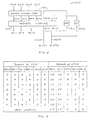
- the input ports 17 are the first and the second input ports 17(1) and 17(2)
- the output ports 19 are the first and the second output ports 19(1) and 19(2)
- each data sequence consists of first and second packets as the consecutive packets.
- the first packet is the leading packet described in the foregoing.
- the second packet is a data packet.
- the leading packets of the data sequences are supplied to the first and the second input ports 17 in respective machine cycles.
- the first and the second output ports 19 are depicted in duplicate.
- first and second control registers (CREG) 31(1) and 31(2) are for holding, while locked or contents-held as will later be described, the control signals of the leading or the first packets of the data sequences received by the first and the second input ports 17.
- the first and the second control registers 31(1) and 31(2) will either collectively or individually be designated by a single reference numeral 31. This manner of designation will be used throughout the following.
- control signal the validity bit and the routing address will be denoted by V and RA.
- the control signal therefore represents combinations (V, RA).
- the first and the second output ports 19(1) and 19(2) will be identified by the first and the second routing addresses of the binary zero and one bits.
- the control signal represents one of the combinations (0, 0), (1, 0), (1, 1), and so forth at a time for the example being illustrated.
- each of the first and the second control registers 31 holds the control signal as a held signal and produces the held signal. In this manner, the first and the second control registers 31 produce first and second held signals 311-0 and 312-0.
- first and second control buffers (CBUF) 33(1) and 33(2) or 33 store the first and the second held signals as first and second stored signals and produce: the first and the second stored signals as indicated at 331-0 and 332-0.
- first and second data registers (DREG) 35(1) and 35(2) or 35 are for holding during one machine cycle the data of the leading packets of the data sequences received by the first and the second input ports 17 at the respective machine cycles.
- the first and the second data buffers 35 hold first and second held data.
- each of the first and the second data registers 35 holds as another held datum the datum of the second packet of the data sequence supplied to a pertinent one of the first and the second input ports 17.
- first through (N-1)-th primary data registers are serially connected to the first input port 17(1) collectively as a first data register unit 35(1).
- first through (N-1)-th secondary data registers are connected to the second input port 17(2) as a second data register unit 35(2).
- Each of the first and the second data register units 35 holds the data of the consecutive packets of a relevant one of the data sequences during (N - 1) machine cycles in total.
- each of the data register units 35 produces a data train of the data of the first through the N-th consecutive packets from points of serial connection of the first through the (N-1)-th data registers and a pertinent one of the input ports 17 in a "packet-serial" manner. In this manner, the first and the second data register units 35 produce primary and secondary held packets 351-0 and 352-0.
- first and second data buffers (DBUF) 37(1) and 37(2) or 37 are connected to the first and the second data registers 35 and to the first and the second input ports 17.
- Each of the first and the second data buffers 37 stores the data of the leading and the other consecutive packets of the data sequence received by the pertinent one of the input ports 17.
- the data of the first through the N-th consecutive packets of each data sequence are simultaneously stored in a concerned one of the first and the second data buffers 37 as its primary stored data which are herein called primary stored packets.
- the first and the second data buffers 37 produce their primary stored packets simultaneously in one machine cycle in a "packet-parallel" fashion as first and second primary stored packets 371-0 and 372-0.
- first and second arbiters 39(1) and 39(2) or 39 correspond to the first and the second output ports 19 and are operable differently from the first and the second arbiters 25 described in conjunction with Fig. 2.
- Each of the first and the second arbiters 39 is cross connected to the first and the second control registers 31 and to the first and the second control buffers 33.
- the first arbiter 39(1) produces primary first and second arbiter signals 391-1 and 391-2 and a primary zeroth arbiter signal 391-0.
- the second arbiter 39(2) produces secondary first and second arbiter signals 392-1 and 392-2 and a secondary zeroth arbiter signal 392-0.
- first and the second sequences are supplied to the first and the second input ports 17, respectively, with the leading packets of the first and the second sequences received in one machine cycle to specify the common address as the particular address and that each of the first and the second sequences consists of the first and the second packets.
- the first and the second arbiters 39 give the priority right to the first sequence and determine the first sequence as the privileged sequence.
- each of the control signals of the first and the second sequences represents the combination (1, 0). If no data sequence precedes the first sequence at the first input port 17(1), the first control register 31(1) produces the control signal of the first sequence while locked. The control signal is not stored in the first control buffer 33(1), which keeps its output signal quiescent, namely, at 0. The control signal of the second sequence is not produced from the second control register 31(2) but is stored in the second control buffer 33(2). The data of the first and the second packets are successively produced from the first data register or register unit 35(1) and are not stored in the first data buffer 37(1).
- the first and the second packets are not produced from the second data register or register unit 35(2) but are stored simultaneously in the second data buffer 37(2).
- Output signals of the second control register 31(2), the second data register unit 35(2), and the second data buffer 37(2) are all quiescent.
- a preceding sequence of the data sequences is processed by the interconnection network.
- the control signal of the privileged sequence is stored in the first control buffer 33(1) as a stored signal.
- the data of the first and the second packets of the privileged sequence are simultaneously stored in the first data buffer 37(1) as stored data.
- the first control register 31(1) is locked.
- the first control buffer 33(1) produces the combination.
- the first data buffer 37(1) simultaneously produces the stored data.
- Output signals of the first control register 31(1) and the second register unit 35(2) are both quiescent.
- first primary and secondary selectors 41(1) and 41(2) or 41 correspond to the first and the second output ports 19, The first primary and secondary selectors 41 are controlled by the primary and the secondary first arbiter signals. Each of the first primary and secondary selectors 41 is cross connected to the first and the second data register units 35 and to the first and the second data buffers 37. Second primary and secondary selectors (SEL) 43(1) and 43(2) or 43 are serially connected to the first primary and secondary selectors 41 and are controlled by the primary and the secondary arbiter signals. In the manner which will shortly be described, the first primary selector 41(1) produces first primary and secondary selected signals 411-0 and 411-1. The first secondary selector 41(2) produces second primary and secondary selected signals 412-0 and 412-1. The second primary and secondary selectors 43 produce primary and secondary second selected signals 431-0 and 432-0.
- the first arbiter 39(1) comprises a first enable signal generator 45(1) supplied from the first and the second control buffers 33 with stored signals of the first and the second trains 331-0 and 332-0 and from the first and the second control registers 31 with held signals of the first and the second data trains 311-0 and 332-0.
- the first enable signal generator 45(1) produces first through fourth primary enable signals 451-0, 451-1, 451-2, and 451-3 which are given a logic one level only when the validity bit V is the binary one bit and the routing address RA is the binary zero bit indicative of the first output port 19(1) in the control signal supplied from one or the other of the first and the second control buffers 33 and of the first and the second control registers 31.
- a first request arbiter 47(1) is controlled by the first through the fourth primary enable signals and by first and second primary loop input signals 491-0 and 511-0.
- the first and the second primary loops include first and second primary flip-flops 49(1) and 51(1).
- the first request arbiter 47(1) produces the primary zeroth through second arbiter signals 391-0 to 391-2 and first and second primary loop output signals 391-3 and 391-4.
- the first and the second primary loop output signals are given the logic one level when the privileged sequence is the data sequence supplied to the first and the second input ports 17, respectively.
- the first and the second primary loop output signals are branched to primary first and second branches 53(11) and 53(12) or 53 and are supplied through connections not shown in Fig. 3 to the first and the second control registers 31.
- the first and the second primary loop output signals make corresponding ones of the first and the second control registers 31 keep the control signals of the leading packets supplied thereto.
- the first and the second primary loop output signals of the logic one level put the first and the second primary flip-flops 49(1) and 51(1) on or in a lit state and thereby give the logic one level to the first and the second primary loop output signals.
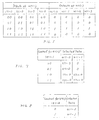
- selection logic tables are shown for the first and the second primary selectors 41(1) and 43(1). Those for the first and the second secondary selectors 41(2) and 43(2) are similar provided that the control signals and the selected data are reworded accordingly.
- the second arbiter 39(2) is similar in structure and operation to the first arbiter 39(1).
- a second enable signal generator 45(2) is supplied from the first and the second control buffers 33 and from the first and the second control registers 31 with the control signals as indicated.
- a second request arbiter 47(2) is connected to the second enable signal generator 45(2) to supply the first and the second secondary selectors 41(2) and 43(2) with the control signals as depicted and to produce the secondary zeroth arbiter signal.
- first and second secondary flip-flops 49(2) and 51(2) are connected to the first and the second control registers 31.
- secondary first and second branches 53(21) and 53(22) or 53 supply first and second secondary loop output signals to the first and the second control registers 31. It is now readily possible to implement third and other arbiters 39 when the output ports 19 are three or more in number.
- a truth table for the second enable signal generator 45(2) is similar to that shown in Fig. 5.
- Another truth table for the second request arbiter 47(2) is similar to that of Fig. 6 and is omitted.
- Selection logic tables for the first and the second secondary selectors 41(2) and 43(2) are similar to those of Figs. 7 and 8 and are no more shown. It is now readily possible to make up such truth tables and selection logic tables when the output ports 19 are three or more in number.
- the interconnection network has the first and the second input ports 17 and the first and the second output ports 19.
- the first and the second input ports 17 are supplied with the first and the second sequences, each consisting of the first and the second packets.
- the first primary flip-flop 49(1) is turned on to keep the control signal of the privileged sequence in the first control register 31(1).
- the first primary selector 41(1) selects the first packet of the privileged sequence and will select in a next subsequent machine cycle the second packet of the privileged sequence. In this machine cycle, the control signal of the privileged sequence is kept in the first control register 31(1). It is consequently possible for the first primary selector 41(1) to select the second packet with no delay.
- the second primary flip-flop 51(1) is turned on to keep the control signal of the second sequence in the second control register 31(2).
- the second primary selector 41(2) therefore selects the second packet of the second sequence with no delay after having selected the first packet of the second sequence.
- the first secondary flip-flop 49(2) is lit to keep the control signal of the first sequence in the first control register 31(1).
- the first secondary selector 41(2) selects the first packet of the first sequence and will select in a next subsequent machine cycle the second packet of the first sequence. Inasmuch as the control signal is kept in the first control register 31(1), this selector 41(2) selects the second packet with no delay.
- the second secondary flip-flop 51(2) is lit to keep the control signal of the second sequence in the second control register 31(2).
- the first secondary selector 41(2) selects the second packet of the second sequence with no delay.
- the first primary selector 41(1) selects one of the first and the second data register units 35. In a first machine cycle, this selector 41(1) selects the first packet of a selected sequence of the first and the second sequences as the first primary selected signal 411-0. In a second machine cycle, the second packet of the selected sequence is selected as the first primary selected signal.
- the second primary selector 43(1) is for selecting in the second machine cycle the first primary selected signal as the primary second selected signal 431-0.
- the first secondary selector 41(2) selects one of the first and the second data register units 35. In a first machine cycle, this selector 41(2) selects the first packet of the selected sequence as the first secondary selected signal 412-0. In a second machine cycle, the second packet of the selected sequence is selected as the first secondary selected signal.
- the second secondary selector 43(2) is for selecting in the second machine cycle the first secondary selected signal as the secondary second selected signal 432-0.
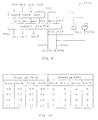
- first and second output buffers 55(1) and 55(2) or 55 are connected to the second primary and secondary selectors 43 and therefore correspond to the first and the second output ports 19.
- the first and the second packets of the privileged sequence are stored either packet serially or in packet parallel in one of the first and the second output buffers 55 that corresponds to the above-mentioned one of the output ports 19.
- the consecutive packets of the privileged sequence are stored in one or the other of the output buffers 55 as secondary stored packets and are produced as secondary supply packets.
- the first and the second packets of the privileged sequence are referred to as first and second primary output buffered signals 551-0 and 551-1 when produced from the first output buffer 55(1).
- first and second secondary output buffered signals 552-0 and 552-1 When produced from the second output buffer 55(2), such packets are called first and second secondary output buffered signals 552-0 and 552-1.
- the second packet When stored in packet serial in a correlated one of the output buffers 55, the second packet is preferably stored in a memory word for the first packet without destruction of the first packet.
- First and second output selectors 57(1) and 57(2) or 57 are connected to the first and the second output buffers 55 and to the first and the second output ports 19.
- the first and the second output selectors 57 are controlled by first and second output selector control signals to select the secondary supply packets as output packets for delivery to the above-mentioned one of the output ports 19 in packet serial.
- Produced from the first and the second output selectors 57, primary and secondary output packets are indicated by 571-0 and 572-0.
- Select logic tables for the first and the second output selectors 57 are not different from that shown in Fig. 10 except for the control signals and the selected data and will not be described any longer.
- the primary and the secondary zeroth arbiter signals 391-0 and 392-0 indicate the validity bit V and, instead of the routing address RA, a reply routing address RRA.
- This routing address represents the input port number of one of the input ports 17 that should receive the privileged sequence and is equal to the routing address indicative of the destination port.
- Such validity bits and reply routing addresses are stored in first and second additional buffers 59(1) and 59(2) or 59.
- the reply routing addresses are delivered to the first and the second output ports 19 in synchronism with delivery of the first packet of the privileged sequence to the destination port and are used in the memory unit 15 described in conjunction with Fig. 1.
- the memory unit 15 produces the reply data which are described before in connection with Fig. 1 and are transferred to the input port in question through another interconnection network described hereinabove.
- first and the second additional buffers 59 From the first and the second additional buffers 59, the validity bits stored therein are delivered to first input terminals of first and second two-input AND gates 61(1) and 61(2) or 61.
- First and second output signals of the first and the second AND gates 61 are supplied to first and second control flip-flops 63(1) and 63(2) or 63, each of which has an inverter output terminal and which hold first and second control flags.
- the first and the second control flags are delivered to second input terminals of the first and the second AND gates 61 in a machine cycle next following the machine cycle in which the first packets are selected by the first and the second output selectors 57.
- the gates 61 produce the first and the second output signals as the first and the second output selector control signals which are now indicated by labels 611-0 and 612-0.
- the first and the second additional buffers 59 produce the validity bit of the binary one level.
- the gates 61 give the binary one level to the first and the second output selector control signals and to the first and the second control flags.
- the binary zero bits are supplied to the second input terminals of the gates 61. Irrespective of the validity bits produced from the first and the second additional buffers 59, the binary zero level is given to the first and the second output selector control signals to make the first and the second output selectors 57 select the second and subsequent packets supplied from the first and the second output buffers 55.
- the privileged sequence is what is received by one of the input ports 17 that is identified by the input port number of a predetermined one among the input port numbers of the prescribed order when two or more data sequences are received by ones of the input ports 17 with the leading packets of these data sequences received in one machine cycle to indicate a common address of the routing addresses. It is possible to make the interconnection network deal with data sequences which are composed of different numbers of consecutive packets and more than four consecutive packets.
Landscapes
- Engineering & Computer Science (AREA)
- Computer Hardware Design (AREA)
- Theoretical Computer Science (AREA)
- Physics & Mathematics (AREA)
- Software Systems (AREA)
- General Engineering & Computer Science (AREA)
- General Physics & Mathematics (AREA)
- Mathematical Physics (AREA)
- Data Exchanges In Wide-Area Networks (AREA)
- Multi Processors (AREA)
- Small-Scale Networks (AREA)
Applications Claiming Priority (3)
| Application Number | Priority Date | Filing Date | Title |
|---|---|---|---|
| JP6145100A JP2644185B2 (ja) | 1994-06-27 | 1994-06-27 | データ処理装置 |
| JP14510094 | 1994-06-27 | ||
| JP145100/94 | 1994-06-27 |
Publications (3)
| Publication Number | Publication Date |
|---|---|
| EP0690390A2 EP0690390A2 (en) | 1996-01-03 |
| EP0690390A3 EP0690390A3 (enExample) | 1996-01-17 |
| EP0690390B1 true EP0690390B1 (en) | 2001-01-10 |
Family
ID=15377378
Family Applications (1)
| Application Number | Title | Priority Date | Filing Date |
|---|---|---|---|
| EP95109743A Expired - Lifetime EP0690390B1 (en) | 1994-06-27 | 1995-06-22 | Network for transferring consecutive packets between processor and memory with a reduced blocking time |
Country Status (6)
| Country | Link |
|---|---|
| US (1) | US5857078A (enExample) |
| EP (1) | EP0690390B1 (enExample) |
| JP (1) | JP2644185B2 (enExample) |
| BR (1) | BR9502279A (enExample) |
| CA (1) | CA2152637C (enExample) |
| DE (1) | DE69519825T2 (enExample) |
Families Citing this family (10)
| Publication number | Priority date | Publication date | Assignee | Title |
|---|---|---|---|---|
| US7295563B2 (en) * | 2001-10-01 | 2007-11-13 | Advanced Micro Devices, Inc. | Method and apparatus for routing packets that have ordering requirements |
| US7274692B1 (en) | 2001-10-01 | 2007-09-25 | Advanced Micro Devices, Inc. | Method and apparatus for routing packets that have multiple destinations |
| US7221678B1 (en) * | 2001-10-01 | 2007-05-22 | Advanced Micro Devices, Inc. | Method and apparatus for routing packets |
| US7353317B2 (en) * | 2004-12-28 | 2008-04-01 | Intel Corporation | Method and apparatus for implementing heterogeneous interconnects |
| JP5691555B2 (ja) * | 2011-01-25 | 2015-04-01 | 日本電気株式会社 | 相互結合網制御システム、相互結合網制御方法 |
| US9137173B2 (en) * | 2012-06-19 | 2015-09-15 | Advanced Micro Devices, Inc. | Devices and methods for interconnecting server nodes |
| US11275632B2 (en) | 2018-09-14 | 2022-03-15 | Advanced Micro Devices, Inc. | Broadcast command and response |
| CN113010173A (zh) | 2019-12-19 | 2021-06-22 | 超威半导体(上海)有限公司 | 并行处理中矩阵数据广播的方法 |
| CN113094099B (zh) | 2019-12-23 | 2026-04-21 | 超威半导体(上海)有限公司 | 矩阵数据广播架构 |
| US11403221B2 (en) | 2020-09-24 | 2022-08-02 | Advanced Micro Devices, Inc. | Memory access response merging in a memory hierarchy |
Family Cites Families (14)
| Publication number | Priority date | Publication date | Assignee | Title |
|---|---|---|---|---|
| US4320502A (en) * | 1978-02-22 | 1982-03-16 | International Business Machines Corp. | Distributed priority resolution system |
| US4480307A (en) * | 1982-01-04 | 1984-10-30 | Intel Corporation | Interface for use between a memory and components of a module switching apparatus |
| US4560985B1 (en) * | 1982-05-07 | 1994-04-12 | Digital Equipment Corp | Dual-count, round-robin ditributed arbitration technique for serial buses |
| US4724520A (en) * | 1985-07-01 | 1988-02-09 | United Technologies Corporation | Modular multiport data hub |
| JPH01221042A (ja) * | 1988-02-29 | 1989-09-04 | Toshiba Corp | パケット交換機の輻輳制御方法 |
| US4862454A (en) * | 1988-07-15 | 1989-08-29 | International Business Machines Corporation | Switching method for multistage interconnection networks with hot spot traffic |
| US5053942A (en) * | 1988-11-01 | 1991-10-01 | The Regents Of The University Of California | Bit-sliced cross-connect chip having a tree topology of arbitration cells for connecting memory modules to processors in a multiprocessor system |
| EP0426413B1 (en) * | 1989-11-03 | 1997-05-07 | Compaq Computer Corporation | Multiprocessor arbitration in single processor arbitration schemes |
| JPH077975B2 (ja) * | 1990-08-20 | 1995-01-30 | インターナショナル・ビジネス・マシーンズ・コーポレイション | データ伝送を制御するためのシステムおよび方法 |
| US5251209A (en) * | 1991-03-28 | 1993-10-05 | Sprint International Communications Corp. | Prioritizing attributes in integrated services networks |
| US5313458A (en) * | 1991-06-03 | 1994-05-17 | Fujitsu Limited | Traffic control system |
| US5339313A (en) * | 1991-06-28 | 1994-08-16 | Digital Equipment Corporation | Method and apparatus for traffic congestion control in a communication network bridge device |
| US5467295A (en) * | 1992-04-30 | 1995-11-14 | Intel Corporation | Bus arbitration with master unit controlling bus and locking a slave unit that can relinquish bus for other masters while maintaining lock on slave unit |
| MX9308193A (es) * | 1993-01-29 | 1995-01-31 | Ericsson Telefon Ab L M | Conmutador atm de acceso controlado. |
-
1994
- 1994-06-27 JP JP6145100A patent/JP2644185B2/ja not_active Expired - Fee Related
-
1995
- 1995-06-22 EP EP95109743A patent/EP0690390B1/en not_active Expired - Lifetime
- 1995-06-22 DE DE69519825T patent/DE69519825T2/de not_active Expired - Fee Related
- 1995-06-26 CA CA002152637A patent/CA2152637C/en not_active Expired - Fee Related
- 1995-06-27 BR BR9502279A patent/BR9502279A/pt not_active IP Right Cessation
-
1997
- 1997-11-21 US US08/975,682 patent/US5857078A/en not_active Expired - Fee Related
Also Published As
| Publication number | Publication date |
|---|---|
| CA2152637C (en) | 1999-08-17 |
| JP2644185B2 (ja) | 1997-08-25 |
| CA2152637A1 (en) | 1995-12-28 |
| DE69519825D1 (de) | 2001-02-15 |
| BR9502279A (pt) | 1996-02-27 |
| US5857078A (en) | 1999-01-05 |
| DE69519825T2 (de) | 2001-08-02 |
| JPH0818565A (ja) | 1996-01-19 |
| EP0690390A3 (enExample) | 1996-01-17 |
| EP0690390A2 (en) | 1996-01-03 |
Similar Documents
| Publication | Publication Date | Title |
|---|---|---|
| US5117420A (en) | Method and apparatus for routing message packets | |
| EP0226632B1 (en) | A packet switching network with multiple packet destinations | |
| EP0169208B1 (en) | Self-routing packet switching network | |
| US4833468A (en) | Layered network | |
| US5053942A (en) | Bit-sliced cross-connect chip having a tree topology of arbitration cells for connecting memory modules to processors in a multiprocessor system | |
| US4984235A (en) | Method and apparatus for routing message packets and recording the roofing sequence | |
| US4670871A (en) | Reliable synchronous inter-node communication in a self-routing network | |
| US5859975A (en) | Parallel processing computer system having shared coherent memory and interconnections utilizing separate undirectional request and response lines for direct communication or using crossbar switching device | |
| US4484326A (en) | Packet load monitoring by trunk controllers | |
| KR100250437B1 (ko) | 라운드로빈 중재 및 적응 경로 제어를 수행하는경로제어 장치 | |
| EP0198010B1 (en) | Packet switched multiport memory nxm switch node and processing method | |
| US4110830A (en) | Channel storage adapter | |
| US5675736A (en) | Multi-node network with internode switching performed within processor nodes, each node separately processing data and control messages | |
| CA2196567C (en) | Network communication unit using an adaptive router | |
| JPH04267464A (ja) | スーパーコンピユータシステム | |
| EP0430569A1 (en) | Fault tolerant interconnection networks | |
| WO1999026163A1 (en) | Router table lookup mechanism | |
| US5857078A (en) | Network for transferring consecutive packets between processor and memory with a reduced blocking time | |
| IL97315A (en) | Multi-group signal processor | |
| JPS6360579B2 (enExample) | ||
| US5420982A (en) | Hyper-cube network control system having different connection patterns corresponding to phase signals for interconnecting inter-node links and between input/output links | |
| JPH02237248A (ja) | 多段相互接続ネツトワークにおける交換方法 | |
| EP0036766A1 (en) | Computer system and interface therefor | |
| JP2853652B2 (ja) | プロセッサ間通信におけるパケット送信方法およびその装置 | |
| KR940005025B1 (ko) | 패킷방식 다단 상호 접속망용 스위칭 소자 |
Legal Events
| Date | Code | Title | Description |
|---|---|---|---|
| PUAI | Public reference made under article 153(3) epc to a published international application that has entered the european phase |
Free format text: ORIGINAL CODE: 0009012 |
|
| PUAL | Search report despatched |
Free format text: ORIGINAL CODE: 0009013 |
|
| AK | Designated contracting states |
Kind code of ref document: A2 Designated state(s): CH DE FR LI NL |
|
| AK | Designated contracting states |
Kind code of ref document: A3 Designated state(s): CH DE FR LI NL |
|
| 17P | Request for examination filed |
Effective date: 19960509 |
|
| 17Q | First examination report despatched |
Effective date: 19980622 |
|
| GRAG | Despatch of communication of intention to grant |
Free format text: ORIGINAL CODE: EPIDOS AGRA |
|
| GRAG | Despatch of communication of intention to grant |
Free format text: ORIGINAL CODE: EPIDOS AGRA |
|
| GRAH | Despatch of communication of intention to grant a patent |
Free format text: ORIGINAL CODE: EPIDOS IGRA |
|
| GRAH | Despatch of communication of intention to grant a patent |
Free format text: ORIGINAL CODE: EPIDOS IGRA |
|
| GRAH | Despatch of communication of intention to grant a patent |
Free format text: ORIGINAL CODE: EPIDOS IGRA |
|
| GRAA | (expected) grant |
Free format text: ORIGINAL CODE: 0009210 |
|
| AK | Designated contracting states |
Kind code of ref document: B1 Designated state(s): CH DE FR LI NL |
|
| REG | Reference to a national code |
Ref country code: CH Ref legal event code: EP |
|
| REF | Corresponds to: |
Ref document number: 69519825 Country of ref document: DE Date of ref document: 20010215 |
|
| REG | Reference to a national code |
Ref country code: CH Ref legal event code: NV Representative=s name: E. BLUM & CO. PATENTANWAELTE |
|
| ET | Fr: translation filed | ||
| PLBE | No opposition filed within time limit |
Free format text: ORIGINAL CODE: 0009261 |
|
| STAA | Information on the status of an ep patent application or granted ep patent |
Free format text: STATUS: NO OPPOSITION FILED WITHIN TIME LIMIT |
|
| 26N | No opposition filed | ||
| PGFP | Annual fee paid to national office [announced via postgrant information from national office to epo] |
Ref country code: FR Payment date: 20060608 Year of fee payment: 12 |
|
| PGFP | Annual fee paid to national office [announced via postgrant information from national office to epo] |
Ref country code: NL Payment date: 20060615 Year of fee payment: 12 Ref country code: DE Payment date: 20060615 Year of fee payment: 12 |
|
| PGFP | Annual fee paid to national office [announced via postgrant information from national office to epo] |
Ref country code: CH Payment date: 20060628 Year of fee payment: 12 |
|
| REG | Reference to a national code |
Ref country code: CH Ref legal event code: PFA Owner name: NEC CORPORATION Free format text: NEC CORPORATION#7-1, SHIBA 5-CHOME, MINATO-KU#TOKYO (JP) -TRANSFER TO- NEC CORPORATION#7-1, SHIBA 5-CHOME, MINATO-KU#TOKYO (JP) |
|
| REG | Reference to a national code |
Ref country code: CH Ref legal event code: PL |
|
| NLV4 | Nl: lapsed or anulled due to non-payment of the annual fee |
Effective date: 20080101 |
|
| REG | Reference to a national code |
Ref country code: FR Ref legal event code: ST Effective date: 20080229 |
|
| PG25 | Lapsed in a contracting state [announced via postgrant information from national office to epo] |
Ref country code: NL Free format text: LAPSE BECAUSE OF NON-PAYMENT OF DUE FEES Effective date: 20080101 Ref country code: LI Free format text: LAPSE BECAUSE OF NON-PAYMENT OF DUE FEES Effective date: 20070630 Ref country code: DE Free format text: LAPSE BECAUSE OF NON-PAYMENT OF DUE FEES Effective date: 20080101 Ref country code: CH Free format text: LAPSE BECAUSE OF NON-PAYMENT OF DUE FEES Effective date: 20070630 |
|
| PG25 | Lapsed in a contracting state [announced via postgrant information from national office to epo] |
Ref country code: FR Free format text: LAPSE BECAUSE OF NON-PAYMENT OF DUE FEES Effective date: 20070702 |