EP0659581B1 - Stabilisiertes thermisches Farbstoffbleichkonstrukt - Google Patents
Stabilisiertes thermisches Farbstoffbleichkonstrukt Download PDFInfo
- Publication number
- EP0659581B1 EP0659581B1 EP94120118A EP94120118A EP0659581B1 EP 0659581 B1 EP0659581 B1 EP 0659581B1 EP 94120118 A EP94120118 A EP 94120118A EP 94120118 A EP94120118 A EP 94120118A EP 0659581 B1 EP0659581 B1 EP 0659581B1
- Authority
- EP
- European Patent Office
- Prior art keywords
- carbon atoms
- group
- dye
- thermal
- alkyl
- Prior art date
- Legal status (The legal status is an assumption and is not a legal conclusion. Google has not performed a legal analysis and makes no representation as to the accuracy of the status listed.)
- Expired - Lifetime
Links
- 239000007844 bleaching agent Substances 0.000 title claims abstract description 93
- 238000010276 construction Methods 0.000 title claims description 58
- 125000000217 alkyl group Chemical group 0.000 claims abstract description 47
- 125000003118 aryl group Chemical group 0.000 claims abstract description 36
- 125000003342 alkenyl group Chemical group 0.000 claims abstract description 31
- 125000003710 aryl alkyl group Chemical group 0.000 claims abstract description 27
- 125000002252 acyl group Chemical group 0.000 claims abstract description 8
- 239000000975 dye Substances 0.000 claims description 117
- 125000004432 carbon atom Chemical group C* 0.000 claims description 83
- -1 aralky Chemical group 0.000 claims description 53
- 150000001875 compounds Chemical class 0.000 claims description 51
- 229910052739 hydrogen Inorganic materials 0.000 claims description 31
- 239000001257 hydrogen Substances 0.000 claims description 31
- 150000001768 cations Chemical class 0.000 claims description 24
- 125000000753 cycloalkyl group Chemical group 0.000 claims description 20
- UFHFLCQGNIYNRP-UHFFFAOYSA-N Hydrogen Chemical compound [H][H] UFHFLCQGNIYNRP-UHFFFAOYSA-N 0.000 claims description 15
- 150000002431 hydrogen Chemical class 0.000 claims description 13
- AEMRFAOFKBGASW-UHFFFAOYSA-N Glycolic acid Chemical class OCC(O)=O AEMRFAOFKBGASW-UHFFFAOYSA-N 0.000 claims description 12
- 150000001450 anions Chemical class 0.000 claims description 12
- 125000000623 heterocyclic group Chemical group 0.000 claims description 12
- 229920000747 poly(lactic acid) Polymers 0.000 claims description 11
- YTEFAALYDTWTLB-UHFFFAOYSA-N 2-(benzenesulfonyl)acetic acid Chemical compound OC(=O)CS(=O)(=O)C1=CC=CC=C1 YTEFAALYDTWTLB-UHFFFAOYSA-N 0.000 claims description 9
- 125000002496 methyl group Chemical group [H]C([H])([H])* 0.000 claims description 9
- 229920000642 polymer Polymers 0.000 claims description 8
- 125000005504 styryl group Chemical group 0.000 claims description 8
- 229920001577 copolymer Polymers 0.000 claims description 7
- 125000000732 arylene group Chemical group 0.000 claims description 6
- JPIYZTWMUGTEHX-UHFFFAOYSA-N auramine O free base Chemical compound C1=CC(N(C)C)=CC=C1C(=N)C1=CC=C(N(C)C)C=C1 JPIYZTWMUGTEHX-UHFFFAOYSA-N 0.000 claims description 6
- 150000003242 quaternary ammonium salts Chemical class 0.000 claims description 6
- 125000001495 ethyl group Chemical group [H]C([H])([H])C([H])([H])* 0.000 claims description 5
- 150000002596 lactones Chemical class 0.000 claims description 5
- 229920000954 Polyglycolide Polymers 0.000 claims description 4
- 125000000218 acetic acid group Chemical group C(C)(=O)* 0.000 claims description 3
- 125000004450 alkenylene group Chemical group 0.000 claims description 3
- 125000002947 alkylene group Chemical group 0.000 claims description 3
- 125000000304 alkynyl group Chemical group 0.000 claims description 3
- 125000004419 alkynylene group Chemical group 0.000 claims description 3
- 150000004649 carbonic acid derivatives Chemical class 0.000 claims description 3
- FFYRIXSGFSWFAQ-UHFFFAOYSA-N 1-dodecylpyridin-1-ium Chemical compound CCCCCCCCCCCC[N+]1=CC=CC=C1 FFYRIXSGFSWFAQ-UHFFFAOYSA-N 0.000 claims description 2
- VYNUATGQEAAPAQ-UHFFFAOYSA-N 2-sulfonylacetic acid Chemical group OC(=O)C=S(=O)=O VYNUATGQEAAPAQ-UHFFFAOYSA-N 0.000 claims description 2
- UTFVFKSDGGVWCV-UHFFFAOYSA-N [AsH2]C1=CC=CC2=CC3=CC=C(C=CC=C4)C4=C3C=C12 Chemical compound [AsH2]C1=CC=CC2=CC3=CC=C(C=CC=C4)C4=C3C=C12 UTFVFKSDGGVWCV-UHFFFAOYSA-N 0.000 claims description 2
- HSDZUJGXNQXPEM-UHFFFAOYSA-N benzo[a]anthracen-10-ylphosphane Chemical compound C1=CC=C2C3=CC4=CC(P)=CC=C4C=C3C=CC2=C1 HSDZUJGXNQXPEM-UHFFFAOYSA-N 0.000 claims description 2
- YOUGRGFIHBUKRS-UHFFFAOYSA-N benzyl(trimethyl)azanium Chemical compound C[N+](C)(C)CC1=CC=CC=C1 YOUGRGFIHBUKRS-UHFFFAOYSA-N 0.000 claims description 2
- 125000002993 cycloalkylene group Chemical group 0.000 claims description 2
- VICYBMUVWHJEFT-UHFFFAOYSA-N dodecyltrimethylammonium ion Chemical compound CCCCCCCCCCCC[N+](C)(C)C VICYBMUVWHJEFT-UHFFFAOYSA-N 0.000 claims description 2
- DZLFLBLQUQXARW-UHFFFAOYSA-N tetrabutylammonium Chemical compound CCCC[N+](CCCC)(CCCC)CCCC DZLFLBLQUQXARW-UHFFFAOYSA-N 0.000 claims description 2
- CBXCPBUEXACCNR-UHFFFAOYSA-N tetraethylammonium Chemical compound CC[N+](CC)(CC)CC CBXCPBUEXACCNR-UHFFFAOYSA-N 0.000 claims description 2
- QEMXHQIAXOOASZ-UHFFFAOYSA-N tetramethylammonium Chemical compound C[N+](C)(C)C QEMXHQIAXOOASZ-UHFFFAOYSA-N 0.000 claims description 2
- OSBSFAARYOCBHB-UHFFFAOYSA-N tetrapropylammonium Chemical compound CCC[N+](CCC)(CCC)CCC OSBSFAARYOCBHB-UHFFFAOYSA-N 0.000 claims description 2
- 150000003893 lactate salts Chemical class 0.000 claims 1
- 238000005979 thermal decomposition reaction Methods 0.000 claims 1
- 239000000463 material Substances 0.000 abstract description 44
- 239000003795 chemical substances by application Substances 0.000 abstract description 28
- 150000004820 halides Chemical class 0.000 abstract 1
- 239000000243 solution Substances 0.000 description 88
- OKKJLVBELUTLKV-UHFFFAOYSA-N Methanol Chemical compound OC OKKJLVBELUTLKV-UHFFFAOYSA-N 0.000 description 69
- CSCPPACGZOOCGX-UHFFFAOYSA-N Acetone Chemical compound CC(C)=O CSCPPACGZOOCGX-UHFFFAOYSA-N 0.000 description 48
- 238000002835 absorbance Methods 0.000 description 44
- ZMXDDKWLCZADIW-UHFFFAOYSA-N N,N-Dimethylformamide Chemical compound CN(C)C=O ZMXDDKWLCZADIW-UHFFFAOYSA-N 0.000 description 33
- 238000000576 coating method Methods 0.000 description 33
- 239000003381 stabilizer Substances 0.000 description 31
- SICAMBKGKQLIOL-UHFFFAOYSA-N 2-(4-nitrophenyl)sulfonylacetic acid Chemical class OC(=O)CS(=O)(=O)C1=CC=C([N+]([O-])=O)C=C1 SICAMBKGKQLIOL-UHFFFAOYSA-N 0.000 description 21
- 230000032683 aging Effects 0.000 description 19
- 239000002253 acid Substances 0.000 description 18
- 238000004061 bleaching Methods 0.000 description 18
- JVTAAEKCZFNVCJ-UHFFFAOYSA-N lactic acid Chemical compound CC(O)C(O)=O JVTAAEKCZFNVCJ-UHFFFAOYSA-N 0.000 description 17
- 239000000203 mixture Substances 0.000 description 15
- 239000011248 coating agent Substances 0.000 description 14
- 239000012038 nucleophile Substances 0.000 description 13
- 229920000728 polyester Polymers 0.000 description 13
- 239000002243 precursor Substances 0.000 description 13
- 229910052709 silver Inorganic materials 0.000 description 13
- 239000004332 silver Substances 0.000 description 13
- BQCADISMDOOEFD-UHFFFAOYSA-N Silver Chemical compound [Ag] BQCADISMDOOEFD-UHFFFAOYSA-N 0.000 description 12
- YXFVVABEGXRONW-UHFFFAOYSA-N Toluene Chemical compound CC1=CC=CC=C1 YXFVVABEGXRONW-UHFFFAOYSA-N 0.000 description 12
- 238000010438 heat treatment Methods 0.000 description 11
- 238000012545 processing Methods 0.000 description 11
- 150000003839 salts Chemical class 0.000 description 10
- 229920006217 cellulose acetate butyrate Polymers 0.000 description 9
- 238000000034 method Methods 0.000 description 9
- 238000002360 preparation method Methods 0.000 description 9
- 125000001453 quaternary ammonium group Chemical group 0.000 description 9
- 239000000126 substance Substances 0.000 description 9
- ZWEHNKRNPOVVGH-UHFFFAOYSA-N 2-Butanone Chemical compound CCC(C)=O ZWEHNKRNPOVVGH-UHFFFAOYSA-N 0.000 description 8
- JJTUDXZGHPGLLC-IMJSIDKUSA-N 4511-42-6 Chemical compound C[C@@H]1OC(=O)[C@H](C)OC1=O JJTUDXZGHPGLLC-IMJSIDKUSA-N 0.000 description 8
- WYURNTSHIVDZCO-UHFFFAOYSA-N Tetrahydrofuran Chemical compound C1CCOC1 WYURNTSHIVDZCO-UHFFFAOYSA-N 0.000 description 8
- ZRALSGWEFCBTJO-UHFFFAOYSA-O guanidinium Chemical compound NC(N)=[NH2+] ZRALSGWEFCBTJO-UHFFFAOYSA-O 0.000 description 8
- 239000004310 lactic acid Substances 0.000 description 8
- 235000014655 lactic acid Nutrition 0.000 description 8
- 125000001424 substituent group Chemical group 0.000 description 8
- WGTYBPLFGIVFAS-UHFFFAOYSA-M tetramethylammonium hydroxide Chemical compound [OH-].C[N+](C)(C)C WGTYBPLFGIVFAS-UHFFFAOYSA-M 0.000 description 8
- ZRALSGWEFCBTJO-UHFFFAOYSA-N Guanidine Chemical class NC(N)=N ZRALSGWEFCBTJO-UHFFFAOYSA-N 0.000 description 7
- 125000004435 hydrogen atom Chemical group [H]* 0.000 description 7
- JJTUDXZGHPGLLC-UHFFFAOYSA-N lactide Chemical compound CC1OC(=O)C(C)OC1=O JJTUDXZGHPGLLC-UHFFFAOYSA-N 0.000 description 7
- ZEUMGONLWQMPOR-UHFFFAOYSA-M 2-(4-nitrophenyl)sulfonylacetate;tetramethylazanium Chemical compound C[N+](C)(C)C.[O-]C(=O)CS(=O)(=O)C1=CC=C([N+]([O-])=O)C=C1 ZEUMGONLWQMPOR-UHFFFAOYSA-M 0.000 description 6
- WFDIJRYMOXRFFG-UHFFFAOYSA-N Acetic anhydride Chemical compound CC(=O)OC(C)=O WFDIJRYMOXRFFG-UHFFFAOYSA-N 0.000 description 6
- CURLTUGMZLYLDI-UHFFFAOYSA-N Carbon dioxide Chemical compound O=C=O CURLTUGMZLYLDI-UHFFFAOYSA-N 0.000 description 6
- XEKOWRVHYACXOJ-UHFFFAOYSA-N Ethyl acetate Chemical compound CCOC(C)=O XEKOWRVHYACXOJ-UHFFFAOYSA-N 0.000 description 6
- 125000004429 atom Chemical group 0.000 description 6
- 239000002585 base Substances 0.000 description 6
- 150000003903 lactic acid esters Chemical class 0.000 description 6
- 229920000139 polyethylene terephthalate Polymers 0.000 description 6
- 239000005020 polyethylene terephthalate Substances 0.000 description 6
- 230000002829 reductive effect Effects 0.000 description 6
- 239000000758 substrate Substances 0.000 description 6
- VMUIDCLSELWZBB-UHFFFAOYSA-M 2-(4-chlorophenyl)sulfonylacetate;tetramethylazanium Chemical compound C[N+](C)(C)C.[O-]C(=O)CS(=O)(=O)C1=CC=C(Cl)C=C1 VMUIDCLSELWZBB-UHFFFAOYSA-M 0.000 description 5
- LFQSCWFLJHTTHZ-UHFFFAOYSA-N Ethanol Chemical compound CCO LFQSCWFLJHTTHZ-UHFFFAOYSA-N 0.000 description 5
- NTIZESTWPVYFNL-UHFFFAOYSA-N Methyl isobutyl ketone Chemical compound CC(C)CC(C)=O NTIZESTWPVYFNL-UHFFFAOYSA-N 0.000 description 5
- UIHCLUNTQKBZGK-UHFFFAOYSA-N Methyl isobutyl ketone Natural products CCC(C)C(C)=O UIHCLUNTQKBZGK-UHFFFAOYSA-N 0.000 description 5
- 150000007513 acids Chemical class 0.000 description 5
- 238000003384 imaging method Methods 0.000 description 5
- 125000001997 phenyl group Chemical group [H]C1=C([H])C([H])=C(*)C([H])=C1[H] 0.000 description 5
- 239000000047 product Substances 0.000 description 5
- 238000010521 absorption reaction Methods 0.000 description 4
- 150000001412 amines Chemical class 0.000 description 4
- 239000011230 binding agent Substances 0.000 description 4
- 150000001732 carboxylic acid derivatives Chemical class 0.000 description 4
- 230000015556 catabolic process Effects 0.000 description 4
- 238000006243 chemical reaction Methods 0.000 description 4
- 230000021615 conjugation Effects 0.000 description 4
- 238000006114 decarboxylation reaction Methods 0.000 description 4
- 238000006731 degradation reaction Methods 0.000 description 4
- 230000000087 stabilizing effect Effects 0.000 description 4
- RKDVKSZUMVYZHH-UHFFFAOYSA-N 1,4-dioxane-2,5-dione Chemical compound O=C1COC(=O)CO1 RKDVKSZUMVYZHH-UHFFFAOYSA-N 0.000 description 3
- LPEKGGXMPWTOCB-UHFFFAOYSA-N 8beta-(2,3-epoxy-2-methylbutyryloxy)-14-acetoxytithifolin Natural products COC(=O)C(C)O LPEKGGXMPWTOCB-UHFFFAOYSA-N 0.000 description 3
- ZMANZCXQSJIPKH-UHFFFAOYSA-N Triethylamine Chemical compound CCN(CC)CC ZMANZCXQSJIPKH-UHFFFAOYSA-N 0.000 description 3
- 125000000129 anionic group Chemical group 0.000 description 3
- 239000001569 carbon dioxide Substances 0.000 description 3
- 229910002092 carbon dioxide Inorganic materials 0.000 description 3
- 230000008859 change Effects 0.000 description 3
- ODQWQRRAPPTVAG-GZTJUZNOSA-N doxepin Chemical compound C1OC2=CC=CC=C2C(=C/CCN(C)C)/C2=CC=CC=C21 ODQWQRRAPPTVAG-GZTJUZNOSA-N 0.000 description 3
- 238000001035 drying Methods 0.000 description 3
- 230000000694 effects Effects 0.000 description 3
- 238000001914 filtration Methods 0.000 description 3
- 229940057867 methyl lactate Drugs 0.000 description 3
- 230000003287 optical effect Effects 0.000 description 3
- 230000008569 process Effects 0.000 description 3
- 239000007787 solid Substances 0.000 description 3
- 238000003756 stirring Methods 0.000 description 3
- 238000006467 substitution reaction Methods 0.000 description 3
- 238000005406 washing Methods 0.000 description 3
- 238000001644 13C nuclear magnetic resonance spectroscopy Methods 0.000 description 2
- AQDHXMBUTDLAMD-UHFFFAOYSA-N 2-(4-methylphenyl)sulfonylacetic acid Chemical compound CC1=CC=C(S(=O)(=O)CC(O)=O)C=C1 AQDHXMBUTDLAMD-UHFFFAOYSA-N 0.000 description 2
- SQMDWSXUIQGTQV-UHFFFAOYSA-N 2-(benzenesulfonyl)acetate;carbamimidoylazanium Chemical class NC(N)=N.OC(=O)CS(=O)(=O)C1=CC=CC=C1 SQMDWSXUIQGTQV-UHFFFAOYSA-N 0.000 description 2
- VVBLNCFGVYUYGU-UHFFFAOYSA-N 4,4'-Bis(dimethylamino)benzophenone Chemical compound C1=CC(N(C)C)=CC=C1C(=O)C1=CC=C(N(C)C)C=C1 VVBLNCFGVYUYGU-UHFFFAOYSA-N 0.000 description 2
- 125000002373 5 membered heterocyclic group Chemical group 0.000 description 2
- 125000004070 6 membered heterocyclic group Chemical group 0.000 description 2
- NLXLAEXVIDQMFP-UHFFFAOYSA-N Ammonia chloride Chemical compound [NH4+].[Cl-] NLXLAEXVIDQMFP-UHFFFAOYSA-N 0.000 description 2
- IJGRMHOSHXDMSA-UHFFFAOYSA-N Atomic nitrogen Chemical compound N#N IJGRMHOSHXDMSA-UHFFFAOYSA-N 0.000 description 2
- 229920002799 BoPET Polymers 0.000 description 2
- BVKZGUZCCUSVTD-UHFFFAOYSA-L Carbonate Chemical compound [O-]C([O-])=O BVKZGUZCCUSVTD-UHFFFAOYSA-L 0.000 description 2
- JVTAAEKCZFNVCJ-UHFFFAOYSA-M Lactate Chemical compound CC(O)C([O-])=O JVTAAEKCZFNVCJ-UHFFFAOYSA-M 0.000 description 2
- CSNNHWWHGAXBCP-UHFFFAOYSA-L Magnesium sulfate Chemical compound [Mg+2].[O-][S+2]([O-])([O-])[O-] CSNNHWWHGAXBCP-UHFFFAOYSA-L 0.000 description 2
- 238000005481 NMR spectroscopy Methods 0.000 description 2
- CDBYLPFSWZWCQE-UHFFFAOYSA-L Sodium Carbonate Chemical compound [Na+].[Na+].[O-]C([O-])=O CDBYLPFSWZWCQE-UHFFFAOYSA-L 0.000 description 2
- 230000002378 acidificating effect Effects 0.000 description 2
- 125000005073 adamantyl group Chemical group C12(CC3CC(CC(C1)C3)C2)* 0.000 description 2
- 125000003545 alkoxy group Chemical group 0.000 description 2
- 239000000908 ammonium hydroxide Substances 0.000 description 2
- 230000008901 benefit Effects 0.000 description 2
- BNZXJGMVVSASQT-UHFFFAOYSA-N benzenesulfonyl acetate Chemical compound CC(=O)OS(=O)(=O)C1=CC=CC=C1 BNZXJGMVVSASQT-UHFFFAOYSA-N 0.000 description 2
- STIAPHVBRDNOAJ-UHFFFAOYSA-N carbamimidoylazanium;carbonate Chemical compound NC(N)=N.NC(N)=N.OC(O)=O STIAPHVBRDNOAJ-UHFFFAOYSA-N 0.000 description 2
- 229940125904 compound 1 Drugs 0.000 description 2
- 229940125782 compound 2 Drugs 0.000 description 2
- MLIREBYILWEBDM-UHFFFAOYSA-N cyanoacetic acid Chemical class OC(=O)CC#N MLIREBYILWEBDM-UHFFFAOYSA-N 0.000 description 2
- 125000004122 cyclic group Chemical group 0.000 description 2
- 125000000113 cyclohexyl group Chemical group [H]C1([H])C([H])([H])C([H])([H])C([H])(*)C([H])([H])C1([H])[H] 0.000 description 2
- 238000000354 decomposition reaction Methods 0.000 description 2
- 238000004821 distillation Methods 0.000 description 2
- 238000009472 formulation Methods 0.000 description 2
- 125000005843 halogen group Chemical group 0.000 description 2
- 229910052740 iodine Inorganic materials 0.000 description 2
- 238000006140 methanolysis reaction Methods 0.000 description 2
- 125000004170 methylsulfonyl group Chemical group [H]C([H])([H])S(*)(=O)=O 0.000 description 2
- 230000007935 neutral effect Effects 0.000 description 2
- 150000002892 organic cations Chemical class 0.000 description 2
- 230000036961 partial effect Effects 0.000 description 2
- 125000005010 perfluoroalkyl group Chemical group 0.000 description 2
- 238000006116 polymerization reaction Methods 0.000 description 2
- 239000002244 precipitate Substances 0.000 description 2
- 230000002028 premature Effects 0.000 description 2
- 150000003141 primary amines Chemical class 0.000 description 2
- 125000001436 propyl group Chemical group [H]C([*])([H])C([H])([H])C([H])([H])[H] 0.000 description 2
- 230000009257 reactivity Effects 0.000 description 2
- 125000006413 ring segment Chemical group 0.000 description 2
- 229930195734 saturated hydrocarbon Natural products 0.000 description 2
- HPALAKNZSZLMCH-UHFFFAOYSA-M sodium;chloride;hydrate Chemical class O.[Na+].[Cl-] HPALAKNZSZLMCH-UHFFFAOYSA-M 0.000 description 2
- 239000002904 solvent Substances 0.000 description 2
- 238000001228 spectrum Methods 0.000 description 2
- 125000004079 stearyl group Chemical group [H]C([*])([H])C([H])([H])C([H])([H])C([H])([H])C([H])([H])C([H])([H])C([H])([H])C([H])([H])C([H])([H])C([H])([H])C([H])([H])C([H])([H])C([H])([H])C([H])([H])C([H])([H])C([H])([H])C([H])([H])C([H])([H])[H] 0.000 description 2
- 125000000999 tert-butyl group Chemical group [H]C([H])([H])C(*)(C([H])([H])[H])C([H])([H])[H] 0.000 description 2
- VDZOOKBUILJEDG-UHFFFAOYSA-M tetrabutylammonium hydroxide Chemical compound [OH-].CCCC[N+](CCCC)(CCCC)CCCC VDZOOKBUILJEDG-UHFFFAOYSA-M 0.000 description 2
- NLDYACGHTUPAQU-UHFFFAOYSA-N tetracyanoethylene Chemical group N#CC(C#N)=C(C#N)C#N NLDYACGHTUPAQU-UHFFFAOYSA-N 0.000 description 2
- 238000001149 thermolysis Methods 0.000 description 2
- JOXIMZWYDAKGHI-UHFFFAOYSA-N toluene-4-sulfonic acid Chemical compound CC1=CC=C(S(O)(=O)=O)C=C1 JOXIMZWYDAKGHI-UHFFFAOYSA-N 0.000 description 2
- XLYOFNOQVPJJNP-UHFFFAOYSA-N water Substances O XLYOFNOQVPJJNP-UHFFFAOYSA-N 0.000 description 2
- JIAARYAFYJHUJI-UHFFFAOYSA-L zinc dichloride Chemical compound [Cl-].[Cl-].[Zn+2] JIAARYAFYJHUJI-UHFFFAOYSA-L 0.000 description 2
- ICKAEAFPESRWOT-UHFFFAOYSA-N 1,2,2,3,3,4,5,5,6,6-decafluoro-4-(1,1,2,2,2-pentafluoroethyl)cyclohexane-1-sulfonic acid Chemical group OS(=O)(=O)C1(F)C(F)(F)C(F)(F)C(F)(C(F)(F)C(F)(F)F)C(F)(F)C1(F)F ICKAEAFPESRWOT-UHFFFAOYSA-N 0.000 description 1
- ZTUKGBOUHWYFGC-UHFFFAOYSA-N 1,3,3-trimethyl-2-methylideneindole Chemical compound C1=CC=C2N(C)C(=C)C(C)(C)C2=C1 ZTUKGBOUHWYFGC-UHFFFAOYSA-N 0.000 description 1
- 238000005160 1H NMR spectroscopy Methods 0.000 description 1
- IAONCYGNBVHNCT-UHFFFAOYSA-N 2-(4-chlorophenyl)sulfonylacetic acid Chemical compound OC(=O)CS(=O)(=O)C1=CC=C(Cl)C=C1 IAONCYGNBVHNCT-UHFFFAOYSA-N 0.000 description 1
- WGVQVACFIFWZSL-UHFFFAOYSA-M 2-(4-nitrophenyl)sulfonylacetate;tetrabutylazanium Chemical compound [O-]C(=O)CS(=O)(=O)C1=CC=C([N+]([O-])=O)C=C1.CCCC[N+](CCCC)(CCCC)CCCC WGVQVACFIFWZSL-UHFFFAOYSA-M 0.000 description 1
- UELOVXITXUGDMM-UHFFFAOYSA-M 2-(4-nitrophenyl)sulfonylacetate;tetraethylazanium Chemical compound CC[N+](CC)(CC)CC.[O-]C(=O)CS(=O)(=O)C1=CC=C([N+]([O-])=O)C=C1 UELOVXITXUGDMM-UHFFFAOYSA-M 0.000 description 1
- BKZTYDHPHFAKSZ-UHFFFAOYSA-N 2-[4-(trifluoromethyl)phenyl]sulfonylacetic acid Chemical compound OC(=O)CS(=O)(=O)C1=CC=C(C(F)(F)F)C=C1 BKZTYDHPHFAKSZ-UHFFFAOYSA-N 0.000 description 1
- MLIREBYILWEBDM-UHFFFAOYSA-M 2-cyanoacetate Chemical compound [O-]C(=O)CC#N MLIREBYILWEBDM-UHFFFAOYSA-M 0.000 description 1
- GRJRKPMIRMSBNK-UHFFFAOYSA-N 3,3,4,4,5,5,6,6,7,7,8,8,8-tridecafluorooctan-1-ol Chemical compound OCCC(F)(F)C(F)(F)C(F)(F)C(F)(F)C(F)(F)C(F)(F)F GRJRKPMIRMSBNK-UHFFFAOYSA-N 0.000 description 1
- QQAVZEYXLCYOKO-UHFFFAOYSA-N 4-Hydroxycapric acid Chemical compound CCCCCCC(O)CCC(O)=O QQAVZEYXLCYOKO-UHFFFAOYSA-N 0.000 description 1
- 125000003341 7 membered heterocyclic group Chemical group 0.000 description 1
- QTBSBXVTEAMEQO-UHFFFAOYSA-M Acetate Chemical compound CC([O-])=O QTBSBXVTEAMEQO-UHFFFAOYSA-M 0.000 description 1
- QGZKDVFQNNGYKY-UHFFFAOYSA-O Ammonium Chemical compound [NH4+] QGZKDVFQNNGYKY-UHFFFAOYSA-O 0.000 description 1
- AEMRFAOFKBGASW-UHFFFAOYSA-M Glycolate Chemical compound OCC([O-])=O AEMRFAOFKBGASW-UHFFFAOYSA-M 0.000 description 1
- DGAQECJNVWCQMB-PUAWFVPOSA-M Ilexoside XXIX Chemical compound C[C@@H]1CC[C@@]2(CC[C@@]3(C(=CC[C@H]4[C@]3(CC[C@@H]5[C@@]4(CC[C@@H](C5(C)C)OS(=O)(=O)[O-])C)C)[C@@H]2[C@]1(C)O)C)C(=O)O[C@H]6[C@@H]([C@H]([C@@H]([C@H](O6)CO)O)O)O.[Na+] DGAQECJNVWCQMB-PUAWFVPOSA-M 0.000 description 1
- WHXSMMKQMYFTQS-UHFFFAOYSA-N Lithium Chemical compound [Li] WHXSMMKQMYFTQS-UHFFFAOYSA-N 0.000 description 1
- OFOBLEOULBTSOW-UHFFFAOYSA-L Malonate Chemical compound [O-]C(=O)CC([O-])=O OFOBLEOULBTSOW-UHFFFAOYSA-L 0.000 description 1
- CHJJGSNFBQVOTG-UHFFFAOYSA-N N-methyl-guanidine Natural products CNC(N)=N CHJJGSNFBQVOTG-UHFFFAOYSA-N 0.000 description 1
- OAICVXFJPJFONN-UHFFFAOYSA-N Phosphorus Chemical compound [P] OAICVXFJPJFONN-UHFFFAOYSA-N 0.000 description 1
- ZLMJMSJWJFRBEC-UHFFFAOYSA-N Potassium Chemical compound [K] ZLMJMSJWJFRBEC-UHFFFAOYSA-N 0.000 description 1
- 239000006096 absorbing agent Substances 0.000 description 1
- WDJHALXBUFZDSR-UHFFFAOYSA-M acetoacetate Chemical compound CC(=O)CC([O-])=O WDJHALXBUFZDSR-UHFFFAOYSA-M 0.000 description 1
- 125000003158 alcohol group Chemical group 0.000 description 1
- 229910052783 alkali metal Inorganic materials 0.000 description 1
- 125000004414 alkyl thio group Chemical group 0.000 description 1
- 125000003277 amino group Chemical group 0.000 description 1
- 235000019270 ammonium chloride Nutrition 0.000 description 1
- 229910052787 antimony Inorganic materials 0.000 description 1
- WATWJIUSRGPENY-UHFFFAOYSA-N antimony atom Chemical compound [Sb] WATWJIUSRGPENY-UHFFFAOYSA-N 0.000 description 1
- 238000000149 argon plasma sintering Methods 0.000 description 1
- 150000003934 aromatic aldehydes Chemical class 0.000 description 1
- 229910052785 arsenic Inorganic materials 0.000 description 1
- RQNWIZPPADIBDY-UHFFFAOYSA-N arsenic atom Chemical compound [As] RQNWIZPPADIBDY-UHFFFAOYSA-N 0.000 description 1
- 125000005110 aryl thio group Chemical group 0.000 description 1
- 125000004104 aryloxy group Chemical group 0.000 description 1
- 230000009286 beneficial effect Effects 0.000 description 1
- DWDJCOZXRKIPKZ-UHFFFAOYSA-N benzenesulfonylformic acid Chemical class OC(=O)S(=O)(=O)C1=CC=CC=C1 DWDJCOZXRKIPKZ-UHFFFAOYSA-N 0.000 description 1
- RWCCWEUUXYIKHB-UHFFFAOYSA-N benzophenone Chemical compound C=1C=CC=CC=1C(=O)C1=CC=CC=C1 RWCCWEUUXYIKHB-UHFFFAOYSA-N 0.000 description 1
- 239000012965 benzophenone Substances 0.000 description 1
- 230000015572 biosynthetic process Effects 0.000 description 1
- 229910052797 bismuth Inorganic materials 0.000 description 1
- JCXGWMGPZLAOME-UHFFFAOYSA-N bismuth atom Chemical compound [Bi] JCXGWMGPZLAOME-UHFFFAOYSA-N 0.000 description 1
- 239000001045 blue dye Substances 0.000 description 1
- 229910052794 bromium Inorganic materials 0.000 description 1
- 150000004657 carbamic acid derivatives Chemical class 0.000 description 1
- 125000002837 carbocyclic group Chemical group 0.000 description 1
- BVKZGUZCCUSVTD-UHFFFAOYSA-N carbonic acid Chemical class OC(O)=O BVKZGUZCCUSVTD-UHFFFAOYSA-N 0.000 description 1
- 125000003178 carboxy group Chemical group [H]OC(*)=O 0.000 description 1
- 239000003054 catalyst Substances 0.000 description 1
- 125000002091 cationic group Chemical group 0.000 description 1
- 239000007810 chemical reaction solvent Substances 0.000 description 1
- 239000013626 chemical specie Substances 0.000 description 1
- 229910052801 chlorine Inorganic materials 0.000 description 1
- 125000001309 chloro group Chemical group Cl* 0.000 description 1
- 229940126214 compound 3 Drugs 0.000 description 1
- 238000001816 cooling Methods 0.000 description 1
- 150000003983 crown ethers Chemical class 0.000 description 1
- 239000002739 cryptand Substances 0.000 description 1
- 125000004093 cyano group Chemical group *C#N 0.000 description 1
- 125000000392 cycloalkenyl group Chemical group 0.000 description 1
- 238000013500 data storage Methods 0.000 description 1
- 238000004042 decolorization Methods 0.000 description 1
- NYXJIBKXAZWVLD-UHFFFAOYSA-N diaminomethylideneazanium;2-(4-methylphenyl)sulfonylacetate Chemical compound NC([NH3+])=N.CC1=CC=C(S(=O)(=O)CC([O-])=O)C=C1 NYXJIBKXAZWVLD-UHFFFAOYSA-N 0.000 description 1
- 125000000664 diazo group Chemical group [N-]=[N+]=[*] 0.000 description 1
- 239000000539 dimer Substances 0.000 description 1
- SWSQBOPZIKWTGO-UHFFFAOYSA-N dimethylaminoamidine Natural products CN(C)C(N)=N SWSQBOPZIKWTGO-UHFFFAOYSA-N 0.000 description 1
- ROORDVPLFPIABK-UHFFFAOYSA-N diphenyl carbonate Chemical compound C=1C=CC=CC=1OC(=O)OC1=CC=CC=C1 ROORDVPLFPIABK-UHFFFAOYSA-N 0.000 description 1
- 238000004090 dissolution Methods 0.000 description 1
- 230000005670 electromagnetic radiation Effects 0.000 description 1
- 125000006575 electron-withdrawing group Chemical group 0.000 description 1
- 238000005516 engineering process Methods 0.000 description 1
- RIFGWPKJUGCATF-UHFFFAOYSA-N ethyl chloroformate Chemical compound CCOC(Cl)=O RIFGWPKJUGCATF-UHFFFAOYSA-N 0.000 description 1
- 125000004494 ethyl ester group Chemical group 0.000 description 1
- 238000002474 experimental method Methods 0.000 description 1
- 229910052731 fluorine Inorganic materials 0.000 description 1
- 125000000524 functional group Chemical group 0.000 description 1
- 230000009477 glass transition Effects 0.000 description 1
- 229920001519 homopolymer Polymers 0.000 description 1
- XLYOFNOQVPJJNP-UHFFFAOYSA-M hydroxide Chemical compound [OH-] XLYOFNOQVPJJNP-UHFFFAOYSA-M 0.000 description 1
- 125000002887 hydroxy group Chemical group [H]O* 0.000 description 1
- 230000006872 improvement Effects 0.000 description 1
- RKJUIXBNRJVNHR-UHFFFAOYSA-N indolenine Natural products C1=CC=C2CC=NC2=C1 RKJUIXBNRJVNHR-UHFFFAOYSA-N 0.000 description 1
- 230000002401 inhibitory effect Effects 0.000 description 1
- 230000003993 interaction Effects 0.000 description 1
- 230000000670 limiting effect Effects 0.000 description 1
- 239000007788 liquid Substances 0.000 description 1
- 229910052744 lithium Inorganic materials 0.000 description 1
- 238000010907 mechanical stirring Methods 0.000 description 1
- 230000007246 mechanism Effects 0.000 description 1
- 229910052751 metal Inorganic materials 0.000 description 1
- 239000002184 metal Substances 0.000 description 1
- 125000001570 methylene group Chemical group [H]C([H])([*:1])[*:2] 0.000 description 1
- JCDWETOKTFWTHA-UHFFFAOYSA-N methylsulfonylbenzene Chemical compound CS(=O)(=O)C1=CC=CC=C1 JCDWETOKTFWTHA-UHFFFAOYSA-N 0.000 description 1
- 238000002156 mixing Methods 0.000 description 1
- 238000012986 modification Methods 0.000 description 1
- 230000004048 modification Effects 0.000 description 1
- 125000001624 naphthyl group Chemical group 0.000 description 1
- 238000006386 neutralization reaction Methods 0.000 description 1
- 150000002825 nitriles Chemical class 0.000 description 1
- 125000000449 nitro group Chemical group [O-][N+](*)=O 0.000 description 1
- 229910052757 nitrogen Inorganic materials 0.000 description 1
- 150000007524 organic acids Chemical class 0.000 description 1
- 150000007530 organic bases Chemical class 0.000 description 1
- 230000020477 pH reduction Effects 0.000 description 1
- 239000002245 particle Substances 0.000 description 1
- 239000013618 particulate matter Substances 0.000 description 1
- 230000000737 periodic effect Effects 0.000 description 1
- 229950009215 phenylbutanoic acid Drugs 0.000 description 1
- 125000003170 phenylsulfonyl group Chemical group C1(=CC=CC=C1)S(=O)(=O)* 0.000 description 1
- 229910052698 phosphorus Inorganic materials 0.000 description 1
- 239000011574 phosphorus Substances 0.000 description 1
- 229910052700 potassium Inorganic materials 0.000 description 1
- 239000011591 potassium Substances 0.000 description 1
- 239000000843 powder Substances 0.000 description 1
- 230000005588 protonation Effects 0.000 description 1
- 238000000746 purification Methods 0.000 description 1
- 238000001454 recorded image Methods 0.000 description 1
- 238000010992 reflux Methods 0.000 description 1
- 238000011160 research Methods 0.000 description 1
- 230000000717 retained effect Effects 0.000 description 1
- 230000002441 reversible effect Effects 0.000 description 1
- 238000012216 screening Methods 0.000 description 1
- 125000000467 secondary amino group Chemical class [H]N([*:1])[*:2] 0.000 description 1
- 230000035945 sensitivity Effects 0.000 description 1
- UQDJGEHQDNVPGU-UHFFFAOYSA-N serine phosphoethanolamine Chemical compound [NH3+]CCOP([O-])(=O)OCC([NH3+])C([O-])=O UQDJGEHQDNVPGU-UHFFFAOYSA-N 0.000 description 1
- 229910052708 sodium Inorganic materials 0.000 description 1
- 239000011734 sodium Substances 0.000 description 1
- 229910000029 sodium carbonate Inorganic materials 0.000 description 1
- 125000000472 sulfonyl group Chemical group *S(*)(=O)=O 0.000 description 1
- 238000003786 synthesis reaction Methods 0.000 description 1
- 150000003513 tertiary aromatic amines Chemical class 0.000 description 1
- 150000005621 tetraalkylammonium salts Chemical class 0.000 description 1
- 229940073455 tetraethylammonium hydroxide Drugs 0.000 description 1
- LRGJRHZIDJQFCL-UHFFFAOYSA-M tetraethylazanium;hydroxide Chemical compound [OH-].CC[N+](CC)(CC)CC LRGJRHZIDJQFCL-UHFFFAOYSA-M 0.000 description 1
- YLQBMQCUIZJEEH-UHFFFAOYSA-N tetrahydrofuran Natural products C=1C=COC=1 YLQBMQCUIZJEEH-UHFFFAOYSA-N 0.000 description 1
- NPCMFOCUTAUPIW-UHFFFAOYSA-M tetramethylazanium;2-[4-(trifluoromethyl)phenyl]sulfonylacetate Chemical compound C[N+](C)(C)C.[O-]C(=O)CS(=O)(=O)C1=CC=C(C(F)(F)F)C=C1 NPCMFOCUTAUPIW-UHFFFAOYSA-M 0.000 description 1
- 238000001931 thermography Methods 0.000 description 1
- ANRHNWWPFJCPAZ-UHFFFAOYSA-M thionine Chemical compound [Cl-].C1=CC(N)=CC2=[S+]C3=CC(N)=CC=C3N=C21 ANRHNWWPFJCPAZ-UHFFFAOYSA-M 0.000 description 1
- 231100000331 toxic Toxicity 0.000 description 1
- 230000002588 toxic effect Effects 0.000 description 1
- 238000002834 transmittance Methods 0.000 description 1
- 229940066528 trichloroacetate Drugs 0.000 description 1
- YNJBWRMUSHSURL-UHFFFAOYSA-N trichloroacetic acid Chemical compound OC(=O)C(Cl)(Cl)Cl YNJBWRMUSHSURL-UHFFFAOYSA-N 0.000 description 1
- 229940086542 triethylamine Drugs 0.000 description 1
- 125000002023 trifluoromethyl group Chemical group FC(F)(F)* 0.000 description 1
- 125000001889 triflyl group Chemical group FC(F)(F)S(*)(=O)=O 0.000 description 1
- 238000005292 vacuum distillation Methods 0.000 description 1
- 125000000391 vinyl group Chemical group [H]C([*])=C([H])[H] 0.000 description 1
- 229920002554 vinyl polymer Polymers 0.000 description 1
- 229910052727 yttrium Inorganic materials 0.000 description 1
- 239000011592 zinc chloride Substances 0.000 description 1
- 235000005074 zinc chloride Nutrition 0.000 description 1
Classifications
-
- G—PHYSICS
- G03—PHOTOGRAPHY; CINEMATOGRAPHY; ANALOGOUS TECHNIQUES USING WAVES OTHER THAN OPTICAL WAVES; ELECTROGRAPHY; HOLOGRAPHY
- G03C—PHOTOSENSITIVE MATERIALS FOR PHOTOGRAPHIC PURPOSES; PHOTOGRAPHIC PROCESSES, e.g. CINE, X-RAY, COLOUR, STEREO-PHOTOGRAPHIC PROCESSES; AUXILIARY PROCESSES IN PHOTOGRAPHY
- G03C1/00—Photosensitive materials
- G03C1/494—Silver salt compositions other than silver halide emulsions; Photothermographic systems ; Thermographic systems using noble metal compounds
- G03C1/498—Photothermographic systems, e.g. dry silver
- G03C1/49836—Additives
- G03C1/49845—Active additives, e.g. toners, stabilisers, sensitisers
-
- G—PHYSICS
- G03—PHOTOGRAPHY; CINEMATOGRAPHY; ANALOGOUS TECHNIQUES USING WAVES OTHER THAN OPTICAL WAVES; ELECTROGRAPHY; HOLOGRAPHY
- G03C—PHOTOSENSITIVE MATERIALS FOR PHOTOGRAPHIC PURPOSES; PHOTOGRAPHIC PROCESSES, e.g. CINE, X-RAY, COLOUR, STEREO-PHOTOGRAPHIC PROCESSES; AUXILIARY PROCESSES IN PHOTOGRAPHY
- G03C1/00—Photosensitive materials
- G03C1/494—Silver salt compositions other than silver halide emulsions; Photothermographic systems ; Thermographic systems using noble metal compounds
- G03C1/498—Photothermographic systems, e.g. dry silver
- G03C1/49836—Additives
-
- G—PHYSICS
- G03—PHOTOGRAPHY; CINEMATOGRAPHY; ANALOGOUS TECHNIQUES USING WAVES OTHER THAN OPTICAL WAVES; ELECTROGRAPHY; HOLOGRAPHY
- G03C—PHOTOSENSITIVE MATERIALS FOR PHOTOGRAPHIC PURPOSES; PHOTOGRAPHIC PROCESSES, e.g. CINE, X-RAY, COLOUR, STEREO-PHOTOGRAPHIC PROCESSES; AUXILIARY PROCESSES IN PHOTOGRAPHY
- G03C1/00—Photosensitive materials
- G03C1/76—Photosensitive materials characterised by the base or auxiliary layers
- G03C1/825—Photosensitive materials characterised by the base or auxiliary layers characterised by antireflection means or visible-light filtering means, e.g. antihalation
- G03C1/83—Organic dyestuffs therefor
Definitions
- This invention relates to stabilized thermal-dye-bleach constructions and in particular, it relates to thermal-dye-bleach constructions containing poly(lactic acid) and poly(glycolic acid) polymers or copolymers, and certain carbonates, lactones, lactates, lactylates, lactides, glycolates, glycolylates, and glycolides as stabilizers, preferably for use in acutance and antihalation systems.
- Light-sensitive recording materials suffer from a phenomenon known as halation which causes degradation in the quality of the recorded image. Such degradation occurs when a fraction of the imaging light which strikes the photosensitive layer is not absorbed, but instead passes through to the film base on which the photosensitive layer is coated. A portion of the light reaching the base may be reflected back to strike the photosensitive layer from the underside. Light thus reflected may, in some cases, contribute significantly to the total exposure of the photosensitive layer. Any particulate matter in the photosensitive element may also cause light passing through the element to be scattered. Scattered light which is reflected from the film base will, on its second passage through the photosensitive layer, cause exposure over an area adjacent to the point of intended exposure. This effect leads to reduced image sharpness and image degradation.
- Silver-halide based photographic materials are prone to this form of image degradation since the photosensitive layers contain light-scattering particles (see, T. N. James, The Theory of the Photographic Process , 4th Edition, Chapter 20, MacMillan 1977).
- a dye in one or more layers of the material, the purpose of which is to absorb light that has been scattered within the coating and would otherwise lead to reduced image sharpness.
- the absorption of this layer must be at the same wavelength as the sensitivity of the photosensitive layer.
- a light-absorbing layer is frequently coated in a separate backing layer or underlayer on the reverse side of the substrate from the photosensitive layer.
- Such a coating known as an "antihalation layer” effectively reduces reflection of any light which has passed through the photosensitive layer.
- a similar effect may be achieved by interposing a light-absorbing layer between the photosensitive layer and the substrate.
- This construction known in the art as an “antihalation underlayer”, is applicable to photosensitive coatings on non-transparent as well as on transparent substrates.
- a light-absorbing substance may also be incorporated into the photosensitive layer itself in order to absorb scattered light.
- Substances used for this purpose are known as "acutance dyes.” It is also possible to improve image quality by coating a light-absorbing layer above the photosensitive layer of a photographic element. Coatings of this kind, described in U.S. Patent Nos. 4,312,941; 4,581,323; and 4,581,325; reduce multiple reflections of scattered light between the internal surfaces of a photographic element.
- antihalation or acutance dyes which absorb in the visible region of the spectrum should completely decolorize under the processing conditions of the photographic material concerned. This may be achieved by a variety of methods, such as by washing out or by chemical reaction in wet processing techniques, or by thermal bleaching during heat processing techniques. In the case of photothermographic materials which are processed by simply heating for a short period, usually between 100 °C and 200 °C, antihalation or acutance dyes used must decolorize thermally.
- thermal-dye-bleach systems including single compounds which spontaneously decompose and decolorize at elevated temperatures and combinations of dye and thermal-dye-bleaching agent which together form a thermal-dye-bleach system.
- EP-A-0,377,961 discloses the use of certain polymethine dyes for infrared antihalation in both wet-processed and dry-processed photographic materials.
- the dyes bleach completely during wet-processing, but remain unbleached after dry-processing. This is acceptable for some purposes because infrared dyes have a relatively small component of their absorption in the visible region. This absorption can be masked, for example, by using a blue-tinted polyester base. For most applications, however, it is preferable that the dyes bleach completely during dry-processing, leaving no residual stain.
- EP-A-403157 discloses a thermal-dye-bleach construction comprising a thermal nucleophile-generating agent in association with a polymethine dye.
- U.S. Patent Nos. 3,684,552, and 3,769,019 disclose the use of tetra-alkylammonium salts of cyanoacetic acid as bleaching agents for light- and heat-sensitive materials. These are unacceptable due to liberation of volatile, potentially toxic materials such as nitriles.
- U.S. Patent No. 5,135,842 incorporated herein by reference, describes thermal-dye-bleach constructions employing guanidinium salts of phenylsulfonylacetic acids and polymethine dyes such as IV and V (disclosed later herein).
- U.S. Patent No. 5,258,274, incorporated herein by reference also describes thermal-dye-bleach constructions employing guanidinium salts of phenylsulfonylacetic acids and styryl dyes.
- the guanidinium salts upon heating, the guanidinium salts liberate guanidine which nucleophilically adds to the polymethine or styryl chain, respectively, thereby disrupting conjugation and decolorizing the dye.
- thermal-dye-bleach constructions employing guanidinium salts have relatively short shelf life, are subject to premature bleaching, and, upon heating, display slow bleaching over a broad temperature range.
- thermal-dye-bleach constructions containing materials capable of generating a nucleophile or carbanion upon thermolysis i.e., a thermal-nucleophile-generating agent or thermal-carbanion-generating agent
- the nucleophile or carbanion can be generated slowly during storage of the thermal-dye-bleach construction before use in an imaging process, thereby leading to premature bleaching of the dye and thus, poor image quality.
- Attempts to overcome this problem have included the addition of acids to the thermal-dye-bleach construction.
- acidic materials are slowly neutralized or decompose under conditions of storage, elevated temperature, and humidity. The neutralization or decomposition products thus formed no longer stabilize the thermal-dye-bleach layers, and thus, upon further aging, the dyes slowly bleach.
- thermal-dye-bleach construction comprising;
- the above compounds may serve as stabilizers for antihalation layers by minimizing prebleaching of the antihalation dyes.
- the compounds may be used to stabilize acutance dye-bleach-systems. Mixtures of stabilizing compounds (i) - (v) are often useful and desirable in the constructions of the invention.
- thermally-generated bleaching agent is a thermal-nucleophile- generating agent or a thermal-carbanion-generating agent of general formula I: wherein:
- M + is a cation which contains no labile hydrogen atoms so that it will not react with the carbanion generated from the thermal-carbanion-generating agent in such manner as to render the carbanion ineffective as a bleaching agent for the dye. In this instance, it is the carbanion itself which reacts with and bleaches the dye.
- M + is a nucleophile-precursor cation which contains at least one labile hydrogen atom and, therefore, will react with the carbanion generated from the anionic portion of the bleaching agent molecule in such a manner as to transform the cation M + into a nucleophile. In this case, it is the nucleophile generated from M + , and not the carbanion, which bleaches the dye.
- M + is an organic cation.
- organic cation means a cation whose sum total by weight of hydrogen and carbon atoms is greater than 50%, based upon the formula weight of the cation, halogen atoms being excluded from consideration.
- the present invention also provides thermal-dye-bleach constructions in the form of photothermographic and photographic elements comprising: a support bearing an electromagnetic-radiation-sensitive photothermographic or photographic silver halide material; a thermally-generated-bleaching agent; a dye as an antihalation or acutance agent; and a stabilizer of the structure as disclosed above.
- alkyl group is intended to include not only pure open-chain and cyclic saturated hydrocarbon alkyl substituents, such as methyl, ethyl, propyl, t-butyl, cyclohexyl, adamantyl and octadecyl, but also alkyl substituents bearing further substituents known in the art, such as hydroxyl, alkoxy, vinyl, phenyl, halogen atoms (F, Cl, Br, and I), cyano, nitro, amino and carboxyl.
- alkyl moiety is limited to the inclusion of only pure open-chain and cyclic saturated hydrocarbon alkyl substituents, such as methyl, ethyl, propyl, t-butyl, cyclohexyl, adamantyl and octadecyl.
- Thermal bleaching materials are an important component in the construction of photothermographic, photographic, and thermal imaging elements.
- thermal bleaching materials have found use in antihalation layers and acutance agents for photothermographic and photographic materials.
- the stabilizing compounds of this invention may serve as stabilizers for antihalation layers by minimizing prebleaching of antihalation dyes.
- the compounds may be used to stabilize acutance agents.
- Compound (i) is an example of a carbonate.
- Compounds (ii)-(v) are derivatives of hydroxycarboxylic acid esters and are preferred for use in the invention.
- Compounds (ii) and (iii) are examples of 5- and 6-membered lactones, respectively.
- the compounds represented by formula (v) are derivatives of ⁇ -hydroxycarboxylic acid esters.
- compound (v) can be a homopolymer or a copolymer depending on the nature of the independently variable groups R y and R z and the degree of polymerization: when R y and R z are hydrogen, the compound is a poly(glycolic acid); when R y and R z are methyl, the compound is a poly(lactic acid); and when R y and R z are hydrogen and methyl, the compound is a poly(lactic acid/glycolic acid) copolymer.
- the compounds represented by formula ( v ) are most preferred for use in the present invention.
- the stabilizing compounds of this invention slowly hydrolyze to form acidic materials that continually stabilize the thermal-dye-bleach layer without inhibiting the thermal bleaching of the construction upon imaging and heat-processing.
- the stabilizing compounds of this invention may serve as stabilizers for antihalation layers by minimizing prebleaching of antihalation dyes.
- the compounds may be used to stabilize acutance dye-bleach-systems.
- thermally-generated bleaching agents may be used for the purposes of this invention.
- these are thermal-nucleophile generating agents or thermal-carbanion generating agents.
- any precursor that effectively irreversibly generates a nucleophile or a carbanion upon heating can be used.
- Carbanion precursors formed by decarboxylation of an organic acid anion (carboxylate anion) upon heating are preferred. It is further preferred that the carbanion precursor undergo decarboxylation at elevated temperatures, preferably in the range of 95-150 °C and more preferably in the range of 115-135 °C.
- carboxylic acid anions having the above-mentioned property examples include trichloroacetate, acetoacetate, malonate, cyanoacetate, and sulfonylacetate. It is also preferred that the carboxylate anion have a functional group that accelerates decarboxylation such as an aryl group or an arylene group.
- the carboxylic acid anion is preferably a sulfonylacetate anion having formula I .
- each of R a and R b is a monovalent group such as hydrogen, an alkyl group, an alkenyl group, a cycloalkyl group, an aralkyl group, an aryl group, and a heterocyclic group.
- R a and/or R b taken together may represent non-metallic atoms necessary to form a 5-, 6-, or 7-membered ring. Hydrogen is preferred.
- Each of the monovalent groups may have one or more substituent groups.
- Each of the alkyl and alkenyl groups preferably has from one to eight carbon atoms.
- M + is a cation containing no labile hydrogen atoms or is a nucleophile- precursor.
- M + contains no labile hydrogen atoms, it will not react with the carbanion generated by decomposition of the thermal-carbanion-generating agent in such manner as to render the carbanion ineffective as a bleaching agent for the dye.
- M + may be a quaternary-ammonium cation wherein the central atom is attached only to carbon atoms, lithium, sodium, or potassium.
- Compounds such as cryptands can be used to increase the solubility of the carbanion generator when M + is a metal cation. Examples of these cations include tetra-alkylammonium cations and crown ether complexes of alkali metal cations.
- quaternary-ammonium further includes atoms that are in the same group in the periodic table as nitrogen. Such atoms include phosphorus, arsenic, antimony, and bismuth.
- Representative non-labile-hydrogen-containing cations M + are cations C1-C13 shown in Table I.
- M + may be a nucleophile-precursor.
- M + is a cation which contains at least one labile hydrogen atom and which will react with the carbanion generated from the anionic portion of the bleaching agent molecule in such a manner as to transform M + into a nucleophile.
- a thermal-amine-generating agent for example an ammonium or guanidinium salt.
- the amine should be a primary or a secondary amine. Compounds of this type are disclosed, for example, in U.S. Patent Nos.
- Japanese Patent Application No.1-150,575 discloses bis-amines as nucleophile precursors.
- Other nucleophile-precursors which generate amines include 2-carboxycarboxamide derivatives disclosed in U.S. Patent No. 4,088,469; hydroxime carbamates disclosed in U.S. Patent No. 4,511,650; and aldoxime carbamates disclosed in U.S. Patent No. 4,499,180.
- the above nucleophile-generating agents are further described in U.S.Patent No. 5,135,842, incorporated herein by reference.
- Representative labile-hydrogen-containing nucleophile-precursor cations M + are cations C14-C22 shown in Table I.
- p is one or two.
- Z is a monovalent group such as an alkyl group, a cycloalkyl group, an alkenyl group, an alkynyl group, an aralkyl group, an aryl group, and a heterocyclic group.
- An aryl group is preferred.
- Each of the monovalent groups may have one or more substituent groups.
- the more preferred substituent groups are those having a Hammett sigma ( para ) value equal to or more positive than that of hydrogen (defined as zero).
- Z is a divalent group such as an alkylene group, an arylene group, a cycloalkylene group, an alkynylene group, an alkenylene group, an aralkylene group, and a heterocyclic group.
- Each of the divalent groups may have one or more substituent groups, an arylene group and a heterocyclic group being preferred.
- An arylene group is particularly preferred.
- a preferred embodiment uses, as the thermal-nucleophile or thermal-carbanion generating agent, a quaternary-ammonium salt of an organic acid which decarboxylates upon heating to yield a carbanion.
- the carboxylic acid anion is a phenylsulfonylacetate and bleaching of the antihalation layer is efficiently accomplished using thermal-carbanion-generating compounds of formula II . wherein:
- Y may be any carbanion-stabilizing group.
- Preferred groups are those having a Hammett sigma ( para ) value ⁇ P ⁇ 0 .
- Such groups are exemplified by, but not limited to, hydrogen, nitro, chloro, cyano, perfluoroalkyl (e.g., trifluoromethyl), sulfonyl (e.g., benzenesulfonyl and methanesulfonyl), perfluoroalkylsulfonyl (e.g., trifluoromethanesulfonyl), and the like.
- the more preferred Y are those having Hammett ⁇ P ⁇ +0.5 , examples being methanesulfonyl and perfluoroalkyl.
- the most preferred embodiments are those that employ quaternary-ammonium salts of 4-nitrophenylsulfonylacetic acid.
- Thermal-nucleophile-generating bleaching agents such as the thermal-amine-generating agents described in U.S. Patent No. 5,135,842, are believed to function by a different mechanism. Those bleaching agents contain a labile-hydrogen-containing cation, such as cations C14-C22 in Table I, and are derived from primary and secondary amine salts of a phenylsulfonylacetic acid .
- Heating of those materials results similarly in decarboxylation to give carbon dioxide and a phenylsulfonylmethide anion; however, in those materials, the anion abstracts a labile proton from the positively charged primary or secondary amine salt to form a phenylsulfonylmethane and release an amine.
- Addition of that amine to one of the double bonds of the dye chromophore results in disruption of conjugation in the dye and thus, loss of color.
- bleaching results from addition of a nucleophile derived from the cationic portion of the bleaching agent; such addition may often be reversed by exposure to an acid.
- thermal-nucleophile-generating or thermal-carbanion-generating agents are shown in Table I.
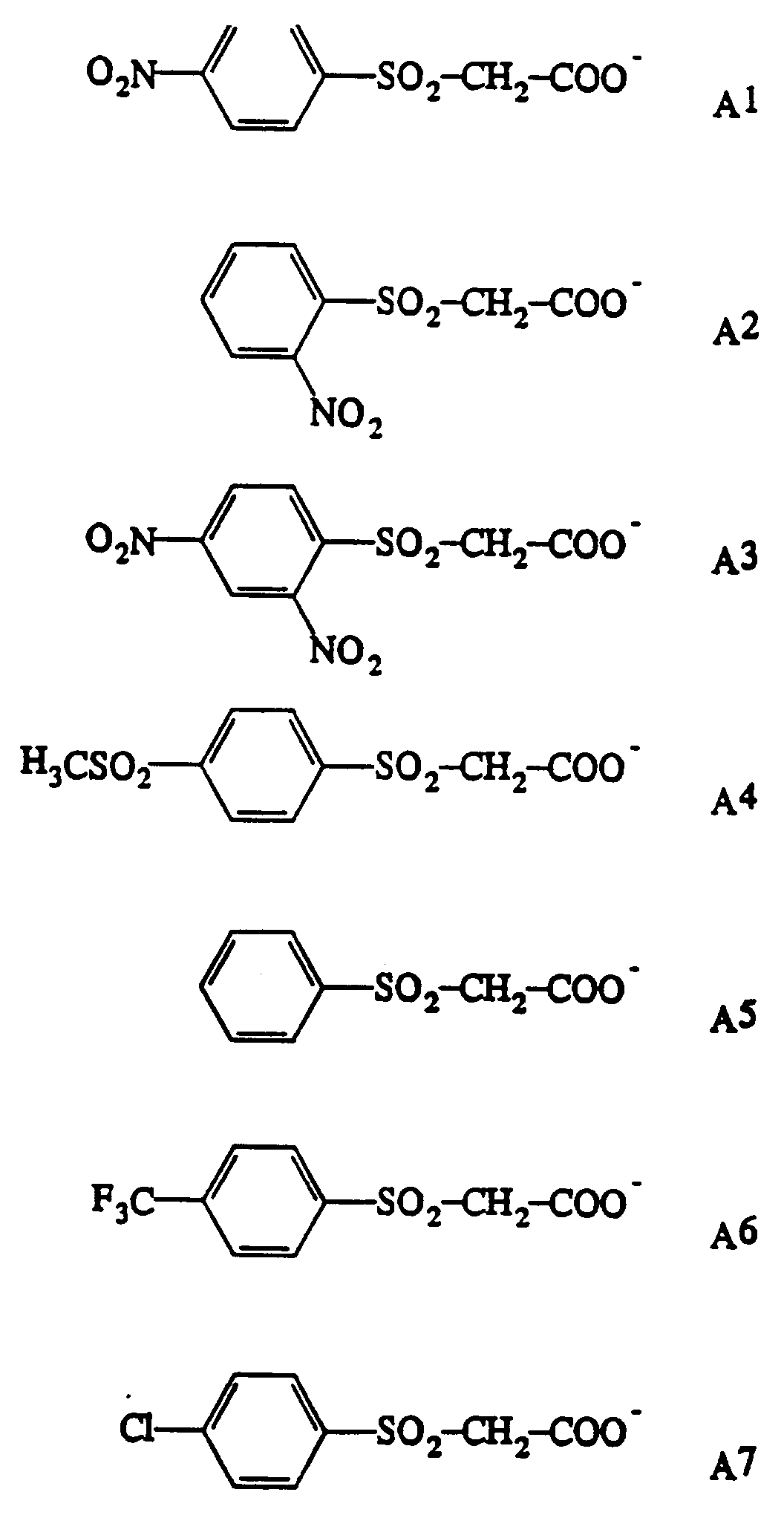
- Representative cations are designated C1-C22 and representative anions are designated A1-A7.
- any combination of anion with cation will be effective in these constructions.
- Acid Addition Although addition of the above-disclosed stabilizers of the present invention is critical, additional use of other acids in the thermal-dye-bleach solution is frequently beneficial. Acid retards pre-bleaching of the dye prior to coating, during coating, and in the drying ovens; and it results in longer solution pot life, higher D max and improved shelf life of the thermally bleachable coatings.
- the acid may be added to the polymer solution directly.
- the acid is a carboxylic acid or a phenylsulfonylacetic acid. Phenylsulfonylacetic acids having strongly electron withdrawing groups on the phenyl ring are particularly preferred.
- Representative acids are acids corresponding to acidification (i.e., protonation) of anions A1-A7. In practice, use of the free acid of the anion used in the thermal-carbanion-generating salt is convenient.
- the molar ratio of acid to nucleophile or carbanion generator is not thought to be unduly critical, but usually an excess of acid is used. A mole ratio between about 1/1 to about 5/1 is preferred.
- the molar ratio of acid to dye is also not thought to be particularly critical, but usually an excess of acid is present. A ratio from about 1/1 to about 4/1 is preferred.
- the stabilizers of this invention are usually present in excess by weight as compared to the weight of the thermal-dye-bleach agents and the dye. A ratio of from about 5:1 to about 50:1 by weight is preferred. A ratio of from about 5:1 to 20:1 is more preferred.
- the molar ratio of thermal-(nucleophile or carbanion)-generator to dye is not thought to be particularly critical. If used alone, it is important that the molar amount of carbanion-generator be greater than that of the dye. A ratio from about 2/1 to about 5/1 is preferred. When used in conjuction with an amine-releaser, a ratio of less than 1/1 may be used as long as the total molar ratio of combined bleaching agents to dye is greater than 1/1.
- an isolable complex, III below, of a quaternary-ammonium phenylsulfonylacetate and a phenylsulfonylacetic acid may be prepared and utilized.
- the thermal-carbanion-generating agents described by III can be prepared readily by reacting in solution one mole of quaternary ammonium hydroxide with two moles of carboxylic acid or by treating a solution of the (one-to-one) quaternary ammonium salt with a second equivalent of acid.
- These "acid-salts" are often stable crystalline solids which are easily isolated and purified. When these compounds are heated they decarboxylate to generate an organic base in the form of a carbanion.
- R c to R f By varying the structure of R c to R f as well as by varying the substituent groups on the phenyl ring, a variety of salts may be obtained. Thus, it is possible to modify the solubility and reactivity characteristics of the thermal-carbanion-generator salt.
- R c to R f , Y, and k are as defined earlier herein.
- Thermal-dye-bleach constructions employing mixtures of thermal-carbanion-generating or thermal-nucleophile-generating agents of the invention, such as those described in Table I, can also be used. Such mixtures maintain the improved shelf life and rapid bleaching over a narrow temperature range characteristic of the thermal-carbanion-generating agents.
- thermal-carbanion-generating agent with an amine salt has improved stability when compared with thermal-dye-bleach constructions containing only amine salts as the thermal-dye-bleach agent.
- the combination of the stabilizers of this invention with a dye and bleaching agent capable of generating a nucleophile or a carbanion upon thermolysis finds particular utility as antihalation or acutance constructions in photothermographic materials, e.g., dry silver materials, since the dyes will readily bleach during the thermal processing of the materials.
- the dye may be any dye capable of being bleached by the bleaching agent contained in the construction. Representative, non limiting classes of dyes include; polymethine dyes, auramine dyes, tricyanovinyl dyes, disulfone dyes, and styryl dyes.
- Polymethine Dyes A preferred class of dyes are polymethine dyes. These are disclosed, for example, in W. S. Tuemmler and B. S. Wildi, J. Amer. Chem. Soc. 1958 , 80, 3772; H. Lorenz and R. Wizinger, Helv. Chem. Acta. 1945 , 28, 600; U.S. Patent Nos. 2,813,802, 2,992,938, 3,099,630, 3,275,442, 3,436,353 and 4,547,444; and Japanese Patent No. 56-109,358.
- the dyes have found utility in infrared screening compounds, as photochromic materials, as sensitizers for photoconductors, and as infrared absorbers for optical data storage media.
- polymethine dyes have been shown to bleach in conventional photographic processing solutions, as disclosed in European Patent Publication No. EP 0,377,961.
- EP 0,377,961 European Patent Publication No. EP 0,377,961.
- U.S. Patent No. 5,135,842 describes the use of polymethine dyes in thermal dye bleach constructions.
- the present invention provides a thermal-dye-bleach construction comprising a polymethine dye having a nucleus of general formula IV : wherein:
- polymethine dyes which may be a far-red- or near-infrared-absorbing dye, are particularly preferred.
- Auramine Dyes A second class of dyes is that of ketone imine dyes such as auramine dyes.
- Auramine dyes are derivatives of diarylmethanes and are prepared by the reaction of diarylketones such as Michler's Ketone, bis(4,4'-dimethylamino)benzophenone, with ammonium chloride in the presence of zinc chloride.
- Auramine dyes are commercially available.
- Tricyanovinyl Dyes A third class of dyes is that of tricyanovinyl dyes. These can be prepared by the reaction of tetracyanoethylene (TCNE) with tertiary aromatic amines having a free hydrogen para to the amine group. Detailed procedures for the preparation of tricyanovinyl dyes are given in B. C. McKusick, et al J. Amer. Chem. Soc. 1958 , 80, 2806.
- Disulfone Dyes Another class of dyes is that of disulfone dyes. Disulfone dyes and processes for preparing these materials are disclosed, for example, in U.S. Patent Nos. 3,932,526, 3,933,914, 3,984,357, 4,018,810, 4,069,233, 4,156,696, 4,357,405, and in copending U.S. Patent Application Serial Number 07/730,225. The disclosures of these patents are incorporated herein by reference. The Disulfone dyes have found utility as catalysts, dyes, sensitizers, and non-linear optical materials.
- Styryl Dyes Another class of dyes is that of styryl dyes.
- Styryl dyes such as those described herein are prepared by the reaction of aromatic aldehydes with heterocyclic bases having an activated methylene group such as Fischer's Base (1,3,3-trimethyl-2-methylene indolenine).
- Fischer's Base (1,3,3-trimethyl-2-methylene indolenine).
- the stabilizers of this invention, bleaching agents (such as those of structures I - III ), and dyes are usually coated together with an organic binder as a thin layer on a substrate.
- the heat-bleachable construction thus formed may be used as an antihalation coating for photothermography or photography, it may be used directly as a thermographic element, or it may be used as an acutance or filter dye.
- the type of photothermographic element used in the invention is not critical. Examples of suitable photothermographic elements include dry silver systems (see, for example U.S. Patent Nos. 3,457,075 and 5,258,274, both incorporated herein by reference) and diazo systems.
- the dyes When used as an acutance, antihalation, or filter dye, in photographic or photothermographic elements, it is preferred to incorporate dyes in an amount sufficient to provide an optical density of from 0.05 to 3.0 absorbance units at ⁇ max of the dye.
- the coating weight of the dye is generally from 0.001 to 1 g/m 2 , preferably 0.001 to 0.05 g/m 2 .
- the dye When used for antihalation purposes, the dye must be present in a layer separate from the light-sensitive layer(s).
- the antihalation layer(s) may be positioned either above and/or below the light-sensitive layer(s), and if the support is transparent, an antihalation layer may be positioned on the surface of the support opposite the light-sensitive layer(s).
- the dyes are incorporated within the light-sensitive layer(s).
- the dyes When used for filter purposes, the dyes are normally incorporated in a layer separate from and positioned above the light-sensitive layer(s).
- thermal-dye-bleach layer A wide variety of polymers are suitable for use as the binder in the heat-bleachable construction.
- the activity of the thermal-dye-bleach layer may be adjusted by suitable choice of polymeric binder, and thermal-dye-bleach layers with a wide variety of decolorization temperatures may be prepared.
- polymeric binders of lower glass transition temperatures (T g ) produce thermal-dye-bleach constructions with greater reactivity but less shelf stability.
- thermo-dye-bleach constructions comprising a stabilizer in association with a thermal bleaching agent and a dye.
- Dye-1 is a polymethine dye that absorbs in the near infrared at 821 nm. It has a pale purple color due to a small amount of visible absorption and has the following structure:
- Tetraethylammonium 4-nitrophenylsulfonylacetate (Compound C2-A1) - from tetraethylammonium hydroxide and 4-nitrophenylsulfonylacetic acid.
- Tetrabutylammonium 4-nitrophenylsulfonylacetate (Compound C4-A1) - from tetrabutylammonium hydroxide and 4-nitrophenylsulfonylacetic acid.
- Tetramethylammonium 4-(trifluoromethyl)phenylsulfonylacetate (Compound C1-A6) - from tetramethylammonium hydroxide and 4-(trifluoromethyl)phenylsulfonylacetic acid.
- Tetramethylammonium 4-chlorophenylsulfonylacetate (Compound C1-A7) - from tetramethylammonium hydroxide and 4-chlorophenylsulfonylacetic acid.
- Guanidinium 4-methylphenylsulfonylacetate was prepared as follows: To a mixture of 4.441 g (0.0207 mol) of 4-methylphenylsulfonylacetic acid in 25 mL of ethanol was added 1.867 g (0.0104 mol) of guanidine carbonate and the mixture stirred at room temperature for 18 hr. The resultant product was then filtered off and air dried to afford 5.150 g; mp 152-153 o C (dec). NMR was in agreement with the proposed structure. The 4-methylphenylsulfonylacetic acid was obtained from Lancaster Synthesis Inc. Windham, NH.
- acid-salts described by III can be readily prepared by treating one mole of quaternary-ammonium or other hydroxide with two moles of carboxylic acid or by treating a solution of neutral quaternary ammonium hydroxide or other salt with a second equivalent of acid.
- the materials are typically stable crystalline salts which are easy to isolate and purify. When these compounds are heated they decarboxylate and generate an organic carbanion.
- Typical heat-bleachable antihalation formulations were prepared as described below.
- Solution A A solution of Eastman cellulose acetate butyrate (CAB 381-20), Goodyear polyester (PE-200), 2-butanone, toluene, or 4-methyl-2-pentanone was prepared.
- Solution B When used, a solution of substituted-phenylsulfonylacetic acid in acetone or methanol was prepared.
- Solution C A solution of polymethine dye of formula IV in acetone or methanol was prepared.
- Solution D A solution of thermal carbanion generating salt or "acid-salt" in acetone, methanol, and/or dimethylformamide (DMF) was prepared.
- Solution E When used, a solution of guanidinium thermal-nucleophile-generating agent in methanol or dimethylformamide (DMF) was prepared.
- the resulting polymer, dye, and thermal-carbanion-generator, and amine-releaser solutions were combined and mixed thoroughly and coated onto a polyester substrate using a knife coater.
- the wet coating thickness was 3 mils (76 ⁇ m).
- the coating was dried 4 minutes at 180 °F (82 °C).
- the substrate was either a clear or white opaque polyester.
- Absorbances were obtained using a Hitachi Model 110-A Spectrophotometer in either transmittance or reflectance mode.
- the constructions were bleached by running them through a 3M Model 9014 Dry Silver Processor.
- the temperature was 260-265 °F (127-129 °C) and dwell time was 10 seconds.
- solutions A through E were prepared (see Table V). To solution A, solution E was added followed by the stabilizer or solution of the stabilizer (see Table VI), then solutions B, C, and D, respectively. The solutions were then coated at 3.5 mils wet thickness onto PET film and dried at 180°F (82°C) for 4 minutes. The samples were processed in a 3M Model 9014 Dry Silver Processor.
- Compound 1 is diphenyl carbonate; Compound 2 is 3-benzyl-5 hydroxypentanoicacid lactone; Compound 3 is 4-n-hexyl-4-hydroxybutanoicacid lactone; and Compound 4 is 4-hydroxy-5-phenylbutanoic acid lactone.
- Compounds 1, 3, and 4 were obtained from Aldrich Chemical Company.
- Compound 2 was prepared by the procedure of A. J. Irvin et al. J. Chem. Soc., Perkin I 1978, 1636-1642.
- Compound 1 is an example of a carbonate, while compounds 2, 3, and 4 are examples of lactones.
- the amount of loss of dye absorbance is tabulated in a different manner in Table VIII.
- the initial absorbance is used as a reference and the percentage change from that value is listed for the various aging conditions and times.
- the important comparison here is that a film without any stabilizer (Example 9) would have lost more than 55% of its initial absorbance after 2 months of aging.
- the films incorporating the stabilizers of the present invention retained more of the dye.
- Examples 10-14 demonstrate use of poly (lactic acid/glycolic acid) copolymers as stabilizer for thermal dye bleach constructions.
- the poly (lactic acid/glycolic acid) polymer employed is designated Medisorb 8515-DL and was obtained from Medisorb Technologies International (a Stolle-DuPont Company), Wilmington, DE. It is a poly(lactic acid/glycolic acid) copolymer, has a molecular weight range of 40,000 to 100,000 and a Tg of 40-45 °C. It is an example of compound (v) .
- solutions A through E were prepared (see Table IX). Mixing was achieved by shaking in the case of small samples and by mechanical stirring in the case of larger samples.
- solution A solution E was added followed by the stabilizer or solution of the stabilizer (see Table VI), then solutions B, C, and D, respectively.
- the solutions were then coated at 3.5 mils (88 ⁇ m) wet thickness onto PET film and dried at 180°F (82°C) for 4 minutes.
- the samples were processed in a 3M Model 9014 Dry Silver Processor.
- the 70°F (21°C)/50% RH aging did not show significant differences after 8 weeks to differentiate between the polylactide/glycolide and control material. Aging at 70°F(21°C)/50% RH is less severe than aging for 4 weeks at 80°F(27°C)/80% relative humidity.
- L-Lactide is the L-form of the structure shown below and was obtained from Purac America, Lincolnshire, IL.
- Examples 19-21 also demonstrates the use of L-Lactide as a stabilizer for thermal dye bleach constructions.
- Table XIV Material Ex. 19 Ex. 20 Ex. 21 Solution A Cellulose Acetate Butyrate (Kodak CAB 381-20) 0.525 g 0.3675 g 0.3150 g Polyester Goodyear PE200 0.0073 0.0051 0.0044 2-Butanone 3.686 2.5802 2.2116 Toluene 1.792 1.2544 1.0752 Solution B 4-nitrophenylsulfonylacetic acid 0.0248 0.0248 0.0248 Acetone 2.0098 2.0098 2.0098 Solution C Dye-1 0.0273 0.0273 0.0273 Acetone 1.927 1.927 1.927 Solution D Tetramethylammonium 4-nitrophenylsulfonylacetate (Carbanion Generator C1-A1) 0.0168 0.0168 0.0168 Methanol 0.6781 0.0168 0.0168 Solution E Guanidinium 4-nitrophenylsulfonylacetate (Compound C14-
- each Example was then coated onto a poly(ethylene terephthalate) film at 3.5 mil (89 ⁇ m) wet thickness and dried 180°F (82°C) for 4 minutes.
- the samples were processed in a 3M Model 9014 Dry Silver Thermal Processor at 260°F (127°C) for 10 seconds. All samples completely bleached.
- Examples 22-24 demonstrate the use of a Glycolide-S as a stabilizer for the thermal dye bleach constructions of the invention and compare levels of Glycolide-S to a control without stabilizers.
- Glycolide-S has the structure shown below and was obtained from Henley Chemical Co, Newark, NJ. Table XVII Material Ex. 22 Ex. 23 Ex.
- each Example was then coated onto a poly(ethylene terephthalate) film at 3.5 mil (89 ⁇ m) wet thickness and dried 180°F (82°C) for 4 minutes.
- the samples were processed in a 3M Model 9014 Dry Silver Thermal Processor at 260°F (127°C) for 10 seconds. All samples completely bleached.
- Examples 25-26 demonstrate the ability of lactate esters to stabilize thermal dye bleach constructions against bleaching.
- the lactate ester used was methyl lactate.
- Example 25 served as a control and contained no methyl lactate.
- Examples 27-29 compare an "end capped" poly(lactic acid) polymer with a control without any stabilizer.
- the poly(lactic acid) polymer identified as Ac-(PLA) 6 -OEt, has about 6 poly(lactic acid) groups 100% acetylated and 100% esterfied with -OEt groups and was prepared as described below.
- Lactic acid oligomers were prepared by heating 622.79 g of 85 % lactic acid (obtained from Aldrich Chemical Co.) to 140°C under a 30 torr vacuum for 18 hr. This material, with a typical average degree of polymerization of 6, was then mixed with 300 mL of acetic anhydride and heated at 120°C for 6 hr. Much of the excess acetic anhydride was then removed by distillation under reduced pressure. After cooling to 60°C, a mixture of 75 mL of water in 425 mL of tetrahydrofuran was added and stirred for 50 min.
- the solutions were coated onto poly(ethylene terephthalate) films at 5 mils (127 ⁇ m) wet thickness and dried 180°F (82°C) for 3 minutes.
- the samples were processed in a 3M Model 9014 Dry Silver Thermal Processor at 250°F (121°C) for 15 seconds. All samples completely bleached.
- Examples 33-35 demonstrate the ability of perfluorinated lactate esters to stabilize thermal dye bleach constructions against bleaching.
- Example 33 served as a control and contained no stabilizer material.
- Solution A Cellulose Acetate Butyrate Kodak CAB 381-20 1.0037 g 1.0037 g 1.0037 g Goodyear Polyester PE 200 0.0014 0.0014 0.0014 2-butanone 6.9823 6.9823 6.9823 Solution B 4-nitrophenyl-sulfonyl acetic acid 0.0237 0.0237 0.0237 Acetone 0.9565 0.9565 Solution C Dye-1 0.0273 0.0273 0.0273 Acetone 0.6127 0.6127 0.6127 4-methyl-2-pentanone 0.2750 0.2750 Solution D Tetramethylammonium 4-chlorophenylsulfonylacetate (Carbanion Generator C1-A7) 0.0092 0.0092 0.0092 Methanol 0.2610 0.2610 0.2610 Solution E Guanidinium 4-nitrophenylsulfonylacetate (Compound C14-A1) 0.0227 0.0227 0.0227 Methanol 0.9023 0.9023 0.9023 Dimethylformamide 0.9023 0.9023 0.9023 Solution
- Example 35 The pale purple coating of Example 35 was evaluated as a potential thermographic medium.
- the coating prepared as described in Example 35 had a pale purple color. This coating was found to produce a pleasing negative clear-on-purple transparent copy from printed text when passed through a 3M Transparency Maker.
Landscapes
- Chemical & Material Sciences (AREA)
- Engineering & Computer Science (AREA)
- Materials Engineering (AREA)
- Physics & Mathematics (AREA)
- General Physics & Mathematics (AREA)
- Non-Silver Salt Photosensitive Materials And Non-Silver Salt Photography (AREA)
- Detergent Compositions (AREA)
- Heat Sensitive Colour Forming Recording (AREA)
- Anti-Oxidant Or Stabilizer Compositions (AREA)
- Organic Low-Molecular-Weight Compounds And Preparation Thereof (AREA)
Claims (10)
- Thermisches Farbstoffbleichkonstrukt, umfassend:(a) einen Farbstoff in Verbindung mit einem thermisch erzeugten Bleichmittel, und(b) mindestens eine Verbindung ausgewählt aus:
 Rs ausgewählt ist aus Alkyl-, Aralkyl-, Cycloalkyl-, Alkenyl- und Acylresten mit bis zu 20 Kohlenstoffatomen, Arylresten mit bis zu 14 Kohlenstoffatomen und einem Wasserstoffatom;Rt ausgewählt ist aus Alkyl-, Aralkyl-, Cycloalkyl- und Alkenylresten mit bis zu 20 Kohlenstoffatomen und Arylresten mit bis zu 14 Kohlenstoffatomen;Ru und Rv jeweils unabhängig ausgewählt sind aus Alkyl-, Aralkyl-, Cycloalkyl- und Alkenylresten mit bis zu 20 Kohlenstoffatomen und Arylresten mit bis zu 14 Kohlenstoffatomen, mit der Maßgabe, daß nur einer der Reste Ru und Rv ein Alkylrest ist;Ry und Rz jeweils unabhängig ausgewählt sind aus Alkyl-, Aralkyl- und Alkenylresten mit bis zu 20 Kohlenstoffatomen, Arylresten mit bis zu 14 Kohlenstoffatomen und einem Wasserstoffatom; undj eine ganze Zahl von 0 bis 2000 ist.
 - Thermisches Farbstoffbleichkonstrukt nach Anspruch 1, wobei:Rs ausgewählt ist aus Alkyl-, Aralkyl-, Cycloalkyl-, Alkenyl-, Acyl- und Arylresten mit bis zu 10 Kohlenstoffatomen und einem Wasserstoffatom;Rt ausgewählt ist aus Alkyl-, Aralkyl-, Cycloalkyl-, Alkenyl- und Arylresten mit bis zu 10 Kohlenstoffatomen;Ru und Rv jeweils unabhängig ausgewählt sind aus Alkyl-, Aralkyl-, Cycloalkyl-, Alkenyl- und Arylresten mit bis zu 10 Kohlenstoffatomen; undRy und Rz jeweils unabhängig ausgewählt sind aus Alkyl-, Aralkyl-, Alkenyl- und Arylresten mit bis zu 10 Kohlenstoffatomen und einem Wasserstoffatom.
- Thermisches Farbstoffbleichkonstrukt nach Anspruch 2, wobei:Rs ausgewählt ist aus Alkyl-, Aralkyl-, Cycloalkyl-, Alkenyl- und Acylresten mit bis zu 5 Kohlenstoffatomen, Arylresten mit bis zu 6 Kohlenstoffatomen und einem Wasserstoffatom;Rt ausgewählt ist aus Alkyl-, Aralkyl-, Cycloalkyl- und Alkenylresten mit bis zu 5 Kohlenstoffatomen und Arylresten mit bis zu 6 Kohlenstoffatomen;Ru und Rv jeweils unabhängig ausgewählt sind aus Alkyl-, Aralkyl-, Cycloalkyl- und Alkenylresten mit bis zu 5 Kohlenstoffatomen und Arylresten mit bis zu 6 Kohlenstoffatomen; undRy und Rz jeweils unabhängig ausgewählt sind aus Alkyl-, Aralkyl- und Alkenylresten mit bis zu 5 Kohlenstoffatomen, Arylresten mit bis zu 6 Kohlenstoffatomen und einem Wasserstoffatom.
- Thermisches Farbstoffbleichkonstrukt nach Anspruch 2, wobei:Rs ausgewählt ist aus einem Wasserstoffatom, einer Methyl-, Ethyl- und Acetylgruppe;Rt ein fluorierter Alkylrest mit bis zu 10 Kohlenstoffatomen ist;Ru und Rv jeweils unabhängig Arylreste mit bis zu 10 Kohlenstoffatomen sind; undRy und Rz jeweils unabhängig ausgewählt werden aus Alkylresten mit bis zu 5 Kohlenstoffatomen und einem Wasserstoffatom.
- Thermisches Farbstoffbleichkonstrukt nach Anspruch 1, wobei die mindestens eine Verbindung ausgewählt ist aus Poly(milchsäure) und Poly(glykolsäure)-Polymeren oder -Copolymeren, Carbonaten, Lactonen, Lactaten, Lactylaten, Lactiden, Glykolaten, Glykolylaten und Glykoliden.
- Thermisches Farbstoffbleichkonstrukt nach Anspruch 1, wobei das thermisch erzeugte Bleichmittel ein Sulfonylacetat der allgemeinen Formel I ist:
 Ra und Rb jeweils unabhängig ausgewählt sind aus einem Wasserstoffatom, einem Alkylrest, einem Alkenylrest, einem Cycloalkylrest, einem Aralkylrest, einem Arylrest und einem heterocyclischen Rest;p 1 oder 2 ist, und wenn p 1 ist, Z ein monovalenter Rest ist, ausgewählt aus einem Alkylrest, einem Cycloalkylrest, einem Alkenylrest, einem Alkinylrest, einem Aralkylrest, einem Arylrest und einem heterocyclischen Rest, und wenn p 2 ist, Z ein divalenter Rest ist, ausgewählt aus einem Alkylenrest, einem Arylenrest, einem Cycloalkylenrest, einem Alkinylenrest, einem Aralkylenrest, einem Alkenylenrest und einem heterocyclischen Rest; undM+ ein Kation ist.
 - Thermisches Farbstoffbleichkonstrukt nach Anspruch 1, wobei das thermisch erzeugte Bleichmittel ein quaternäres Ammoniumsalz einer Phenylsulfonylessigsäure umfaßt, das bei thermischer Zersetzung ein oder mehrere Carbanionreste freisetzt.
- Thermisches Farbstoffbleichkonstrukt nach Anspruch 7, wobei das quaternäre Ammoniumsalz der Phenylsulfonylessigsäure durch nachstehende Formel wiedergegeben wird:
 Y einen Carbanion stabilisierenden Rest darstellt;k 0 bis 5 ist; undRc bis Rf unabhängig voneinander C1 bis C18-Alkyl-, Alkenyl-, Aralkyl- oder Arylreste sind, mit der Maßgabe, daß die Gesamtzahl der in
- Thermisches Farbstoffbleichkonstrukt nach Anspruch 6, wobei das thermisch erzeugte Bleichmittel ein Kation, ausgewählt aus C1 bis C22 in Kombination mit einem Anion, ausgewählt aus A1 bis A7 umfaßt:C1 Tetramethylammonium+C2 Tetraethylammonium+C3 Tetrapropylammonium+C4 Tetrabutylammonium+C5 Benzyltrimethylammonium+C6 Li-12-Krone-4+C7 Na-15-Krone-5+C8 K-Dibenzo-18-Krone-6+C9 K-18-Krone-6+C10 Tetraphenylphosphonium+C11 Tetraphenylarsonium+C12 N-Dodecylpyridinium+C13 Dodecyltrimethylammonium+

- Thermisches Farbstoffbleichkonstrukt nach Anspruch 1, wobei der Farbstoff ausgewählt ist aus Polymethinfarbstoffen, Auraminfarbstoffen, Tricyanovinylfarbstoffen, Disulfonfarbstoffen und Styrylfarbstoffen.
Applications Claiming Priority (2)
| Application Number | Priority Date | Filing Date | Title |
|---|---|---|---|
| US170536 | 1993-12-20 | ||
| US08/170,536 US5395747A (en) | 1993-12-20 | 1993-12-20 | Stabilized thermal-dye-bleach constructions |
Publications (3)
| Publication Number | Publication Date |
|---|---|
| EP0659581A2 EP0659581A2 (de) | 1995-06-28 |
| EP0659581A3 EP0659581A3 (de) | 1995-08-23 |
| EP0659581B1 true EP0659581B1 (de) | 1997-10-15 |
Family
ID=22620250
Family Applications (1)
| Application Number | Title | Priority Date | Filing Date |
|---|---|---|---|
| EP94120118A Expired - Lifetime EP0659581B1 (de) | 1993-12-20 | 1994-12-19 | Stabilisiertes thermisches Farbstoffbleichkonstrukt |
Country Status (7)
| Country | Link |
|---|---|
| US (1) | US5395747A (de) |
| EP (1) | EP0659581B1 (de) |
| JP (1) | JP2719116B2 (de) |
| AT (1) | ATE159205T1 (de) |
| CA (1) | CA2135448A1 (de) |
| DE (1) | DE69406254T2 (de) |
| ES (1) | ES2108927T3 (de) |
Families Citing this family (11)
| Publication number | Priority date | Publication date | Assignee | Title |
|---|---|---|---|---|
| GB9617416D0 (en) * | 1996-08-20 | 1996-10-02 | Minnesota Mining & Mfg | Thermal bleaching of infrared dyes |
| US5945249A (en) * | 1995-04-20 | 1999-08-31 | Imation Corp. | Laser absorbable photobleachable compositions |
| US5935758A (en) * | 1995-04-20 | 1999-08-10 | Imation Corp. | Laser induced film transfer system |
| US6329128B1 (en) * | 1995-05-01 | 2001-12-11 | Eastman Kodak Company | Stable antihalation materials for photographic and photothermographic elements |
| US5637449A (en) * | 1995-09-19 | 1997-06-10 | Imation Corp | Hydrogen atom donor compounds as contrast enhancers for black-and-white photothermographic and thermographic elements |
| EP0921434B1 (de) * | 1997-12-06 | 2003-07-09 | Agfa-Gevaert | Thermographisches Aufzeichnungsmaterial mit verbesserter Bilddichte und/oder Gradation bei der thermischen Entwicklung |
| US6037114A (en) * | 1998-01-27 | 2000-03-14 | Agfa-Gevaert | Thermographic recording material with improved image density and/or image gradation upon thermal development |
| JP3851452B2 (ja) * | 1998-08-13 | 2006-11-29 | 富士写真フイルム株式会社 | 透過型熱現像感光材料 |
| US6746807B1 (en) * | 2002-11-20 | 2004-06-08 | Eastman Kodak Company | Thermally bleachable filter dye compositions comprising benzothiazine-dioxide arylidene dyes and base precursors for use in a photothermographic element |
| US7267935B1 (en) | 2006-06-19 | 2007-09-11 | Carestream Health, Inc. | Thermally developable materials stabilized with crown ethers |
| EP3482964A1 (de) * | 2017-11-13 | 2019-05-15 | Mitsubishi HiTec Paper Europe GmbH | Wärmeempfindliches aufzeichnungsmaterial auf basis von pla |
Family Cites Families (26)
| Publication number | Priority date | Publication date | Assignee | Title |
|---|---|---|---|---|
| US3220846A (en) * | 1960-06-27 | 1965-11-30 | Eastman Kodak Co | Use of salts of readily decarboxylated acids in thermography, photography, photothermography and thermophotography |
| US3769019A (en) * | 1968-05-29 | 1973-10-30 | Minnesota Mining & Mfg | Light and heat sensitive sheet material |
| BE755091A (fr) * | 1969-08-22 | 1971-02-01 | Eastman Kodak Co | Composition photoconductrice, produit la contenant et ses applications en electrophotographie |
| US3609360A (en) * | 1969-09-15 | 1971-09-28 | Joseph A Wiese Jr | Negative projection transparencies and method |
| US3619194A (en) * | 1969-11-05 | 1971-11-09 | Gary F Mitchell | Novel light-absorbing layers for photographic elements containing substituted 1-aminopyridinium dyes |
| US3667959A (en) * | 1970-05-01 | 1972-06-06 | Eastman Kodak Co | Photosensitive and thermosensitive element,compositions and process |
| US3684552A (en) * | 1970-11-16 | 1972-08-15 | Minnesota Mining & Mfg | Heat-sensitive sheet material |
| US3852093A (en) * | 1972-12-13 | 1974-12-03 | Minnesota Mining & Mfg | Heat-sensitive copy-sheet |
| US4033948A (en) * | 1976-05-17 | 1977-07-05 | Minnesota Mining And Manufacturing Company | Acutance agents for use in thermally-developable photosensitive compositions |
| US4060420A (en) * | 1976-08-06 | 1977-11-29 | Eastman Kodak Company | Sulfonylacetate activator-stabilizer precursor |
| US4088469A (en) * | 1977-03-21 | 1978-05-09 | Ppg Industries, Inc. | Environmental control of a glass fiber forming bushing |
| US4196002A (en) * | 1977-09-19 | 1980-04-01 | Eastman Kodak Company | Photothermographic element containing heat sensitive dye materials |
| US4201590A (en) * | 1977-09-19 | 1980-05-06 | Eastman Kodak Company | Heat sensitive reactive products of hexaarylbiimidazole and antihalation dyes |
| US4197131A (en) * | 1978-11-29 | 1980-04-08 | Minnesota Mining And Manufacturing Company | Dry silver photo-sensitive compositions |
| DD144131A1 (de) * | 1979-05-31 | 1980-09-24 | Martin Scharf | Fotografische materialien mit lichthofschutz auf basis von halogensilberemulsionen |
| US4283487A (en) * | 1979-11-29 | 1981-08-11 | Minnesota Mining And Manufacturing Company | Thermolabile acutance dyes for dry silver |
| JPS5895345A (ja) * | 1981-12-01 | 1983-06-06 | Konishiroku Photo Ind Co Ltd | 色素画像形成方法 |
| DE3375704D1 (en) * | 1982-08-20 | 1988-03-24 | Minnesota Mining & Mfg | Photographic elements incorporating antihalation and/or acutance dyes |
| JPS59157637A (ja) * | 1983-02-25 | 1984-09-07 | Fuji Photo Film Co Ltd | 熱現像カラ−感光材料 |
| GB8307022D0 (en) * | 1983-03-15 | 1983-04-20 | Minnesota Mining & Mfg | Photothermographic element |
| JPS59168440A (ja) * | 1983-03-16 | 1984-09-22 | Fuji Photo Film Co Ltd | 熱現像カラ−感光材料 |
| US4705737A (en) * | 1983-03-16 | 1987-11-10 | Fuji Photo Film Co., Ltd. | Heat developable photographic materials |
| JPS6153636A (ja) * | 1984-08-24 | 1986-03-17 | Fuji Photo Film Co Ltd | 熱現像感光材料 |
| GB8830168D0 (en) * | 1988-12-23 | 1989-02-22 | Minnesota Mining & Mfg | Infrared-sensitive photographic materials incorporating antihalation and/or acutance dye |
| GB8913444D0 (en) * | 1989-06-12 | 1989-08-02 | Minnesota Mining & Mfg | Thermal dye bleach construction |
| US5258274A (en) * | 1992-05-22 | 1993-11-02 | Minnesota Mining And Manufacturing Company | Thermal dye bleach construction sensitive to ultraviolet radiation |
-
1993
- 1993-12-20 US US08/170,536 patent/US5395747A/en not_active Expired - Fee Related
-
1994
- 1994-11-09 CA CA002135448A patent/CA2135448A1/en not_active Abandoned
- 1994-12-14 JP JP6310464A patent/JP2719116B2/ja not_active Expired - Fee Related
- 1994-12-19 AT AT94120118T patent/ATE159205T1/de not_active IP Right Cessation
- 1994-12-19 EP EP94120118A patent/EP0659581B1/de not_active Expired - Lifetime
- 1994-12-19 DE DE69406254T patent/DE69406254T2/de not_active Expired - Fee Related
- 1994-12-19 ES ES94120118T patent/ES2108927T3/es not_active Expired - Lifetime
Also Published As
| Publication number | Publication date |
|---|---|
| US5395747A (en) | 1995-03-07 |
| ATE159205T1 (de) | 1997-11-15 |
| EP0659581A2 (de) | 1995-06-28 |
| DE69406254D1 (de) | 1997-11-20 |
| ES2108927T3 (es) | 1998-01-01 |
| JP2719116B2 (ja) | 1998-02-25 |
| JPH07199409A (ja) | 1995-08-04 |
| EP0659581A3 (de) | 1995-08-23 |
| DE69406254T2 (de) | 1998-04-02 |
| CA2135448A1 (en) | 1995-06-21 |
Similar Documents
| Publication | Publication Date | Title |
|---|---|---|
| EP0605286B1 (de) | Konstruktion zum thermischen Farbbleichen | |
| EP0748465B1 (de) | Dihydroperimidinsquarylium farbstoffe als lichthofschutz- und konturenschaerfematerialien fuer photographische und photothermographische gegenstaende | |
| EP0659581B1 (de) | Stabilisiertes thermisches Farbstoffbleichkonstrukt | |
| EP0665960B1 (de) | Bildaufzeichnungsmedium und verfahren | |
| US5215876A (en) | Radiographic element with uv absorbation compound in polyester support | |
| US4871844A (en) | Diazepihium dyes | |
| US4081278A (en) | Heat sensitive dye layers comprising a benzopinacol | |
| US5384237A (en) | Quaternary-ammonium phenylsulfonylacetate thermal-dye-bleach agents | |
| EP1033618A1 (de) | Wärmeentwickelbares lichtempfindliches Material | |
| EP0377961B1 (de) | Photographische, infrarotempfindliche Materialien, die Farbstoffe zur Verbesserung des Lichthofschutzes und/oder der Konturenschärfe enthalten | |
| JPH0723468B2 (ja) | フオトクロミツク感光性組成物 | |
| US6329128B1 (en) | Stable antihalation materials for photographic and photothermographic elements | |
| US4140532A (en) | Thermally developable light-sensitive material | |
| JP4003375B2 (ja) | 熱現像感光材料とその製造方法 | |
| JP3767214B2 (ja) | 熱現像ハロゲン化銀感光材料、画像記録方法、及び画像形成方法 | |
| JPS6339390A (ja) | 光学記録媒体 | |
| JPH07114140A (ja) | 写真用吸光染料 | |
| JP2001051374A (ja) | 熱現像感光材料 | |
| JPH11194446A (ja) | 熱現像感光材料 |
Legal Events
| Date | Code | Title | Description |
|---|---|---|---|
| PUAI | Public reference made under article 153(3) epc to a published international application that has entered the european phase |
Free format text: ORIGINAL CODE: 0009012 |
|
| AK | Designated contracting states |
Kind code of ref document: A2 Designated state(s): AT BE DE ES FR GB IT NL |
|
| PUAL | Search report despatched |
Free format text: ORIGINAL CODE: 0009013 |
|
| AK | Designated contracting states |
Kind code of ref document: A3 Designated state(s): AT BE DE ES FR GB IT NL |
|
| 17P | Request for examination filed |
Effective date: 19951004 |
|
| GRAG | Despatch of communication of intention to grant |
Free format text: ORIGINAL CODE: EPIDOS AGRA |
|
| 17Q | First examination report despatched |
Effective date: 19960917 |
|
| GRAH | Despatch of communication of intention to grant a patent |
Free format text: ORIGINAL CODE: EPIDOS IGRA |
|
| GRAH | Despatch of communication of intention to grant a patent |
Free format text: ORIGINAL CODE: EPIDOS IGRA |
|
| GRAA | (expected) grant |
Free format text: ORIGINAL CODE: 0009210 |
|
| AK | Designated contracting states |
Kind code of ref document: B1 Designated state(s): AT BE DE ES FR GB IT NL |
|
| REF | Corresponds to: |
Ref document number: 159205 Country of ref document: AT Date of ref document: 19971115 Kind code of ref document: T |
|
| REF | Corresponds to: |
Ref document number: 69406254 Country of ref document: DE Date of ref document: 19971120 |
|
| ITF | It: translation for a ep patent filed | ||
| REG | Reference to a national code |
Ref country code: ES Ref legal event code: FG2A Ref document number: 2108927 Country of ref document: ES Kind code of ref document: T3 |
|
| ET | Fr: translation filed | ||
| PLBE | No opposition filed within time limit |
Free format text: ORIGINAL CODE: 0009261 |
|
| STAA | Information on the status of an ep patent application or granted ep patent |
Free format text: STATUS: NO OPPOSITION FILED WITHIN TIME LIMIT |
|
| 26N | No opposition filed | ||
| PGFP | Annual fee paid to national office [announced via postgrant information from national office to epo] |
Ref country code: FR Payment date: 19981202 Year of fee payment: 5 |
|
| PGFP | Annual fee paid to national office [announced via postgrant information from national office to epo] |
Ref country code: GB Payment date: 19981203 Year of fee payment: 5 |
|
| PGFP | Annual fee paid to national office [announced via postgrant information from national office to epo] |
Ref country code: AT Payment date: 19981204 Year of fee payment: 5 |
|
| PGFP | Annual fee paid to national office [announced via postgrant information from national office to epo] |
Ref country code: NL Payment date: 19981217 Year of fee payment: 5 |
|
| PGFP | Annual fee paid to national office [announced via postgrant information from national office to epo] |
Ref country code: ES Payment date: 19981223 Year of fee payment: 5 |
|
| PGFP | Annual fee paid to national office [announced via postgrant information from national office to epo] |
Ref country code: BE Payment date: 19981231 Year of fee payment: 5 |
|
| PG25 | Lapsed in a contracting state [announced via postgrant information from national office to epo] |
Ref country code: GB Free format text: LAPSE BECAUSE OF NON-PAYMENT OF DUE FEES Effective date: 19991219 Ref country code: AT Free format text: LAPSE BECAUSE OF NON-PAYMENT OF DUE FEES Effective date: 19991219 |
|
| PG25 | Lapsed in a contracting state [announced via postgrant information from national office to epo] |
Ref country code: BE Free format text: LAPSE BECAUSE OF NON-PAYMENT OF DUE FEES Effective date: 19991231 |
|
| BERE | Be: lapsed |
Owner name: MINNESOTA MINING AND MFG CY Effective date: 19991231 |
|
| PG25 | Lapsed in a contracting state [announced via postgrant information from national office to epo] |
Ref country code: NL Free format text: LAPSE BECAUSE OF NON-PAYMENT OF DUE FEES Effective date: 20000701 |
|
| GBPC | Gb: european patent ceased through non-payment of renewal fee |
Effective date: 19991219 |
|
| PG25 | Lapsed in a contracting state [announced via postgrant information from national office to epo] |
Ref country code: FR Free format text: LAPSE BECAUSE OF NON-PAYMENT OF DUE FEES Effective date: 20000831 |
|
| NLV4 | Nl: lapsed or anulled due to non-payment of the annual fee |
Effective date: 20000701 |
|
| REG | Reference to a national code |
Ref country code: FR Ref legal event code: ST |
|
| PG25 | Lapsed in a contracting state [announced via postgrant information from national office to epo] |
Ref country code: ES Free format text: LAPSE BECAUSE OF NON-PAYMENT OF DUE FEES Effective date: 20001220 |
|
| REG | Reference to a national code |
Ref country code: ES Ref legal event code: FD2A Effective date: 20010113 |
|
| PG25 | Lapsed in a contracting state [announced via postgrant information from national office to epo] |
Ref country code: IT Free format text: LAPSE BECAUSE OF NON-PAYMENT OF DUE FEES;WARNING: LAPSES OF ITALIAN PATENTS WITH EFFECTIVE DATE BEFORE 2007 MAY HAVE OCCURRED AT ANY TIME BEFORE 2007. THE CORRECT EFFECTIVE DATE MAY BE DIFFERENT FROM THE ONE RECORDED. Effective date: 20051219 |
|
| PGFP | Annual fee paid to national office [announced via postgrant information from national office to epo] |
Ref country code: DE Payment date: 20051230 Year of fee payment: 12 |
|
| PG25 | Lapsed in a contracting state [announced via postgrant information from national office to epo] |
Ref country code: DE Free format text: LAPSE BECAUSE OF NON-PAYMENT OF DUE FEES Effective date: 20070703 |