EP0657300B1 - Akzeptorschicht für druckempfindliche Aufzeichnungsblätter - Google Patents
Akzeptorschicht für druckempfindliche Aufzeichnungsblätter Download PDFInfo
- Publication number
- EP0657300B1 EP0657300B1 EP94118477A EP94118477A EP0657300B1 EP 0657300 B1 EP0657300 B1 EP 0657300B1 EP 94118477 A EP94118477 A EP 94118477A EP 94118477 A EP94118477 A EP 94118477A EP 0657300 B1 EP0657300 B1 EP 0657300B1
- Authority
- EP
- European Patent Office
- Prior art keywords
- caco
- weight
- recording
- sheet
- pressure
- Prior art date
- Legal status (The legal status is an assumption and is not a legal conclusion. Google has not performed a legal analysis and makes no representation as to the accuracy of the status listed.)
- Expired - Lifetime
Links
- 239000000370 acceptor Substances 0.000 claims description 23
- 239000000049 pigment Substances 0.000 claims description 17
- 239000011230 binding agent Substances 0.000 claims description 15
- VTYYLEPIZMXCLO-UHFFFAOYSA-L Calcium carbonate Chemical compound [Ca+2].[O-]C([O-])=O VTYYLEPIZMXCLO-UHFFFAOYSA-L 0.000 claims description 12
- 239000003921 oil Substances 0.000 claims description 11
- 239000002245 particle Substances 0.000 claims description 10
- 239000000945 filler Substances 0.000 claims description 7
- 229910000019 calcium carbonate Inorganic materials 0.000 claims description 5
- 238000010521 absorption reaction Methods 0.000 claims 1
- 239000000654 additive Substances 0.000 claims 1
- 239000000463 material Substances 0.000 description 11
- 235000019198 oils Nutrition 0.000 description 10
- 239000007788 liquid Substances 0.000 description 6
- 238000001179 sorption measurement Methods 0.000 description 6
- 239000008199 coating composition Substances 0.000 description 5
- 238000000576 coating method Methods 0.000 description 5
- 239000000470 constituent Substances 0.000 description 5
- 239000011248 coating agent Substances 0.000 description 4
- 230000000694 effects Effects 0.000 description 4
- 229920000126 latex Polymers 0.000 description 4
- 238000000034 method Methods 0.000 description 4
- XLOMVQKBTHCTTD-UHFFFAOYSA-N Zinc monoxide Chemical compound [Zn]=O XLOMVQKBTHCTTD-UHFFFAOYSA-N 0.000 description 3
- 235000010216 calcium carbonate Nutrition 0.000 description 3
- 238000006243 chemical reaction Methods 0.000 description 3
- 229920001577 copolymer Polymers 0.000 description 3
- 230000007423 decrease Effects 0.000 description 3
- 239000004816 latex Substances 0.000 description 3
- 239000005011 phenolic resin Substances 0.000 description 3
- 229920001568 phenolic resin Polymers 0.000 description 3
- 150000003872 salicylic acid derivatives Chemical class 0.000 description 3
- 239000002904 solvent Substances 0.000 description 3
- 229920003048 styrene butadiene rubber Polymers 0.000 description 3
- IAUKWGFWINVWKS-UHFFFAOYSA-N 1,2-di(propan-2-yl)naphthalene Chemical compound C1=CC=CC2=C(C(C)C)C(C(C)C)=CC=C21 IAUKWGFWINVWKS-UHFFFAOYSA-N 0.000 description 2
- 239000004372 Polyvinyl alcohol Substances 0.000 description 2
- VYPSYNLAJGMNEJ-UHFFFAOYSA-N Silicium dioxide Chemical compound O=[Si]=O VYPSYNLAJGMNEJ-UHFFFAOYSA-N 0.000 description 2
- GWEVSGVZZGPLCZ-UHFFFAOYSA-N Titan oxide Chemical compound O=[Ti]=O GWEVSGVZZGPLCZ-UHFFFAOYSA-N 0.000 description 2
- 239000002253 acid Substances 0.000 description 2
- 229920006322 acrylamide copolymer Polymers 0.000 description 2
- MTAZNLWOLGHBHU-UHFFFAOYSA-N butadiene-styrene rubber Chemical compound C=CC=C.C=CC1=CC=CC=C1 MTAZNLWOLGHBHU-UHFFFAOYSA-N 0.000 description 2
- 239000002270 dispersing agent Substances 0.000 description 2
- 239000006185 dispersion Substances 0.000 description 2
- 238000009826 distribution Methods 0.000 description 2
- 239000010419 fine particle Substances 0.000 description 2
- 235000021388 linseed oil Nutrition 0.000 description 2
- 239000000944 linseed oil Substances 0.000 description 2
- 229910052751 metal Inorganic materials 0.000 description 2
- 239000002184 metal Substances 0.000 description 2
- 229920000058 polyacrylate Polymers 0.000 description 2
- 229920002451 polyvinyl alcohol Polymers 0.000 description 2
- 238000007639 printing Methods 0.000 description 2
- 239000000376 reactant Substances 0.000 description 2
- 229940058287 salicylic acid derivative anticestodals Drugs 0.000 description 2
- 150000003839 salts Chemical class 0.000 description 2
- XLYOFNOQVPJJNP-UHFFFAOYSA-N water Substances O XLYOFNOQVPJJNP-UHFFFAOYSA-N 0.000 description 2
- 239000011787 zinc oxide Substances 0.000 description 2
- LNAZSHAWQACDHT-XIYTZBAFSA-N (2r,3r,4s,5r,6s)-4,5-dimethoxy-2-(methoxymethyl)-3-[(2s,3r,4s,5r,6r)-3,4,5-trimethoxy-6-(methoxymethyl)oxan-2-yl]oxy-6-[(2r,3r,4s,5r,6r)-4,5,6-trimethoxy-2-(methoxymethyl)oxan-3-yl]oxyoxane Chemical compound CO[C@@H]1[C@@H](OC)[C@H](OC)[C@@H](COC)O[C@H]1O[C@H]1[C@H](OC)[C@@H](OC)[C@H](O[C@H]2[C@@H]([C@@H](OC)[C@H](OC)O[C@@H]2COC)OC)O[C@@H]1COC LNAZSHAWQACDHT-XIYTZBAFSA-N 0.000 description 1
- VOEFELLSAAJCHJ-UHFFFAOYSA-N 1-(3-chlorophenyl)-2-(methylamino)propan-1-one Chemical compound CNC(C)C(=O)C1=CC=CC(Cl)=C1 VOEFELLSAAJCHJ-UHFFFAOYSA-N 0.000 description 1
- KXGFMDJXCMQABM-UHFFFAOYSA-N 2-methoxy-6-methylphenol Chemical compound [CH]OC1=CC=CC([CH])=C1O KXGFMDJXCMQABM-UHFFFAOYSA-N 0.000 description 1
- FJKROLUGYXJWQN-UHFFFAOYSA-N 4-hydroxybenzoic acid Chemical compound OC(=O)C1=CC=C(O)C=C1 FJKROLUGYXJWQN-UHFFFAOYSA-N 0.000 description 1
- 229920002134 Carboxymethyl cellulose Polymers 0.000 description 1
- 239000001856 Ethyl cellulose Substances 0.000 description 1
- ZZSNKZQZMQGXPY-UHFFFAOYSA-N Ethyl cellulose Chemical compound CCOCC1OC(OC)C(OCC)C(OCC)C1OC1C(O)C(O)C(OC)C(CO)O1 ZZSNKZQZMQGXPY-UHFFFAOYSA-N 0.000 description 1
- 229920002153 Hydroxypropyl cellulose Polymers 0.000 description 1
- 229920000881 Modified starch Polymers 0.000 description 1
- 229920002472 Starch Polymers 0.000 description 1
- PPBRXRYQALVLMV-UHFFFAOYSA-N Styrene Natural products C=CC1=CC=CC=C1 PPBRXRYQALVLMV-UHFFFAOYSA-N 0.000 description 1
- 239000002174 Styrene-butadiene Substances 0.000 description 1
- 229910010413 TiO 2 Inorganic materials 0.000 description 1
- 239000012963 UV stabilizer Substances 0.000 description 1
- 229920006243 acrylic copolymer Polymers 0.000 description 1
- WNROFYMDJYEPJX-UHFFFAOYSA-K aluminium hydroxide Chemical compound [OH-].[OH-].[OH-].[Al+3] WNROFYMDJYEPJX-UHFFFAOYSA-K 0.000 description 1
- 239000003963 antioxidant agent Substances 0.000 description 1
- 159000000032 aromatic acids Chemical class 0.000 description 1
- 230000015572 biosynthetic process Effects 0.000 description 1
- AXCZMVOFGPJBDE-UHFFFAOYSA-L calcium dihydroxide Chemical compound [OH-].[OH-].[Ca+2] AXCZMVOFGPJBDE-UHFFFAOYSA-L 0.000 description 1
- 239000000920 calcium hydroxide Substances 0.000 description 1
- 229910001861 calcium hydroxide Inorganic materials 0.000 description 1
- BRPQOXSCLDDYGP-UHFFFAOYSA-N calcium oxide Chemical compound [O-2].[Ca+2] BRPQOXSCLDDYGP-UHFFFAOYSA-N 0.000 description 1
- 239000000292 calcium oxide Substances 0.000 description 1
- ODINCKMPIJJUCX-UHFFFAOYSA-N calcium oxide Inorganic materials [Ca]=O ODINCKMPIJJUCX-UHFFFAOYSA-N 0.000 description 1
- 235000010948 carboxy methyl cellulose Nutrition 0.000 description 1
- 229920003086 cellulose ether Polymers 0.000 description 1
- 229920006184 cellulose methylcellulose Polymers 0.000 description 1
- 239000003795 chemical substances by application Substances 0.000 description 1
- 239000004927 clay Substances 0.000 description 1
- 229910052570 clay Inorganic materials 0.000 description 1
- 150000001875 compounds Chemical class 0.000 description 1
- 229920001249 ethyl cellulose Polymers 0.000 description 1
- 235000019325 ethyl cellulose Nutrition 0.000 description 1
- 238000002474 experimental method Methods 0.000 description 1
- 239000001863 hydroxypropyl cellulose Substances 0.000 description 1
- 235000010977 hydroxypropyl cellulose Nutrition 0.000 description 1
- NLYAJNPCOHFWQQ-UHFFFAOYSA-N kaolin Chemical compound O.O.O=[Al]O[Si](=O)O[Si](=O)O[Al]=O NLYAJNPCOHFWQQ-UHFFFAOYSA-N 0.000 description 1
- 239000000395 magnesium oxide Substances 0.000 description 1
- CPLXHLVBOLITMK-UHFFFAOYSA-N magnesium oxide Inorganic materials [Mg]=O CPLXHLVBOLITMK-UHFFFAOYSA-N 0.000 description 1
- AXZKOIWUVFPNLO-UHFFFAOYSA-N magnesium;oxygen(2-) Chemical compound [O-2].[Mg+2] AXZKOIWUVFPNLO-UHFFFAOYSA-N 0.000 description 1
- 238000004519 manufacturing process Methods 0.000 description 1
- 229920000609 methyl cellulose Polymers 0.000 description 1
- 239000001923 methylcellulose Substances 0.000 description 1
- 235000010981 methylcellulose Nutrition 0.000 description 1
- 235000019426 modified starch Nutrition 0.000 description 1
- 238000007645 offset printing Methods 0.000 description 1
- TWNQGVIAIRXVLR-UHFFFAOYSA-N oxo(oxoalumanyloxy)alumane Chemical compound O=[Al]O[Al]=O TWNQGVIAIRXVLR-UHFFFAOYSA-N 0.000 description 1
- ISWSIDIOOBJBQZ-UHFFFAOYSA-N phenol group Chemical group C1(=CC=CC=C1)O ISWSIDIOOBJBQZ-UHFFFAOYSA-N 0.000 description 1
- 150000002989 phenols Chemical class 0.000 description 1
- 229920000642 polymer Polymers 0.000 description 1
- 229920002689 polyvinyl acetate Polymers 0.000 description 1
- 239000011118 polyvinyl acetate Substances 0.000 description 1
- 238000002360 preparation method Methods 0.000 description 1
- 229920005989 resin Polymers 0.000 description 1
- 239000011347 resin Substances 0.000 description 1
- 238000000518 rheometry Methods 0.000 description 1
- 238000007789 sealing Methods 0.000 description 1
- 239000000377 silicon dioxide Substances 0.000 description 1
- 235000012239 silicon dioxide Nutrition 0.000 description 1
- 239000008107 starch Substances 0.000 description 1
- 235000019698 starch Nutrition 0.000 description 1
- 239000011115 styrene butadiene Substances 0.000 description 1
- 229920001059 synthetic polymer Polymers 0.000 description 1
- 239000004408 titanium dioxide Substances 0.000 description 1
- 238000009827 uniform distribution Methods 0.000 description 1
- 229920002554 vinyl polymer Polymers 0.000 description 1
- 239000003232 water-soluble binding agent Substances 0.000 description 1
Images

Classifications
-
- B—PERFORMING OPERATIONS; TRANSPORTING
- B41—PRINTING; LINING MACHINES; TYPEWRITERS; STAMPS
- B41M—PRINTING, DUPLICATING, MARKING, OR COPYING PROCESSES; COLOUR PRINTING
- B41M5/00—Duplicating or marking methods; Sheet materials for use therein
- B41M5/124—Duplicating or marking methods; Sheet materials for use therein using pressure to make a masked colour visible, e.g. to make a coloured support visible, to create an opaque or transparent pattern, or to form colour by uniting colour-forming components
- B41M5/132—Chemical colour-forming components; Additives or binders therefor
- B41M5/155—Colour-developing components, e.g. acidic compounds; Additives or binders therefor; Layers containing such colour-developing components, additives or binders
-
- B—PERFORMING OPERATIONS; TRANSPORTING
- B41—PRINTING; LINING MACHINES; TYPEWRITERS; STAMPS
- B41M—PRINTING, DUPLICATING, MARKING, OR COPYING PROCESSES; COLOUR PRINTING
- B41M5/00—Duplicating or marking methods; Sheet materials for use therein
- B41M5/124—Duplicating or marking methods; Sheet materials for use therein using pressure to make a masked colour visible, e.g. to make a coloured support visible, to create an opaque or transparent pattern, or to form colour by uniting colour-forming components
- B41M5/1243—Inert particulate additives, e.g. protective stilt materials
Definitions
- the invention relates to the use of a special CaCO 3 in the acceptor layers of self-copying, pressure-sensitive recording materials.
- Pressure sensitive recording materials have been known for many years.
- a color former contained in a solvent and used as a reactant, is transferred from the back of the sheet (CB sheet) printed on the front side to a layer arranged below (CF sheet) with a receiving or accepting layer and by reaction with a so-called acceptor a colored record.
- CB sheet the back of the sheet
- CF sheet a layer arranged below
- acceptor a colored record the so-called single-sheet type, both reactants are arranged separately from one another in a layer and are brought into contact with one another by the writing pressure applied.
- Phenolic resins, their derivatives, salicylic acid derivatives and their polymers are used as organic acceptors in the acceptor layers.
- a color developer preparation for the production of receiving sheets of pressure-sensitive recording materials which contains a p-alkylphenol resin, optionally CaCO 3 and calcium oxide, calcium hydroxide and / or magnesium oxide and conventional binders.
- DE-B-22 29 354 uses hydroxybenzoic acid and hydroxynaphtholic acid derivatives and their metal salts as organic acceptors in combination with binders and pigments, including CaCO 3 in acceptor layers of pressure-sensitive recording materials.
- EP-A-051 846 discloses a color development sheet for pressure-sensitive recording materials with a color development layer which contains an organic acceptor, CaCO 3 and polyvinyl alcohol-acrylamide copolymer.
- the CaCO 3 has an average particle size of less than 0.6 ⁇ m and is present in the layer with a proportion of at least 30% by weight of the dry constituents.
- the combination of PVA-acrylamide copolymer and CaCO 3 improves the recording capacity and the printability of the sheet.
- GB-A-2 028 888 describes the use of calcium carbonate whose particle size distribution is such that 55% of the particles have a size of 2 ⁇ m or less in acceptor layers of pressure-sensitive recording materials.
- the acceptor layer contains organic or inorganic acceptor, binder and calcium carbonate as pigment / filler.
- EP-A-60 386 describes the combination of CaCO 3 , styrene-butadiene latex and organic acceptor in color development sheets for pressure-sensitive recording materials.
- the precipitated CaCO 3 has an average particle size of less than 0.6 ⁇ m and is used in a 5-20-fold excess, based on the organic acceptor.
- the fine-particle CaCO 3 with a large specific surface area absorbs the carrier liquid with the color former particularly well, but causes a high binder requirement, so that a modified styrene-butadiene copolymer latex with a particle size of less than 0.08 ⁇ m must be used as the binder component in order to ensure sufficient strength of the To reach the recording layer without significantly impairing the printability.
- the proportion of the organic acceptor in the receiving layers is usually 5-20% by weight, based on the weight of the coating.
- the remaining components are binders and pigments or fillers.
- the intensity of the color formation depends largely on the uniform distribution of the organic acceptor in the layer. This distribution is supported by the use of pigments, which also influence the adsorption capacity of the layer against the carrier liquid for the color former.
- the paper must also ensure problem-free printability in offset printing, ie it must have no line picking, filing or printing ink build-up etc.
- the possible causes for this effect are the covering of the active centers of the acceptor by binders and the sealing of the CF layer against the carrier liquid of the color former, i.e. the insufficient porosity of the layer.
- the object of the invention is to further improve the write-through performance of pressure-sensitive recording materials with an organic acceptor in the CF layer compared to the known recording materials.
- a receiving sheet for pressure-sensitive recording systems with a recording layer arranged on the top of the paper sheet and containing organic acceptor, binder, pigments / fillers and CaCO 3 , characterized by the use of precipitated CaCO 3 with an average particle size of 0, 8 to 1.2 ⁇ m and a BET surface area of 8-12 m 2 / g. and an oil number of 40 to 60 g / 100 g.
- the oil number of the CaCO 3 is determined and specified in accordance with DIN 53 199. It is 40-60 g / 100 g pigment and is relatively high in relation to the comparatively low BET value of 8-12 m 2 / g. Even higher adsorption values are achieved if the color former solvent is used instead of the linseed oil commonly used for the DIN method.
- An 'oil number' determined, for example, with diisopropylnaphthalene (KMC 113, Rütgerswerke, Duisburg) for the special CaCO 3 to be used according to the invention is 80-95 g / 100 g pigment.
- the special effect of the special precipitated CaCO 3 which has a specific surface area which is relatively low for fine-particle pigments, is obviously related to its structure. If this structure is destroyed, for example, by intensive dispersion in a liquid medium, the effect of increasing the recording intensity of the CaCO 3 in the recording layer is lost.
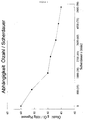
- FIG. 1 shows the decrease in the oil number determining the adsorption capacity with increasing shear duration.
- the CaCO 3 to be used according to the invention was dispersed in water with a commercially available dispersant (polyacrylate) (150 g CaCO 3 in 120 g water in a 1000 ml beaker and 3500 rpm) and exposed to the shear stress for up to 90 minutes.
- the CaCO 3 was then separated from the dispersing liquid, dried and the oil number was determined using KMC oil. It can be seen that the adsorption capacity of the CaCO 3 decreases significantly when it is exposed to intense shear stress for an extended period.
- CaCO 3 samples after shear stress were incorporated into a coating composition for a recording layer and a recording sheet was prepared.
- a recording sheet was prepared using a commercially available CB sheet (54 g / m 2 ), a recording was made on the recording sheet with a typewriter of the AEG Olympia Standard 200i type.
- the intensity of the recording is determined as the difference between the brightness of the recording and the background or sheet without recording.
- the brightness is measured with an ELREPHO device type 2000 at 550 nm (filter Y).
- the brightness differences determined in percent are converted into dimensionless values by forming the ratio: Difference in brightness Ratio value 24.3 ⁇ 1 26.3 ⁇ 1.5 28.3 ⁇ 2nd 30.3 ⁇ 2.5 32.3 ⁇ 3rd
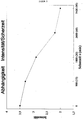
- Figure 2 shows that the intensity of the recording decreases with increasing shear stress on the CaCO 3 .
- the oil number of CaCO 3 is, in addition to the mean particle size and the specific surface area according to BET, a feature with which a suitable CaCO 3 can be distinguished from less suitable CaCO 3 . It is particularly advantageous to deviate from the DIN specification when determining the oil number and to use the diisopropylnaphthalene known as color former solvent instead of linseed oil and to determine a modified oil number.
- the known compounds can be used as organic acceptors in the recording layers, for example phenolic compounds such as phenolic resin, zinc-modified phenolic resins, organic aromatic acids and their metal salts, salicylic acid derivatives, naphtholic acid derivatives, which are used individually or in combination with one another.
- the proportion of organic acceptor in the recording layer can be from 3-10% by weight, preferably 5-8% by weight, based on the weight of the dry layer.
- binders for pigmented paper coatings can be used as binders for the recording layer.
- These include water-soluble binders such as polyvinyl alcohol and its derivatives, starch and starch derivatives, maleic anhydride copolymers, cellulose ethers such as methyl cellulose, ethyl cellulose, hydroxypropyl cellulose, CMC, but also aqueous dispersions of synthetic polymers, so-called latices such as acrylic polymers and copolymers, styrene copolymers, polyvinyl acetate and copolymers.
- the proportion of binder in the recording layer can be 5-15% by weight, based on the weight of the dry layer.
- pigments and fillers customary for such recording layers can also be used, for example clay, titanium dioxide, ZnO, aluminum oxide, aluminum hydroxide, other calcium carbonates or silicon dioxide.
- the proportion of special CaCO 3 to be used according to the invention should be 20% by weight to 50% by weight, based on the weight of the dry layer.
- the proportion of additional further pigments can be 30% by weight to 60% by weight, based on the weight of the dry layer.
- the ratio of organic acceptor to special CaCO 3 in the recording layer can be 1: 4 to 1:10.
- the ratio of special CaCO 3 to other pigments and fillers used in the recording layer can be 1: 3 to 1: 1.
- the recording layer can additionally contain customary auxiliaries for producing and applying the coating composition, such as dispersing aids, defoamers, rheology control agents, but also antioxidants, UV stabilizers and the like in customary amounts.
- customary auxiliaries for producing and applying the coating composition, such as dispersing aids, defoamers, rheology control agents, but also antioxidants, UV stabilizers and the like in customary amounts.
- the constituents of the recording layer are applied in the form of an aqueous coating composition in which the constituents are dissolved or dispersed to a conventional base paper with a basis weight of 30 g / m 2 to 100 g / m 2 using a conventional coating device and dried.
- the coating weight of the dried layer is 2-10 g / m 2 , preferably 3-6 g / m 2 .
- the aqueous coating composition was formulated with a dry matter content of about 40% by weight and applied to a base paper with a coat weight of about 5 g / m 2 (dried) and dried.
- a recording was made using a commercially available CB sheet (54 g / m 2 ) with a typewriter type AEG Olympia 200i.
- the intensity of the recording was determined as a difference in brightness and converted into dimensionless values by forming the ratio.
- This conversion makes sense because it enables a direct comparison with the printability of the surface, which can be described with picking values according to the Tappi method T 459 om-88, after the picking value obtained has been expressed here as a ratio.
- the procedure is shown in the following conversion table: Picking value according to M 459 Ratio value 14 ⁇ 2.0 13 ⁇ 1.6 12th ⁇ 1.2 11 ⁇ 0.8 10th ⁇ 0.4
Landscapes
- Chemical & Material Sciences (AREA)
- Chemical Kinetics & Catalysis (AREA)
- General Chemical & Material Sciences (AREA)
- Color Printing (AREA)
- Paper (AREA)
Description
- Gegenstand der Erfindung ist die Verwendung eines speziellen CaCO3 in den Akzeptorschichten selbstdurchschreibender druckempfindlicher Aufzeichnungsmaterialien.
- Druckempfindliche Aufzeichnungsmaterialien sind seit vielen Jahren bekannt. Beim Aufzeichnungsvorgang wird von der Rückseite des auf der Vorderseite im Druck beaufschlagten Blattes (CB-Blatt) ein in einem Lösemittel enthaltener, als Reaktionspartner dienender, Farbbildner auf ein darunter angeordnetes (CF-Blatt) mit einer Empfangs- oder Akzeptorschicht übertragen und durch Reaktion mit einem sogenannten Akzeptor eine farbige Aufzeichnung ausgebildet.
Beim sogenannten Einblatt-Typ sind beide Reaktionspartner voneinander getrennt in einer Schicht angeordnet und werden durch den aufgebrachten Schreibdruck miteinander in Kontakt gebracht. - In den Akzeptorschichten werden als organische Akzeptoren Phenolharze, deren Derivate, Salicylsäurederivate und deren Polymere verwendet.
Aus DE-C-28 54 318 ist eine Farbentwicklerzubereitung für die Herstellung von aufnehmenden Blättern druckempfindlicher Aufzeichnungsmaterialien bekannt, die ein p-Alkylphenolharz, ggf. CaCO3 und Calciumoxid, Calciumhydroxid und/oder Magnesiumoxid und übliche Bindemittel enthält.
In DE-B-22 29 354 \verden Hydroxybenzoesäure- und Hydroxynaphtholsäurederivate und deren Metallsalze als organische Akzeptoren in Kombination mit Bindemitteln und Pigmenten, u.a. CaCO3 in Akzeptorschichten druckempfindlicher Aufzeichnungsmaterialien verwendet.
Aus EP-A-051 846 ist ein Farbentwicklungsblatt für druckempfindliche Aufzeichnungsmaterialien bekannt mit einer Farbentwicklungsschicht, die einen organischen Akzeptor, CaCO3 und Polyvinylalkohol-Acrylamidcopolymer enthält.
Das CaCO3 hat eine mittlere Teilchengröße kleiner 0,6 µm und ist mit einem Anteil von mindestens 30 Gew.% der trockenen Bestandteile in der Schicht vorhanden. Die Kombination von PVA-Acrylamidcopolymer und CaCO3 verbessert das Aufzeichnungsvermögen und die Bedruckbarkeit des Blattes. - In GB-A-2 028 888 ist die Verwendung von Calciumcarbonat dessen Teilchengrößeverteilung so ist, daß 55% der Teilchen eine Größe von 2 µm oder weniger aufweisen in Akzeptorschichten von druckempfindlichen Aufzeichnungsmaterialien beschrieben. Die Akzeptorschicht enthält organischen oder anorganischen Akzeptor, Bindemittel und als Pigment/Füllstoff das Calciumcarbonat.
- In EP-A-60 386 ist die Kombination von CaCO3, Styrolbutadienlatex und organischem Akzeptor in Farbentwicklungsblättern für druckempfindliche Aufzeichnungsmaterialien beschrieben.
Das gefällte CaCO3 hat eine mittlere Teilchengröße kleiner 0,6 µm und wird in 5-20fachem Überschuß, bezogen auf organischen Akzeptor, eingesetzt. Das feinteilige CaCO3 mit großer spezifischer Oberfläche nimmt die Trägerflüssigkeit mit dem Farbbildner besonders gut auf, verursacht jedoch einen hohen Bindemittelbedarf, so daß ein modifizierter Styrol-Butadiencopolymerlatex mit einer Teilchengröße kleiner 0,08 µm als Bindemittelanteil verwendet werden muß, um eine ausreichende Festigkeit der Aufnahmeschicht zu erreichen, ohne die Bedruckbarkeit wesentlich zu verschlechtern. - Alle diese bekannten CF-Schichten genügen jedoch den gestiegenen Anforderungen an die Durchschreibleistung nicht mehr, so daß auch die in den europäischen Anmeldungen erreichten Qualitätsverbesserungen nicht mehr ausreichend sind.
- Der Anteil des organischen Akzeptors in den aufnehmenden Schichten beträgt üblicherweise 5-20 Gew.-% bezogen auf Gewicht der Beschichtung.
Die übrigen Bestandteile sind Bindemittel und Pigmente oder Füllstoffe. Die Intensität der Farbbildung hängt wesentlich von der gleichmäßigen Verteilung des organischen Akzeptors in der Schicht ab.
Diese Verteilung wird durch die Mitverwendung von Pigmenten unterstützt, die auch das Adsorptionsvermögen der Schicht gegenüber der Trägerflüssigkeit für den Farbbildner beeinflussen. - Die Grundanforderung für ein selbstdurchschreibendes System ist das Erreichen einer befriedigenden Durchschreibeleistung unter Verwendung der heute üblichen Druck- und Schreibsysteme.
- Da hier die Entwicklung in Richtung von Maschinen mit hohen Geschwindigkeiten und damit geringster Anschlagstärke geht, werden zwangsläufig auch an das SD-System in Bezug auf die Intensität der Durchschrift immer höhere Anforderungen gestellt.
- Gleichzeitig muß das Papier aber auch eine problemlose Bedruckbarkeit im Offsetdruck gewährleisten, d.h. es darf kein Strichrupfen, Ablegen oder Druckfarbenaufbauen etc. aufweisen.
- Die Erhöhung der Durchschreibeleistung bei gleichbleibend guter Bedruckbarkeit sind aber Kriterien, die sich im Grunde widersprechen, da eine gute Bedruckbarkeit nur dann gegeben ist, wenn der Strich über eine genügende Bindung zum Rohpapier hin verfügt. Diese Bindung erreicht man durch Verwendung von Bindemitteln (natürliche oder synthetische), die in genügend hoher Konzentration im Strich vorhanden sein müssen.
- Je höher aber die Konzentration an Bindemitteln in einem CF-Strich, umso geringer ist die Durchschreibeleistung des Systems.
- Die möglichen Ursachen für diesen Effekt sind die Belegung der aktiven Zentren des Akzeptors durch Bindemittel und die Abdichtung der CF-Schicht gegenüber der Trägerflüssigkeit des Farbbildners, d.h. die zu geringe Porosität der Schicht.
- Aufgabe der Erfindung ist es, die Durchschreibeleistung von druckempfindlichen Aufzeichnungsmaterialien mit organischem Akzeptor in der CF-Schicht gegenüber den bekannten Aufzeichnungsmaterialien weiter zu verbessern.
- Diese Aufgabe wird gelöst durch ein aufnehmendes Blatt für druckempfindliche Aufzeichnungssysteme mit einer auf der Oberseite des Papierblattes angeordneten Aufzeichnungsschicht, die organischen Akzeptor, Bindemittel, Pigmente/Füllstoffe und CaCO3 enthält, gekennzeichnet durch die Verwendung von gefälltem CaCO3 mit einer mittleren Teilchengröße von 0,8 bis 1,2 µm und einer BET-Oberfläche von 8-12 m2/g. und einer Ölzahl von 40 bis 60 g/100 g.
- Es wurde gefunden, daß gefälltes CaCO3 mit einem bestimmten Verhältnis von spezifischer Oberfläche, Teilchengröße und Adsorptionsvermögen gegenüber der Trägerflüssigkeit des Farbbildners bei gleichbleibend guter Bedruckbarkeit der Aufzeichnungsschicht die Aufzeichnungsleistung des organischen Akzeptorsystems erheblich verbessert. Die Ölzahl des CaCO3 wird nach DIN 53 199 ermittelt und angegeben. Sie beträgt 40-60 g/100 g Pigment und ist bezogen auf den vergleichsweise niedrigen BET-Wert von 8-12 m2/g relativ hoch. Zu noch höheren Adsorptionswerten gelangt man, wenn statt des für die DIN-Methode üblicherweise verwendeten Leinöls das Farbbildnerlösemittel eingesetzt wird.
Eine, beispielsweise mit Diisopropylnaphthalin (KMC 113, Rütgerswerke, Duisburg) ermittelte 'Ölzahl' für das spezielle erfindungsgemäß zu verwendende CaCO3 beträgt 80-95 g/100 g Pigment. - Die besondere Wirkung des speziellen gefällten CaCO3, das eine, für feinteilige Pigmente relativ niedrige spezifische Oberfläche aufweist, hängt offensichtlich mit seiner Struktur zusammen. Wird diese Struktur z.B. durch intensive Dispergierung in einem flüssigen Medium zerstört, geht die Wirkung der Steigerung der Aufzeichnungsintensität des CaCO3 in der Aufzeichnungsschicht verloren.
- Die Figur 1 zeigt die Abnahme der das Adsorptionsvermögen bestimmenden Ölzahl mit steigender Scherdauer.
Bei diesen Versuchen wurde das erfindungsgemäß zu verwendende CaCO3 in Wasser mit einem handelsüblichen Dispergiermittel (Polyacrylat) dispergiert (150 g CaCO3 in 120 g Wasser in einem 1000 ml Becherglas und 3500 UpM) und bis zu 90 Minuten der Scherbelastung ausgesetzt. Anschließend wurde das CaCO3 von der Dispergierflüssigkeit abgetrennt, getrocknet und die Ölzahl mit KMC-Öl bestimmt. Es zeigt sich, daß das Adsorptionsvermögen des CaCO3 deutlich abnimmt, wenn es intensiver längerer Scherbelastung ausgesetzt ist. - Um zu prüfen, inwiefern das Adsorptionsvermögen des CaCO3 die Intensität der Aufzeichnung beeinflußt, wurden CaCO3-Proben nach Scherbelastung in eine Beschichtungszusammensetzung für eine Aufzeichnungsschicht eingearbeitet und eine Aufzeichnungsblatt erstellt. Unter Verwendung eines handelsüblichen CB-Blattes (54 g/m2) wurde mit einer Schreibmaschine der Type AEG Olympia Standard 200i eine Aufzeichnung auf dem Aufzeichnungsblatt erzeugt.
- Die Intensität der Aufzeichnung wird ermittelt als Differenz der Helligkeit der Aufzeichnung und Hintergrund bzw. Blatt ohne Aufzeichnung. Die Helligkeitsmessung erfolgt mit einem ELREPHO-Gerät Typ 2000 bei 550 nm (Filter Y).
- Die in Prozent ermittelten Helligkeitsdifferenzen werden durch Verhältnisbildung in dimensionslose Werte umgerechnet:
Helligkeitsdifferenz Verhältniswert 24,3 ≙ 1 26,3 ≙ 1,5 28,3 ≙ 2 30,3 ≙ 2,5 32,3 ≙ 3 - Abbildung 2 zeigt, daß die Intensität der Aufzeichnung bei zunehmender Scherbelastung des CaCO3 abnimmt.
Anders ausgedrückt, die Ölzahl des CaCO3 ist zusätzlich zur mittleren Teilchengröße und der spezifischen Oberfläche nach BET ein Merkmal, mit dem sich ein geeignetes CaCO3 von weniger geeignetem CaCO3 unterscheiden läßt. Besonders vorteilhaft ist, bei der Ermittlung der Ölzahl von der DIN-Vorschrift abzuweichen und an Stelle des Leinöl das als Farbbildnerlösemittel bekannte Diisopropylnaphthalin zu verwenden und eine modifizierte Ölzahl zu bestimmen. - In den Aufzeichnungsschichten können als organische Akzeptoren die bekannten Verbindungen verwendet werden, beispielsweise phenolische Verbindungen wie Phenolharz, Zink-modifizierte Phenolharze, organische aromatische Säuren und deren Metallsalze, Salicylsäurederivate, Naphtholsäurederivate, die jeweils allein oder in Kombination miteinander verwendet werden. Der Anteil an organischem Akzeptor in der Aufzeichnungsschicht kann von 3-10 Gew.-%, vorzugsweise 5-8 Gew.-%, bezogen auf Gewicht der trockenen Schicht, betragen.
- Als Bindemittel für die Aufzeichnungsschicht können für pigmentierte Papierbeschichtungen übliche Bindemittel verwendet werden. Dazu gehören wasserlösliche Bindemittel wie Polyvinylalkohol und dessen Derivate, Stärke und Stärkederivate, Maleinsäureanhydridcopolymere, Celluloseether, wie Methylcellulose, Ethylcellulose, Hydroxypropylcellulose, CMC, aber auch wäßrige Dispersionen von synthetischen Polymeren, sogenannte Latices wie Acrylpolymere und Copolymere, Styrolcopolymere, Polyvinylacetat und Copolymere desselben.
Der Bindemittelanteil in der Aufzeichnungsschicht kann 5-15 Gew.-%, bezogen auf Gewicht der trockenen Schicht, betragen. - Neben dem speziellen CaCO3 können noch weitere für derartige Aufzeichnungsschichten übliche Pigmente und Füllstoffe mitverwendet werden, beispielsweise Clay, Titandioxid, ZnO, Aluminiumoxid, Aluminiumhydroxid, andere Calciumcarbonate oder Siliciumdioxid.
Der Anteil an speziellen erfindungsgemäß zu verwendendem CaCO3 soll 20 Gew.-% bis 50 Gew.-%, bezogen auf das Gewicht der trockenen Schicht betragen. Der Anteil an zusätzlichen weiteren Pigmenten kann 30 Gew.-% bis 60 Gew.-%, bezogen auf das Gewicht der trockenen Schicht, betragen.
Das Verhältnis von organischem Akzeptor zu speziellem CaCO3 in der Aufzeichnungsschicht kann 1:4 bis 1:10 betragen. - Das Verhältnis von speziellem CaCO3 zu anderen mitverwendeten Pigmenten und Füllstoffen in der Aufzeichnungsschicht kann 1:3 bis 1:1 betragen.
- Die Aufzeichnungsschicht kann zusätzlich übliche Hilfsstoffe zum Herstellen und Aufbringen der Beschichtungszusammensetzung, wie Dispergierhilfsmittel, Entschäumer, Rheologie steuernde Mittel, aber auch Antioxidantien, UV-Stabilisatoren und dergleichen in üblichen Mengen enthalten.
- Die Bestandteile der Aufzeichnungsschicht werden in Form einer wäßrigen Beschichtungszusammensetzung, in der die Bestandteile gelöst oder dispergiert sind, auf ein übliches Rohpapier mit einem Flächengewicht von 30 g/m2 bis 100 g/m2 mit einer üblichen Beschichtungseinrichtung aufgebracht und getrocknet. Das Strichgewicht der getrockneten Schicht beträgt von 2-10 g/m2, vorzugsweise von 3-6 g/m2.
- Um die Auswirkungen von Pigmenten im Vergleich zu dem erfindungsgemäß benutzten speziellen CaCO3 auf die Aufzeichnungsintensität und die Bedruckbarkeit des aufnehmenden Blattes zu ermitteln, wurde eine Beschichtungszusammensetzung mit folgenden Bestandteilen (Trockenbestandteile) hergestellt:
Bestandteil Gew.-Teile Prüfpigment 26,6 Al(OH)3 40,0 China Clay 17,4 ZnO 2,7 TiO2 13,3 Dispergierhilfsmittel (handelsüblich) 0,3 CMC 1,2 Stärke 8,5 Polyvinylalkohol 1,0 Styrol-Butadiencopolymerlatex 8,6 Organischer Akzeptor (Salicylsäurederivat) 11,0 - Die wäßrige Beschichtungszusammensetzung wurde mit einem Trockensubstanzgehalt von ca. 40 Gew.-% formuliert und auf ein Strichrohpapier mit einem Strichgewicht von etwa 5 g/m2 (getrocknet) aufgebracht und getrocknet.
Es wurde eine Aufzeichnung unter Verwendung eines handelsüblichen CB-Blattes (54 g/m2) mit einer Schreibmaschine Type AEG Olympia 200i erzeugt. - Die Intensität der Aufzeichnung wurde jeweils, wie bereits beschrieben, als Helligkeitsdifferenz ermittelt und durch Verhältnisbildung in dimensionslose Werte umgerechnet.
Dies Umrechnung ist sinnvoll, weil dadurch ein direkter Vergleich mit der Bedruckbarkeit der Oberfläche, die sich mit Rupfwerten nach der Tappi-Methode T 459 om-88 beschreiben läßt, möglich ist, nachdem auch hier der erhaltene Rupfwert als Verhältniszahl ausgedrückt worden ist.
Die Vorgehensweise ist der folgenden Umrechnungstabelle zu entnehmen:Rupfwert nach T 459 Verhältniswert 14 ≙ 2,0 13 ≙ 1,6 12 ≙ 1,2 11 ≙ 0,8 10 ≙ 0,4 - Die BET-Werte, Ölzahl DIN 53 199 und die Teilchengröße entsprechend Herstellerangaben oder nach Lückert-Pigment- und Füllstofftabellen (4. Auflage) von handelsüblichen Pigmenten, insbesondere CaCO3, sind in der nachfolgenden Tabelle angegeben:

- Die an den erstellten Aufzeichnungsmaterialien ermittelten Werte für Intensität der Aufzeichnung und Bedruckbarkeit (Rupfwerte) sind in Figur 3 wiedergegeben.
- Der Standardwert für Durchschriftintensität und Bedruckbarkeit (Rupfwert) beträgt 2. Werte unterhalb von 2 dokumentieren schlechtere, Werte oberhalb zeigen höhere Durchschriftsintensitäten.
Rupfwerte unterhalb des Wertes 2 dokumentieren eine nicht akzeptable Bedruckbarkeit des Aufzeichnungsmaterials, daß CaCO3 dieser handelsüblichen Typen nicht erfindungsgemäß verwendet werden kann. - Aus der Figur 3 ergibt sich, daß es sich bei der Auswahl des CaCO3 um eine spezielle Auswahl handelt, bei der die Intensität der Aufzeichnung gegenüber anderem CaCO3 deutlich verbessert ist, ohne daß gleichzeitig die Bedruckbarkeit der Oberfläche der Beschichtung auf ein unbrauchbares Niveau absinkt.
Dieses Ergebnis ist völlig überraschend und war nicht zu erwarten.
Claims (2)
- Aufzeichnendes Blatt für druckempfindliche Aufzeichnungssysteme mit einer auf der Oberseite des Papierblattes angeordneten Aufzeichnungsschicht, die organischen Akzeptor, Bindemittel, Pigmente / Füllstoffe und CaCO3 enthält, gekennzeichnet durch Verwendung von gefälltem CaCO3 mit einer mittleren Teilchengröße von 0,8 bis 1,2 µm, einer BET-Oberfläche von 8 - 12 m2/g und einer Ölzahl nach DIN 53 199 von 40 bis 60 g/100g.
- Aufzeichnendes Blatt nach Anspruch 1, dadurch gekennzeichnet, daß die Aufzeichnungsschicht 3 Gew.-% bis 10 Gew.-% organischen Akzeptor, 20 Gew.-% bis 50 Gew.-% des speziellen CaCO3 und als Rest bis 100 Gew.-% Bindemittel, weitere Pigmente und übliche Hilfsstoffe enthält, wobei sich die Prozentangaben auf das Gewicht der Aufzeichnungsschicht beziehen.
Applications Claiming Priority (2)
| Application Number | Priority Date | Filing Date | Title |
|---|---|---|---|
| DE4342140A DE4342140C2 (de) | 1993-12-10 | 1993-12-10 | Aufzeichnendes Blatt für druckempfindliche Aufzeichnungssysteme |
| DE4342140 | 1993-12-10 |
Publications (2)
| Publication Number | Publication Date |
|---|---|
| EP0657300A1 EP0657300A1 (de) | 1995-06-14 |
| EP0657300B1 true EP0657300B1 (de) | 1996-07-24 |
Family
ID=6504657
Family Applications (1)
| Application Number | Title | Priority Date | Filing Date |
|---|---|---|---|
| EP94118477A Expired - Lifetime EP0657300B1 (de) | 1993-12-10 | 1994-11-24 | Akzeptorschicht für druckempfindliche Aufzeichnungsblätter |
Country Status (3)
| Country | Link |
|---|---|
| EP (1) | EP0657300B1 (de) |
| DE (2) | DE4342140C2 (de) |
| ES (1) | ES2091079T3 (de) |
Cited By (1)
| Publication number | Priority date | Publication date | Assignee | Title |
|---|---|---|---|---|
| US10718089B2 (en) | 2014-06-13 | 2020-07-21 | Papierfabrik August Koehler Se | CF paper |
Families Citing this family (1)
| Publication number | Priority date | Publication date | Assignee | Title |
|---|---|---|---|---|
| ES2525570T5 (es) † | 2011-07-14 | 2018-11-07 | Mitsubishi Hitec Paper Europe Gmbh | Material de impresión piezosensible y procedimiento para su producción |
Family Cites Families (5)
| Publication number | Priority date | Publication date | Assignee | Title |
|---|---|---|---|---|
| US3573085A (en) * | 1968-07-03 | 1971-03-30 | Engelhard Min & Chem | Abrasive-containing capsular coating composition for pressure-sensitive record paper |
| JPS54121815A (en) * | 1978-03-14 | 1979-09-21 | Fuji Photo Film Co Ltd | Recording material |
| JPS5838117B2 (ja) * | 1978-08-23 | 1983-08-20 | 三菱製紙株式会社 | 感圧複写紙用顕色シ−ト |
| JPS6013839B2 (ja) * | 1980-11-12 | 1985-04-09 | 十條製紙株式会社 | 感圧複写用顕色シ−ト |
| EP0072380A1 (de) * | 1981-08-14 | 1983-02-23 | Mitsubishi Paper Mills, Ltd. | Farbentwicklungsfolie für kohlefreie Aufzeichnungsbögen |
-
1993
- 1993-12-10 DE DE4342140A patent/DE4342140C2/de not_active Expired - Fee Related
-
1994
- 1994-11-24 ES ES94118477T patent/ES2091079T3/es not_active Expired - Lifetime
- 1994-11-24 EP EP94118477A patent/EP0657300B1/de not_active Expired - Lifetime
- 1994-11-24 DE DE59400453T patent/DE59400453D1/de not_active Expired - Fee Related
Cited By (1)
| Publication number | Priority date | Publication date | Assignee | Title |
|---|---|---|---|---|
| US10718089B2 (en) | 2014-06-13 | 2020-07-21 | Papierfabrik August Koehler Se | CF paper |
Also Published As
| Publication number | Publication date |
|---|---|
| EP0657300A1 (de) | 1995-06-14 |
| DE4342140A1 (de) | 1995-06-14 |
| DE4342140C2 (de) | 1997-03-06 |
| ES2091079T3 (es) | 1996-10-16 |
| DE59400453D1 (de) | 1996-08-29 |
Similar Documents
| Publication | Publication Date | Title |
|---|---|---|
| DE60314608T2 (de) | Zusammensetzung zur oberflächenbehandlung von papier | |
| DE69027662T2 (de) | Tintenstrahlaufzeichnungsmittel und -verfahren | |
| DE3151471C2 (de) | ||
| DE69014001T2 (de) | Aufnahmemittel und dabei verwendete Aufnahmemethode. | |
| DE69011991T2 (de) | Registriermittel und Verfahren zum Registrieren damit. | |
| EP0192252B1 (de) | Verfahren zur Verbesserung des Holdouts von Druckfarben, Lacken und Beschichtungsmassen auf Flächengebilden aus Fasern sowie zur Verbesserung des De-Inkings der Fasern sowie Masse zur Durchführung des Verfahrens und damit erzeugte Flächengebilde | |
| DE4330428A1 (de) | Tintenstrahlaufzeichnungsblatt | |
| CH623876A5 (de) | ||
| EP1126081B1 (de) | Schichtträger für Aufzeichnungsschichten | |
| DE4217779A1 (de) | Streichpigment | |
| DE68914130T3 (de) | Zeitungspapier. | |
| DE69712421T2 (de) | Mattgestrichenes papier und verfahren zu siener herstellung | |
| DE2152763A1 (de) | Aufzeichnungsbogen und hierfür geeigneter Farbentwickler | |
| DE60107725T3 (de) | Für eine pigmenthaltige Tinte geeignetes Tintenstrahlaufzeichnungsmaterial | |
| DE60012254T2 (de) | Tintenstrahlaufzeichnungsmedium | |
| EP3098085A1 (de) | Transfer-material für den sublimationsdruck | |
| DE2531878A1 (de) | Mikrokapseln zur verwendung in verbindung mit kohlefreien kopiersystemen und verfahren zu deren herstellung | |
| DE2822961A1 (de) | Druckempfindliches kopiermaterial | |
| DE2602444A1 (de) | Waessrige streichmassen fuer papier und karton fuer den tiefdruck | |
| EP0387893B1 (de) | Aufzeichnungsblatt für Tintenstrahldrucker | |
| DE69925761T2 (de) | Farbe und damit beschichtetes papier | |
| DE2854318C2 (de) | ||
| EP0919396B1 (de) | Farbentwicklerpigment für Selbstdurchschreibepapiere, Herstellungsverfahren dafür, das Pigment enthaltendes Durchschreibepapier und Streichfarbe | |
| DE2449616C3 (de) | Verfahren zur Herstellung von gestrichenen Papieren | |
| EP3155169B1 (de) | Cf-papier |
Legal Events
| Date | Code | Title | Description |
|---|---|---|---|
| PUAI | Public reference made under article 153(3) epc to a published international application that has entered the european phase |
Free format text: ORIGINAL CODE: 0009012 |
|
| 17P | Request for examination filed |
Effective date: 19950327 |
|
| AK | Designated contracting states |
Kind code of ref document: A1 Designated state(s): BE DE ES FR GB IT LU NL |
|
| 17Q | First examination report despatched |
Effective date: 19950718 |
|
| GRAH | Despatch of communication of intention to grant a patent |
Free format text: ORIGINAL CODE: EPIDOS IGRA |
|
| GRAH | Despatch of communication of intention to grant a patent |
Free format text: ORIGINAL CODE: EPIDOS IGRA |
|
| GRAA | (expected) grant |
Free format text: ORIGINAL CODE: 0009210 |
|
| AK | Designated contracting states |
Kind code of ref document: B1 Designated state(s): BE DE ES FR GB IT LU NL |
|
| ITF | It: translation for a ep patent filed | ||
| REF | Corresponds to: |
Ref document number: 59400453 Country of ref document: DE Date of ref document: 19960829 |
|
| ET | Fr: translation filed | ||
| REG | Reference to a national code |
Ref country code: ES Ref legal event code: FG2A Ref document number: 2091079 Country of ref document: ES Kind code of ref document: T3 |
|
| REG | Reference to a national code |
Ref country code: ES Ref legal event code: FG2A Ref document number: 2091079 Country of ref document: ES Kind code of ref document: T3 |
|
| GBT | Gb: translation of ep patent filed (gb section 77(6)(a)/1977) |
Effective date: 19961029 |
|
| PLBE | No opposition filed within time limit |
Free format text: ORIGINAL CODE: 0009261 |
|
| STAA | Information on the status of an ep patent application or granted ep patent |
Free format text: STATUS: NO OPPOSITION FILED WITHIN TIME LIMIT |
|
| 26N | No opposition filed | ||
| PGFP | Annual fee paid to national office [announced via postgrant information from national office to epo] |
Ref country code: DE Payment date: 20000919 Year of fee payment: 7 |
|
| PGFP | Annual fee paid to national office [announced via postgrant information from national office to epo] |
Ref country code: GB Payment date: 20001006 Year of fee payment: 7 |
|
| PGFP | Annual fee paid to national office [announced via postgrant information from national office to epo] |
Ref country code: LU Payment date: 20001114 Year of fee payment: 7 |
|
| PGFP | Annual fee paid to national office [announced via postgrant information from national office to epo] |
Ref country code: ES Payment date: 20001116 Year of fee payment: 7 |
|
| PGFP | Annual fee paid to national office [announced via postgrant information from national office to epo] |
Ref country code: FR Payment date: 20001129 Year of fee payment: 7 |
|
| PGFP | Annual fee paid to national office [announced via postgrant information from national office to epo] |
Ref country code: NL Payment date: 20001130 Year of fee payment: 7 |
|
| PGFP | Annual fee paid to national office [announced via postgrant information from national office to epo] |
Ref country code: BE Payment date: 20001204 Year of fee payment: 7 |
|
| PG25 | Lapsed in a contracting state [announced via postgrant information from national office to epo] |
Ref country code: LU Free format text: LAPSE BECAUSE OF NON-PAYMENT OF DUE FEES Effective date: 20011124 Ref country code: GB Free format text: LAPSE BECAUSE OF NON-PAYMENT OF DUE FEES Effective date: 20011124 |
|
| PG25 | Lapsed in a contracting state [announced via postgrant information from national office to epo] |
Ref country code: ES Free format text: LAPSE BECAUSE OF NON-PAYMENT OF DUE FEES Effective date: 20011125 |
|
| PG25 | Lapsed in a contracting state [announced via postgrant information from national office to epo] |
Ref country code: BE Free format text: LAPSE BECAUSE OF NON-PAYMENT OF DUE FEES Effective date: 20011130 |
|
| REG | Reference to a national code |
Ref country code: GB Ref legal event code: IF02 |
|
| BERE | Be: lapsed |
Owner name: ZANDERS FEINPAPIERE A.G. Effective date: 20011130 |
|
| PG25 | Lapsed in a contracting state [announced via postgrant information from national office to epo] |
Ref country code: NL Free format text: LAPSE BECAUSE OF NON-PAYMENT OF DUE FEES Effective date: 20020601 |
|
| PG25 | Lapsed in a contracting state [announced via postgrant information from national office to epo] |
Ref country code: DE Free format text: LAPSE BECAUSE OF NON-PAYMENT OF DUE FEES Effective date: 20020702 |
|
| GBPC | Gb: european patent ceased through non-payment of renewal fee |
Effective date: 20011124 |
|
| PG25 | Lapsed in a contracting state [announced via postgrant information from national office to epo] |
Ref country code: FR Free format text: LAPSE BECAUSE OF NON-PAYMENT OF DUE FEES Effective date: 20020730 |
|
| NLV4 | Nl: lapsed or anulled due to non-payment of the annual fee |
Effective date: 20020601 |
|
| REG | Reference to a national code |
Ref country code: FR Ref legal event code: ST |
|
| REG | Reference to a national code |
Ref country code: FR Ref legal event code: ST |
|
| REG | Reference to a national code |
Ref country code: ES Ref legal event code: FD2A Effective date: 20021213 |
|
| PG25 | Lapsed in a contracting state [announced via postgrant information from national office to epo] |
Ref country code: IT Free format text: LAPSE BECAUSE OF NON-PAYMENT OF DUE FEES;WARNING: LAPSES OF ITALIAN PATENTS WITH EFFECTIVE DATE BEFORE 2007 MAY HAVE OCCURRED AT ANY TIME BEFORE 2007. THE CORRECT EFFECTIVE DATE MAY BE DIFFERENT FROM THE ONE RECORDED. Effective date: 20051124 |