EP0655152B1 - Procede de simulation d'au moins un composant dont les caracteristiques sont decrites par des valeurs couplees, au moyen d'un simulateur assiste par ordinateur - Google Patents
Procede de simulation d'au moins un composant dont les caracteristiques sont decrites par des valeurs couplees, au moyen d'un simulateur assiste par ordinateur Download PDFInfo
- Publication number
- EP0655152B1 EP0655152B1 EP94908125A EP94908125A EP0655152B1 EP 0655152 B1 EP0655152 B1 EP 0655152B1 EP 94908125 A EP94908125 A EP 94908125A EP 94908125 A EP94908125 A EP 94908125A EP 0655152 B1 EP0655152 B1 EP 0655152B1
- Authority
- EP
- European Patent Office
- Prior art keywords
- point
- values
- function
- spline
- extreme
- Prior art date
- Legal status (The legal status is an assumption and is not a legal conclusion. Google has not performed a legal analysis and makes no representation as to the accuracy of the status listed.)
- Expired - Lifetime
Links
Images


Classifications
-
- G—PHYSICS
- G06—COMPUTING OR CALCULATING; COUNTING
- G06F—ELECTRIC DIGITAL DATA PROCESSING
- G06F17/00—Digital computing or data processing equipment or methods, specially adapted for specific functions
- G06F17/10—Complex mathematical operations
- G06F17/17—Function evaluation by approximation methods, e.g. inter- or extrapolation, smoothing, least mean square method
-
- G—PHYSICS
- G06—COMPUTING OR CALCULATING; COUNTING
- G06F—ELECTRIC DIGITAL DATA PROCESSING
- G06F30/00—Computer-aided design [CAD]
- G06F30/30—Circuit design
- G06F30/36—Circuit design at the analogue level
- G06F30/367—Design verification, e.g. using simulation, simulation program with integrated circuit emphasis [SPICE], direct methods or relaxation methods
Definitions
- the invention relates to a method with which components such as e.g. electronic analog components or mechanical components, can be simulated faster and more precisely than previously customary on a computer-based simulator.
- a method for simulating electronic circuits is known from [5], the component properties being given by individual measuring points.
- B-spline functions of the order (N + 1) are used for the interpolation between the measuring points in order to make the transitions at the interpolation points steady up to the Nth derivative.
- [6] describes cubic nonparametric splines that are used for the interpolation of value pairs (x i , y i ), whereby a shaping parameter is introduced in addition to avoiding unnatural vibrations of the interpolated curve.
- the transition to the second derivative is continuous.
- the object on which the invention is based is to provide an improved method for simulating at least one component which works faster and more precisely than previously customary methods.
- C m [I] denotes the set of functions that are continuously differentiable by I m times.
- the property (i) means that a spline is continuously differentiable by the degree m (m-1) times.
- a cubic spline can thus be continuously differentiated twice and is a polynomial of at most third degree on each subinterval I i .
- Cubic interpolating splines are simply called splines in the following.
- s is also called a natural spline.
- s is also called a natural spline.
- the derivatives of the function f in the boundary points a, b are known.
- s (x i + ) denotes the functional value of the spline, which is given by the representative third-order polynomial in the subinterval [x i , x +1 ] at position x i .
- s (x i - ) denotes the function value of the polynomial in the subinterval [x i-1 , x i ] at the point x i .
- the data points (x i , y i ) i ⁇ M are thus interpolated by a function that can be continuously differentiated twice.
- the data points are explicitly on the function graph.
- a smooth curve is obtained which has no "jumps" (points of discontinuity) or "kinks" (points which cannot be differentiated).
- the second derivative s "(x) of the spline is a linear polynomial on every subinterval.
- H 2 [I] The set of functions that are continuously differentiable on interval I, whose second derivative exists almost everywhere and is quadratic Lebesgue integrable, is denoted by H 2 [I]. This allows the semi-norm for functions for H 2 [I] define.
- the curvature in the quadratic mean is given by ⁇ f ⁇ .
- Splines converge to the function that they interpolate if the partitioning I i is chosen ever finer. In contrast to interpolation with ordinary polynomials. In the case of interpolation with splines, one is therefore not limited in principle in the achievable accuracy of the interpolation,
- the data points are usually taken from a function curve specified on a data sheet.
- Such physical curves often contain at least optically "kinks", which can be regarded as non-differentiable points in a first approximation. This is the case, for example, with the characteristic curve of a diode (breakdown voltage). Therefore, the possibility of non-differentiable points is explicitly provided in the algorithms described here.
- Other striking points that can be found in a data sheet are relative maxima and minima. The possibility of explicitly defining certain points as extremes is also provided in our algorithms.
- Interpolation with splines can also be formulated without the use of matrices as an algorithm.
- the core of our algorithms is formulated as matrix-independent natural spline interpolation.
- the algorithm is autonomous, in particular no matrices are used.
- the aim of the algorithm is therefore to determine the coefficients a i, 0 , a i, 1 , a i, 2 and a i, 3 in each subinterval.
- the algorithm cannot be used for n ⁇ 2 (partial interval with less than two points) and is terminated with an error.
- data points whose ordinates are not arranged in ascending order (x j ⁇ x j + 1 ) lead to an error and termination.
- the first and second derivatives s' (x i ) and s "(x i ) can be calculated using an iterative method.
- equations (3.17) and (3.15) provides the coefficients ⁇ i , ⁇ i for i ⁇ M ⁇ ⁇ n ⁇ .
- the successive application of equations (3.13) and (3.12) then provides all second derivatives s "(x i ).
- Equations (3.17), (3.15), (3.13), (3.12), (3.18), (3.20) and (3.3) provide a closed algorithm for calculating the coefficients a i, 0 , a i, 1 , a i, 2 and a i, 3 of the spline in each subinterval I; (i ⁇ M ⁇ ⁇ n ⁇ .
- Equation (3.21) represents an additional requirement for the (natural) spline, it is therefore overdetermined.
- the following describes how other requirements for the spline to satisfy equation (3.21) are dropped and how the algorithm described in chapter 3.3 is modified.
- Equation (3.16) is therefore replaced by equation (3.23).
- Equation (3.13) is therefore replaced by equation (3.25)
- a i, 0 y 1
- a i, 1 ⁇ 1
- a straight line is obtained that connects the two data points (x 1 , y 1 ) and (x 2 , y 2 )
- the curvature of the spline s "(x) is a measure of the accuracy: Large curvature requires high accuracy. The maximum of the curvature in a given interval can be used as a measure. This can be easily determined since the second derivative s "(x) is a linear polynomial (it is sufficient to consider the boundary values in the respective interval I i ).
- Table 2 first shows a list of data points as they were used as input. The maximum is at a voltage of 1 volt. Figure 2 shows the simulation without a predetermined maximum point. One can clearly see the shift of the maximum by approx. 0.1 volt towards higher values.
- FIG. 3 The result of the modeling with a predetermined extreme point can be seen in FIG. 3: The function curve now assumes its maximum exactly at the defined value of 1 volt.
- FIGS. 4 and 5 In FIG.
- FIG. 1 shows the result of the simulation of a diode F452 using the method according to the invention.
- Current-voltage characteristic This simulation is based on the value pairs from Table 1. They are shown in simplified form for the method according to the invention. First, the representation of the value pairs in exponential form is agreed with "scale 1e-3". A point is identified with the name point. It the pair of values follows horizontally in the next two columns. A label is then given which tells the method according to the invention whether special characteristics have to be taken into account when calculating this point. -s means a normal data point, -d means an indistinguishable data point, -e means an extreme value. The result of the simulation clearly shows that the extreme value E at a voltage of 8 volts and the non-differentiable point D (kink) at the voltage 130 volts are correctly reproduced by the method according to the invention.
- kink non-differentiable point
- FIG. 2 shows the simulation result of a component which must not exceed a maximum M at points 1 and 2.6.
- the simulated result is based on the value pairs shown in Table 2.
- point E2 which is provided as the maximum in the value pairs, is part of the function curve in the simulation result, but it is not the maximum.
- the criterion for extreme values "-e" provided in the method according to the invention was not used in the definition of the value pairs. This manifests itself in a shift in the maximum in the curve profile shown.
- FIG. 3 shows the course of the curve as it results after the simulation with the method according to the invention, which is based on the same input pair of values as in FIG. 2, with the exception that points 1 and 2.6 in table 3 are marked as extreme values with "-e" .
- E3 has shifted compared to the version shown in FIG. 2 and is now approximately in the correct place.
- FIG. 4 simulates a component with the method according to the invention, the characteristic properties of which are shown in value pair table 4. It is characteristic of this component that its function curve has a non-differentiable point (kink) at a voltage of 3 volts. For the simulation, this point was not explicitly identified by an option "-d" in Table 4. The result of the simulation clearly shows that the component tends to vibrate during the simulation and that the course of the curve which characterizes the component is not correctly represented by the simulation.
- kink non-differentiable point
- FIG. 5 shows the result of a simulation using the method according to the invention, on which the value pairs from Table 5 are based.
- Table 5 differs from Table 4, which was simulated in FIG. 4, only in that the point at 3 volts is now marked as indistinguishable with the option “-d”. It can clearly be seen that the simulation with the method according to the invention now leads to a correct result which describes the characteristic properties of the component. This means that the kink at a voltage of 3 volts is reproduced correctly.
- FIG. 6 shows the result of a simulation using the method according to the invention, on which the value pairs from Table 6 are based.
- the behavior of the method according to the invention is to be shown here when a large number of value pairs is entered.
- the temperature curve of the thermistor S235 (Siemens-Matsushita) is simulated here. It can clearly be seen that the simulation with the method according to the invention leads to a correct result even with a large number of entered value pairs.
- Table 1 scale 1e-3 point -0.9 -881. -s point -0.6 -302. -s point -0.5 -149. -s point -0.4 -46.
Landscapes
- Engineering & Computer Science (AREA)
- Physics & Mathematics (AREA)
- General Physics & Mathematics (AREA)
- Computer Hardware Design (AREA)
- Theoretical Computer Science (AREA)
- Mathematical Physics (AREA)
- Pure & Applied Mathematics (AREA)
- Data Mining & Analysis (AREA)
- General Engineering & Computer Science (AREA)
- Computational Mathematics (AREA)
- Mathematical Analysis (AREA)
- Mathematical Optimization (AREA)
- Evolutionary Computation (AREA)
- Algebra (AREA)
- Geometry (AREA)
- Microelectronics & Electronic Packaging (AREA)
- Databases & Information Systems (AREA)
- Software Systems (AREA)
- Management, Administration, Business Operations System, And Electronic Commerce (AREA)
- Complex Calculations (AREA)
Abstract
Claims (3)
- Procédé de simulation d'au moins un composant dont la caractéristique est décrite par un ensemble de couples de valeurs, au moyen d'un simulateur assisté par ordinateur, dans lequel :a) on utilise dans une première phase, pour une interpolation spline, une fonction spline cubique notée sous la forme :


qui sont classées en ordre ascendant selon la valeur de xi et définissent les limites d'intervalle des intervalles partiels pour l'interpolation spline ;b) on calcule les coefficients


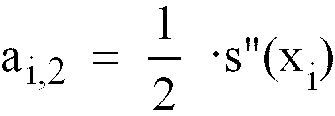


l'indice " ' " signifiant dérivée première, et
l'indice " " " signifiant dérivée seconde ;c) on utilise dans une autre phase la fonction trouvée dans le simulateur pour déterminer des couples de valeurs quelconques pour le composant. - Procédé selon la revendication 1, dans lequela) on génère dans le tracé de la fonction un point non dérivable (D) en divisant l'ensemble des couples de valeurs en deux sous-ensembles, dans lesquels le point est inclus.b) on effectue l'interpolation spline pour chaque sous-ensemble, le point étant utilisé une fois comme limite supérieure de l'intervalle et l'autre fois comme limite inférieure de l'intervalle par rapport aux deux sous-ensembles de l'interpolation spline.
- Procédé selon l'une des revendications 1 ou 2, dans lequel on impose à la fonction des points extrémaux (E) en calculant les coefficients a à l'aide des mêmes formules récurrentes de la manière suivante :a) on utilise pour x1 comme point extrémal :


 b) on utilise pour xn comme point extrémal :

Priority Applications (1)
| Application Number | Priority Date | Filing Date | Title |
|---|---|---|---|
| EP94908125A EP0655152B1 (fr) | 1992-08-13 | 1993-08-06 | Procede de simulation d'au moins un composant dont les caracteristiques sont decrites par des valeurs couplees, au moyen d'un simulateur assiste par ordinateur |
Applications Claiming Priority (4)
| Application Number | Priority Date | Filing Date | Title |
|---|---|---|---|
| EP92113834 | 1992-08-13 | ||
| EP92113834 | 1992-08-13 | ||
| EP94908125A EP0655152B1 (fr) | 1992-08-13 | 1993-08-06 | Procede de simulation d'au moins un composant dont les caracteristiques sont decrites par des valeurs couplees, au moyen d'un simulateur assiste par ordinateur |
| PCT/EP1993/002105 WO1994004987A1 (fr) | 1992-08-13 | 1993-08-06 | Procede de simulation d'au moins un composant dont les caracteristiques sont decrites par des valeurs couplees, au moyen d'un simulateur assiste par ordinateur |
Publications (2)
| Publication Number | Publication Date |
|---|---|
| EP0655152A1 EP0655152A1 (fr) | 1995-05-31 |
| EP0655152B1 true EP0655152B1 (fr) | 1997-05-02 |
Family
ID=8209914
Family Applications (1)
| Application Number | Title | Priority Date | Filing Date |
|---|---|---|---|
| EP94908125A Expired - Lifetime EP0655152B1 (fr) | 1992-08-13 | 1993-08-06 | Procede de simulation d'au moins un composant dont les caracteristiques sont decrites par des valeurs couplees, au moyen d'un simulateur assiste par ordinateur |
Country Status (5)
| Country | Link |
|---|---|
| US (1) | US5612907A (fr) |
| EP (1) | EP0655152B1 (fr) |
| JP (1) | JPH08500198A (fr) |
| DE (1) | DE59306346D1 (fr) |
| WO (1) | WO1994004987A1 (fr) |
Families Citing this family (1)
| Publication number | Priority date | Publication date | Assignee | Title |
|---|---|---|---|---|
| JP3019020B2 (ja) * | 1997-03-28 | 2000-03-13 | 日本電気株式会社 | 回路設計方法およびシステム |
Family Cites Families (6)
| Publication number | Priority date | Publication date | Assignee | Title |
|---|---|---|---|---|
| JPH0718853B2 (ja) * | 1984-05-15 | 1995-03-06 | 住友化学工業株式会社 | クロマトグラフイ−におけるデ−タ処理方法 |
| US4663726A (en) * | 1985-04-15 | 1987-05-05 | General Electric Co. | Robot control utilizing cubic spline interpolation |
| US5047971A (en) * | 1987-06-23 | 1991-09-10 | Intergraph Corporation | Circuit simulation |
| JPH02113305A (ja) * | 1988-10-24 | 1990-04-25 | Fanuc Ltd | スプライン補間方法 |
| US5287273A (en) * | 1990-03-15 | 1994-02-15 | Mount Sinai School Of Medicine | Functional organ images |
| JPH0514654A (ja) * | 1991-07-04 | 1993-01-22 | Kowa Co | 画像信号処理装置 |
-
1993
- 1993-08-06 US US08/382,034 patent/US5612907A/en not_active Expired - Fee Related
- 1993-08-06 WO PCT/EP1993/002105 patent/WO1994004987A1/fr not_active Ceased
- 1993-08-06 EP EP94908125A patent/EP0655152B1/fr not_active Expired - Lifetime
- 1993-08-06 DE DE59306346T patent/DE59306346D1/de not_active Expired - Fee Related
- 1993-08-06 JP JP6505843A patent/JPH08500198A/ja active Pending
Also Published As
| Publication number | Publication date |
|---|---|
| WO1994004987A1 (fr) | 1994-03-03 |
| JPH08500198A (ja) | 1996-01-09 |
| US5612907A (en) | 1997-03-18 |
| DE59306346D1 (de) | 1997-06-05 |
| EP0655152A1 (fr) | 1995-05-31 |
Similar Documents
| Publication | Publication Date | Title |
|---|---|---|
| DE3852596T2 (de) | Verfahren zur Erzeugung eines diskreten Netzes zur Simulation mittels finiter Differenzen. | |
| DE69026885T2 (de) | Dynamische Selektion von Datenformaten für rekursiv geschachtelte logische Elemente | |
| DE3237393A1 (de) | Verfahren zum korrigieren der gradation der ausgangsdaten, zur anwendung bei einem digitalen bildverarbeitungssystem | |
| DE69300914T2 (de) | Zeitmodell zur logiksimulation von integrierten schaltungen. | |
| DE2050923A1 (de) | Verfahren zur Simulation einer oder mehrerer frequenzabhangiger Eigenschaften einer Ubertragungsanordnung fur elektn sehe Signale | |
| DE102004021421A1 (de) | Verfahren zur Bereitstellung eines Hochfrequenz-Ersatzschaltbilds für elektronische Bauteile | |
| EP0653081B1 (fr) | Procede pour la simulation d'au moins un composant, dont les caracteristiques sont decrites par plusieurs paires de valeurs, au moyen d'un simulateur assiste par ordinateur | |
| DE2235802A1 (de) | Verfahren und einrichtung zur pruefung nichtlinearer schaltkreise | |
| DE102020115192A1 (de) | Computerimplementiertes Verfahren zur Simulation eines Unfalls eines Kraftfahrzeugs mittels eines neuronalen Netzwerks | |
| WO1994004987A1 (fr) | Procede de simulation d'au moins un composant dont les caracteristiques sont decrites par des valeurs couplees, au moyen d'un simulateur assiste par ordinateur | |
| DE4022381C2 (de) | Verwendung langer Digitalfilter bei Vorkommnis von Abrundungsfehlern | |
| DE10109554A1 (de) | Verfahren zur Modellierung von Induktivitäten | |
| DE3334679A1 (de) | Anpassung von duennschichtwiderstaenden | |
| DE10100168A1 (de) | Entwurf von Schaltungen mit Abschnitten unterschiedlicher Versorgungsspannung | |
| EP1146393A2 (fr) | Procédé pour réaliser des photomasques pour la production des structures sur semi-conducteurs | |
| DE3789376T2 (de) | Verfahren zur Fehlererkennung und -korrektur in einem digitalen Rechner. | |
| DE10303186B4 (de) | Verfahren zur Simulation einer elektrischen Schaltung | |
| EP3494507B1 (fr) | Procédé de vérification de la disponibilité et de l'intégrité d'un objet de données enregistré de manière répartie | |
| WO2002097679A2 (fr) | Procede pour fournir des informations d'erreur sur des incoherences dans un systeme d'equations differentielles | |
| DE102004037403B4 (de) | Verfahren zur Bewertung der Güte eines Computerprogrammes | |
| DE2514211A1 (de) | Pruefschaltung fuer einen l-aus-n- entschluesseler | |
| EP0433315A1 (fr) | Circuits d'addition ou de soustraction d'operandes codes selon un code bcd ou dual | |
| EP1344125A2 (fr) | Procede de production orientee besoins de nombres aleatoires individuels d'une suite de nombres aleatoires d'un bruit en 1/f | |
| DE10331431B4 (de) | Datenkompression von Simulationsergebnissen | |
| EP1590751A2 (fr) | Detection de proprietes (verification formelle) pour un systeme mixte constitue de sous systemes analogiques et numeriques |
Legal Events
| Date | Code | Title | Description |
|---|---|---|---|
| PUAI | Public reference made under article 153(3) epc to a published international application that has entered the european phase |
Free format text: ORIGINAL CODE: 0009012 |
|
| 17P | Request for examination filed |
Effective date: 19950119 |
|
| AK | Designated contracting states |
Kind code of ref document: A1 Designated state(s): DE FR GB |
|
| GRAG | Despatch of communication of intention to grant |
Free format text: ORIGINAL CODE: EPIDOS AGRA |
|
| GRAH | Despatch of communication of intention to grant a patent |
Free format text: ORIGINAL CODE: EPIDOS IGRA |
|
| 17Q | First examination report despatched |
Effective date: 19961001 |
|
| GRAH | Despatch of communication of intention to grant a patent |
Free format text: ORIGINAL CODE: EPIDOS IGRA |
|
| GRAH | Despatch of communication of intention to grant a patent |
Free format text: ORIGINAL CODE: EPIDOS IGRA |
|
| GRAA | (expected) grant |
Free format text: ORIGINAL CODE: 0009210 |
|
| AK | Designated contracting states |
Kind code of ref document: B1 Designated state(s): DE FR GB |
|
| REF | Corresponds to: |
Ref document number: 59306346 Country of ref document: DE Date of ref document: 19970605 |
|
| ET | Fr: translation filed | ||
| GBT | Gb: translation of ep patent filed (gb section 77(6)(a)/1977) |
Effective date: 19970715 |
|
| PG25 | Lapsed in a contracting state [announced via postgrant information from national office to epo] |
Ref country code: GB Free format text: LAPSE BECAUSE OF NON-PAYMENT OF DUE FEES Effective date: 19970806 |
|
| PLBE | No opposition filed within time limit |
Free format text: ORIGINAL CODE: 0009261 |
|
| STAA | Information on the status of an ep patent application or granted ep patent |
Free format text: STATUS: NO OPPOSITION FILED WITHIN TIME LIMIT |
|
| GBPC | Gb: european patent ceased through non-payment of renewal fee |
Effective date: 19970806 |
|
| 26N | No opposition filed | ||
| PG25 | Lapsed in a contracting state [announced via postgrant information from national office to epo] |
Ref country code: FR Free format text: LAPSE BECAUSE OF NON-PAYMENT OF DUE FEES Effective date: 19980430 |
|
| PG25 | Lapsed in a contracting state [announced via postgrant information from national office to epo] |
Ref country code: DE Free format text: LAPSE BECAUSE OF NON-PAYMENT OF DUE FEES Effective date: 19980501 |
|
| REG | Reference to a national code |
Ref country code: FR Ref legal event code: ST |