EP0652224B1 - Verfahren zur Herstellung von Metallocenen in einem Reaktionsschritt - Google Patents
Verfahren zur Herstellung von Metallocenen in einem Reaktionsschritt Download PDFInfo
- Publication number
- EP0652224B1 EP0652224B1 EP94116523A EP94116523A EP0652224B1 EP 0652224 B1 EP0652224 B1 EP 0652224B1 EP 94116523 A EP94116523 A EP 94116523A EP 94116523 A EP94116523 A EP 94116523A EP 0652224 B1 EP0652224 B1 EP 0652224B1
- Authority
- EP
- European Patent Office
- Prior art keywords
- alkyl
- metal
- bis
- preparation
- unsaturated
- Prior art date
- Legal status (The legal status is an assumption and is not a legal conclusion. Google has not performed a legal analysis and makes no representation as to the accuracy of the status listed.)
- Expired - Lifetime
Links
- 238000000034 method Methods 0.000 title claims description 22
- 238000002360 preparation method Methods 0.000 title claims description 8
- 230000015572 biosynthetic process Effects 0.000 title 1
- 238000003786 synthesis reaction Methods 0.000 title 1
- 125000000753 cycloalkyl group Chemical group 0.000 claims description 19
- 229910052751 metal Inorganic materials 0.000 claims description 19
- 239000002184 metal Substances 0.000 claims description 19
- 238000006243 chemical reaction Methods 0.000 claims description 15
- 229910052739 hydrogen Inorganic materials 0.000 claims description 13
- 150000003839 salts Chemical class 0.000 claims description 12
- 229910052783 alkali metal Inorganic materials 0.000 claims description 11
- 150000001340 alkali metals Chemical class 0.000 claims description 11
- RTZKZFJDLAIYFH-UHFFFAOYSA-N Diethyl ether Chemical compound CCOCC RTZKZFJDLAIYFH-UHFFFAOYSA-N 0.000 claims description 10
- 239000002904 solvent Substances 0.000 claims description 10
- 125000001424 substituent group Chemical group 0.000 claims description 10
- 229910052799 carbon Inorganic materials 0.000 claims description 9
- 239000001257 hydrogen Substances 0.000 claims description 8
- 125000000008 (C1-C10) alkyl group Chemical group 0.000 claims description 6
- ZAMOUSCENKQFHK-UHFFFAOYSA-N Chlorine atom Chemical group [Cl] ZAMOUSCENKQFHK-UHFFFAOYSA-N 0.000 claims description 6
- PXBRQCKWGAHEHS-UHFFFAOYSA-N dichlorodifluoromethane Chemical group FC(F)(Cl)Cl PXBRQCKWGAHEHS-UHFFFAOYSA-N 0.000 claims description 6
- 239000000460 chlorine Chemical group 0.000 claims description 5
- 229910052801 chlorine Inorganic materials 0.000 claims description 5
- 125000004122 cyclic group Chemical group 0.000 claims description 5
- 125000004432 carbon atom Chemical group C* 0.000 claims description 4
- PNDPGZBMCMUPRI-UHFFFAOYSA-N iodine Chemical group II PNDPGZBMCMUPRI-UHFFFAOYSA-N 0.000 claims description 4
- WKBOTKDWSSQWDR-UHFFFAOYSA-N Bromine atom Chemical group [Br] WKBOTKDWSSQWDR-UHFFFAOYSA-N 0.000 claims description 3
- OKTJSMMVPCPJKN-UHFFFAOYSA-N Carbon Chemical group [C] OKTJSMMVPCPJKN-UHFFFAOYSA-N 0.000 claims description 3
- XUIMIQQOPSSXEZ-UHFFFAOYSA-N Silicon Chemical group [Si] XUIMIQQOPSSXEZ-UHFFFAOYSA-N 0.000 claims description 3
- ATJFFYVFTNAWJD-UHFFFAOYSA-N Tin Chemical group [Sn] ATJFFYVFTNAWJD-UHFFFAOYSA-N 0.000 claims description 3
- 125000003710 aryl alkyl group Chemical group 0.000 claims description 3
- GDTBXPJZTBHREO-UHFFFAOYSA-N bromine Chemical group BrBr GDTBXPJZTBHREO-UHFFFAOYSA-N 0.000 claims description 3
- 229910052794 bromium Inorganic materials 0.000 claims description 3
- 150000001875 compounds Chemical class 0.000 claims description 3
- 239000011737 fluorine Substances 0.000 claims description 3
- 229910052731 fluorine Inorganic materials 0.000 claims description 3
- 229910052732 germanium Inorganic materials 0.000 claims description 3
- GNPVGFCGXDBREM-UHFFFAOYSA-N germanium atom Chemical group [Ge] GNPVGFCGXDBREM-UHFFFAOYSA-N 0.000 claims description 3
- 229910052747 lanthanoid Inorganic materials 0.000 claims description 3
- 150000002602 lanthanoids Chemical class 0.000 claims description 3
- 150000003512 tertiary amines Chemical class 0.000 claims description 3
- 229910052718 tin Inorganic materials 0.000 claims description 3
- 125000004169 (C1-C6) alkyl group Chemical group 0.000 claims description 2
- 229910052710 silicon Inorganic materials 0.000 claims description 2
- 239000010703 silicon Substances 0.000 claims description 2
- 125000004435 hydrogen atom Chemical group [H]* 0.000 claims 3
- 125000003837 (C1-C20) alkyl group Chemical group 0.000 claims 2
- 125000001153 fluoro group Chemical group F* 0.000 claims 1
- WYURNTSHIVDZCO-UHFFFAOYSA-N Tetrahydrofuran Chemical compound C1CCOC1 WYURNTSHIVDZCO-UHFFFAOYSA-N 0.000 description 24
- YLQBMQCUIZJEEH-UHFFFAOYSA-N tetrahydrofuran Natural products C=1C=COC=1 YLQBMQCUIZJEEH-UHFFFAOYSA-N 0.000 description 12
- ZSWFCLXCOIISFI-UHFFFAOYSA-N endo-cyclopentadiene Natural products C1C=CC=C1 ZSWFCLXCOIISFI-UHFFFAOYSA-N 0.000 description 9
- 229910052804 chromium Inorganic materials 0.000 description 8
- 239000011651 chromium Substances 0.000 description 8
- 238000004519 manufacturing process Methods 0.000 description 8
- VYZAMTAEIAYCRO-UHFFFAOYSA-N Chromium Chemical compound [Cr] VYZAMTAEIAYCRO-UHFFFAOYSA-N 0.000 description 7
- XEEYBQQBJWHFJM-UHFFFAOYSA-N Iron Chemical compound [Fe] XEEYBQQBJWHFJM-UHFFFAOYSA-N 0.000 description 7
- 229910021554 Chromium(II) chloride Inorganic materials 0.000 description 6
- UFHFLCQGNIYNRP-UHFFFAOYSA-N Hydrogen Chemical compound [H][H] UFHFLCQGNIYNRP-UHFFFAOYSA-N 0.000 description 6
- XBWRJSSJWDOUSJ-UHFFFAOYSA-L chromium(ii) chloride Chemical compound Cl[Cr]Cl XBWRJSSJWDOUSJ-UHFFFAOYSA-L 0.000 description 6
- 239000000203 mixture Substances 0.000 description 6
- DGAQECJNVWCQMB-PUAWFVPOSA-M Ilexoside XXIX Chemical compound C[C@@H]1CC[C@@]2(CC[C@@]3(C(=CC[C@H]4[C@]3(CC[C@@H]5[C@@]4(CC[C@@H](C5(C)C)OS(=O)(=O)[O-])C)C)[C@@H]2[C@]1(C)O)C)C(=O)O[C@H]6[C@@H]([C@H]([C@@H]([C@H](O6)CO)O)O)O.[Na+] DGAQECJNVWCQMB-PUAWFVPOSA-M 0.000 description 4
- PXHVJJICTQNCMI-UHFFFAOYSA-N Nickel Chemical compound [Ni] PXHVJJICTQNCMI-UHFFFAOYSA-N 0.000 description 4
- QCWXUUIWCKQGHC-UHFFFAOYSA-N Zirconium Chemical compound [Zr] QCWXUUIWCKQGHC-UHFFFAOYSA-N 0.000 description 4
- 229910052784 alkaline earth metal Inorganic materials 0.000 description 4
- TYYBBNOTQFVVKN-UHFFFAOYSA-N chromium(2+);cyclopenta-1,3-diene Chemical compound [Cr+2].C=1C=C[CH-]C=1.C=1C=C[CH-]C=1 TYYBBNOTQFVVKN-UHFFFAOYSA-N 0.000 description 4
- 229910052735 hafnium Inorganic materials 0.000 description 4
- VBJZVLUMGGDVMO-UHFFFAOYSA-N hafnium atom Chemical compound [Hf] VBJZVLUMGGDVMO-UHFFFAOYSA-N 0.000 description 4
- 150000003254 radicals Chemical class 0.000 description 4
- 229910052708 sodium Inorganic materials 0.000 description 4
- 239000011734 sodium Substances 0.000 description 4
- 238000000859 sublimation Methods 0.000 description 4
- 230000008022 sublimation Effects 0.000 description 4
- PXGOKWXKJXAPGV-UHFFFAOYSA-N Fluorine Chemical compound FF PXGOKWXKJXAPGV-UHFFFAOYSA-N 0.000 description 3
- OKKJLVBELUTLKV-UHFFFAOYSA-N Methanol Chemical compound OC OKKJLVBELUTLKV-UHFFFAOYSA-N 0.000 description 3
- RTAQQCXQSZGOHL-UHFFFAOYSA-N Titanium Chemical compound [Ti] RTAQQCXQSZGOHL-UHFFFAOYSA-N 0.000 description 3
- YXFVVABEGXRONW-UHFFFAOYSA-N Toluene Chemical compound CC1=CC=CC=C1 YXFVVABEGXRONW-UHFFFAOYSA-N 0.000 description 3
- ZMANZCXQSJIPKH-UHFFFAOYSA-N Triethylamine Chemical compound CCN(CC)CC ZMANZCXQSJIPKH-UHFFFAOYSA-N 0.000 description 3
- 150000001342 alkaline earth metals Chemical class 0.000 description 3
- QSWDMMVNRMROPK-UHFFFAOYSA-K chromium(3+) trichloride Chemical compound [Cl-].[Cl-].[Cl-].[Cr+3] QSWDMMVNRMROPK-UHFFFAOYSA-K 0.000 description 3
- 125000002704 decyl group Chemical group [H]C([H])([H])C([H])([H])C([H])([H])C([H])([H])C([H])([H])C([H])([H])C([H])([H])C([H])([H])C([H])([H])C([H])([H])* 0.000 description 3
- 150000002431 hydrogen Chemical class 0.000 description 3
- 238000002844 melting Methods 0.000 description 3
- 230000008018 melting Effects 0.000 description 3
- 239000011541 reaction mixture Substances 0.000 description 3
- 238000003756 stirring Methods 0.000 description 3
- -1 unsaturated cyclic hydrocarbon radicals Chemical class 0.000 description 3
- YBYIRNPNPLQARY-UHFFFAOYSA-N 1H-indene Chemical compound C1=CC=C2CC=CC2=C1 YBYIRNPNPLQARY-UHFFFAOYSA-N 0.000 description 2
- XKRFYHLGVUSROY-UHFFFAOYSA-N Argon Chemical compound [Ar] XKRFYHLGVUSROY-UHFFFAOYSA-N 0.000 description 2
- XTHFKEDIFFGKHM-UHFFFAOYSA-N Dimethoxyethane Chemical compound COCCOC XTHFKEDIFFGKHM-UHFFFAOYSA-N 0.000 description 2
- ZOKXTWBITQBERF-UHFFFAOYSA-N Molybdenum Chemical compound [Mo] ZOKXTWBITQBERF-UHFFFAOYSA-N 0.000 description 2
- IMNFDUFMRHMDMM-UHFFFAOYSA-N N-Heptane Chemical compound CCCCCCC IMNFDUFMRHMDMM-UHFFFAOYSA-N 0.000 description 2
- JUJWROOIHBZHMG-UHFFFAOYSA-N Pyridine Chemical compound C1=CC=NC=C1 JUJWROOIHBZHMG-UHFFFAOYSA-N 0.000 description 2
- KJTLSVCANCCWHF-UHFFFAOYSA-N Ruthenium Chemical compound [Ru] KJTLSVCANCCWHF-UHFFFAOYSA-N 0.000 description 2
- 239000003513 alkali Substances 0.000 description 2
- 229910017052 cobalt Inorganic materials 0.000 description 2
- 239000010941 cobalt Substances 0.000 description 2
- GUTLYIVDDKVIGB-UHFFFAOYSA-N cobalt atom Chemical compound [Co] GUTLYIVDDKVIGB-UHFFFAOYSA-N 0.000 description 2
- 230000000052 comparative effect Effects 0.000 description 2
- 150000004292 cyclic ethers Chemical class 0.000 description 2
- SINKOGOPEQSHQD-UHFFFAOYSA-N cyclopentadienide Chemical compound C=1C=C[CH-]C=1 SINKOGOPEQSHQD-UHFFFAOYSA-N 0.000 description 2
- 229910052742 iron Inorganic materials 0.000 description 2
- 229910052759 nickel Inorganic materials 0.000 description 2
- GUCVJGMIXFAOAE-UHFFFAOYSA-N niobium atom Chemical compound [Nb] GUCVJGMIXFAOAE-UHFFFAOYSA-N 0.000 description 2
- 229910052762 osmium Inorganic materials 0.000 description 2
- SYQBFIAQOQZEGI-UHFFFAOYSA-N osmium atom Chemical compound [Os] SYQBFIAQOQZEGI-UHFFFAOYSA-N 0.000 description 2
- 229910052707 ruthenium Inorganic materials 0.000 description 2
- JQUZTGJSSQCTPV-UHFFFAOYSA-N sodium;cyclopenta-1,3-diene Chemical compound [Na+].C1C=CC=[C-]1 JQUZTGJSSQCTPV-UHFFFAOYSA-N 0.000 description 2
- 239000000725 suspension Substances 0.000 description 2
- GUVRBAGPIYLISA-UHFFFAOYSA-N tantalum atom Chemical compound [Ta] GUVRBAGPIYLISA-UHFFFAOYSA-N 0.000 description 2
- 229910052719 titanium Inorganic materials 0.000 description 2
- 239000010936 titanium Substances 0.000 description 2
- GETQZCLCWQTVFV-UHFFFAOYSA-N trimethylamine Chemical compound CN(C)C GETQZCLCWQTVFV-UHFFFAOYSA-N 0.000 description 2
- WFKWXMTUELFFGS-UHFFFAOYSA-N tungsten Chemical compound [W] WFKWXMTUELFFGS-UHFFFAOYSA-N 0.000 description 2
- 229910052720 vanadium Inorganic materials 0.000 description 2
- GPPXJZIENCGNKB-UHFFFAOYSA-N vanadium Chemical compound [V]#[V] GPPXJZIENCGNKB-UHFFFAOYSA-N 0.000 description 2
- 229910052726 zirconium Inorganic materials 0.000 description 2
- 0 CC1(*)C(*)=C(*)C(*)=C1C Chemical compound CC1(*)C(*)=C(*)C(*)=C1C 0.000 description 1
- 229910021556 Chromium(III) chloride Inorganic materials 0.000 description 1
- UHCOEQZUSAFLHQ-UHFFFAOYSA-L Cl[Hf](Cl)(C1C=CC=C1)C1C=CC=C1 Chemical compound Cl[Hf](Cl)(C1C=CC=C1)C1C=CC=C1 UHCOEQZUSAFLHQ-UHFFFAOYSA-L 0.000 description 1
- VEXZGXHMUGYJMC-UHFFFAOYSA-N Hydrochloric acid Chemical compound Cl VEXZGXHMUGYJMC-UHFFFAOYSA-N 0.000 description 1
- WHXSMMKQMYFTQS-UHFFFAOYSA-N Lithium Chemical compound [Li] WHXSMMKQMYFTQS-UHFFFAOYSA-N 0.000 description 1
- KWYHDKDOAIKMQN-UHFFFAOYSA-N N,N,N',N'-tetramethylethylenediamine Chemical compound CN(C)CCN(C)C KWYHDKDOAIKMQN-UHFFFAOYSA-N 0.000 description 1
- ZLMJMSJWJFRBEC-UHFFFAOYSA-N Potassium Chemical compound [K] ZLMJMSJWJFRBEC-UHFFFAOYSA-N 0.000 description 1
- 229910007926 ZrCl Inorganic materials 0.000 description 1
- RDFLPFHTKPULOK-UHFFFAOYSA-N [CH-]1C=CC=C1.[CH-]1C=CC=C1.[Cr+2].C1(C=CC=C1)[Cr]C1C=CC=C1 Chemical compound [CH-]1C=CC=C1.[CH-]1C=CC=C1.[Cr+2].C1(C=CC=C1)[Cr]C1C=CC=C1 RDFLPFHTKPULOK-UHFFFAOYSA-N 0.000 description 1
- WETWJCDKMRHUPV-UHFFFAOYSA-N acetyl chloride Chemical compound CC(Cl)=O WETWJCDKMRHUPV-UHFFFAOYSA-N 0.000 description 1
- 239000012346 acetyl chloride Substances 0.000 description 1
- 125000001931 aliphatic group Chemical group 0.000 description 1
- 150000001338 aliphatic hydrocarbons Chemical class 0.000 description 1
- 150000001336 alkenes Chemical class 0.000 description 1
- 125000000217 alkyl group Chemical group 0.000 description 1
- 239000000956 alloy Substances 0.000 description 1
- 229910045601 alloy Inorganic materials 0.000 description 1
- 238000004458 analytical method Methods 0.000 description 1
- 229910052786 argon Inorganic materials 0.000 description 1
- 239000012300 argon atmosphere Substances 0.000 description 1
- 150000004945 aromatic hydrocarbons Chemical class 0.000 description 1
- 238000009835 boiling Methods 0.000 description 1
- CODNYICXDISAEA-UHFFFAOYSA-N bromine monochloride Chemical compound BrCl CODNYICXDISAEA-UHFFFAOYSA-N 0.000 description 1
- 230000005587 bubbling Effects 0.000 description 1
- 239000003054 catalyst Substances 0.000 description 1
- 238000004587 chromatography analysis Methods 0.000 description 1
- UZEDIBTVIIJELN-UHFFFAOYSA-N chromium(2+) Chemical compound [Cr+2] UZEDIBTVIIJELN-UHFFFAOYSA-N 0.000 description 1
- 235000007831 chromium(III) chloride Nutrition 0.000 description 1
- 239000011636 chromium(III) chloride Substances 0.000 description 1
- 238000004140 cleaning Methods 0.000 description 1
- 238000001816 cooling Methods 0.000 description 1
- 238000002425 crystallisation Methods 0.000 description 1
- 230000008025 crystallization Effects 0.000 description 1
- 125000000058 cyclopentadienyl group Chemical group C1(=CC=CC1)* 0.000 description 1
- XKLWATAZDMHTSH-UHFFFAOYSA-L cyclopentane;dichlorotitanium Chemical compound Cl[Ti]Cl.[CH]1[CH][CH][CH][CH]1.[CH]1[CH][CH][CH][CH]1 XKLWATAZDMHTSH-UHFFFAOYSA-L 0.000 description 1
- QRUYYSPCOGSZGQ-UHFFFAOYSA-L cyclopentane;dichlorozirconium Chemical compound Cl[Zr]Cl.[CH]1[CH][CH][CH][CH]1.[CH]1[CH][CH][CH][CH]1 QRUYYSPCOGSZGQ-UHFFFAOYSA-L 0.000 description 1
- 238000000605 extraction Methods 0.000 description 1
- RMBPEFMHABBEKP-UHFFFAOYSA-N fluorene Chemical compound C1=CC=C2C3=C[CH]C=CC3=CC2=C1 RMBPEFMHABBEKP-UHFFFAOYSA-N 0.000 description 1
- 125000003983 fluorenyl group Chemical group C1(=CC=CC=2C3=CC=CC=C3CC12)* 0.000 description 1
- 239000002816 fuel additive Substances 0.000 description 1
- 238000010438 heat treatment Methods 0.000 description 1
- 125000004051 hexyl group Chemical group [H]C([H])([H])C([H])([H])C([H])([H])C([H])([H])C([H])([H])C([H])([H])* 0.000 description 1
- IXCSERBJSXMMFS-UHFFFAOYSA-N hydrogen chloride Substances Cl.Cl IXCSERBJSXMMFS-UHFFFAOYSA-N 0.000 description 1
- 229910000041 hydrogen chloride Inorganic materials 0.000 description 1
- 125000003454 indenyl group Chemical group C1(C=CC2=CC=CC=C12)* 0.000 description 1
- 239000012442 inert solvent Substances 0.000 description 1
- 238000012432 intermediate storage Methods 0.000 description 1
- 229910052740 iodine Inorganic materials 0.000 description 1
- 239000003446 ligand Substances 0.000 description 1
- 239000004611 light stabiliser Substances 0.000 description 1
- 229910052744 lithium Inorganic materials 0.000 description 1
- WPBNNNQJVZRUHP-UHFFFAOYSA-L manganese(2+);methyl n-[[2-(methoxycarbonylcarbamothioylamino)phenyl]carbamothioyl]carbamate;n-[2-(sulfidocarbothioylamino)ethyl]carbamodithioate Chemical compound [Mn+2].[S-]C(=S)NCCNC([S-])=S.COC(=O)NC(=S)NC1=CC=CC=C1NC(=S)NC(=O)OC WPBNNNQJVZRUHP-UHFFFAOYSA-L 0.000 description 1
- 238000005259 measurement Methods 0.000 description 1
- 229910052750 molybdenum Inorganic materials 0.000 description 1
- 239000011733 molybdenum Substances 0.000 description 1
- 230000007935 neutral effect Effects 0.000 description 1
- 229910052758 niobium Inorganic materials 0.000 description 1
- 239000010955 niobium Substances 0.000 description 1
- NIHNNTQXNPWCJQ-UHFFFAOYSA-N o-biphenylenemethane Natural products C1=CC=C2CC3=CC=CC=C3C2=C1 NIHNNTQXNPWCJQ-UHFFFAOYSA-N 0.000 description 1
- 239000004597 plastic additive Substances 0.000 description 1
- 238000006116 polymerization reaction Methods 0.000 description 1
- 229910052700 potassium Inorganic materials 0.000 description 1
- 239000011591 potassium Substances 0.000 description 1
- 239000000843 powder Substances 0.000 description 1
- UMJSCPRVCHMLSP-UHFFFAOYSA-N pyridine Natural products COC1=CC=CN=C1 UMJSCPRVCHMLSP-UHFFFAOYSA-N 0.000 description 1
- 239000000376 reactant Substances 0.000 description 1
- 238000010992 reflux Methods 0.000 description 1
- SNOOUWRIMMFWNE-UHFFFAOYSA-M sodium;6-[(3,4,5-trimethoxybenzoyl)amino]hexanoate Chemical compound [Na+].COC1=CC(C(=O)NCCCCCC([O-])=O)=CC(OC)=C1OC SNOOUWRIMMFWNE-UHFFFAOYSA-M 0.000 description 1
- 239000003381 stabilizer Substances 0.000 description 1
- 229910052715 tantalum Inorganic materials 0.000 description 1
- 150000003624 transition metals Chemical group 0.000 description 1
- 229910052721 tungsten Inorganic materials 0.000 description 1
- 239000010937 tungsten Substances 0.000 description 1
Classifications
-
- C—CHEMISTRY; METALLURGY
- C07—ORGANIC CHEMISTRY
- C07F—ACYCLIC, CARBOCYCLIC OR HETEROCYCLIC COMPOUNDS CONTAINING ELEMENTS OTHER THAN CARBON, HYDROGEN, HALOGEN, OXYGEN, NITROGEN, SULFUR, SELENIUM OR TELLURIUM
- C07F17/00—Metallocenes
- C07F17/02—Metallocenes of metals of Groups 8, 9 or 10 of the Periodic Table
-
- C—CHEMISTRY; METALLURGY
- C07—ORGANIC CHEMISTRY
- C07F—ACYCLIC, CARBOCYCLIC OR HETEROCYCLIC COMPOUNDS CONTAINING ELEMENTS OTHER THAN CARBON, HYDROGEN, HALOGEN, OXYGEN, NITROGEN, SULFUR, SELENIUM OR TELLURIUM
- C07F17/00—Metallocenes
Definitions
- the present invention relates to processes for the production of Metallocenes.
- metallocenes are usually carried out in such a way that a metal salt with an alkali or alkaline earth metal cyclopentadienide is reacted in an inert solvent.
- a metallocene production on a technical scale this is that in a first reactor or reaction step the desired Alkali or alkaline earth metal cyclopentadienide separately is then made in a second reactor or reaction step to implement with the metal salt.
- This type of procedure are described in US-A 2 870 183 and GB-A 1 416 543.
- the object of the present invention was therefore to describe the To remedy disadvantages and a procedural less complex and economical process for the production of To provide metallocenes.
- Such compounds are thus called metallocenes understood, in which a transition metal atom via ⁇ bonds associated with unsaturated cyclic hydrocarbon residues is, for example cyclopentadienyl, fluorenyl or indenyl groups.
- Preferred metallocenes of the general formula I are also those in which the unsaturated cyclic hydrocarbon radicals are the same.
- Examples of particularly preferred metallocenes of the general formula I are: Bis (cyclopentadienyl) chromium, bis (cyclopentadienyl) dichlorotitanium, bis (cyclopentadienyl) dichlorozirconium, bis (cyclopentadienyl) dichlorohafnium and bis (cyclopentadienyl) iron.
- Metal salts of the general formula II are preferred in the process according to the invention MX p L q used.
- the substituents X are fluorine, chlorine, bromine, iodine, -OR 14 , -OOCR 14 or where R 14 is hydrogen or C 1 - to C 20 -alkyl, preferably C 1 - to C 8 -alkyl and R 15 is C 1 - to C 20 -alkyl, preferably C 1 - to C 8 -alkyl.
- Preferred substituents X are chlorine. If there are several X substituents, these may also have different meanings.
- the substituent L stands for a neutral ligand, for example for a tertiary amine such as trimethylamine or triethylamine, for a multinuclear tertiary amine such as N, N'-tetramethylethylene diamine or for an aromatic tertiary amine, for example pyridine.
- L can furthermore be an aliphatic open-chain or cyclic, mono- or polyvalent ether, for example diethyl ether, tetrahydrofuran or 1,2-dimethoxyethane.
- the index p depends on the valency of the metal M and is for the numbers 2, 3, 4, 5 or 6.
- the index q means 0, 1, 2, 3 or 4, preferably 0 or 1.
- Preferred metal salts of the general formula II are CrCl 2 , CrCl 3 , TiCl 4 , ZrCl 4 , HfCl 4 and FeCl 2 .
- Alkali metals are preferred in the process according to the invention Lithium, sodium or potassium used. Alloys several alkali metals can also be used. Prefers the alkali metal is used in finely divided form. The molar ratio of alkali metal to metal salt is preferably 2: 1 to 20: 1, especially 2: 1 to 10: 1.
- the molar ratio of unsaturated, cyclic hydrocarbons to alkali metals is preferably in the range from 1: 1 to 10: 1, in particular from 1: 1 to 5: 1.
- the molar amount of unsaturated, cyclic hydrocarbons is understood here to mean the total molar amount of unsaturated, cyclic hydrocarbons if different ones are used. If unsaturated, cyclic hydrocarbons are used which have a grouping - [Y (R 12 R 13 )] m -, both unsaturated cyclic systems must be taken into account when calculating the molar amount. If the unsaturated, cyclic hydrocarbons are used in molar excess, based on the amount of alkali metals, these unsaturated, cyclic hydrocarbons can also stand for the substituents Z 1 or Z 2 .
- Suitable solvents in the process according to the invention those that do not react with the reaction partners used, in which, however, the metal salts are at least partially soluble are.
- solvents can be aliphatic and aromatic Hydrocarbons, for example heptane or toluene, and open-chain and cyclic ethers, for example diethyl ether or tetrahydrofuran can be used. Mixtures of different Solvents can also be used. To be favoured open chain and cyclic ethers.
- the amount of solvent is not critical per se, preferred 10 to 100 ml, based on 1 g of metal salt.
- the inventive method can at temperatures in the range from -100 to + 200 ° C, preferably from -80 to + 100 ° C, in particular from +10 to + 70 ° C and pressures from 0.1 to 100 bar, preferably 0.5 to 2 bar can be carried out.
- the response times are i.a. in the range of 0.1 to 20 hours, preferably 0.5 to 2 hours.
- the process according to the invention is preferably carried out in such a way that the metal salt in a batch operated stirred tank the solvent is added, for this purpose the alkali metal is given and then, preferably with stirring, the unsaturated, cyclic hydrocarbons are added.
- the implementation therefore takes place in one reaction step and in one Reactor, i.e. in a reaction zone.
- the metallocenes produced by the process according to the invention can be made using the usual methods such as crystallization, extraction, Sublimation or chromatography isolated in pure form become. They are suitable, for example, as catalysts, e.g. for the polymerization of olefins, as stabilizers, as Plastic and fuel additives and as light stabilizers.
- the process according to the invention for the production of metallocenes is characterized by low procedural effort and high economic efficiency.
- Example 2 Analogous to Example 1, 16.9 g of sodium in the form of cube-shaped pieces with an edge length of approximately 5 mm were added to 36.9 g of the chromium (II) chloride prepared in Example A in THF at room temperature in a discontinuously operated reactor. For this purpose, however, 96.8 g of freshly distilled cyclopentadiene ( ⁇ 1.46 mol) were added with stirring at 30 ° C. within 2 minutes. The reaction mixture heated up to 62 ° C. (boiling point of the THF) within 5 minutes. After 15 minutes the reaction had subsided and the reaction mixture was refluxed for a further hour by heating. The solvent was then removed in vacuo at room temperature. The resulting chromocene was isolated from the dry residue by sublimation. Yield: 38.8 g (71% of theory) Melting point: 173 ° C Composition: found: 65.7% C 5.5% H 28.1% Cr
- Example A Analogously to Example A, in a reactor I from a suspension of 30.1 g of anhydrous chromium (III) chloride ( ⁇ 0.19 mol) and 14.8 g of chromium powder ( ⁇ 0.28 mol) in 400 ml of anhydrous THF 35, 6 g chromium (II) chloride ( ⁇ 0.29 mol) prepared in THF. In parallel, 13.8 g of sodium ( ⁇ 0.60 mol) in the form of cube-shaped pieces with an edge length of approx. 5 mm in 200 ml of anhydrous THF and 59.5 g of freshly distilled cyclopentadiene ( ⁇ 0, 90 mol) 52.8 g of sodium cyclopentadienide ( ⁇ 0.6 mol).
Landscapes
- Chemical & Material Sciences (AREA)
- Organic Chemistry (AREA)
- Transition And Organic Metals Composition Catalysts For Addition Polymerization (AREA)
- Organic Low-Molecular-Weight Compounds And Preparation Thereof (AREA)
Description

- R1 bis R10
- Wasserstoff, C1- bis C10-Alkyl, 5- bis 7-gliedriges Cycloalkyl, das seinerseits C1- bis C6-Alkylgruppen als Substituenten tragen kann, C6- bis C15-Aryl oder Arylalkyl und wobei gegebenenfalls auch zwei benachbarte Reste gemeinsam für 4 bis 15 C-Atome aufweisende cyclische Gruppen stehen können, oder Si(R11)3,
- mit R11
- C1- bis C10-Alkyl, C6- bis C15-Aryl oder C3- bis C10-Cycloalkyl,
- mit Y
- Silicium, Germanium, Zinn oder Kohlenstoff
- R12, R13
- Wasserstoff, C1- bis C10-Alkyl, C3- bis C10-Cycloalkyl oder C6- bis C15-Aryl
- m
- 1,2,3 oder 4
- M
- ein Metall der IV. bis VIII. Nebengruppe oder ein Metall der Lanthanidenreihe,
- Z1, Z2
- Fluor, Chlor, Brom, Jod, -OR14, -OOCR14,
oder

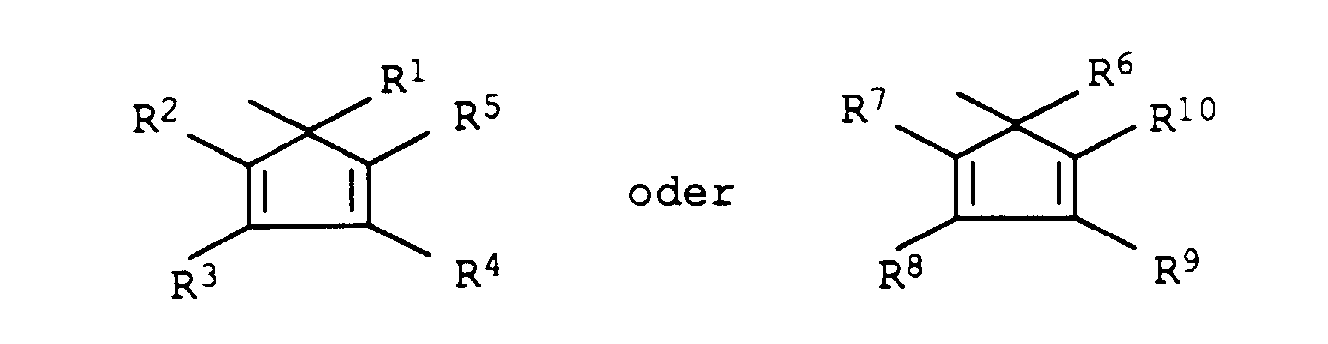
- mit R14
- Wasserstoff oder C1- oder C20-Alkyl,
- R15
- C1- bis C20-Alkyl,
- n
- 0,1 oder 2
- r
- 0,1 oder 2,
- R1 bis R10
- Wasserstoff, C1- bis C6-Alkyl oder wobei zwei benachbarte Reste gemeinsam für 4 bis 15 C-Atome, bevorzugt 8 bis 15 C-Atome, aufweisende cyclische Gruppen stehen,
- M
- Titan, Zirkonium, Hafnium, Vanadium, Niob, Tantal, Chrom, Molybdän, Wolfram, Mangan, Eisen, Ruthenium, Osmium, Cobalt oder Nickel, insbesondere Titan, Zirkonium, Hafnium, Chrom oder Eisen
- Z1, Z2
- Chlor.

Bis(cyclopentadienyl)chrom, Bis(cyclopentadienyl)dichlorotitan, Bis(cyclopentadienyl)dichlorozirkonium, Bis(cyclopentadienyl)-dichlorohafnium und Bis(cyclopentadienyl)eisen.


Cyclopentadien, Inden und Fluoren.
Ausbeute: 30,7 g (56,3 % d. Th.)
Schmelzpunkt: 173°C
| Zusammensetzung: | ber: | 65,96 % C | 5,49 % H | 28,55 % Cr |
| gef. | 65,9 % C | 5,6 % H | 28,5 % Cr |
Ausbeute: 38,8 g (71 % d. Th.)
Schmelzpunkt: 173°C
| Zusammensetzung: | gef.: | 65,7 % C | 5,5 % H | 28,1 % Cr |
Ausbeute: 46,1 g (87,3 % d. Th.)
Schmelzpunkt: 173°C
| Zusammensetzung: | 65,4 % C | 5,5 % H | 28,3 % Cr |
Claims (6)
- Verfahren zur Herstellung von Metallocenen, dadurch gekennzeichnet, daß man ein Metallsalz mit mindestens einem Alkalimetall und mit ungesättigten, cyclischen Kohlenwasserstoffen in Gegenwart eines Lösungsmittels in einem Reaktionsschritt umsetzt.
- Verfahren nach Anspruch 1, dadurch gekennzeichnet, daß das Molverhältnis von Alkalimetallen zu Metallsalz im Bereich von 2:1 bis 20:1 liegt.
- Verfahren nach den Ansprüchen 1 bis 2, dadurch gekennzeichnet, daß das Molverhältnis von ungesättigten, cyclischen Kohlenwasserstoffen zu Alkalimetallen im Bereich von 1:1 bis 10:1 liegt.
- Verfahren nach den Ansprüchen 1 bis 3, dadurch gekennzeichnet, daß die Herstellung von Metallocenen bei Temperaturen im Bereich von -100 bis +200°C und Drücken von 0,1 bis 100 bar erfolgt.
- Verfahren nach den Ansprüchen 1 bis 4, dadurch gekennzeichnet, daß als Metallsalze Verbindungen der allgemeinen Formel II
- M
- für ein Metall der IV. bis VIII. Nebengruppe oder für ein Metall der Lanthanidenreihe steht,
- X
- Fluor, Chlor, Brom, Jod, -OR14, -OOCR14 oder
bedeutet,
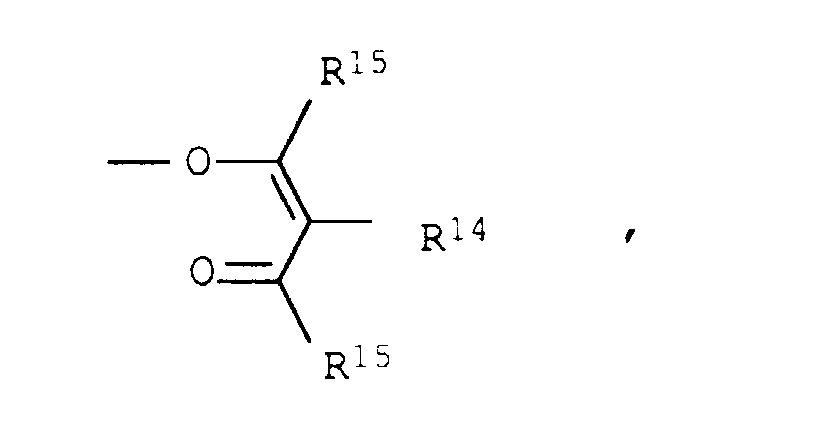
- mit R14
- Wasserstoff oder C1- bis C20-Alkyl,
- R15
- C1- bis C20-Alkyl,
- L
- ein tertiäres Amin oder einen Ether bedeutet,
- p
- für die Zahlen 2, 3, 4, 5 oder 6 steht
- q
- 0, 1, 2, 3 oder 4 bedeutet,
- Verfahren nach den Ansprüchen 1 bis 5, dadurch gekennzeichnet, daß man es zur Herstellung von Metallocenen der allgemeinen Formel Iin der die Substituenten folgende Bedeutung haben:

- R1 bis R10
- Wasserstoff, C1- bis C10-Alkyl, 5- bis 7-gliedriges Cycloalkyl, das seinerseits C1- bis C6-Alkylgruppen als Substituenten tragen kann, C6- bis C15-Aryl oder Arylalkyl und wobei gegebenenfalls auch zwei benachbarte Reste gemeinsam für 4 bis 15 C-Atome aufweisende cyclische Gruppen stehen können, oder Si(R11)3,
- mit R11
- C1- bis C10-Alkyl, C6- bis C15-Aryl oder C3- bis C10-Cycloalkyl,
- mit Y
- Silicium, Germanium, Zinn oder Kohlenstoff
- R12, R13
- Wasserstoff, C1- bis C10-Alkyl, C3- bis C10-Cycloalkyl oder C6- bis C15-Aryl
- m
- 1,2,3 oder 4
- Z1, Z2
- X oder
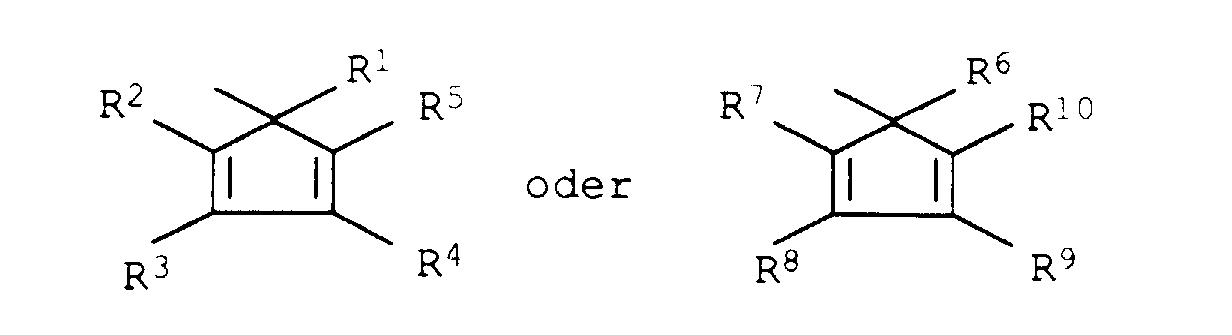
- n
- 0,1 oder 2
- r
- 0,1 oder 2,
Applications Claiming Priority (2)
| Application Number | Priority Date | Filing Date | Title |
|---|---|---|---|
| DE4337230 | 1993-10-30 | ||
| DE4337230A DE4337230A1 (de) | 1993-10-30 | 1993-10-30 | Verfahren zur Herstellung von Metallocenen in einem Reaktionsschritt |
Publications (2)
| Publication Number | Publication Date |
|---|---|
| EP0652224A1 EP0652224A1 (de) | 1995-05-10 |
| EP0652224B1 true EP0652224B1 (de) | 1999-09-01 |
Family
ID=6501516
Family Applications (1)
| Application Number | Title | Priority Date | Filing Date |
|---|---|---|---|
| EP94116523A Expired - Lifetime EP0652224B1 (de) | 1993-10-30 | 1994-10-20 | Verfahren zur Herstellung von Metallocenen in einem Reaktionsschritt |
Country Status (5)
| Country | Link |
|---|---|
| US (1) | US5641871A (de) |
| EP (1) | EP0652224B1 (de) |
| JP (1) | JP3641659B2 (de) |
| DE (2) | DE4337230A1 (de) |
| ES (1) | ES2136689T3 (de) |
Families Citing this family (12)
| Publication number | Priority date | Publication date | Assignee | Title |
|---|---|---|---|---|
| US5631202A (en) | 1993-09-24 | 1997-05-20 | Montell Technology Company B.V. | Stereospecific metallocene catalysts with stereolocking α-CP substituents |
| DE4434640C1 (de) * | 1994-09-28 | 1996-02-01 | Hoechst Ag | Verfahren zur Herstellung verbrückter Metallocene |
| US6403772B1 (en) * | 1995-09-11 | 2002-06-11 | Montell Technology Company, Bv | Open-pentadienyl metallocenes, precursors thereof and polymerization catalysts therefrom |
| US6160072A (en) * | 1997-05-02 | 2000-12-12 | Ewen; John A. | Process for polymerizing tactioselective polyolefins in condensed phase using titanocenes |
| US5942462A (en) * | 1997-10-20 | 1999-08-24 | Akzo Nobel N.V. | Process for preparing group 6 metal-based olefin polymerization catalyst component |
| RU2139883C1 (ru) * | 1998-12-18 | 1999-10-20 | Государственный научный центр Российской Федерации Государственный научно-исследовательский институт химии и технологии элементоорганических соединений | Способ получения бис-(циклопентадиенил)хрома |
| RU2188826C2 (ru) * | 2000-01-17 | 2002-09-10 | ООО "Синтезхим Бис" | Способ получения ферроцена |
| JP4426158B2 (ja) * | 2002-08-05 | 2010-03-03 | Tanakaホールディングス株式会社 | ビス(シクロペンタジエニル)ルテニウムの製造方法 |
| US7176158B2 (en) * | 2002-10-25 | 2007-02-13 | Exxonmobil Chemical Patents Inc. | Polymerization catalyst composition |
| KR101288228B1 (ko) | 2005-05-10 | 2013-07-18 | 이네오스 유럽 리미티드 | 신규 공중합체 |
| RU2323248C1 (ru) * | 2006-07-21 | 2008-04-27 | ЗАО "Каспийская нефтеперерабатывающая компания" | Способ получения присадок к углеводородным топливам |
| US20100189898A1 (en) * | 2009-01-22 | 2010-07-29 | Zhiwen WAN | MANUFACTURING OF ADDUCT FREE ALKALINE-EARTH METAL Cp COMPLEXES |
Family Cites Families (3)
| Publication number | Priority date | Publication date | Assignee | Title |
|---|---|---|---|---|
| US2834796A (en) * | 1953-03-02 | 1958-05-13 | California Research Corp | Preparation of iron cyclopentadienides |
| US2870183A (en) * | 1953-09-23 | 1959-01-20 | Union Carbide Corp | Organo-chromium compounds |
| GB1416543A (en) * | 1972-11-13 | 1975-12-03 | Bp Chem Int Ltd | Process for producing chromocene |
-
1993
- 1993-10-30 DE DE4337230A patent/DE4337230A1/de not_active Withdrawn
-
1994
- 1994-10-17 JP JP25095794A patent/JP3641659B2/ja not_active Expired - Fee Related
- 1994-10-20 ES ES94116523T patent/ES2136689T3/es not_active Expired - Lifetime
- 1994-10-20 EP EP94116523A patent/EP0652224B1/de not_active Expired - Lifetime
- 1994-10-20 DE DE59408687T patent/DE59408687D1/de not_active Expired - Lifetime
- 1994-10-28 US US08/328,776 patent/US5641871A/en not_active Expired - Lifetime
Also Published As
| Publication number | Publication date |
|---|---|
| JP3641659B2 (ja) | 2005-04-27 |
| DE4337230A1 (de) | 1995-05-04 |
| US5641871A (en) | 1997-06-24 |
| ES2136689T3 (es) | 1999-12-01 |
| DE59408687D1 (de) | 1999-10-07 |
| EP0652224A1 (de) | 1995-05-10 |
| JPH07188272A (ja) | 1995-07-25 |
Similar Documents
| Publication | Publication Date | Title |
|---|---|---|
| DE69418742T2 (de) | Katalysatorbestandteil für alpha-Olefinpolymerisation und Verfahren zur Herstellung von alpha-Olefinpolymeren unter Anwendung derselben | |
| EP0770587B1 (de) | Verfahren zur Herstellung einer Indenverbindung und deren Verwendung zur Herstellung eines Metallocenkatalysator | |
| DE69232608T2 (de) | Verwendung von Fluorenylorganometallverbindungen. | |
| DE69224184T2 (de) | Verfahren zur Herstellung von verbrückten, chiralen Metallocenkatalysatoren des Types Bisindenyl | |
| DE69328955T2 (de) | Katalysatorzusammensetzungen und Verfahren zur Herstellung von Polyolefinen | |
| EP0582195B1 (de) | Verfahren zur Herstellung eines Olefinpolymers unter Verwendung spezieller Metallocene | |
| DE69717645T2 (de) | Verbrückte nicht-aromatische anionische dienylgruppen enthaltende metallkomplexe und darauf basierte polymerisatonskatalysatoren | |
| DE69811221T2 (de) | Verfahren zur herstellung von verbrükten phosphol-cyclopentadienyl verbindungen | |
| EP0519237B1 (de) | Lösliche Katalysatorsysteme zur Herstellung von Polyalk-1-enen mit hohen Molmassen | |
| DE69210276T2 (de) | Herstellung von Alpha-Olefinpolymeren | |
| EP0868440B1 (de) | Verfahren zur herstellung von ethylen-copolymerisaten unter hochdruck | |
| EP0416566B1 (de) | Verfahren zur Herstellung eines Polyolefinwachses | |
| DE4005947A1 (de) | Loesliche katalysatorsysteme zur polymerisation von c(pfeil abwaerts)2(pfeil abwaerts)- bis c(pfeil abwaerts)1(pfeil abwaerts)(pfeil abwaerts)0(pfeil abwaerts)-alk-1-enen | |
| DE3889866T2 (de) | Katalysatoren zur Olefinpolymerisation. | |
| DE69506443T2 (de) | Verbesserte herstellung von titan (ii) oder zirkon (ii) komplexen | |
| EP0652224A1 (de) | Verfahren zur Herstellung von Metallocenen in einem Reaktionsschritt | |
| DE69602937T2 (de) | Verbesserte synthese von racemischen metallocenen | |
| EP0745606B1 (de) | Verfahren zur Herstellung von verbrückten Metallocenkomplexen | |
| EP0650981B1 (de) | Verfahren zur Herstellung von Polymerisaten von C2-bis C10-Alk-1-enen unter Verwendung von racemischen Metallocenkomplexen als Katalysatoren | |
| EP1313747A1 (de) | VERFAHREN ZUR HERSTELLUNG VON AlKYLVERBRÜCKTEN LIGANDSYSTEMEN UND ÜBERGANGSMETALLVERBINDUNGEN | |
| DE4332009A1 (de) | Verfahren zur Herstellung von Organometallfluoriden | |
| DE69704683T2 (de) | Substituierte Metallocen-Katalysator für die Olefinpolymerisation | |
| EP0669337B1 (de) | Verbrückte Cyclopentadienylmagnesium-Verbindungen und Verfahren zu ihrer Herstellung und ihre Verwendung zur Herstellung von Metallocenen | |
| DE69206945T2 (de) | Katalysator für Olefinpolymerisation | |
| DE69128117T2 (de) | Homogene Katalysatoren zum Polymerisieren von Olefinen |
Legal Events
| Date | Code | Title | Description |
|---|---|---|---|
| PUAI | Public reference made under article 153(3) epc to a published international application that has entered the european phase |
Free format text: ORIGINAL CODE: 0009012 |
|
| 17P | Request for examination filed |
Effective date: 19950303 |
|
| AK | Designated contracting states |
Kind code of ref document: A1 Designated state(s): BE DE ES FR GB IT NL |
|
| 17Q | First examination report despatched |
Effective date: 19971021 |
|
| GRAG | Despatch of communication of intention to grant |
Free format text: ORIGINAL CODE: EPIDOS AGRA |
|
| GRAH | Despatch of communication of intention to grant a patent |
Free format text: ORIGINAL CODE: EPIDOS IGRA |
|
| GRAH | Despatch of communication of intention to grant a patent |
Free format text: ORIGINAL CODE: EPIDOS IGRA |
|
| GRAA | (expected) grant |
Free format text: ORIGINAL CODE: 0009210 |
|
| AK | Designated contracting states |
Kind code of ref document: B1 Designated state(s): BE DE ES FR GB IT NL |
|
| REF | Corresponds to: |
Ref document number: 59408687 Country of ref document: DE Date of ref document: 19991007 |
|
| GBT | Gb: translation of ep patent filed (gb section 77(6)(a)/1977) |
Effective date: 19990920 |
|
| ITF | It: translation for a ep patent filed | ||
| REG | Reference to a national code |
Ref country code: ES Ref legal event code: FG2A Ref document number: 2136689 Country of ref document: ES Kind code of ref document: T3 |
|
| ET | Fr: translation filed | ||
| PLBE | No opposition filed within time limit |
Free format text: ORIGINAL CODE: 0009261 |
|
| STAA | Information on the status of an ep patent application or granted ep patent |
Free format text: STATUS: NO OPPOSITION FILED WITHIN TIME LIMIT |
|
| 26N | No opposition filed | ||
| PGFP | Annual fee paid to national office [announced via postgrant information from national office to epo] |
Ref country code: NL Payment date: 20010921 Year of fee payment: 8 |
|
| PGFP | Annual fee paid to national office [announced via postgrant information from national office to epo] |
Ref country code: ES Payment date: 20011008 Year of fee payment: 8 |
|
| PGFP | Annual fee paid to national office [announced via postgrant information from national office to epo] |
Ref country code: BE Payment date: 20011119 Year of fee payment: 8 |
|
| REG | Reference to a national code |
Ref country code: GB Ref legal event code: IF02 |
|
| PG25 | Lapsed in a contracting state [announced via postgrant information from national office to epo] |
Ref country code: ES Free format text: LAPSE BECAUSE OF NON-PAYMENT OF DUE FEES Effective date: 20021021 |
|
| PG25 | Lapsed in a contracting state [announced via postgrant information from national office to epo] |
Ref country code: BE Free format text: LAPSE BECAUSE OF NON-PAYMENT OF DUE FEES Effective date: 20021031 |
|
| BERE | Be: lapsed |
Owner name: *BASF A.G. Effective date: 20021031 |
|
| PG25 | Lapsed in a contracting state [announced via postgrant information from national office to epo] |
Ref country code: NL Free format text: LAPSE BECAUSE OF NON-PAYMENT OF DUE FEES Effective date: 20030501 |
|
| NLV4 | Nl: lapsed or anulled due to non-payment of the annual fee |
Effective date: 20030501 |
|
| REG | Reference to a national code |
Ref country code: ES Ref legal event code: FD2A Effective date: 20031112 |
|
| REG | Reference to a national code |
Ref country code: GB Ref legal event code: 732E |
|
| REG | Reference to a national code |
Ref country code: FR Ref legal event code: TP |
|
| PGFP | Annual fee paid to national office [announced via postgrant information from national office to epo] |
Ref country code: DE Payment date: 20091029 Year of fee payment: 16 |
|
| PGFP | Annual fee paid to national office [announced via postgrant information from national office to epo] |
Ref country code: IT Payment date: 20091028 Year of fee payment: 16 Ref country code: GB Payment date: 20091026 Year of fee payment: 16 Ref country code: FR Payment date: 20091029 Year of fee payment: 16 |
|
| GBPC | Gb: european patent ceased through non-payment of renewal fee |
Effective date: 20101020 |
|
| PG25 | Lapsed in a contracting state [announced via postgrant information from national office to epo] |
Ref country code: FR Free format text: LAPSE BECAUSE OF NON-PAYMENT OF DUE FEES Effective date: 20101102 |
|
| REG | Reference to a national code |
Ref country code: FR Ref legal event code: ST Effective date: 20110630 |
|
| PG25 | Lapsed in a contracting state [announced via postgrant information from national office to epo] |
Ref country code: GB Free format text: LAPSE BECAUSE OF NON-PAYMENT OF DUE FEES Effective date: 20101020 |
|
| REG | Reference to a national code |
Ref country code: DE Ref legal event code: R119 Ref document number: 59408687 Country of ref document: DE Effective date: 20110502 |
|
| PG25 | Lapsed in a contracting state [announced via postgrant information from national office to epo] |
Ref country code: IT Free format text: LAPSE BECAUSE OF NON-PAYMENT OF DUE FEES Effective date: 20101020 |
|
| PG25 | Lapsed in a contracting state [announced via postgrant information from national office to epo] |
Ref country code: DE Free format text: LAPSE BECAUSE OF NON-PAYMENT OF DUE FEES Effective date: 20110502 |