EP0651042B1 - Verfahren zum Reinigen von Druckgasen - Google Patents
Verfahren zum Reinigen von Druckgasen Download PDFInfo
- Publication number
- EP0651042B1 EP0651042B1 EP94115524A EP94115524A EP0651042B1 EP 0651042 B1 EP0651042 B1 EP 0651042B1 EP 94115524 A EP94115524 A EP 94115524A EP 94115524 A EP94115524 A EP 94115524A EP 0651042 B1 EP0651042 B1 EP 0651042B1
- Authority
- EP
- European Patent Office
- Prior art keywords
- reactor
- laden
- condensation
- scrubbing
- scrubbing liquid
- Prior art date
- Legal status (The legal status is an assumption and is not a legal conclusion. Google has not performed a legal analysis and makes no representation as to the accuracy of the status listed.)
- Expired - Lifetime
Links
Images

Classifications
-
- C—CHEMISTRY; METALLURGY
- C01—INORGANIC CHEMISTRY
- C01B—NON-METALLIC ELEMENTS; COMPOUNDS THEREOF; METALLOIDS OR COMPOUNDS THEREOF NOT COVERED BY SUBCLASS C01C
- C01B3/00—Hydrogen; Gaseous mixtures containing hydrogen; Separation of hydrogen from mixtures containing it; Purification of hydrogen; Reversible storage of hydrogen
- C01B3/50—Separation of hydrogen or hydrogen-containing gases from gaseous mixtures, e.g. purification
- C01B3/52—Separation of hydrogen or hydrogen-containing gases from gaseous mixtures, e.g. purification by contacting with liquids; Regeneration of used liquids
-
- B—PERFORMING OPERATIONS; TRANSPORTING
- B01—PHYSICAL OR CHEMICAL PROCESSES OR APPARATUS IN GENERAL
- B01D—SEPARATION
- B01D53/00—Separation of gases or vapours; Recovering vapours of volatile solvents from gases; Chemical or biological purification of waste gases, e.g. engine exhaust gases, smoke, fumes, flue gases, aerosols
- B01D53/14—Separation of gases or vapours; Recovering vapours of volatile solvents from gases; Chemical or biological purification of waste gases, e.g. engine exhaust gases, smoke, fumes, flue gases, aerosols by absorption
- B01D53/1425—Regeneration of liquid absorbents
-
- C—CHEMISTRY; METALLURGY
- C10—PETROLEUM, GAS OR COKE INDUSTRIES; TECHNICAL GASES CONTAINING CARBON MONOXIDE; FUELS; LUBRICANTS; PEAT
- C10K—PURIFYING OR MODIFYING THE CHEMICAL COMPOSITION OF COMBUSTIBLE GASES CONTAINING CARBON MONOXIDE
- C10K1/00—Purifying combustible gases containing carbon monoxide
- C10K1/08—Purifying combustible gases containing carbon monoxide by washing with liquids; Reviving the used wash liquors
- C10K1/16—Purifying combustible gases containing carbon monoxide by washing with liquids; Reviving the used wash liquors with non-aqueous liquids
- C10K1/165—Purifying combustible gases containing carbon monoxide by washing with liquids; Reviving the used wash liquors with non-aqueous liquids at temperatures below zero degrees Celsius
-
- C—CHEMISTRY; METALLURGY
- C01—INORGANIC CHEMISTRY
- C01B—NON-METALLIC ELEMENTS; COMPOUNDS THEREOF; METALLOIDS OR COMPOUNDS THEREOF NOT COVERED BY SUBCLASS C01C
- C01B2203/00—Integrated processes for the production of hydrogen or synthesis gas
- C01B2203/04—Integrated processes for the production of hydrogen or synthesis gas containing a purification step for the hydrogen or the synthesis gas
- C01B2203/0415—Purification by absorption in liquids
-
- C—CHEMISTRY; METALLURGY
- C01—INORGANIC CHEMISTRY
- C01B—NON-METALLIC ELEMENTS; COMPOUNDS THEREOF; METALLOIDS OR COMPOUNDS THEREOF NOT COVERED BY SUBCLASS C01C
- C01B2203/00—Integrated processes for the production of hydrogen or synthesis gas
- C01B2203/04—Integrated processes for the production of hydrogen or synthesis gas containing a purification step for the hydrogen or the synthesis gas
- C01B2203/0465—Composition of the impurity
-
- C—CHEMISTRY; METALLURGY
- C01—INORGANIC CHEMISTRY
- C01B—NON-METALLIC ELEMENTS; COMPOUNDS THEREOF; METALLOIDS OR COMPOUNDS THEREOF NOT COVERED BY SUBCLASS C01C
- C01B2203/00—Integrated processes for the production of hydrogen or synthesis gas
- C01B2203/04—Integrated processes for the production of hydrogen or synthesis gas containing a purification step for the hydrogen or the synthesis gas
- C01B2203/0465—Composition of the impurity
- C01B2203/0485—Composition of the impurity the impurity being a sulfur compound
Definitions
- the invention relates to a method for cleaning pressurized gases by cryogenic gas scrubbing and then degassing the loaded washing liquid by relaxing, evacuating, expelling and heating.
- the present method serves to remove in particular metal carbonyl compounds, those in association with other by-products, especially at Cleavage of fuels containing heavy metals to produce synthesis gas.
- Synthesis gas can be generated by various processes, for example by steam reforming natural gas, liquefied petroleum gas or naphtha, by processes which consist of a combination of partial oxidation and steam reforming processes, with or without addition of CO 2 , or by processes for the partial oxidation of gaseous or liquid to low-viscosity hydrocarbons .
- the synthesis gas consists essentially of hydrogen, hydrocarbons, carbon dioxide and carbon monoxide with the by-products derived from the raw materials used, such as in particular H 2 S, HCN, COS, HSCN, but also metal carbonyl compounds.
- Metal carbonyl compounds of this type which, in addition to the by-products mentioned, have to be removed from the raw synthesis gas as disruptive gas impurities, are probably due to the use of residues from mineral oil processing which contain heavy metals.
- the raw gas is first prewashed with a small portion of the regenerated scrubbing liquid, here methanol, for HCN removal.
- the raw gas is then washed with the majority of the regenerated methanol in order to absorb the H 2 S.
- Both the loaded pre-wash methanol and the loaded main wash methanol contain the heavy metal compounds mentioned.
- a process for cleaning compressed gases from the cleavage containing heavy metals Fuels through single or multi-stage low-temperature gas scrubbing at - 60 to 0 ° C with solvents and subsequent degassing of the solvent by relaxing, Evacuation, expulsion and heating with additional treatment in one
- the pre-reactor is described in more detail in the patent DE 26 10 982 C3.
- the method described there is the prevention of such deposits insoluble heavy metal compounds in the outgassing columns of gas scrubbers and the extension of operating hours.
- metal carbonyls not converted in the prereactor Metal carbonyls dissolved in prewash methanol and in the prereactor outgassed metal carbonyls still largely in the sour gas.
- the loaded main washing methanol becomes after heating via pre-reactor 3 Regeneration column 6 driven. This creates a sour gas, which the in the course the by-products of the regeneration not converted, the despite the Pre-reactor 3 remaining in the acid gas metal carbonyl compounds in the Sulfur recovery plant (Claus plant) for deposits and thus to be shortened Terms would lead.
- the prewash methanol is used after heating a stripping column, where the liquid with the Flash gases of the pre-reactor is stripped.
- the H 2 S / CO 2 -containing gas also contains heavy metal compounds of this type, which lead, in particular in the downstream Claus plants, to caking on the catalyst bed and thus to shortened running times.
- a degree of deposition of the metal compounds is achieved which can be between 20 and 96% (cf. FIG. 2 of DE 26 10 982 C3).
- the invention consists in that in a method of the aforementioned Kind before entering a regeneration column 6 a heavily loaded and a weakly laden partial flow of the washing liquid is heated and one reactor 3, 4 each is supplied and that the weakly charged partial flow of the washing liquid together with the condensate that is released during the partial condensation of the vapors the condensation system 7 of the regeneration column 6 is obtained in the residence reactor 4 is driven.
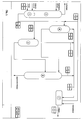
- a preferred embodiment of the method according to the invention is in the figure 1 of the drawing in a flow diagram stating the associated masses (weight) Portions shown in ppm of nickel and iron carbonyl.
- FIG. 2 of the drawing A more specific embodiment can be seen in FIG. 2 of the drawing.
- both loaded flows of washing liquid are preferred Wash methanol flows, heated and then a separate one Residence reactor fed.
- the conditions in reactors 3 and 4 are as follows chosen that the outgassing is minimized.
- the weakly laden partial flow of washing liquid is combined with the Condensate, which in the course of the partial condensation of the vapors from the condensation system 7 of the regeneration column 6 is obtained, moved to the residence reactor 4.
- the heavy metal compounds are mainly nickel tetracarbonyl (Nickel carbonyl) and iron pentacarbonyl (iron carbonyl), which at 42 and Boil 103 ° C.
- Nickel carbonyl nickel tetracarbonyl
- iron pentacarbonyl iron carbonyl
- the condensation system 7 of the regeneration column 6 can be preferred Execution can be constructed from two condensation stages. The gas, for example cooled to about 40 ° C and partially condensed. The remaining gas is then for example cooled to about - 30 ° C. Condensed at this temperature almost all of the methanol and most of the carbonyls. The carbonyl-containing Condensate becomes the additional reaction stage proposed according to the invention recirculated.
- the vapors can be contacted with washing or fresh methanol, which via residence time reactor 4 is recirculated.
- a further embodiment of the method according to the invention is as Washing liquid unloaded washing methanol or fresh methanol in the Inject gas phase to the second cryogenic condensation stage of the regeneration column 6 and to recirculate this together with condensate via reactor 4.
- This measure makes the ratio of Claus gas to condensate decreases, which is a corresponding increase in the proportion of condensed Heavy metal connections results.
- the nickel carbonyl content in the Clausgas can be reduced by 30%, for example.
- Reactor 4 is advantageously operated at a pressure which is approximately the boiling temperature corresponds to the combined reactor inlet flows.
- Is preferred reactor 4 at a temperature of 50 to 180 ° C, a pressure of 5 up to 25 bar and a dwell time of 0.05 to 1 h.
- An advantageous embodiment of the proposed method consists in the Reflux from the condensation stages for the top product from the regeneration column 6 via the residence reactor 4 for the weakly loaded washing liquid Head of the regeneration column 6 attributed.
- Another preferred embodiment is the liquid phase from the flash container 5 to recycle to reactor 4.
- the non-quantitative degradation of the Heavy metal components in the pre-reactor 3 significantly affected.
- the in the Gas phase of the stripping column 5 functioning as a flash container Heavy metal components sometimes get into the condensate of the condensation system 7 of the regeneration column 6 and are returned to the reactor 4.
- the heavy metal compounds are reacted at about 100 ° C and failed.
- the pressure is chosen so high, for example 15 bar, that only outgas small amounts of steam. This leaves the heavy metal compounds predominantly in the liquid phase.
- the carbonyls in Claus gas each after choosing the process conditions in the two reactors 3 and 4 and in Flash container 5 and depending on those recirculated via the reactor 4 Condensate quantities and the injection methanol quantity by up to 95 or even 99% to reduce.
Landscapes
- Chemical & Material Sciences (AREA)
- Engineering & Computer Science (AREA)
- Organic Chemistry (AREA)
- Combustion & Propulsion (AREA)
- Chemical Kinetics & Catalysis (AREA)
- Oil, Petroleum & Natural Gas (AREA)
- General Chemical & Material Sciences (AREA)
- Inorganic Chemistry (AREA)
- Analytical Chemistry (AREA)
- Gas Separation By Absorption (AREA)
- Industrial Gases (AREA)
- Solid-Sorbent Or Filter-Aiding Compositions (AREA)
- Separation By Low-Temperature Treatments (AREA)
Description
- 1
- Vorwaschkolonne
- 2
- Hauptwaschkolonne
- 3
- Vorreaktor
- 4
- Reaktor
- 5
- Flashbehälter
- 6
- Regenerierkolonne
- 7
- Kondensationssystem
- L1 bis L5
- Leitungen wie in Figur 2 eingetragen.
Claims (7)
- Verfahren zum Reinigen von Druckgasen durch Tieftemperaturgaswäsche, anschließendes Ausgasen der beladenen Waschflüssigkeit durch Entspannen, Evakuieren, Austreiben und Erhitzen, dadurch gekennzeichnet, daß vor Eintritt in eine Regenerierkolonne (6) ein stark beladener und ein schwach beladener Teilstrom der Waschflüssigkeit erhitzt und je einem Reaktor (3, 4) zugeführt werden und daß der schwach beladene Teilstrom der Waschflüssigkeit gemeinsam mit dem Kondensat, das im Zuge der Teilkondensation der Dämpfe in dem Kondensationssystem (7) der Regenerierkolonne (6) anfällt, in Verweilzeitreaktor (4) gefahren wird.
- Verfahren nach Anspruch 1, dadurch gekennzeichnet, daß das Kondensationssystem (7) der Regenerierkolonne (6) aus zwei Kondensationsstufen aufgebaut ist.
- Verfahren nach Anspruch 1 oder 2, dadurch gekennzeichnet, daß als Waschflüssigkeit unbeladenes Waschmethanol oder auch Frischmethanol in die Gasphase zur zweiten tiefkalten Kondensationsstufe der Regenerierkolonne (6) eingespritzt wird.
- Verfahren nach einem der Ansprüche 1 bis 3, dadurch gekennzeichnet, daß Reaktor (4) bei einem Druck, der etwa der Siedetemperatur der kombinierten Reaktoreintrittsströme entspricht, betrieben wird.
- Verfahren nach einem der Ansprüche 1 bis 4, dadurch gekennzeichnet, daß Reaktor (4) bei einer Temperatur von 50 bis 180°C, einem Druck von 5 bis 25 bar sowie einer Verweilzeit von 0,05 bis 1 h betrieben wird.
- Verfahren nach einem der Ansprüche 1 bis 5, dadurch gekennzeichnet, daß der schwach beladene Teilstrom der Waschflüssigkeit aus Reaktor (4), ggf. zusammen mit Flashgasen aus Reaktor (3) einem Flashbehälter (5) zugeführt wird, dessen Dämpfe über Kondensationssystem (7) gefahren werden.
- Verfahren nach einem der Ansprüche 1 bis 6, dadurch gekennzeichnet, daß die Flüssigphase von Flashbehälter (5) zu Reaktor (4) rezirkuliert wird.
Applications Claiming Priority (2)
| Application Number | Priority Date | Filing Date | Title |
|---|---|---|---|
| DE4336790 | 1993-10-28 | ||
| DE4336790A DE4336790C2 (de) | 1993-10-28 | 1993-10-28 | Verfahren zum Reinigen von Druckgasen |
Publications (2)
| Publication Number | Publication Date |
|---|---|
| EP0651042A1 EP0651042A1 (de) | 1995-05-03 |
| EP0651042B1 true EP0651042B1 (de) | 1999-01-07 |
Family
ID=6501226
Family Applications (1)
| Application Number | Title | Priority Date | Filing Date |
|---|---|---|---|
| EP94115524A Expired - Lifetime EP0651042B1 (de) | 1993-10-28 | 1994-10-01 | Verfahren zum Reinigen von Druckgasen |
Country Status (5)
| Country | Link |
|---|---|
| EP (1) | EP0651042B1 (de) |
| AT (1) | ATE175436T1 (de) |
| DE (2) | DE4336790C2 (de) |
| DK (1) | DK0651042T3 (de) |
| ES (1) | ES2128483T3 (de) |
Families Citing this family (10)
| Publication number | Priority date | Publication date | Assignee | Title |
|---|---|---|---|---|
| DE10336677B4 (de) * | 2003-08-09 | 2007-10-31 | Lurgi Ag | Verfahren und Vorrichtung zur Reinigung von Industriegasen |
| US20070225382A1 (en) | 2005-10-14 | 2007-09-27 | Van Den Berg Robert E | Method for producing synthesis gas or a hydrocarbon product |
| CN101200650B (zh) | 2006-11-01 | 2012-01-18 | 国际壳牌研究有限公司 | 将固体含碳供给料处理成液体的方法 |
| US8048178B2 (en) | 2007-11-20 | 2011-11-01 | Shell Oil Company | Process for producing a purified synthesis gas stream |
| JP5473934B2 (ja) | 2007-11-27 | 2014-04-16 | アルストム テクノロジー リミテッド | 水素を多く含む第二の燃料を用いてガスタービン設備を動作させる装置及び方法 |
| EP2373602B1 (de) | 2008-12-22 | 2013-08-21 | Shell Internationale Research Maatschappij B.V. | Verfahren zur herstellung von methanol und/oder dimethylether |
| EP2540663B1 (de) | 2011-06-30 | 2019-07-31 | Neste Oyj | Verfahren zur Anpassung des Wasserstoff-Kohlenmonoxidverhältnisses in Synthesegas |
| CN105779026B (zh) * | 2016-03-11 | 2019-04-09 | 神华集团有限责任公司 | 甲醇洗系统 |
| PL3530340T3 (pl) | 2018-02-27 | 2021-05-31 | L'air Liquide, Société Anonyme pour l'Étude et l'Exploitation des Procédés Georges Claude | Sposób i instalacja do oddzielania kwaśnych składników gazowych z gazu syntezowego zawierającego karbonylki metali |
| WO2022171906A2 (en) | 2021-04-28 | 2022-08-18 | Torrgas Technology B.V. | Process to prepare lower olefins |
Family Cites Families (7)
| Publication number | Priority date | Publication date | Assignee | Title |
|---|---|---|---|---|
| DE2260248C3 (de) * | 1972-12-08 | 1981-08-27 | Linde Ag, 6200 Wiesbaden | Verfahren und Vorrichtung zur Entfernung von Cyanwasserstoff aus Gasen |
| DE2610982C3 (de) * | 1976-03-16 | 1982-12-30 | Veba Oel AG, 4660 Gelsenkirchen-Buer | Verfahren zum Reinigen von Druckgasen aus der Spaltung schwermetallhaltiger Brennstoffe |
| IT1211081B (it) * | 1981-07-23 | 1989-09-29 | Snam Progetti | Procedimento criogenico di rimozione di gas acidi da misceledi gas. |
| DE3148520A1 (de) * | 1981-12-08 | 1983-07-21 | Linde Ag, 6200 Wiesbaden | "verfahren zur entfernung von sauren gasen aus gasgemischen" |
| FR2600554B1 (fr) * | 1986-06-30 | 1988-09-02 | Elf Aquitaine | Procede et dispositif pour la desacidification d'un gaz renfermant h2s ou/et co2 ainsi que des mercaptans |
| DE4027239A1 (de) * | 1990-08-29 | 1992-03-05 | Linde Ag | Verfahren zur selektiven entfernung anorganischer und/oder organischer schwefelverbindungen |
| DE4115532A1 (de) * | 1991-05-13 | 1992-11-19 | Leuna Werke Ag | Verfahren zur entfernung von nickeltetracarbonyl und eisenpentacarbonyl aus schwefelwasserstoffreichen gasen |
-
1993
- 1993-10-28 DE DE4336790A patent/DE4336790C2/de not_active Expired - Fee Related
-
1994
- 1994-10-01 ES ES94115524T patent/ES2128483T3/es not_active Expired - Lifetime
- 1994-10-01 AT AT94115524T patent/ATE175436T1/de active
- 1994-10-01 DK DK94115524T patent/DK0651042T3/da active
- 1994-10-01 DE DE59407596T patent/DE59407596D1/de not_active Expired - Lifetime
- 1994-10-01 EP EP94115524A patent/EP0651042B1/de not_active Expired - Lifetime
Also Published As
| Publication number | Publication date |
|---|---|
| DE4336790C2 (de) | 1995-08-17 |
| DK0651042T3 (da) | 1999-08-30 |
| ES2128483T3 (es) | 1999-05-16 |
| EP0651042A1 (de) | 1995-05-03 |
| DE4336790A1 (de) | 1995-05-04 |
| ATE175436T1 (de) | 1999-01-15 |
| DE59407596D1 (de) | 1999-02-18 |
Similar Documents
| Publication | Publication Date | Title |
|---|---|---|
| DE1494809C3 (de) | Verfahren zum Auswaschen von Kohlendioxid aus schwefelarmen oder schwefelfreien Gasen | |
| DE102007056625B3 (de) | Verfahren zur Behandlung eines CO2 enthaltenden Prozessgasstrom | |
| DE2227071A1 (de) | Verfahren zum reinigen technischer brenn- und synthesegase | |
| EP0054772A1 (de) | Verfahren zum Reinigen eines Gasstroms | |
| DE4336790C2 (de) | Verfahren zum Reinigen von Druckgasen | |
| EP3912704B1 (de) | Gaswäscheverfahren zur reinigung von rohsynthesegas durch physikalische absorption in methanol | |
| EP0081241B1 (de) | Verfahren zur Entfernung von sauren Gasen aus Gasgemischen | |
| DE102006014302A1 (de) | Verfahren und Vorrichtung zur Regenerierung des beladenen Waschmittels in einer physikalischen Gaswäsche | |
| DE3247773A1 (de) | Verfahren zum entfernen saurer bestandteile aus co(pfeil abwaerts)2(pfeil abwaerts)-reichem, kohlenwasserstoffhaltigem rohgas | |
| WO2008064761A1 (de) | Verfahren und vorrichtung zur abtrennung von metallcarbonvlen aus svntheseqas | |
| DE1667433B2 (de) | Verfahren zur Gewinnung von Schwefelwasserstoff | |
| EP3789102B1 (de) | Verfahren und anlage zur abtrennung von begleitstoffen aus einem rohsynthesegasstrom und zur herstellung eines schwefelfreien naphtha-produktes | |
| EP0160203A1 (de) | Verfahren zum Entfernen von CO2 und/oder H2S aus Gasen | |
| DE3242277A1 (de) | Verfahren zum entschwefeln von gasen mit einer aminhaltigen waschloesung | |
| DE3709363C1 (de) | Verfahren zum Behandeln zweier beladener Waschloesungsstroeme | |
| EP0192195B1 (de) | Verfahren und Vorrichtung zum Abtrennen unerwünschter Komponenten aus Gasgemischen | |
| DE2433078B2 (de) | Verfahren zur Reinigung von durch Vergasung fester fossiler Brennstoffe mittels Wasserdampf und Sauerstoff unter Druck erzeugter Gase | |
| EP0361557B1 (de) | Verfahren zum Behandeln eines Kohlenwasserstoffe und H2S enthaltenden Erdgases | |
| EP0285189B1 (de) | Verfahren zum Behandeln einer beladenen, unter Druck stehenden Waschlösung | |
| EP3530340A1 (de) | Verfahren und anlage zur abtrennung acider gasbestandteile aus metallcarbonyle enthaltendem synthesegas | |
| DE2137183A1 (de) | Absorptionsverfahren | |
| DE4235957C2 (de) | Verfahren zur getrennten Entfernung von Schwefelverbindungen und CO¶2¶ aus Gas | |
| DE1948428C3 (de) | Verfahren zur Gewinnung von NH tief 3 und H tief 2 S aus einer leichte Kohlenwasserstoffe, Wasserstoff sowie H tief 2 S und NH tief 3 enthaltenden Ausgangslösung | |
| EP3666365A1 (de) | Verfahren zur regenerierung eines beladenen waschmittels aus einer physikalisch wirkenden gaswäsche und vorrichtung für eine physikalisch wirkende gaswäsche | |
| DE2246722B2 (de) | Verfahren zur Reinigung von Gasen |
Legal Events
| Date | Code | Title | Description |
|---|---|---|---|
| PUAI | Public reference made under article 153(3) epc to a published international application that has entered the european phase |
Free format text: ORIGINAL CODE: 0009012 |
|
| AK | Designated contracting states |
Kind code of ref document: A1 Designated state(s): AT BE CH DE DK ES FR GB GR IE IT LI LU MC NL PT SE |
|
| 17P | Request for examination filed |
Effective date: 19950406 |
|
| GRAG | Despatch of communication of intention to grant |
Free format text: ORIGINAL CODE: EPIDOS AGRA |
|
| 17Q | First examination report despatched |
Effective date: 19980129 |
|
| GRAG | Despatch of communication of intention to grant |
Free format text: ORIGINAL CODE: EPIDOS AGRA |
|
| GRAH | Despatch of communication of intention to grant a patent |
Free format text: ORIGINAL CODE: EPIDOS IGRA |
|
| GRAH | Despatch of communication of intention to grant a patent |
Free format text: ORIGINAL CODE: EPIDOS IGRA |
|
| GRAA | (expected) grant |
Free format text: ORIGINAL CODE: 0009210 |
|
| AK | Designated contracting states |
Kind code of ref document: B1 Designated state(s): AT BE CH DE DK ES FR GB GR IE IT LI LU MC NL PT SE |
|
| PG25 | Lapsed in a contracting state [announced via postgrant information from national office to epo] |
Ref country code: SE Free format text: THE PATENT HAS BEEN ANNULLED BY A DECISION OF A NATIONAL AUTHORITY Effective date: 19990107 Ref country code: GR Free format text: LAPSE BECAUSE OF NON-PAYMENT OF DUE FEES Effective date: 19990107 |
|
| REF | Corresponds to: |
Ref document number: 175436 Country of ref document: AT Date of ref document: 19990115 Kind code of ref document: T |
|
| REG | Reference to a national code |
Ref country code: CH Ref legal event code: EP |
|
| GBT | Gb: translation of ep patent filed (gb section 77(6)(a)/1977) |
Effective date: 19990108 |
|
| REF | Corresponds to: |
Ref document number: 59407596 Country of ref document: DE Date of ref document: 19990218 |
|
| REG | Reference to a national code |
Ref country code: IE Ref legal event code: FG4D Free format text: GERMAN |
|
| ITF | It: translation for a ep patent filed | ||
| ET | Fr: translation filed | ||
| PG25 | Lapsed in a contracting state [announced via postgrant information from national office to epo] |
Ref country code: PT Free format text: LAPSE BECAUSE OF FAILURE TO SUBMIT A TRANSLATION OF THE DESCRIPTION OR TO PAY THE FEE WITHIN THE PRESCRIBED TIME-LIMIT Effective date: 19990407 |
|
| REG | Reference to a national code |
Ref country code: ES Ref legal event code: FG2A Ref document number: 2128483 Country of ref document: ES Kind code of ref document: T3 |
|
| PG25 | Lapsed in a contracting state [announced via postgrant information from national office to epo] |
Ref country code: IE Free format text: LAPSE BECAUSE OF NON-PAYMENT OF DUE FEES Effective date: 19990820 |
|
| REG | Reference to a national code |
Ref country code: DK Ref legal event code: T3 |
|
| PG25 | Lapsed in a contracting state [announced via postgrant information from national office to epo] |
Ref country code: LU Free format text: LAPSE BECAUSE OF NON-PAYMENT OF DUE FEES Effective date: 19991001 |
|
| REG | Reference to a national code |
Ref country code: IE Ref legal event code: FD4D |
|
| PG25 | Lapsed in a contracting state [announced via postgrant information from national office to epo] |
Ref country code: LI Free format text: LAPSE BECAUSE OF NON-PAYMENT OF DUE FEES Effective date: 19991031 Ref country code: CH Free format text: LAPSE BECAUSE OF NON-PAYMENT OF DUE FEES Effective date: 19991031 |
|
| PLBE | No opposition filed within time limit |
Free format text: ORIGINAL CODE: 0009261 |
|
| STAA | Information on the status of an ep patent application or granted ep patent |
Free format text: STATUS: NO OPPOSITION FILED WITHIN TIME LIMIT |
|
| 26N | No opposition filed | ||
| PG25 | Lapsed in a contracting state [announced via postgrant information from national office to epo] |
Ref country code: MC Free format text: LAPSE BECAUSE OF NON-PAYMENT OF DUE FEES Effective date: 20000430 |
|
| REG | Reference to a national code |
Ref country code: CH Ref legal event code: PL |
|
| REG | Reference to a national code |
Ref country code: GB Ref legal event code: IF02 |
|
| PGFP | Annual fee paid to national office [announced via postgrant information from national office to epo] |
Ref country code: ES Payment date: 20100803 Year of fee payment: 17 |
|
| PGFP | Annual fee paid to national office [announced via postgrant information from national office to epo] |
Ref country code: NL Payment date: 20101029 Year of fee payment: 17 Ref country code: FR Payment date: 20101115 Year of fee payment: 17 Ref country code: DK Payment date: 20101006 Year of fee payment: 17 Ref country code: AT Payment date: 20100803 Year of fee payment: 17 |
|
| PGFP | Annual fee paid to national office [announced via postgrant information from national office to epo] |
Ref country code: DE Payment date: 20100826 Year of fee payment: 17 Ref country code: BE Payment date: 20100720 Year of fee payment: 17 |
|
| PGFP | Annual fee paid to national office [announced via postgrant information from national office to epo] |
Ref country code: IT Payment date: 20101028 Year of fee payment: 17 |
|
| PGFP | Annual fee paid to national office [announced via postgrant information from national office to epo] |
Ref country code: GB Payment date: 20110801 Year of fee payment: 18 |
|
| BERE | Be: lapsed |
Owner name: *RUHR OEL G.M.B.H. Effective date: 20111031 |
|
| REG | Reference to a national code |
Ref country code: NL Ref legal event code: V1 Effective date: 20120501 |
|
| REG | Reference to a national code |
Ref country code: DK Ref legal event code: EBP |
|
| REG | Reference to a national code |
Ref country code: FR Ref legal event code: ST Effective date: 20120629 |
|
| PG25 | Lapsed in a contracting state [announced via postgrant information from national office to epo] |
Ref country code: BE Free format text: LAPSE BECAUSE OF NON-PAYMENT OF DUE FEES Effective date: 20111031 Ref country code: DE Free format text: LAPSE BECAUSE OF NON-PAYMENT OF DUE FEES Effective date: 20120501 Ref country code: NL Free format text: LAPSE BECAUSE OF NON-PAYMENT OF DUE FEES Effective date: 20120501 |
|
| REG | Reference to a national code |
Ref country code: DE Ref legal event code: R119 Ref document number: 59407596 Country of ref document: DE Effective date: 20120501 |
|
| PG25 | Lapsed in a contracting state [announced via postgrant information from national office to epo] |
Ref country code: IT Free format text: LAPSE BECAUSE OF NON-PAYMENT OF DUE FEES Effective date: 20111001 Ref country code: FR Free format text: LAPSE BECAUSE OF NON-PAYMENT OF DUE FEES Effective date: 20111102 |
|
| PG25 | Lapsed in a contracting state [announced via postgrant information from national office to epo] |
Ref country code: DK Free format text: LAPSE BECAUSE OF NON-PAYMENT OF DUE FEES Effective date: 20111031 |
|
| REG | Reference to a national code |
Ref country code: AT Ref legal event code: MM01 Ref document number: 175436 Country of ref document: AT Kind code of ref document: T Effective date: 20111001 |
|
| PG25 | Lapsed in a contracting state [announced via postgrant information from national office to epo] |
Ref country code: AT Free format text: LAPSE BECAUSE OF NON-PAYMENT OF DUE FEES Effective date: 20111001 |
|
| REG | Reference to a national code |
Ref country code: ES Ref legal event code: FD2A Effective date: 20130603 |
|
| GBPC | Gb: european patent ceased through non-payment of renewal fee |
Effective date: 20121001 |
|
| PG25 | Lapsed in a contracting state [announced via postgrant information from national office to epo] |
Ref country code: ES Free format text: LAPSE BECAUSE OF NON-PAYMENT OF DUE FEES Effective date: 20111002 Ref country code: GB Free format text: LAPSE BECAUSE OF NON-PAYMENT OF DUE FEES Effective date: 20121001 |