EP0650491B1 - Continuous bleaching of alkylpolyglycosides - Google Patents
Continuous bleaching of alkylpolyglycosides Download PDFInfo
- Publication number
- EP0650491B1 EP0650491B1 EP93917103A EP93917103A EP0650491B1 EP 0650491 B1 EP0650491 B1 EP 0650491B1 EP 93917103 A EP93917103 A EP 93917103A EP 93917103 A EP93917103 A EP 93917103A EP 0650491 B1 EP0650491 B1 EP 0650491B1
- Authority
- EP
- European Patent Office
- Prior art keywords
- bleaching
- maintained
- aqueous solution
- alkylpolyglycoside
- alcohol
- Prior art date
- Legal status (The legal status is an assumption and is not a legal conclusion. Google has not performed a legal analysis and makes no representation as to the accuracy of the status listed.)
- Expired - Lifetime
Links
- 238000004061 bleaching Methods 0.000 title claims abstract description 53
- MHAJPDPJQMAIIY-UHFFFAOYSA-N Hydrogen peroxide Chemical compound OO MHAJPDPJQMAIIY-UHFFFAOYSA-N 0.000 claims abstract description 54
- LFQSCWFLJHTTHZ-UHFFFAOYSA-N Ethanol Chemical compound CCO LFQSCWFLJHTTHZ-UHFFFAOYSA-N 0.000 claims abstract description 45
- 230000008033 biological extinction Effects 0.000 claims abstract description 15
- 125000000864 peroxy group Chemical group O(O*)* 0.000 claims abstract description 5
- HEMHJVSKTPXQMS-UHFFFAOYSA-M Sodium hydroxide Chemical compound [OH-].[Na+] HEMHJVSKTPXQMS-UHFFFAOYSA-M 0.000 claims description 57
- 238000000034 method Methods 0.000 claims description 57
- 239000007864 aqueous solution Substances 0.000 claims description 29
- 238000006243 chemical reaction Methods 0.000 claims description 23
- 150000002978 peroxides Chemical class 0.000 claims description 20
- 150000001720 carbohydrates Chemical class 0.000 claims description 19
- 239000007844 bleaching agent Substances 0.000 claims description 17
- 239000003377 acid catalyst Substances 0.000 claims description 16
- 239000007787 solid Substances 0.000 claims description 11
- 229910052799 carbon Inorganic materials 0.000 claims description 4
- 239000007795 chemical reaction product Substances 0.000 claims description 4
- 238000011437 continuous method Methods 0.000 abstract description 2
- 239000000047 product Substances 0.000 description 53
- 229930182470 glycoside Natural products 0.000 description 35
- 239000000203 mixture Substances 0.000 description 32
- -1 Alkyl glycosides Chemical class 0.000 description 23
- 150000002338 glycosides Chemical class 0.000 description 21
- 125000000217 alkyl group Chemical group 0.000 description 17
- CPLXHLVBOLITMK-UHFFFAOYSA-N Magnesium oxide Chemical group [Mg]=O CPLXHLVBOLITMK-UHFFFAOYSA-N 0.000 description 14
- 238000009826 distribution Methods 0.000 description 12
- 238000006116 polymerization reaction Methods 0.000 description 10
- 238000002360 preparation method Methods 0.000 description 10
- 239000004094 surface-active agent Substances 0.000 description 10
- 239000003518 caustics Substances 0.000 description 9
- 239000011777 magnesium Substances 0.000 description 9
- 239000000395 magnesium oxide Substances 0.000 description 9
- OKTJSMMVPCPJKN-UHFFFAOYSA-N Carbon Chemical compound [C] OKTJSMMVPCPJKN-UHFFFAOYSA-N 0.000 description 8
- 125000004432 carbon atom Chemical group C* 0.000 description 8
- 238000010924 continuous production Methods 0.000 description 8
- 238000001704 evaporation Methods 0.000 description 8
- 230000008020 evaporation Effects 0.000 description 8
- 239000000523 sample Substances 0.000 description 8
- 239000000243 solution Substances 0.000 description 8
- XLYOFNOQVPJJNP-UHFFFAOYSA-N water Chemical compound O XLYOFNOQVPJJNP-UHFFFAOYSA-N 0.000 description 8
- 239000000463 material Substances 0.000 description 7
- 238000006386 neutralization reaction Methods 0.000 description 7
- 239000011541 reaction mixture Substances 0.000 description 7
- FYYHWMGAXLPEAU-UHFFFAOYSA-N Magnesium Chemical compound [Mg] FYYHWMGAXLPEAU-UHFFFAOYSA-N 0.000 description 6
- 150000001298 alcohols Chemical class 0.000 description 6
- 229910052749 magnesium Inorganic materials 0.000 description 6
- 150000002772 monosaccharides Chemical class 0.000 description 6
- 230000006641 stabilisation Effects 0.000 description 6
- 238000011105 stabilization Methods 0.000 description 6
- 238000002835 absorbance Methods 0.000 description 5
- 239000002253 acid Substances 0.000 description 5
- 239000006260 foam Substances 0.000 description 5
- 239000000376 reactant Substances 0.000 description 5
- SRBFZHDQGSBBOR-IOVATXLUSA-N D-xylopyranose Chemical compound O[C@@H]1COC(O)[C@H](O)[C@H]1O SRBFZHDQGSBBOR-IOVATXLUSA-N 0.000 description 4
- QAOWNCQODCNURD-UHFFFAOYSA-N Sulfuric acid Chemical compound OS(O)(=O)=O QAOWNCQODCNURD-UHFFFAOYSA-N 0.000 description 4
- RAHZWNYVWXNFOC-UHFFFAOYSA-N Sulphur dioxide Chemical compound O=S=O RAHZWNYVWXNFOC-UHFFFAOYSA-N 0.000 description 4
- 150000008044 alkali metal hydroxides Chemical class 0.000 description 4
- PYMYPHUHKUWMLA-UHFFFAOYSA-N arabinose Natural products OCC(O)C(O)C(O)C=O PYMYPHUHKUWMLA-UHFFFAOYSA-N 0.000 description 4
- QVGXLLKOCUKJST-UHFFFAOYSA-N atomic oxygen Chemical compound [O] QVGXLLKOCUKJST-UHFFFAOYSA-N 0.000 description 4
- SRBFZHDQGSBBOR-UHFFFAOYSA-N beta-D-Pyranose-Lyxose Natural products OC1COC(O)C(O)C1O SRBFZHDQGSBBOR-UHFFFAOYSA-N 0.000 description 4
- 230000015556 catabolic process Effects 0.000 description 4
- 238000006731 degradation reaction Methods 0.000 description 4
- 239000003599 detergent Substances 0.000 description 4
- 238000010438 heat treatment Methods 0.000 description 4
- AXZKOIWUVFPNLO-UHFFFAOYSA-N magnesium;oxygen(2-) Chemical compound [O-2].[Mg+2] AXZKOIWUVFPNLO-UHFFFAOYSA-N 0.000 description 4
- 238000004519 manufacturing process Methods 0.000 description 4
- 238000000199 molecular distillation Methods 0.000 description 4
- 229910052760 oxygen Inorganic materials 0.000 description 4
- 239000001301 oxygen Substances 0.000 description 4
- 238000003860 storage Methods 0.000 description 4
- 230000003247 decreasing effect Effects 0.000 description 3
- 239000012470 diluted sample Substances 0.000 description 3
- 238000002845 discoloration Methods 0.000 description 3
- 238000004821 distillation Methods 0.000 description 3
- 238000007730 finishing process Methods 0.000 description 3
- 239000007788 liquid Substances 0.000 description 3
- 238000012545 processing Methods 0.000 description 3
- 238000000926 separation method Methods 0.000 description 3
- OWEGMIWEEQEYGQ-UHFFFAOYSA-N 100676-05-9 Natural products OC1C(O)C(O)C(CO)OC1OCC1C(O)C(O)C(O)C(OC2C(OC(O)C(O)C2O)CO)O1 OWEGMIWEEQEYGQ-UHFFFAOYSA-N 0.000 description 2
- GUBGYTABKSRVRQ-XLOQQCSPSA-N Alpha-Lactose Chemical compound O[C@@H]1[C@@H](O)[C@@H](O)[C@@H](CO)O[C@H]1O[C@@H]1[C@@H](CO)O[C@H](O)[C@H](O)[C@H]1O GUBGYTABKSRVRQ-XLOQQCSPSA-N 0.000 description 2
- 229930091371 Fructose Natural products 0.000 description 2
- RFSUNEUAIZKAJO-ARQDHWQXSA-N Fructose Chemical compound OC[C@H]1O[C@](O)(CO)[C@@H](O)[C@@H]1O RFSUNEUAIZKAJO-ARQDHWQXSA-N 0.000 description 2
- 239000005715 Fructose Substances 0.000 description 2
- WQZGKKKJIJFFOK-GASJEMHNSA-N Glucose Natural products OC[C@H]1OC(O)[C@H](O)[C@@H](O)[C@@H]1O WQZGKKKJIJFFOK-GASJEMHNSA-N 0.000 description 2
- VEXZGXHMUGYJMC-UHFFFAOYSA-N Hydrochloric acid Chemical compound Cl VEXZGXHMUGYJMC-UHFFFAOYSA-N 0.000 description 2
- KFZMGEQAYNKOFK-UHFFFAOYSA-N Isopropanol Chemical compound CC(C)O KFZMGEQAYNKOFK-UHFFFAOYSA-N 0.000 description 2
- GUBGYTABKSRVRQ-QKKXKWKRSA-N Lactose Natural products OC[C@H]1O[C@@H](O[C@H]2[C@H](O)[C@@H](O)C(O)O[C@@H]2CO)[C@H](O)[C@@H](O)[C@H]1O GUBGYTABKSRVRQ-QKKXKWKRSA-N 0.000 description 2
- CSNNHWWHGAXBCP-UHFFFAOYSA-L Magnesium sulfate Chemical compound [Mg+2].[O-][S+2]([O-])([O-])[O-] CSNNHWWHGAXBCP-UHFFFAOYSA-L 0.000 description 2
- GUBGYTABKSRVRQ-PICCSMPSSA-N Maltose Natural products O[C@@H]1[C@@H](O)[C@H](O)[C@@H](CO)O[C@@H]1O[C@@H]1[C@@H](CO)OC(O)[C@H](O)[C@H]1O GUBGYTABKSRVRQ-PICCSMPSSA-N 0.000 description 2
- AFVFQIVMOAPDHO-UHFFFAOYSA-N Methanesulfonic acid Chemical compound CS(O)(=O)=O AFVFQIVMOAPDHO-UHFFFAOYSA-N 0.000 description 2
- NBIIXXVUZAFLBC-UHFFFAOYSA-N Phosphoric acid Chemical compound OP(O)(O)=O NBIIXXVUZAFLBC-UHFFFAOYSA-N 0.000 description 2
- 230000002378 acidificating effect Effects 0.000 description 2
- 150000007513 acids Chemical class 0.000 description 2
- 239000003463 adsorbent Substances 0.000 description 2
- 238000013019 agitation Methods 0.000 description 2
- 125000001931 aliphatic group Chemical group 0.000 description 2
- 229910000287 alkaline earth metal oxide Inorganic materials 0.000 description 2
- WQZGKKKJIJFFOK-PHYPRBDBSA-N alpha-D-galactose Chemical compound OC[C@H]1O[C@H](O)[C@H](O)[C@@H](O)[C@H]1O WQZGKKKJIJFFOK-PHYPRBDBSA-N 0.000 description 2
- PYMYPHUHKUWMLA-WDCZJNDASA-N arabinose Chemical compound OC[C@@H](O)[C@@H](O)[C@H](O)C=O PYMYPHUHKUWMLA-WDCZJNDASA-N 0.000 description 2
- WQZGKKKJIJFFOK-VFUOTHLCSA-N beta-D-glucose Chemical compound OC[C@H]1O[C@@H](O)[C@H](O)[C@@H](O)[C@@H]1O WQZGKKKJIJFFOK-VFUOTHLCSA-N 0.000 description 2
- GUBGYTABKSRVRQ-QUYVBRFLSA-N beta-maltose Chemical compound OC[C@H]1O[C@H](O[C@H]2[C@H](O)[C@@H](O)[C@H](O)O[C@@H]2CO)[C@H](O)[C@@H](O)[C@@H]1O GUBGYTABKSRVRQ-QUYVBRFLSA-N 0.000 description 2
- DLRVVLDZNNYCBX-ZZFZYMBESA-N beta-melibiose Chemical compound O[C@@H]1[C@@H](O)[C@@H](O)[C@@H](CO)O[C@@H]1OC[C@@H]1[C@@H](O)[C@H](O)[C@@H](O)[C@H](O)O1 DLRVVLDZNNYCBX-ZZFZYMBESA-N 0.000 description 2
- 230000015572 biosynthetic process Effects 0.000 description 2
- 238000009903 catalytic hydrogenation reaction Methods 0.000 description 2
- 239000013065 commercial product Substances 0.000 description 2
- 238000001816 cooling Methods 0.000 description 2
- 238000004042 decolorization Methods 0.000 description 2
- 230000006866 deterioration Effects 0.000 description 2
- 150000002191 fatty alcohols Chemical class 0.000 description 2
- 238000005187 foaming Methods 0.000 description 2
- 229930182830 galactose Natural products 0.000 description 2
- 239000011521 glass Substances 0.000 description 2
- 239000008103 glucose Substances 0.000 description 2
- 150000004676 glycans Chemical class 0.000 description 2
- WQYVRQLZKVEZGA-UHFFFAOYSA-N hypochlorite Chemical compound Cl[O-] WQYVRQLZKVEZGA-UHFFFAOYSA-N 0.000 description 2
- 239000003456 ion exchange resin Substances 0.000 description 2
- 229920003303 ion-exchange polymer Polymers 0.000 description 2
- 239000008101 lactose Substances 0.000 description 2
- 239000011159 matrix material Substances 0.000 description 2
- 238000005259 measurement Methods 0.000 description 2
- 230000007935 neutral effect Effects 0.000 description 2
- 229920001282 polysaccharide Polymers 0.000 description 2
- 239000005017 polysaccharide Substances 0.000 description 2
- 239000012279 sodium borohydride Substances 0.000 description 2
- 229910000033 sodium borohydride Inorganic materials 0.000 description 2
- GEHJYWRUCIMESM-UHFFFAOYSA-L sodium sulfite Chemical compound [Na+].[Na+].[O-]S([O-])=O GEHJYWRUCIMESM-UHFFFAOYSA-L 0.000 description 2
- 239000000126 substance Substances 0.000 description 2
- WBIQQQGBSDOWNP-UHFFFAOYSA-N 2-dodecylbenzenesulfonic acid Chemical compound CCCCCCCCCCCCC1=CC=CC=C1S(O)(=O)=O WBIQQQGBSDOWNP-UHFFFAOYSA-N 0.000 description 1
- DBTMGCOVALSLOR-UHFFFAOYSA-N 32-alpha-galactosyl-3-alpha-galactosyl-galactose Natural products OC1C(O)C(O)C(CO)OC1OC1C(O)C(OC2C(C(CO)OC(O)C2O)O)OC(CO)C1O DBTMGCOVALSLOR-UHFFFAOYSA-N 0.000 description 1
- TWCMVXMQHSVIOJ-UHFFFAOYSA-N Aglycone of yadanzioside D Natural products COC(=O)C12OCC34C(CC5C(=CC(O)C(O)C5(C)C3C(O)C1O)C)OC(=O)C(OC(=O)C)C24 TWCMVXMQHSVIOJ-UHFFFAOYSA-N 0.000 description 1
- PLMKQQMDOMTZGG-UHFFFAOYSA-N Astrantiagenin E-methylester Natural products CC12CCC(O)C(C)(CO)C1CCC1(C)C2CC=C2C3CC(C)(C)CCC3(C(=O)OC)CCC21C PLMKQQMDOMTZGG-UHFFFAOYSA-N 0.000 description 1
- LSNNMFCWUKXFEE-UHFFFAOYSA-M Bisulfite Chemical compound OS([O-])=O LSNNMFCWUKXFEE-UHFFFAOYSA-M 0.000 description 1
- 239000004215 Carbon black (E152) Substances 0.000 description 1
- GUBGYTABKSRVRQ-CUHNMECISA-N D-Cellobiose Chemical compound O[C@@H]1[C@@H](O)[C@H](O)[C@@H](CO)O[C@H]1O[C@@H]1[C@@H](CO)OC(O)[C@H](O)[C@H]1O GUBGYTABKSRVRQ-CUHNMECISA-N 0.000 description 1
- RXVWSYJTUUKTEA-UHFFFAOYSA-N D-maltotriose Natural products OC1C(O)C(OC(C(O)CO)C(O)C(O)C=O)OC(CO)C1OC1C(O)C(O)C(O)C(CO)O1 RXVWSYJTUUKTEA-UHFFFAOYSA-N 0.000 description 1
- WQZGKKKJIJFFOK-QTVWNMPRSA-N D-mannopyranose Chemical compound OC[C@H]1OC(O)[C@@H](O)[C@@H](O)[C@@H]1O WQZGKKKJIJFFOK-QTVWNMPRSA-N 0.000 description 1
- SNRUBQQJIBEYMU-UHFFFAOYSA-N Dodecane Natural products CCCCCCCCCCCC SNRUBQQJIBEYMU-UHFFFAOYSA-N 0.000 description 1
- 229920002488 Hemicellulose Polymers 0.000 description 1
- 241000282596 Hylobatidae Species 0.000 description 1
- GRYLNZFGIOXLOG-UHFFFAOYSA-N Nitric acid Chemical compound O[N+]([O-])=O GRYLNZFGIOXLOG-UHFFFAOYSA-N 0.000 description 1
- 239000004435 Oxo alcohol Substances 0.000 description 1
- CBENFWSGALASAD-UHFFFAOYSA-N Ozone Chemical compound [O-][O+]=O CBENFWSGALASAD-UHFFFAOYSA-N 0.000 description 1
- MUPFEKGTMRGPLJ-RMMQSMQOSA-N Raffinose Natural products O(C[C@H]1[C@@H](O)[C@H](O)[C@@H](O)[C@@H](O[C@@]2(CO)[C@H](O)[C@@H](O)[C@@H](CO)O2)O1)[C@@H]1[C@H](O)[C@@H](O)[C@@H](O)[C@@H](CO)O1 MUPFEKGTMRGPLJ-RMMQSMQOSA-N 0.000 description 1
- 239000007868 Raney catalyst Substances 0.000 description 1
- NPXOKRUENSOPAO-UHFFFAOYSA-N Raney nickel Chemical compound [Al].[Ni] NPXOKRUENSOPAO-UHFFFAOYSA-N 0.000 description 1
- 229910000564 Raney nickel Inorganic materials 0.000 description 1
- UQZIYBXSHAGNOE-USOSMYMVSA-N Stachyose Natural products O(C[C@H]1[C@@H](O)[C@H](O)[C@H](O)[C@@H](O[C@@]2(CO)[C@H](O)[C@@H](O)[C@@H](CO)O2)O1)[C@@H]1[C@H](O)[C@@H](O)[C@@H](O)[C@H](CO[C@@H]2[C@@H](O)[C@@H](O)[C@@H](O)[C@H](CO)O2)O1 UQZIYBXSHAGNOE-USOSMYMVSA-N 0.000 description 1
- 229920002472 Starch Polymers 0.000 description 1
- CZMRCDWAGMRECN-UGDNZRGBSA-N Sucrose Chemical compound O[C@H]1[C@H](O)[C@@H](CO)O[C@@]1(CO)O[C@@H]1[C@H](O)[C@@H](O)[C@H](O)[C@@H](CO)O1 CZMRCDWAGMRECN-UGDNZRGBSA-N 0.000 description 1
- 229930006000 Sucrose Natural products 0.000 description 1
- MUPFEKGTMRGPLJ-UHFFFAOYSA-N UNPD196149 Natural products OC1C(O)C(CO)OC1(CO)OC1C(O)C(O)C(O)C(COC2C(C(O)C(O)C(CO)O2)O)O1 MUPFEKGTMRGPLJ-UHFFFAOYSA-N 0.000 description 1
- 238000010521 absorption reaction Methods 0.000 description 1
- 239000008186 active pharmaceutical agent Substances 0.000 description 1
- 229910052783 alkali metal Inorganic materials 0.000 description 1
- 150000001340 alkali metals Chemical class 0.000 description 1
- 125000003545 alkoxy group Chemical group 0.000 description 1
- 229910000147 aluminium phosphate Inorganic materials 0.000 description 1
- 238000013459 approach Methods 0.000 description 1
- 125000003118 aryl group Polymers 0.000 description 1
- 238000010923 batch production Methods 0.000 description 1
- 238000009835 boiling Methods 0.000 description 1
- 239000003575 carbonaceous material Substances 0.000 description 1
- 239000003054 catalyst Substances 0.000 description 1
- 238000006555 catalytic reaction Methods 0.000 description 1
- 239000003153 chemical reaction reagent Substances 0.000 description 1
- 239000003795 chemical substances by application Substances 0.000 description 1
- 230000000052 comparative effect Effects 0.000 description 1
- 150000001875 compounds Chemical class 0.000 description 1
- 238000000354 decomposition reaction Methods 0.000 description 1
- 125000002704 decyl group Chemical group [H]C([H])([H])C([H])([H])C([H])([H])C([H])([H])C([H])([H])C([H])([H])C([H])([H])C([H])([H])C([H])([H])C([H])([H])* 0.000 description 1
- 235000014113 dietary fatty acids Nutrition 0.000 description 1
- 238000010790 dilution Methods 0.000 description 1
- 239000012895 dilution Substances 0.000 description 1
- 125000003438 dodecyl group Chemical group [H]C([H])([H])C([H])([H])C([H])([H])C([H])([H])C([H])([H])C([H])([H])C([H])([H])C([H])([H])C([H])([H])C([H])([H])C([H])([H])C([H])([H])* 0.000 description 1
- 229940060296 dodecylbenzenesulfonic acid Drugs 0.000 description 1
- 238000011143 downstream manufacturing Methods 0.000 description 1
- 230000000694 effects Effects 0.000 description 1
- 239000003925 fat Substances 0.000 description 1
- 229930195729 fatty acid Natural products 0.000 description 1
- 239000000194 fatty acid Substances 0.000 description 1
- 150000004665 fatty acids Chemical class 0.000 description 1
- 239000010408 film Substances 0.000 description 1
- 238000001914 filtration Methods 0.000 description 1
- 239000012467 final product Substances 0.000 description 1
- 239000007789 gas Substances 0.000 description 1
- PFOARMALXZGCHY-UHFFFAOYSA-N homoegonol Natural products C1=C(OC)C(OC)=CC=C1C1=CC2=CC(CCCO)=CC(OC)=C2O1 PFOARMALXZGCHY-UHFFFAOYSA-N 0.000 description 1
- 229930195733 hydrocarbon Natural products 0.000 description 1
- 238000009897 hydrogen peroxide bleaching Methods 0.000 description 1
- 238000005984 hydrogenation reaction Methods 0.000 description 1
- 230000002209 hydrophobic effect Effects 0.000 description 1
- 125000002887 hydroxy group Chemical group [H]O* 0.000 description 1
- 239000012535 impurity Substances 0.000 description 1
- 229910052500 inorganic mineral Inorganic materials 0.000 description 1
- 238000002955 isolation Methods 0.000 description 1
- 238000005511 kinetic theory Methods 0.000 description 1
- TWNIBLMWSKIRAT-VFUOTHLCSA-N levoglucosan Chemical group O[C@@H]1[C@@H](O)[C@H](O)[C@H]2CO[C@@H]1O2 TWNIBLMWSKIRAT-VFUOTHLCSA-N 0.000 description 1
- 125000005645 linoleyl group Chemical group 0.000 description 1
- 229910052943 magnesium sulfate Inorganic materials 0.000 description 1
- FYGDTMLNYKFZSV-UHFFFAOYSA-N mannotriose Natural products OC1C(O)C(O)C(CO)OC1OC1C(CO)OC(OC2C(OC(O)C(O)C2O)CO)C(O)C1O FYGDTMLNYKFZSV-UHFFFAOYSA-N 0.000 description 1
- 229940098779 methanesulfonic acid Drugs 0.000 description 1
- 239000011707 mineral Substances 0.000 description 1
- 238000002156 mixing Methods 0.000 description 1
- 125000001421 myristyl group Chemical group [H]C([*])([H])C([H])([H])C([H])([H])C([H])([H])C([H])([H])C([H])([H])C([H])([H])C([H])([H])C([H])([H])C([H])([H])C([H])([H])C([H])([H])C([H])([H])C([H])([H])[H] 0.000 description 1
- 229910017604 nitric acid Inorganic materials 0.000 description 1
- 125000002347 octyl group Chemical group [H]C([*])([H])C([H])([H])C([H])([H])C([H])([H])C([H])([H])C([H])([H])C([H])([H])C([H])([H])[H] 0.000 description 1
- 239000003921 oil Substances 0.000 description 1
- 125000001117 oleyl group Chemical group [H]C([*])([H])C([H])([H])C([H])([H])C([H])([H])C([H])([H])C([H])([H])C([H])([H])C([H])([H])/C([H])=C([H])\C([H])([H])C([H])([H])C([H])([H])C([H])([H])C([H])([H])C([H])([H])C([H])([H])C([H])([H])[H] 0.000 description 1
- 229920001542 oligosaccharide Polymers 0.000 description 1
- 150000002482 oligosaccharides Chemical class 0.000 description 1
- 230000003287 optical effect Effects 0.000 description 1
- 150000007524 organic acids Chemical class 0.000 description 1
- 235000005985 organic acids Nutrition 0.000 description 1
- 239000007800 oxidant agent Substances 0.000 description 1
- 125000000913 palmityl group Chemical group [H]C([*])([H])C([H])([H])C([H])([H])C([H])([H])C([H])([H])C([H])([H])C([H])([H])C([H])([H])C([H])([H])C([H])([H])C([H])([H])C([H])([H])C([H])([H])C([H])([H])C([H])([H])C([H])([H])[H] 0.000 description 1
- ACVYVLVWPXVTIT-UHFFFAOYSA-N phosphinic acid Chemical compound O[PH2]=O ACVYVLVWPXVTIT-UHFFFAOYSA-N 0.000 description 1
- 238000001556 precipitation Methods 0.000 description 1
- MUPFEKGTMRGPLJ-ZQSKZDJDSA-N raffinose Chemical compound O[C@H]1[C@H](O)[C@@H](CO)O[C@@]1(CO)O[C@@H]1[C@H](O)[C@@H](O)[C@H](O)[C@@H](CO[C@@H]2[C@@H]([C@@H](O)[C@@H](O)[C@@H](CO)O2)O)O1 MUPFEKGTMRGPLJ-ZQSKZDJDSA-N 0.000 description 1
- 239000011347 resin Substances 0.000 description 1
- 229920005989 resin Polymers 0.000 description 1
- 230000000717 retained effect Effects 0.000 description 1
- 238000005070 sampling Methods 0.000 description 1
- HRZFUMHJMZEROT-UHFFFAOYSA-L sodium disulfite Chemical compound [Na+].[Na+].[O-]S(=O)S([O-])(=O)=O HRZFUMHJMZEROT-UHFFFAOYSA-L 0.000 description 1
- JVBXVOWTABLYPX-UHFFFAOYSA-L sodium dithionite Chemical compound [Na+].[Na+].[O-]S(=O)S([O-])=O JVBXVOWTABLYPX-UHFFFAOYSA-L 0.000 description 1
- 229940001584 sodium metabisulfite Drugs 0.000 description 1
- 235000010262 sodium metabisulphite Nutrition 0.000 description 1
- 235000010265 sodium sulphite Nutrition 0.000 description 1
- 230000000087 stabilizing effect Effects 0.000 description 1
- UQZIYBXSHAGNOE-XNSRJBNMSA-N stachyose Chemical compound O[C@H]1[C@H](O)[C@@H](CO)O[C@@]1(CO)O[C@@H]1[C@H](O)[C@@H](O)[C@H](O)[C@@H](CO[C@@H]2[C@@H]([C@@H](O)[C@@H](O)[C@@H](CO[C@@H]3[C@@H]([C@@H](O)[C@@H](O)[C@@H](CO)O3)O)O2)O)O1 UQZIYBXSHAGNOE-XNSRJBNMSA-N 0.000 description 1
- 239000008107 starch Substances 0.000 description 1
- 235000019698 starch Nutrition 0.000 description 1
- 239000007858 starting material Substances 0.000 description 1
- 230000003068 static effect Effects 0.000 description 1
- 125000004079 stearyl group Chemical group [H]C([*])([H])C([H])([H])C([H])([H])C([H])([H])C([H])([H])C([H])([H])C([H])([H])C([H])([H])C([H])([H])C([H])([H])C([H])([H])C([H])([H])C([H])([H])C([H])([H])C([H])([H])C([H])([H])C([H])([H])C([H])([H])[H] 0.000 description 1
- 239000005720 sucrose Substances 0.000 description 1
- 238000000194 supercritical-fluid extraction Methods 0.000 description 1
- 238000003786 synthesis reaction Methods 0.000 description 1
- 238000012360 testing method Methods 0.000 description 1
- 239000010409 thin film Substances 0.000 description 1
- JOXIMZWYDAKGHI-UHFFFAOYSA-N toluene-4-sulfonic acid Chemical compound CC1=CC=C(S(O)(=O)=O)C=C1 JOXIMZWYDAKGHI-UHFFFAOYSA-N 0.000 description 1
- 238000012546 transfer Methods 0.000 description 1
- 238000002834 transmittance Methods 0.000 description 1
- 238000005292 vacuum distillation Methods 0.000 description 1
- 238000009834 vaporization Methods 0.000 description 1
- 230000008016 vaporization Effects 0.000 description 1
- 238000013022 venting Methods 0.000 description 1
- FYGDTMLNYKFZSV-BYLHFPJWSA-N β-1,4-galactotrioside Chemical compound O[C@@H]1[C@@H](O)[C@H](O)[C@@H](CO)O[C@H]1O[C@@H]1[C@H](CO)O[C@@H](O[C@@H]2[C@@H](O[C@@H](O)[C@H](O)[C@H]2O)CO)[C@H](O)[C@H]1O FYGDTMLNYKFZSV-BYLHFPJWSA-N 0.000 description 1
Images
Classifications
-
- C—CHEMISTRY; METALLURGY
- C07—ORGANIC CHEMISTRY
- C07H—SUGARS; DERIVATIVES THEREOF; NUCLEOSIDES; NUCLEOTIDES; NUCLEIC ACIDS
- C07H1/00—Processes for the preparation of sugar derivatives
- C07H1/06—Separation; Purification
-
- C—CHEMISTRY; METALLURGY
- C07—ORGANIC CHEMISTRY
- C07H—SUGARS; DERIVATIVES THEREOF; NUCLEOSIDES; NUCLEOTIDES; NUCLEIC ACIDS
- C07H15/00—Compounds containing hydrocarbon or substituted hydrocarbon radicals directly attached to hetero atoms of saccharide radicals
- C07H15/02—Acyclic radicals, not substituted by cyclic structures
- C07H15/04—Acyclic radicals, not substituted by cyclic structures attached to an oxygen atom of the saccharide radical
Definitions
- This invention relates to an improved method for bleaching alkylpolyglycosides, and in particular to a continuous method of bleaching with a peroxide, such as hydrogen peroxide.
- Alkyl glycosides are conveniently prepared by reacting an alcohol of the type and chain length which is desired to form the "alkyl" portion of the glycoside of interest with a saccharide reactant (e.g., a monosaccharide such as glucose, xylose, arabinose, galactose, fructose, etc., or a polysaccharide such as starch, hemicellulose, lactose, maltose, melibiose, etc.) or with a glycoside starting material wherein the aglycone portion thereof is different from the alkyl substituent desired for the ultimate alkyl glycoside product of interest. Typically, such reaction is conducted at an elevated temperature and in the presence of an acid catalyst.
- a saccharide reactant e.g., a monosaccharide such as glucose, xylose, arabinose, galactose, fructose, etc., or a polysaccharide such as starch, hemicellulose, lacto
- U.S. Patent 4,987,225 contains an extensive listing of processes for preparing alkyl glycoside compositions. As disclosed therein, processes for preparing alkyl glycoside compositions are disclosed in U.S. Pat. No. 3,219,656 to Boettner (issued Nov. 23, 1965); U.S. Pat. No. 3,547,828 to Mansfield et al. (issued Dec. 15, 1970); U.S. Pat. No. 3,598,865 to Lew (issued Aug. 10, 1971); U.S. Pat. No. 3,707,535 to Lew (issued Dec. 26, 1972); U.S. Pat. No.
- 3,450,690 which discloses an alkaline heat treatment/separation procedure that can optionally be followed by treatment with bleaching agents such as hydrogen peroxide or by treatment with decolorizing carbons. See also Cantor's U.S. Pat. No. 2,390,507; White's U.S. Pat. No. 2,235,783; Example 1 of Throckmorton et al.'s U.S. Pat. No. 3,737,426; Examples 5 and 10 of Langdon's U.S. Pat. No. 4,011,389; and Example 1 of U.S. Pat. No. 4,472,170 to Hellyer (issued Sept. 18, 1984) for teachings related to the use of carbon adsorbents for the decolorization of various alkyl glycoside products.
- the overall process to prepare light colored alkylpolyglycoside surfactants accordingly typically involves reaction of an alcohol with a saccharide in the presence of an acid catalyst followed by neutralization of the acid catalyst, removal of the alcohol and bleaching of the resultant substantially alcohol-free alkylpolyglycoside product, followed usually by a stabilization treatment to provide color stability.
- the process has been conducted as a batch process, and while it was recognized that a continuous process would be desirable, no practical continuous process has been developed to provide a very light colored alkylpolyglycoside surfactant product.
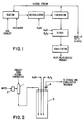
- Figure 1 is a diagrammatic flow chart of the overall process of preparation of a light color, stable, alkylpolyglycoside product showing the reaction of the alcohol and saccharide in the presence of an acid catalyst, followed by neutralization, removal of alcohol by evaporation, the bleaching process of the present invention and subsequent stabilization.
- Figure 2 of the drawing is a more detailed flow chart of the continuous bleaching step of the present invention to provide a light colored alkylpolyglycoside surfactant.
- the present invention relates to a method of reducing the color of an alkylpolyglycoside comprising the steps of
- alkylpolyglycosides can be continuously bleached in a well-mixed, pressurized, vessel by metering in a crude alkylpolyglycoside feed (preferably substantially alcohol-free), preferably hydrogen peroxide (as the peroxy bleaching agent), and caustic and in the presence of 250 ppm to 1000 ppm Mg (in the MgO form) per 0.453 kg (one pound dry solids crude, into a bleaching matrix.
- the caustic addition is adjusted to maintain the reaction pH above 9, preferably above 10, by metering in from 1.0 to 1.2 moles of caustic per mole of peroxide and 0.25 to 2% wt./wt.
- the pressure of the reaction mixture builds due to liquid hydraulics, including the water vapor pressure and oxygen generated from degradation of hydrogen peroxide and is controlled at an elevated, economical level. Based on the vessel pressure control, the bleached product is vented off as a foamy liquid and subjected to further downstream processing, such as stabilization.
- the continuous process of this invention avoids the disadvantages of previous approaches involving batch processing.
- the present process allows for bleaching at temperatures which minimize discoloration and handling problems below 120°C, preferably below 100°C and most preferably in the range of 90 to 100°C, the nominal temperature limit of atmospheric pressure bleaching due to foam expansion and boiling. While the choice of operating temperature is primarily an economical consideration, it must balance investment capital (smaller reactor, smaller agitator, higher pressure reactor system and more reactor heating/cooling equipment with higher temperature) versus operating costs (higher hydrogen peroxide consumption, more product degradation, higher heating and cooling duties and less agitation power with higher temperature). In a production mode, where the product rate and equipment volume is fixed, the final product color is controlled by adjustment of the combination of the reactor temperature, reactor pressure and hydrogen peroxide dosage, which will be discussed in more detail hereinafter.
- a continuous tank reactor with the bleaching matrix which includes the crude feed, peroxide, caustic and the Mg, provide a significant improvement in bleaching efficiency, improving the overall bleaching efficiency beyond that possible in a batch reaction.
- Another advantage of this continuous process is that it provides a repeatable and less operationally intensive processing technique.
- the use of a pressure vessel provides the ability for bleaching to be conducted at temperatures greater than 100°C, thereby decreasing processing time by accelerating bleach reaction kinetics.
- the use of a pressure vessel lowers the volume of foam generated during this bleaching process, thereby reducing the required size of the vessel and the apparent viscosity of the foam. Reduction of the foam viscosity improves vessel agitation efficiency and heat transfer of the foamy liquid.
- an object of the invention to provide an improved process for preparing light colored alkylpolyglycosides of a saccharide reacted with an alcohol in the presence of an acid catalyst at elevated temperatures, after which the acid catalyst is neutralized and the excess alcohol removed, and the substantially alcohol-free alkylpolyglycoside product is bleached and stabilized, in which the improvement comprises a controlled, continuous, bleaching step wherein said alkylpolyglycoside is bleached at an alkaline pH and elevated temperature with a peroxy bleaching agent preferably in the presence of magnesium in the form of the oxide, MgO.
- the initial reaction product of the alcohol and saccharide in the presence of an acid catalyst results in a glycoside product.
- the product is a mixture of a monoglycoside of the alcohol and various higher degrees of polymerization (DP) polyglycosides in progressively decreasing mole percentage amounts, i.e., the diglycoside (DP2), the triglycoside (DP3) and the higher polyglycosides (DP4 and higher).
- DP2 diglycoside
- DP3 triglycoside
- DP4 and higher higher polyglycosides
- the overall distribution curve is the same, though the average DP of the reaction mixture may vary due to the differing distribution of the various fractions, i.e., DP1, DP2, DP3 and higher fractions.
- the Flory distribution of the reaction product after removal of the excess alcohol will have an average degree of polymerization above 1.2, i.e., 1.4, with a monoglycoside content in the range of 50-70% by weight of the glycoside product.
- Commercially available products typically have an average Flory DP of 1.3-1.7.
- glycoside products of the reaction of an alcohol and saccharide may be represented by the formula I: ROG x wherein R is a residue of an alcohol, O is oxygen, G is a glycoside residue, and x is the average degree of polymerization (DP) resulting from weighting of the various mono-, di-, tri- and higher glycoside fractions present in the product and is a number of from one to three.
- R is a residue of an alcohol
- O oxygen
- G is a glycoside residue
- x is the average degree of polymerization (DP) resulting from weighting of the various mono-, di-, tri- and higher glycoside fractions present in the product and is a number of from one to three.
- the average degree of polymerization is thus defined as the ratio of saccharide rings to the R groups in the alkyl glycoside.
- the monoglycoside fraction would have one saccharide ring, the diglycoside would have 2, the triglycoside would have 3 with the higher glycoside having corresponding more rings, the average of which in the currently available commercial product therefore being typically greater than 1, generally in the order of 1.2 to 1.7, with preferred mixtures at 1.3 to 1.7.
- the alkyl polyglycoside products represented by the formula above contain a lipophilic group, the R group, and a hydrophilic group, the OG x group.
- the product should have a hydrophilic-lipophilic balance (HLB) of from 10 to 16, and preferably 11 to 14.
- HLB hydrophilic-lipophilic balance
- the lipophilic R groups in the alkyl polyglycosides are derived from alcohols, preferably monohydric, for the detergent, surfactant-use applications and should contain from 8 to 20, preferably 9 to 18 carbon atoms, with an average of 10 to 13 being most preferred, to provide R groups of sufficient length for detergent, surfactant-use applications. While the preferred R groups are saturated aliphatic or alkyl, there may be present some unsaturated aliphatic hydrocarbon groups.
- the preferred groups are derived from the fatty alcohols derived from the naturally-occurring fats and oils, such as octyl, decyl, dodecyl, tetradecyl, hexadecyl, octadecyl, oleyl and linoleyl, but R groups may be derived from synthetically produced Ziegler alcohols or oxo alcohols containing 9, 10, 11, 12, 13, 14 or 15 carbon atoms.
- the alcohols of naturally-occurring fatty acids typically contain an even number of carbon atoms and mixtures of alcohols are commercially available such as mixtures of C 8 and C 10 , C 12 and C 14 , and the like.
- Synthetically-produced alcohols for example those produced by an oxo process contain both an odd and even number of carbon atoms such as the C 9 , C 10 , C 11 mixtures, which are also available commercially.
- Glycoside products suitable for treatment in accordance with the present invention also include derivatives of products of the formula I above including, for example, those in which one or more of the normally free (i.e., unreacted) hydroxyl groups of the saccharide moiety, G, have been alkoxylated, preferably, ethoxylated or propoxylated, so as to attach one or more pendant alkoxy or polyalkoxy groups in place thereof.
- the formula (I) above in order to encompass both alkoxylated and non-ethoxylated products, may be modified to the formula II: RO (R 1 O) y G x where R, O, G and x are as defined earlier, R 1 is a divalent hydrocarbon radical of the alkoxylating agent, typically containing from 2 to 4 carbon atoms and y is a number having an average value of from 0 to 12, more preferably 0 to 5. When y is 0, the formula reduces to formula I above and the product is non-alkoxylated.
- Saccharide reactants which can be employed to prepare the aforementioned glycoside surfactants include reducing monosaccharide materials containing 5 or 6 carbon atoms such as, for example, glucose, galactose, mannose, xylose, arabinose, fructose, etc. as well as materials which are hydrolyzable to form monosaccharides such as lower alkyl glycosides (e.g. methyl glycoside, ethyl glycoside, propyl glycoside, butyl glycoside, etc.), oligosaccharides (e.g.
- saccharide reactants may be employed in dry (e.g. anhydrous) form or, if desired, may be employed in the form of hydrated solids or aqueous solutions thereof. If utilized in the form of a solution, it is preferred that the resulting reaction mixture contain only small amounts of water, i.e., less than 1% by weight, preferably less than 0.5% i.e. less than 0.25 or 0.1%.
- the molar ratio of alcohol to monosaccharide in the reaction mixture can vary widely but is typically between 1.5:1 to 10:1, and preferably between 2.0:1 to 6.0:1.
- the particular molar ratio chosen depends upon the desired average degree of polymerization (DP) of the monosaccharide reacted with the alcohol.
- DP desired average degree of polymerization
- the ratio of alcohol to monosaccharide will be chosen to allow the production of an alkyl glycoside product having a DP between 1.2 to 1.7, and more preferably 1.3 and 1.6.
- the reaction, as shown in Fig. 1, between the hydrophobic alcohol reactant and the saccharide reactant to form the glycoside surfactant is typically conducted at an elevated temperature and in the presence of an acid catalyst.
- said reaction is preferably conducted at a temperature of from 80° to 140°C, preferably 90° to 120°C, and at pressures [1.33 kPa to 13.3 kPa (10 to 100 mm Hg absolute)], which facilitate water removal, while at the same time maintaining the desired reaction temperatures.
- Acid catalysts suitable for use include strong mineral acids such as hydrochloric acid, sulfuric acid, nitric acid, phosphoric acid, hypophosphorous acid, etc.; strong organic acids such as para toluenesulfonic acid, methanesulfonic acid, triflouromethanesulfonic acid, mono- or polyalkylated aryl mono- or polysulfonic acids such as dodecylbenzenesulfonic acid, etc.; and macroreticular acidic ion exchange resins such as macroreticular sulfonic acid ion exchange resins, perfluorinatedsulfonic acid resins, etc.
- said acid catalyst will be employed in an amount ranging from 0.0005 to 0.03 (preferably from 0.002 to 0.015) moles thereof per mole of saccharide used.
- the above-described reaction process will be conducted over a reaction period of from 1 to 20 (preferably from 2 to 10) hours.
- the acid catalyst is typically neutralized as indicated in Fig. 1 by an alkaline substance, preferably an alkali metal hydroxide such as sodium hydroxide, used in an amount about equal, on a stoichiometric basis, to the amount of material needed to neutralize the catalyst.
- an alkaline substance preferably an alkali metal hydroxide such as sodium hydroxide, used in an amount about equal, on a stoichiometric basis, to the amount of material needed to neutralize the catalyst.
- the mixture is neutralized and adjusted to a pH in the range of 9 to 10 with an alkali metal hydroxide and alkaline earth metal oxide, such as magnesium oxide, prior to removal of the alcohol.
- Alcohol removal is generally accomplished by evaporation, e.g. distillation, of the alcohol as indicated in Fig. 1.
- evaporation e.g. distillation
- the use of a wiped film or thin film evaporator is particularly convenient for this purpose, preferably operated at 150°-220°C and 13.3 kPa to 6.67 kPa (0.1 to 50 mm Hg) pressure. More generally pressures of 0.13 to 13.3 kPa (1 to 100 mm Hg) and temperatures of 140° to 230°C may be employed.
- Other methods of removal of the alcohol may be employed including distillation techniques and supercritical extraction under conditions for removing alcohol to levels below 5%, more desirably below 2% by weight to 0.5%.
- the resulting commercial product is typically a mixture of alkyl glycosides, in which for purposes of this invention the average alkyl group will contain from 8 to 20, preferably 9 to 18, most preferably an average of 10 to 13, carbon atoms, having the typical Flory distribution discussed earlier above.
- the substantially alcohol-free product is then bleached to a light color by the continuous bleaching process of the present invention.
- the present invention is also applicable to glycoside products which have been molecularly distilled to further remove a portion of the monoglycoside present, particularly those in which sufficient monoglycoside is removed to provide a mixture of alkylpolyglycosides having varying degrees of polymerization of 2 and higher in progressively decreasing amounts, in which the amount by weight of polyglycoside having a degree of polymerization of 2, or mixtures thereof with the polyglycoside having a degree of polymerization of 3, predominate in relation to the amount of monoglycoside, said composition having an average degree of polymerization of 1.8 to 3.
- compositions can be prepared by separation of the monoglycoside from the original reaction mixture of alkyl monoglycoside and alkyl polyglycosides after removal of the alcohol. This separation may be carried out by molecular distillation which normally results in the removal of 70-95% by weight of the alkyl monoglycosides. After removal of the alkyl monoglycosides, the relative distribution of the various components, mono- and poly-glycosides, in the resulting product changes and the concentration in the product of the polyglycosides relative to the monoglycoside increases as well as the concentration of individual polyglycosides to the total, i.e. DP2 and DP3 fractions in relation to the sum of all DP fractions.
- compositions are disclosed in commonly assigned copending application Serial Number 07/810,588, filed on 12/19/91 US-A-5,266,690.
- Molecular distillation as described therein is a short path, high vacuum distillation. On a laboratory scale, pressures of 10 Pa (0.1 mbar) and lower may be employed. On a commercial scale, pressures will desirably be in the range of 10 Pa (0.01 mbar) and lower, preferably 0.1 Pa (0.001 mbar) or lower.
- a very short distance is employed between the vaporization and condensing surfaces, which is as close as possible. In practice the actual gap is bounded by 0.1 to 10 times the mean free path of distilling molecules which is defined by kinetic theory.
- the residence time is as short as possible to minimize thermal degradation of the alkyl polyglycosides, less than 2 minutes and preferably less than 15 seconds.
- the molecularly distilled products will have an average DP of at least 1.8 and at least 0.2 units higher than the average DP of the initial feed to the molecular still. If the amount of monoglycoside separated from the original reaction mixtures is in a sufficient amount to provide that the monoglycoside retained in the resulting product is less than the total of DP2 and DP3 fractions, or more preferably, less than that of the DP2 fraction, it can be readily seen that a "peaked" distribution results i.e. that the DP2 and DP3 distribution now illustrates a reduced or non-monoglycoside "peaked" distribution in the resulting products, which retain the DP4 and higher fractions in the resulting products prepared by molecular distillation.
- the present continuous bleaching process is accordingly applicable to alkylpolyglycosides from which only the excess alcohol has been removed or those which have been treated so as to remove at least a portion, including removal of a significant portion of monoglycoside.
- the continuous process of bleaching is also applicable to compositions comprised of a mixture of two or more of at least binary components of alkylpolyglycosides wherein each binary component is present in the mixture in relation to its average carbon chain length in an amount effective to provide the surfactant composition with the average carbon chain length of 9 to 14 and wherein at least one, or both binary components, comprise a Flory distribution of polyglycosides derived from an acid-catalyzed reaction of an alcohol containing 6-20 carbon atoms and a suitable saccharide from which excess alcohol has been separated.
- Such compositions are disclosed in commonly assigned copending application Serial Number 07/774,430, filed on October 10, 1991 (WO-A-93/07429).
- alkylpolyglycosides are prepared from binary or ternary mixtures of alcohols providing the corresponding mixtures (binary or ternary) of alkylpolyglycosides.
- the application accordingly describes the preparation of alkylpolyglycoside compositions having a preselected or predetermined average alkyl chain length and surfactant properties prepared from commercially available at least binary mixtures.
- the composition having the desired detergent or surfactant properties is prepared by mixing two or more of at least binary components, each binary component having an average alkyl chain length such that when mixed the amounts of the binary components are effective to provide the predetermined selected average alkyl moiety and surfactant properties.
- the composition may contain a mixture of C 8 -C 10 , C 10 -C 12 , C 12 -C 13 , C 12 -C 16 , C 12 -C 14 , C 14 -C 15 , C 16 -C 18 , as well as one containing C 9 -C 10 -C 11 and C 12 -C 14 -C 16 alkylpolyglycosides and the like.
- the bleaching process of the present invention while preferably useful as a step in the overall preparation of alkylpolyglycosides including the initial reaction, neutralization, alcohol removal, decolorization and stabilization (as shown in Fig. 1), is also applicable to alkylpolyglycosides of (a) a single alkyl group, (b) commercially available mixtures of alkylpolyglycosides having two or more different alkyl groups and (c) to molecularly distilled products in which the products have a peak of the DP2, or DP2 and DP3 components therein.
- the alkylpolyglycoside has a residual bleaching agent level of below 500 ppm.
- the alkylpolyglycoside is one obtained from the reaction at elevated temperatures of an alcohol and saccharide in the presence of an acid catalyst as discussed earlier above, after neutralization of the acid catalyst and removal of substantially all excess alcohol.
- the alkylpolyglycoside is diluted with water to form an aqueous solution containing 30 to 85% by weight dry solids (ds) alkyl polyglycoside, preferably 50 to 75% and most preferably 53 to 73%.
- the alkylpolyglycoside product from the evaporation of the alcohol contains less than 5% alcohol, preferably less than 2% and most preferably less than 1% to 0.5%, thereby containing from 95 to 99.5% alkylpolyglycoside.
- the alkylpolyglycoside product now substantially alcohol-free, is removed from the evaporation zone at a temperature of 198.9°C (390°F), plus or minus 16.7°C (30°F)., about the temperature employed in the evaporation step.
- the water employed to provide the aqueous solution of alkylpolyglycoside for the bleaching process of the present invention may be pre-heated to a temperature of 21.1 to 65.5°C (70 to 150°F) in a preheater 2 in Figure 1.
- the acid is neutralized as discussed earlier above, preferably with an alkali metal hydroxide, such as sodium hydroxide.
- an alkali metal hydroxide such as sodium hydroxide.
- the neutralization is carried out with a mixture of sodium hydroxide and an alkaline earth metal oxide, such as magnesium oxide, to a pH level of 9 to 11 or 12.
- the magnesium oxide is employed in an amount effective to provide 250 to 1000 ppm, or less, of magnesium in the product after evaporation and removal of the alcohol.
- the aqueous solution of the substantially alcohol-free alkylpolyglycoside and the preheated water will accordingly, preferably contain less than 1000 ppm magnesium and more preferably 500 to 700 ppm for solution containing 50% to 70% d.s. alkylpolyglycosides.
- the temperature of the aqueous solution is controlled and maintained at a temperature about the temperature at which the bleaching step will be conducted, and the aqueous solution is then introduced into a vessel or bleaching reactor 3 which is maintained at the bleaching temperature of 85 to 105°C, preferably 88 to 93°C (190 to 200°F.), most preferably at 88°C (190°F.).
- the aqueous solution is introduced into the bleaching reactor 3.
- the reactor will be filled to a level above the agitator (not shown) in vessel 3 before the caustic and bleaching agent (preferably NaOH and H 2 O 2 ) are introduced into the reactor vessel.
- the pH of the aqueous solution is adjusted to a level of 10 to 11.5, preferably 10.2 to 10.8, most preferably 10.3 to 10.7, and maintained at this level during the bleaching process by the use of alkali metal hydroxide, preferably NaOH as shown in Figure 2.
- the preferred bleaching agent is hydrogen peroxide, H 2 O 2 , shown in Figure 2.
- the amounts of NaOH and H 2 O 2 are controlled and metered into the vessel 3 in amounts effective to maintain the pH level at the desired level and to effect the reduction in color to the desired level.
- the hydrogen peroxide preferably in a 35% aqueous solution, will be employed in a weight per weight (wt/wt) dry solids alkylpolyglycoside of 0.25 to 2% wt/wt, more desirably 0.6 to 1.25% and most preferably at 1%.
- the sodium hydroxide will be employed in an amount of 0.9 to 1.2 moles NaOH per mol H 2 O 2 , preferably at 1.1 moles NaOH per mole H 2 O 2 .
- Adjustment of the magnesium level can preferably be made by adding a source of magnesium, such as MgO or MgSO 4 to the aqueous solution prior to introduction to the reactor vessel 3, during preparation of the aqueous solution.
- a source of magnesium such as MgO or MgSO 4
- the magnesium oxide can be introduced directly into the bleaching zone reactor vessel 3.
- the lower levels of MgO result in more decomposition of peroxide during the reaction and accordingly to achieve the same color conversion will require a higher peroxide dosage and/or higher pH resulting in increased cost of the operation. Operation at 250 ppm to 1000 ppm results in an optimum balance.
- the hydrogen peroxide and sodium hydroxide are typically injected simultaneously and the process proceeds with evolution of oxygen from the hydrogen peroxide addition, which causes the reaction pressure to rise. Foaming occurs in the reactor, but foaming is minimized by not automatically venting the reactor to maintain atmospheric pressure. As shown in Figure 2, a valve 4 which contains a pressure relief valve permits the pressure in the reactor to rise and be maintained at 377 kPa (40 psig), more preferably 239 kPa (20 psig). This minimizes foam and permits efficient bleaching.
- the efficiency of the hydrogen peroxide bleaching is influenced by the concentration of residual peroxide, pH and reaction temperature. At the pH level and temperatures discussed above, residual peroxide levels are maintained at 200 ppm to 1500 ppm, preferably below 1000 ppm and most preferably at 200 to 400 for greatest efficiency.
- residence time is largely fixed by the product rate from the evaporator where the alcohol is removed.
- Residence times on the order of 5 to 15 hours are generally used with 5 to 7.0 being preferred at temperatures of 93 to 98.9°C (200 to 210°F), most preferably 6.0 to 6.5 at the temperatures of 96.1°C (205°F) and 10 to 12 at temperatures of 87.8 to 93.3°C (190 to 200°F), with about 12 at 87.8°C (190°F), pH and peroxide levels preferred as discussed above and with feed rates of substantially alcohol-free alkylpolyglycoside melt from the evaporation above.
- the temperature is controlled and maintained at the preferred level and the feed of caustic and peroxide controlled and maintained to provide the preferred pH and peroxide levels, at target steady state values of 10.7 to 11.0 pH and 200 to 400 ppm respectively. These conditions will provide product of the desired reduced color, which can be monitored throughout the process by sampling and determining the color.
- the aqueous solution fed to the bleaching vessel will be dark having an extinction coefficient at 470 nm in the range of 10 to 15, typically at 12.5 to 13.
- the target steady state value for extinction coefficient of the product at pH of 7 is from 0.025 to 0.15, and provides a Klett color of 50 or less preferably in the range of 5 to 30.
- the product exiting the continuous stirred bleach reactor 3 is cooled to 150°F (65°C) in preparation for completion of the finishing process which includes a stabilization treatment, to stabilize the color against any reversion to a darker color.
- a stabilization treatment typically involves catalytic hydrogenation or treatment with a stabilizing compound, such as alkali metal borohydrides to further reduce color and stabilize the color against deterioration over long periods of storage.
- the pH and concentration of the alkylpolyglycoside surfactant is adjusted and placed in storage for sale.
- a peroxide bleached alkylpolyglycoside solution of 50 to 55% actives concentration, and a pH of 10 and residual peroxide concentration below 50 ppm, and preferably below 25 ppm is adjusted to a pH of about 7 with sulfuric acid to eliminate any haze, after which the product is adjusted to a pH of about 10 and treated with a sodium borohydride solution until the borohydride concentration is substantially zero.
- the extinction coefficient method is a measure of color by absorption. This method uses absorbance at 470 nm, the fraction of dry solids, and 'as is' sample weight, diluted sample weight, and densities to arrive at the extinction coefficient.
- the determination is made employing a Spectronic 20, Bausch & Lomb, Spectrophotometer (Catalog No. 33-31-72 or equivalent) and Dispo Culture Tubes for measurement, 13 x 100 mm. (VWR Products, Catalog No. 60825-571 or equivalent).
- the dry solids weight fraction of the as is sample is determined.
- a sample is diluted with a 3/1(v/v) isopropanol/water blend to obtain a clear solution which will give a transmittance between 15% and 85% on the Spectronic 20.
- the weight of the 'as is' sample and of the diluted sample is noted and the density (g/ml) of the final dilution sample is determined.
- the absorbance of the clear diluted sample at 470 nm is measured in the Spectronic 20.
- the procedure is an empirical measurement of color (broad band absorbance) using a Klett-Summerson Photoelectric Colorimeter, Glass Cell Model 900-3, using a 400-450 nm blue filter No. RS-42 and a Klett cuvette test cell (rectangular, 8 x 4 x 2 cm glass cuvetti, Klett part No. 901, optical path length, 4 cm).
- the absorbance is measured at 5% actives and pH of 7 and the scale reading reported as "Klett color (4 cm)."
- This example is an illustration of a continuous steady-state process of bleaching of a substantially alcohol-free alkylpolyglycoside melt subsequent to removal of the alcohol by an evaporation process.
- Softened Water 1313.7 kg/hr (2900#/hr)] was injected a stream of C 12 -C 16 alkylpolyglucoside melt [1472.2 kg/hr (3250#/hr)].
- a highly efficient bleaching process is developed which results in an unexpected reduction in color from a dark brown (extinction coefficient of 10 to 15 at 470 nm on a 50-55% active aqueous solution) to a very light or white, slightly hazy, solution of an extinction coefficient color on the order of 0.025 to 0.15.
- the color as determined by the Klett method is below 50 and in the range of 5 to 30.
Landscapes
- Chemical & Material Sciences (AREA)
- Organic Chemistry (AREA)
- Genetics & Genomics (AREA)
- Molecular Biology (AREA)
- Engineering & Computer Science (AREA)
- Biochemistry (AREA)
- Biotechnology (AREA)
- General Health & Medical Sciences (AREA)
- Health & Medical Sciences (AREA)
- Life Sciences & Earth Sciences (AREA)
- Crystallography & Structural Chemistry (AREA)
- Saccharide Compounds (AREA)
- Detergent Compositions (AREA)
- Emulsifying, Dispersing, Foam-Producing Or Wetting Agents (AREA)
- Cosmetics (AREA)
- Organic Low-Molecular-Weight Compounds And Preparation Thereof (AREA)
Applications Claiming Priority (3)
| Application Number | Priority Date | Filing Date | Title |
|---|---|---|---|
| US07/914,363 US5362861A (en) | 1992-07-15 | 1992-07-15 | Continuous bleaching of alkylpolyglycosides |
| US914363 | 1992-07-15 | ||
| PCT/US1993/006523 WO1994002494A1 (en) | 1992-07-15 | 1993-07-14 | Continuous bleaching of alkylpolyglycosides |
Publications (3)
| Publication Number | Publication Date |
|---|---|
| EP0650491A1 EP0650491A1 (en) | 1995-05-03 |
| EP0650491A4 EP0650491A4 (en) | 1995-06-07 |
| EP0650491B1 true EP0650491B1 (en) | 1999-05-26 |
Family
ID=25434254
Family Applications (1)
| Application Number | Title | Priority Date | Filing Date |
|---|---|---|---|
| EP93917103A Expired - Lifetime EP0650491B1 (en) | 1992-07-15 | 1993-07-14 | Continuous bleaching of alkylpolyglycosides |
Country Status (15)
| Country | Link |
|---|---|
| US (2) | US5362861A (cs) |
| EP (1) | EP0650491B1 (cs) |
| JP (1) | JPH07508995A (cs) |
| KR (1) | KR100242176B1 (cs) |
| AT (1) | ATE180487T1 (cs) |
| AU (1) | AU676487B2 (cs) |
| BR (1) | BR9306727A (cs) |
| CA (1) | CA2140017A1 (cs) |
| CZ (1) | CZ5895A3 (cs) |
| DE (1) | DE69325102T2 (cs) |
| ES (1) | ES2134853T3 (cs) |
| MX (1) | MX9304288A (cs) |
| PL (1) | PL307163A1 (cs) |
| RU (1) | RU95104944A (cs) |
| WO (1) | WO1994002494A1 (cs) |
Cited By (2)
| Publication number | Priority date | Publication date | Assignee | Title |
|---|---|---|---|---|
| KR100382241B1 (ko) * | 1998-06-03 | 2003-08-21 | 주식회사 엘지생활건강 | 색도및투명도가우수한알킬글리코시드를안정적으로제조하는방법 |
| WO2026017514A1 (en) | 2024-07-17 | 2026-01-22 | Basf Se | Process for de-hazing of polyglycosides |
Families Citing this family (16)
| Publication number | Priority date | Publication date | Assignee | Title |
|---|---|---|---|---|
| US5362861A (en) * | 1992-07-15 | 1994-11-08 | Henkel Corporation | Continuous bleaching of alkylpolyglycosides |
| US5432275A (en) * | 1994-02-25 | 1995-07-11 | Henkel Corporation | Continuous bleaching of alkylpolyglycosides |
| DE4423641C1 (de) * | 1994-07-06 | 1995-09-07 | Henkel Kgaa | Verfahren zur Herstellung hellfarbiger Tenside |
| DE4431852A1 (de) * | 1994-09-07 | 1996-03-14 | Huels Chemische Werke Ag | Verfahren zur Bleichung von Alkylpolyglycosiden |
| DE4432623A1 (de) * | 1994-09-14 | 1996-03-21 | Huels Chemische Werke Ag | Verfahren zur Bleichung von wäßrigen Tensidlösungen |
| DE4436761A1 (de) * | 1994-10-14 | 1996-04-18 | Henkel Kgaa | Verfahren zur Herstellung hellfarbiger Alkyl- und/oder Alkenyloligoglykoside |
| US6077945A (en) * | 1997-02-18 | 2000-06-20 | Eastman Chemical Company | Process for making alkylpolyglycosides |
| US5935137A (en) * | 1997-07-18 | 1999-08-10 | Gynecare, Inc. | Tubular fallopian sterilization device |
| CN1213054C (zh) * | 1997-11-22 | 2005-08-03 | Lg化学株式会社 | 制备浅色且透明的烷基糖苷的方法 |
| US6204369B1 (en) | 1999-06-08 | 2001-03-20 | Henkel Corporation | Process for the preparation of alykl polyglycosides |
| DE10046250A1 (de) * | 2000-09-19 | 2002-03-28 | Cognis Deutschland Gmbh | Verfahren zur Herstellung von hellfarbigen Alkyl-und/oder Alkenyloligoglycosid-Mischungen und deren Verwendung in Wasch-, Spül-und Reinigungsmittel |
| DE102004025195A1 (de) * | 2004-05-22 | 2005-12-08 | Goldschmidt Gmbh | Verfahren zur Herstellung von Alkylglycosiden |
| CN103102374A (zh) * | 2013-02-01 | 2013-05-15 | 上海发凯化工有限公司 | 合成烷基糖苷的新工艺 |
| CN103483397B (zh) * | 2013-09-24 | 2016-05-04 | 上海发凯化工有限公司 | 椰子油单乙醇酰胺糖苷及其制备方法 |
| CN103483398B (zh) * | 2013-09-24 | 2016-05-04 | 上海发凯化工有限公司 | 单硬脂酸甘油酯糖苷及其合成方法 |
| KR102719802B1 (ko) | 2024-06-18 | 2024-10-21 | 박상우 | 상하 이동이 가능한 식물재배부 및 거터거치대의 상하 간격 조절장치 |
Family Cites Families (36)
| Publication number | Priority date | Publication date | Assignee | Title |
|---|---|---|---|---|
| US2356565A (en) * | 1938-07-15 | 1944-08-22 | Chwala August | Glucosidic compounds and process of making them |
| US2235783A (en) * | 1939-09-13 | 1941-03-18 | Dow Chemical Co | Ethers of glucosides |
| US2390507A (en) * | 1941-01-21 | 1945-12-11 | Corn Prod Refining Co | Production of alkyl glycosides |
| US2422328A (en) * | 1942-07-16 | 1947-06-17 | Ind Patents Corp | Glucosides as plasticizers for water-soluble animal and vegetable adhesives |
| US3219656A (en) * | 1963-08-12 | 1965-11-23 | Rohm & Haas | Alkylpolyalkoxyalkyl glucosides and process of preparation therefor |
| US3375243A (en) * | 1965-10-22 | 1968-03-26 | Staley Mfg Co A E | Method of producing alkyl glucoside compositions |
| US3450690A (en) * | 1966-12-23 | 1969-06-17 | Corn Products Co | Preparation of alkali-stable alkyl glucosides |
| US3598865A (en) * | 1968-02-07 | 1971-08-10 | Atlas Chem Ind | Polyglycosides and process of preparing mono and polyglycosides |
| US3547828A (en) * | 1968-09-03 | 1970-12-15 | Rohm & Haas | Alkyl oligosaccharides and their mixtures with alkyl glucosides and alkanols |
| US3640998A (en) * | 1969-06-18 | 1972-02-08 | Richard C Mansfield | Alkylene oxide adducts of alkyloligosaccharides and their mixtures with alkylene oxide adducts of bord alkyl glucosides and alkanols |
| US3772269A (en) * | 1969-07-24 | 1973-11-13 | Ici America Inc | Glycoside compositions and process for the preparation thereof |
| US3707535A (en) * | 1969-07-24 | 1972-12-26 | Atlas Chem Ind | Process for preparing mono- and polyglycosides |
| US3721633A (en) * | 1969-10-06 | 1973-03-20 | Atlas Chem Ind | Aqueous built liquid detergents containing alkyl glycosides |
| US3737426A (en) * | 1970-09-25 | 1973-06-05 | Us Agriculture | Biodegradeable surfactants from starch-derived glycosides |
| US3839318A (en) * | 1970-09-27 | 1974-10-01 | Rohm & Haas | Process for preparation of alkyl glucosides and alkyl oligosaccharides |
| US3974138A (en) * | 1972-12-15 | 1976-08-10 | Ici United States Inc. | Method of preparing butyl polyglycosides |
| US4011389A (en) * | 1975-03-21 | 1977-03-08 | Basf Wyandotte Corporation | Glycoside polyethers |
| US4223129A (en) * | 1978-09-01 | 1980-09-16 | A. E. Staley Manufacturing Company | Continuous process for making alkyl aldosides from starch or other carbohydrates |
| DE3001064A1 (de) * | 1980-01-12 | 1981-07-16 | Basf Ag, 6700 Ludwigshafen | Verfahren zur reinigung von alkylglycosiden durch destillative abtennung nicht umgesetzter alkohole |
| US4510306A (en) * | 1981-12-04 | 1985-04-09 | Basf Wyandotte Corporation | Method for purifying reaction products containing higher-alkyl glycosides |
| CA1195323A (en) * | 1982-04-12 | 1985-10-15 | Leonard F. Vander Burgh | Glycosidic surfactants |
| US4393203B2 (en) * | 1982-04-26 | 1997-07-01 | Procter & Gamble | Process of preparing alkylpolysaccharides |
| EP0096917A1 (en) * | 1982-06-14 | 1983-12-28 | THE PROCTER & GAMBLE COMPANY | Process for preparation of alkyl glycosides |
| DE3232791A1 (de) * | 1982-09-03 | 1984-03-08 | Basf Ag, 6700 Ludwigshafen | Verfahren zur herstellung von alkylglucosiden |
| US4472170A (en) * | 1982-12-27 | 1984-09-18 | The Procter & Gamble Company | Coal-water slurry compositions |
| DE3468217D1 (en) * | 1983-06-15 | 1988-02-04 | Procter & Gamble | Improved process for preparing alkyl glycosides |
| US4713447A (en) * | 1983-06-30 | 1987-12-15 | The Procter & Gamble Company | Process for preparing alkyl glycosides |
| US4557729A (en) * | 1984-05-24 | 1985-12-10 | A. E. Staley Manufacturing Company | Color stabilization of glycosides |
| US4762918A (en) * | 1984-11-21 | 1988-08-09 | Staley Continental, Inc. | Decolorization of glycosides |
| US4597770A (en) * | 1984-12-24 | 1986-07-01 | The Procter & Gamble Company | Coal-water slurry compositions |
| US4950743A (en) * | 1987-07-29 | 1990-08-21 | Henkel Kommanditgesellschaft Auf Aktien | Process for preparation of alkylglycosides |
| DE3729842A1 (de) * | 1987-09-05 | 1989-03-23 | Huels Chemische Werke Ag | Verfahren zur herstellung von alkyloligoglycosiden |
| DE3833780A1 (de) * | 1988-10-05 | 1990-04-12 | Henkel Kgaa | Verfahren zur direkten herstellung von alkylglykosiden |
| US5003057A (en) * | 1988-12-23 | 1991-03-26 | Henkel Kommanditgesellschaft Auf Aktien | Process for production of glycosides |
| US4987225A (en) * | 1988-12-23 | 1991-01-22 | Henkel Kommanditgesellschaft Auf Aktien | Removal of water miscible materials from glycoside mixtures |
| US5362861A (en) * | 1992-07-15 | 1994-11-08 | Henkel Corporation | Continuous bleaching of alkylpolyglycosides |
-
1992
- 1992-07-15 US US07/914,363 patent/US5362861A/en not_active Expired - Fee Related
-
1993
- 1993-07-14 AU AU46734/93A patent/AU676487B2/en not_active Ceased
- 1993-07-14 KR KR1019950700134A patent/KR100242176B1/ko not_active Expired - Fee Related
- 1993-07-14 PL PL93307163A patent/PL307163A1/xx unknown
- 1993-07-14 CZ CZ9558A patent/CZ5895A3/cs unknown
- 1993-07-14 AT AT93917103T patent/ATE180487T1/de not_active IP Right Cessation
- 1993-07-14 EP EP93917103A patent/EP0650491B1/en not_active Expired - Lifetime
- 1993-07-14 WO PCT/US1993/006523 patent/WO1994002494A1/en not_active Ceased
- 1993-07-14 CA CA002140017A patent/CA2140017A1/en not_active Abandoned
- 1993-07-14 BR BR9306727A patent/BR9306727A/pt not_active Application Discontinuation
- 1993-07-14 ES ES93917103T patent/ES2134853T3/es not_active Expired - Lifetime
- 1993-07-14 JP JP6504002A patent/JPH07508995A/ja active Pending
- 1993-07-14 RU RU95104944/04A patent/RU95104944A/ru unknown
- 1993-07-14 DE DE69325102T patent/DE69325102T2/de not_active Expired - Fee Related
- 1993-07-15 MX MX9304288A patent/MX9304288A/es not_active IP Right Cessation
-
1994
- 1994-08-23 US US08/294,689 patent/US5554740A/en not_active Expired - Fee Related
Cited By (2)
| Publication number | Priority date | Publication date | Assignee | Title |
|---|---|---|---|---|
| KR100382241B1 (ko) * | 1998-06-03 | 2003-08-21 | 주식회사 엘지생활건강 | 색도및투명도가우수한알킬글리코시드를안정적으로제조하는방법 |
| WO2026017514A1 (en) | 2024-07-17 | 2026-01-22 | Basf Se | Process for de-hazing of polyglycosides |
Also Published As
| Publication number | Publication date |
|---|---|
| PL307163A1 (en) | 1995-05-02 |
| EP0650491A1 (en) | 1995-05-03 |
| WO1994002494A1 (en) | 1994-02-03 |
| ATE180487T1 (de) | 1999-06-15 |
| RU95104944A (ru) | 1997-03-20 |
| AU4673493A (en) | 1994-02-14 |
| KR950702569A (ko) | 1995-07-29 |
| US5362861A (en) | 1994-11-08 |
| DE69325102T2 (de) | 2000-01-05 |
| MX9304288A (es) | 1994-05-31 |
| BR9306727A (pt) | 1998-12-08 |
| DE69325102D1 (de) | 1999-07-01 |
| ES2134853T3 (es) | 1999-10-16 |
| KR100242176B1 (ko) | 2000-02-01 |
| AU676487B2 (en) | 1997-03-13 |
| CZ5895A3 (en) | 1995-09-13 |
| JPH07508995A (ja) | 1995-10-05 |
| US5554740A (en) | 1996-09-10 |
| CA2140017A1 (en) | 1994-02-03 |
| EP0650491A4 (en) | 1995-06-07 |
Similar Documents
| Publication | Publication Date | Title |
|---|---|---|
| EP0650491B1 (en) | Continuous bleaching of alkylpolyglycosides | |
| US4557729A (en) | Color stabilization of glycosides | |
| EP0746571B1 (en) | Continuous bleaching of alkylpolyglycosides | |
| US4959468A (en) | Color stabilization method for glycoside products | |
| US5554742A (en) | Preparation of alkyl glycosides | |
| EP0693076B1 (en) | Process for the production of alkylpolyglycoside | |
| US5612467A (en) | Process for the production of light-colored alkyl oligoglycoside pastes | |
| DE69805061T2 (de) | Verfahren zur herstellung von alkylpolyglykosiden | |
| CA2061213A1 (en) | Process for the preparation of light-coloured alkyl polyglycosides | |
| US5633359A (en) | Method for making alkyl polyglycosides | |
| CA2108091A1 (en) | Process for working up fatty alcohol alkyl polyglycoside solutions | |
| EP0728137B1 (en) | Improvement in the production of alkylpolyglycosides | |
| JP3142049B2 (ja) | アルキルグリコシドの製造方法 | |
| US5430131A (en) | Method for preparing stabilized alkyl glycosides | |
| US5556950A (en) | Method for preparing stabilized alkyl glycosides | |
| US5648475A (en) | Process for preparing alkyl glycosides having a low degree of glycosidation | |
| JPH05155895A (ja) | 淡い色のアルキルポリグリコシドの製造方法 |
Legal Events
| Date | Code | Title | Description |
|---|---|---|---|
| PUAI | Public reference made under article 153(3) epc to a published international application that has entered the european phase |
Free format text: ORIGINAL CODE: 0009012 |
|
| 17P | Request for examination filed |
Effective date: 19950110 |
|
| AK | Designated contracting states |
Kind code of ref document: A1 Designated state(s): AT BE DE DK ES FR GB GR IE IT NL PT SE |
|
| A4 | Supplementary search report drawn up and despatched | ||
| AK | Designated contracting states |
Kind code of ref document: A4 Designated state(s): AT BE DE DK ES FR GB GR IE IT NL PT SE |
|
| RHK1 | Main classification (correction) |
Ipc: C07H 15/04 |
|
| 17Q | First examination report despatched |
Effective date: 19970604 |
|
| GRAG | Despatch of communication of intention to grant |
Free format text: ORIGINAL CODE: EPIDOS AGRA |
|
| GRAG | Despatch of communication of intention to grant |
Free format text: ORIGINAL CODE: EPIDOS AGRA |
|
| GRAG | Despatch of communication of intention to grant |
Free format text: ORIGINAL CODE: EPIDOS AGRA |
|
| GRAH | Despatch of communication of intention to grant a patent |
Free format text: ORIGINAL CODE: EPIDOS IGRA |
|
| GRAH | Despatch of communication of intention to grant a patent |
Free format text: ORIGINAL CODE: EPIDOS IGRA |
|
| GRAA | (expected) grant |
Free format text: ORIGINAL CODE: 0009210 |
|
| AK | Designated contracting states |
Kind code of ref document: B1 Designated state(s): AT BE DE DK ES FR GB GR IE IT NL PT SE |
|
| PG25 | Lapsed in a contracting state [announced via postgrant information from national office to epo] |
Ref country code: SE Free format text: THE PATENT HAS BEEN ANNULLED BY A DECISION OF A NATIONAL AUTHORITY Effective date: 19990526 Ref country code: NL Free format text: LAPSE BECAUSE OF FAILURE TO SUBMIT A TRANSLATION OF THE DESCRIPTION OR TO PAY THE FEE WITHIN THE PRESCRIBED TIME-LIMIT Effective date: 19990526 Ref country code: IT Free format text: LAPSE BECAUSE OF FAILURE TO SUBMIT A TRANSLATION OF THE DESCRIPTION OR TO PAY THE FEE WITHIN THE PRESCRIBED TIME-LIMIT;WARNING: LAPSES OF ITALIAN PATENTS WITH EFFECTIVE DATE BEFORE 2007 MAY HAVE OCCURRED AT ANY TIME BEFORE 2007. THE CORRECT EFFECTIVE DATE MAY BE DIFFERENT FROM THE ONE RECORDED. Effective date: 19990526 Ref country code: GR Free format text: LAPSE BECAUSE OF NON-PAYMENT OF DUE FEES Effective date: 19990526 Ref country code: BE Free format text: LAPSE BECAUSE OF FAILURE TO SUBMIT A TRANSLATION OF THE DESCRIPTION OR TO PAY THE FEE WITHIN THE PRESCRIBED TIME-LIMIT Effective date: 19990526 |
|
| REF | Corresponds to: |
Ref document number: 180487 Country of ref document: AT Date of ref document: 19990615 Kind code of ref document: T |
|
| REF | Corresponds to: |
Ref document number: 69325102 Country of ref document: DE Date of ref document: 19990701 |
|
| PG25 | Lapsed in a contracting state [announced via postgrant information from national office to epo] |
Ref country code: IE Free format text: LAPSE BECAUSE OF NON-PAYMENT OF DUE FEES Effective date: 19990726 |
|
| REG | Reference to a national code |
Ref country code: IE Ref legal event code: FG4D |
|
| PG25 | Lapsed in a contracting state [announced via postgrant information from national office to epo] |
Ref country code: PT Free format text: LAPSE BECAUSE OF FAILURE TO SUBMIT A TRANSLATION OF THE DESCRIPTION OR TO PAY THE FEE WITHIN THE PRESCRIBED TIME-LIMIT Effective date: 19990826 Ref country code: DK Free format text: LAPSE BECAUSE OF FAILURE TO SUBMIT A TRANSLATION OF THE DESCRIPTION OR TO PAY THE FEE WITHIN THE PRESCRIBED TIME-LIMIT Effective date: 19990826 |
|
| ET | Fr: translation filed | ||
| REG | Reference to a national code |
Ref country code: ES Ref legal event code: FG2A Ref document number: 2134853 Country of ref document: ES Kind code of ref document: T3 |
|
| PLBE | No opposition filed within time limit |
Free format text: ORIGINAL CODE: 0009261 |
|
| STAA | Information on the status of an ep patent application or granted ep patent |
Free format text: STATUS: NO OPPOSITION FILED WITHIN TIME LIMIT |
|
| REG | Reference to a national code |
Ref country code: IE Ref legal event code: MM4A |
|
| 26N | No opposition filed | ||
| PGFP | Annual fee paid to national office [announced via postgrant information from national office to epo] |
Ref country code: GB Payment date: 20000720 Year of fee payment: 8 |
|
| PGFP | Annual fee paid to national office [announced via postgrant information from national office to epo] |
Ref country code: AT Payment date: 20000721 Year of fee payment: 8 |
|
| PG25 | Lapsed in a contracting state [announced via postgrant information from national office to epo] |
Ref country code: GB Free format text: LAPSE BECAUSE OF NON-PAYMENT OF DUE FEES Effective date: 20010714 Ref country code: AT Free format text: LAPSE BECAUSE OF NON-PAYMENT OF DUE FEES Effective date: 20010714 |
|
| GBPC | Gb: european patent ceased through non-payment of renewal fee |
Effective date: 20010714 |
|
| PGFP | Annual fee paid to national office [announced via postgrant information from national office to epo] |
Ref country code: FR Payment date: 20050718 Year of fee payment: 13 |
|
| PGFP | Annual fee paid to national office [announced via postgrant information from national office to epo] |
Ref country code: ES Payment date: 20050727 Year of fee payment: 13 |
|
| PGFP | Annual fee paid to national office [announced via postgrant information from national office to epo] |
Ref country code: DE Payment date: 20050831 Year of fee payment: 13 |
|
| PG25 | Lapsed in a contracting state [announced via postgrant information from national office to epo] |
Ref country code: DE Free format text: LAPSE BECAUSE OF NON-PAYMENT OF DUE FEES Effective date: 20070201 |
|
| REG | Reference to a national code |
Ref country code: FR Ref legal event code: ST Effective date: 20070330 |
|
| REG | Reference to a national code |
Ref country code: ES Ref legal event code: FD2A Effective date: 20060715 |
|
| PG25 | Lapsed in a contracting state [announced via postgrant information from national office to epo] |
Ref country code: ES Free format text: LAPSE BECAUSE OF NON-PAYMENT OF DUE FEES Effective date: 20060715 |
|
| PG25 | Lapsed in a contracting state [announced via postgrant information from national office to epo] |
Ref country code: FR Free format text: LAPSE BECAUSE OF NON-PAYMENT OF DUE FEES Effective date: 20060731 |