EP0646189B1 - Preparing polyester fine filaments - Google Patents
Preparing polyester fine filaments Download PDFInfo
- Publication number
- EP0646189B1 EP0646189B1 EP92904563A EP92904563A EP0646189B1 EP 0646189 B1 EP0646189 B1 EP 0646189B1 EP 92904563 A EP92904563 A EP 92904563A EP 92904563 A EP92904563 A EP 92904563A EP 0646189 B1 EP0646189 B1 EP 0646189B1
- Authority
- EP
- European Patent Office
- Prior art keywords
- range
- filaments
- shrinkage
- denier
- less
- Prior art date
- Legal status (The legal status is an assumption and is not a legal conclusion. Google has not performed a legal analysis and makes no representation as to the accuracy of the status listed.)
- Revoked
Links
- 229920000728 polyester Polymers 0.000 title claims abstract description 82
- 229920000642 polymer Polymers 0.000 claims abstract description 100
- 238000000034 method Methods 0.000 claims abstract description 60
- 230000008569 process Effects 0.000 claims abstract description 47
- -1 alkali metal cation Chemical class 0.000 claims description 36
- 238000001125 extrusion Methods 0.000 claims description 29
- 238000002844 melting Methods 0.000 claims description 26
- 230000008018 melting Effects 0.000 claims description 26
- 239000004753 textile Substances 0.000 claims description 24
- 230000009477 glass transition Effects 0.000 claims description 22
- 239000000835 fiber Substances 0.000 claims description 18
- 229920000139 polyethylene terephthalate Polymers 0.000 claims description 18
- 239000005020 polyethylene terephthalate Substances 0.000 claims description 17
- 239000000986 disperse dye Substances 0.000 claims description 15
- 238000004519 manufacturing process Methods 0.000 claims description 11
- 238000001816 cooling Methods 0.000 claims description 9
- 238000002425 crystallisation Methods 0.000 claims description 8
- 230000008025 crystallization Effects 0.000 claims description 8
- 230000002238 attenuated effect Effects 0.000 claims description 5
- 229910052783 alkali metal Inorganic materials 0.000 claims description 4
- VGGSQFUCUMXWEO-UHFFFAOYSA-N Ethene Chemical compound C=C VGGSQFUCUMXWEO-UHFFFAOYSA-N 0.000 claims description 2
- 239000005977 Ethylene Substances 0.000 claims description 2
- 238000009987 spinning Methods 0.000 abstract description 36
- GWEVSGVZZGPLCZ-UHFFFAOYSA-N Titan oxide Chemical compound O=[Ti]=O GWEVSGVZZGPLCZ-UHFFFAOYSA-N 0.000 description 46
- 238000010791 quenching Methods 0.000 description 32
- 239000004744 fabric Substances 0.000 description 24
- 238000010438 heat treatment Methods 0.000 description 20
- 238000002788 crimping Methods 0.000 description 13
- 238000000113 differential scanning calorimetry Methods 0.000 description 13
- 239000000975 dye Substances 0.000 description 13
- 229920001519 homopolymer Polymers 0.000 description 12
- 239000000155 melt Substances 0.000 description 11
- 230000002829 reductive effect Effects 0.000 description 11
- 238000004804 winding Methods 0.000 description 10
- 230000007423 decrease Effects 0.000 description 8
- 230000000694 effects Effects 0.000 description 8
- 238000001914 filtration Methods 0.000 description 7
- 238000012545 processing Methods 0.000 description 7
- 239000011800 void material Substances 0.000 description 7
- 238000004736 wide-angle X-ray diffraction Methods 0.000 description 7
- VYPSYNLAJGMNEJ-UHFFFAOYSA-N Silicium dioxide Chemical compound O=[Si]=O VYPSYNLAJGMNEJ-UHFFFAOYSA-N 0.000 description 6
- 125000002091 cationic group Chemical group 0.000 description 6
- 239000013078 crystal Substances 0.000 description 6
- 230000003247 decreasing effect Effects 0.000 description 6
- 238000004043 dyeing Methods 0.000 description 6
- 230000014509 gene expression Effects 0.000 description 6
- 239000000969 carrier Substances 0.000 description 5
- 230000009467 reduction Effects 0.000 description 5
- 238000011282 treatment Methods 0.000 description 5
- 238000010036 direct spinning Methods 0.000 description 4
- 238000009998 heat setting Methods 0.000 description 4
- 238000001228 spectrum Methods 0.000 description 4
- 238000004364 calculation method Methods 0.000 description 3
- 244000144992 flock Species 0.000 description 3
- 230000006872 improvement Effects 0.000 description 3
- 230000006911 nucleation Effects 0.000 description 3
- 238000010899 nucleation Methods 0.000 description 3
- 238000004806 packaging method and process Methods 0.000 description 3
- 239000000377 silicon dioxide Substances 0.000 description 3
- 238000000235 small-angle X-ray scattering Methods 0.000 description 3
- 239000007787 solid Substances 0.000 description 3
- 238000012360 testing method Methods 0.000 description 3
- RTZKZFJDLAIYFH-UHFFFAOYSA-N Diethyl ether Chemical compound CCOCC RTZKZFJDLAIYFH-UHFFFAOYSA-N 0.000 description 2
- LFQSCWFLJHTTHZ-UHFFFAOYSA-N Ethanol Chemical compound CCO LFQSCWFLJHTTHZ-UHFFFAOYSA-N 0.000 description 2
- DGAQECJNVWCQMB-PUAWFVPOSA-M Ilexoside XXIX Chemical compound C[C@@H]1CC[C@@]2(CC[C@@]3(C(=CC[C@H]4[C@]3(CC[C@@H]5[C@@]4(CC[C@@H](C5(C)C)OS(=O)(=O)[O-])C)C)[C@@H]2[C@]1(C)O)C)C(=O)O[C@H]6[C@@H]([C@H]([C@@H]([C@H](O6)CO)O)O)O.[Na+] DGAQECJNVWCQMB-PUAWFVPOSA-M 0.000 description 2
- WHXSMMKQMYFTQS-UHFFFAOYSA-N Lithium Chemical compound [Li] WHXSMMKQMYFTQS-UHFFFAOYSA-N 0.000 description 2
- 239000004677 Nylon Substances 0.000 description 2
- 229920002334 Spandex Polymers 0.000 description 2
- 238000013459 approach Methods 0.000 description 2
- 239000006085 branching agent Substances 0.000 description 2
- 229910052799 carbon Inorganic materials 0.000 description 2
- 238000004581 coalescence Methods 0.000 description 2
- 229910052681 coesite Inorganic materials 0.000 description 2
- 238000010276 construction Methods 0.000 description 2
- 229920001577 copolymer Polymers 0.000 description 2
- 229910052906 cristobalite Inorganic materials 0.000 description 2
- 238000011161 development Methods 0.000 description 2
- 238000005516 engineering process Methods 0.000 description 2
- 229910052739 hydrogen Inorganic materials 0.000 description 2
- 238000009940 knitting Methods 0.000 description 2
- 239000007788 liquid Substances 0.000 description 2
- 229910052744 lithium Inorganic materials 0.000 description 2
- 238000012986 modification Methods 0.000 description 2
- 230000004048 modification Effects 0.000 description 2
- 229920001778 nylon Polymers 0.000 description 2
- 229910052760 oxygen Inorganic materials 0.000 description 2
- 238000012856 packing Methods 0.000 description 2
- 238000002360 preparation method Methods 0.000 description 2
- 230000000171 quenching effect Effects 0.000 description 2
- 238000004904 shortening Methods 0.000 description 2
- 229910052708 sodium Inorganic materials 0.000 description 2
- 239000011734 sodium Substances 0.000 description 2
- 239000004759 spandex Substances 0.000 description 2
- 229910052682 stishovite Inorganic materials 0.000 description 2
- 239000000126 substance Substances 0.000 description 2
- 229920002994 synthetic fiber Polymers 0.000 description 2
- 229910052905 tridymite Inorganic materials 0.000 description 2
- 230000000007 visual effect Effects 0.000 description 2
- 238000009941 weaving Methods 0.000 description 2
- 239000002759 woven fabric Substances 0.000 description 2
- YKCSYIYQRSVLAK-UHFFFAOYSA-N 3,5-dimethyl-2-phenylmorpholine Chemical compound CC1NC(C)COC1C1=CC=CC=C1 YKCSYIYQRSVLAK-UHFFFAOYSA-N 0.000 description 1
- LLLVZDVNHNWSDS-UHFFFAOYSA-N 4-methylidene-3,5-dioxabicyclo[5.2.2]undeca-1(9),7,10-triene-2,6-dione Chemical compound C1(C2=CC=C(C(=O)OC(=C)O1)C=C2)=O LLLVZDVNHNWSDS-UHFFFAOYSA-N 0.000 description 1
- IJGRMHOSHXDMSA-UHFFFAOYSA-N Atomic nitrogen Chemical compound N#N IJGRMHOSHXDMSA-UHFFFAOYSA-N 0.000 description 1
- 101100224414 Caenorhabditis elegans dpf-1 gene Proteins 0.000 description 1
- OKTJSMMVPCPJKN-UHFFFAOYSA-N Carbon Chemical compound [C] OKTJSMMVPCPJKN-UHFFFAOYSA-N 0.000 description 1
- 229920001634 Copolyester Polymers 0.000 description 1
- 229920000742 Cotton Polymers 0.000 description 1
- 241000876833 Emberizinae Species 0.000 description 1
- 229920001410 Microfiber Polymers 0.000 description 1
- SJEYSFABYSGQBG-UHFFFAOYSA-M Patent blue Chemical compound [Na+].C1=CC(N(CC)CC)=CC=C1C(C=1C(=CC(=CC=1)S([O-])(=O)=O)S([O-])(=O)=O)=C1C=CC(=[N+](CC)CC)C=C1 SJEYSFABYSGQBG-UHFFFAOYSA-M 0.000 description 1
- 229920001872 Spider silk Polymers 0.000 description 1
- BOTDANWDWHJENH-UHFFFAOYSA-N Tetraethyl orthosilicate Chemical compound CCO[Si](OCC)(OCC)OCC BOTDANWDWHJENH-UHFFFAOYSA-N 0.000 description 1
- 239000000980 acid dye Substances 0.000 description 1
- 230000009471 action Effects 0.000 description 1
- 230000002411 adverse Effects 0.000 description 1
- 239000003513 alkali Substances 0.000 description 1
- 125000000129 anionic group Chemical group 0.000 description 1
- 238000000137 annealing Methods 0.000 description 1
- 230000003466 anti-cipated effect Effects 0.000 description 1
- QVGXLLKOCUKJST-UHFFFAOYSA-N atomic oxygen Chemical compound [O] QVGXLLKOCUKJST-UHFFFAOYSA-N 0.000 description 1
- 230000004888 barrier function Effects 0.000 description 1
- 238000005452 bending Methods 0.000 description 1
- 230000000740 bleeding effect Effects 0.000 description 1
- 230000001680 brushing effect Effects 0.000 description 1
- 229920003118 cationic copolymer Polymers 0.000 description 1
- 239000003518 caustics Substances 0.000 description 1
- 238000006243 chemical reaction Methods 0.000 description 1
- 238000010622 cold drawing Methods 0.000 description 1
- 244000221110 common millet Species 0.000 description 1
- 230000000052 comparative effect Effects 0.000 description 1
- 238000009833 condensation Methods 0.000 description 1
- 230000005494 condensation Effects 0.000 description 1
- 238000010924 continuous production Methods 0.000 description 1
- 239000003431 cross linking reagent Substances 0.000 description 1
- 230000006866 deterioration Effects 0.000 description 1
- MTHSVFCYNBDYFN-UHFFFAOYSA-N diethylene glycol Chemical compound OCCOCCO MTHSVFCYNBDYFN-UHFFFAOYSA-N 0.000 description 1
- 229910001873 dinitrogen Inorganic materials 0.000 description 1
- 238000006073 displacement reaction Methods 0.000 description 1
- 238000007688 edging Methods 0.000 description 1
- 239000000839 emulsion Substances 0.000 description 1
- 238000005530 etching Methods 0.000 description 1
- 238000011049 filling Methods 0.000 description 1
- 239000012530 fluid Substances 0.000 description 1
- 230000004927 fusion Effects 0.000 description 1
- 229910052733 gallium Inorganic materials 0.000 description 1
- 125000003827 glycol group Chemical group 0.000 description 1
- 125000000743 hydrocarbylene group Chemical group 0.000 description 1
- 239000001257 hydrogen Substances 0.000 description 1
- 125000004435 hydrogen atom Chemical class [H]* 0.000 description 1
- 239000000463 material Substances 0.000 description 1
- 235000019988 mead Nutrition 0.000 description 1
- 238000005259 measurement Methods 0.000 description 1
- 229910052751 metal Inorganic materials 0.000 description 1
- 239000002184 metal Substances 0.000 description 1
- 239000003658 microfiber Substances 0.000 description 1
- 239000000203 mixture Substances 0.000 description 1
- 239000003607 modifier Substances 0.000 description 1
- 239000001301 oxygen Substances 0.000 description 1
- 239000004814 polyurethane Substances 0.000 description 1
- 230000000063 preceeding effect Effects 0.000 description 1
- 230000002028 premature Effects 0.000 description 1
- 230000001681 protective effect Effects 0.000 description 1
- 238000003303 reheating Methods 0.000 description 1
- 230000002040 relaxant effect Effects 0.000 description 1
- 229920006395 saturated elastomer Polymers 0.000 description 1
- 238000010008 shearing Methods 0.000 description 1
- 235000012239 silicon dioxide Nutrition 0.000 description 1
- 239000012209 synthetic fiber Substances 0.000 description 1
- 239000004758 synthetic textile Substances 0.000 description 1
- 230000010512 thermal transition Effects 0.000 description 1
- 238000007669 thermal treatment Methods 0.000 description 1
- 239000004408 titanium dioxide Substances 0.000 description 1
- XLYOFNOQVPJJNP-UHFFFAOYSA-N water Substances O XLYOFNOQVPJJNP-UHFFFAOYSA-N 0.000 description 1
- 210000002268 wool Anatomy 0.000 description 1
Images




Classifications
-
- D—TEXTILES; PAPER
- D01—NATURAL OR MAN-MADE THREADS OR FIBRES; SPINNING
- D01D—MECHANICAL METHODS OR APPARATUS IN THE MANUFACTURE OF ARTIFICIAL FILAMENTS, THREADS, FIBRES, BRISTLES OR RIBBONS
- D01D5/00—Formation of filaments, threads, or the like
- D01D5/24—Formation of filaments, threads, or the like with a hollow structure; Spinnerette packs therefor
-
- D—TEXTILES; PAPER
- D01—NATURAL OR MAN-MADE THREADS OR FIBRES; SPINNING
- D01D—MECHANICAL METHODS OR APPARATUS IN THE MANUFACTURE OF ARTIFICIAL FILAMENTS, THREADS, FIBRES, BRISTLES OR RIBBONS
- D01D10/00—Physical treatment of artificial filaments or the like during manufacture, i.e. during a continuous production process before the filaments have been collected
- D01D10/02—Heat treatment
-
- D—TEXTILES; PAPER
- D01—NATURAL OR MAN-MADE THREADS OR FIBRES; SPINNING
- D01D—MECHANICAL METHODS OR APPARATUS IN THE MANUFACTURE OF ARTIFICIAL FILAMENTS, THREADS, FIBRES, BRISTLES OR RIBBONS
- D01D5/00—Formation of filaments, threads, or the like
- D01D5/08—Melt spinning methods
- D01D5/082—Melt spinning methods of mixed yarn
-
- D—TEXTILES; PAPER
- D01—NATURAL OR MAN-MADE THREADS OR FIBRES; SPINNING
- D01D—MECHANICAL METHODS OR APPARATUS IN THE MANUFACTURE OF ARTIFICIAL FILAMENTS, THREADS, FIBRES, BRISTLES OR RIBBONS
- D01D5/00—Formation of filaments, threads, or the like
- D01D5/22—Formation of filaments, threads, or the like with a crimped or curled structure; with a special structure to simulate wool
-
- D—TEXTILES; PAPER
- D01—NATURAL OR MAN-MADE THREADS OR FIBRES; SPINNING
- D01F—CHEMICAL FEATURES IN THE MANUFACTURE OF ARTIFICIAL FILAMENTS, THREADS, FIBRES, BRISTLES OR RIBBONS; APPARATUS SPECIALLY ADAPTED FOR THE MANUFACTURE OF CARBON FILAMENTS
- D01F6/00—Monocomponent artificial filaments or the like of synthetic polymers; Manufacture thereof
- D01F6/58—Monocomponent artificial filaments or the like of synthetic polymers; Manufacture thereof from homopolycondensation products
- D01F6/62—Monocomponent artificial filaments or the like of synthetic polymers; Manufacture thereof from homopolycondensation products from polyesters
-
- D—TEXTILES; PAPER
- D01—NATURAL OR MAN-MADE THREADS OR FIBRES; SPINNING
- D01F—CHEMICAL FEATURES IN THE MANUFACTURE OF ARTIFICIAL FILAMENTS, THREADS, FIBRES, BRISTLES OR RIBBONS; APPARATUS SPECIALLY ADAPTED FOR THE MANUFACTURE OF CARBON FILAMENTS
- D01F8/00—Conjugated, i.e. bi- or multicomponent, artificial filaments or the like; Manufacture thereof
- D01F8/04—Conjugated, i.e. bi- or multicomponent, artificial filaments or the like; Manufacture thereof from synthetic polymers
- D01F8/12—Conjugated, i.e. bi- or multicomponent, artificial filaments or the like; Manufacture thereof from synthetic polymers with at least one polyamide as constituent
-
- D—TEXTILES; PAPER
- D01—NATURAL OR MAN-MADE THREADS OR FIBRES; SPINNING
- D01F—CHEMICAL FEATURES IN THE MANUFACTURE OF ARTIFICIAL FILAMENTS, THREADS, FIBRES, BRISTLES OR RIBBONS; APPARATUS SPECIALLY ADAPTED FOR THE MANUFACTURE OF CARBON FILAMENTS
- D01F8/00—Conjugated, i.e. bi- or multicomponent, artificial filaments or the like; Manufacture thereof
- D01F8/04—Conjugated, i.e. bi- or multicomponent, artificial filaments or the like; Manufacture thereof from synthetic polymers
- D01F8/14—Conjugated, i.e. bi- or multicomponent, artificial filaments or the like; Manufacture thereof from synthetic polymers with at least one polyester as constituent
-
- D—TEXTILES; PAPER
- D02—YARNS; MECHANICAL FINISHING OF YARNS OR ROPES; WARPING OR BEAMING
- D02G—CRIMPING OR CURLING FIBRES, FILAMENTS, THREADS, OR YARNS; YARNS OR THREADS
- D02G1/00—Producing crimped or curled fibres, filaments, yarns, or threads, giving them latent characteristics
- D02G1/18—Producing crimped or curled fibres, filaments, yarns, or threads, giving them latent characteristics by combining fibres, filaments, or yarns, having different shrinkage characteristics
-
- D—TEXTILES; PAPER
- D02—YARNS; MECHANICAL FINISHING OF YARNS OR ROPES; WARPING OR BEAMING
- D02G—CRIMPING OR CURLING FIBRES, FILAMENTS, THREADS, OR YARNS; YARNS OR THREADS
- D02G3/00—Yarns or threads, e.g. fancy yarns; Processes or apparatus for the production thereof, not otherwise provided for
- D02G3/02—Yarns or threads characterised by the material or by the materials from which they are made
-
- D—TEXTILES; PAPER
- D02—YARNS; MECHANICAL FINISHING OF YARNS OR ROPES; WARPING OR BEAMING
- D02J—FINISHING OR DRESSING OF FILAMENTS, YARNS, THREADS, CORDS, ROPES OR THE LIKE
- D02J1/00—Modifying the structure or properties resulting from a particular structure; Modifying, retaining, or restoring the physical form or cross-sectional shape, e.g. by use of dies or squeeze rollers
- D02J1/22—Stretching or tensioning, shrinking or relaxing, e.g. by use of overfeed and underfeed apparatus, or preventing stretch
Definitions
- This invention concerns improvements in, and relating to, polyester fine filaments and their manufacture and use.
- polyester fibers for use in apparel, including polyester fibers
- synthetic fibers for use in apparel have generally been supplied to the textile industry for use in fabrics and garments with the object of more or less duplicating and/or improving on natural fibers.
- commercial synthetic textile filaments such as were made and used for apparel, were mostly of deniers per filament (dpf) in a similar range to those of the commoner natural fibers; i.e., cotton and wool.
- polyester filaments have been available commercially in a range of dpf similar to that of natural silk, i.e. of the order of 1 dpf, and even in subdeniers, i.e., less than about 1 dpf, despite the increased cost.
- dpf deniers per filament
- subdeniers i.e., less than about 1 dpf
- the present invention is concerned with the preparation of fine filaments by a novel direct spinning/winding process, in contrast with a process of first spinning and winding up bicomponent filaments of higher denier which then must be further processed to obtain the reduced fine denier filaments that are desired for use in textiles.
- Another 2-stage possibility of manufacturing filaments of reduced denier is to spin filaments of greater than one denier, and then, draw the filaments after the spinning operation, but this possibility has important disadvantages that have been discussed in the art; on the one hand, there are practical limitations to the amount of draw that can be effected; there are also product disadvantages in the properties of drawn yarns, as contrasted with direct spin-oriented yarns; and the cost of such processing (i.e., drawing) has to be considered, especially when the drawing is performed as a separate operation, after first packaging the spun filaments, such as single yarn or warp drawing.
- Such drawing proposals may have involved conventional drawing techniques, or may have involved other techniques, e.g., aerodynamic effects or reheating the filaments after they have been solidified, but still advancing under sufficient tension to draw (sometimes referred to as space-drawing, if performed without godets of differential speeds).
- Some direct spinning processes that have been proposed have relied on use of specific polymer compositions, for instance specific viscosities, that have disadvantages, so it would be desirable to use a process that does not require use of special viscosities or other special compositional aspects.
- polyester filament manufacturing techniques that have been disclosed in the art have not been specifically directed to and have not been suitable in practice for producing fine denier polyester filaments by a simple direct spinning/winding operation, or have involved limitations and disadvantages. So it has been desirable to provide such a direct spinning process for manufacturing fine polyester filaments of the desired dpf and properties without such disadvantages.
- the present invention solves this problem.
- the filaments of the invention are "spin-oriented", the significance of which is discussed in the art and hereinafter.
- polyester filaments were made initially by "split" processes that involved a separate drawing stage after spinning and winding undrawn filaments.
- Hebeler suggested in U. S. Patents Nos. 2,604,667 and 2,604,689, the possibilities of high speed spinning of polyester melts.
- high speed spinning of polyester melts as described by Petrille in U. S. Patent No. 3,771,307 and by Piazza and Reese in U. S. Patent No. 3,772,872, were made the basis of a process for preparing spin-oriented yarns that have been used as draw-texturing feed yarns.
- High speed spinning of polyester melts has also been the basis of other processes that were first disclosed in the 1970's, such as Knox in U. S. Patent No. 4,156,071, and Frankfort and Knox in U. S. Patent Nos. 4,134,882, and 4,195,051.
- the art discloses fundamental differences in fine structure and properties between filaments that are spin-oriented, indicating orientation of the polyester molecules obtained from the (high speed) spinning, and drawn filaments, indicating orientation derived from drawing of the filaments as an entirely separate process, after winding the spun filaments, or even as a continuous process, before winding, but after cooling the melt to form solid filaments before drawing such filaments.
- An object of the present invention is to provide fine filaments that have the characteristics of being spin-oriented, because of the advantageous properties that are provided by this characteristic.
- the filaments have a denier in the range of 0.6 to 0.2 and a denier spread (DS) less than 2%.
- Polyester fine filaments of denier per filament (dpf) 1 or less, preferably in the range of 0.8 to 0.2 dpf, wherein, said polyester is characterized by having a relative viscosity (LRV) in the range of 13 to 23, a zero-shear polymer melting point (T M o ) in the range of 240°C to 265°C, and a glass-transition temperature (T g ) in the range of 40°C to 80°C; and said fine filaments are further characterized by:
- Bulked spin-oriented polyester fine filaments of denier after boil-off shrinkage, dpf (ABO),in the range of 1 to 0.2 dpf, preferably 0.8 to 0.2 dpf, wherein, said bulked filaments are further characterized by a boil-off shrinkage (S) and dry heat shrinkage (DHS) in the range 2% to 12%, an elongation-at-break (E B ) in the of range 15% to 55%, a tenacity-at-7%-elongation (T 7 ) at least 1 g/d, and preferably with a post-yield modulus (M py ) in the range 5 to 25 g/d and a relative disperse dye rate (RDDR), normalized to 1 dpf, of at least 0.1.
- S boil-off shrinkage
- DHS dry heat shrinkage
- E B elongation-at-break
- T 7 tenacity-at-7%-elongation
- M py post-
- Mixed filament yarns wherein the fine filaments are of this invention; and especially mixed filament yarns, wherein, all filaments are of this invention, but differ in denier, cross-section, and/or shrinkage potential.
- Preferred such spin-oriented, bulked and drawn flat filaments are capable of being dyed with cationic dyestuffs, on account of containing in the range of 1 to 3 mole % of ethylene-5-M-sulfo-isophthalate structural units, where M is an alkali metal cation, such sodium or lithium.
- Especially preferred such spin-oriented, bulked, and drawn flat filaments capable of being disperse dyed uniformly under atmospheric conditions without carriers are characterized by a dynamic loss modulus peak temperature T(E" max ) of less than about 115°C, preferably less than about 110°C; and are of polyester polymer, essentially poly(ethylene terephthalate), composed of first alternating hydrocarbolenedioxy structural units A, [-O-C 2 H 4 -O-], and hydrocarbolenedicarbonyl structural units B, [-C(O)-C 6 H 4 -C(O)-], modified with minor amounts of other hydrocarbolenedioxy structural units A and/or hydrocarbolenedicarbonyl structural units B, that are different from the first structural units, such as to provide a polyester polymer with a zero-shear melting point (T M o ) in the range 240°C to 265°C and a glass-transition temperature (T g ) in the range of 40°C to 80°C.
- the filaments of the present invention may be nonround for enhanced tactile and visual aesthetics, and comfort, where said nonround filaments have a shape factor (SF) at least 1.25, wherein the shape factor (SF) is defined by the ratio of the measured filament parameter (P M ) and the calculated parameter (P RND ) for a round filament of equivalent cross-sectional area.
- Hollow filaments may be spun via post-coalescence from segmented spinneret capillary orifices to provide lighter weight fabrics with greater bulk and filament bending modulus for improved fabric drape.
- FIG. 1 is a graphical representation of spinline velocity (V) plotted versus distance (x) where the spin speed increases from the velocity at extrusion (V o ) to the final (withdrawal) velocity after having completed attenuation (typically measured downstream at the point of convergence, V c ); wherein, the apparent internal spinline stress ( ⁇ a ) is taken as being proportional to the product of the spinline viscosity at the neck point ( ⁇ ) N , (i.e., herein found to be approximately proportional to about the ratio LRV/T p 6 , where T P is expressed in °C),and the velocity gradient at the neck point (dV/dx), (herein found to be approximately proportional to about V 2 /dpf, especially over the spin speed range of about 2 to 4 km/min and proportional to about V 3/2 /dpf at higher spin speeds, e.g., in the range of about 4 to 6 km/min).
- the spin line temperature is also plotted versus spinline distance (
- FIG. 2 is a graphical representation of the birefringence ( ⁇ n ) of the spin-oriented filaments versus the apparent internal spinline stress ( ⁇ ) a ; wherein the slope is referred to as the "stress-optical coefficient, SOC" and Lines A, B, and C have SOC values of 0.75, 0.71, and 0.645 (g/d) -1 , respectively; with an average SOC of about 0.7; and wherein Lines A and C are typical relationships found in literature for 2GT polyester.
- the values of the apparent internal spinline stress ( ⁇ a ) agree well with values found in literature.
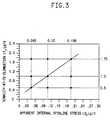
- FIG. 3 is a graphical representation of the tenacity-at-7%-elongation (T 7 ) of the spin-oriented filaments versus the apparent internal spinline stress ( ⁇ a ).
- T 7 tenacity-at-7%-elongation
- ⁇ a apparent internal spinline stress
- Birefringence ( ⁇ n ) is typically very difficult structural parameter to measure for fine filaments with deniers less than 1.
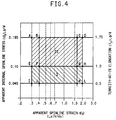
- the process of the invention is described by the enclosed region ADLI with region ADHE (II) preferred for preparing direct-use filaments and region EHLI (I) preferred for preparing draw feed yarns. Especially preferred processes are represented by regions BCGF and FGKI.
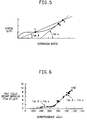
- FIG. 5 is a representative Instron load-extension curve showing the graphical calculation of the "secant" post-yield modulus (M py ) calculated from the tenacity-at-7%-elongation (T 7 ), denoted by point C, and from the tenacity-at-20%-elongation (T 20 ), denoted by point A, and defined by the expression (1.2T 20 - 1.07 T 7 )/0.13; and compares the "secant" M py (herein denoted as tan ⁇ to that of the "tangential" M py (herein denoted as tan ⁇ , i.e., slope of line segment AB).
- tan ⁇ i.e., slope of line segment AB
- FIG. 6 is a graphical representation of the secant M py (tan ⁇ in FIG. 5) versus birefringence ( ⁇ n ) of spin-oriented filaments.
- M py post-yield modulus
- FIG. 7 is a graphical representation of the Relative Disperse Dye Rate (RDDR), as normalized to 1 dpf, versus the average filament birefringence ( ⁇ n ).
- RDDR Relative Disperse Dye Rate
- FIG. 8 is a graphical representation of the filament amorphous free-volume of the fiber (V f,am , as defined herein after), versus the peak temperature of the fiber dynamic loss modulus, T(E" max ), taken herein as a measure of the glass transition temperature which is typically 20°C to about 50°C above the T g of the polymer.
- T(E" max) the peak temperature of the fiber dynamic loss modulus
- a decreasing T(E"max) value corresponds to greater amorphous free-volume (V f,am ), and hence to improved dyeability, as measured herein by a Relative Disperse Dye Rate (RDDR) value (normalized to 1 dpf) of at least about 0.1.
- RDDR Relative Disperse Dye Rate
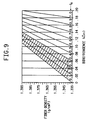
- FIG. 9 is a graphical representation of the filament density ( ⁇ ) versus birefringence ( ⁇ n ); wherein the diagonal lines represent combinations of density ( ⁇ ) and ( ⁇ n ) of increasing fractional amorphous orientation (f a ), used in the calculation of the free-volume V f,am depicted in FIG. 8.
- FIG. 10 is a representative Differential Scanning Calorimetry (DSC) spectrum showing the thermal transitions corresponding to the glass-transition temperature (T g ), onset of "cold" crystallization T cc (DSC) and the zero-shear melting point T M of the fiber, which is higher than the zero-shear melting point T M o of the polymer due to the effect of orientation and crystallinity of the fiber melting point.
- T M o glass-transition temperature
- FIG. 11 is a representative shrinkage tension (ST)-temperature spectrum for the spin-oriented fine polymer filaments of the invention showing the maximum shrinkage tension ST( max ), peak temperature T(ST max ) and the preferred "heat set” temperature T set below which heat setting does not appreciably adversely affect dye ability.
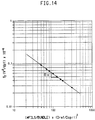
- FIG. 14 is a plot of the ratio, T 7 /(V 2 /dpf) versus the product of the number of filaments per yarn extrusion bundle (# c ) and the ratio, (D ref /D sprt ) 2 , where D ref and D sprt are the diameters of a reference spinneret (e.g., about 75 cm) and the test spinneret, respectively.
- the slope "n" from a ln-ln plot is found to be about negative 0.7 (-0.7); that is, the tenacity-at-7%-elongation (T 7 ) is found to vary proportionally to (V 2 /dpf) and to [(#c)(D ref /D sprt ) 2 ] -0.7 ; that is, the tenacity-at-7%-elongation (T 7 ) decreases approximately linearly with an increase in the filament extrusion density to the power of plus 0.7 (+0.7); and thereby the filament extrusion density may be used to as a process parameter to spin finer denier filaments at higher spinning speeds (V). At higher spin speeds, e.g., in the range of 4 to 6 km/min, it is found that the apparent spinline stress increases less rapidly with spin speed (V); i.e., is found to be proportional to (V 3/2 /dpf).
- the polyester polymer used for preparing spin-oriented filaments of the invention is selected to have a relative viscosity (LRV) in the range 13 to 23, a zero-shear melting point (T M o ) in the range 240°C to 265°C; and a glass-transition temperature (T g ) in the range 40°C to 80°C (wherein T M o and T g are measured from the second DSC heating cycle under nitrogen gas at a heating rate of 20°C per minute).
- LUV relative viscosity
- T M o zero-shear melting point
- T g glass-transition temperature
- the said polyester polymer is a linear condensation polymer composed of alternating A and B structural units, where, A is a hydrocarbolenedioxy unit of the form [-O-R'-O-] and B is a hydrocarbolenedicarbonyl unit of the form [-C(O)-R"-C(O)-], wherein, R' is primarily [-C 2 H 4 -], as in the ethylenedioxy (glycol) unit [-O-C 2 H 2 -O-], and R" is primarily [-C 6 H 4 -], as in the 1,4-benzenedicarbonyl unit [-C(O)-C 6 H 4 -C(O)-], such to provide, for example, at least 85 percent of the recurring structural units as ethylene terephthalate, [-O-C 2 H 4 -O-C(O)-C 6 H 4 -C(O)-].
- Suitable poly(ethylene terephthalate), herein denoted as PET or 2GT, based polymer may be formed by the DMT-process as described by H. Ludwig in his book “Polyester Fibers, Chemistry and Technology", John Wiley and Sons Limited (1971), and by the TPA-process as described in Edging U. S. Patent No. 4,110,316. Included are also copolyesters in which, for example, up to about 15 percent of the hydrocarbolenedioxy and/or hydrocarbolenedicarbonyl units are replaced with different hydrocarbolenedioxy and hydrocarbolenedicarbonyl units to provide enhanced low temperature disperse dyeability, comfort, and aesthetic properties. Suitable replacement units may be found in Most U. S. Patent No. 4,444,710 (Example VI), Pacofsky U. S. Patent No. 3,748,844 (Col. 4), and Hancock, et al. U. S. Patent No. 4,639,347 (Col. 3).
- the polyester polymer may also be modified with ionic dye sites, such as ethylene-5-M-sulfo-isophthalate residues, where M is an alkali metal cation, such as sodium or lithium; for example, in the range of 1 to 3 mole percent ethylene-5-sodium-sulfo-isophthalate residues may be added to provide dyeability of the polyester filaments with cationic dyestuffs, as disclosed by Griffing and Remington U. S. Patent No. 3,018,272, Hagewood etal in U. S. Patent No. 4,929,698, Duncan and Scrivener U. S. Patent No. 4,041,689 (Ex. VI), and Piazza and Reese U. S. Patent. No.
- ionic dye sites such as ethylene-5-M-sulfo-isophthalate residues, where M is an alkali metal cation, such as sodium or lithium; for example, in the range of 1 to 3 mole percent ethylene-5-sodium-sul
- DEG diethylene glycol
- the preferred process for preparing spin-oriented polyester filaments having a fineness for example, in the range of 1 to 0.2 denier per filament (dpf), preferably in the range 0.8 to 0.2 denier per filament (dpf); comprises
- polyester fine filaments of this invention are manufactured by a simplified direct spin-orientation (SDSO) process which does not incorporate drawing or heat treatment, and therein provides a preferred balance of shrinkage and dyeability behavior making the polyester fine filaments of the invention especially suitable for replacement of natural continuous filaments, such as silk.
- SDSO direct spin-orientation
- fine filaments with excellent mechanical quality and uniformity are made; such that the fine filaments, having shrinkages less than 12%, may be used in multifilament direct-use yarns (DUY) and processed without forming broken filaments in high speed weaving and knitting; and filaments, having shrinkages preferably greater than about 12%, may be used in multifilament draw-feed yarns (DFY) in high speed textile draw processes, such as friction-twist texturing, air-jet texturing, stuffer-box crimping and warp-drawing, without forming broken filaments.
- DY multifilament direct-use yarns
- DFY multifilament draw-feed yarns
- the fine filaments of this invention are characterized by having excellent mechanical quality permitting yarns made from these filaments to be used in high speed textile processes, such as draw false-twist and air-jet texturing, warp drawing, draw gear and stuffer-box crimping, and air and water jet weaving and warp knitting, without broken filaments; and the filaments of this invention are further characterized by having excellent denier uniformity (as defined herein by along-end denier spread, DS) permitting use in critically dyed fabrics.
- denier uniformity as defined herein by along-end denier spread, DS
- the filaments of this invention may be used as filaments in draw feed yarns (and tows), preferably filaments having boil-off shrinkage (S) and dry heat shrinkage (DHS) greater than 12% are especially suitable for draw feed yarns; and filaments of this invention, having shrinkages less than 12%, are especially suitable flat untextured multifilament yarns, and as yarns for such texturing processes as air-jet texturing, gear crimping, and stuffer-box crimping, wherein, no draw need be taken, and the flat and textured filaments of this invention may be cut into staple fibers and flock; but the filaments with shrinkages less than about 12% may be uniformly cold drawn as described by Knox and Noe in U. S. Patent No. 5,066,447.
- the yarn characteristics are measured as in U. S. Patent Nos. 4,134,882, 4,156,071, and 5,066,447; except the relative disperse dye rate (RDDR) is normalized to 1 dpf, dry heat shrinkage (DHS) is measured at 180C, and the lab relative viscosity (LRV) is defined according to Broaddus in U. S. Patent No. 4,712,998 and is equal to about (HRV - 1.2), where HRV is given in U. S. Patents Nos. 4,134,882 and 4,156,071.
- RDDR relative disperse dye rate
- DHS dry heat shrinkage
- LRV lab relative viscosity
- LRV 20.8 is taken as the reference LRV of the polyester polymer of equal zero-shear "Newtonian" melt viscosity ⁇ o to that of 20.8 LRV 2GT homopolymer (e.g., providing for the same capillary pressure drop at the same mass flow rate and temperature).
- Poly(ethylene terephthalate) having a polymer LRV in the range of 13 to 23 (which corresponds to an [ ⁇ ] in the range of 0.5 to 0.7), preferably in the range of 13 to 18 for ionically modified polyesters, and in the range of 18 to 23 for nonionically modified polyesters, a zero-shear melting point (T M o ) in the range of 240°C to 265°C, and a glass-transition temperature (T g ) in the range of 40°C to 80°C, and containing minor amounts of delusterants and surface friction modifiers (e.g., TiO 2 and SiO 2 ), is melted at a polymer temperature T P (°C) and filtered through inert medium for a residence (hold-up) time (t r , min) and then extruded through spinneret capillaries of diameter (D RND ) with length (L) at a capillary mass flow rate w [ (dpf ⁇ V)/9],
- filaments of most of the examples herein were spun from spinnerets having a filament density per extrusion surface area in the range of typically 2.5 to 13, while it was possible to spin and quench filament bundles with a extrusion filament density as high as 25 provided capillary hole pattern (filament array) was optimized for the type of quench (i.e., radial vs.
- extrusion filament density is defined by the ratio of the number of filaments (# c ) divided by the extrusion surface area (A o ), (i.e., # c /A o , cm -2 ), into a "shroud” which protects the freshly extruded filaments from direct quench air for a distance at least 2 cm and not greater than (12dpf 1 ⁇ 2 ,cm); and then carefully cooled to a temperature less than about polymer T g , preferably by radially directed air having a temperature T a (herein about 22°C) less than about the polymer T g (herein T a was about 70°C for 2GT homopolymer) and of linear velocity V a (m/min) in the range of 10 to 30 m/min.
- Suitable spinning apparatus used are essentially as that described in U. S. Patent Nos. 4,134,
- the along-end denier spread (DS) and draw tension variation (DTV) were minimized by balancing the values for the delay quench length (L DQ ), the quench air temperature (T a ), the quench air flow rate (V a ), and the convergence length (L c ), while selecting T P for spinning continuity.
- Increasing the polymer spin temperature (T P ) (but less than about [(T M ) a + 55°C] usually increases spinning continuity and mechanical quality (i.e., T B , g/d), but usually decreases along-end uniformity and increases shrinkage.
- incipient shear-induced molecular ordering e.g., lower chain entropy and possible incipient "nucleation" of the polymer melt occurs, especially for polymer melt filtered prior to extrusion for residence times (t r ) greater than about 4 minutes, wherein this molecular ordering (possible incipient nucleation) is believed to increase the apparent polymer melting point from the zero-shear value (T M o ) to an apparent value (T M ) a .
- This has the effect of reducing the spin temperature differential, T P -(T M ) a .
- T P needs to be further increased as given by the amount defined by the expression: 2x10 -4 (L/D RND )G a ,°C, for the selected values of L, D RND , and G a .
- the apparent internal spinline stress ( ⁇ a ) at the "neck-point" is controlled in the range of 0.045 to 0.195 g/d while controlling the melt extension strain ⁇ a in the range of about 5.7 to about 7.6.
- the attenuated and cooled filaments are converged into a multifilament bundle and withdrawn at a spinning speed (V, km/min) as defined by the surface speed of the first driven roll.
- the external spinline tension arising from frictional surfaces (and air drag) is removed prior to packaging by slightly over feeding the spinline between the first driven roll and the windup, usually between about 0.5% and 5%. Finish is applied at the point of convergence and interlace is provided, preferably after the first driven roll.
- the values for finish-on-yarn (weight, %) and degree of filament entanglement (RPC) are selected to meet end-use processing needs.
- Polyester fine filaments of the invention are of good mechanical quality and uniformity having a linear density less than about of that of natural worm silk, but greater than that of spider silk, that is between 1 and 0.2 denier per filament, and having the capability of being uniformly dyed without use of high temperatures and chemical dye assists; that is, more akin to that of natural silks.
- the fine denier filament yarns may be treated with caustic in spin finish (according to the invention as taught by Grindstaff and Reese in the copending allowed Patent Application Serial No. 07/420,459 (US-A-5 069 844), filed October 12, 1989) to enhance their hydrophilicity and improved moisture-transport and comfort.
- Incorporating filaments of different deniers and/or cross-sections may be used to reduce filament-to-filament packing and thereby improve tactile aesthetics and comfort.
- Unique dyeability effects may be obtained by co-mingling filaments of differing polymer modifications, such as homopolymer dyeable with disperse dyes and ionic copolymers dyeable with cationic dyes.
- Fine filaments of lower shrinkage may be obtained, if desired, by incorporating chain branching agents, on the order of about 0.1 mole percent, as described in part in Knox U. S. Patent No. 4,156,071, MacLean U. S. Patent No. 4,092,229, and Reese in U. S. Patents Nos. 4,883,032, 4,996,740, and 5,034,174; and/or increasing polymer viscosity by about +0.5 to about +1.0 LRV units.
- the fine filament yarns of this invention are suitable for warp drawing, air jet texturing, false-twist texturing, gear crimping, and stuffer-box crimping, for example; and the low shrinkage filament yarns may be used as direct-use flat textile yarns and a feed yarns for air-jet texturing and stuffer-box crimping wherein no draw is need be taken.
- the filaments (and tows made therefrom) may also be crimped (if desired) and cut into staple and flock.
- the fabrics made from these improved yarns may be surface treated by conventional sanding and brushing to give suede-like tactility.
- the filament surface frictional characteristics may be changed by selection of cross-section, delusterant, and through such treatments as alkali-etching.
- the improved combination of filament strength and uniformity makes these filaments, especially suited for end-use processes that require fine filament yarns without broken filaments (and filament breakage) and uniform dyeing with critical dyes.
- the fine denier filament polyester yarns of the invention are especially suitable for making of high-end density moisture-barrier fabrics, such as rainwear and medical garments.
- the surface of the knit and woven fabrics can be napped (brushed or sanded).
- the filaments may be treated (preferably in fabric form) with conventional alkali procedures.
- the fine filament yarns especially those capable of being cationic dyeable, may also be used as covering yarns of elastomeric treatments yarns (and strips), preferably by air entanglement as described by Strachan in U. S. Patent No. 3,940,917.
- the fine filaments of the invention may be co-mingled on-line in spinning or off-line with higher denier polyester (or nylon) filaments to provide for cross-dyed effects and/or mixed shrinkage post-bulkable potential, where the bulk may be developed off-line, such as over feeding in presence of heat while beaming/slashing or in fabric form, such as in the dye bath.
- the degree of interlace and type/amount of finish applied during spinning is selected based on the textile processing needs and final desired yarn/fabric aesthetics.
- Yarns of 100 and 300 filaments of nominal 0.5 dpf were spun from poly(ethylene terephthalate) of 19 LRV (corresponding to about 0.60 [ ⁇ ]) and containing 0.3 weight percent of TiO 2 .
- the 300-filament yarns were spun using spinnerets of varying construction; e.g.
- T B The normalized values for T B (denoted herein by (T B ) n ) are defined by the product the measured tenacity-at-break (T B ) and the factor (20.8/LRV) 0.75 (1-X) -4 which for these yarns is about 1.057; thereby, the normalized break tenacities (T B ) n are about 6% higher when compared to reference LRV and % TiO 2 of 20.8 and 0%, respectively.
- the fine filament yarns of this example were capable of being dyed to deep shades at atmospheric conditions (100°C) without use of dye carriers as given by an Relative Disperse Dye rate (RDDR)-value (normalized to a 1 dpf) of about 0.16 versus an RDDR-value of 0.055 for a conventional fully drawn yarn.
- RDDR Relative Disperse Dye rate
- the 300-filament yarn bundle into 2,3 or 4 individual bundles of 150, 100, and 75-filament yarn bundles, respectively, preferably by use of metered finish tip separating guides at the exit of the radial quench chamber.
- Multi-ending permits a higher mass flow rate (w) through the filter pack cavity and thereby reducing the residence time (t r ) in the pack cavity per threadline.
- Fine filaments were spun from poly(ethylene terephthalate) of nominal 20.8 LRV (about 0.65 [ ⁇ ]) and containing 0.1 weight percent TiO 2 at a withdrawal speed (V) of 4000 ypm (3.66 km/min) using a radial quench apparatus, essentially as described in Example I, except for having a delay "shroud" length (L DQ ) of about 2.25 inches (5.72 cm).
- L DQ delay "shroud" length
- Example III 68-and 136-(unplied and plied) filament yarns were spun, essentially according to Example I, except convergence was by a metered finish tip as described in U. S. Patent No. 4,926,661 for Examples III-1 through III-9 and III-11 through III-25.
- Example III-10 used a metering finish roll surface to converge the filaments as described in Examples I and II. Other process details are summarized in Tables I and II.
- the filaments of Example III-1 through III-5 and III-12 through III-15 have T 7 -values greater than about 1 g/d making them especially suitable for use as filaments in direct-use textile filament yarns and as feed yarns in air-jet textured, wherein no draw is taken; and, if desired, can be drawn uniformly without heat (cold) in warp drawing (and air-jet texturing) as described in Knox and Noe U. S. Patent No. 5,066,447.
- the filaments of III-6,7, and III-16 through III-25 with T 7 -values less than about 1 g/d are especially suitable as filaments in draw feed yarns (DFY) , such as draw false-twist texturing (FTT) and draw air-jet texturing (AJT) or as draw feed yarns in warp drawing.
- DTY draw feed yarns
- FTT draw false-twist texturing
- AJT draw air-jet texturing
- Example III-4 had a spinning continuity of 0.39 breaks per 1000 lbs. (0.86 per 1000 kg) which is equivalent to about 9.5 breaks per 10 9 meters.
- the yarns of Example III-4 were wound with about 10 cm interlace (as measured by the rapid pin count procedure described in U. S. Patent No. 3,290,932) for air-jet texturing on a Barmag FK6T-80 without drawing and wound with about 5-7 RPC interlace for direct-use as a flat textile yarn in wovens and warp knits.
- Example III-6 and 7 were drawn without broken filaments at 1.44X and 1.7X, respectively, to give drawn 35 denier 68-filament yarns.
- Example III-6 is preferred versus III-7 since the spinning productivity (spun denier x spin speed) of III-6 is about 25% greater than Example III-7.
- Yarns of Example III-6 were successfully cold warp drawn using a 1.44X draw-ratio.
- Example III-12 Acceptable quality was obtained for Example III-12; wherein the residence time (t r ) during filtration in the pack cavity was reduced by spinning 136-filaments versus 68-filaments.
- the yarn bundle could be withdrawn as a single 136-filament bundle or split to wind-up two 68-filament yarn bundles.
- Residence times (t r ) less than about 4 minutes for high L/D RND capillary spinnerets are found to be necessary to spin without having to use high "input" polymer temperatures (T P ). See Example IX for a more detailed discussion about the spinning with high shear capillary spinnerets.
- 136-filament yarns were spun using 136-9x36 mil (0.229x0.916 mm, 0.0229x0.0916 cm) capillaries per spinneret, and thereby reducing the filtration residence time (t r ) by 50%, to provide yarns with good mechanical quality.
- the high filament count yarns are especially suitable for draw air-jet texturing (AJT) and for false-twist texturing (FTT), wherein, a straight draw-texturing machine configuration is preferred.
- Yarns from Examples III-19,22,24 and 25 were used for preparing warp drawn flat yarns of nominal 0.5 dpf as described in Example XII.
- Example III-10 The structural properties of the filaments of Example III-10 are representative of spin-oriented filaments of this invention having shrinkages less than 6%.
- Poly(ethylene terephthalate) of nominal 21.2 LRV (about 0.66 [ ⁇ ]) of 0.035, 0.3 and 1 weight percent TiO 2 were spun using a radial quench spinning apparatus, essentially as described in Example I, except the length (L DQ ) of the delay "shroud" was about 2-5/8 inches (6.7 cm), and the filament bundles were converged by a metered finish tip at 43 inches (109 cm) from the face of the spinneret. Other process details are summarized in Tables III and IV. Increasing weight percent TiO 2 is observed to decrease the tenacity-at-break (T B ) of these fine filaments.
- the amount of TiO 2 is usually varied between about 0.035% for minimum yarn-to-metal and yarn-to-yarn frictional needs and less than about 1.5%, more typically less than about 1% for desired mechanical quality and visual aesthetics.
- Poly(ethylene terephthalate) of nominal 21.1 LRV (about 0.655 [ ⁇ ]) and containing 0.3 weight percent TiO 2 was spun using apparatus similar to Example IV.
- Examples V-1 through V-4, IV-9 and IV-10 use 12x50 mil (0.305x1.270 mm, 0.0305x0.127 cm) spinneret capillaries.
- Examples V-5, 7, 8, and 11 through 13 use 9x36 mil (0.229x0.914 mm, 0.0229x0.0914 cm) spinneret capillaries, and
- Example V-6 uses 6x18 mil (0.152x0.457 mm, 0.0152x0.0457 cm) spinneret capillaries to spin 100-filament 85 denier feed yarns for warp draw and draw air-jet texturing (AJT).
- the length of delay quench (L DQ ) was increased from 2-5/8 inches (6.7 cm) to 4-5/8 inches (11.7 cm) in EX. V-8 and V-10.
- the delay length (L DQ ) is less than about (12dpf 1 ⁇ 2 )cm, good uniformity may be obtained.
- Examples V-11 through V-13 have tenacity-at-7%-elongation (T 7 ) values less than about 1 g/d making them especially suitable as draw feed yarns even though the shrinkages of the undrawn yarns were less than 12%.
- T 7 tenacity-at-7%-elongation
- Example VI Example V-13 was repeated at 3300 ypm (3.02 km/min) for varying spun deniers, delay quench lengths (L DQ ), spinning temperatures (T P ), and convergence guide lengths (L C ).
- Example VI-2 with a denier spread (DS) of 3.8% was successfully drawn 1.35X to give a drawn 0.3 dpf 100-filament yarn with a 2.3% denier spread, tenacity of 4.4 g/d, E B of 32.5% and a boil-off shrinkage(S) of 6.3%.
- DS denier spread
- Fine trilobal filaments were spun from poly(ethylene terephthalate) of nominal 21 LRV (about 0.65 [ ⁇ ] containing 0.035 weight percent TiO 2 using spinnerets with 9x36 mil (0.229x0.914 mm, 0.0229x0.0914 cm) and 12x50 mil (0.305x1.270 mm, 0.0305x0.127 cm) metering capillaries and a Y-shaped exit orifices of area (A c ) of about 197 mils 2 (1.27 mm 2 , 0.0127 cm 2 ), which corresponds to a D RND of about 15.9 mils (0.40 mm, 0.04 cm) with an L/D RND of about 1.5 (as essentially as described in Examples 45-47 of U. S.
- the 9x36 mil metering capillaries provided better mechanical quality and along-end denier uniformity than the 12x50 mil metering capillaries.
- the 100-filament yarns could be drawn without forming broken filaments to nominal 50 denier, or about 0.5 dpf.
- Poly(ethylene terephthalate) polymer modified with about 2 mole % of ethylene 5-sodium-sulfo isophthate having a nominal LRV of about 15.3 was spun using a laminar cross-flow quench apparatus with a 2.2 inches (5.6 cm) delay, essentially as described in U. S. Patent No. 4,529,638, and converging the filament bundle at about 43-inches (109 cm) with metered finish tip guides.
- the lower LRV is usually preferred for ionically modified polyesters because the ionic sites act as cross linking agents and provide higher melt viscosity.
- the 15 LRV used, herein, had a melt viscosity about that of a 20 LRV homopolymer.
- LRV low LRV homopolymer
- viscosity builders such as tetra-ethyl silicate (as described in Mead and Reese, U. S. Patent No. 3,335,211). It is generally preferred to spin ionically modified polyesters with LRV in the range of about 13 to about 18 and nonionically modified polyesters with LRV in the range of about 18 to about 23. Withdrawal speeds were increased from 2400 ypm (2.2 km/min) to 3000 ypm (2.74 km/min). As expected the cationic copolymer yarns had lower T B -values based on their lower LRV.
- the lower LRV is preferred for filaments yarns used in napped and brushed fabrics and for tows to be cut into flock.
- the as-spun yarns could be drawn without breaking filaments to about 50 denier 100-filament yarns.
- the cationically modified polyester had a RDDR value of 0.225 versus 0.125 for the 2GT homopolymer spun under similar conditions.
- Poly(ethylene terephthalate) of nominal 21.9 LRV (about 0.67 [ ⁇ ]) and containing 0.3 weight percent TiO 2 was spun using apparatus similar to Example IV with a air flow rate of about 30 m/min.
- Examples IX-1 through IX-3 use 12x50 mil (0.305x1.270 mm, 0.0305x0.127 cm) spinneret capillaries;
- Examples IX-4 through IX-8 use 9x36 mil (0.229x0.914 mm, 0.0229x0.0914 cm) spinneret capillaries;
- Examples IX-9 through IX-11 use 6x18 mil (0.152x0.457 mm, 0.0152x0.0457 cm) spinneret capillaries to spin nominal 50 denier 100-filament low-shrinkage yarns suitable as direct-use textile yarns for warp knits and wovens and as feed yarns for air-jet and stuffer-box texturing wherein no draw is required.
- Poly(ethylene terephthalate) of nominal 21.9 LRV (about 0.67 [ ⁇ ]) and containing 0.3 weight percent TiO 2 was spun using apparatus similar to Example IV with an air flow rate varied from about 11 to about 30 m/min.
- Examples X-1 through X-9 use 12x50 mil (0.305x1.270 mm, 0.0305x0.127 cm) spinneret capillaries and Examples X-10 through X-16 use 9x36 mil (0.229x0.914 mm, 0.0229x0.0914 cm) spinneret capillaries to spin nominal 70 denier 100-filament low-shrinkage yarns with T 7 -values greater than about 1 g/d, making these especially suitable as direct-use textile yarns for warp knits and wovens and as feed yarns for air-jet and stuffer-box texturing wherein no draw is required.
- the fine filament feed yarns of Example V-11, 12, and 13 were uniformly drawn cold and at 155°C at 1.45X, 1.5X, and 1.55X draw-ratios, respectively, to give nominal 50 denier 100-filament drawn yarns that can be used as flat textile yarns.
- the drawn fine filament yarns have excellent mechanical quality and along-end denier uniformity with boil-off shrinkages (S) less than about 6%.
- S boil-off shrinkages
- the cold drawn yarns had slightly less shrinkage than the hot drawn yarns and also were slightly more uniform. With less interlace levels and a different finish, these yarns may be cold drawn air-jet textured, consistent with the teachings of Knox and Noe in U. S. Patent No. 5,066,447.
- These fine filament spun yarns could also be used as feed yarns for draw air-jet/stuffer-box/friction-twist texturing. Warp draw process and product details are summarized in Table VII.
- Examples III-20 through 25 were repeated by varying spin speed and spun denier to provide draw feed yarns capable of being drawn to provide 35 denier 68-filament yarns.
- Nominal 50 to 60 denier as-spun yarns with excellent mechanical quality and denier uniformity were drawn cold and heat set at 160°C to 180°C to obtain low shrinkage filaments of nominal 0.5 dpf yarns without loss in mechanical quality and along-end denier uniformity.
- Spin process and product details are summarized in Tables IV and V, and the corresponding draw process and product details are summarized in Table VII.
- Example XIII the ability to obtain high T 7 fine filament yarns was explored.
- Spinning apparatus similar to that in Example X was used.
- Poly(ethylene terephthalate) of nominal 20.8 LRV (0.65 [ ⁇ ]) containing 0.3 weight percent TiO 2 was extruded through 9x36 mil (0.229x0.914 mm, 0.0229x0.0914 cm) spinneret capillaries and cooled using a radial quench apparatus as described in Example I, except for having a delay length L DQ of about 2.25 inches (5.7 cm).
- the cooled filaments were converged into yarn bundles at a convergence length (L c ) of about 32 inches (81.3 cm) from the face of the spinneret by use of metered finish tip guides.
- the withdrawal speed (V) was varied from 4500 ypm (4.12 km/min) to 5300 ypm (4.85 km/min) to provide 68 and 100-filament direct-use textile yarns with T 7 -values between about 1 and 1.5 g/d.
- the process and product details are summarized in Table VI.
- the tensiles of Example XIII were inferior due to use of lower polymer melt temperature (T P ) and higher quench air flow rates (V a ) than in Example X.
- a 91 denier 100-filament yarn made according to Example IV was air-jet textured using a Barmag FK6T80 at 300 km/min; wherein, the as-spun yarns were drawn cold (about 40°C) at 1.0X, 1.1X, 1.2X, and 1.32X draw-ratios and sequentially air-jet textured using a conventional air-jet at 125 lbs./in 2 (8.8 kg/cm 2 ) to provide bulky yarns with filament deniers between about 0.7 and 0.9 (before boil-off shrinkage) and between about 0.77 and 0.94 dpf (after boil-off shrinkage).
- the denier of the textured filament yarn showed an increase in yarn denier of about 11% due to bulk (e.g., filament loops), where the ratio (denier) AJT /(denier) FLAT is preferably greater than about 1.1); however, the filament denier showed no increase in denier.
- Example XIV-1 and 2 were uniformly cold partially drawn, as defined herein, by providing a RDR of at least about 1.4X in the drawn yarn.
- Example XIV-5 through 8 68-filament yarns were sequentially draw cold and air-jet textured. The shrinkage increased with draw ratio, providing a route to higher shrinkage AJT yarns.
- Table VIII The process and product data for Example XIV is given in Table VIII.
- Co-mingling (plying) 2 or more cold drawn AJT yarn textile yarns wherein at least one AJT yarn has been heat set to shrinkages less than about 3%, and a second AJT yarn has not been heatset, so has significantly higher shrinkage, provides a simplified route to a mixed shrinkage yarn.
- Similar mixed shrinkage AJT yarns may be provided with the lower shrinkage component provided by alternate techniques, for instance by hot drawing, with or without heat setting.
- mixed shrinkage AJT yarns may be provided by co-mingling 2 or more drawn filament bundles wherein both bundles are drawn by cold drawing, without post heat treatment, but the bundles are cold drawn to different elongations, preferably by about 10% or more.
- the resulting mixed shrinkage drawn yarn may be AJT to provide a mixed shrinkage textured (bulked) yarn.
- Incorporating filaments of different deniers and/or cross-sections may also be used to reduce filament-to-filament packing and thereby improve tactile aesthetics and comfort.
- Unique dyeability effects may be obtained by co-mingling drawn filaments of differing polymer modifications, such as homopolymer dyeable with disperse dyes and ionic copolymers dyeable with cationic dyes.
- AJT process and product details are summarized in Table VIII.
- Example XV yarns were spun for use as draw feed yarns (DFY)in false twist texturing (FTT).
- Example XV-1 a nominal 58 denier 68-filament yarn was textured at 500 m/min on a L900 PU machine with a 1.707 D/Y-ratio at a 1.628X draw to provide 68-filament textured yarns of nominal 37 denier (0.54 dpf) with a tenacity (T) of 4.1 g/d, an elongation-at-break (E B ) of 26.8%, a tenacity-at-7%-elongation (T 7 ) of 2.19 g/d, and an initial modulus (M) of 44.6 g/d.
- T tenacity
- E B elongation-at-break
- T 7 tenacity-at-7%-elongation
- M initial modulus
- Example XV-2 a nominal 118 denier 200-filament draw feed yarn was prepared for false twist texturing, as in Example XV-1, except with a D/Y-ratio of 1.59 at a 1.461X draw-ratio to provide 200-filament textured yarns of 83.5 nominal denier (0.42 dpf) with a tenacity (T) of about 3.25 g/d and an elongation-at-break (E B ) of about 23.9%.
- the 200-filament yarns were also successfully "partially" warp drawn as per the teachings of Knox and Noe in U. S. Patent No.
- Example XV-3 a nominal 38 denier 100-filament yarn was prepared for use as a draw feed yarn in false-twist texturing and in warp drawing.
- the process operability for Example XV-3 was better with 6x18 mil (0.152x0.457 mm) capillaries than with 9x36 mil (0.229x0.914 mm) capillaries.
- the yarns of Example XV-3 were warp drawn over a range of conditions in Example XVIII to provide 0.22 to 0.27 dpf 100-filament yarns for wovens and knit fabrics.
- Example XVI 21.2 LRV polyester polymer containing 0.035 weight percent TiO 2 was extruded at 285°C through 9x36 mil (0.229 x 0.914 mm) metering capillaries with a four-diamond-shaped corrugated ribbon cross-section exiting orifice of area 318 mils 2 (0.205 mm 2 ).
- the 80 denier 100-filament bundles were quenched using radial quench apparatus similar to that used in Example III having a delay length of 2.9 cm and converged by a metered finish tip applicator at 109 cm from the face of the spinneret and withdrawn at a spin speed of 2350 ypm (2.15 km/min).
- DS along-end denier spread
- BOS of about 2.8%
- E B average elongation-at-break
- T B average tenacity-at-break
- T B -values are a consequence of the corrugated filament cross-sectional shape and such filaments may be used in processes, such as false-twist texturing (FTT) and air-jet texturing (AJT) where filament fracture is desired to give even finer filaments (i.e., even less than about 0.2 dpf) for a more spun-like aesthetics.
- FTT false-twist texturing
- AJT air-jet texturing
- Example XVII nominal 43 denier 50-filaments with a concentric void of about 16-17% were spun at 3500 ypm (3.2 km/min) and at 4500 ypm (4.12 km/min).
- the hollow filaments were formed by post-coalescence of nominal 21.2 LRV polymer at 290°C using segmented capillary orifices with 15x72 mil (0.381x1.829 mm) metering capillaries as essentially described by Champaneria etal in U. S. Patent No. 3,745,061, Farley and Barker in Br. Patent No. 1,106,263, Hodge in U. S. Patent No. 3,924,988 ( Figure 1), Most in U. S. Patent No.
- the void content is found to increase with extrusion void area ( ⁇ ID 2 /4), mass flow rate, polymer melt viscosity (i.e., proportional to LRV/T P ) and with increasing withdrawal speed (V) and the above process parameters are selected to obtain at least about 10% and preferably at least about 15% void content (VC).
- the fine hollow filaments were quenched using radial quench apparatus fitted with a short delay shroud as described in Example XVI, except air flow was reduced to about 16 m/min and converged via a metered finish tip applicator at a distance less than about 140 cm.
- the yarns spun at 3.2 km/min had tenacity/elongation/modulus of about 3 gpd/90%/45 gpd, respectively and a tenacity-at-7%-elongation (T 7 ) of about 0.88 g/d.
- Yarns spun at 4.115 km/min had tenacity/elongation/modulus of about 2.65 gpd/46%/64 gpd, respectively, and a tenacity-at-7%-elongation (T 7 ) of about 1.5 g/d.
- Yarns spun at 3.2 and 4.12 km/min had boil-off shrinkage (S) values between about 3-5%.
- Example XVIII the spun yarns of Example XV-3 were drawn over a range of draw-ratios from 1.4X to 1.7X to provide drawn filament yarns of deniers 26.6 to 22.2, respectively; with tenacities increasing from 4.38 g/d to 5.61 g/d and elongations-at-break (E B ) decreasing from 36.6% to 15.8% with increasing draw-ratio. All the draw yarns had boil-off shrinkages (S) of about 4%. See Table VIII for process and product summery.
- Example XIX-1 and XIX-2 200-filament and 168-filament yarns (feed yarns from Example XV-3 and 4, repsectively) of nominal 0.5 dpf were spun at 4400 ypm (4.02 km/min) for use as direct-use flat yarns in woven and knit fabrics. These yarns can also be air-jet textured (AJT) without draw to provide low-shrinkage AJT yarns of nominal 3% shrinkage.
- AJT air-jet textured
- Example XX mixed filament yarns were prepared by co-spinning sub denier filaments of the invention with higher denier filaments, such as the low shrinkage filaments as described by Knox in U. S. Patent No. 4,156,071 and/or the high shrinkage filaments described by Piazza and Reese in U. S. Patent No. 3,772,872 to provide the potential for mixed-shrinkage (e.g., post-bulking in fabric) such as in the case when the low shrinkage filaments of this invention are combined with the high shrinkage filaments of Piazza and Reese.
- higher denier filaments such as the low shrinkage filaments as described by Knox in U. S. Patent No. 4,156,071 and/or the high shrinkage filaments described by Piazza and Reese in U. S. Patent No. 3,772,872 to provide the potential for mixed-shrinkage (e.g., post-bulking in fabric) such as in the case when the low shrinkage filaments of this invention are combined with the high
- On-line thermal treatment by use of a heated tube or a steam jet, wherein essentially no reduction in filament denier takes place (i.e., no space drawing) of mixed dpf low shrinkage filament yarns, such as those prepared by co-spinning filaments of this invention with those as described by Knox in U. S. Patent No. 4,156,071, provides a route to unique mixed shrinkage post-bulkable filament yarns wherein the shrinkage of the sub denier filaments of this invention remain essentially unchanged while the shrinkage of the higher denier filaments (e.g., 2-4 dpf) is increased from initial boil-off shrinkage (S) of less than about 6-10% to greater than 10%, typically about 15-35%.
- S initial boil-off shrinkage
- the mixed shrinkage yarns prepared with the mentioned intermediate heat treatment differ from those obtained by combining the low shrinkage filaments of this invention with the higher shrinkage filaments of Piazza and Reese in that the heat treated high shrinkage filaments have significantly improved shrinkage tension (e.g., at least about 0.15 g/d) which permits development of the bulk from the mixed-shrinkage even in very tightly constructed woven fabrics.
- shrinkage power The combination of high shrinkage and high shrinkage tension (herein called shrinkage power) was heretofore only obtained, for example, by fully drawing conventional LOY/MOY/POY followed by no or low temperature annealing.
- the sub denier filaments of the invention migrate to the surface on mixed shrinkage and provide a soft luxurious tactile aesthetics even in the most tightly constructed fabrics.
- the heat treatment is typically carried out after the filaments are fully attenuated and quenched to below their glass transition temperature and in a manner that the increase in tension during the heat treatment is of the magnitude equal to that of the observed increase in shrinkage tension by said heat treatment.
- T CC cold crystallization temperature
- T C maximum crystallization temperature
- T C temperature of maximum crystallization
- the filaments may be heated either by passing through high pressure superheated steam (e.g., 40-140 psi at about 245°C) or by passing through a heated tube.
- the above heat treatment process can also be used to increase the lower shrinkage of the sub denier filaments of the invention as defined by the needs of the particular end-use, such as increasing from about 3% to about 6-8% with higher shrinkage tension (and shrinkage power) for tightly constructed wovens.
- Example XXII 50 denier 68-filament undrawn flat textile yarns were uniformly cold drawn and heat treated at 160, 170, and 180°C to provide nominal 36 denier 50 filament drawn yarns of about 4-5% boil-off shrinkage (S) with a T 7 of about 3.5 g/d, a tenacity of about 4.5 g/d with an elongation-at-break (E B ) of about 27%.
- the drawn yarns have a percent Uster of about 2.1-2.4% and may be used for critically dyed fabrics.
- the fine denier filaments of this invention may be used to cover elastomeric yarns (and tapes) by high speed air-jet entanglement as taught by Strachan in U. S. Patent No. 3,940,917.
- Polyester fine filaments prepared from polymer modified for cationic dyeability are especially suitable for elastomeric yarns, such as Lycra® to prevent "bleeding" of the dyestuff from the elastomeric yarns, such as observed for Lycra® covered with homopolymer polyester dyed with nonionic disperse dyes.
- the direct-use filaments of this invention are preferred (and those with increased shrinkage, shrinkage tension, and shrinkage power as described in Example XX are especially preferred) for air-entanglement covering and permit the covered elastomeric yarns to be dyed under atmospheric conditions without the use of carriers, e.g., similar to the dye bath conditions to dye nylon filament covered elastomeric yarns (except for being dyed with anionic acid dyes).
- Some example fabrics made from the yarns of the invention are: 1) a medical barrier fabric constructed with a low shrinkage 70 denier 100-filament direct-use flat yarn filling and a 70 denier 34-filament conventional warp drawn POY in the warp and woven on a high speed water-jet loom at 420 picks per minute to give a plain weave fabric of 164 ends per inch in the warp and 92 picks per inch in the fill; 2) a lounge wear satin constructed using the above 70 denier 100-filament direct-use yarn in the warp and combining it with a 60 denier 100-filament false twist textured fill to provide a satin with 172 ends per inch in the warp and 100 picks per inch in the fill; and 3) a crepe de chines fabric constructed with the above 70 denier 100-filament direct-use yarn in the warp and a 2-ply 60 denier 100-filament false twist textured yarn in the fill.
Landscapes
- Engineering & Computer Science (AREA)
- Textile Engineering (AREA)
- Mechanical Engineering (AREA)
- Chemical & Material Sciences (AREA)
- Chemical Kinetics & Catalysis (AREA)
- General Chemical & Material Sciences (AREA)
- Physics & Mathematics (AREA)
- Thermal Sciences (AREA)
- Artificial Filaments (AREA)
- Spinning Methods And Devices For Manufacturing Artificial Fibers (AREA)
Applications Claiming Priority (7)
| Application Number | Priority Date | Filing Date | Title |
|---|---|---|---|
| US64737191A | 1991-01-29 | 1991-01-29 | |
| US64738191A | 1991-01-29 | 1991-01-29 | |
| US647371 | 1991-01-29 | ||
| US647381 | 1991-01-29 | ||
| PCT/US1992/000359 WO1992013119A1 (en) | 1991-01-29 | 1992-01-29 | Preparing polyester fine filaments |
| CN92103680A CN1047634C (zh) | 1991-01-29 | 1992-04-11 | 纺丝—取向的聚酯细丝及其制备方法 |
| PCT/US1994/013189 WO1996016206A1 (en) | 1993-06-29 | 1994-11-21 | Improvements in continuous filaments, yarns, and tows |
Publications (2)
| Publication Number | Publication Date |
|---|---|
| EP0646189A1 EP0646189A1 (en) | 1995-04-05 |
| EP0646189B1 true EP0646189B1 (en) | 1997-08-20 |
Family
ID=27179019
Family Applications (1)
| Application Number | Title | Priority Date | Filing Date |
|---|---|---|---|
| EP92904563A Revoked EP0646189B1 (en) | 1991-01-29 | 1992-01-29 | Preparing polyester fine filaments |
Country Status (10)
| Country | Link |
|---|---|
| EP (1) | EP0646189B1 (enExample) |
| JP (1) | JP3043414B2 (enExample) |
| CN (1) | CN1047634C (enExample) |
| AU (1) | AU653207B2 (enExample) |
| BR (1) | BR9205719A (enExample) |
| CA (1) | CA2101788C (enExample) |
| DE (1) | DE69221739T2 (enExample) |
| ES (1) | ES2104898T3 (enExample) |
| TW (1) | TW215113B (enExample) |
| WO (1) | WO1992013119A1 (enExample) |
Cited By (1)
| Publication number | Priority date | Publication date | Assignee | Title |
|---|---|---|---|---|
| US6174474B1 (en) | 1998-05-14 | 2001-01-16 | Ems-Inventa Ag | Device and method for producing microfilament yarns with high titer uniformity from thermoplastic polymers |
Families Citing this family (19)
| Publication number | Priority date | Publication date | Assignee | Title |
|---|---|---|---|---|
| US5356582A (en) * | 1986-01-30 | 1994-10-18 | E. I. Du Pont De Nemours And Company | Continuous hollow filament, yarns, and tows |
| WO1994003660A1 (en) * | 1992-08-05 | 1994-02-17 | E.I. Du Pont De Nemours And Company | Polyester mixed yarns with fine filaments |
| CN1092721C (zh) * | 1995-08-04 | 2002-10-16 | 纳幕尔杜邦公司 | 高支长丝细聚酯纱的制造方法及由该方法制得的产品 |
| DE69516910T2 (de) * | 1995-08-04 | 2000-12-07 | E.I. Du Pont De Nemours And Co., Wilmington | Verfahren zur herstellung von polyestergarne mit einer hohen anzahl von feinfilamenten |
| DE19922240A1 (de) * | 1999-05-14 | 2000-11-16 | Lurgi Zimmer Ag | Verfahren zur Herstellung von ultrafeinen synthetischen Garnen |
| DE19924838A1 (de) | 1999-05-29 | 2000-11-30 | Lurgi Zimmer Ag | Spinnvorrichtung zum Verspinnen schmelzflüssiger Polymere und Verfahren zum Beheizen der Spinnvorrichtung |
| DE19951067B4 (de) * | 1999-10-22 | 2004-04-08 | Inventa-Fischer Ag | Polyesterfasern mit verminderter Pillingneigung sowie Verfahren zu ihrer Herstellung |
| US6685859B2 (en) * | 2000-03-03 | 2004-02-03 | E. I. Du Pont De Nemours And Company | Processes for making poly(trimethylene terephthalate) yarn |
| TWI294926B (en) | 2002-04-25 | 2008-03-21 | Teijin Fibers Ltd | Polyester fine false twisting textured yarn, and methods for producing the same |
| KR101129204B1 (ko) | 2003-01-16 | 2012-03-28 | 데이진 화이바 가부시키가이샤 | 폴리에스테르 섬유 및 이를 함유하는 가연 가공사 |
| US20080006970A1 (en) | 2006-07-10 | 2008-01-10 | General Electric Company | Filtered polyetherimide polymer for use as a high heat fiber material |
| US9416465B2 (en) | 2006-07-14 | 2016-08-16 | Sabic Global Technologies B.V. | Process for making a high heat polymer fiber |
| JP5908811B2 (ja) * | 2012-09-07 | 2016-04-26 | 有限会社ナイセム | 長期間生体内植え込み用極細繊維製医療材料 |
| CN110938882B (zh) * | 2019-12-11 | 2020-12-29 | 诸暨市百乐化纤有限公司 | 一种高性能涤纶poy制备装置及方法 |
| CN111041578B (zh) * | 2019-12-24 | 2022-03-18 | 江苏恒力化纤股份有限公司 | 粘度不同的pet双组份弹性丝及其制备方法 |
| CN111893586B (zh) * | 2020-07-21 | 2021-11-09 | 合肥洁诺无纺布制品有限公司 | 一种聚酯纤维加工用过滤装置 |
| CN112923904B (zh) * | 2021-01-26 | 2022-09-23 | 四川融鑫信息科技有限公司 | 面向多无人机协同摄影测量的地质灾害隐患探测方法 |
| CN115233324B (zh) * | 2022-08-05 | 2023-11-03 | 常州德利斯护理用品有限公司 | 一种制备不同截面异型纤维的纺黏牵伸装置 |
| CN121496630B (zh) * | 2026-01-14 | 2026-04-28 | 东华大学 | 一种基于动态捻度控制的花式纱的纺纱方法 |
Family Cites Families (5)
| Publication number | Priority date | Publication date | Assignee | Title |
|---|---|---|---|---|
| US4134882A (en) * | 1976-06-11 | 1979-01-16 | E. I. Du Pont De Nemours And Company | Poly(ethylene terephthalate)filaments |
| US4156071A (en) * | 1977-09-12 | 1979-05-22 | E. I. Du Pont De Nemours And Company | Poly(ethylene terephthalate) flat yarns and tows |
| JPS5562209A (en) * | 1978-10-30 | 1980-05-10 | Toray Ind Inc | Melt spinning of ultra-fine fiber |
| US4529368A (en) * | 1983-12-27 | 1985-07-16 | E. I. Du Pont De Nemours & Company | Apparatus for quenching melt-spun filaments |
| US4926661A (en) * | 1989-03-15 | 1990-05-22 | E. I. Du Pont De Nemours And Company | Yarn finish applicator |
-
1992
- 1992-01-29 EP EP92904563A patent/EP0646189B1/en not_active Revoked
- 1992-01-29 AU AU12310/92A patent/AU653207B2/en not_active Ceased
- 1992-01-29 CA CA002101788A patent/CA2101788C/en not_active Expired - Fee Related
- 1992-01-29 WO PCT/US1992/000359 patent/WO1992013119A1/en not_active Ceased
- 1992-01-29 DE DE69221739T patent/DE69221739T2/de not_active Revoked
- 1992-01-29 JP JP4504583A patent/JP3043414B2/ja not_active Expired - Fee Related
- 1992-01-29 ES ES92904563T patent/ES2104898T3/es not_active Expired - Lifetime
- 1992-04-01 TW TW081102473A patent/TW215113B/zh active
- 1992-04-11 CN CN92103680A patent/CN1047634C/zh not_active Expired - Fee Related
-
1994
- 1994-11-21 BR BR9205719A patent/BR9205719A/pt not_active Application Discontinuation
Cited By (2)
| Publication number | Priority date | Publication date | Assignee | Title |
|---|---|---|---|---|
| US6174474B1 (en) | 1998-05-14 | 2001-01-16 | Ems-Inventa Ag | Device and method for producing microfilament yarns with high titer uniformity from thermoplastic polymers |
| DE19821778B4 (de) * | 1998-05-14 | 2004-05-06 | Ems-Inventa Ag | Vorrichtung und Verfahren zur Herstellung von Mikrofilamenten von hoher Titer-Gleichmäßigkeit aus thermoplastischen Polymeren |
Also Published As
| Publication number | Publication date |
|---|---|
| JPH06507212A (ja) | 1994-08-11 |
| JP3043414B2 (ja) | 2000-05-22 |
| CN1047634C (zh) | 1999-12-22 |
| BR9205719A (pt) | 1994-04-26 |
| AU653207B2 (en) | 1994-09-22 |
| EP0646189A1 (en) | 1995-04-05 |
| DE69221739T2 (de) | 1998-03-12 |
| ES2104898T3 (es) | 1997-10-16 |
| WO1992013119A1 (en) | 1992-08-06 |
| AU1231092A (en) | 1992-08-27 |
| DE69221739D1 (de) | 1997-09-25 |
| CN1077233A (zh) | 1993-10-13 |
| TW215113B (enExample) | 1993-10-21 |
| CA2101788C (en) | 2002-05-28 |
| CA2101788A1 (en) | 1992-07-30 |
Similar Documents
| Publication | Publication Date | Title |
|---|---|---|
| US5250245A (en) | Process for preparing polyester fine filaments | |
| AU653207B2 (en) | Preparing polyester fine filaments | |
| CA1125488A (en) | Heat bulkable polyester yarn | |
| US5356582A (en) | Continuous hollow filament, yarns, and tows | |
| CA2478286C (en) | Process for producing polyester fine multifilament yarn and polyester fine false-twist textured yarn, polyester fine multifilament yarn and polyester fine false-twist textured yarn | |
| US5417902A (en) | Process of making polyester mixed yarns with fine filaments | |
| EP0804640B1 (en) | Improvements in continuous filaments, yarns, and tows | |
| US5288553A (en) | Polyester fine filaments | |
| US4115989A (en) | Product and process | |
| US5645936A (en) | Continuous filaments, yarns, and tows | |
| US5585182A (en) | Process for polyester fine hollow filaments | |
| US5407621A (en) | Process for preparing polyester fine filaments | |
| US5691057A (en) | Polyester mixed yarns with fine filaments | |
| US5487859A (en) | Process of making fine polyester hollow filaments | |
| Murase et al. | Melt spinning | |
| CA1292602C (en) | Process for producing a smooth polyester yarn and polyester yarn produced by said process | |
| US5827464A (en) | Making high filament count fine filament polyester yarns | |
| US5741587A (en) | High filament count fine filament polyester yarns | |
| KR0181183B1 (ko) | 폴리에스테르 미세 필라멘트의 제조 | |
| EP0843750B1 (en) | Making high filament count fine filament polyester yarns | |
| WO1994003660A1 (en) | Polyester mixed yarns with fine filaments | |
| WO1993010292A1 (en) | Improvements in polyester filaments, yarns and tows | |
| WO1993010288A1 (en) | Improvements in continuous filaments, yarns and tows | |
| Nagai | Melt spinning | |
| HK1069856A (en) | Method for producing polyester extra fine multi-filament yarn and polyester extra fine false twist textured yarn, polyester extra fine multi-filament yarn, and polyester extra-fine false twist textured yarn |
Legal Events
| Date | Code | Title | Description |
|---|---|---|---|
| PUAI | Public reference made under article 153(3) epc to a published international application that has entered the european phase |
Free format text: ORIGINAL CODE: 0009012 |
|
| 17P | Request for examination filed |
Effective date: 19930726 |
|
| AK | Designated contracting states |
Kind code of ref document: A1 Designated state(s): CH DE ES FR GB IT LI NL |
|
| 17Q | First examination report despatched |
Effective date: 19950609 |
|
| GRAG | Despatch of communication of intention to grant |
Free format text: ORIGINAL CODE: EPIDOS AGRA |
|
| GRAH | Despatch of communication of intention to grant a patent |
Free format text: ORIGINAL CODE: EPIDOS IGRA |
|
| GRAH | Despatch of communication of intention to grant a patent |
Free format text: ORIGINAL CODE: EPIDOS IGRA |
|
| GRAA | (expected) grant |
Free format text: ORIGINAL CODE: 0009210 |
|
| AK | Designated contracting states |
Kind code of ref document: B1 Designated state(s): CH DE ES FR GB IT LI NL |
|
| PG25 | Lapsed in a contracting state [announced via postgrant information from national office to epo] |
Ref country code: NL Free format text: LAPSE BECAUSE OF FAILURE TO SUBMIT A TRANSLATION OF THE DESCRIPTION OR TO PAY THE FEE WITHIN THE PRESCRIBED TIME-LIMIT Effective date: 19970820 |
|
| REG | Reference to a national code |
Ref country code: CH Ref legal event code: NV Representative=s name: RITSCHER & SEIFERT PATENTANWAELTE VSP Ref country code: CH Ref legal event code: EP |
|
| REF | Corresponds to: |
Ref document number: 69221739 Country of ref document: DE Date of ref document: 19970925 |
|
| REG | Reference to a national code |
Ref country code: ES Ref legal event code: FG2A Ref document number: 2104898 Country of ref document: ES Kind code of ref document: T3 |
|
| ET | Fr: translation filed | ||
| ITF | It: translation for a ep patent filed | ||
| NLV1 | Nl: lapsed or annulled due to failure to fulfill the requirements of art. 29p and 29m of the patents act | ||
| PLBQ | Unpublished change to opponent data |
Free format text: ORIGINAL CODE: EPIDOS OPPO |
|
| PLBI | Opposition filed |
Free format text: ORIGINAL CODE: 0009260 |
|
| PLBQ | Unpublished change to opponent data |
Free format text: ORIGINAL CODE: EPIDOS OPPO |
|
| PLBI | Opposition filed |
Free format text: ORIGINAL CODE: 0009260 |
|
| 26 | Opposition filed |
Opponent name: ZIMMER A.G. Effective date: 19980512 |
|
| 26 | Opposition filed |
Opponent name: HOECHST TREVIRA GMBH & CO KG Effective date: 19980520 Opponent name: RHONE-POULENC SETILA Effective date: 19980519 Opponent name: EMS-INVENTA AG Effective date: 19980519 Opponent name: ZIMMER A.G. Effective date: 19980512 |
|
| TPAD | Observations filed by third parties |
Free format text: ORIGINAL CODE: EPIDOS TIPA |
|
| PLBF | Reply of patent proprietor to notice(s) of opposition |
Free format text: ORIGINAL CODE: EPIDOS OBSO |
|
| PLBG | Opposition deemed not to have been filed |
Free format text: ORIGINAL CODE: 0009274 |
|
| 26D | Opposition deemed not to have been filed | ||
| PLBF | Reply of patent proprietor to notice(s) of opposition |
Free format text: ORIGINAL CODE: EPIDOS OBSO |
|
| PLAB | Opposition data, opponent's data or that of the opponent's representative modified |
Free format text: ORIGINAL CODE: 0009299OPPO |
|
| PLBF | Reply of patent proprietor to notice(s) of opposition |
Free format text: ORIGINAL CODE: EPIDOS OBSO |
|
| R26 | Opposition filed (corrected) |
Opponent name: LURGI ZIMMER AKTIENGESELLSCHAFT * 19980519 RHONE-P Effective date: 19980512 |
|
| PLBF | Reply of patent proprietor to notice(s) of opposition |
Free format text: ORIGINAL CODE: EPIDOS OBSO |
|
| PGFP | Annual fee paid to national office [announced via postgrant information from national office to epo] |
Ref country code: ES Payment date: 20010122 Year of fee payment: 10 Ref country code: DE Payment date: 20010122 Year of fee payment: 10 |
|
| PGFP | Annual fee paid to national office [announced via postgrant information from national office to epo] |
Ref country code: GB Payment date: 20010124 Year of fee payment: 10 |
|
| PGFP | Annual fee paid to national office [announced via postgrant information from national office to epo] |
Ref country code: FR Payment date: 20010125 Year of fee payment: 10 |
|
| PGFP | Annual fee paid to national office [announced via postgrant information from national office to epo] |
Ref country code: CH Payment date: 20010219 Year of fee payment: 10 |
|
| RDAH | Patent revoked |
Free format text: ORIGINAL CODE: EPIDOS REVO |
|
| RDAG | Patent revoked |
Free format text: ORIGINAL CODE: 0009271 |
|
| STAA | Information on the status of an ep patent application or granted ep patent |
Free format text: STATUS: PATENT REVOKED |
|
| 27W | Patent revoked |
Effective date: 20010517 |
|
| GBPR | Gb: patent revoked under art. 102 of the ep convention designating the uk as contracting state |
Free format text: 20010517 |
|
| REG | Reference to a national code |
Ref country code: CH Ref legal event code: PL |