EP0644163B1 - Manufacture of mineral fiber - Google Patents
Manufacture of mineral fiber Download PDFInfo
- Publication number
- EP0644163B1 EP0644163B1 EP94113815A EP94113815A EP0644163B1 EP 0644163 B1 EP0644163 B1 EP 0644163B1 EP 94113815 A EP94113815 A EP 94113815A EP 94113815 A EP94113815 A EP 94113815A EP 0644163 B1 EP0644163 B1 EP 0644163B1
- Authority
- EP
- European Patent Office
- Prior art keywords
- mineral
- acceleration
- mineral fiber
- pellets
- stream
- Prior art date
- Legal status (The legal status is an assumption and is not a legal conclusion. Google has not performed a legal analysis and makes no representation as to the accuracy of the status listed.)
- Expired - Lifetime
Links
Images
Classifications
-
- C—CHEMISTRY; METALLURGY
- C03—GLASS; MINERAL OR SLAG WOOL
- C03B—MANUFACTURE, SHAPING, OR SUPPLEMENTARY PROCESSES
- C03B37/00—Manufacture or treatment of flakes, fibres, or filaments from softened glass, minerals, or slags
- C03B37/01—Manufacture of glass fibres or filaments
- C03B37/04—Manufacture of glass fibres or filaments by using centrifugal force, e.g. spinning through radial orifices; Construction of the spinner cups therefor
-
- C—CHEMISTRY; METALLURGY
- C03—GLASS; MINERAL OR SLAG WOOL
- C03B—MANUFACTURE, SHAPING, OR SUPPLEMENTARY PROCESSES
- C03B37/00—Manufacture or treatment of flakes, fibres, or filaments from softened glass, minerals, or slags
- C03B37/005—Manufacture of flakes
Definitions
- the invention relates to a process and a system for the manufacture of a flake-like mineral fiber material.
- Mineral fiber is a low cost, fibrous mineral product that can be manufactured from a variety of materials including igneous rock and basalt, from slag produced by the blast furnaces used to make steel and other metals, and from waste products from the phosphate industry.
- mineral fiber has an appearance similar to glass fiber, its chemical composition is significantly different from that of glass fiber, due to high calcium and magnesium content in the mineral fiber and a relatively low proportion of silica and alumina in it.
- Mineral fiber is suitable for use in many high temperature applications, 650 to 980°C (1200° to 1800°F). Industrial uses are many and varied.
- Another object of the invention is to provide a new and improved process and apparatus for conversion of small, compact pellets of mineral fiber into shredded, open, flake-like elements without applying substantial force to the pellets and hence without materially damaging or shortening the fibers by breakage.
- the invention relates to an improved process for the manufacture of a flake-like mineral fiber material, comprising the steps of:
- the invention pertains to a manufacturing system for the manufacture of a flake-like mineral fiber material, that system comprising, in sequence:
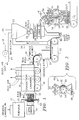
- the manufacturing system 10 for producing a glass-like mineral fiber begins with a cupola furnace 11 at the left-hand side of the figure.
- Furnace 11 has an outlet 12 that feeds a spinning and attenuating mechanism 14 actuated by a spin drive 13.
- Spinning mechanism 14 extends to a collection chamber 15 that includes the upper or transport level of a conveyor belt 16.
- Collection chamber 15 is equipped with one or more exhaust fans 17. The direction of air flow in the collection chamber is controlled in part by a seal roll 18 located at the outlet of the collection chamber.
- separator 25 is assumed to be a conventional cyclone or centrifugal separator. Separator 25 has a central connection to an outlet duct 26 and an exhaust fan 27 for the purpose of removing dust and excess air from the separator.
- Prills or pellets of a given size are passed from screen unit 29 to the input of an acceleration station 30 which has an external housing 31 and two driven acceleration rolls 32 and 33.
- Rolls 32 and 33 are each provided with a series of vanes or teeth 34; the two rolls are aligned with each other in the central portion of housing 31, separated by a nip or acceleration passage 35. If each of the nodules entering station 30 has a maximum cross-sectional dimension X, the width of the acceleration passage 35 should be no smaller than X and preferably should be substantially larger than X.
- Rolls 32 and 33 need not be driven at the same rotational speed; it may be advantageous to drive these rolls at markedly different peripheral speeds.
- the fibrous material is transferred to an output conveyor 40 for movement to appropriate packaging equipment.
- the initial operation is the melting of a mineral charge in furnace 11.
- that mineral charge may comprise igneous rock or basalt, slag from a steel blast furnace or other metal-working furnace, or the byproducts of a phosphate process.
- the molten mineral material is discharged from furnace 11 as a stream 44 through the furnace outlet 12 and into spinning mechanism 14.
- the spinning mechanism the molten material output from furnace 11 is first spun into raw fiber, after which it is collected on conveyor belt 16 in the bottom of collection chamber 15, appearing as a fiber blanket 19 at the output of the collection chamber.
- Seal roll 18 inhibits entry of air into collection chamber 15 through the chamber outlet.
- cooling of the raw fiber begins as it enters the collection chamber from spinning mechanism 14, and cooling continues until the fiber blanket 19 leaves the collection chamber.
- the temperature of the hot air output from the discharge fan 17 is usually of the order of 90 to 120°C (200 to 250°F); the entry temperature for the raw fiber passing into collection chamber 15 is very much higher.
- molten mineral material As the molten mineral material is discharged from outlet 12 of furnace 11 and is spun and stretched (attenuated) into the fibrous material supplied to collection chamber 15 by mechanism 14, a number of small, shot-like elements 45 tend to form and drop out of the system. These spherical elements 45 are not impurities, nor are they granules in the molten stream 44.
- the molten material of stream 45 has a high surface tension and low viscosity, characteristics that make it prone to assume a configuration with the smallest surface area to mass (i.e., spherical) during attenuation in mechanism 14.
- the shot-like material 45 represents waste in the overall operation of system 10, but it can be and usually is recycled to the input of furnace 11.
- the fibrous blanket 19 that constitutes the output from collection chamber 15 is supplied to granulator 21, where it is chopped or otherwise broken up into relatively small segments usually having maximum dimensions ranging from two inches to six inches. There is still some shot-like waste trapped in the fibrous material at this point and some of that waste passes out over the head pulley of conveyor 22 as the shot drop out 46.
- the fibrous segments themselves which may still contain some shot waste, are airlifted through conduit 24 and deposited in the input of the centrifugal separator 25.
- the dust and air are removed from the separator by fan 27, through conduit 26.
- the mineral fiber material itself passes down through a rotary air seal rolls 28 to screen unit 29. Again, there is some shot-like waste output from the screen unit.
- the waste from this source and from conveyor 22, shown at 46, can be recycled.
- the output from screen unit 29, which is to say the input to acceleration station 30, is the multiplicity of tightly clumped or entangled small prills or pellets of fiber material referred to above. This is usually the form of the mineral fiber material that is available for industrial use. Acceleration station 30 converts that mineral fiber material to more usable, and hence more valuble, form.
- Acceleration station 30 as shown in Fig. 1, includes an external housing 31 in which the two multi-vaned or toothed acceleration rolls 32 and 33 are mounted in parallel relation to each other, separated by the acceleration passage or nip 35.
- Pellets 37 in the illustrated apparatus, fall at a moderate speed, under the influence of gravity, into the top of housing 31. But rolls 32 and 33 are rotatably driven at a high speed.
- the stress on each pellet exceeds its internal bond strength and the pellet shreds into an open flake-like structure.
- the fibrous material formed by these shredded pellets is then collected and packaged in conventional equipment, ready for sale and subsequent industrial use.
- Fig. 2 illustrates another acceleration station 50 that can be used as the final stage of system 10 instead of the previously described station 30.
- acceleration station 50 includes only one acceleration roll 52 provided with a series of teeth or vanes 54.
- Acceleration roll 52 is mounted within a housing 51 that has an acceleration passage 55 around one side of the acceleration roll.
- Pellets 57 of fibrous mineral material dropping at a moderate speed into housing 51 of station 50 are greatly accelerated and subjected to substantial stress by the vanes or teeth 54 on roll 52. This stress causes them to shred and fall out of stage 50 in the form of shredded flake-like mineral fiber elements 59 that are ready for industrial use and can be packaged for that purpose.
- shredding is effected by acceleration stress, not impact.
- a Kirshner beater as used in some textile installations can be employed; the usual input nip or feed rolls are preferably omitted.
- the reason for elimination of the feed rolls in the Kirshner beater is due to the differences between conventional textile fibers and the glass-like mineral fibers produced in system 10.
- the mineral fibers have substantially shorter lengths and materially different aspect ratios than ordinary textile fibers.
- Other kinds of textile equipment also requiring some modification in most instances, can be used for the acceleration stage at the output of system 10; these include two beater shredders, which are generally similar to the dual acceleration rolls in station 30 of Fig. 1, and bar pickers, which more closely resemble the single roll acceleration station 50 of Fig. 2. In both instances, input or feed rolls should be eliminated.
- the mineral fiber product from an apparatus like system 10 is substantially more valuable than mineral fiber as produced by more conventional systems.
- the reason for the higher value is that the loose, shredded fibers that constitute the output of the system can be more readily dispersed in viscous liquids or in dry power formulations than is possible with previously known mineral fiber products. Consequently, the mineral fiber output from system 10 and its modifications can be incorporated in a substantially greater variety of new and existing product lines.
Landscapes
- Engineering & Computer Science (AREA)
- Chemical & Material Sciences (AREA)
- Life Sciences & Earth Sciences (AREA)
- General Life Sciences & Earth Sciences (AREA)
- Geochemistry & Mineralogy (AREA)
- Manufacturing & Machinery (AREA)
- Materials Engineering (AREA)
- Organic Chemistry (AREA)
- Inorganic Fibers (AREA)
- Glass Compositions (AREA)
- Nonwoven Fabrics (AREA)
- Manufacture, Treatment Of Glass Fibers (AREA)
Applications Claiming Priority (2)
| Application Number | Priority Date | Filing Date | Title |
|---|---|---|---|
| US121524 | 1987-11-17 | ||
| US08/121,524 US5352260A (en) | 1993-09-16 | 1993-09-16 | Manufacture of mineral fiber |
Publications (2)
| Publication Number | Publication Date |
|---|---|
| EP0644163A1 EP0644163A1 (en) | 1995-03-22 |
| EP0644163B1 true EP0644163B1 (en) | 1998-01-14 |
Family
ID=22397240
Family Applications (1)
| Application Number | Title | Priority Date | Filing Date |
|---|---|---|---|
| EP94113815A Expired - Lifetime EP0644163B1 (en) | 1993-09-16 | 1994-09-02 | Manufacture of mineral fiber |
Country Status (6)
| Country | Link |
|---|---|
| US (1) | US5352260A (enExample) |
| EP (1) | EP0644163B1 (enExample) |
| JP (1) | JP3290033B2 (enExample) |
| KR (1) | KR100319265B1 (enExample) |
| CA (1) | CA2117388C (enExample) |
| DE (1) | DE69407906T2 (enExample) |
Families Citing this family (11)
| Publication number | Priority date | Publication date | Assignee | Title |
|---|---|---|---|---|
| US5772126A (en) * | 1996-11-06 | 1998-06-30 | Ppg Industries, Inc. | System and process for recycling waste material produced by a glass fiberizing process |
| US6199778B1 (en) | 1996-11-06 | 2001-03-13 | Ppg Industries Ohio, Inc. | Systems and processes for recycling glass fiber waste material into glass fiber product |
| US5961686A (en) | 1997-08-25 | 1999-10-05 | Guardian Fiberglass, Inc. | Side-discharge melter for use in the manufacture of fiberglass |
| US20060042319A1 (en) * | 2002-11-06 | 2006-03-02 | Rockwool International A/S | Method for preparing a mineral melt |
| US8806900B2 (en) * | 2005-04-04 | 2014-08-19 | Reforcetech As | Ceramic bushing/s consisting local heating/s integrated in apparatus for manufacturing mineral/basalt fibers |
| US20080179779A1 (en) * | 2006-01-26 | 2008-07-31 | Rock Fiber Technology, Inc. | Process For Producing Chopped Rock Fibers |
| ES2992152T3 (es) * | 2011-09-30 | 2024-12-09 | Owens Corning Intellectual Capital Llc | Método para formar una trama a partir de materiales fibrosos |
| US12590393B2 (en) | 2011-09-30 | 2026-03-31 | Owens Corning Intellectual Capital, Llc | Method of forming a web from fibrous materials |
| PL414330A1 (pl) | 2015-10-09 | 2017-04-10 | Flis Stanisław Przedsiębiorstwo Budowlano-Montażowe Flisbud | Sposób wytwarzania proszku bazaltowego, włókna bazaltowego i innych wyrobów kształtowych |
| JP7633638B2 (ja) * | 2020-08-14 | 2025-02-20 | 新日本繊維株式会社 | フレーク状組成物、フレーク状組成物の製造方法 |
| CN120759051A (zh) * | 2025-09-09 | 2025-10-10 | 交城义望铁合金节能环保科技有限责任公司 | 一种粒状棉生产用集棉机 |
Family Cites Families (10)
| Publication number | Priority date | Publication date | Assignee | Title |
|---|---|---|---|---|
| GB458292A (en) * | 1935-11-29 | 1936-12-16 | Fitger California Company | Machine for opening and cleaning wool and other like fibres and materials |
| US2375284A (en) * | 1942-01-28 | 1945-05-08 | Johns Manville | Method of making mineral wool products |
| US3469961A (en) * | 1966-08-25 | 1969-09-30 | United States Steel Corp | Method and apparatus for making slag pellets |
| JPS5857536B2 (ja) * | 1977-03-14 | 1983-12-20 | セントラル硝子株式会社 | 繊維塊状体の製造装置 |
| US4296164A (en) * | 1978-08-04 | 1981-10-20 | Owens-Corning Fiberglas Corporation | Fibrous glass blowing insulation and process |
| US4244720A (en) * | 1978-11-08 | 1981-01-13 | Johns-Manville Corporation | Fiber waste and cullet collection process and apparatus therefor |
| SE441523C (sv) * | 1980-02-22 | 1987-01-19 | Laxa Bruks Ab | Metod och anordning for uppsamling av mineralfibrer som bildas genom fibrering av en mineralsmelta |
| DE3205108C2 (de) * | 1982-02-12 | 1984-03-29 | Grünzweig + Hartmann und Glasfaser AG, 6700 Ludwigshafen | Verfahren zur Erzeugung eines Mineralfasergemisches mit einer vorgegebenen Längenverteilung der Fasern |
| JPS62294139A (ja) * | 1986-06-11 | 1987-12-21 | Nippon Jiryoku Senko Kk | ダスト、スラツジと製鋼スラグの同時処理方法 |
| DE4021329A1 (de) * | 1990-07-03 | 1992-01-16 | Kuettner Gmbh & Co Kg Dr | Verfahren und vorrichtung zum aufbereiten heisser, fluessiger schlacke |
-
1993
- 1993-09-16 US US08/121,524 patent/US5352260A/en not_active Expired - Lifetime
-
1994
- 1994-07-07 CA CA002117388A patent/CA2117388C/en not_active Expired - Fee Related
- 1994-09-02 EP EP94113815A patent/EP0644163B1/en not_active Expired - Lifetime
- 1994-09-02 DE DE69407906T patent/DE69407906T2/de not_active Expired - Lifetime
- 1994-09-03 KR KR1019940022165A patent/KR100319265B1/ko not_active Expired - Fee Related
- 1994-09-16 JP JP22169294A patent/JP3290033B2/ja not_active Expired - Fee Related
Also Published As
| Publication number | Publication date |
|---|---|
| KR100319265B1 (ko) | 2002-04-06 |
| JPH07149531A (ja) | 1995-06-13 |
| CA2117388A1 (en) | 1995-03-17 |
| US5352260A (en) | 1994-10-04 |
| JP3290033B2 (ja) | 2002-06-10 |
| KR950009295A (ko) | 1995-04-21 |
| CA2117388C (en) | 1999-06-22 |
| EP0644163A1 (en) | 1995-03-22 |
| DE69407906T2 (de) | 1998-07-09 |
| DE69407906D1 (de) | 1998-02-19 |
Similar Documents
| Publication | Publication Date | Title |
|---|---|---|
| US5352260A (en) | Manufacture of mineral fiber | |
| US2474314A (en) | Method and apparatus for size reduction and fiberizing of crude fibrous materials | |
| JP3294241B2 (ja) | 混合廃棄物を処理するための方法、および、この方法を実施する処理プラント | |
| US4353725A (en) | Process and apparatus for recycling scrap glass | |
| CA1207279A (en) | Apparatus and method for producing shot-free mineral wool | |
| CN1120332A (zh) | 用废玻璃制造纤维的方法和装置 | |
| DE69104783T2 (de) | Verfahren zum Herstellen von Mineralfasern. | |
| CA1059964A (en) | Installation for separating a heterogeneous product into two fractions | |
| FI104249B (fi) | Menetelmä ja laite lasimurskan esikuumentamiseksi ja saaste-emissioiden vähentämiseksi lasinvalmistusprosessissa | |
| JPH07149531A5 (enExample) | ||
| CN113847789A (zh) | 用于防止钛精矿板结的吹扫干燥系统及其工艺方法 | |
| US4362543A (en) | Method for controlling particulate emissions | |
| EP0027021A1 (en) | Apparatus for disintegrating foam plastics | |
| US2739708A (en) | Separatory apparatus for concentrating asbestos fibers | |
| CA2099651A1 (en) | Apparatus for and a method of disposing of wet sludge | |
| US3336125A (en) | Apparatus for shredding molten mineral materials into fibers | |
| US2280902A (en) | Opening and cleansing of asbestos fibrous material | |
| SU1528556A1 (ru) | Устройство дл распушки асбестового волокна | |
| CZ189697A3 (cs) | Způsob mechanického čištění prášku a zařízení k provádění tohoto způsobu | |
| CA1271038A (en) | Apparatus for the production of mineral fibers having supplemental collection chamber exhaust | |
| US2825933A (en) | Fiber treating method and apparatus | |
| US3580537A (en) | Process for dressing asbestos ore waste | |
| SU1207528A1 (ru) | Устройство дл разделени сыпучих материалов | |
| SU1364378A1 (ru) | Установка дл разделени не св занных между собой материалов луба и бересты | |
| CN111715381B (zh) | 碎玻璃自动粉碎筛分装置 |
Legal Events
| Date | Code | Title | Description |
|---|---|---|---|
| PUAI | Public reference made under article 153(3) epc to a published international application that has entered the european phase |
Free format text: ORIGINAL CODE: 0009012 |
|
| AK | Designated contracting states |
Kind code of ref document: A1 Designated state(s): BE DE FR GB NL SE |
|
| RAP1 | Party data changed (applicant data changed or rights of an application transferred) |
Owner name: FIBROX TECHNOLOGY LTD. |
|
| 17P | Request for examination filed |
Effective date: 19950519 |
|
| 17Q | First examination report despatched |
Effective date: 19970120 |
|
| GRAG | Despatch of communication of intention to grant |
Free format text: ORIGINAL CODE: EPIDOS AGRA |
|
| GRAG | Despatch of communication of intention to grant |
Free format text: ORIGINAL CODE: EPIDOS AGRA |
|
| GRAH | Despatch of communication of intention to grant a patent |
Free format text: ORIGINAL CODE: EPIDOS IGRA |
|
| RAP1 | Party data changed (applicant data changed or rights of an application transferred) |
Owner name: FIBROX TECHNOLOGY LTD. |
|
| GRAH | Despatch of communication of intention to grant a patent |
Free format text: ORIGINAL CODE: EPIDOS IGRA |
|
| GRAA | (expected) grant |
Free format text: ORIGINAL CODE: 0009210 |
|
| AK | Designated contracting states |
Kind code of ref document: B1 Designated state(s): BE DE FR GB NL SE |
|
| ET | Fr: translation filed | ||
| REF | Corresponds to: |
Ref document number: 69407906 Country of ref document: DE Date of ref document: 19980219 |
|
| PLBQ | Unpublished change to opponent data |
Free format text: ORIGINAL CODE: EPIDOS OPPO |
|
| PLBI | Opposition filed |
Free format text: ORIGINAL CODE: 0009260 |
|
| PLBF | Reply of patent proprietor to notice(s) of opposition |
Free format text: ORIGINAL CODE: EPIDOS OBSO |
|
| 26 | Opposition filed |
Opponent name: ROCKWOOL INTERNATIONAL A/S Effective date: 19981012 |
|
| NLR1 | Nl: opposition has been filed with the epo |
Opponent name: ROCKWOOL INTERNATIONAL A/S |
|
| PLBF | Reply of patent proprietor to notice(s) of opposition |
Free format text: ORIGINAL CODE: EPIDOS OBSO |
|
| PLBF | Reply of patent proprietor to notice(s) of opposition |
Free format text: ORIGINAL CODE: EPIDOS OBSO |
|
| PLBO | Opposition rejected |
Free format text: ORIGINAL CODE: EPIDOS REJO |
|
| PLBN | Opposition rejected |
Free format text: ORIGINAL CODE: 0009273 |
|
| STAA | Information on the status of an ep patent application or granted ep patent |
Free format text: STATUS: OPPOSITION REJECTED |
|
| 27O | Opposition rejected |
Effective date: 20000417 |
|
| NLR2 | Nl: decision of opposition | ||
| REG | Reference to a national code |
Ref country code: GB Ref legal event code: IF02 |
|
| PGFP | Annual fee paid to national office [announced via postgrant information from national office to epo] |
Ref country code: NL Payment date: 20090924 Year of fee payment: 16 Ref country code: GB Payment date: 20090929 Year of fee payment: 16 |
|
| PGFP | Annual fee paid to national office [announced via postgrant information from national office to epo] |
Ref country code: SE Payment date: 20090929 Year of fee payment: 16 Ref country code: DE Payment date: 20090929 Year of fee payment: 16 |
|
| PGFP | Annual fee paid to national office [announced via postgrant information from national office to epo] |
Ref country code: BE Payment date: 20091026 Year of fee payment: 16 |
|
| BERE | Be: lapsed |
Owner name: *FIBROX TECHNOLOGY LTD Effective date: 20100930 |
|
| REG | Reference to a national code |
Ref country code: NL Ref legal event code: V1 Effective date: 20110401 |
|
| REG | Reference to a national code |
Ref country code: SE Ref legal event code: EUG |
|
| GBPC | Gb: european patent ceased through non-payment of renewal fee |
Effective date: 20100902 |
|
| REG | Reference to a national code |
Ref country code: FR Ref legal event code: ST Effective date: 20110531 |
|
| REG | Reference to a national code |
Ref country code: DE Ref legal event code: R119 Ref document number: 69407906 Country of ref document: DE Effective date: 20110401 |
|
| PG25 | Lapsed in a contracting state [announced via postgrant information from national office to epo] |
Ref country code: FR Free format text: LAPSE BECAUSE OF NON-PAYMENT OF DUE FEES Effective date: 20100930 Ref country code: BE Free format text: LAPSE BECAUSE OF NON-PAYMENT OF DUE FEES Effective date: 20100930 Ref country code: DE Free format text: LAPSE BECAUSE OF NON-PAYMENT OF DUE FEES Effective date: 20110401 |
|
| PG25 | Lapsed in a contracting state [announced via postgrant information from national office to epo] |
Ref country code: NL Free format text: LAPSE BECAUSE OF NON-PAYMENT OF DUE FEES Effective date: 20110401 Ref country code: GB Free format text: LAPSE BECAUSE OF NON-PAYMENT OF DUE FEES Effective date: 20100902 |
|
| PGFP | Annual fee paid to national office [announced via postgrant information from national office to epo] |
Ref country code: FR Payment date: 20091006 Year of fee payment: 16 |
|
| PG25 | Lapsed in a contracting state [announced via postgrant information from national office to epo] |
Ref country code: SE Free format text: LAPSE BECAUSE OF NON-PAYMENT OF DUE FEES Effective date: 20100903 |