EP0642556B1 - Liquid crystal polymer blends, process for the preparation thereof and products manufactured from the blends - Google Patents
Liquid crystal polymer blends, process for the preparation thereof and products manufactured from the blends Download PDFInfo
- Publication number
- EP0642556B1 EP0642556B1 EP93910062A EP93910062A EP0642556B1 EP 0642556 B1 EP0642556 B1 EP 0642556B1 EP 93910062 A EP93910062 A EP 93910062A EP 93910062 A EP93910062 A EP 93910062A EP 0642556 B1 EP0642556 B1 EP 0642556B1
- Authority
- EP
- European Patent Office
- Prior art keywords
- polymer
- weight
- blend
- liquid crystalline
- lcp
- Prior art date
- Legal status (The legal status is an assumption and is not a legal conclusion. Google has not performed a legal analysis and makes no representation as to the accuracy of the status listed.)
- Expired - Lifetime
Links
- 229920000106 Liquid crystal polymer Polymers 0.000 title claims abstract description 160
- 239000000203 mixture Substances 0.000 title claims abstract description 138
- 238000000034 method Methods 0.000 title claims abstract description 17
- 230000008569 process Effects 0.000 title claims abstract description 13
- 238000002360 preparation method Methods 0.000 title abstract description 4
- 239000004977 Liquid-crystal polymers (LCPs) Substances 0.000 title description 2
- 229920000642 polymer Polymers 0.000 claims abstract description 67
- 239000011159 matrix material Substances 0.000 claims abstract description 49
- 229920002959 polymer blend Polymers 0.000 claims abstract description 35
- 229920000098 polyolefin Polymers 0.000 claims abstract description 18
- 239000000126 substance Substances 0.000 claims abstract description 16
- 125000000524 functional group Chemical group 0.000 claims abstract description 13
- 229920000728 polyester Polymers 0.000 claims abstract description 9
- VOZRXNHHFUQHIL-UHFFFAOYSA-N glycidyl methacrylate Chemical compound CC(=C)C(=O)OCC1CO1 VOZRXNHHFUQHIL-UHFFFAOYSA-N 0.000 claims abstract description 8
- 238000004519 manufacturing process Methods 0.000 claims abstract description 8
- 229920001935 styrene-ethylene-butadiene-styrene Polymers 0.000 claims abstract description 8
- 239000007788 liquid Substances 0.000 claims abstract description 7
- FPYJFEHAWHCUMM-UHFFFAOYSA-N maleic anhydride Chemical compound O=C1OC(=O)C=C1 FPYJFEHAWHCUMM-UHFFFAOYSA-N 0.000 claims abstract description 7
- 230000003287 optical effect Effects 0.000 claims abstract description 4
- 239000004743 Polypropylene Substances 0.000 claims description 64
- 229920001155 polypropylene Polymers 0.000 claims description 64
- -1 poly(butylene terephthalate) Polymers 0.000 claims description 49
- 229920000139 polyethylene terephthalate Polymers 0.000 claims description 34
- 239000005020 polyethylene terephthalate Substances 0.000 claims description 34
- 229920001169 thermoplastic Polymers 0.000 claims description 29
- 229920001577 copolymer Polymers 0.000 claims description 18
- 238000002156 mixing Methods 0.000 claims description 16
- 229920001897 terpolymer Polymers 0.000 claims description 16
- 230000000875 corresponding effect Effects 0.000 claims description 11
- 239000000155 melt Substances 0.000 claims description 11
- FJKROLUGYXJWQN-UHFFFAOYSA-N 4-hydroxybenzoic acid Chemical compound OC(=O)C1=CC=C(O)C=C1 FJKROLUGYXJWQN-UHFFFAOYSA-N 0.000 claims description 9
- 125000003700 epoxy group Chemical group 0.000 claims description 9
- 238000001125 extrusion Methods 0.000 claims description 9
- VGGSQFUCUMXWEO-UHFFFAOYSA-N Ethene Chemical compound C=C VGGSQFUCUMXWEO-UHFFFAOYSA-N 0.000 claims description 8
- 239000005977 Ethylene Substances 0.000 claims description 8
- 238000002347 injection Methods 0.000 claims description 8
- 239000007924 injection Substances 0.000 claims description 8
- 238000012545 processing Methods 0.000 claims description 8
- UPHOPMSGKZNELG-UHFFFAOYSA-N 2-hydroxynaphthalene-1-carboxylic acid Chemical compound C1=CC=C2C(C(=O)O)=C(O)C=CC2=C1 UPHOPMSGKZNELG-UHFFFAOYSA-N 0.000 claims description 6
- 239000004698 Polyethylene Substances 0.000 claims description 5
- 229920001707 polybutylene terephthalate Polymers 0.000 claims description 5
- 229920000573 polyethylene Polymers 0.000 claims description 5
- 230000001737 promoting effect Effects 0.000 claims description 5
- RTZKZFJDLAIYFH-UHFFFAOYSA-N Diethyl ether Chemical compound CCOCC RTZKZFJDLAIYFH-UHFFFAOYSA-N 0.000 claims description 4
- 150000008064 anhydrides Chemical class 0.000 claims description 4
- 229920000515 polycarbonate Polymers 0.000 claims description 4
- 239000004417 polycarbonate Substances 0.000 claims description 4
- 230000007717 exclusion Effects 0.000 claims description 3
- 150000002148 esters Chemical class 0.000 claims description 2
- 239000000835 fiber Substances 0.000 claims description 2
- 229920003055 poly(ester-imide) Polymers 0.000 claims description 2
- LLLVZDVNHNWSDS-UHFFFAOYSA-N 4-methylidene-3,5-dioxabicyclo[5.2.2]undeca-1(9),7,10-triene-2,6-dione Chemical compound C1(C2=CC=C(C(=O)OC(=C)O1)C=C2)=O LLLVZDVNHNWSDS-UHFFFAOYSA-N 0.000 claims 1
- 125000003118 aryl group Chemical group 0.000 abstract description 2
- 239000004597 plastic additive Substances 0.000 abstract description 2
- 239000004416 thermosoftening plastic Substances 0.000 description 24
- 238000007792 addition Methods 0.000 description 19
- 238000012360 testing method Methods 0.000 description 18
- PPBRXRYQALVLMV-UHFFFAOYSA-N Styrene Chemical compound C=CC1=CC=CC=C1 PPBRXRYQALVLMV-UHFFFAOYSA-N 0.000 description 10
- 229920002943 EPDM rubber Polymers 0.000 description 9
- 230000006872 improvement Effects 0.000 description 7
- 230000003993 interaction Effects 0.000 description 7
- 239000000463 material Substances 0.000 description 7
- 238000001746 injection moulding Methods 0.000 description 6
- 238000006243 chemical reaction Methods 0.000 description 5
- 229920001971 elastomer Polymers 0.000 description 5
- 238000001878 scanning electron micrograph Methods 0.000 description 5
- NIXOWILDQLNWCW-UHFFFAOYSA-N acrylic acid group Chemical group C(C=C)(=O)O NIXOWILDQLNWCW-UHFFFAOYSA-N 0.000 description 4
- 239000000654 additive Substances 0.000 description 4
- 230000000694 effects Effects 0.000 description 4
- 239000005060 rubber Substances 0.000 description 4
- 239000002253 acid Substances 0.000 description 3
- 125000003178 carboxy group Chemical group [H]OC(*)=O 0.000 description 3
- 150000001875 compounds Chemical class 0.000 description 3
- 239000006185 dispersion Substances 0.000 description 3
- 229920001519 homopolymer Polymers 0.000 description 3
- 238000001000 micrograph Methods 0.000 description 3
- 239000004033 plastic Substances 0.000 description 3
- 229920003023 plastic Polymers 0.000 description 3
- 230000002787 reinforcement Effects 0.000 description 3
- 238000000518 rheometry Methods 0.000 description 3
- 229920006132 styrene block copolymer Polymers 0.000 description 3
- RRHGJUQNOFWUDK-UHFFFAOYSA-N Isoprene Chemical compound CC(=C)C=C RRHGJUQNOFWUDK-UHFFFAOYSA-N 0.000 description 2
- OFOBLEOULBTSOW-UHFFFAOYSA-N Malonic acid Chemical compound OC(=O)CC(O)=O OFOBLEOULBTSOW-UHFFFAOYSA-N 0.000 description 2
- 239000004793 Polystyrene Substances 0.000 description 2
- 229920001400 block copolymer Polymers 0.000 description 2
- 238000012937 correction Methods 0.000 description 2
- 230000003247 decreasing effect Effects 0.000 description 2
- 238000001035 drying Methods 0.000 description 2
- 238000005516 engineering process Methods 0.000 description 2
- 235000012438 extruded product Nutrition 0.000 description 2
- 239000000945 filler Substances 0.000 description 2
- 125000002887 hydroxy group Chemical group [H]O* 0.000 description 2
- 238000011065 in-situ storage Methods 0.000 description 2
- 239000002245 particle Substances 0.000 description 2
- 239000008188 pellet Substances 0.000 description 2
- 238000013001 point bending Methods 0.000 description 2
- 229920002223 polystyrene Polymers 0.000 description 2
- 239000002990 reinforced plastic Substances 0.000 description 2
- XLYOFNOQVPJJNP-UHFFFAOYSA-N water Substances O XLYOFNOQVPJJNP-UHFFFAOYSA-N 0.000 description 2
- 229940090248 4-hydroxybenzoic acid Drugs 0.000 description 1
- 229920013683 Celanese Polymers 0.000 description 1
- 239000004150 EU approved colour Substances 0.000 description 1
- 239000004593 Epoxy Substances 0.000 description 1
- JIGUQPWFLRLWPJ-UHFFFAOYSA-N Ethyl acrylate Chemical compound CCOC(=O)C=C JIGUQPWFLRLWPJ-UHFFFAOYSA-N 0.000 description 1
- 229920002633 Kraton (polymer) Polymers 0.000 description 1
- 229920002367 Polyisobutene Polymers 0.000 description 1
- NINIDFKCEFEMDL-UHFFFAOYSA-N Sulfur Chemical group [S] NINIDFKCEFEMDL-UHFFFAOYSA-N 0.000 description 1
- RAHZWNYVWXNFOC-UHFFFAOYSA-N Sulphur dioxide Chemical group O=S=O RAHZWNYVWXNFOC-UHFFFAOYSA-N 0.000 description 1
- 125000001931 aliphatic group Chemical group 0.000 description 1
- 125000002947 alkylene group Chemical group 0.000 description 1
- 239000000956 alloy Substances 0.000 description 1
- 229910045601 alloy Inorganic materials 0.000 description 1
- 239000002216 antistatic agent Substances 0.000 description 1
- 125000002029 aromatic hydrocarbon group Chemical group 0.000 description 1
- QVGXLLKOCUKJST-UHFFFAOYSA-N atomic oxygen Chemical group [O] QVGXLLKOCUKJST-UHFFFAOYSA-N 0.000 description 1
- 230000004888 barrier function Effects 0.000 description 1
- 238000010923 batch production Methods 0.000 description 1
- FFBHFFJDDLITSX-UHFFFAOYSA-N benzyl N-[2-hydroxy-4-(3-oxomorpholin-4-yl)phenyl]carbamate Chemical compound OC1=C(NC(=O)OCC2=CC=CC=C2)C=CC(=C1)N1CCOCC1=O FFBHFFJDDLITSX-UHFFFAOYSA-N 0.000 description 1
- MTAZNLWOLGHBHU-UHFFFAOYSA-N butadiene-styrene rubber Chemical compound C=CC=C.C=CC1=CC=CC=C1 MTAZNLWOLGHBHU-UHFFFAOYSA-N 0.000 description 1
- 125000002915 carbonyl group Chemical group [*:2]C([*:1])=O 0.000 description 1
- 238000012512 characterization method Methods 0.000 description 1
- 239000003795 chemical substances by application Substances 0.000 description 1
- 238000000576 coating method Methods 0.000 description 1
- 230000001143 conditioned effect Effects 0.000 description 1
- 238000010924 continuous production Methods 0.000 description 1
- 239000013078 crystal Substances 0.000 description 1
- 230000003292 diminished effect Effects 0.000 description 1
- 150000002009 diols Chemical class 0.000 description 1
- 238000006073 displacement reaction Methods 0.000 description 1
- 239000000806 elastomer Substances 0.000 description 1
- 125000004185 ester group Chemical group 0.000 description 1
- 229920006242 ethylene acrylic acid copolymer Polymers 0.000 description 1
- 239000003063 flame retardant Substances 0.000 description 1
- 239000012530 fluid Substances 0.000 description 1
- 239000011521 glass Substances 0.000 description 1
- 229920001112 grafted polyolefin Polymers 0.000 description 1
- 150000002430 hydrocarbons Chemical group 0.000 description 1
- 230000001771 impaired effect Effects 0.000 description 1
- 238000010102 injection blow moulding Methods 0.000 description 1
- 239000000314 lubricant Substances 0.000 description 1
- VZCYOOQTPOCHFL-UPHRSURJSA-N maleic acid Chemical compound OC(=O)\C=C/C(O)=O VZCYOOQTPOCHFL-UPHRSURJSA-N 0.000 description 1
- 239000011976 maleic acid Substances 0.000 description 1
- 238000005259 measurement Methods 0.000 description 1
- 238000002844 melting Methods 0.000 description 1
- 230000008018 melting Effects 0.000 description 1
- 239000000178 monomer Substances 0.000 description 1
- 229940006093 opthalmologic coloring agent diagnostic Drugs 0.000 description 1
- 229910052760 oxygen Inorganic materials 0.000 description 1
- 239000001301 oxygen Substances 0.000 description 1
- PNJWIWWMYCMZRO-UHFFFAOYSA-N pent‐4‐en‐2‐one Natural products CC(=O)CC=C PNJWIWWMYCMZRO-UHFFFAOYSA-N 0.000 description 1
- 230000035699 permeability Effects 0.000 description 1
- 239000000049 pigment Substances 0.000 description 1
- 229920000058 polyacrylate Polymers 0.000 description 1
- 229920001748 polybutylene Polymers 0.000 description 1
- 239000002861 polymer material Substances 0.000 description 1
- QQONPFPTGQHPMA-UHFFFAOYSA-N propylene Natural products CC=C QQONPFPTGQHPMA-UHFFFAOYSA-N 0.000 description 1
- 125000004805 propylene group Chemical group [H]C([H])([H])C([H])([*:1])C([H])([H])[*:2] 0.000 description 1
- 230000009257 reactivity Effects 0.000 description 1
- 230000003014 reinforcing effect Effects 0.000 description 1
- 239000007787 solid Substances 0.000 description 1
- 239000003381 stabilizer Substances 0.000 description 1
- 229920002725 thermoplastic elastomer Polymers 0.000 description 1
- VZCYOOQTPOCHFL-UHFFFAOYSA-N trans-butenedioic acid Natural products OC(=O)C=CC(O)=O VZCYOOQTPOCHFL-UHFFFAOYSA-N 0.000 description 1
- 125000000391 vinyl group Chemical group [H]C([*])=C([H])[H] 0.000 description 1
- 229920002554 vinyl polymer Polymers 0.000 description 1
- 230000003313 weakening effect Effects 0.000 description 1
- 125000006839 xylylene group Chemical group 0.000 description 1
Images


Classifications
-
- C—CHEMISTRY; METALLURGY
- C08—ORGANIC MACROMOLECULAR COMPOUNDS; THEIR PREPARATION OR CHEMICAL WORKING-UP; COMPOSITIONS BASED THEREON
- C08L—COMPOSITIONS OF MACROMOLECULAR COMPOUNDS
- C08L67/00—Compositions of polyesters obtained by reactions forming a carboxylic ester link in the main chain; Compositions of derivatives of such polymers
- C08L67/02—Polyesters derived from dicarboxylic acids and dihydroxy compounds
-
- C—CHEMISTRY; METALLURGY
- C08—ORGANIC MACROMOLECULAR COMPOUNDS; THEIR PREPARATION OR CHEMICAL WORKING-UP; COMPOSITIONS BASED THEREON
- C08L—COMPOSITIONS OF MACROMOLECULAR COMPOUNDS
- C08L101/00—Compositions of unspecified macromolecular compounds
-
- C—CHEMISTRY; METALLURGY
- C08—ORGANIC MACROMOLECULAR COMPOUNDS; THEIR PREPARATION OR CHEMICAL WORKING-UP; COMPOSITIONS BASED THEREON
- C08L—COMPOSITIONS OF MACROMOLECULAR COMPOUNDS
- C08L23/00—Compositions of homopolymers or copolymers of unsaturated aliphatic hydrocarbons having only one carbon-to-carbon double bond; Compositions of derivatives of such polymers
- C08L23/02—Compositions of homopolymers or copolymers of unsaturated aliphatic hydrocarbons having only one carbon-to-carbon double bond; Compositions of derivatives of such polymers not modified by chemical after-treatment
-
- C—CHEMISTRY; METALLURGY
- C08—ORGANIC MACROMOLECULAR COMPOUNDS; THEIR PREPARATION OR CHEMICAL WORKING-UP; COMPOSITIONS BASED THEREON
- C08L—COMPOSITIONS OF MACROMOLECULAR COMPOUNDS
- C08L2205/00—Polymer mixtures characterised by other features
- C08L2205/12—Polymer mixtures characterised by other features containing additives being liquid crystalline or anisotropic in the melt
-
- C—CHEMISTRY; METALLURGY
- C08—ORGANIC MACROMOLECULAR COMPOUNDS; THEIR PREPARATION OR CHEMICAL WORKING-UP; COMPOSITIONS BASED THEREON
- C08L—COMPOSITIONS OF MACROMOLECULAR COMPOUNDS
- C08L67/00—Compositions of polyesters obtained by reactions forming a carboxylic ester link in the main chain; Compositions of derivatives of such polymers
- C08L67/04—Polyesters derived from hydroxycarboxylic acids, e.g. lactones
Definitions
- the present invention concerns a liquid crystalline blend according to the preamble of claim 1.
- This kind of a blend comprises a polymer matrix and a liquid crystalline polymer.
- the blend further contains a substance which enhances the compatibility of the polymer matrix and the liquid crystalline polymer.
- the invention also relates to a process according to the preamble of claim 13 for preparing liquid crystalline polymer blends and to products according to claims 18 and 19, which essentially consist of said polymer blends.
- Liquid crystalline polymers are polymers which in melt state lie between the boundaries of solid substances and liquids.
- the liquid crystalline structure is called a mesomorphic phase or an anisotropic phase because macroscopically in the melt state the liquid crystalline polymers are fluids. Microscopically they have a regular structure similar to that of crystals.
- the liquid crystalline polymers are called "thermotropic” if their anisotropy depends on the temperature only. The strength and stiffness of many thermoplastics can be substantially improved by blending them with thermotropic, main-chain liquid crystalline polymers. This is because the liquid crystalline polymers form fibres which orientate in the flow direction of the thermoplastic matrix melt.
- thermoplastic As a result there is an improvement of the mechanical properties, such as tensile strength and modulus of elasticity, of the thermoplastic in this direction.
- the addition of the liquid crystalline polymer also improves the heat resistance and dimensional stability of the thermoplastics and makes it easier to process them.
- compatibility of liquid crystalline polymers and thermoplastics and that the impact strength of blends thereof can, to some extent, be improved by adding to the blends a third component, i.e. a substance known as a compatibilizer.
- a compatibilizer a substance known as a compatibilizer.
- the task of the compatibilizer is, for instance, to diminish surface tension between the phases, to improve adhesion, and to improve dispersion.
- EP Published Patent Application No. 0 369 734 describes a polymer blend which consists of a poly(alkylene terephthalate) matrix, a polyacrylate-based liquid crystalline polymer and a substance which improves the impact strengths of the processed articles at low temperatures.
- the last-mentioned substance can be comprised of polyethylene, polypropylene, an ethylene-acrylic acid copolymer or a ethylene-propylenediene rubber.
- a compatibilized blend of a liquid crystalline polymer and polycarbonate is disclosed in the EP Published Patent Application No. 0 380 112.
- the compatibilizer used in said reference consists of a polyolefin and/or olefinic copolymers.
- the olefinic copolymers substances containing styrene monomers may be mentioned.
- the present invention aims at removing the problems relating to the prior art while providing liquid crystalline polymer blends of an entirely novel kind.
- our invention is based on the concept that the substance used for promoting the compatibility of the polymers comprises a polymer containing reactive functional groups.
- the substance used for promoting the compatibility of the polymers comprises a polymer containing reactive functional groups.
- the blend according to the invention is mainly characterized by what is stated in the characterizing part of claim 1.
- reactive compatibilizer containing functional groups denotes a polymer with at least in principle is capable of reacting with at least one of the components of the blend.
- all polymers which contain functional groups capable of reacting with the functional groups of the matrix polymer and/or the liquid crystalline polymer are considered to be reactive compatibilizers.
- the reactive functional groups of a polymer working as a compatibilizer react (or interact in some other way) with the functional groups of the liquid crystalline polymer.
- the last-mentioned groups are comprised of the free terminal groups of the polymer chain.
- the polymer chain of the compatibilizer e.g. its polyolefin residue
- the compatibilizer may react both with the matrix and with the liquid crystalline polymer because PET, for instance, is not an entire inert polymer.
- the functional groups of the compatibilizer comprise, for example, anhydride or epoxy groups.
- the polymer residue of the compatibilizer can comprise co- and terpolymers, grafted polyolefins, grafted polystyrene and thermoplastic elastomers.
- the polar groups of polyolefinic copolymers are generally acrylic esters or functional acrylic acid groups.
- the polar groups of the terpolymers can be maleic anhydride groups, hydroxyl groups and epoxy groups, of which the last-mentioned are particularly preferred.
- the styrene block copolymers are generally acrylic esters or functional acrylic acid groups.
- the polar groups of the terpolymers can be maleic anhydride groups, hydroxyl groups and epoxy groups, of which the last-mentioned are particularly preferred.
- the styrene block copolymers can consist of polystyrene segments and flexible elastomer segments.
- Typical styrene block copolymers are SBS (styrene/butadiene/styrene-copolymer), SIS (styrene/isoprene/styrene-copolymer) and SEBS (styrene/ethylene butylene/styrene-copolymer.
- the compatibilizer used is selected depending on the other components of the liquid crystalline polymer blend.
- particularly preferred compatibilizers are functional polyolefines or olefinic copolymers (including styrene), the functional groups preferably being epoxy, or anhydride groups, in particular epoxy groups and glycidyl methacrylate groups.
- the portion of functional groups in the polymer is 0.1 to 30%, preferably 10 to 10% with the proviso that if the matrix polymer comprises a polyolefin then the compatibilizer is not a maleated polyolefin.
- Liquid crystalline polymer blend means a blend in which at least one thermoplastic has been blended with at least one liquid crystalline polymer.
- the blend further contains at least one of said compatibilizers and additives, if any.
- the blending of a liquid crystalline polymer with a thermoplastic gives rise to a blend whose viscosity generally is smaller than the viscosity of the thermoplastics.
- the blend of a liquid crystalline polymer and thermoplastics can also be called an "in situ" blend because the liquid crystalline polymer fibres are formed first during processing of the blend.
- the plastic matrix stock if tie polymer blend can comprise any suitable polymer material which has the desired properties as regards strength and processability.
- the matrix polymers the following polymers may be mentioned: polyolefins such as polyethylene, polypropylene, polybutylene, polyisobutylene, poly(4-methyl-1-pentylene), including copolymers of ethylene and propylene (EPM, EPDM) and chlorinated and chlorosulphonated polyethylenes.
- the matrix polymer may also be comprised of the corresponding polyalkanes, which contain styrene, acryl, vinyl and fluorethylene groups, and different polyesters such as poly(ethylene terephthalate) and poly(butylene terephthalate) with the exclusion of polycarbonate.
- Particularly preferred matrix polymers are the polyolefins and polyesters. In the example described below polypropylene and poly(ethylene terephthalate) have been used as matrix poymers. However, equally preferred are polyethylene and poly(butylene terephthalate).
- the liquid crystalline polymer may comprise an aromatic main chain thermotropic polymer, preferably a thermotropic polyester, poly(ester amide), poly(ester ether), or poly(ester imide). It can also comprise a copolymer of a polyester, such as a copolymer of poly(ethylene terephthalate) and hydroxy benzoic acid or a copolymer of hydroxynaphthoic acid and hydroxybenzoic acid.
- the liquid crystalline polymer can be defined as a polymer which is formed when the components of the following general formulas (or at least two of them) are reacted with each other: a dicarboxylic acid of formula HOOC-R 1 -COOH, a diol of formula HO-R 2 -OH, and a oxycarboxylic acid of formula HO-R 3 -COOH, wherein R 1 , R 2 and R 3 represent a bivalent aromatic hydrocarbon group, a group of formula R 4 -X-R 5 , wherein R 4 and R 5 represent a bivalent hydrocarbon group and X is an oxygen or a sulphur atom, a sulphonyl, carbonyl, alkylene, or ester group or X is a single bond, a xylylene group or a bivalent aliphatic hydrocarbon group.
- the liquid crystalline polymer can also comprise a homopolymer of an oxycarboxylic acid of formula HO-R 3 -
- the proportion of the liquid crystalline polymer may, in principle, vary within large ranges, depending on the effect which is sought to be achieved by the liquid crystalline polymer addition. Said proportion calculated on basis of the total amount of the matrix polymer; and the liquid crystalline polymer may vary in the range from 1 to 99 %.
- liquid crystalline polymer blends in which the amount of the liquid crystalline polymer lies in the range from 5 to 50 percent by weight, in particular 10 to 30 percent by weight of the total amount of the matrix polymer and the liquid crystalline polymer.
- the corresponding amount of the matrix polymer is preferably 95 to 50 percent by weight, in particular 90 to 70 percent by weight.
- the amount of the compatibilizer can vary in the range from 0.1 to 30 %, preferably it is 1 to 15 percent by weight of the total weight of the matrix polymer and the liquid crystalline polymer.
- Plastic additives known per se can be added to the polymer blend according to the invention. These additives comprise, for instance, stabilizers, colouring agents, lubricants, antistatic agents, fillers and fire retardants. If desired, these substances can be premixed with, e.g., the matrix polymer before forming the polymer blend.
- the amounts of polymer additives are typically 0.01 to 5 %, preferably 0.1 to 2 % of the weight of the polymer blend.
- liquid crystalline polymer blends according to the invention, the following are particularly preferred:
- Particularly preferred matrix polymer/liquid crystalline polymer blends are represented by those having better tensile and flexural strengths than the matrix polymer and having at least 20 % better impact strength than the uncompatibilized polymer blends.
- the Charpy impact strength of unnotched test samples prepared from blends according to the invention is typically over 30 kJ/m 2 .
- thermoplastic/liquid crystalline polymer blends according to the invention can be prepared by methods known per se.
- the mixing methods are either batch or continuous processes.
- the Banbury mixer and the heated roll mill may be mentioned.
- Continuous mixers are exemplified by, for instance, the Farrel mixer, and single-and double-screw extruders.
- single- or twin-screw extruders are used for blending the liquid crystalline polymer with the thermoplastic.
- the liquid crystalline polymers are blended with the thermoplastics either by first premixing the liquid crystalline polymers with the thermoplastics in a twin-screw extruder and then processing them in an injection moulding machine or, alternatively, by processing them by injection moulding or extrusion without premixing.
- the blends according to the invention can be processed according to methods known per se in polymer technology to manufacture the final products.
- the blends can be used for preparing moulded articles, extruded products and thermoformed products.
- the moulded articles can be manufactured by, for instance, injection moulding or blow moulding. Fibres, films, pipes, profiles, cables and coatings may be mentioned as examples of extruded products.
- liquid crystalline polymer blends are "in situ" blends it is particularly preferred to process the blends by extrusion, LCP fibres being formed during extrusion, which improves the strength properties of the products in longitudinal direction.
- extrusion is used to manufacture liquid crystalline polymer blends consisting of a polypropylene matrix.
- the Charpy impact strength of an injection moulded liquid crystalline/polypropylene blend (30/70) was three-folded when a small amount of ethylene based terpolymer was added.
- the melt flow viscosity of the blend was also slightly increased after the addition of the compatibilizer, which appears to indicate that the compatibilizer addition not only improves the impact strength but it also increases phase interaction.
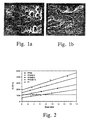
- the size of the liquid crystalline polymer phases decreased, which indicates that the compatibilizers according to the invention increases dispersion.
- the reinforced plastics and the products prepared from them can be recirculated as such because they do not contain reinforcing fibres consisting of other materials, such as glass.
- the wear of the processing equipment is, for the same reason, diminished. Processability is improved and because there is not much thermal expansion, instrument parts requiring dimensional stability can be manufactured from the blends. Due to the small temperature coefficient, the blends are well suited for use as constructional materials for electrical and optical cables.
- the present invention concerns, in particular, constructional parts of electrical and optical cables manufactured from the above-mentioned liquid crystalline polymer blends.
- the blends can also be used for manufacturing injection moulded parts used in the electronics industry. Pipes and tubes made from the blends typically have good barrier properties, i.e. low permeability.
- Thermotropic main-chain liquid crystalline polymer was blended with thermoplastics, the amount of the LCP being 10 to 30 percent by weight of the weight of the blend (without the ccmpatibilizer).
- small amounts of different compatibilizers were added to the LCP/thermoplastic blends.
- the blend processed in a twin-screw extruder were injection moulded to test samples whose mechanical and thermal properties as well as morphology and rheology were tested.
- Example 4 discloses a new way of preparing compatibilized liquid crystalline polymer blends according to which embodiment the compatibilizer is first preblended with the liquid crystalline polymer, the thermoplastic being added in the second stage of the process. By the process an improved interaction between the compatibilizer and the LCP is achieved.
- the liquid crystalline polymer used was a PHB/HNA based aromatic copolymer marketed under the trade name Vectra A 950. This product is supplied by Hoechst Celanese and its density is 1.40 g/cm 3 , melting point 280 °C, tensile strength 165 MPa, elastic modulus 9700 MPa, and elongation at break 3.0 %. It consists of a copolymer of hydroxynaphthoic acid and p-hydroxybenzoic acid
- Homopolymer VB 19 50K supplied by Neste Oy was used as polypropylene, and the crystallizing product Arnite D04 300 supplied by AKZO as poly(ethylene terephthalate).
- the compatibilizer used comprised a reactive ethylene-based terpolymer compatibilizer D) marketed under the name Lotader AX 8660.
- the polymer is supplied by Atochem.
- the product contains about 30 percent by weight of ethyl acrylate, 62 percent by weight of ethene, and 8 percent by weight of glycidyl methacrylate having reactive epoxy groups.
- the other reactive compatibilizer used comprised maleic anhydride grafted SEBS with an acid content of 1.8 percent by weight (compatibilizer A).
- the product is supplied by Shell under the name Kraton FG 1901 X.
- the afore-mentioned compatibilizers were dded in amounts of 2 to 10 percent by weight of the amount of the thermoplastic and LCP blend.
- the materials were first manually mixed with the matrix thermoplastics as dry pellets.
- the mixed polymer pellets were then dried.
- the drying conditions for the blends were chosen according to the matrix polymers and were normally at least 2 hours at 70 °C.
- the melt blending of the materials was performed by a Berstorff ZE 25x33D co-rotating twin-screw extruder at temperatures ranging from 285 to 290 °C (the temperature of the molten polymer was about 290 to 295 °C) and with a screw speed of 150 rpm.
- the extrudate was immediately quenched in a water bath and pelletized again.
- the blends as well as the pure polymers were dried as described above and injection moulded into the form of test specimens. Pure thermoplastic polymers were processed at typical conditions (the polypropylenes at about 210 to 230 °C). The blends were injection moulded at about 280 to 290 °C.
- the twin screw extruder used comprised a Brabender DSK 42/7 counterrotating twin-screw extruder.
- the temperature was maintained at about 230 to 290 °C with a screw speed of about 75 rpm.
- the mechanical properties of the blends were assessed by testing the blends for tensile strength, flexural strength and impact strength.
- Tensile properties were measured according to ISO 527. Flexural properties were studied with the same equipment according to ISO 178 as a three-point-bending test. Charpy impact strength was determined of unnotched test specimens according to ISO 179 by using a Zwick 5102 pendulum type testing machine. A pendulum of 40 kpcm was used.
- the morphology of the blend samples was investigated with a scanning electron microscope (SEM).
- the rheology of the polymers was investigated by measuring their melt viscosities in shear flow.
- the measuring temperature was 290 °C and the L/D ratio of the die was 20 mm/0.5 mm. Bagley correction was not done but the results include Rabinowitch correction.
- Polymer blends were prepared from PP homopolymer and LCP, and 2 to 10 percent by weight of a reactive ethylene based terpolymer (comp. D) was added to the blends. Processing, injection moulding and testing of the blends were carried out as described above.
- Viscosity measurements show that the addition of LCP diminishes the melt viscosity of thermoplastics (such as polypropylene in this Example).
- compatibilizer D increases the viscosity of the blend towards the polypropylene level ( Figure 3). This suggests an increased interaction between the blend components (possibly a chemical reaction).
- LCP was blended into a PP/EPDM (75/25) compound and, according to a second embodiment, 5, 10, and 20 wt.-% of EPDM were added to PP/30 wt.-% LCP blends.
- the blends were processed, injection moulded, and tested as described above. The test results are given in Table 2.
- Polymer blends were prepared from a PET polymer and LCP and 2, 5, and 10 wt.-% of reactive ethylene-based terpolymers (comp. D) or maleic acid grafted SEBS block copolymer (comp. A). The preparation of the blends, the injection moulding, and the testing thereof were carried out as described above.
- Figure 5 shows that the impact strength of the PET/LCP 10 blend was increased with both compatibilizers.
- a clear increase in the impact strength could be noticed, and after a 5 wt.-% terpolymer addition only half of the test bars were broken.
- the impact strengths of these bars were 3.5 times greater than the strengths of uncompatibilized samples.
- the impact strength was raised to the same level as the impact strength of the matrix polymer.
- the impact strength of these bars was 2.4 times greater than that of uncompatibilized samples.
- the melt blending was carried out with a DSK 42/7 counter-rotating twin-screw extruder at about 290 °C (230 °C for B1) with a screw speed of 75 rpm. After drying, the blends were injection moulded to form test specimens for testing of mechanical properties.
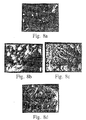
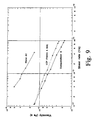
- Compatibilizer D was dispersed in the PP phase as fine droplets of the order of less than 1 ⁇ m (Fig. 8a). Partly because of the large proportion of the LCP, the binary blend of comp. D and LCP exhibited a fibrous structure. The compatibilizer could not be seen as a separate phase on the micrographs, and it is possile that it reacted so well with the LCP that it did not form a separate phase (Fig. 8b). Compatibilizer D raised the melt viscosity of the LCP to a clearly higher level (Fig. 9) which seems to indicate a chemical reaction between the compatibilizer and LCP as suggested also in earlier examples. On the other hand the addition of Comp.
- compatibilizer D in compatibilization of LCP and PP is based on good mixing of comp. D in the PP matrix and chemical reactivity with the LCP.
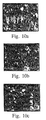
- Blend B2PET exhibited a highly fibrillar structure throughout the sample, which explains the high level of strength and stiffness, while B3PET contained deformed LCP domains but less fibres than B2PET.
- the LCP domains (fibres) were better attached to the PET matrix and the fibre surfaces were not so smooth in B2PET due to the more reactive compatibilizer.
- thermoplastic matrix polymer may be advantageous for the resultant blend properties.
Landscapes
- Chemical & Material Sciences (AREA)
- Health & Medical Sciences (AREA)
- Chemical Kinetics & Catalysis (AREA)
- Medicinal Chemistry (AREA)
- Polymers & Plastics (AREA)
- Organic Chemistry (AREA)
- Compositions Of Macromolecular Compounds (AREA)
- Processes Of Treating Macromolecular Substances (AREA)
- Liquid Crystal Substances (AREA)
- Polyesters Or Polycarbonates (AREA)
- Extrusion Moulding Of Plastics Or The Like (AREA)
- Blow-Moulding Or Thermoforming Of Plastics Or The Like (AREA)
- Manufacture Of Macromolecular Shaped Articles (AREA)
- Injection Moulding Of Plastics Or The Like (AREA)
Applications Claiming Priority (3)
| Application Number | Priority Date | Filing Date | Title |
|---|---|---|---|
| FI922520A FI97476C (fi) | 1992-05-29 | 1992-05-29 | Nestekidepolymeeriseokset, menetelmä niiden valmistamiseksi sekä niistä valmistetut tuotteet |
| FI922520 | 1992-05-29 | ||
| PCT/FI1993/000233 WO1993024574A1 (en) | 1992-05-29 | 1993-05-31 | Liquid crystal polymer blends, process for the preparation thereof and products manufactured from the blends |
Publications (2)
| Publication Number | Publication Date |
|---|---|
| EP0642556A1 EP0642556A1 (en) | 1995-03-15 |
| EP0642556B1 true EP0642556B1 (en) | 2001-07-18 |
Family
ID=8535386
Family Applications (1)
| Application Number | Title | Priority Date | Filing Date |
|---|---|---|---|
| EP93910062A Expired - Lifetime EP0642556B1 (en) | 1992-05-29 | 1993-05-31 | Liquid crystal polymer blends, process for the preparation thereof and products manufactured from the blends |
Country Status (6)
| Country | Link |
|---|---|
| EP (1) | EP0642556B1 (enExample) |
| JP (1) | JP2859439B2 (enExample) |
| AT (1) | ATE203259T1 (enExample) |
| DE (1) | DE69330462T2 (enExample) |
| FI (1) | FI97476C (enExample) |
| WO (1) | WO1993024574A1 (enExample) |
Cited By (1)
| Publication number | Priority date | Publication date | Assignee | Title |
|---|---|---|---|---|
| TWI871359B (zh) * | 2019-09-27 | 2025-02-01 | 日商富士軟片股份有限公司 | 液晶聚合物膜及高速通訊用基板 |
Families Citing this family (34)
| Publication number | Priority date | Publication date | Assignee | Title |
|---|---|---|---|---|
| US5981007A (en) * | 1992-03-31 | 1999-11-09 | Foster-Miller, Inc. | Extruded thermoplastic, liquid crystalline polymers and blends thereof having a planar morphology |
| ATE180818T1 (de) * | 1993-05-07 | 1999-06-15 | Sinco Ricerche Spa | Polyesterzusammensetzungen geeignet zur herstellung von fasern und folien mit hohem elastizitätsmodul |
| FI940953L (fi) * | 1994-02-28 | 1995-08-29 | Neste Oy | Polymeerikalvot ja menetelmä niiden valmistamiseksi |
| WO1995023183A1 (en) * | 1994-02-28 | 1995-08-31 | Neste Oy | Liquid crystalline polymer blends and processes for the preparation thereof |
| EP0767815A4 (en) * | 1994-06-28 | 1998-05-13 | Foster Miller Inc | COMPATIBILIZED LIQUID CRYSTAL POLYMER MIXTURES |
| JP3355061B2 (ja) | 1994-10-18 | 2002-12-09 | ポリプラスチックス株式会社 | 熱可塑性樹脂組成物、その射出成形方法および射出成形体 |
| US6010760A (en) * | 1994-10-18 | 2000-01-04 | Polyplastics Co., Ltd. | Thermoplastic resin composition, injection molding method thereof, and injection molded article |
| DE69712551T3 (de) † | 1996-02-19 | 2008-02-21 | Sumitomo Chemical Co. Ltd. | Flüssigkristalline Polyesterharz-Zusammensetzung |
| FI963233A7 (fi) * | 1996-08-16 | 1998-02-17 | Optatech Oy | Substituoidut nestekiteiset polymeerit ja niiden käyttö kompatibilisaattoreina LCP:n ja muiden polymeerien seoksissa |
| EP0937271A1 (fr) * | 1997-09-05 | 1999-08-25 | Acome, Societe Cooperative De Travailleurs | Cable a fibres optiques de structure composite compacte |
| US7101597B2 (en) | 1997-09-10 | 2006-09-05 | Boston Scientific Scimed, Inc. | Medical devices made from polymer blends containing low melting temperature liquid crystal polymers |
| US6284333B1 (en) | 1997-09-10 | 2001-09-04 | Scimed Life Systems, Inc. | Medical devices made from polymer blends containing low melting temperature liquid crystal polymers |
| US6242063B1 (en) | 1997-09-10 | 2001-06-05 | Scimed Life Systems, Inc. | Balloons made from liquid crystal polymer blends |
| US6013373A (en) * | 1997-10-20 | 2000-01-11 | Hoechst Celanese Corporation | Adhesives for making multilayer films comprising liquid crystalline polymer and polypropylene |
| US6312772B1 (en) | 1997-10-20 | 2001-11-06 | Hoechst Celanese Corporation | Multilayer laminate formed from a substantially stretched non-molten wholly aromatic liquid crystalline polymer and non-polyester thermoplastic polymer |
| US6015524A (en) * | 1997-10-20 | 2000-01-18 | Hoechst Celanese Corporation | Adhesives for making multilayer films comprising liquid crystalline polymers and polyethylene |
| US6042902A (en) * | 1997-10-20 | 2000-03-28 | Hoechst Celanese Corporation | Adhesives for making multilayer films comprising liquid crystalline polymers and poly(ethylene terephthalate) or polycarbonate |
| US6268026B1 (en) | 1997-10-20 | 2001-07-31 | Hoechst Celanese Corporation | Multilayer laminate formed from a substantially stretched non-molten wholly aromatic liquid crystalline polymer and non-liquid crystalline polyester and method for forming same |
| US6426128B1 (en) | 1998-01-06 | 2002-07-30 | Hna Holdings, Inc. | Co-processable multi-layer laminates for forming high strength, haze-free, transparent articles and methods of producing same |
| DE69943330D1 (de) | 1998-02-23 | 2011-05-19 | Draka Comteq Bv | Verbundbauelemente mit thermotropem flüssigkristallinem Polymer Verstärkung für faseroptische Kabel |
| US6977103B2 (en) | 1999-10-25 | 2005-12-20 | Boston Scientific Scimed, Inc. | Dimensionally stable balloons |
| EP1176102A3 (en) | 2000-07-25 | 2002-05-29 | Ticona LLC | High gas barrier asymmetric liner and closure |
| WO2002020698A1 (en) | 2000-09-01 | 2002-03-14 | Ticona Llc | Blends of stretchable liquid crystal polymers with thermoplastics |
| US6730377B2 (en) | 2002-01-23 | 2004-05-04 | Scimed Life Systems, Inc. | Balloons made from liquid crystal polymer blends |
| FR2842611B1 (fr) * | 2002-07-19 | 2004-11-26 | Acome Soc Coop Travailleurs | Unite optique comprenant une gaine particuliere |
| EP1621580B1 (en) * | 2003-05-02 | 2008-12-10 | Toray Industries, Inc. | Polyester resin composition |
| DE102007015318A1 (de) | 2007-03-30 | 2008-10-02 | Rehau Ag + Co. | Verfahren zur Herstellung von verstärkten thermoplastischen Kunststoffcomposites und zugehörige Vorrichtung zur Durchführung, sowie derart hergestellte Composites |
| JP6811628B2 (ja) * | 2016-09-27 | 2021-01-13 | 帝人株式会社 | 熱可塑性ポリエステル樹脂組成物およびその成形品 |
| CN109456524B (zh) * | 2018-10-22 | 2021-03-23 | 佳易容聚合物(上海)有限公司 | 一种高阻隔pe/lcp/pet树脂组合物及其制备方法 |
| WO2021199851A1 (ja) | 2020-03-31 | 2021-10-07 | 株式会社カネカ | 熱可塑性樹脂組成物及びその製造方法 |
| US20230273382A1 (en) * | 2020-08-06 | 2023-08-31 | Sumitomo Electric Industries, Ltd. | Optical cable |
| JP7545842B2 (ja) * | 2020-09-18 | 2024-09-05 | 上野製薬株式会社 | ポリプロピレン樹脂組成物 |
| CN116635457A (zh) * | 2020-12-25 | 2023-08-22 | 富士胶片株式会社 | 液晶聚合物膜、高速通信用基板 |
| CN116162312B (zh) * | 2022-12-26 | 2024-05-03 | 湖南工业职业技术学院 | 一种高分子材料耐磨混凝土输送管道 |
Family Cites Families (2)
| Publication number | Priority date | Publication date | Assignee | Title |
|---|---|---|---|---|
| EP0380112A3 (en) * | 1989-01-26 | 1991-10-30 | Kawasaki Steel Corporation | Resin composition |
| US5621041A (en) * | 1991-04-17 | 1997-04-15 | Center For Innovative Technology | Compatible liquid crystal polymer/polyolefin blends |
-
1992
- 1992-05-29 FI FI922520A patent/FI97476C/fi active
-
1993
- 1993-05-31 EP EP93910062A patent/EP0642556B1/en not_active Expired - Lifetime
- 1993-05-31 AT AT93910062T patent/ATE203259T1/de not_active IP Right Cessation
- 1993-05-31 JP JP6500241A patent/JP2859439B2/ja not_active Expired - Lifetime
- 1993-05-31 DE DE69330462T patent/DE69330462T2/de not_active Expired - Fee Related
- 1993-05-31 WO PCT/FI1993/000233 patent/WO1993024574A1/en not_active Ceased
Cited By (1)
| Publication number | Priority date | Publication date | Assignee | Title |
|---|---|---|---|---|
| TWI871359B (zh) * | 2019-09-27 | 2025-02-01 | 日商富士軟片股份有限公司 | 液晶聚合物膜及高速通訊用基板 |
Also Published As
| Publication number | Publication date |
|---|---|
| JP2859439B2 (ja) | 1999-02-17 |
| FI97476C (fi) | 1996-12-27 |
| DE69330462T2 (de) | 2002-05-23 |
| WO1993024574A1 (en) | 1993-12-09 |
| EP0642556A1 (en) | 1995-03-15 |
| FI922520A0 (fi) | 1992-05-29 |
| JPH07508050A (ja) | 1995-09-07 |
| DE69330462D1 (de) | 2001-08-23 |
| ATE203259T1 (de) | 2001-08-15 |
| FI922520A7 (fi) | 1993-11-30 |
| FI97476B (fi) | 1996-09-13 |
Similar Documents
| Publication | Publication Date | Title |
|---|---|---|
| US6221962B1 (en) | Liquid crystal polymer blends, process for the preparation thereof and products manufactured from the blends | |
| JP2859439B2 (ja) | 液晶ポリマーブレンド,その製法およびブレンドから製造した製品 | |
| Holsti‐Miettinen et al. | Use of epoxy reactivity for compatibilization of PP/PBT and PP/LCP blends | |
| EP0696303B1 (en) | Blends of graft-modified substantially linear ethylene polymers and other thermoplastic polymers | |
| US5767195A (en) | Liquid crystal polyester resin composition | |
| Heino et al. | Compatibilization of polyethylene terephthalate/polypropylene blends with styrene–ethylene/butylene–styrene (SEBS) block copolymers | |
| Loyens et al. | Ultimate mechanical properties of rubber toughened semicrystalline PET at room temperature | |
| EP0285256B1 (en) | Method for producing a thermoplastic resin composition | |
| John et al. | Properties of reactively blended soy protein and modified polyesters | |
| US5070157A (en) | Self reinforced composite of thermotropic liquid crystal polymers | |
| JPH0588265B2 (enExample) | ||
| JP3195334B2 (ja) | 機械混和性ポリウレタン/ポリオレフィン熱可塑性ポリマーブレンド | |
| US5006403A (en) | Wholly aromatic polyester fiber-reinforced poly(phenylene oxide) and process for preparing same | |
| EP0494971A1 (en) | Polyolefin/thermoplastic blend | |
| US6025420A (en) | Compositions for tough and easy melt processible polycarbonate/polyolefin blend resin | |
| EP0397881A1 (en) | Process for producing composite material composition | |
| JP4624499B2 (ja) | 耐衝撃性ポリエステルの射出成形品 | |
| JPH06179791A (ja) | 樹脂組成物 | |
| US20030105231A1 (en) | Polyester composition | |
| Kang et al. | Effects of amorphous nylon on the properties of nylon 6 | |
| Kristofic et al. | Compatibilisation of PP/PA blends | |
| La Mantia et al. | Filmability and properties of compatibilized PA6/LDPE blends | |
| JPS59176344A (ja) | 高性能ゴム−ポリエステル配合物 | |
| KR20050004871A (ko) | 동적 가교 단계를 포함하는 열가소성 조성물의 제조 방법 | |
| EP0709430B1 (en) | Polyacetal resin composition |
Legal Events
| Date | Code | Title | Description |
|---|---|---|---|
| PUAI | Public reference made under article 153(3) epc to a published international application that has entered the european phase |
Free format text: ORIGINAL CODE: 0009012 |
|
| 17P | Request for examination filed |
Effective date: 19941213 |
|
| AK | Designated contracting states |
Kind code of ref document: A1 Designated state(s): AT BE CH DE DK ES FR GB GR IE IT LI LU MC NL PT SE |
|
| RIN1 | Information on inventor provided before grant (corrected) |
Inventor name: WESTMAN, MARJUT Inventor name: SEPPAELAE, JUKKA Inventor name: HEINO, MARKKU |
|
| 17Q | First examination report despatched |
Effective date: 19960624 |
|
| RAP1 | Party data changed (applicant data changed or rights of an application transferred) |
Owner name: OPTATECH CORPORATION |
|
| GRAG | Despatch of communication of intention to grant |
Free format text: ORIGINAL CODE: EPIDOS AGRA |
|
| GRAG | Despatch of communication of intention to grant |
Free format text: ORIGINAL CODE: EPIDOS AGRA |
|
| GRAH | Despatch of communication of intention to grant a patent |
Free format text: ORIGINAL CODE: EPIDOS IGRA |
|
| GRAH | Despatch of communication of intention to grant a patent |
Free format text: ORIGINAL CODE: EPIDOS IGRA |
|
| GRAA | (expected) grant |
Free format text: ORIGINAL CODE: 0009210 |
|
| AK | Designated contracting states |
Kind code of ref document: B1 Designated state(s): AT BE CH DE DK ES FR GB GR IE IT LI LU MC NL PT SE |
|
| PG25 | Lapsed in a contracting state [announced via postgrant information from national office to epo] |
Ref country code: NL Free format text: LAPSE BECAUSE OF FAILURE TO SUBMIT A TRANSLATION OF THE DESCRIPTION OR TO PAY THE FEE WITHIN THE PRESCRIBED TIME-LIMIT Effective date: 20010718 Ref country code: LI Free format text: LAPSE BECAUSE OF FAILURE TO SUBMIT A TRANSLATION OF THE DESCRIPTION OR TO PAY THE FEE WITHIN THE PRESCRIBED TIME-LIMIT Effective date: 20010718 Ref country code: CH Free format text: LAPSE BECAUSE OF FAILURE TO SUBMIT A TRANSLATION OF THE DESCRIPTION OR TO PAY THE FEE WITHIN THE PRESCRIBED TIME-LIMIT Effective date: 20010718 Ref country code: AT Free format text: LAPSE BECAUSE OF FAILURE TO SUBMIT A TRANSLATION OF THE DESCRIPTION OR TO PAY THE FEE WITHIN THE PRESCRIBED TIME-LIMIT Effective date: 20010718 |
|
| REF | Corresponds to: |
Ref document number: 203259 Country of ref document: AT Date of ref document: 20010815 Kind code of ref document: T |
|
| REG | Reference to a national code |
Ref country code: CH Ref legal event code: EP |
|
| REG | Reference to a national code |
Ref country code: IE Ref legal event code: FG4D |
|
| REF | Corresponds to: |
Ref document number: 69330462 Country of ref document: DE Date of ref document: 20010823 |
|
| ITF | It: translation for a ep patent filed | ||
| PG25 | Lapsed in a contracting state [announced via postgrant information from national office to epo] |
Ref country code: SE Free format text: LAPSE BECAUSE OF FAILURE TO SUBMIT A TRANSLATION OF THE DESCRIPTION OR TO PAY THE FEE WITHIN THE PRESCRIBED TIME-LIMIT Effective date: 20011018 Ref country code: PT Free format text: LAPSE BECAUSE OF FAILURE TO SUBMIT A TRANSLATION OF THE DESCRIPTION OR TO PAY THE FEE WITHIN THE PRESCRIBED TIME-LIMIT Effective date: 20011018 Ref country code: DK Free format text: LAPSE BECAUSE OF FAILURE TO SUBMIT A TRANSLATION OF THE DESCRIPTION OR TO PAY THE FEE WITHIN THE PRESCRIBED TIME-LIMIT Effective date: 20011018 |
|
| PG25 | Lapsed in a contracting state [announced via postgrant information from national office to epo] |
Ref country code: GR Free format text: LAPSE BECAUSE OF FAILURE TO SUBMIT A TRANSLATION OF THE DESCRIPTION OR TO PAY THE FEE WITHIN THE PRESCRIBED TIME-LIMIT Effective date: 20011019 |
|
| ET | Fr: translation filed | ||
| REG | Reference to a national code |
Ref country code: GB Ref legal event code: IF02 |
|
| NLV1 | Nl: lapsed or annulled due to failure to fulfill the requirements of art. 29p and 29m of the patents act | ||
| PG25 | Lapsed in a contracting state [announced via postgrant information from national office to epo] |
Ref country code: ES Free format text: LAPSE BECAUSE OF FAILURE TO SUBMIT A TRANSLATION OF THE DESCRIPTION OR TO PAY THE FEE WITHIN THE PRESCRIBED TIME-LIMIT Effective date: 20020131 |
|
| REG | Reference to a national code |
Ref country code: CH Ref legal event code: PL |
|
| PLBE | No opposition filed within time limit |
Free format text: ORIGINAL CODE: 0009261 |
|
| STAA | Information on the status of an ep patent application or granted ep patent |
Free format text: STATUS: NO OPPOSITION FILED WITHIN TIME LIMIT |
|
| PG25 | Lapsed in a contracting state [announced via postgrant information from national office to epo] |
Ref country code: MC Free format text: LAPSE BECAUSE OF NON-PAYMENT OF DUE FEES Effective date: 20020531 Ref country code: LU Free format text: LAPSE BECAUSE OF NON-PAYMENT OF DUE FEES Effective date: 20020531 Ref country code: IE Free format text: LAPSE BECAUSE OF NON-PAYMENT OF DUE FEES Effective date: 20020531 Ref country code: GB Free format text: LAPSE BECAUSE OF NON-PAYMENT OF DUE FEES Effective date: 20020531 Ref country code: BE Free format text: LAPSE BECAUSE OF NON-PAYMENT OF DUE FEES Effective date: 20020531 |
|
| 26N | No opposition filed | ||
| GBPC | Gb: european patent ceased through non-payment of renewal fee |
Effective date: 20020531 |
|
| REG | Reference to a national code |
Ref country code: IE Ref legal event code: MM4A |
|
| PGFP | Annual fee paid to national office [announced via postgrant information from national office to epo] |
Ref country code: FR Payment date: 20030521 Year of fee payment: 11 |
|
| PG25 | Lapsed in a contracting state [announced via postgrant information from national office to epo] |
Ref country code: FR Free format text: LAPSE BECAUSE OF NON-PAYMENT OF DUE FEES Effective date: 20050131 |
|
| REG | Reference to a national code |
Ref country code: FR Ref legal event code: ST |
|
| PG25 | Lapsed in a contracting state [announced via postgrant information from national office to epo] |
Ref country code: IT Free format text: LAPSE BECAUSE OF NON-PAYMENT OF DUE FEES;WARNING: LAPSES OF ITALIAN PATENTS WITH EFFECTIVE DATE BEFORE 2007 MAY HAVE OCCURRED AT ANY TIME BEFORE 2007. THE CORRECT EFFECTIVE DATE MAY BE DIFFERENT FROM THE ONE RECORDED. Effective date: 20050531 |
|
| PGFP | Annual fee paid to national office [announced via postgrant information from national office to epo] |
Ref country code: DE Payment date: 20060519 Year of fee payment: 14 |
|
| PG25 | Lapsed in a contracting state [announced via postgrant information from national office to epo] |
Ref country code: DE Free format text: LAPSE BECAUSE OF NON-PAYMENT OF DUE FEES Effective date: 20071201 |