EP0638653B1 - Process for producing chromium-containing stainless steel strip with excellent toughness - Google Patents
Process for producing chromium-containing stainless steel strip with excellent toughness Download PDFInfo
- Publication number
- EP0638653B1 EP0638653B1 EP94905217A EP94905217A EP0638653B1 EP 0638653 B1 EP0638653 B1 EP 0638653B1 EP 94905217 A EP94905217 A EP 94905217A EP 94905217 A EP94905217 A EP 94905217A EP 0638653 B1 EP0638653 B1 EP 0638653B1
- Authority
- EP
- European Patent Office
- Prior art keywords
- thin
- strip
- less
- hot
- stainless steel
- Prior art date
- Legal status (The legal status is an assumption and is not a legal conclusion. Google has not performed a legal analysis and makes no representation as to the accuracy of the status listed.)
- Expired - Lifetime
Links
Images


Classifications
-
- C—CHEMISTRY; METALLURGY
- C21—METALLURGY OF IRON
- C21D—MODIFYING THE PHYSICAL STRUCTURE OF FERROUS METALS; GENERAL DEVICES FOR HEAT TREATMENT OF FERROUS OR NON-FERROUS METALS OR ALLOYS; MAKING METAL MALLEABLE, e.g. BY DECARBURISATION OR TEMPERING
- C21D8/00—Modifying the physical properties of ferrous metals or ferrous alloys by deformation combined with, or followed by, heat treatment
- C21D8/02—Modifying the physical properties of ferrous metals or ferrous alloys by deformation combined with, or followed by, heat treatment during manufacturing of plates or strips
-
- C—CHEMISTRY; METALLURGY
- C21—METALLURGY OF IRON
- C21D—MODIFYING THE PHYSICAL STRUCTURE OF FERROUS METALS; GENERAL DEVICES FOR HEAT TREATMENT OF FERROUS OR NON-FERROUS METALS OR ALLOYS; MAKING METAL MALLEABLE, e.g. BY DECARBURISATION OR TEMPERING
- C21D9/00—Heat treatment, e.g. annealing, hardening, quenching or tempering, adapted for particular articles; Furnaces therefor
- C21D9/46—Heat treatment, e.g. annealing, hardening, quenching or tempering, adapted for particular articles; Furnaces therefor for sheet metals
-
- C—CHEMISTRY; METALLURGY
- C21—METALLURGY OF IRON
- C21D—MODIFYING THE PHYSICAL STRUCTURE OF FERROUS METALS; GENERAL DEVICES FOR HEAT TREATMENT OF FERROUS OR NON-FERROUS METALS OR ALLOYS; MAKING METAL MALLEABLE, e.g. BY DECARBURISATION OR TEMPERING
- C21D6/00—Heat treatment of ferrous alloys
- C21D6/002—Heat treatment of ferrous alloys containing Cr
Definitions
- JP-A-2-166233 discloses a process for producing a chromium stainless steel sheet excellent in workability by thin strip casting, in which a cast slab having a thickness of cup to 10 mm is rolled in the temperature range of at least the ⁇ -phase precipitation starting temperature.
Landscapes
- Chemical & Material Sciences (AREA)
- Engineering & Computer Science (AREA)
- Physics & Mathematics (AREA)
- Thermal Sciences (AREA)
- Crystallography & Structural Chemistry (AREA)
- Mechanical Engineering (AREA)
- Materials Engineering (AREA)
- Metallurgy (AREA)
- Organic Chemistry (AREA)
- Heat Treatment Of Sheet Steel (AREA)
- Heat Treatment Of Steel (AREA)
Abstract
Description
- In recent years, a technology of casting a thin cast strip having a strip thickness of 10 mm or less directly from a steel melt was developed and tested on an industrial scale. This new technology provides a process of producing a cold-rolled thin sheet product, in which a hot rolling step is either simplified or omitted, and thereby attracts considerable attention and is expected from the view point of saving energy and cost.
- Processes of producing a thin sheet, including the above process, will hereinafter be referred to as "STC processes" (Strip Casting Process). In contrast, processes of producing a cold-rolled thin sheet product which includes the steps of continuous-casting a 100 mm or more thick steel slab, hot-rolling the slab to a several millimeters thick hot-rolled strip, and cold-rolling the hot-rolled strip, will be referred to as a conventional process.
- The present invention relates to a process of producing a thin cast strip having a high toughness, particularly a thin cast strip of a Cr-stainless steel containing Nb, Ti, Al, etc., by an STC process.
- Conventionally, Cr-stainless steels were produced by a conventional hot rolling-process which included casting a slab and hot-rolling the slab. This process had a problem that ridging (or roping) occurs in the cold-rolled thin sheet products due to a texture established during hot rolling. Then, trials were conducted in which the STC process was used to cast a thin cast strip for producing a thin sheet product in which no ridging occurs. For example, Japanese Unexamined Patent Publication (Kokai) No. 62-176649 disclosed "Process of Producing Ferritic Stainless Steel Thin Strip Having No Roping". This publication, however, did not describe the reduction in toughness which occurs in Cr-stainless steels having a single phase structure and containing Nb, Ti, Al, and V in an amount of from 0.05 to 1.0 wt% in total. Therefore, there remains a problem that a cast strip of a Cr-stainless steel containing Nb, Ti, Al and V in the above-recited total amount has too low a toughness to be cold-rolled in a subsequent step.
- Japanese Unexamined Patent Publication (Kokai) No. 64-4458 entitled "Rapid-Cooled Strip of Ferritic Stainless Steel Having High Toughness" disclosed that a cast strip having a high toughness can be produced by controlling its columnar crystal content to 70% or more, but did not consider the technological significance of the relationship between the toughness of and the precipitates in the cast strips of Cr-stainless steels containing NB, Ti, Al, and V.
- JP-A-2-166233 discloses a process for producing a chromium stainless steel sheet excellent in workability by thin strip casting, in which a cast slab having a thickness of cup to 10 mm is rolled in the temperature range of at least the γ-phase precipitation starting temperature.
- The present inventors have been developing a technology of producing Cr-stainless steel thin sheet by using an STC process. As a result, it became apparent that cast strips have a poor toughness which causes cracking to occur during cold rolling of SUS 430 or other steel systems in which a γ -phase is precipitated during cooling after solidification to room temperature and a martensite phase transformed from the γ-phase remains at room temperature.
- To prevent the precipitation of γ-phase during cooling after solidification to room temperature, the present inventors produced a thin cast strip of a Cr-stainless steel with a controlled chemical composition having a γ p value of 0% or less. The term γ p is a parameter predicting the precipitate amount of γ -phase based on the chemical composition. However, even when a Cr-stainless steel has a γ p of 0% or less, there remains a problem that a cast strip has a poor toughness and is broken during cold rolling when it contains one or more of Nb, Ti, Al and V in an amount of 0.05 wt% or more in total.
- The present inventors made a study and found that thin cast strips of Cr-stainless steels containing such elements and exhibiting a poor toughness contain fine precipitates with a size of 0.1 µm or less. It is known that such fine precipitates harden the steel matrix and thus deteriorates the toughness.
- A thin cast strip cast by an STC process contains fine precipitates of 0.1 µm or less, probably because its speed of cooling after solidification to room temperature is much higher than that of a slab cast by the conventional process, so that those precipitates, which precipitate and can grow to several µm during cooling of a slab by the conventional process, do not actually have sufficient time to precipitate and grow but precipitate in a fine form instead in a thin cast strip cast by an STC process.
- Thus, to improve the toughness of a thin cast strip of a Cr-stainless steel containing one or more of Nb, Ti, Al and V in an amount of 0.05 wt% or more in total, it is required that precipitates be grown to 0.1 µm or greater.
- This problem occurrs in Cr-stainless steels containing Nb, Ti, Al and/or V in an amount of 0.05 wt% or more, irrespective of the structure of a cast strip such as the content of columnar crystals.
- It also became apparent that the conventional hot-rolling process has no problem concerning the toughness of hot-rolled and annealed sheets of the subject steels of the present invention and that the problem is specific to STC processes.
- The object of the present invention is to solve the above-discussed problem in STC processes.
- To achieve the object according to the present invention, there is provided a process of producing a thin strip of a Cr-stainless steel having a high toughness, characterized by the steps of: casting a thin cast strip of a Cr-stainless steel having a thickness of 10 mm or less, the steel containing 13-25 wt% of Cr, 0.05-1 wt% of one or more of Nb, Ti, Al and V in terms of a total amount, 0.03 wt% or less of C, 0.03 wt% or less of N, and 0.3-3.0 wt% of Mo in accordance with need, and having a γ p value of 0 % or less, γ p being defined as γ p(%) = 420C + 470N + 23Ni + 9Cu + 7Mn - 11.5Cr - 11.5Si - 12 Mo - 23V - 47Nb - 49 Ti - 52Al + 189 (respective elements in wt%); hot-rolling the thin cast strip in a temperature range of from 1150 to 950°C at a reduction in thickness of 5 to 50 % to form a thin strip; either slowly cooling the thin strip at a speed of 20 °C/sec or less or holding the thin strip for 5 sec or more, in a temperature range of from 1150 to 950°C, or passing the thin strip through a heat treatment furnace held at a temperature of from 1150 to 950°C for 5 sec or more; and then coiling the thin strip at a temperature lower than 700 °C.
- According to the present invention, the chemical composition of steel is numerically limited as mentioned above for the following reasons.
- Cr effectively improves the corrosion resistance, the oxidation resistance at high temperatures, and other properties of a steel. To ensure these properties at least to an extent necessary in the Cr-stainless steels for usual applications, the Cr content must be 13 wt% or more. This content is also a minimum amount necessary to control the γp value to be 0% or less by adjusting the contents of other components. On the other hand, the Cr content must be 25 wt% or less because the toughness is significantly reduced when the Cr content is more than 25 wt%.
- γ p is a parameter for calculating the amount of precipitated γ-phase based on the chemical composition. Any precipitated γ-phase is transformed to martensite phase during cooling to room temperature and the hard martensite phase significantly deteriorates the toughness. Therefore, to prevent γ-phase from being precipitated, γ p is limited to 0% or less.
- γ p is defined by the formula: γp(%) = 420C + 470N + 23Ni + 9Cu + 7Mn - 11.5Cr - 11.5Si - 12 Mo - 23V - 47Nb - 49 Ti - 52Al + 189 (respective elements in wt%).
- Generally, Ti, Al, Nb, and V are occasionally added to a ferritic stainless steel in order to improve the corrosion resistance and the formability. These elements, however, are precipitated in the form of fine particles in thin cast strips solidified by rapid cooling and deteriorate the toughness of the cast strip. When contained in an amount of less than 0.05 wt%, these elements are harmless to the toughness, but when present in an amount of 0.05 wt% or more, fine particles of about 0.1 µm are precipitated and deteriorate the toughness. Thus, the present invention is directed to an improvement of the toughness of Cr-stainless steels containing one or more of Ti, Al, Nb, and V in an amount of 0.05 wt% in total as specified as a lower limit in the claims. The upper limit is specified as 1.0 wt%, because an amount greater than 1.0 wt% does not further improve the corrosion resistance and the formability under usual environmental conditions.
- Generally, C and N cause Cr to precipitate as a carbonitride on grain boundaries, and thereby, deteriorate the grain boundary corrosion resistance and the toughness. Therefore, the contents of these elements must be as small as possible and limited to 0.030 wt% or less.
- Similar to Cr, Mo effectively improves corrosion resistance. Thus, Mo is present together with Cr to improve the corrosion resistance in an amount of 0.3 wt% or more to ensure this effect but must not be more than 3 % because greater amounts would induce the embrittlement due to the precipitation of sigma and chi phases.
- The cast strips are hot-rolled and cooled under the conditions specified for the following reasons.
- STC process uses rapid cooling of cast strips after casting and therefore there is only a little time for the precipitation and growth of the precipitated particles. Therefore, a heat treatment for the precipitation and growth is necessary. Because a thin cast strip has only a few precipitation sites, the heat treatment must be carried out at a high temperature for a long time to induce the precipitation and growth. To perform such a heat treatment on the cast strip immediately after casting, there is a problem that a long and large heat treatment line is necessary.
- Thus, it is desired to provide a technology which enables the precipitation and growth to occur in a short time. Introduction of dislocations providing nuclei for precipitation effectively facilitates the precipitation. Namely, hot rolling in a precipitation temperature region effectively promotes precipitation. After the hot rolling to promote the precipitation, a slow cooling or an isothermal holding is performed to cause the precipitates to grow. These treatments ensure the precipitation and growth of the precipitates in a short time and render any precipitates in a cast strip harmless.
- Cast strips are hot-rolled at a temperature of from 1150 to 950 °C and at a reduction in thickness of 5 % or more, based on the following experimental results.
- The present inventors carried out a laboratory experiment, in which a Fe-19wt%Cr-0.60wt%Nb-0.015wt%C-0.015wt%N steel was cast into 3 mm thick cast strips, which were then hot-rolled in a temperature range of from 1200 to 800 °C with a reduction in thickness of 3 to 50 % to form thin strips. The hot-rolled thin strips were then passed through a heat treatment furnace held at 1100°C for 10 sec, were secondarily cooled at 100 °C/sec to 500 °C, and were then coiled. The thin strips were subjected to a Charpy impact test at room temperature to estimate the toughness. The Charpy impact test was performed by using a specimen with the thickness of the thin strip.
- The results are summarized in Fig. 1. The cast strips had a high toughness when hot-rolled at a reduction in thickness of 5% or more and at a temperature of from 950 to 1150°C. It is believed that carbonitrides were not rendered harmless because carbonitrides are not precipitated at temperatures above 1150°C and because carbonitrides, even if precipitated, do not grow fast at temperatures below 950°C.
- The hot rolling must be performed at a reduction in thickness of 50 % or less, because higher reductions cause spill-like defects to occur.
- The hot-rolled strip is either held for 5 see or longer or slowly cooled at 20 °C/sec or less, in a temperature range of from 1150 to 950°C. These conditions are determined by the following experiment.
- The present inventors carried out an experiment, in which a Fe-19wt%Cr-0.60wt%Nb-0.015wt%C-0.015wt%N steel was cast into 3 mm thick cast strips, which were then hot-rolled at 1000°C at a reduction in thickness of 10%. The hot-rolled strips were heat-treated under different conditions, secondarily cooled at 100°C /see to 500 °C, and coiled. The hot-rolled strips were subjected to a Charpy impact test at room temperature to estimate the toughness. The Charpy impact test was performed by using a specimen with the thickness of the thin strip.
- The results are summarized in Figs. 2 and 3. The hot-rolled strips had a high toughness when held for 5 see or more or slowly cooled at 20°C/sec or less in a temperature region of from 1150 to 950°C. Poor toughness was obtained under other conditions, probably because carbonitrides did not grow sufficiently.
- It is advantageous for process control that the heat treatment after hot rolling is effected by passing the hot-rolled strip through a heat treating furnace held at a temperature of from 1150 to 950 °C. In this case, the hot-rolled strips also had a high toughness after being passed through the furnace for 5 see or more in a temperature region of from 1150 to 950°C.
- Stainless steels containing elements such as Ti and Nb, when held at 700 to 900°C for a long period of time, have a poor toughness due to precipitation of very brittle intermetallic compounds (Laves phase). Thus, the strip must be coiled at a temperature of lower than 700 °C.
- This control of precipitates by hot rolling and heat treatment under the above-stated conditions was proved to be effective not only with Nb-containing steels but also with Ti- or Al-containing steels.
- Figure 1 is a graph showing the relationship between the hot rolling conditions of the cast strip and the cast strip toughness.
- Figure 2 is a graph showing the relationship between the heat treatment conditions after hot rolling and the cast strip toughness.
- Figure 3 is a graph showing the relationship between the heat treatment conditions after hot rolling and the cast strip toughness.
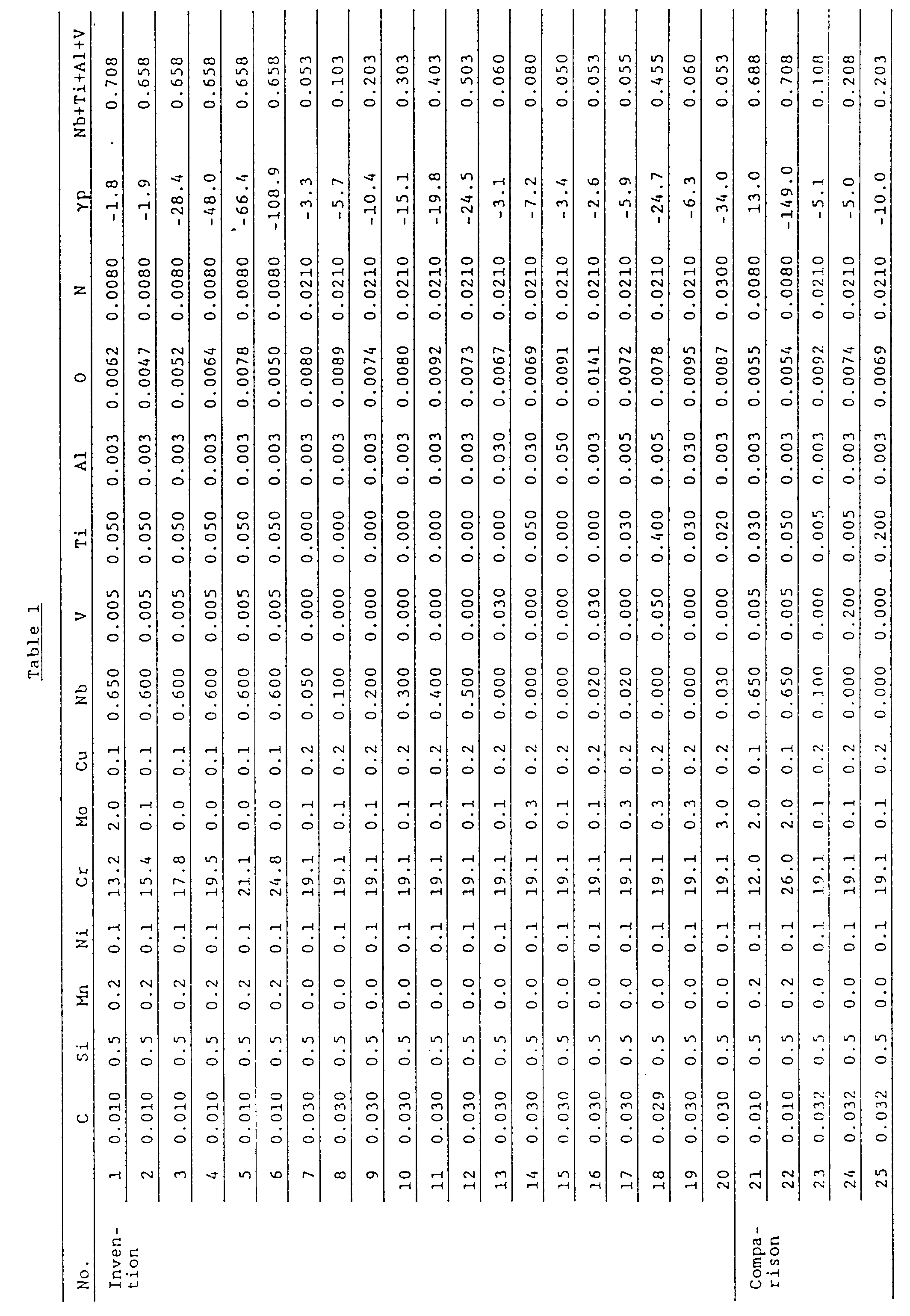
- Various Cr-stainless steels having the chemical compositions shown in Table 1 within the claimed range of the present invention were melted to provide 10-ton melts, which were then cast to thin cast strips having a thickness of 3 mm in a water-cooled twin-drum caster. The cast strips were hot-rolled in the temperature range of from 1150 to 950'C at different reductions in thickness of from 5 to 50 %, were held, or slowly cooled, for 5 see in the temperature range of from 1150 to 950°C, and were coiled in the form of a thin strip.
- For comparison, Cr-stainless steels having the chemical compositions shown in Table 1 as comparative examples were also cast in a similar manner. The cast strips were hot-rolled, heat-treated after the hot rolling, and coiled under the respective conditions, at least one of which was outside the claimed range, to produce thin strips.
- As can be seen from Table 2, the thin strips produced by the present inventive process had a high toughness of 2 kgf-m/cm2 or greater at 0 °C whereas the thin strips produced by the comparative process had too low a toughness of less than 2 kgf-m/cm2 to carry out the subsequent step of cold rolling.
Test No. Steel Hot rolling Heat treatment after hot rolling Coiling temp. Charpy impact value (0°C) Temp. (°C) Reduction (%) Temp. (°C) Time (sec) Cooling speed (°C/sec) (°C) (kgf·m/cm2) Invention a 1 1100 10 1000 10 0 500 12.9 b 2 1100 10 1000 10 0 500 13.4 c 3 1100 10 1000 10 0 500 12.4 d 4 1100 10 1000 10 0 500 6.8 e 5 1100 10 1000 10 0 500 5.4 f 6 1100 10 1000 10 0 500 3.4 g 7 1100 10 1000 10 0 500 12.4 h 8 1100 10 1000 10 0 500 11.4 i 9 1100 10 1000 10 0 500 13.5 j 10 1100 10 1000 10 0 500 18.4 k 11 1100 10 1000 10 0 500 12.4 l 12 1100 10 1000 10 0 500 15.2 m 13 1100 10 1000 10 0 500 15.4 n 14 1100 10 1000 10 0 500 16.2 o 15 1100 10 1000 10 0 500 14.8 p 16 1100 10 1000 10 0 500 14.2 q 17 1100 10 1000 10 0 500 14.3 r 18 1100 10 1000 10 0 500 13.4 s 19 1100 10 1000 10 0 500 15.2 t 20 1100 10 1000 10 0 500 11 u 10 1150 10 1000 10 0 500 14 v 10 1050 10 1000 10 0 500 8.2 w 10 1000 10 1000 10 0 500 7.8 x 10 950 10 1000 10 0 500 11 y 10 950 10 1000 10 0 500 8.9 z 10 1100 40 1000 10 0 500 15.4 aa 10 1100 5 1000 10 0 500 12.2 ab 10 1150 10 1150 10 0 500 11.8 ac 10 950 10 950 60 0 500 10.9 ad 10 1100 20 1000 20 10 500 11.4 ae 10 1100 20 1000 5 5 500 12 af 10 1150 20 1100 5 20 500 10.9 ag 10 1150 20 1100 10 1 680 8.5 Comparison ah 21 Not hot-rolled Not heat-treated 500 0.3 ai 22 Not hot-rolled Not heat-treated 500 0.3 aj 23 Not hot-rolled Not heat-treated 500 0.3 ak 24 Not hot-rolled Not heat-treated 500 0.3 al 25 Not hot-rolled Not heat-treated 500 0.2 am 23 Not hot-rolled Not heat-treated 800 03 an 23 1100 3 1000 10 10 500 0.3 ao 23 800 20 1000 10 0 400 0.3 ap 23 Not hot-rolled 1100 20 0 500 1.2 aq 23 1100 10 Not heat-treated 600 0.8 - As hereinbefore-described, the present invention provides a process of producing, by an STC process, a thin cast strip of a Cr-stainless steel having a high toughness, thereby providing an extremely great technological and economical advantage.
Claims (2)
- A process of producing a thin strip of a Cr-stainless steel having a high toughness comprising the steps of: casting a thin cast strip of a Cr-stainless steel having a thickness of 10 mm or less, said steel containing 13-25 wt% of Cr, 0.05-1 wt% of one or more of Nb, Ti, Al and V in terms of a total amount, 0.03 wt% or less of C, 0.03 wt% or less of N, and 0.3-3.0 wt% of Mo in accordance with need, and having a γ p value of 0 % or less, said γ p being defined as γ p(%) = 420C + 470N + 23Ni + 9Cu + 7Mn - 11.5Cr - 11.5Si - 12 Mo - 23V - 47Nb - 49 Ti - 52Al + 189 (respective elements in wt%); hot-rolling said thin cast strip in a temperature range of from 1150 to 950 °C at a reduction in thickness of 5 to 50 % to form a thin strip; either slowly cooling said thin strip at a rate of 20 °C /see or less cr holding said thin strip for 5 see or more, in a temperature range of from 1150 to 950 °C; and then coiling said thin strip at a temperature lower than 700°C.
- A process of producing a thin strip of a Cr-stainless steel having a high toughness comprising the steps of: casting a thin cast strip of a Cr-stainless steel having a thickness of 10 mm or less, said steel containing 13-25 wt% of Cr, 0.05-1 wt% of one or more of Nb, Ti, Al and V in terms of a total amount, 0.03 wt% or less of C, 0.03 wt% or less of N, and 0.3-3.0 wt% of Mo in accordance with need, and having a γ p value of 0 % or less, said γ p being defined as γ p(%) = 420C + 470N + 23Ni + 9Cu + 7Mn - 11.5Cr - 11.5Si - 12 Mo - 23V - 47Nb - 49 Ti - 52Al + 189 (respective elements in wt%); hot-rolling said thin cast strip in a temperature range of from 1150 to 950 °C at a reduction in thickness of 5 to 50 % to form a thin strip; passing said thin strip through a heat treatment furnace held at a temperature of from 1150 to 950°C for 5 see or more; and then coiling said thin strip at a temperature lower than 700 °C.
Applications Claiming Priority (4)
| Application Number | Priority Date | Filing Date | Title |
|---|---|---|---|
| JP12690/93 | 1993-01-28 | ||
| JP1269093 | 1993-01-28 | ||
| JP5012690A JPH06220545A (en) | 1993-01-28 | 1993-01-28 | Method for producing Cr-based stainless steel ribbon having excellent toughness |
| PCT/JP1994/000112 WO1994017215A1 (en) | 1993-01-28 | 1994-01-27 | Process for producing chromium-containing stainless steel strip with excellent toughness |
Publications (3)
| Publication Number | Publication Date |
|---|---|
| EP0638653A1 EP0638653A1 (en) | 1995-02-15 |
| EP0638653A4 EP0638653A4 (en) | 1996-10-09 |
| EP0638653B1 true EP0638653B1 (en) | 2000-01-12 |
Family
ID=11812379
Family Applications (1)
| Application Number | Title | Priority Date | Filing Date |
|---|---|---|---|
| EP94905217A Expired - Lifetime EP0638653B1 (en) | 1993-01-28 | 1994-01-27 | Process for producing chromium-containing stainless steel strip with excellent toughness |
Country Status (6)
| Country | Link |
|---|---|
| US (1) | US5492575A (en) |
| EP (1) | EP0638653B1 (en) |
| JP (1) | JPH06220545A (en) |
| KR (2) | KR0139016B1 (en) |
| DE (1) | DE69422557D1 (en) |
| WO (1) | WO1994017215A1 (en) |
Families Citing this family (16)
| Publication number | Priority date | Publication date | Assignee | Title |
|---|---|---|---|---|
| DE69623210T2 (en) * | 1995-04-14 | 2003-04-30 | Nippon Steel Corp., Tokio/Tokyo | DEVICE FOR PRODUCING STAINLESS STEEL TAPES |
| JP3064871B2 (en) * | 1995-06-22 | 2000-07-12 | 川崎製鉄株式会社 | Ferritic stainless steel hot-rolled steel sheet with excellent roughening resistance and high temperature fatigue properties after forming |
| JPH09194947A (en) * | 1996-01-17 | 1997-07-29 | Nippon Steel Corp | Cr-Ni system stainless steel hot rolled steel sheet having small anisotropy and method for producing the same |
| FR2763960B1 (en) * | 1997-05-29 | 1999-07-16 | Usinor | PROCESS FOR PRODUCING FERRITIC STAINLESS STEEL THIN STRIPS AND THIN STRIPS THUS OBTAINED |
| US5858135A (en) * | 1997-07-29 | 1999-01-12 | Inland Steel Company | Method for cold rolling and annealing strip cast stainless steel strip |
| DE19755409A1 (en) * | 1997-12-12 | 1999-06-17 | Econsult Unternehmensberatung | Stainless structural steel and process for its manufacture |
| US5868875A (en) * | 1997-12-19 | 1999-02-09 | Armco Inc | Non-ridging ferritic chromium alloyed steel and method of making |
| US6855213B2 (en) | 1998-09-15 | 2005-02-15 | Armco Inc. | Non-ridging ferritic chromium alloyed steel |
| TW496903B (en) * | 1997-12-19 | 2002-08-01 | Armco Inc | Non-ridging ferritic chromium alloyed steel |
| US6261639B1 (en) * | 1998-03-31 | 2001-07-17 | Kawasaki Steel Corporation | Process for hot-rolling stainless steel |
| ATE319525T1 (en) * | 1998-12-18 | 2006-03-15 | Outokumpu Stainless Ab | METHOD FOR PRODUCING STRIPS AND ROLLING TRAINS |
| FR2790485B1 (en) * | 1999-03-05 | 2002-02-08 | Usinor | CONTINUOUS CASTING PROCESS BETWEEN CYLINDERS OF HIGH-DUCTILITY FERRITIC STAINLESS STEEL STRIPS, AND THIN STRIPS THUS OBTAINED |
| EP1207214B1 (en) | 2000-11-15 | 2012-07-04 | JFE Steel Corporation | Soft Cr-containing steel |
| CN101784686B (en) * | 2007-08-20 | 2011-09-21 | 杰富意钢铁株式会社 | Ferritic stainless steel plate excellent in punchability and process for production of the same |
| DE102009039552B4 (en) * | 2009-09-01 | 2011-05-26 | Thyssenkrupp Vdm Gmbh | Process for producing an iron-chromium alloy |
| UA111115C2 (en) | 2012-04-02 | 2016-03-25 | Ейкей Стіл Пропертіс, Інк. | cost effective ferritic stainless steel |
Family Cites Families (6)
| Publication number | Priority date | Publication date | Assignee | Title |
|---|---|---|---|---|
| US3850703A (en) * | 1971-07-14 | 1974-11-26 | Allegheny Ludlum Ind Inc | Stainless steel of improved ductility |
| FR2589482B1 (en) * | 1985-11-05 | 1987-11-27 | Ugine Gueugnon Sa | STAINLESS STEEL FERRITIC STEEL SHEET OR STRIP, ESPECIALLY FOR EXHAUST SYSTEMS |
| US4834808A (en) * | 1987-09-08 | 1989-05-30 | Allegheny Ludlum Corporation | Producing a weldable, ferritic stainless steel strip |
| JPH075984B2 (en) * | 1988-12-20 | 1995-01-25 | 新日本製鐵株式会社 | Method for producing Cr-based stainless steel thin plate using thin casting method |
| JPH02232317A (en) * | 1989-03-07 | 1990-09-14 | Nippon Steel Corp | Production of cr stainless steel sheet by thin-wall casting method |
| JP3026232B2 (en) * | 1991-05-07 | 2000-03-27 | 新日本製鐵株式会社 | Manufacturing method of thin stainless steel slab with excellent corrosion resistance and workability |
-
1993
- 1993-01-28 JP JP5012690A patent/JPH06220545A/en active Pending
-
1994
- 1994-01-27 DE DE69422557T patent/DE69422557D1/en not_active Expired - Lifetime
- 1994-01-27 KR KR1019940703335A patent/KR0139016B1/en not_active Expired - Lifetime
- 1994-01-27 EP EP94905217A patent/EP0638653B1/en not_active Expired - Lifetime
- 1994-01-27 WO PCT/JP1994/000112 patent/WO1994017215A1/en not_active Ceased
- 1994-01-27 US US08/307,617 patent/US5492575A/en not_active Expired - Lifetime
- 1994-09-26 KR KR1019940703335A patent/KR950701001A/en active Granted
Also Published As
| Publication number | Publication date |
|---|---|
| US5492575A (en) | 1996-02-20 |
| KR950701001A (en) | 1995-02-20 |
| KR0139016B1 (en) | 1998-07-15 |
| WO1994017215A1 (en) | 1994-08-04 |
| EP0638653A4 (en) | 1996-10-09 |
| DE69422557D1 (en) | 2000-02-17 |
| EP0638653A1 (en) | 1995-02-15 |
| JPH06220545A (en) | 1994-08-09 |
Similar Documents
| Publication | Publication Date | Title |
|---|---|---|
| US5492575A (en) | Process for producing thin strip of Cr-stainless steel having high toughness | |
| US5624504A (en) | Duplex structure stainless steel having high strength and elongation and a process for producing the steel | |
| US4883544A (en) | Process for preparation of austenitic stainless steel having excellent seawater resistance | |
| US6413332B1 (en) | Method of producing ferritic Cr-containing steel sheet having excellent ductility, formability, and anti-ridging properties | |
| KR100538683B1 (en) | Process for manufacturing thin strip of ferritic stainless steel, and thin strip thus obtained | |
| AU757018B2 (en) | Method for continuous casting of highly ductile ferritic stainless steel strips between rolls, and resulting thin strips | |
| EP0050356B2 (en) | Method for producing ferritic stainless steel sheets or strips containing aluminum | |
| US4325751A (en) | Method for producing a steel strip composed of a dual-phase steel | |
| JPH08283915A (en) | Austenitic stainless steel with excellent workability | |
| JPH0619110B2 (en) | Method for producing high Mn austenitic stainless steel for cryogenic use | |
| JP3806186B2 (en) | Method for producing ferritic stainless steel with excellent anti-roping properties | |
| SE2051558A1 (en) | Coiling temperature influenced cold rolled strip or steel | |
| KR850000930B1 (en) | Manufacturing method of ferritic stainless steel sheet or strip | |
| JPH07233452A (en) | Ferritic stainless steel with excellent magnetic properties | |
| JP3302118B2 (en) | Manufacturing method of cold rolled steel sheet with excellent deep drawability | |
| KR910009760B1 (en) | Manufacturing method of forced goods with high permeability and low coercivity | |
| JPH01262048A (en) | Production of high corrosion resistant stainless steel having excellent hot workability and reducing segregation | |
| JP2763141B2 (en) | Manufacturing method of ferritic stainless steel sheet with excellent heat and corrosion resistance | |
| JP2512650B2 (en) | Method for producing Cr-Ni type stainless steel thin plate excellent in material and surface quality | |
| JP3026232B2 (en) | Manufacturing method of thin stainless steel slab with excellent corrosion resistance and workability | |
| JPH05293595A (en) | Production of ferritic stainless steel cast strip | |
| JP2680424B2 (en) | Method for producing low yield strength austenitic stainless steel sheet | |
| JPH0742552B2 (en) | High Ni alloy thin strip having excellent corrosion resistance and method for producing the same | |
| JPS61272322A (en) | Manufacture of sea water resistant stainless steel sheet | |
| JPH0572448B2 (en) |
Legal Events
| Date | Code | Title | Description |
|---|---|---|---|
| PUAI | Public reference made under article 153(3) epc to a published international application that has entered the european phase |
Free format text: ORIGINAL CODE: 0009012 |
|
| 17P | Request for examination filed |
Effective date: 19941027 |
|
| AK | Designated contracting states |
Kind code of ref document: A1 Designated state(s): DE ES FR GB IT SE |
|
| A4 | Supplementary search report drawn up and despatched |
Effective date: 19960820 |
|
| AK | Designated contracting states |
Kind code of ref document: A4 Designated state(s): DE ES FR GB IT SE |
|
| 17Q | First examination report despatched |
Effective date: 19980608 |
|
| GRAG | Despatch of communication of intention to grant |
Free format text: ORIGINAL CODE: EPIDOS AGRA |
|
| GRAG | Despatch of communication of intention to grant |
Free format text: ORIGINAL CODE: EPIDOS AGRA |
|
| GRAH | Despatch of communication of intention to grant a patent |
Free format text: ORIGINAL CODE: EPIDOS IGRA |
|
| GRAH | Despatch of communication of intention to grant a patent |
Free format text: ORIGINAL CODE: EPIDOS IGRA |
|
| GRAA | (expected) grant |
Free format text: ORIGINAL CODE: 0009210 |
|
| AK | Designated contracting states |
Kind code of ref document: B1 Designated state(s): DE ES FR GB IT SE |
|
| PG25 | Lapsed in a contracting state [announced via postgrant information from national office to epo] |
Ref country code: SE Free format text: THE PATENT HAS BEEN ANNULLED BY A DECISION OF A NATIONAL AUTHORITY Effective date: 20000112 Ref country code: ES Free format text: THE PATENT HAS BEEN ANNULLED BY A DECISION OF A NATIONAL AUTHORITY Effective date: 20000112 |
|
| ITF | It: translation for a ep patent filed | ||
| REF | Corresponds to: |
Ref document number: 69422557 Country of ref document: DE Date of ref document: 20000217 |
|
| PG25 | Lapsed in a contracting state [announced via postgrant information from national office to epo] |
Ref country code: GB Free format text: LAPSE BECAUSE OF NON-PAYMENT OF DUE FEES Effective date: 20000412 |
|
| PG25 | Lapsed in a contracting state [announced via postgrant information from national office to epo] |
Ref country code: DE Free format text: LAPSE BECAUSE OF FAILURE TO SUBMIT A TRANSLATION OF THE DESCRIPTION OR TO PAY THE FEE WITHIN THE PRESCRIBED TIME-LIMIT Effective date: 20000413 |
|
| ET | Fr: translation filed | ||
| PLBE | No opposition filed within time limit |
Free format text: ORIGINAL CODE: 0009261 |
|
| STAA | Information on the status of an ep patent application or granted ep patent |
Free format text: STATUS: NO OPPOSITION FILED WITHIN TIME LIMIT |
|
| GBPC | Gb: european patent ceased through non-payment of renewal fee |
Effective date: 20000412 |
|
| 26N | No opposition filed | ||
| PGFP | Annual fee paid to national office [announced via postgrant information from national office to epo] |
Ref country code: IT Payment date: 20120117 Year of fee payment: 19 |
|
| PGFP | Annual fee paid to national office [announced via postgrant information from national office to epo] |
Ref country code: FR Payment date: 20130204 Year of fee payment: 20 |
|
| REG | Reference to a national code |
Ref country code: FR Ref legal event code: CD Owner name: NIPPON STEEL & SUMITOMO METAL CORPORATION, JP Effective date: 20130913 Ref country code: FR Ref legal event code: CA Effective date: 20130913 |