EP0637154A2 - Steuerungsarchitektur für ATM-Netze - Google Patents
Steuerungsarchitektur für ATM-Netze Download PDFInfo
- Publication number
- EP0637154A2 EP0637154A2 EP94111567A EP94111567A EP0637154A2 EP 0637154 A2 EP0637154 A2 EP 0637154A2 EP 94111567 A EP94111567 A EP 94111567A EP 94111567 A EP94111567 A EP 94111567A EP 0637154 A2 EP0637154 A2 EP 0637154A2
- Authority
- EP
- European Patent Office
- Prior art keywords
- counter
- input
- burst
- receiving
- output signal
- Prior art date
- Legal status (The legal status is an assumption and is not a legal conclusion. Google has not performed a legal analysis and makes no representation as to the accuracy of the status listed.)
- Withdrawn
Links
Images




Classifications
-
- H—ELECTRICITY
- H04—ELECTRIC COMMUNICATION TECHNIQUE
- H04L—TRANSMISSION OF DIGITAL INFORMATION, e.g. TELEGRAPHIC COMMUNICATION
- H04L12/00—Data switching networks
- H04L12/54—Store-and-forward switching systems
- H04L12/56—Packet switching systems
- H04L12/5601—Transfer mode dependent, e.g. ATM
- H04L12/5602—Bandwidth control in ATM Networks, e.g. leaky bucket
-
- H—ELECTRICITY
- H04—ELECTRIC COMMUNICATION TECHNIQUE
- H04Q—SELECTING
- H04Q11/00—Selecting arrangements for multiplex systems
- H04Q11/04—Selecting arrangements for multiplex systems for time-division multiplexing
- H04Q11/0428—Integrated services digital network, i.e. systems for transmission of different types of digitised signals, e.g. speech, data, telecentral, television signals
- H04Q11/0478—Provisions for broadband connections
-
- H—ELECTRICITY
- H04—ELECTRIC COMMUNICATION TECHNIQUE
- H04L—TRANSMISSION OF DIGITAL INFORMATION, e.g. TELEGRAPHIC COMMUNICATION
- H04L12/00—Data switching networks
- H04L12/54—Store-and-forward switching systems
- H04L12/56—Packet switching systems
- H04L12/5601—Transfer mode dependent, e.g. ATM
- H04L2012/5629—Admission control
- H04L2012/5631—Resource management and allocation
- H04L2012/5636—Monitoring or policing, e.g. compliance with allocated rate, corrective actions
- H04L2012/5637—Leaky Buckets
-
- H—ELECTRICITY
- H04—ELECTRIC COMMUNICATION TECHNIQUE
- H04L—TRANSMISSION OF DIGITAL INFORMATION, e.g. TELEGRAPHIC COMMUNICATION
- H04L12/00—Data switching networks
- H04L12/54—Store-and-forward switching systems
- H04L12/56—Packet switching systems
- H04L12/5601—Transfer mode dependent, e.g. ATM
- H04L2012/5638—Services, e.g. multimedia, GOS, QOS
- H04L2012/564—Connection-oriented
-
- H—ELECTRICITY
- H04—ELECTRIC COMMUNICATION TECHNIQUE
- H04L—TRANSMISSION OF DIGITAL INFORMATION, e.g. TELEGRAPHIC COMMUNICATION
- H04L12/00—Data switching networks
- H04L12/54—Store-and-forward switching systems
- H04L12/56—Packet switching systems
- H04L12/5601—Transfer mode dependent, e.g. ATM
- H04L2012/5638—Services, e.g. multimedia, GOS, QOS
- H04L2012/5645—Connectionless
Definitions
- the present invention relates to a control architecture for asynchronous transfer mode (ATM) networks, and specifically relates to a burst-level control for controlling access in an ATM network.
- ATM asynchronous transfer mode
- a solution to implementing media access control and shared bandwidth at a hot-spot output port is to institute a burst-level control that manages media access in an ATM LAN.
- Burst level control is preferable in an ATM LAN when the following conditions are met: sources generate large bursts (compared to the amount of buffer memory in the switch) that will result in buffer overflows in the absence of any control; blocking a burst at the beginning of the burst is preferable to having retransmissions of bursts already in progress and frequent retransmissions due to cell loss increases the effective load on the system, resulting in an end-to-end throughput that is several times slower than that of a shared medium network.
- burst level control it is important that the burst level control be done in real time so that the latencies in admitting new bursts do not become a significant bottleneck.
- the present invention describes a burst level control method and apparatus for use in an ATM LAN.
- the burst level provides both a media access control and a fast and efficient call admission control.
- the ATM LAN is able to provide a total bandwidth that is N times the bandwidth of a shared media system (where N is the number of ports).
- the burst level control is scalable to wide area networks because the control does not rely on reactive mechanisms as a primary method of congestion control and is a small add-on function that is useful for Public Networks.
- the source and the network have usage parameter control (UPC) parameter negotiation.
- UPC usage parameter control
- the present invention provides a burst-level control scheme based upon UPC parameters. Specifically, a new cell transmission accept/reject methodology is used to modify individual bursts. Novel circuitry detects the presence of a new burst.
- a principal object of the present invention therefore, is the provision of burst level control in an ATM network.
- Another object of the present invention is the provision of an accept/reject method for modifying a burst.
- a further object of the present invention is a circuit for detecting the presence of a new burst.
- Leaky bucket algorithms and their application to ATM networks are described in articles such as "Leaky Bucket Analysis for ATM Networks" by J. Monteiro et al, and "Performance Limitation of Leaky Bucket Algorithm for Usage Parameter Control and Bandwidth Allocation Methods" by N. Yamanaka et al in IEICE Trans. Commun., Vol 75-B No. 2, Feb. 1992.
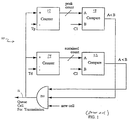
- Customer premises equipment is assumed to implement a dual leaky bucket of the kind shown in Figure 1 based shaping mechanism on a per VC (Virtual Channel) basis. Shaping refers to the changing of the spacing of the cells comprising the burst or packet of information or data.
- a switch (not shown) must implement the same criteria as the CPE for policing mechanism. When both the switch and the CPE implement the same criteria, the two act in the manner of a set of matched filters thereby potentially saving signalling bandwidth and latency time.
- the described arrangement has limitations for initial deployment so it will be assumed that signalling will be from the switch to the CPE.
- the dual leaky bucket shaping circuit 10 comprises a pair of counters 12 and 14.
- Counter 12 controls the peak rate ⁇ p at which the source is permitted to send bursts.
- the size of counter 12 is C 1.
- the counter 12 is assumed to be a one bit counter.
- Counter 14 controls a parameter referred to as the sustained rate ⁇ D to be described hereinafter.
- the size of counter 14 is C 2.
- the operation of the dual leaky bucket shaping circuit 10 is rule-based and shapes the user traffic as described in the following manner.
- a cell is transmitted along conductor 16 if the current value of counter 12 is one less than C 1 and the current value of counter 14 is one less than C 2. Otherwise, the cell is held back either in the interface card or a CPU comprising a portion of the traffic source, until the conditions are satisfied.
- the cell is transmitted, and both of the counters are incremented by one.
- the counter 12 is continuously decremented at a constant rate equal to the peak rate ⁇ P by virtue of an input signal T P .
- the counter 14 is continuously decremented at a constant rate ⁇ D by virtue of an input signal T d .
- the minimum value of the counters is ZERO. Hence, if only the counter 12 is full ( C 1) when a cell arrives, the cell is delayed at most for a period ⁇ or T p , before being transmitted.
- the output of counter 12 is provided as a first input to comparator 18.
- the size of counter 12 is provided as a second input to comparator 18. As described above, when the output of counter 12 is less than the size of counter 12 a signal is manifest from comparator 18 as a first input to AND gate 20.
- the output of counter 14 is provided as a first input of comparator 22.
- the size of counter 14 is provided as a second input to comparator 22. As described above, when the output of counter 14 is less than the size of counter 14 a signal is manifest from comparator 22 as a second input to AND gate 20.
- New cells are provided as third input signals to AND gate 20. When all three inputs to AND gate 20 are present simultaneously, the cell is manifest at conductor 16 for transmission.
- the output of AND circuit 20 is also provided as a respective inputs to counter 12 and to counter 14.
- the leaky bucket shaper circuit output comprises at most B Max cells at the peak rate ⁇ P .
- the leaky bucket shaper circuit output comprises the remaining B - B Max cells at the sustained rate ⁇ D . After the sustained mode the VC becomes idle, in an idle mode.
- a method for detecting the beginning and end of each mode and a method for using the detected information form the basis of the control comprising the present invention.
- N VCs connected to a given output port and that it is possible to detect the beginning and end of each burst.
- L of the VCs are active at a particular time.
- the remaining ( N - L ) VCs are declared inactive and their resources are deallocated. If a new VC L +1 becomes active with parameters ⁇ , ⁇ , B , whether the burst is accepted or rejected depends upon how conservative or optimistic the accept/reject decision criteria is made.
- each active VC is in the process of generating their maximum burst at their respective peak rate.
- a new burst is accepted on the premise that there are B Q buffers and the output port speed is ⁇ C , then the new burst is accepted only if no cell loss will result.
- the approach is conservative because in practical situations not all VCs are likely to be in the compliant mode.
- the basic principle of the present invention results in using the traffic shaping performed by the dual leaky bucket shaper circuit.
- the local ATM LAN can be divided into two domains, i.e., the CPE domain and the switch domain.
- the CPE comprises a workstation, the applications in the workstation that need the transport provided by the switch, the transport protocols and the interface to the switch.
- the CPE can also be a router or an access node.
- the ATM LAN could be viewed as a hub.
- Current data applications use a connection-less mode for transport of information.
- the ATM LAN which is inherently based on connection oriented transport, will provide connection-less service based on fast VC setup provided that there is a signalling scheme that can: request new VCs to be setup and existing VCs to be disconnected; detect activity levels on a given VC; request existing VCs be either deactivated or activated based on the activity level of the VC; and associate a unique VC with a given application. It is assumed that the application uses the socket feature of the UNIX OS for communication. In this case, at the time of a fast VC setup, the CPE must be able to associate the new VC with the socket port number used by the application. This may require either a new implementation of the Transport protocols, or a violation of the protocol layering function.
- the Service Access Point (SAP) may be one way of accomplishing this result.
- Tear-down of connections involves disassociation-association of the incoming and outgoing VCs.
- the resources allocated to the connection are also deallocated.
- the resources of interest are the output port transmission bandwidth and the output port buffers.
- the VCs are now free.
- the switch and the CPE should also monitor the activity level of VCs and declare an ACTIVE VC as IDLE.
- the corresponding VC instead of tearing down down the connection at the end of every burst, the corresponding VC is to declared as IDLE, and the resources are deallocated but the VC is marked as BUSY.
- the resources are restored to this connection and the connection is declared as ACTIVE.
- hardware based timeout will actually be used to declare the VC IDLE. Detection of ACTIVE-IDLE states increases the resource utilization (and thereby reduces blocking), and also reduces the load on the call processor. That is, call setups (and tear downs) are not performed at the beginning (and end) of each burst.
- a fast call setup will be performed and the appropriate VCs will be set.
- the necessary resources will be allocated and the leaky bucket parameters will be updated.
- a state machine is maintained for each VC which can be ACTIVE or IDLE.
- IDLE determined by timing out the idle period after the end of a burst
- the resources are deallocated and the state of the VC is marked IDLE.
- the connection becomes active again (by detecting the beginning of a new burst while in the IDLE state), the necessary resources are reallocated.
- the described burst-level control can significantly increase the utilization of available bandwidth.
- a high utilization is achieved by trading cell or frame loss with burst level blocking, for example, to achieve a burst level blocking of 10 ⁇ 3 with a cell loss probability of 10 ⁇ 6.
- the burst level control requires detecting the activity of the VC and declaring it as being either ACTIVE (resources are committed in this state) or IDLE (resources are deallocated).
- a VC can be in any one of three states: active compliant, active sustained and idle.
- a third counter is added to the dual leaky bucket shaper circuit that is monitoring the connection.
- the counter 30 has a maximum count C Idle .
- the counter 30 is incremented at a constant rate R O .
- T O C O /R O
- the counter will reach the value C O .
- a signal is generated indicating that the connection is inactive.
- the parameters R O and C O are functions of the parameters declared by the connection.
- the value of the time out interval T O can be dynamically altered if necessary.
- the time T O is chosen to be larger than the reciprocal of the sustained rate ⁇ d but smaller than the estimated time in an IDLE state.
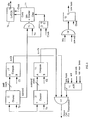
- a counter-based implementation of the leaky bucket shaper circuit with an idle state detector is shown in Figure 3.
- the idle counter is incremented at the drain-rate time constant T d so long as the peak rate counter 12 is zero. Whenever the peak rate counter is non-zero, the idle counter 30 is cleared.
- the count from counter 12 is provided as a first input to AND gate 32 and to flip flop 34.
- the drain rate time contrast pulses T d are provided as a second input to AND gate 32.
- a clock signal is provided as a second input to flip flop 34.
- the output of AND gate 32 is provided as an input idle to counter 30.
- the output of flip flop counter 34 is used to clear idle counter 30.
- a latch 36 receives as its first input the carry output from idle counter 30 and receives as its second input the clock pulses. The output signal from latch 36 is indicative of whether the associated VC being encountered is in its ACTIVE or IDLE states.
- the output signal from latch 36 is provided as a first input to AND gate 38.
- the other input to AND gate 38 is the new cell (burst) signal.
- an output signal is routed from AND gate 38 to flip flop 40.
- the clock pulse is provided as a second input to flip flop 40.
- An output signal from flip flop 40 indicates receipt of a new burst.
- the described embodiment assumes the receipt of an ACK signal prior to the cell being pondered for transmission of a new burst by means of AOI 42.
- the inputs to AOI 42 are new burst signal, not new burst signal, new cell signal and the ACK signal.
- the output of AOI 42 is provided as the third input to AND gate 20 and is indicative to the transmission of a new burst.
- a connection is declared inactive the CPE is informed and the resources are deallocated.
- the state of the VC at the CPE and the switch will be marked as IDLE.
- the CPE can also accomplish the same results by using a value C that is slightly smaller than C O . That is, the CPE will detect the connection to be inactive before the switch does) then, the CPE subsequently detects activity (i.e., the beginning of a new burst while in the IDLE state), the CPE withholds the burst and asks the switch to activate the connection first through an ACTIVATE connection request.
- the CPE can ask for the same last set of UPC parameters that was used previously, or the CPE can ask for a new set of UPC parameters. If the CPE transmits without restoring the connection to an ACTIVE state, the transmitted data will be treated as violating traffic by the switch. The switch is able to achieve the connection since its leaky bucket shaper circuit parameters would have already been modified.
- the switch receives the ACTIVATE request, the request is queued in the appropriate RRQ of the associated output port. The request is serviced when resources become available (until then the VC is blocked and maintained in a wait state). When a transition occurs from an IDLE state to an ACTIVE state, no NACK signal is sent if the VC is blocked.
- an ACKTOSEND signal is sent to the CPE and the CPE begins transmission of the burst. If the VC is blocked for a time greater than T W , the switch returns an ACK signal with a set of leaky bucket parameters that offers a smaller bandwidth.
- the advantage of this implementation is that no bursts are lost. It also provides time for the switch to process the burst request.
- the disadvantage of this implementation is the additional signalling required, and the possible incompatibility with interfaces that do not implement the required additional signalling (ACTIVATE and ACKTOSEND) signals.
- a CPE when a CPE has information to transmit, it transmits at the rate determined by the current leaky bucket shaper circuit setting. This is done without an ACTIVATE signal. If the VC has been declared as being IDLE, the switch detects the transition, and makes a decision in real time whether the burst can be accepted, or not, without incurring cell loss. If the burst can be accepted, the burst is admitted. If not, the burst is rejected. If the burst is rejected, it has to be retransmitted. An ACCEPT or REJECT-SENDAGAIN signal is sent to the CPE, indicating whether the burst has been accepted or not. The CPE interface will store the burst until the ACCEPT signal is received.
- the switch can request a new set of leaky bucket shaper circuit parameters for the CPE to transmit the burst again through the REJECT-SENDAGAIN signal. With the changed parameters the burst will be accepted.
- the REJECT-SENDAGAIN signal can be delayed by the switch. In this arrangement, the retransmission is done at the media-access level, at the cost of additional signalling.
- the method has the advantages of being compatible with conventional CPE interface cards that do not have extensive signalling capability and also that if the additional signalling is not implemented, the burst will be lost and will have to be retransmitted by a higher level protocol.
- a limitation of the method is that the time to process the acceptance of a new burst is very short (one cell time).
- One method to overcome the disadvantage is to buffer n cells of the burst, where n cell times are sufficient to process the burst. This can be implemented by using either a shift register or a circular RAM-based buffer.
- the primary objectives of a resource management scheme are (1) to minimize signalling overhead.
- call setup involves negotiation of parameter values.
- the signalling overhead is the processing power required to do the fast call setup, fast resource allocation and deallocation. Since the turn around time should to be small, these functions may have to be implemented in hardware/firmware and hence are preferably kept simple. Ultimately, it will be a trade-off between implementation complexity and efficient utilization of network resources and consequent frame loss rate.
- any user should be able to capture the full capacity of the path. When the network is heavily loaded, the path capacity must be shared between all contending users. Such an approach will make the LAN appear like a shared medium. This has to be achieved with little or no frame loss.
- connection oriented service is a special case of connection-less service as far as resource allocation and deallocation are concerned.
- the following embodiments relate to resource alloocation methods and apparatus that facilitate hardware embodiments.
- a dual leaky bucket shaper circuit is used to monitor two traffic parameters, namely the peak cell rate, and the maximum sustained burst size at the peak rates.
- the maximum compliant burst size B C is given by: For a given set of leaky bucket parameters, the maximum burst size that can be transmitted at the peak rate ⁇ P is B C . If the actual burst size is larger than B C , then the first B C cells are transmitted at the peak rate ⁇ D ⁇ ⁇ P (see Figure 2). Once a burst equal to the compliant burst size is transmitted at the peak rate, in order to transmit another burst of the same size at the peak rate, it is necessary to wait a time C 2/ ⁇ D for the counter value of the second bucket to decrement to zero. Hence, the dual leaky bucket shaper circuit which is rule-based makes the traffic more predictable, once the parameters are determined.
- a VC When there is either a request for a NEW connection or a VC makes a transition from an IDLE state an ACTIVE state, and the VC's resource requirements be defined by the parameters B *, ⁇ , ⁇ .
- the switch first identifies the appropriate output port and its associated resource request queue (RRQ). Each of these VCs can belong to different source destination pair. Assume that the amount of buffering in the output port is B Q and the output port speed is ⁇ C . Let the i th active VC have the traffic descriptors B i , ⁇ , ⁇ .
- the B i is the compliant burst length at the second leaky bucket, then the leaky bucket counter value Cl is given by: For a given size of the second bucket C , the compliant burst length depends on the choice of the peak rate and the sustained rate.
- the number of buffers in the switch is small, thereby placing an upper limit on the compliant burst size, and hence the size of the second leaky bucket counter.
- the size of the peak rate bucket counter is 1. If a source has a burst length that is larger than the compliant burst length for a given peak and sustained rate, after the compliant burst is admitted at the peak rate, the remaining portion of the burst will only be admitted at the sustained rate. That is, traffic shaping occurs only when the burst length is larger than the compliant burst length. If the source traffic is shaped, then that the burst will be held back in the CPE.
- ⁇ CBR be the capacity allocated to continuous bit rate (CBR) traffic on a link.
- CBR continuous bit rate
- the traffic parameters will be (1, ⁇ P , ⁇ P ). That is, the burst size is 1, and the peak rate and the sustained rate are the same.
- the resource allocation method is such that no cell loss occurs.
- the following rules are applied in order to determine if the queue can accept the new VC without incurring cell loss.
- the queue call accept the traffic from the new VC.
- the VC connection is setup and the leaky bucket parameters are updated.
- the incoming and outgoing VCs are also marked as BUSY and the connection is marked as ACTIVE.
- each VC can be in one of three states; ACTIVE, IDLE, ACTIVE and Being TIMED OUT. If the VC is ACTIVE, it can be in the compliant mode, in the sustained mode, or be waiting to be timed out. In the conservative approach it was assumed that all active VCs are in the compliant mode.
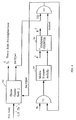
- An estimator for B - i is shown schematically in Figure 4. Any time a new request is accepted with values ( B max , T ), a counter bank j 44 shown in Figure 3 is chosen from an unused set. The relevant address for that counter bank is marked as being used. B is loaded into the up-down counter 46 which is decremented every T using modulo-N counter until the value of the up-down counter 46 is zero, at which time the counter bank is cleared and its address is sent back to the unused token pool. The output count from up/down counter 46 is connected to one input of AND gate 50. The other input to AND gate 50 is connected to an output of chosen counter bank j 44 and is a logic level 1 state when the VC is chosen.
- up/down counter 46 when up/down counter 46 reaches zero, the output of AND gate 50 is in a logic level 1 state.
- the output of AND gate 50 is provided as an input to AND gate 52.
- the other input to AND gate 52 are the pulses at rate T c .
- the value of the up-down counter at any given time is an estimate of B - i .
- P i be the probability that source i that is being timed out will switch to a compliant mode (and generate a burst) before the time out expires.
- the computation of P i is given below.
- a new request from a new connection or a VC making a transition from an IDLE to ACTIVE state is accepted if The above implementation is considered to be optimistic, since it only takes the average contribution from those sources that are not in the compliant mode. Cell loss can result in this implementation.
- the probability is determined that cell loss can result if a new burst is accepted.
- the key to the present method is the ability to determine the probability that a source that is being timed-out as IDLE will become active before the timeout expires.
- the leaky bucket parameters of a source are ( B C , ⁇ P , ⁇ D ). Assume that the source makes transitions between an ON state and an OFF state. While in the ON state, the source is transmitting cells. While in the OFF state, it transmits no cells. If this latter state persists for a sufficiently long length of time, the source can be timed-out.
- the timeout interval is T OUT
- the time out interval must be chosen such that the probability of a burst being timed out before the end of the burst is very low.
- the probability that source i becomes active before its time expires is given by
- the total number of ACTIVE VCs is N , of which L are in the compliant mode.
- the remaining ( N - L ) VCs are either in the sustained mode or are in process of being timed out.
- connectionless service there are special cases of the method.
- the ability of the UPC to detect the start of the burst can be used to emulate media access control.
- a path between an input/output port pair can be in one of three states: in a Free state where the output port bandwidth is not allocated to any VC; in a Busy state with a single VC using the full capacity or in a Blocked state because another path using the same output port (but from a different input port) is being used by an active VC.
- the appropriate RRQ of the associated output port is selected and the request is put in the queue. If the output port bandwidth is free, the path is assigned to the connection and the leaky bucket rates are set equal to the port speed. The path and the output port used by the path are marked busy. Also, all other free paths that use the same output port are marked blocked.
- the above method has the following advantages.
- the signalling is simple. There is very little negotiation involved with the CPE.
- the method is efficient at low loads (with low latency). This method will perform as well as an equivalent FDDI if all the inputs what to communicate to the same output. Further, the method also allows simultaneous communication to other output ports as well.
- the method presupposes that all the input ports will be transmitting at the output port speed. If this is not true, there will be waste of bandwidth. If the bursts are very long, or several burst get merged into one long burst, and the variability in response time can increase.
- the methods allow the input port to communicate to only one output port at any given time. Connection oriented services can block an output port for a prolonged period of time.
- many paths share the output port capacity where each new connection or a connection making a transition from an IDLE to ACTIVE state can ask for a peak bandwidth ⁇ p that is less than the port bandwidth ⁇ C .
- the leaky bucket parameters would be 1, ⁇ , ⁇ ⁇ , with ⁇ ⁇ ⁇ C .
- the method involves identification of the appropriate output port for the connection request.
- the RRQ of the output port has the following information: (a) paths that are FREE, BUSY, BLOCKED on this output port; (b) VCs that are marked FREE, BUSY, IDLE on this port; (c) resource allocated to each of the BUSY VCs that are associated with their outpout port, and (d) the total bandwidth that has been allocated.
- the controller checks whether where the index ⁇ , is the bandwidth allocated to ACTIVE VC j using the given output port.
- the required bandwidth allows, it is possible to offer a peak bandwidth or place the queue on wait in the resource queue, and wait for bandwidth to be freed, or ask the input port to retry later.
- the above method allows simultaneous multi rate-switching, and CBR sources can now be easily accommodated.
- the method has minimal signalling, but can operate with a higher efficiency than the previous method.
- a connection was either assigned the full capacity if it was available, or it had to wait until the full capacity was available.
- the quantum size was the capacity of the port.
- a connection could request any bandwidth less than or equal to output port bandwidth.
- the bandwidth allocation is quantized. This later method may have the advantage of each resource management, but at the expense of some efficiency.
- the advantage of this method is that at low loads (with respect to a given output port), the input ports can access whatever bandwidth they request. At higher loads, there is natural sharing of the limited bandwidth between the contending connections. The result is higher efficiency and lower variance in delay.
- An input port specifies all three parameters ( B , ⁇ p , ⁇ D ).
- the input port and the controller can negotiate and redefine the leaky bucket parameters as necessary.
- the principle advantage of the method is that traffic negotiation will now be compatible with resource negotiation procedures for wide area networking.
- the drain rates are small, then the number of active VCs could be large but the rate of change of their counter states could be sufficiently slow and the method could be implemented in software, rather than hardware.
- the other salient feature of the leaky bucket implementation is the face that as the ratio of the peak rate to the drain rate becomes large, the maximum sustained burst effectively becomes equal to C 2. If this ratio approaches one, this burst size approaches infinity and we are back to allocating resources only at the peak rate.
- the first factor above clearly points to the possibility of a RAM-based implementation where the states are stored in a RAM and for slow VCs the control is implemented by updating the RAM while the fact VCs can be controlled in hardware.
- One embodiment is to have only a limited set of LEAKY bucket monitors that will be shared by all the VCs using a given link.
- the state information of each VC would be sorted in a RAM and at appropriate times, state information is loaded into the LEAKY BUCKETS and updated.
- some of the high speed VC states may always be maintained in the leaky bucket circuit, and only the low speed VC status be stored in RAM.
- the scheme can lead to a certain amount of blocking i.e., the leaky bucket circuitry is not available when needed.
- a virtual clock based implementation there is a notion of a counter keeping track of time where time is quantized to the system clock and a timestamp is used for a particular event. It is assumed that the system clock is running at a much high rate than the peak and drain rates of the individual VCs. For example, if the usual clock chip is designed to operate at a rate of 40 MHz, it is several orders of magnitude larger than the cell transfer time at the peak line rate of 155 Mb/s which is 2.8 microseconds and corresponds to about 300 KHz. The number of VCs able to be multiplexed on a chip is obviously a function of the maximum system clock rate and the line rate.
- a virtual clock based implementation of the leaky bucket is described in article by H. J.
- Chao entitled, "Design of Leaky Bucket Access Control Schemes in ATM Networks" in the 1991 IEEE International Communications Conference.
- the implementation in Chao can be optimized further and instead of the 256 VCs that are described in Chao, the present invention is capable of providing support for several thousand VCs in hardware and ultimately supporting 64,000 active VCs (some in hardware and the rest through RAM-manipulations in software).
- a preferred method of implementing a virtual-clock based control is the use of a priority queue.
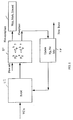
- Figure 5 schematically shows the basic working of a priority queue.
- a priority queue can be viewed as a chain of D Flip-Flops or shift registers connected through combinatorial logic.
- a broadcast bus will broadcast a 2-tuple to this priority queue, the 2-tuple consists of a value that is used for comparison (for example, a time-stamp) and an associated address or control information which is carried along with it.
- the combinational logic basicically a compare and an and-or-invert circuit) compares the new value to the existing value.
- the existing 2-tuple is shifted one step to the left otherwise the existing 2-tuple is reloaded without any shifting.
- the priority queue is either shifting right (business as usual), reloading the old value or shifting left.
- the priority queue at any given time has an ordered list of time stamps and the entry at the head of the queue is compared to the real-time counter value T now to see if the time for this event has occurred or not.
- Figure 5 is not the way an optimal priority queue can be implemented but is presented rather for this purpose of describing in principle. In practice, the broadcast bus is eliminated and known retiming techniques are used to make the queue essentially ripple free.
- the length of the priority queue has to be sufficiently large that all the active VCs are able to cycle through the RAM manipulations without falling off at the end of the queue due to faster VCs.
- the leaky bucket counters and the idle/burst detectors are implemented in a RAM.
- the RAM is shown in Figure 6.
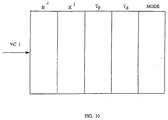
- the RAM is indexed by the particular VC and contains fields for T p , T d which are the peak and drain rate timers, C p and C d which are the leaky bucket maximum counter values for the two buckets, N p and N d which are the actual values of the counters, and T or which is the timeout value for this particular VC before it is declared idle (equivalent to N T d in Figure 3).
- T p peak and drain rate timers
- C p and C d which are the leaky bucket maximum counter values for the two buckets
- N p and N d which are the actual values of the counters
- Also needed is information whether the VC is active or idle. And for time out purposes, it is necessary to know the time of arrival of the
- T l is the time-stamp for the event.
- the control information that the time stamp carries is the VC number 1 and the type of event (peak time-stamp, drain time-stamp and timeout time-stamp).
- the event at the head of the queue T l in RAM 60 is compared to T now in comparator 62. If the compare is true (time for the event has occurred), the control information is latched in latch 64.
- the address part of the information l is used to obtain the relevant information from the shaper RAM 66.
- the type field signal from latch 64 to microprocessor 68 determines the fields that will be modified. If the field to be modified is the peak, N is decremented by one.
- N is zero then it is necessary to also send a timeout time-stamp ( T ) which is equal to T + 'T now to the priority queue. A new peak time-stamp also has to be sent to the priority queue. If the peak counter time-stamp is much smaller then the time-out then the time-out will overtake all the time-out values for the VC (which will fall off the edge of the queue) but in order to maintain control, the time T now is written into the field for the last cell arrival for this VC when a request for a new cell does arrive as shown in Figure 8. If the type of the time-stamp counter is a drain rate type. N is appropriately decremented in RAM 78, the next event time calculated and sent back to the queue. If the type is timeout, then the current time is compared in RAM 80 to determine whether it actually does exceed the value of the last cell arrival by T . If it does, the circuit is determined to be idle and marked accordingly in the mode field of the RAM 72.
- T timeout time-stamp
- FIG. 9 A similar implementation of estimating B - i and the sum of existing compliant cells is shown in Figure 9.
- the hardware embodiment in Figure 9 maintains track of the residual time B remaining from a particular virtual channel n and in addition, computes the sum of the residual times from all of the virtual channels.
- sum B i the sum of all the residual work from the existing VCs, sum B i , is incremented in unit 92 by B i and B - i and is set to B i .
- FIG. 10 A RAM-based implementation of the event in Figure 9 and the contents of the RAM is shown in Figure 10. This RAM keeps track of each of the VCs in the compliant mode and their residual load on the system.
- a problem with the above implementation may be the size of the queue needed to ensure that it is possible to cycle through all the possible entries in the RAM in Figure 6.
- One method of simplification is by maintaining a link-list of the next N events that need to be incremented or decremented in the RAM. N is chosen such that there is sufficient time to cycle through the entire VC space of the RAM. If N is much smaller than the size of the priority queue then it may be a more efficient implementation.
- the hardware elements are replaced by memory elements.
- a dedicated processor, and commodity memory ICs are used to essentially simulate the operation of the hardware illustrated in Figures 3 and 4.
- the embodiment comprises of a single processor, and some associated DRAM ICs. Even though none of the controllers is actually explicitly implemented, the "state" of each controller is saved in a preassigned location in DRAM.
- the counter values of each controller are always updated every 64K maximum-rate cell transfer times.
- two pieces of information are needed: the number of counter decrements that would have occurred since the last counter-value update, and the number of counter-value increments that have occurred since the last update.
- the decrement offset may change after each update, and hence, it is necessary to associate additional state with each counter.
- the number of counter value increments is kept up-to-date as cell-acceptance decisions are made, and is "zeroed" each time that the counter value is updated.
- the controllers are updated in sequence, and the updates of each controller are equally-spaced over time.
- the up-to-date state of any particular controller can be calculated "on demand,” whenever a new acceptance decision.
- the on-demand update is performed in the same fashion as the previously described "standard” counter-value update, except that the time since the last standard update must be computed from the current time (modulo 64K), the controller "index", and the spacing between the updates of the different controllers.
- a RAM-base implementation is, however, reasonably scalable. For example, if the additional cost of a custom processing IC is acceptable, 32K of (non-trench) DRAM could be integrated onto the processor die, and a one-package, 128 leaky-bucket controller implementation could be realized. In addition, by adding more DRAMs, the described implementation should scale to 16K Leaky-Bucket Controllers, using 8 DRAMs for Controller state.
Landscapes
- Engineering & Computer Science (AREA)
- Computer Networks & Wireless Communication (AREA)
- Signal Processing (AREA)
- Data Exchanges In Wide-Area Networks (AREA)
Applications Claiming Priority (2)
| Application Number | Priority Date | Filing Date | Title |
|---|---|---|---|
| US97683 | 1993-07-27 | ||
| US08/097,683 US5448567A (en) | 1993-07-27 | 1993-07-27 | Control architecture for ATM networks |
Publications (2)
| Publication Number | Publication Date |
|---|---|
| EP0637154A2 true EP0637154A2 (de) | 1995-02-01 |
| EP0637154A3 EP0637154A3 (de) | 1998-05-27 |
Family
ID=22264632
Family Applications (1)
| Application Number | Title | Priority Date | Filing Date |
|---|---|---|---|
| EP94111567A Withdrawn EP0637154A3 (de) | 1993-07-27 | 1994-07-25 | Steuerungsarchitektur für ATM-Netze |
Country Status (4)
| Country | Link |
|---|---|
| US (1) | US5448567A (de) |
| EP (1) | EP0637154A3 (de) |
| JP (1) | JP2646984B2 (de) |
| CA (1) | CA2128767A1 (de) |
Cited By (1)
| Publication number | Priority date | Publication date | Assignee | Title |
|---|---|---|---|---|
| EP0755594A4 (de) * | 1995-02-15 | 1998-07-08 | Motorola Inc | Leaky-bucket-vorrichtung zweiter ordnung und verfahren zum verkehrsmanagement in zellenrelais-netzwerken |
Families Citing this family (68)
| Publication number | Priority date | Publication date | Assignee | Title |
|---|---|---|---|---|
| US5453981A (en) * | 1990-10-16 | 1995-09-26 | Kabushiki Kaisha Toshiba | Method of controlling communication network incorporating virtual channels exchange nodes and virtual paths exchange nodes |
| JP3128654B2 (ja) | 1990-10-19 | 2001-01-29 | 富士通株式会社 | 監視制御方法、監視制御装置及び交換システム |
| GB9405406D0 (en) * | 1994-03-18 | 1994-05-04 | Netcomm Ltd | Atm cell switch |
| US5877814A (en) * | 1994-04-20 | 1999-03-02 | Thomson Consumer Electronics, Inc. | Asynchronous control signal generating apparatus |
| EP0687120A1 (de) * | 1994-06-09 | 1995-12-13 | ALCATEL BELL Naamloze Vennootschap | Reglementierungsverfahren zur Garantierung von fairem Durchsatz und Anlage zur Durchführung des Verfahrens |
| US5724513A (en) * | 1994-06-30 | 1998-03-03 | Digital Equipment Corporation | Traffic shaping system for asynchronous transfer mode networks |
| US5515363A (en) * | 1994-06-30 | 1996-05-07 | Digital Equipment Corporation | Traffic shaping system with transmit latency feedback for asynchronous transfer mode networks |
| WO1996034469A1 (en) * | 1995-04-22 | 1996-10-31 | General Datacomm, Inc. | A traffic shaping atm network switch |
| US5535201A (en) * | 1995-05-10 | 1996-07-09 | Mitsubishi Electric Research Laboratories, Inc. | Traffic shaping system using two dimensional timing chains |
| US5563885A (en) * | 1995-05-24 | 1996-10-08 | Loral Fairchild Corporation | Method and system for processing multiple channel data |
| US6327246B1 (en) | 1995-11-29 | 2001-12-04 | Ahead Communications Systems, Inc. | Controlled available bit rate service in an ATM switch |
| US5978843A (en) * | 1995-12-06 | 1999-11-02 | Industrial Technology Research Institute | Scalable architecture for media-on-demand servers |
| GB9602809D0 (en) * | 1996-02-12 | 1996-04-10 | Northern Telecom Ltd | A bidirectional communications network |
| US6195352B1 (en) * | 1996-03-15 | 2001-02-27 | Network Associates, Inc. | System and method for automatically identifying and analyzing currently active channels in an ATM network |
| US5812527A (en) * | 1996-04-01 | 1998-09-22 | Motorola Inc. | Simplified calculation of cell transmission rates in a cell based netwook |
| US5794025A (en) * | 1996-05-09 | 1998-08-11 | Maker Communications, Inc. | Method and device for performing modulo-based arithmetic operations in an asynchronous transfer mode cell processing system |
| US5860148A (en) * | 1996-05-09 | 1999-01-12 | Maker Communications, Inc. | Asynchronous transfer mode cell processing system with cell buffer space gathering |
| US5748631A (en) * | 1996-05-09 | 1998-05-05 | Maker Communications, Inc. | Asynchronous transfer mode cell processing system with multiple cell source multiplexing |
| US6128303A (en) * | 1996-05-09 | 2000-10-03 | Maker Communications, Inc. | Asynchronous transfer mode cell processing system with scoreboard scheduling |
| US5748630A (en) * | 1996-05-09 | 1998-05-05 | Maker Communications, Inc. | Asynchronous transfer mode cell processing system with load multiple instruction and memory write-back |
| US5771228A (en) * | 1996-05-16 | 1998-06-23 | Integrated Telecom Technology, Inc. | Method and apparatus for recovery of peak cell rate tokens in an ATM network interface |
| JPH1023023A (ja) * | 1996-07-03 | 1998-01-23 | Sony Corp | 交換装置およびその方法 |
| DE19745020B4 (de) * | 1996-10-29 | 2008-01-31 | Keymile Ag | Verfahren zum Steuern des Datenverkehrs in einem ATM-Netzwerk |
| US5974029A (en) * | 1996-10-31 | 1999-10-26 | Inverness System Ltd. | Method for limiting the transmission of data generated by a data source |
| US7058892B1 (en) | 1996-11-08 | 2006-06-06 | America Online, Inc. | Displaying content from multiple servers |
| US5796393A (en) * | 1996-11-08 | 1998-08-18 | Compuserve Incorporated | System for intergrating an on-line service community with a foreign service |
| US5987027A (en) * | 1996-11-08 | 1999-11-16 | Alcatel | Cross-connect multirate/multicast SDH/SONET rearrangement procedure and cross-connect using same |
| CH690887A5 (de) * | 1996-12-13 | 2001-02-15 | Alcatel Sa | Former für einen Strom von Datenpaketen |
| WO1998031156A2 (en) * | 1997-01-14 | 1998-07-16 | Bell Communications Research, Inc. | Method and system for dynamic allocation of bandwidth in asynchronous transfer mode (atm) switching systems |
| US6304551B1 (en) * | 1997-03-21 | 2001-10-16 | Nec Usa, Inc. | Real-time estimation and dynamic renegotiation of UPC values for arbitrary traffic sources in ATM networks |
| KR100235605B1 (ko) * | 1997-04-09 | 1999-12-15 | 윤종용 | Mbea를 이용한 atm의 멀티플렉서 |
| US6167027A (en) | 1997-09-09 | 2000-12-26 | Cisco Technology, Inc. | Flow control technique for X.25 traffic in a high speed packet switching network |
| US6198724B1 (en) | 1997-10-02 | 2001-03-06 | Vertex Networks, Inc. | ATM cell scheduling method and apparatus |
| US6449253B1 (en) | 1997-10-29 | 2002-09-10 | Telcordia Technologies, Inc. | Method and system for dynamic allocation of bandwidth in asynchronous transfer mode (ATM) switching systems |
| US6052375A (en) * | 1997-11-26 | 2000-04-18 | International Business Machines Corporation | High speed internetworking traffic scaler and shaper |
| AU2617699A (en) * | 1999-01-15 | 2000-08-01 | Nokia Networks Oy | Packet concatenation method and apparatus |
| US6718382B1 (en) * | 1999-02-11 | 2004-04-06 | Yunzhou Li | Technique for detecting leaky points within a network protocol domain |
| US6408187B1 (en) * | 1999-05-14 | 2002-06-18 | Sun Microsystems, Inc. | Method and apparatus for determining the behavior of a communications device based upon environmental conditions |
| US6747951B1 (en) * | 1999-09-20 | 2004-06-08 | Nortel Networks Limited | Method and apparatus for providing efficient management of resources in a multi-protocol over ATM (MPOA) |
| US7624172B1 (en) | 2000-03-17 | 2009-11-24 | Aol Llc | State change alerts mechanism |
| US9736209B2 (en) | 2000-03-17 | 2017-08-15 | Facebook, Inc. | State change alerts mechanism |
| US8032653B1 (en) * | 2000-09-08 | 2011-10-04 | Juniper Networks, Inc. | Guaranteed bandwidth sharing in a traffic shaping system |
| TW540205B (en) * | 2001-02-27 | 2003-07-01 | Ind Tech Res Inst | Real-time scheduling mechanism capable of controlling quality of service |
| US6980513B2 (en) * | 2001-09-24 | 2005-12-27 | Transwitch Corporation | Methods and apparatus for the fair allocation of bandwidth among MCR and best effort service connections in an ATM switch |
| US7450561B2 (en) * | 2002-02-13 | 2008-11-11 | General Instrument Corporation | Method and apparatus for reserving and releasing bandwidth for a packet-switched telephony connection established over an HFC cable network |
| US7307951B2 (en) * | 2002-04-24 | 2007-12-11 | International Business Machines Corporation | Timeout determination method and apparatus |
| JP3908589B2 (ja) * | 2002-04-24 | 2007-04-25 | 日本電気株式会社 | 通信システム、コネクション管理サーバ装置及びプログラム |
| US6822939B2 (en) | 2002-05-20 | 2004-11-23 | Transwitch Corporation | Method and apparatus for guaranteeing a minimum cell rate (MCR) for asynchronous transfer mode (ATM) traffic queues |
| US8122137B2 (en) | 2002-11-18 | 2012-02-21 | Aol Inc. | Dynamic location of a subordinate user |
| US7640306B2 (en) | 2002-11-18 | 2009-12-29 | Aol Llc | Reconfiguring an electronic message to effect an enhanced notification |
| US7899862B2 (en) | 2002-11-18 | 2011-03-01 | Aol Inc. | Dynamic identification of other users to an online user |
| US8005919B2 (en) | 2002-11-18 | 2011-08-23 | Aol Inc. | Host-based intelligent results related to a character stream |
| US7428580B2 (en) | 2003-11-26 | 2008-09-23 | Aol Llc | Electronic message forwarding |
| WO2004046867A2 (en) | 2002-11-18 | 2004-06-03 | America Online, Inc. | People lists |
| US8965964B1 (en) | 2002-11-18 | 2015-02-24 | Facebook, Inc. | Managing forwarded electronic messages |
| US8701014B1 (en) | 2002-11-18 | 2014-04-15 | Facebook, Inc. | Account linking |
| US7590696B1 (en) | 2002-11-18 | 2009-09-15 | Aol Llc | Enhanced buddy list using mobile device identifiers |
| US7603417B2 (en) | 2003-03-26 | 2009-10-13 | Aol Llc | Identifying and using identities deemed to be known to a user |
| US7653693B2 (en) | 2003-09-05 | 2010-01-26 | Aol Llc | Method and system for capturing instant messages |
| US7669213B1 (en) | 2004-10-28 | 2010-02-23 | Aol Llc | Dynamic identification of other viewers of a television program to an online viewer |
| EP1878270B1 (de) * | 2005-05-03 | 2013-04-10 | NetSocket, Inc. | Verfahren und anordnungen zum reservieren von betriebsmitteln in einem datennetzwerk |
| US7760641B2 (en) * | 2006-07-10 | 2010-07-20 | International Business Machines Corporation | Distributed traffic shaping across a cluster |
| US20100100536A1 (en) * | 2007-04-10 | 2010-04-22 | Robin Daniel Chamberlain | System and Method for Evaluating Network Content |
| US8733453B2 (en) * | 2007-12-21 | 2014-05-27 | Schlumberger Technology Corporation | Expandable structure for deployment in a well |
| US8291781B2 (en) * | 2007-12-21 | 2012-10-23 | Schlumberger Technology Corporation | System and methods for actuating reversibly expandable structures |
| US7896088B2 (en) | 2007-12-21 | 2011-03-01 | Schlumberger Technology Corporation | Wellsite systems utilizing deployable structure |
| US8031606B2 (en) | 2008-06-24 | 2011-10-04 | Intel Corporation | Packet switching |
| WO2010022459A1 (en) * | 2008-08-27 | 2010-03-04 | Rob Chamberlain | System and/or method for linking network content |
Family Cites Families (11)
| Publication number | Priority date | Publication date | Assignee | Title |
|---|---|---|---|---|
| US4669113A (en) * | 1985-04-26 | 1987-05-26 | At&T Company | Integrated network controller for a dynamic nonhierarchical routing switching network |
| JP2725678B2 (ja) * | 1988-10-11 | 1998-03-11 | 日本電信電話株式会社 | パケット通信方法 |
| NL8900269A (nl) * | 1989-02-03 | 1990-09-03 | Nederland Ptt | Methode voor het via een meervoud van asynchroon tijdverdeelde transmissiekanalen overdragen van een stroom van datacellen, waarbij per transmissiekanaal een tellerstand wordt bijgehouden, die afhankelijk is van het aantal datacellen per tijd. |
| JPH04117545A (ja) * | 1990-09-07 | 1992-04-17 | Toshiba Corp | 通信資源割付け機能を持つ情報処理装置 |
| JPH04150439A (ja) * | 1990-10-12 | 1992-05-22 | Toshiba Corp | 通信資源管理方式 |
| EP0487235B1 (de) * | 1990-11-21 | 1999-02-03 | AT&T Corp. | Bandbreitenverwaltung und Überlastabwehr für den Zugang zu Breitband-ISDN-Netzen |
| JPH0783361B2 (ja) * | 1991-05-14 | 1995-09-06 | 松下電器産業株式会社 | リング状パケット通信網 |
| JPH04369942A (ja) * | 1991-06-19 | 1992-12-22 | Hitachi Ltd | データ通信システム |
| US5179556A (en) * | 1991-08-02 | 1993-01-12 | Washington University | Bandwidth management and congestion control scheme for multicast ATM networks |
| DE59108304D1 (de) * | 1991-08-27 | 1996-11-28 | Siemens Ag | Anordnung zur Bitratenüberwachung in ATM-Netzen |
| US5313454A (en) * | 1992-04-01 | 1994-05-17 | Stratacom, Inc. | Congestion control for cell networks |
-
1993
- 1993-07-27 US US08/097,683 patent/US5448567A/en not_active Expired - Lifetime
- 1993-12-20 JP JP32066293A patent/JP2646984B2/ja not_active Expired - Fee Related
-
1994
- 1994-07-25 CA CA002128767A patent/CA2128767A1/en not_active Abandoned
- 1994-07-25 EP EP94111567A patent/EP0637154A3/de not_active Withdrawn
Cited By (1)
| Publication number | Priority date | Publication date | Assignee | Title |
|---|---|---|---|---|
| EP0755594A4 (de) * | 1995-02-15 | 1998-07-08 | Motorola Inc | Leaky-bucket-vorrichtung zweiter ordnung und verfahren zum verkehrsmanagement in zellenrelais-netzwerken |
Also Published As
| Publication number | Publication date |
|---|---|
| EP0637154A3 (de) | 1998-05-27 |
| CA2128767A1 (en) | 1995-01-28 |
| US5448567A (en) | 1995-09-05 |
| JP2646984B2 (ja) | 1997-08-27 |
| JPH0746256A (ja) | 1995-02-14 |
Similar Documents
| Publication | Publication Date | Title |
|---|---|---|
| US5448567A (en) | Control architecture for ATM networks | |
| EP0430570B1 (de) | Verfahren und Vorrichtung zur Überlastregelung in einem Datennetzwerk | |
| Chang et al. | Guaranteed quality-of-service wireless access to ATM networks | |
| US5818815A (en) | Method and an apparatus for shaping the output traffic in a fixed length cell switching network node | |
| US5179556A (en) | Bandwidth management and congestion control scheme for multicast ATM networks | |
| US5455826A (en) | Method and apparatus for rate based flow control | |
| US6175570B1 (en) | Method and an apparatus for shaping the output traffic in a fixed length cell switching network node | |
| US7002911B1 (en) | Flow control mechanism | |
| US6839767B1 (en) | Admission control for aggregate data flows based on a threshold adjusted according to the frequency of traffic congestion notification | |
| AU707294B2 (en) | ATM throttling | |
| US6295532B1 (en) | Apparatus and method for classifying information received by a communications system | |
| McAuley | Protocol design for high speed networks | |
| CN100514931C (zh) | 线路卡端口保护速率限制器电路 | |
| Fulton et al. | An ABR feedback control scheme with tracking | |
| JP4652494B2 (ja) | 分散構成のatmスイッチでのフロー制御方法 | |
| Gerla et al. | Internetting LAN's and MAN's to B-ISDN's for Connectionless Traffic Support | |
| US20020078040A1 (en) | Apparatus and method for providing a binary range tree search | |
| US6504824B1 (en) | Apparatus and method for managing rate band | |
| US6504821B2 (en) | Flexible bandwidth negotiation for the block transfer of data | |
| JPH05219093A (ja) | ポリシング方法および回路 | |
| Siu et al. | Virtual queueing techniques for UBR+ service in ATM with fair access and minimum bandwidth guarantee | |
| US6466542B1 (en) | Multiple phase time counter for use in a usage parameter control device for an asynchronous transfer mode system | |
| Garlick et al. | Reliable host-to-host protocols: Problems and techniques | |
| Keshav et al. | Rate controlled servers for very high speed networks | |
| Siu et al. | Performance of TCP over ATM with time-varying available bandwidth |
Legal Events
| Date | Code | Title | Description |
|---|---|---|---|
| PUAI | Public reference made under article 153(3) epc to a published international application that has entered the european phase |
Free format text: ORIGINAL CODE: 0009012 |
|
| AK | Designated contracting states |
Kind code of ref document: A2 Designated state(s): DE FR GB |
|
| PUAL | Search report despatched |
Free format text: ORIGINAL CODE: 0009013 |
|
| AK | Designated contracting states |
Kind code of ref document: A3 Designated state(s): DE FR GB |
|
| 17P | Request for examination filed |
Effective date: 19980415 |
|
| 17Q | First examination report despatched |
Effective date: 20010905 |
|
| STAA | Information on the status of an ep patent application or granted ep patent |
Free format text: STATUS: THE APPLICATION IS DEEMED TO BE WITHDRAWN |
|
| 18D | Application deemed to be withdrawn |
Effective date: 20020306 |