EP0630514B1 - Kernreaktor-brennstab mit zweischichtigem hüllrohr - Google Patents
Kernreaktor-brennstab mit zweischichtigem hüllrohr Download PDFInfo
- Publication number
- EP0630514B1 EP0630514B1 EP93903814A EP93903814A EP0630514B1 EP 0630514 B1 EP0630514 B1 EP 0630514B1 EP 93903814 A EP93903814 A EP 93903814A EP 93903814 A EP93903814 A EP 93903814A EP 0630514 B1 EP0630514 B1 EP 0630514B1
- Authority
- EP
- European Patent Office
- Prior art keywords
- weight
- content
- alloy
- fuel rod
- tin
- Prior art date
- Legal status (The legal status is an assumption and is not a legal conclusion. Google has not performed a legal analysis and makes no representation as to the accuracy of the status listed.)
- Revoked
Links
Images




Classifications
-
- G—PHYSICS
- G21—NUCLEAR PHYSICS; NUCLEAR ENGINEERING
- G21C—NUCLEAR REACTORS
- G21C3/00—Reactor fuel elements and their assemblies; Selection of substances for use as reactor fuel elements
- G21C3/02—Fuel elements
- G21C3/04—Constructional details
- G21C3/06—Casings; Jackets
- G21C3/07—Casings; Jackets characterised by their material, e.g. alloys
-
- B—PERFORMING OPERATIONS; TRANSPORTING
- B32—LAYERED PRODUCTS
- B32B—LAYERED PRODUCTS, i.e. PRODUCTS BUILT-UP OF STRATA OF FLAT OR NON-FLAT, e.g. CELLULAR OR HONEYCOMB, FORM
- B32B15/00—Layered products comprising a layer of metal
- B32B15/01—Layered products comprising a layer of metal all layers being exclusively metallic
-
- C—CHEMISTRY; METALLURGY
- C22—METALLURGY; FERROUS OR NON-FERROUS ALLOYS; TREATMENT OF ALLOYS OR NON-FERROUS METALS
- C22C—ALLOYS
- C22C16/00—Alloys based on zirconium
-
- Y—GENERAL TAGGING OF NEW TECHNOLOGICAL DEVELOPMENTS; GENERAL TAGGING OF CROSS-SECTIONAL TECHNOLOGIES SPANNING OVER SEVERAL SECTIONS OF THE IPC; TECHNICAL SUBJECTS COVERED BY FORMER USPC CROSS-REFERENCE ART COLLECTIONS [XRACs] AND DIGESTS
- Y02—TECHNOLOGIES OR APPLICATIONS FOR MITIGATION OR ADAPTATION AGAINST CLIMATE CHANGE
- Y02E—REDUCTION OF GREENHOUSE GAS [GHG] EMISSIONS, RELATED TO ENERGY GENERATION, TRANSMISSION OR DISTRIBUTION
- Y02E30/00—Energy generation of nuclear origin
- Y02E30/30—Nuclear fission reactors
Definitions
- the invention relates to a fuel rod of a pressurized water-cooled fuel element, with a cladding tube enclosing a fuel filling, which consists of a first, thicker inner layer facing the fuel filling made of a first zirconium alloy and a thinner outer layer metallurgically bonded to the inner layer of a second zirconium alloy, wherein the two zirconium alloys each contain at least the metals tin, iron and chromium.
- Zirconium is a relatively soft metal, which is particularly suitable for structural parts of nuclear reactors due to its low neutron absorption and is technically usually produced as a "zirconium sponge", the maximum impurities of which are standardized for use in nuclear reactors. Since the fuel rods of reactor fuel elements are only finger-thin, but several meters long, the fuel rods filled with fuel rods and the guide tubes, spacers and other structural parts of the fuel element require a high level of strength that is stable even after prolonged exposure to radiation, which can be achieved by alloying with tin is. Pure zirconium forms a thin oxide layer in water, which protects the metal from further oxidation, but foreign substances built into the structure of the zirconium or the oxide layer, especially nitrogen, can greatly accelerate the corrosion.
- the tin additive neutralizes the corrosion effect of nitrogen, especially in combination with low iron additions, but it also promotes corrosion at higher tin contents (B. Lustman, Frank Kerze: "The metallurgy of circonium” New York 1955, page 538, Fig. 10.34 and Page 628, Fig.11.35).
- An iron additive hardens the alloy in such a way that even at relatively low iron contents processing of the alloy into thin, long cladding tubes is practically no longer possible.
- such an iron content leads to increased diffusion and absorption of the hydrogen formed in the metal during corrosion in water, whereby hydrogenated areas form ("W. Berry, D. Vaughan, E.
- the remaining, thick outer layer of the cladding tube provides the mechanical stability of the entire cladding tube, on the one hand, and is made up of corrosion under the conditions of the coolant, a liquid / vapor mixture consisting mainly of water with moderate pressure and temperature the already proven Zirkaloy 2.
- Modern pressurized water reactors have a design of the fuel elements and reactivity distribution, which allow an increase in economy due to long service life, high burn-up and increased operating temperatures.
- the prerequisite here is that the failure probability of the fuel elements due to cladding tube defects is kept extremely low.
- the focus is on efforts to prevent primary damage to the outer surface of the cladding tube, since such primary defects at some point in the long cladding tube can force water from the high pressure in the coolant flow into the inside of the cladding tube, where it reacts with the hot fuel. The result can be devastating secondary damage to the inside of the cladding tube.
- European patent 0 212 351 therefore proposes for the first time a two-layer composite tube as the cladding tube of a water-cooled reactor fuel element, the inner layer of which faces the fuel and 80 to 95% of the total Wall thickness of the cladding tube and consists of Zirkaloy 4, while the thin outer layer consists of zirconium with 0.5% iron and 0.25% vanadium.
- this so-called "duplex tube” has a thick layer of Zirkaloy 2 or Zirkaloy 4 as a carrier, which determines the mechanical properties of the entire cladding tube, onto which (e.g.
- a thin, outer protective layer from a second Zirconium alloy is metallurgically bonded, which contains 0.1 to 1% vanadium and / or 0.1 to 1% platinum and / or 1 to 3% copper, and possibly up to 1% iron. All percentages refer to the weight of the alloys.
- Such cladding tubes show excellent behavior, in particular, even with burns between 40 and 60 MWd / kg uranium, only oxide layers with a thickness of less than 20 ⁇ m appear on the outer surface exposed to the pressurized water, while the mechanical behavior, for example the length growth and the shrinkage of the fuel rod diameter is in the range of the cheapest values obtained with full pipes from Zirkaloy 4.
- these cladding tubes are relatively expensive, the outer alloy in particular being mechanically difficult to process because of its hardness and requiring lengthy, careful processing steps with an increased incidence of rejects.
- the alloy components of the second alloy are not permitted as reactor materials and are only tolerable, since they are only used in low concentrations in the thin outer layer.
- European patent 0 301 295 describes an easier-to-process duplex cladding tube in which the outer layer is made of a tin-free zirconium alloy with 2.5% niobium or at least of a low-tin alloy with 0.25% tin, 0.5% iron and 0, 05% chrome. Good results are expected with a niobium content between 0.2 and 3% and / or a total content of iron, chromium, nickel and tin between 0.4 and 1.0%.
- a similar fuel rod is described in US Pat. No. 5,023,048, the outer layer consisting of Zr, (0.35 ... 0.65)% Sn, (0.2 .. 0.65)% Fe, (0.24 .. 0 , 35)% Nb and (0.09 .. 0.16)% 0 and contains no chromium.
- Measures taken by the individual power plant operators for other reasons such as the corrosion protection of heat exchangers or other components of the coolant circuit, which can affect the corrosion processes on the fuel rods. Measures are also taken when starting off or in certain, temporary operating states, which can lead to a change in the corrosion of the fuel rod shells.
- Fuel rods from pressurized water reactors which operate at an average coolant outlet temperature of 316 ° C, show excellent behavior, but already show a slight, but undesirably higher failure probability in reactors with medium coolant outlet temperatures of 326 ° C.
- One of the reasons for this can be the strong temperature dependence of the hydrogen diffusion with very long service lives.
- At the beginning of the operation of some nuclear reactors there is also a small amount of dissolved lithium hydroxide in the coolant circuit, which can have a strong influence on the corrosion of the cladding tubes.
- an increase in the power of the fuel rods can lead to an outside temperature of the fuel rod, which is only a few degrees higher, but at which e.g. A local boiling occurs in the pores of the oxide layer, which leads to significantly sharper corrosion conditions.
- the above-mentioned Li content in the cooling water which does not cause any problems with conventional fuel element designs, can concentrate in the pores during local boiling and force either to switch to other alloys or to forego the increase in performance.
- the invention is therefore based on the object of providing a fuel assembly with fuel rod cladding tubes which can be produced efficiently and are adapted to the operating conditions of modern pressurized water reactors.
- the invention initially assumes that no completely new alloys are used, the approval of which as a material for reactor technology is only possible by means of extensive, time-consuming and expensive processes.
- For the inner pipe surface it is assumed that Zirkaloy 2 and especially Zirkaloy 4 are there during the pressurized water operation prevailing conditions are adequately adapted and, with the appropriate thickness of a cladding tube inner layer made therefrom, also ensure the load-bearing capacity that is required for the cladding tube as a whole.
- alloy components that are not approved for Zirkaloy 2 and Zirkaloy 4 should be used if possible.
- the thick support layer can strictly comply with the regulations of the Zirkaloy, if this is necessary, but on the other hand, certain slight deviations also appear possible and justifiable, for example to adapt this inner layer even better to the mechanical-thermal-chemical stresses on the inner surface of the cladding tube.
- the usability of the new fuel rods should also include pressurized water reactors that work, for example, at slightly higher coolant temperatures and / or lithium additives in the coolant.
- the invention therefore provides for a two-layer structure of the cladding tube, in which the limits for the content of tin, iron and chromium in the two alloys are modified compared to the specification of Zirkaloy, but in the outside the content of tin ("(Sn) (outside) ") is reduced so that a minimum content of tin, iron and chromium is not undercut: (Sn) (outside) + (Fe + Cr) (outside)> 1%
- the tin content it should be noted that an excessive reduction in the outer layer brings with it the risk that previously unnoticed damage (e.g. increased corrosion in the presence of lithium, which is added to the coolant for other reasons) occurs.
- values for the tin content in the Zirkaloy specification are provided due to the required hardness of the cladding tube, these are unfavorable in terms of corrosion and hydrogenation prove, the tin can be enriched in the inner layer as long as a sufficient content of iron and chromium in the outer layer protects against corrosion and hydrogenation.
- This (Fe + Cr) content of the outer layer is advantageously higher than in the inner layer; in order to avoid difficulties during processing due to hardening of the inner layer (Sn content!) and embrittlement of the outer layer (content of Fe + Cr!) and a metallurgical connection of both layers (e.g.
- Table 2 gives upper and lower limits for the concentrations of the individual alloy constituents in the first and second alloys, the brackets indicating advantageous or preferred values which further narrow the concentration ranges.
- the different composition of the two alloys composed of the same alloy components can lead to the fact that scrap or waste arising in the manufacture of cladding tubes has an average composition which is slightly outside the limits permitted for Zirkaloy 2 or Zirkaloy 4, but is useful for the production of the first layer is.
- the standardization of Zirkaloy 2 and Zirkaloy 4 does not appear to be quite optimal anyway, and a slight shift in the concentration limits should also be tolerable for licensing authorities and power plant operators.
- the minimum and maximum weight components of tin, iron and chromium given in Table 2 for the inner layer result.
- the lower and upper limits of the weight components of these metals provided according to the invention are specified in the outer layer.
- brackets also contain advantageous or particularly preferred limit values, which result — in particular for the second alloy (“outer layer”) - from the test results by optimization.
- Both layers have in common that apart from tin, iron and chromium they advantageously only contain further alloy components approved for Zirkaloy 2 and Zirkaloy 4 and the amounts of these further alloy components, in particular nickel, silicon and oxygen, practically within those for Zirkaloy 2 or Zirkaloy 4 permitted limits.
- the adjustment of the silicon and oxygen content is expedient in order to achieve a defined alloy with a stabilized grain structure and advantageous grain refinement.
- the fuel rod shown in cross-section in Figure 1 is in an axial flow of water at a temperature of e.g. 326 ° C and a pressure of about 160 bar.
- the cladding tube In the interior of the cladding tube there is a column of fuel tablets 1, which consists of uranium oxide or a uranium oxide / plutonium oxide mixture, which increasingly releases aggressive gases and fission products during reactor operation.
- the material of the cladding tube 2 Under the influence of the reactor radiation, the material of the cladding tube 2 undergoes structural changes which lead to a lengthening of the cladding tube, while at the same time the pressure of the coolant compresses the tube.
- the inner surface 3 of the cladding tube comes into contact with the hot fuel, so that ultimately not only aggressive chemical conditions, but also mechanical and thermal loads occur on this inner surface.
- the cladding tube is produced as a composite body from two layers metallurgically connected to one another, the thickness of the inner layer 4 being approximately 75 to 95% of the total cladding tube wall thickness and determining the mechanical stability of the entire cladding tube.
- the alloy of this inner layer (“first alloy”) consists of zirconium sponge with 1.5 ⁇ 0.1% tin, 0.21 ⁇ 0.03% iron, 0.1 ⁇ 0.03% chromium, 0.14 ⁇ 0, 02% oxygen, 0.01 ⁇ 0.002% silicon and less than 0.007% nickel.
- This alloy is Zirkaloy 4 with a relatively high content of tin, oxygen and silicon. Under the conditions of the pressurized water reactor, this material does not expect the cladding tube to suffer damage from the inside which grows through the entire cladding tube.
- the thin outer layer 5 consists of an alloy (“second alloy”) which, in addition to zirconium sponge, contains 0.8 ⁇ 0.1% tin, 0.21 ⁇ 0.03% iron, 0.1 ⁇ 0.03% chromium, 01 ⁇ 0.002% silicon and an oxygen content between 0.12 and 0.16%. It is assumed that no special measures are required to reduce corrosion in a medium containing lithium.
- the amount of tin is increased above 1.2% in view of the required mechanical properties, but limited to 1.7% in view of the increased corrosion resistance due to tin.
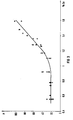
- Figure 2 shows as with water (350 C at 170 bar) or steam (420 ° C at 105 bar) the corrosion rate, measured as weight increase in milligrams per dm 2 and day with Zirkaloy 4 ("Zry-4") in a corresponding autoclave with the tin content depends.
- FIG. 3 shows the corresponding measured values of oxide layer thicknesses which have formed on various workpieces during reactor operation.
- An Sn gradient was maintained in a single Zry-4 melt and the material of the individual workpieces was taken from this one melt at different locations.
- a particularly low oxidation occurs as long as the tin content, especially in the second alloy, is kept below about 1.1%.
- tin contents above it in particular tin contents above 1.4% by weight, can be permitted in the first alloy in order to obtain advantageous mechanical properties of the cladding tube.
- Zirconium alloys are brittle with an iron content above about 0.5% by weight and, for example in pilgrim machines, are practically no longer machinable.
- the determination of the iron content in Zirkaloy 2 and Zirkaloy 4 was based on laboratory tests in which an oxide layer of about 2 ⁇ formed at 400 ° C after about 30 days, which protects the alloy from further oxidation and only one - largely independent of the iron content - causes low corrosion rate. This transition to low corrosion rates is temperature-dependent and occurs at 360 ° z. B. only after 110 to 120 days. If the iron content is low, however, the oxide layer grows again, that is to say an increased weight gain, as soon as the oxide layer reaches values between about 7 and 11 ⁇ m after even longer test periods.
- the limitation of the iron content in Zry 4 and in particular in Zry 2 therefore does not take sufficient account of the favorable influence of this metal on the corrosion behavior in the long-term test;
- a total iron and chromium content of between about 0.4 to 0.5, which is above the Zry specification is particularly advantageous.
- an Fe + Cr content of at least 0.25%, in particular at least about 0.35% can therefore be selected, while the limits of the Zircaloy are roughly adhered to, in spite of, for the inner layer of a higher tin content, the Fe content and the (Fe + Cr) content is lower or at most approximately the same size compared to the outer layer.
- the invention enables waste to be returned without problems.
- a cladding tube with an outer diameter of 10.7 mm and a wall thickness of 0.27 mm, whereby 16% of the wall thickness, i.e. approximately 16.5% of the material, falls on the outer layer, which consists of Zrl, lSnO, 4Fe0.25Cr .
- the inner layer consists of Zry 2 with the composition Zrl, 7SnD, 16Fe0.12Cr0.03Ni. Both alloys are also determined by an oxygen content of approximately 0.07% and a silicon content of approximately 0.012%.
- the high iron content of the outer layer is favorable with regard to the hydrogen absorption of this layer, but this alloy is difficult to process and gives rise to fears of a relatively high level of rejects in the production of the duplex cladding tubes.
- This committee has the gross composition of the entire cladding tube, namely Zrl, 6Sn 0.2Fe0.14Cr0.03Ni, which is within the range of Zry2.
- a cladding tube in which ZrlSn0.2Fe0.3Cr is used as the second alloy for the production of the outer layer, has an iron content which is reduced in terms of better workability, the higher hydrogen absorption associated with this being partially compensated for by an increased chromium content is.
- the reduced tin content causes the oxide layer to grow less.
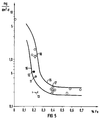
- FIG. 2 initially makes tin contents below 0.6% appear advantageous, this range is unfavorable.
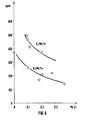
- the formation of the oxide layer depends on the one hand on the point in time (“transition point”) at which the stronger corrosion shown in FIGS. 3 and 4 occurs in the long-term test (“post transition corrosion rate”, PTCR) and on the other hand on the PCTR itself. Measures that are favorable for the lowest possible PCTR can have an unfavorable effect in that the transition point is brought forward, that is, the oxide thickness growth described with the PCTR occurs earlier.
- the invention in any case serves a total content of iron, chromium and tin above 1 % in the second alloy.
- the fuel rods can also be used for outputs and temperature ranges where the Li content of the cooling water pisher feared dangerous corrosion damage.
- FIG. 7 shows that the corrosion-related increase in the weight of the surface of a Zr 0.2 Fe 0.1 Cr workpiece under pressure water at 170 bar and 350 ° C. with 70 ppm Li and 153 days in an autoclave is shown as a function of the Sn content .
- FIG. 8 shows the measurement results of the same corrosion test for a Zr base alloy with 0.5% Sn as a function of the iron content. Similar relationships often arise when additional elements are added (e.g. 0.5% Nb).
- FIGS. 2 to 8 results in an advantageous outer layer of the cladding tube of an alloy Zr (0.8 ⁇ 0.1) Sn (0.28 ⁇ 0.04) Fe (0.17 ⁇ 0.03) Cr.
- Zirkaloy 4 with a relatively high tin content (between about 1.4 and 1.6) can advantageously be selected for the inner layer.
- a defined content of oxygen and silicon e.g. [0.14 ⁇ 0.02) 0 and (0.01 ⁇ 0.002)% Si.
- this first alloy is related to the tin content with regard to corrosion in water (FIG. 2) and with regard to the low iron content and total content of iron and chromium Corrosion and hydrogen absorption ( Figures 4 to 6) are not optimal.
- This first layer largely determines the required mechanical properties of the cladding tube.
- the cladding tube is protected against corrosive attack and hydrogenation by the coolant (also in the case of a solution containing lithium) by the second layer, which for this purpose has a higher iron and Fe + Cr content and over 1.0% with a low tin content.
Landscapes
- Engineering & Computer Science (AREA)
- Metallurgy (AREA)
- Physics & Mathematics (AREA)
- Chemical & Material Sciences (AREA)
- Mechanical Engineering (AREA)
- Organic Chemistry (AREA)
- Materials Engineering (AREA)
- Plasma & Fusion (AREA)
- General Engineering & Computer Science (AREA)
- High Energy & Nuclear Physics (AREA)
- Rigid Pipes And Flexible Pipes (AREA)
- Laminated Bodies (AREA)
- Monitoring And Testing Of Nuclear Reactors (AREA)
Applications Claiming Priority (5)
| Application Number | Priority Date | Filing Date | Title |
|---|---|---|---|
| WOPCT/DE92/00218 | 1992-03-13 | ||
| DE9200218 | 1992-03-13 | ||
| DE9205857U DE9205857U1 (de) | 1992-03-13 | 1992-04-30 | Kernreaktor-Brennstab mit zweischichtigem Hüllrohr |
| DE9205857U | 1992-04-30 | ||
| PCT/DE1993/000151 WO1993018520A1 (de) | 1992-03-13 | 1993-02-22 | Kernreaktor-brennstab mit zweischichtigem hüllrohr |
Publications (2)
| Publication Number | Publication Date |
|---|---|
| EP0630514A1 EP0630514A1 (de) | 1994-12-28 |
| EP0630514B1 true EP0630514B1 (de) | 1996-10-16 |
Family
ID=25959044
Family Applications (1)
| Application Number | Title | Priority Date | Filing Date |
|---|---|---|---|
| EP93903814A Revoked EP0630514B1 (de) | 1992-03-13 | 1993-02-22 | Kernreaktor-brennstab mit zweischichtigem hüllrohr |
Country Status (6)
| Country | Link |
|---|---|
| US (1) | US5493592A (enExample) |
| EP (1) | EP0630514B1 (enExample) |
| JP (1) | JP3215112B2 (enExample) |
| DE (1) | DE59304204D1 (enExample) |
| ES (1) | ES2094528T3 (enExample) |
| WO (1) | WO1993018520A1 (enExample) |
Cited By (1)
| Publication number | Priority date | Publication date | Assignee | Title |
|---|---|---|---|---|
| US6898260B2 (en) | 1999-03-29 | 2005-05-24 | Framatome Anp Gmbh | Fuel element for a pressurized water reactor and method for producing cladding tubes |
Families Citing this family (31)
| Publication number | Priority date | Publication date | Assignee | Title |
|---|---|---|---|---|
| SE503349C2 (sv) * | 1994-09-09 | 1996-05-28 | Asea Atom Ab | Kärnbränsleelement innefattande en kapsling med ett yttre skikt av Zr-Sn-Fe-legering |
| SE509382C2 (sv) * | 1996-02-23 | 1999-01-18 | Asea Atom Ab | Komponent som är utformad för användning i en lättvattenreaktor samt förfarande för att framställa en sådan komponent |
| US6512806B2 (en) | 1996-02-23 | 2003-01-28 | Westinghouse Atom Ab | Component designed for use in a light water reactor, and a method for the manufacture of such a component |
| US5805656A (en) * | 1996-04-08 | 1998-09-08 | General Electric Company | Fuel channel and fabrication method therefor |
| US5790623A (en) * | 1997-03-25 | 1998-08-04 | Siemens Power Corporation | Composite cladding for nuclear fuel rods |
| US5772798A (en) | 1997-03-25 | 1998-06-30 | Siemens Power Corporation | High strength zirconium alloys containing bismuth |
| US5768332A (en) * | 1997-03-27 | 1998-06-16 | Siemens Power Corporation | Nuclear fuel rod for pressurized water reactor |
| US5787142A (en) * | 1997-04-29 | 1998-07-28 | Siemens Power Corporation | Pressurized water reactor nuclear fuel assembly |
| US6511556B1 (en) | 1998-06-12 | 2003-01-28 | Siemens Power Corporation | High strength zirconium alloys containing bismuth and niobium |
| SE516045C2 (sv) * | 2000-03-20 | 2001-11-12 | Westinghouse Atom Ab | Komponent innefattande en zirkoniumlegering, förfarande för att tillverka nämnda komponent samt en nukleär anläggning innefattande nämnda komponent |
| US20060012183A1 (en) * | 2004-07-19 | 2006-01-19 | David Marchiori | Rail car door opener |
| US20070133733A1 (en) * | 2005-12-07 | 2007-06-14 | Liviu Popa-Simil | Method for developing nuclear fuel and its application |
| US8594269B2 (en) * | 2006-01-13 | 2013-11-26 | Westinghouse Electric Company Llc | Nuclear fuel assemblies with structural support replacement rods |
| SE530673C2 (sv) * | 2006-08-24 | 2008-08-05 | Westinghouse Electric Sweden | Vattenreaktorbränslekapslingsrör |
| US7860207B2 (en) | 2006-11-28 | 2010-12-28 | The Invention Science Fund I, Llc | Method and system for providing fuel in a nuclear reactor |
| US9275759B2 (en) * | 2006-11-28 | 2016-03-01 | Terrapower, Llc | Modular nuclear fission reactor |
| US20090080588A1 (en) * | 2006-11-28 | 2009-03-26 | Searete Llc, A Limited Liability Corporation Of The State Of Delaware | Nuclear fission igniter |
| US20080123795A1 (en) * | 2006-11-28 | 2008-05-29 | Searete Llc, A Limited Liability Corporation Of The State Of Delaware | Controllable long term operation of a nuclear reactor |
| US9214246B2 (en) * | 2006-11-28 | 2015-12-15 | Terrapower, Llc | System and method for operating a modular nuclear fission deflagration wave reactor |
| US9831004B2 (en) | 2006-11-28 | 2017-11-28 | Terrapower, Llc | Controllable long term operation of a nuclear reactor |
| US9734922B2 (en) * | 2006-11-28 | 2017-08-15 | Terrapower, Llc | System and method for operating a modular nuclear fission deflagration wave reactor |
| US20090175402A1 (en) * | 2006-11-28 | 2009-07-09 | Searete Llc, A Limited Liability Corporation Of The State Of Delaware | Method and system for providing fuel in a nuclear reactor |
| US20090080587A1 (en) * | 2006-11-28 | 2009-03-26 | Searete Llc, A Limited Liability Corporation Of The State Of Delaware | Nuclear fission igniter |
| US9230695B2 (en) * | 2006-11-28 | 2016-01-05 | Terrapower, Llc | Nuclear fission igniter |
| US8971474B2 (en) * | 2006-11-28 | 2015-03-03 | Terrapower, Llc | Automated nuclear power reactor for long-term operation |
| US20080123797A1 (en) * | 2006-11-28 | 2008-05-29 | Searete Llc, A Limited Liability Corporation Of The State Of Delaware | Automated nuclear power reactor for long-term operation |
| US20090285348A1 (en) * | 2008-05-15 | 2009-11-19 | Searete Llc, A Limited Liability Corporation Of The State Of Delaware | Heat pipe fission fuel element |
| US9793014B2 (en) * | 2008-05-15 | 2017-10-17 | Terrapower, Llc | Heat pipe fission fuel element |
| JP5970375B2 (ja) * | 2009-11-02 | 2016-08-17 | テラパワー, エルエルシー | 核分裂炉 |
| AU2011212810B2 (en) | 2010-02-04 | 2013-10-10 | General Atomics | Modular nuclear fission waste conversion reactor |
| CN117431427B (zh) * | 2023-10-30 | 2025-12-30 | 中色(宁夏)东方集团有限公司 | 一种锆钇合金管靶材的制备方法 |
Family Cites Families (16)
| Publication number | Priority date | Publication date | Assignee | Title |
|---|---|---|---|---|
| US4664881A (en) * | 1984-03-14 | 1987-05-12 | Westinghouse Electric Corp. | Zirconium base fuel cladding resistant to PCI crack propagation |
| FR2564832B1 (fr) * | 1984-05-23 | 1987-05-15 | Panmedica Sa | Nouveaux n-acyl derives d'amino-acides et leurs esters, leur procede de preparation et medicaments les contenant |
| JPS6224182A (ja) * | 1985-03-08 | 1987-02-02 | ウエスチングハウス・エレクトリック・コ−ポレ−ション | 原子炉燃料被覆管 |
| DE3528545A1 (de) * | 1985-08-08 | 1987-02-19 | Kraftwerk Union Ag | Brennstab fuer ein kernreaktorbrennelement |
| US4751044A (en) * | 1985-08-15 | 1988-06-14 | Westinghouse Electric Corp. | Composite nuclear fuel cladding tubing and other core internal structures with improved corrosion resistance |
| JPH076018B2 (ja) * | 1986-07-29 | 1995-01-25 | 三菱マテリアル株式会社 | 耐食性のすぐれた原子炉燃料被覆管用Zr合金 |
| US4963323A (en) * | 1986-07-29 | 1990-10-16 | Mitsubishi Kinzoku Kabushiki Kaisha | Highly corrosion-resistant zirconium alloy for use as nuclear reactor fuel cladding material |
| US4778648A (en) * | 1987-04-24 | 1988-10-18 | Westinghouse Electric Corp. | Zirconium cladded pressurized water reactor nuclear fuel element |
| ES2023983B3 (es) * | 1987-07-21 | 1992-02-16 | Siemens Ag | Barra de combustible para un elemento de combustion de reactor nuclear |
| JP2548773B2 (ja) * | 1988-06-06 | 1996-10-30 | 三菱重工業株式会社 | ジルコニウム基合金とその製造方法 |
| FR2642215B1 (fr) * | 1989-01-23 | 1992-10-02 | Framatome Sa | Crayon pour assemblage combustible d'un reacteur nucleaire resistant a la corrosion et a l'usure |
| US5073336A (en) * | 1989-05-25 | 1991-12-17 | General Electric Company | Corrosion resistant zirconium alloys containing copper, nickel and iron |
| US4986957A (en) * | 1989-05-25 | 1991-01-22 | General Electric Company | Corrosion resistant zirconium alloys containing copper, nickel and iron |
| US5080861A (en) * | 1990-07-25 | 1992-01-14 | Combustion Engineering, Inc. | Corrosion resistant zirconium alloy |
| US5245645A (en) * | 1991-02-04 | 1993-09-14 | Siemens Aktiengesellschaft | Structural part for a nuclear reactor fuel assembly and method for producing this structural part |
| US5211774A (en) * | 1991-09-18 | 1993-05-18 | Combustion Engineering, Inc. | Zirconium alloy with superior ductility |
-
1993
- 1993-02-22 EP EP93903814A patent/EP0630514B1/de not_active Revoked
- 1993-02-22 JP JP51522693A patent/JP3215112B2/ja not_active Expired - Fee Related
- 1993-02-22 WO PCT/DE1993/000151 patent/WO1993018520A1/de not_active Ceased
- 1993-02-22 DE DE59304204T patent/DE59304204D1/de not_active Expired - Fee Related
- 1993-02-22 ES ES93903814T patent/ES2094528T3/es not_active Expired - Lifetime
-
1994
- 1994-09-13 US US08/305,156 patent/US5493592A/en not_active Expired - Lifetime
Cited By (2)
| Publication number | Priority date | Publication date | Assignee | Title |
|---|---|---|---|---|
| US6898260B2 (en) | 1999-03-29 | 2005-05-24 | Framatome Anp Gmbh | Fuel element for a pressurized water reactor and method for producing cladding tubes |
| US7127024B2 (en) | 1999-03-29 | 2006-10-24 | Framatome Anp Gmbh | Fuel element for a pressurized water reactor |
Also Published As
| Publication number | Publication date |
|---|---|
| WO1993018520A1 (de) | 1993-09-16 |
| JPH07504500A (ja) | 1995-05-18 |
| ES2094528T3 (es) | 1997-01-16 |
| EP0630514A1 (de) | 1994-12-28 |
| DE59304204D1 (de) | 1996-11-21 |
| US5493592A (en) | 1996-02-20 |
| JP3215112B2 (ja) | 2001-10-02 |
Similar Documents
| Publication | Publication Date | Title |
|---|---|---|
| WO1993018520A1 (de) | Kernreaktor-brennstab mit zweischichtigem hüllrohr | |
| EP0726966B1 (de) | Werkstoff und strukturteil aus modifiziertem zirkaloy | |
| EP0121204B1 (de) | Brennstab für einen Kernreaktor | |
| DE68908196T2 (de) | Kernbrennstoffelement mit oxidationsbeständiger Schicht. | |
| DE69008374T2 (de) | Abriebs- und korrosionsfester Stab für Kernreaktorbrennstabbündel. | |
| DE69815556T2 (de) | Zirkonium-Niob-Zinn-Legierungen für Kernreaktorbrennstäbe und Bauteile, die einen hohen Abbrand ermöglichen | |
| DE69006914T2 (de) | Korrosionsfeste Zirkoniumlegierungen, enthaltend Kupfer, Nickel und Eisen. | |
| DE60031804T2 (de) | Umhüllung zum Einsatz in Kernreaktoren mit erhöhter Riss- und Korrosionsbeständigkeit | |
| DE2010871A1 (de) | Gegen Kernbrennstoff und Reaktorkuhl mittel korrosionsbeständige Brennstoff hülle fur Kernreaktoren | |
| US4735768A (en) | Fuel rod for a nuclear reactor fuel assembly | |
| DE69417509T2 (de) | Verfahren zur Verbesserung der Korrosionsbeständigkeit von Zirkon oder einer Zirkonlegierungsauskleidungsschicht | |
| DE19509045A1 (de) | Kernbrennstoffhülle mit einer Sperrschicht aus legiertem Zirkonium | |
| DE19509258A1 (de) | Kernbrennstoffhülle mit einer Wasserstoff absorbierenden inneren Auskleidung | |
| DE69216536T2 (de) | Zirkonium-Legierungen für Bauteile von Kernreaktoren | |
| DE10332239B3 (de) | Zirkoniumlegierung und Bauteile für den Kern von leichtwassergekühlten Kernreaktoren | |
| DE69521322T2 (de) | Nukleare brennstoffelement für einen druckwasserreaktor | |
| DE60215886T2 (de) | Brennstab mit einer Hülle aus einer Zirkoniumlegierung und beinhaltend ein Metalloxid zum Begrenzen der Hydrierung | |
| DE60014269T2 (de) | Zirkonium-niobium-legierung mit erbium, herstellungsverfahren und legierung enthaltendes werkstück | |
| DE3248235A1 (de) | Verbundbehaelter fuer kernreaktoren | |
| DE9204306U1 (de) | Kernreaktor-Brennstab mit zweischichtigem Hüllrohr | |
| DE69910077T2 (de) | Legierung auf zirkonbasis und komponente für nukleare energieanlage | |
| DE3315820C2 (enExample) | ||
| DE19844759A1 (de) | Hüllrohre und Strukturteile aus Zirkonium-Legierungen mit einem Konzentrationsgradienten der gelösten Legierungsbestandteile und deren Herstellung | |
| DE69401126T2 (de) | Korrosionsbeständige zirkoniumlegierungen, geeignet zur verwendung in wassergekühlten reaktoren | |
| DE2549970C2 (de) | Kernbrennstoffelement |
Legal Events
| Date | Code | Title | Description |
|---|---|---|---|
| PUAI | Public reference made under article 153(3) epc to a published international application that has entered the european phase |
Free format text: ORIGINAL CODE: 0009012 |
|
| 17P | Request for examination filed |
Effective date: 19940120 |
|
| AK | Designated contracting states |
Kind code of ref document: A1 Designated state(s): CH DE ES FR GB LI NL SE |
|
| GRAG | Despatch of communication of intention to grant |
Free format text: ORIGINAL CODE: EPIDOS AGRA |
|
| GRAH | Despatch of communication of intention to grant a patent |
Free format text: ORIGINAL CODE: EPIDOS IGRA |
|
| 17Q | First examination report despatched |
Effective date: 19960325 |
|
| GRAH | Despatch of communication of intention to grant a patent |
Free format text: ORIGINAL CODE: EPIDOS IGRA |
|
| GRAA | (expected) grant |
Free format text: ORIGINAL CODE: 0009210 |
|
| AK | Designated contracting states |
Kind code of ref document: B1 Designated state(s): CH DE ES FR GB LI NL SE |
|
| REG | Reference to a national code |
Ref country code: CH Ref legal event code: NV Representative=s name: SIEMENS SCHWEIZ AG |
|
| REF | Corresponds to: |
Ref document number: 59304204 Country of ref document: DE Date of ref document: 19961121 |
|
| ET | Fr: translation filed | ||
| GBT | Gb: translation of ep patent filed (gb section 77(6)(a)/1977) |
Effective date: 19961223 |
|
| REG | Reference to a national code |
Ref country code: ES Ref legal event code: FG2A Ref document number: 2094528 Country of ref document: ES Kind code of ref document: T3 |
|
| PLBQ | Unpublished change to opponent data |
Free format text: ORIGINAL CODE: EPIDOS OPPO |
|
| PLBI | Opposition filed |
Free format text: ORIGINAL CODE: 0009260 |
|
| 26 | Opposition filed |
Opponent name: ASEA BROWN BOVERI AB Effective date: 19970715 |
|
| NLR1 | Nl: opposition has been filed with the epo |
Opponent name: ASEA BROWN BOVERI AB |
|
| PLBF | Reply of patent proprietor to notice(s) of opposition |
Free format text: ORIGINAL CODE: EPIDOS OBSO |
|
| PLBF | Reply of patent proprietor to notice(s) of opposition |
Free format text: ORIGINAL CODE: EPIDOS OBSO |
|
| RDAH | Patent revoked |
Free format text: ORIGINAL CODE: EPIDOS REVO |
|
| APAC | Appeal dossier modified |
Free format text: ORIGINAL CODE: EPIDOS NOAPO |
|
| APAE | Appeal reference modified |
Free format text: ORIGINAL CODE: EPIDOS REFNO |
|
| APAC | Appeal dossier modified |
Free format text: ORIGINAL CODE: EPIDOS NOAPO |
|
| REG | Reference to a national code |
Ref country code: GB Ref legal event code: IF02 |
|
| REG | Reference to a national code |
Ref country code: GB Ref legal event code: 732E |
|
| REG | Reference to a national code |
Ref country code: CH Ref legal event code: PUE Owner name: SIEMENS AKTIENGESELLSCHAFT TRANSFER- FRAMATOME ANP |
|
| NLS | Nl: assignments of ep-patents |
Owner name: FRAMATOME ANP GMBH |
|
| RAP2 | Party data changed (patent owner data changed or rights of a patent transferred) |
Owner name: FRAMATOME ANP GMBH |
|
| NLT2 | Nl: modifications (of names), taken from the european patent patent bulletin |
Owner name: FRAMATOME ANP GMBH |
|
| PGFP | Annual fee paid to national office [announced via postgrant information from national office to epo] |
Ref country code: GB Payment date: 20030129 Year of fee payment: 11 |
|
| PGFP | Annual fee paid to national office [announced via postgrant information from national office to epo] |
Ref country code: NL Payment date: 20030217 Year of fee payment: 11 |
|
| PGFP | Annual fee paid to national office [announced via postgrant information from national office to epo] |
Ref country code: FR Payment date: 20030218 Year of fee payment: 11 |
|
| PGFP | Annual fee paid to national office [announced via postgrant information from national office to epo] |
Ref country code: SE Payment date: 20030221 Year of fee payment: 11 Ref country code: CH Payment date: 20030221 Year of fee payment: 11 |
|
| PGFP | Annual fee paid to national office [announced via postgrant information from national office to epo] |
Ref country code: ES Payment date: 20030224 Year of fee payment: 11 |
|
| PLBQ | Unpublished change to opponent data |
Free format text: ORIGINAL CODE: EPIDOS OPPO |
|
| PLAB | Opposition data, opponent's data or that of the opponent's representative modified |
Free format text: ORIGINAL CODE: 0009299OPPO |
|
| PGFP | Annual fee paid to national office [announced via postgrant information from national office to epo] |
Ref country code: DE Payment date: 20030422 Year of fee payment: 11 |
|
| R26 | Opposition filed (corrected) |
Opponent name: WESTINGHOUSE ATOM AB Effective date: 19970715 |
|
| NLR1 | Nl: opposition has been filed with the epo |
Opponent name: WESTINGHOUSE ATOM AB |
|
| APBU | Appeal procedure closed |
Free format text: ORIGINAL CODE: EPIDOSNNOA9O |
|
| RDAG | Patent revoked |
Free format text: ORIGINAL CODE: 0009271 |
|
| STAA | Information on the status of an ep patent application or granted ep patent |
Free format text: STATUS: PATENT REVOKED |
|
| REG | Reference to a national code |
Ref country code: CH Ref legal event code: PL |
|
| 27W | Patent revoked |
Effective date: 19990415 |
|
| GBPR | Gb: patent revoked under art. 102 of the ep convention designating the uk as contracting state |
Free format text: 19990415 |
|
| REG | Reference to a national code |
Ref country code: SE Ref legal event code: ECNC |
|
| NLR2 | Nl: decision of opposition |
Effective date: 19990415 |
|
| APAH | Appeal reference modified |
Free format text: ORIGINAL CODE: EPIDOSCREFNO |
|
| PLAB | Opposition data, opponent's data or that of the opponent's representative modified |
Free format text: ORIGINAL CODE: 0009299OPPO |