EP0614112B1 - Photographische Zusammensetzung mit verbesserte Beschichtungscharakteristika - Google Patents
Photographische Zusammensetzung mit verbesserte Beschichtungscharakteristika Download PDFInfo
- Publication number
- EP0614112B1 EP0614112B1 EP94101452A EP94101452A EP0614112B1 EP 0614112 B1 EP0614112 B1 EP 0614112B1 EP 94101452 A EP94101452 A EP 94101452A EP 94101452 A EP94101452 A EP 94101452A EP 0614112 B1 EP0614112 B1 EP 0614112B1
- Authority
- EP
- European Patent Office
- Prior art keywords
- integer
- alkyl
- carbons
- photographic element
- recited
- Prior art date
- Legal status (The legal status is an assumption and is not a legal conclusion. Google has not performed a legal analysis and makes no representation as to the accuracy of the status listed.)
- Expired - Lifetime
Links
- 239000011248 coating agent Substances 0.000 title description 22
- 238000000576 coating method Methods 0.000 title description 22
- 239000000203 mixture Substances 0.000 title description 2
- 125000000217 alkyl group Chemical group 0.000 claims description 36
- 229920000642 polymer Polymers 0.000 claims description 16
- 239000004094 surface-active agent Substances 0.000 claims description 16
- 239000000084 colloidal system Substances 0.000 claims description 14
- 125000003118 aryl group Chemical group 0.000 claims description 12
- 125000004432 carbon atom Chemical group C* 0.000 claims description 9
- 125000004435 hydrogen atom Chemical group [H]* 0.000 claims description 7
- 125000002877 alkyl aryl group Chemical group 0.000 claims description 6
- 125000003710 aryl alkyl group Chemical group 0.000 claims description 6
- 239000001257 hydrogen Substances 0.000 claims description 6
- 229910052739 hydrogen Inorganic materials 0.000 claims description 6
- 150000001768 cations Chemical group 0.000 claims description 4
- 229910052731 fluorine Inorganic materials 0.000 claims description 4
- 239000011737 fluorine Substances 0.000 claims description 4
- BVKZGUZCCUSVTD-UHFFFAOYSA-L Carbonate Chemical group [O-]C([O-])=O BVKZGUZCCUSVTD-UHFFFAOYSA-L 0.000 claims description 3
- PXGOKWXKJXAPGV-UHFFFAOYSA-N Fluorine Chemical compound FF PXGOKWXKJXAPGV-UHFFFAOYSA-N 0.000 claims description 3
- UFHFLCQGNIYNRP-UHFFFAOYSA-N Hydrogen Chemical compound [H][H] UFHFLCQGNIYNRP-UHFFFAOYSA-N 0.000 claims description 3
- 229910002651 NO3 Inorganic materials 0.000 claims description 3
- NHNBFGGVMKEFGY-UHFFFAOYSA-N Nitrate Chemical group [O-][N+]([O-])=O NHNBFGGVMKEFGY-UHFFFAOYSA-N 0.000 claims description 3
- 125000002947 alkylene group Chemical group 0.000 claims description 3
- 125000000732 arylene group Chemical group 0.000 claims description 3
- 125000005647 linker group Chemical group 0.000 claims description 3
- 125000002496 methyl group Chemical group [H]C([H])([H])* 0.000 claims description 3
- QAOWNCQODCNURD-UHFFFAOYSA-L sulfate group Chemical group S(=O)(=O)([O-])[O-] QAOWNCQODCNURD-UHFFFAOYSA-L 0.000 claims description 3
- 229910006127 SO3X Inorganic materials 0.000 claims description 2
- 125000000484 butyl group Chemical group [H]C([*])([H])C([H])([H])C([H])([H])C([H])([H])[H] 0.000 claims description 2
- 125000001495 ethyl group Chemical group [H]C([H])([H])C([H])([H])* 0.000 claims description 2
- 125000001436 propyl group Chemical group [H]C([*])([H])C([H])([H])C([H])([H])[H] 0.000 claims description 2
- 108010010803 Gelatin Proteins 0.000 description 13
- 229920000159 gelatin Polymers 0.000 description 13
- 239000008273 gelatin Substances 0.000 description 13
- 235000019322 gelatine Nutrition 0.000 description 13
- 235000011852 gelatine desserts Nutrition 0.000 description 13
- RTZKZFJDLAIYFH-UHFFFAOYSA-N Diethyl ether Chemical compound CCOCC RTZKZFJDLAIYFH-UHFFFAOYSA-N 0.000 description 8
- 239000011324 bead Substances 0.000 description 8
- -1 silver halide Chemical class 0.000 description 7
- IJGRMHOSHXDMSA-UHFFFAOYSA-N Atomic nitrogen Chemical compound N#N IJGRMHOSHXDMSA-UHFFFAOYSA-N 0.000 description 5
- 239000000178 monomer Substances 0.000 description 5
- 239000000047 product Substances 0.000 description 5
- HZAXFHJVJLSVMW-UHFFFAOYSA-N 2-Aminoethan-1-ol Chemical compound NCCO HZAXFHJVJLSVMW-UHFFFAOYSA-N 0.000 description 4
- IMSODMZESSGVBE-UHFFFAOYSA-N 2-Oxazoline Chemical compound C1CN=CO1 IMSODMZESSGVBE-UHFFFAOYSA-N 0.000 description 4
- XKRFYHLGVUSROY-UHFFFAOYSA-N Argon Chemical compound [Ar] XKRFYHLGVUSROY-UHFFFAOYSA-N 0.000 description 4
- HEDRZPFGACZZDS-UHFFFAOYSA-N Chloroform Chemical compound ClC(Cl)Cl HEDRZPFGACZZDS-UHFFFAOYSA-N 0.000 description 4
- 102000008186 Collagen Human genes 0.000 description 4
- 108010035532 Collagen Proteins 0.000 description 4
- 229920001436 collagen Polymers 0.000 description 4
- 229910052709 silver Inorganic materials 0.000 description 4
- 239000004332 silver Substances 0.000 description 4
- 239000007787 solid Substances 0.000 description 4
- 238000003756 stirring Methods 0.000 description 4
- XLYOFNOQVPJJNP-UHFFFAOYSA-N water Substances O XLYOFNOQVPJJNP-UHFFFAOYSA-N 0.000 description 4
- DNIAPMSPPWPWGF-UHFFFAOYSA-N Propylene glycol Chemical compound CC(O)CO DNIAPMSPPWPWGF-UHFFFAOYSA-N 0.000 description 3
- 238000006243 chemical reaction Methods 0.000 description 3
- 150000001875 compounds Chemical class 0.000 description 3
- MTHSVFCYNBDYFN-UHFFFAOYSA-N diethylene glycol Chemical compound OCCOCCO MTHSVFCYNBDYFN-UHFFFAOYSA-N 0.000 description 3
- 239000000975 dye Substances 0.000 description 3
- 125000001424 substituent group Chemical group 0.000 description 3
- QGZKDVFQNNGYKY-UHFFFAOYSA-N Ammonia Chemical compound N QGZKDVFQNNGYKY-UHFFFAOYSA-N 0.000 description 2
- VEXZGXHMUGYJMC-UHFFFAOYSA-N Hydrochloric acid Chemical compound Cl VEXZGXHMUGYJMC-UHFFFAOYSA-N 0.000 description 2
- LRHPLDYGYMQRHN-UHFFFAOYSA-N N-Butanol Chemical compound CCCCO LRHPLDYGYMQRHN-UHFFFAOYSA-N 0.000 description 2
- KKEYFWRCBNTPAC-UHFFFAOYSA-N Terephthalic acid Chemical compound OC(=O)C1=CC=C(C(O)=O)C=C1 KKEYFWRCBNTPAC-UHFFFAOYSA-N 0.000 description 2
- 230000002378 acidificating effect Effects 0.000 description 2
- 239000002671 adjuvant Substances 0.000 description 2
- 229910052786 argon Inorganic materials 0.000 description 2
- WERYXYBDKMZEQL-UHFFFAOYSA-N butane-1,4-diol Chemical compound OCCCCO WERYXYBDKMZEQL-UHFFFAOYSA-N 0.000 description 2
- 239000003153 chemical reaction reagent Substances 0.000 description 2
- 238000007334 copolymerization reaction Methods 0.000 description 2
- 230000007423 decrease Effects 0.000 description 2
- 230000007547 defect Effects 0.000 description 2
- WOZVHXUHUFLZGK-UHFFFAOYSA-N dimethyl terephthalate Chemical compound COC(=O)C1=CC=C(C(=O)OC)C=C1 WOZVHXUHUFLZGK-UHFFFAOYSA-N 0.000 description 2
- 230000002255 enzymatic effect Effects 0.000 description 2
- 239000003999 initiator Substances 0.000 description 2
- 239000007788 liquid Substances 0.000 description 2
- 238000000034 method Methods 0.000 description 2
- OIRDBPQYVWXNSJ-UHFFFAOYSA-N methyl trifluoromethansulfonate Chemical compound COS(=O)(=O)C(F)(F)F OIRDBPQYVWXNSJ-UHFFFAOYSA-N 0.000 description 2
- 229910052757 nitrogen Inorganic materials 0.000 description 2
- 229920000728 polyester Polymers 0.000 description 2
- 239000003505 polymerization initiator Substances 0.000 description 2
- 239000002244 precipitate Substances 0.000 description 2
- 238000002360 preparation method Methods 0.000 description 2
- FVSKHRXBFJPNKK-UHFFFAOYSA-N propionitrile Chemical compound CCC#N FVSKHRXBFJPNKK-UHFFFAOYSA-N 0.000 description 2
- 239000011541 reaction mixture Substances 0.000 description 2
- 239000011734 sodium Substances 0.000 description 2
- 239000002904 solvent Substances 0.000 description 2
- 239000000126 substance Substances 0.000 description 2
- 239000000758 substrate Substances 0.000 description 2
- MCKYDHGETROGPX-UHFFFAOYSA-N 2-(2-fluorooctyl)-4,5-dihydro-1,3-oxazole Chemical compound CCCCCCC(F)CC1=NCCO1 MCKYDHGETROGPX-UHFFFAOYSA-N 0.000 description 1
- QGZKDVFQNNGYKY-UHFFFAOYSA-O Ammonium Chemical compound [NH4+] QGZKDVFQNNGYKY-UHFFFAOYSA-O 0.000 description 1
- 239000004215 Carbon black (E152) Substances 0.000 description 1
- 229920002284 Cellulose triacetate Polymers 0.000 description 1
- LFQSCWFLJHTTHZ-UHFFFAOYSA-N Ethanol Chemical compound CCO LFQSCWFLJHTTHZ-UHFFFAOYSA-N 0.000 description 1
- DGAQECJNVWCQMB-PUAWFVPOSA-M Ilexoside XXIX Chemical compound C[C@@H]1CC[C@@]2(CC[C@@]3(C(=CC[C@H]4[C@]3(CC[C@@H]5[C@@]4(CC[C@@H](C5(C)C)OS(=O)(=O)[O-])C)C)[C@@H]2[C@]1(C)O)C)C(=O)O[C@H]6[C@@H]([C@H]([C@@H]([C@H](O6)CO)O)O)O.[Na+] DGAQECJNVWCQMB-PUAWFVPOSA-M 0.000 description 1
- WHXSMMKQMYFTQS-UHFFFAOYSA-N Lithium Chemical compound [Li] WHXSMMKQMYFTQS-UHFFFAOYSA-N 0.000 description 1
- OFOBLEOULBTSOW-UHFFFAOYSA-N Malonic acid Chemical compound OC(=O)CC(O)=O OFOBLEOULBTSOW-UHFFFAOYSA-N 0.000 description 1
- 239000004793 Polystyrene Substances 0.000 description 1
- 231100000766 Possible carcinogen Toxicity 0.000 description 1
- ZLMJMSJWJFRBEC-UHFFFAOYSA-N Potassium Chemical compound [K] ZLMJMSJWJFRBEC-UHFFFAOYSA-N 0.000 description 1
- 229920006362 Teflon® Polymers 0.000 description 1
- XTXRWKRVRITETP-UHFFFAOYSA-N Vinyl acetate Chemical compound CC(=O)OC=C XTXRWKRVRITETP-UHFFFAOYSA-N 0.000 description 1
- BZHJMEDXRYGGRV-UHFFFAOYSA-N Vinyl chloride Chemical compound ClC=C BZHJMEDXRYGGRV-UHFFFAOYSA-N 0.000 description 1
- NNLVGZFZQQXQNW-ADJNRHBOSA-N [(2r,3r,4s,5r,6s)-4,5-diacetyloxy-3-[(2s,3r,4s,5r,6r)-3,4,5-triacetyloxy-6-(acetyloxymethyl)oxan-2-yl]oxy-6-[(2r,3r,4s,5r,6s)-4,5,6-triacetyloxy-2-(acetyloxymethyl)oxan-3-yl]oxyoxan-2-yl]methyl acetate Chemical compound O([C@@H]1O[C@@H]([C@H]([C@H](OC(C)=O)[C@H]1OC(C)=O)O[C@H]1[C@@H]([C@@H](OC(C)=O)[C@H](OC(C)=O)[C@@H](COC(C)=O)O1)OC(C)=O)COC(=O)C)[C@@H]1[C@@H](COC(C)=O)O[C@@H](OC(C)=O)[C@H](OC(C)=O)[C@H]1OC(C)=O NNLVGZFZQQXQNW-ADJNRHBOSA-N 0.000 description 1
- YIMQCDZDWXUDCA-UHFFFAOYSA-N [4-(hydroxymethyl)cyclohexyl]methanol Chemical compound OCC1CCC(CO)CC1 YIMQCDZDWXUDCA-UHFFFAOYSA-N 0.000 description 1
- 238000005299 abrasion Methods 0.000 description 1
- 239000002253 acid Substances 0.000 description 1
- 150000001252 acrylic acid derivatives Chemical class 0.000 description 1
- 125000005210 alkyl ammonium group Chemical group 0.000 description 1
- PNEYBMLMFCGWSK-UHFFFAOYSA-N aluminium oxide Inorganic materials [O-2].[O-2].[O-2].[Al+3].[Al+3] PNEYBMLMFCGWSK-UHFFFAOYSA-N 0.000 description 1
- 229910021529 ammonia Inorganic materials 0.000 description 1
- 239000012298 atmosphere Substances 0.000 description 1
- 239000011230 binding agent Substances 0.000 description 1
- 230000015572 biosynthetic process Effects 0.000 description 1
- LHQLJMJLROMYRN-UHFFFAOYSA-L cadmium acetate Chemical compound [Cd+2].CC([O-])=O.CC([O-])=O LHQLJMJLROMYRN-UHFFFAOYSA-L 0.000 description 1
- AXCZMVOFGPJBDE-UHFFFAOYSA-L calcium dihydroxide Chemical compound [OH-].[OH-].[Ca+2] AXCZMVOFGPJBDE-UHFFFAOYSA-L 0.000 description 1
- 239000000920 calcium hydroxide Substances 0.000 description 1
- 229910001861 calcium hydroxide Inorganic materials 0.000 description 1
- 229920002678 cellulose Polymers 0.000 description 1
- 239000001913 cellulose Substances 0.000 description 1
- 229920002301 cellulose acetate Polymers 0.000 description 1
- 239000003795 chemical substances by application Substances 0.000 description 1
- 239000008199 coating composition Substances 0.000 description 1
- 230000000052 comparative effect Effects 0.000 description 1
- 238000001816 cooling Methods 0.000 description 1
- 229920001577 copolymer Polymers 0.000 description 1
- 239000007822 coupling agent Substances 0.000 description 1
- 239000008367 deionised water Substances 0.000 description 1
- 229910021641 deionized water Inorganic materials 0.000 description 1
- 230000002939 deleterious effect Effects 0.000 description 1
- 230000001627 detrimental effect Effects 0.000 description 1
- 229910001873 dinitrogen Inorganic materials 0.000 description 1
- 238000004821 distillation Methods 0.000 description 1
- 239000000839 emulsion Substances 0.000 description 1
- 150000002148 esters Chemical class 0.000 description 1
- 238000002474 experimental method Methods 0.000 description 1
- 239000012467 final product Substances 0.000 description 1
- 125000001153 fluoro group Chemical group F* 0.000 description 1
- 239000011521 glass Substances 0.000 description 1
- 229930195733 hydrocarbon Natural products 0.000 description 1
- 150000002430 hydrocarbons Chemical class 0.000 description 1
- 238000003384 imaging method Methods 0.000 description 1
- 229910052744 lithium Inorganic materials 0.000 description 1
- 230000005499 meniscus Effects 0.000 description 1
- VUQUOGPMUUJORT-UHFFFAOYSA-N methyl 4-methylbenzenesulfonate Chemical compound COS(=O)(=O)C1=CC=C(C)C=C1 VUQUOGPMUUJORT-UHFFFAOYSA-N 0.000 description 1
- 150000002918 oxazolines Chemical class 0.000 description 1
- 229920003023 plastic Polymers 0.000 description 1
- 229920006267 polyester film Polymers 0.000 description 1
- 229920000139 polyethylene terephthalate Polymers 0.000 description 1
- 239000005020 polyethylene terephthalate Substances 0.000 description 1
- 238000006116 polymerization reaction Methods 0.000 description 1
- 229920002223 polystyrene Polymers 0.000 description 1
- 229910052700 potassium Inorganic materials 0.000 description 1
- 239000011591 potassium Substances 0.000 description 1
- 239000000843 powder Substances 0.000 description 1
- 108090000623 proteins and genes Proteins 0.000 description 1
- 102000004169 proteins and genes Human genes 0.000 description 1
- 238000010926 purge Methods 0.000 description 1
- 238000000746 purification Methods 0.000 description 1
- 229910052708 sodium Inorganic materials 0.000 description 1
- 239000003381 stabilizer Substances 0.000 description 1
- 239000007858 starting material Substances 0.000 description 1
- 230000003068 static effect Effects 0.000 description 1
- 231100000331 toxic Toxicity 0.000 description 1
- 230000002588 toxic effect Effects 0.000 description 1
- ITMCEJHCFYSIIV-UHFFFAOYSA-M triflate Chemical compound [O-]S(=O)(=O)C(F)(F)F ITMCEJHCFYSIIV-UHFFFAOYSA-M 0.000 description 1
- 125000000391 vinyl group Chemical group [H]C([*])=C([H])[H] 0.000 description 1
- 238000012800 visualization Methods 0.000 description 1
Classifications
-
- G—PHYSICS
- G03—PHOTOGRAPHY; CINEMATOGRAPHY; ANALOGOUS TECHNIQUES USING WAVES OTHER THAN OPTICAL WAVES; ELECTROGRAPHY; HOLOGRAPHY
- G03C—PHOTOSENSITIVE MATERIALS FOR PHOTOGRAPHIC PURPOSES; PHOTOGRAPHIC PROCESSES, e.g. CINE, X-RAY, COLOUR, STEREO-PHOTOGRAPHIC PROCESSES; AUXILIARY PROCESSES IN PHOTOGRAPHY
- G03C1/00—Photosensitive materials
- G03C1/005—Silver halide emulsions; Preparation thereof; Physical treatment thereof; Incorporation of additives therein
- G03C1/06—Silver halide emulsions; Preparation thereof; Physical treatment thereof; Incorporation of additives therein with non-macromolecular additives
- G03C1/38—Dispersants; Agents facilitating spreading
- G03C1/385—Dispersants; Agents facilitating spreading containing fluorine
-
- G—PHYSICS
- G03—PHOTOGRAPHY; CINEMATOGRAPHY; ANALOGOUS TECHNIQUES USING WAVES OTHER THAN OPTICAL WAVES; ELECTROGRAPHY; HOLOGRAPHY
- G03C—PHOTOSENSITIVE MATERIALS FOR PHOTOGRAPHIC PURPOSES; PHOTOGRAPHIC PROCESSES, e.g. CINE, X-RAY, COLOUR, STEREO-PHOTOGRAPHIC PROCESSES; AUXILIARY PROCESSES IN PHOTOGRAPHY
- G03C1/00—Photosensitive materials
- G03C1/005—Silver halide emulsions; Preparation thereof; Physical treatment thereof; Incorporation of additives therein
- G03C1/04—Silver halide emulsions; Preparation thereof; Physical treatment thereof; Incorporation of additives therein with macromolecular additives; with layer-forming substances
-
- G—PHYSICS
- G03—PHOTOGRAPHY; CINEMATOGRAPHY; ANALOGOUS TECHNIQUES USING WAVES OTHER THAN OPTICAL WAVES; ELECTROGRAPHY; HOLOGRAPHY
- G03C—PHOTOSENSITIVE MATERIALS FOR PHOTOGRAPHIC PURPOSES; PHOTOGRAPHIC PROCESSES, e.g. CINE, X-RAY, COLOUR, STEREO-PHOTOGRAPHIC PROCESSES; AUXILIARY PROCESSES IN PHOTOGRAPHY
- G03C1/00—Photosensitive materials
- G03C1/005—Silver halide emulsions; Preparation thereof; Physical treatment thereof; Incorporation of additives therein
- G03C1/06—Silver halide emulsions; Preparation thereof; Physical treatment thereof; Incorporation of additives therein with non-macromolecular additives
- G03C1/38—Dispersants; Agents facilitating spreading
-
- G—PHYSICS
- G03—PHOTOGRAPHY; CINEMATOGRAPHY; ANALOGOUS TECHNIQUES USING WAVES OTHER THAN OPTICAL WAVES; ELECTROGRAPHY; HOLOGRAPHY
- G03C—PHOTOSENSITIVE MATERIALS FOR PHOTOGRAPHIC PURPOSES; PHOTOGRAPHIC PROCESSES, e.g. CINE, X-RAY, COLOUR, STEREO-PHOTOGRAPHIC PROCESSES; AUXILIARY PROCESSES IN PHOTOGRAPHY
- G03C1/00—Photosensitive materials
- G03C1/74—Applying photosensitive compositions to the base; Drying processes therefor
Definitions
- This invention relates to a coated photographic element.
- Slide bead coaters are well known in the art to utilize a pressure differential on the upper and lower surfaces of the coating solution to reduce air entrapment and to facilitate the formation of a liquid bead, or bridge, between the surface of the coater and the substrate being coated.
- the range of operative differential pressure also known as vacuum range
- an upper limit and a lower limit Above the upper limit streaks and other defects occur which decreases the usefulness of the final product. Below the lower limit the stability of the bead degrades and the edges of the coating are drawn in towards the center of the coating which is catastrophic. It is the goal of the artisan to maintain an operating differential pressure which is between the upper and lower limits and which will not encroach on either limit when minor operational fluctuations occur.
- the present invention provides a coated photographic element comprising a support, a hydrophilic colloid layer on at least one side of said support wherein said hydrophilic colloid layer further comprises at least one polymer defined by Formula 1: wherein
- Compounds represented by Formula 1 are preferably added to a hydrophilic colloid layer in an amount sufficient to equal 1.00 to 40.0 mg/m 2 on the substrate. More preferred is a coating weight of Formula 1 sufficient to equal 2.0 mg/m 2 to 20.0 mg/m 2 .
- the ratio of y/x is 1 to 23. Below a ratio of 1 the solubility of the polymer becomes insufficiently low to act in a manner consistent with the current invention. Above a ratio of 23 the fluorinated alkyl group represented by R f is in a concentration which is to low to sufficiently alter the surface elasticity of the hydrophilic colloid solution. Particularly preferred y/x ratios are 10 to 20.
- Substituent Z is a divalent linking group represented by the formula -(R 2 ) n L- or -L-(R 2 ) n - where R 2 is an alkylene, arylene, or aralkylene group containing 1 to 10 carbon atoms, -L- is an -O-,-S-, -NR 3 -, -CO-, -OCO-, -SCO-, -CONR 3 -, -SO 2 -, -NR 3 SO 2 -, -SO 2 NR 3 - or -SO- group; wherein R 3 is an alkyl group containing from 1 to 4 carbons; n is an integer of 0 or 1.
- Particularly preferred oxazoline polymers are obtained when -(Z) n -R f is chosen from the set consisting of -CH 2 CH 2 C 4 F 9 , -CH 2 CH 2 C 6 F 13 , -CH 2 CH 2 C 8 F 17 , -CH 2 CH 2 C 10 F 21 , -CH 2 C 6 F 13 , CH 2 C 10 F 21 , -CH 2 N(C 2 H 5 )SO 2 C 6 F 13 , -CH 2 N(C 3 H 7 )SO 2 C 8 F 17 , -C 6 (CF 3 ) 5 , and -CH 2 CH 2 C 8 F 17 ; and R 1 is chosen from the set consisting of methyl, ethyl and propyl.
- the most preferred oxazoline polymer is obtained when -(Z) n -R is CH 2 CH 2 C 8 F 17 and R 1 is methyl.
- Surfactant compounds represented by Formula 2, are added to a hydrophilic colloid layer in an amount of 0.05 to 20.0 mg/m 2 . More preferred is an amount sufficient to equal 2.0 to 5.0 mg/m 2 .
- a preferred substituents represented by A is -((CH 2 ) a -O) b -((CH 2 ) c -O) d -C 6 H 4 -R 4 wherein a and c independently represent an integer of 1 to 3; more preferably a and c independently represent 2; b and d independently represent an integer of 0 to 50; more preferably b and d independently represent an integer of 0 to 20 and most preferably b and d independently represent 0 to 12. More preferred is a sum of b and d equal to at least 2.
- R 4 is chosen from the set consisting of alkyl of 2 to 20 carbons, more preferably 2 to 10 carbons.
- alkyl when applied to R 4 can be a straight chain or a branched hydrocarbon. Most preferred is an alkyl chain with a terminal tertiary butyl substituent.
- X is a cation chosen from the set consisting of sodium, potassium, lithium, ammonium and alkylammonium wherein alkyl contains 1 to 5 carbons.
- Particularly preferred surfactants of Formula 2 are those chosen from the set consisting of:
- the most preferred surfactants of Formula 2 are C 9 H 19 C 6 H 4 O(CH 2 CH 2 O) 4 SO 3 Na and
- the photographic element may be any element known to the art of silver halide imaging including a photosensitive layer, an underlayer, an overcoat, or a backing layer. Most preferred is an element comprising an underlayer.
- a photosensitive layer typically comprises silver halide dispersed in a hydrophilic colloid binder.
- the silver halide is sensitized as known in the art and the layer may contain other adjuvants such as dyes, stabilizers, development agents, color coupling agents, toners and surfactants.
- An underlayer typically comprises a hydrophilic colloid layer with a dye dispersed therein.
- the overcoat is typically coated supra to the photosensitive layer as protection from abrasion and may comprise dyes or other adjuvants as known in the art.
- vacuum range refers specifically to the difference between the upper limit of differential pressure and the lower limit of differential pressure.
- the differential pressure is applied by a vacuum chamber as known in the art and the differential pressure is usually defined as the difference between the atmospheric pressure above the solution and the pressure below the solution.
- the upper limit is usually refereed to as the maximum differential pressure and corresponds to a gross failure characterized by regularly spaced streaks. These streaks are referred to in the art as “vacuum streaks".
- the lower limit is the minimum differential pressure defined by the point at which catastrophic failure occurs due to a dislocation between the edge guides and the bead. The dislocation is typically associated with a narrowing of the coating width at which point the differential pressure is completely lost due to leaks around the solution.
- hydrophilic colloid or its homologue "gelatin” is used herein to refer to the protein substances which are derived from collagen.
- hydrophilic colloid also refers to substantially equivalent substances such as synthetic analogues of gelatin.
- gelatin is classified as alkaline gelatin, acidic gelatin or enzymatic gelatin.
- Alkaline gelatin is obtained from the treatment of collagen with a base such as calcium hydroxide.
- Acidic gelatin is that which is obtained from the treatment of collagen in acid such as, for example, hydrochloric acid and enzymatic gelatin is generated with a hydrolase treatment of collagen.
- the teachings of the present invention are not restricted to gelatin type or the molecular weight of the gelatin. It is preferable to harden or crosslink the hydrophilic colloid as know in the art.
- the film support for the emulsion layers used for preparing the element may be any suitable transparent plastic.
- the cellulosic supports e.g. cellulose acetate, cellulose triacetate and cellulose mixed esters may be used.
- Polymerized vinyl compounds e.g., copolymerized vinyl acetate and vinyl chloride, polystyrene, and polymerized acrylates may also be mentioned.
- Preferred films include those formed from the polyesterification product of a dicarboxylic acid and a dihydric alcohol made according to the teachings of Alles, U.S. Patent 2,779,684 and the patents referred to in the specification thereof.
- Suitable supports are the polyethylene terephthalate/isophthalates of British Patent 766,290 and Canadian Patent 562,672 and those obtainable by condensing terephthalic acid and dimethyl terephthalate with propylene glycol, diethylene glycol, tetramethylene glycol or cyclohexane 1,4-dimethanol (hexahydro-p-xylene alcohol).
- the films of Bauer et al., U.S. Patent 3,052,543 may also be used.
- the above polyester films are particularly suitable because of their dimensional stability.
- the oxazoline polymer (Formula 1) is prepared by the copolymerization of oxazoline monomers M-1 and M-2 corresponding to the following structures: wherein Z, Rf, R1 and n are defined above.
- Z, Rf, R1 and n are defined above.
- a myriad of monomers are taught in the literature. The following detailed synthetic procedures may be employed to prepare the monomers and copolymers of choice. Other synthetic procedures known to the art are also suitable.
- a dry 1 l 4-neck round bottom flask was equipped with a thermometer, condenser, dropping funnel, nitrogen gas inlet and outlet and magnetic stirrer. Added to the flask was 186 g of 3-(n-perfluorooctyl)propionitrile, 2.6 g of cadmium acetate and 200 ml of n-butanol. The flask was purged with nitrogen and placed in an oil bath at 120°C. Distilled ethanolamine (28.5 g) was added slowly via the dropping funnel after which the reaction was stirred for 48 h. The nitrogen stream was maintained throughout to remove the liberated ammonia.
- the polymerization initiator, 3-perfluorooctylethyl-2-oxazolinium triflate, was prepared as described below.
- the starting material methyl trifluoromethanesulfonate is highly toxic, a possible carcinogen and corrosive.
- Methyl trifluoromethanesulfonate (10 g) and anhydrous ethyl ether (100 ml) were added to a dry 250 ml 3-neck round bottom flask equipped with a dropping funnel, magnetic stirrer and argon purge. The flask was cooled in an ice bath and 13.6 g of 2-perfluorooctylethyl-2-oxazoline was added dropwise with vigorous stirring. A white precipitate formed immediately.
- reaction mixture was allowed to warm to room temperature and the precipitates were filtered off under argon. The solids were washed in the filter with five 100 ml portions of ethyl ether and dried under vacuum at room temperature. 17.3 g of product were obtained.
- Other commercially available initiators are also suitable such as, for example methyl p-toluenesulphonate.
- the solid initiator was placed in a dried 250 ml reaction kettle under inert atmosphere.
- the kettle was equipped with a teflon® stirring blade attached to a glass shaft and powered by an air driven motor.
- the monomers were added via syringe and the kettle was placed in an oil bath at 80°C.
- the clear reaction mixture was stirred vigorously for about 45 minutes after which the mixture became cloudy and the viscosity began to increase rapidly. After 1 hour the temperature was increased to 90°C and stirring became increasingly difficult. After approximately 90 minutes stirring was stopped and the temperature was raised to 100°C.
- the solution was left at this temperature for 5 more hours to complete polymerization.
- After cooling to room temperature the solid polymer was dissolved in 800 ml of chloroform and precipitated into ethyl ether. The polymer settled to the bottom as a gummy solid and the the ether was decanted off. The polymer was dried under vacuum at 70°C and then ground to a fine powder. 120.9 g of polymer
- a 5-10% by weight solution of kind and Knox deionized gelatin was prepared in deionized water.
- An amount of polymer P-1 was added as indicated in the Table as was the surfactant S-1.
- C 9 H 19 -C 6 H 4 -O(CH 2 CH 2 O) 4 -SO 3 - Na + Silver halide was added in an amount sufficient to assist in the visualization of the onset of ribbing.
- An overcoat was prepared with conventional coating aids. The solutions were simultaneously coated onto a 13.75 cm wide polyester support using a conventional slide bead coater. The polyester support had a previously applied gelatin subcoat to ensure wettability as known in the art.
- the static contact angle of the coating solutions were in the range of 18-24 degrees and the coating temperature was maintained at 40°C with a temperature controlled slide.
- Bead stability was characterized by measuring the differential pressure at which flow disturbances were noticed. At reasonable coating rates, subatmospheric pressures are required under the lower meniscus to maintain a bead. Below a minimum differential pressure the edges usually contract and do not cover the entire width of the support. Above a maximum differential pressure fine lines, or ribbing, can be observed on the surface of the coating in the machine direction.
- the difference between minimum differential pressure and maximum differential pressure is known as the vacuum range and a larger range is advantageous since minor fluctuations in the vacuum range due to unpredictable disturbances will not cause defects.
- the surfactant or the polymer alone decreases the vacuum range which is deleterious.
- the specific combination of surfactant and polymer increases the vacuum range. Levels of surfactant which are below those taught are actually shown to be detrimental to vacuum range. At higher coating rates the advantage provided is less pronounced and the vacuum range is lower than for the lower coating rate as expected.
Landscapes
- Physics & Mathematics (AREA)
- Chemical & Material Sciences (AREA)
- Engineering & Computer Science (AREA)
- Materials Engineering (AREA)
- General Physics & Mathematics (AREA)
- Spectroscopy & Molecular Physics (AREA)
- Chemical Kinetics & Catalysis (AREA)
- Paints Or Removers (AREA)
- Compositions Of Macromolecular Compounds (AREA)
- Application Of Or Painting With Fluid Materials (AREA)
Claims (9)
- Beschichtetes, photographisches Element, umfassend einen Träger und eine hydrophile Kolloid-Schicht auf wenigstens einer Seite des Trägers, worin die hydrophile Kolloid-Schicht weiterhin 1,00 bis 40,0 mg/m2 wenigstens eines Polymers der Formelumfaßt, worin
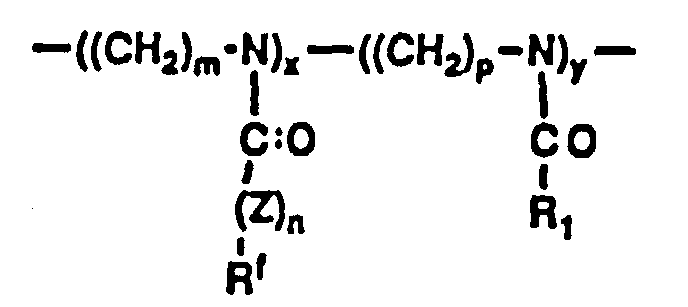 die hydrophile Kolloid-Schicht weiterhin 0,05 bis 20 mg/m2 wenigstens eines Tensids der Formely/x 1 bis 23 ist;Z eine zweiwertige verbindende Gruppe ist, dargestellt durch die Formel -(R2)rL- oder -L-(R2)r-, worin R2 eine Alkylen-, Arylen- oder Aralkylen-Gruppe ist, die 1 bis 10 Kohlenstoffatome enthält, -L- eine -0-, -S-, -NR3-, -CO-, -OCO-, -SCO-, CONR3-, -SO2-, -NR3SO2-, -SO2NR3- oder -SO-Gruppe ist; worin R3 eine Alkylgruppe ist, die 1 bis 4 Kohlenstoffatome enthält:m und p unabhängig voneinander eine ganze Zahl von 2 oder3 darstellen;n eine ganze Zahl von 0 oder 1 ist;r eine ganze Zahl von 0 oder 1 ist;m und p unabhängig voneinander eine ganze Zahl von 2 oder 3 darstellen;Rf eine Alkyl-, Aralkyl-, Aryl- oder Alkylaryl-Gruppe ist, die 1 bis 30 Kohlenstoffatome enthält, worin wenigstens ein Wasserstoffatom durch Fluor ersetzt ist;R1 eine Alkyl-, Aralkyl-, Aryl- oder Alkylaryl-Gruppe ist, die 1 bis 20 Kohlenstoffatome enthält;
A aus der Gruppe ausgewählt ist, bestehend ausc eine ganze Zahl von 1 bis 3 darstellt;b eine ganze Zahl von 0 bis 50 darstellt;d eine ganze Zahl von 0 bis 50 darstellt;R4 Alkyl mit 2 bis 20 Kohlenstoffatomen ist;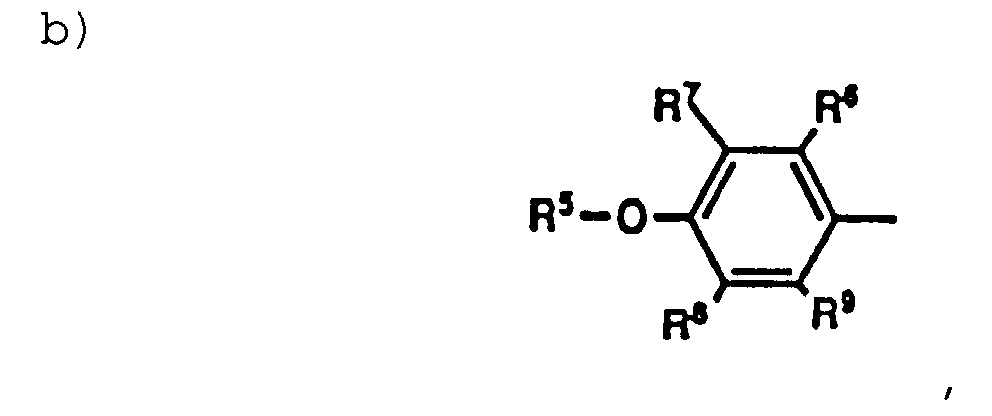 worin R5 Wasserstoff, Alkyl mit 1 bis 20 Kohlenstoffatomen, Aryl mit 6 bis 20 Kohlenstoffatomen oder Aryl mit 6 bis 20 Kohlenstoffatomen, das mit Sulfat, Nitrat, Carbonat oder Alkyl mit 1 bis 20 Kohlenstoffatomen substituiert ist, darstellt; R6, R7, R8, R9 unabhänig voneinander Wasserstoff oder Alkyl mit 1 bis 20 Kohlenstoffatomen darstellen; X ein Kation ist.
 - Beschichtetes, photographisches Element gemäß Anspruch 1, worin das Polymer in einer Menge vorliegt, die gleich 2 bis 20 mg/m2 ist, und das Tensid in einer Menge vorliegt, die gleich 2 bis 5 mg/m2 ist.
- Beschichtetes, photographisches Element gemäß Anspruch 1, worin -(Z)n-Rf aus der aus -CH2CH2C4F9, -CH2CH2C6F13, -CH2CH2C8F17, -CH2CH2C10F21,-CH2C6F13, -CH2C10F21, -CH2N(C2H5)SO2C6F13, -CH2N(C3H7)SO2C8F17, -C6(CF3)5 und -CH2CH2C8F17; R1 bestehenden Gruppe ausge wählt ist; R1 aus der aus Methyl, Ethyl und Propyl bestehenden Gruppe ausgewählt ist.
- Beschichtetes, photographisches Element gemäß Anspruch 1, worin das Tensid
- Beschichtetes, photographisches Element gemäß Anspruch 4, worin g und i die ganze Zahl 2 darstellen, h und j unabhängig voneinander die ganzen Zahlen 0 bis 20 darstellen und R7 aus der aus Alkyl mit 1 bis 10 Kohlenstoffatomen bestehenden Gruppe ausgewählt ist.
- Beschichtetes, photographisches Element gemäß Anspruch 5, worin g und i die ganze Zahl 2 darstellen, h und j unabhängig voneinander die ganzen Zahlen 0 bis 10 darstellen und R7 ein Alkyl mit einer terminalen tertiären Butylgruppe darstellt.
- Beschichtetes, photographisches Element gemäß Anspruch 1, worin das Tensidist, worin
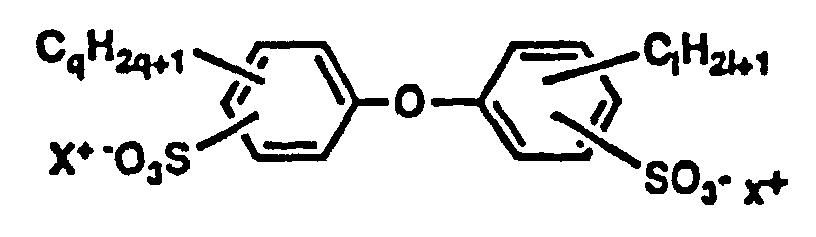 X ein Kation ist;l ganze Zahlen von 0 bis 40 darstellt,q eine ganze Zahl von 0 bis 40 darstellt.
 - Beschichtetes, photographisches Element gemäß Anspruch 7, worin 1 eine ganze Zahl von 8 bis 14 darstellt und q eine ganze Zahl von 8 bis 14 darstellt.
- Beschichtetes, photographisches Element gemäß Anspruch 1, worin das Polymerist, worin x und y 14 sind,

und das Tensid aus der Gruppe ausgewählt ist, bestehend ausund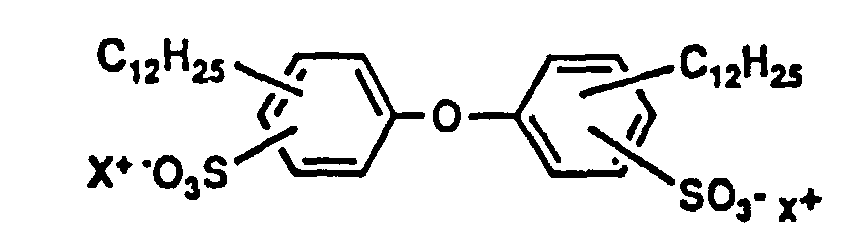
Applications Claiming Priority (2)
| Application Number | Priority Date | Filing Date | Title |
|---|---|---|---|
| US08/017,161 US5268263A (en) | 1993-02-22 | 1993-02-22 | Photographic elements with improved coating layers |
| US17161 | 1993-02-22 |
Publications (2)
| Publication Number | Publication Date |
|---|---|
| EP0614112A1 EP0614112A1 (de) | 1994-09-07 |
| EP0614112B1 true EP0614112B1 (de) | 1998-12-30 |
Family
ID=21781061
Family Applications (1)
| Application Number | Title | Priority Date | Filing Date |
|---|---|---|---|
| EP94101452A Expired - Lifetime EP0614112B1 (de) | 1993-02-22 | 1994-02-01 | Photographische Zusammensetzung mit verbesserte Beschichtungscharakteristika |
Country Status (4)
| Country | Link |
|---|---|
| US (1) | US5268263A (de) |
| EP (1) | EP0614112B1 (de) |
| JP (1) | JPH06317864A (de) |
| DE (1) | DE69415568T2 (de) |
Families Citing this family (1)
| Publication number | Priority date | Publication date | Assignee | Title |
|---|---|---|---|---|
| US5425980A (en) * | 1994-02-22 | 1995-06-20 | Eastman Kodak Company | Use of glow discharge treatment to promote adhesion of aqueous coats to substrate |
Family Cites Families (7)
| Publication number | Priority date | Publication date | Assignee | Title |
|---|---|---|---|---|
| JPS6018977B2 (ja) * | 1978-06-02 | 1985-05-14 | 富士写真フイルム株式会社 | 写真感光材料 |
| US4508764A (en) * | 1982-12-14 | 1985-04-02 | E. I. Du Pont De Nemours And Company | Coating process employs surfactants |
| US4440848A (en) * | 1983-01-31 | 1984-04-03 | Eastman Kodak Company | Vinyl-ester polymeric timing layer for color transfer assemblages |
| JPS60210613A (ja) * | 1984-04-03 | 1985-10-23 | Fuji Photo Film Co Ltd | 写真感光材料 |
| JP2542844B2 (ja) * | 1987-04-08 | 1996-10-09 | コニカ株式会社 | 皮膜特性の改良されたハロゲン化銀写真感光材料 |
| US4929666A (en) * | 1987-05-14 | 1990-05-29 | The Dow Chemical Company | Fluorocarbon containing, reactive polymeric surfactants and coating compositions therefrom |
| JPH04278946A (ja) * | 1991-03-07 | 1992-10-05 | Fuji Photo Film Co Ltd | ハロゲン化銀カラー写真感光材料の処理方法 |
-
1993
- 1993-02-22 US US08/017,161 patent/US5268263A/en not_active Expired - Lifetime
-
1994
- 1994-02-01 EP EP94101452A patent/EP0614112B1/de not_active Expired - Lifetime
- 1994-02-01 DE DE69415568T patent/DE69415568T2/de not_active Expired - Fee Related
- 1994-02-02 JP JP6011256A patent/JPH06317864A/ja active Pending
Also Published As
| Publication number | Publication date |
|---|---|
| DE69415568D1 (de) | 1999-02-11 |
| DE69415568T2 (de) | 1999-07-01 |
| EP0614112A1 (de) | 1994-09-07 |
| US5268263A (en) | 1993-12-07 |
| JPH06317864A (ja) | 1994-11-15 |
Similar Documents
| Publication | Publication Date | Title |
|---|---|---|
| CA1057994A (en) | Polymers and photographic elements containing same | |
| US3411911A (en) | Novel photographic materials containing water insoluble interpolymers | |
| US5268411A (en) | Fluorine-containing polymer composition | |
| US4948720A (en) | Photographic element containing polyphosphazene antistatic composition | |
| EP0127820B1 (de) | Antistatischer photographischer Träger, Verfahren zur Herstellung und diesen enthaltendes photographisches Material | |
| EP0614112B1 (de) | Photographische Zusammensetzung mit verbesserte Beschichtungscharakteristika | |
| GB2080559A (en) | Silver halide photographic materials | |
| US4266015A (en) | Light sensitive materials with fluorinated polymer antistats | |
| EP0300259B1 (de) | Silberhalogenid enthaltende lichtempfindliche photographische Materialien | |
| US4032518A (en) | Sulfonamide compounds and polymers derived therefrom | |
| US3589902A (en) | Photographic developer concentrate | |
| US3277030A (en) | Polymeric hardeners for gelatin | |
| US4197127A (en) | Photographic silver halide composition and element containing sulfonate copolymers | |
| CA1116004A (en) | Photographic materials containing sulfonate copolymers | |
| US3860428A (en) | Silver halide peptizers containing bis(thioether) linkages | |
| US3773517A (en) | Production of photographic silver halide emulsions | |
| JP2624637B2 (ja) | 改良された乾燥特性を有する写真エレメント | |
| EP0402774A1 (de) | Antistatische Schicht | |
| JPS61236542A (ja) | ハロゲン化銀写真感光材料 | |
| US3247172A (en) | Colored copolymers of cyclopentadiene and indole or pyrrole | |
| US4902612A (en) | Photographic coating solutions | |
| JPH0545013B2 (de) | ||
| JPH0356515A (ja) | 塩化ビニル系共重合体及びその製造方法 | |
| JPS61236539A (ja) | ハロゲン化銀写真感光材料 | |
| JPH10301220A (ja) | ハロゲン化銀写真感光材料 |
Legal Events
| Date | Code | Title | Description |
|---|---|---|---|
| PUAI | Public reference made under article 153(3) epc to a published international application that has entered the european phase |
Free format text: ORIGINAL CODE: 0009012 |
|
| AK | Designated contracting states |
Kind code of ref document: A1 Designated state(s): DE FR GB |
|
| 17P | Request for examination filed |
Effective date: 19941017 |
|
| RAP1 | Party data changed (applicant data changed or rights of an application transferred) |
Owner name: STERLING DIAGNOSTIC IMAGING, INC. |
|
| 17Q | First examination report despatched |
Effective date: 19970916 |
|
| GRAG | Despatch of communication of intention to grant |
Free format text: ORIGINAL CODE: EPIDOS AGRA |
|
| GRAG | Despatch of communication of intention to grant |
Free format text: ORIGINAL CODE: EPIDOS AGRA |
|
| GRAH | Despatch of communication of intention to grant a patent |
Free format text: ORIGINAL CODE: EPIDOS IGRA |
|
| GRAH | Despatch of communication of intention to grant a patent |
Free format text: ORIGINAL CODE: EPIDOS IGRA |
|
| GRAA | (expected) grant |
Free format text: ORIGINAL CODE: 0009210 |
|
| AK | Designated contracting states |
Kind code of ref document: B1 Designated state(s): DE FR GB |
|
| REF | Corresponds to: |
Ref document number: 69415568 Country of ref document: DE Date of ref document: 19990211 |
|
| ET | Fr: translation filed | ||
| PLBE | No opposition filed within time limit |
Free format text: ORIGINAL CODE: 0009261 |
|
| STAA | Information on the status of an ep patent application or granted ep patent |
Free format text: STATUS: NO OPPOSITION FILED WITHIN TIME LIMIT |
|
| 26N | No opposition filed | ||
| REG | Reference to a national code |
Ref country code: GB Ref legal event code: 732E |
|
| REG | Reference to a national code |
Ref country code: FR Ref legal event code: TP |
|
| REG | Reference to a national code |
Ref country code: GB Ref legal event code: IF02 |
|
| REG | Reference to a national code |
Ref country code: GB Ref legal event code: 746 Effective date: 20020405 |
|
| PGFP | Annual fee paid to national office [announced via postgrant information from national office to epo] |
Ref country code: FR Payment date: 20021210 Year of fee payment: 10 |
|
| PGFP | Annual fee paid to national office [announced via postgrant information from national office to epo] |
Ref country code: DE Payment date: 20021212 Year of fee payment: 10 |
|
| REG | Reference to a national code |
Ref country code: FR Ref legal event code: D6 |
|
| PG25 | Lapsed in a contracting state [announced via postgrant information from national office to epo] |
Ref country code: DE Free format text: LAPSE BECAUSE OF NON-PAYMENT OF DUE FEES Effective date: 20040901 |
|
| PG25 | Lapsed in a contracting state [announced via postgrant information from national office to epo] |
Ref country code: FR Free format text: LAPSE BECAUSE OF NON-PAYMENT OF DUE FEES Effective date: 20041029 |
|
| REG | Reference to a national code |
Ref country code: FR Ref legal event code: ST |
|
| PGFP | Annual fee paid to national office [announced via postgrant information from national office to epo] |
Ref country code: GB Payment date: 20070126 Year of fee payment: 14 |
|
| REG | Reference to a national code |
Ref country code: GB Ref legal event code: 732E |
|
| GBPC | Gb: european patent ceased through non-payment of renewal fee |
Effective date: 20080201 |
|
| PG25 | Lapsed in a contracting state [announced via postgrant information from national office to epo] |
Ref country code: GB Free format text: LAPSE BECAUSE OF NON-PAYMENT OF DUE FEES Effective date: 20080201 |