EP0614085A1 - A method for directly monitoring the concentrations of water treatment compositions in steam generating systems - Google Patents
A method for directly monitoring the concentrations of water treatment compositions in steam generating systems Download PDFInfo
- Publication number
- EP0614085A1 EP0614085A1 EP94250049A EP94250049A EP0614085A1 EP 0614085 A1 EP0614085 A1 EP 0614085A1 EP 94250049 A EP94250049 A EP 94250049A EP 94250049 A EP94250049 A EP 94250049A EP 0614085 A1 EP0614085 A1 EP 0614085A1
- Authority
- EP
- European Patent Office
- Prior art keywords
- concentration
- polymer
- blowdown
- tracer
- steam generating
- Prior art date
- Legal status (The legal status is an assumption and is not a legal conclusion. Google has not performed a legal analysis and makes no representation as to the accuracy of the status listed.)
- Withdrawn
Links
Images
Classifications
-
- G—PHYSICS
- G01—MEASURING; TESTING
- G01N—INVESTIGATING OR ANALYSING MATERIALS BY DETERMINING THEIR CHEMICAL OR PHYSICAL PROPERTIES
- G01N33/00—Investigating or analysing materials by specific methods not covered by groups G01N1/00 - G01N31/00
- G01N33/18—Water
- G01N33/1813—Specific cations in water, e.g. heavy metals
-
- G—PHYSICS
- G01—MEASURING; TESTING
- G01N—INVESTIGATING OR ANALYSING MATERIALS BY DETERMINING THEIR CHEMICAL OR PHYSICAL PROPERTIES
- G01N29/00—Investigating or analysing materials by the use of ultrasonic, sonic or infrasonic waves; Visualisation of the interior of objects by transmitting ultrasonic or sonic waves through the object
- G01N29/02—Analysing fluids
- G01N29/036—Analysing fluids by measuring frequency or resonance of acoustic waves
-
- G—PHYSICS
- G01—MEASURING; TESTING
- G01N—INVESTIGATING OR ANALYSING MATERIALS BY DETERMINING THEIR CHEMICAL OR PHYSICAL PROPERTIES
- G01N21/00—Investigating or analysing materials by the use of optical means, i.e. using sub-millimetre waves, infrared, visible or ultraviolet light
- G01N21/17—Systems in which incident light is modified in accordance with the properties of the material investigated
- G01N21/25—Colour; Spectral properties, i.e. comparison of effect of material on the light at two or more different wavelengths or wavelength bands
- G01N21/31—Investigating relative effect of material at wavelengths characteristic of specific elements or molecules, e.g. atomic absorption spectrometry
-
- G—PHYSICS
- G01—MEASURING; TESTING
- G01N—INVESTIGATING OR ANALYSING MATERIALS BY DETERMINING THEIR CHEMICAL OR PHYSICAL PROPERTIES
- G01N33/00—Investigating or analysing materials by specific methods not covered by groups G01N1/00 - G01N31/00
- G01N33/18—Water
- G01N33/182—Specific anions in water
-
- G—PHYSICS
- G01—MEASURING; TESTING
- G01N—INVESTIGATING OR ANALYSING MATERIALS BY DETERMINING THEIR CHEMICAL OR PHYSICAL PROPERTIES
- G01N33/00—Investigating or analysing materials by specific methods not covered by groups G01N1/00 - G01N31/00
- G01N33/18—Water
- G01N33/1826—Organic contamination in water
-
- C—CHEMISTRY; METALLURGY
- C02—TREATMENT OF WATER, WASTE WATER, SEWAGE, OR SLUDGE
- C02F—TREATMENT OF WATER, WASTE WATER, SEWAGE, OR SLUDGE
- C02F1/00—Treatment of water, waste water, or sewage
- C02F1/008—Control or steering systems not provided for elsewhere in subclass C02F
-
- C—CHEMISTRY; METALLURGY
- C02—TREATMENT OF WATER, WASTE WATER, SEWAGE, OR SLUDGE
- C02F—TREATMENT OF WATER, WASTE WATER, SEWAGE, OR SLUDGE
- C02F2209/00—Controlling or monitoring parameters in water treatment
- C02F2209/005—Processes using a programmable logic controller [PLC]
-
- C—CHEMISTRY; METALLURGY
- C02—TREATMENT OF WATER, WASTE WATER, SEWAGE, OR SLUDGE
- C02F—TREATMENT OF WATER, WASTE WATER, SEWAGE, OR SLUDGE
- C02F2209/00—Controlling or monitoring parameters in water treatment
- C02F2209/15—N03-N
-
- C—CHEMISTRY; METALLURGY
- C02—TREATMENT OF WATER, WASTE WATER, SEWAGE, OR SLUDGE
- C02F—TREATMENT OF WATER, WASTE WATER, SEWAGE, OR SLUDGE
- C02F5/00—Softening water; Preventing scale; Adding scale preventatives or scale removers to water, e.g. adding sequestering agents
- C02F5/08—Treatment of water with complexing chemicals or other solubilising agents for softening, scale prevention or scale removal, e.g. adding sequestering agents
- C02F5/10—Treatment of water with complexing chemicals or other solubilising agents for softening, scale prevention or scale removal, e.g. adding sequestering agents using organic substances
-
- G—PHYSICS
- G01—MEASURING; TESTING
- G01N—INVESTIGATING OR ANALYSING MATERIALS BY DETERMINING THEIR CHEMICAL OR PHYSICAL PROPERTIES
- G01N2201/00—Features of devices classified in G01N21/00
- G01N2201/12—Circuits of general importance; Signal processing
- G01N2201/129—Using chemometrical methods
-
- Y—GENERAL TAGGING OF NEW TECHNOLOGICAL DEVELOPMENTS; GENERAL TAGGING OF CROSS-SECTIONAL TECHNOLOGIES SPANNING OVER SEVERAL SECTIONS OF THE IPC; TECHNICAL SUBJECTS COVERED BY FORMER USPC CROSS-REFERENCE ART COLLECTIONS [XRACs] AND DIGESTS
- Y02—TECHNOLOGIES OR APPLICATIONS FOR MITIGATION OR ADAPTATION AGAINST CLIMATE CHANGE
- Y02A—TECHNOLOGIES FOR ADAPTATION TO CLIMATE CHANGE
- Y02A20/00—Water conservation; Efficient water supply; Efficient water use
- Y02A20/20—Controlling water pollution; Waste water treatment
Definitions
- the present invention is directed to a method for monitoring the concentration of one or more components of water treatment compositions in steam generating systems and more particularly to a direct spectrometric method for quantifying the concentrations of oxygen scavengers, corrosion inhibitors, chelants, nitrates, polymers, neutralizing amines, phosphonates, scale inhibitors, tracers and/or other boiler water treatment compositions which have absorbance or emission spectra in the wavelength range of from 200 to 2500 nm by determining the spectra of the compositions in the foregoing range and then applying chemometric algorithms to the spectrum.
- steam generating system refers to any aqueous system where water is heated and circulated as steam or hot water in a continuous or semi-continuous stream and generally includes, but is not limited to boiler systems, desalinization units, evaporators, turbines, cookers such as those used in food processing, and the like.
- the concentration of oxygen scavenger in a steam-generating system is typically measured in the feedwater, the boiler water blowdown and the steam condensate.
- concentrations of polymeric dispersants are often measured in the feed water and boiler water blowdown.
- product feed rate for these compositions is adjusted based upon the respective analyses of the residual oxygen scavenger and dispersant present in the boiler water blowdown.
- Another method which has been used for measuring oxygen scavenger concentration is a platinum/silversilver oxide cell.
- this technique requires the use of a caustic soda electrolyte which needs to be replenished periodically.
- inert e.g. tracer
- Tracers involve an indirect measurement and an assumption that the ratio of tracer compound to active treatment components will remain constant and thus indirectly gives an indication of active product performance.
- active treatment components are depleted in steam generating systems due to chemical reaction, adsorption, thermal instability or volatility.
- the demand for oxygen scavengers and polymers will be dependent upon, inter alia, the concentration of dissolved oxygen and water hardness respectively.
- the dissolved oxygen content of the boiler feed water prior to the addition of the chemical oxygen scavenger may vary widely depending upon the efficiency of the deaerator system.
- the water hardness concentration in the boiler feedwater will vary dependent upon the efficiency of the softener system in the pretreatment process.
- the use of tracers is ineffective for accurately monitoring product dosage levels. There is, therefore, a need for a rapid, direct method of monitoring active water treatment compositions in steam generating systems.
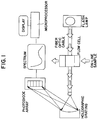
- Figure 1 shows a schematic diagram of the array spectrometer and optrode arrangement.
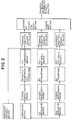
- Figure 2 shows a block diagram of the calibration options available in this invention utilizing the principle of component regression analysis method.
- a method for directly measuring the concentration of one or more water treatment compositions in a steam generating system which comprises directly determining an absorbance or emission spectrum of the system water in the wavelenth range of from 200 to 2500, and applying chemometrics algorithms to the absorbance or emission spectrum to determine the concentration of the water treatment compositions.
- Also provided in accordance with the present invention is a method of determining cycles of concentration in a steam generating system which contains a monitorable component in the systems which is not actively consumed in the system water comprising monitoring the concentration of the component in a feed water stream and in a blowdown stream of the system and determining a ratio of the concentration of the component in the blowdown to the concentration of the component in the feedwater wherein said ratio equals the cycles of concentration.
- Also provided in accordance with the present invention is a method for determining the effective dosage amount of a polymer to treat an aqueous system. It has now been found that by directly measuring the polymer concentration in the system and also determining the level of hardness in the feedwater, it is possible to more effectively control polymer dosage amounts.
- this embodiment of the invention is directed to a method for determining polymer dosage requirements by measuring the concentration of hardness in the feedwater with a hardness analyzer, generating a voltage analog which is proportional to the degree of hardness, measuring the polymer treatment concentration with a spectometer having a wavelength range of from 200 to 2500 nm, applying chemometrics algorithms to the spectrum to determine the concentration and generating a voltage analog which is proportional to the polymer treatment concentration, outputting the respective voltage analogs to a logic controller which is capable of calculating a ratio of these voltage analogs, and then comparing the calculated ratio to a predetermined standard operating range, and if the ratio is outside the standard operating range, increasing or decreasing the rate of polymer treatment feed until an acceptable ratio is obtained.
- the present invention is directed to a novel method for directly monitoring the concentrations of one or more components of water treatment compositions in steam generating systems.
- the method in general, involves directly determining an absorbance or emission spectrum of the system water containing the water treatment compositions in the ultraviolet, visible and/or near infrared wavelength range, and then applying chemometrics algorithms to the spectrum to determine the concentrations of the water treatment compositions.
- the method of the present invention is generally unaffected by background matrix interferences and thus does not require time consuming, off-line separation or derivitization techniques.
- the method of the present invention does not require or involve the use of additional colorizing agents, dyes, titrations or other typical indirect monitoring techniques.
- the present monitoring method is of general applicability with respect to water treatment compositions used to treat steam generating systems provided, of course, that the particular water treatment composition has a detectable absorbance or emission spectrum in the visible, ultraviolet and/or near infrared range (i.e., in a wavelength range of 200 to 2500 nm).
- water treatment compositions are considered to be "detectable” if they have a chromophore with at least about 0.01 absorbance units (or a corresponding measureable response with an emissivity spectrometer) in the wavelength range of from 200 to 2500 nm under normal treatment dosages and preferably have between 0.1 to 1.5 absorbance units.
- Suitable monitorable water treatment compositions may easily be determined by preparing an aqueous solution of the composition in its normal dosage concentration, and then scanning the solution in a suitable spectometer in the range 200 to 2500 nm. If the spectrum exhibits an absorbance or emission maxima of 0.01 absorbance or emissivity units from a background spectrum (i.e., without the compound of interest), then this water treatment component is considered to be monitorable under this invention.
- Particular water treatment components of interest include oxygen scavengers, oxygen scavenger catalysts, corrosion inhibitors, chelants, nitrates, tracers, scale inhibitors, neutralizing amines, polymers, and the like and mixtures thereof.
- Typical oxygen scavengers which have been found to be monitorable in accordance with the present invention, include sulfite, hydrazine, erythorbic acid, alkylhydroxyl amines such as e.g., diethylhydroxylamine, n-isopropylhydroxyl amine, and the like, hydroxyalkyl substituted hydroxyl amines including bis(2-hydroxyethyl)-hydroxylamine, bis(2-hydroxypropyl)-hydroxylamine, bis(2-hydroxybutyl)hydroxylamine and the like, precursors to hydroxylamines such as methylethylketoxime and the like, and mixtures thereof.
- Typical catalysts for oxygen scavengers include copper, hydroquinone, benzoquinone, 1,2-naphthoquinone-4-sulfonic acid, pyrogallol, t-butyl-catechol, and the like and mixtures thereof.
- Typical corrosion and/or scale inhibitors include nitrate, molybdate, neutralizing amines, phosphates, phosphonates, and the like and mixtures thereof.
- Typical chelants include nitrilotriacetic acid, ethylene diamine tetracetic acid and the like.
- Typical tracers include inert dyes having absorbance or emission spectra in the wavelength range of 200 to 2500 nm such as, 2-naphthalene sulfonic acid, lissamine FF, bromophenol, rhodamine, stilbene derivatives, sulfostyrene derivatives, propene, xanthene, fluoroscein, and the like and mixtures thereof.
- Typical polymers include, but are not limited to homo-polymers and copolymers containing one or more of the following recurring moieties, acrylates, methacrylates, acrylamides, methacrylamides, sulfonated styrenes, lignosulfonates, tannins, alkyl naphthalene sulfonates, and the like.
- a steam generating system may be monitored at any convenient location in the system and is generally monitored in the feed water stream, the continuous blowdown stream and/or the steam condensate stream, and is preferably monitored in the continuous blowdown stream. It is also possible to monitor the system in the bottom blowdown stream. However, since this aqueous stream often contains large amounts of particulate matter, it is advisable to filter the bottom blowdown water stream prior to obtaining its spectrum.
- any commercial grade UV, visible and/or near infrared spectrometer may be used in accordance with this invention.
- Charged coupled device (CCD) analyzers may also be used. It is preferred that the spectrometer have a resolution of at least 10 nm, preferably 2 nm and most preferably 1 nm.
- An array spectrometer having wavelengths within the range of from 200 to 2500 nm is preferred for use in this invention and most preferably has a wavelength range of from 200 to 800 nm.
- Instrument stability is an important consideration when operating in areas with a high potential for electrical and mechanical noise.
- the spectrometer is preferably designed to operate at 40°C to eliminate any varying temperature effects.
- the spectrometer may be used to monitor off-line samples, or in a preferred embodiment, is equipped with an on-line fiber optic probe.
- a flow through optical chamber is preferred.
- light from a xenon flash lamp (or other suitable source) is transmitted to the optrode via a quartz fiber optic cable.
- the light is transmitted through the aqueous solution and collected in a second fiber optic cable which transmits the light to the diode array spectrometer.
- the spectrometer In the spectrometer the light is converted into an analog voltage for each pixel of the array.
- the array is then read by a computer and by subtracting a previously stored deionized water scan from the sample scan a true absorption spectrum is generated.
- the resultant spectrum is then processed by a chemometrics calibration algorithm to generate a quantitative multicomponent analysis for any and all of the water treatment compositions of interest.
- Chemometrics is the application of statistical and pattern recognition techniques to chemical analysis. Quantitative estimates of chemical concentration in reagentless UV-vis-NIR spectroscopy are based on algorithms, the parameters of which are determined in calibration sequences called learning sets. Learning sets consist of a large number of known samples that are used to determine the parameters of the algorithms. The number of samples required depends on the complexity of the matrix, the number of spectroscopic interferences that are present, and the number of variables used in the algorithm. In general, the number of samples should be at least 10 times the number of independent variables employed. In the presence of known and unknown interferences, a multiple sample calibration averages out the effects of these interferences.
- the learning set solutions are prepared in a manner to typify the interferences and their variability that will be experienced in the steam generating system.
- the invention uses a multi-sample calibration based on either principle component regression analysis or rotated principle component analysis of absorbance, and subsequent derivative data.
- the rotated principle component analysis method is preferred and involves a rotation of the principle components which allows the concentration of all the relevant information for a particular analyte into a single rotated principle component.
- the use of rotated principle components enables one to detect weak UV-vis-NIR species that would not normally be quantifiable using more conventional chemometric techniques.
- the most accurate calibration method for each analyte may be determined by selecting the particular method having the highest coefficient of determination (r2) value.
- Another embodiment of this invention is directed to a method for determining the cycles of concentration in a steam generating system.
- Current methods of calculating cycles of concentration involve monitoring the chloride ion level in the system. This method has a relatively high degree of experimental error, and involves off-line wet chemical techniques which are time consuming and do not provide continuous results. It has now been found that the method of the present invention when used to monitor the level of a component having a low system demand such as e.g. nitrate levels or inert tracer levels in a steam generating system provides a continuous, accurate method for calculating the cycles of concentration.
- Nitrate is usually present as a natural contaminant in boiler feed water and boiler water blowdown except in those steam generating systems where demineralization is used as the method of water softening. Since nitrate has a low system demand the concentration of nitrate can be monitored in the boiler feed water and boiler blowdown and thus provides an accurate method of calculating cycles of concentration wherein; This method is suitable for calculating cycles of concentration in those steam generating systems that have a loss of nitrate which is generally less than 10% as measured against chloride ion or other stable component in the system. In those systems where nitrate loss exceeds 10%, or where it may be advantageous for other reasons, an inert tracer may be monitored in addition to or instead of the nitrate. Accordingly, cycles of concentrations can be calculated by monitoring the concentrations of tracer in the blowdown and in the feedwater, and substituting these concentrations into the above calculation, respectively.
- Yet another embodiment of this invention is directed to a method of accurately determining polymer dosage requirements in a steam generating system.
- This method involves 1) measuring the degree of hardness of the feedwater with a hardness analyzer which generates a voltage analog which is proportional to the degree of hardness, 2) measuring the polymer treatment concentration in accordance with the present invention and generating a voltage analog which is proportional to the concentration, 3) outputting the respective voltage analogs to a logic controller which is capable of calculating a ratio of these voltage analogs, and then comparing the ratio to a predetermined standard operating range, and if the ratio is outside the standard operating range, increasing or decreasing the rate of polymer treatment feed until an acceptable ratio is obtained.
- the determination of theoretical polymer level in the blowdown can be made by either 1) measuring the level of an inert tracer in the blowdown and which was dosed in a known proportion with the polymer and then multiplying this proportion by the concentration of tracer in the blowdown or 2) by directly measuring the level of polymer in the feedwater and then multiplying this value by the cycles of concentration.
- a calibration of a sodium styrene sulfonate methacrylic acid copolymer was prepared in demineralized water at pH 10 containing 10 ppm disodium phosphate (as PO4 ⁇ 3).
- Concentration range of learning set - polymer - 0-5.0 ppm active.
- Number of samples in learning set - 14 Wavelength range - 230 nm - 284 nm
- This test set of samples was passed through the analyzer, the concentrations of the polymer were determined and a comparison made between the theoretical polymer value and the predicted value based upon the calibration.
- a calibration of a sodium styrene sulfonate methacrylic acid copolymer and sodium sulfite was prepared in demineralized water at pH 10 containing 10 ppm disodium phosphate.
- Concentration - polymer 0-25 ppm (active) Ranges in the learning set - sulfite 0-50 ppm (as SO32 ⁇ ) Number of samples in learning set - 26
- the test set contained 4 samples of mixtures of the sodium styrene sulfonate/methacrylic acid copolymer and sodium sulfite.
- a calibration of a sodium styrene sulfonate/maleic acid copolymer and sodium sulfite was prepared in demineralized water at pH 10 containing 10 ppm disodium phosphate (as PO43 ⁇ ).
- Concentration ranges in the learning set Polymer 0-25 ppm (active) Sulfite 0-50 ppm (as SO32 ⁇ ) Number of samples in the learning set - 31
- the test set contained 6 samples of mixtures of the sodium styrene sulfonate/methacrylic acid copolymer and sodium sulfite.
- a calibration of a sodium styrene sulfonate methacrylic acid copolymer with sodium nitrate was prepared in demineralized water at pH 10 containing 10 ppm disodium phosphate (as PO43 ⁇ ).
- Concentration ranges in the learning set polymer 0-25 ppm (active) nitrate 0-25 ppm (as NO3 ⁇ ) Number of samples in the learning set - 30
- the test set contained 2 samples of mixtures of the sodium styrene sulfonate/methacrylic acid copolymer and sodium nitrate.
- a calibration of a sodium styrene sulfonate/maleic acid copolymer and sodium sulfite was prepared in a sample of boiler water blowdown collected from a 600 psi boiler.
- the test set contained 7 samples of the sodium styrene sulfonate/methacrylic acid and sodium sulfite prepared in the boiler water blowdown.
- a calibration of a sodium sulfonate/methacrylic acid copolymer and a sodium alkylnaphthalenesulphonate polymer was prepared in a synthetic demineralized feed water containing 10 ppm disodium phosphate (as PO43 ⁇ ) at pH 10.
- a calibration of sodium sulfonate/methacrylic acid copolymer and a polymer of sodium alkylnaphthalenesulphonate was prepared in zeolite softened water. 10 ppm disodium phosphate was added and the pH was adjusted to 10.0.
- Concentration ranges in the learning set Analyte 1 0-25 ppm active Analyte 2 0-7 ppm active Wavelength range Analyte 1 240-298 nm Analyte 2 240-327 nm
- the test set contained 5 samples of mixtures of sodium styrene sulfonate/methacrylic acid copolymer and a sodium alkylnaphthalenesulphonate polymer.
Landscapes
- Chemical & Material Sciences (AREA)
- Physics & Mathematics (AREA)
- Health & Medical Sciences (AREA)
- Life Sciences & Earth Sciences (AREA)
- General Physics & Mathematics (AREA)
- Biochemistry (AREA)
- General Health & Medical Sciences (AREA)
- Analytical Chemistry (AREA)
- Immunology (AREA)
- Pathology (AREA)
- Medicinal Chemistry (AREA)
- Engineering & Computer Science (AREA)
- Food Science & Technology (AREA)
- Spectroscopy & Molecular Physics (AREA)
- Acoustics & Sound (AREA)
- Investigating Or Analyzing Non-Biological Materials By The Use Of Chemical Means (AREA)
- Investigating Or Analysing Materials By Optical Means (AREA)
- Investigating Or Analysing Materials By The Use Of Chemical Reactions (AREA)
Applications Claiming Priority (2)
| Application Number | Priority Date | Filing Date | Title |
|---|---|---|---|
| US2569493A | 1993-03-03 | 1993-03-03 | |
| US25694 | 1993-03-03 |
Publications (1)
| Publication Number | Publication Date |
|---|---|
| EP0614085A1 true EP0614085A1 (en) | 1994-09-07 |
Family
ID=21827558
Family Applications (1)
| Application Number | Title | Priority Date | Filing Date |
|---|---|---|---|
| EP94250049A Withdrawn EP0614085A1 (en) | 1993-03-03 | 1994-02-28 | A method for directly monitoring the concentrations of water treatment compositions in steam generating systems |
Country Status (12)
| Country | Link |
|---|---|
| EP (1) | EP0614085A1 (cg-RX-API-DMAC7.html) |
| JP (1) | JPH06300687A (cg-RX-API-DMAC7.html) |
| KR (1) | KR940022084A (cg-RX-API-DMAC7.html) |
| CN (1) | CN1104328A (cg-RX-API-DMAC7.html) |
| AU (1) | AU5643394A (cg-RX-API-DMAC7.html) |
| BR (1) | BR9400807A (cg-RX-API-DMAC7.html) |
| CA (1) | CA2116737A1 (cg-RX-API-DMAC7.html) |
| FI (1) | FI941004L (cg-RX-API-DMAC7.html) |
| NZ (1) | NZ250956A (cg-RX-API-DMAC7.html) |
| TR (1) | TR28427A (cg-RX-API-DMAC7.html) |
| TW (1) | TW265410B (cg-RX-API-DMAC7.html) |
| ZA (1) | ZA941413B (cg-RX-API-DMAC7.html) |
Cited By (5)
| Publication number | Priority date | Publication date | Assignee | Title |
|---|---|---|---|---|
| WO1997035192A1 (en) * | 1996-03-21 | 1997-09-25 | Nalco Chemical Company | Fluorescent-tagged polymers for boiler internal treatment |
| EP0916936A1 (fr) * | 1997-11-14 | 1999-05-19 | Lac Instruments SA | Dispositif pour l'analyse automatique multiparamètres d'une solution aqueuse |
| WO2009032422A1 (en) * | 2007-09-04 | 2009-03-12 | General Electric Company | Polymer concentration monitoring system and use thereof |
| WO2016069301A1 (en) * | 2014-10-29 | 2016-05-06 | Horiba Instruments Incorporated | Determination of water treatment parameters based on absorbance and fluorescence |
| IT201600122231A1 (it) * | 2016-12-01 | 2018-06-01 | Lw S R L | Metodo per misurare la concentrazione di un additivo anti-sporcamento in un flusso di acqua salina circolante in un impianto di desalinizzazione e relative applicazioni. |
Families Citing this family (7)
| Publication number | Priority date | Publication date | Assignee | Title |
|---|---|---|---|---|
| US5242602A (en) * | 1992-03-04 | 1993-09-07 | W. R. Grace & Co.-Conn. | Spectrophotometric monitoring of multiple water treatment performance indicators using chemometrics |
| JP2006234637A (ja) * | 2005-02-25 | 2006-09-07 | Aquas Corp | 水処理用薬品の濃度管理方法及び水処理用薬品の濃度管理用トレーサー物質 |
| CN106706541A (zh) * | 2015-07-17 | 2017-05-24 | 中国钢铁股份有限公司 | 分散剂浓度检测装置 |
| CN106490993B (zh) * | 2016-11-22 | 2024-09-10 | 宁波卡特马克智能厨具股份有限公司 | 一种锅盖 |
| CN108344706B (zh) * | 2017-01-23 | 2021-10-22 | 中国石油化工股份有限公司 | 一种β-萘磺酸甲醛缩合物中有效成分含量的测定方法 |
| CN106770923A (zh) * | 2017-03-07 | 2017-05-31 | 李刚 | 一种油田湿蒸汽发生器水质自动检测装置及方法 |
| JP7775514B1 (ja) * | 2025-03-11 | 2025-11-25 | 花王株式会社 | 機械学習装置 |
Citations (8)
| Publication number | Priority date | Publication date | Assignee | Title |
|---|---|---|---|---|
| EP0320086A2 (en) * | 1987-12-11 | 1989-06-14 | Diversey Corporation | Visual analytical tracer and method for detection and quantitative analysis for water treatment chemicals |
| EP0344694A2 (en) * | 1988-05-31 | 1989-12-06 | Hercules Incorporated | Method of monitoring and controlling retention of chemicals in processed water/cellulose matrix |
| EP0418799A2 (en) * | 1989-09-20 | 1991-03-27 | Kurashiki Boseki Kabushiki Kaisha | Quantitative determination method of chemicals for processing semiconductor and an apparatus thereof |
| US5006311A (en) * | 1990-03-23 | 1991-04-09 | Nalco Chemical Company | Monitoring performance of a treating agent added to a body of water |
| EP0469773A2 (en) * | 1990-07-31 | 1992-02-05 | Nalco Chemical Company | Iron (II) concentration monitoring for determining corrosion in boiler systems |
| US5171450A (en) * | 1991-03-20 | 1992-12-15 | Nalco Chemical Company | Monitoring and dosage control of tagged polymers in cooling water systems |
| EP0522988A1 (fr) * | 1991-07-10 | 1993-01-13 | Gie Anjou-Recherche | Procédé et dispositifs de détection infrarouge de pollution en milieu aqueux |
| EP0559305A2 (en) * | 1992-03-04 | 1993-09-08 | W.R. Grace & Co.-Conn. | Simultaneous monitoring of multiple water treatment performance indicators |
-
1994
- 1994-02-23 NZ NZ250956A patent/NZ250956A/en unknown
- 1994-02-24 AU AU56433/94A patent/AU5643394A/en not_active Abandoned
- 1994-02-28 EP EP94250049A patent/EP0614085A1/en not_active Withdrawn
- 1994-03-01 ZA ZA941413A patent/ZA941413B/xx unknown
- 1994-03-01 CA CA002116737A patent/CA2116737A1/en not_active Abandoned
- 1994-03-02 FI FI941004A patent/FI941004L/fi unknown
- 1994-03-02 JP JP6056684A patent/JPH06300687A/ja active Pending
- 1994-03-02 TR TR00176/94A patent/TR28427A/xx unknown
- 1994-03-03 BR BR9400807A patent/BR9400807A/pt not_active Application Discontinuation
- 1994-03-03 CN CN94102018A patent/CN1104328A/zh active Pending
- 1994-03-03 KR KR1019940004353A patent/KR940022084A/ko not_active Withdrawn
- 1994-06-21 TW TW083105607A patent/TW265410B/zh active
Patent Citations (8)
| Publication number | Priority date | Publication date | Assignee | Title |
|---|---|---|---|---|
| EP0320086A2 (en) * | 1987-12-11 | 1989-06-14 | Diversey Corporation | Visual analytical tracer and method for detection and quantitative analysis for water treatment chemicals |
| EP0344694A2 (en) * | 1988-05-31 | 1989-12-06 | Hercules Incorporated | Method of monitoring and controlling retention of chemicals in processed water/cellulose matrix |
| EP0418799A2 (en) * | 1989-09-20 | 1991-03-27 | Kurashiki Boseki Kabushiki Kaisha | Quantitative determination method of chemicals for processing semiconductor and an apparatus thereof |
| US5006311A (en) * | 1990-03-23 | 1991-04-09 | Nalco Chemical Company | Monitoring performance of a treating agent added to a body of water |
| EP0469773A2 (en) * | 1990-07-31 | 1992-02-05 | Nalco Chemical Company | Iron (II) concentration monitoring for determining corrosion in boiler systems |
| US5171450A (en) * | 1991-03-20 | 1992-12-15 | Nalco Chemical Company | Monitoring and dosage control of tagged polymers in cooling water systems |
| EP0522988A1 (fr) * | 1991-07-10 | 1993-01-13 | Gie Anjou-Recherche | Procédé et dispositifs de détection infrarouge de pollution en milieu aqueux |
| EP0559305A2 (en) * | 1992-03-04 | 1993-09-08 | W.R. Grace & Co.-Conn. | Simultaneous monitoring of multiple water treatment performance indicators |
Cited By (11)
| Publication number | Priority date | Publication date | Assignee | Title |
|---|---|---|---|---|
| WO1997035192A1 (en) * | 1996-03-21 | 1997-09-25 | Nalco Chemical Company | Fluorescent-tagged polymers for boiler internal treatment |
| AU718338B2 (en) * | 1996-03-21 | 2000-04-13 | Nalco Chemical Company | Fluorescent-tagged polymers for boiler internal treatment |
| EP0916936A1 (fr) * | 1997-11-14 | 1999-05-19 | Lac Instruments SA | Dispositif pour l'analyse automatique multiparamètres d'une solution aqueuse |
| FR2771176A1 (fr) * | 1997-11-14 | 1999-05-21 | Lac Instr | Dispositif pour l'analyse automatique multiparametres d'une solution aqueuse |
| WO2009032422A1 (en) * | 2007-09-04 | 2009-03-12 | General Electric Company | Polymer concentration monitoring system and use thereof |
| WO2016069301A1 (en) * | 2014-10-29 | 2016-05-06 | Horiba Instruments Incorporated | Determination of water treatment parameters based on absorbance and fluorescence |
| US9670072B2 (en) | 2014-10-29 | 2017-06-06 | Horiba Instruments Incorporated | Determination of water treatment parameters based on absorbance and fluorescence |
| US10996168B2 (en) | 2014-10-29 | 2021-05-04 | Horiba Instruments Incorporated | Determination of water treatment parameters based on absorbance and fluorescence |
| US11874226B2 (en) | 2014-10-29 | 2024-01-16 | Horiba Instruments Incorporated | Determination of water treatment parameters based on absorbance and fluorescence |
| IT201600122231A1 (it) * | 2016-12-01 | 2018-06-01 | Lw S R L | Metodo per misurare la concentrazione di un additivo anti-sporcamento in un flusso di acqua salina circolante in un impianto di desalinizzazione e relative applicazioni. |
| WO2018100505A1 (en) * | 2016-12-01 | 2018-06-07 | Lw S.R.L. | Method for measuring the concentration of an anti- fouling additive in a flow of saline water circulating in a desalination plant and applications thereof |
Also Published As
| Publication number | Publication date |
|---|---|
| FI941004A0 (fi) | 1994-03-02 |
| ZA941413B (en) | 1994-09-05 |
| TW265410B (cg-RX-API-DMAC7.html) | 1995-12-11 |
| TR28427A (tr) | 1996-06-13 |
| BR9400807A (pt) | 1995-03-07 |
| AU5643394A (en) | 1994-09-08 |
| KR940022084A (ko) | 1994-10-20 |
| FI941004A7 (fi) | 1994-09-04 |
| JPH06300687A (ja) | 1994-10-28 |
| CN1104328A (zh) | 1995-06-28 |
| NZ250956A (en) | 1995-04-27 |
| CA2116737A1 (en) | 1994-09-04 |
| FI941004L (fi) | 1994-09-04 |
Similar Documents
| Publication | Publication Date | Title |
|---|---|---|
| US5242602A (en) | Spectrophotometric monitoring of multiple water treatment performance indicators using chemometrics | |
| CN101765772B (zh) | 确定水体系中聚合物浓度的方法 | |
| Liao et al. | Chemical oxidation by photolytic decomposition of hydrogen peroxide | |
| EP0614085A1 (en) | A method for directly monitoring the concentrations of water treatment compositions in steam generating systems | |
| US5416323A (en) | Leak detection and responsive treatment in industrial water processes | |
| AU690178B2 (en) | Monitoring and in-system concentration control of polyelectrolytes using fluorochromatic dyes | |
| KR0171085B1 (ko) | 작동 시스템 응력에 의한 수처리제의 용량조절 | |
| US5736405A (en) | Monitoring boiler internal treatment with fluorescent-tagged polymers | |
| EP0385678A2 (en) | Transition metals as tracers of chemical treatment | |
| KR880014367A (ko) | 증기 발생 시스템내의 오염물 검출방법 | |
| US6228325B1 (en) | Methods and apparatus for measurement of the carbon and heteroorganic content of water including single-cell instrumentation mode for same | |
| EP0469773B1 (en) | Iron (II) concentration monitoring for determining corrosion in boiler systems | |
| JP2005214863A (ja) | 紫外光による水および水溶液測定方法 | |
| US5132096A (en) | Monitoring performance of a water treating agent by measuring and resolving optical voltage analogs | |
| EP1166105A1 (en) | Rapid colorimetric method for measuring polymers in aqueous systems | |
| EP0703451A2 (en) | Monitoring process fluids in papermaking systems | |
| EP0613863A1 (en) | Ultra-violet responsive polymers for treating aqueous systems | |
| EP0614079A2 (en) | A method of directly monitoring the concentrations of microbiocides in aqueous systems | |
| JP7260843B2 (ja) | 検水のpH測定方法 | |
| EP0562210A1 (en) | Method for the determination of polyamines | |
| Capitan-Vallvey et al. | Determination of benzo (a) pyrene in water by synchronous fluorimetry following preconcentration on sephadex gels | |
| Schmid et al. | Innovations in UV Oxidation Direct Conductivity TOC Measurement to Improve Accuracy and Precision | |
| SU1396017A1 (ru) | Способ определени муравьиной кислоты | |
| SU1363030A1 (ru) | Способ определени абсолютной концентрации двухатомных молекул в высокоразреженных парах | |
| Richardson et al. | A New Approach To On-Line Monitoring Of Extended Phosphate Programs |
Legal Events
| Date | Code | Title | Description |
|---|---|---|---|
| PUAI | Public reference made under article 153(3) epc to a published international application that has entered the european phase |
Free format text: ORIGINAL CODE: 0009012 |
|
| AK | Designated contracting states |
Kind code of ref document: A1 Designated state(s): AT BE CH DE DK ES FR GB GR IE IT LI LU MC NL PT SE |
|
| 17P | Request for examination filed |
Effective date: 19950206 |
|
| STAA | Information on the status of an ep patent application or granted ep patent |
Free format text: STATUS: THE APPLICATION IS DEEMED TO BE WITHDRAWN |
|
| 18D | Application deemed to be withdrawn |
Effective date: 19970902 |