EP0613920B1 - Verfahren zur Herstellung von Polyasparaginsäure - Google Patents
Verfahren zur Herstellung von Polyasparaginsäure Download PDFInfo
- Publication number
- EP0613920B1 EP0613920B1 EP94102420A EP94102420A EP0613920B1 EP 0613920 B1 EP0613920 B1 EP 0613920B1 EP 94102420 A EP94102420 A EP 94102420A EP 94102420 A EP94102420 A EP 94102420A EP 0613920 B1 EP0613920 B1 EP 0613920B1
- Authority
- EP
- European Patent Office
- Prior art keywords
- acid
- process according
- reaction
- polyaspartic acid
- water
- Prior art date
- Legal status (The legal status is an assumption and is not a legal conclusion. Google has not performed a legal analysis and makes no representation as to the accuracy of the status listed.)
- Expired - Lifetime
Links
- 229920000805 Polyaspartic acid Polymers 0.000 title claims description 28
- 108010064470 polyaspartate Proteins 0.000 title claims description 28
- 238000004519 manufacturing process Methods 0.000 title claims description 7
- 238000006243 chemical reaction Methods 0.000 claims description 19
- 150000003839 salts Chemical class 0.000 claims description 19
- QGZKDVFQNNGYKY-UHFFFAOYSA-N Ammonia Chemical compound N QGZKDVFQNNGYKY-UHFFFAOYSA-N 0.000 claims description 18
- XLYOFNOQVPJJNP-UHFFFAOYSA-N water Substances O XLYOFNOQVPJJNP-UHFFFAOYSA-N 0.000 claims description 18
- VZCYOOQTPOCHFL-OWOJBTEDSA-N Fumaric acid Chemical compound OC(=O)\C=C\C(O)=O VZCYOOQTPOCHFL-OWOJBTEDSA-N 0.000 claims description 17
- 238000000034 method Methods 0.000 claims description 17
- VZCYOOQTPOCHFL-UHFFFAOYSA-N trans-butenedioic acid Natural products OC(=O)C=CC(O)=O VZCYOOQTPOCHFL-UHFFFAOYSA-N 0.000 claims description 17
- FPYJFEHAWHCUMM-UHFFFAOYSA-N maleic anhydride Chemical compound O=C1OC(=O)C=C1 FPYJFEHAWHCUMM-UHFFFAOYSA-N 0.000 claims description 15
- 239000002904 solvent Substances 0.000 claims description 13
- CKLJMWTZIZZHCS-REOHCLBHSA-N L-aspartic acid Chemical compound OC(=O)[C@@H](N)CC(O)=O CKLJMWTZIZZHCS-REOHCLBHSA-N 0.000 claims description 11
- 235000003704 aspartic acid Nutrition 0.000 claims description 10
- OQFSQFPPLPISGP-UHFFFAOYSA-N beta-carboxyaspartic acid Natural products OC(=O)C(N)C(C(O)=O)C(O)=O OQFSQFPPLPISGP-UHFFFAOYSA-N 0.000 claims description 10
- OFOBLEOULBTSOW-UHFFFAOYSA-N Propanedioic acid Natural products OC(=O)CC(O)=O OFOBLEOULBTSOW-UHFFFAOYSA-N 0.000 claims description 9
- 229910021529 ammonia Inorganic materials 0.000 claims description 9
- VZCYOOQTPOCHFL-UPHRSURJSA-N maleic acid Chemical compound OC(=O)\C=C/C(O)=O VZCYOOQTPOCHFL-UPHRSURJSA-N 0.000 claims description 9
- 239000011976 maleic acid Substances 0.000 claims description 9
- 239000001530 fumaric acid Substances 0.000 claims description 8
- 238000006116 polymerization reaction Methods 0.000 claims description 8
- 238000002360 preparation method Methods 0.000 claims description 7
- 230000007062 hydrolysis Effects 0.000 claims description 6
- 238000006460 hydrolysis reaction Methods 0.000 claims description 6
- 150000001408 amides Chemical class 0.000 claims description 4
- LFQSCWFLJHTTHZ-UHFFFAOYSA-N Ethanol Chemical compound CCO LFQSCWFLJHTTHZ-UHFFFAOYSA-N 0.000 claims description 2
- 239000000010 aprotic solvent Substances 0.000 claims description 2
- 239000000243 solution Substances 0.000 description 16
- XLOMVQKBTHCTTD-UHFFFAOYSA-N Zinc monoxide Chemical compound [Zn]=O XLOMVQKBTHCTTD-UHFFFAOYSA-N 0.000 description 10
- HEMHJVSKTPXQMS-UHFFFAOYSA-M Sodium hydroxide Chemical compound [OH-].[Na+] HEMHJVSKTPXQMS-UHFFFAOYSA-M 0.000 description 9
- 239000002585 base Substances 0.000 description 6
- 238000001816 cooling Methods 0.000 description 4
- 239000011787 zinc oxide Substances 0.000 description 4
- FVVDKUPCWXUVNP-UHFFFAOYSA-M Aminosalicylate sodium anhydrous Chemical class [Na+].NC1=CC=C(C([O-])=O)C(O)=C1 FVVDKUPCWXUVNP-UHFFFAOYSA-M 0.000 description 3
- ZMXDDKWLCZADIW-UHFFFAOYSA-N N,N-Dimethylformamide Chemical compound CN(C)C=O ZMXDDKWLCZADIW-UHFFFAOYSA-N 0.000 description 3
- KWYUFKZDYYNOTN-UHFFFAOYSA-M Potassium hydroxide Chemical compound [OH-].[K+] KWYUFKZDYYNOTN-UHFFFAOYSA-M 0.000 description 3
- 239000002253 acid Substances 0.000 description 3
- 239000007864 aqueous solution Substances 0.000 description 3
- 239000006185 dispersion Substances 0.000 description 3
- 230000014759 maintenance of location Effects 0.000 description 3
- RPACBEVZENYWOL-XFULWGLBSA-M sodium;(2r)-2-[6-(4-chlorophenoxy)hexyl]oxirane-2-carboxylate Chemical compound [Na+].C=1C=C(Cl)C=CC=1OCCCCCC[C@]1(C(=O)[O-])CO1 RPACBEVZENYWOL-XFULWGLBSA-M 0.000 description 3
- 239000008399 tap water Substances 0.000 description 3
- 235000020679 tap water Nutrition 0.000 description 3
- BJEPYKJPYRNKOW-REOHCLBHSA-N (S)-malic acid Chemical compound OC(=O)[C@@H](O)CC(O)=O BJEPYKJPYRNKOW-REOHCLBHSA-N 0.000 description 2
- WMFOQBRAJBCJND-UHFFFAOYSA-M Lithium hydroxide Chemical compound [Li+].[OH-] WMFOQBRAJBCJND-UHFFFAOYSA-M 0.000 description 2
- 150000001298 alcohols Chemical class 0.000 description 2
- 229910001860 alkaline earth metal hydroxide Inorganic materials 0.000 description 2
- -1 amino acids Derivatives of malic Chemical class 0.000 description 2
- 238000005260 corrosion Methods 0.000 description 2
- 230000007797 corrosion Effects 0.000 description 2
- 239000003599 detergent Substances 0.000 description 2
- 239000002270 dispersing agent Substances 0.000 description 2
- 239000003337 fertilizer Substances 0.000 description 2
- 238000004128 high performance liquid chromatography Methods 0.000 description 2
- 239000003112 inhibitor Substances 0.000 description 2
- 239000007788 liquid Substances 0.000 description 2
- 239000000203 mixture Substances 0.000 description 2
- 238000006068 polycondensation reaction Methods 0.000 description 2
- 239000011541 reaction mixture Substances 0.000 description 2
- 238000004062 sedimentation Methods 0.000 description 2
- 239000003352 sequestering agent Substances 0.000 description 2
- 159000000000 sodium salts Chemical class 0.000 description 2
- 239000007858 starting material Substances 0.000 description 2
- 239000000126 substance Substances 0.000 description 2
- 239000004094 surface-active agent Substances 0.000 description 2
- 238000012719 thermal polymerization Methods 0.000 description 2
- 238000001644 13C nuclear magnetic resonance spectroscopy Methods 0.000 description 1
- NLXLAEXVIDQMFP-UHFFFAOYSA-N Ammonium chloride Substances [NH4+].[Cl-] NLXLAEXVIDQMFP-UHFFFAOYSA-N 0.000 description 1
- VHUUQVKOLVNVRT-UHFFFAOYSA-N Ammonium hydroxide Chemical compound [NH4+].[OH-] VHUUQVKOLVNVRT-UHFFFAOYSA-N 0.000 description 1
- 241000894006 Bacteria Species 0.000 description 1
- 229910001369 Brass Inorganic materials 0.000 description 1
- 241000233866 Fungi Species 0.000 description 1
- SECXISVLQFMRJM-UHFFFAOYSA-N N-Methylpyrrolidone Chemical compound CN1CCCC1=O SECXISVLQFMRJM-UHFFFAOYSA-N 0.000 description 1
- 230000002378 acidificating effect Effects 0.000 description 1
- 150000007513 acids Chemical class 0.000 description 1
- 239000000654 additive Substances 0.000 description 1
- 230000000996 additive effect Effects 0.000 description 1
- 239000003513 alkali Substances 0.000 description 1
- BJEPYKJPYRNKOW-UHFFFAOYSA-N alpha-hydroxysuccinic acid Natural products OC(=O)C(O)CC(O)=O BJEPYKJPYRNKOW-UHFFFAOYSA-N 0.000 description 1
- 150000001412 amines Chemical class 0.000 description 1
- 235000001014 amino acid Nutrition 0.000 description 1
- 235000011114 ammonium hydroxide Nutrition 0.000 description 1
- 238000004458 analytical method Methods 0.000 description 1
- 230000000845 anti-microbial effect Effects 0.000 description 1
- 239000012736 aqueous medium Substances 0.000 description 1
- 238000010923 batch production Methods 0.000 description 1
- 239000010951 brass Substances 0.000 description 1
- 150000004649 carbonic acid derivatives Chemical class 0.000 description 1
- 150000001875 compounds Chemical class 0.000 description 1
- 238000010924 continuous production Methods 0.000 description 1
- 230000008021 deposition Effects 0.000 description 1
- 230000000694 effects Effects 0.000 description 1
- 238000005516 engineering process Methods 0.000 description 1
- 238000005227 gel permeation chromatography Methods 0.000 description 1
- 230000005764 inhibitory process Effects 0.000 description 1
- 238000009413 insulation Methods 0.000 description 1
- 150000002500 ions Chemical class 0.000 description 1
- 150000002688 maleic acid derivatives Chemical class 0.000 description 1
- 239000001630 malic acid Substances 0.000 description 1
- 235000011090 malic acid Nutrition 0.000 description 1
- 239000000155 melt Substances 0.000 description 1
- 230000003641 microbiacidal effect Effects 0.000 description 1
- 229940124561 microbicide Drugs 0.000 description 1
- 239000002855 microbicide agent Substances 0.000 description 1
- 239000003960 organic solvent Substances 0.000 description 1
- 239000003880 polar aprotic solvent Substances 0.000 description 1
- 229920000642 polymer Polymers 0.000 description 1
- 239000012429 reaction media Substances 0.000 description 1
- 230000035484 reaction time Effects 0.000 description 1
- 230000008707 rearrangement Effects 0.000 description 1
- 239000012266 salt solution Substances 0.000 description 1
- 239000000523 sample Substances 0.000 description 1
- 239000002455 scale inhibitor Substances 0.000 description 1
- 239000007787 solid Substances 0.000 description 1
- 239000007790 solid phase Substances 0.000 description 1
- 238000001694 spray drying Methods 0.000 description 1
- 239000000758 substrate Substances 0.000 description 1
- KZNICNPSHKQLFF-UHFFFAOYSA-N succinimide Chemical group O=C1CCC(=O)N1 KZNICNPSHKQLFF-UHFFFAOYSA-N 0.000 description 1
Classifications
-
- C—CHEMISTRY; METALLURGY
- C08—ORGANIC MACROMOLECULAR COMPOUNDS; THEIR PREPARATION OR CHEMICAL WORKING-UP; COMPOSITIONS BASED THEREON
- C08G—MACROMOLECULAR COMPOUNDS OBTAINED OTHERWISE THAN BY REACTIONS ONLY INVOLVING UNSATURATED CARBON-TO-CARBON BONDS
- C08G73/00—Macromolecular compounds obtained by reactions forming a linkage containing nitrogen with or without oxygen or carbon in the main chain of the macromolecule, not provided for in groups C08G12/00 - C08G71/00
- C08G73/06—Polycondensates having nitrogen-containing heterocyclic rings in the main chain of the macromolecule
- C08G73/10—Polyimides; Polyester-imides; Polyamide-imides; Polyamide acids or similar polyimide precursors
- C08G73/1092—Polysuccinimides
-
- C—CHEMISTRY; METALLURGY
- C08—ORGANIC MACROMOLECULAR COMPOUNDS; THEIR PREPARATION OR CHEMICAL WORKING-UP; COMPOSITIONS BASED THEREON
- C08G—MACROMOLECULAR COMPOUNDS OBTAINED OTHERWISE THAN BY REACTIONS ONLY INVOLVING UNSATURATED CARBON-TO-CARBON BONDS
- C08G69/00—Macromolecular compounds obtained by reactions forming a carboxylic amide link in the main chain of the macromolecule
-
- C—CHEMISTRY; METALLURGY
- C08—ORGANIC MACROMOLECULAR COMPOUNDS; THEIR PREPARATION OR CHEMICAL WORKING-UP; COMPOSITIONS BASED THEREON
- C08G—MACROMOLECULAR COMPOUNDS OBTAINED OTHERWISE THAN BY REACTIONS ONLY INVOLVING UNSATURATED CARBON-TO-CARBON BONDS
- C08G73/00—Macromolecular compounds obtained by reactions forming a linkage containing nitrogen with or without oxygen or carbon in the main chain of the macromolecule, not provided for in groups C08G12/00 - C08G71/00
- C08G73/06—Polycondensates having nitrogen-containing heterocyclic rings in the main chain of the macromolecule
- C08G73/10—Polyimides; Polyester-imides; Polyamide-imides; Polyamide acids or similar polyimide precursors
- C08G73/12—Unsaturated polyimide precursors
Definitions
- the invention relates to a process for the preparation of polysuccinimide (PSI) and Polyaspartic acid (PAS), its salts and its amide by polymerization of Aspartic acid, maleic anhydride, maleic acid or fumaric acid in a solvent at 150 ° C to 300 ° C, optionally in the presence of ammonia.
- PSI polysuccinimide
- PAS Polyaspartic acid
- PAS polyaspartic acid
- Maleic anhydride is concentrated in an aqueous medium with the addition of Ammonia solution converted into the monoammonium salt.
- the monoammonium salt becomes polysuccinimide in the melt at temperatures from 125 ° C to 140 ° C polymerized and converted to PAS or a salt thereof by hydrolysis.
- Polyaspartic acid can be described in EP-A 256 366 (US-A-4 839 461) and US-A 5 116 513 for removing incrustations caused by water hardness (scale Use inhibition and scale deposition removal). Polyaspartic acid and its Salts are effective components of detergents and fertilizers, see p. US-A-4 839 461 and EP-A454 126.
- DE-A 2 029 502 already describes a process for the preparation of aspartic acid known by rearrangement of the diammonium salt of maleic acid, in which a aqueous solution of the diammonium salt under pressure at temperatures of 110 ° C. is heated to 145 ° C. Another process for the production of aspartic acid in aqueous solution is described in DD 126 075. The production of polyaspartic acid is not specified in DE-A 2 029 502 and DD 126 075.
- the invention relates to a process for the preparation of polysuccinimide and polyaspartic acid, their salts and their amide, characterized in that one Aspartic acid, maleic anhydride, maleic acid or fumaric acid in one Treated solvent at 150 ° C to 300 ° C, optionally in the presence of Ammonia, in a preferred embodiment the residence time being 5 to Is 300 minutes and the polysuccinimide obtained, if appropriate by hydrolysis converted into polyaspartic acid, water as the solvent, an alcohol or an organic, polar, aprotic solvent is used.
- polyaspartic acid includes both the free Polyaspartic acid understood as well as their salts.
- the reaction can be carried out as a batch process or continuously.
- Organic solvents or water can be used as solvents. If water is used as the solvent, the reaction mixture can be reacted in the same solvent with a base to give the corresponding salt.
- suitable solvents are alcohols, especially tertiary C 4 -C 8 alcohols, but above all organic polar aprotic solvents such as dimethylformamide and N-methylpyrrolidone.
- the invention further relates to a process for the preparation of polyaspartic acid and their salts.
- the polymerization products can be dissolved in a base at 20 to 95 ° C, preferably 40 to 70 ° C, particularly preferably 50 to 70 ° C in the corresponding polyaspartic acid salt be transferred.
- bases for example, alkali and Alkaline earth metal hydroxides or carbonates, in particular NaOH, KOH, LiOH are used will.
- concentration of the base used is not critical, it is is preferably 5 to 50 wt .-% in the form of aqueous solutions. It is also possible by hydrolysis in water at 80 ° C to 100 ° C or by treating the Salt with acids or acidic ion exchangers is already free at this point Obtain polyaspartic acid.
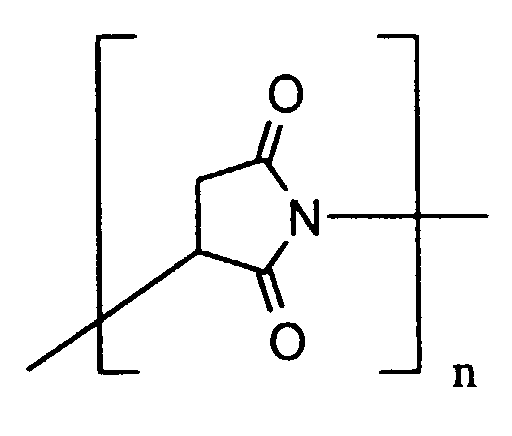
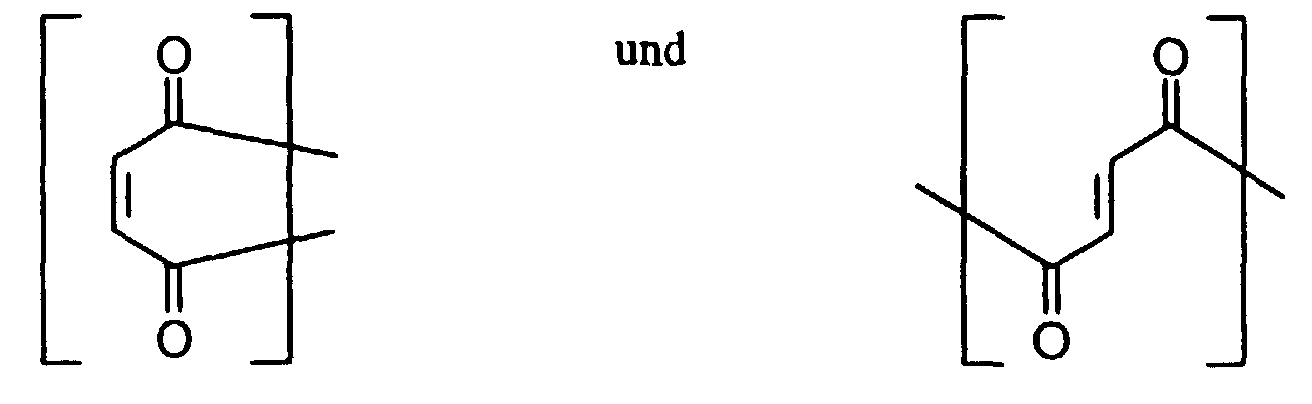
- the polyaspartic acid produced according to the invention contains in a preferred Embodiment essentially the ⁇ and ⁇ units specified under a). in the In general, this is at least 50%, in particular at least 70% beta form.
- repeating polyaspartic acid units e.g. the under b) and c) recurring units.
- the chemical structure is preferably analyzed using 13 C-NMR and total hydrolysis using HPLC, GC and GC / MS.
- the reaction is carried out in water as a solvent.
- the starting materials in particular maleic anhydride and ammonia, are reacted in water.
- the reaction takes place at a temperature of 150 ° C. to 300 ° C., preferably 180 ° C. to 250 ° C., particularly preferably 180 ° C. to 220 ° C. and a molar ratio of maleic anhydride or maleic acid or fumaric acid to NH 3 of 1: 0.8 to 1: 1.2, preferably 1: 0.95 to 1: 1.05.
- the molar ratio of substrate to ammonia in the case of maleic anhydride, maleic acid or fumaric acid is 1: 1.8 to 1: 2.4, preferably 1: 1.9 to 1: 2.2 and in the case of aspartic acid 1: 0.8 to 1: 1.2, preferably 1: 0.95 to 1: 1.05.
- the residence time is 5 minutes to 300 minutes, depending on the reaction temperature.
- Another embodiment is to carry out the reaction at two temperature levels.
- maleic anhydride and NH 3 are reacted at 20 ° C. to 100 ° C., particularly 40 ° C. to 80 ° C., and then heated to 150 ° C.
- the corresponding PAS salts can be prepared in the same reaction medium by adding a base.
- the molar ratio of the solvent water to, for example, maleic anhydride is such that a liquid reaction solution is ensured throughout the reaction.
- Part of the water is added at the start of the reaction; a further part of the water is added after the polymerization and cooling of the reaction mixture to 60 ° C to 100 ° C either as pure water or in the preparation of the PAS salts in the form of an aqueous base solution.
- the reaction is carried out under increased pressure.
- a maximum pressure can be achieved which corresponds to the critical pressure of the ammonia (113 bar) corresponds.
- the reaction is preferred at a pressure of 2-70 bar, carried out particularly preferably at 5-40 bar.
- An advantage of the method according to the invention is the circumvention of the in Substance polymerization inevitable tough and solid phases, their mastery is only possible with great technical effort. It is also advantageous that the Process can be carried out without intermediate insulation.
- the salts produced by this process (e.g. Na salt) have properties a dispersing and sequestering agent and a corrosion inhibitor on and can be used accordingly in terms of application technology. Furthermore, can antimicrobial activity, i.e. against bacteria and fungi will.
- the compounds according to the invention are used in particular as dispersants, Detergent additive, sequestering agent, scale inhibitor, as corrosion inhibitor, especially for brass and as a microbicide and in fertilizers.
Landscapes
- Chemical & Material Sciences (AREA)
- Health & Medical Sciences (AREA)
- Chemical Kinetics & Catalysis (AREA)
- Medicinal Chemistry (AREA)
- Polymers & Plastics (AREA)
- Organic Chemistry (AREA)
- Macromolecular Compounds Obtained By Forming Nitrogen-Containing Linkages In General (AREA)
- Polyamides (AREA)
Description


Claims (9)
- Verfahren zur Herstellung von Polysuccinimid und Polyasparaginsäure, ihren Salzen und ihrem Amid durch Polymerisation von Maleinsäureanhydrid, Asparaginsäure, Maleinsäure oder Fumarsäure in einem Lösungsmittel bei 150°C bis 300°C, gegebenenfalls in Anwesenheit von Ammoniak und gegebenenfalls Hydrolyse des erhaltenen Polysuccinimids zu Polyasparaginsäure oder einem Salz davon, dadurch gekennzeichnet, daß das Lösungsmittel Wasser, ein Alkohol oder ein organisches, polares, aprotisches Lösungsmittel ist.
- Verfahren nach Anspruch 1, dadurch gekennzeichnet, daß die Polymerisation mit einer Verweilzeit von 5 bis 300 Minuten durchgeführt wird.
- Verfahren nach wenigstens einem der vorhergehenden Ansprüche, dadurch gekennzeichnet, daß bei der Herstellung von Polyasparaginsäure das molare Verhältnis von Maleinsäureanhydrid, Maleinsäure oder Fumarsäure zu Ammoniak zwischen 1:0,8 und 1:1,2 liegt.
- Verfahren nach wenigstens einem der vorhergehenden Ansprüche, dadurch gekennzeichnet, daß bei der Herstellung des Amides der Polyasparaginsäure das molare Verhältnis zu Ammoniak im Falle von Maleinsäureanhydrid, Maleinsäure oder Fumarsäure zwischen 1:1,8 und 1:2,4 und im Falle von Asparaginsäure zwischen 1:0,8 und 1:1,2 liegt.
- Verfahren nach wenigstens einem der vorhergehenden Ansprüche, dadurch gekennzeichnet, daß die Reaktion bei einem Druck von 2 bis 70 bar durchgeführt wird.
- Verfahren nach wenigstens einem der vorhergehenden Ansprüche, dadurch gekennzeichnet, daß die Reaktion bei 180°C bis 220°C durchgeführt wird.
- Verfahren nach wenigstens einem der vorhergehenden Ansprüche, dadurch gekennzeichnet, daß die Reaktion kontinuierlich durchgeführt wird.
- Verfahren nach wenigstens einem der vorhergehenden Ansprüche, dadurch gekennzeichnet, daß Basen vor oder nach der Polymerisation zugesetzt werden.
- Verfahren nach wenigstens einem der vorhergehenden Ansprüche, dadurch gekennzeichnet, daß als Lösungsmittel Wasser verwendet wird.
Applications Claiming Priority (2)
| Application Number | Priority Date | Filing Date | Title |
|---|---|---|---|
| DE4306412A DE4306412A1 (de) | 1993-03-02 | 1993-03-02 | Verfahren zur Herstellung von Polyasparaginsäure |
| DE4306412 | 1993-03-02 |
Publications (2)
| Publication Number | Publication Date |
|---|---|
| EP0613920A1 EP0613920A1 (de) | 1994-09-07 |
| EP0613920B1 true EP0613920B1 (de) | 1998-05-20 |
Family
ID=6481700
Family Applications (1)
| Application Number | Title | Priority Date | Filing Date |
|---|---|---|---|
| EP94102420A Expired - Lifetime EP0613920B1 (de) | 1993-03-02 | 1994-02-17 | Verfahren zur Herstellung von Polyasparaginsäure |
Country Status (4)
| Country | Link |
|---|---|
| EP (1) | EP0613920B1 (de) |
| JP (1) | JP3419067B2 (de) |
| DE (2) | DE4306412A1 (de) |
| ES (1) | ES2115794T3 (de) |
Families Citing this family (14)
| Publication number | Priority date | Publication date | Assignee | Title |
|---|---|---|---|---|
| EP0612784B1 (de) * | 1993-02-22 | 1998-11-11 | Bayer Ag | Verfahren zur Herstellung von Polysuccinimid und Polyasparaginsäure |
| DE4427233A1 (de) * | 1994-06-29 | 1996-01-04 | Basf Ag | Verfahren zur Herstellung von Polyasparaginsäure und/oder Polyasparaginsäureimiden |
| DE4434463A1 (de) * | 1994-09-27 | 1996-03-28 | Basf Ag | Verfahren zur Herstellung von modifizierten Polyasparaginsäuren |
| IT1275961B1 (it) * | 1995-03-23 | 1997-10-24 | Sisas Spa | Polimeri dell'acido aspartico ad azione sequestrante procedimento per la loro preparazione e loro impiego |
| JPH09165447A (ja) * | 1995-12-15 | 1997-06-24 | Mitsubishi Chem Corp | ポリアスパラギン酸共重合体及びその製造方法 |
| IT1283642B1 (it) * | 1996-07-30 | 1998-04-23 | Lonza Spa | Procedimento per la preparazione di acido poliaspartico |
| DE19636190A1 (de) * | 1996-09-06 | 1998-03-12 | Bayer Ag | Verfahren zur Herstellung von Polymeren mit wiederkehrenden Succinyleinheiten |
| ATE217650T1 (de) * | 1996-09-20 | 2002-06-15 | Dsm Fine Chem Austria Gmbh | Verfahren zur herstellung von z-l-asparaginsäure- dinatriumsalz aus fumarsäure |
| KR20010040378A (ko) | 1998-01-28 | 2001-05-15 | 어웨어 케미칼즈 엘.엘.씨. | 도장실로부터 배출되는 순환수의 처리 방법 |
| ATA16398A (de) * | 1998-02-02 | 2001-06-15 | Chemie Linz Gmbh | Verfahren zur herstellung von z-l-asparaginsäure-dinatriumsalz aus fumarsäure |
| AT408755B (de) * | 1998-05-22 | 2002-03-25 | Dsm Fine Chem Austria Gmbh | Verfahren zur herstellung von l-asparaginsäure |
| AT407227B (de) | 1998-06-26 | 2001-01-25 | Aware Chemicals Llc | Verfahren zum reinigen von lackführenden teilen einer lackieranlage, insbesondere von lackleitungen |
| JP5650194B2 (ja) | 2010-02-18 | 2015-01-07 | 三井化学株式会社 | ポリアスパラギン酸前駆体ポリマーおよびポリアスパラギン酸塩の製造方法 |
| CN108383251B (zh) * | 2018-04-17 | 2021-07-16 | 唐山师范学院 | 一种阻垢剂的制备方法 |
Family Cites Families (6)
| Publication number | Priority date | Publication date | Assignee | Title |
|---|---|---|---|---|
| JPS4851995A (de) * | 1971-11-01 | 1973-07-21 | ||
| US3846380A (en) | 1972-10-31 | 1974-11-05 | M Teranishi | Polyamino acid derivatives and compositions containing same |
| DE3626672A1 (de) * | 1986-08-07 | 1988-02-11 | Bayer Ag | Polyasparaginamidsaeure |
| US5057597A (en) | 1990-07-03 | 1991-10-15 | Koskan Larry P | Process for the manufacture of anhydro polyamino acids and polyamino acids |
| US5221733A (en) | 1991-02-22 | 1993-06-22 | Donlar Corporation | Manufacture of polyaspartic acids |
| US5288783A (en) | 1992-05-14 | 1994-02-22 | Srchem Incorporated | Preparation of salt of polyaspartic acid by high temperature reaction |
-
1993
- 1993-03-02 DE DE4306412A patent/DE4306412A1/de not_active Withdrawn
-
1994
- 1994-02-17 EP EP94102420A patent/EP0613920B1/de not_active Expired - Lifetime
- 1994-02-17 DE DE59405969T patent/DE59405969D1/de not_active Expired - Lifetime
- 1994-02-17 ES ES94102420T patent/ES2115794T3/es not_active Expired - Lifetime
- 1994-02-24 JP JP05000094A patent/JP3419067B2/ja not_active Expired - Fee Related
Also Published As
| Publication number | Publication date |
|---|---|
| JPH06256504A (ja) | 1994-09-13 |
| EP0613920A1 (de) | 1994-09-07 |
| DE59405969D1 (de) | 1998-06-25 |
| ES2115794T3 (es) | 1998-07-01 |
| JP3419067B2 (ja) | 2003-06-23 |
| DE4306412A1 (de) | 1994-09-08 |
Similar Documents
| Publication | Publication Date | Title |
|---|---|---|
| DE69127758T2 (de) | Markierte Polymere und Synthese durch Nach-Polymerisation-Transamidierung | |
| EP0821054A2 (de) | Verwendung von Polyasparaginsäure und ihrer Salze | |
| EP0623587B1 (de) | Verfahren zur Herstellung von amphoteren Tensiden | |
| EP0633281B1 (de) | Verfahren zur Herstellung von Polysuccinimid und Polyasparaginsäure | |
| DE69320643T2 (de) | Herstellung von polysuccinimide und polyasparginsäure | |
| EP0613920A1 (de) | Verfahren zur Herstellung von Polyasparaginsäure | |
| DE1593165B2 (de) | Verfahren zur Herstellung eines Sulfonierungsprodukts von ungesättigten Carbonsäuren oder von Estern ungesättigter Carbonsäuren | |
| EP0612784B1 (de) | Verfahren zur Herstellung von Polysuccinimid und Polyasparaginsäure | |
| DE69209709T2 (de) | Verfahren zur Herstellung von aus Di- oder Tri-Carboxylsäuren abgeleiteten Grenzflächenaktiven Mitteln | |
| EP1097184A1 (de) | Konzentrierte leukoindigolösungen | |
| DE4310503A1 (de) | Verfahren zur Herstellung von Polyasparaginsäure und ihre Salze | |
| EP0557835B1 (de) | Verfahren zur Herstellung von Betainen | |
| DE2727345C2 (de) | Verfahren zur Herstellung von 8-Amino-1-naphthol-3,6-disulfonsäure | |
| DE1468460B2 (de) | Verfahren zur Herstellung von oberflächenaktiven, monochlor-perfluorierten Verbindungen | |
| DE69514882T2 (de) | Verfahren der Herstellung von Aminosäure-Polykondensaten und deren bioabbaubarer Polypeptid-Hydrolysate, ihre Verwendung in Detergens-zusammensetzungen | |
| DE69304932T2 (de) | Fleckenabweisendes mittel auf basis von phenolderivaten | |
| DE1493776C3 (de) | Substituierte o-Phenoxyphenylester, Verfahren zu deren Herstellung und diese enthaltende Mittel | |
| DE69217386T2 (de) | Lösungen von polyamidimiden in gamma-butryrolacton und deren herstellungsverfahren | |
| EP0237946B1 (de) | Kupferhaltiges Mittel zur Bekämpfung von Pilzen und Bakterien | |
| DE69614155T2 (de) | Antimikrobielle lösung von durch formaldehyd substituiertem hydantoin und verfahren zu deren herstellung | |
| EP0937704B1 (de) | Verfahren zur Herstellung von Acylglutamat-Lösungen | |
| EP0812822B1 (de) | Verfahren zur Herstellung von Aminoessigsäuren mit alpha-ständigem tertiären Kohlenwasserstoffrest oder deren Nitrilen | |
| DE1795846C2 (de) | 2-O-Acyl-3,4-O-aryliden-clindamycine | |
| DE896489C (de) | Verfahren zur Herstellung von Acetessigsaeureamiden | |
| EP0701999B1 (de) | Verfahren zur Herstellung von Betainen |
Legal Events
| Date | Code | Title | Description |
|---|---|---|---|
| PUAI | Public reference made under article 153(3) epc to a published international application that has entered the european phase |
Free format text: ORIGINAL CODE: 0009012 |
|
| AK | Designated contracting states |
Kind code of ref document: A1 Designated state(s): BE DE ES FR GB IT NL |
|
| 17P | Request for examination filed |
Effective date: 19950130 |
|
| 17Q | First examination report despatched |
Effective date: 19960523 |
|
| GRAG | Despatch of communication of intention to grant |
Free format text: ORIGINAL CODE: EPIDOS AGRA |
|
| GRAG | Despatch of communication of intention to grant |
Free format text: ORIGINAL CODE: EPIDOS AGRA |
|
| GRAH | Despatch of communication of intention to grant a patent |
Free format text: ORIGINAL CODE: EPIDOS IGRA |
|
| GRAH | Despatch of communication of intention to grant a patent |
Free format text: ORIGINAL CODE: EPIDOS IGRA |
|
| GRAA | (expected) grant |
Free format text: ORIGINAL CODE: 0009210 |
|
| AK | Designated contracting states |
Kind code of ref document: B1 Designated state(s): BE DE ES FR GB IT NL |
|
| GBT | Gb: translation of ep patent filed (gb section 77(6)(a)/1977) |
Effective date: 19980520 |
|
| REF | Corresponds to: |
Ref document number: 59405969 Country of ref document: DE Date of ref document: 19980625 |
|
| REG | Reference to a national code |
Ref country code: ES Ref legal event code: FG2A Ref document number: 2115794 Country of ref document: ES Kind code of ref document: T3 |
|
| ITF | It: translation for a ep patent filed | ||
| ET | Fr: translation filed | ||
| PLBE | No opposition filed within time limit |
Free format text: ORIGINAL CODE: 0009261 |
|
| STAA | Information on the status of an ep patent application or granted ep patent |
Free format text: STATUS: NO OPPOSITION FILED WITHIN TIME LIMIT |
|
| 26N | No opposition filed | ||
| REG | Reference to a national code |
Ref country code: GB Ref legal event code: IF02 |
|
| REG | Reference to a national code |
Ref country code: GB Ref legal event code: 732E |
|
| PGFP | Annual fee paid to national office [announced via postgrant information from national office to epo] |
Ref country code: NL Payment date: 20070204 Year of fee payment: 14 |
|
| PGFP | Annual fee paid to national office [announced via postgrant information from national office to epo] |
Ref country code: ES Payment date: 20070327 Year of fee payment: 14 |
|
| NLS | Nl: assignments of ep-patents |
Owner name: LANXESS DEUTSCHLAND GMBH Effective date: 20070305 |
|
| PGFP | Annual fee paid to national office [announced via postgrant information from national office to epo] |
Ref country code: FR Payment date: 20070208 Year of fee payment: 14 |
|
| PGFP | Annual fee paid to national office [announced via postgrant information from national office to epo] |
Ref country code: GB Payment date: 20080213 Year of fee payment: 15 |
|
| NLV4 | Nl: lapsed or anulled due to non-payment of the annual fee |
Effective date: 20080901 |
|
| REG | Reference to a national code |
Ref country code: FR Ref legal event code: TP |
|
| PG25 | Lapsed in a contracting state [announced via postgrant information from national office to epo] |
Ref country code: NL Free format text: LAPSE BECAUSE OF NON-PAYMENT OF DUE FEES Effective date: 20080901 |
|
| REG | Reference to a national code |
Ref country code: FR Ref legal event code: ST Effective date: 20081031 |
|
| PG25 | Lapsed in a contracting state [announced via postgrant information from national office to epo] |
Ref country code: FR Free format text: LAPSE BECAUSE OF NON-PAYMENT OF DUE FEES Effective date: 20080229 |
|
| REG | Reference to a national code |
Ref country code: ES Ref legal event code: FD2A Effective date: 20080218 |
|
| PG25 | Lapsed in a contracting state [announced via postgrant information from national office to epo] |
Ref country code: ES Free format text: LAPSE BECAUSE OF NON-PAYMENT OF DUE FEES Effective date: 20080218 |
|
| GBPC | Gb: european patent ceased through non-payment of renewal fee |
Effective date: 20090217 |
|
| PG25 | Lapsed in a contracting state [announced via postgrant information from national office to epo] |
Ref country code: GB Free format text: LAPSE BECAUSE OF NON-PAYMENT OF DUE FEES Effective date: 20090217 |
|
| PGFP | Annual fee paid to national office [announced via postgrant information from national office to epo] |
Ref country code: IT Payment date: 20100220 Year of fee payment: 17 |
|
| PGFP | Annual fee paid to national office [announced via postgrant information from national office to epo] |
Ref country code: DE Payment date: 20100226 Year of fee payment: 17 Ref country code: BE Payment date: 20100215 Year of fee payment: 17 |
|
| BERE | Be: lapsed |
Owner name: *LANXESS DEUTSCHLAND G.M.B.H. Effective date: 20110228 |
|
| PG25 | Lapsed in a contracting state [announced via postgrant information from national office to epo] |
Ref country code: BE Free format text: LAPSE BECAUSE OF NON-PAYMENT OF DUE FEES Effective date: 20110228 |
|
| PG25 | Lapsed in a contracting state [announced via postgrant information from national office to epo] |
Ref country code: IT Free format text: LAPSE BECAUSE OF NON-PAYMENT OF DUE FEES Effective date: 20110217 |
|
| REG | Reference to a national code |
Ref country code: DE Ref legal event code: R119 Ref document number: 59405969 Country of ref document: DE Effective date: 20110901 |
|
| PG25 | Lapsed in a contracting state [announced via postgrant information from national office to epo] |
Ref country code: DE Free format text: LAPSE BECAUSE OF NON-PAYMENT OF DUE FEES Effective date: 20110901 |