EP0608397B1 - Vorrichtung und verfahren zum anbringen eines informationsanhängers an einem flaschenhals - Google Patents
Vorrichtung und verfahren zum anbringen eines informationsanhängers an einem flaschenhals Download PDFInfo
- Publication number
- EP0608397B1 EP0608397B1 EP93916396A EP93916396A EP0608397B1 EP 0608397 B1 EP0608397 B1 EP 0608397B1 EP 93916396 A EP93916396 A EP 93916396A EP 93916396 A EP93916396 A EP 93916396A EP 0608397 B1 EP0608397 B1 EP 0608397B1
- Authority
- EP
- European Patent Office
- Prior art keywords
- neck
- booklet
- elastic band
- band
- slide plate
- Prior art date
- Legal status (The legal status is an assumption and is not a legal conclusion. Google has not performed a legal analysis and makes no representation as to the accuracy of the status listed.)
- Expired - Lifetime
Links
- 238000000034 method Methods 0.000 title claims description 12
- 239000004744 fabric Substances 0.000 claims description 5
- 239000011248 coating agent Substances 0.000 claims description 3
- 238000000576 coating method Methods 0.000 claims description 3
- 210000003739 neck Anatomy 0.000 description 120
- 235000013361 beverage Nutrition 0.000 description 10
- 238000004519 manufacturing process Methods 0.000 description 4
- 239000013013 elastic material Substances 0.000 description 2
- 239000007787 solid Substances 0.000 description 2
- 238000010276 construction Methods 0.000 description 1
- 230000000694 effects Effects 0.000 description 1
- 239000000463 material Substances 0.000 description 1
- 238000012986 modification Methods 0.000 description 1
- 230000004048 modification Effects 0.000 description 1
- 238000003825 pressing Methods 0.000 description 1
- 230000005855 radiation Effects 0.000 description 1
- 239000012858 resilient material Substances 0.000 description 1
- 230000000717 retained effect Effects 0.000 description 1
- 238000007789 sealing Methods 0.000 description 1
Images


Classifications
-
- B—PERFORMING OPERATIONS; TRANSPORTING
- B65—CONVEYING; PACKING; STORING; HANDLING THIN OR FILAMENTARY MATERIAL
- B65B—MACHINES, APPARATUS OR DEVICES FOR, OR METHODS OF, PACKAGING ARTICLES OR MATERIALS; UNPACKING
- B65B61/00—Auxiliary devices, not otherwise provided for, for operating on sheets, blanks, webs, binding material, containers or packages
- B65B61/20—Auxiliary devices, not otherwise provided for, for operating on sheets, blanks, webs, binding material, containers or packages for adding cards, coupons or other inserts to package contents
- B65B61/202—Auxiliary devices, not otherwise provided for, for operating on sheets, blanks, webs, binding material, containers or packages for adding cards, coupons or other inserts to package contents for attaching articles to the outside of a container
-
- B—PERFORMING OPERATIONS; TRANSPORTING
- B65—CONVEYING; PACKING; STORING; HANDLING THIN OR FILAMENTARY MATERIAL
- B65C—LABELLING OR TAGGING MACHINES, APPARATUS, OR PROCESSES
- B65C7/00—Affixing tags
-
- Y—GENERAL TAGGING OF NEW TECHNOLOGICAL DEVELOPMENTS; GENERAL TAGGING OF CROSS-SECTIONAL TECHNOLOGIES SPANNING OVER SEVERAL SECTIONS OF THE IPC; TECHNICAL SUBJECTS COVERED BY FORMER USPC CROSS-REFERENCE ART COLLECTIONS [XRACs] AND DIGESTS
- Y10—TECHNICAL SUBJECTS COVERED BY FORMER USPC
- Y10S—TECHNICAL SUBJECTS COVERED BY FORMER USPC CROSS-REFERENCE ART COLLECTIONS [XRACs] AND DIGESTS
- Y10S29/00—Metal working
- Y10S29/044—Vacuum
-
- Y—GENERAL TAGGING OF NEW TECHNOLOGICAL DEVELOPMENTS; GENERAL TAGGING OF CROSS-SECTIONAL TECHNOLOGIES SPANNING OVER SEVERAL SECTIONS OF THE IPC; TECHNICAL SUBJECTS COVERED BY FORMER USPC CROSS-REFERENCE ART COLLECTIONS [XRACs] AND DIGESTS
- Y10—TECHNICAL SUBJECTS COVERED BY FORMER USPC
- Y10T—TECHNICAL SUBJECTS COVERED BY FORMER US CLASSIFICATION
- Y10T29/00—Metal working
- Y10T29/49—Method of mechanical manufacture
- Y10T29/49826—Assembling or joining
- Y10T29/49863—Assembling or joining with prestressing of part
- Y10T29/4987—Elastic joining of parts
-
- Y—GENERAL TAGGING OF NEW TECHNOLOGICAL DEVELOPMENTS; GENERAL TAGGING OF CROSS-SECTIONAL TECHNOLOGIES SPANNING OVER SEVERAL SECTIONS OF THE IPC; TECHNICAL SUBJECTS COVERED BY FORMER USPC CROSS-REFERENCE ART COLLECTIONS [XRACs] AND DIGESTS
- Y10—TECHNICAL SUBJECTS COVERED BY FORMER USPC
- Y10T—TECHNICAL SUBJECTS COVERED BY FORMER US CLASSIFICATION
- Y10T29/00—Metal working
- Y10T29/53—Means to assemble or disassemble
- Y10T29/53313—Means to interrelatedly feed plural work parts from plural sources without manual intervention
- Y10T29/53322—Means to assemble container
- Y10T29/5333—Label to container
-
- Y—GENERAL TAGGING OF NEW TECHNOLOGICAL DEVELOPMENTS; GENERAL TAGGING OF CROSS-SECTIONAL TECHNOLOGIES SPANNING OVER SEVERAL SECTIONS OF THE IPC; TECHNICAL SUBJECTS COVERED BY FORMER USPC CROSS-REFERENCE ART COLLECTIONS [XRACs] AND DIGESTS
- Y10—TECHNICAL SUBJECTS COVERED BY FORMER USPC
- Y10T—TECHNICAL SUBJECTS COVERED BY FORMER US CLASSIFICATION
- Y10T29/00—Metal working
- Y10T29/53—Means to assemble or disassemble
- Y10T29/53478—Means to assemble or disassemble with magazine supply
Definitions
- the present invention is directed to a neck booklet machine and method which is adapted to place an elastic band, string or the like connected to a neck booklet around a neck of a container, such as a bottle, beverage container or the like.
- Advertising devices such as neck booklets having closed elastic bands, closed loops or the like connected thereto, are desirably placed around the neck of beverage containers to convey a particular advertising message for the particular beverage within the container.
- Proskauer, U.S. Patent No. 1,994,961, entitled “ADVERTISING DEVICE” describes a container having a neck portion with a booklet.
- Means for securing the booklet include a cord, or the like, passing through the booklet and positioned around the neck portion of the container. (Col. 2, lines 9-13.)
- Staves fails to describe a device to accomplish these tasks.
- the weight of the booklet dragging along a rail creates frictional resistance thereby causing a slight tensioning in the cord so as to remove slack from the cord. This prevents the cord from becoming dislodged from the body portion of the closure and allows the presser wheel to fully insert the closure.
- the manual placement of neck booklets becomes more difficult and often requires additional people to perform the manual placement function.
- Machines have also been designed to position elastic type members around the cylindrical objects, such as expandable neck labels around the neck of a container.
- elastic type members such as expandable neck labels around the neck of a container.
- U.S. Patent No. 4,215,460 entitled “APPARATUS AND METHOD FOR ASSEMBLYING TUBULAR SLEEVE PREFORMS AND CONTAINERS” discloses a device to place a heat-shrinkable tubular sleeve about the neck of a container.
- the tubular sleeve is flat folded in a holder having dimensions complemental to the retained flattened stack of sleeves (Col. 3, line 55-57).
- the flattened tubular sleeve is gripped by a pair of vacuum cups moving downwardly and divergently along chains to open the flattened sleeve.
- the opened tubular sleeve is placed on a cylindrical mandrel to more fully open the tubular sleeve prior to its being mounted telescopically by a stripper element on the container neck portion of the container.
- Hoffman et al. U.S. Patent No. 3,186,333, entitled “RUBBER BAND STRETCHING APPARATUS”, discloses a device for wrapping elastic bands around an article.
- the elastic bands are supplied in a stacked relationship, such as having adjacent bands connected to each other by a strip.
- a feeder blade grasps the lowermost band so that four expander fingers are positioned with the band.
- the outmost fingers are shifted downwardly and outwardly, the major component of their movement being horizontal.
- the innermost fingers are shifted downwardly and outwardly, with the major component of their movement being downwardly.
- the curved and angulated configuration of the release fingers allows the elastic band to slip from engagement with them and engage the article.
- Strout U.S. Patent No. 2,103,302, entitled “BAND APPLYING MACHINE” describes a machine for applying a tubular banding sleeve to a neck of a container.
- a magazine is disposed to store collapsed or flat sleeves.
- a first movable suction member withdraws a sleeve from the magazine and positions it over the neck of the container.
- Second suction members in cooperation and conjunction with the first suction member effects the opening of the sleeve.
- the sleeve is opened by an air jet via tubes which force air into the interior of the banding sleeve.
- An expansible member first engages the sleeve as a cone shaped member and then expands itself and the sleeve into a cylindrical shape. This expands the sleeve into an open position for positioning onto the neck of the container.
- the label By applying pressure to the label perpendicular to the axis of the container, the label is secured to the container so that the container may be removed from the label applicator.
- a resilient expandable solid cone may be used in lieu of ring and expandable fingers.
- a machine for positioning a booklet having a band around a container comprising:
- the slide plate terminates in a manner so that the carrier pads release the booklet once the booklet is affixed around the next of the container.
- the machine positions neck booklets having an elastic band and includes a curved magazine defined to receive a plurality of neck booklets.
- a vacuum cup is positioned to sequentially remove in series neck booklets from the curved magazine and position the booklets along a slide plate.
- Carrier pads are disposed to engage the neck booklet and incrementally transport the neck booklet along the slide plate.
- the carrier pads in combination with a vacuum nozzle maintain the elastic band in a downwardly projecting open loop.
- a needle point is disposed to project into the open loop of the elastic band as the elastic band moves along the slide plate.
- An opening horn is affixed to the needle point and is disposed to gradually expand the elastic band as the neck booklet moves along the slide plate.
- Application fingers are positioned to receive the expanded elastic band with fingers having at least three points to define an opening suitable for fitting the elastic band around the neck of the container as the carrier pads incrementally transport the neck booklet along the carrier plate and elastic band along the application fingers.
- the neck booklet machine additionally comprises either a conveyor or rotatable table having a plurality of containers positioned on the conveyor or rotatable table.
- the application fingers are disposed in a manner to incrementally position the elastic bands around the containers.
- a neck booklet having an elastic band around a neck of a container comprising:
- the above method additionally includes the steps of terminating the slide plate in a manner so that the carrier pads release the booklet once the booklet is affixed around the neck of the container.
- a machine for positioning a booklet having a band around a container comprising:
- the neck booklet machine of this invention provides important advantages. It can precisely and accurately place a neck booklet on the neck of a beverage container while the beverage container is moving along a conveyor belt. Additionally, it can handle a wide variety of shapes and sizes of necks of beverage containers moving at a range of production line speeds. Further, the neck booklet machine of the present invention provides a rugged construction which is easy to repair and maintain, e.g., a neck booklet jamming along the slide rail.
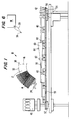
- the neck booklet machine 10 includes a curved magazine 12 holding a plurality of booklets or neck booklets 14.
- the neck booklets 14 are generally vertically positioned within a slide plate 16 positioned at the bottom of the curved magazine 12.
- the neck booklets 14 have elastic bands 20 or strings, cords or the like tied through a punched hole 22 in the neck booklet 14.
- the elastic band 20 includes a fabric or cloth coating positioned over an elastic material.
- the elastic material is about 1 mm in diameter with the fabric coating about 0.5 mm to provide an elastic band of about 1.5 mm in diameter.
- elastic it is intended to include any expandable-resilient material which may be suitably expanded to be positioned over a neck of a container and resiliently contract therearound once expansion forces are released, or contracted due to the application of physical conditions or phenomena such as heat, pressure, UV radiation, etc.
- the neck booklets 14 are vertically stacked in the curved magazine 12 and sequentially pulled in series from the magazine by a vacuum cup 24, or other removal means such as frictional pads.
- the shape of the curved magazine 12 matches the natural curvature of a stack of neck booklets 14 having an elastic band 20 positioned on one end 26 to render one end of the booklet thicker than the other end 28 of the booklet.
- the bottom 30 of the curved magazine 12 includes an arc-shaped opening 32 to allow the elastic bands 20 to hang free in an essentially vertical position.
- the elastic bands 20 have a knot 34 positioned therein which provides a length of about 11 ⁇ 2 inches and forms a closed loop 36a of about 3 inches in diameter.
- a knot tying machine for elastic bands suitable for use in this invention is a model #185 Whirlwind knot tying machine available from the Bobst Corporation in New Jersey.
- the booklet 14 is picked up by a carrier pad, such as a carrier pressure pad 40, and held against and transported along a slide plate 42 toward a container transport means, such as a conveyor 46, having containers 44 positioned thereon.
- a carrier pad such as a carrier pressure pad 40
- An indexing drive motor 48 moves an endless flexible member, such as chain 50, upon which the carrier pads 40 are positioned.
- the chain 50 is positioned between drive rotational member 52 and idler rotation member 54, which moves the neck booklets 14 via the carrier pads 40 therebetween.
- a low vacuum nozzle 56 pulls and holds the closed loop 36a of the elastic band 20 down to a generally vertical position.
- This vacuum pull by the vacuum nozzle 56 in combination with the carrier pads 40 enables the closed loop 36a of the elastic band 20 to be picked up by a needle point 58.
- the loose elastic band 20 is held precisely below the neck booklet 14 on the slide plate 42.
- the opening horn 60 is carried on front support 62 and rear support 64 on the bottom 66 and sides 68 with a top opening 70 positioned to allow the elastic band 20 to pass over and around the opening horn 60, as shown in phantom lines and becomes an open loop 36b.
- the opening horn 60 is loosely supported by the two "U" shaped supports 62, 64 (or horse collars) to allow the thickness of the elastic band 20 to pass between the support members 62, 64 and the opening horn 60.
- the opening horn 60 is a generally conical shape having one plane generally parallel, or adjacent, to the axis or path of the slide bar 42.
- the elastic band 20 moves along the opening horn 60 to be stretched into an expanded position and form an open loop 36b.
- the opening horn 60 feeds the elastic band 14 into a plurality of application fingers 72, 74.
- the four application fingers 72a, 72b, 74a, 74b maintain the elastic band 20 in an expanded position, and when indexed to the next container 44 positioned along the conveyor 46, feed the expanded elastic band 20 onto the neck 76 of the container 44.
- the carrier pressure pads 40 release the neck booklet 14 at the end of the slide plate 42 at the precise time as the elastic band 20 is positioned over the neck 76 of the container 44 by the plurality of fingers 72a, 72b, 74a, 74b.
- the elastic band 20 is expanded from about 3 inches in circumference to about 4 inches in circumference.
- One of the application fingers 74b is a lesser length by distance "X" than the other three application fingers 72a, 72b, 74a to define the three points on the elastic band 20.
- the opening in the elastic band 20 defined by points 72a, 72b, 74a is suitable for fitting the elastic band 20 around the neck 76 of the container 44.
- the neck 76 of the container 44 is about 28 mm and the above expansion is suitable to position the elastic band 20 therearound.
- the number of application fingers may be reduced or increased depending upon the resiliency of the elastic band to be affixed around the neck 76 of the container 44.
- the incremental positioning of the neck booklets 14 with the elastic band 20 onto the neck 76 of containers 44 being transported on a conveyor or rotatable table is accomplished by use an indexing photo cell 80 coupled to the indexing drive motor 48.
- the indexing photo cell 80 precisely coordinates the movement of the carrier pressure pads 40 along the slide plate 42 as the containers 44 move under the plurality of application fingers 72, 74.
- Each continuous or sequential movement of the container 44 along the conveyor 46 brings about an incremental movement of the carrier pressure pads 40 along the slide plate 42 and the resulting positioning of the expanded elastic band 14 over the neck 76 of the container 44.
- the neck booklet machine 10 can handle a wide range of production line speeds with precision and accuracy.
- the present invention additionally comprises a method for positioning a neck booklet 14 having an elastic band 20 around a neck 76 of a container 44 comprising the steps of: providing a curved magazine 12 to receive a plurality of neck booklets 14; providing a vacuum cup 24 to sequentially remove in series neck booklets 14 from the curved magazine 12 and positioning the neck booklets 14 along a slide plate 42; providing a plurality of carrier pads 40 disposed to engage the neck booklet 14 between the carrier pads 40 and the slide plate 42, transporting incrementally the neck booklet 14 along the slide plate 42 via the carrier pads 40; providing a vacuum nozzle 56 in combination with the carrier pads 40 to maintain the elastic band 20 in a downwardly projecting closed loop 36a; providing a needle point 58 projecting into the closed loop 36a of the elastic band 20 as the elastic band 20 moves along the slide plate 42; providing an opening horn 60 affixed to the needle point 58 and disposed to gradually expand
- the neck booklet machine 10 of the present invention may be used to position an elastic band 20 around any cylindrical object or materials, such as containers, rolled papers, etc.
- a simple destructible card can be used as a carrier along the slide plate 42 of the neck booklet machine 10 to properly position the elastic band 14.
- the destructible card may be removed manually, or by a machine such as a rotating brush which bears against the destructible card.
- a plurality of the neck booklet machines 10 of the present invention may be ganged together in series to serve a plurality of moving conveyors 46 or rotatable tables having containers 44 positioned thereon.
- the opening horn 60 includes at least one "U" shaped support 65, the "U" shaped support 65 loosely supports the opening horn to allow the elastic band 20 to pass between the support and the opening horn 60, shown in phantom.
- the opening horn 60 may be supported by either air bearings or magnetic means in a manner to allow the elastic band to pass therebetween.
- one or two of the application fingers 72 or 74 may be affixed to the opening horn 60 to support the opening horn 60 in a manner to allow the elastic band 20 to pass between the supports 62, 64 and the opening horn 60 onto the application fingers 72, 74.
- This support of the opening horn 60 by the application fingers 72 or 74 is preferably in combination with the supports 62, 64 which are positioned on sides and bottom of the opening horn 60, but may be accomplished separately provided the application fingers 72, 74 are supported in a like manner as is the opening horn 60.
- the carrier pads 40 may comprise either pressure pads, friction pads or vacuum cups or other suitable means to transport the neck booklets 14.
- the opening horn 60 may define either a circular, square, triangular, oval or other suitable cross-section conformed to match the shape of the container 44 on which the neck booklet 14 is to be affixed.
- the cross-section of the opening horn 60 is matched to the cross section of the application fingers 72, 74 to assure ease of movement of the elastic band 20. More preferably, the opening horn 60 defines a cylindrically shaped solid cone having an angle less than 30°.
- the opening horn 60 may be defined by a plurality of opening horn fingers, illustrated by phantom lines 73a-g, with selected opening horn fingers 73a-g being coextensive with the application fingers 72a, 72b, 74a, 74b.
- the number of application fingers 72, 74 may be reduced or increased depending upon the resiliency of the elastic band 20 to be affixed around the neck 76 of the container 44, provided that the application fingers 72, 74 define at least three points 72a, 72b, 74a to receive the elastic band just prior to its placement on the neck 76 of the container 44.
- the application fingers 72a, 72b, 74a, 74b are defined to convey the elastic band 20 or loop 36a from the opening horn
- one of the application fingers 74b is a lesser length than the other three application fingers 72a, 72b, 74a to define the three points on the elastic band 14b.
- the open loop 36b in the elastic band 20 is suitable for fitting the elastic band 20 around the neck 76 of the container 44.
- the neck booklet machine 10' includes the curved magazine 12' and vacuum cup 24' as described above. Vacuum cup 24' positions neck booklets 14 between parallel endless members 100, 102, which are spaced apart and moved incrementally around pulleys 104, 106 and 110, 112, respectively.
- the endless parallel members 100, 102 function as the carrier pads 40 and slide plate 42 of the embodiment described in Figs. 1 and 2.
- the closed loop 36a of the elastic band 20 is pulled down in a vertical position by vacuum nozzle 56'.
- the closed loop 36a is grasped by two application fingers 72', 74' positioned on a rotating wheel 120 and expanded by relative motion of the application fingers 72', 74' to the endless members 100, 102 into an open loop 36b by the rotational forces of the rotating wheel 120 on the application fingers 72', 74'.
- the plurality of application fingers 72', 74' are spaced about the rotating wheel 120, which is timed to incrementally place the open loop 36a around the necks 76 of containers 44 positioned on conveyor 46.
- the rotating wheel performs the function of the needle point 58 and opening horn 60 of the embodiment described in Figs. 1 and 2.
- At least one of the application fingers is of a bladelike or arcuate structure so that the application fingers 72', 74' define a minimum of three points to properly place the elastic band 20 around the neck of the container 44.
- the neck booklet machine 10 features the combination of the curved magazine 12 with the carrier pads 40 and slide plate 42 which enable the needle point 58, opening horn 60 and application fingers 72, 74 to affix the elastic band 20 around the neck 76 of the container 44 as the container 44 moves sequentially along a conveyor 46.
- the neck booklets 14 via the elastic bands 20 are precisely and accurately positioned around the necks 76 of containers 44 moving along conveyors 46 at high speeds.
Landscapes
- Engineering & Computer Science (AREA)
- Mechanical Engineering (AREA)
- Labeling Devices (AREA)
- Auxiliary Devices For And Details Of Packaging Control (AREA)
- Sheets, Magazines, And Separation Thereof (AREA)
Claims (25)
- Maschine (10) zur Positionierung eines Etiketts mit einem Band (20) um einen Behälter (44), aufweisend:ein Magazin (12), das definiert ist, mehrere Halsetiketten (14) aufzunehmen;eine Entnahmeeinrichtung (24), die angeordnet ist, aufeinanderfolgend die Halsetiketten (14) nacheinander von dem Magazin (12) zu entnehmen und die Halsetiketten (14) entlang einer Gleitplatte (42) zu positionieren;eine Trägerunterlage (40), die ausgebildet ist, eine der Halsetiketten (14) zu ergreifen und die Halsetiketten (14) schrittweise entlang der Gleitplatte (42) zu transportieren;eine Positionierungseinrichtung, um das Band (20) in einer abwärtsgerichteten geschlossenen Schleife zu halten;eine Nadelspitze (58), die angeordnet ist, in die geschlossene Schleife des Bandes (20) zu ragen, wenn sich das Band (20) entlang der Gleitplatte (42) bewegt;einen an der Nadelspitze (58) befestigten Öffnungstrichter (60), der angeordnet ist, kontinuierlich oder schrittweise das Band (20) in eine offene Schleife zu dehnen, wenn sich die Halsetikette (14) entlang der Gleitplatte (42) bewegt; undBetätigungsfinger (72, 74), die angeordnet sind, das gedehnte Band (20) aufzunehmen, wobei die Betätigungsfinger (72, 74) wenigstens drei Punkte definieren, um eine zum Anbringen des Bandes (20) um den Behälter geeignete Öffnung zu definieren, wenn die Trägerunterlagen (40) das Etikett (14) schrittweise entlang den Betätigungsfingern (72, 74) transportieren.
- Maschine gemäß Anspruch 1, wobei die Gleitplatte (42) so endet, daß die Trägerunterlagen (40) das Etikett (14) freigeben, sobald das Halsetikett (14) und/oder das Band (20) um den Hals des Behälters (44) befestigt ist.
- Maschine gemäß Anspruch 1, ferner aufweisend eine Behältertransporteinrichtung mit mehreren darauf angeordneten Behältern, wobei die Betätigungsfinger (72, 74) so angeordnet sind, daß sie die Bänder (20) schrittweise um die Behälter (44) anordnen, wobei die Trägerunterlagen (40) und die Gleitplatte (42) so definiert sind, daß die Halsetiketten (14) freigegeben werden, nachdem die elastischen Bänder (20) um den Behälter (44) angeordnet sind.
- Maschine gemäß einem der vorangehenden Ansprüche, bei der das Band (20) ein elastisches Band ist, das Magazin (12) gekrümmt ist, die Entnahmeeinrichtung eine Vakuumschale (24) aufweist und die Trägerunterlagen (40) in Kombination mit einer Vakuumdüse (56) vorgesehen sind, die angeordnet ist, um das Band (20) in einer nach unten gerichteten geschlossenen Schleife zu halten.
- Maschine gemäß Anspruch 4, ferner aufweisend entweder ein Förderband (46) oder einen Drehtisch mit mehreren auf dem Förderband (46) oder dem Drehtisch angeordneten Behältern (44), wobei die Betätigungsfinger (72, 74) so angeordnet sind, daß sie die elastischen Bänder (20) schrittweise um die Behälter (44) positionieren, die Trägerunterlagen (40) und die Gleitplatte (42) definiert sind, die Halsetiketten (14) freizugeben, nachdem die elastischen Bänder (20) um den Behälter (44) positioniert sind.
- Maschine gemäß Anspruch 5, ferner aufweisend eine Indexierphotozelle (80), die angeordnet ist, die sich entlang des Förderbandes (46) oder des Drehtisches bewegenden Behälter (44) zu erfassen, wobei die Photozelle (80) mit einem Schrittmotor (48) verbunden ist, um die Trägerunterlagen (40) schrittweise entlang der Gleitplatte (42) zu bewegen.
- Maschine gemäß Anspruch 4, wobei das gekrümmte Magazin (12) die Halsetikette (14) in einer allgemein vertikalen Position in dem Magazin (12) aufnimmt, die elastischen Bänder (20) einen Knoten aufweist, der angeordnet ist, durch eine Öffnung in dem Magazin (12) zu ragen, um eine Schleife mit dem Knoten nahe dem Boden der geschlossenen Schleife des elastischen Bandes (20) zu bilden.
- Maschine gemäß Anspruch 4, wobei die Trägerunterlagen (40) entweder Druckelemente, Reibungselemte oder Vakuumschalen enthält.
- Maschine gemäß Anspruch 8, wobei die Trägerunterlagen (40) Druckelemente enthalten.
- Maschine gemäß Anspruch 4, wobei der Öffnungstrichter entweder einen kreisförmigen, quadratischen, dreieckigen oder ovalen Querschnitt definiert.
- Maschine gemäß Anspruch 4, wobei der Öffnungstrichter (60) einen Zylinderkegel mit einem Winkel von weniger als 30° definiert.
- Maschine gemäß Anspruch 4, wobei das elastische Band eine Gewebe- oder Stoffbeschichtung aufweist.
- Maschine gemäß Anspruch 4, wobei der Öffnungstrichter (60) wenigstens ein "U"-förmiges Halteteil (65) enthält, wobei das "U"-förmige Teil den Öffnungstrichter (60) lose hält, um dem elastischen Band zu erlauben, zwischen dem Unterstützungsteil und dem Öffnungstrichter (60) durchzulaufen.
- Maschine gemäß Anspruch 4, wobei der Öffnungstrichter (60) entweder durch Kugellager oder magnetische Mittel so gelagert ist, daß das elastische Band (20) frei entlang des Öffnungstrichters (60) durchlaufen kann.
- Maschine gemäß Anspruch 13, wobei wenigstens einer der Betätigungsfinger (72, 74) mit dem Öffnungstrichter (60) verbunden ist, um den Öffnungstrichter (60) so zu halten, so daß das elastische Band (20) zwischen dem Unterstützungsteil (62, 64) und dem Öffnungstrichter (60) auf die Betätigungsfinger (72, 74) durchlaufen kann.
- Maschine gemäß Anspruch 4, wobei wenigstens zwei der Betätigungsfinger (72, 74) an dem Öffnungstrichter (60) befestigt sind, um den Öffnungstrichter (60) so zu unterstützen, daß das elastische Band (20) zwischen einem Unterstützungsteil (62, 64) und dem Öffnungstrichter (60) auf die Betätigungsfinger (72, 74) durchlaufen kann.
- Maschine gemäß Anspruch 16, wobei der Öffnungstrichter (60) durch mehrere Öffnungstrichter-Finger (73a-g) definiert ist, wobei die Öffnungstrichter-Finger den Betätigungsfingern (72, 74) zugeordnet sind.
- Maschine gemäß Anspruch 4, wobei vier Betätigungsfinger (72, 74) definiert sind, das elastische Band (20) von dem Öffnungstrichter (60) zu transportieren.
- Maschine gemäß Anspruch 1, wobei vier Betätigungsfinger (72, 74) definiert sind, das Band (20) von dem Öffnungstrichter (60) zu transportieren, wobei einer der Betätigungsfinger (72, 74) eine geringere Länge hat als die anderen drei Betätigungsfinger (72, 74), um die Öffnung zu definieren, die geeignet ist, um das elastische Band (20) um den Hals des Behälter (44) anzubringen.
- Verfahren zur Positionierung eines Halsetiketts (14) mit einem elastischen Band (20) um den Hals eines Behälters (44), aufweisend:Bereitstellung eines gekrümmten Magazins (12), um mehrere Halsetiketten (14) aufzunehmen;Bereitstellung einer Vakuumschale (24), um aufeinanderfolgend die Halsetiketten (14) nacheinander von dem gekrümmten Magazin (12) zu entnehmen und die Etiketten (14) entlang einer Gleitplatte (42) anzuordnen;Bereitstellung mehrerer Trägerunterlagen (40), die angeordnet sind, die Halsetikette (14) zwischen den Trägerunterlagen (40) und der Gleitplatte (42) zu ergreifen und die Halsetiketten (14) schrittweise entlang der Gleitplatte (42) mittels der Trägerunterlagen (40) zu transportieren;Bereitstellung einer Vakuumdüse (56) in Kombination mit den Trägerunterlagen (40), um das elastische Band (42) in einer abwärtsgerichteten geschlossenen Schleife zu halten;Bereitstellung einer Nadelspitze (58), die in die geschlossene Schleife des elastischen Bandes (20) ragt, wenn sich das elastische Band (20) entlang der Gleitplatte (42) bewegt;Bereitstellung eines an der Nadelspitze (58) befestigten Öffnungstrichters (60), der angeordnet ist, das elastische Band (20) allmählich fortschreitend in eine offene Schleife zu dehnen, wenn das Halsetikett (14) sich entlang der Gleitplatte (42) bewegt; undBereitstellung mehrerer Betätigungsfinger (72, 74), um das gedehnte elastische Band (20) aufzunehmen, wobei die Finger wenigstens drei Punkte aufweisen, um eine Öffnung zu definieren, die geeignet ist, um das elastische Band (20) um den Hals des Behälters (44) anzubringen, wenn die Trägerunterlagen (40) die Halsetikette (14) schrittweise transportieren.
- Verfahren gemäß Anspruch 20, wobei die Gleitplatte (42) so endet, daß die Trägerunterlagen (40) die Halsetiketten (14) freigeben, sobald das elastische Band und/oder die Halsetikette um den Hals des Behälters (44) befestigt ist.
- Verfahren gemäß Anspruch 20, ferner aufweisend die Bereitstellung einer Indexierungsphotozelle (80), die angeordnet ist, die sich entlang eines Förderbandes (46) oder eines Drehtisches bewegenden Behälter (44) zu erfassen, und Bereitstellung eines Schrittmotors (48), um die Trägerunterlagen (40) schrittweise entlang der Gleitplatte (42) zu bewegen, wobei die Indexierungsphotozelle (80) mit dem Schrittmotor (48) verbunden ist, um die schrittweise Bewegung der Trägerunterlagen (40) zu steuern.
- Verfahren gemäß Anspruch 20, wobei der Öffnungstrichter (60) wenigstens ein "U"-förmiges Halteteil (65) enthält, wobei das "U"-förmige Teil (65) den Öffnungstrichter (60) lose hält, so daß das elastische Band (20) zwischen dem Halteteil (65) und dem Öffnungstrichter (60) durchlaufen kann.
- Maschine zur Positionierung einer Etikette (14) mit einem Band (20) um einen Behälter (44), aufweisend:ein Magazin (12'), das definiert ist, mehrere Halsetiketten (14) aufzunehmen;eine Entnahmeeinrichtung (24'), die angeordnet ist, um aufeinanderfolgend Halsetiketten (14) von dem Magazin (12') nacheinander zu entfernen und die Halsetiketten (14) entlang einer Gleitplatte (42) anzuordnen;ein Paar von voneinander beabstandeten parallelen Endlosteilen (100, 102), die angeordnet sind, die Halsetikette (14) zwischen ihnen zu ergreifen und die Etikette (14) schrittweise entlang der Endlosteile (100, 102) zu transportieren;eine Positioniereinrichtung (56'), um das Band (20) in einer abwärtsgerichteten geschlossenen Schleife (36a) zu halten;ein drehbares Rad (120) mit mehreren gepaarten ersten und zweiten Betätigungsfingern (72', 74'), die darum angeordnet sind, wobei die ersten Betätigungsfinger eine Spitze aufweisen, die angeordnet sind, zuerst in die geschlossene Schleife (36a) des Bandes zu ragen, wenn das drehbare Rad sich dreht, um das Band in eine offene Schleife zu dehnen, wobei der zweite Betätigungsfinger in die offene Schleife (36a) eingreift, um die offene Schleife zu erhalten, wobei die ersten und zweiten Betätigungsfinger (72', 74') wenigstens drei Punkte definieren, um eine Öffnung zu definieren, die geeignet ist, um das Band (20) um den Behälter (44) anzubringen, wobei das drehbare Rad (120) angeordnet ist, sich schrittweise zu drehen und das elastische Band (20) zur Befestigung an dem Behälter (44) zu drehen.
- Maschine gemäß Anspruch 1, ferner aufweisend ein Förderband mit mehreren darauf angeordneten Behältern, wobei die Betätigungsfinger die Halsetikette freigeben, sobald das Etikett um den Hals des Behälters angebracht ist.
Applications Claiming Priority (3)
| Application Number | Priority Date | Filing Date | Title |
|---|---|---|---|
| US929442 | 1992-08-14 | ||
| US07/929,442 US5241743A (en) | 1992-08-14 | 1992-08-14 | Neck booklet machine |
| PCT/US1993/004852 WO1994004308A1 (en) | 1992-08-14 | 1993-05-21 | Neck booklet machine |
Publications (3)
| Publication Number | Publication Date |
|---|---|
| EP0608397A1 EP0608397A1 (de) | 1994-08-03 |
| EP0608397A4 EP0608397A4 (en) | 1996-07-31 |
| EP0608397B1 true EP0608397B1 (de) | 1998-12-09 |
Family
ID=25457867
Family Applications (1)
| Application Number | Title | Priority Date | Filing Date |
|---|---|---|---|
| EP93916396A Expired - Lifetime EP0608397B1 (de) | 1992-08-14 | 1993-05-21 | Vorrichtung und verfahren zum anbringen eines informationsanhängers an einem flaschenhals |
Country Status (8)
| Country | Link |
|---|---|
| US (2) | US5241743A (de) |
| EP (1) | EP0608397B1 (de) |
| JP (1) | JPH07503441A (de) |
| AT (1) | ATE174283T1 (de) |
| CA (1) | CA2120747A1 (de) |
| DE (1) | DE69322492D1 (de) |
| GE (1) | GEP19981526B (de) |
| WO (1) | WO1994004308A1 (de) |
Families Citing this family (16)
| Publication number | Priority date | Publication date | Assignee | Title |
|---|---|---|---|---|
| US5768767A (en) * | 1996-09-23 | 1998-06-23 | Schmalbach-Lubeca Ag | Automatic handle applicator |
| NL1007683C2 (nl) | 1997-12-03 | 1999-06-07 | Antonius Adrianus Arnold Smits | Inrichting en werkwijze voor het aanbrengen van voorwerpen op produkten. |
| US6192658B1 (en) | 1998-06-30 | 2001-02-27 | Shibuya Kogyo Co., Ltd. | Method and apparatus for fitting a sheet-like article |
| US6263940B1 (en) | 1999-04-21 | 2001-07-24 | Axon Corporation | In-line continuous feed sleeve labeling machine and method |
| US6162158A (en) * | 1999-06-29 | 2000-12-19 | Plastic Packaging Inc. | Method of fabricating a sleeve label with multilayered integral flaps |
| AU2003216236A1 (en) * | 2003-02-12 | 2004-09-06 | Stoffel Seals Corporation | Method and apparatus for applying tags to objects |
| FR2856031B1 (fr) | 2003-06-13 | 2005-08-19 | Mgt Leaflets | Procede et dispositif pour la pose automatisee de porte-etiquette |
| CA2664485C (en) * | 2006-10-27 | 2015-07-14 | Busse/Sji Corporation | Strap removal system |
| US20090015000A1 (en) * | 2007-03-28 | 2009-01-15 | Wolfe Yvette F | Apparatus and method for identifying a container |
| USD605507S1 (en) | 2008-03-07 | 2009-12-08 | Wolfe Yvette F | Bottle neck identification ring |
| CA2761172C (en) * | 2009-06-09 | 2014-08-05 | Graphic Packaging International, Inc. | Article selection and placement assembly and method |
| US9789989B2 (en) * | 2013-05-01 | 2017-10-17 | Northfield Corporation | Flexible loop applicator and method |
| IT201900001611A1 (it) * | 2019-02-05 | 2020-08-05 | Cosmopack S R L | Sistema e metodo per applicare un pendaglio ad un oggetto |
| CN110422422B (zh) * | 2019-08-15 | 2022-02-11 | 武汉琦尔工业设备有限公司 | 一种标签自动取挂系统及方法 |
| BR112022021755A2 (pt) | 2020-05-29 | 2022-12-13 | Graphic Packaging Int Llc | Método para alterar a disposição de artigos, e sistema para alterar pelo menos parcialmente a disposição de artigos |
| CN111846494B (zh) * | 2020-07-31 | 2022-03-22 | 武汉琦尔工业设备有限公司 | 一种自动挂标机 |
Family Cites Families (16)
| Publication number | Priority date | Publication date | Assignee | Title |
|---|---|---|---|---|
| US2103302A (en) * | 1934-02-24 | 1937-12-28 | Du Pont | Band applying machine |
| US1994961A (en) * | 1934-10-22 | 1935-03-19 | William C Popper And Company | Advertising device |
| US2091891A (en) * | 1935-12-21 | 1937-08-31 | Felton & Son Inc | Assembling of bottle seals and strands |
| US2579458A (en) * | 1944-09-21 | 1951-12-25 | American Mach & Foundry | Machine for applying banding sleeves to containers |
| US2852899A (en) * | 1954-03-16 | 1958-09-23 | Harvey S Murrell | Collar feeding mechanism |
| US3313090A (en) * | 1963-08-09 | 1967-04-11 | Cps Ind Inc | Machine for forming and applying bands |
| US3186333A (en) * | 1963-11-01 | 1965-06-01 | Kett Tool Co | Rubber band stretching apparatus |
| US3439404A (en) * | 1966-08-02 | 1969-04-22 | Reinhold A Pearson | Tag attaching apparatus |
| US3558404A (en) * | 1968-05-31 | 1971-01-26 | Phillips Petroleum Co | Apparatus for applying a label to a container by moving the container through resilient fingers having the label mounted thereon |
| US4013496A (en) * | 1974-11-22 | 1977-03-22 | Owens-Illinois, Inc. | Method for producing shrunken pilfer-proof neck labels on containers |
| US4177546A (en) * | 1977-08-22 | 1979-12-11 | Wolfgang Geisinger | Apparatus for inserting a resilient band on a container |
| US4236305A (en) * | 1978-04-26 | 1980-12-02 | Abbott Laboratories | Apparatus for fitting a resilient ring on a bottle |
| US4215460A (en) * | 1978-09-05 | 1980-08-05 | Owens-Illinois, Inc. | Apparatus and method for assemblying tubular sleeve preforms and containers |
| JPS5589017A (en) * | 1978-12-18 | 1980-07-05 | Nifco Inc | Method and device for attaching transportation sheet to container |
| US4514966A (en) * | 1982-12-02 | 1985-05-07 | Konstantin Anatole E | Shrink banding machine for use with thin film |
| CA1337968C (en) * | 1989-02-24 | 1996-01-23 | Donald E. Weder | Means for securing a decorative cover about a flower pot |
-
1992
- 1992-08-14 US US07/929,442 patent/US5241743A/en not_active Expired - Fee Related
-
1993
- 1993-05-21 EP EP93916396A patent/EP0608397B1/de not_active Expired - Lifetime
- 1993-05-21 WO PCT/US1993/004852 patent/WO1994004308A1/en not_active Ceased
- 1993-05-21 AT AT93916396T patent/ATE174283T1/de not_active IP Right Cessation
- 1993-05-21 CA CA002120747A patent/CA2120747A1/en not_active Abandoned
- 1993-05-21 US US08/065,267 patent/US5412859A/en not_active Expired - Fee Related
- 1993-05-21 JP JP6506228A patent/JPH07503441A/ja active Pending
- 1993-05-21 DE DE69322492T patent/DE69322492D1/de not_active Expired - Lifetime
- 1993-06-21 GE GEAP19932614A patent/GEP19981526B/en unknown
Also Published As
| Publication number | Publication date |
|---|---|
| EP0608397A1 (de) | 1994-08-03 |
| WO1994004308A1 (en) | 1994-03-03 |
| ATE174283T1 (de) | 1998-12-15 |
| US5412859A (en) | 1995-05-09 |
| GEP19981526B (en) | 1998-11-30 |
| US5241743A (en) | 1993-09-07 |
| CA2120747A1 (en) | 1994-03-03 |
| JPH07503441A (ja) | 1995-04-13 |
| DE69322492D1 (de) | 1999-01-21 |
| EP0608397A4 (en) | 1996-07-31 |
Similar Documents
| Publication | Publication Date | Title |
|---|---|---|
| US5241743A (en) | Neck booklet machine | |
| US11980979B2 (en) | Article selection and placement assembly | |
| US4387553A (en) | Banding apparatus | |
| AU678569B2 (en) | Improvements relating to balloons | |
| US8621745B2 (en) | Stretch film sleeve label applicator | |
| EP0584021B1 (de) | Vorrichtung und Verfahren zum Etikettieren unter Ausnutzung des Bernoulli-Effekts | |
| EP0292018A2 (de) | Bandanbringapparat mit Schwebedorn und Verfahren zum Bandanbringen | |
| US20150121806A1 (en) | Container sleeving method and system for fixing a sleeve around a container | |
| US5565055A (en) | Decoration of articles | |
| US4562688A (en) | Apparatus and method for applying heat-shrinkable members to containers | |
| CA2082316A1 (en) | High speed sleever | |
| EP3024739B1 (de) | Applikator für flexible schleifen und verfahren | |
| WO2012108353A1 (ja) | ラベル装着装置 | |
| JP4306862B2 (ja) | ラベル装着装置 | |
| JP4306867B2 (ja) | ラベル装着装置 | |
| JP4306861B2 (ja) | ラベル装着装置 | |
| WO2012108307A1 (ja) | ラベル装着装置 | |
| US4881868A (en) | Apparatus and method for rapid transport of an elastic band | |
| JP3658710B2 (ja) | 線香の自動結束装置 | |
| JP2007210647A (ja) | フィルム被嵌装置 | |
| JPH0314494A (ja) | 容器等への偏平チユーブの拡開嵌装方法とその装置 | |
| WO2004071753A1 (en) | Method and apparatus for applying tags to objects |
Legal Events
| Date | Code | Title | Description |
|---|---|---|---|
| PUAI | Public reference made under article 153(3) epc to a published international application that has entered the european phase |
Free format text: ORIGINAL CODE: 0009012 |
|
| AK | Designated contracting states |
Kind code of ref document: A1 Designated state(s): AT BE CH DE DK ES FR GB GR IE IT LI LU MC NL PT SE |
|
| 17P | Request for examination filed |
Effective date: 19940823 |
|
| A4 | Supplementary search report drawn up and despatched |
Effective date: 19960610 |
|
| AK | Designated contracting states |
Kind code of ref document: A4 Designated state(s): AT BE CH DE DK ES FR GB GR IE IT LI LU MC NL PT SE |
|
| RHK1 | Main classification (correction) |
Ipc: B65B 61/20 |
|
| 17Q | First examination report despatched |
Effective date: 19960902 |
|
| GRAG | Despatch of communication of intention to grant |
Free format text: ORIGINAL CODE: EPIDOS AGRA |
|
| GRAG | Despatch of communication of intention to grant |
Free format text: ORIGINAL CODE: EPIDOS AGRA |
|
| GRAH | Despatch of communication of intention to grant a patent |
Free format text: ORIGINAL CODE: EPIDOS IGRA |
|
| GRAH | Despatch of communication of intention to grant a patent |
Free format text: ORIGINAL CODE: EPIDOS IGRA |
|
| GRAA | (expected) grant |
Free format text: ORIGINAL CODE: 0009210 |
|
| AK | Designated contracting states |
Kind code of ref document: B1 Designated state(s): AT BE CH DE DK ES FR GB GR IE IT LI LU MC NL PT SE |
|
| PG25 | Lapsed in a contracting state [announced via postgrant information from national office to epo] |
Ref country code: NL Free format text: LAPSE BECAUSE OF FAILURE TO SUBMIT A TRANSLATION OF THE DESCRIPTION OR TO PAY THE FEE WITHIN THE PRESCRIBED TIME-LIMIT Effective date: 19981209 Ref country code: LI Free format text: LAPSE BECAUSE OF FAILURE TO SUBMIT A TRANSLATION OF THE DESCRIPTION OR TO PAY THE FEE WITHIN THE PRESCRIBED TIME-LIMIT Effective date: 19981209 Ref country code: IT Free format text: LAPSE BECAUSE OF FAILURE TO SUBMIT A TRANSLATION OF THE DESCRIPTION OR TO PAY THE FEE WITHIN THE PRESCRIBED TIME-LIMIT;WARNING: LAPSES OF ITALIAN PATENTS WITH EFFECTIVE DATE BEFORE 2007 MAY HAVE OCCURRED AT ANY TIME BEFORE 2007. THE CORRECT EFFECTIVE DATE MAY BE DIFFERENT FROM THE ONE RECORDED. Effective date: 19981209 Ref country code: GR Free format text: LAPSE BECAUSE OF NON-PAYMENT OF DUE FEES Effective date: 19981209 Ref country code: FR Free format text: LAPSE BECAUSE OF FAILURE TO SUBMIT A TRANSLATION OF THE DESCRIPTION OR TO PAY THE FEE WITHIN THE PRESCRIBED TIME-LIMIT Effective date: 19981209 Ref country code: ES Free format text: THE PATENT HAS BEEN ANNULLED BY A DECISION OF A NATIONAL AUTHORITY Effective date: 19981209 Ref country code: CH Free format text: LAPSE BECAUSE OF FAILURE TO SUBMIT A TRANSLATION OF THE DESCRIPTION OR TO PAY THE FEE WITHIN THE PRESCRIBED TIME-LIMIT Effective date: 19981209 Ref country code: BE Free format text: LAPSE BECAUSE OF FAILURE TO SUBMIT A TRANSLATION OF THE DESCRIPTION OR TO PAY THE FEE WITHIN THE PRESCRIBED TIME-LIMIT Effective date: 19981209 Ref country code: AT Free format text: LAPSE BECAUSE OF FAILURE TO SUBMIT A TRANSLATION OF THE DESCRIPTION OR TO PAY THE FEE WITHIN THE PRESCRIBED TIME-LIMIT Effective date: 19981209 |
|
| REF | Corresponds to: |
Ref document number: 174283 Country of ref document: AT Date of ref document: 19981215 Kind code of ref document: T |
|
| REG | Reference to a national code |
Ref country code: CH Ref legal event code: EP |
|
| REF | Corresponds to: |
Ref document number: 69322492 Country of ref document: DE Date of ref document: 19990121 |
|
| REG | Reference to a national code |
Ref country code: IE Ref legal event code: FG4D |
|
| PG25 | Lapsed in a contracting state [announced via postgrant information from national office to epo] |
Ref country code: SE Free format text: LAPSE BECAUSE OF FAILURE TO SUBMIT A TRANSLATION OF THE DESCRIPTION OR TO PAY THE FEE WITHIN THE PRESCRIBED TIME-LIMIT Effective date: 19990309 Ref country code: PT Free format text: LAPSE BECAUSE OF FAILURE TO SUBMIT A TRANSLATION OF THE DESCRIPTION OR TO PAY THE FEE WITHIN THE PRESCRIBED TIME-LIMIT Effective date: 19990309 Ref country code: DK Free format text: LAPSE BECAUSE OF FAILURE TO SUBMIT A TRANSLATION OF THE DESCRIPTION OR TO PAY THE FEE WITHIN THE PRESCRIBED TIME-LIMIT Effective date: 19990309 |
|
| PG25 | Lapsed in a contracting state [announced via postgrant information from national office to epo] |
Ref country code: DE Free format text: LAPSE BECAUSE OF FAILURE TO SUBMIT A TRANSLATION OF THE DESCRIPTION OR TO PAY THE FEE WITHIN THE PRESCRIBED TIME-LIMIT Effective date: 19990310 |
|
| NLV1 | Nl: lapsed or annulled due to failure to fulfill the requirements of art. 29p and 29m of the patents act | ||
| EN | Fr: translation not filed | ||
| PG25 | Lapsed in a contracting state [announced via postgrant information from national office to epo] |
Ref country code: LU Free format text: LAPSE BECAUSE OF NON-PAYMENT OF DUE FEES Effective date: 19990521 Ref country code: IE Free format text: LAPSE BECAUSE OF NON-PAYMENT OF DUE FEES Effective date: 19990521 Ref country code: GB Free format text: LAPSE BECAUSE OF NON-PAYMENT OF DUE FEES Effective date: 19990521 |
|
| REG | Reference to a national code |
Ref country code: CH Ref legal event code: PL |
|
| PLBE | No opposition filed within time limit |
Free format text: ORIGINAL CODE: 0009261 |
|
| STAA | Information on the status of an ep patent application or granted ep patent |
Free format text: STATUS: NO OPPOSITION FILED WITHIN TIME LIMIT |
|
| PG25 | Lapsed in a contracting state [announced via postgrant information from national office to epo] |
Ref country code: MC Free format text: LAPSE BECAUSE OF NON-PAYMENT OF DUE FEES Effective date: 19991130 |
|
| 26N | No opposition filed | ||
| GBPC | Gb: european patent ceased through non-payment of renewal fee |
Effective date: 19990521 |