EP0608263B1 - Verfahren zur kontinuierlichen herstellung von vanadium pentoxid gelen und vorrichtung zur durchführung dieses verfahrens - Google Patents
Verfahren zur kontinuierlichen herstellung von vanadium pentoxid gelen und vorrichtung zur durchführung dieses verfahrens Download PDFInfo
- Publication number
- EP0608263B1 EP0608263B1 EP92920113A EP92920113A EP0608263B1 EP 0608263 B1 EP0608263 B1 EP 0608263B1 EP 92920113 A EP92920113 A EP 92920113A EP 92920113 A EP92920113 A EP 92920113A EP 0608263 B1 EP0608263 B1 EP 0608263B1
- Authority
- EP
- European Patent Office
- Prior art keywords
- reactor
- vanadium pentoxide
- gel
- quenching
- ageing
- Prior art date
- Legal status (The legal status is an assumption and is not a legal conclusion. Google has not performed a legal analysis and makes no representation as to the accuracy of the status listed.)
- Expired - Lifetime
Links
- GNTDGMZSJNCJKK-UHFFFAOYSA-N divanadium pentaoxide Chemical compound O=[V](=O)O[V](=O)=O GNTDGMZSJNCJKK-UHFFFAOYSA-N 0.000 title claims abstract description 160
- 238000000034 method Methods 0.000 title claims abstract description 39
- 238000002360 preparation method Methods 0.000 title abstract description 4
- 239000000499 gel Substances 0.000 title description 34
- 238000010791 quenching Methods 0.000 claims abstract description 52
- 230000000171 quenching effect Effects 0.000 claims abstract description 52
- 230000032683 aging Effects 0.000 claims abstract description 36
- XLYOFNOQVPJJNP-UHFFFAOYSA-N water Chemical compound O XLYOFNOQVPJJNP-UHFFFAOYSA-N 0.000 claims abstract description 25
- 239000012153 distilled water Substances 0.000 claims abstract description 20
- 238000002844 melting Methods 0.000 claims abstract description 15
- 230000008018 melting Effects 0.000 claims abstract description 15
- 238000003860 storage Methods 0.000 claims abstract description 8
- 229910052751 metal Inorganic materials 0.000 claims description 4
- 239000002184 metal Substances 0.000 claims description 4
- 150000002739 metals Chemical class 0.000 claims description 4
- 239000010453 quartz Substances 0.000 claims description 4
- VYPSYNLAJGMNEJ-UHFFFAOYSA-N silicon dioxide Inorganic materials O=[Si]=O VYPSYNLAJGMNEJ-UHFFFAOYSA-N 0.000 claims description 4
- 229910052723 transition metal Inorganic materials 0.000 claims description 4
- 150000003624 transition metals Chemical class 0.000 claims description 4
- 238000010924 continuous production Methods 0.000 claims description 3
- 229910052761 rare earth metal Inorganic materials 0.000 claims description 3
- 150000002910 rare earth metals Chemical class 0.000 claims description 3
- 229910052709 silver Inorganic materials 0.000 claims description 3
- 239000004332 silver Substances 0.000 claims description 3
- RYGMFSIKBFXOCR-UHFFFAOYSA-N Copper Chemical compound [Cu] RYGMFSIKBFXOCR-UHFFFAOYSA-N 0.000 claims description 2
- 229910052693 Europium Inorganic materials 0.000 claims description 2
- 229910052688 Gadolinium Inorganic materials 0.000 claims description 2
- 229910052779 Neodymium Inorganic materials 0.000 claims description 2
- 229910052772 Samarium Inorganic materials 0.000 claims description 2
- BQCADISMDOOEFD-UHFFFAOYSA-N Silver Chemical compound [Ag] BQCADISMDOOEFD-UHFFFAOYSA-N 0.000 claims description 2
- 229910052769 Ytterbium Inorganic materials 0.000 claims description 2
- HCHKCACWOHOZIP-UHFFFAOYSA-N Zinc Chemical compound [Zn] HCHKCACWOHOZIP-UHFFFAOYSA-N 0.000 claims description 2
- 229910052802 copper Inorganic materials 0.000 claims description 2
- 239000010949 copper Substances 0.000 claims description 2
- 238000007599 discharging Methods 0.000 claims description 2
- OGPBJKLSAFTDLK-UHFFFAOYSA-N europium atom Chemical compound [Eu] OGPBJKLSAFTDLK-UHFFFAOYSA-N 0.000 claims description 2
- UIWYJDYFSGRHKR-UHFFFAOYSA-N gadolinium atom Chemical compound [Gd] UIWYJDYFSGRHKR-UHFFFAOYSA-N 0.000 claims description 2
- WPBNNNQJVZRUHP-UHFFFAOYSA-L manganese(2+);methyl n-[[2-(methoxycarbonylcarbamothioylamino)phenyl]carbamothioyl]carbamate;n-[2-(sulfidocarbothioylamino)ethyl]carbamodithioate Chemical compound [Mn+2].[S-]C(=S)NCCNC([S-])=S.COC(=O)NC(=S)NC1=CC=CC=C1NC(=S)NC(=O)OC WPBNNNQJVZRUHP-UHFFFAOYSA-L 0.000 claims description 2
- 238000005259 measurement Methods 0.000 claims description 2
- QEFYFXOXNSNQGX-UHFFFAOYSA-N neodymium atom Chemical compound [Nd] QEFYFXOXNSNQGX-UHFFFAOYSA-N 0.000 claims description 2
- 229910052758 niobium Inorganic materials 0.000 claims description 2
- 239000010955 niobium Substances 0.000 claims description 2
- GUCVJGMIXFAOAE-UHFFFAOYSA-N niobium atom Chemical compound [Nb] GUCVJGMIXFAOAE-UHFFFAOYSA-N 0.000 claims description 2
- 230000003134 recirculating effect Effects 0.000 claims description 2
- KZUNJOHGWZRPMI-UHFFFAOYSA-N samarium atom Chemical compound [Sm] KZUNJOHGWZRPMI-UHFFFAOYSA-N 0.000 claims description 2
- NAWDYIZEMPQZHO-UHFFFAOYSA-N ytterbium Chemical compound [Yb] NAWDYIZEMPQZHO-UHFFFAOYSA-N 0.000 claims description 2
- 229910052725 zinc Inorganic materials 0.000 claims description 2
- 239000011701 zinc Substances 0.000 claims description 2
- QDOXWKRWXJOMAK-UHFFFAOYSA-N dichromium trioxide Chemical compound O=[Cr]O[Cr]=O QDOXWKRWXJOMAK-UHFFFAOYSA-N 0.000 claims 1
- FUJCRWPEOMXPAD-UHFFFAOYSA-N lithium oxide Chemical compound [Li+].[Li+].[O-2] FUJCRWPEOMXPAD-UHFFFAOYSA-N 0.000 claims 1
- 229910001947 lithium oxide Inorganic materials 0.000 claims 1
- 229910000314 transition metal oxide Inorganic materials 0.000 claims 1
- 238000004519 manufacturing process Methods 0.000 abstract description 4
- 238000013019 agitation Methods 0.000 description 9
- 150000001875 compounds Chemical class 0.000 description 6
- 239000007788 liquid Substances 0.000 description 6
- 239000000203 mixture Substances 0.000 description 6
- 238000010438 heat treatment Methods 0.000 description 3
- 239000007787 solid Substances 0.000 description 3
- 238000001816 cooling Methods 0.000 description 2
- 239000002019 doping agent Substances 0.000 description 2
- 239000011521 glass Substances 0.000 description 2
- 239000000463 material Substances 0.000 description 2
- 239000002245 particle Substances 0.000 description 2
- 229920001343 polytetrafluoroethylene Polymers 0.000 description 2
- 239000004810 polytetrafluoroethylene Substances 0.000 description 2
- 238000005507 spraying Methods 0.000 description 2
- 239000000126 substance Substances 0.000 description 2
- 239000000758 substrate Substances 0.000 description 2
- VYZAMTAEIAYCRO-UHFFFAOYSA-N Chromium Chemical compound [Cr] VYZAMTAEIAYCRO-UHFFFAOYSA-N 0.000 description 1
- WHXSMMKQMYFTQS-UHFFFAOYSA-N Lithium Chemical compound [Li] WHXSMMKQMYFTQS-UHFFFAOYSA-N 0.000 description 1
- 239000004809 Teflon Substances 0.000 description 1
- 229920006362 Teflon® Polymers 0.000 description 1
- XHCLAFWTIXFWPH-UHFFFAOYSA-N [O-2].[O-2].[O-2].[O-2].[O-2].[V+5].[V+5] Chemical compound [O-2].[O-2].[O-2].[O-2].[O-2].[V+5].[V+5] XHCLAFWTIXFWPH-UHFFFAOYSA-N 0.000 description 1
- 230000015572 biosynthetic process Effects 0.000 description 1
- 150000004649 carbonic acid derivatives Chemical class 0.000 description 1
- 229910052804 chromium Inorganic materials 0.000 description 1
- 239000011651 chromium Substances 0.000 description 1
- 238000000576 coating method Methods 0.000 description 1
- 238000002477 conductometry Methods 0.000 description 1
- 239000004020 conductor Substances 0.000 description 1
- 239000013078 crystal Substances 0.000 description 1
- 230000001419 dependent effect Effects 0.000 description 1
- 230000000694 effects Effects 0.000 description 1
- 238000000605 extraction Methods 0.000 description 1
- 238000011049 filling Methods 0.000 description 1
- 238000000265 homogenisation Methods 0.000 description 1
- 230000006698 induction Effects 0.000 description 1
- 229910052744 lithium Inorganic materials 0.000 description 1
- 150000003891 oxalate salts Chemical class 0.000 description 1
- 238000005086 pumping Methods 0.000 description 1
- 230000005855 radiation Effects 0.000 description 1
- 238000010008 shearing Methods 0.000 description 1
- 229910001220 stainless steel Inorganic materials 0.000 description 1
- 239000010935 stainless steel Substances 0.000 description 1
- 238000005979 thermal decomposition reaction Methods 0.000 description 1
- 230000007704 transition Effects 0.000 description 1
- 229910052720 vanadium Inorganic materials 0.000 description 1
- LEONUFNNVUYDNQ-UHFFFAOYSA-N vanadium atom Chemical compound [V] LEONUFNNVUYDNQ-UHFFFAOYSA-N 0.000 description 1
- 229910001935 vanadium oxide Inorganic materials 0.000 description 1
- 238000005303 weighing Methods 0.000 description 1
Images
Classifications
-
- C—CHEMISTRY; METALLURGY
- C01—INORGANIC CHEMISTRY
- C01G—COMPOUNDS CONTAINING METALS NOT COVERED BY SUBCLASSES C01D OR C01F
- C01G31/00—Compounds of vanadium
- C01G31/02—Oxides
-
- B—PERFORMING OPERATIONS; TRANSPORTING
- B01—PHYSICAL OR CHEMICAL PROCESSES OR APPARATUS IN GENERAL
- B01J—CHEMICAL OR PHYSICAL PROCESSES, e.g. CATALYSIS OR COLLOID CHEMISTRY; THEIR RELEVANT APPARATUS
- B01J13/00—Colloid chemistry, e.g. the production of colloidal materials or their solutions, not otherwise provided for; Making microcapsules or microballoons
- B01J13/0052—Preparation of gels
- B01J13/0056—Preparation of gels containing inorganic material and water
-
- Y—GENERAL TAGGING OF NEW TECHNOLOGICAL DEVELOPMENTS; GENERAL TAGGING OF CROSS-SECTIONAL TECHNOLOGIES SPANNING OVER SEVERAL SECTIONS OF THE IPC; TECHNICAL SUBJECTS COVERED BY FORMER USPC CROSS-REFERENCE ART COLLECTIONS [XRACs] AND DIGESTS
- Y10—TECHNICAL SUBJECTS COVERED BY FORMER USPC
- Y10S—TECHNICAL SUBJECTS COVERED BY FORMER USPC CROSS-REFERENCE ART COLLECTIONS [XRACs] AND DIGESTS
- Y10S260/00—Chemistry of carbon compounds
- Y10S260/15—Antistatic agents not otherwise provided for
- Y10S260/16—Antistatic agents containing a metal, silicon, boron or phosphorus
Definitions
- the invention relates to a method for the continuous preparation of vanadium pentoxide gels used for anti-static applications.
- the invention also relates apparatus for implementing the method.
- the oxide of vanadium V2O5 is an oxide which is particularly useful for obtaining compounds with satisfactory conductive properties for use in anti-static coatings.
- a Revcolevschi proposes different methods for obtaining this result. It has been possible to obtain amorphous structures by these methods since the rate of quenching has been sufficiently rapid to fix the structure of the liquid state in the solid state.
- V2O5 vanadium pentoxide
- the V2O5 is melted in a furnace incorporating a quartz tube.
- the V2O5 is optionally mixed with a doping agent such as silver.
- the furnace is raised to a temperature of approximately 1050°C.
- the molten oxide is then cast into a quenching reactor, under agitation, containing distilled water at 20°C.
- the outlet from the furnace is arranged at approximately 80 cm from the surface of the water in the quenching reactor.
- the process is stopped.
- the molten V2O5 remaining in the furnace is removed and the agitation of the gel in the quenching reactor is continued for approximately 30 minutes in order to obtain a uniform gel.
- Such a method has known drawbacks of batch manufacture, namely: the losses of molten oxide remaining in excess in the oven at the time the process is stopped (approximately 30% of the quantity of oxide); the stages during which the equipment is cleaned, requiring a considerable amount of time; non-uniform production from one batch to another.
- the yield of this type of method is relatively low.
- the maximum quantity of gel produced at 4% V2O5 is 90 kg in 8 hours.
- one of the objects of the present invention is to provide a method allowing the continuous production of a vanadium pentoxide gel, optionally mixed with a doping agent.
- Another object is to provide a method of manufacturing vanadium pentoxide gel making it possible, with a high yield, to obtain a gel with a constant concentration of vanadium pentoxide.
- Yet another object of the present invention is to provide an apparatus enabling vanadium pentoxide to be produced continuously with a constant concentration of vanadium pentoxide.
- the method according to the present invention is implemented by means of apparatus for the continuous production of a vanadium pentoxide gel comprising:
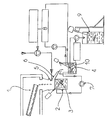
- the device shown in Fig 1 comprises a heating device 1 enabling the vanadium pentoxide (V2O5) to be melted.
- this heating device 1 consists of a furnace incorporating a quartz tube.
- the heating is produced by means of an induction furnace or by using laser radiation.
- the V2O5 is raised to a temperature at least 100°C higher than its melting point under conditions such that the molten mass comes into contact with the contents of the quenching reactor (which will be described in more detail later) at a temperature at least approximately 50°C higher than the melting point of V2O5.
- temperatures 100°C to 400°C higher than the melting point of V2O5 are used and, preferably again, 200°C to 400°C higher than the melting point of V2O5.
- the V2O5 is raised to a temperature of approximately 1050°C.
- the V2O5 is, according to one particular embodiment, mixed with an additional oxide or a chemical compound able, through thermal decomposition, to give an oxide.
- the additional compounds are preferably oxides chosen from amongst the oxides of alkaline metals, transition metals and rare earth metals.
- the compounds of alkaline metals, transition metals or rare earths used in association with the vanadium pentoxide are oxides, oxalates or carbonates.
- lithium is used as alkaline metals, chromium, manganese, copper, zinc, niobium and silver as transition metals and neodymium, samarium, gadolinium, ytterbium and europium as rare earth metals.
- the compounds cited above represent less than 20% of the mixture obtained and preferably less than 10% of the mixture.
- the V2O5 thus melted, and optionally mixed with auxiliary compounds, is poured continuously into a quenching reactor 2 initially containing distilled water at ambient temperature. Subsequently, by suitable means, arrangements are made to maintain the said quenching reactor at a temperature varying between 20°C and 40°C.
- the molten mixture is poured into the quenching reactor 2 from a height (with respect to the surface of the contents of the quenching reactor) varying between 15 cm and 2 m. According to one preferred embodiment, the molten mixture is poured into the quenching reactor 2 from a height of 80 cm. The contact of the molten mixture, under such temperature conditions, with the distilled water in the quenching reactor leads to the formation of a gel.
- the contents of the reactor are maintained under strong agitation by means, for example, of a radial-action agitator 3 producing a high amount of shearing enabling the crystals to be broken rapidly.
- the agitation speed is preferably between 2000 and 8000 rev/min and, preferably again, of the order of 6000 rev/min.
- the walls of the reactor can be made from polished stainless steel.
- distilled water is added, the quantity of which is adjusted according to the desired concentration of V2O5.
- the water is atomised by means of a circular head 5 positioned above the quenching reactor.
- a constant level of gel is maintained inside the quenching reactor by causing the V2O5 gel to flow by overflowing into an ageing reactor 4 placed below the said quenching reactor 2, the gel flowing through a channel 6 which, advantageously, is made from PTFE.
- the large particles which form when the molten V2O5 comes into contact with the contents of the quenching reactor fall to the bottom of the quenching reactor 2 and remain there for a sufficient length of time (of the order of 5 to 10 min) to form a gel under the effect of the strong agitation, whilst the gel remains at the surface of the said quenching reactor.
- the ageing reactor 4 which by way of example can be made from glass, is also maintained under strong agitation.
- the rate of agitation varies between 750 and 1500 rev/min and, preferably, is of the order of 800 rev/min.
- the gel is caused to recirculate continuously from the ageing reactor into the quenching reactor according to a flow rate which allows a sufficient residence time for the gel in the ageing reactor.
- the volume of the ageing reactor is 6 litres
- the recirculation rate 7 is 1 litre/min
- the time of residence of the gel in the ageing reactor 4 is of the order of 5 min.
- the quantity of distilled water added continuously to the quenching reactor 2 is adjusted according to the desired concentration of V2O5.
- some of the contents of the ageing reactor 4 are continuously taken off and the density measured, the quantity of water added being dependent on the results supplied by the densitometer 8.
- the final V2O5 gel is extracted continuously from the ageing reactor 4, the level in the said reactor being measured, by way of example, by conductimetry.
- the final V2O5 gel extracted from the ageing reactor for example by pumping, is introduced into a storage drum 9 under agitation in order to allow ageing and homogenisation during the filling of the said storage drum.
- the materials making up the reactors, the extraction and recirculation pipes and the densitometer are chosen so as to avoid any deposit of V2O5 gel.
- these are glass or PTFE.
- Teflon R will be used.
- the yield permitted by the implementation of the method according to the present invention is 200 kg/8 h, that is to say more than twice the yield obtained by the traditional methods.
- the losses of molten V2O5 have been reduced from 30% to 5%.
- the ageing of the V2O5 gel is, for anti-static applications, a mandatory stage since the desired level of conductivity of the gel is obtained only 3 months after its preparation.
- this ageing period has been reduced by causing the gel to pass successively through two additional reactors (not shown) maintained at a temperature of 50-80°C and disposed between the ageing reactor 4 and the storage drum 9.
- the ageing period is reduced by 3 to 4 times.
Landscapes
- Chemical & Material Sciences (AREA)
- Organic Chemistry (AREA)
- Inorganic Chemistry (AREA)
- Dispersion Chemistry (AREA)
- Chemical Kinetics & Catalysis (AREA)
- Inorganic Compounds Of Heavy Metals (AREA)
- Colloid Chemistry (AREA)
Claims (24)
- Verfahren zur Herstellung eines Vanadiumpentoxidgels mit folgenden Schritten:a) das Vanadiumpentoxid wird bei einer Temperatur geschmolzen, die mindestens 100° C über seinem Schmelzpunkt liegt;b) das Vanadiumpentoxid wird kontinuierlich in einen destilliertes Wasser enthaltenden Abschreckreaktor (2) gegossen, so daß ein Gel erzeugt wird, wobei das Vanadiumpentoxid in den Reaktor unter Bedingungen eingebracht wird, die bewirken, daß die geschmolzene Masse in das destillierte Wasser bei einer Temperatur eintaucht, die mindestens 50° C über dem Schmelzpunkt des Vanadiumpentoxids liegt, und wobei entsprechend der gewünschten Vanadiumpentoxid-Konzentration destilliertes Wasser in den Abschreckreaktor (2) nachgefüllt wird;c) das in dem Abschreckreaktor erhaltene Gel fließt ab durch Überfließen in einen Alterungsreaktor (4), dessen Inhalt kontinuierlich in den Abschreckreaktor (2) zurückgeführt wird, wobei die Konzentration des in dem Alterungsraktor enthaltenen Gels laufend gemessen wird, um die in den Abschreckreaktor (2) nachzufüllende Menge an destilliertem Wasser kontinuierlich anzugleichen, und wobei der Inhalt der beiden Reaktoren laufend umgerührt wird; undd) der Inhalt des Alterungsreaktors (4) wird kontinuierlich in eine Speichertrommel abgelassen.
- Verfahren nach Anspruch 1, dadurch gekennzeichnet, daß das Vanadiumpentoxid mittels eines eine Quarzröhre aufweisenden Ofens (1) geschmolzen wird.
- Verfahren nach Anspruch 1 oder 2, dadurch gekennzeichnet, daß das Vanadiumpentoxid auf eine Temperatur in der Größenordnung von 1050° C erhitzt wird.
- Verfahren nach einem der Ansprüche 1 - 3, dadurch gekennzeichnet, daß der Abschreckreaktor (2) auf einer Temperatur zwischen 20 und 40° C gehalten wird.
- Verfahren nach einem der Ansprüche 1 - 4, dadurch gekennzeichnet, daß der Abschreckreaktor (2) mit einer Geschwindigkeit zwischen 2000 und 8000 U/min gerührt wird.
- Verfahren nach einem der Ansprüche 1 - 5, dadurch gekennzeichnet, daß der Alterungsreaktor (4) mit einer Geschwindigkeit zwischen 750 und 1500 U/min gerührt wird.
- Verfahren nach einem der Ansprüche 1 - 6, dadurch gekennzeichnet, daß die geschmolzene Masse aus einer Höhe zwischen 15 cm und 2 m in den Abschreckreaktor (2) gegossen wird.
- Verfahren nach einem der Ansprüche 1 - 7, dadurch gekennzeichnet, daß die geschmolzene Masse aus ca. 80 cm Höhe in den Abschreckreaktor gegossen wird.
- Verfahren nach einem der Ansprüche 1 - 8, dadurch gekennzeichnet, daß das Vanadiumpentoxid vor dem Schmelzen mit einem zusätzlichen Oxid gemischt wird.
- Verfahren nach Anspruch 9, dadurch gekennzeichnet, daß das zusätzliche Oxid unter den Oxiden der Alkalimetalle, Übergangsmetalle und Seltenen Erden ausgewählt wird.
- Verfahren nach Anspruch 10, dadurch gekennzeichnet, daß das zusätzliche Oxid ein Lithiumoxid ist.
- Verfahren nach Anspruch 10, dadurch gekennzeichnet, daß das Übergangsmetalloxid ein Chrom-, Mangan-, Kupfer-, Zink-, Niob- oder Silberoxid ist.
- Verfahren nach Anspruch 10, dadurch gekennzeichnet, daß das Oxid der Seltene Erden-Metalle ein Neodym-, Samarium-, Gadolin-, Ytterbium- oder Europiumoxid ist.
- Verfahren nach einem der Ansprüche 1 - 13, dadurch gekennzeichnet, daß das Vanadiumpentoxidgel vor dem Ablassen in die Speichertrommel nacheinander zwei weitere auf einer Temperatur zwischen 50 und 80° C gehaltene Reaktoren passiert.
- Vorrichtung für die kontinuierliche Herstellung eines Vanadiumpentoxidgels mita) Mitteln (1), mittels deren das Vanadiumpentoxid auf eine Temperatur erhitzt wird, die mindestens 100° C über seinem Schmelzpunkt liegt;b) einem auf Umgebungstemperatur gehaltenen Abschreckreaktor (2), der destilliertes Wasser enthält und in dem das geschmolzene Vanadiumpentoxid zur Bildung eines Gels gegossen wird, wobei das geschmolzene Vanadiumpentoxid in den Abschreckreaktor bei einer Temperatur eintaucht, die mindestens 50° C über dem Schmelzpunkt des Vanadiumpentoxids liegt;c) einem Alterungsreaktor (4), in den der Inhalt des Abschreckreaktors (2) durch Überfließen abfließt;d) Mittel (3) (10) zum Umrühren des Inhalts der beiden Reaktoren;e) Mitteln (7) zum kontinuierlichen Rückführen des Inhalts des Alterungsreaktors (4) in den Abschreckreaktor (2);f) Mitteln (8) zur kontinuierlichen Messung der Konzentration des Vanadiumpentoxidgels im Alterungsreaktor (4);g) Mitteln (5) zum Nachfüllen von destilliertem Wasser in den Abschreckungsreaktor entsprechend der gewünschten Vanadiumpentoxid-Konzentration; undh) Mitteln (9) zum laufenden Extrahieren des Vanadiumpentoxidgels aus dem Alterungsreaktor (4).
- Vorrichtung nach Anspruch 15, dadurch gekennzeichnet, daß die Mittel (1), mittels deren das Vanadiumpentoxid erhitzt wird, einen eine Quarzröhre einschließenden Ofen aufweisen.
- Vorrichtung nach Anspruch 15 oder 16, dadurch gekennzeichnet, daß das Vanadiumpentoxid auf eine Temperatur von etwa 1050° C erhitzt wird.
- Vorrichtung nach einem der Ansprüche 15 - 17, dadurch gekennzeichnet, daß der Abschreckreaktor (2) mit einer Geschwindigkeit zwischen 2000 und 8000 U/min gerührt wird.
- Vorrichtung nach einem der Ansprüche 15 - 18, dadurch gekennzeichnet, daß der Alterungsreaktor (4) mit einer Geschwindigkeit zwischen 750 und 1500 U/min gerührt wird.
- Vorrichtung nach einem der Ansprüche 15 - 19, dadurch gekennzeichnet, daß das geschmolzene Vanadiumpentoxid aus einer Höhe zwischen 15 cm und 2 m relativ zur Oberfläche des Inhalts in den Abschreckreaktor (2) gegossen wird.
- Vorrichtung nach Anspruch 20, dadurch gekennzeichnet, daß das geschmolzene Vanadiumpentoxid aus etwa 80 cm Höhe relativ zur Oberfläche des Inhalts in den Abschreckreaktor (2) gegossen wird.
- Vorrichtung nach einem der Ansprüche 15 - 21, dadurch gekennzeichnet, daß die Mittel (8) zum Messen der Gelkonzentration Mittel zum Messen der Geldichte aufweisen, wobei Mittel zur laufenden Entnahme eines Teils des Inhalts des Alterungsreaktors vorgesehen sind.
- Vorrichtung nach einem der Ansprüche 15 - 22, dadurch gekennzeichnet, daß das Vanadiumpentoxid vor dem Schmelzen mit einem zusätzlichen Oxid gemischt wird.
- Vorrichtung nach einem der Ansprüche 15 - 23, dadurch gekennzeichnet, daß sie zwei weitere Reaktoren aufweist, die in einer Kaskade zwischen Alterungsreaktor (4) und Speichertrommel (9) angeordnet sind und auf einer Temperatur zwischen 50 und 80° C gehalten werden.
Applications Claiming Priority (3)
| Application Number | Priority Date | Filing Date | Title |
|---|---|---|---|
| FR9112155 | 1991-09-27 | ||
| FR9112155A FR2681852B1 (fr) | 1991-09-27 | 1991-09-27 | Procede de preparation en continu de gels de pentoxyde de vanadium et appareil de mise en óoeuvre du procede. |
| PCT/EP1992/002159 WO1993006043A1 (en) | 1991-09-27 | 1992-09-18 | Method for the continuous preparation of vanadium pentoxide gels and apparatus for implementing the method |
Publications (2)
| Publication Number | Publication Date |
|---|---|
| EP0608263A1 EP0608263A1 (de) | 1994-08-03 |
| EP0608263B1 true EP0608263B1 (de) | 1995-08-23 |
Family
ID=9417535
Family Applications (1)
| Application Number | Title | Priority Date | Filing Date |
|---|---|---|---|
| EP92920113A Expired - Lifetime EP0608263B1 (de) | 1991-09-27 | 1992-09-18 | Verfahren zur kontinuierlichen herstellung von vanadium pentoxid gelen und vorrichtung zur durchführung dieses verfahrens |
Country Status (6)
| Country | Link |
|---|---|
| US (1) | US5549846A (de) |
| EP (1) | EP0608263B1 (de) |
| JP (1) | JPH07502246A (de) |
| DE (1) | DE69204296T2 (de) |
| FR (1) | FR2681852B1 (de) |
| WO (1) | WO1993006043A1 (de) |
Families Citing this family (6)
| Publication number | Priority date | Publication date | Assignee | Title |
|---|---|---|---|---|
| US5407603A (en) * | 1992-06-04 | 1995-04-18 | Minnesota Mining And Manufacturing Company | Vanadium oxide colloidal dispersons and antistatic coatings |
| US5954995A (en) * | 1996-03-22 | 1999-09-21 | Goble; George H. | Drop-in substitutes for 1,1,1,2-tetrafluoroethane (R-134a) refrigerant |
| US6214530B1 (en) | 1999-06-30 | 2001-04-10 | Tulalip Consultoria Comercial Sociedade Unidessoal S.A. | Base film with a conductive layer and a magnetic layer |
| RU2248407C1 (ru) * | 2003-07-02 | 2005-03-20 | Государственное Учреждение Институт металлургии Уральского отделения Российской Академии Наук (ГУ ИМЕТ УрО РАН) | Способ извлечения ванадия из растворов |
| RU2348716C1 (ru) * | 2007-05-22 | 2009-03-10 | Государственное Учреждение Институт металлургии Уральского отделения Российской Академии Наук (ГУ ИМЕТ УрО РАН) | Способ извлечения ванадия |
| CN114005983B (zh) * | 2021-10-14 | 2023-04-07 | 华中科技大学 | 一种无添加剂的五氧化二钒/碳电极浆料制备方法及产品 |
Family Cites Families (5)
| Publication number | Priority date | Publication date | Assignee | Title |
|---|---|---|---|---|
| GB1410188A (en) * | 1970-03-27 | 1975-10-15 | Wallace R A P | Method of and apparatus for removing concentrated solutions of ionisalbe compounds from aqueous solutions thereof |
| FR2318442A1 (fr) * | 1975-07-15 | 1977-02-11 | Kodak Pathe | Nouveau produit, notamment, photographique, a couche antistatique et procede pour sa preparation |
| FR2429252A2 (fr) * | 1978-06-23 | 1980-01-18 | Kodak Pathe | Nouveau produit, notamment photographique, a couche antistatique et procede pour sa preparation |
| JPH0623043B2 (ja) * | 1985-08-02 | 1994-03-30 | 新興化学工業株式会社 | 水性酸化バナジウムの製法 |
| JPS6245006A (ja) * | 1985-08-22 | 1987-02-27 | Sony Corp | 強磁性粉末 |
-
1991
- 1991-09-27 FR FR9112155A patent/FR2681852B1/fr not_active Expired - Fee Related
-
1992
- 1992-09-18 JP JP5505785A patent/JPH07502246A/ja active Pending
- 1992-09-18 DE DE69204296T patent/DE69204296T2/de not_active Expired - Fee Related
- 1992-09-18 US US08/162,039 patent/US5549846A/en not_active Expired - Fee Related
- 1992-09-18 WO PCT/EP1992/002159 patent/WO1993006043A1/en not_active Ceased
- 1992-09-18 EP EP92920113A patent/EP0608263B1/de not_active Expired - Lifetime
Also Published As
| Publication number | Publication date |
|---|---|
| FR2681852A1 (fr) | 1993-04-02 |
| WO1993006043A1 (en) | 1993-04-01 |
| DE69204296D1 (de) | 1995-09-28 |
| FR2681852B1 (fr) | 1993-12-17 |
| US5549846A (en) | 1996-08-27 |
| JPH07502246A (ja) | 1995-03-09 |
| EP0608263A1 (de) | 1994-08-03 |
| DE69204296T2 (de) | 1996-04-18 |
Similar Documents
| Publication | Publication Date | Title |
|---|---|---|
| DE69621348T2 (de) | Verfahren und vorrichtung zur herstellung von polykristallinem silizium und verfahren zur herstellung eines siliziumsubstrats für eine solarzelle | |
| US4590043A (en) | Apparatus for obtaining silicon from fluosilicic acid | |
| KR100625726B1 (ko) | 니오브 분말 및 니오브 및(또는) 탄탈 분말의 제조 방법 | |
| US4442082A (en) | Process for obtaining silicon from fluosilicic acid | |
| EP0173961B1 (de) | Verfahren zur Herstellung von Glas | |
| SU1087091A3 (ru) | Состав дл отверждени радиоактивных отходов и способ отверждени радиоактивных отходов | |
| Scott et al. | Phase equilibria in the NaNbO3 BaNb2O6 system | |
| JPH044965B2 (de) | ||
| EP0608263B1 (de) | Verfahren zur kontinuierlichen herstellung von vanadium pentoxid gelen und vorrichtung zur durchführung dieses verfahrens | |
| GavináWhittaker et al. | Microwave-assisted solid-state reactions involving metal powders | |
| US4584181A (en) | Process and apparatus for obtaining silicon from fluosilicic acid | |
| Cai et al. | Dissolution of TiO2 and TiN inclusions in CaO–SiO2–B2O3-based fluorine-free mold flux | |
| US3367394A (en) | Process for manufacturing homogeneous bodies of germanium-silicon | |
| US4207834A (en) | Process and devices for the elaboration of preforms for optical fibers | |
| US4597948A (en) | Apparatus for obtaining silicon from fluosilicic acid | |
| JPH09171096A (ja) | 放射性廃棄物の処理方法およびその処理装置 | |
| US4748014A (en) | Process and apparatus for obtaining silicon from fluosilicic acid | |
| DE2635373A1 (de) | Verfahren und vorrichtung zur kontinuierlichen zuechtung von einkristallen bestimmter form | |
| Kotkata et al. | Equilibrium diagram of Selenium—Tellurium system | |
| Mroczkowski et al. | Preparation of Rb2NaYF6: Ce3+ and Cs2NaYF6: Ce3+—prospect for tunable lasers in the blue-green wavelength | |
| SU823276A1 (ru) | Способ получени четырехфтористойСЕРы | |
| JPH03503158A (ja) | 炭化硼素結晶を製造するための方法および装置 | |
| JPS58156542A (ja) | 光学ガラスの溶融方法 | |
| Runnalls et al. | Polymorphic transformations in PuAl3 | |
| DE2252567C2 (de) | Verfahren zur Herstellung von Mangan aus Manganhalogeniden durch Reduktion mit schmelzflüssigem Aluminium |
Legal Events
| Date | Code | Title | Description |
|---|---|---|---|
| PUAI | Public reference made under article 153(3) epc to a published international application that has entered the european phase |
Free format text: ORIGINAL CODE: 0009012 |
|
| 17P | Request for examination filed |
Effective date: 19940329 |
|
| AK | Designated contracting states |
Kind code of ref document: A1 Designated state(s): BE CH DE FR GB IT LI NL |
|
| 17Q | First examination report despatched |
Effective date: 19941128 |
|
| RAP1 | Party data changed (applicant data changed or rights of an application transferred) |
Owner name: EASTMAN KODAK COMPANY Owner name: KODAK-PATHE |
|
| RBV | Designated contracting states (corrected) |
Designated state(s): DE FR GB |
|
| GRAA | (expected) grant |
Free format text: ORIGINAL CODE: 0009210 |
|
| AK | Designated contracting states |
Kind code of ref document: B1 Designated state(s): DE FR GB |
|
| REF | Corresponds to: |
Ref document number: 69204296 Country of ref document: DE Date of ref document: 19950928 |
|
| ET | Fr: translation filed | ||
| PLBE | No opposition filed within time limit |
Free format text: ORIGINAL CODE: 0009261 |
|
| STAA | Information on the status of an ep patent application or granted ep patent |
Free format text: STATUS: NO OPPOSITION FILED WITHIN TIME LIMIT |
|
| 26N | No opposition filed | ||
| REG | Reference to a national code |
Ref country code: FR Ref legal event code: TP |
|
| REG | Reference to a national code |
Ref country code: GB Ref legal event code: IF02 |
|
| PGFP | Annual fee paid to national office [announced via postgrant information from national office to epo] |
Ref country code: FR Payment date: 20030902 Year of fee payment: 12 |
|
| PGFP | Annual fee paid to national office [announced via postgrant information from national office to epo] |
Ref country code: DE Payment date: 20030930 Year of fee payment: 12 |
|
| PGFP | Annual fee paid to national office [announced via postgrant information from national office to epo] |
Ref country code: GB Payment date: 20040812 Year of fee payment: 13 |
|
| PG25 | Lapsed in a contracting state [announced via postgrant information from national office to epo] |
Ref country code: DE Free format text: LAPSE BECAUSE OF NON-PAYMENT OF DUE FEES Effective date: 20050401 |
|
| PG25 | Lapsed in a contracting state [announced via postgrant information from national office to epo] |
Ref country code: FR Free format text: LAPSE BECAUSE OF NON-PAYMENT OF DUE FEES Effective date: 20050531 |
|
| REG | Reference to a national code |
Ref country code: FR Ref legal event code: ST |
|
| PG25 | Lapsed in a contracting state [announced via postgrant information from national office to epo] |
Ref country code: GB Free format text: LAPSE BECAUSE OF NON-PAYMENT OF DUE FEES Effective date: 20050918 |
|
| GBPC | Gb: european patent ceased through non-payment of renewal fee |
Effective date: 20050918 |