EP0574209B1 - Methode zum Beschichten eines Substrats mit Phosphorpartikeln - Google Patents
Methode zum Beschichten eines Substrats mit Phosphorpartikeln Download PDFInfo
- Publication number
- EP0574209B1 EP0574209B1 EP93304393A EP93304393A EP0574209B1 EP 0574209 B1 EP0574209 B1 EP 0574209B1 EP 93304393 A EP93304393 A EP 93304393A EP 93304393 A EP93304393 A EP 93304393A EP 0574209 B1 EP0574209 B1 EP 0574209B1
- Authority
- EP
- European Patent Office
- Prior art keywords
- polymer
- phosphor
- coating
- substrate
- phosphor particles
- Prior art date
- Legal status (The legal status is an assumption and is not a legal conclusion. Google has not performed a legal analysis and makes no representation as to the accuracy of the status listed.)
- Expired - Lifetime
Links
- OAICVXFJPJFONN-UHFFFAOYSA-N Phosphorus Chemical compound [P] OAICVXFJPJFONN-UHFFFAOYSA-N 0.000 title claims description 153
- 238000000576 coating method Methods 0.000 title claims description 78
- 239000011248 coating agent Substances 0.000 title claims description 75
- 239000002245 particle Substances 0.000 title claims description 59
- 238000000034 method Methods 0.000 title claims description 46
- 239000000758 substrate Substances 0.000 title claims description 19
- 229920000642 polymer Polymers 0.000 claims description 137
- 239000011521 glass Substances 0.000 claims description 70
- 239000000203 mixture Substances 0.000 claims description 43
- 230000008569 process Effects 0.000 claims description 19
- 238000000151 deposition Methods 0.000 claims description 17
- 238000010438 heat treatment Methods 0.000 claims description 15
- 230000008021 deposition Effects 0.000 claims description 9
- 239000012159 carrier gas Substances 0.000 claims description 8
- 238000002844 melting Methods 0.000 claims description 7
- 230000008018 melting Effects 0.000 claims description 7
- 238000000354 decomposition reaction Methods 0.000 claims description 5
- 229920003171 Poly (ethylene oxide) Polymers 0.000 claims description 4
- 239000000654 additive Substances 0.000 claims description 4
- 238000011068 loading method Methods 0.000 claims description 3
- 229920001451 polypropylene glycol Polymers 0.000 claims description 3
- 229920002845 Poly(methacrylic acid) Polymers 0.000 claims description 2
- 229920002873 Polyethylenimine Polymers 0.000 claims description 2
- 229920002125 Sokalan® Polymers 0.000 claims description 2
- 229920002401 polyacrylamide Polymers 0.000 claims description 2
- 239000004584 polyacrylic acid Substances 0.000 claims description 2
- 229920002717 polyvinylpyridine Polymers 0.000 claims description 2
- 229920000036 polyvinylpyrrolidone Polymers 0.000 claims description 2
- 239000001267 polyvinylpyrrolidone Substances 0.000 claims description 2
- 235000013855 polyvinylpyrrolidone Nutrition 0.000 claims description 2
- 150000004760 silicates Chemical class 0.000 claims description 2
- 239000000523 sample Substances 0.000 description 27
- 239000000843 powder Substances 0.000 description 25
- 239000000243 solution Substances 0.000 description 22
- 238000009503 electrostatic coating Methods 0.000 description 17
- 239000000463 material Substances 0.000 description 16
- 238000012360 testing method Methods 0.000 description 15
- PNEYBMLMFCGWSK-UHFFFAOYSA-N aluminium oxide Inorganic materials [O-2].[O-2].[O-2].[Al+3].[Al+3] PNEYBMLMFCGWSK-UHFFFAOYSA-N 0.000 description 10
- 239000002537 cosmetic Substances 0.000 description 10
- 239000004094 surface-active agent Substances 0.000 description 10
- 238000001035 drying Methods 0.000 description 9
- XLYOFNOQVPJJNP-UHFFFAOYSA-N water Substances O XLYOFNOQVPJJNP-UHFFFAOYSA-N 0.000 description 8
- -1 Aliphatic amines Chemical class 0.000 description 5
- 239000012535 impurity Substances 0.000 description 5
- TWNQGVIAIRXVLR-UHFFFAOYSA-N oxo(oxoalumanyloxy)alumane Chemical compound O=[Al]O[Al]=O TWNQGVIAIRXVLR-UHFFFAOYSA-N 0.000 description 5
- 239000007787 solid Substances 0.000 description 5
- XKRFYHLGVUSROY-UHFFFAOYSA-N Argon Chemical compound [Ar] XKRFYHLGVUSROY-UHFFFAOYSA-N 0.000 description 4
- OKTJSMMVPCPJKN-UHFFFAOYSA-N Carbon Chemical compound [C] OKTJSMMVPCPJKN-UHFFFAOYSA-N 0.000 description 4
- 239000004809 Teflon Substances 0.000 description 4
- 229920006362 Teflon® Polymers 0.000 description 4
- QSHDDOUJBYECFT-UHFFFAOYSA-N mercury Chemical compound [Hg] QSHDDOUJBYECFT-UHFFFAOYSA-N 0.000 description 4
- 238000002203 pretreatment Methods 0.000 description 4
- 229910052761 rare earth metal Inorganic materials 0.000 description 4
- 150000002910 rare earth metals Chemical class 0.000 description 4
- 230000000007 visual effect Effects 0.000 description 4
- 229920003169 water-soluble polymer Polymers 0.000 description 4
- 235000008733 Citrus aurantifolia Nutrition 0.000 description 3
- VYPSYNLAJGMNEJ-UHFFFAOYSA-N Silicium dioxide Chemical compound O=[Si]=O VYPSYNLAJGMNEJ-UHFFFAOYSA-N 0.000 description 3
- 235000011941 Tilia x europaea Nutrition 0.000 description 3
- 238000004833 X-ray photoelectron spectroscopy Methods 0.000 description 3
- 239000002253 acid Substances 0.000 description 3
- 239000007789 gas Substances 0.000 description 3
- 239000004571 lime Substances 0.000 description 3
- 229910052753 mercury Inorganic materials 0.000 description 3
- IPCSVZSSVZVIGE-UHFFFAOYSA-N palmitic acid group Chemical group C(CCCCCCCCCCCCCCC)(=O)O IPCSVZSSVZVIGE-UHFFFAOYSA-N 0.000 description 3
- 229920006254 polymer film Polymers 0.000 description 3
- 239000000725 suspension Substances 0.000 description 3
- 230000004580 weight loss Effects 0.000 description 3
- 229910001369 Brass Inorganic materials 0.000 description 2
- XEEYBQQBJWHFJM-UHFFFAOYSA-N Iron Chemical compound [Fe] XEEYBQQBJWHFJM-UHFFFAOYSA-N 0.000 description 2
- NBIIXXVUZAFLBC-UHFFFAOYSA-N Phosphoric acid Chemical compound OP(O)(O)=O NBIIXXVUZAFLBC-UHFFFAOYSA-N 0.000 description 2
- 229920013632 Ryton Polymers 0.000 description 2
- 239000004736 Ryton® Substances 0.000 description 2
- 229910052771 Terbium Inorganic materials 0.000 description 2
- 150000007513 acids Chemical class 0.000 description 2
- 230000002411 adverse Effects 0.000 description 2
- 150000001412 amines Chemical class 0.000 description 2
- 229910052786 argon Inorganic materials 0.000 description 2
- 239000010951 brass Substances 0.000 description 2
- 230000008859 change Effects 0.000 description 2
- 235000014113 dietary fatty acids Nutrition 0.000 description 2
- 239000000194 fatty acid Substances 0.000 description 2
- 229930195729 fatty acid Natural products 0.000 description 2
- 150000004665 fatty acids Chemical class 0.000 description 2
- 239000012530 fluid Substances 0.000 description 2
- 238000007496 glass forming Methods 0.000 description 2
- 239000011261 inert gas Substances 0.000 description 2
- 238000004519 manufacturing process Methods 0.000 description 2
- 230000007246 mechanism Effects 0.000 description 2
- 239000003960 organic solvent Substances 0.000 description 2
- 239000004800 polyvinyl chloride Substances 0.000 description 2
- 229920000915 polyvinyl chloride Polymers 0.000 description 2
- 230000005855 radiation Effects 0.000 description 2
- 230000009467 reduction Effects 0.000 description 2
- 150000003839 salts Chemical class 0.000 description 2
- 238000002411 thermogravimetry Methods 0.000 description 2
- 229920001169 thermoplastic Polymers 0.000 description 2
- 238000001429 visible spectrum Methods 0.000 description 2
- 229920003176 water-insoluble polymer Polymers 0.000 description 2
- 238000009736 wetting Methods 0.000 description 2
- PQMFVUNERGGBPG-UHFFFAOYSA-N (6-bromopyridin-2-yl)hydrazine Chemical compound NNC1=CC=CC(Br)=N1 PQMFVUNERGGBPG-UHFFFAOYSA-N 0.000 description 1
- 229920000178 Acrylic resin Polymers 0.000 description 1
- 239000004925 Acrylic resin Substances 0.000 description 1
- IJGRMHOSHXDMSA-UHFFFAOYSA-N Atomic nitrogen Chemical compound N#N IJGRMHOSHXDMSA-UHFFFAOYSA-N 0.000 description 1
- 229910001018 Cast iron Inorganic materials 0.000 description 1
- 229910001060 Gray iron Inorganic materials 0.000 description 1
- 238000004566 IR spectroscopy Methods 0.000 description 1
- 229920001730 Moisture cure polyurethane Polymers 0.000 description 1
- 229910002651 NO3 Inorganic materials 0.000 description 1
- NHNBFGGVMKEFGY-UHFFFAOYSA-N Nitrate Chemical compound [O-][N+]([O-])=O NHNBFGGVMKEFGY-UHFFFAOYSA-N 0.000 description 1
- 235000021314 Palmitic acid Nutrition 0.000 description 1
- 239000004698 Polyethylene Substances 0.000 description 1
- 239000004793 Polystyrene Substances 0.000 description 1
- 238000010521 absorption reaction Methods 0.000 description 1
- 238000003916 acid precipitation Methods 0.000 description 1
- 230000000996 additive effect Effects 0.000 description 1
- 229910000147 aluminium phosphate Inorganic materials 0.000 description 1
- 238000004458 analytical method Methods 0.000 description 1
- 150000008064 anhydrides Chemical class 0.000 description 1
- 238000013459 approach Methods 0.000 description 1
- 239000007864 aqueous solution Substances 0.000 description 1
- 239000003125 aqueous solvent Substances 0.000 description 1
- QVGXLLKOCUKJST-UHFFFAOYSA-N atomic oxygen Chemical compound [O] QVGXLLKOCUKJST-UHFFFAOYSA-N 0.000 description 1
- 230000008901 benefit Effects 0.000 description 1
- 239000011230 binding agent Substances 0.000 description 1
- 230000015572 biosynthetic process Effects 0.000 description 1
- 238000007664 blowing Methods 0.000 description 1
- 239000004327 boric acid Substances 0.000 description 1
- 230000001680 brushing effect Effects 0.000 description 1
- 229910052791 calcium Inorganic materials 0.000 description 1
- 239000011575 calcium Substances 0.000 description 1
- JUNWLZAGQLJVLR-UHFFFAOYSA-J calcium diphosphate Chemical compound [Ca+2].[Ca+2].[O-]P([O-])(=O)OP([O-])([O-])=O JUNWLZAGQLJVLR-UHFFFAOYSA-J 0.000 description 1
- 229940043256 calcium pyrophosphate Drugs 0.000 description 1
- 239000003575 carbonaceous material Substances 0.000 description 1
- 230000015556 catabolic process Effects 0.000 description 1
- 239000010960 cold rolled steel Substances 0.000 description 1
- 238000010276 construction Methods 0.000 description 1
- 239000000356 contaminant Substances 0.000 description 1
- 238000006731 degradation reaction Methods 0.000 description 1
- 230000002939 deleterious effect Effects 0.000 description 1
- 238000010586 diagram Methods 0.000 description 1
- MNNHAPBLZZVQHP-UHFFFAOYSA-N diammonium hydrogen phosphate Chemical compound [NH4+].[NH4+].OP([O-])([O-])=O MNNHAPBLZZVQHP-UHFFFAOYSA-N 0.000 description 1
- 229910000388 diammonium phosphate Inorganic materials 0.000 description 1
- 235000019838 diammonium phosphate Nutrition 0.000 description 1
- 235000019821 dicalcium diphosphate Nutrition 0.000 description 1
- 229910001873 dinitrogen Inorganic materials 0.000 description 1
- 239000006185 dispersion Substances 0.000 description 1
- 230000009977 dual effect Effects 0.000 description 1
- 230000000694 effects Effects 0.000 description 1
- 230000005611 electricity Effects 0.000 description 1
- 238000007610 electrostatic coating method Methods 0.000 description 1
- 238000004924 electrostatic deposition Methods 0.000 description 1
- 230000008030 elimination Effects 0.000 description 1
- 238000003379 elimination reaction Methods 0.000 description 1
- 238000005516 engineering process Methods 0.000 description 1
- 238000011156 evaluation Methods 0.000 description 1
- 238000002474 experimental method Methods 0.000 description 1
- 239000012065 filter cake Substances 0.000 description 1
- 239000000706 filtrate Substances 0.000 description 1
- 239000010419 fine particle Substances 0.000 description 1
- 238000007667 floating Methods 0.000 description 1
- 238000005189 flocculation Methods 0.000 description 1
- 230000016615 flocculation Effects 0.000 description 1
- 239000005431 greenhouse gas Substances 0.000 description 1
- 229920001477 hydrophilic polymer Polymers 0.000 description 1
- 230000002209 hydrophobic effect Effects 0.000 description 1
- 238000005286 illumination Methods 0.000 description 1
- 150000002500 ions Chemical class 0.000 description 1
- 229910052742 iron Inorganic materials 0.000 description 1
- YWXYYJSYQOXTPL-SLPGGIOYSA-N isosorbide mononitrate Chemical compound [O-][N+](=O)O[C@@H]1CO[C@@H]2[C@@H](O)CO[C@@H]21 YWXYYJSYQOXTPL-SLPGGIOYSA-N 0.000 description 1
- 229910052743 krypton Inorganic materials 0.000 description 1
- DNNSSWSSYDEUBZ-UHFFFAOYSA-N krypton atom Chemical compound [Kr] DNNSSWSSYDEUBZ-UHFFFAOYSA-N 0.000 description 1
- 230000007774 longterm Effects 0.000 description 1
- 238000012423 maintenance Methods 0.000 description 1
- 238000002156 mixing Methods 0.000 description 1
- WQEPLUUGTLDZJY-UHFFFAOYSA-N n-Pentadecanoic acid Natural products CCCCCCCCCCCCCCC(O)=O WQEPLUUGTLDZJY-UHFFFAOYSA-N 0.000 description 1
- 125000004108 n-butyl group Chemical group [H]C([H])([H])C([H])([H])C([H])([H])C([H])([H])* 0.000 description 1
- 239000002736 nonionic surfactant Substances 0.000 description 1
- 229920001778 nylon Polymers 0.000 description 1
- ZQPPMHVWECSIRJ-KTKRTIGZSA-N oleic acid group Chemical group C(CCCCCCC\C=C/CCCCCCCC)(=O)O ZQPPMHVWECSIRJ-KTKRTIGZSA-N 0.000 description 1
- 150000002894 organic compounds Chemical class 0.000 description 1
- 239000001301 oxygen Substances 0.000 description 1
- 229910052760 oxygen Inorganic materials 0.000 description 1
- 229920000573 polyethylene Polymers 0.000 description 1
- 229920005862 polyol Polymers 0.000 description 1
- 150000003077 polyols Chemical class 0.000 description 1
- 229920000069 polyphenylene sulfide Polymers 0.000 description 1
- 229920002223 polystyrene Polymers 0.000 description 1
- 239000002243 precursor Substances 0.000 description 1
- 239000000047 product Substances 0.000 description 1
- 230000000750 progressive effect Effects 0.000 description 1
- 239000011253 protective coating Substances 0.000 description 1
- 230000009257 reactivity Effects 0.000 description 1
- 229920005989 resin Polymers 0.000 description 1
- 239000011347 resin Substances 0.000 description 1
- 229920006395 saturated elastomer Polymers 0.000 description 1
- 238000007790 scraping Methods 0.000 description 1
- 239000000377 silicon dioxide Substances 0.000 description 1
- 239000002002 slurry Substances 0.000 description 1
- 239000000779 smoke Substances 0.000 description 1
- 238000001228 spectrum Methods 0.000 description 1
- 239000007858 starting material Substances 0.000 description 1
- 238000004381 surface treatment Methods 0.000 description 1
- 238000010998 test method Methods 0.000 description 1
- 238000012546 transfer Methods 0.000 description 1
- WFKWXMTUELFFGS-UHFFFAOYSA-N tungsten Chemical compound [W] WFKWXMTUELFFGS-UHFFFAOYSA-N 0.000 description 1
- 229910052721 tungsten Inorganic materials 0.000 description 1
- 239000010937 tungsten Substances 0.000 description 1
- 229910052845 zircon Inorganic materials 0.000 description 1
Images
Classifications
-
- C—CHEMISTRY; METALLURGY
- C09—DYES; PAINTS; POLISHES; NATURAL RESINS; ADHESIVES; COMPOSITIONS NOT OTHERWISE PROVIDED FOR; APPLICATIONS OF MATERIALS NOT OTHERWISE PROVIDED FOR
- C09K—MATERIALS FOR MISCELLANEOUS APPLICATIONS, NOT PROVIDED FOR ELSEWHERE
- C09K11/00—Luminescent, e.g. electroluminescent, chemiluminescent materials
- C09K11/02—Use of particular materials as binders, particle coatings or suspension media therefor
-
- H—ELECTRICITY
- H01—ELECTRIC ELEMENTS
- H01J—ELECTRIC DISCHARGE TUBES OR DISCHARGE LAMPS
- H01J61/00—Gas-discharge or vapour-discharge lamps
- H01J61/02—Details
- H01J61/38—Devices for influencing the colour or wavelength of the light
- H01J61/42—Devices for influencing the colour or wavelength of the light by transforming the wavelength of the light by luminescence
- H01J61/46—Devices characterised by the binder or other non-luminescent constituent of the luminescent material, e.g. for obtaining desired pouring or drying properties
-
- H—ELECTRICITY
- H01—ELECTRIC ELEMENTS
- H01J—ELECTRIC DISCHARGE TUBES OR DISCHARGE LAMPS
- H01J9/00—Apparatus or processes specially adapted for the manufacture, installation, removal, maintenance of electric discharge tubes, discharge lamps, or parts thereof; Recovery of material from discharge tubes or lamps
- H01J9/20—Manufacture of screens on or from which an image or pattern is formed, picked up, converted or stored; Applying coatings to the vessel
- H01J9/22—Applying luminescent coatings
- H01J9/221—Applying luminescent coatings in continuous layers
-
- H—ELECTRICITY
- H01—ELECTRIC ELEMENTS
- H01J—ELECTRIC DISCHARGE TUBES OR DISCHARGE LAMPS
- H01J9/00—Apparatus or processes specially adapted for the manufacture, installation, removal, maintenance of electric discharge tubes, discharge lamps, or parts thereof; Recovery of material from discharge tubes or lamps
- H01J9/20—Manufacture of screens on or from which an image or pattern is formed, picked up, converted or stored; Applying coatings to the vessel
- H01J9/22—Applying luminescent coatings
- H01J9/221—Applying luminescent coatings in continuous layers
- H01J9/225—Applying luminescent coatings in continuous layers by electrostatic or electrophoretic processes
Definitions
- This invention relates to a method for coating a substrate with phosphor particles.
- the invention is particularly concerned with a method for coating a fluorescent lamp glass with phosphor particles.
- an electrostatic coating process lies in the elimination of the need for a dedicated brushing machine after bakeout, since electrostatically coated lamps can be brushed easily before bakeout by a unit mounted in the coating station. This yields savings in maintenance since there is one less machine, the brusher, to maintain. Finally, an electrostatic coating unit needs a smaller footprint than a comparable water based coating system.
- US-A-5,032,420 discusses a method of manufacturing Cd free yellow incandescent bug lights. The emphasis is on the powder which is used for the coating process: ZrSiO 4 /Pr mixed with 10% amorphous silica.
- US-A-4,914,723 discloses a standard fluorescent lamp discharge tube with an electrostatically coated envelope. The phosphor is pretreated prior to the electrostatic coating step, by coating the powder with a fatty acid (like palmitic, oleic etc.) or a NH 4 , Al or alkaline earth salt and finely divided alumina. The relative composition of the mix is 100 parts by weight phosphor, 0.01 to 3 parts by weight fatty acid and 0.05 to 5 parts by weight fine particle size alumina.
- US-A-4,689,172 teaches a process for the surface treatment of phosphors prior to electrostatic coating of the material on low pressure mercury vapor discharge lamps.
- the treated material can preferably be used for coating the envelope of compact fluorescent lamps as well as standard size fluorescent lamps.
- the luminescent materials are treated with acids the anhydrides of which are susceptible to the formation of low melting point glasses.
- Aliphatic amines are subsequently adsorbed onto the acid treated particle surfaces. It is stated that the double acid-alkylamine layer makes the particles hydrophobic and more easily sprayable and dischargeable.
- the amine is removed without leaving any C contaminants.
- the glass forming oxide liberated during heat treatment adheres the particles together and to the glass. Examples of glass forming acids are boric and phosphoric acid while examples of amines are n-butyl and n-octyl.
- US-A-4,610, 217 relates to an apparatus for the electrostatic coating of the insides of different kinds of bulbous lamp envelopes. Means of producing a homogeneous smoke of the powder are discussed. No special pretreatment of the phosphor is discussed.
- US-A-4,597,984 presents a method and apparatus for coating fluorescent lamp tubes. In particular, this work focuses on the U lamp and the twin tube configuration lamp (GE Mod-U-Line). This document teaches the use of dual electrodes: one is stationed outside the U tube and a pair are located inside the two legs. The electrodes move in sequence, the movement being controlled by a motor mechanism. The glass tube is maintained between 150°C and 500°C to render it conductive.
- the phosphor coating is humidified by blowing saturated air over the layers resulting in a decrease in voidage and a more compact coating. Humidification is followed by a low temperature bakeout, 475 to 600°C, which removes any moisture from the coating and bonds the phosphor particles to the glass and to themselves.
- a low temperature bakeout 475 to 600°C, which removes any moisture from the coating and bonds the phosphor particles to the glass and to themselves.
- a lower lehring temperature may be employed following the electrostatic deposition according to the present invention than is employed in prior art slurry deposition, because no organic binder containing carbon materials is used to initially bond the phosphor coating to the glass".
- US-A-4,081,714 teaches pretreatment of phosphors for electrostatic coating of standard size fluorescent lamps.
- 100 parts by weight phosphor are mixed with 0.01 to 1 part by weight stearic, palmitic acid or salts thereof, 0.1 to 3 parts by weight Ca or Sr nitrate for good adhesion and 0.05 to 5 parts by weight fine alumina for flowability.
- JP 7639509 and JP 7638357 discuss electrostatic coating of standard fluorescent lamps wherein phosphor powder is mixed with 0.1 to 8 weight % calcium pyrophosphate or low melting point glass frit and charged at 18-22 kV.
- DD 156,497 teaches the coating of phosphor powders onto lamp envelope walls by mixing phosphor with diammonium hydrogen phosphate, coating the mixture electrostatically and heating.
- a method for forming a coating of phosphor particles on a substrate comprising the steps of depositing a polymer on the phosphor particles, the polymer being transformable from a non-adhering state to an adhering state, entraining the phosphor particles thus obtained in a carrier gas whilst the polymer is in a non-adhering state, to carry the phosphor particles to the substrate, depositing the phosphor particles on the substrate whilst the polymer is in an adhering state, so as to retain the phosphor particles as a coating on the substrate, and heating the coating to a temperature above a decomposition temperature of the polymer, so as to remove the polymer.
- the phosphor particles are deposited on the fluorescent glass by applying a sufficient electric charge to the phosphor particles comprising polymer for attracting the particles to the fluorescent lamp glass.
- the polymer on the phosphor particles is a type which becomes tacky when heated, and according to the preferred method, phosphor particles are entrained in the carrier gas in a non-tacky state and deposited on the fluorescent lamp glass by heating to the tacky state to retain the phosphor particles on the fluorescent glass and form a coated fluorescent glass. Subsequently, the fluorescent glass is heated to a temperature above the decomposition temperature of the polymer for removing the polymer and form a coating of phosphor particles devoid of polymer on a fluorescent lamp glass.
- the preferred polymers are polymers which become tacky when heated to a polymer softening temperature and are non-tacky below a polymer softening temperature.
- the pretreatment of the phosphor particles comprises depositing a polymer on the surface of the phosphor and, optionally, the interior surface of the glass.
- the deposition of polymer on the phosphor particles enhances the electrostatic coating process by improving the flowability of the phosphor, increasing the adhesion of the coating, raising the upper bound of the coating weight and improving the cosmetics of the coated lamp.
- the phosphor and, optionally, the glass are pretreated prior to electrostatically coating the phosphor on the glass.
- the process includes one or more of the following steps: (a) depositing polymer on the phosphor and, optionally, the inner surface of the glass; (b) transporting the polymer treated phosphor in a carrier gas stream to an electrostatic probe; (c) charging the polymer treated phosphor as it travels through the corona developed at the probe which is maintained at a negative potential; (d) maintaining the glass substrate at an appropriate first temperature, such as by using an electrically heated jacket, while the phosphor particles coat the inner surface; preferably the jacket is preheated for this step but is electrically isolated during the period the glass is being electrostatically coated (f) exposing the phosphor coating on the glass to steam to dissipate residual charge from the coated glass; and (g) heating the coated glass to remove the polymer and any water vapor.
- said phosphor particles comprise a phosphor blend composed of rare earth activated phosphors.
- the rare earth phosphors emit in the red, green and blue regions of the visible spectrum.
- the rare earth phorphors emit in the red and green regions of the visible spectrum.
- the red phosphor is at least 60% of the phosphor blend by mass.
- the red phosphor is Y 2 O 3 :Eu.
- the specific surface area of the Y 2 O 3 :Eu phosphor is 0.65 m 2 /g or larger.
- the specific surface area of the green phosphor is 0.3 m 2 /g or larger.
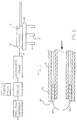
- FIdURE 1 is a schematic diagram of the coating apparatus utilized in the process according to preferred embodiments of the present invention.
- FIGURE 2 is a cross sectional view of a portion of an electrostatic coating probe.
- Phosphor particles are pretreated by depositing a polymer on the surface of the phosphor and, optionally, the interior surface of the glass.
- the deposition of polymer to the phosphor particles enhances the electrostatic coating process by improving the flowability of the phosphor, increasing the adhesion of the coating, raising the upper bound of the coating weight and improving the cosmetics of the coated lamp.
- the polymer is a type having a decomposition temperature and which is transformable from a nonadhering state to an adhering state.
- Inorganic additives are often present in polymers. In the present case, such additives should not adversely affect lamp performance. For example, it is known that silica reacts adversely with mercury in low pressure discharge lamps. Preferably, the concentration of silicates in the coating of the finished lamp should not exceed 500 parts per million.
- the preferred polymers are polymers which become tacky when heated to a polymer softening temperature and are in a non-tacky state below a polymer softening temperature. Preferred polymers are soluble in an aqueous or organic solvent. A coating of the polymer may be applied to the particles by contacting a mixture of the fluid containing the polymer with the particles.
- Typical polymers are thermoplastic polymers which soften when exposed to heat and return to their original condition when cooled.
- Typical synthetic thermoplastic polymers include polyvinyl chloride, nylons, fluorocarbons, linear polyethylene, polyurethane prepolymer, polystyrene, and cellulosic and acrylic resins.
- the preferred polymer has a melting point in the range of 60-110°C so that a low coating temperature is maintained during the deposition of the phosphor.
- the polymer decomposes and burns out in air by about 475°C. This is an upper bound of temperature. A higher temperature may lead to deformation of the lime glass during bakeout.
- Hydrophilicity or hydrophobicity of the polymer determine the process by which the polymer is deposited on the phosphor particle surface and, optionally, the glass surface.
- Water insoluble polymers require an organic solvent.
- a typical water insoluble polymer is poly vinyl chloride.
- a water soluble polymer is preferable to develop an environmentally attractive aqueous process rather than an organic process.
- Typical water soluble polymers include polyacrylic acid, polymethacrylic acid, polyacrylamide, polymethacrylamide, poly-N-alkylacrylamide, polyvinylpyrrolidone, polyvinylpyridine and derivatives, polyethylene imine, poly-(ethylene oxide), and low molecular weight polypropylene oxide.
- a preferred polymer is a poly-(ethylene oxide) polymer having a low melting point of about 62-67°C.
- An example of this polymer is Polyox manufactured by Union Carbide. The average molecular weight of the grade of Polyox used in this study is about 400,000. A lower MW Polyox, up to a lower limit of MW of about 100,000, could also be used. Thermogravimetric analysis of Polyox indicates burn-out in air by about 425-450°C.
- the phosphor particles comprising polymer are entrained in a carrier gas wherein the polymer is in a non-adhering state.
- the phosphor particles are entrained in the carrier gas in a non-tacky state and transported in the carrier gas stream to an electrostatic probe.
- the polymer treated phosphor is charged as it travels through the corona developed at the probe.
- the probe is preferably maintained at a negative potential to impart a sufficient negative charge to the particles to attract the particles to the lamp glass.
- the phosphor particles comprising polymer are deposited on the fluorescent lamp glass.
- the polymer is in an adhering state for retaining the phosphor particles on the fluorescent glass to form a coated fluorescent glass.
- the glass is maintained at an appropriate first temperature, such as by using an electrically heated jacket, while the phosphor particles coat the inner surface.
- the jacket is preheated to assure that the initial deposition of phosphor particles is at the correct temperature.
- the jacket preferably remains electrically isolated to reduce the magnitude of the charge flow or current to ground. If the probe current exceeds a certain value, the electrical safety circuit of the probe becomes energized and drops the probe voltage to compensate for the large current. A reduction in the probe voltage is not desirable because it reduces the charge transferred from the probe corona to the phosphor particles comprising polymer. Reduction in the charging of the particles affects the quality of the coating. Any charge build up on the coating, after the phosphor particles comprising polymer are deposited on the glass, is dissipated by grounding through a conductive path. This helps reduce the porosity of the coating by eliminating charge induced repulsion among the particles. Exposing the phosphor coating on the glass to a conductive fluid such as steam to dissipate electrostatic charges is preferred.
- the coated fluorescent glass is heated to a temperature above the decomposition temperature of the polymer for removing the polymer to form a coating of the phosphor particles on the fluorescent lamp glass which is devoid of organic compounds.
- the heating also desirably removes any water vapor which can be deleterious to the operation of a completed fluorescent lamp.
- a fluorescent lamp comprises a tubular, hermetically sealed, glass envelope. Electrodes are sealed in the ends of envelope. Suitable terminals are connected to the respective electrodes and project from the envelope. The electrodes extend through glass presses in mount stems to the terminals.
- the interior of the tube is filled with an inert gas such as argon or a mixture of argon and krypton at a low pressure, for example 270 Pa (2 torr), and a small quantity of mercury, at least enough to provide a low vapor pressure during operation.
- An arc generating and sustaining medium such as one or more inert gases and mercury is included within the envelope so that ultraviolet radiation is produced in the interior of the glass envelope during lamp operation.
- a phosphor coating on the interior surface of the glass envelope converts the emitted ultraviolet radiation to visible illumination having a white color.
- phosphor blend refers to a two component blend of rare earth activated phosphors containing 70% by mass of red phosphor, Y 2 O 3 : Eu, the balance being a green phosphor, (Ce,Tb) Mg Al 11 O 19 : Ce,Tb.
- the specific surface areas of these two phosphors are about 0.65 and 0.3 m 2 /g respectively.
- a tricomponent blend with red, green and blue phdsphors could also be used.
- the glass being electrostatically coated is a commercial GTE twin tube (TT) U shaped lime glass used for the production of energy efficient compact fluorescent lamps.
- Pretreatment methods (a) and (b) are self-explanatory.
- the polymer chosen for the subsequent tests was Polyox (Polyox is a registered Trademark) which is poly-(ethylene oxide): a low melting point (62-67°C), hydrophilic and water soluble polymer manufactured by Union Carbide .
- the average molecular weight of the grade of Polyox used in this study is about 400,000.
- any other polymer i.e. non Polyox
- the polymer Polyox is hydrophilic and water soluble, alternate polymers need not necessarily have these properties.
- Hydrophilicity or hydrophobicity govern only the process by which the polymer is deposited on the phosphor blend surface and, optionally, the glass surface.
- a water soluble polymer is preferable in that it is possible to develop an environmentally attractive aqueous process rather than an organic process to deposit the polymer on the phosphor.
- the polymer selected burns out in air by about 475°C. This is an upper bound of temperature. A higher temperature will lead to deformation of the lime glass during bakeout.
- Thermogravimetric analysis of Polyox indicates burn-out in air by about 425-450°C.
- a very fine size Polyox is used as an additive to the phosphor blend.
- the fine polymer is made by classifying commercial size Polyox.
- the specific surface areas of the two materials give a good indication of their relative particle sizes.
- the BET Monosorb areas for the classified and standard polymers are 2.99 m 2 /g and 1.68 m 2 /g respectively, clearly proving the smaller particle size of the classified polymer.
- the standard Polyox polymer MW of 400,000, was dissolved in water to make an aqueous solution which contained 2.5% by mass of polymer. This is referred to in the specification as a 2.5% Polyox solution.
- Twenty TT glasses were tared, filled with the 2.5% Polyox solution, inverted and allowed to dry in a convection oven at 110°C for 4 hours and then weighed again.
- the mean coating weight of the polymer on the glass was 2.46 mg.
- the mean coating weight of the polymer was 19.9 mg.
- the range of polymer loading can be obtained by taking the ratio of the mass of polymer to the internal surface area of the glass which is about 100 cm 2 .
- the polymer loading is found to be 0.02 to 0.2mg/cm 2 of glass surface.
- the highly nonlinear nature of the mass of the polymer coating is attributed to the nonlinear dependence of solution viscosity on the concentration of the polymer which influences the relative values of the polymer solution drain time and the film setting up time due to drying.
- the drying time of 4 hours is sufficient, as shown by an additional drying period of 4 hours at 110°C for the 5% Polyox system which did not reveal any change in the weight of the polymer coated tubes.
- Reflectance IR spectroscopy was used to verify the presence of polymer on the inner surface of the twin tube glass. Absorption in the 3000 cm -1 region of the spectrum indicates the presence of the polymer.
- each of the powder samples was subjected to two studies: flowability and weight loss at an elevated temperature.
- flowability tests the loosely packed bulk density (LPBD) and the tapped density (TD) were measured using a Hosokawa Powder Tester.
- HR Hausner Ratio
- the HR which always exceeds unity, is the ratio of the TD to the LPBD and is a measure of the cohesiveness, hence the flowability, of a powder. The higher is the HR, the more cohesive or less free flowing is the powder.
- each solids sample was heat treated for 1 hour at 550°C and the change in mass measured with respect to the dried solids.
- Drying of the polymer coating at 140°C removes substantially all of the moisture from the polymer film and the loosely bound moisture from the as received phosphor, but retains the strongly bound moisture and other thermally degradable impurities associated with the as received phosphor.
- the loss in mass on heating at 550°C reflects, therefore, the mass of polymer deposited on the phosphor + the mass of strongly bound moisture + the mass of the thermally degradable impurities present in the as received phosphor.
- the loss in mass experienced by the as received phosphor reflects the loosely and strongly bound moisture as well as the other impurities present in that material.
- the loss in mass of the dried phosphor is attributed to the strongly bound moisture and the thermally degradable impurities.
- M p /M a the mass of polymer deposited per unit mass of the as received phosphor.
- Table 2 shows the results of XPS (X-ray photoelectron spectroscopy) conducted on the surface of the untreated and polymer treated phosphor.
- the source of the Y peak is the red phosphor which is the major component of the blend.
- the result of the polymer treatment should be to increase the amount of surface C relative to Y. This is clearly borne out in Table 2.
- the phosphor blend which was polymer treated in the presence of the surfactant differs from that which was prepared without surfactant.
- SEM study shows that the material made with the surfactant appears to be more agglomerated than the one without.
- the SEM sample handling procedure indicates that the surfactant prepared material tends to charge more than the other.
- XPS shows that use of the surfactant leads to a much higher C/Y ratio in the final dried product as compared to that without: 0.42 versus 0.22. This large increase cannot be accounted for by the very small increase in organics content of the system due to the addition of the surfactant. It indicates better wetting, in the presence of the surfactant, of the phosphor blend surface by the polymer solution.
- the powders treated according to methods (a) through (g) outlined previously were electrostatically coated onto the surface of TT glass of ID 9.8 ⁇ 0.3mm (0.386" ⁇ 0.011") using a coating apparatus shown in Figure 1.
- the twin tube glass was held in a block during the coating process.
- Gray cast iron was used as the material of construction of the block 13 the top cover of which was guided on to the lower piece by two pins.
- Each section 13 of the block 13 was capable of being heated by four 135 W resistive elements.
- the horizontal motion of the block 13, on rails made of cold rolled steel was controlled by a stepper motor. The area of contact between the lower portion of the block 13 and the rails or slide 15 was minimized to reduce the rate of heat transfer to the latter.
- the slide 15 was supported three vertically oriented cylindrical pieces 17 of Ryton IPC-171E: a poly(phenylene sulfide) resin impregnated with glass.
- the choice of Ryton was made on the basis of its coefficient of thermal expansion, dielectric strength, resistivity and high temperature durability.
- the coating station was enclosed, for safety reasons, by a Faraday cage which minimized the concentration of free ions outside of this environment.
- a quantity of the pretreated phosphor blend was introduced into the hopper of a powder feeder which delivered the material to the suction zone of a venturi supplied with dry motive air.
- the teflon tube enters an electrostatic probe 19 shown in Figure 2.
- a wire 25 which delivers a maximum of 100 kV to a brass insert 27 snug fit at the end of the probe 19, between the teflon and alumina 21 tubes.
- Attached symetrically to the outer end of the brass insert 27 are four curved tungsten wires 29 ending in needle points. It is at these points that a corona develops. As the phosphor blend in the carrier gas stream emerges from the probe, the particles get charged during their passage through the corona.
- the electrostatically coated twin tubes were evaluated with respect to three criteria: powder weight, blow test loss and visual appearance.
- a concern with electrostatic coating is that back ionization may limit the mass of coating that may be deposited electrostatically. The concern stems from the fact that if the powder weight is too low, the lamp brightness will suffer. If a particular pretreatment process is capable, however, of depositing a larger than required mass of powder, then the process can always be tailored to deposit a smaller and optimum quantity of the phosphor. The lamp performance will, however, suffer if the maximum powder that a certain pretreatment will deposit is on the low side.
- the blow test loss quantifies the coating strength both in terms of cohesion among particles and adhesion of the coating to the glass. The smaller the blow test loss, the better is the coating strength. Finally, a visual check is necessary to identify flaws in the coating like pin holes, larger fall-off areas and light coating areas.
- a blow test method was developed to quantify the coating strength both in terms of cohesion among particles and adhesion of the coating to the glass.
- Nitrogen gas was introduced into the coated tube through a 1/8 NPT iron pipe which just fits the twin tube diameter.
- the gas flow was controlled using a 600 slm (full scale) electronic mass flow controller.
- the set point was 8% of full scale or 48 slm (slm: 1/minute at 0°C, 1013 hPa).
- the gas flow was maintained for 5 s inside the coated tube.
- the % loss in mass of the coating after the flow of gas quantifies the coating strength.
- Column 3 of Tables 3 to 9 list the blow test loss in mass.
Landscapes
- Engineering & Computer Science (AREA)
- Chemical & Material Sciences (AREA)
- Manufacturing & Machinery (AREA)
- Materials Engineering (AREA)
- Organic Chemistry (AREA)
- Luminescent Compositions (AREA)
- Formation Of Various Coating Films On Cathode Ray Tubes And Lamps (AREA)
Claims (17)
- Verfahren zur Bildung einer Beschichtung aus Phosphorpartikeln auf einem Substrat, welches folgende Schritte umfaßt:Ablagerung eines Polymers auf den Phosphorpartikeln, wobei dieses Polymer aus einem nichtadhäsiven Zustand in einen adhäsiven Zustand transformierbar ist,Mitreißen der derart erhaltenen Phophorpartikel in einem Trägergas, während das Polymer in einem nichtadhäsiven Zustand ist, um Phosphorpartikel zum Substrat zu transportieren, Ablagerung der Phosphorpartikel auf dem Substrat, während das Polymer in einem adhäsiven Zustand ist, derart, daß die Phosphorpartikel als eine Schicht auf dem Substrat festgehalten werden, undAufheizen der Beschichtung auf eine Temperatur oberhalb der Zersetzungstemperatur des Polymers, um das Polymer zu entfernen.
- Verfahren nach Anspruch 1, dadurch gekennzeichnet, daß das Substrat ein fluoreszierendes Lampenglas ist.
- Verfahren nach Anspruch 1 oder 2, dadurch gekennzeichnet, daß die Phosphorpartikel durch einen elektrostatischen Prozeß auf dem Substrat abgelagert werden.
- Verfahren nach Anspruch 1, 2 oder 3, dadurch gekennzeichnet, daß das Polymer durch Aufheizen aus dem nichtadhäsiven in den adhäsiven Zustand überführt wird.
- Verfahren nach irgendeinem der vorhergehenden Ansprüche, dadurch gekennzeichnet, daß das Polymer vor der Ablagerung des Phosphors auf dem Substrat abgelagert wird.
- Verfahren nach Anspruch 5, dadurch gekennzeichnet, daß sich die Polymerbelastung auf dem Substrat im Bereich von 0,02 bis 0,2 mg/cm2 bewegt.
- Verfahren nach irgendeinem der Ansprüche 1 bis 4, dadurch gekennzeichnet, daß das Substrat auf einer angehobenen Temperatur gehalten wird, um die Adhäsion des Polymers auf dem Substrat zu fördern.
- Verfahren nach Anspruch 7, dadurch gekennzeichnet, daß das Substrat durch Verwendung einer elektrisch beheizten Hülle auf der angehobenen Temperatur gehalten wird.
- Verfahren nach Anspruch 8, dadurch gekennzeichnet, daß die Hülle vorgeheizt und während der Ablagerung der Phosphorpartikel elektrisch isoliert wird.
- Verfahren nach irgendeinem der vorhergehenden Ansprüche, dadurch gekennzeichnet, daß das Polymer einen Schmelzpunkt zwischen 60 und 110° C aufweist.
- Verfahren nach irgendeinem der vorhergehenden Ansprüche, dadurch gekennzeichnet, daß die endgültige Phosphorbeschichtung auf dem Substrat weniger als 500 ppm Silikat aus Additiven in dem Polymer aufweist.
- Verfahren nach irgendeinem der vorhergehenden Ansprüche, dadurch gekennzeichnet, daß das Polymer bei einer Temperatur unterhalb 450°C zerfällt.
- Verfahren nach irgendeinem der vorhergehenden Ansprüche, dadurch gekennzeichnet, daß sich die Menge des auf den Phosphorpartikeln abgelagerten Polymers im Bereich von 0.3 bis 0.8 Massenprozenten des Phosphors bewegt.
- Verfahren nach irgendeinem der vorhergehenden Ansprüche, dadurch gekennzeichnet, daß das Hausner-Verhältnis der polymerbehandelten Phosphorpartikel zumindest 10 % geringer ist als dasjenige des unbehandelten Phosphors.
- Verfahren nach Anspruch 14, dadurch gekennzeichnet, daß das Hausner-Verhältnis des polymerbehandelten Phosphors 1,76 oder niedriger ist.
- Verfahren nach irgendeinem der vorhergehenden Ansprüche, dadurch gekennzeichnet, daß sich die Beschichtungsgewichte im Bereich von 8 mg/cm2 bis 12 mg/cm2 bewegen.
- Verfahren nach irgendeinem der vorhergehenden Ansprüche, dadurch gekennzeichnet, daß das Polymer aus der Gruppe ausgewählt wird, die aus Polyacrylsäure, Polymetacrylsäure, Polyacrylamid, Polymetacrylamid, Poly-N-Alkylacrylamid, Polyvinylpyrrolidon, Polyvinylpyridin und Derivaten, Polyäthylenimin, Poly-(äthylenoxid) und Polypropylenoxid mit niedrigem Molekulargewicht oder aus Mischungen derselben besteht.
Applications Claiming Priority (2)
| Application Number | Priority Date | Filing Date | Title |
|---|---|---|---|
| US07/895,762 US5314723A (en) | 1992-06-09 | 1992-06-09 | Method of coating phosphors on fluorescent lamp glass |
| US895762 | 1992-06-09 |
Publications (3)
| Publication Number | Publication Date |
|---|---|
| EP0574209A2 EP0574209A2 (de) | 1993-12-15 |
| EP0574209A3 EP0574209A3 (en) | 1994-07-27 |
| EP0574209B1 true EP0574209B1 (de) | 1996-09-04 |
Family
ID=25405043
Family Applications (1)
| Application Number | Title | Priority Date | Filing Date |
|---|---|---|---|
| EP93304393A Expired - Lifetime EP0574209B1 (de) | 1992-06-09 | 1993-06-07 | Methode zum Beschichten eines Substrats mit Phosphorpartikeln |
Country Status (4)
| Country | Link |
|---|---|
| US (2) | US5314723A (de) |
| EP (1) | EP0574209B1 (de) |
| CA (1) | CA2097625C (de) |
| DE (1) | DE69304428T2 (de) |
Families Citing this family (20)
| Publication number | Priority date | Publication date | Assignee | Title |
|---|---|---|---|---|
| US5792509A (en) * | 1997-02-07 | 1998-08-11 | Industrial Technology Research Institute | Phosphor particle with antireflection coating |
| US6197218B1 (en) | 1997-02-24 | 2001-03-06 | Superior Micropowders Llc | Photoluminescent phosphor powders, methods for making phosphor powders and devices incorporating same |
| US6273488B1 (en) | 1999-05-03 | 2001-08-14 | Guardian Industries Corporation | System and method for removing liquid from rear window of a vehicle |
| US7604839B2 (en) * | 2000-07-31 | 2009-10-20 | Los Alamos National Security, Llc | Polymer-assisted deposition of films |
| US6525460B1 (en) | 2000-08-30 | 2003-02-25 | General Electric Company | Very high color rendition fluorescent lamps |
| US6452324B1 (en) | 2000-08-30 | 2002-09-17 | General Electric Company | Fluorescent lamp for grocery lighting |
| US7042147B2 (en) * | 2002-08-27 | 2006-05-09 | Lcd Lighting, Inc. | Serpentine fluorescent lamp with shaped corners providing uniform backlight illumination for displays |
| US6791272B2 (en) * | 2002-08-27 | 2004-09-14 | Lcd Lighting, Inc. | Fluorescent lamp providing uniform backlight illumination for displays |
| US7633093B2 (en) * | 2003-05-05 | 2009-12-15 | Lighting Science Group Corporation | Method of making optical light engines with elevated LEDs and resulting product |
| US7777235B2 (en) | 2003-05-05 | 2010-08-17 | Lighting Science Group Corporation | Light emitting diodes with improved light collimation |
| US7157745B2 (en) * | 2004-04-09 | 2007-01-02 | Blonder Greg E | Illumination devices comprising white light emitting diodes and diode arrays and method and apparatus for making them |
| US7528421B2 (en) * | 2003-05-05 | 2009-05-05 | Lamina Lighting, Inc. | Surface mountable light emitting diode assemblies packaged for high temperature operation |
| CN100439456C (zh) * | 2003-07-18 | 2008-12-03 | 恩格哈德公司 | 粉末涂料前体及其在粉末涂料组合物中的用途 |
| US7335695B2 (en) * | 2003-07-18 | 2008-02-26 | Engelhard Corporation | Powder coating precursors and the use thereof in powder coating compositions |
| US7163722B2 (en) * | 2003-12-19 | 2007-01-16 | Lcd Lighting, Inc. | Device and method for coating serpentine fluorescent lamps |
| JP5090802B2 (ja) * | 2006-06-28 | 2012-12-05 | ソウル セミコンダクター カンパニー リミテッド | 蛍光体及びその製造方法並びに発光ダイオード |
| CN101596515A (zh) * | 2008-06-05 | 2009-12-09 | 奥斯兰姆有限公司 | 管内壁涂覆层形成方法和设备 |
| US8323748B2 (en) * | 2009-05-15 | 2012-12-04 | Achrolux Inc. | Methods for forming uniform particle layers of phosphor material on a surface |
| US20120064134A1 (en) | 2010-08-06 | 2012-03-15 | Immunolight, Llc | Color enhancement utilizing up converters and down converters |
| WO2017216608A1 (en) | 2016-06-15 | 2017-12-21 | Sorin Group Italia S.R.L | Methods and devices for monitoring blood |
Family Cites Families (19)
| Publication number | Priority date | Publication date | Assignee | Title |
|---|---|---|---|---|
| DE156497C (de) * | ||||
| NL135549C (de) * | 1966-04-22 | |||
| US3483010A (en) * | 1966-10-03 | 1969-12-09 | Sylvania Electric Prod | Method of applying particulate matter to a surface |
| US3672927A (en) * | 1969-10-29 | 1972-06-27 | Ransburg Electro Coating Corp | Electrostatic coating method |
| SU581526A1 (ru) * | 1973-09-24 | 1977-11-25 | Предприятие П/Я В-2346 | Способ закреплени на люминесцентных лампах покрытий из порошкообразных люминофоров |
| JPS5138357A (ja) * | 1974-09-28 | 1976-03-31 | Toray Industries | Akurironitorirujugotaifuirumu no enshinhoho |
| JPS5139509A (en) * | 1974-10-02 | 1976-04-02 | Nippon Steel Corp | Koonkinzokubanno reikyakuhoho |
| NL179956C (nl) * | 1975-10-17 | 1986-12-01 | Philips Nv | Werkwijze voor het bedekken van de binnenwand van een lagedrukkwikdampontladingslamp met luminescerend materiaal. |
| US4128674A (en) * | 1976-03-31 | 1978-12-05 | Gte Sylvania Incorporated | Method of making pigmented phosphors |
| JPS52121052A (en) * | 1976-04-05 | 1977-10-12 | Matsushita Electronics Corp | Method of electrostatic painting of fluorescent lamp |
| US4175143A (en) * | 1979-01-02 | 1979-11-20 | Gte Sylvania Incorporated | Color cathode ray tube phosphors coated by a wetting agent |
| CS205273B1 (en) * | 1979-09-05 | 1981-05-29 | Milada Neumanova | Method of increasement of adhesivity of anorganic luminescent or lightscattering powder materials coated electrostatically on the inside walls of light sources bulbs |
| HU184030B (en) * | 1982-09-22 | 1984-06-28 | Egyesuelt Izzolampa | Apparatus for electrostatic coating bulb of light sources |
| GB8306375D0 (en) * | 1983-03-08 | 1983-04-13 | Emi Plc Thorn | Electrostatically coating phosphor onto envelopes |
| US4597984A (en) * | 1985-06-03 | 1986-07-01 | General Electric Company | Method and apparatus for coating fluorescent lamp tubes |
| HUT41435A (en) * | 1985-07-04 | 1987-04-28 | Tungsram Reszvenytarsasag | Process for the surface treatment of luminous powders (ljuminescent materials) |
| US4806389A (en) * | 1987-03-02 | 1989-02-21 | Gte Laboratories Incorporated | Method of treating a coated phosphor |
| KR920010099B1 (ko) * | 1989-07-06 | 1992-11-14 | 삼성전관 주식회사 | 안료부착 형광체의 제조방법 |
| US5032420A (en) * | 1990-06-19 | 1991-07-16 | Gte Products Corporation | Method of applying cadium-free incandescent lamp powder coating |
-
1992
- 1992-06-09 US US07/895,762 patent/US5314723A/en not_active Expired - Lifetime
-
1993
- 1993-06-03 CA CA002097625A patent/CA2097625C/en not_active Expired - Fee Related
- 1993-06-07 DE DE69304428T patent/DE69304428T2/de not_active Expired - Lifetime
- 1993-06-07 EP EP93304393A patent/EP0574209B1/de not_active Expired - Lifetime
-
1994
- 1994-05-23 US US08/247,919 patent/US5441774A/en not_active Expired - Lifetime
Also Published As
| Publication number | Publication date |
|---|---|
| CA2097625C (en) | 2004-11-16 |
| CA2097625A1 (en) | 1993-12-10 |
| US5314723A (en) | 1994-05-24 |
| EP0574209A2 (de) | 1993-12-15 |
| EP0574209A3 (en) | 1994-07-27 |
| DE69304428D1 (de) | 1996-10-10 |
| DE69304428T2 (de) | 1997-04-17 |
| US5441774A (en) | 1995-08-15 |
Similar Documents
| Publication | Publication Date | Title |
|---|---|---|
| EP0574209B1 (de) | Methode zum Beschichten eines Substrats mit Phosphorpartikeln | |
| US5244750A (en) | Coated electroluminescent phosphor | |
| CA2255871A1 (en) | Moisture insensitive electroluminescent phosphor | |
| EP0279254A2 (de) | Verfahren zur Vorbehandlung eines Wassersuspensionsphosphors | |
| JPH09104863A (ja) | 被覆蛍光体および蛍光体の被覆処理方法および被覆蛍光体を用いた電界発光灯 | |
| US5012155A (en) | Surface treatment of phosphor particles and method for a CRT screen | |
| US4305016A (en) | Electric lamp with opaque cap, particularly halogen cycle, dual filament, automotive-type lamp | |
| US4857798A (en) | Fluorescent lamp with silica layer | |
| US4099080A (en) | Incandescent lamp with improved coating and method | |
| CA1088814A (en) | Method of coating the inner wall of a low-pressure mercury vapour discharge lamp with luminescent material | |
| US4088802A (en) | Process for coating envelope for reflector-type fluorescent lamp and the lamp resulting therefrom | |
| US4597984A (en) | Method and apparatus for coating fluorescent lamp tubes | |
| JP3840360B2 (ja) | カラープラズマディスプレイパネル用青色蛍光体 | |
| KR0183966B1 (ko) | 형광 입자의 표면 처리 방법 및 그 방법을 사용한 음극선관 | |
| EP0407104A2 (de) | Nichtorganisch isoliertes Heizelement, dessen Herstellungsverfahren und ein solches Element verwendende Kathodenstrahlröhre | |
| US4441047A (en) | Electrostatic silica coating for electric lamps | |
| US4923425A (en) | Fluorescent lamp with a predetermined CRI and method for making | |
| JP2838831B2 (ja) | 分散型el用蛍光体の被覆処理方法 | |
| US4914723A (en) | Fluorescent lamp discharge tube having electrostatically coated envelope | |
| KR101407430B1 (ko) | 전기 램프, 전기 램프에서의 사용을 위한 서스펜션 및 전기 램프 제조 방법 | |
| US2878136A (en) | Method of coating electric lamp envelopes | |
| JP3210655B2 (ja) | エレクトロルミネセントランプ | |
| US5000989A (en) | Fine particle-size powder coating suspension and method | |
| US5693259A (en) | Coating compositions for glass surfaces or cathode ray tubes | |
| EP0605250B1 (de) | Beschichtung von Lampenkolben mit phosphoreszierendem Stoff |
Legal Events
| Date | Code | Title | Description |
|---|---|---|---|
| PUAI | Public reference made under article 153(3) epc to a published international application that has entered the european phase |
Free format text: ORIGINAL CODE: 0009012 |
|
| AK | Designated contracting states |
Kind code of ref document: A2 Designated state(s): BE DE FR GB NL |
|
| PUAL | Search report despatched |
Free format text: ORIGINAL CODE: 0009013 |
|
| AK | Designated contracting states |
Kind code of ref document: A3 Designated state(s): BE DE FR GB NL |
|
| 17P | Request for examination filed |
Effective date: 19940928 |
|
| 17Q | First examination report despatched |
Effective date: 19950724 |
|
| GRAH | Despatch of communication of intention to grant a patent |
Free format text: ORIGINAL CODE: EPIDOS IGRA |
|
| GRAH | Despatch of communication of intention to grant a patent |
Free format text: ORIGINAL CODE: EPIDOS IGRA |
|
| GRAA | (expected) grant |
Free format text: ORIGINAL CODE: 0009210 |
|
| AK | Designated contracting states |
Kind code of ref document: B1 Designated state(s): BE DE FR GB NL |
|
| REF | Corresponds to: |
Ref document number: 69304428 Country of ref document: DE Date of ref document: 19961010 |
|
| ET | Fr: translation filed | ||
| PLBE | No opposition filed within time limit |
Free format text: ORIGINAL CODE: 0009261 |
|
| STAA | Information on the status of an ep patent application or granted ep patent |
Free format text: STATUS: NO OPPOSITION FILED WITHIN TIME LIMIT |
|
| 26N | No opposition filed | ||
| PGFP | Annual fee paid to national office [announced via postgrant information from national office to epo] |
Ref country code: BE Payment date: 20000522 Year of fee payment: 8 |
|
| PGFP | Annual fee paid to national office [announced via postgrant information from national office to epo] |
Ref country code: GB Payment date: 20000601 Year of fee payment: 8 |
|
| PGFP | Annual fee paid to national office [announced via postgrant information from national office to epo] |
Ref country code: NL Payment date: 20000630 Year of fee payment: 8 Ref country code: FR Payment date: 20000630 Year of fee payment: 8 |
|
| PGFP | Annual fee paid to national office [announced via postgrant information from national office to epo] |
Ref country code: DE Payment date: 20000830 Year of fee payment: 8 |
|
| PG25 | Lapsed in a contracting state [announced via postgrant information from national office to epo] |
Ref country code: DE Free format text: LAPSE BECAUSE OF THE APPLICANT RENOUNCES Effective date: 20001021 |
|
| PG25 | Lapsed in a contracting state [announced via postgrant information from national office to epo] |
Ref country code: GB Free format text: LAPSE BECAUSE OF NON-PAYMENT OF DUE FEES Effective date: 20010607 |
|
| PG25 | Lapsed in a contracting state [announced via postgrant information from national office to epo] |
Ref country code: BE Free format text: LAPSE BECAUSE OF NON-PAYMENT OF DUE FEES Effective date: 20010630 |
|
| BERE | Be: lapsed |
Owner name: FLOWIL INTERNATIONAL LIGHTING (HOLDING) B.V. Effective date: 20010630 |
|
| PG25 | Lapsed in a contracting state [announced via postgrant information from national office to epo] |
Ref country code: NL Free format text: LAPSE BECAUSE OF NON-PAYMENT OF DUE FEES Effective date: 20020101 |
|
| GBPC | Gb: european patent ceased through non-payment of renewal fee |
Effective date: 20010607 |
|
| PG25 | Lapsed in a contracting state [announced via postgrant information from national office to epo] |
Ref country code: FR Free format text: LAPSE BECAUSE OF NON-PAYMENT OF DUE FEES Effective date: 20020228 |
|
| NLV4 | Nl: lapsed or anulled due to non-payment of the annual fee |
Effective date: 20020101 |