EP0569784A1 - Cyan-Mischungen für den Farbstofftransfer - Google Patents
Cyan-Mischungen für den Farbstofftransfer Download PDFInfo
- Publication number
- EP0569784A1 EP0569784A1 EP93106938A EP93106938A EP0569784A1 EP 0569784 A1 EP0569784 A1 EP 0569784A1 EP 93106938 A EP93106938 A EP 93106938A EP 93106938 A EP93106938 A EP 93106938A EP 0569784 A1 EP0569784 A1 EP 0569784A1
- Authority
- EP
- European Patent Office
- Prior art keywords
- alkyl
- optionally substituted
- formula
- dye
- oder
- Prior art date
- Legal status (The legal status is an assumption and is not a legal conclusion. Google has not performed a legal analysis and makes no representation as to the accuracy of the status listed.)
- Granted
Links
Classifications
-
- B—PERFORMING OPERATIONS; TRANSPORTING
- B41—PRINTING; LINING MACHINES; TYPEWRITERS; STAMPS
- B41M—PRINTING, DUPLICATING, MARKING, OR COPYING PROCESSES; COLOUR PRINTING
- B41M5/00—Duplicating or marking methods; Sheet materials for use therein
- B41M5/26—Thermography ; Marking by high energetic means, e.g. laser otherwise than by burning, and characterised by the material used
- B41M5/382—Contact thermal transfer or sublimation processes
- B41M5/385—Contact thermal transfer or sublimation processes characterised by the transferable dyes or pigments
- B41M5/3858—Mixtures of dyes, at least one being a dye classifiable in one of groups B41M5/385 - B41M5/39
-
- C—CHEMISTRY; METALLURGY
- C09—DYES; PAINTS; POLISHES; NATURAL RESINS; ADHESIVES; COMPOSITIONS NOT OTHERWISE PROVIDED FOR; APPLICATIONS OF MATERIALS NOT OTHERWISE PROVIDED FOR
- C09B—ORGANIC DYES OR CLOSELY-RELATED COMPOUNDS FOR PRODUCING DYES, e.g. PIGMENTS; MORDANTS; LAKES
- C09B67/00—Influencing the physical, e.g. the dyeing or printing properties of dyestuffs without chemical reactions, e.g. by treating with solvents grinding or grinding assistants, coating of pigments or dyes; Process features in the making of dyestuff preparations; Dyestuff preparations of a special physical nature, e.g. tablets, films
- C09B67/0033—Blends of pigments; Mixtured crystals; Solid solutions
-
- B—PERFORMING OPERATIONS; TRANSPORTING
- B41—PRINTING; LINING MACHINES; TYPEWRITERS; STAMPS
- B41M—PRINTING, DUPLICATING, MARKING, OR COPYING PROCESSES; COLOUR PRINTING
- B41M5/00—Duplicating or marking methods; Sheet materials for use therein
- B41M5/26—Thermography ; Marking by high energetic means, e.g. laser otherwise than by burning, and characterised by the material used
- B41M5/382—Contact thermal transfer or sublimation processes
- B41M5/385—Contact thermal transfer or sublimation processes characterised by the transferable dyes or pigments
- B41M5/3852—Anthraquinone or naphthoquinone dyes
-
- B—PERFORMING OPERATIONS; TRANSPORTING
- B41—PRINTING; LINING MACHINES; TYPEWRITERS; STAMPS
- B41M—PRINTING, DUPLICATING, MARKING, OR COPYING PROCESSES; COLOUR PRINTING
- B41M5/00—Duplicating or marking methods; Sheet materials for use therein
- B41M5/26—Thermography ; Marking by high energetic means, e.g. laser otherwise than by burning, and characterised by the material used
- B41M5/382—Contact thermal transfer or sublimation processes
- B41M5/385—Contact thermal transfer or sublimation processes characterised by the transferable dyes or pigments
- B41M5/39—Dyes containing one or more carbon-to-nitrogen double bonds, e.g. azomethine
-
- Y—GENERAL TAGGING OF NEW TECHNOLOGICAL DEVELOPMENTS; GENERAL TAGGING OF CROSS-SECTIONAL TECHNOLOGIES SPANNING OVER SEVERAL SECTIONS OF THE IPC; TECHNICAL SUBJECTS COVERED BY FORMER USPC CROSS-REFERENCE ART COLLECTIONS [XRACs] AND DIGESTS
- Y10—TECHNICAL SUBJECTS COVERED BY FORMER USPC
- Y10S—TECHNICAL SUBJECTS COVERED BY FORMER USPC CROSS-REFERENCE ART COLLECTIONS [XRACs] AND DIGESTS
- Y10S430/00—Radiation imagery chemistry: process, composition, or product thereof
- Y10S430/165—Thermal imaging composition
Definitions
- a transfer sheet which contains a thermally transferable dye in one or more binders, optionally together with suitable auxiliaries, on a support, with an energy source, e.g. with a heating head or a laser, heated by short heating impulses (duration: fractions of a second) from the back, whereby the dye migrates from the transfer sheet and diffuses into the surface coating of a recording medium.
- an energy source e.g. with a heating head or a laser
- short heating impulses duration: fractions of a second
- the color recording is carried out using the three subtractive primary colors yellow, magenta, cyan (and possibly black).
- a mixing partner of the new dye mixtures are anthraquinone dyes, whose absorption maximum is at a wavelength of 600 to 750 nm, in particular 640 to 680 nm.
- L2 residues can e.g. derived from components from the benzene, indole, quinoline, aminonaphthalene, aminothiazole or aminothiophene series.
- alkyl groups occur in the above formulas, as substituents, unless otherwise noted, for example cyano, phenyl, tolyl, C1-C6-alkanoyloxy, C1-C4-alkoxycarbonyl, C1-C4-alkylaminocarbonyloxy or C1-C4-alkoxycarbonyloxy, in the latter case the alkoxy group may be substituted by phenyl or C1-C4-alkoxy.
- Residues E are e.g. Ethylene, 1,2- or 1,3-propylene, 1,2-, 1,3-, 1,4- or 2,3-butylene, pentamethylene, hexamethylene or 2-methylpentamethylene.
- Suitable radicals R1, R2, R3, R5, Z1, L1, L5, L6, L7, L12, A1, A2, Q1, Q2, Z1, Z3, Z4, Z6 and Z7 are e.g. Methyl, ethyl, propyl, isopropyl, butyl, isobutyl, sec-butyl or tert-butyl.
- Residues R1, R2, R3, L1, L6, L7, A1, A2, Q1, Q2, Z1, Z3, Z4, Z6 and Z7 are further e.g. Pentyl, isopentyl, neopentyl, tert-pentyl, hexyl, 2-methylpentyl, heptyl, octyl, 2-ethylhexyl or isooctyl.
- R1, R2, R3, L1, L6 and L7 are also e.g. Nonyl, isononyl, decyl, isodecyl, undecyl or dodecyl.
- R1, R2, R3 and L1 are further e.g. Tridecyl, isotridecyl, tetradecyl, pentadecyl, hexadecyl, heptadecyl, octadecyl, nonadecyl or eicosyl.
- the designations isooctyl, isononyl, isodecyl and isotridecyl are trivial designations and come from the alcohols obtained after oxosynthesis (cf. Ullmanns Enzyklopadie der Technische Chemie, 4th edition, volume 7, pages 215 to 217 and volume 11, pages 435 and 436 ).).
- Residues R1, R2, R3, A1, A2, Q2, L1, Z1 and Z7 are furthermore, for example, 2-methoxyethyl, 2-ethoxyethyl, 2-propoxyethyl, 2-butoxyethyl, 2- or 3-methoxypropyl, 2- or 3-ethoxypropyl , 2- or 3-propoxypropyl, 2- or 3-butoxypropyl, 2- or 4-methoxybutyl, 2- or 4-ethoxybutyl or 2- or 4-butoxybutyl.
- L1, R1, R2, R3, A1, A2, Q2 and Z1 are further e.g. 3,6-dioxaheptyl, 3,6-dioxaoctyl, 4,8-dioxanonyl, 3,7-dioxaoctyl, 3,7-dioxanonyl, 4,7-dioxaoctyl, 4,7-dioxanonyl, or 4,8-dioxadecyl.
- R1, R2, R3 and L1 are further e.g. 3,6,9-trioxadecyl, 3,6,9-trioxaundecyl, 3,6,9,12-tetraoxatridecyl, 3,6,9,12-tetraoxatetradecyl, 2-methoxycarbonylethyl, benzyl, 1- or 2-phenylethyl, 3rd -Benzyloxypropyl or 2-, 3- or 4-chlorophenyl.
- L3 residues are e.g. Methoxycarbonyl, ethoxycarbonyl, propoxycarbonyl, isopropoxycarbonyl, butoxycarbonyl, isobutoxycarbonyl or sec-butoxycarbonyl.
- R1, R2, R3, L1 and Z6 are also e.g. 2-, 3- or 4-methylphenyl, 2-, 3- or 4-ethylphenyl, 2-, 3- or 4-propylphenyl, 2-, 3- or 4-isopropylphenyl, 2-, 3- or 4-butylphenyl, 2,4-dimethylphenyl, 2-, 3- or 4-methoxyphenyl, 2-, 3- or 4-ethoxyphenyl, 2-, 3- or 4-isobutoxyphenyl or 2,4-dimethoxyphenyl.
- L6 and L7 are still e.g. Phenyl, 2-, 3- or 4-methylphenyl, 2-, 3- or 4-methoxyphenyl, pyridyl, 2-, 3- or 4-methylpyridyl, 2-, 3- or 4-methoxypyridyl, formyl, acetyl, propionyl, butyryl, isobutyryl, pentanoyl, hexanoyl, heptanoyl, octanoyl, 2-ethylhexanoyl, methoxycarbonyl, ethoxycarbonyl, propoxycarbonyl, isopropoxycarbonyl, butoxycarbonyl, methylsulfonyl, ethylsulfonyl, propylsulfonyl, isopropylsulfonyl, butylsulfonyl, cyclopentylsulfonyl, cyclohexylsulfony
- R1, R2, R3, Q2, L6, L7, Z3 and Z4 are furthermore, for example, 2-cyanoethyl, 2- or 3-cyanopropyl, 2-acetyloxyethyl, 2- or 3-acetyloxypropyl, 2-isobutyryloxyethyl, 2- or 3- Isobutyryloxypropyl, 2-methoxycarbonylethyl, 2- or 3-methoxycarbonylpropyl, 2-ethoxycarbonylethyl, 2- or 3-ethoxycarbonylpropyl, 2-methoxycarbonyloxyethyl, 2- or 3-methoxycarbonyloxypropyl, 2-ethoxycarbonyloxyethyl, 2- or 3-ethoxycarbonyloxypropyl, 2-butoxycarbonyl 2- or 3-butoxycarbonyloxypropyl, 2- (2-phenylethoxycarbonyloxy) ethyl, 2- or 3- (2-phenylethoxycarbonyloxy) propyl, 2- (2-e
- Residues Q2, L6, L7, Z3 and Z4 are further e.g. Benzyl, 2-methylbenzyl, 1- or 2-phenylethyl, cyclopentyl, cyclohexyl, cycloheptyl or 2-, 3- or 4-methylphenyl.
- Z1 are e.g. Methylsulfonylamino, ethylsulfonylamino, propylsulfonylamino, isopropylsulfonylamino, butylsulfonylamino, mono- or dimethylaminosulfonylamino, mono- or diethylaminosulfonylamino, mono- or dipropylaminosulfonylamino, mono- or diisopropylaminosulfonylamino-nylamino or n-aminobutylamino-sulfonylamino or n-aminobutylamino-sulfonylamino-naphonamino or n-aminobutylamino or
- Residues Z6 are also, like residues Z5, e.g. Fluorine, chlorine or bromine.
- Residues Z6 are still e.g. Phenyl, 2-methylphenyl, 2,4-dimethylphenyl, 2-methoxyphenyl, 2,4-dimethoxyphenyl, benzyl, 2-methylbenzyl, 2,4-dimethylbenzyl, 2-methoxybenzyl, 2,4-dimethoxybenzyl, methylamino, ethylamino, propylamino, Isopropylamino, butylamino, pentylamino, hexylamino, heptylamino, octylamino or 2-ethylhexylamino.
- Residues Z3 and Z4 are still e.g. Allyl or methallyl.
- L6 and L7 or and Z4 together with the nitrogen atom connecting them represent a five- or six-membered saturated heterocyclic radical which may have further heteroatoms, e.g. Pyrrolidinyl, piperidinyl, morpholinyl, piperazinyl or N- (C1-C4-alkyl) piperazinyl come into consideration.
- L6, L7, A1 and A2 are also e.g. Cyclopentyl, cyclohexyl or cycloheptyl.
- Residues A3 are derived from a five- or six-membered aromatic heterocyclic radical which is optionally benzo-fused and which has one or more heteroatoms, selected from the group consisting of nitrogen, oxygen and sulfur.
- Suitable heterocyclic basic bodies which can carry substituents from which the radicals A3 are derived are e.g. Pyrrole, furan, thiophene, pyrazole, imidazole, oxazole, isoxazole, thiazole, isothiazole, 1,2,4-triazole, 1,2,4-oxdiazole, 1,3,4-oxdiazole, 1,2,4-thiadiazole, 1,3,4-thiadiazole, pyridine, pyridazine, pyrimidine or pyrazine.
- heterocycles from the pyrrole, thiophene, isoxazole, pyridine or pyridazine series are heterocycles from the pyrrole, thiophene, isoxazole, pyridine or pyridazine series.
- Preferred mixture partners are dyes of the formula I or II, in which L3 is cyano.
- Preferred mixture partners are also dyes of the formula I or II, in which L2 is derived from a component from the benzene, indole, quinoline, aminonaphthalene, aminothiazole or aminothiophene series.
- Preferred mixture partners are also dyes of the formula I or II, in which L1 is C1-C12-alkyl, which may be C1-C6-alkanoyloxy, C1-C8-alkoxycarbonyl, the alkyl chain of which may be interrupted by 1 or 2 oxygen atoms in ether function, phenyl or C1 -C4-alkylphenyl is substituted and can be interrupted by 1 or 2 oxygen atoms in ether function means.
- Particularly preferred mixture partners are dyes of the formula I or II, in which L1 is alkyl, alkoxyalkyl, alkanoyloxyalkyl or alkoxycarbonyloxyalkyl, where these radicals each have up to 12 carbon atoms, optionally benzyl substituted by methyl or phenyl optionally substituted by methyl.
- Particularly preferred mixture partners are also dyes of the formula I or II, in which L2 is a radical of the abovementioned formula IXa, IXc, IXl, IXm, IXn or IXo.
- Preferred mixture partners are dyes of the formula III in which L2 is a radical of the formula IXa, IXc, IXl, IXm, IXn, IXo or IXp, a radical of the formula IXc or IXl being particularly mentioned.
- Dyes of the formula IIIb are also particularly worth mentioning as mixing partners in which B7 denotes C1-C6-alkyl, phenyl, tolyl, anisidiyl, benzyl, cyclohexyl or thienyl and B1, B2, B4, B5 and B6 each have the meaning given under the formula IIIa.
- dyes of the formula IIIa in which B1 and B2 each independently represent C1-C8-alkylcarbonyl, benzoyl, methylbenzoyl or thienylcarbonyl.
- pyridone dyes of the formula IV in which L2 is a radical of the formula IXa, IXc, IXe, IXf, IXg, IXj, IXl, IXm, IXn or IXo, a radical of the formula IXa or IXc being particularly emphasized is.
- mixing partners are pyridone dyes of the formula IVa or IVb, in which L10 the radical -NH-COA1, wherein A1 is C1-C8-alkyl, which is optionally interrupted by 1 oxygen atom in ether function, and Z1 the radical -NH -COZ7 or -NHCO2Z7, wherein Z7 represents phenyl, benzyl, tolyl or C1-C8-alkyl, which is optionally interrupted by 1 oxygen atom in ether function, mean.
- dye mixtures containing an anthraquinone dye of the formula VI and a dye of the formula I are also to be emphasized.
- dye mixtures containing an anthraquinone dye of the formula VI and a dye of the formula II are also to be emphasized.
- dye mixtures comprising an anthraquinone dye of the formula VI and a dye of the formula III.
- dye mixtures containing an anthraquinone dye of the formula VI and a dye of the formula IV are also to be emphasized.
- dye mixtures containing an anthraquinone dye of the formula VI and a dye of the formula V are also to be emphasized.
- dye mixtures containing an anthraquinone dye of the formula VII and a dye of the formula I are also to be emphasized.
- dye mixtures containing an anthraquinone dye of the formula VII and a dye of the formula II are also to be emphasized.
- dye mixtures containing an anthraquinone dye of the formula VII and a dye of the formula III are also to be emphasized.
- dye mixtures containing an anthraquinone dye of the formula VII and a dye of the formula IV are also to be emphasized.
- dye mixtures containing an anthraquinone dye of the formula VII and a dye of the formula V are also to be emphasized.
- dye mixtures comprising an anthraquinone dye of the formula VIII and a dye of the formula I.
- dye mixtures comprising an anthraquinone dye of the formula VIII and a dye of the formula II.
- dye mixtures comprising an anthraquinone dye of the formula VIII and a dye of the formula III.
- dye mixtures containing an anthraquinone dye of the formula VIII and a dye of the formula IV are also to be emphasized.
- dye mixtures comprising an anthraquinone dye of the formula VIII and a dye of the formula V.
- Dyestuff mixtures containing a dye of the formula I should also be mentioned in particular.
- Dye mixtures which contain an anthraquinone dye of the formula VI and a dye of the formula I are of particular importance.
- the dye mixtures according to the invention generally contain 10 to 90% by weight, preferably 40 to 80% by weight and in particular 70 to 80% by weight, in each case based on the weight of the dye mixture, one or more anthraquinone dyes and 10 to 90% by weight, preferably 20 to 60% by weight and in particular 20 to 30% by weight, in each case based on the weight of the dye mixture, one or more dyes of the formula I, II, III, IV and / or V.
- the new dye mixtures can be made by methods known per se, e.g. can be obtained by mixing the individual dyes in the weight ratio mentioned above.
- the anthraquinone dyes are known per se and e.g. in EP-A-337 200, EP-A-351 968 and EP-A-480 278 or can be obtained by the methods mentioned therein.
- the dyes of formula I, II, III, IV and V are also known and e.g. in US-A-5 079 365, the older patent application PCT / EP / 92/00505 and in EP-A-480 252 and EP-A-479 068.
- the cyan dye mixtures according to the invention are distinguished by advantageous performance properties. They have high solubility in the ink ribbon (good compatibility with the binder), high stability in the printing ink, good transferability, high image stability (ie good lightfastness and good stability against environmental influences, e.g. moisture, temperature or Chemicals) and allow a flexible coloristic adaptation to already specified subtractive primary colors yellow and magenta in the sense of optimal trichromatic (maximum possible brilliance of basic or mixed colors and deep neutral black).
- Another object of the present invention is a method for transferring dyes from a support to a plastic-coated paper by diffusion or sublimation using an energy source, which is characterized in that one uses a support on which a dye mixture specified in the introduction located.
- the dye mixtures are processed to a printing ink in a suitable organic solvent or in mixtures of solvents with one or more binders, if appropriate with the addition of auxiliaries.
- a suitable organic solvent or in mixtures of solvents with one or more binders if appropriate with the addition of auxiliaries.
- the printing ink can be applied to the inert support using a doctor blade and the dyeing can be dried in air.
- Suitable organic solvents for the dye mixtures are e.g. those in which the solubility of the dye mixtures at a temperature of 20 ° C. is greater than 1% by weight, preferably greater than 5% by weight.
- Examples include ethanol, propanol, isobutanol, tetrahydrofuran, methylene chloride, methyl ethyl ketone, cyclopentanone, cyclohexanone, toluene, chlorobenzene or mixtures thereof.
- binders All resins or polymer materials which are soluble in organic solvents and which are able to bind the dye mixtures to the inert support in an abrasion-resistant manner are suitable as binders. Preference is given to those binders which the dye mixture after drying the Absorb ink in air in the form of a clear, transparent film without any visible crystallization of the dye mixture.
- Preferred binders are ethyl cellulose, ethyl hydroxyethyl cellulose, polyvinyl butyrate, polyvinyl acetate, cellulose propionate or saturated linear polyesters.
- the weight ratio of binder: dye mixture is generally 1: 1 to 10: 1.
- Suitable inert carriers are e.g. in EP-A-441 282 or in the corresponding patent applications cited therein.
- the thickness of the dye carrier is generally 3 to 30 microns, preferably 5 to 10 microns.
- thermostable plastic layers with affinity for the dyes to be transferred can be used as the dye-receiving layer, e.g. modified polycarbonates or polyester. Further details can e.g. from EP-A-441 282 or the corresponding patent applications cited therein.
- the transfer takes place by means of an energy source, for example by means of a laser or a thermal head, the latter having to be heatable to a temperature of ⁇ 300 ° C. so that the dye transfer can take place in the time range t: 0 ⁇ t ⁇ 15 msec.
- the dye migrates from the transfer sheet and diffuses into the surface coating of the recording medium.
- the dye mixtures according to the invention are furthermore advantageously suitable for dyeing synthetic materials, e.g. of polyesters, polyamides or polycarbonates. Textile fabrics made of polyester or polyamide or polyester-cotton blended fabrics should be mentioned in particular.
- the new dye mixtures are also advantageous for the production of color filters, such as those e.g. are described in EP-A-399 473.
- Table 1 below lists the individual dyes that served as mixing partners.
- Table 2 below shows the light fastness (LE) of the individual dyes 1 to 31 and their thermal stability (TS).
- the value for the assessment of the light fastness (here and below) is the number of irradiation hours after which 20% of the amount of dye originally present had been destroyed.
- the thermal stability is determined by storing the prints in a drying cabinet (1 week at 70 ° C). It is judged by grades ranging from 1 to 6. The grade 1 stands for very good, the grade 6 for insufficient.
Landscapes
- Chemical & Material Sciences (AREA)
- Physics & Mathematics (AREA)
- Optics & Photonics (AREA)
- Chemical Kinetics & Catalysis (AREA)
- Organic Chemistry (AREA)
- Thermal Transfer Or Thermal Recording In General (AREA)
- Coloring (AREA)
- Nitrogen Condensed Heterocyclic Rings (AREA)
Abstract
Description
- Die vorliegende Erfindung betrifft neue Farbstoffmischungen, enthaltend mindestens einen Anthrachinonfarbstoff, dessen Absorptionsmaximum bei einer Wellenlänge von 600 bis 750 nm liegt, sowie mindestens einen Farbstoff der Formel I, II, III, IV und/oder V
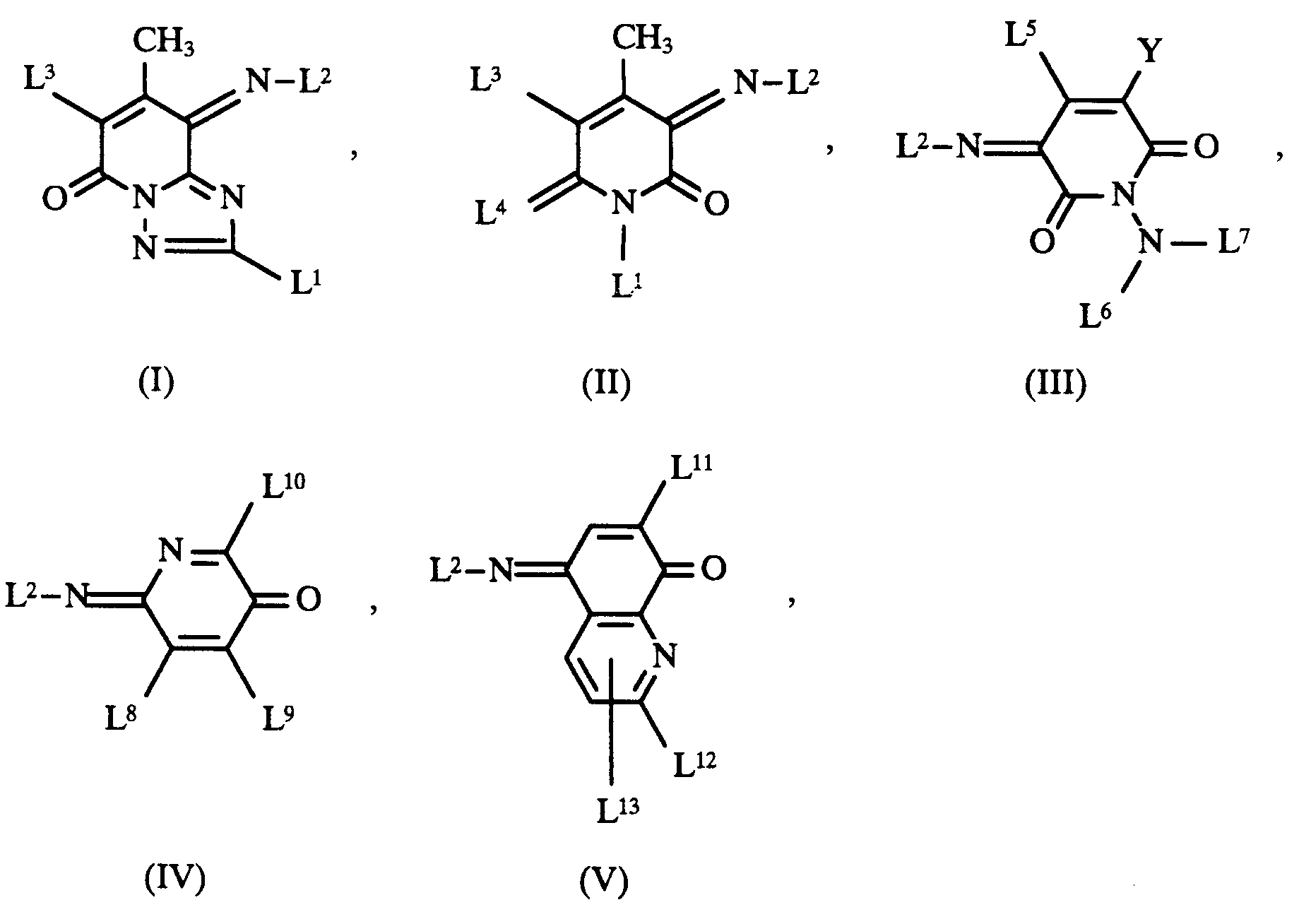
worin - L¹
- C₁-C₂₀-Alkyl, das gegebenenfalls substituiert ist und durch 1 bis 4 Sauerstoffatome in Etherfunktion unterbrochen sein kann, gegebenenfalls substituiertes Phenyl oder Hydroxy,
- L²
- einen 5- oder 6-gliedrigen carbocyclischen oder heterocyclischen Rest,
- L³
- Cyano, Carbamoyl, Carboxyl oder C₁-C₄-Alkoxycarbonyl,
- L⁴
- Sauerstoff oder einen Rest der Formel

- X
- CH oder Stickstoff,
- L⁵
- Wasserstoff oder C₁-C₄-Alkyl,
- L⁶ und L⁷
- gleich oder verschieden sind und unabhängig voneinander jeweils Wasserstoff, gegebenenfalls substituiertes C₁-C₁₂-Alkyl, C₅-C₇-Cycloalkyl, gegebenenfalls substituiertes Phenyl, gegebenenfalls substituiertes Pyridyl, gegebenenfalls substituiertes C₁-C₁₂-Alkanoyl, C₁-C₁₂-Alkoxycarbonyl, gegebenenfalls substituiertes C₁-C₁₂-Alkylsulfonyl, C₅-C₇-Cycloalkylsulfonyl, gegebenenfalls substituiertes Phenylsulfonyl, gegebenenfalls substituiertes Pyridylsulfonyl, gegebenenfalls substituiertes Benzoyl, Pyridylcarbonyl oder Thienylcarbonyl oder L⁶ und L⁷ zusammen mit dem sie verbindenden Stickstoffatom gegebenenfalls durch C₁-C₄-Alkyl substituiertes Succinimido, gegebenenfalls durch C₁-C₄-Alkyl substituiertes Phthalimido oder einen fünf-oder sechsgliedrigen gesättigten heterocyclischen Rest, der gegebenenfalls weitere Heteroatome enthält,
- Y
- Cyano oder einen Rest der Formel CO-Q², CO-OQ² oder CO-NHQ², worin Q² für Wasserstoff, C₁-C₈-Alkyl, das gegebenenfalls substituiert ist und durch 1 oder 2 Sauerstoffatome in Etherfunktion unterbrochen sein kann, C₅-C₇-Cycloalkyl, Phenyl oder Tolyl steht,
- L⁸
- Wasserstoff, Fluor, Chlor, Methyl oder einen Rest der Formel -NH-CO-A¹, -NH-CO-OA¹, -NH-CO-NA¹A², -NH-CS-OA¹, -NH-CS-NA¹A², -NH-CO-A³, -NH-SO₂-A¹, -NH-SO₂-A³ oder -NH-SO₂-NA¹A², worin
- A¹ und A²
- gleich oder verschieden sind und unabhängig voneinander jeweils für C₁-C₈-Alkyl, das gegebenenfalls substituiert ist und durch 1 oder 2 Sauerstoffatome in Etherfunktion unterbrochen sein kann, C₅-C₇-Cycloalkyl, Phenyl oder Tolyl oder -NA¹A² auch für Amino und
- A³
- für einen fühf- oder sechsgliedrigen aromatischen heterocyclischen Rest, der gegebenenfalls benzoanelliert ist und ein oder mehrere Heteroatome, ausgewählt aus der Gruppe, bestehend aus Stickstoff, Sauerstoff und Schwefel, aufweist, stehen,
- L⁹
- Wasserstoff, Fluor oder Chlor oder L⁸ und L⁹ zusammen mit den Kohlenstoffatomen an die sie geknüpft sind, einen fünf- oder sechsgliedrigen aromatischen carbocyclischen oder heterocyclischen Ring,
- L¹⁰
- den obengenannten Rest A³ oder einen Rest der Formel -CO-OA¹, -CO-NH-A¹, -CO-NH-CO-A¹, -CO-NH-CO-A³, -CO-NH-SO₂-A³, -NH-CO-A¹, -NH-CO-OA¹, -NH-CO-NA¹A², -NH-CS-OA¹, -NH-CS-NA¹A², -NH-CO-A³, -NH-SO₂-A¹, -NH-SO₂-A³ oder -NH-SO₂-NA¹A², worin A¹, A² und A³ jeweils die obengenannte Bedeutung besitzen,
- L¹¹
- Fluor, Chlor oder Brom,
- L¹²
- Wasserstoff oder C₁-C₄-Alkyl und
- L¹³
- Wasserstoff, Fluor, Chlor oder Brom bedeuten,
- Beim Thermotransferdruckverfahren wird ein Transferblatt, das einen thermisch transferierbaren Farbstoff in einem oder mehreren Bindemitteln, gegebenenfalls zusammen mit geeigneten Hilfsmitteln, auf einem Träger enthält, mit einer Energiequelle, z.B. mit einem Heizkopf oder einem Laser, durch kurze Heizimpulse (Dauer: Bruchteile einer Sekunde) von der Rückseite her erhitzt, wodurch der Farbstoff aus dem Transferblatt migriert und in die Oberflächenbeschichtung eines Aufnahmemediums hineindiffundiert. Der wesentliche Vorteil dieses Verfahrens besteht darin, daß die Steuerung der zu übertragenden Farbstoffmenge (und damit die Farbabstufung) durch Einstellung der von der Energiequelle abzugebenden Energie leicht möglich ist.
- Allgemein wird die Farbaufzeichnung unter Verwendung der drei subtraktiven Grundfarben Gelb, Magenta, Cyan (und gegebenenfalls Schwarz) durchgeführt.
- Es ist bekannt, das Thermotransferdruckverfahren mit einzelnen Farbstoffen oder auch mit Mischungen von Farbstoffen durchzuführen. Dabei hat sich jedoch gezeigt, daß die zur Anwendung kommenden Farbstoffe noch anwendungstechnische Mängel aufweisen.
- Aufgabe der vorliegenden Erfindung war es daher, neue Farbstoffmischungen im Cyanbereich bereitzustellen, die sich in vorteilhafter Weise zur thermischen Übertragung eignen. Demgemäß wurden die eingängs näher bezeichneten Farbstoffmischungen gefunden.
- Ein Mischungspartner der neuen Farbstoffmischungen sind Anthrachinonfarbstoffe, deren Absorptionsmaximum bei einer Wellenlänge von 600 bis 750 nm, insbesondere 640 bis 680 nm, liegt.
- Hervorzuheben sind dabei Anthrachinonfarbstoffe der Formel VI, VII oder VIII

worin - a
- 0 oder 1,
- R¹, R² und R³
- gleich oder verschieden sind und unabhängig voneinander jeweils Wasserstoff, Alkyl, Alkoxyalkyl, Alkanoyloxyalkyl, Alkoxycarbonyloxyalkyl oder Alkoxycarbonylalkyl, wobei diese Reste jeweils bis zu 20 Kohlenstoffatome aufweisen und durch Phenyl, C₁-C₄-Alkylphenyl, C₁-C₄-Alkoxyphenyl, Halogenphenyl, Benzyloxy, C₁-C₄-Alkylbenzyloxy, C₁-C₄-Alkoxybenzyloxy, Halogenbenzyloxy, Halogen, Hydroxy oder Cyano substituiert sein können, gegebenenfalls durch C₁-C₁₅-Alkyl, C₁-C₁₅-Alkoxy, Halogen oder Benzyloxy substituiertes Phenyl, gegebenenfalls durch C₁-C₁₅-Alkyl, C₁-C₁₅-Alkoxy, Halogen oder Benzyloxy substituiertes Cyclohexyl oder einen Rest der Formel
[-E-O]m-R⁵,
worin - E
- für C₂-C₆-Alkylen
- m
- für 1, 2, 3, 4, 5 oder 6 und
- R⁵
- für C₁-C₄-Alkyl oder gegebenenfalls durch C₁-C₄-Alkyl oder C₁-C₄-Alkoxy substituiertes Phenyl stehen, und
- R⁴
- Wasserstoff oder Cyano bedeuten,
- Reste L² können sich z.B. von Komponenten aus der Benzol-, Indol-, Chinolin-, Aminonaphthalin-, Aminothiazol- oder Aminothiophenreihe ableiten.
- Hervorzuheben sind Farbstoffmischungen, die mindestens einen Farbstoff der Formel I, II, III, IV und/oder V enthalten, worin L² für einen Rest der Formel


steht, worin - n
- 0 oder 1,
- Z¹
- für Wasserstoff, C₁-C₈-Alkyl, das gegebenenfalls durch 1 oder 2 Sauerstoffatome in Etherfunktion unterbrochen ist, Methoxy, Ethoxy, C₁-C₄-Alkylsulfonylamino, C₁-C₄-Mono- oder Dialkylaminosulfonylamino oder den Rest -NHCOZ⁷ oder -NHCO₂Z⁷, wobei Z⁷ die Bedeutung von Phenyl, Benzyl, Tolyl oder C₁-C₈-Alkyl, das gegebenenfalls durch ein oder zwei Sauerstoffatome in Etherfunktion unterbrochen ist, besitzt,
- Z²
- für Wasserstoff, Methyl, Methoxy oder Ethoxy,
- Z³ und Z⁴
- gleich oder verschieden sind und unabhängig voneinander jeweils für Wasserstoff, C₁-C₈-Alkyl, das gegebenenfalls substituiert ist und durch ein oder zwei Sauerstoffatome in Etherfunktion unterbrochen sein kann, C₃-C₄-Alkenyl, C₅-C₇-Cycloalkyl, Phenyl oder Tolyl oder zusammen mit dem sie verbindenden Stickstoffatom für einen fünf- oder sechsgliedrigen gesättigten heterocyclischen Rest, der gegebenenfalls weitere Heteroatome enthält,
- Z⁵
- Halogen oder gegebenenfalls substituiertes Phenyl und
- Z⁶
- für Wasserstoff, Halogen, C₁-C₈-Alkyl, gegebenenfalls substituiertes Phenyl, gegebenenfalls substituiertes Benzyl, Cyclohexyl, Thienyl, Hydroxy oder C₁-C₈-Monoalkylamino stehen und
- L⁵
- die obengenannte Bedeutung besitzt.
- Alle in den obengenannten Formeln auftretenden Alkyl-, Alkylen- und Alkenylgruppen können sowohl geradkettig als auch verzweigt sind.
- Wenn in den obengenannten Formeln substituierte Alkylgruppen auftreten, so können als Substituenten, sofern nicht anders vermerkt, z.B. Cyano, Phenyl, Tolyl, C₁-C₆-Alkanoyloxy, C₁-C₄-Alkoxycarbonyl, C₁-C₄-Alkylaminocarbonyloxy oder C₁-C₄-Alkoxycarbonyloxy, wobei im letzten Fall die Alkoxygruppe durch Phenyl oder C₁-C₄-Alkoxy substituiert sein kann, in Betracht kommen.
- Wenn in den obengenannten Formeln substituierte Phenyl- oder Pyridylgruppen auftreten, so können als Substituenten z.B. Halogen, C₁-C₄-Alkyl- oder C₁-C₄-Alkoxy in Betracht kommen.
- Reste E sind z.B. Ethylen, 1,2- oder 1,3-Propylen, 1,2-, 1,3-, 1,4- oder 2,3-Butylen, Pentamethylen, Hexamethylen oder 2-Methylpentamethylen.
- Geeignete Reste R¹, R², R³, R⁵, Z¹, L¹, L⁵, L⁶, L⁷, L¹², A¹, A², Q¹, Q², Z¹, Z³, Z⁴, Z⁶ und Z⁷ sind z.B. Methyl, Ethyl, Propyl, Isopropyl, Butyl, Isobutyl, sec-Butyl oder tert-Butyl.
- Reste R¹, R², R³, L¹, L⁶, L⁷, A¹, A², Q¹, Q², Z¹, Z³, Z⁴, Z⁶ und Z⁷ sind weiterhin z.B. Pentyl, Isopentyl, Neopentyl, tert-Pentyl, Hexyl, 2-Methylpentyl, Heptyl, Octyl, 2-Ethylhexyl oder Isooctyl.
- Reste R¹, R², R³, L¹, L⁶ und L⁷ sind weiterhin z.B. Nonyl, Isononyl, Decyl, Isodecyl, Undecyl oder Dodecyl.
- Reste R¹, R², R³ und L¹ sind weiterhin z.B. Tridecyl, Isotridecyl, Tetradecyl, Pentadecyl, Hexadecyl, Heptadecyl, Octadecyl, Nonadecyl oder Eicosyl. (Die Bezeichnungen Isooctyl, Isononyl, Isodecyl und Isotridecyl sind Trivialbezeichnungen und stammen von den nach der Oxosynthese erhaltenen Alkoholen (vgl. dazu Ullmanns Enzyklopädie der technischen Chemie, 4. Auflage, Band 7, Seiten 215 bis 217 sowie Band 11, Seiten 435 und 436).).
- Reste R¹, R², R³, A¹, A², Q², L¹, Z¹ und Z⁷ sind weiterhin z.B. 2-Methoxyethyl, 2-Ethoxyethyl, 2-Propoxyethyl, 2-Butoxyethyl, 2- oder 3-Methoxypropyl, 2- oder 3-Ethoxypropyl, 2- oder 3-Propoxypropyl, 2- oder 3-Butoxypropyl, 2- oder 4-Methoxybutyl, 2- oder 4-Ethoxybutyl oder 2- oder 4-Butoxybutyl.
- Reste L¹, R¹, R², R³, A¹, A², Q² und Z¹ sind weiterhin z.B. 3,6-Dioxaheptyl, 3,6-Dioxaoctyl, 4,8-Dioxanonyl, 3,7-Dioxaoctyl, 3,7-Dioxanonyl, 4,7-Dioxaoctyl, 4,7-Dioxanonyl, oder 4,8-Dioxadecyl.
- Reste R¹, R², R³ und L¹ sind weiterhin z.B. 3,6,9-Trioxadecyl, 3,6,9-Trioxaundecyl, 3,6,9,12-Tetraoxatridecyl, 3,6,9,12-Tetraoxatetradecyl, 2-Methoxycarbonylethyl, Benzyl, 1- oder 2-Phenylethyl, 3-Benzyloxypropyl oder 2-, 3-oder 4-Chlorphenyl.
- Reste L³ sind z.B. Methoxycarbonyl, Ethoxycarbonyl, Propoxycarbonyl, Isopropoxycarbonyl, Butoxycarbonyl, Isobutoxycarbonyl oder sec-Butoxycarbonyl.
- Reste R¹, R², R³, L¹ und Z⁶ sind weiterhin z.B. 2-, 3- oder 4-Methylphenyl, 2-, 3- oder 4-Ethylphenyl, 2-, 3- oder 4-Propylphenyl, 2-, 3-oder 4-Isopropylphenyl, 2-, 3- oder 4-Butylphenyl, 2,4-Dimethylphenyl, 2-, 3- oder 4-Methoxyphenyl, 2-, 3- oder 4-Ethoxyphenyl, 2-, 3- oder 4-Isobutoxyphenyl oder 2,4-Dimethoxyphenyl.
- Reste L⁶ und L⁷ sind weiterhin z.B. Phenyl, 2-, 3- oder 4-Methylphenyl, 2-, 3- oder 4-Methoxyphenyl, Pyridyl, 2-, 3-oder 4-Methylpyridyl, 2-, 3- oder 4-Methoxypyridyl, Formyl, Acetyl, Propionyl, Butyryl, Isobutyryl, Pentanoyl, Hexanoyl, Heptanoyl, Octanoyl, 2-Ethylhexanoyl, Methoxycarbonyl, Ethoxycarbonyl, Propoxycarbonyl, Isopropoxycarbonyl, Butoxycarbonyl, Methylsulfonyl, Ethylsulfonyl, Propylsulfonyl, Isopropylsulfonyl, Butylsulfonyl, Cyclopentylsulfonyl, Cyclohexylsulfonyl, Cycloheptylsulfonyl, Phenylsulfonyl, Tolylsulfonyl, Pyridylsulfonyl, Benzoyl, 2-, 3- oder 4-Methylbenzoyl, 2-, 3- oder 4-Methoxybenzoyl, Thien-2-ylcarbonyl oder Thien-3-ylcarbonyl.
- Reste R¹, R², R³, Q², L⁶, L⁷, Z³ und Z⁴ sind weiterhin z.B. 2-Cyanoethyl, 2- oder 3-Cyanopropyl, 2-Acetyloxyethyl, 2- oder 3-Acetyloxypropyl, 2-Isobutyryloxyethyl, 2- oder 3-Isobutyryloxypropyl, 2-Methoxycarbonylethyl, 2- oder 3-Methoxycarbonylpropyl, 2-Ethoxycarbonylethyl, 2- oder 3-Ethoxycarbonylpropyl, 2-Methoxycarbonyloxyethyl, 2- oder 3-Methoxycarbonyloxypropyl, 2-Ethoxycarbonyloxyethyl, 2- oder 3-Ethoxycarbonyloxypropyl, 2-Butoxycarbonyloxyethyl, 2- oder 3-Butoxycarbonyloxypropyl, 2-(2-Phenylethoxycarbonyloxy)ethyl, 2- oder 3-(2-Phenylethoxycarbonyloxy)propyl, 2-(2-Ethoxyethoxycarbonyloxy)ethyl oder 2- oder 3-(2-Ethoxyethoxycarbonyloxy)propyl.
- Reste Q², L⁶, L⁷, Z³ und Z⁴ sind weiterhin z.B. Benzyl, 2-Methylbenzyl, 1-oder 2-Phenylethyl, Cyclopentyl, Cyclohexyl, Cycloheptyl oder 2-, 3- oder 4-Methylphenyl.
- Reste Z¹ sind z.B. Methylsulfonylamino, Ethylsulfonylamino, Propylsulfonylamino, Isopropylsulfonylamino, Butylsulfonylamino, Mono- oder Dimethylaminosulfonylamino, Mono- oder Diethylaminosulfonylamino, Mono- oder Dipropylaminosulfonylamino, Mono- oder Diisopropylaminosulfonylamino, Mono- oder Dibutylaminosulfonylamino oder (N-Methyl-N-ethylaminosulfonyl)amino.
- Reste Z⁶ sind weiterhin, wie auch Reste Z⁵, z.B. Fluor, Chlor oder Brom.
- Reste Z⁶ sind weiterhin z.B. Phenyl, 2-Methylphenyl, 2,4-Dimethylphenyl, 2-Methoxyphenyl, 2,4-Dimethoxyphenyl, Benzyl, 2-Methylbenzyl, 2,4-Dimethylbenzyl, 2-Methoxybenzyl, 2,4-Dimethoxybenzyl, Methylamino, Ethylamino, Propylamino, Isopropylamino, Butylamino, Pentylamino, Hexylamino, Heptylamino, Octylamino oder 2-Ethylhexylamino.
- Reste Z³ und Z⁴ sind weiterhin z.B. Allyl oder Methallyl.
- Wenn L⁶ und L⁷ oder und Z⁴ zusammen mit dem sie verbindenden Stickstoffatom einen fühf- oder sechsgliedrigen gesättigten heterocyclischen Rest, der gegebenenfalls weitere Heteroatome aufweist, bedeuten, so können dafür z.B. Pyrrolidinyl, Piperidinyl, Morpholinyl, Piperazinyl oder N-(C₁-C₄-Alkyl)piperazinyl in Betracht kommen.
- Reste L⁶, L⁷, A¹ und A² sind weiterhin z.B. Cyclopentyl, Cyclohexyl oder Cycloheptyl.
- Reste A³ leiten sich von einem fünf- oder sechsgliedrigen aromatischen heterocyclischen Rest ab, der gegebenenfalls benzoanelliert ist und der ein oder mehrere Heteroatome, ausgewählt aus der Gruppe, bestehend aus Stickstoff, Sauerstoff und Schwefel, aufweist.
- Geeignete heterocyclische Grundkörper, die Substituenten tragen können, von denen sich die Reste A³ ableiten, sind z.B. Pyrrol, Furan, Thiophen, Pyrazol, Imidazol, Oxazol, Isoxazol, Thiazol, Isothiazol, 1,2,4-Triazol, 1,2,4-Oxdiazol, 1,3,4-Oxdiazol, 1,2,4-Thiadiazol, 1,3,4-Thiadiazol, Pyridin, Pyridazin, Pyrimidin oder Pyrazin.
- Hervorzuheben sind dabei Heterocyclen aus der Pyrrol-, Thiophen-, Isoxazol-, Pyridin- oder Pyridazinreihe.
- Als Reste A³-CO oder A³-SO₂ kommen insbesondere solche fünf- oder sechsgliedrige aromatische heterocyclische Reste in Betracht, die sich von den folgenden heterocyclischen Carbonsäuren A³-COOH oder Sulfonsäuren A³-SO₃H ableiten:

wobei - M
- jeweils für C₁-C₄-Alkyl steht.
- Bevorzugte Mischungspartner sind Farbstoffe der Formel I oder II, worin L³ Cyano bedeutet.
- Bevorzugte Mischungspartner sind weiterhin Farbstoffe der Formel I oder II, worin L² sich von einer Komponente aus der Benzol-, Indol-, Chinolin-, Aminonaphthalin-, Aminothiazol oder Aminothiophenreihe ableitet.
- Bevorzugte Mischungspartner sind weiterhin Farbstoffe der Formel I oder II, worin L¹ C₁-C₁₂-Alkyl, das gegebenenfalls durch C₁-C₆-Alkanoyloxy, C₁-C₈-Alkoxycarbonyl, dessen Alkylkette durch 1 oder 2 Sauerstoffatome in Etherfunktion unterbrochen sein kann, Phenyl oder C₁-C₄-Alkylphenyl substituiert ist und durch 1 oder 2 Sauerstoffatome in Etherfunktion unterbrochen sein kann, bedeutet.
- Besonders bevorzugte Mischungspartner sind Farbstoffe der Formel I oder II, worin L¹ Alkyl, Alkoxyalkyl, Alkanoyloxyalkyl oder Alkoxycarbonyloxyalkyl, wobei diese Reste jeweils bis zu 12 Kohlenstoffatome aufweisen, gegebenenfalls durch Methyl substituiertes Benzyl oder gegebenenfalls durch Methyl substituiertes Phenyl bedeutet.
- Besonders bevorzugte Mischungspartner sind weiterhin Farbstoffe der Formel I oder II, worin L² einen Rest der obengenannten Formel IXa, IXc, IXl, IXm, IXn oder IXo bedeutet.
- Bevorzugt als Mischungspartner sind Farbstoffe der Formel III, in der L² einen Rest der Formel IXa, IXc, IXl, IXm, IXn, IXo oder IXp bedeutet, wobei ein Rest der Formel IXc oder IXl besonders zu nennen ist.
- Besonders als Mischungspartner hervorzuheben sind Farbstoffe der Formel IIIa

in der - B¹ und B²
- unabhängig voneinander jeweils Wasserstoff, C₁-C₈-Alkyl, Phenyl, Tolyl, C₁-C₈-Alkylcarbonyl, C₁-C₈-Alkylsulfonyl, Phenylsulfonyl, Tolylsulfonyl, Pyridylsulfonyl, Benzoyl, Methylbenzoyl, Pyridylcarbonyl oder Thienylcarbonyl,
- B³
- Wasserstoff, Methyl, Methoxy oder den Rest -NHCOZ⁷ oder -NHCO₂Z⁷, worin Z⁷ für Phenyl, Benzyl, Tolyl oder C₁-C₈-Alkyl, das gegebenenfalls durch ein oder zwei Sauerstoffatome in Etherfunktion unterbrochen ist, steht,
- B⁴ und B⁵
- unabhängig voneinander Wasserstoff, C₁-C₈-Alkyl, 2-Cyanoethyl, Benzyl, C₁-C₄-Alkanoyloxy-C₂-C₄-alkyl, C₁-C₄-Alkoxycarbonyl-C₁-C₄-alkyl oder C₁-C₄-Alkoxycarbonyloxy-C₂-C₄-alkyl und
- B⁶
- Wasserstoff oder Methyl bedeuten.
- Besonders als Mischungspartner hervorzuheben sind weiterhin Farbstoffe der Formel IIIb

in der B⁷ C₁-C₆-Alkyl, Phenyl, Tolyl, Anisidiyl, Benzyl, Cyclohexyl oder Thienyl bedeutet und B¹, B², B⁴, B⁵ und B⁶ jeweils die unter der Formel IIIa genannte Bedeutung besitzen. - Ganz besonders hervorzuheben sind Farbstoffe der Formel IIIa, in der B¹ und B² unabhängig voneinander jeweils C₁-C₈-Alkylcarbonyl, Benzoyl, Methylbenzoyl oder Thienylcarbonyl bedeuten.
- Weiterhin bevorzugt als Mischungspartner sind Farbstoffe der Formel IV, in der
- L⁸
- Wasserstoff, Chlor oder Methyl und
- L⁹
- Wasserstoff oder Chlor bedeuten.
- Weiterhin besonders bevorzugt als Mischungspartner sind Pyridonfarbstoffe der Formel IV, in der L² einen Rest der Formel IXa, IXc, IXe, IXf, IXg, IXj, IXl, IXm, IXn oder IXo, bedeutet, wobei ein Rest der Formel IXa oder IXc besonders hervorzuheben ist.
- Insbesondere als Mischungspartner zu nennen sind Pyridonfarbstoffe der Formel IVa

in der - L⁸
- Wasserstoff, Chlor oder Methyl,
- L⁹
- Wasserstoff oder Chlor,
- L¹⁰
- einen Rest der Formel -CO-NH-A¹, -NH-CO-A¹, -NH-CO-OA¹ oder -NH-CO-NA¹A², worin A¹ und A² unabhängig voneinander für C₁-C₈-Alkyl, 2-Cyanoethyl, Benzyl, C₁-C₄-Alkanoyloxy-C₂-C₄-alkyl, C₁-C₄-Alkoxycarbonyl-C₁-C₄-alkyl, C₁-C₄-Alkoxcarbonyloxy-C₂-C₄-alkyl, C₅-C₇-Cycloalkyl, Phenyl oder Tolyl oder -NA¹A² auch für Amino stehen,
- Z¹
- Wasserstoff, Methyl, Methoxy oder den Rest -NHCOZ⁷ oder -NHCO₂Z⁷, worin Z⁷ für Phenyl, Benzyl, Tolyl oder C₁-C₈-Alkyl, das gegebenenfalls durch 1 Sauerstoffatom in Etherfunktion unterbrochen ist, steht,
- Z²
- Wasserstoff und
- Z³ und Z⁴
- unabhängig voneinander Wasserstoff, C₁-C₈-Alkyl, 2-Cyanoethyl, Benzyl, C₁-C₄-Alkanoyloxy-C₂-C₄-alkyl, C₁-C₄-Alkoxycarbonyl-C₁-C₄-alkyl oder C₁-C₄-Alkoxycarbonyloxy-C₂-C₄-alkyl bedeuten.
- Insbesondere als Mischungspartner zu nennen sind weiterhin Pyridonfarbstoffe der Formel IVb
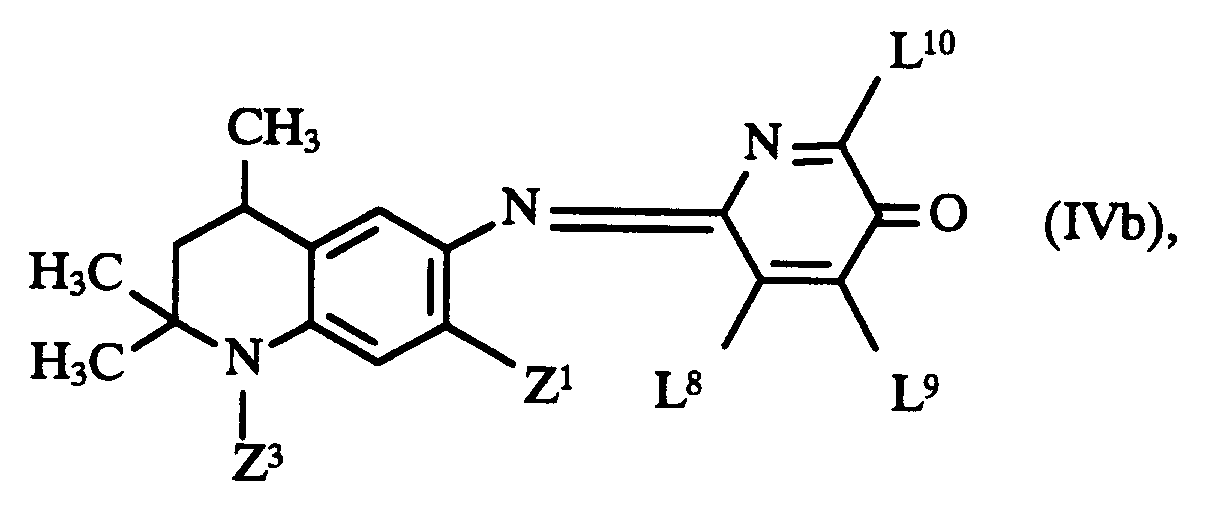
in der - L⁸
- Wasserstoff, Chlor oder Methyl,
- L⁹
- Wasserstoff oder Chlor,
- L¹⁰
- einen Rest der Formel -CO-NH-A¹, -NH-CO-A¹, -NH-CO-OA¹ oder -NH-CO-NA¹A², worin A¹ und A² unabhängig voneinander für C₁-C₈-Alkyl, 2-Cyanoethyl, Benzyl, C₁-C₄-AlkanoyloxyC₂-C₄-alkyl, C₁-C₄-Alkoxycarbonyl-C₁-C₄-alkyl, C₁-C₄-Alkoxycarbonyloxy-C₂-C₄-alkyl, C₅-C₇-Cycloalkyl, Phenyl oder Tolyl oder -NA¹-A² auch für Amino stehen,
- Z¹
- Wasserstoff, Methyl, Methoxy oder den Rest -NHCOZ⁷ oder -NHCO₂Z⁷, worin Z⁷ für Phenyl, Benzyl, Tolyl oder C₁-C₈-Alkyl, das gegebenenfalls durch 1 Sauerstoffatom in Etherfunktion unterbrochen ist, steht und
- Z³
- Wasserstoff, C₁-C₈-Alkyl, 2-Cyanoethyl, Benzyl, C₁-C₄-Alkanoyloxy-C₂-C₄-alkyl, C₁-C₄-Alkoxycarbonyl-C₁-C₄-alkyl oder C₁-C₄-Alkoxycarbonyloxy-C₂-C₄-alkyl bedeuten.
- Ganz besonders als Mischungspartner hervorzuheben sind Pyridonfarbstoffe der Formel IVa oder IVb, in der L¹⁰ den Rest -NH-COA¹, worin A¹ für C₁-C₈-Alkyl, das gegebenenfalls durch 1 Sauerstoffatom in Etherfunktion unterbrochen ist, steht, und Z¹ den Rest -NH-COZ⁷ oder -NHCO₂Z⁷, worin Z⁷ für Phenyl, Benzyl, Tolyl oder C₁-C₈-Alkyl, das gegebenenfalls durch 1 Sauerstoffatom in Etherfunktion unterbrochen ist, steht, bedeuten.
- Bevorzugt als Mischungspartner sind weiterhin Farbstoffe der Formel V, in der
- L¹¹
- Chlor,
- L¹²
- Wasserstoff oder Methyl
- L¹³
- Wasserstoff und
- L²
- einen Rest der Formel IXa, IXc, IXe, IXf oder IXg bedeuten, wobei solche Farbstoffe hervorzuheben sind, in denen Z¹ für Wasserstoff oder den Rest -NH-COZ⁷ oder - NHCO₂Z⁷ steht, worin Z⁷ jeweils die obengenannte Bedeutung besitzt.
- Besonders bevorzugt als Mischungspartner sind Farbstoffe der Formel V, in der
- L¹¹
- Chlor,
- L¹²
- Wasserstoff oder Methyl,
- L¹³
- Wasserstoff und
- L²
- einen Rest der Formel IXa oder IXc bedeuten, worin
- Z¹
- für Wasserstoff, Methyl oder Acetylamino,
- Z²
- für Wasserstoff oder Methoxy und
- Z³ und Z⁴
- unabhängig voneinander für Wasserstoff, Benzyl oder gegebenenfalls substituiertes C₁-C₈-Alkyl stehen.
- Bevorzugte Mischungspartner sind auch Anthrachinonfarbstoffe der Formel VI, VII und/oder VIII, wobei
- R¹, R² und R³
- unabhängig voneinander Alkyl oder Alkoxyalkyl bedeuten, wobei diese Reste jeweils bis zu 15 Kohlenstoffatome aufweisen und durch Phenyl, C₁-C₄-Alkylphenyl oder C₁-C₄-Alkoxyphenyl substituiert und durch 1 oder 2 Sauerstoffatome in Etherfunktion unterbrochen sein können.
- Hervorzuheben als Mischungspartner sind auch Anthrachinonfarbstoffe der Formel VIa
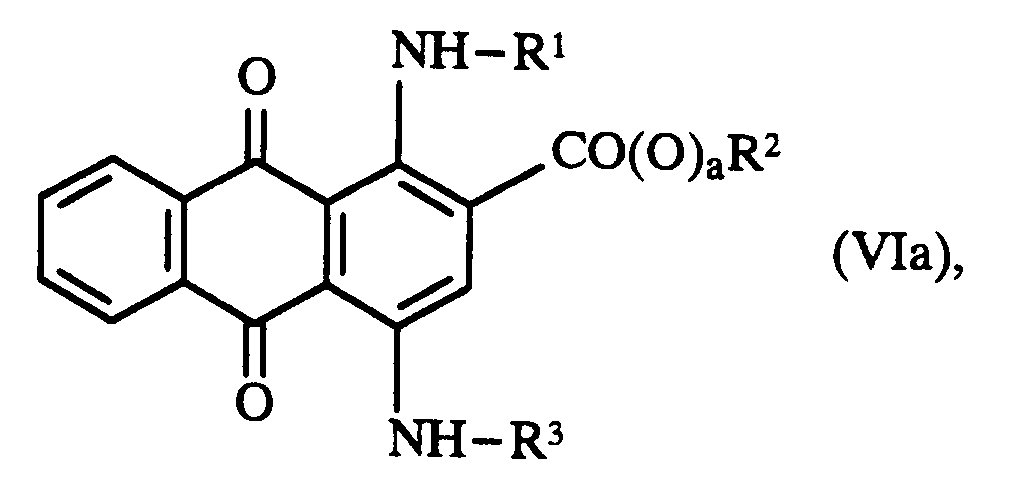
worin - a
- 0 oder 1,
- R¹
- C₁-C₁₅-Alkyl,
- R²
- C₁-C₁₅-Alkyl, einen Rest der Formel
[-E¹-O]p-R⁷,
worin - E¹
- für C₂-C₄-Alkylen,
- p
- für 1, 2, 3 oder 4 und
- R⁷
- für C₁-C₄-Alkyl oder Phenyl stehen, oder, wenn a 0 ist, auch Wasserstoff und
- R³
- C₁-C₁₅-Alkyl oder gegebenenfalls durch C₁-C₁₅-Alkyl oder C₁-C₁₅-Alkoxy substituiertes Phenyl bedeuten.
- Besonders bevorzugte Mischungspartner sind auch Anthrachinonfarbstoffe der Formel VIb

in der - a
- 0 oder 1,
- R²
- C₁-C₁₅-Alkyl, einen Rest der Formel
[-E¹-O]p-R⁷,
worin - E¹
- für C₂- bis C₄-Alkylen,
- p
- für 1, 2, 3 oder 4 und
- R⁷
- für C₁-C₄-Alkyl oder Phenyl stehen, oder wenn a 0 ist, auch Wasserstoff und
- R⁸
- C₁-C₁₅-Alkyl oder C₁-C₁₅-Alkoxy bedeuten.
- Besonders bevorzugte Mischungspartner sind auch Anthrachinonfarbstoffe der Formel IVc

in der - R²
- C₁-C₁₅-Alkyl oder einen Rest der Formel
[-E¹-O]p-R⁷,
worin
E, R⁵ und m jeweils die obengenannte Bedeutung besitzen und - R¹ und R³
- unabhängig voneinander Wasserstoff oder gegebenenfalls durch C₁-C₁₅-Alkyl oder C₁-C₁₅-Alkoxy substituiertes Benzyl oder Phenyl, C₄-C₁₅-Alkanoyloxyalkyl, C₄-C₁₅-Alkoxycarbonyloxyalkyl, C₄-C₁₅-Alkoxycarbonylalkyl oder den Rest R² bedeuten.
- Hervorzuheben sind Farbstoffmischungen, enthaltend einen Anthrachinonfarbstoff der Formel VI sowie einen Farbstoff der Formel I.
Weiterhin hervorzuheben sind Farbstoffmischungen, enthaltend einen Anthrachinonfarbstoff der Formel VI sowie einen Farbstoff der Formel II. - Weiterhin hervorzuheben sind Farbstoffmischungen, enthaltend einen Anthrachinonfarbstoff der Formel VI sowie einen Farbstoff der Formel III.
- Weiterhin hervorzuheben sind Farbstoffmischungen, enthaltend einen Anthrachinonfarbstoff der Formel VI sowie einen Farbstoff der Formel IV.
- Weiterhin hervorzuheben sind Farbstoffmischungen, enthaltend einen Anthrachinonfarbstoff der Formel VI sowie einen Farbstoff der Formel V.
- Weiterhin hervorzuheben sind Farbstoffmischungen, enthaltend einen Anthrachinonfarbstoff der Formel VII sowie einen Farbstoff der Formel I.
- Weiterhin hervorzuheben sind Farbstoffmischungen, enthaltend einen Anthrachinonfarbstoff der Formel VII sowie eien Farbstoff der Formel II.
- Weiterhin hervorzuheben sind Farbstoffmischungen, enthaltend einen Anthrachinonfarbstoff der Formel VII sowie einen Farbstoff der Formel III.
- Weiterhin hervorzuheben sind Farbstoffmischungen, enthaltend einen Anthrachinonfarbstoff der Formel VII sowie einen Farbstoff der Formel IV.
- Weiterhin hervorzuheben sind Farbstoffmischungen, enthaltend einen Anthrachinonfarbstoff der Formel VII sowie einen Farbstoff der Formel V.
- Weiterhin hervorzuheben sind Farbstoffmischungen, enthaltend einen Anthrachinonfarbstoff der Formel VIII sowie einen Farbstoff der Formel I.
- Weiterhin hervorzuheben sind Farbstoffmischungen, enthaltend einen Anthrachinonfarbstoff der Formel VIII sowie einen Farbstoff der Formel II.
- Weiterhin hervorzuheben sind Farbstoffmischungen, enthaltend einen Anthrachinonfarbstoff der Formel VIII sowie einen Farbstoff der Formel III.
- Weiterhin hervorzuheben sind Farbstoffmischungen, enthaltend einen Anthrachinonfarbstoff der Formel VIII sowie einen Farbstoff der Formel IV.
- Weiterhin hervorzuheben sind Farbstoffmischungen, enthaltend einen Anthrachinonfarbstoff der Formel VIII sowie einen Farbstoff der Formel V.
- Besonders zu nennen sind Farbstoffmischungen, enthaltend einen Anthrachinonfarbstoff der Formel VI oder VII, wobei solchen Farbstoffmischungen, die einen Anthrachinonfarbstoff der Formel VI enthalten, besondere Bedeutung zukommmt,
- Weiterhin besonders zu nennen sind Farbstoffmischungen, enthaltend einen Farbstoff der Formel I.
- Ganz besondere Bedeutung kommt solchen Farbstoffmischungen zu, die einen Anthrachinonfarbstoff der Formel VI sowie einen Farbstoff der Formel I enthalten.
- Die erfindungsgemäßen Farbstoffmischungen enthalten in der Regel 10 bis 90 Gew.%, vorzugsweise 40 bis 80 Gew.% und insbesondere 70 bis 80 Gew.%, jeweils bezogen auf das Gewicht der Farbstoffmischung, einen oder mehrere Anthrachinonfarbstoffe sowie 10 bis 90 Gew.%, vorzugsweise 20 bis 60 Gew.% und insbesondere 20 bis 30 Gew.%, jeweils bezogen auf das Gewicht der Farbstoffmischung, einen oder mehrere Farbstoffe der Formel I, II, III, IV und/oder V.
- Die neuen Farbstoffmischungen können nach an sich bekannten Methoden, z.B. durch Abmischen der Einzelfarbstoffe im obengenannten Gewichtsverhältnis erhalten werden.
- Die Anthrachinonfarbstoffe sind an sich bekannt und z.B. in der EP-A-337 200, EP-A-351 968 sowie EP-A-480 278 beschrieben oder können nach den dort genannten Methoden erhalten werden.
- Die Farbstoffe der Formel I, II, III, IV und V sind ebenfalls bekannt und z.B. in der US-A-5 079 365, der älteren Patentanmeldung PCT/EP/92/00505 sowie in der EP-A-480 252 und EP-A-479 068 beschrieben.
- Die erfindungsgemäßen Cyan-Farbstoffmischungen zeichnen sich durch vorteilhafte anwendungstechnische Eigenschaften aus. Sie weisen eine hohe Löslichkeit im Farbband (gute Kompatibilität mit dem Bindemittel), eine hohe Stabilität in der Drucktinte, eine gute Transferierbarkeit, eine hohe Bildstabilität (d.h. gute Lichtechtheit sowie gute Stabilität gegenüber Umwelteinflüssen, z.B. Feuchtigkeit, Temperatur oder Chemikalien) auf und erlauben eine flexible coloristische Anpassung an bereits vorgegebene subtraktive Grundfarben Gelb und Magenta im Sinne einer optimalen Trichromie (höchst mögliche Brillanz von Grund- oder Mischfarben und tiefes neutrales Schwarz).
- Insbesondere hervorzuheben ist die spektral gleichmäßige Abnahme der Einzelkomponenten bei Bestrahlung, d.h. der Einzelfarbstoff mit der geringeren Lichtechtheit nimmt nicht bevorzugt ab.
- Ein weiterer Gegenstand der vorliegenden Erfindung ist ein Verfahren zur Übertragung von Farbstoffen von einem Träger auf ein mit Kunststoff beschichtetes Papier durch Diffusion oder Sublimation mit Hilfe einer Energiequelle, das dadurch gekennzeichnet ist, daß man einen Träger verwendet, auf dem sich eine eingangs näher bezeichnete Farbstoffmischung befindet.
- Zur Herstellung der für das erfindungsgemäße Verfahren benötigten Farbstoffträger werden die Farbstoffmischungen in einem geeigneten organischen Lösungsmittel oder in Mischungen von Lösungsmitteln mit einem oder mehreren Bindemitteln, gegebenenfalls unter Zugabe von Hilfsmitteln, zu einer Druckfarbe verarbeitet. Diese enthält die Farbstoffmischung vorzugsweise in molekular-dispers gelöster Form. Die Druckfarbe kann mittels einer Rakel auf den inerten Träger aufgetragen und die Färbung an der Luft getrocknet werden. Geeignete organische Lösungsmittel für die Farbstoffmischungen sind z.B. solche, in denen die Löslichkeit der Farbstoffmischungen bei einer Temperatur von 20°C größer als 1 Gew.%, vorzugsweise größer als 5 Gew.% ist.
- Beispielhaft seien Ethanol, Propanol, Isobutanol, Tetrahydrofuran, Methylenchlorid, Methylethylketon, Cyclopentanon, Cyclohexanon, Toluol, Chlorbenzol oder deren Mischungen genannt.
- Als Bindemittel kommen alle Resins oder Polymermaterialien in Betracht, die in organischen Lösungsmitteln löslich sind und die die Farbstoffmischungen an den inerten Träger abriebfest zu binden vermögen. Dabei werden solche Bindemittel bevorzugt, die die Farbstoffmischung nach Trocknung der Druckfarbe an der Luft in Form eines klaren, transparenten Films aufnehmen, ohne daß dabei eine sichtbare Auskristallisation der Farbstoffmischung auftritt.
- Solche Bindemittel sind beispielsweise in der EP-A-441 282 oder in den entsprechenden dort zitierten Patentanmeldungen genannt. Darüber hinaus sind gesättigte lineare Polyester zu nennen.
- Bevorzugte Bindemittel sind Ethylcellulose, Ethylhydroxyethylcellulose, Polyvinylbutyrat, Polyvinylacetat, Cellulosepropionat oder gesättigte lineare Polyester.
- Das Gewichtsverhältnis Bindemittel:Farbstoffmischung beträgt im allgemeinen 1:1 bis 10:1.
- Als Hilfsmittel kommen z.B. Trennmittel in Betracht, wie sie in der EP-A-441 282 oder den entsprechenden dort zitierten Patentanmeldungen genannt sind. Darüber hinaus sind besonders organische Additive zu nennen, welche das Auskristallisieren der Transferfarbstoffe bei Lagerung oder beim Erhitzen des Farbbandes verhindern, z.B. Cholesterin oder Vanillin.
- Geeignete inerte Träger sind z.B. in der EP-A-441 282 oder in den entsprechenden dort zitierten Patentanmeldungen beschrieben. Die Dicke des Farbstoff-Trägers beträgt im allgemeinen 3 bis 30 µm, vorzugsweise 5 bis 10 µm.
- Als Farbstoffnehmerschicht kommen prinzipiell alle temperaturstabilen Kunststoffschichten mit Affinität zu den zu transferierenden Farbstoffen in Betracht, z.B. modifizierte Polycarbonate oder Polyester. Weitere Einzelheiten dazu können z.B. aus der EP-A-441 282 oder den entsprechenden dort zitierten Patentanmeldungen entnommen werden.
- Die Übertragung erfolgt mittels einer Energiequelle, z.B. mittels eines Lasers oder eines Thermokopfes, wobei letzterer auf eine Temperatur von ≧ 300°C aufheizbar sein muß, damit der Farbstofftransfer im Zeitbereich t: 0 < t < 15 msec erfolgen kann. Dabei migriert der Farbstoff aus dem Transferblatt und diffundiert in die Oberflächenbeschichtung des Aufnahmemediums.
- Die erfindungsgemäßen Farbstoffmischungen eignen sich weiterhin vorteilhaft zum Färben von synthetischen Materialien, z.B. von Polyestern, Polyamiden oder Polycarbonaten. Insbesondere zu nennen sind textile Gewebe aus Polyester oder Polyamid oder Polyester-Baumwolle-Mischgewebe.
- Die neuen Farbstoffmischungen eignen sich weiterhin vorteilhaft für die Herstellung von Farbfiltern, wie sie z.B. in der EP-A-399 473 beschrieben sind.
- Schließlich können sie auch vorteilhaft als Farbmittel für die Herstellung von Tonern für die Elektrophotographie verwendet werden.
- Die folgenden Beispiele sollen die Erfindung weiter erläutern.
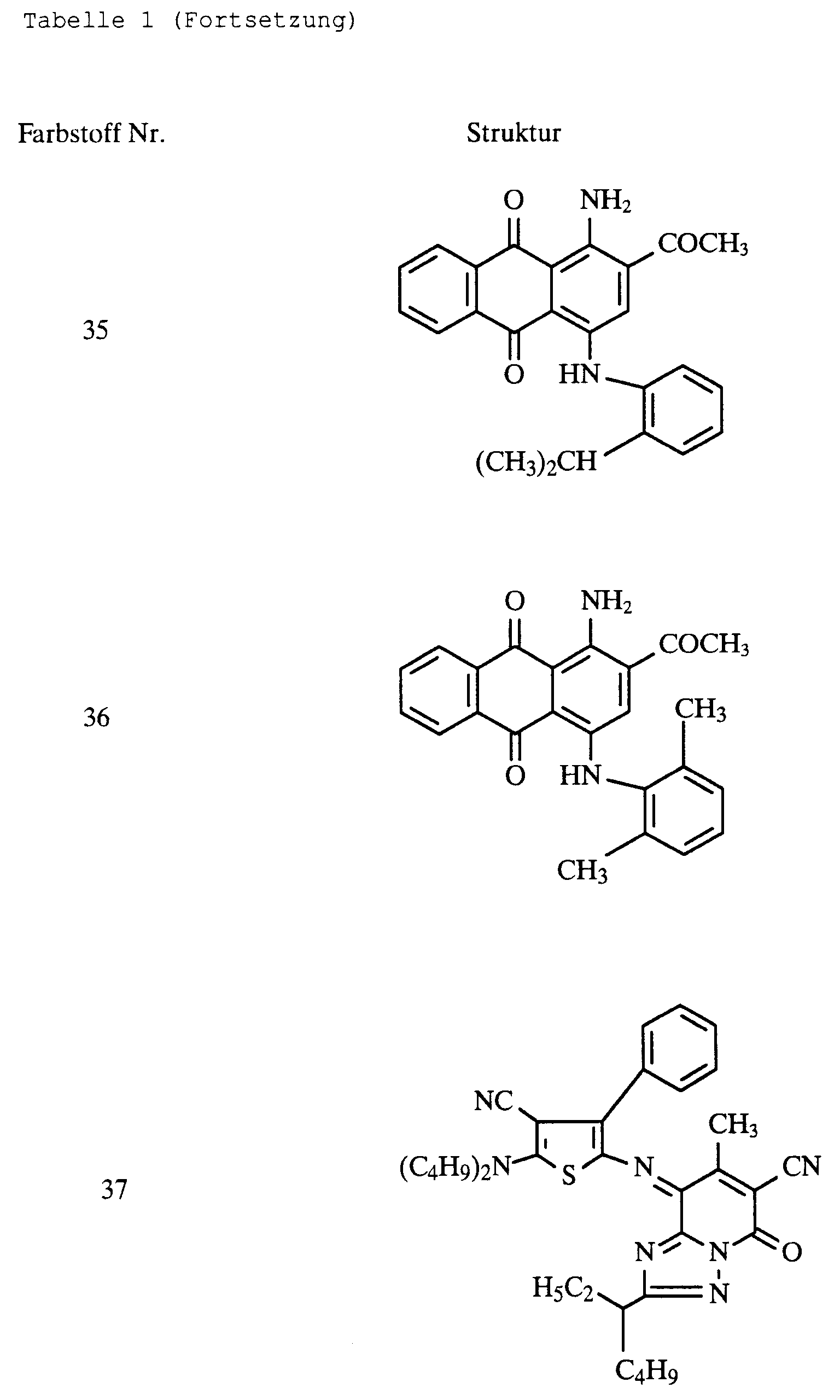
- In der folgenden Tabelle 1 sind die Einzelfarbstoffe aufgeführt, die als Mischungspartner dienten.


- In der folgenden Tabelle 2 sind die Lichtechtheit (LE) der Einzelfarbstoffe 1 bis 31 sowie ihre thermische Stabilität (TS) aufgeführt. Als Wert für die Beurteilung der Lichtechtheit ist (hier und im folgenden) die Anzahl der Bestrahlungsstunden angegeben, nach der 20 % der ursprünglich vorhandenen Farbstoffmenge zerstört war.
- Die thermische Stabilität wird durch Lagern der Drucke im Trockenschrank (1 Woche bei 70°C) bestimmt. Sie wird durch Noten beurteilt, die von 1 bis 6 reichen. Die Note 1 steht für sehr gut, die Note 6 für ungenügend.


- Allgemeine Vorschrift:
- a) 10 g Farbstoffmischung werden, gegebenenfalls unter kurzzeitigem Erwärmen auf 80 bis 90°C, in 100 g einer 10 gew.%igen Lösung eines Bindemittels (Vylon® 290 der Firma Toyobo) in ein Methylethylketon/Toluol/Cyclohexanon-Gemisch (4,5:2:2 v/v/v) eingerührt.
Die Drucktinte wird mit einer 6 µm Rakel auf eine Polyesterfolie von 6 µm Dicke, auf deren Rückseite eine geeignete Gleitschicht aufgebracht ist, aufgerakelt und mit einem Föhn 1 Minute trockengeblasen. Bevor das Farbband verdruckt werden kann, muß es mindestens 24 Stunden an der Luft nachtrocknen, da Restlösungsmittel den Druckvorgang beeinträchtigen können. - b) Die Farbbänder werden auf einer rechnergesteuerten Versuchsanordnung, die mit einem handelsüblichen Thermokopf ausgestattet ist, auf Hitachi VY-S Videoprinterpapier verdruckt.
Durch Veränderung der Spannung wird die Energieabgabe des Thermokopfs gesteuert, wobei die eingestellte Impulsdauer 7ms beträgt und immer nur ein Impuls abgegeben wird. Die abgegebene Energie liegt zwischen 0,7 und 2,0 mJ/Dot.
Da die Höhe der Anfärbung direkt proportional der zugeführten Energie ist, kann ein Farbkeil erzeugt und spektroskopisch ausgewertet werden.
Aus der graphischen Auftragung der Farbtiefe gegen die zugeführte Energie je Heizelement wird der Q*-Wert (= Energie in mJ für den Extinktionswert 1) und die Steigung m in 1/mJ ermittelt. - Die erhaltenen Ergebnisse sind in der folgenden Tabelle 3 aufgeführt, wobei zusätzlich noch das Mischungsverhältnis (MV - Gewichtsverhältnis), die Lichtechtheit sowie die thermische Stabilität angegeben sind.


- Unter der Annahme, daß die Farbstoffe exponentiell mit der Zeit und unabhängig voneinander unter Lichteinwirkung zerfallen, wurden für die Mischungen 1/2, 1/6 und 1/13 folgende LE-Werte rechnerisch bestimmt: 58, 12,5 und 55.
Claims (4)
- Farbstoffmischungen, enthaltend mindestens einen Anthrachinonfarbstoff, dessen Absorptionsmaximum bei einer Wellenlänge von 600 bis 750 nm liegt, sowie mindestens einen Farbstoff der Formel I, II, III, IV und/oder V
 L¹ C₁-C₂₀-Alkyl, das gegebenenfalls substituiert ist und durch 1 bis 4 Sauerstoffatome in Etherfunktion unterbrochen sein kann, gegebenenfalls substituiertes Phenyl oder Hydroxy,L² einen 5- oder 6-gliedrigen carbocyclischen oder heterocyclischen Rest,L³ Cyano, Carbamoyl, Carboxyl oder C₁-C₄-Alkoxycarbonyl,L⁴ Sauerstoff oder einen Rest der Formel
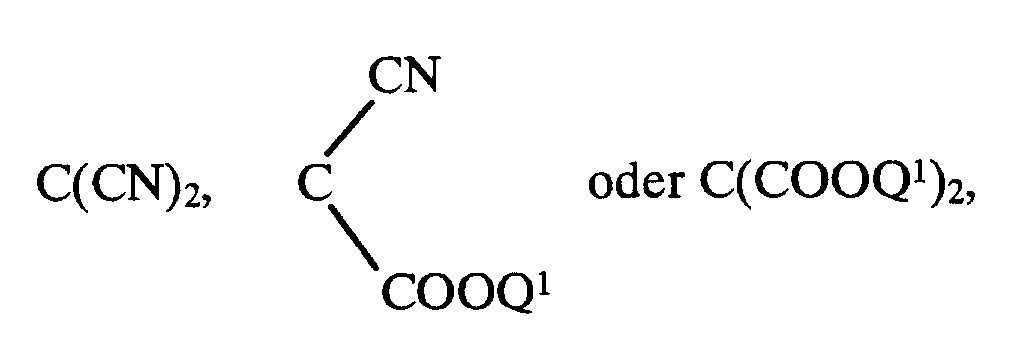 X CH oder Stickstoff,L⁵ Wasserstoff oder C₁-C₄-Alkyl,L⁶ und L⁷ gleich oder verschieden sind und unabhängig voneinander jeweils Wasserstoff, gegebenenfalls substituiertes C₁-C₁₂-Alkyl, C₅-C₇-Cycloalkyl, gegebenenfalls substituiertes Phenyl, gegebenenfalls substituiertes Pyridyl, gegebenenfalls substituiertes C₁-C₁₂-Alkanoyl, C₁-C₁₂-Alkoxycarbonyl, gegebenenfalls substituiertes C₁-C₁₂-Alkylsulfonyl, C₅-C₇-Cycloalkylsulfonyl, gegebenenfalls substituiertes Phenylsulfonyl, gegebenenfalls substituiertes Pyridylsulfonyl, gegebenenfalls substituiertes Benzoyl, Pyridylcarbonyl oder Thienylcarbonyl oder L⁶ und L⁷ zusammen mit dem sie verbindenden Stickstoffatom gegebenenfalls durch C₁-C₄-Alkyl substituiertes Succinimido, gegebenenfalls durch C₁-C₄-Alkyl substituiertes Phthalimido oder einen fünf-oder sechsgliedrigen gesättigten heterocyclischen Rest, der gegebenenfalls weitere Heteroatome enthält,Y Cyano oder einen Rest der Formel CO-Q², CO-OQ² oder CO-NHQ², worin Q² für Wasserstoff, C₁-C₈-Alkyl, das gegebenenfalls substituiert ist und durch 1 oder 2 Sauerstoffatome in Etherfunktion unterbrochen sein kann, C₅-C₇-Cycloalkyl, Phenyl oder Tolyl steht,L⁸ Wasserstoff, Fluor, Chlor, Methyl oder einen Rest der Formel -NH-CO-A¹, -NH-CO-OA¹, -NH-CO-NA¹A², -NH-CS-OA¹, -NH-CS-NA¹A², -NH-CO-A³, -NH-SO₂-A¹, -NH-SO₂-A³ oder -NH-SO₂-NA¹A², worinA¹ und A² gleich oder verschieden sind und unabhängig voneinander jeweils für C₁-C₈-Alkyl, das gegebenenfalls substituiert ist und durch 1 oder 2 Sauerstoffatome in Etherfunktion unterbrochen sein kann, C₅-C₇-Cycloalkyl, Phenyl oder Tolyl oder -NA¹A² auch für Amino undA³ für einen fünf- oder sechsgliedrigen aromatischen heterocyclischen Rest, der gegebenenfalls benzoanelliert ist und ein oder mehrere Heteroatome, ausgewählt aus der Gruppe, bestehend aus Stickstoff, Sauerstoff und Schwefel, aufweist, stehen,L⁹ Wasserstoff, Fluor oder Chlor oder L⁸ und L⁹ zusammen mit den Kohlenstoffatomen an die sie geknüpft sind, einen fünf- oder sechsgliedrigen aromatischen carbocyclischen oder heterocyclischen Ring,L¹⁰ den obengenannten Rest A³ oder einen Rest der Formel -CO-OA¹, -CO-NH-A¹, -CO-NH-CO-A¹, -CO-NH-CO-A³ -CO-NH-SO₂-A³, -NH-CO-A¹, -NH-CO-OA¹, -NH-CO-NA¹A², -NH-CS-OA¹, -NH-CS-NA¹A², -NH-CO-A³, -NH-SO₂-A¹, -NH-SO₂-A³ oder -NH-SO₂-NA¹A², worin A¹, A² und A³ jeweils die obengenannte Bedeutung besitzen,L¹¹ Fluor, Chlor oder Brom,L¹² Wasserstoff oder C₁-C₄-Alkyl undL¹³ Wasserstoff, Fluor, Chlor oder Brom bedeuten.
 - Farbstoffmischungen nach Anspruch 1, enthaltend mindestens einen Anthrachinonfarbstoff der Formel VI, VII und/oder VIII
 a 0 oder 1,R¹, R² und R³ gleich oder verschieden sind und unabhängig voneinander jeweils Wasserstoff, Alkyl, Alkoxyalkyl, Alkanoyloxyalkyl, Alkoxycarbonyloxyalkyl oder Alkoxycarbonylalkyl, wobei diese Reste jeweils bis zu 20 Kohlenstoffatome aufweisen und durch Phenyl, C₁-C₄-Alkylphenyl, C₁-C₄-Alkoxyphenyl, Halogenphenyl, Benzyloxy, C₁-C₄-Alkylbenzyloxy, C₁-C₄-Alkoxybenzyloxy, Halogenbenzyloxy, Halogen, Hydroxy oder Cyano substituiert sein können, gegebenenfalls durch C₁-C₁₅-Alkyl, C₁-C₁₅-Alkoxy, Halogen oder Benzyloxy substituiertes Phenyl, gegebenenfalls durch C₁-C₁₅-Alkyl, C₁-C₁₅-Alkoxy, Halogen oder Benzyloxy substituiertes Cyclohexyl oder einen Rest der Formel
[-E-O]m-R⁵,
worinE für C₂-C₆-Alkylenm für 1, 2, 3, 4, 5 oder 6 undR⁵ für C₁-C₄-Alkyl oder gegebenenfalls durch C₁-C₄-Alkyl oder C₁-C₄-Alkoxy substituiertes Phenyl stehen, undR⁴ Wasserstoff oder Cyano bedeuten,mit der Maßgabe, daß R² nur dann Wasserstoff bedeutet, wenn a 0 ist. - Farbstoffmischungen nach Anspruch 1, enthaltend 10 bis 90 Gew.%, bezogen auf das Gewicht der Farbstoffmischung, einen oder mehrere Anthrachinonfarbstoffe sowie 10 bis 90 Gew.%, bezogen auf das Gewicht der Farbstoffmischung, einen oder mehrere Farbstoffe der Formel I, II, III, IV und/oder V.
- Verfahren zur Übertragung von Farbstoffen von einem Träger auf ein mit Kunststoff beschichtetes Papier durch Diffusion oder Sublimation mit Hilfe einer Energiequelle, dadurch gekennzeichnet, daß man einen Träger verwendet, auf dem sich eine Farbstoffmischung gemäß Anspruch 1 befindet.
Applications Claiming Priority (2)
| Application Number | Priority Date | Filing Date | Title |
|---|---|---|---|
| DE4215536 | 1992-05-12 | ||
| DE4215536A DE4215536A1 (de) | 1992-05-12 | 1992-05-12 | Cyan-Mischungen für den Farbstofftransfer |
Publications (2)
| Publication Number | Publication Date |
|---|---|
| EP0569784A1 true EP0569784A1 (de) | 1993-11-18 |
| EP0569784B1 EP0569784B1 (de) | 1997-07-16 |
Family
ID=6458621
Family Applications (1)
| Application Number | Title | Priority Date | Filing Date |
|---|---|---|---|
| EP93106938A Expired - Lifetime EP0569784B1 (de) | 1992-05-12 | 1993-04-29 | Cyan-Mischungen für den Farbstofftransfer |
Country Status (4)
| Country | Link |
|---|---|
| US (2) | US5421834A (de) |
| EP (1) | EP0569784B1 (de) |
| JP (1) | JP3461858B2 (de) |
| DE (2) | DE4215536A1 (de) |
Cited By (7)
| Publication number | Priority date | Publication date | Assignee | Title |
|---|---|---|---|---|
| EP0591736A2 (de) | 1992-09-29 | 1994-04-13 | BASF Aktiengesellschaft | Verwendung von Pyridinfarbstoffen im textilen Bereich, Farbstoffmischungen, enthaltend Pyridinfarbstoffe, sowie Triazolopyridinfarbstoffe mit einem Thienylrest |
| EP0680834A1 (de) * | 1994-05-02 | 1995-11-08 | Basf Aktiengesellschaft | Thermische Übertragung von Pyridonfarbstoffen |
| EP0761464A1 (de) * | 1995-09-07 | 1997-03-12 | Basf Aktiengesellschaft | Thermischer Transfer von Farbstoffmischungen, enthaltend Azamethinfarbstoffe |
| EP0763571A1 (de) * | 1995-09-07 | 1997-03-19 | Basf Aktiengesellschaft | Farbmischungen, enhaltend Methin- und Anthrachinonfarbstoffe |
| WO1997047690A1 (de) * | 1996-06-12 | 1997-12-18 | Basf Aktiengesellschaft | Farbstoffmischungen |
| EP0968838A1 (de) * | 1998-06-29 | 2000-01-05 | Dai Nippon Printing Co., Ltd. | Thermisches Übertragungsblatt, das ein Farbstoffgemisch enthält |
| CN105566947A (zh) * | 2016-01-11 | 2016-05-11 | 浙江龙盛集团股份有限公司 | 一种分散蓝至黑色染料组合物及其染料制品和应用 |
Families Citing this family (10)
| Publication number | Priority date | Publication date | Assignee | Title |
|---|---|---|---|---|
| DE4405167A1 (de) * | 1994-02-18 | 1995-08-24 | Basf Ag | Triazolopyridinfarbstoffe |
| US5813217A (en) * | 1996-04-05 | 1998-09-29 | Beall; James C. | Ion beam thrust method |
| US5792587A (en) * | 1997-08-29 | 1998-08-11 | Eastman Kodak Company | Cyan dye mixtures for thermal color proofing |
| US5874196A (en) * | 1997-08-29 | 1999-02-23 | Eastman Kodak Company | Cyan dye mixtures for thermal color proofing |
| RU2263672C2 (ru) * | 2000-02-11 | 2005-11-10 | Рисерч Дивелопмент Фаундейшн | Токоферолы, токотриенолы, другие хроманы и производные по боковым цепям и их применение |
| JP4911191B2 (ja) * | 2009-04-08 | 2012-04-04 | 株式会社ニコン | 画像処理装置および画像処理プログラム |
| JP6543116B2 (ja) * | 2015-07-02 | 2019-07-10 | キヤノン株式会社 | 色素化合物、トナー及び該トナーの製造方法 |
| JP2017014414A (ja) * | 2015-07-02 | 2017-01-19 | キヤノン株式会社 | 色素化合物、トナー及び該トナーの製造方法 |
| JP6921902B2 (ja) * | 2018-07-30 | 2021-08-18 | キヤノン株式会社 | 化合物、インク、カラーフィルター用レジスト組成物、カラーフィルター、感熱転写記録用シート、及びトナー |
| JP7679201B2 (ja) * | 2020-01-27 | 2025-05-19 | キヤノン株式会社 | 筆記具用油性インキ組成物、筆記具用水性インキ組成物およびボールペン |
Family Cites Families (10)
| Publication number | Priority date | Publication date | Assignee | Title |
|---|---|---|---|---|
| DE3812053A1 (de) * | 1988-04-12 | 1989-10-26 | Basf Ag | Verfahren zur uebertragung von farbstoffen |
| GB8817219D0 (en) * | 1988-07-20 | 1988-08-24 | Ici Plc | Thermal transfer printing |
| US4975410A (en) * | 1989-05-26 | 1990-12-04 | Eastman Kodak Company | Thermally-transferred color filter array element and process for preparing |
| DE3929698A1 (de) * | 1989-09-07 | 1991-03-14 | Basf Ag | Triazolopyridinfarbstoffe sowie ein verfahren zum thermischen transfer von methinfarbstoffen |
| DE4004612A1 (de) * | 1990-02-15 | 1991-08-22 | Basf Ag | Neue bichromophore methin- und azamethinfarbstoffe und ein verfahren zu ihrer uebertragung |
| DE59008090D1 (de) * | 1990-06-12 | 1995-02-02 | Siemens Ag | Überabtastender Analog-Digital-Umsetzer mit Rauschfilterung in Switched-Capacitor-Technik. |
| CH683639A5 (fr) * | 1990-06-27 | 1994-04-15 | Baumer Electric Ag | Capteur de position pour déterminer la position angulaire d'un arbre rotatif. |
| DE4031254A1 (de) * | 1990-10-04 | 1992-04-09 | Basf Ag | Chinolinmethinfarbstoffe sowie ein verfahren zur thermischen uebertragung von methinfarbstoffen |
| DE4031722A1 (de) * | 1990-10-06 | 1992-04-09 | Basf Ag | Pyridonfarbstoffe und ein verfahren zu ihrer thermischen uebertragung |
| DE4031984A1 (de) * | 1990-10-09 | 1992-04-16 | Basf Ag | Verwendung von anthrachinonfarbstoffen fuer den thermotransferdruck |
-
1992
- 1992-05-12 DE DE4215536A patent/DE4215536A1/de not_active Withdrawn
-
1993
- 1993-04-29 DE DE59306911T patent/DE59306911D1/de not_active Expired - Lifetime
- 1993-04-29 EP EP93106938A patent/EP0569784B1/de not_active Expired - Lifetime
- 1993-05-10 JP JP10817493A patent/JP3461858B2/ja not_active Expired - Lifetime
- 1993-05-10 US US08/058,228 patent/US5421834A/en not_active Expired - Lifetime
-
1995
- 1995-01-23 US US08/376,391 patent/US5489312A/en not_active Expired - Lifetime
Cited By (10)
| Publication number | Priority date | Publication date | Assignee | Title |
|---|---|---|---|---|
| EP0591736A2 (de) | 1992-09-29 | 1994-04-13 | BASF Aktiengesellschaft | Verwendung von Pyridinfarbstoffen im textilen Bereich, Farbstoffmischungen, enthaltend Pyridinfarbstoffe, sowie Triazolopyridinfarbstoffe mit einem Thienylrest |
| EP0680834A1 (de) * | 1994-05-02 | 1995-11-08 | Basf Aktiengesellschaft | Thermische Übertragung von Pyridonfarbstoffen |
| US5545235A (en) * | 1994-05-02 | 1996-08-13 | Basf Aktiengesellschaft | Thermal transfer of pyridone dyes |
| EP0761464A1 (de) * | 1995-09-07 | 1997-03-12 | Basf Aktiengesellschaft | Thermischer Transfer von Farbstoffmischungen, enthaltend Azamethinfarbstoffe |
| EP0763571A1 (de) * | 1995-09-07 | 1997-03-19 | Basf Aktiengesellschaft | Farbmischungen, enhaltend Methin- und Anthrachinonfarbstoffe |
| US5853432A (en) * | 1995-09-07 | 1998-12-29 | Basf Aktiengesellschaft | Dye mixtures comprising methine and anthraquinone dyes |
| WO1997047690A1 (de) * | 1996-06-12 | 1997-12-18 | Basf Aktiengesellschaft | Farbstoffmischungen |
| EP0968838A1 (de) * | 1998-06-29 | 2000-01-05 | Dai Nippon Printing Co., Ltd. | Thermisches Übertragungsblatt, das ein Farbstoffgemisch enthält |
| CN105566947A (zh) * | 2016-01-11 | 2016-05-11 | 浙江龙盛集团股份有限公司 | 一种分散蓝至黑色染料组合物及其染料制品和应用 |
| CN105566947B (zh) * | 2016-01-11 | 2018-05-08 | 浙江龙盛集团股份有限公司 | 一种分散蓝至黑色染料组合物及其染料制品和应用 |
Also Published As
| Publication number | Publication date |
|---|---|
| JPH0665519A (ja) | 1994-03-08 |
| DE59306911D1 (de) | 1997-08-21 |
| US5489312A (en) | 1996-02-06 |
| EP0569784B1 (de) | 1997-07-16 |
| JP3461858B2 (ja) | 2003-10-27 |
| DE4215536A1 (de) | 1993-11-18 |
| US5421834A (en) | 1995-06-06 |
Similar Documents
| Publication | Publication Date | Title |
|---|---|---|
| EP0582579B1 (de) | N-aminopyridonfarbstoffe | |
| EP0569784B1 (de) | Cyan-Mischungen für den Farbstofftransfer | |
| EP0569785B1 (de) | Farbstoffmischungen für den Farbstofftransfer | |
| EP0787169B1 (de) | Farbstoffmischungen, enthaltend methin- und azofarbstoffe | |
| EP0763571B1 (de) | Farbmischungen, enhaltend Methin- und Anthrachinonfarbstoffe | |
| DE19611351A1 (de) | Farbstoffmischungen, enthaltend Thienyl- und/oder Thiazolazofarbstoffe | |
| EP0680834B1 (de) | Thermische Übertragung von Pyridonfarbstoffen | |
| WO1997047690A1 (de) | Farbstoffmischungen | |
| EP0480252A1 (de) | Pyridonfarbstoffe und ein Verfahren zu ihrer thermischen Übertragung | |
| EP0745107B1 (de) | Triazolopyridinfarbstoffe | |
| EP0761464B1 (de) | Thermischer Transfer von Farbstoffmischungen, enthaltend Azamethinfarbstoffe | |
| EP0727463A2 (de) | Triazolopyridinfarbstoffe und deren Zwischenprodukte | |
| EP0736575B1 (de) | Azamethinfarbstoffe mit heterocyclischen Seitengruppen | |
| EP0791035B1 (de) | Azamethinfarbstoffe | |
| EP0509302A1 (de) | Verfahren zur Übertragung von Methinfarbstoffen | |
| EP0796297B1 (de) | Methinfarbstoffe auf basis von formylaminopyridonen | |
| DE4442391A1 (de) | Thermische Übertragung von Azamethinfarbstoffen auf Pyridonbasis | |
| DE4114456A1 (de) | N-aminopyridonfarbstoffe | |
| DE4134805A1 (de) | N-acylaminopyridonfarbstoffe |
Legal Events
| Date | Code | Title | Description |
|---|---|---|---|
| PUAI | Public reference made under article 153(3) epc to a published international application that has entered the european phase |
Free format text: ORIGINAL CODE: 0009012 |
|
| 17P | Request for examination filed |
Effective date: 19930902 |
|
| AK | Designated contracting states |
Kind code of ref document: A1 Designated state(s): CH DE FR GB IT LI |
|
| GRAG | Despatch of communication of intention to grant |
Free format text: ORIGINAL CODE: EPIDOS AGRA |
|
| GRAH | Despatch of communication of intention to grant a patent |
Free format text: ORIGINAL CODE: EPIDOS IGRA |
|
| 17Q | First examination report despatched |
Effective date: 19960911 |
|
| GRAH | Despatch of communication of intention to grant a patent |
Free format text: ORIGINAL CODE: EPIDOS IGRA |
|
| GRAA | (expected) grant |
Free format text: ORIGINAL CODE: 0009210 |
|
| AK | Designated contracting states |
Kind code of ref document: B1 Designated state(s): CH DE FR GB IT LI |
|
| REG | Reference to a national code |
Ref country code: CH Ref legal event code: EP |
|
| GBT | Gb: translation of ep patent filed (gb section 77(6)(a)/1977) |
Effective date: 19970729 |
|
| REF | Corresponds to: |
Ref document number: 59306911 Country of ref document: DE Date of ref document: 19970821 |
|
| ITF | It: translation for a ep patent filed | ||
| ET | Fr: translation filed | ||
| PLBE | No opposition filed within time limit |
Free format text: ORIGINAL CODE: 0009261 |
|
| 26N | No opposition filed | ||
| REG | Reference to a national code |
Ref country code: GB Ref legal event code: IF02 |
|
| PG25 | Lapsed in a contracting state [announced via postgrant information from national office to epo] |
Ref country code: IT Free format text: LAPSE BECAUSE OF NON-PAYMENT OF DUE FEES;WARNING: LAPSES OF ITALIAN PATENTS WITH EFFECTIVE DATE BEFORE 2007 MAY HAVE OCCURRED AT ANY TIME BEFORE 2007. THE CORRECT EFFECTIVE DATE MAY BE DIFFERENT FROM THE ONE RECORDED. Effective date: 20050429 |
|
| REG | Reference to a national code |
Ref country code: CH Ref legal event code: PUE Owner name: DYSTAR TEXTILFARBEN GMBH & CO. DEUTSCHLAND KG Free format text: BASF AKTIENGESELLSCHAFT#CARL-BOSCH-STRASSE 38#67063 LUDWIGSHAFEN (DE) -TRANSFER TO- DYSTAR TEXTILFARBEN GMBH & CO. DEUTSCHLAND KG#INDUSTRIEPARK HOECHST#65926 FRANKFURT (DE) Ref country code: CH Ref legal event code: NV Representative=s name: PATENTANWAELTE SCHAAD, BALASS, MENZL & PARTNER AG |
|
| REG | Reference to a national code |
Ref country code: GB Ref legal event code: 732E |
|
| REG | Reference to a national code |
Ref country code: FR Ref legal event code: TP |
|
| REG | Reference to a national code |
Ref country code: GB Ref legal event code: 732E Free format text: REGISTERED BETWEEN 20110303 AND 20110309 |
|
| REG | Reference to a national code |
Ref country code: FR Ref legal event code: TP |
|
| REG | Reference to a national code |
Ref country code: DE Ref legal event code: R081 Ref document number: 59306911 Country of ref document: DE Owner name: DYSTAR COLOURS DISTRIBUTION GMBH, DE Free format text: FORMER OWNER: DYSTAR COLOURS DEUTSCHLAND GMBH, 65929 FRANKFURT, DE Effective date: 20111216 |
|
| PGFP | Annual fee paid to national office [announced via postgrant information from national office to epo] |
Ref country code: CH Payment date: 20120412 Year of fee payment: 20 |
|
| REG | Reference to a national code |
Ref country code: GB Ref legal event code: 732E Free format text: REGISTERED BETWEEN 20120726 AND 20120801 |
|
| PGFP | Annual fee paid to national office [announced via postgrant information from national office to epo] |
Ref country code: FR Payment date: 20120504 Year of fee payment: 20 Ref country code: GB Payment date: 20120425 Year of fee payment: 20 |
|
| REG | Reference to a national code |
Ref country code: CH Ref legal event code: PUE Owner name: DYSTAR COLOURS DISTRIBUTION GMBH Free format text: DYSTAR TEXTILFARBEN GMBH & CO. DEUTSCHLAND KG#INDUSTRIEPARK HOECHST#65926 FRANKFURT (DE) -TRANSFER TO- DYSTAR COLOURS DISTRIBUTION GMBH#INDUSTRIEPARK HOECHST#65926 FRANKFURT AM MAIN (DE) |
|
| PGFP | Annual fee paid to national office [announced via postgrant information from national office to epo] |
Ref country code: DE Payment date: 20120628 Year of fee payment: 20 |
|
| REG | Reference to a national code |
Ref country code: DE Ref legal event code: R071 Ref document number: 59306911 Country of ref document: DE |
|
| REG | Reference to a national code |
Ref country code: CH Ref legal event code: PL |
|
| REG | Reference to a national code |
Ref country code: GB Ref legal event code: PE20 Expiry date: 20130428 |
|
| PG25 | Lapsed in a contracting state [announced via postgrant information from national office to epo] |
Ref country code: DE Free format text: LAPSE BECAUSE OF EXPIRATION OF PROTECTION Effective date: 20130430 Ref country code: GB Free format text: LAPSE BECAUSE OF EXPIRATION OF PROTECTION Effective date: 20130428 |