EP0568872B1 - Verfahren zur Herstellung von Dihydroxyaceton - Google Patents
Verfahren zur Herstellung von Dihydroxyaceton Download PDFInfo
- Publication number
- EP0568872B1 EP0568872B1 EP93106595A EP93106595A EP0568872B1 EP 0568872 B1 EP0568872 B1 EP 0568872B1 EP 93106595 A EP93106595 A EP 93106595A EP 93106595 A EP93106595 A EP 93106595A EP 0568872 B1 EP0568872 B1 EP 0568872B1
- Authority
- EP
- European Patent Office
- Prior art keywords
- thiazolium
- formaldehyde
- catalysts
- reaction
- organic
- Prior art date
- Legal status (The legal status is an assumption and is not a legal conclusion. Google has not performed a legal analysis and makes no representation as to the accuracy of the status listed.)
- Expired - Lifetime
Links
- 0 C1CC*CC1 Chemical compound C1CC*CC1 0.000 description 3
Classifications
-
- C—CHEMISTRY; METALLURGY
- C07—ORGANIC CHEMISTRY
- C07C—ACYCLIC OR CARBOCYCLIC COMPOUNDS
- C07C45/00—Preparation of compounds having >C = O groups bound only to carbon or hydrogen atoms; Preparation of chelates of such compounds
Definitions
- the present invention relates to a process for the preparation of dihydroxyacetone by the thiazolium ylide-catalyzed condensation of formaldehyde.
- the thiazoliumylide-catalyzed conversion of formaldehyde to DHA must be carried out in an essentially water-free reaction medium, water contents of less than 0.4% by weight, preferably less than 0.1% by weight. -% are understood. For this reason, dry, anhydrous formaldehyde is also used as a starting material in this process.
- catalytically active thiazoliumylides can also be produced from thiazolium salts by dissolving the corresponding thiazolium salts in an organic solvent and extracting their anions from the organic solution using water. After extraction is complete, the aqueous phase is separated from the organic phase. The residual amounts of water dissolved in the organic medium are then azeotropically distilled off with some of the organic solvents. The condensation of the anhydrous formaldehyde dissolved in the organic phase to give DHA does not begin until the water content of the reaction medium has dropped to 0.1% by weight.
- JP-A 112847/1992 relates to a process for the preparation of 1,3-dihydroxyacetone by the condensation of formaldehyde by means of a quaternary thiazolium salt catalyst bonded to a polystyrene resin in an aqueous medium.
- Formaldehyde is obtained as an aqueous solution in practically all industrial manufacturing processes.
- the extraction of anhydrous formaldehyde for example in the form of dried solutions of paraformaldehyde or gaseous formaldehyde, is associated with considerable additional technical expenditure, which increases the economics of processes for the production of DHA and in particular of its secondary products glycerol (EP-A 306 215) and 1 , 2-propanediol (German patent application no. P 41 38 792.9) severely impaired.
- the present invention was therefore based on the object of finding a process by which it is possible to prepare DHA from crude aqueous formaldehyde solutions without further working up using thiazolium ylide catalysts.
- a process for the preparation of dihydroxyacetone by the thiazoliumylide-catalyzed condensation of formaldehyde was found, which is characterized in that the reaction in a reaction system consisting of an aqueous and at least one liquid organic phase and at a pH of the aqueous phase of less than 8 runs.
- a reaction system which consists of at least one organic, water-immiscible, liquid phase and an aqueous phase.
- the catalyst for example a thiazolium ylide, is essentially in the organic phase, whereas the formaldehyde to be condensed preferably dissolves in the aqueous phase.
- the chemical processes taking place in the process according to the invention can be described in a simplified manner in such a way that the formaldehyde may be transported from the aqueous phase into the organic phase with the cooperation of the organic solvent used and there, from the catalyst essentially dissolved in the organic phase to DHA is condensed, which then migrates into the aqueous phase from which it can be isolated.
- the method according to the invention thus takes place under phase transfer catalysis.
- the formaldehyde is generally used in the form of its aqueous solution.
- the formaldehyde can also be supplied in another form, for example as a formaldehyde / water vapor gas mixture.
- the catalysts for the condensation of formaldehyde are essentially in the water-immiscible, organic phase.
- This water-immiscible, liquid organic phase is generally an organic solvent, but it can also be a liquid, organic phase which has been applied to an organic or inorganic support material and adheres firmly to it, in which the catalyst is dissolved.
- the catalyst itself can be used as an organic phase, for example in the form of its melt.
- a large number of water-immiscible organic solvents are suitable as organic solvents in the process according to the invention, for example higher alcohols, water-insoluble N, N-dialkylformamides, water-insoluble N-alkylpyrrolidones, hydrocarbons or halogenated hydrocarbons.
- Higher alcohols, in particular C 5 -C 30 alcohols and water-insoluble N, N-dialkylformamides, such as N, N-dipropylformamide, N, N-dibutylformamide, N, N-dipentylformamide, etc., are particularly preferably used.
- Particularly advantageous alcoholic solvents are C 6 -C 22 alcohols, such as n-hexanol, cyclohexanol, 2-ethylhexanol, n-octanol, nonanols, decanols, dodecanols, hexadecanols and eicosanols, of which such alcohols are preferred because of their good technical accessibility that are derived from naturally occurring fatty acids or are produced in large quantities like 2-ethylhexanol for other technical uses and are therefore available at low cost.
- mixtures of various water-insoluble organic solvents can be used with good success.
- Support-supported liquid organic phases can be produced, for example, by applying a support material with a large surface area with a solution of the catalyst in a lipophilic organic solvent, optionally with the addition of a volatile auxiliary solvent.
- a support material with a large surface area with a solution of the catalyst in a lipophilic organic solvent, optionally with the addition of a volatile auxiliary solvent.
- all the techniques can be used as are common for the preparation of carrier materials for gas chromatography.
- lipophilic catalysts used, e.g. with long chain lipophilic residues, e.g. Long-chain alkyl radicals are substituted, these catalysts can form the liquid organic phase even in the presence or in the absence of an organic solvent.
- a volume ratio of aqueous phase / organic phase generally being from 0.01 to 5, preferably from 0.1 to 1 and particularly preferably from 0.2 to 0 , 5 is set.
- the use of larger amounts of water is also possible, but this generally does not lead to further advantages.
- Catalysts containing thiazolium ring which are unsubstituted in the 2-position of the thiazolium ring, for example thiazoliumylides of the formula I, are advantageously used as catalysts in the process according to the invention If these ylides are isolated, dimers of the formula Ia are obtained depending on the type of production of the thiazoliumylides or alcohol adducts of the formula Ib
- the compounds of formula Ia can preferably be isolated from thiazolium ylide solutions which e.g. have been obtained by deprotonation of the thiazolium salts in question using amines, whereas the compounds Ib can preferably be obtained from thiazolium ylide solutions which have been produced, for example, by reacting N-formyl-N-alkyl-o-mercaptoaniline derivatives with orthoformates.
- the compounds Ia and Ib are stable, can be obtained in crystalline form and in particular Ib can be used as a stable storage form for the Ylide I.
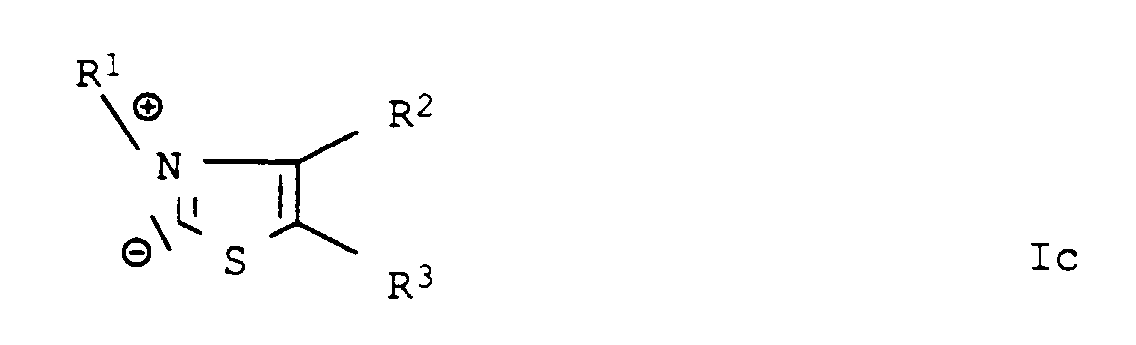
- the thiazoliumylides produced therefrom are unsubstituted in the 2-position of the thiazolium ring. Otherwise, the thiazolium ylide catalysts can be substituted with any substituents R ', R''orR'''.
- R 1 for example for a C 1 -C 30 -alkyl group, preferably a C 2 - to C 20 -alkyl group or a haloalkyl group with a corresponding carbon number, which may preferably contain fluorine or chlorine atoms as
- the radicals R 2 to R 5 can in principle be of any type, provided that they are inert under the reaction conditions.
- the radicals R 2 , R 3 , R 4 and R 5 can be the same or different and, for hydrogen, a halogen atom, a C 1 to C 20 alkyl or alkoxy group, preferably a C 1 to C 4 alkyl group , a C 1 to C 20 , preferably a C 2 to C 4 carboxamido group, a C 7 to C 12 aralkyl group, preferably the benzyl group and / or a phenyl and naphthyl group.
- the radicals R 1 , R 2 , R 3 , R 4 and R 5 can, if desired, carry substituents which are inert under the reaction conditions, such as alkyl groups, alkoxy groups, halogen atoms, C 2 - to C 10 -dialkylamino groups, C 1 - to C 10 -thioether groups , Nitro groups or nitro groups. Since the preparation of thiazolium salts, in which the radicals R 1 , R 2 , R 3 , R 4 and R 5 carry such additional substituents, is generally quite complex, since expensive starting materials generally have to be used, the use of which is prepared thiazolium or benzothiazoliumylide in the invention Processes generally less preferred for cost reasons.
- thiazoliumylides of the formula Ic and polynuclear-aromatic thiazoliumylides, such as benzothiazoliumylide Id or naphthathiazoliumylide.
- the naphthathiazoliumylides of the formula II are particularly preferred used, the same provisions apply to their additional radicals R 6 to R 7 as set out above for the radicals R 2 to R 5 , ie the radicals R 6 to R 7 have the same meaning as they do for the radicals R. 2 to R 5 was specified.
- Long-chain radicals R 1 in particular can increase the lipophilicity of the thiazolium salts and the thiazolium ylide catalysts prepared therefrom and thus their solubility in the organic solvent of the two-phase system used according to the invention.
- the thiazolium, benzothiazolium and naphthathiazoliumylides can also be bound to a polymeric, organic or inorganic support, for example a crosslinked styrene-divinylbenzene resin or a phenol-formaldehyde resin, for example via the radical R 1 , the radical R 1 being a C 1 to C 25 , preferably a C 1 to C 4 alkylene group.
- thiazolium ylide catalysts there are various ways of producing these thiazolium ylide catalysts.
- the thiazoliumylides in question can be dissolved by heating the inner, betaine-like thiazolium salts of the general formula III be generated with elimination of carbon dioxide.
- the compounds IV form in the reaction of the N-alkyl-o-mercaptoanilines with formic acid and its derivatives, such as formic acids and orthoformic acid esters.
- the o-mercaptoanilines used as starting products for the preparation of these compounds can be obtained, for example, by the process of DE-PS 367 346.
- the radicals R of the orthoformic acid esters are preferably C 1 -C 4 -alkyl groups.
- Another method for producing the thiazolium ylide catalysts I is to deprotonate the corresponding thiazolium ring-containing compounds, such as those of the formula V.
- the counter anion X ⁇ to the positively charged thiazolium cation can be chosen arbitrarily and can be, for example, a halide anion or a nitrate, perchlorate, tetrafluoroborate, toluenesulfonate, methanesulfonate, benzenesulfonate, hydrogen sulfate or acetate group, with the aid of bases .
- Such thiazolium salts are easily prepared by the general method of Matsumoto et al. (J.Am.Chem. Soc. 106 , 4829 (1984)) by reacting the relevant thiazoles, benzothiazoles, phenanthro- and naphthathiazoles with alkyl halides.
- the thiazoles in question can be prepared by known methods (see, for example, G.Vernin, General Synthetic Methods for Thiazole and Thiazolium Salts, in: Thiazole and its Derivatives (The Chemistry of Heterocyclic Compounds, Vol. 34, part I), Ed .: JV Metzger, John Wiley, New York (1979)).
- the alkyl halides are easily accessible from the corresponding fatty alcohols, for example by treating them with hydrohalic acids.
- the naphthathiazoles can, for example, by the method of Wanzlick et al, Liebigs Ann. Chem. 708 , 155 (1967).
- Auxiliary bases for the production of the thiazoliumylides are, for example, tertiary amines having 3 to 30 carbon atoms or cyclic amines, as described, for example, in EP-A 219 317, which are able, owing to their base strength, to convert the thiazolium salts in question into 2- Deprotonate position of the thiazolium ring.
- Suitable tertiary amines are, for example, trimethylamine, triethylamine, tripropylamine, tributylamine, ethyldiisopropylamine, decyldiethylamine, tridecylamine, quinuclidine, diazabicyclo [2,2,2] octane, N-methylpiperidine, N-ethylpiperidine, N-propylpiperidine, N-butylpiperidine, N-butylpiperidine , N'-dimethylpiperazine, N-methylmorpholine, dimethylbenzylamine, dibenzylmethylamine, benzyldioctylamine, benzyldiethylamine, cyclohexyldiethylamine, dicyclohexylmethylamine, dicyclohexylethylamine, etc.
- Triethylamine is particularly preferably used.
- cyclic amidines 1,5-diazabicyclo- [4,3,0] -non-5-ene, 1,8-diazabicyclo- [5,4,0] -undec-7-ene and 1,5,7 -Triazabicyclo- [4,4,0] -dec-7-ene is preferably used.
- Polymeric tertiary amines can also be used as auxiliary bases, for example crosslinked styrene-divinylbenzene resins or phenol-formaldehyde resins which carry side chains with tertiary amino groups or whose aryl groups are substituted with dialkylamino groups.
- Such polymeric amines are usually used as anion exchangers.
- lipophilic thiazolium salts such as hexadecylbenzothiazolium salts
- thiazolium salts are particularly easily deprotonated to the corresponding, catalytically active thiazoliumylidene and are therefore catalytically active even in the acidic pH range.
- weakly basic nitrogen compounds such as pyridine or N-alkylimidazoles, in particular NC 1 to C 4 alkylimidazoles, can also be used to deprotonate the thiazolium salts.
- inorganic bases such as alkali metal and alkaline earth metal bicarbonates or alkali metal and alkaline earth metal carbonates can be used to produce the thiazolium ylide catalysts.
- alkali metal and alkaline earth metal hydroxide solutions is also possible. Solutions of the basic alkali metal carboxylates can also advantageously be used, the sodium and potassium salts of C 1 -C 4 -carboxylic acids being generally preferred.
- the thiazolium ylide catalysts can be produced from the above-mentioned precursor compounds in situ in the aqueous-organic 2-phase system used according to the invention, but it can also be advantageous to generate the thiazolium ylide catalysts in a separate reaction by the methods mentioned, to isolate them and to add the pure thiazolium ylide catalysts isolated as such to the reaction system according to the invention.
- a method for obtaining the pure thiazolium ylide catalysts is described in German patent application application number P 41 22 669.0, to which reference is hereby made.
- the process according to the invention can be carried out in a wide temperature range, for example at temperatures from 20 to 160 ° C., preferably at 60 to 150 ° C. and particularly preferably at 100 to 150 ° C. It is expedient to work under the autogenous pressure of the reaction system used.
- the pH of the aqueous phase is generally adjusted to a pH of less than 8, preferably to a pH of 2 to 7, in particular 3 to 6, and is kept in this range during the reaction.
- Working in these pH ranges has the advantage in carrying out the DHA preparation according to the invention in a two-phase system that thiazolium ylide catalysts are stable against attack by water on their catalytically active center.
- the high catalytic activity of the thiazolium ylide catalysts used is retained even at these low pH values, so that the activity of the catalysts is not impaired even by acidic by-products of the reaction, for example carboxylic acids. It is therefore possible and advantageous when using the process according to the invention to carry out the condensation of formaldehyde to DHA in the acidic pH range.
- Examples 2 to 4 show the feasibility of the process according to the invention with various thiazolium ylide catalysts.
- Examples 5 to 14 show the usability of different solvents in the process according to the invention.
Landscapes
- Chemical & Material Sciences (AREA)
- Organic Chemistry (AREA)
- Low-Molecular Organic Synthesis Reactions Using Catalysts (AREA)
- Organic Low-Molecular-Weight Compounds And Preparation Thereof (AREA)
- Catalysts (AREA)
Description
- Die vorliegende Erfindung betrifft ein Verfahren zur Herstellung von Dihydroxyaceton durch die Thiazoliumylid-katalysierte Kondensation von Formaldehyd.
- Die Thiazoliumylid-katalysierte Formoin-Kondensation von Formaldehyd zu Dihydroxyaceton (DHA) in einem wasserfreien Medium wurde erstmals von Castells (Tetrahedron Lett. 21, 4517 (1980)) beschrieben.
- Matsumoto et. al. (J. Am. Chem. Soc. 106, 4829 (1984)) untersuchten diese Reaktion systematisch in verschiedenen Lösungsmitteln und fanden bei der Verwendung wasserfreier Lösungsmittel, wie Ethanol, Butanol, Dioxan, Diethylenglykol, Dimethylether, Ethylpropionat, Dimethylsulfoxid, Dimethylformamid und Heptan gute Ergebnisse. Lediglich bei der Verwendung von Wasser war die Ausbeute an DHA gleich Null.
- Gemäß EP-A 306 215 muß die Thiazoliumylid-katalysierte Umsetzung von Formaldehyd zu DHA in einem im wesentlichen wasserfreien Reaktionsmedium vorgenommen werden, wobei unter diesem Begriff Wassergehalte von weniger als 0,4 Gew.-%, vorzugsweise von weniger als 0,1 Gew.-% verstanden werden. Aus diesem Grunde wird nach diesem Verfahren auch trockener, wasserfreier Formaldehyd als Edukt eingesetzt.
- Gemäß EP-A 410 613 können katalytisch aktive Thiazoliumylide auch aus Thiazoliumsalzen erzeugt werden, indem man die entsprechenden Thiazoliumsalze in einem organischen Lösungsmittel löst und aus der organischen Lösung deren Anionen mittels Wasser extrahiert. Nach beendeteter Extraktion wird die wäßrige Phase von der organischen abgetrennt. Die im organischen Medium gelösten Restmengen Wasser werden anschließend mit einem Teil der organischen Lösungsmittel azeotrop abdestilliert. Die Kondensation des in der organischen Phase gelösten wasserfreien Formaldehyds zu DHA setzt dabei erst ein, sobald der Wassergehalt des Reaktionsmediums auf 0,1 Gew.-% gesunken ist.
- Ursache für die schlechten Ergebnisse der genannten Umsetzung in Gegenwart von Wasser ist vermutlich der Umstand, daß in wäßrigem Medium befindliche Hydroxylionen, die als Katalysator dienenden Thiazoliumverbindungen in 2-Position des Thiazoliumringes nukleophil angreifen und dort nicht nur das katalytisch aktive Zentrum der Katalysatorverbindung blockieren, sondern letztendlich die Ringöffnung und irreversible Zerstörung der Katalysatorverbindung bewirken.
- JP-A 112847/1992 betrifft ein Verfahren zur Herstellung von 1,3-Dihydroxyaceton durch die Kondensation von Formaldehyd mittels eines an ein Polystyrolharz gebundenen quarternären Thiazoliumsalzkatalysators in wäßrigem Medium.
- Formaldehyd wird bei praktisch allen industriellen Herstellungsverfahren als wäßrige Lösung gewonnen. Die Gewinnung von wasserfreiem Formaldehyd, etwa in Form von getrockneten Lösungen von Paraformaldehyd oder gasförmigem Formaldehyd, ist mit einem erheblichen technischen Mehraufwand verbunden, der die Wirtschaftlichkeit von Verfahren zur Herstellung von DHA und insbesondere von dessen Folgeprodukten Glycerin (EP-A 306 215) und 1,2-Propandiol (deutsche Patentanmeldung Anmelde-Nr. P 41 38 792.9) stark beeinträchtigt. Der vorliegenden Erfindung lag daher die Aufgabe zugrunde, ein Verfahren zu finden, mit dem es möglich ist, aus rohen wäßrigen Formaldehydlösungen ohne weitere Aufarbeitung mittels Thiazoliumylid-Katalysatoren DHA herzustellen.
- Dementsprechend wurde ein Verfahren zur Herstellung von Dihydroxyaceton durch die Thiazoliumylid-katalysierte Kondensation von Formaldehyd gefunden, das dadurch gekennzeichnet ist, daß man die Umsetzung in einem Reaktionssystem, bestehend aus einer wäßrigen und mindestens einer flüssigen organischen Phase und bei einem pH-Wert der wäßrigen Phase von weniger als 8 ausführt.
- Bei dem erfindungsgemäßen Verfahren wird somit ein Reaktionssystem angewandt, das aus mindestens einer organischen, nicht mit Wasser mischbaren, flüssigen Phase und einer wäßrigen Phase besteht. Dabei befindet sich der Katalysator, beispielsweise ein Thiazoliumylid, im wesentlichen in der organischen Phase, wohingegen der zu kondensierende Formaldehyd, sich vorzugsweise in der wäßrigen Phase löst. Die beim erfindungsgemäßen Verfahren ablaufenden chemischen Vorgänge lassen sich vereinfacht so beschreiben, daß der Formaldehyd möglicherweise unter Mitwirkung des verwendeten organischen Lösungsmittels aus der wäßrigen Phase in die organische Phase transportiert wird und dort, von dem im wesentlichen in der organischen Phase gelösten Katalysator zu DHA kondensiert wird, welches anschließend in die wäßrige Phase migriert, aus der es isoliert werden kann. Das erfindungsgemäße Verfahren findet somit unter Phasentransferkatalyse statt.
- Zur Durchführung des erfindungsgemäßen Verfahrens wird der Formaldehyd im allgemeinen in Form seiner wäßrigen Lösung eingesetzt. Es kann der Formaldehyd jedoch auch in anderer Form, beispielsweise als Formaldehyd/Wasserdampf-Gasgemisch zugeführt werden.
- Die Katalysatoren für die Kondensation des Formaldehyds befinden sich erfindungsgemäß im wesentlichen in der nicht mit Wasser mischbaren, organischen Phase. Diese nicht mit Wasser mischbare, flüssige organische Phase ist im allgemeinen ein organisches Lösungsmittel, es kann aber auch eine auf einem organischen oder anorganischen Trägermaterial aufgezogene und fest an diesem anhaftende, flüssige, organische Phase sein, in der der Katalysator gelöst ist. Weiterhin kann der Katalysator selbst als organische Phase verwendet werden, beispielsweise in Form seiner Schmelze.
- Als organische Lösungsmittel sind im erfindungsgemäßen Verfahren eine Vielzahl von nicht mit Wasser mischbaren, organischen Lösungsmitteln geeignet, beispielsweise höhere Alkohole, wasserunlösliche N,N-Dialkylformamide, wasserunlösliche N-Alkylpyrrolidone, Kohlenwasserstoffe oder halogenierte Kohlenwasserstoffe. Besonders bevorzugt werden höhere Alkohole, insbesondere C5-C30-Alkohole sowie wasserunlösliche N,N-Dialkylformamide, wie N,N-Dipropylformamid, N,N-Dibutylformamid, N,N-Dipentylformamid usw. verwendet. Besonders vorteilhafte alkoholische Lösungsmittel sind C6-C22-Alkohole, wie n-Hexanol, Cyclohexanol, 2-Ethylhexanol, n-Octanol, Nonanole, Decanole, Dodecanole, Hexadecanole und Eicosanole, von denen wiederum solche Alkohole aufgrund ihrer guten technischen Zugänglichkeit bevorzugt eingesetzt werden, die sich von den natürlich vorkommenden Fettsäuren ableiten oder wie 2-Ethylhexanol für andere technische Verwendungen in großen Mengen produziert werden und daher kostengünstig zur Verfügung stehen. Desgleichen können mit gutem Erfolg Mischungen verschiedener, wasserunlöslicher organischer Lösungsmittel verwendet werden.
- Trägergestützte flüssige organische Phasen (supported-liquid phase) können beispielsweise hergestellt werden, indem man ein Trägermaterial großer Oberfläche mit einer Lösung des Katalysators in einem lipophilen organischen Lösungsmittel, gegebenenfalls unter Zusatz eines leicht flüchtigen Hilfslösungsmittels aufbringt. Dazu können all die Techniken angewandt werden, wie sie zur Präparation von Trägermaterialien für die Gaschromatographie gang und gäbe sind.
- Werden lipophile Katalysatoren eingesetzt, die z.B. mit langkettigen lipophilen Resten, z.B. langkettigen Alkylresten, substituiert sind, so können diese Katalysatoren sowohl in An- als auch in Abwesenheit eines organischen Lösungsmittels selbst die flüssige organische Phase ausbilden.
- Im allgemeinen und vorzugsweise werden aber organische Lösungsmittel als organische Phase im erfindungsgemäßen Verfahren eingesetzt, wobei in der Regel ein Volumenverhältnis wäßrige Phase/organische Phase von 0,01 bis 5, vorzugsweise von 0,1 bis 1 und besonders bevorzugt von 0,2 bis 0,5 eingestellt wird. Die Anwendung größerer Wassermengen ist ebenfalls möglich, doch führt dies im allgemeinen nicht zu weiteren Vorteilen.
- Als Katalysatoren werden im erfindungsgemäßen Verfahren zweckmäßigerweise Thiazoliumring-haltige Katalysatoren verwendet, die in 2-Stellung des Thiazoliumrings unsubstituiert sind, beispielsweise Thiazoliumylide der Formel I

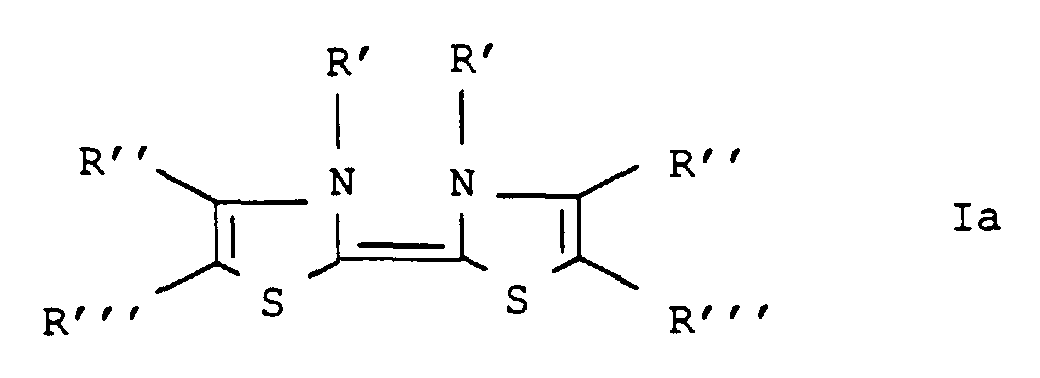

- Die Verbindungen der Formel Ia lassen sich vorzugsweise aus Thiazoliumylid-Lösungen isolieren, die z.B. durch die Deprotonierung der betreffenden Thiazoliumsalze mittels Aminen erhalten worden sind, wohingegen die Verbindungen Ib, sich vorzugsweise aus Thiazoliumylid-Lösungen gewinnen lassen, die beispielsweise durch Umsetzung von N-Formyl-N-Alkyl-o-mercaptoanilin-Derivaten mit Orthoformiaten erzeugt worden sind. Die Verbindugnen Ia und Ib sind stabil, können kristallin erhalten werden und insbesondere Ib als stabile Lagerform für die Ylide I genutzt werden.
- Für die katalytische Aktivität der als Katalysatoren verwendeten Thiazoliumverbindungen ist es allein wichtig, daß die daraus hergestellten Thiazoliumylide in 2-Stellung des Thiazoliumrings unsubstituiert sind. Ansonsten können die Thiazoliumylid-Katalysatoren mit beliebigen Substituenten R', R'' oder R''' substituiert sein. Beispielsweise können Thiazoliumylide der Formel Ic


- Die Thiazolium-, Benzothiazolium- und Naphthathiazoliumylide können auch an einem polymeren, organischen oder anorganischen Träger, beispielsweise einem vernetzten Styrol-Divinylbenzol-Harz oder einem Phenol-Formaldehyd-Harz, z.B. über den Rest R1 angebunden sein, wobei der Rest R1 eine C1- bis C25-, vorzugsweise eine C1- bis C4-Alkylengruppe sein kann.
- Zur Erzeugung dieser Thiazoliumylidkatalysatoren gibt es verschiedenerlei Möglichkeiten. So können die betreffenden Thiazoliumylide in Lösung durch Erhitzung der inneren, betainartigen Thiazoliumsalze der allgemeinen Formel III

- Eine andere Möglichkeit besteht in der direkten Synthese von Benzothiazoliumyliden Id durch die Umsetzung der entsprechenden N-Formyl-N-Alkyl-o-mercaptoanilin-derivaten IV mit wasserentziehenden Mitteln, wie Orthoameisensäureestern, gemäß Reaktionsgleichung (1)

- Die Verbindungen IV bilden sich bei der Umsetzung der N-Alkyl-o-mercaptoaniline mit Ameisensäure und deren Derivaten, wie Ameisensäuren und Orthoameisensäureestern. Die als Ausgangsprodukte zur Herstellung dieser Verbindungen dienenden o-Mercaptoaniline können beispielsweise nach dem Verfahren der DE-PS 367 346 erhalten werden. Die Reste R der Orthoameisensäureester sind vorzugsweise C1- bis C4-Alkylgruppen.
- Eine weitere Möglichkeit zur Erzeugung der Thiazoliumylidkatalysatoren I besteht im Erhitzen der Wasser- oder Alkoholaddukte Ib (R = H oder C1- bis C20-Alkyl, C6- bis C12-Aryl) in Lösung, wobei Wasser bzw. der betreffende Alkohol in der Regel bei Temperaturen von 100 bis 2500C und zweckmäßigerweise unter dem Eigendruck des Reaktionssystems aus diesen Addukten abgespalten werden.
- Eine andere Methode zur Herstellung der Thiazoliumylidkatalysatoren I besteht in der Deprotonierung der entsprechenden Thiazoliumring-haltigen Verbindungen, wie denen der Formel V

- Solche Thiazoliumsalze sind leicht nach dem allgemein anwendbaren Verfahren von Matsumoto et al. (J.Am.Chem. Soc. 106, 4829 (1984)) durch die Umsetzung der betreffenden Thiazole, Benzothiazole, Phenanthro- und Naphthathiazole mit Alkylhalogeniden erhältlich. Die betreffenden Thiazole können nach bekannten Methoden (s. z.B. G.Vernin, General Synthetic Methods for Thiazole and Thiazolium Salts, in: Thiazole and its Derivatives (The Chemistry of Heterocyclic Compounds, Vol. 34, part I), Ed.: J.V. Metzger, John Wiley, New York (1979)), synthetisiert werden. Die Alkylhalogenide sind leicht aus den entsprechenden Fettalkoholen, z.B. durch deren Behandlung mit Halogenwasserstoffsäuren, zugänglich.
- Die Naphthathiazole können z.B. nach dem Verfahren von Wanzlick et al, Liebigs Ann. Chem. 708, 155 (1967) hergestellt werden.
- Als Hilfsbasen zur Erzeugung der Thiazoliumylide können z.B. tertiäre Amine mit 3- bis 30 Kohlenstoffatomen oder cyclische Amine, wie sie z.B. in EP-A 219 317 beschrieben sind, eingesetzt werden, die aufgrund ihrer Basenstärke in der Lage sind, die betreffenden Thiazoliumsalze in 2-Stellung des Thiazoliumringes zu deprotonieren.
- Geeignete tertiäre Amine sind beispielsweise Trimethylamin, Triethylamin, Tripropylamin, Tributylamin, Ethyldiisopropylamin, Decyldiethylamin, Tridecylamin, Chinuclidin, Diazabicyclo-[2,2,2]-octan, N-Methylpiperidin, N-Ethylpiperidin, N-Propylpiperidin, N-Butylpiperidin, N,N'-Dimethylpiperazin, N-Methylmorpholin, Dimethylbenzylamin, Dibenzylmethylamin, Benzyldioctylamin, Benzyldiethylamin, Cyclohexyldiethylamin, Dicyclohexylmethylamin, Dicyclohexylethylamin usw. Besonders bevorzugt wird Triethylamin verwendet. Von den cyclischen Amidinen werden 1,5-Diazabicyclo-[4,3,0]-non-5-en, 1,8-Diazabicyclo-[5,4,0]-undec-7-en und 1,5,7-Triazabicyclo-[4,4,0]-dec-7-en vorzugsweise eingesetzt.
- Es können auch polymere tertiäre Amine als Hilfsbasen verwendet werden, beispielsweise vernetzte Styrol-Divinylbenzol-Harze oder Phenol-Formaldehyd-Harze, die Seitenketten mit tertiären Aminogruppen tragen oder deren Arylgruppen mit Dialkylaminogruppen substituiert sind. Solche polymeren Amine werden üblicherweise als Anionenaustauscher eingesetzt.
- Es ist bemerkenswert, daß im erfindungsgemäß angewandten, flüssigen Zweiphasensystem lipophile Thiazoliumsalze, wie Hexadecylbenzothiazoliumsalze, besonders leicht zu den entsprechenden, katalytisch aktiven Thiazoliumyliden deprotoniert werden und daher selbst im sauren pH-Bereich katalytisch aktiv sind. So können auch schwach basische Stickstoffverbindungen, wie Pyridin oder N-Alkylimidazole, insbesondere N-C1- bis C4-Alkylimidazole zur Deprotonierung der Thiazoliumsalze eingesetzt werden. Des weiteren können anorganische Basen wie Alkalimetall- und Erdalkalimetallhydrogencarbonate oder Alkalimetall- und Erdalkalimetallcarbonate zur Erzeugung der Thiazoliumylidkatalysatoren verwendet werden. Die Verwendung von Alkalimetall- und Erdalkalimetallhydroxid-Lösungen ist ebenfalls möglich. Vorteilhaft lassen sich auch Lösungen der basisch reagierenden Alkalimetallcarboxylate einsetzen, wobei im allgemeinen die Natrium- und Kaliumsalze von C1- bis C4-Carbonsäuren bevorzugt sind.
- Die Thiazoliumylidkatalysatoren können aus den genannten Vorläuferverbindungen nach den genannten Methoden in situ im erfindungsgemmäß angewandten, wäßrig-organischen 2-Phasensystem erzeugt werden, es kann aber auch vorteilhaft sein, die Thiazoliumylidkatalysatoren in einer separaten Umsetzung nach den genannten Methoden zu erzeugen, sie zu isolieren und die derart isolierten, reinen Thiazoliumylidkatalysatoren als solche dem erfindungsgemäßen Reaktionssystem zuzusetzen. Ein Verfahren zur Gewinnung der reinen Thiazoliumylid-Katalysatoren ist in der deutschen Patentanmeldung Anmeldenummer P 41 22 669.0 beschrieben, auf die hiermit Bezug genommen wird.
- Das erfindungsgemäße Verfahren kann in einem weiten Temperaturbereich ausgeübt werden, beispielsweise bei Temperaturen von 20 bis 160oC, vorzugsweise bei 60 bis 150oC und besonders bevorzugt bei 100 bis 150oC. Dabei wird zweckmäßigerweise unter dem Eigendruck des angewandten Reaktionssystems gearbeitet.
- Der pH-Wert der wäßrigen Phase wird im allgemeinen auf einen pH-Wert von weniger als 8, vorzugsweise auf einen pH-Wert von 2 bis 7, insbesondere von 3 bis 6 eingestellt und während der Umsetzung in diesem Bereich gehalten. Das Arbeiten in diesen pH-Bereichen hat bei der erfindungsgemäßen Durchführung der DHA-Herstellung im 2-Phasen-System den Vorteil, daß Thiazoliumylid-Katalysatoren gegenüber einem Angriff von Wasser auf ihr katalytisch aktives Zentrum stabil sind. Unerwarteterweise bleibt die hohe katalytische Aktivität der eingesetzten Thiazoliumylid-Katalysatoren auch bei diesen niederen pH-Werten erhalten, so daß die Katalysatoren in ihrer Aktivität auch durch acide Nebenprodukte der Umsetzung, beispielsweise Carbonsäuren, nicht beeinträchtigt werden. Es ist also bei Anwendung des erfindungsgemäßen Verfahrens möglich und vorteilhaft, die Kondensation von Formaldehyd zu DHA im sauren pH-Bereich durchzuführen.
- In einem Druckglasgefäß wurden 10,06 g einer 37 gew.-%igen, wäßrigen Formaldehydlösung (Formalin®), 10,2 g Dodecanol und 1,099 g N-Hexadecylbenzothiazoliumylid vorgelegt und anschließend 30 Minuten lang bei 140oC gerührt. Nach Abkühlung der Reaktionsmischung auf Raumtemperatur enthielt die wäßrige Phase 30,4 Gew.-% DHA, entsprechend einer Ausbeute von 82 %.
- Die Beispiele 2 bis 4 zeigen die Durchführbarkeit des erfindungsgemäßen Verfahrens mit verschiedenerlei Thiazoliumylid-Katalysatoren.
Ansatz: 4,86 g (60 mmol) Formalin® (37 %ig).
5,0 g 2-Ethylhexanool
0,155 g (1,5 mmol) Triethylamin und
1,5 mmol Katalysator A, B oder C. - Zur genaueren Dosierung des Triethylamins wurden 50 g Formalin® mit 1,55 g Triethylamin versetzt und davon 5,0 g sofort verwendet. Die verschiedenen Ansätze wurden bei 100°C jeweils 1 h lang intensiv gerührt. Nach jeweils 15, 30 und 60 Minuten wurde der wäßrigen Phase eine Probe entnommen und deren DHA-Gehalt mittels Gaschromatographie (GC) bestimmt. Die Ergebnisse der Beispiele 2 bis 4 sind in der folgenden Tabelle I aufgelistet.
Tabelle I Bsp. Nr. Katalysator*) Temperatur (0C) Zeit (min) DHA (Gew.-% in Lösung) Ausbeute (%) 2 A 100 15 4.00 10.8 A 100 30 4.96 13.4 A 100 60 7.04 19.0 3 B 100 15 0.74 2.0 B 100 30 1.34 3.6 B 100 60 2.54 6.9 4 C 100 15 18.44 49.8 C 100 30 28.81 77.9 C 100 60 26.92 72.7 *) A = N-Hexadecylthiazoliumbromid
B = N-Hexadecylbenzothiazoliumbromid
C = N-Hexadecylnaphthathiazoliumbromid - Die Beispiele 5 bis 14 zeigen die Verwendbarkeit unterschiedlicher Lösungsmittel im erfindungsgemäßen Verfahren.
- Ein Ansatz aus 4,86 (60 mmol) Formalin® (37 %ig), 5,0 g Lösungsmittel, 0,155 g (1,5 mmol) Triethylamin und 0,585 g N-Hexadecylthiazoliumbromid wurden 30 Minuten bei 100oC intensiv gerührt. Nach beendeter Umsetzung wurde der DHA-Gehalt der wäßrigen Phase mittels HPLC bestimmt. Die Ergebnisse dieser Versuchsreihe sind in Tabelle II aufgeführt.
Tabelle II Bsp. Nr. Lösungsmittel Zeit (Minuten) Dihydroxyaceton (Gew.-% in Lösung) 5 n-Hexanol 30 1.70 6 n-Octanol 30 3.38 7 n-Decanol 30 4.62 8 n-Dodecanol 30 5.23 9 n-Hexadecanol 30 6.54 10 Cyclohexanol 30 1.06 11 Dodecandiol-1,12 30 1.01 12 2-Ethylhexanol 30 4.96 13 Dibutylformamid 30 2.52 14 Dibutylformamid/n-Octanol 1:1 30 3.55 - Diese Versuchsserie belegt, daß das als Katalysator eingesetzte Thiazoliumsalz im erfindungsgemäßen Verfahren durch ein breites Spektrum von organischen und anorganischen Basen aktiviert, d.h. in das katalytisch aktive Thiazoliumylid umgewandelt werden kann. Insbesondere muß hervorgehoben werden, daß auch schwache Basen, wie Pyridin, unter den angewandten Phasentransferbedingungen in der Lage sind, den Katalysator zu deprotonieren und somit zu aktivieren, was unter homogenen Reaktionsbedingungen nicht möglich ist.
- Ein Ansatz aus 4,86 g (60 mmol) Formalin®, 5,0 g Ethylhexanol, 1,5 mmol Base und 0,585 (1,5 mmol) N-Hexadecylthiazoliumbromid wurde 30 Minuten bei 100oC intensiv gerührt. Danach wurde der DHA-Gehalt der wäßrigen Phase mittels GC bestimmt. Die Ergebnisse dieser Versuchsreihe befinden sind in Tabelle III.
Tabelle III Bsp. Nr. Base Reaktionszeit (Minuten) DHA (Gew.-% in der Lösung) 15 NaHCO3 30 5.23 16 Na2CO3 30 3.02 17 Natriumacetat 30 13.41 18 Natriumformiat 30 7.28 19 Pyridin 30 3.25 20 N-Methylimidazol 30 7.43 21 NaOH 30 4.99
Claims (7)
- Verfahren zur Herstellung von Dihydroxyaceton durch die Thiazoliumylid-katalysierte Kondensation von Formaldehyd, dadurch gekennzeichnet, daß man die Umsetzung in einem Reaktionssystem bestehend aus einer wäßrigen und mindestens einer organischen, flüssigen Phase und bei einem pH-Wert der wäßrigen Phase von weniger als 8 ausführt.
- Verfahren nach Anspruch 1, dadurch gekennzeichnet, daß man eine wäßrige Lösung von Formaldehyd als Ausgangsmaterial einsetzt.
- Verfahren nach Anspruch 1, dadurch gekennzeichnet, daß man einen Alkohol mit mehr als 4 Kohlenstoffatomen oder ein Gemisch eines nicht mit Wasser mischbaren, organischen Lösungsmittels mit einem solchen Alkohol als organische Phase verwendet.
- Verfahren nach Anspruch 1, dadurch gekennzeichnet, daß man die Umsetzung bei 20 bis 180°C durchführt.
- Verfahren nach Anspruch 1, dadurch gekennzeichnet, daß man lipophile Thiazoliumylide als Katalysatoren verwendet.
- Verfahren gemäß Anspruch 1, dadurch gekennzeichnet, daß man Naphthathiazoliumylide als Katalysatoren benutzt.
- Verfahren nach Anspruch 1, dadurch gekennzeichnet, daß man die Umsetzung in einem pH-Bereich von 3 bis 7 durchführt.
Applications Claiming Priority (2)
| Application Number | Priority Date | Filing Date | Title |
|---|---|---|---|
| DE4214808 | 1992-05-04 | ||
| DE4214808A DE4214808A1 (de) | 1992-05-04 | 1992-05-04 | Verfahren zur Herstellung von Dihydroxyaceton |
Publications (2)
| Publication Number | Publication Date |
|---|---|
| EP0568872A1 EP0568872A1 (de) | 1993-11-10 |
| EP0568872B1 true EP0568872B1 (de) | 1996-12-27 |
Family
ID=6458195
Family Applications (1)
| Application Number | Title | Priority Date | Filing Date |
|---|---|---|---|
| EP93106595A Expired - Lifetime EP0568872B1 (de) | 1992-05-04 | 1993-04-23 | Verfahren zur Herstellung von Dihydroxyaceton |
Country Status (4)
| Country | Link |
|---|---|
| US (1) | US5410089A (de) |
| EP (1) | EP0568872B1 (de) |
| JP (1) | JPH0625066A (de) |
| DE (2) | DE4214808A1 (de) |
Families Citing this family (10)
| Publication number | Priority date | Publication date | Assignee | Title |
|---|---|---|---|---|
| US5601581A (en) * | 1995-05-19 | 1997-02-11 | General Surgical Innovations, Inc. | Methods and devices for blood vessel harvesting |
| JP2004055748A (ja) | 2002-07-18 | 2004-02-19 | Sharp Corp | パーティクル除去装置 |
| JP5070936B2 (ja) * | 2006-07-21 | 2012-11-14 | 住友化学株式会社 | 2−ヒドロキシ−4−(メチルチオ)酪酸またはそのエステルの製造方法およびその中間体 |
| EP2753598A1 (de) * | 2011-09-06 | 2014-07-16 | Sumitomo Chemical Company Limited | Verfahren zur herstellung einer alpha- hydroxy-ketonverbindung |
| JP2015071541A (ja) * | 2012-04-17 | 2015-04-16 | 住友化学株式会社 | α−ヒドロキシケトン化合物の製造方法 |
| WO2015112096A1 (en) * | 2014-01-23 | 2015-07-30 | Agency For Science, Technology And Research | Condensation of aldehyde |
| WO2016201110A1 (en) * | 2015-06-09 | 2016-12-15 | Kembiotix Llc | Method for producing carbohydrates from dihydroxyacetone |
| CN107400047A (zh) * | 2017-05-26 | 2017-11-28 | 苏州双湖化工技术有限公司 | 离子液体催化甲醛缩合反应制备二羟基丙酮的方法 |
| AU2021405761A1 (en) | 2020-12-23 | 2023-07-06 | Basf Se | Binder composition comprising amino acid polymer(s) as well as carbohydrates for composite articles |
| US12312472B2 (en) | 2020-12-23 | 2025-05-27 | Basf Se | Binder composition comprising polyamine(s) as well as 1,3-dihydroxyacetone, glycolaldehyde and/or glyceraldehyde for composite articles |
Family Cites Families (5)
| Publication number | Priority date | Publication date | Assignee | Title |
|---|---|---|---|---|
| GB8525402D0 (en) * | 1985-10-15 | 1985-11-20 | British Petroleum Co Plc | Acyloin condensation |
| GB8720491D0 (en) * | 1987-08-29 | 1987-10-07 | Bp Chem Int Ltd | Synthesis of glycerol |
| GB8917092D0 (en) * | 1989-07-26 | 1989-09-13 | Bp Chem Int Ltd | Production of hydroxy ketones |
| GB9019311D0 (en) * | 1990-09-04 | 1990-10-17 | Bp Chem Int Ltd | Synthesis of alpha-hydroxy ketones |
| GB9022071D0 (en) * | 1990-10-10 | 1990-11-21 | Bp Chem Int Ltd | Production of hydroxyletones |
-
1992
- 1992-05-04 DE DE4214808A patent/DE4214808A1/de not_active Withdrawn
-
1993
- 1993-04-23 EP EP93106595A patent/EP0568872B1/de not_active Expired - Lifetime
- 1993-04-23 DE DE59304854T patent/DE59304854D1/de not_active Expired - Lifetime
- 1993-04-27 JP JP5100636A patent/JPH0625066A/ja not_active Withdrawn
- 1993-04-29 US US08/054,814 patent/US5410089A/en not_active Expired - Fee Related
Also Published As
| Publication number | Publication date |
|---|---|
| DE59304854D1 (de) | 1997-02-06 |
| DE4214808A1 (de) | 1993-11-11 |
| EP0568872A1 (de) | 1993-11-10 |
| JPH0625066A (ja) | 1994-02-01 |
| US5410089A (en) | 1995-04-25 |
Similar Documents
| Publication | Publication Date | Title |
|---|---|---|
| DE69116826T2 (de) | Herstellung von Alkoxyalkansäuren | |
| DE10208822A1 (de) | Halogenfreie ionische Flüssigkeiten | |
| EP0568872A1 (de) | Verfahren zur Herstellung von Dihydroxyaceton | |
| EP0587044B1 (de) | Verfahren zur katalytischen Herstellung von Kondensationsprodukten des Formaldehyds | |
| EP0847976B1 (de) | Verfahren zur Herstellung von Glyoxalmonoacetalen | |
| EP0772578B1 (de) | Verfahren zur herstellung von acyloinen | |
| EP0608725B1 (de) | Verfahren zur Herstellung von Aminomethylenverbindungen | |
| EP0526737B1 (de) | Verfahren zur Herstellung von Dihydroxyaceton | |
| CH648282A5 (de) | Verfahren zur herstellung von oxocyclopentenen. | |
| DE2732714C2 (de) | Verfahren zur Herstellung von Acyloinen | |
| EP0058326B1 (de) | Verfahren zur Herstellung von araliphatischen Aldehyden und/oder Aminen | |
| DE2654928C3 (de) | Verfahren zur Herstellung von N-methylierten Harnstoffen oder Alkylenharnstoffen | |
| EP0054699B1 (de) | Verfahren zur katalytischen Hydrogenolyse von p-substituierten Benzaldehyd-dimethylacetalen zu den entsprechenden Benzylmethyl-ether-Derivaten | |
| DE3037086A1 (de) | 3-(m-chloranilino-)acrylsaeureaethylester und ein verfahren zu dessen herstellung | |
| EP0251058A2 (de) | Verfahren zur Racemisierung optisch aktiver- Phenoxy- propionsäureester und deren Derivate | |
| DE1795430C3 (de) | Verfahren zur Herstellung von 2,4,6-Heptantrion und 2,6-Dime thy 1-4pyranon | |
| DE3035792C2 (de) | Verfahren zur Herstellung von 2-Oxodihydrobenzo[d][1,3]-oxazinen und deren Verwendung zur Herstellung von o-Aminobenzylalkoholen | |
| EP0353670B1 (de) | Verfahren zur Herstellung cyclischer 6- bis 8-gliedriger Vinylen-1,2-dioxyverbindungen | |
| EP0003052A2 (de) | Verfahren zur Herstellung von 4-Methyl-5-chlormethylimidazol | |
| DE2643842C2 (de) | Verfahren zur Herstellung von aromatischen Aminoketonen | |
| DE1193938B (de) | Verfahren zur Herstellung des Racemats und der Stereoisomeren einschliesslich des Mesoisomeren von Butan-1, 2, 3, 4-tetrol-1, 4-di-(methansulfonat) | |
| DE1795430B2 (de) | Verfahren zur herstellung von 2,4,6-heptantrion und 2,6-dimethyl-4- pyranon | |
| AT235814B (de) | Verfahren zur Herstellung von Butantetrolderivaten | |
| DE1238921B (de) | Verfahren zur Herstellung von 2-Oxo-hexahydro-pyrimidinen neben 1,3-Diaminopropanderivaten | |
| DE2359107A1 (de) | Verfahren zur herstellung von 2oder 4-(2-alkylaminoaethyl)-pyridinen |
Legal Events
| Date | Code | Title | Description |
|---|---|---|---|
| PUAI | Public reference made under article 153(3) epc to a published international application that has entered the european phase |
Free format text: ORIGINAL CODE: 0009012 |
|
| AK | Designated contracting states |
Kind code of ref document: A1 Designated state(s): BE CH DE FR GB LI |
|
| 17P | Request for examination filed |
Effective date: 19931221 |
|
| 17Q | First examination report despatched |
Effective date: 19950918 |
|
| RIN1 | Information on inventor provided before grant (corrected) |
Inventor name: GROENING, CARSTEN, DR. Inventor name: EBEL, KLAUS, DR. Inventor name: KNUTH, BERNHARD, DR. Inventor name: VOGEL, HERBERT, DR. Inventor name: HARDER, WOLFGANG, DR. Inventor name: GEHRER, EUGEN, DR. |
|
| GRAG | Despatch of communication of intention to grant |
Free format text: ORIGINAL CODE: EPIDOS AGRA |
|
| GRAH | Despatch of communication of intention to grant a patent |
Free format text: ORIGINAL CODE: EPIDOS IGRA |
|
| GRAH | Despatch of communication of intention to grant a patent |
Free format text: ORIGINAL CODE: EPIDOS IGRA |
|
| GRAA | (expected) grant |
Free format text: ORIGINAL CODE: 0009210 |
|
| AK | Designated contracting states |
Kind code of ref document: B1 Designated state(s): BE CH DE FR GB LI |
|
| REF | Corresponds to: |
Ref document number: 59304854 Country of ref document: DE Date of ref document: 19970206 |
|
| GBT | Gb: translation of ep patent filed (gb section 77(6)(a)/1977) |
Effective date: 19970125 |
|
| ET | Fr: translation filed | ||
| PLBE | No opposition filed within time limit |
Free format text: ORIGINAL CODE: 0009261 |
|
| 26N | No opposition filed | ||
| PGFP | Annual fee paid to national office [announced via postgrant information from national office to epo] |
Ref country code: FR Payment date: 19990312 Year of fee payment: 7 |
|
| PGFP | Annual fee paid to national office [announced via postgrant information from national office to epo] |
Ref country code: CH Payment date: 19990325 Year of fee payment: 7 |
|
| PGFP | Annual fee paid to national office [announced via postgrant information from national office to epo] |
Ref country code: BE Payment date: 19990409 Year of fee payment: 7 |
|
| PGFP | Annual fee paid to national office [announced via postgrant information from national office to epo] |
Ref country code: GB Payment date: 19990415 Year of fee payment: 7 |
|
| PGFP | Annual fee paid to national office [announced via postgrant information from national office to epo] |
Ref country code: DE Payment date: 19990428 Year of fee payment: 7 |
|
| PG25 | Lapsed in a contracting state [announced via postgrant information from national office to epo] |
Ref country code: DE Free format text: LAPSE BECAUSE OF THE APPLICANT RENOUNCES Effective date: 20000318 |
|
| PG25 | Lapsed in a contracting state [announced via postgrant information from national office to epo] |
Ref country code: GB Free format text: LAPSE BECAUSE OF NON-PAYMENT OF DUE FEES Effective date: 20000423 |
|
| PG25 | Lapsed in a contracting state [announced via postgrant information from national office to epo] |
Ref country code: LI Free format text: LAPSE BECAUSE OF NON-PAYMENT OF DUE FEES Effective date: 20000430 Ref country code: CH Free format text: LAPSE BECAUSE OF NON-PAYMENT OF DUE FEES Effective date: 20000430 Ref country code: BE Free format text: LAPSE BECAUSE OF NON-PAYMENT OF DUE FEES Effective date: 20000430 |
|
| BERE | Be: lapsed |
Owner name: BASF A.G. Effective date: 20000430 |
|
| GBPC | Gb: european patent ceased through non-payment of renewal fee |
Effective date: 20000423 |
|
| REG | Reference to a national code |
Ref country code: CH Ref legal event code: PL |
|
| PG25 | Lapsed in a contracting state [announced via postgrant information from national office to epo] |
Ref country code: FR Free format text: LAPSE BECAUSE OF NON-PAYMENT OF DUE FEES Effective date: 20001229 |
|
| REG | Reference to a national code |
Ref country code: FR Ref legal event code: ST |