EP0561362B1 - Glass yarn, method and apparatus for manufacturing the same - Google Patents
Glass yarn, method and apparatus for manufacturing the same Download PDFInfo
- Publication number
- EP0561362B1 EP0561362B1 EP93104299A EP93104299A EP0561362B1 EP 0561362 B1 EP0561362 B1 EP 0561362B1 EP 93104299 A EP93104299 A EP 93104299A EP 93104299 A EP93104299 A EP 93104299A EP 0561362 B1 EP0561362 B1 EP 0561362B1
- Authority
- EP
- European Patent Office
- Prior art keywords
- strand
- winding
- glass
- tension
- glass yarn
- Prior art date
- Legal status (The legal status is an assumption and is not a legal conclusion. Google has not performed a legal analysis and makes no representation as to the accuracy of the status listed.)
- Revoked
Links
Images


Classifications
-
- C—CHEMISTRY; METALLURGY
- C03—GLASS; MINERAL OR SLAG WOOL
- C03B—MANUFACTURE, SHAPING, OR SUPPLEMENTARY PROCESSES
- C03B37/00—Manufacture or treatment of flakes, fibres, or filaments from softened glass, minerals, or slags
- C03B37/10—Non-chemical treatment
- C03B37/12—Non-chemical treatment of fibres or filaments during winding up
-
- C—CHEMISTRY; METALLURGY
- C03—GLASS; MINERAL OR SLAG WOOL
- C03B—MANUFACTURE, SHAPING, OR SUPPLEMENTARY PROCESSES
- C03B37/00—Manufacture or treatment of flakes, fibres, or filaments from softened glass, minerals, or slags
- C03B37/01—Manufacture of glass fibres or filaments
- C03B37/02—Manufacture of glass fibres or filaments by drawing or extruding, e.g. direct drawing of molten glass from nozzles; Cooling fins therefor
- C03B37/03—Drawing means, e.g. drawing drums ; Traction or tensioning devices
-
- B—PERFORMING OPERATIONS; TRANSPORTING
- B65—CONVEYING; PACKING; STORING; HANDLING THIN OR FILAMENTARY MATERIAL
- B65H—HANDLING THIN OR FILAMENTARY MATERIAL, e.g. SHEETS, WEBS, CABLES
- B65H54/00—Winding, coiling, or depositing filamentary material
- B65H54/02—Winding and traversing material on to reels, bobbins, tubes, or like package cores or formers
- B65H54/06—Winding and traversing material on to reels, bobbins, tubes, or like package cores or formers for making cross-wound packages
-
- B—PERFORMING OPERATIONS; TRANSPORTING
- B65—CONVEYING; PACKING; STORING; HANDLING THIN OR FILAMENTARY MATERIAL
- B65H—HANDLING THIN OR FILAMENTARY MATERIAL, e.g. SHEETS, WEBS, CABLES
- B65H55/00—Wound packages of filamentary material
-
- B—PERFORMING OPERATIONS; TRANSPORTING
- B65—CONVEYING; PACKING; STORING; HANDLING THIN OR FILAMENTARY MATERIAL
- B65H—HANDLING THIN OR FILAMENTARY MATERIAL, e.g. SHEETS, WEBS, CABLES
- B65H59/00—Adjusting or controlling tension in filamentary material, e.g. for preventing snarling; Applications of tension indicators
- B65H59/10—Adjusting or controlling tension in filamentary material, e.g. for preventing snarling; Applications of tension indicators by devices acting on running material and not associated with supply or take-up devices
- B65H59/18—Driven rotary elements
-
- B—PERFORMING OPERATIONS; TRANSPORTING
- B65—CONVEYING; PACKING; STORING; HANDLING THIN OR FILAMENTARY MATERIAL
- B65H—HANDLING THIN OR FILAMENTARY MATERIAL, e.g. SHEETS, WEBS, CABLES
- B65H59/00—Adjusting or controlling tension in filamentary material, e.g. for preventing snarling; Applications of tension indicators
- B65H59/10—Adjusting or controlling tension in filamentary material, e.g. for preventing snarling; Applications of tension indicators by devices acting on running material and not associated with supply or take-up devices
- B65H59/36—Floating elements compensating for irregularities in supply or take-up of material
-
- C—CHEMISTRY; METALLURGY
- C03—GLASS; MINERAL OR SLAG WOOL
- C03B—MANUFACTURE, SHAPING, OR SUPPLEMENTARY PROCESSES
- C03B37/00—Manufacture or treatment of flakes, fibres, or filaments from softened glass, minerals, or slags
- C03B37/01—Manufacture of glass fibres or filaments
- C03B37/02—Manufacture of glass fibres or filaments by drawing or extruding, e.g. direct drawing of molten glass from nozzles; Cooling fins therefor
-
- B—PERFORMING OPERATIONS; TRANSPORTING
- B65—CONVEYING; PACKING; STORING; HANDLING THIN OR FILAMENTARY MATERIAL
- B65H—HANDLING THIN OR FILAMENTARY MATERIAL, e.g. SHEETS, WEBS, CABLES
- B65H2701/00—Handled material; Storage means
- B65H2701/30—Handled filamentary material
- B65H2701/31—Textiles threads or artificial strands of filaments
- B65H2701/312—Fibreglass strands
- B65H2701/3122—Fibreglass strands extruded from spinnerets
-
- D—TEXTILES; PAPER
- D10—INDEXING SCHEME ASSOCIATED WITH SUBLASSES OF SECTION D, RELATING TO TEXTILES
- D10B—INDEXING SCHEME ASSOCIATED WITH SUBLASSES OF SECTION D, RELATING TO TEXTILES
- D10B2101/00—Inorganic fibres
- D10B2101/02—Inorganic fibres based on oxides or oxide ceramics, e.g. silicates
- D10B2101/06—Glass
-
- Y—GENERAL TAGGING OF NEW TECHNOLOGICAL DEVELOPMENTS; GENERAL TAGGING OF CROSS-SECTIONAL TECHNOLOGIES SPANNING OVER SEVERAL SECTIONS OF THE IPC; TECHNICAL SUBJECTS COVERED BY FORMER USPC CROSS-REFERENCE ART COLLECTIONS [XRACs] AND DIGESTS
- Y02—TECHNOLOGIES OR APPLICATIONS FOR MITIGATION OR ADAPTATION AGAINST CLIMATE CHANGE
- Y02P—CLIMATE CHANGE MITIGATION TECHNOLOGIES IN THE PRODUCTION OR PROCESSING OF GOODS
- Y02P40/00—Technologies relating to the processing of minerals
- Y02P40/50—Glass production, e.g. reusing waste heat during processing or shaping
- Y02P40/57—Improving the yield, e-g- reduction of reject rates
Definitions
- the present invention relates to a glass yarn having a filament diameter of 3 to 9 ⁇ , and more particularly to a glass yarn wound into a form of a square-end cheese package and a method of and an apparatus for manufacturing the same.
- glass fiber is formed into hundreds of filaments by drawing, at high speed, molten glass flowed out through hundreds of orifices formed in the bottom of a bushing. Then, sizing agent is applied to the filaments followed by gathering the filaments into one strand.
- the strand is wound by a winding apparatus while traversing the strand by a traversing device, so that the strand is temporarily formed into a cake (see Figs. 3A and 3B).
- the glass fiber is unwound from the cake to be used in either of two methods categorized as follows: the first method is a method in which a winding tube is removed after the cake has been heated and dried for a predetermined time, and the strand is drawn out from the inside of the cake (generally aforesaid method is called an "inside drawing method). Then, a predetermined number (usually 10 to 30) of the strands are paralleled to be wound up by a winder so that a glass roving is formed.
- the first method is a method in which a winding tube is removed after the cake has been heated and dried for a predetermined time, and the strand is drawn out from the inside of the cake (generally aforesaid method is called an "inside drawing method). Then, a predetermined number (usually 10 to 30) of the strands are paralleled to be wound up by a winder so that a glass roving is formed.
- the strands are supplied to a cutter to be formed into chopped strands which will be used as reinforcing materials for FRP (Fiberglas Reinforced Plastics) or FRTP (Fiberglas Reinforced Thermoplastics).
- FRP Fiberglas Reinforced Plastics
- FRTP Fiberglas Reinforced Thermoplastics
- the cake is formed into a barrel-like shape, the central portion of which projects outwardly as shown in Fig. 3A, because the strand is wound as described above while being traversed with an amplitude as shown in Fig. 3A in such a manner that the traversing device is also reciprocated within a stroke b.
- the degree of the projection over the central portion of the cake undesirably increases in proportion to the quantity of the wound strand. If the central portion of the cake projects excessively, the speed of the strand is always changed when the strand is wound while being traversed because the peripheral speed varies depending upon the position in the cake. The aforesaid speed change causes the speed of drawing the molten glass at the high speed to be changed.
- the size of the strand is undesirably changed. Therefore, a glass yarn composed of strands exhibiting an equal yarn count cannot be manufactured. If the degree of the projection is enlarged for the purpose of enlarging the quantity of the cake formed by winding the strands, the size of the strand cannot be included in a predetermined range. Therefore, the strand cannot be wound to form the projection of the cake that is larger than a certain degree. As a result, the inner diameter of the cake tends to be enlarged in order to enlarge the quantity of the cake formed by winding the strand, resulting in an excessively large size of the cake. Furthermore, the aforesaid large cake is formed into a thin shape.
- the two terminative ends of the cake are formed into excessively thin and sharpened shape. Therefore, the cake cannot easily be handled. It is very difficult for a user to handle the cake as it is, and the cake cannot easily be packaged up for transportation. Even if the cake can be packaged up, the size of the package becomes too large with respect to the quantity which can be transported, causing a problem of unsatisfactory transportation efficiency. As a result, there arises an economical problem in terms of practical use if the strand wound into the cake is made to be a product as it is. Therefore, the aforesaid post-process must be performed.
- the strand is rewound from the cake to be formed into a yarn package while being twisted to be a predetermined degree as described above.
- a rewinding twister to be used in the aforesaid process has a creel on which a cake having a winding tube can be mounted. The strand is drawn out from the outer portion of the cake mounted on the delivery creel followed by twisting the strand by an ordinary twisting mechanism. Then, the strand is wound to be formed into the yarn package.
- Methods of delivering the strand from the creel are categorized into a method in which the creel is drivingly rotated, and a method in which the rotation of the creel is made free to draw out the strand at a predetermined speed. It is considered to employ the rotation driving method to deliver the strand in order to prevent generation of fluff. If the thickness of the cake formed by winding the strand is large, the number of twist in the inner layer and that in the outer layer are therefore different from each other. As a result, a problem arises in a post-process such as the doubling and twisting process and the weaving process. The aforesaid fact has been one of the reasons that the thickness of the cake for the glass yarn cannot be enlarged considerably.
- the glass yarn is different from the glass roving in a necessity of having a satisfactory constant-length rate. Since glass yarns shorter than a predetermined length or glass yarns that have an adhesive portion cause the yield in the following process or the quality of the product to deteriorate, such glass yarns cannot be used freely. Since the roving is used in the form of glass roving manufactured by paralleling 10 to 30 strands or in the form of chopped strands obtained by cutting the strand to have a predetermined length, the constant-length rate is not the critical factor.
- the constant-length rate of the glass yarn depends upon the cut ratio during the time of the spinning process and the cut ratio during the time of the rewinding process.
- the cut ratio per cake rises in proportion to the length of the glass yarn wound to form the cake.
- the constant-length rate is lowered in inverse proportion to the length of the wound glass yarn.
- the quantity of the wound glass yarn is ordinarily made to be 8 kg in the case of ECG75 (400 filaments of 9 ⁇ having a tex count of 67.5) and 3.5 kg (200 filaments of 7 ⁇ having a tex count of 22.5) according to the JIS (Japanese Industrial Standard) for Textile Glas Yarn.
- Tension (per tex count) acting on the strand at the time of the spinning process increases in inverse proportion to the diameter of the filament if the residual conditions for the glass fiber are the same. Therefore, the glass yarn is applied with a large spinning tension per tex because the glass yarn has a smaller filament diameter than the roving.
- the enlargement of the spinning tension for the glass yarn is in inverse proportion to the diameter of the filament. If the quantity of winding to form the cake is enlarged, the large spinning tension causes a problem of the quality of the thread in the inner layer to arise because the pressure of winding acting on the inner layer of the cake is enlarged. That is, the thread in the inner layer easily encounters cracks and easily generates fluff.
- a glass yarn having a filament diameter of 3 ⁇ and known as a beta-yarn cannot be substantially used due to deterioration of the threads in the inner layer thereof if the quantity of the cake is made to be 2 kg or more. Because of the aforesaid reasons, it has been considered that the quantity of the wound glass yarn is limited to about 150,000 m under excellent conditions although it depends upon the filament diameter and the number of filaments.
- the glass yarn has been used in a variety of ways and therefore the glass yarn must meet various requirements. For example, there arise a desire for a non-twisted glass yarn recently.
- the strand wound at a terminative end portion of the cake and the strand wound at the central portion are different from each other in the yarn count. Therefore, the yarn count varies in one strand in accordance with the period of the traverse. The aforesaid phenomenon becomes excessive in proportion to the quantity of the cake.
- the quantity of the wound glass yarn be large in terms of the control in the following process, the quantity of winding is limited because the dispersion of the yarn counts must be prevented.
- the cake Since the cake is formed into a shape having two thin ends pointed as shown in Fig. 3A, it cannot easily be handled. If the end portion is damaged, the strand can be cut at the damaged portion when the strand is drawn out from the cake. Therefore, it is very difficult to transport and package the cake.
- the strand is wound up while placing the cake stationarily in such a manner that substantially no twist is given, for example if the strand is intended to be drawn out from the inside of the cake placed horizontally, an adjacent strand is undesirably drawn out together with the desired strand. That is, a so-called scramble drawing phenomenon takes place and therefore the strand cannot be drawn out as desired.
- a wire traverse-method for traversing the cake for the glass yarn cannot accurately control the traversing angle.
- the employed starch type sizing agent which are dried by air, cannot retain the shape of the cake. Therefore, the strand can easily be separated from other strands if a small impact is applied.
- the strand which is being drawn out can be caught and cut at this position. If the cake including the winding tube is placed vertically, the strand which is being drawn out comes in contact with and rubs the central portion in which the strands are wound densely in the case where the strand is drawn out from the lower portion of the cake because the central portion of the cake has a large thickness and the thickness decreases toward the two ends. As a result, fluff easily takes place, causing the strand to be cut finally.
- the conventional glass yarn has a limitation in the quantity of winding and the length of winding. Therefore, there arises a problem that a requirement to enlarge the quantity of winding made from the following process cannot be met.
- the enlargement of the quantity of winding has been become important because the glass yarn has been used widely as well as the conventional requirement made by the following glass yarn process.
- US-A-3 523 650 discloses a method and apparatus for forming a square-end cylindrically shaped package of a roving, the method involving the compacting of the roving adjacent each end region of the package by means of a special traverse guide. It is said that the invention embraces a novel roving product wherein a large number of streams of glass are attenuated to continuous filaments simultaneously and the filaments are gathered into untwisted bundled relation providing a roving wherein the filaments are not adhered one to another by coating material.
- US-A-3 966 133 that is also concerned with the winding of rovings and discloses an apparatus comprising means for tensioning the roving along its path to a collector.
- the apparatus inlcudes a first and a second bar in spaced relation located at opposite sides of the path of the roving and upon which the roving turns or bends as it passes over these bars.
- the bars can be allowed to rotate and can be positively rotated.
- the tension in the roving is controlled by means for holding the first bar on a fixed axis; and pneumatic means comprising an air cylinder for movably holding the second bar in a biassed relationship with the roving so that changes in the disposition of the second bar modifies the turning of the roving about said bars to modify the tension in the roving.
- the invention is as defined in the accompanying claims.
- the inventor of the present invention has, as a result of a variety of investigations, found a fact that the aforesaid problems can be overcome by forming the shape of the strand package for use in the spinning process into a square-end cheese package in place of the conventional barrel-like cake, the forming of the square-end cheese package being considered impossible to be realized. That is, it has been found that the aforesaid problems can be overcome by employing a glass yarn, the monofilament diameter of which is 3 to 9 ⁇ , to which sizing agents are applied, which is not twisted and which is wound to form a square-end cheese package.
- the "9 ⁇ " filament is, in the glass fiber industrial field, a filament that has an average diameter of 9.1 to 9.2 ⁇ .
- the square-end cheese package can be formed by using a tension relaxing device below the gathering roller at the time of spinning the glass yarn. That is, the square-end cheese package can be formed by the following process: a multiplicity of 3 to 9 ⁇ glass filaments are formed by drawing molten glass discharged through a multiplicity of orifices formed in the bottom portion of a bushing; sizing agent is applied to a multiplicity of the glass filaments; one strand is formed by a gathering device; the one strand is brought into contact with at least one rotative drum of a tension relaxing device; the strand is wound around a winding tube fastened to a collet while being traversed by a traversing device having a predetermined amplitude; and the strand is formed into a square-end cheese package.
- the direct roving has been, in place of the bundled roving, employed in the filament winding field and the pultrusion field.
- An ordinary direct roving has an arrangement that the filament diameter is a large value of 13 to 20 ⁇ and the tex count is 1000 to 3000 tex, that is, not only has each filament a large diameter but also the strand has a large size. Therefore, assuming that the quantity of the package formed by winding is 16 kg, the length of winding is 8,000 m if the yarn count of the strand is 2000 tex. As described above, the quantity of winding is relatively small.
- the glass yarn has a very small filament diameter of 3 to 9 ⁇ and a small strand yarn count of 3 to 140 tex which are very thin as compared with the direct roving.
- the glass yarn has been different from the glass roving in the fact that there is no idea of winding the glass yarn to form a square-end cheese package.
- the inventor of the present invention has found a fact that the strand must be wound to form the square-end cheese package to overcome the foregoing problems. Furthermore, the inventor found that a glass yarn can be obtained with which the thread in the inner layer is not deformed by the pressure and has quality substantially same as that of the thread in the outer layer by employing spinning conditions capable of winding the glass yarn to form the square-end cheese package.
- a glass yarn having a diameter of 9 ⁇ or less is wound to form a square-end cheese package
- the thread in the intermediate layer is forcibly discharged as shown in Fig. 5 because the glass yarn has a large spinning tension.
- the size 5a shown in Fig. 5 increases in inverse proportion to the filament diameter and in proportion to the quantity of winding. If the glass yarn is wound to form a cake, the force for deforming the cake acts on the central portion of the cake. Therefore, the glass yarn is able to bear the aforesaid force.
- the friction coefficient of the glass yarn is made small in order to improve the facility of performing the following manufacturing process. Therefore, the thread easily slips and the end portion easily projects if it is wound to form the square-end. Since the quality of the thread of the projecting portion excessively deteriorates, the square-end cheese package of this type cannot be used as a product.
- the most important factor for deforming the square-end cheese package is the relationship between the tension of the strand to be wound to form the package and the size of the strand.
- a factor for preventing the deformation is the angle of the strand to be wound on the package, that is, the degree of the traversing angle. If the traversing angle is the same, the degree of the deformation depends upon tension/size. If the tension is halved, the degree of the deformation is the same in the case where the size is the half.
- the degree of the deformation of the package is the same between two cases, that is between a case in which the speed of the strand, that is, the speed at which the strand is wound is 3000 m/min and a case in which the speed is 1500 m/min, which are ordinary strand speeds in manufacturing glass fiber. That is, the degree of the deformation depends upon the force of per volume applied from the strand wound to form the package.
- An example of the tension realized when the glass filament diameter is 9 ⁇ or less will now be described.
- the tension varies considerably depending upon the viscosity of the glass, the shape of the bushing orifice, the speed at which the strand is drawn out, the following tensions are realized if the speed is 3000 m/min and the size of the strand is 33.7 tex (g/1000 m): 170 gf when the glass filament diameter is 9.2 ⁇ (200 filaments); 190 gf when the glass filament diameter is 7.5 ⁇ (300 filaments); 215 gf when the glass filament diameter is 6.5 ⁇ (400 filaments); 320 gf when the glass filament diameter is 5.3 ⁇ (600 filaments); and 490 gf when the glass filament diameter is 3.7 ⁇ (1200 filaments).
- the tension per the same strand size rapidly increases in inverse proportion to the diameter of the glass filament.
- the tension In the case where the size of the strand is 33.7 tex and the traversing angle is 4.5°, the tension must be reduced to 150 gf or lower regardless of the strand speed to easily form the square-end cheese package while maintaining the desired shape. If the traversing angle is decreased to 3°, the tension must be reduced to 100 gf to easily wind the strand. As described above, the target value of the tension of the strand which can be wound depends upon the traversing angle. Although the traversing angle acts to prevent the deformation of the package, the necessity of enlarging the traversing angle to prevent the deformation can be eliminated by further lowering the tension. Therefore, winding of the strand to form the square-end cheese package can be facilitated by reducing the tension.
- the tension relaxing device comprises at least one rotative drum.
- the peripheral speed of the drum is made to be faster than the speed at which the strand is being wound to form the package. Furthermore, the strand is brought into contact with at least one drum. If the tension relaxing device is omitted, the strand is pulled by the rotational force of the package to draw the molten glass. Therefore, the tension generated at the time of drawing the molten glass acts, as the tension of the strand, on the surface of the package.
- the tension relaxing device By sharing the force for drawing the molten glass to the drum of the tension relaxing device, the strand freed from tension can be supplied to the package. Therefore, square-end cheese package revealing excellent shape can be formed.
- the strand By winding the strand into a predetermined shape while maintaining the square-end cheese package, an ordinary process for manufacturing a product by rewinding the glass yarn to a bobbin can be omitted. Therefore, the strand can be wound to form a package by a quantity larger than a limit quantity for a cake. As a result, the manufacturing yield can be improved. Furthermore, excellent quantity glass fiber, the yarn count of which is not substantially changed and which is freed from twist, can be manufactured.
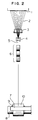
- Figs. 1 and 2 respectively are a side elevational view and a front elevational view which illustrate an embodiment of an apparatus according to the present invention for forming a strand having a glass filament diameter of 9 ⁇ or less into a square-end cheese package.
- a multiplicity of filaments 2 are drawn through a multiplicity of orifices formed in the bottom surface of a multi-hole bushing 1.
- the filaments 2 are applied with sizing agent by a sizing agent applicator 3, are gathered by a gathering device 4 to form one strand 5.
- the strand 5 is supplied to a tension relaxing device 6, and is brought into contact with at least one drum of the tension relaxing device 6 before it is conveyed.
- the tension relaxing device 6 is composed of three drums arranged in such a manner that the second drum is shifted freely.
- force for pulling the strand can be varied arbitrarily.
- the present invention can be realized by using at least one drum. The reason is that even if only one drum is used, the force for pulling the strand can be generated by enlarging the angle at which the strand is brought into contact with the drum or by winding the strand around the drum one or more times.
- the strand 5 delivered from the tension relaxing device 6 is traversed by a traversing device 7 having a predetermined amplitude. Then, the strand 5 is wound around a winding tube 9 inserted onto a winding collet 8. As a result, the strand 5 is formed into a square-end cheese package 10.
- the tension relaxing device 6 shown in Figs. 1 and 2 comprises three drums each of which is rotated at a certain speed higher than the speed of the strand 5.
- the three drums can be individually set to determine speeds.
- the lateral position of the second drum can be freely shifted with respect to the upper and the lower drums.
- the traversing device 7 is a device having a chip 11 for holding the strand 5 and swinging the same at a predetermined amplitude and causing the chip 11 to swing at a predetermined amplitude to supply the strand 5 to a winding tube while traversing the strand 5.
- the traversing device 7 has a function to move while maintaining the distance from the surface of the square-end cheese package 10 at a constant distance as the outer diameter of the square-end cheese package 10 is enlarged with proceeding of the winding operation.
- the winding collet 8 has a function for controlling the rotational speed thereof so as to prevent change in the package peripheral speed, that is, change of the speed at which the strand 5 is wound, even when the outer diameter of the square-end cheese package 10 is enlarged with proceeding of the winding operation.
- Figs. 4A and 4B illustrate a product formed by winding the square-end cheese package 10 around the tube 9 while preventing deformation.
- reference numeral 4a represents the width of winding
- 4b represents the thickness of winding
- 4c represents a traversing angle of the wound strand
- 4d represents the diameter of the winding collet 8
- 4e represents the thickness of the winding tube 9.
- Fig. 5 illustrates an example of a state where the square-end cheese package is deformed by an excessively large tension of the strand, Fig. 5 being a cross sectional view (one side is shown) which illustrates the square-end cheese package wound around the winding tube 9.
- dashed lines show the cross sectional view of the package which is not deformed.
- Reference numeral 5a represents the width of deformation.
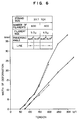
- Table 1 A result of an experiment is shown in Table 1.
- the experiment was carried out to examine the deformation of the package when square-end cheese packages were formed by using two types of strands and two traversing angles while changing the tension of the strand.
- the experiment conditions were as follows: winding width 4a was 200 mm; winding thickness 4b was 20 mm; two traversing angles 4c were 3.07° and 4.45°; winding collet diameter 4d was 150 mm; winding tube thickness 4e was 0.5 mm; strand winding speed was 3000 m/min; two types of strands one of which was 33.7 tex strand composed of 400 filaments (filament diameter: 6.5 ⁇ ) and the other of which was a strand of 33.7 tex composed of 600 filaments (the filament diameter: 5.3 ⁇ ), were used. Results of the experiment are shown in Table 1.
- the four strands have the same size of 33.7 tex, while having different number of filaments thereof as 600 and 400, varying by 1.5 times.
- the tensions generated were 332 g and 201 g.
- the thin filament has a larger tension.
- the width of the deformation of the package can be reduced. Furthermore, the gradient varies depending upon the traversing angle at which the strand is wound, the traversing angle being 4.45° and 3.07°. If the strands wound at the same traversing angles and having the same size are used, the same results are obtained regardless of the tension of the strands. Although the width of the deformation of the packages is changed considerably due to a slight change of the traversing angle if the tension is large, the same is not changed considerably if the tension is small.
- the degree of the deformation of the square-end cheese package depends upon the traversing angle and tension/strand size. Therefore, the degree of the deformation is the same if the size of the strand is doubled and the tension is also doubled in the case where the traversing angle is the same. The aforesaid fact was also confirmed by the experiment.
- the tension per strand size is rapidly enlarged in inverse proportion of the size of the filament.
- the aforesaid fact causes the glass fiber to encounter the difficulty that the glass yarn having a diameter of 9 ⁇ or less cannot easily be wound to form a square-end cheese package.
- the arrangement of the present invention that the large tension generated in the strand is considerably reduced by the tension relaxing device, followed by winding enables a strand to be wound to form a square-end cheese package regardless of the tension of the strand.
- a conventional method has an arrangement that the glass strand is temporarily wound to form a so-called cake and the cake is rewound to a bobbin to manufacture a product.
- the present invention enables the square-end cheese package to be a product by forming the square-end cheese package in the process in which the cake is manufactured according to the conventional technology. Furthermore, the following process in which rewinding to a bobbin is performed can be completely omitted. As a result, the cost can be significantly reduced.
- the following problems can be overcome: the problem of deterioration of the quality due to the fact that the strand is rubbed and the problem of the unsatisfactory yield due to cutting of the strand each of which takes place in the process in which the strand is rewound to a bobbin.
- the conventional technology in which a cake is first formed encounters a problem that the change in the size of the strand becomes excessive with proceeding of the winding operation. Furthermore, the tension generated in the strand is enlarged in inverse proportion to the size of the glass filament, causing the strand wound in the lower layer to be pressed if a large cake is formed. As a result, the quality deteriorates excessively and therefore a large cake cannot be formed.
- the present invention having the arrangement that the square-end cheese package having a flat surface is formed by winding the strand enables the change in the size of the strand to be eliminated. Furthermore, the tension relaxing device considerably reduces the tension of the strand. Therefore, a large package formed by winding a strand by a large quantity can be formed.
Landscapes
- Engineering & Computer Science (AREA)
- Chemical & Material Sciences (AREA)
- Life Sciences & Earth Sciences (AREA)
- General Life Sciences & Earth Sciences (AREA)
- Geochemistry & Mineralogy (AREA)
- Manufacturing & Machinery (AREA)
- Materials Engineering (AREA)
- Organic Chemistry (AREA)
- Filamentary Materials, Packages, And Safety Devices Therefor (AREA)
- Yarns And Mechanical Finishing Of Yarns Or Ropes (AREA)
- Reinforced Plastic Materials (AREA)
- Spinning Methods And Devices For Manufacturing Artificial Fibers (AREA)
Applications Claiming Priority (2)
| Application Number | Priority Date | Filing Date | Title |
|---|---|---|---|
| JP4058187A JP2909294B2 (ja) | 1992-03-16 | 1992-03-16 | ガラスヤーンの製造方法 |
| JP58187/92 | 1992-03-16 |
Publications (3)
| Publication Number | Publication Date |
|---|---|
| EP0561362A2 EP0561362A2 (en) | 1993-09-22 |
| EP0561362A3 EP0561362A3 (en) | 1993-10-13 |
| EP0561362B1 true EP0561362B1 (en) | 1998-07-15 |
Family
ID=13077019
Family Applications (1)
| Application Number | Title | Priority Date | Filing Date |
|---|---|---|---|
| EP93104299A Revoked EP0561362B1 (en) | 1992-03-16 | 1993-03-16 | Glass yarn, method and apparatus for manufacturing the same |
Country Status (6)
| Country | Link |
|---|---|
| US (1) | US6035667A (ja) |
| EP (1) | EP0561362B1 (ja) |
| JP (1) | JP2909294B2 (ja) |
| KR (1) | KR960000030B1 (ja) |
| DE (1) | DE69319642T2 (ja) |
| TW (1) | TW529629U (ja) |
Cited By (1)
| Publication number | Priority date | Publication date | Assignee | Title |
|---|---|---|---|---|
| CN116023021A (zh) * | 2022-12-30 | 2023-04-28 | 长飞光纤光缆股份有限公司 | 一种拉丝张力自动控制方法及装置 |
Families Citing this family (19)
| Publication number | Priority date | Publication date | Assignee | Title |
|---|---|---|---|---|
| ITMI20020120A1 (it) * | 2002-01-24 | 2003-07-24 | Leone Felisi S P A | Metodo e relativa apparecchiatura per il detensionamento di fili durante un processo di produzione di corde |
| JP4924674B2 (ja) * | 2002-04-05 | 2012-04-25 | 日本電気硝子株式会社 | ガラスヤーンパッケージ |
| JP3777145B2 (ja) * | 2002-06-21 | 2006-05-24 | 旭ファイバーグラス株式会社 | ガラス繊維強化熱可塑性樹脂ペレット及びその製造方法 |
| US7195194B2 (en) * | 2002-07-08 | 2007-03-27 | Superba S.A.S. | Process for automatic removal of packages |
| JP2007204191A (ja) | 2006-01-31 | 2007-08-16 | Murata Mach Ltd | 糸巻取装置 |
| US8316865B2 (en) * | 2008-07-31 | 2012-11-27 | Mcneil-Ppc, Inc. | Process for winding dental tape |
| US20100024722A1 (en) * | 2008-07-31 | 2010-02-04 | Harold Ochs | Apparatus for Coating Dental Tape |
| US20100024721A1 (en) * | 2008-07-31 | 2010-02-04 | Harold Ochs | Apparatus for Coating Dental Tape |
| US20110014467A1 (en) * | 2009-07-16 | 2011-01-20 | Brown Nancy E | Extrusion coated non-twisted yarn |
| CN102515509A (zh) * | 2011-09-10 | 2012-06-27 | 泰安兴华玻璃纤维有限公司 | 一种玻璃纤维拉丝设备 |
| JP6030311B2 (ja) * | 2012-02-13 | 2016-11-24 | 日産自動車株式会社 | 帯状の電池素材の搬送装置および搬送方法 |
| CN103787119B (zh) * | 2012-10-29 | 2016-12-28 | 财团法人工业技术研究院 | 传输装置 |
| JP2015137222A (ja) * | 2014-01-24 | 2015-07-30 | 日本電気硝子株式会社 | ガラス繊維の巻取装置及びガラス繊維の製造方法 |
| JP7338454B2 (ja) * | 2019-12-24 | 2023-09-05 | 日本電気硝子株式会社 | ガラスダイレクトロービング及びその製造方法 |
| CN111483874B (zh) * | 2020-04-17 | 2021-07-23 | 江苏沪越机械设备有限公司 | 一种基于伯努利原理的光纤牵引用辅助装置 |
| JP7448146B2 (ja) * | 2020-05-19 | 2024-03-12 | ユニチカ株式会社 | ケーキ、及びガラスヤーンパッケージ |
| JP7581746B2 (ja) * | 2020-09-30 | 2024-11-13 | 日本電気硝子株式会社 | ガラスダイレクトロービングの製造方法 |
| CN113072298A (zh) * | 2021-04-22 | 2021-07-06 | 重庆国际复合材料股份有限公司 | 一种玻璃纤维合股纱拉丝设备及张力控制方法 |
| CN114481394B (zh) * | 2022-01-19 | 2023-04-18 | 泰山玻璃纤维邹城有限公司 | 地面外退用合股纱生产装置及工艺方法 |
Family Cites Families (19)
| Publication number | Priority date | Publication date | Assignee | Title |
|---|---|---|---|---|
| DE893321C (de) * | 1949-08-03 | 1953-10-15 | Reiners Walter Dr Ing | Klauenbremse zum Spannen eines Fadens |
| US2935179A (en) * | 1955-09-02 | 1960-05-03 | Owens Corning Fiberglass Corp | High speed rotary means for linearly feeding a continuous multifilament strand |
| US3300161A (en) * | 1963-09-21 | 1967-01-24 | Frau Sigrid Heim | Control device |
| CH456011A (de) * | 1965-03-27 | 1968-05-15 | Westofen Gmbh | Brennkammer mit Brenner für flüssige, gasförmige und staubförmige Brennstoffe |
| US3371877A (en) * | 1965-05-14 | 1968-03-05 | Owens Corning Fiberglass Corp | Method for packaging multistrand roving |
| US3523650A (en) * | 1965-05-14 | 1970-08-11 | Owens Corning Fiberglass Corp | Roving and method and apparatus for forming and packaging same |
| US3361375A (en) * | 1966-04-18 | 1968-01-02 | Owens Corning Fiberglass Corp | Method and apparatus for packaging strand material |
| SU504714A1 (ru) * | 1968-05-30 | 1976-02-28 | Установка дл изготовлени ориентированных материалов их стекловолокна | |
| US3718448A (en) * | 1972-01-03 | 1973-02-27 | Ppg Industries Inc | Glass fiber forming and coating process |
| US3808789A (en) * | 1973-01-26 | 1974-05-07 | Owens Corning Fiberglass Corp | Apparatus for collection of linear material |
| US3847579A (en) * | 1973-03-22 | 1974-11-12 | Owens Corning Fiberglass Corp | Method of and apparatus for processing linear elements |
| US3876404A (en) * | 1974-03-27 | 1975-04-08 | Ppg Industries Inc | Method and apparatus for reducing tension and traversing glass fiber strand |
| US3966133A (en) * | 1974-12-23 | 1976-06-29 | Owens-Corning Fiberglas Corporation | Tension controlling apparatus |
| US3997308A (en) * | 1975-03-31 | 1976-12-14 | Ppg Industries, Inc. | Apparatus for gathering fibers into a plurality of spaced apart strands |
| US4045195A (en) * | 1975-12-03 | 1977-08-30 | Ppg Industries, Inc. | Method of preparing glass strand and novel glass strand packages |
| US4130248A (en) * | 1977-05-20 | 1978-12-19 | Owens-Corning Fiberglas Corporation | Method and apparatus for packaging multistrand roving |
| DE3702702A1 (de) * | 1986-02-27 | 1987-09-03 | Baer Maschf Josef | Regeleinrichtung fuer die fadenspannung bei wickelmaschinen, insbesondere in der faserwickeltechnik |
| JPS6424047A (en) * | 1987-07-17 | 1989-01-26 | Nitto Glass Fiber Mfg | Production of glass yarn |
| DE4129028A1 (de) * | 1990-09-06 | 1992-03-12 | Barmag Barmer Maschf | Falschzwirnkraeuselmaschine |
-
1992
- 1992-03-16 JP JP4058187A patent/JP2909294B2/ja not_active Expired - Lifetime
-
1993
- 1993-03-05 TW TW088200513U patent/TW529629U/zh unknown
- 1993-03-16 EP EP93104299A patent/EP0561362B1/en not_active Revoked
- 1993-03-16 DE DE69319642T patent/DE69319642T2/de not_active Revoked
- 1993-03-16 KR KR1019930004028A patent/KR960000030B1/ko not_active Expired - Lifetime
-
1996
- 1996-12-17 US US08/768,866 patent/US6035667A/en not_active Expired - Lifetime
Cited By (1)
| Publication number | Priority date | Publication date | Assignee | Title |
|---|---|---|---|---|
| CN116023021A (zh) * | 2022-12-30 | 2023-04-28 | 长飞光纤光缆股份有限公司 | 一种拉丝张力自动控制方法及装置 |
Also Published As
| Publication number | Publication date |
|---|---|
| US6035667A (en) | 2000-03-14 |
| TW529629U (en) | 2003-04-21 |
| KR930019571A (ko) | 1993-10-18 |
| EP0561362A3 (en) | 1993-10-13 |
| DE69319642D1 (de) | 1998-08-20 |
| DE69319642T2 (de) | 1999-01-07 |
| JPH05254877A (ja) | 1993-10-05 |
| KR960000030B1 (ko) | 1996-01-03 |
| JP2909294B2 (ja) | 1999-06-23 |
| EP0561362A2 (en) | 1993-09-22 |
Similar Documents
| Publication | Publication Date | Title |
|---|---|---|
| EP0561362B1 (en) | Glass yarn, method and apparatus for manufacturing the same | |
| US3371877A (en) | Method for packaging multistrand roving | |
| US4903472A (en) | Process and apparatus for the spinning of fiber yarns, possibly comprising at least one core | |
| US4830647A (en) | Method of manufacturing glass yarns | |
| US2719350A (en) | Method and apparatus for packaging a continuously available strand | |
| CN106414290B (zh) | 一种纺织机和用于操作这种纺织机的方法 | |
| US4471917A (en) | Balloon-control guide and yarn rewinding process | |
| US6775970B2 (en) | Apparatus and method for making a hybrid cord | |
| CN1083022C (zh) | 生产加捻的纱线的方法和装置 | |
| CN100384709C (zh) | 制造交叉卷绕筒子的方法 | |
| US3866403A (en) | Untwisting mechanism | |
| US5170619A (en) | Apparatus for producing yarn | |
| US2096316A (en) | Method of forming cross-wound packages | |
| JPH0333804B2 (ja) | ||
| US4854523A (en) | Twisted yarn feed spool and process for producing same | |
| US4186549A (en) | Packaging of self-twist yarns | |
| US12398492B2 (en) | Workstation of a two-for-one twisting or cabling machine for the production of carpet yarn | |
| US6886771B2 (en) | Conical cheese and method of forming the package of a conical cheese | |
| US4112667A (en) | Apparatus and process suitable for twist-drawing a yarn | |
| CN106460245A (zh) | 用于生产粗纱的纺织机和用于操作这种纺织机的方法 | |
| US5603464A (en) | Low abrasion resistance fiber cake and method of manufacturing the same | |
| US3064922A (en) | Twisted yarn package | |
| US2197847A (en) | Cross-wound package | |
| EP0118173B1 (en) | Process for crosswinding filamentary yarn | |
| US3813864A (en) | Method for stringing up a rotating package holder |
Legal Events
| Date | Code | Title | Description |
|---|---|---|---|
| PUAI | Public reference made under article 153(3) epc to a published international application that has entered the european phase |
Free format text: ORIGINAL CODE: 0009012 |
|
| PUAL | Search report despatched |
Free format text: ORIGINAL CODE: 0009013 |
|
| AK | Designated contracting states |
Kind code of ref document: A2 Designated state(s): BE DE FR IT |
|
| AK | Designated contracting states |
Kind code of ref document: A3 Designated state(s): BE DE FR IT |
|
| 17P | Request for examination filed |
Effective date: 19940223 |
|
| 17Q | First examination report despatched |
Effective date: 19950724 |
|
| GRAG | Despatch of communication of intention to grant |
Free format text: ORIGINAL CODE: EPIDOS AGRA |
|
| GRAG | Despatch of communication of intention to grant |
Free format text: ORIGINAL CODE: EPIDOS AGRA |
|
| GRAH | Despatch of communication of intention to grant a patent |
Free format text: ORIGINAL CODE: EPIDOS IGRA |
|
| GRAH | Despatch of communication of intention to grant a patent |
Free format text: ORIGINAL CODE: EPIDOS IGRA |
|
| GRAA | (expected) grant |
Free format text: ORIGINAL CODE: 0009210 |
|
| AK | Designated contracting states |
Kind code of ref document: B1 Designated state(s): BE DE FR IT |
|
| ITF | It: translation for a ep patent filed | ||
| REF | Corresponds to: |
Ref document number: 69319642 Country of ref document: DE Date of ref document: 19980820 |
|
| ET | Fr: translation filed | ||
| PLBQ | Unpublished change to opponent data |
Free format text: ORIGINAL CODE: EPIDOS OPPO |
|
| PLBI | Opposition filed |
Free format text: ORIGINAL CODE: 0009260 |
|
| PLBF | Reply of patent proprietor to notice(s) of opposition |
Free format text: ORIGINAL CODE: EPIDOS OBSO |
|
| 26 | Opposition filed |
Opponent name: ADVANCED GLASSFIBER YARNS LLC Effective date: 19990414 |
|
| PLBF | Reply of patent proprietor to notice(s) of opposition |
Free format text: ORIGINAL CODE: EPIDOS OBSO |
|
| PLBF | Reply of patent proprietor to notice(s) of opposition |
Free format text: ORIGINAL CODE: EPIDOS OBSO |
|
| PLBF | Reply of patent proprietor to notice(s) of opposition |
Free format text: ORIGINAL CODE: EPIDOS OBSO |
|
| PGFP | Annual fee paid to national office [announced via postgrant information from national office to epo] |
Ref country code: DE Payment date: 20010323 Year of fee payment: 9 |
|
| RDAH | Patent revoked |
Free format text: ORIGINAL CODE: EPIDOS REVO |
|
| PGFP | Annual fee paid to national office [announced via postgrant information from national office to epo] |
Ref country code: FR Payment date: 20020318 Year of fee payment: 10 |
|
| PGFP | Annual fee paid to national office [announced via postgrant information from national office to epo] |
Ref country code: BE Payment date: 20020430 Year of fee payment: 10 |
|
| RDAG | Patent revoked |
Free format text: ORIGINAL CODE: 0009271 |
|
| 27W | Patent revoked |
Effective date: 20010117 |