EP0555952B1 - PVC-Beschichtungen für Elektroden - Google Patents
PVC-Beschichtungen für Elektroden Download PDFInfo
- Publication number
- EP0555952B1 EP0555952B1 EP93300037A EP93300037A EP0555952B1 EP 0555952 B1 EP0555952 B1 EP 0555952B1 EP 93300037 A EP93300037 A EP 93300037A EP 93300037 A EP93300037 A EP 93300037A EP 0555952 B1 EP0555952 B1 EP 0555952B1
- Authority
- EP
- European Patent Office
- Prior art keywords
- electrode
- reaction
- pvc
- copolymer
- copolymer composition
- Prior art date
- Legal status (The legal status is an assumption and is not a legal conclusion. Google has not performed a legal analysis and makes no representation as to the accuracy of the status listed.)
- Expired - Lifetime
Links
Images

Classifications
-
- C—CHEMISTRY; METALLURGY
- C08—ORGANIC MACROMOLECULAR COMPOUNDS; THEIR PREPARATION OR CHEMICAL WORKING-UP; COMPOSITIONS BASED THEREON
- C08F—MACROMOLECULAR COMPOUNDS OBTAINED BY REACTIONS ONLY INVOLVING CARBON-TO-CARBON UNSATURATED BONDS
- C08F214/00—Copolymers of compounds having one or more unsaturated aliphatic radicals, each having only one carbon-to-carbon double bond, and at least one being terminated by a halogen
- C08F214/02—Monomers containing chlorine
- C08F214/04—Monomers containing two carbon atoms
- C08F214/06—Vinyl chloride
-
- C—CHEMISTRY; METALLURGY
- C08—ORGANIC MACROMOLECULAR COMPOUNDS; THEIR PREPARATION OR CHEMICAL WORKING-UP; COMPOSITIONS BASED THEREON
- C08F—MACROMOLECULAR COMPOUNDS OBTAINED BY REACTIONS ONLY INVOLVING CARBON-TO-CARBON UNSATURATED BONDS
- C08F8/00—Chemical modification by after-treatment
- C08F8/42—Introducing metal atoms or metal-containing groups
-
- C—CHEMISTRY; METALLURGY
- C08—ORGANIC MACROMOLECULAR COMPOUNDS; THEIR PREPARATION OR CHEMICAL WORKING-UP; COMPOSITIONS BASED THEREON
- C08F—MACROMOLECULAR COMPOUNDS OBTAINED BY REACTIONS ONLY INVOLVING CARBON-TO-CARBON UNSATURATED BONDS
- C08F8/00—Chemical modification by after-treatment
- C08F8/30—Introducing nitrogen atoms or nitrogen-containing groups
-
- C—CHEMISTRY; METALLURGY
- C09—DYES; PAINTS; POLISHES; NATURAL RESINS; ADHESIVES; COMPOSITIONS NOT OTHERWISE PROVIDED FOR; APPLICATIONS OF MATERIALS NOT OTHERWISE PROVIDED FOR
- C09D—COATING COMPOSITIONS, e.g. PAINTS, VARNISHES OR LACQUERS; FILLING PASTES; CHEMICAL PAINT OR INK REMOVERS; INKS; CORRECTING FLUIDS; WOODSTAINS; PASTES OR SOLIDS FOR COLOURING OR PRINTING; USE OF MATERIALS THEREFOR
- C09D127/00—Coating compositions based on homopolymers or copolymers of compounds having one or more unsaturated aliphatic radicals, each having only one carbon-to-carbon double bond, and at least one being terminated by a halogen; Coating compositions based on derivatives of such polymers
- C09D127/02—Coating compositions based on homopolymers or copolymers of compounds having one or more unsaturated aliphatic radicals, each having only one carbon-to-carbon double bond, and at least one being terminated by a halogen; Coating compositions based on derivatives of such polymers not modified by chemical after-treatment
- C09D127/04—Coating compositions based on homopolymers or copolymers of compounds having one or more unsaturated aliphatic radicals, each having only one carbon-to-carbon double bond, and at least one being terminated by a halogen; Coating compositions based on derivatives of such polymers not modified by chemical after-treatment containing chlorine atoms
- C09D127/06—Homopolymers or copolymers of vinyl chloride
-
- G—PHYSICS
- G01—MEASURING; TESTING
- G01N—INVESTIGATING OR ANALYSING MATERIALS BY DETERMINING THEIR CHEMICAL OR PHYSICAL PROPERTIES
- G01N27/00—Investigating or analysing materials by the use of electric, electrochemical, or magnetic means
- G01N27/26—Investigating or analysing materials by the use of electric, electrochemical, or magnetic means by investigating electrochemical variables; by using electrolysis or electrophoresis
- G01N27/28—Electrolytic cell components
- G01N27/30—Electrodes, e.g. test electrodes; Half-cells
- G01N27/333—Ion-selective electrodes or membranes
- G01N27/3335—Ion-selective electrodes or membranes the membrane containing at least one organic component
Definitions
- the resultant polymer degradation is also accelerated by light, especially when it is in solution and at elevated temperatures.
- the derivatization of PVC by reaction with amines is normally carried out at high temperatures (Ma; Chenh; Biswas) and/or in a nonsolvent, such as methanol (Ma; Chenh).
- a nonsolvent such as methanol
- PVC is used in a number of applications in which it is desirable to have adhesion between the PVC and some substrate.
- the adhesion is achieved by treatment of the surface in question with a silane, such as dimethyldichlorosilane.
- a silane such as dimethyldichlorosilane.
- the adhesion is due to hydrophobic interactions, not the formation of covalent chemical bonds.
- the adhesion can be somewhat improved by the use of a silane which can form hydrogen bonds with the PVC, as these interactions are stronger than simple hydrophobic interaction.
- ISEs ion selective electrodes
- membranes which contain the ion selective components.
- These membranes are most often made from highly plasticized PVC, indeed, the plasticizer content is nearly.. always greater than the PVC content. This fact is important, since, due to the oily nature of the plasticizers, adhesion of this membrane to any surface is extremely difficult to achieve.
- FR-A-2 600 070 which relates to the preparation of crosslinkable halogen-hydrocarbon polymers by reaction of halogen atoms with mercapto-containing silanes having hydrolysable groups in the presence of compounds containing Pb or Group IV elements and plasticizer
- DE-A-24 32 006 which concerns rendering vinyl chloride copolymers crosslinkable by reaction with amine-substituted silanes
- EP-A-45396 which discloses adhesion-improving compositions containing aminoalkyltrialkoxysilanes, PVC powder, silicic acid and organic solvents
- EP-A-50248 which is entitled "Vinyl-type resin composition.
- This invention involved the discovery of novel polymers and a process for their preparation.
- the polymers were prepared by the nucleophilic substitution, at room temperature, of PVC with substituted alkyltrialkoxysilanes, which can be cured at room temperature to give adhesion of PVC to hydrophilic substrates. These polymers are particularly useful as adhesion promoters in ion-selective electrodes.
- the invention also involved the application of these adhesive primers to planar electrode substrates to give greatly improved performance in the response of ISEs.
- Figure 1 shows the apparatus which is used for synthesizing the PVC copolymer coatings.
- Figure 2 represents constant pressure apparatus, which is used to maintain an inert atmosphere at 1 atmosphere pressure for use in the reaction.
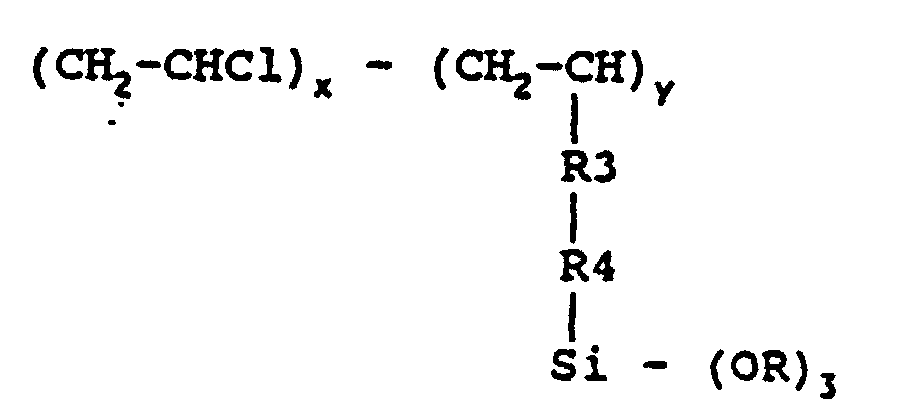
- the present invention provides a copolymer composition characterised in that it consists of a copolymer of polyvinylchloride and substituted alkyltrialkoxysilane corresponding to the following general formula: wherein x and y represent moles of monomer in the copolymer; R3 represents an amino or mercapto group; R4 represents an alkylene or aromatic group or an organic spacer group; and R independently represents an alkyl group; and in that the copolymer is produced by reacting polyvinylchloride and the alkyltrialkoxysilane in the presence of a polar aprotic solvent.
- the present invention further provides the production process.
- the present invention also provides an electrode characterised in that it has a coating of such a copolymer composition and a process for the production thereof.
- This invention involved the synthesis and use of polymer coatings that chemically bond to electrodes.
- novel polymer compositions were developed, as well as methods for preparing these polymer compositions.
- novel ways of obtaining adhesive membranes for ISEs were developed.
- silanes could be used to coat metal, glass and other surfaces that contain hydroxy groups or oxides.
- This process termed silanization, is used as a means of making surfaces hydrophobic and, in this case, as a means of reducing the driving force for the migration of aqueous contaminants under membranes.
- the polymer composition consists of a copolymer of PVC and substituted alkyltrialkoxysilane (hereafter referred to as ATAS).
- ATAS substituted alkyltrialkoxysilane
- the current polymer composition was synthesized by reacting PVC with a substituted ATAS, in the presence of a polar aprotic solvent. Reaction temperatures from 5 to 100 degrees C were evaluated and found acceptable for this reaction, although a reaction temperature of room temperature (approximately 20 degrees C) was found optimum. This reaction was found to work for any molecular weight PVC, namely molecular weights of 1,000 and higher. The preferred molecular weight range was found to be 10,000 - 100,000, while the optimum molecular weight was found to be approximately 62,000.
- compounds of the structure R1-R2-Si-(OR) 3 can be used to react with the PVC, where
- the copolymer has been found to perform satisfactorily when the ratio of y:x varies from 1:20 to 1:500.
- the preferred ratio was found to be 1:100 to 1:200, while the optimum ratio was found to be approximately 1:170 (or approximately 0.6%).
- the preferred aprotic solvent used in the synthesis of PVC-silane is hexamethylphosphoramide (HMPA).
- suitable solvents include, but are not limited to, dimethylsulfoxide (DMSO); 2-methylpyrrolidinone; 1,3-dimethyl-2-pyrimidinone; N,N-dimethyl formamide; and N,N-dimethyl acetamide. These solvents must be scrupulously cleaned and dried in order to remove any traces of water and/or basic moieties and other impurities.
- DMSO dimethylsulfoxide
- 2-methylpyrrolidinone 1,3-dimethyl-2-pyrimidinone
- N,N-dimethyl formamide N,N-dimethyl formamide
- N,N-dimethyl acetamide N,N-dimethyl acetamide.
- the reaction take place at room temperature, to avoid degradation of the PVC.
- the reaction is carried out under a blanket of dry, inert gas, preferably nitrogen or argon, to prevent oxidation of the polymer.
- the system is also kept free from light to prevent photodegradation of the polymer during the reaction.
- the system must be scrupulously dried to avoid premature curing of the product. The first three of these precautions have been found to prevent discoloration due to conjugated alkene formation, as all three or any combination of them catalyze dehydrochlorination in PVC.
- Chakrabarti a PVC and substituted ATAS were mixed at the point of application, then heated to 80 degrees C to provide an adhesive for attaching cover layers of cellular and non-cellular polyurethane layers.
- the product was not isolated or identified.
- the instant polymer composition is an isolated and distinct chemical species of known composition.
- the method of adhesion in Chakrabarti depends on the migration of the silane to the surface of the polymer, where it is cured at elevated temperatures.
- One advantage of the instant polymer composition is that the siloxane groups are dispersed throughout the polymer film. This gives rise to a uniformly crosslinked system upon curing, giving strength through the whole polymer layer, rather than just at the surface.
- the instant polymer layer is much more flexible, giving the possibility of application under a variety of conditions, and room temperature curing. This property is particularly important for use in ISEs, since the electrochemistry is very sensitive to the polymer matrix; only minimal variation from the parent PVC can be made without significantly affecting performance.
- the novel polymer compositions In using the novel polymer compositions to coat substrates, between 0.1 and 10% by weight solutions of the substituted PVC in volatile solvents, for example anhydrous tetrahydrofuran, are prepared. Optimum concentration was approximately 1% by weight.
- the substrates were coated to give layers of from 0.1 to 10 ⁇ m (microns) thick, preferably 1 ⁇ m (micron) in thickness. Cure times varied from 2 to 24 hours, depending upon the curing temperature, which could range from below room temperature (as low as approximately 0°C.) up to approximately 100°C. The preferred temperature for curing was room temperature. Adhesion was improved by soaking the coated substrate in water for 5 minutes prior to curing.
- the amount of proton scavenger needed is dependent on the amount of substitution which is obtained. Ratios of moles of scavenger to moles of total chlorine in PVC starting material have been investigated, and acceptable performance has been found when the ratios range between 1:100 and 10:1. Preferred ratios have been found to range between 1:20 and 10:1. Optimum performance has been found when the ratio is approximately 1:10.
- the reaction by-product, hydrochloric acid (HCl) may be removed by reaction with hindered bases such as 2,6-di-t-butylpyridine, diazobicyclo compounds, such as 1,4-diazabicyclo[2.2.2]octane, 1,5-diazabicyclo[4.3.0]non-5-ene, 1,8-diaza[5.4.0]undec-7-ene, or by tertiary amines such as tridodecyl amine, diisopropyl ethyl amine or di-t-butyl ethyl amine.
- the HCl may be removed by reaction with the excess substituted ATAS, since there is a large excess of this compound in the reaction.
- the instant polymer compositions and processes are useful primarily as adhesion promoters in ion selective and planar electrodes. It should be emphasized that the instant coating techniques are primarily useful for electrodes made of glass or aluminum or other metals/metal oxides. However, they are also usable on any materials that have hydroxyl or other groups that can react with the substituted ATAS.
- the polymer materials and techniques disclosed herein also have applicability in various other areas.
- the materials and processes have applicability in the adhesive area.
- FIG. 1 is a powder addition funnel.
- 2 is a pressure equalizing addition funnel.
- 3 is a sampling and draw-off tube with a 3-way stopcock.
- 4 is a 3-neck roundbottom flask.
- 5 is a side-arm Erlenmeyer flask containing precipitation solvent. 13 represent stirrers.
- Figure 2 represents the constant pressure apparatus, which is used to produce an inert atmosphere at 1 atmosphere pressure for use in the reaction.
- 6 is an Erlenmeyer flask with a 2-hole rubber stopper (20) , having a mercury resevoir (7) .
- One opening is connected to the atmosphere (18) , while the other (19) is connected to the rest of the system.
- 8 is a side-arm flask, containing potassium hydroxide pellets (9) , covered with glass wool (10) .
- the side arm is connected to a vacuum line, while the outlet of this flask is connected via a three-way stopcock (21) to either the balance of the system or an inert gas (12) .
- the constant pressure system is introduced to vacuum through line 11 to remove all gases from the system.
- Line 11 is then sealed and line 12 opened to introduce argon (or another inert gas) to the system until the pressure is again at equilibrium with the atmosphere. This procedure is repeated two additional times to insure removal of all oxygen from the system.
- the outlet 14 is then connected to the appropriate inlet to the reaction system (15, 16 , or 17) without opening the system to the atmosphere.
- All glassware used in the reaction is coated with black plastic to exclude light during the reaction.
- the reaction is maintained under a blanket of argon (or other inert gas) at atmospheric pressure. Initially, the system is set up with a measured amount of PVC in the powder funnel and a measured amount of the substituted ATAS in the addition funnel. A proton scavenger can be added to the addition funnel as well. The solvent for the reaction is present in the desired amount in the round bottom flask.
- the solvent is purified to remove amines. It is refluxed in the presence of 4-nitrophenyl hippuric acid ester for 24 hours. The mixture is cooled and pure solvent isolated by distillation in vacuo. The distillate is stirred at 50°C. over barium oxide, in an atmosphere of dry nitrogen, for 24 hours. The solvent is isolated by distillation in vacuo, and the process is repeated to give clean, dry solvent for the reaction.
- Polyvinylchloride (5 gm, 0.08 mol) is added slowly and with rapid stirring to 100 ml of HMPA.
- the HMPA has been previously exhaustively purified as described above.
- the solution is stirred for 24 hours (a previously determined amount of time) at room temperature to ensure that all PVC is dissolved in the solvent.
- aminopropyltriethoxysilane (3.6 gm, 0.016 mol) is added to the rapidly stirred reaction dropwise.
- the solution is stirred under these conditions for 48 hours. It is purified by addition, still under the inert atmosphere, to 2 liters of dried and distilled methanol.
- the solid polymer is filtered off, under an inert atmosphere, then redissolved into scrupulously dried tetrahydrofuran and precipitated into hexane. Note that the polymer continues to be kept under an inert atmosphere. The filtration, dissolution, and precipitation into hexane is repeated once more. The process yields approximately 80% of the theoretical amount of the product, with a substitution (i.e. ratio of silicon to chlorine) of 0.6%. It should be stressed that any introduction of water at any stage in this process will lead to premature curing of the polymer, rendering it insoluble and useless for further processes.
- Example 2 A process similar to that used in Example 1 was used, except that other polar aprotic solvents were substituted for the HMPA.
- the solvents used were 2-methylpyrrolidinone, 1,3-dimethylimidazolinone, N,N-dimethylformamide, 1,3-dimethyl-2-pyrimidinone, and dimethylsulfoxide.
- the results were as follows: Solvent % substitution hexamethylphosphoramide 0.60 - 0.79 1,3-dimethyl-2-imidazolinone 0.78 1,3-dimethyl-2-pyrimidinone 1.5 dimethyl sulfoxide 0.17 2-methyl-1-pyrrolidinone 4.5
- Example 2 A process similar to that used in Example 1 was used, except that different silanes were substituted for aminopropyltriethoxy silane.
- the silanes used were aminopropyltrimethoxy silane and mercaptopropyltriethoxy silane.
- the scavengers served to remove HCl, which could cause dehydrochlorination.
- the application method used to coat planar substrates with the substituted PVC compositions is as follows:
- the substituted PVC is dissolved in anhydrous tetrahydrofuran to give a 1% by weight solution.
- the solution is mixed in a dry glove box and stored in a presilanized bottle with a septum cap.
- the substrate is cleaned prior to coating with techniques suitable for removing surface particulates and organic contamination (grease).
- the preferred method used was a water rinse, N2 purge to dry, and plasma etching (3 min. Oxygen and 5 min. Argon cycle used at 300 watts).
- the substrates were spin coated with the substituted PVC solution to give a layer approximately 1 ⁇ m (micron) thick. The cure is affected at room temperature at high humidity over a 24-hour period.
- Example 7 An application method similar to that used in Example 7 except that the coated substrates were cured at 80°C for 2 hours. The shorter cure time was at the expense of increased degradation of PVC.
Landscapes
- Chemical & Material Sciences (AREA)
- Health & Medical Sciences (AREA)
- Chemical Kinetics & Catalysis (AREA)
- Organic Chemistry (AREA)
- Medicinal Chemistry (AREA)
- Polymers & Plastics (AREA)
- Life Sciences & Earth Sciences (AREA)
- General Chemical & Material Sciences (AREA)
- Physics & Mathematics (AREA)
- General Health & Medical Sciences (AREA)
- Molecular Biology (AREA)
- Electrochemistry (AREA)
- Materials Engineering (AREA)
- Analytical Chemistry (AREA)
- Biochemistry (AREA)
- Wood Science & Technology (AREA)
- General Physics & Mathematics (AREA)
- Immunology (AREA)
- Pathology (AREA)
- Engineering & Computer Science (AREA)
- Paints Or Removers (AREA)
- Addition Polymer Or Copolymer, Post-Treatments, Or Chemical Modifications (AREA)
- Processes Specially Adapted For Manufacturing Cables (AREA)
- Silicon Polymers (AREA)
Claims (18)
- Copolymerzusammensetzung, dadurch gekennzeichnet, daß sie aus einem Copolymer von Polyvinylchlorid und substituiertem Alkyltrialkoxysilan besteht und der folgenden allgemeinen Formel entspricht:wobei x und y die Mole Monomer im Copolymer darstellen; R3 eine Amino- oder Mercaptogruppe darstellt; R4 einen Alkylen- oder Aromatenrest oder eine organische Spacer-Gruppe darstellt und R unabhängig einen Alkylrest darstellt; und dadurch, daß das Copolymer durch Umsetzen von Polyvinylchlorid und Alkyltrialkoxysilan in Gegenwart eines polaren aprotischen Lösungsmittels hergestellt wird.
- Copolymerzusammensetzung nach Anspruch 1, wobei das Molekulargewicht des Polyvinylchlorid-Ausgangsmaterials größer als 1000 ist.
- Copolymerzusammensetzung nach Anspruch 1 oder Anspruch 2, wobei das Verhältnis y:x im Copolymer von 1:20 bis 1:500, vorzugsweise von 1:100 bis 1:200 reicht und stärker bevorzugt etwa 1:170 ist.
- Verfahren zur Herstellung einer Copolymerzusammensetzung nach einem der Ansprüche 1 bis 3, dadurch gekennzeichnet, daß es das Umsetzen von Polyvinylchlorid und einem geeigneten Alkyltrialkoxysilan in Gegenwart eines polaren aprotischen Lösungsmittels umfaßt.
- Verfahren nach Anspruch 4, wobei das Verhältnis x:y in der im Anspruch 1 definierten allgemeinen Formel von 100:1 bis 1:10, vorzugsweise von 20:1 bis 1:3 reicht und stärker bevorzugt etwa 5:1 ist. ,
- Verfahren nach Anspruch 4 oder Anspruch 5, wobei die Umsetzung von 5 bis 50°C, vorzugsweise bei etwa 20°C durchgeführt wird.
- Verfahren nach einem der Ansprüche 4 bis 6, wobei das aprotische Lösungsmittel ausgewählt ist aus Hexamethylphosphoramid (bevorzugt), Dimethylsulfoxid, 2-Methylpyrrolidinon, 1,3-Dimethyl-2-pyrimidinon, N,N-Dimethylformamid und N,N-Dimethylacetamid.
- Verfahren nach einem der Ansprüche 4 bis 7, wobei es in einem Zweiphasen- oder Einphasensystem durchgeführt wird.
- Verfahren nach einem der Ansprüche 4 bis 8, wobei die Umsetzung in einer Umgebung durchgeführt wird, die ein trokkenes, inertes Gas, vorzugsweise Argon oder Stickstoff, umfaßt.
- Verfahren nach einem der Ansprüche 4 bis 9, wobei die Umsetzung im Dunkeln durchgeführt wird.
- Verfahren nach einem der Ansprüche 4 bis 10, wobei es in Gegenwart eines Protonenfängers durchgeführt wird, der beim Einsetzen der Umsetzung oder, nachdem die Umsetzung begonnen hat, vorliegt, wobei der Protonenfänger vorzugsweise ausgewählt ist aus gehinderten Basen, Diazabicycloverbindungen, tertiären Aminen und einem Überschuß an substituiertem Alkyltrialkoxysilan, stärker bevorzugt 2,6-Di-t-butylpyridin, 1,4-Diazabicyclo[2.2.2]octan, 1,5-Diazabicyclo[4.3.0]non-5-en, 1,8-Diaza[5.4.0]undec-7-en, Tridodecylamin, Diisopropylethylamin oder Di-t-butylethylamin.
- Verfahren nach Anspruch 11, wobei das Verhältnis der Mole des Protonenfängers zu den Molen Chlor im Ausgangsmaterial von 1:100 bis 10:1, vorzugsweise von 1:20 bis 10:1 reicht und stärker bevorzugt etwa 1:10 ist.
- Elektrode, dadurch gekennzeichnet, daß sie eine Beschichtung aus einer Copolymerzusammensetzung nach einem der Ansprüche 1 bis 3 oder hergestellt durch ein Verfahren nach einem der Ansprüche 4 bis 12 hat.
- Elektrode nach Anspruch 13, wobei sie eine ionenselektive Elektrode oder eine planare Elektrode ist.
- Elektrode nach Anspruch 13 oder Anspruch 14, wobei die Beschichtung eine ausreichende Vernetzung besitzt, daß sie die Nichtfließ-Eigenschaften eines Feststoffs hat.
- Elektrode nach einem der Ansprüche 13 bis 15, wobei die Beschichtung von 0,1 bis 10%, vorzugsweise etwa 1%, bezogen auf das Gewicht, der Copolymerzusammensetzung in einem flüchtigen Lösungsmittel, vorzugsweise wasserfreiem Tetrahydrofuran, umfaßt.
- Elektrode nach einem der Ansprüche 13 bis 16, wobei sie eine Beschichtung hat, die nach dem Härten eine 0,1 bis 10 Mikron (µm) dicke, vorzugsweise etwa 1 Mikron (µm) dicke Schicht erzeugt.
- Verfahren zur Herstellung einer Elektrode nach einem der Ansprüche 13 bis 17, dadurch gekennzeichnet, daß es das Aufbringen einer Beschichtung darauf aus einer Copolymerzusammensetzung nach einem der Ansprüche 1 bis 3 oder hergestellt durch ein Verfahren nach einem der Ansprüche 4 bis 12 umfaßt.
Applications Claiming Priority (2)
| Application Number | Priority Date | Filing Date | Title |
|---|---|---|---|
| US07/817,721 US5283288A (en) | 1992-01-07 | 1992-01-07 | PVC coatings for electrodes |
| US817721 | 1992-01-07 |
Publications (2)
| Publication Number | Publication Date |
|---|---|
| EP0555952A1 EP0555952A1 (de) | 1993-08-18 |
| EP0555952B1 true EP0555952B1 (de) | 1999-08-25 |
Family
ID=25223748
Family Applications (1)
| Application Number | Title | Priority Date | Filing Date |
|---|---|---|---|
| EP93300037A Expired - Lifetime EP0555952B1 (de) | 1992-01-07 | 1993-01-05 | PVC-Beschichtungen für Elektroden |
Country Status (9)
| Country | Link |
|---|---|
| US (1) | US5283288A (de) |
| EP (1) | EP0555952B1 (de) |
| JP (1) | JP3292959B2 (de) |
| KR (1) | KR930016452A (de) |
| AT (1) | ATE183756T1 (de) |
| AU (1) | AU655484B2 (de) |
| CA (1) | CA2076405A1 (de) |
| DE (1) | DE69326088T2 (de) |
| DK (1) | DK174816B1 (de) |
Families Citing this family (3)
| Publication number | Priority date | Publication date | Assignee | Title |
|---|---|---|---|---|
| ATE198615T1 (de) * | 1991-11-15 | 2001-01-15 | Ici Plc | Polymerisierbare zusammensetzungen |
| US5433852A (en) * | 1993-09-02 | 1995-07-18 | Industrial Technology Research Institute | Method for modifying PVC separation membranes |
| US20040142572A1 (en) * | 2003-01-16 | 2004-07-22 | Deveau Jason S. T. | Apparatus and method for selectively inducing hydrophobicity in a single barrel of a multibarrel ion selective microelectrode |
Family Cites Families (7)
| Publication number | Priority date | Publication date | Assignee | Title |
|---|---|---|---|---|
| US3850772A (en) * | 1967-08-16 | 1974-11-26 | Desoto Inc | Electrodeposition of organopolysiloxane-containing coatings to provide improved gloss and weather resistance |
| GB1485263A (en) * | 1973-07-17 | 1977-09-08 | Dow Corning Ltd | Method for preparing crosslinkable polymers |
| US4146585A (en) * | 1977-03-02 | 1979-03-27 | Union Carbide Corporation | Process for preparing silane grafted polymers |
| DE3029583A1 (de) * | 1980-08-05 | 1982-03-11 | Basf Ag, 6700 Ludwigshafen | Haftvermittler und deren verwendung zum verbinden von polyurethanen mit deckschichten sowie ein verfahren hierzu |
| JPS5763351A (en) * | 1980-10-03 | 1982-04-16 | Kanegafuchi Chem Ind Co Ltd | Composition having improved pot life |
| CS262332B1 (en) * | 1987-03-30 | 1989-03-14 | Miroslav Doc Ing Csc Schatz | Process for preparing vulcanizable halogen-hydrocarbon polymers |
| US5102526A (en) * | 1990-05-02 | 1992-04-07 | The University Of Michigan | Solid state ion sensor with silicon membrane |
-
1992
- 1992-01-07 US US07/817,721 patent/US5283288A/en not_active Expired - Lifetime
- 1992-07-28 AU AU20581/92A patent/AU655484B2/en not_active Ceased
- 1992-08-19 CA CA002076405A patent/CA2076405A1/en not_active Abandoned
- 1992-10-14 DK DK199201255A patent/DK174816B1/da not_active IP Right Cessation
- 1992-10-15 JP JP27700392A patent/JP3292959B2/ja not_active Expired - Fee Related
-
1993
- 1993-01-05 AT AT93300037T patent/ATE183756T1/de not_active IP Right Cessation
- 1993-01-05 EP EP93300037A patent/EP0555952B1/de not_active Expired - Lifetime
- 1993-01-05 DE DE69326088T patent/DE69326088T2/de not_active Expired - Lifetime
- 1993-01-07 KR KR1019930000124A patent/KR930016452A/ko not_active Withdrawn
Also Published As
| Publication number | Publication date |
|---|---|
| DK125592A (da) | 1993-07-08 |
| AU2058192A (en) | 1993-07-08 |
| US5283288A (en) | 1994-02-01 |
| DE69326088T2 (de) | 1999-12-16 |
| JPH05247125A (ja) | 1993-09-24 |
| AU655484B2 (en) | 1994-12-22 |
| ATE183756T1 (de) | 1999-09-15 |
| DE69326088D1 (de) | 1999-09-30 |
| JP3292959B2 (ja) | 2002-06-17 |
| DK125592D0 (da) | 1992-10-14 |
| EP0555952A1 (de) | 1993-08-18 |
| KR930016452A (ko) | 1993-08-26 |
| CA2076405A1 (en) | 1993-07-08 |
| DK174816B1 (da) | 2003-12-01 |
Similar Documents
| Publication | Publication Date | Title |
|---|---|---|
| EP0034722B1 (de) | Beschichtungszusammensetzung und Verfahren zum Verkleben einer härtbaren Zusammensetzung auf einem Substrat | |
| Zhu et al. | Polydopamine-melanin initiators for Surface-initiated ATRP | |
| US11834541B2 (en) | Compositions for forming polymer brushes | |
| JPS6388439A (ja) | イオン感応電界効果トランジスターおよびその製法 | |
| US4243718A (en) | Primer compositions for Si-H-olefin platinum catalyzed silicone compositions | |
| US7179506B2 (en) | Surface modification of solid phase objects by poly(vinyl alcohol) | |
| US4973394A (en) | Immobilized valinomycin molecule for K+ sensor | |
| US5283288A (en) | PVC coatings for electrodes | |
| US5637642A (en) | PVC adhesives for electrodes and other applications | |
| US5595658A (en) | Membrane based on graft copolymers | |
| JPH08119673A (ja) | ガラスの親水化処理方法 | |
| JP2721932B2 (ja) | 塩素化付加系(共)重合体上に官能基を置換反応する方法 | |
| EP0423334B1 (de) | Harzzusammensetzung und verfahren zur herstellung eines durchsichtigen dünnen filmes | |
| JPH0726062B2 (ja) | 無機コート膜の表面処理剤 | |
| JP2812121B2 (ja) | 光学物品の製造方法 | |
| CN1301287C (zh) | 一种荷正电有机-无机杂化膜的制备方法 | |
| JP2002265868A (ja) | プライマー組成物 | |
| JPS62250017A (ja) | シリコン樹脂組成物 | |
| CN115244148A (zh) | 包含全氟苯基叠氮化物的硅氧烷低聚物混合物 | |
| JPH0688902A (ja) | 無機コート膜を有する光学物品及びその表面改質方法 | |
| JPH0682603A (ja) | 反射防止性を有する光学物品及びその表面改質方法 | |
| JPS6330512A (ja) | 室温硬化性共重合体並びにその製造方法 | |
| JP2002542462A (ja) | Pvc接着性層を電極に付着させる方法およびかかる方法にしたがって製造する電極 | |
| JP2001089744A (ja) | 耐光接着性の改良されたシーリング材施工方法 | |
| EP4026611A1 (de) | Adsorbierendes verbundmaterial für vorrichtungen zur feuchtigkeitskontrolle, wärmeaustausch- und wärmespeichervorrichtungen |
Legal Events
| Date | Code | Title | Description |
|---|---|---|---|
| PUAI | Public reference made under article 153(3) epc to a published international application that has entered the european phase |
Free format text: ORIGINAL CODE: 0009012 |
|
| AK | Designated contracting states |
Kind code of ref document: A1 Designated state(s): AT DE FR GB IT |
|
| 17P | Request for examination filed |
Effective date: 19940128 |
|
| 17Q | First examination report despatched |
Effective date: 19951222 |
|
| GRAG | Despatch of communication of intention to grant |
Free format text: ORIGINAL CODE: EPIDOS AGRA |
|
| GRAG | Despatch of communication of intention to grant |
Free format text: ORIGINAL CODE: EPIDOS AGRA |
|
| GRAH | Despatch of communication of intention to grant a patent |
Free format text: ORIGINAL CODE: EPIDOS IGRA |
|
| GRAH | Despatch of communication of intention to grant a patent |
Free format text: ORIGINAL CODE: EPIDOS IGRA |
|
| GRAA | (expected) grant |
Free format text: ORIGINAL CODE: 0009210 |
|
| AK | Designated contracting states |
Kind code of ref document: B1 Designated state(s): AT DE FR GB IT |
|
| PG25 | Lapsed in a contracting state [announced via postgrant information from national office to epo] |
Ref country code: AT Free format text: LAPSE BECAUSE OF FAILURE TO SUBMIT A TRANSLATION OF THE DESCRIPTION OR TO PAY THE FEE WITHIN THE PRESCRIBED TIME-LIMIT Effective date: 19990825 |
|
| REF | Corresponds to: |
Ref document number: 183756 Country of ref document: AT Date of ref document: 19990915 Kind code of ref document: T |
|
| ITF | It: translation for a ep patent filed | ||
| REF | Corresponds to: |
Ref document number: 69326088 Country of ref document: DE Date of ref document: 19990930 |
|
| ET | Fr: translation filed | ||
| PLBE | No opposition filed within time limit |
Free format text: ORIGINAL CODE: 0009261 |
|
| 26N | No opposition filed | ||
| PGFP | Annual fee paid to national office [announced via postgrant information from national office to epo] |
Ref country code: FR Payment date: 20001220 Year of fee payment: 9 |
|
| REG | Reference to a national code |
Ref country code: GB Ref legal event code: IF02 |
|
| PG25 | Lapsed in a contracting state [announced via postgrant information from national office to epo] |
Ref country code: FR Free format text: LAPSE BECAUSE OF NON-PAYMENT OF DUE FEES Effective date: 20020930 |
|
| REG | Reference to a national code |
Ref country code: FR Ref legal event code: ST |
|
| PG25 | Lapsed in a contracting state [announced via postgrant information from national office to epo] |
Ref country code: IT Free format text: LAPSE BECAUSE OF NON-PAYMENT OF DUE FEES;WARNING: LAPSES OF ITALIAN PATENTS WITH EFFECTIVE DATE BEFORE 2007 MAY HAVE OCCURRED AT ANY TIME BEFORE 2007. THE CORRECT EFFECTIVE DATE MAY BE DIFFERENT FROM THE ONE RECORDED. Effective date: 20050105 |
|
| REG | Reference to a national code |
Ref country code: GB Ref legal event code: 732E Free format text: REGISTERED BETWEEN 20100923 AND 20100929 |
|
| REG | Reference to a national code |
Ref country code: GB Ref legal event code: 732E Free format text: REGISTERED BETWEEN 20101104 AND 20101110 |
|
| REG | Reference to a national code |
Ref country code: DE Ref legal event code: R082 Ref document number: 69326088 Country of ref document: DE |
|
| REG | Reference to a national code |
Ref country code: DE Ref legal event code: R081 Ref document number: 69326088 Country of ref document: DE Owner name: SIEMENS HEALTHCARE DIAGNOSTICS INC., US Free format text: FORMER OWNER: CIBA CORNING DIAGNOSTICS CORP., MEDFIELD, US Effective date: 20120208 |
|
| PGFP | Annual fee paid to national office [announced via postgrant information from national office to epo] |
Ref country code: DE Payment date: 20120319 Year of fee payment: 20 |
|
| PGFP | Annual fee paid to national office [announced via postgrant information from national office to epo] |
Ref country code: GB Payment date: 20120112 Year of fee payment: 20 |
|
| REG | Reference to a national code |
Ref country code: DE Ref legal event code: R071 Ref document number: 69326088 Country of ref document: DE |
|
| REG | Reference to a national code |
Ref country code: GB Ref legal event code: PE20 Expiry date: 20130104 |
|
| PG25 | Lapsed in a contracting state [announced via postgrant information from national office to epo] |
Ref country code: GB Free format text: LAPSE BECAUSE OF EXPIRATION OF PROTECTION Effective date: 20130104 Ref country code: DE Free format text: LAPSE BECAUSE OF EXPIRATION OF PROTECTION Effective date: 20130108 |