EP0544091B2 - Verfahren zur Reaktivierung wasserlöslicher Hydroformylierungskatalysatoren - Google Patents
Verfahren zur Reaktivierung wasserlöslicher Hydroformylierungskatalysatoren Download PDFInfo
- Publication number
- EP0544091B2 EP0544091B2 EP92117580A EP92117580A EP0544091B2 EP 0544091 B2 EP0544091 B2 EP 0544091B2 EP 92117580 A EP92117580 A EP 92117580A EP 92117580 A EP92117580 A EP 92117580A EP 0544091 B2 EP0544091 B2 EP 0544091B2
- Authority
- EP
- European Patent Office
- Prior art keywords
- olefinically unsaturated
- unsaturated compound
- catalyst
- alkyl
- sulfonated
- Prior art date
- Legal status (The legal status is an assumption and is not a legal conclusion. Google has not performed a legal analysis and makes no representation as to the accuracy of the status listed.)
- Expired - Lifetime
Links
Classifications
-
- B—PERFORMING OPERATIONS; TRANSPORTING
- B01—PHYSICAL OR CHEMICAL PROCESSES OR APPARATUS IN GENERAL
- B01J—CHEMICAL OR PHYSICAL PROCESSES, e.g. CATALYSIS OR COLLOID CHEMISTRY; THEIR RELEVANT APPARATUS
- B01J31/00—Catalysts comprising hydrides, coordination complexes or organic compounds
- B01J31/40—Regeneration or reactivation
-
- B—PERFORMING OPERATIONS; TRANSPORTING
- B01—PHYSICAL OR CHEMICAL PROCESSES OR APPARATUS IN GENERAL
- B01J—CHEMICAL OR PHYSICAL PROCESSES, e.g. CATALYSIS OR COLLOID CHEMISTRY; THEIR RELEVANT APPARATUS
- B01J31/00—Catalysts comprising hydrides, coordination complexes or organic compounds
- B01J31/40—Regeneration or reactivation
- B01J31/4015—Regeneration or reactivation of catalysts containing metals
- B01J31/4023—Regeneration or reactivation of catalysts containing metals containing iron group metals, noble metals or copper
- B01J31/4038—Regeneration or reactivation of catalysts containing metals containing iron group metals, noble metals or copper containing noble metals
- B01J31/4046—Regeneration or reactivation of catalysts containing metals containing iron group metals, noble metals or copper containing noble metals containing rhodium
-
- B—PERFORMING OPERATIONS; TRANSPORTING
- B01—PHYSICAL OR CHEMICAL PROCESSES OR APPARATUS IN GENERAL
- B01J—CHEMICAL OR PHYSICAL PROCESSES, e.g. CATALYSIS OR COLLOID CHEMISTRY; THEIR RELEVANT APPARATUS
- B01J31/00—Catalysts comprising hydrides, coordination complexes or organic compounds
- B01J31/16—Catalysts comprising hydrides, coordination complexes or organic compounds containing coordination complexes
- B01J31/20—Carbonyls
-
- B—PERFORMING OPERATIONS; TRANSPORTING
- B01—PHYSICAL OR CHEMICAL PROCESSES OR APPARATUS IN GENERAL
- B01J—CHEMICAL OR PHYSICAL PROCESSES, e.g. CATALYSIS OR COLLOID CHEMISTRY; THEIR RELEVANT APPARATUS
- B01J31/00—Catalysts comprising hydrides, coordination complexes or organic compounds
- B01J31/16—Catalysts comprising hydrides, coordination complexes or organic compounds containing coordination complexes
- B01J31/24—Phosphines, i.e. phosphorus bonded to only carbon atoms, or to both carbon and hydrogen atoms, including e.g. sp2-hybridised phosphorus compounds such as phosphabenzene, phosphole or anionic phospholide ligands
-
- B—PERFORMING OPERATIONS; TRANSPORTING
- B01—PHYSICAL OR CHEMICAL PROCESSES OR APPARATUS IN GENERAL
- B01J—CHEMICAL OR PHYSICAL PROCESSES, e.g. CATALYSIS OR COLLOID CHEMISTRY; THEIR RELEVANT APPARATUS
- B01J31/00—Catalysts comprising hydrides, coordination complexes or organic compounds
- B01J31/16—Catalysts comprising hydrides, coordination complexes or organic compounds containing coordination complexes
- B01J31/24—Phosphines, i.e. phosphorus bonded to only carbon atoms, or to both carbon and hydrogen atoms, including e.g. sp2-hybridised phosphorus compounds such as phosphabenzene, phosphole or anionic phospholide ligands
- B01J31/2404—Cyclic ligands, including e.g. non-condensed polycyclic ligands, the phosphine-P atom being a ring member or a substituent on the ring
-
- B—PERFORMING OPERATIONS; TRANSPORTING
- B01—PHYSICAL OR CHEMICAL PROCESSES OR APPARATUS IN GENERAL
- B01J—CHEMICAL OR PHYSICAL PROCESSES, e.g. CATALYSIS OR COLLOID CHEMISTRY; THEIR RELEVANT APPARATUS
- B01J31/00—Catalysts comprising hydrides, coordination complexes or organic compounds
- B01J31/16—Catalysts comprising hydrides, coordination complexes or organic compounds containing coordination complexes
- B01J31/24—Phosphines, i.e. phosphorus bonded to only carbon atoms, or to both carbon and hydrogen atoms, including e.g. sp2-hybridised phosphorus compounds such as phosphabenzene, phosphole or anionic phospholide ligands
- B01J31/2404—Cyclic ligands, including e.g. non-condensed polycyclic ligands, the phosphine-P atom being a ring member or a substituent on the ring
- B01J31/2442—Cyclic ligands, including e.g. non-condensed polycyclic ligands, the phosphine-P atom being a ring member or a substituent on the ring comprising condensed ring systems
- B01J31/2447—Cyclic ligands, including e.g. non-condensed polycyclic ligands, the phosphine-P atom being a ring member or a substituent on the ring comprising condensed ring systems and phosphine-P atoms as substituents on a ring of the condensed system or on a further attached ring
-
- C—CHEMISTRY; METALLURGY
- C07—ORGANIC CHEMISTRY
- C07C—ACYCLIC OR CARBOCYCLIC COMPOUNDS
- C07C45/00—Preparation of compounds having >C = O groups bound only to carbon or hydrogen atoms; Preparation of chelates of such compounds
- C07C45/49—Preparation of compounds having >C = O groups bound only to carbon or hydrogen atoms; Preparation of chelates of such compounds by reaction with carbon monoxide
- C07C45/50—Preparation of compounds having >C = O groups bound only to carbon or hydrogen atoms; Preparation of chelates of such compounds by reaction with carbon monoxide by oxo-reactions
-
- C—CHEMISTRY; METALLURGY
- C07—ORGANIC CHEMISTRY
- C07C—ACYCLIC OR CARBOCYCLIC COMPOUNDS
- C07C45/00—Preparation of compounds having >C = O groups bound only to carbon or hydrogen atoms; Preparation of chelates of such compounds
- C07C45/78—Separation; Purification; Stabilisation; Use of additives
- C07C45/85—Separation; Purification; Stabilisation; Use of additives by treatment giving rise to a chemical modification
-
- B—PERFORMING OPERATIONS; TRANSPORTING
- B01—PHYSICAL OR CHEMICAL PROCESSES OR APPARATUS IN GENERAL
- B01J—CHEMICAL OR PHYSICAL PROCESSES, e.g. CATALYSIS OR COLLOID CHEMISTRY; THEIR RELEVANT APPARATUS
- B01J2231/00—Catalytic reactions performed with catalysts classified in B01J31/00
- B01J2231/30—Addition reactions at carbon centres, i.e. to either C-C or C-X multiple bonds
- B01J2231/32—Addition reactions to C=C or C-C triple bonds
- B01J2231/321—Hydroformylation, metalformylation, carbonylation or hydroaminomethylation
-
- B—PERFORMING OPERATIONS; TRANSPORTING
- B01—PHYSICAL OR CHEMICAL PROCESSES OR APPARATUS IN GENERAL
- B01J—CHEMICAL OR PHYSICAL PROCESSES, e.g. CATALYSIS OR COLLOID CHEMISTRY; THEIR RELEVANT APPARATUS
- B01J2531/00—Additional information regarding catalytic systems classified in B01J31/00
- B01J2531/80—Complexes comprising metals of Group VIII as the central metal
- B01J2531/82—Metals of the platinum group
- B01J2531/822—Rhodium
-
- B—PERFORMING OPERATIONS; TRANSPORTING
- B01—PHYSICAL OR CHEMICAL PROCESSES OR APPARATUS IN GENERAL
- B01J—CHEMICAL OR PHYSICAL PROCESSES, e.g. CATALYSIS OR COLLOID CHEMISTRY; THEIR RELEVANT APPARATUS
- B01J2531/00—Additional information regarding catalytic systems classified in B01J31/00
- B01J2531/90—Catalytic systems characterized by the solvent or solvent system used
- B01J2531/96—Water
-
- Y—GENERAL TAGGING OF NEW TECHNOLOGICAL DEVELOPMENTS; GENERAL TAGGING OF CROSS-SECTIONAL TECHNOLOGIES SPANNING OVER SEVERAL SECTIONS OF THE IPC; TECHNICAL SUBJECTS COVERED BY FORMER USPC CROSS-REFERENCE ART COLLECTIONS [XRACs] AND DIGESTS
- Y02—TECHNOLOGIES OR APPLICATIONS FOR MITIGATION OR ADAPTATION AGAINST CLIMATE CHANGE
- Y02P—CLIMATE CHANGE MITIGATION TECHNOLOGIES IN THE PRODUCTION OR PROCESSING OF GOODS
- Y02P20/00—Technologies relating to chemical industry
- Y02P20/50—Improvements relating to the production of bulk chemicals
- Y02P20/584—Recycling of catalysts
Definitions
- the invention relates to a method for restoring the effectiveness of partially deactivated, water soluble hydroformylation catalysts.
- the rhodium catalyst is an additional one Ligands, especially tertiary organic phosphines or phosphites modified hydridorhodium carbonyl.
- the ligands are usually present in excess, so that the catalyst system consists of a complex compound and free ligand exists.
- the use of the described rhodium catalysts enables the Carry out hydroformylation reaction at pressures below 30 MPa.
- catalyst systems which are in Water are soluble.
- Such catalysts are e.g. described in DE-PS 26 27 354.
- the solubility of the rhodium complex compounds is here by using sulfonated triarylphosphines as a complex component reached.
- the separation of the catalyst from the reaction product after the end of In this process variant, implementation is carried out simply by decanting aqueous and organic Phase, i.e. without distillation and thus without additional thermal process steps.
- Another one A feature of this procedure is that with high selectivity from straight-chain terminal olefins n-aldehydes and only to a very minor extent iso-aldehydes are formed.
- water-soluble rhodium complex compounds are preferably sulfonated, but also, e.g. is known from DE-A1 31 35 127, carboxylated triarylphosphines used.
- sulfonated compounds e.g. Phosphine oxides, phosphine sulfides, aromatic Sulfonic acids, ⁇ -hydroxybutyldisulfophenylphosphine oxide, disulfophosphinic acid and disulfophenylphosphinic acid, each in the form of their salts.
- phosphine oxides and phosphine sulfides nor the salts of aromatic sulfonic acids and the Disulfophenylphosphinic acid are catalytically active alone or together with rhodium. The same goes for also for cluster compounds of rhodium which, after long reaction times, result from the catalytic can form effective rhodium complex compound.
- cluster compounds of rhodium which, after long reaction times, result from the catalytic can form effective rhodium complex compound.
- To maintain the original activity and selectivity of the To restore the catalyst system one can use the catalyst components that have become ineffective remove them from the reaction mixture until the initial concentration is adjusted by fresh ones Replace rhodium compound and / or fresh phosphine.
- sulfonated or carboxylated alkyl arylphosphines are also conversion products to mention that inhibit the hydroformylation reaction.
- These mixed, aliphatic-aromatic Phosphines form in the course of the reaction of the olefins with carbon monoxide and Hydrogen from the sulfonated or carboxylated triarylphosphine by exchanging aryl residues against alkyl groups, the alkyl groups being derived from the olefin being hydroformylated. So arises e.g.
- the task was therefore to selectively selectively deactivate the alkyl arylphosphines to remove the reaction mixture.
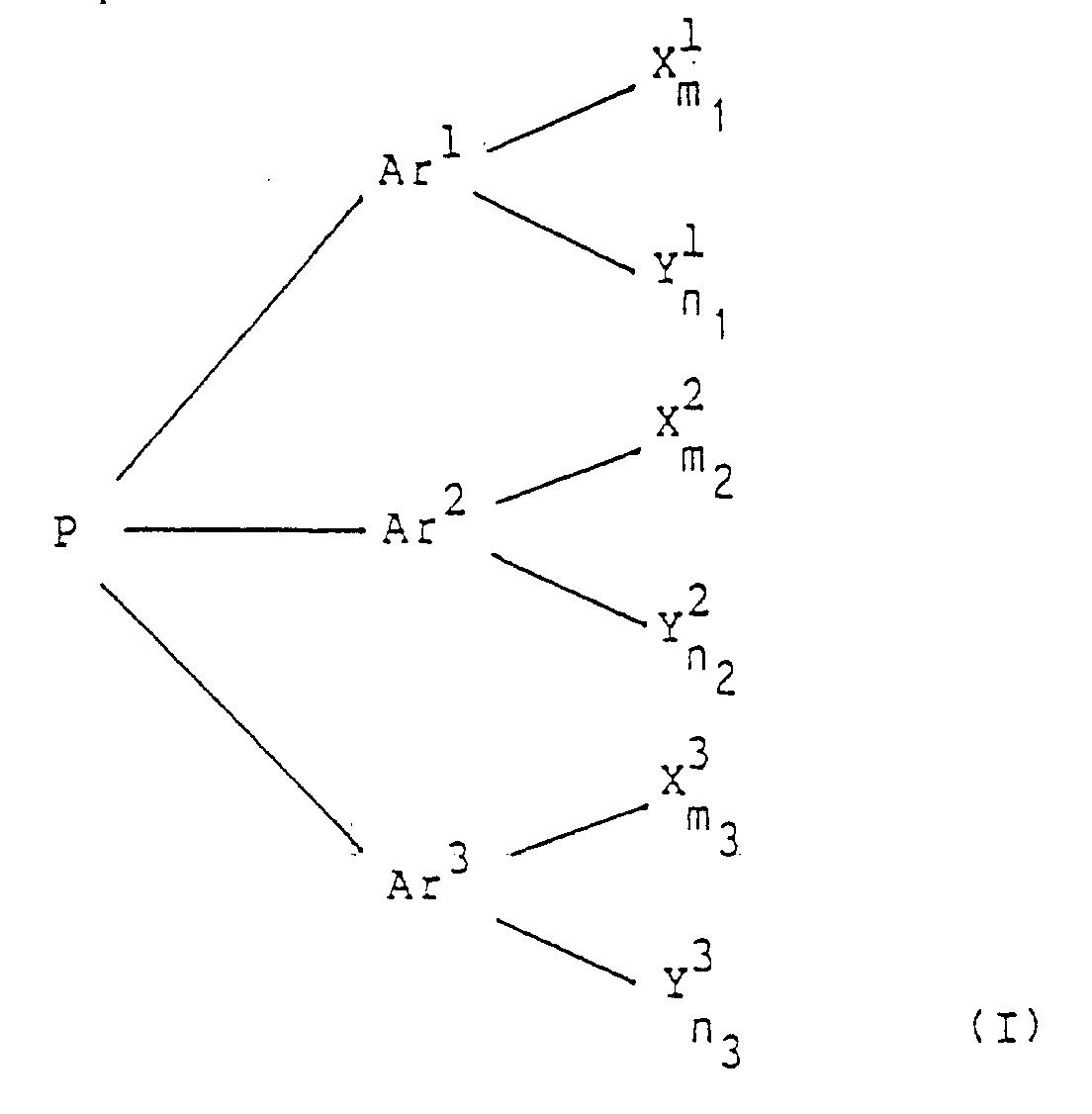
- this object is achieved by a process for regenerating water-soluble catalyst systems which were used in a hydroformulation reaction using aqueous catalyst solutions and rhodium and compounds of the general formula I where Ar 1 , Ar 2 , Ar 3 each represent a phenyl or naphthyl group, Y 1 , Y 2 , Y 3 each represent a straight-chain or branched alkyl group having 1 to 4 C atoms, a straight-chain or branched alkoxy group having 1 to 4 C atoms , a halogen atom, the OH, CN, NO 2 or R 1 R 2 N group, in which R 1 and R 2 each represent a straight-chain or branched alkyl group having 1 to 4 C atoms, X 1 , X 2 and X 3 is a carboxylate (- COO - -) and / or a sulfonate - (- SO 3 - -) radical, m 1 , m 2
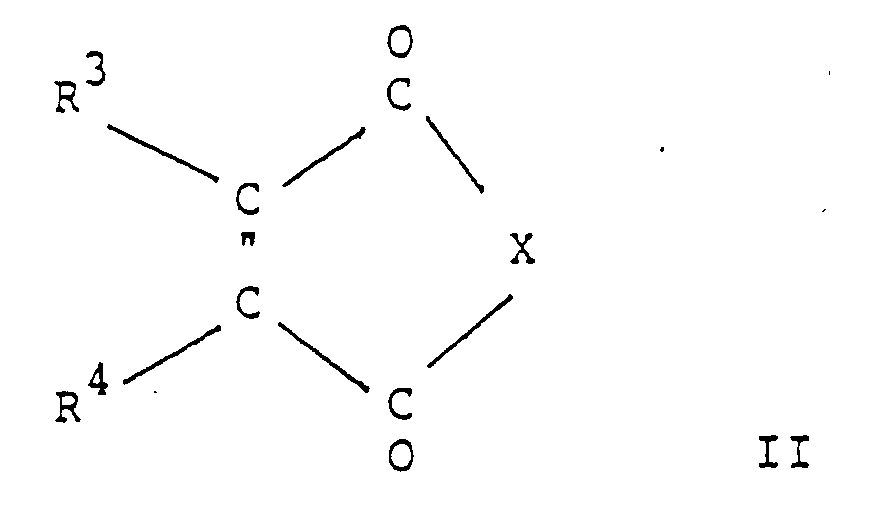
- aqueous solutions of the catalyst systems for reacting sulfonated or carboxylated alkyl arylphosphines are maleic acid, fumaric acid or olefinically unsaturated compounds of the general formula II in which X represents O, S, NR 5 or PR 5 and R 3 , R 4 and R 5 are identical or different and are hydrogen, an alkyl or aryl radical.
- the new process leads to a significant revival even of such Catalysts that have been used for extended periods.
- Gain activity and selectivity through the The measure according to the invention often returns to its original values.
- the reactivation of the catalyst can take place during its use, so that a separation of the Catalyst solution from the reaction mixture or an interruption of the ongoing synthesis is not necessary is.
- the conversion products of the water-soluble alkyl arylphosphine and the water-soluble olefinic compound remain in the aqueous solution. This differs The new way of working benefited from hydroformylation in a homogeneous phase Rhodium / arylphosphine catalysts.
- This variant of oxosynthesis can also be undesirable Conversion products of the lipophilic arylphosphines by reaction with certain olefinically unsaturated Connections are made harmless (cf. EP 00 19 296 A1). However, it is required that Remove conversion products from the reaction mixture by extraction with water. This The process therefore requires the separation of the catalyst system from the reaction mixture, so it can not be carried out in a running system.
- An unexpected side effect of the procedure according to the invention is the increase in the reaction rate in the hydroformylation of higher olefins, i.e. H. Olefins with 9 and more carbon atoms, using catalyst solutions resulting from the reaction of water-soluble alkyl arylphosphines contain compounds resulting from water-soluble olefinically unsaturated compounds. possibly are the newly formed compounds phase transfer reagents (solubilizers) that the Improve the solubility of the higher olefins in the aqueous phase and thus accelerate the reaction.
- phase transfer reagents solubilizers
- the aqueous catalyst solutions used in the synthesis are usually used to regenerate catalyst systems by the process according to the invention. They generally contain rhodium in concentrations of 450 to 800 ppm by weight and water-soluble phosphines in concentrations of 25 to 30% by weight, based in each case on the aqueous solution.
- the rhodium is present as a carbonyl hydrogen compound which additionally contains phosphine in a complex bond.
- Unbound phosphines are dissolved in the solution as salts, preferably as alkali, ammonium or quaternary ammonium salts. They correspond to the general formula I given above.
- phosphines examples include tri (m-sulfophenyl) phosphine, phenyl-di (m-sulfophenyl) phosphine and diphenyl- (m-sulfophenyl) phosphine.
- the conversion products of the phosphines for example phosphine oxides and phosphine sulfides and, if appropriate, other substances, such as solubilizers, are contained in the solution, which are characterized in more detail above.
- the formation of by-products takes place independently of the individual olefinically unsaturated compounds which have been hydroformylated under the action of the aqueous catalyst solution.
- the alkyl arylphosphines recognized as disruptive are compounds which contain one or contain two alkyl radicals and 2 or 1 sulfonated or carboxylated aryl group. These phosphines too are able to form complex compounds with rhodium, but have been shown to be catalytic are not or only slightly effective.
- the inactivity of the alkylarylphoshins may be due to their im Higher basicity compared to arylphosphines.
- the aryl residues in the mixed aliphatic-aromatic phosphines match those in the Triarylphosphinen the catalyst system are included and the number of carbon atoms in the alkyl radical is equal to the number of carbon atoms in the olefin used. Therefore, e.g.
- alkyl arylphosphines contained in the catalyst solution are set with olefinic compounds of the general formula II around.
- X represents O, S, NR 5 or PR 5 ;
- R 3 , R 4 and R 5 are the same or different and represent an alkyl or aryl radical.
- R 3 , R 4 and R 5 are hydrogen, unbranched or branched C 2 -C 6 alkyl radicals or unsubstituted or substituted phenyl radicals.
- the olefinic compounds are not required to be readily soluble in water. It is enough, that they pass into the aqueous phase, if only in small amounts, and to the extent that they be consumed by the reaction, go back to this phase. Still preferred in Water easily and in organic media difficult or insoluble substances to cause the reaction simplify and accelerate and enrichment of the olefinically unsaturated compounds in the avoid organic phase.
- Maleic acid has proven to be an olefinically unsaturated compound, Fumaric acid, maleic anhydride, maleimide, maleic acid and maleic anhydride are particularly suitable.
- the compounds are used as such or, u. a. to simplify their dosage, as solutions, suitably in water or in solvents that are miscible with water.
- the concentration of the olefinically unsaturated compounds in the solutions can vary within wide limits solutions which are 0.1 to 40% by weight, in particular 0.1 to 10% by weight, of unsaturated are preferred Compound (based on the solution) included.
- the reaction takes place in a simple manner by mixing the catalyst phase and olefinically unsaturated compound. Temperature and pressure are not critical to the reaction, in general one works at temperatures from 0 to 150 ° C, whereby temperatures of 100 ° C and more goes without saying require the application of increased pressure.
- Alkyl-arylphosphine and olefinic compound react with each other in a molar ratio of 1: 1 one must per mole of the phosphine to be removed. its amount can be analytical, e.g. by HPLC analysis be determined, use at least 1 mol of olefinically unsaturated compound.
- the catalyst system can also be reactivated repeatedly. Both when using of the olefinically unsaturated compound in excess and in the repeated reactivation of the It should be noted that the catalyst solution does not react with the water-soluble alkylarylphosphine takes place selectively, but that always also to a minor extent sulfonated or carboxylated triarylphosphine mitreagiert. It may therefore be necessary to sulfonate or carboxylate from time to time Triarylphosphine in the catalyst solution to add the optimal ratio of rhodium to Maintain phosph i n.
- the tests were carried out in a continuously operating laboratory apparatus consisting of a stirred reactor, a phase separator and a product template with exhaust gas control.
- the reactor was filled with 150 ml, the phase separator with 130 ml of catalyst solution.
- the catalyst solution contained about 300 ppm by weight Rh, the molar ratio phosphorus (III) / Rh varied between 100: 1 (fresh catalyst solution) and 15: 1 (used catalyst solution).
- 122 ° C. reactor temperature, 5.0 MPa synthesis gas pressure (CO: H 2 1: 1), depending on the activity of the catalyst solution used, 20-40 g of propylene were pumped continuously into the reactor.
- reaction mixture overflowing into the phase separator (aqueous-organic product, CO / H 2 , propylene) was separated and the aqueous catalyst solution which settled out was continuously returned to the reactor.
- aqueous-organic product, CO / H 2 , propylene aqueous-organic product, CO / H 2 , propylene
- crude oxo product and synthesis gas were separated from one another and the resulting aqueous solution was pumped into the reactor in a closed circuit.
- the escaping crude aldehyde was collected in the product template and its amount was determined every hour.
- Examples 1-3 show the deactivating effect of PDSPP on a fresh Rh / TPPTS catalyst solution used in the hydroformylation.
- Example 1 is a reference test with fresh catalyst solution. Their (absolute) activity is 15.8 and is set to 100 as the relative activity.
- Examples 2 and 3 increasing amounts of PDSPP were added to the catalyst solution.
- the molar ratio (TPPTS + TPPDS) / PDSPP serves as an orientation variable.
- Example 4 as a reference experiment shows the A and P values of an aged catalyst solution.
- the relative Activity has dropped to 41%.
- the molar ratio (TPPTS + TPPDS) / PDSPP is 13: 1.
- Example 5 illustrates the effect of adding maleic anhydride as an olefinically unsaturated compound according to the invention.
- the relative activity rises again to 77.5%.
- the maleic acid addition in Examples 7 to 11 was between 0.05 and 0.5% by weight, based on the old catalyst solution, varies.
- Example 7 gives the proportions of TPPTS and TPPDS and PDSPP (each in mmol) in the catalyst solution again.
- the molar ratio (TPPTS + TPPDS) / PDSPP in turn serves as an optimization variable.
- Example 12 shows that the activity within the range of fluctuation could be reduced to the Starting level of a fresh catalyst solution may be raised, although the total salt concentration (this means the totality of the salts contained in the solution) of the catalyst solution has now risen from 15 to around 30%.
- Example 13 makes it clear that by increasing the P (III) content through fresh TPPTS, the activity can be raised far above the initial level. The relative activity increases to 139%. to Explanation of this surprising phenomenon is believed to be that in the old catalyst solution contained degradation products as well as the solvent-mediated phosphonium salts formed by maleic acid Have properties that can only develop their effect if the activity-reducing ones Rh / PDSPP complexes are largely degraded.
Landscapes
- Chemical & Material Sciences (AREA)
- Organic Chemistry (AREA)
- Chemical Kinetics & Catalysis (AREA)
- Engineering & Computer Science (AREA)
- Materials Engineering (AREA)
- Inorganic Chemistry (AREA)
- General Chemical & Material Sciences (AREA)
- Catalysts (AREA)
- Low-Molecular Organic Synthesis Reactions Using Catalysts (AREA)
- Organic Low-Molecular-Weight Compounds And Preparation Thereof (AREA)
Description

- PDSPP :
- Di-Na-propyldisulfophenylphosphin
- TPPDS :
- Di-Na-phenyldisulfophenylphosphin
- TPPTS :
- Tri-Na-phenyltrisulfophenylphosphin
- MSA :
- Maleinsäureanhydrid
| Beispiel | 1 | 2 | 3 |
| Na-TPPTS | Zugabe von 1,73 Mol % PDSPP | Zugabe von 7,4 Mol % PDSPP | |
| A-Wert | 15,78 | 14,5 | 7,33 |
| P-Wert | 0,213 | 0,202 | 0,101 |
| P(III)/Rh-Verhältnis | 100 | 100 | 100 |
| (TPPTS+TPPDS):PDSPP | 252:0 | 240,7:1,4 = 172:1 | 225,4:10,2 = 22:1 |
| relative Aktivität | 100 | 92 | 46 |
| Beispiel | 4 | 5 |
| Altkontakt | Altkontakt + 0,4 Gew.-% MSA | |
| A-Wert | 6,51 | 11,3 |
| P-Wert | 0,092 | 0,165 |
| P/Rh-Verhältnis | 32 | 17 |
| (TPPTS + TPPDS)/PDSPP | 94:7,4 = 13:1 | 59,5:1,6 = 37:1 |
| relative Aktivität | 41,2 | 77,5 |
| Optimierung der Zugabe von MSA zur Altkatalysatorlösung | |||||
| Beispiel | 7 | 8 | 9 | 10 | 11 |
| MSA-Zugabe Gew.-% | - | 0,05 | 0,10 | 0,4 | 0,5 |
| mmol (TPPDS+TPPDS) | 88,5 | 87,0 | 76,7 | 59,9 | 47,7 |
| mmol PDSPP | 5,2 | 4,2 | 1,8 | 1,6 | 2,4 |
| TPPTS + TPPDS | 17,02 | 20,71 | 42,6 | 37,4 | 19,9 |
| PDSPP |
| Beispiel | 4 | 12 | 13 |
| Altkatalysator | Altkatalysator +0,1 Gew.% MSA | Altkatalysator +0,1 Gew.% MSA +7 Gew.% TPPTS | |
| A-Wert | 6,5 | 16,9 | 21,9 |
| P-Wert | 0,092 | 0,256 | 0,335 |
| P/Rh-Verh. | 32 | 17 | ∼ 25 |
| (TPPTS+ TPPDS)/ PDSPP | 13 : 1 | 28 : 1 | n.b. |
| rel. Aktivität (%) | 41,2 | 107 | 139 |
Claims (8)
- Verfahren zum Regenerieren wasserlöslicher Katalysatorsysteme, die in einer Hydroformylierungsreaktion unter Verwendung wässriger Katalysatorlösungen gebraucht wurden und Rhodium und Verbindungen der allgemeinen Formel Iwobei Ar1, Ar2, Ar3 jeweils eine Phenyl- oder Naphthylgruppe, Y1, Y2, Y3 jeweils eine geradkettige oder verzweigte Alkylgruppe mit 1 bis 4 C-Atomen, eine geradkettige oder verzweigte Alkoxygruppe mit 1 bis 4 C-Atomen, ein Halogenatom, die OH-, CN-, NO2- oder R1R2N-Gruppe, in der R1 und R2 für jeweils eine geradkettige oder verzweigte Alkylgruppe mit 1 bis 4 C-Atomen stehen, bedeuten, X1, X2 und X3 ein Carboxylat-(COO--)und/oder ein Sulfonat-(SO3 --)Rest ist, m1, m2, m3 gleiche oder verschiedene ganze Zahlen von 0 bis 3 sind, wobei mindestens eine Zahl m1, m2, m3 gleich oder größer als 1 ist und n1, n2, n3 gleiche oder verschiedene ganze Zahlen von 0 bis 5 sind, komplexgebunden und gegebenenfalls im Überschuß enthalten, dadurch gekennzeichnet, daß man den wäßrigen Lösungen der Katalysatorsysteme zur Umsetzung sulfonierter oder carboxylierter Alkyl-arylphosphine Maleinsäure, Fumarsäure oder olefinisch ungesättigte Verbindungen der allgemeinen Formel II
 in der X für O, S, N-R5 oder P-R5 steht und R3, R4 und R5 gleich oder verschieden sind und Wasserstoff, einen Alklylrest oder Arylrest bedeuten, zusetzt.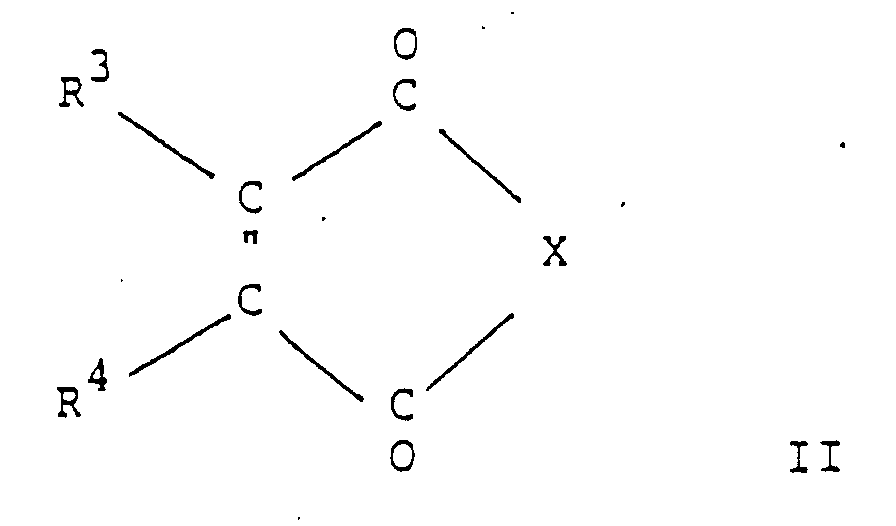
- Verfahren nach Anspruch 1, dadurch gekennzeichnet, daß man je mol im Katalysatorsystem enthaltenen sulfonierten oder carboxylierten Alkyl-arylphosphins mindestens ein mol olefinisch ungesättigte Verbindung zusetzt.
- Verfahren nach Anspruch 1 oder 2, dadurch gekennzeichnet, daß man je mol im Katalysatorsystem enthaltenen sulfonierten oder carboxylierten Alkyl-arylphosphins 15 bis 20 mol olefinisch ungesättigter Verbindung zusetzt.
- Verfahren nach einem oder mehreren der Ansprüche 1 bis 3, dadurch gekennzeichnet, daß die olefinisch ungesättigte Verbindung Maleinsäureanhydrid oder Maleinsäure ist.
- Verfahren nach einem oder mehreren der Ansprüche 1 bis 3, dadurch gekennzeichnet, daß die olefinisch ungesättigte Verbindung Maleinimid ist.
- Verfahren nach einem oder mehreren der Ansprüche 1 bis 3, dadurch gekennzeichnet, daß die olefinisch ungesättigte Verbindung Fumarsäure ist.
- Verfahren nach einem oder mehreren der Ansprüche 1 bis 6, dadurch gekennzeichnet, daß die olefinisch ungesättigte Verbindung dem Katalysatorsystem als wäßrige Lösung zugesetzt wird.
- Verfahren nach Anspruch 7, dadurch gekennzeichnet, daß die wäßrige Lösung 0,1 bis 40 Gew.-%, insbesondere 0,1 bis 10 Gew.-% der olefinisch ungesättigten Verbindung, jeweils bezogen auf die Lösung, gelöst enthält.
Applications Claiming Priority (2)
| Application Number | Priority Date | Filing Date | Title |
|---|---|---|---|
| DE4135050 | 1991-10-24 | ||
| DE4135050A DE4135050A1 (de) | 1991-10-24 | 1991-10-24 | Verfahren zur reaktivierung wasserloeslicher hydroformylierungskatalysatoren |
Publications (3)
| Publication Number | Publication Date |
|---|---|
| EP0544091A1 EP0544091A1 (de) | 1993-06-02 |
| EP0544091B1 EP0544091B1 (de) | 1995-03-08 |
| EP0544091B2 true EP0544091B2 (de) | 2002-08-28 |
Family
ID=6443286
Family Applications (1)
| Application Number | Title | Priority Date | Filing Date |
|---|---|---|---|
| EP92117580A Expired - Lifetime EP0544091B2 (de) | 1991-10-24 | 1992-10-15 | Verfahren zur Reaktivierung wasserlöslicher Hydroformylierungskatalysatoren |
Country Status (15)
| Country | Link |
|---|---|
| US (1) | US5466644A (de) |
| EP (1) | EP0544091B2 (de) |
| JP (1) | JPH0736894B2 (de) |
| KR (1) | KR960005498B1 (de) |
| CN (1) | CN1036249C (de) |
| AT (1) | ATE119432T1 (de) |
| AU (1) | AU653073B2 (de) |
| BR (1) | BR9204068A (de) |
| CA (1) | CA2080746C (de) |
| DE (2) | DE4135050A1 (de) |
| DK (1) | DK0544091T3 (de) |
| ES (1) | ES2072074T3 (de) |
| MX (1) | MX9205984A (de) |
| TW (1) | TW218358B (de) |
| ZA (1) | ZA928022B (de) |
Families Citing this family (8)
| Publication number | Priority date | Publication date | Assignee | Title |
|---|---|---|---|---|
| DE4427428A1 (de) | 1994-08-03 | 1996-02-29 | Basf Ag | Verfahren zur Herstellung von Aldehyden |
| DE19940250B4 (de) * | 1999-08-25 | 2005-06-16 | Celanese Chemicals Europe Gmbh | Verfahren zur Regenerierung gebrauchter wasserlöslicher Hydroformylierungskatalysatoren |
| DE10164720B4 (de) * | 2001-07-07 | 2013-12-19 | Oxea Gmbh | Verfahren zur Herstellung von Aldehyden |
| CN100526279C (zh) * | 2006-04-11 | 2009-08-12 | 中国科学院兰州化学物理研究所 | 连续制备正戊醛的工艺过程 |
| WO2013153136A1 (de) | 2012-04-12 | 2013-10-17 | Basf Se | Verfahren zur ergänzung des katalysators bei der kontinuierlichen hydroformylierung |
| US9174907B2 (en) * | 2012-06-04 | 2015-11-03 | Dow Technology Investments Llc | Hydroformylation process |
| DE102014002103B4 (de) * | 2014-02-15 | 2020-10-22 | Oxea Gmbh | Verfahren zur Regenerierung gebrauchter Hydroformylierungskatalysatoren |
| CN104028311B (zh) * | 2014-07-02 | 2016-06-15 | 天津渤化永利化工股份有限公司 | 一种丁辛醇羰基合成催化剂化学再生方法 |
Family Cites Families (12)
| Publication number | Priority date | Publication date | Assignee | Title |
|---|---|---|---|---|
| US4248802A (en) * | 1975-06-20 | 1981-02-03 | Rhone-Poulenc Industries | Catalytic hydroformylation of olefins |
| US4297239A (en) * | 1979-07-16 | 1981-10-27 | Union Carbide Corporation | Hydroformylation catalyst reactivation |
| US4283304A (en) * | 1979-05-21 | 1981-08-11 | Union Carbide Corporation | Process for removing triorganophosphine from a liquid composition |
| US4710587A (en) * | 1980-04-16 | 1987-12-01 | Union Carbide Corp. | Process for removing triorganophosphine from an organic liquid |
| GB2085874B (en) * | 1980-09-04 | 1984-08-08 | Johnson Matthey Plc | Hydroformylation of olefins |
| US4605780A (en) * | 1980-09-24 | 1986-08-12 | Union Carbide Corporation | Reactivation of rhodium complex hydroformylation catalysts |
| JPS5923858B2 (ja) * | 1981-01-22 | 1984-06-05 | 三菱化学株式会社 | ロジウム錯体の取得方法 |
| US4374276A (en) * | 1981-08-27 | 1983-02-15 | International Flavors & Fragrances Inc. | Novel branched chain ketones and the process for preparing same |
| US4528404A (en) * | 1983-03-16 | 1985-07-09 | Exxon Research And Engineering Co. | High temperature hydroformylation in the presence of triarylphosphine rhodium carbonyl hydride complex catalyst systems |
| US5091350A (en) * | 1984-03-26 | 1992-02-25 | Hoechst Aktiengesellschaft | Process for hydroformylation with rhodium catalysts and the separation of rhodium therefrom |
| DE3640615A1 (de) * | 1986-11-27 | 1988-06-09 | Ruhrchemie Ag | Verfahren zur herstellung von aldehyden |
| US4861918A (en) * | 1988-08-12 | 1989-08-29 | Union Carbide Corporation | Reactivation of hydroformylation catalysts |
-
1991
- 1991-10-24 DE DE4135050A patent/DE4135050A1/de not_active Withdrawn
-
1992
- 1992-09-24 TW TW081107547A patent/TW218358B/zh active
- 1992-10-13 KR KR1019920018823A patent/KR960005498B1/ko not_active Expired - Fee Related
- 1992-10-15 EP EP92117580A patent/EP0544091B2/de not_active Expired - Lifetime
- 1992-10-15 JP JP4277525A patent/JPH0736894B2/ja not_active Expired - Lifetime
- 1992-10-15 DK DK92117580.8T patent/DK0544091T3/da active
- 1992-10-15 ES ES92117580T patent/ES2072074T3/es not_active Expired - Lifetime
- 1992-10-15 AT AT92117580T patent/ATE119432T1/de not_active IP Right Cessation
- 1992-10-15 DE DE59201602T patent/DE59201602D1/de not_active Expired - Fee Related
- 1992-10-16 CA CA002080746A patent/CA2080746C/en not_active Expired - Fee Related
- 1992-10-16 ZA ZA928022A patent/ZA928022B/xx unknown
- 1992-10-16 MX MX9205984A patent/MX9205984A/es unknown
- 1992-10-20 BR BR929204068A patent/BR9204068A/pt not_active IP Right Cessation
- 1992-10-22 CN CN92112344A patent/CN1036249C/zh not_active Expired - Fee Related
- 1992-10-23 AU AU27317/92A patent/AU653073B2/en not_active Ceased
-
1995
- 1995-01-19 US US08/378,861 patent/US5466644A/en not_active Expired - Lifetime
Also Published As
| Publication number | Publication date |
|---|---|
| BR9204068A (pt) | 1993-05-11 |
| EP0544091A1 (de) | 1993-06-02 |
| DE4135050A1 (de) | 1993-04-29 |
| DE59201602D1 (de) | 1995-04-13 |
| CA2080746A1 (en) | 1993-04-25 |
| JPH0736894B2 (ja) | 1995-04-26 |
| TW218358B (de) | 1994-01-01 |
| ES2072074T3 (es) | 1995-07-01 |
| KR960005498B1 (ko) | 1996-04-25 |
| MX9205984A (es) | 1993-04-01 |
| CN1071606A (zh) | 1993-05-05 |
| KR930007506A (ko) | 1993-05-20 |
| EP0544091B1 (de) | 1995-03-08 |
| CN1036249C (zh) | 1997-10-29 |
| ZA928022B (en) | 1993-04-27 |
| ATE119432T1 (de) | 1995-03-15 |
| AU2731792A (en) | 1993-04-29 |
| JPH05301046A (ja) | 1993-11-16 |
| DK0544091T3 (da) | 1995-05-22 |
| CA2080746C (en) | 1997-10-21 |
| AU653073B2 (en) | 1994-09-15 |
| US5466644A (en) | 1995-11-14 |
Similar Documents
| Publication | Publication Date | Title |
|---|---|---|
| DE3338340C2 (de) | Verfahren zur Hydroformylierung einer olefinischen Verbindung | |
| EP0571819A1 (de) | Sulfonierte 2,2'-Bis(diphenylphosphinomethyl)-1,1'binaphthaline, Verfahren zu ihrer Herstellung und ihre Verwendung in einem Verfahren zur Hydroformylierung vonolefinisch ungesättigten Verbindungen | |
| EP0163234B1 (de) | Verfahren zur Herstellung von Aldehyden | |
| EP0158246B1 (de) | Verfahren zur Herstellung von Aldehyden | |
| DE4110212A1 (de) | Verfahren zur wiedergewinnung von rhodium aus den rueckstaenden der destillation von produkten oder oxosynthese | |
| EP0157316B1 (de) | Verfahren zur Herstellung von Aldehyden | |
| EP0544091B1 (de) | Verfahren zur Reaktivierung wasserlöslicher Hydroformylierungskatalysatoren | |
| EP0491239B1 (de) | Verfahren zur Herstellung von Aldehyden | |
| EP0226988B1 (de) | Verfahren zur Herstellung von Aldehyden | |
| EP0811424A2 (de) | Katalysatorsysteme auf der Basis von Rhodium-Komplex-verbindungen mit Diphosphin-Liganden und ihre Verwendung bei der Herstellung von Aldehyden | |
| EP0885183B1 (de) | Verfahren zur herstellung von aldehyden durch hydroformylierung von olefinen | |
| EP0906261B1 (de) | Verfahren zur hydroformylierung und dafür geeignete katalysatoren, die phosphorverbindungen als liganden enthalten | |
| EP0602463B1 (de) | Verfahren zur Herstellung von Aldehyden | |
| EP0588225B1 (de) | Verfahren zur Herstellung von Aldehyden | |
| EP0269011A1 (de) | Verfahren zur Herstellung von Aldehyden | |
| DE10164720B4 (de) | Verfahren zur Herstellung von Aldehyden | |
| EP0160249B1 (de) | Verfahren zur Herstellung von Aldehyden | |
| EP0186075B1 (de) | Verfahren zur Herstellung von 8- und 9-Formyl-tricyclo-(5,2,1,0, 2,6)-decen-3 | |
| EP1017492B1 (de) | Verfahren zur herstellung von aldehyden durch hydroformulierung | |
| DE3934824A1 (de) | Verfahren zur wiedergewinnung von rhodium aus den rueckstaenden der destillation von produkten der oxosynthese | |
| DE4025074A1 (de) | Verfahren zur wiedergewinnung von rhodium aus den rueckstaenden der destillation von produkten der oxosynthese | |
| EP0584720B1 (de) | Verfahren zur Wiedergewinnung von Rhodium aus den Destillationsrückständen von Produkten der Oxosynthese | |
| DE19940250B4 (de) | Verfahren zur Regenerierung gebrauchter wasserlöslicher Hydroformylierungskatalysatoren | |
| DE102014002103B4 (de) | Verfahren zur Regenerierung gebrauchter Hydroformylierungskatalysatoren | |
| WO2001014302A2 (de) | Verfahren zur herstellung von aldehyden |
Legal Events
| Date | Code | Title | Description |
|---|---|---|---|
| PUAI | Public reference made under article 153(3) epc to a published international application that has entered the european phase |
Free format text: ORIGINAL CODE: 0009012 |
|
| AK | Designated contracting states |
Kind code of ref document: A1 Designated state(s): AT BE CH DE DK ES FR GB IT LI LU NL SE |
|
| 17P | Request for examination filed |
Effective date: 19930623 |
|
| 17Q | First examination report despatched |
Effective date: 19940425 |
|
| GRAA | (expected) grant |
Free format text: ORIGINAL CODE: 0009210 |
|
| AK | Designated contracting states |
Kind code of ref document: B1 Designated state(s): AT BE CH DE DK ES FR GB IT LI LU NL SE |
|
| REF | Corresponds to: |
Ref document number: 119432 Country of ref document: AT Date of ref document: 19950315 Kind code of ref document: T |
|
| REF | Corresponds to: |
Ref document number: 59201602 Country of ref document: DE Date of ref document: 19950413 |
|
| ITF | It: translation for a ep patent filed | ||
| REG | Reference to a national code |
Ref country code: DK Ref legal event code: T3 |
|
| ET | Fr: translation filed | ||
| REG | Reference to a national code |
Ref country code: ES Ref legal event code: FG2A Ref document number: 2072074 Country of ref document: ES Kind code of ref document: T3 |
|
| GBT | Gb: translation of ep patent filed (gb section 77(6)(a)/1977) |
Effective date: 19950615 |
|
| PGFP | Annual fee paid to national office [announced via postgrant information from national office to epo] |
Ref country code: LU Payment date: 19951001 Year of fee payment: 4 |
|
| PGFP | Annual fee paid to national office [announced via postgrant information from national office to epo] |
Ref country code: CH Payment date: 19951006 Year of fee payment: 4 |
|
| PGFP | Annual fee paid to national office [announced via postgrant information from national office to epo] |
Ref country code: DK Payment date: 19951009 Year of fee payment: 4 |
|
| PGFP | Annual fee paid to national office [announced via postgrant information from national office to epo] |
Ref country code: AT Payment date: 19951017 Year of fee payment: 4 |
|
| PLBI | Opposition filed |
Free format text: ORIGINAL CODE: 0009260 |
|
| PLBQ | Unpublished change to opponent data |
Free format text: ORIGINAL CODE: EPIDOS OPPO |
|
| 26 | Opposition filed |
Opponent name: UNION CARBIDE CORPORATION Effective date: 19951208 |
|
| NLR1 | Nl: opposition has been filed with the epo |
Opponent name: UNION CARBIDE CORPORATION |
|
| PLBF | Reply of patent proprietor to notice(s) of opposition |
Free format text: ORIGINAL CODE: EPIDOS OBSO |
|
| PLBF | Reply of patent proprietor to notice(s) of opposition |
Free format text: ORIGINAL CODE: EPIDOS OBSO |
|
| PLBF | Reply of patent proprietor to notice(s) of opposition |
Free format text: ORIGINAL CODE: EPIDOS OBSO |
|
| PG25 | Lapsed in a contracting state [announced via postgrant information from national office to epo] |
Ref country code: DK Effective date: 19961015 Ref country code: AT Effective date: 19961015 Ref country code: LU Free format text: LAPSE BECAUSE OF NON-PAYMENT OF DUE FEES Effective date: 19961015 |
|
| REG | Reference to a national code |
Ref country code: DK Ref legal event code: EBP |
|
| PG25 | Lapsed in a contracting state [announced via postgrant information from national office to epo] |
Ref country code: LI Effective date: 19961031 Ref country code: CH Effective date: 19961031 |
|
| REG | Reference to a national code |
Ref country code: CH Ref legal event code: PL |
|
| PLAW | Interlocutory decision in opposition |
Free format text: ORIGINAL CODE: EPIDOS IDOP |
|
| APAC | Appeal dossier modified |
Free format text: ORIGINAL CODE: EPIDOS NOAPO |
|
| APAE | Appeal reference modified |
Free format text: ORIGINAL CODE: EPIDOS REFNO |
|
| PGFP | Annual fee paid to national office [announced via postgrant information from national office to epo] |
Ref country code: FR Payment date: 19970918 Year of fee payment: 6 Ref country code: NL Payment date: 19970918 Year of fee payment: 6 |
|
| PGFP | Annual fee paid to national office [announced via postgrant information from national office to epo] |
Ref country code: SE Payment date: 19970919 Year of fee payment: 6 |
|
| APAE | Appeal reference modified |
Free format text: ORIGINAL CODE: EPIDOS REFNO |
|
| PGFP | Annual fee paid to national office [announced via postgrant information from national office to epo] |
Ref country code: GB Payment date: 19971006 Year of fee payment: 6 |
|
| PGFP | Annual fee paid to national office [announced via postgrant information from national office to epo] |
Ref country code: BE Payment date: 19971010 Year of fee payment: 6 |
|
| PGFP | Annual fee paid to national office [announced via postgrant information from national office to epo] |
Ref country code: ES Payment date: 19971015 Year of fee payment: 6 |
|
| APAC | Appeal dossier modified |
Free format text: ORIGINAL CODE: EPIDOS NOAPO |
|
| RAP2 | Party data changed (patent owner data changed or rights of a patent transferred) |
Owner name: CELANESE GMBH |
|
| NLT2 | Nl: modifications (of names), taken from the european patent patent bulletin |
Owner name: CELANESE GMBH |
|
| PG25 | Lapsed in a contracting state [announced via postgrant information from national office to epo] |
Ref country code: GB Free format text: LAPSE BECAUSE OF NON-PAYMENT OF DUE FEES Effective date: 19981015 |
|
| PG25 | Lapsed in a contracting state [announced via postgrant information from national office to epo] |
Ref country code: SE Free format text: LAPSE BECAUSE OF NON-PAYMENT OF DUE FEES Effective date: 19981016 |
|
| PG25 | Lapsed in a contracting state [announced via postgrant information from national office to epo] |
Ref country code: BE Free format text: LAPSE BECAUSE OF NON-PAYMENT OF DUE FEES Effective date: 19981031 |
|
| BERE | Be: lapsed |
Owner name: HOECHST A.G. Effective date: 19981031 |
|
| PG25 | Lapsed in a contracting state [announced via postgrant information from national office to epo] |
Ref country code: NL Free format text: LAPSE BECAUSE OF NON-PAYMENT OF DUE FEES Effective date: 19990501 |
|
| GBPC | Gb: european patent ceased through non-payment of renewal fee |
Effective date: 19981015 |
|
| EUG | Se: european patent has lapsed |
Ref document number: 92117580.8 |
|
| PG25 | Lapsed in a contracting state [announced via postgrant information from national office to epo] |
Ref country code: FR Free format text: LAPSE BECAUSE OF NON-PAYMENT OF DUE FEES Effective date: 19990630 |
|
| NLV4 | Nl: lapsed or anulled due to non-payment of the annual fee |
Effective date: 19990501 |
|
| REG | Reference to a national code |
Ref country code: FR Ref legal event code: ST |
|
| RAP2 | Party data changed (patent owner data changed or rights of a patent transferred) |
Owner name: CELANESE CHEMICALS EUROPE GMBH |
|
| APAE | Appeal reference modified |
Free format text: ORIGINAL CODE: EPIDOS REFNO |
|
| PG25 | Lapsed in a contracting state [announced via postgrant information from national office to epo] |
Ref country code: ES Free format text: LAPSE BECAUSE OF THE APPLICANT RENOUNCES Effective date: 20001116 |
|
| REG | Reference to a national code |
Ref country code: ES Ref legal event code: FD2A Effective date: 20001009 |
|
| APAC | Appeal dossier modified |
Free format text: ORIGINAL CODE: EPIDOS NOAPO |
|
| PLAW | Interlocutory decision in opposition |
Free format text: ORIGINAL CODE: EPIDOS IDOP |
|
| PUAH | Patent maintained in amended form |
Free format text: ORIGINAL CODE: 0009272 |
|
| STAA | Information on the status of an ep patent application or granted ep patent |
Free format text: STATUS: PATENT MAINTAINED AS AMENDED |
|
| 27A | Patent maintained in amended form |
Effective date: 20020828 |
|
| AK | Designated contracting states |
Kind code of ref document: B2 Designated state(s): AT BE CH DE DK ES FR GB IT LI LU NL SE |
|
| APAH | Appeal reference modified |
Free format text: ORIGINAL CODE: EPIDOSCREFNO |
|
| PG25 | Lapsed in a contracting state [announced via postgrant information from national office to epo] |
Ref country code: IT Free format text: LAPSE BECAUSE OF NON-PAYMENT OF DUE FEES;WARNING: LAPSES OF ITALIAN PATENTS WITH EFFECTIVE DATE BEFORE 2007 MAY HAVE OCCURRED AT ANY TIME BEFORE 2007. THE CORRECT EFFECTIVE DATE MAY BE DIFFERENT FROM THE ONE RECORDED. Effective date: 20051015 |
|
| PGFP | Annual fee paid to national office [announced via postgrant information from national office to epo] |
Ref country code: DE Payment date: 20081031 Year of fee payment: 17 |
|
| PG25 | Lapsed in a contracting state [announced via postgrant information from national office to epo] |
Ref country code: ES Free format text: LAPSE BECAUSE OF THE APPLICANT RENOUNCES Effective date: 19981031 |
|
| PG25 | Lapsed in a contracting state [announced via postgrant information from national office to epo] |
Ref country code: DE Free format text: LAPSE BECAUSE OF NON-PAYMENT OF DUE FEES Effective date: 20100501 |