EP0541004B1 - Elément de construction à mouvement circulaire présentant une séquence de pas différents - Google Patents
Elément de construction à mouvement circulaire présentant une séquence de pas différents Download PDFInfo
- Publication number
- EP0541004B1 EP0541004B1 EP92118488A EP92118488A EP0541004B1 EP 0541004 B1 EP0541004 B1 EP 0541004B1 EP 92118488 A EP92118488 A EP 92118488A EP 92118488 A EP92118488 A EP 92118488A EP 0541004 B1 EP0541004 B1 EP 0541004B1
- Authority
- EP
- European Patent Office
- Prior art keywords
- rotary component
- sequence
- radicand
- different
- size
- Prior art date
- Legal status (The legal status is an assumption and is not a legal conclusion. Google has not performed a legal analysis and makes no representation as to the accuracy of the status listed.)
- Expired - Lifetime
Links
- 238000010276 construction Methods 0.000 title description 3
- 230000017105 transposition Effects 0.000 claims description 42
- 230000006835 compression Effects 0.000 claims description 5
- 238000007906 compression Methods 0.000 claims description 5
- 238000012986 modification Methods 0.000 description 26
- 230000004048 modification Effects 0.000 description 26
- 238000001228 spectrum Methods 0.000 description 11
- 239000011295 pitch Substances 0.000 description 10
- 230000000694 effects Effects 0.000 description 9
- 230000005540 biological transmission Effects 0.000 description 5
- 230000002349 favourable effect Effects 0.000 description 5
- 238000005299 abrasion Methods 0.000 description 4
- 238000011161 development Methods 0.000 description 4
- 230000018109 developmental process Effects 0.000 description 4
- 238000012360 testing method Methods 0.000 description 4
- 230000036515 potency Effects 0.000 description 3
- 230000015572 biosynthetic process Effects 0.000 description 2
- 230000005284 excitation Effects 0.000 description 2
- 238000003475 lamination Methods 0.000 description 2
- 239000000203 mixture Substances 0.000 description 2
- 230000002123 temporal effect Effects 0.000 description 2
- 238000004073 vulcanization Methods 0.000 description 2
- 238000012935 Averaging Methods 0.000 description 1
- 241000446313 Lamella Species 0.000 description 1
- 238000005452 bending Methods 0.000 description 1
- 210000004556 brain Anatomy 0.000 description 1
- 230000000052 comparative effect Effects 0.000 description 1
- 230000008878 coupling Effects 0.000 description 1
- 238000010168 coupling process Methods 0.000 description 1
- 238000005859 coupling reaction Methods 0.000 description 1
- 230000001419 dependent effect Effects 0.000 description 1
- 238000013461 design Methods 0.000 description 1
- 238000010586 diagram Methods 0.000 description 1
- 238000011156 evaluation Methods 0.000 description 1
- 238000002474 experimental method Methods 0.000 description 1
- 239000000284 extract Substances 0.000 description 1
- 238000011835 investigation Methods 0.000 description 1
- 230000014759 maintenance of location Effects 0.000 description 1
- 238000005259 measurement Methods 0.000 description 1
- 230000010355 oscillation Effects 0.000 description 1
- 230000008447 perception Effects 0.000 description 1
- 230000000717 retained effect Effects 0.000 description 1
- 238000006798 ring closing metathesis reaction Methods 0.000 description 1
- 238000005096 rolling process Methods 0.000 description 1
- 238000004088 simulation Methods 0.000 description 1
- 239000000725 suspension Substances 0.000 description 1
- 230000009897 systematic effect Effects 0.000 description 1
Images
Classifications
-
- B—PERFORMING OPERATIONS; TRANSPORTING
- B60—VEHICLES IN GENERAL
- B60C—VEHICLE TYRES; TYRE INFLATION; TYRE CHANGING; CONNECTING VALVES TO INFLATABLE ELASTIC BODIES IN GENERAL; DEVICES OR ARRANGEMENTS RELATED TO TYRES
- B60C11/00—Tyre tread bands; Tread patterns; Anti-skid inserts
- B60C11/03—Tread patterns
- B60C11/0318—Tread patterns irregular patterns with particular pitch sequence
Definitions
- the invention relates to a rotating component according to the preamble of claim 1.
- the list of successive sizes in their order on the rotating component is hereinafter called "size sequence”.
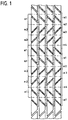
- the geometrically concretized form within each step is to be understood as a combination of a varying size (in particular angle or arc length) in the circumferential direction with at least one pattern to be varied in size in the circumferential direction.
- the force transmission elements which become effective one after the other when the component moves relative to another component known per se generate a series of acoustic individual events which are combined to form a noise.
- frequency fluctuation of the noise is effected by the fluctuation of the successive variables.
- Transverse grooves are grooves whose extension has at least one component in the axial. They are "negatives" in the sense of the first paragraph. The fact that longitudinal grooves are also referred to as negatives in the tire technical language does not bother, because the presence or absence of longitudinal grooves is irrelevant to the invention.
- each positive is bounded by grooves all around
- the positive is also referred to as blocks or blocks.
- the positives transmit in particular the normal force due to the vehicle weight and tangential forces (braking, accelerating, cornering).
- a flank-open V-belt should also be considered as a rotating component. With it - to increase the flexibility and thus to reduce the flexing performance - axially running incisions in the flanks are arranged at intervals. These cuts are negative in the sense of the first paragraph.
- the belt flanks that remain between two incisions are power transmission elements or positives. Their entry and exit into and out of the pulleys causes a series of acoustic events.
- the other component known per se is the road surface.
- the other component is the drive pulley or driven pulley.
- an "acoustic single event” is characterized by the fact that it has a temporal beginning and a temporal end given by rapid decay.
- a drum beat is a single acoustic event.
- the beginning and end of an otherwise stationary tone can also be understood as individual acoustic events.
- the pattern m 1 shows a transverse groove running from the top left to the bottom right
- the pattern m 2 shows a cross groove running from the top right to the bottom left.
- the sequence is: m1, m2, m2, m1, m1, m2, m2, m1, ..
- n The total number of all steps of a size sequence
- m The large number of different sizes. This multiplicity m is between 2 and the multiplicity n, each inclusive.
- n is usually between 50 and 80, on tires for road trucks between 40 and 75, on tires for off-road vehicles between 20 and 60 and on open-sided V-belts between 100 and 250.
- the number m of different step sizes is usually between 2 and 6 for car tires, for other tires it is usually 2 or 3, for belts it is usually between 2 and 5; the figures in the last two sections do not limit the scope of protection.
- the object of the invention is to design the frequency composition of the noises which inevitably arise as a result of the discontinuous power transmission in such a way that it is felt to be as pleasant as possible.
- V max the maximum size ratio
- the larger profile blocks in the circumferential direction oppose the flattening in the contact area with greater resistance and therefore assume a disproportionately large proportion of the normal forces. This reduces slippage and abrasion of the larger tread blocks compared to the smaller ones.
- the maximum size ratio In order not to produce excessive systematic tire run-out at the end of the service life, the maximum size ratio must be limited to smaller values, the greater the tread depth.
- the maximum size ratio for truck tires is usually between 1.15 and 1.45, for car tires between 1.30 and 1.60. With open-sided V-belts, the maximum size ratio V max can be selected to be larger, for example up to 1.8.
- n x The number of steps of a size g x arranged in a size sequence.
- the smallest size of a size sequence is referred to below with g1, the second smallest with g2 and so on up to the largest size, which is designated with g m .
- the modulation wavelength within each harmonic segment should correspond to the length of this harmonic segment itself.
- the size of the steps is gradually changed from one extreme to the other and back in an approximately sinusoidal shape.
- the relationships between different sizes of the steps are not fixed.
- the frequency of the different sizes should be the same.
- DE-OS 36 30 590 teaches the composition of a size sequence using exclusively, unchanged repeated use of four different sections I, II, III and IV. IV.
- adjacent size ratio V x is defined as follows:
- V x G x +1 G x
- V1 G x +1 G x
- g3 / g2 is the adjacent aspect ratio V2
- g4 / g3 is the adjacent aspect ratio V3.
- EP-OS 0 268 436 (which forms the preamble of claim 1), in particular in FIGS. 6 to 9, proposes that the adjacent size ratios be between 1.1 and 1.2 and that maximum size ratio between 1.5 and 1.9.
- the number P of possible sequences (these are the permutations in the closed ring) lies between (n-1)! 2 n 1 ! n 2nd ! ... n x ! ... n m ! and n! 2 n 1 ! n 2nd ! ... n x ! ... n m !
- the number P of the different sequences is between 4.432 ⁇ 1031 and 3.324 ⁇ 1033.
- the object of the invention is to create such frequency spectra for components that are rotating around one another with discontinuous power transmission by means of improved frequency modulation that have a particularly unpleasant effect on the human ear.
- This task takes into account the knowledge that different noises of the same level can differ greatly in terms of their comfort.
- An important sense of the characterizing feature of claim 1 is that of enabling transpositions.
- the possible transpositions are particularly easy to specify if all V x are the same; the index "x" can then be omitted.
- the different transpositions of a section provide similar acoustic effects due to the unchanged retention of all proportions of the steps; namely, only the level of all excitation frequencies is changed (increased in the case of compression, reduced in the case of stretching), while all frequency relationships and thus the degree of tonality or atonality are retained.
- only natural potencies of V should be used as extension or compression factors.
- the section is considered: g2, g2, g3, g4, g4, g3, g4.
- the entire size sequence of a rotating component with discontinuous power transmission compared to another component known per se consists exclusively of - at least three different - modifications of a single sequence section.
- the small number of modifications lined up in the following is called m a .
- m a is between 3 and 6, for open-sided V-belts between 4 and 9 inclusive.
- m a should be chosen the larger, the larger n and the smaller m is.
- a transposition resulting from multiplication by V1 is denoted by I.
- a transposition that results from multiplying the topic by V2 is denoted by II, and so on; in short the Roman numeral indicates the exponent of the respective transposition based on the topic.
- a horizontal line under these symbols indicates an inversion.
- all possible (real) transpositions are to be listed according to the above example: Detailed: Symbol: 1 1 2 3 3 2 3 0 3 2 3 3 2 1 1 0 2 2 3 4 4 3 4 I. 4 3 4 4 3 2 2 I. 3 3 4 5 5 4 5 II 5 4 5 5 4 3 3 II
- the ratio of the size of a double step created in this way to the largest real step size g m is in turn a power with natural exponent of the size ratio V according to claims 1 and 2.
- Each step g5 is modified to double step g1, g1.
- the next larger virtual step size after the double step g1, g1 provides the double step g2, g2.
- the formation of even larger virtual step sizes according to the same scheme is only limited where the arc length or the total angle of the same steps arranged one after the other would be too long in relation to the total circumference or full angle.
- the permissible number of repetitions must be limited in such a way that the gradual out-of-roundness does not become too great due to the abrasion differences between (in the circumferential direction) large and small blocks; As a rule, the largest repetition should occupy a maximum of 9% of the period (full angle).
- step size measurement astonishingly proves itself also in those sequences that are only partially constructed in this or a similar regularity (see first exemplary embodiment) .
- the first two exemplary embodiments and the fourth relate to vehicle tires. It is specified here that the total number n of sizes (pitches) should be 66. In the first two exemplary embodiments, V max should at most be 1.65.
- the means of transposition and inversion are used only to a limited extent.
- An advantageous consequence is: 1 2 2 2 1 1 1 2 1 2 3 3 3 2 1 2 2 1 3 1 3 2 1 3 2 3 2 1 2 3 3 3 2 2 3 3 1 1 1 3 1 1 1 1 3 2 1 1 1 1 2 1 3 3 1 1 1 2 2 3 1 2 1 2
- the further exemplary embodiments are composed exclusively of different modifications of a topic (according to claim 6).
- choose m 3 (as large as possible, as small as necessary).
- a single step of the three different sizes and a double repetition of the three different sizes should be arranged in the topic. It follows that the topic will contain 9 steps and 6 step size changes.
- step size changes listed within a line differ only in their orientation and, moreover, the amounts (namely V) in the first and third lines match, it is advisable to arrange all step size changes approximately equally frequently in the topic; in this example an exactly even distribution is shown.
- the first variant is more promising because all possible transposition lengths are used here. Therefore the second variant is eliminated.
- the inversion lies on the 0 or the I or the III, then since there is no change in the existence of a repetition, namely the II, there are as many permutations as above, that is 60. In the combination where the inversion on an II there is no repetition, so there are 120 permutations. In total there are 300 permutations with one inversion.
- the repetition is omitted for combinations 2, 4 and 7; with the 4 remaining combinations, there is a repetition of II or II .
- the inventor may not know exactly how powerful the computers of other specialists in the field are in other companies; Due to the hardware that is still available today, it can be assumed that at worst computers slower by a factor of 1,000 are used there. Instead of 22.4 seconds, a computing time of 6.25 hours would be required. This is also reasonable.
- sequences according to the invention which are favorable according to the frequency analysis, are subjectively rated even better; this is usually reversed for episodes not according to the invention.
- the effect may be due to the fact that our brain also searches for order in the analysis of a sound - and finds it in the case of sequences according to the invention in the way it is put together from various modifications of a single topic.
- the first episode is developed from the topic 1 2 3 3 1 1 3 2 2 in the variation order III 0 I II I so that it is written out: 2 2 2 3 3 1 1 1 1 3 3 3 3 2 2 1 1 1 2 3 3 1 1 3 2 2 2 3 1 1 1 1 1 2 2 1 1 3 3 3 1 1 2 2 2 2 3 3 2 2 1 1 1 1 1 2 3 1 1 1 2 2 1 1 3 3 3 3
- the selection of this sequence was dependent on particularly low levels in the 68th to 71st harmonic range. It should also give equally good results in 7-fold and 9-fold vulcanization forms. A relatively high level of the 8th harmonic was accepted for the last rather unusual requirement.
- the second one has greater market relevance; it should only be used on tires that are manufactured in 7-fold vulcanization molds, where particularly low 7th harmonic amplitude is important. Furthermore, the entire band from the 30th to the 120th harmonic should be characterized by low levels.
- This sequence should in turn refer to pneumatic vehicle tires and have an unusually large maximum size ratio for this application.
- a stronger lamination of the larger blocks than the smaller ones is required, whereby the person skilled in the art will generally determine the lamella variation required for a particular profile after a rough preliminary estimate after a series of tests.
- Tires are expediently created for these tests, which contain the respectively provided step sizes in long repetitions, and the criterion is the amount of abrasion on either side of a boundary between two abutting long repetitions of different sizes.
- test tires In order to keep the effort associated with the test series within narrow limits, this sequence should be composed of only two step sizes.
- the test tires then expediently contain large blocks in uninterrupted repetition on about half of their circumference and short blocks in uninterrupted repetition on the remaining circumferential part. These tires then show exactly one change from short to long pitches and one from long to short pitches.
- the maximum permissible repetition should be about 6 times the smallest size. - If a 2-fold repetition of the large size appears in the topic, then in the II. Transposition due to radical 3 a 6-fold repetition with the total length 10.3923; it follows that either the repetition of the large size must not appear in the topic, or that only the first (virtual) transposition is to be used.
- the topic must contain size 2 five times and size 1 four times in order to arrive at step number 19 in the first modification.
- the same repetitions as in case b) are permitted.
- three I. modifications are provided in a row; According to claim 9, at least one of the three I. modifications should be used in inversion, preferably the middle one. - Furthermore, according to claim 8, such a repetition should occur at at least one of the joints, which is greater than 2 in its degree and does not correspond to an integral multiple of the radical, here 3, that is, a repetition that is not possible within the modifications.
Landscapes
- Engineering & Computer Science (AREA)
- Mechanical Engineering (AREA)
- Tires In General (AREA)
Claims (13)
- Composant à mouvement tournant continu (1), qui est équipé de zones négatives (2) et de zones positives (3) qui se trouvent chaque fois entre deux zones négatives (2), étant précisé que la forme de chacune des zones négatives (2) ou positives (3) est définie en un pas ou en plusieurs pas, étant précisé que chaque pas présente une certaine valeur selon la direction périphérique et que les valeurs sont choisies à partir d'une pluralité m>2 de valeurs (g₁, g₂, ..., gm) dont on dispose et qu'au moins quelques valeurs se suivant les unes les autres sont différentes l'une de l'autre, caractérisé par le fait que les rapports Vx entre valeurs voisines sont choisis de façon que tous les Vx soient égaux à une puissance naturelle de V,
étant précisé que pour tous les x pris parmi les nombre naturels allant de 1 à m-1, le rapport Vx de valeurs voisines se définit comme suit: a) tous les Vx sont supérieurs à 1,2 et/oub) V est égal à la racine d'ordre (m+ø) d'un nombre placé sous le radical, le nombre placé sous le radical étant 2 ou 3 et ø, étant un élément des nombre naturels, y compris 0.
 - Composant à mouvement tournant continu (1), qui est équipé de zones négatives (2) et de zones positives (3) qui se trouvent chaque fois entre deux zones négatives (2), étant précisé que la forme de chacune des zones négatives (2) ou positives (3) est définie en un pas ou en plusieurs pas, étant précisé que chaque pas présente, selon la direction périphérique, l'une de deux valeurs (g₁, g₂) dont on dispose et qu'au moins quelques valeurs, se suivant l'une l'autre, sont différentes l'une de l'autre,
caractérisé par le fait que le (unique) rapport de valeurs voisines V est égal à racine d'ordre (m+ø) d'un nombre placé sous le radical, le nombre placé sous le radical étant 2 ou 3 et ø, étant un élément des nombre naturels, y compris 0. - Composant à mouvement tournant continu (1) selon la revendication 1, caractérisé par le fait qu'est remplie la mention variante b) de la revendication 1, selon laquelle V est égal à la racine d'ordre (m+ø) d'un nombre placé sous le radical, le nombre placé sous le radical étant 2 ou 3 et ø, étant un élément des nombres naturels, y compris 0.
- Composant à mouvement tournant continu (1) selon la revendication 2 ou 3, caractérisé par le fait que tous les Vx sont égaux.
- Composant à mouvement tournant continu (1) selon la revendication 2 ou 3, caractérisé par le fait que ø est égal à 0.
- Composant à mouvement tournant continu (1) selon la revendication 1 ou 2, caractérisé par le fait que la totalité de la séquence de valeurs est composée d'au moins trois variantes différentes d'une unique portion de la séquence de valeurs,
étant précisé que sous le nom de variantes il ne faut comprendre que des transpositions ou des inversions, ou leurs liaisons logiques, ou la portion de séquence elle-même dont on prend une variante,
étant précisé qu'une transposition d'une portion de séquence est sa multiplication symbolique régulière, ou sa division symbolique régulière, par une puissance naturelle du plus petit rapport V de valeurs voisines pris comme facteur de la multiplication symbolique ou comme quotient de la division symbolique et
qu'une inversion d'une portion de séquence est la répétition de cette portion de séquence, lue en sens inverse. - Composant à mouvement tournant continu (1) selon les revendications 1 et 3 et 6 ou selon les revendications 2 et 6, caractérisé
par le fait qu'au moins une variante de la portion de séquence contient une valeur virtuelle du pas,
étant précisé que sous le nom de "valeur virtuelle de pas" il faut comprendre une valeur qui est supérieure à gm et se réalise en tant que pas multiple, étant précisé que sous la dénomination de pas multiple il faut comprendre une paire (dans le cas du nombre 2 sous le radical) ou un trio (dans le cas du nombre 3 sous le radical) de pas individuels identiques, disposés l'un derrière l'autre, d'une unique valeur de pas valant entre g₁ et gm. - Composant à mouvement tournant continu selon au moins la revendication 6, caractérisé par le fait que la séquence de valeurs de pas présente en au moins l'un des endroits de jonction de variantes une répétition dont le degré est supérieur à 2 et est différent de tous les multiples entiers du nombre placé sous le radical.
- Composant à mouvement tournant continu selon au moins la revendication 6, caractérisé par le fait que la séquence contient au moins une variante d'un motif qui, en ce qui concerne sa séquence de valeurs, est l'inverse du motif ou d'une transposition de ce motif.
- Composant à mouvement tournant continu selon la revendication 9, caractérisé par le fait que des variantes inverses l'une de l'autre (y compris le motif lui-même) sont disposées directement l'une derrière l'autre.
- Composant à mouvement tournant continu (1) selon la revendication 1 ou 2, caractérisé par le fait que la fréquence des différentes valeurs (g₁, g₂, ... gm) varie, dans la séquence de valeurs, de façon à peu près inversement proportionnelle aux valeurs elles-mêmes.
- Composant à mouvement tournant continu selon au moins l'une des revendications précédentes, caractérisé par le fait qu'il s'agit d'un pneumatique de véhicule présentant des cannelures transversales qui forment des zones négatives et qu'entre ces zones négatives des zones positives les limitent l'une de l'autre.
- Composant à mouvement tournant continu selon au moins l'une des revendications précédentes, caractérisé par le fait qu'il s'agit d'une courroie trapézoïdale à flancs ouverts qui forment des zones négatives et qu'entre ces zones négatives des zones positives les limitent l'une de l'autre.
Applications Claiming Priority (2)
| Application Number | Priority Date | Filing Date | Title |
|---|---|---|---|
| DE4136226A DE4136226C2 (de) | 1991-11-02 | 1991-11-02 | Umlaufend bewegliches Bauteil |
| DE4136226 | 1991-11-02 |
Publications (2)
| Publication Number | Publication Date |
|---|---|
| EP0541004A1 EP0541004A1 (fr) | 1993-05-12 |
| EP0541004B1 true EP0541004B1 (fr) | 1996-03-20 |
Family
ID=6444023
Family Applications (1)
| Application Number | Title | Priority Date | Filing Date |
|---|---|---|---|
| EP92118488A Expired - Lifetime EP0541004B1 (fr) | 1991-11-02 | 1992-10-29 | Elément de construction à mouvement circulaire présentant une séquence de pas différents |
Country Status (2)
| Country | Link |
|---|---|
| EP (1) | EP0541004B1 (fr) |
| DE (2) | DE4136226C2 (fr) |
Families Citing this family (11)
| Publication number | Priority date | Publication date | Assignee | Title |
|---|---|---|---|---|
| DE4332811C2 (de) * | 1993-09-27 | 1996-12-05 | Continental Ag | Profilierter Fahrzeugreifen und Verfahren zum Bemessen des optimalen Phasenversatzes zwischen nebeneinander angeordneten Laufflächenteilen |
| US6949211B2 (en) | 2003-04-16 | 2005-09-27 | The Goodyear & Rubber Company | Means of manufacturing plural optimized cogged drive belts |
| US9266398B2 (en) * | 2007-02-09 | 2016-02-23 | Bridgestone Corporation | Pneumatic tire having turbulence generating protrusions provided inside a groove |
| JP5440590B2 (ja) * | 2011-11-14 | 2014-03-12 | 横浜ゴム株式会社 | 空気入りタイヤ |
| JP5937996B2 (ja) * | 2013-04-03 | 2016-06-22 | 住友ゴム工業株式会社 | 重荷重用空気入りタイヤ |
| EP3335911B1 (fr) * | 2013-07-30 | 2020-09-09 | Sumitomo Rubber Industries, Ltd. | Pneu pour poids lourd |
| JP6737674B2 (ja) * | 2016-09-27 | 2020-08-12 | Toyo Tire株式会社 | 空気入りタイヤ |
| JP6824677B2 (ja) * | 2016-09-27 | 2021-02-03 | Toyo Tire株式会社 | 空気入りタイヤ |
| US10967682B2 (en) * | 2017-07-24 | 2021-04-06 | Nexen Tire Corporation | Tire having noise-reducing tread pattern |
| JP6888707B1 (ja) * | 2020-03-04 | 2021-06-16 | 横浜ゴム株式会社 | タイヤ |
| JP7651872B2 (ja) * | 2021-02-04 | 2025-03-27 | 住友ゴム工業株式会社 | タイヤ |
Family Cites Families (9)
| Publication number | Priority date | Publication date | Assignee | Title |
|---|---|---|---|---|
| US3023798A (en) * | 1958-08-01 | 1962-03-06 | Gates Rubber Co | Noiseless tread portion for tire casing |
| US4327792A (en) | 1978-02-14 | 1982-05-04 | The Goodyear Tire & Rubber Company | Spreading noise generated by load supporting elements |
| CA1157752A (fr) * | 1978-02-14 | 1983-11-29 | Samuel P. Landers | Etalement des bruits engendres par des elements roulants porteurs de charges |
| US4474223A (en) | 1980-01-25 | 1984-10-02 | The Goodyear Tire & Rubber Company | Spreading noise generated by load supporting elements of a tire tread |
| DE3630590A1 (de) * | 1986-09-09 | 1988-03-31 | Continental Gummi Werke Ag | Geraeuschoptimierter fahrzeugluftreifen |
| JPS63130410A (ja) * | 1986-11-17 | 1988-06-02 | Sumitomo Rubber Ind Ltd | 低騒音タイヤ |
| JPH01285405A (ja) * | 1988-05-11 | 1989-11-16 | Yokohama Rubber Co Ltd:The | 空気入りタイヤ |
| IT1237958B (it) * | 1990-01-17 | 1993-06-19 | Pirelli | Sequenze di elementi di battistrada di pneumatici di veicoli a bassa rumorisita' e relativo metodo di generazione |
| AT398730B (de) * | 1990-04-25 | 1995-01-25 | Semperit Ag | Fahrzeugluftreifen |
-
1991
- 1991-11-02 DE DE4136226A patent/DE4136226C2/de not_active Expired - Fee Related
-
1992
- 1992-10-29 EP EP92118488A patent/EP0541004B1/fr not_active Expired - Lifetime
- 1992-10-29 DE DE59205751T patent/DE59205751D1/de not_active Expired - Fee Related
Also Published As
| Publication number | Publication date |
|---|---|
| DE4136226C2 (de) | 1995-02-16 |
| DE4136226A1 (de) | 1993-05-06 |
| EP0541004A1 (fr) | 1993-05-12 |
| DE59205751D1 (de) | 1996-04-25 |
Similar Documents
| Publication | Publication Date | Title |
|---|---|---|
| DE69503938T2 (de) | Luftreifen | |
| DE69107864T3 (de) | Geräuscharme Luftreifen-Laufflächenelemente und Methode zur Herstellung. | |
| EP0114594B1 (fr) | Bande de roulement pour bandages pneumatiques | |
| DE3882483T2 (de) | Luftreifen für LKW ohne unregelmässige Abnutzung. | |
| DE4003369C2 (de) | Luftreifen mit gerichteter Lauffläche | |
| DE69722728T2 (de) | Luftreifen | |
| EP0541004B1 (fr) | Elément de construction à mouvement circulaire présentant une séquence de pas différents | |
| DE69724918T2 (de) | Luftreifen | |
| DE69513331T2 (de) | Lauffläche mit Bändern unterschiedlicher Pitch-Länge | |
| DE3425410A1 (de) | Laufflaechenprofil fuer einen reifen | |
| DE69607408T2 (de) | Radialer Landwirtschaftsreifen mit einer Lauffläche von verschiedenen Pitch-Längen | |
| DE3701909A1 (de) | Pneumatischer guertelreifen fuer personenfahrzeuge | |
| DE68903763T2 (de) | Luftreifen. | |
| DE3517422A1 (de) | Vielfach feinprofilierter reifen fuer leisen lauf | |
| EP1431077B1 (fr) | Pneumatique pour véhicules | |
| DE69402518T2 (de) | Luftreifen | |
| DE10032372A1 (de) | Fahrzeugreifen | |
| DE69202606T2 (de) | Luftreifen. | |
| AT394525B (de) | Fahrzeugluftreifen | |
| DE2211163B2 (de) | Fahrzeugluftreifen mit einer durchlaufenden Karkasse aus zwei Lagen oder Lagengruppen, deren Fäden unterschiedliche Winkel zur Reifenumfangsrichtung bilden, und Verfahren zu seiner Herstellung | |
| DE69403047T2 (de) | Luftreifen | |
| EP0970822B1 (fr) | Bandage pneumatique pour véhicule | |
| EP0454659A2 (fr) | Bandage pneumatique de véhicule | |
| DE69002175T2 (de) | Radialluftreifen. | |
| DE3218219C2 (de) | Verfahren zum Herstellen eines geräuschoptimierten Fahrzeugluftreifens |
Legal Events
| Date | Code | Title | Description |
|---|---|---|---|
| PUAI | Public reference made under article 153(3) epc to a published international application that has entered the european phase |
Free format text: ORIGINAL CODE: 0009012 |
|
| 17P | Request for examination filed |
Effective date: 19930224 |
|
| AK | Designated contracting states |
Kind code of ref document: A1 Designated state(s): BE DE ES FR GB IT |
|
| 17Q | First examination report despatched |
Effective date: 19950125 |
|
| GRAA | (expected) grant |
Free format text: ORIGINAL CODE: 0009210 |
|
| AK | Designated contracting states |
Kind code of ref document: B1 Designated state(s): BE DE ES FR GB IT |
|
| PG25 | Lapsed in a contracting state [announced via postgrant information from national office to epo] |
Ref country code: GB Effective date: 19960320 Ref country code: ES Free format text: THE PATENT HAS BEEN ANNULLED BY A DECISION OF A NATIONAL AUTHORITY Effective date: 19960320 Ref country code: BE Effective date: 19960320 |
|
| REF | Corresponds to: |
Ref document number: 59205751 Country of ref document: DE Date of ref document: 19960425 |
|
| ET | Fr: translation filed | ||
| ITF | It: translation for a ep patent filed | ||
| GBV | Gb: ep patent (uk) treated as always having been void in accordance with gb section 77(7)/1977 [no translation filed] |
Effective date: 19960320 |
|
| PLBE | No opposition filed within time limit |
Free format text: ORIGINAL CODE: 0009261 |
|
| STAA | Information on the status of an ep patent application or granted ep patent |
Free format text: STATUS: NO OPPOSITION FILED WITHIN TIME LIMIT |
|
| 26N | No opposition filed | ||
| PGFP | Annual fee paid to national office [announced via postgrant information from national office to epo] |
Ref country code: FR Payment date: 19970915 Year of fee payment: 6 |
|
| PGFP | Annual fee paid to national office [announced via postgrant information from national office to epo] |
Ref country code: DE Payment date: 19971016 Year of fee payment: 6 |
|
| PG25 | Lapsed in a contracting state [announced via postgrant information from national office to epo] |
Ref country code: FR Free format text: LAPSE BECAUSE OF NON-PAYMENT OF DUE FEES Effective date: 19990630 |
|
| REG | Reference to a national code |
Ref country code: FR Ref legal event code: ST |
|
| PG25 | Lapsed in a contracting state [announced via postgrant information from national office to epo] |
Ref country code: DE Free format text: LAPSE BECAUSE OF NON-PAYMENT OF DUE FEES Effective date: 19990803 |
|
| PG25 | Lapsed in a contracting state [announced via postgrant information from national office to epo] |
Ref country code: IT Free format text: LAPSE BECAUSE OF NON-PAYMENT OF DUE FEES;WARNING: LAPSES OF ITALIAN PATENTS WITH EFFECTIVE DATE BEFORE 2007 MAY HAVE OCCURRED AT ANY TIME BEFORE 2007. THE CORRECT EFFECTIVE DATE MAY BE DIFFERENT FROM THE ONE RECORDED. Effective date: 20051029 |