EP0535799B1 - Reagent for coagulating blood - Google Patents
Reagent for coagulating blood Download PDFInfo
- Publication number
- EP0535799B1 EP0535799B1 EP92307754A EP92307754A EP0535799B1 EP 0535799 B1 EP0535799 B1 EP 0535799B1 EP 92307754 A EP92307754 A EP 92307754A EP 92307754 A EP92307754 A EP 92307754A EP 0535799 B1 EP0535799 B1 EP 0535799B1
- Authority
- EP
- European Patent Office
- Prior art keywords
- reagent
- use according
- substance
- coagulation
- molecular weight
- Prior art date
- Legal status (The legal status is an assumption and is not a legal conclusion. Google has not performed a legal analysis and makes no representation as to the accuracy of the status listed.)
- Expired - Lifetime
Links
- 239000003153 chemical reaction reagent Substances 0.000 title claims description 89
- 230000001112 coagulating effect Effects 0.000 title claims description 11
- 210000004369 blood Anatomy 0.000 title claims description 9
- 239000008280 blood Substances 0.000 title claims description 9
- CSCPPACGZOOCGX-UHFFFAOYSA-N Acetone Chemical compound CC(C)=O CSCPPACGZOOCGX-UHFFFAOYSA-N 0.000 claims description 58
- 108010000499 Thromboplastin Proteins 0.000 claims description 41
- 102000002262 Thromboplastin Human genes 0.000 claims description 41
- 239000000126 substance Substances 0.000 claims description 40
- 239000000843 powder Substances 0.000 claims description 21
- 102000015081 Blood Coagulation Factors Human genes 0.000 claims description 18
- 108010039209 Blood Coagulation Factors Proteins 0.000 claims description 18
- 239000003114 blood coagulation factor Substances 0.000 claims description 18
- 230000003204 osmotic effect Effects 0.000 claims description 13
- 230000003213 activating effect Effects 0.000 claims description 12
- 238000002156 mixing Methods 0.000 claims description 11
- 239000000243 solution Substances 0.000 claims description 9
- 108090000190 Thrombin Proteins 0.000 claims description 8
- 102000004169 proteins and genes Human genes 0.000 claims description 8
- 108090000623 proteins and genes Proteins 0.000 claims description 8
- 229960004072 thrombin Drugs 0.000 claims description 8
- 241000124008 Mammalia Species 0.000 claims description 7
- 239000012503 blood component Substances 0.000 claims description 7
- 150000003904 phospholipids Chemical class 0.000 claims description 7
- 239000013049 sediment Substances 0.000 claims description 6
- BHPQYMZQTOCNFJ-UHFFFAOYSA-N Calcium cation Chemical compound [Ca+2] BHPQYMZQTOCNFJ-UHFFFAOYSA-N 0.000 claims description 5
- 239000003929 acidic solution Substances 0.000 claims description 5
- 229910001424 calcium ion Inorganic materials 0.000 claims description 5
- 229920002307 Dextran Polymers 0.000 claims description 4
- 239000002202 Polyethylene glycol Substances 0.000 claims description 4
- 229920001223 polyethylene glycol Polymers 0.000 claims description 4
- 238000003756 stirring Methods 0.000 claims description 4
- 229920000936 Agarose Polymers 0.000 claims description 2
- 229920001353 Dextrin Polymers 0.000 claims description 2
- 239000004375 Dextrin Substances 0.000 claims description 2
- 229920002527 Glycogen Polymers 0.000 claims description 2
- 239000004372 Polyvinyl alcohol Substances 0.000 claims description 2
- 229920002472 Starch Polymers 0.000 claims description 2
- 235000019425 dextrin Nutrition 0.000 claims description 2
- 229940096919 glycogen Drugs 0.000 claims description 2
- 229920002451 polyvinyl alcohol Polymers 0.000 claims description 2
- 235000019698 starch Nutrition 0.000 claims description 2
- 239000008107 starch Substances 0.000 claims description 2
- -1 polynoxyline Polymers 0.000 claims 1
- 230000015271 coagulation Effects 0.000 description 42
- 238000005345 coagulation Methods 0.000 description 42
- 230000008859 change Effects 0.000 description 27
- 238000000034 method Methods 0.000 description 27
- 102000009123 Fibrin Human genes 0.000 description 22
- 108010073385 Fibrin Proteins 0.000 description 22
- BWGVNKXGVNDBDI-UHFFFAOYSA-N Fibrin monomer Chemical compound CNC(=O)CNC(=O)CN BWGVNKXGVNDBDI-UHFFFAOYSA-N 0.000 description 22
- 229950003499 fibrin Drugs 0.000 description 22
- 238000001514 detection method Methods 0.000 description 17
- 230000000694 effects Effects 0.000 description 16
- 238000006243 chemical reaction Methods 0.000 description 15
- 230000023555 blood coagulation Effects 0.000 description 13
- 108010049003 Fibrinogen Proteins 0.000 description 11
- 102000008946 Fibrinogen Human genes 0.000 description 11
- 229940012952 fibrinogen Drugs 0.000 description 11
- 238000005259 measurement Methods 0.000 description 11
- 210000004556 brain Anatomy 0.000 description 10
- HEMHJVSKTPXQMS-UHFFFAOYSA-M Sodium hydroxide Chemical compound [OH-].[Na+] HEMHJVSKTPXQMS-UHFFFAOYSA-M 0.000 description 9
- 241000283973 Oryctolagus cuniculus Species 0.000 description 8
- 108010094028 Prothrombin Proteins 0.000 description 7
- 238000000605 extraction Methods 0.000 description 7
- 230000003287 optical effect Effects 0.000 description 7
- 102100027378 Prothrombin Human genes 0.000 description 6
- 239000000835 fiber Substances 0.000 description 6
- 239000000178 monomer Substances 0.000 description 6
- 230000009257 reactivity Effects 0.000 description 6
- 230000037361 pathway Effects 0.000 description 5
- 229940039716 prothrombin Drugs 0.000 description 5
- 230000035945 sensitivity Effects 0.000 description 5
- PGOHTUIFYSHAQG-LJSDBVFPSA-N (2S)-6-amino-2-[[(2S)-5-amino-2-[[(2S)-2-[[(2S)-2-[[(2S)-2-[[(2S)-4-amino-2-[[(2S)-2-[[(2S)-2-[[(2S)-2-[[(2S)-2-[[(2S)-5-amino-2-[[(2S)-5-amino-2-[[(2S)-2-[[(2S)-2-[[(2S)-2-[[(2S,3R)-2-[[(2S)-5-amino-2-[[(2S)-2-[[(2S)-2-[[(2S,3R)-2-[[(2S)-2-[[(2S)-2-[[(2S)-2-[[(2S)-2-[[(2S)-5-amino-2-[[(2S)-1-[(2S,3R)-2-[[(2S)-2-[[(2S)-2-[[(2R)-2-[[(2S)-2-[[(2S)-2-[[2-[[(2S)-2-[[(2S)-2-[[(2S)-2-[[(2S)-1-[(2S)-2-[[(2S)-2-[[(2S)-2-[[(2S)-2-amino-4-methylsulfanylbutanoyl]amino]-3-(1H-indol-3-yl)propanoyl]amino]-5-carbamimidamidopentanoyl]amino]propanoyl]pyrrolidine-2-carbonyl]amino]-3-methylbutanoyl]amino]-4-methylpentanoyl]amino]-4-methylpentanoyl]amino]acetyl]amino]-3-hydroxypropanoyl]amino]-4-methylpentanoyl]amino]-3-sulfanylpropanoyl]amino]-4-methylsulfanylbutanoyl]amino]-5-carbamimidamidopentanoyl]amino]-3-hydroxybutanoyl]pyrrolidine-2-carbonyl]amino]-5-oxopentanoyl]amino]-3-hydroxypropanoyl]amino]-3-hydroxypropanoyl]amino]-3-(1H-imidazol-5-yl)propanoyl]amino]-4-methylpentanoyl]amino]-3-hydroxybutanoyl]amino]-3-(1H-indol-3-yl)propanoyl]amino]-5-carbamimidamidopentanoyl]amino]-5-oxopentanoyl]amino]-3-hydroxybutanoyl]amino]-3-hydroxypropanoyl]amino]-3-carboxypropanoyl]amino]-3-hydroxypropanoyl]amino]-5-oxopentanoyl]amino]-5-oxopentanoyl]amino]-3-phenylpropanoyl]amino]-5-carbamimidamidopentanoyl]amino]-3-methylbutanoyl]amino]-4-methylpentanoyl]amino]-4-oxobutanoyl]amino]-5-carbamimidamidopentanoyl]amino]-3-(1H-indol-3-yl)propanoyl]amino]-4-carboxybutanoyl]amino]-5-oxopentanoyl]amino]hexanoic acid Chemical compound CSCC[C@H](N)C(=O)N[C@@H](Cc1c[nH]c2ccccc12)C(=O)N[C@@H](CCCNC(N)=N)C(=O)N[C@@H](C)C(=O)N1CCC[C@H]1C(=O)N[C@@H](C(C)C)C(=O)N[C@@H](CC(C)C)C(=O)N[C@@H](CC(C)C)C(=O)NCC(=O)N[C@@H](CO)C(=O)N[C@@H](CC(C)C)C(=O)N[C@@H](CS)C(=O)N[C@@H](CCSC)C(=O)N[C@@H](CCCNC(N)=N)C(=O)N[C@@H]([C@@H](C)O)C(=O)N1CCC[C@H]1C(=O)N[C@@H](CCC(N)=O)C(=O)N[C@@H](CO)C(=O)N[C@@H](CO)C(=O)N[C@@H](Cc1cnc[nH]1)C(=O)N[C@@H](CC(C)C)C(=O)N[C@@H]([C@@H](C)O)C(=O)N[C@@H](Cc1c[nH]c2ccccc12)C(=O)N[C@@H](CCCNC(N)=N)C(=O)N[C@@H](CCC(N)=O)C(=O)N[C@@H]([C@@H](C)O)C(=O)N[C@@H](CO)C(=O)N[C@@H](CC(O)=O)C(=O)N[C@@H](CO)C(=O)N[C@@H](CCC(N)=O)C(=O)N[C@@H](CCC(N)=O)C(=O)N[C@@H](Cc1ccccc1)C(=O)N[C@@H](CCCNC(N)=N)C(=O)N[C@@H](C(C)C)C(=O)N[C@@H](CC(C)C)C(=O)N[C@@H](CC(N)=O)C(=O)N[C@@H](CCCNC(N)=N)C(=O)N[C@@H](Cc1c[nH]c2ccccc12)C(=O)N[C@@H](CCC(O)=O)C(=O)N[C@@H](CCC(N)=O)C(=O)N[C@@H](CCCCN)C(O)=O PGOHTUIFYSHAQG-LJSDBVFPSA-N 0.000 description 4
- VEXZGXHMUGYJMC-UHFFFAOYSA-N Hydrochloric acid Chemical compound Cl VEXZGXHMUGYJMC-UHFFFAOYSA-N 0.000 description 4
- 238000010586 diagram Methods 0.000 description 4
- 230000008569 process Effects 0.000 description 4
- LYCAIKOWRPUZTN-UHFFFAOYSA-N Ethylene glycol Chemical compound OCCO LYCAIKOWRPUZTN-UHFFFAOYSA-N 0.000 description 3
- 230000007423 decrease Effects 0.000 description 3
- 239000000203 mixture Substances 0.000 description 3
- 229920000642 polymer Polymers 0.000 description 3
- 238000006116 polymerization reaction Methods 0.000 description 3
- 150000003839 salts Chemical class 0.000 description 3
- HEDRZPFGACZZDS-UHFFFAOYSA-N Chloroform Chemical compound ClC(Cl)Cl HEDRZPFGACZZDS-UHFFFAOYSA-N 0.000 description 2
- 102100023804 Coagulation factor VII Human genes 0.000 description 2
- 108010014172 Factor V Proteins 0.000 description 2
- 108010023321 Factor VII Proteins 0.000 description 2
- 108010014173 Factor X Proteins 0.000 description 2
- WQZGKKKJIJFFOK-GASJEMHNSA-N Glucose Natural products OC[C@H]1OC(O)[C@H](O)[C@@H](O)[C@@H]1O WQZGKKKJIJFFOK-GASJEMHNSA-N 0.000 description 2
- NBIIXXVUZAFLBC-UHFFFAOYSA-N Phosphoric acid Chemical compound OP(O)(O)=O NBIIXXVUZAFLBC-UHFFFAOYSA-N 0.000 description 2
- PXIPVTKHYLBLMZ-UHFFFAOYSA-N Sodium azide Chemical compound [Na+].[N-]=[N+]=[N-] PXIPVTKHYLBLMZ-UHFFFAOYSA-N 0.000 description 2
- 239000004280 Sodium formate Substances 0.000 description 2
- 229930003448 Vitamin K Natural products 0.000 description 2
- 239000003146 anticoagulant agent Substances 0.000 description 2
- 229940127219 anticoagulant drug Drugs 0.000 description 2
- 210000001367 artery Anatomy 0.000 description 2
- 230000015572 biosynthetic process Effects 0.000 description 2
- 238000005119 centrifugation Methods 0.000 description 2
- 229940105772 coagulation factor vii Drugs 0.000 description 2
- AGVAZMGAQJOSFJ-WZHZPDAFSA-M cobalt(2+);[(2r,3s,4r,5s)-5-(5,6-dimethylbenzimidazol-1-yl)-4-hydroxy-2-(hydroxymethyl)oxolan-3-yl] [(2r)-1-[3-[(1r,2r,3r,4z,7s,9z,12s,13s,14z,17s,18s,19r)-2,13,18-tris(2-amino-2-oxoethyl)-7,12,17-tris(3-amino-3-oxopropyl)-3,5,8,8,13,15,18,19-octamethyl-2 Chemical compound [Co+2].N#[C-].[N-]([C@@H]1[C@H](CC(N)=O)[C@@]2(C)CCC(=O)NC[C@@H](C)OP(O)(=O)O[C@H]3[C@H]([C@H](O[C@@H]3CO)N3C4=CC(C)=C(C)C=C4N=C3)O)\C2=C(C)/C([C@H](C\2(C)C)CCC(N)=O)=N/C/2=C\C([C@H]([C@@]/2(CC(N)=O)C)CCC(N)=O)=N\C\2=C(C)/C2=N[C@]1(C)[C@@](C)(CC(N)=O)[C@@H]2CCC(N)=O AGVAZMGAQJOSFJ-WZHZPDAFSA-M 0.000 description 2
- 239000000306 component Substances 0.000 description 2
- 239000012467 final product Substances 0.000 description 2
- 239000008103 glucose Substances 0.000 description 2
- 150000004676 glycans Chemical class 0.000 description 2
- DKAGJZJALZXOOV-UHFFFAOYSA-N hydrate;hydrochloride Chemical compound O.Cl DKAGJZJALZXOOV-UHFFFAOYSA-N 0.000 description 2
- 239000007788 liquid Substances 0.000 description 2
- 239000011259 mixed solution Substances 0.000 description 2
- SHUZOJHMOBOZST-UHFFFAOYSA-N phylloquinone Natural products CC(C)CCCCC(C)CCC(C)CCCC(=CCC1=C(C)C(=O)c2ccccc2C1=O)C SHUZOJHMOBOZST-UHFFFAOYSA-N 0.000 description 2
- 229920001282 polysaccharide Polymers 0.000 description 2
- 239000005017 polysaccharide Substances 0.000 description 2
- HLBBKKJFGFRGMU-UHFFFAOYSA-M sodium formate Chemical compound [Na+].[O-]C=O HLBBKKJFGFRGMU-UHFFFAOYSA-M 0.000 description 2
- 235000019254 sodium formate Nutrition 0.000 description 2
- 230000000087 stabilizing effect Effects 0.000 description 2
- 239000004094 surface-active agent Substances 0.000 description 2
- 125000000391 vinyl group Chemical group [H]C([*])=C([H])[H] 0.000 description 2
- 229920002554 vinyl polymer Polymers 0.000 description 2
- 235000019168 vitamin K Nutrition 0.000 description 2
- 239000011712 vitamin K Substances 0.000 description 2
- 150000003721 vitamin K derivatives Chemical class 0.000 description 2
- 229940046010 vitamin k Drugs 0.000 description 2
- 241000283690 Bos taurus Species 0.000 description 1
- UXVMQQNJUSDDNG-UHFFFAOYSA-L Calcium chloride Chemical compound [Cl-].[Cl-].[Ca+2] UXVMQQNJUSDDNG-UHFFFAOYSA-L 0.000 description 1
- 241000282693 Cercopithecidae Species 0.000 description 1
- 102100022641 Coagulation factor IX Human genes 0.000 description 1
- 102100037529 Coagulation factor V Human genes 0.000 description 1
- 102100029117 Coagulation factor X Human genes 0.000 description 1
- 102000016550 Complement Factor H Human genes 0.000 description 1
- 108010053085 Complement Factor H Proteins 0.000 description 1
- 108090000790 Enzymes Proteins 0.000 description 1
- 102000004190 Enzymes Human genes 0.000 description 1
- 241000283073 Equus caballus Species 0.000 description 1
- 108010076282 Factor IX Proteins 0.000 description 1
- 108010048049 Factor IXa Proteins 0.000 description 1
- 108010054218 Factor VIII Proteins 0.000 description 1
- 102000001690 Factor VIII Human genes 0.000 description 1
- 108010074864 Factor XI Proteins 0.000 description 1
- 108010080865 Factor XII Proteins 0.000 description 1
- 102000000429 Factor XII Human genes 0.000 description 1
- 108010080805 Factor XIa Proteins 0.000 description 1
- 241000282414 Homo sapiens Species 0.000 description 1
- VMHLLURERBWHNL-UHFFFAOYSA-M Sodium acetate Chemical compound [Na+].CC([O-])=O VMHLLURERBWHNL-UHFFFAOYSA-M 0.000 description 1
- FAPWRFPIFSIZLT-UHFFFAOYSA-M Sodium chloride Chemical compound [Na+].[Cl-] FAPWRFPIFSIZLT-UHFFFAOYSA-M 0.000 description 1
- 208000007536 Thrombosis Diseases 0.000 description 1
- 239000007983 Tris buffer Substances 0.000 description 1
- 239000013504 Triton X-100 Substances 0.000 description 1
- 229920004890 Triton X-100 Polymers 0.000 description 1
- XSQUKJJJFZCRTK-UHFFFAOYSA-N Urea Chemical compound NC(N)=O XSQUKJJJFZCRTK-UHFFFAOYSA-N 0.000 description 1
- 239000002253 acid Substances 0.000 description 1
- 230000002378 acidificating effect Effects 0.000 description 1
- 230000004913 activation Effects 0.000 description 1
- 239000003513 alkali Substances 0.000 description 1
- 229910000147 aluminium phosphate Inorganic materials 0.000 description 1
- 230000003444 anaesthetic effect Effects 0.000 description 1
- 239000007982 barbital buffer Substances 0.000 description 1
- 210000000601 blood cell Anatomy 0.000 description 1
- 210000005013 brain tissue Anatomy 0.000 description 1
- 239000000872 buffer Substances 0.000 description 1
- 239000007853 buffer solution Substances 0.000 description 1
- 239000001110 calcium chloride Substances 0.000 description 1
- 229910001628 calcium chloride Inorganic materials 0.000 description 1
- 239000004202 carbamide Substances 0.000 description 1
- 210000004027 cell Anatomy 0.000 description 1
- 239000003795 chemical substances by application Substances 0.000 description 1
- 125000003716 cholic acid group Chemical group 0.000 description 1
- GKTWGGQPFAXNFI-HNNXBMFYSA-N clopidogrel Chemical compound C1([C@H](N2CC=3C=CSC=3CC2)C(=O)OC)=CC=CC=C1Cl GKTWGGQPFAXNFI-HNNXBMFYSA-N 0.000 description 1
- 229940105756 coagulation factor x Drugs 0.000 description 1
- 230000002950 deficient Effects 0.000 description 1
- 230000001419 dependent effect Effects 0.000 description 1
- 239000000539 dimer Substances 0.000 description 1
- 238000001035 drying Methods 0.000 description 1
- 239000003792 electrolyte Substances 0.000 description 1
- 230000002708 enhancing effect Effects 0.000 description 1
- 229940088598 enzyme Drugs 0.000 description 1
- 229960004222 factor ix Drugs 0.000 description 1
- 229960000301 factor viii Drugs 0.000 description 1
- 238000004108 freeze drying Methods 0.000 description 1
- 238000000227 grinding Methods 0.000 description 1
- 208000019622 heart disease Diseases 0.000 description 1
- RVRCFVVLDHTFFA-UHFFFAOYSA-N heptasodium;tungsten;nonatriacontahydrate Chemical compound O.O.O.O.O.O.O.O.O.O.O.O.O.O.O.O.O.O.O.O.O.O.O.O.O.O.O.O.O.O.O.O.O.O.O.O.O.O.O.[Na+].[Na+].[Na+].[Na+].[Na+].[Na+].[Na+].[W].[W].[W].[W].[W].[W].[W].[W].[W].[W].[W] RVRCFVVLDHTFFA-UHFFFAOYSA-N 0.000 description 1
- 238000007689 inspection Methods 0.000 description 1
- 210000004072 lung Anatomy 0.000 description 1
- 238000004519 manufacturing process Methods 0.000 description 1
- 238000000691 measurement method Methods 0.000 description 1
- 230000007246 mechanism Effects 0.000 description 1
- 238000012544 monitoring process Methods 0.000 description 1
- 210000002826 placenta Anatomy 0.000 description 1
- 229920005594 polymer fiber Polymers 0.000 description 1
- 238000002360 preparation method Methods 0.000 description 1
- 239000003755 preservative agent Substances 0.000 description 1
- 239000001632 sodium acetate Substances 0.000 description 1
- 235000017281 sodium acetate Nutrition 0.000 description 1
- 239000011780 sodium chloride Substances 0.000 description 1
- 230000003381 solubilizing effect Effects 0.000 description 1
- 239000003381 stabilizer Substances 0.000 description 1
- LENZDBCJOHFCAS-UHFFFAOYSA-N tris Chemical compound OCC(N)(CO)CO LENZDBCJOHFCAS-UHFFFAOYSA-N 0.000 description 1
- PJVWKTKQMONHTI-UHFFFAOYSA-N warfarin Chemical compound OC=1C2=CC=CC=C2OC(=O)C=1C(CC(=O)C)C1=CC=CC=C1 PJVWKTKQMONHTI-UHFFFAOYSA-N 0.000 description 1
- 229960005080 warfarin Drugs 0.000 description 1
- XLYOFNOQVPJJNP-UHFFFAOYSA-N water Substances O XLYOFNOQVPJJNP-UHFFFAOYSA-N 0.000 description 1
Images
Classifications
-
- G—PHYSICS
- G01—MEASURING; TESTING
- G01N—INVESTIGATING OR ANALYSING MATERIALS BY DETERMINING THEIR CHEMICAL OR PHYSICAL PROPERTIES
- G01N33/00—Investigating or analysing materials by specific methods not covered by groups G01N1/00 - G01N31/00
- G01N33/48—Biological material, e.g. blood, urine; Haemocytometers
- G01N33/50—Chemical analysis of biological material, e.g. blood, urine; Testing involving biospecific ligand binding methods; Immunological testing
- G01N33/86—Chemical analysis of biological material, e.g. blood, urine; Testing involving biospecific ligand binding methods; Immunological testing involving blood coagulating time or factors, or their receptors
-
- Y—GENERAL TAGGING OF NEW TECHNOLOGICAL DEVELOPMENTS; GENERAL TAGGING OF CROSS-SECTIONAL TECHNOLOGIES SPANNING OVER SEVERAL SECTIONS OF THE IPC; TECHNICAL SUBJECTS COVERED BY FORMER USPC CROSS-REFERENCE ART COLLECTIONS [XRACs] AND DIGESTS
- Y10—TECHNICAL SUBJECTS COVERED BY FORMER USPC
- Y10T—TECHNICAL SUBJECTS COVERED BY FORMER US CLASSIFICATION
- Y10T436/00—Chemistry: analytical and immunological testing
- Y10T436/10—Composition for standardization, calibration, simulation, stabilization, preparation or preservation; processes of use in preparation for chemical testing
- Y10T436/106664—Blood serum or blood plasma standard or control
-
- Y—GENERAL TAGGING OF NEW TECHNOLOGICAL DEVELOPMENTS; GENERAL TAGGING OF CROSS-SECTIONAL TECHNOLOGIES SPANNING OVER SEVERAL SECTIONS OF THE IPC; TECHNICAL SUBJECTS COVERED BY FORMER USPC CROSS-REFERENCE ART COLLECTIONS [XRACs] AND DIGESTS
- Y10—TECHNICAL SUBJECTS COVERED BY FORMER USPC
- Y10T—TECHNICAL SUBJECTS COVERED BY FORMER US CLASSIFICATION
- Y10T436/00—Chemistry: analytical and immunological testing
- Y10T436/10—Composition for standardization, calibration, simulation, stabilization, preparation or preservation; processes of use in preparation for chemical testing
- Y10T436/108331—Preservative, buffer, anticoagulant or diluent
Definitions
- the invention relates to the use of a high molecular weight substance in a reagent for coagulating preferably, but not exclusively, blood, e.g. when measuring the coagulation activity of a plasma specimen by using optical measurement apparatus or viscosity detection apparatus.
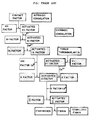
- extrinsic coagulation One pathway is called extrinsic coagulation.
- the coagulation factor VII is activated, and the activated coagulation factor VII activates the coagulation factor X. This activates the coagulation factor V and factor II, and finally fibrinogen is transformed into fibrin to induce coagulation.
- the other pathway is called intrinsic coagulation.
- the coagulation factor XII is activated by contact or the like and activates the factor XI.
- the activated factor XI activates the factor IX
- the activated factor IX activates the factor X by collaborating with calcium ions and factor VIII. This is then followed by activation of the factor V and factor II, and finally fibrinogen is transformed into fibrin to induce coagulation.
- Methods of detecting blood coagulation include the method of detecting the increase in viscosity (viscosity detection method), the method of detecting white turbidity (turbidity detection method), and their combined method.
- viscosity detection method a bar-shaped or spherical magnetic element is placed in the plasma specimen, and a coagulation reagent is added. The motion of the magnetic element becomes slower due to coagulation, and this slowing down is detected.
- the viscosity detection method produces variable results depending on the shape of the fibrin lumps which are the final product of blood coagulation (that is, the quantity or viscosity of the fibrin). Furthermore, it is impossible to detect coagulation unless the viscosity increases to above a specific level. Besides, because the measurement principle is based on observing the motion of the magnetic element, it is dependent on the strength of the magnetic field of the element.
- the turbidity detection method involves mixing the plasma specimen and coagulation reagent, and it does not require a magnetic element or the like.
- the method can be the transmitted light detection method or the scattered light detection method. With these methods of detection, if the fibrinogen quantity is small, the change in the quantity of transmitted or scattered light can be detected, and it is hence free from the shortcoming of the viscosity detection method. However, with either method, the detection is more accurate if the change in the quantity of light is large. Thus the coagulation reagent should have the characteristic of producing a large change in the quantity of light.
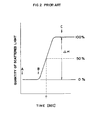
- Fig. 2 is a diagram for explaining the change of signal intensity obtained in the scattered light detection method.
- the result of investigating the plasma coagulation process with an optical detecting device (using the scattered light detection method) is shown.
- point A is the moment of mixing the plasma and coagulation reagent, and afterwards the coagulation reaction progresses in multiple steps.
- point B in the diagram.
- the coagulation time may be (for example as disclosed in Japanese Laid-open Patent Sho. 59-203959) defined as the time T taken to reach 50% of the overall change in the quantity of scattered light, with time B being 0% and time C being 100%.
- ⁇ H is the overall change in the quantity of scattered light from start to finish of the coagulation reaction.
- PT prothrombin time
- PT prothrombin time
- tissue thromboplastin differs in reactivity to extrinsic coagulation factors or yield depending on the extraction conditions, and various methods of extraction have been invented so far.
- Ronald Bach et al. attempted to enhance the yield by solubilizing the tissue thromboplastin by using surface active agent (Triton X-100) (The J. Biological Chemistry, Vol. 256, No. 16, pp. 8324-8331, 1981).
- surface active agent Triton X-100
- tissue thromboplastin is contained in the reagent used in the inspection method (prothrombin time method) known as Quick's single-stage method, and at the same time the tissue thromboplastin must be uniform in reactivity to extrinsic coagulation factors and must also be able to transform fibrinogen into fibrin.
- PT reagent For the conventional reagent for coagulating blood (hereinafter called PT reagent), it was the overriding requirement to have an accurate reactivity to extrinsic coagulation factors and the ability to form fibrin. Little attention has been paid to displaying accurate measurement results. It was necessary to allow significant fluctuations of the coagulation results.
- the present invention involves the use of a high molecular weight substance of molecular weight between 1,000 and 2,000,000 in a reagent for coagulating blood comprising a substance activating coagulation factor and calcium ions for increasing turbidity changes when said reagent is added to a plasma sample.
- Embodiments of the invention produce a large change in the quantity of transmitted or reflected light in order to improve the measurement accuracy. As a result, not only can a specimen of low coagulating activity be measured, but the accuracy of the measurement of normal specimens is also enhanced.
- Embodiments produce enhanced optical and viscosity changes.
- the range for the molecular weight of the high molecular weight substance is 1,000 to 2,000,000, preferably 5,000 or 50,000 or 170,000 to 100,000 or 220,000 or 500,000.
- coagulating factor activating substance examples include the following:
- the coagulating factor activating substance may be a substance selected from the group comprising tissue thromboplastin, phospholipid and thrombin.
- tissue thromboplastin An example of reagent containing tissue thromboplastin is explained below.
- tissues brain, lung, placenta, etc.
- mammal animals human, rabbit, cattle, horse, monkey, etc.
- acetone powder acetone treated powder
- fractions containing tissue thromboplastin are extracted from the acetone powder, and calcium ions and high molecular weight substances are added in the fractions.
- step II it is desired to mix the rabbit brain and acetone at a ratio by weight of 1:7.
- the acetone powder is commercially available and may be bought.
- the undesired component may be much eluted in the solution, so that the removal rate of undesired component may be enhanced (blood corpuscles hemolyze in acidity).
- an acidic solution such as hydrochloric acid water
- step IV by using sodium formate or sodium acetate at a concentration of 25 to 250 mM, a tissue thromboplastin of high coagulating activity may be obtained efficiently.
- the high molecular weight substances at step V may include, among others, high molecular weight vinyl selected from the group comprising polyethylene glycol, polyvinyl alcohol, and polynoxylene, or high molecular weight polysaccharide selected from the group comprising agarose, soluble starch, glycogen, dextran and dextrin.
- high molecular weight vinyl, high molecular weight polysaccharide or both may be used as the high molecular weight substance. More specifically, for example, polyethylene glycol with molecular weight of 1,000 to 500,000 (more preferably 5,000 to 100,000, most preferably 20,000), or dextran with molecular weight of 5,000 to 2,000,000 (more preferably, 50,000 to 500,000, or most preferably 170,000 to 220,000) may be preferred.
- the content may be properly determined, but it is generally 0.25% to 2.0% (w/v), because the effect of high sensitivity is not obtained if too little, or the reaction performance deteriorates due to excessive viscosity if too much.
- the reagent of a higher sensitivity After adding the high molecular weight substance, by setting the reagent in the state at least satisfying one of the following conditions 1 to 3, the reagent of a higher sensitivity will be obtained (best when all three conditions are satisfied).
- an electrolyte may be used (such as salt).
- acid or alkali e.g. hydrochloric acid, sodium hydroxide.
- osmotic pressure a substance which is non-electrolytic and water-soluble at the same time is used (e.g. sugar, urea).
- the prepared thromboplastin reagent should be preferably freeze-dried so as to be stored for a long period. Before use, the dry powder is dissolved in a specific amount of water to return to an initial state of solution.
- tissue thromboplastin taken out from the acetone treated powder obtained by treating mammal tissues with acetone.
- the fraction containing tissue thromboplastin is preferably obtained by dissolving the acetone treated powder in solution, mixing, stirring and centrifuging, or by floating the acetone treated powder in an acidic liquid, removing blood components and foreign proteins by centrifugation, adding liquid to the sediment fraction, stirring and then centrifuging.
- the reagent containing tissue thromboplastin is described above, while the reagent containing phospholipid or the reagent containing thrombin may be obtained by employing the known art.
- the prothrombin time reagent (PT reagent, the reagent for comprehensively measuring the extrinsic coagulation reaction in Fig. 1) is distributed by DADE, ORTHO, GD, all of the United States, Bering and BM, both of Germany, and others.
- reagent for measuring the activity of vitamin K derived enzyme As the reagent for measuring complex factor, Thrombo Test and Hepaplastin Test (both tradenames) are distributed by Eisai of Japan, and Complex Factor H and Complex Factor T (both tradenames) are distributed by Kokusai Shiyaku of Japan.
- the APTT reagent and PTT reagent are distributed by DADE, ORTHO, GD, all of the United States, Bering and BM, both of Germany. and others.
- the reagent for measuring fibrinogen, reagent for measuring thrombin time, or reagent for measuring AT-III are distributed by DADE, ORTHO, GD, all of the United States, Bering and BM, both of Germany, Kokusai Shiyaku of Japan, and others.
- the coagulating factor activating substance the phospholipid containing fraction obtained from acetone treated powder prepared by treating mammal tissue with acetone, or the thrombin containing fraction refined from plasma of mammal, may be used.
- coagulation factors in the plasma are activated one after another, and finally fibrinogen is transformed into fibrin to terminate the coagulation reaction.
- fibrinogen is transformed into fibrin to terminate the coagulation reaction.
- first monomers of fibrin are formed, and the monomers are gradually polymerized to form polymer (fibrous), so that the fibrin become fibrous.
- the fibrin fibers are entangled like a mesh, the mixed solution becomes turbid and is gelled.
- the reagent used in the invention contains high molecular weight substance.
- the entangling is more complicated, and the difference in optical characteristic between right after mixing the reagent (before coagulation) and after coagulation reaction is greater than before (that is, higher in sensitivity).
- the coagulation factors in the plasma are sequentially activated, and finally the fibrinogen is transformed into fibrin.
- the coagulation time is measured, from which the coagulation ability is assessed (calculated).
- the fibrinogen In the final process of blood coagulation, the fibrinogen is transformed into fibrin, but initially monomers of fibrin are formed. As the reaction is advanced, the fibrin monomers grown into dimer and further into polymer (fiber) by polymerization reaction. In this process, the greater the quantity of fibers (fibrin) and the more complicated is the fiber entanglement, the greater is the turbidity change, and therefore the measurement of coagulation ability is enhanced in both accuracy and reproducibility.
- the blood coagulation reagent of the invention contains the high molecular weight substance in order to cause a greater change in the turbidity, and therefore it increases the hardness of coagulation owing to entangling of fibers and high molecular weight substance, as well as entangling of fibers, and amplifies the optical change quantity. Besides, by properly controlling the conditions such as electrical conductivity, the polymerization reaction from fibrin monomers to fibrin polymer may be encouraged. It is anyway effective to increase the turbidity change due to blood coagulation, so that a reagent of high sensitivity may be prepared.
- tissue thromboplastin for the reagent used in the method of examination called Quick's single-stage method (prothrombin time method), it is indispensable to contain tissue thromboplastin in order to endow the extrinsic coagulation factors with reactivity, and moreover in order that the result of reaction be measured accurately, it is necessary to set the reaction environments so that the coagulation lumps may be firmer.
- the tissue thromboplastin of high reactivity was extracted from the rabbit brain tissues in the following procedure.
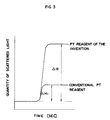
- the PT reagent containing tissue thromboplastin blended with high molecular substance and the PT reagent containing tissue thromboplastin without blend were prepared, and their coagulation curves were compared.
- the PT reagent with high molecular substance was greater in the quantity of change of scattered light as compared with the PT reagent without the blend ( ⁇ H > ⁇ H 1 ).
- the coagulation reaction can be analyzed more closely and precisely by mixing high molecular substance to the PT reagent.
- high molecular substance ethylene glycol with molecular weight of 20,000 was used, and the blending rate was 0.5 w/v%.
- ⁇ H denotes the change of scattered light by adding high molecular substance
- ⁇ H 1 represents the change of scattered light without high molecular substance.
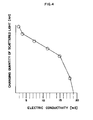
- Fig. 4 shows the effect of adjusting the electric conductivity to 4.0 to 15.0 mS.
- salt was added to tissue thromboplastin, and the PT reagent were prepared so that the electric conductivity be 2.0 to 20.0 mS, and using these PT reagents the plasma coagulation was measured, and the mean of changing quantity of scattered light (the mean of ten measurements each) was compared.
- the mean of changing quantity of scattered light the mean of ten measurements each
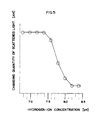
- Fig. 5 shows the effect of adjusting the pH to 6.7 to 8.2, or preferably 7.2 to 7.5.
- PT reagents were prepared in a pH range of 6.7 to 8.5 by using hydrochloric acid of 1 normal and sodium hydroxide of 1 normal in tissue thromboplastin extract, and the plasma coagulation was measured by using these PT reagents, and the mean of changing quantity of scattered light (the mean of ten measurements each) was compared.
- Fig. 5 shows the effect of adjusting the pH to 6.7 to 8.2, or preferably 7.2 to 7.5.
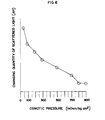
- Fig. 6 shows the effect of adjusting the osmotic pressure to 100 to 700 mmol/kg, or preferably 350 to 700 mmol/kg.
- glucose was mixed to tissue thromboplastin extract, and reagents were prepared by adjusting the osmotic pressure in a range of 50 to 900 mmol/kg, and using these PT reagents, the plasma coagulation was measured, and the mean of the changing quantity of scattered light at that time (the mean of ten measurements each) was compared.
- Fig. 6 shows the effect of adjusting the osmotic pressure to 100 to 700 mmol/kg, or preferably 350 to 700 mmol/kg.
- the changing quantity of scattered light tended to decline along with the elevation of osmotic pressure, but at the osmotic pressure of 100 to 700 mmol/kg, or in particular in a range of 350 to 700 mmol/kg, the changing quantity of scattered light tended to be stable.
- the osmotic pressure of the PT reagent to 100 to 700 mmol/kg, or preferably 350 to 700 mmol/kg, it is known possible to obtain a stable changing quantity of scattered light regardless of fluctuations of the osmotic pressure depending on specimen plasma, while maintaining the changing quantity of scattered light at a high level.
- the reagent used in the invention to coagulate blood possesses reactivity to coagulation factors, same as the conventional coagulation factor activating reagent, and contains high molecular substance, and therefore it is effective to increase the turbidity change along with blood coagulation.
- coagulation factors same as the conventional coagulation factor activating reagent, and contains high molecular substance, and therefore it is effective to increase the turbidity change along with blood coagulation.
- the description herein relates to the field of blood coagulation, but the method and reagent for adjusting the coagulation reaction environments and making the reaction manifest are not limited to the reagent used in the coagulation factor activating substance disclosed in the invention, but may be applied to everything that reacts to solidify or coagulate physically.
Landscapes
- Health & Medical Sciences (AREA)
- Life Sciences & Earth Sciences (AREA)
- Hematology (AREA)
- Engineering & Computer Science (AREA)
- Molecular Biology (AREA)
- Biomedical Technology (AREA)
- Chemical & Material Sciences (AREA)
- Immunology (AREA)
- Urology & Nephrology (AREA)
- Biotechnology (AREA)
- Biochemistry (AREA)
- Cell Biology (AREA)
- Food Science & Technology (AREA)
- Medicinal Chemistry (AREA)
- Physics & Mathematics (AREA)
- Analytical Chemistry (AREA)
- Microbiology (AREA)
- General Health & Medical Sciences (AREA)
- General Physics & Mathematics (AREA)
- Pathology (AREA)
- Investigating Or Analysing Biological Materials (AREA)
- Measuring Or Testing Involving Enzymes Or Micro-Organisms (AREA)
- Investigating Or Analysing Materials By Optical Means (AREA)
Applications Claiming Priority (3)
| Application Number | Priority Date | Filing Date | Title |
|---|---|---|---|
| JP246740/91 | 1991-08-30 | ||
| JP24674091A JP3180824B2 (ja) | 1991-08-30 | 1991-08-30 | 血液凝固試薬 |
| JP24674091 | 1991-08-30 |
Publications (2)
| Publication Number | Publication Date |
|---|---|
| EP0535799A1 EP0535799A1 (en) | 1993-04-07 |
| EP0535799B1 true EP0535799B1 (en) | 1999-10-27 |
Family
ID=17152948
Family Applications (1)
| Application Number | Title | Priority Date | Filing Date |
|---|---|---|---|
| EP92307754A Expired - Lifetime EP0535799B1 (en) | 1991-08-30 | 1992-08-26 | Reagent for coagulating blood |
Country Status (6)
| Country | Link |
|---|---|
| US (1) | US5401663A (enExample) |
| EP (1) | EP0535799B1 (enExample) |
| JP (1) | JP3180824B2 (enExample) |
| AU (1) | AU647626B2 (enExample) |
| CA (1) | CA2072176C (enExample) |
| DE (1) | DE69230209T2 (enExample) |
Families Citing this family (12)
| Publication number | Priority date | Publication date | Assignee | Title |
|---|---|---|---|---|
| US6114135A (en) * | 1991-11-08 | 2000-09-05 | Goldstein; Sheldon | Multiple coagulation test system and method of using a multiple coagulation test system |
| JP3224607B2 (ja) * | 1992-09-11 | 2001-11-05 | 株式会社アズウェル | 血液凝固第xiii因子活性測定方法および該測定用試薬キット |
| EP0633473B1 (de) * | 1993-06-30 | 1999-03-10 | Stiftung Für Diagnostische Forschung | Messung des aktivierten partiellen Thromboplastinzeit (APTT) in einer Einstufen-Reaktion |
| US6150174A (en) * | 1997-03-05 | 2000-11-21 | Diametrics Medical, Inc. | Method for measurement of whole blood coagulation parameters |
| WO2001018551A1 (en) | 1999-09-03 | 2001-03-15 | Roche Diagnostics Corporation | Method, reagent and test cartridge for determining clotting time |
| US6448024B1 (en) | 2000-10-03 | 2002-09-10 | Roche Diagnostics Corporation | Method, reagent, cartridge, and device for determining fibrinogen |
| JP4999613B2 (ja) * | 2007-08-31 | 2012-08-15 | シスメックス株式会社 | 血液凝固測定用試薬及び血液凝固時間測定方法 |
| EP3018481B1 (en) | 2009-05-20 | 2018-02-21 | Sekisui Medical Co., Ltd. | Blood coagulation time prolonging agent |
| GB201223079D0 (en) * | 2012-12-20 | 2013-02-06 | Sepsis Ltd | Point of care sepsis assay device and method |
| WO2016097234A1 (en) * | 2014-12-18 | 2016-06-23 | Koninklijke Philips N.V. | Device, system and method for determining a fibrinogen level in a blood sample |
| US10633645B2 (en) * | 2015-12-30 | 2020-04-28 | General Electric Company | Calcium controlled activation of platelets via electrical stimulation |
| CN106290923B (zh) * | 2016-08-01 | 2018-05-11 | 重庆鼎润医疗器械有限责任公司 | 一种活化凝血检测试剂及其应用 |
Family Cites Families (17)
| Publication number | Priority date | Publication date | Assignee | Title |
|---|---|---|---|---|
| US2847347A (en) * | 1954-05-27 | 1958-08-12 | Ortho Pharmacentical Corp | Preparation of improved thromboplastin |
| US3980432A (en) * | 1973-04-02 | 1976-09-14 | Behringwerke Aktiengesellschaft | Partial thromboplastin, its use as diagnostic agent and process for preparing it |
| ES431736A1 (es) * | 1973-11-13 | 1977-05-16 | Behringwerke Ag | Procedimiento para la preparacion de un agente para diagnos-tico para el proposito de efectuar el control de la capaci- dad de coagulacion de la sangre. |
| DE2550011C2 (de) * | 1975-11-07 | 1982-11-25 | Behringwerke Ag, 3550 Marburg | Verfahren zur Herstellung eines antihämophilen Mittels |
| US4264471A (en) * | 1979-06-04 | 1981-04-28 | E. I. Du Pont De Nemours And Company | Serum and plasma clarification process |
| DE3113350A1 (de) * | 1981-04-02 | 1982-10-21 | Boehringer Mannheim Gmbh, 6800 Mannheim | Reagens zur optischen bestimmung des blutgerinnungsverhaltens |
| DE3150596A1 (de) * | 1981-12-21 | 1983-06-30 | Boehringer Mannheim Gmbh, 6800 Mannheim | Verfahren zur herstellung von gewebsthromboplastin |
| DE3311287A1 (de) * | 1983-03-28 | 1984-10-04 | Behringwerke Ag, 3550 Marburg | Verfahren zur fotometrischen bestimmung der aktivierten partiellen thromboplastinzeit und reagenz dazu |
| US4501731A (en) * | 1983-06-27 | 1985-02-26 | Tishkoff Garson H | Treatment of disparate bleeding disorders with factor X zymogen |
| DE3330699A1 (de) * | 1983-08-25 | 1985-03-07 | Boehringer Mannheim Gmbh, 6800 Mannheim | Verfahren zur gleichzeitigen bestimmung von fibrinogen und fibrinogen-spaltprodukten im plasma |
| DE3413311A1 (de) * | 1984-04-09 | 1985-10-17 | Behringwerke Ag, 3550 Marburg | Reagenz zur bestimmung der thromboplastinzeit |
| US4637932A (en) * | 1984-10-15 | 1987-01-20 | Miles Laboratories, Inc. | Process for producing a concentrate enriched in coagulation factors VII and VIIa |
| DE3441835A1 (de) * | 1984-11-15 | 1986-05-22 | Luitpold-Werk Chemisch-pharmazeutische Fabrik GmbH & Co, 8000 München | Blutstillungsmittel |
| US4755461A (en) * | 1986-04-17 | 1988-07-05 | Bio/Data Corporation | Tableted blood plasma microconcentrated thromboplastin coagulation reagent |
| US4880788A (en) * | 1987-10-30 | 1989-11-14 | Baylor College Of Medicine | Method for preventing and treating thrombosis |
| JPH0720997B2 (ja) * | 1988-08-29 | 1995-03-08 | 興和株式会社 | 新規なトロンビン結合性物質及びその製法 |
| US5190919A (en) * | 1989-11-13 | 1993-03-02 | Board Of Regents, The University Of Texas System | Antihemostatic factor vii peptides |
-
1991
- 1991-08-30 JP JP24674091A patent/JP3180824B2/ja not_active Expired - Fee Related
-
1992
- 1992-06-04 AU AU17396/92A patent/AU647626B2/en not_active Ceased
- 1992-06-23 CA CA002072176A patent/CA2072176C/en not_active Expired - Fee Related
- 1992-08-26 DE DE69230209T patent/DE69230209T2/de not_active Expired - Lifetime
- 1992-08-26 EP EP92307754A patent/EP0535799B1/en not_active Expired - Lifetime
-
1993
- 1993-11-18 US US08/154,399 patent/US5401663A/en not_active Expired - Fee Related
Also Published As
| Publication number | Publication date |
|---|---|
| DE69230209T2 (de) | 2000-03-23 |
| US5401663A (en) | 1995-03-28 |
| JPH0560763A (ja) | 1993-03-12 |
| CA2072176A1 (en) | 1993-03-01 |
| DE69230209D1 (de) | 1999-12-02 |
| EP0535799A1 (en) | 1993-04-07 |
| CA2072176C (en) | 2003-01-28 |
| JP3180824B2 (ja) | 2001-06-25 |
| AU1739692A (en) | 1993-03-04 |
| AU647626B2 (en) | 1994-03-24 |
Similar Documents
| Publication | Publication Date | Title |
|---|---|---|
| DE69535336T2 (de) | Trockener prothrombin-zeittest | |
| US5401663A (en) | Reagent for coagulating blood | |
| US4045176A (en) | Preparation of optically clear serum | |
| Nabb et al. | Determination of cholinesterase by an automated pH stat method | |
| CA1043702A (en) | Diagnostic agent for the control of the coagulability of blood, process for its manufacture and stabilizer for this agent | |
| US4389490A (en) | Method of stabilizing platelets for determining multiple platelet parameters in reference control and calibrator compositions; and diluents thereof | |
| JPH11514101A (ja) | 組換えウサギ組織因子に基づくプロトロンビン時間試薬 | |
| CA1116087A (en) | Artificial medical material with anticoagulative activity | |
| Engel | Glycogen and carbohydrate—protein complex in developing teeth of the rat | |
| EP0123883B1 (de) | Verfahren zur fotometrischen Bestimmung der aktivierten partiellen Thromboplastinzeit und Reagenz dazu | |
| CN114544983A (zh) | 一种凝血与血小板功能分析仪用正常值质控品的制备方法 | |
| NO161079B (no) | Reagens for optisk bestemmelse av blodkoaguleringsforholdet. | |
| JP3180825B2 (ja) | 血液凝固測定方法 | |
| Silberman et al. | Effects of ancrod (Arvin) in mice: studies of plasma fibrinogen and fibrinolytic activity | |
| EP0826965B1 (de) | Verfahren zur Herstellung von Faktor V-Mangelplasma und ein so erhaltenes Mangelplasma | |
| Lootsik et al. | Preparation of chitosan with high blood clotting activity and its hemostatic potential assessment | |
| KR100235517B1 (ko) | 프로트롬빈 시간 테스트용으로 적합한 트롬보플라스틴 시약을 배양 세포로부터 제조하는 방법 | |
| JPH09171021A (ja) | 血液凝固時間測定用乾燥試薬 | |
| JP2001255332A (ja) | 組織因子含有組成物 | |
| Izak et al. | Studies on hypercoagulable state | |
| Marx et al. | Albumin indirectly modulates fibrin and protofibrin ultrastructure | |
| Osbahr | The hemostatic effect of bovine peptide-B from fibrinogen | |
| JP3268221B2 (ja) | 検体希釈液 | |
| Azoury et al. | Hydration feature of urinary compounds: Evidence for molecular abnormality in calcium oxalate urolithiasis | |
| EP4286528A1 (de) | Verfahren und vorrichtung zum nachweis von transglutaminasen |
Legal Events
| Date | Code | Title | Description |
|---|---|---|---|
| PUAI | Public reference made under article 153(3) epc to a published international application that has entered the european phase |
Free format text: ORIGINAL CODE: 0009012 |
|
| AK | Designated contracting states |
Kind code of ref document: A1 Designated state(s): DE FR GB IT NL |
|
| 17P | Request for examination filed |
Effective date: 19930920 |
|
| 17Q | First examination report despatched |
Effective date: 19950712 |
|
| GRAG | Despatch of communication of intention to grant |
Free format text: ORIGINAL CODE: EPIDOS AGRA |
|
| GRAG | Despatch of communication of intention to grant |
Free format text: ORIGINAL CODE: EPIDOS AGRA |
|
| GRAH | Despatch of communication of intention to grant a patent |
Free format text: ORIGINAL CODE: EPIDOS IGRA |
|
| GRAH | Despatch of communication of intention to grant a patent |
Free format text: ORIGINAL CODE: EPIDOS IGRA |
|
| RAP1 | Party data changed (applicant data changed or rights of an application transferred) |
Owner name: SYSMEX CORPORATION |
|
| GRAA | (expected) grant |
Free format text: ORIGINAL CODE: 0009210 |
|
| ITF | It: translation for a ep patent filed | ||
| AK | Designated contracting states |
Kind code of ref document: B1 Designated state(s): DE FR GB IT NL |
|
| REF | Corresponds to: |
Ref document number: 69230209 Country of ref document: DE Date of ref document: 19991202 |
|
| ET | Fr: translation filed | ||
| PLBE | No opposition filed within time limit |
Free format text: ORIGINAL CODE: 0009261 |
|
| STAA | Information on the status of an ep patent application or granted ep patent |
Free format text: STATUS: NO OPPOSITION FILED WITHIN TIME LIMIT |
|
| 26N | No opposition filed | ||
| REG | Reference to a national code |
Ref country code: GB Ref legal event code: IF02 |
|
| PGFP | Annual fee paid to national office [announced via postgrant information from national office to epo] |
Ref country code: NL Payment date: 20060815 Year of fee payment: 15 |
|
| PGFP | Annual fee paid to national office [announced via postgrant information from national office to epo] |
Ref country code: GB Payment date: 20060823 Year of fee payment: 15 |
|
| PGFP | Annual fee paid to national office [announced via postgrant information from national office to epo] |
Ref country code: IT Payment date: 20060831 Year of fee payment: 15 |
|
| GBPC | Gb: european patent ceased through non-payment of renewal fee |
Effective date: 20070826 |
|
| PG25 | Lapsed in a contracting state [announced via postgrant information from national office to epo] |
Ref country code: NL Free format text: LAPSE BECAUSE OF NON-PAYMENT OF DUE FEES Effective date: 20080301 |
|
| NLV4 | Nl: lapsed or anulled due to non-payment of the annual fee |
Effective date: 20080301 |
|
| PG25 | Lapsed in a contracting state [announced via postgrant information from national office to epo] |
Ref country code: GB Free format text: LAPSE BECAUSE OF NON-PAYMENT OF DUE FEES Effective date: 20070826 |
|
| PG25 | Lapsed in a contracting state [announced via postgrant information from national office to epo] |
Ref country code: IT Free format text: LAPSE BECAUSE OF NON-PAYMENT OF DUE FEES Effective date: 20070826 |
|
| PGFP | Annual fee paid to national office [announced via postgrant information from national office to epo] |
Ref country code: FR Payment date: 20090814 Year of fee payment: 18 |
|
| PGFP | Annual fee paid to national office [announced via postgrant information from national office to epo] |
Ref country code: DE Payment date: 20090821 Year of fee payment: 18 |
|
| REG | Reference to a national code |
Ref country code: FR Ref legal event code: ST Effective date: 20110502 |
|
| REG | Reference to a national code |
Ref country code: DE Ref legal event code: R119 Ref document number: 69230209 Country of ref document: DE Effective date: 20110301 |
|
| PG25 | Lapsed in a contracting state [announced via postgrant information from national office to epo] |
Ref country code: DE Free format text: LAPSE BECAUSE OF NON-PAYMENT OF DUE FEES Effective date: 20110301 Ref country code: FR Free format text: LAPSE BECAUSE OF NON-PAYMENT OF DUE FEES Effective date: 20100831 |