EP0533161B1 - Gasket with sealing layer - Google Patents
Gasket with sealing layer Download PDFInfo
- Publication number
- EP0533161B1 EP0533161B1 EP19920115933 EP92115933A EP0533161B1 EP 0533161 B1 EP0533161 B1 EP 0533161B1 EP 19920115933 EP19920115933 EP 19920115933 EP 92115933 A EP92115933 A EP 92115933A EP 0533161 B1 EP0533161 B1 EP 0533161B1
- Authority
- EP
- European Patent Office
- Prior art keywords
- layer
- ultraviolet
- gasket
- polymer
- gasketing
- Prior art date
- Legal status (The legal status is an assumption and is not a legal conclusion. Google has not performed a legal analysis and makes no representation as to the accuracy of the status listed.)
- Expired - Lifetime
Links
Images

Classifications
-
- F—MECHANICAL ENGINEERING; LIGHTING; HEATING; WEAPONS; BLASTING
- F16—ENGINEERING ELEMENTS AND UNITS; GENERAL MEASURES FOR PRODUCING AND MAINTAINING EFFECTIVE FUNCTIONING OF MACHINES OR INSTALLATIONS; THERMAL INSULATION IN GENERAL
- F16J—PISTONS; CYLINDERS; SEALINGS
- F16J15/00—Sealings
- F16J15/02—Sealings between relatively-stationary surfaces
- F16J15/06—Sealings between relatively-stationary surfaces with solid packing compressed between sealing surfaces
- F16J15/10—Sealings between relatively-stationary surfaces with solid packing compressed between sealing surfaces with non-metallic packing
- F16J15/12—Sealings between relatively-stationary surfaces with solid packing compressed between sealing surfaces with non-metallic packing with metal reinforcement or covering
- F16J15/121—Sealings between relatively-stationary surfaces with solid packing compressed between sealing surfaces with non-metallic packing with metal reinforcement or covering with metal reinforcement
- F16J15/122—Sealings between relatively-stationary surfaces with solid packing compressed between sealing surfaces with non-metallic packing with metal reinforcement or covering with metal reinforcement generally parallel to the surfaces
-
- C—CHEMISTRY; METALLURGY
- C09—DYES; PAINTS; POLISHES; NATURAL RESINS; ADHESIVES; COMPOSITIONS NOT OTHERWISE PROVIDED FOR; APPLICATIONS OF MATERIALS NOT OTHERWISE PROVIDED FOR
- C09K—MATERIALS FOR MISCELLANEOUS APPLICATIONS, NOT PROVIDED FOR ELSEWHERE
- C09K3/00—Materials not provided for elsewhere
- C09K3/10—Materials in mouldable or extrudable form for sealing or packing joints or covers
- C09K3/1006—Materials in mouldable or extrudable form for sealing or packing joints or covers characterised by the chemical nature of one of its constituents
- C09K3/1021—Polyurethanes or derivatives thereof
-
- C—CHEMISTRY; METALLURGY
- C09—DYES; PAINTS; POLISHES; NATURAL RESINS; ADHESIVES; COMPOSITIONS NOT OTHERWISE PROVIDED FOR; APPLICATIONS OF MATERIALS NOT OTHERWISE PROVIDED FOR
- C09K—MATERIALS FOR MISCELLANEOUS APPLICATIONS, NOT PROVIDED FOR ELSEWHERE
- C09K3/00—Materials not provided for elsewhere
- C09K3/10—Materials in mouldable or extrudable form for sealing or packing joints or covers
- C09K3/1025—Materials in mouldable or extrudable form for sealing or packing joints or covers characterised by non-chemical features of one or more of its constituents
- C09K3/1028—Fibres
-
- C—CHEMISTRY; METALLURGY
- C09—DYES; PAINTS; POLISHES; NATURAL RESINS; ADHESIVES; COMPOSITIONS NOT OTHERWISE PROVIDED FOR; APPLICATIONS OF MATERIALS NOT OTHERWISE PROVIDED FOR
- C09K—MATERIALS FOR MISCELLANEOUS APPLICATIONS, NOT PROVIDED FOR ELSEWHERE
- C09K2200/00—Chemical nature of materials in mouldable or extrudable form for sealing or packing joints or covers
- C09K2200/02—Inorganic compounds
- C09K2200/0243—Silica-rich compounds, e.g. silicates, cement, glass
- C09K2200/0252—Clays
-
- C—CHEMISTRY; METALLURGY
- C09—DYES; PAINTS; POLISHES; NATURAL RESINS; ADHESIVES; COMPOSITIONS NOT OTHERWISE PROVIDED FOR; APPLICATIONS OF MATERIALS NOT OTHERWISE PROVIDED FOR
- C09K—MATERIALS FOR MISCELLANEOUS APPLICATIONS, NOT PROVIDED FOR ELSEWHERE
- C09K2200/00—Chemical nature of materials in mouldable or extrudable form for sealing or packing joints or covers
- C09K2200/06—Macromolecular organic compounds, e.g. prepolymers
- C09K2200/0692—Fibres
- C09K2200/0695—Polyamide fibres
Definitions
- This invention relates to a gasket excellent in sealing properties and production efficiency which is suitable for various industrial uses.
- a primer coating layer which is for enhancement of adhesion between a gasketing base layer and the silicone rubber layer, is formed by coating a primer solution of a thermoplastic resin, e.g., polyvinyl butyral, or an acrylic silicone resin, in a solvent, e.g., ethanol or methyl ethyl ketone, on a gasketing base layer by screen coating.
- a thermoplastic resin e.g., polyvinyl butyral, or an acrylic silicone resin
- the solvent of the primer solution is vaporized during screen coating to cause clogging of the screen. Further, the wet primer coating layer needs lots of energy and time for drying and hardening, causing a reduction of gasket production efficiency. If a high-boiling solvent is used in the primer solution, the screen coating properties may be improved, but this also results in an increase of energy or time required for drying, etc., eventually failing to improve the overall production efficiency.
- EP-A-0188778 relating to an impregnated gasket, in particular cylinder head gasket for internal combustion engines.
- Said prior art document proposes a technique of using a silicone resin as an impregnating agent for the gasket sheet by thermosetting and further ultraviolet curing.
- Said document furthermore, proposes that a coating layer of ultraviolet hardenable polymers or solid particles substances may be applied to the impregnated gasket after furnace heating and before ultraviolet hardening.
- the silicone impregnated agent which is present in surface regions of the flat sealing gasket is cross-linked to a greater degree than obtainable by thermal treatment alone.
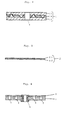
- Figures 1-3 each show a cross-section of gaskets out of the scope of the present invention.
- Figure 4 is a cross-section of a gasketing base layer.
- Figure 5 is a cross section of a sealing layer according to the present invention.
- Figure 6 illustrates an embodiment of usage of the gasket according to the present invention.
- a sealing layer comprises a surface layer and at least one ultraviolet-cured layer via which it is adhered to a gasketing base layer. Therefore, the sealing layer can be formed with good adhesion to the gasketing base layer, and the problem of screen clogging as observed in the case of forming a primer coating layer can be avoided. Besides, the time required for curing can be reduced to about 5 seconds whereas the conventional hardening by drying requires about 15 minutes, which brings about not only increased efficiency but energy saving, ultimately leading to increased overall efficiency of gasket production.
- the surface layer of the sealing layer is tack-free, disadvantages due to adhesion of gaskets with each other, such as interference with successive operations and adhesion to the block side or head side of an engine, can be avoided. Further, the sealing layer having a Shore hardness A of from 10 to 80, a compressibility of from 10 to 90%, and a recovery of not less than 30% is excellent in surface conformability and sealing properties (properties to prevent clearance formation).
- Shore hardness A is measured according to JIS K6301 in the title of "Physical Test Method for Vulcanized Rubber” and compressibility and recovery each are measured according to JIS R3453 in the title of "Asbestos Joint Sheet”.
- FIG. 1 is a gasketing base layer and numeral 2 is a sealing layer.
- the gasketing base layer is not particularly limited. Any of known gasketing profiles, such as those used in internal combustion engines, particularly automobile engines, may be used. General gasketing profiles include fibrous sheets comprising a mixture of a fibrous component, e.g., inorganic and/or organic high-temperature-resistant fibers or fabrications thereof, and a rubber component, e.g., natural rubber or synthetic rubbers (e.g., styrene-butadiene rubber (SBR), acrylonitrile-butadiene rubber (NBR), acrylic rubber), such as joint sheet, beater sheet, and steel sheet wherein asbestos-free compounds are coated on both sides thereof; graphite sheet; and metallic sheet, such as rubber-coated metal sheet.
- SBR styrene-butadiene rubber
- NBR acrylonitrile-butadiene rubber
- acrylic rubber such as joint sheet, beater sheet, and steel sheet wherein asbestos-free compounds are coated on both sides thereof; graphite sheet; and metallic sheet, such
- the gasketing base layer may have a single layer structure as shown in Fig. 1, which comprises, for example, the above-mentioned mixture of a fibrous component and a rubber component; a structure as shown in Fig. 4, which is obtained by calandering the above-described mixture of a fibrous component and a rubber component in both sides of perforated iron plate 12 to form layers 11; or a laminate structure composed of a core, e.g., the perforated iron plate as illustrated in Fig. 4 or a flat iron plate, sandwiched in between a pair of the above-described fibrous sheet or graphite sheet.
- numerals 3, 4, and 5 indicate through-holes which functions as passageways of water, oil, etc. or as bolt holes.
- the sealing layer has a multilayer structure and contains at least an ultraviolet-cured layer as an integral part thereof via which it is bonded to gasketing base layer 1. That is, the sealing layer 1 has a double layer structure composed of an ultraviolet-cured layer 22 having formed thereon a surface layer 21 as shown in Fig. 5 or three or more layers.
- the ultraviolet-cured layer is formed by using an appropriate ultraviolet-curing polymer, such as acrylic epoxy polymer, acrylic polyester polymer, acrylic urethane polymer, acrylic polyether polymer, acrylic polythiol polymer, and epoxy polymer.
- an appropriate ultraviolet-curing polymer such as acrylic epoxy polymer, acrylic polyester polymer, acrylic urethane polymer, acrylic polyether polymer, acrylic polythiol polymer, and epoxy polymer.
- ultraviolet-curing polymers preferred are those providing a soft cured layer from the standpoint of sealing performance properties, such as surface conformability.
- Acrylic urethane polymer is particularly preferred and this polymer provides a sealing layer excellent in water resistance, oil resistance, and the like.
- ultraviolet-curing acrylic urethane polymer include polyether polyol, polyester polyol, and polymers containing an ether group and an ester group per molecule.
- polyether polyol examples include polyethylene glycol, polypropylene glycol, polytetramethylene glycol, 1,3-butylene glycol, 1,4-butylene glycol, 1,6-hexanediol, neopentyl glycol, cyclohexanedimethanol, 2,2-bis(4-hydroxycyclohexyl)propane, and ethylene oxide- or propylene oxide-added bisphenol A.
- polyester polyol examples include reaction products between one or more of the above-enumerated polyether polyol and a dibasic acid, e.g., adipic acid, sebacic acid, azelaic acid, and dodecanedicarboxylic acid, or an anhydride thereof.
- a dibasic acid e.g., adipic acid, sebacic acid, azelaic acid, and dodecanedicarboxylic acid, or an anhydride thereof.
- Diisocyanate to be used in the formation of acrylic urethane polymer includes aromatic diisocyanate, e.g., tolylene diisocyanate and 4,4'-diphenylmethane diisocyanate; alicyclic diisocyanate, e.g., isoboron diisocyanate and 4,4'-dicyclohexylmethane diisocyanate; and aliphatic diisocyanate, e.g., hexamethylene diisocyanate and 2,2'-trimethylhexamethylene diisocyanate.
- aromatic diisocyanate e.g., tolylene diisocyanate and 4,4'-diphenylmethane diisocyanate
- alicyclic diisocyanate e.g., isoboron diisocyanate and 4,4'-dicyclohexylmethane diisocyanate
- aliphatic diisocyanate e.g., hex
- Hydroxyl-containing polymerizable monomers to be used include hydroxyl-containing methacrylates, e.g., ⁇ -hydroxyethyl methacrylate, ⁇ -hydroxypropyl methacrylate, ⁇ -hydroxylauryl methacrylate, and ⁇ -caprolactone- ⁇ -hydroxyethyl methacrylate.
- UV-curing acrylic urethane polymer are commercially available under trade names of "ZF-418-11” and “ZH-353T” (produced by Nippon Zeon Co., Ltd.), "BYX-8017” (produced by Asahi Denka Kogyo K.K.), and "XNR-5470” (produced by Nagase Ciba Co., Ltd.).
- the ultraviolet-curing polymer may contain appropriate additives, such as silica, coupling agents, and colorants.
- Silica and coupling agents are effective to improve resistance to high temperature and high pressure or resistance to settling. Incorporation of these additives is therefore advantageous in production of gaskets required to have good stress relaxation properties, water resistance, and oil resistance, for an extended period of use, such as cylinder head gaskets of automobile engines, etc. which are used in a high temperature and a high pressure and also in contact with water or oil.
- Silica to be used has an average particle size preferably of not more than 30 ⁇ m, more preferably of not more than 20 ⁇ m, and most preferably of from 0.1 to 10 ⁇ m.
- Commercially available silica which can be used in the present invention include "Nipsil VN-3” (produced by Nippon Silica Kogyo K.K.) and "Aerosil 200" (produced by Nippon Aerosil K.K.).
- Silica is added in an amount usually of from 2 to 50 parts by weight, and preferably of from 5 to 30 parts by weight, per 100 parts by weight of the ultraviolet-curing polymer.
- a lower level of addition i.e., less than 2 parts by weight
- a higher level of addition i.e., more than 50 parts by weight
- Coupling agents which can be used in the present invention include silane coupling agents and titanium coupling agents.
- suitable silane coupling agents are ⁇ -aminopropyltriethoxysilane, ⁇ -mercaptopropyltrimethoxysilane, and N- ⁇ (aminoethyl)- ⁇ -aminopropylmethyldimethoxysilane.
- These silane coupling agents are commercially available under trade names of KBE 903, KBM 803, and KBM 603, all produced by Shin-Etsu Chemical Co., Ltd.
- suitable titanium coupling agents include isopropyltriisostearoyl titanate.
- Such a titanium coupling agent is commercially available under a trade name, e.g., of "TTS", produced by Ajinomoto Co., Inc.
- TTS titanium coupling agent
- Preferred of these coupling agents are silane coupling agents, and particularly ⁇ -aminopropyltriethoxysilane and ⁇ -mercaptopropyltrimethoxysilane.
- the coupling agent is added in an amount usually of from 0.1 to 10 parts by weight, and preferably of from 0.2 to 3 parts by weight, per 100 parts by weight of the ultraviolet-curing polymer. A lower level of addition is insufficient for fixing of silica, and a higher level of addition brings about no substantial increase of the effect.
- the coupling agent may previously be supplied as a surface treating agent for silica.
- Colorants are added aiming at discrimination of the sealing layer because a sealing layer, if transparent, is hard to distinguish particularly when provided in parts and tends to reduce the production efficiency.
- Colorants useful for this purpose include various dyes or pigments of arbitrary color.
- Commercially available colorants which can be used include "Quinate 50R-406” (red), “Quinate FTNZ408” (orange), and “Quinate 508L” (blue), all produced by Nippon Zeon Co., Ltd.
- the colorant is added in an amount usually of from 0.01 to 0.5 part by weight, and preferably from 0.02 to 0.2 part by weight, per 100 parts by weight of the ultraviolet-curing polymer.
- a lower level of addition produces only a poor coloring effect, and a higher level of addition is liable to reduce ultraviolet curing properties.
- UV-curing polymer examples include photopolymerization initiators, photopolymerizable monomers, sensitizers, and stabilizers.
- photopolymerization initiators examples include acetophenone, benzophenone, Michler's ketone, benzil, benzoin, benzoin ether, and benzyl dimethyl ketal.
- Photopolymerizable monomers may be added for the purpose of improving properties of the sealing layer containing an ultraviolet-cured layer.
- suitable photopolymerizable monomers include monofunctional monomers, e.g., methyl methacrylate, ethyl methacrylate, 2-ethylhexyl acrylate, 2-hydroxyethyl acrylate, and 2-hydroxypropyl acrylate; bifunctional monomers, e.g., 1,3-butanediol diacrylate, 1,4-butanediol diacrylate, 1,6-hexanediol diacrylate, diethylene glycol diacrylate, neopentyl glycol diacrylate, polyethylene glycol diacrylate, and hydroxypivalic ester neopentyl glycol diacrylate; and tri- or polyfunctional monomers, e.g., trimethylolpropane triacrylate, pentaerythritol triacrylate, dipentaerythritol
- the ultraviolet-cured layer can be formed by coating the above-described ultraviolet-curing polymer or a solution thereof on a prescribed area of a gasketing base layer by screen coating, roll coating, curtain coating, dispenser coating, spray coating, or the like coating technique, followed by curing with ultraviolet rays.
- the ultraviolet irradiation dose is selected appropriately within a range of generally from 80 to 500 mJ/cm 2 .
- the stratified structure of a sealing layer is adopted since a single ultraviolet-cured layer on a gasketing base layer may not be sufficient for satisfying the above-described specific requirements, i.e., surface non-tackiness, a Shore hardness A of 10 to 80, a compressibility of 10 to 90%, and a recovery of 30% or more.
- the surface layer which is stratified on the ultraviolet-cured layer on a gasketing base layer to provide a stratified sealing layer includes an ultraviolet-cured layer, a rubber layer, a resin layer, and a releasable inorganic powder-containing layer.
- the ultraviolet-cured surface layer to be stratified is preferably formed by using acrylic epoxy polymer, acrylic polyester polymer, acrylic polyether polymer, and epoxy polymer from the standpoint of surface non-tackiness.
- acrylic epoxy polymer and epoxy polymer are preferred.
- Commercially available acrylic epoxy polymer such as "XNR 5460” and “XNR 5460 TC”, both produced by Nagase Ciba Co., Ltd.; and commercially available epoxy polymer, such as "KS-830" and "KS-820", both produced by Asahi Denka Kogyo K.K., may be employed.
- Stratification of the ultraviolet-cured surface layer is advantageous in terms of production efficiency as the whole sealing layer can be formed from ultraviolet-curing polymers.
- the tack-free ultraviolet-cured surface layer preferably has a thickness of from 2 to 10 ⁇ m from the viewpoint of preventing reduction in conformability.
- the rubber layer, resin layer, or releasable inorganic powder-containing layer to be stratified on the ultraviolet-cured layer may be formed by using rubbers, such as natural rubber; synthetic rubbers, e.g., SBR, NBR, acrylic rubber, silicone rubber, and fluorine rubber; resins, such as epoxy resin, epoxy silicone resin, acrylic silicone resin, silicone resin, and fluorine resin; or releasable inorganic powders, such as talc, clay, and calcium carbonate.
- rubbers such as natural rubber; synthetic rubbers, e.g., SBR, NBR, acrylic rubber, silicone rubber, and fluorine rubber; resins, such as epoxy resin, epoxy silicone resin, acrylic silicone resin, silicone resin, and fluorine resin; or releasable inorganic powders, such as talc, clay, and calcium carbonate.
- the layer to be stratified on the ultraviolet-cured layer has been described above as a surface layer for making the surface of the sealing layer tack-free, it may also serve as an intermediate layer.
- the above-described rubbers or resins capable of forming a layer having a Shore hardness A of 10 to 80, a compressibility of 10 to 90%, and a recovery of 30% or more are useful for forming an intermediate layer for preference.
- silicone rubber is particularly preferred.
- the silicone rubber to be used may be any of room temperature setting or thermosetting rubbers of addition type or condensation type. These silicone rubbers are commercially available under trade names of "CY52-237", produced by Toray Dow Corning Co., Ltd. and "X32-1134" and "KE-1083", both produced by Shin-Etsu Chemical Co., Ltd.
- the releasable inorganic powder-containing layer may comprise a binder resin having dispersed therein the inorganic powder.
- the sealing layer may be provided on desired part of a gasketing base layer, for example, on the entire surface of one or both sides of a gasketing base layer and/or on the part surrounding through-holes as illustrated in Figures. Where terminal fittings, such as grommet 6 and eyelet, etc., are fitted into the through-holes as illustrated in Fig. 6, the fittings may protrude from the level of sealing layer 2. Further, sealing layer 2 may or may not be in contact with the end of the fittings or may cover the flange of the fittings.
- the thickness of the sealing layer is arbitrary and usually ranges from 5 to 500 ⁇ m, preferably from 10 to 200 ⁇ m, and more preferably from 20 to 150 ⁇ m.
- the thickness of the ultraviolet-cured layer via which the sealing layer is adhered to a gasketing base layer is suitably from 2 to 30 ⁇ m, and preferably from 3 to 15 ⁇ m from the viewpoint of thinness and adhesive strength, and that of the layer laminated thereon for endowing the sealing layer with non-tackiness is preferably as thin as possible, and particularly not more than 10 ⁇ m.
- a sealing layer involves a heat treatment as required in the case of using a silicone rubber, etc.
- an ultraviolet-curing and heat-curing polymer for the formation of an ultraviolet-cured layer.
- curing of the ultraviolet-curing polymer can be carried out by heat treatment for the silicone rubber, etc.
- the gasket according to the present invention is applicable to various industrial fields, such as in automobile engines.
- it is utilized as a cylinder head gasket or a gasket around engine where a gasket is exposed to high temperature and high pressure or as a gasket around transmission in which water or oil takes part.
- the sealing layer of the gasket of the present invention comprises an ultraviolet-curing polymer
- a sealing layer having excellent adhesion to a gasketing base layer can be formed with reduced energy at high efficiency without causing clogging of a screen in screen printing. Further, since the sealing layer has no tackiness, unfavorable adhesion due to tack can be avoided. Accordingly, the gasket of the present invention is easy to handle and is excellent in surface conformability, sealing properties, and production efficiency.
- Gasketing base layer 2 was prepared in the same manner as in the preparation of gasketing base layer 1, except for replacing NBR with 100 parts of an acrylic rubber ("Noxtite A-1095" produced by Nippon Mektron Co., Ltd.) and Noccelar TT with 5 parts of Noccelar H (produced by Ouchi Shinko Chemical Industrial Co., Ltd.).
- a rubber coated metal plate comprising a 0.25 mm thick zinc-plated iron plate having on both sides thereof a 50 ⁇ m thick NBR coat (a product of Sanshin Kogyo K.K.) was cut out in the same manner as in the preparation of gasketing base layer 1 to obtain 0.35 mm thick gasketing base layer 4.
- An ultraviolet-curing polyurethane acrylate (“ZF-418-11" produced by Nippon Zeon Co., Ltd.) was screen printed on the central portion of the ring width of gasketing base layer 1 and cured by irradiating ultraviolet rays for about 30 seconds to form a transparent ultraviolet-cured layer having a width of 2 mm and a thickness of 200 ⁇ m.
- the transparent ultraviolet-cured layer had a Shore hardness of 39 on the A scale, a compressibility of 46.2% and a recovery of 53.9%.
- An acrylic epoxy polymer ("XNR 5460" produced by Nagase Ciba Co., Ltd.) was then screen printed on the ultraviolet-cured layer and cured by irradiating ultraviolet rays for about 10 seconds to form a tack-free surface layer having a thickness of 3 ⁇ m to obtain a gasket having a double-layered sealing layer.
- a gasket having a double-layered sealing layer was obtained in the same manner as in Example 1, except for replacing the ultraviolet-curing polyurethane acrylate with a coating composition consisting of 100 parts of an ultraviolet-curing polyurethane acrylate ("ZH-353T” produced by Nippon Zeon Co., Ltd.), 20 parts of silica powder ("Nipsil VN-3” produced by Nippon Silica Kogyo K.K.), 1 part of a silane coupling agent ("KBE 903" produced by Shin-Etsu Chemical Co., Ltd.), and 0.1 part of a colorant ("Quinate 50BL” produced by Nippon Zeon Co., Ltd.) to form a colored ultraviolet-cured layer.
- the ultraviolet-cured layer had a Shore hardness of 70 on the A scale, a compressibility of 24.6% and a recovery of 78.4%.
- a gasket having a double-layered sealing layer was obtained in the same manner as in Example 1, except for using gasketing base layer 2 and replacing the ultraviolet-curing polyurethane acrylate with a coating composition consisting of 100 parts of an ultraviolet-curing polyurethane acrylate ("XNR-5470" produced by Nagase Ciba Co., Ltd.), 10 parts of silica powder ("Aerosil 200" produced by Nippon Aerosil Co., Ltd.), 0.3 part of a silane coupling agent (“KBE 803" produced by Shin-Etsu Chemical Co., Ltd.), and 0.2 part of a colorant ("Quinate 50R-406” produced by Nippon Zeon Co., Ltd.) to form a colored ultraviolet-cured layer.
- the ultraviolet-cured layer had a Shore hardness of 67 on the A scale, a compressibility of 28.8% and a recovery of 73.3%.
- a gasket having a double-layered sealing layer was obtained in the same manner as in Example 2, except for using gasketing base layer 3.
- a gasket having a double-layered sealing layer was obtained in the same manner as in Example 2, except for using gasketing base layer 4.
- a gasket having a double-layered sealing layer was obtained in the same manner as in Example 1, except for replacing the acrylic epoxy polymer with an epoxy polymer ("KS-830" produced by Asahi Denka Kogyo K.K.) to form a tack-free surface layer.
- KS-830 produced by Asahi Denka Kogyo K.K.
- a gasket having a double-layered sealing layer was obtained in the same manner as in Example 1, except for replacing the acrylic epoxy polymer with a releasable powder (talc) to form a tack-free surface layer.
- talc releasable powder
- An ultraviolet-curing epoxy polymer (“KS-830” produced by Asahi Denka Kogyo K.K.) was screen printed on the central portion of the ring width of gasketing base layer 1 and cured by irradiating ultraviolet rays for about 5 seconds to form an ultraviolet-cured layer having a width of 2 mm and a thickness of 5 ⁇ m.
- a silicone rubber (“KE-1083” produced by Shin-Etsu Chemical Co., Ltd., wherein the Shore hardness is 54 on the A scale, compressibility is 30.5%, and recovery is 72.1%) was then screen printed on the ultraviolet-cured layer and cured by heating at 150°C for about 15 minutes to form a 200 ⁇ m thick rubber layer to obtain a gasket having a double-layered sealing layer.
- a gasket having a double-layered sealing layer was obtained in the same manner as in Example 8, except for using gasketing base layer 2 and forming the ultraviolet-cured layer to a thickness of 10 ⁇ m.
- a gasket having a double-layered sealing layer was obtained in the same manner as in Example 8, except for using gasketing base layer 3, and replacing the ultraviolet-curing epoxy polymer to an ultraviolet-curing acrylic epoxy polymer ("XNR 5460" produced by Nagase Ciba Co., Ltd.).
- a gasket was obtained in the same manner as in Example 1, except that the tack-free surface layer was not formed.
- a gasket was obtained in the same manner as in Example 8, except that the ultraviolet-cured layer was not formed.
- a gasket was obtained in the same manner as in Example 8, except for using gasketing base layer 3 and replacing the ultraviolet-cured layer with a 2 ⁇ m thick primer coat (width: 2 mm) which was formed by screen coating a 30% ethanol solution of polyvinyl butyral on the central portion of the ring width, followed by heating at 80°C for about 3 minutes.
- the adhesive strength of the sealing layer of each of the gaskets of Examples 8 to 10 and Comparative Examples 2 and 3 was measured by peel test at a peel angle of 90° and a peeling speed of 150 mm/min.
- the ring gasket was clamped from both sides under a pressure of 50 kg/cm 2 .
- the inner water pressure was stepwise raised by 0.5 kg/cm 2 starting from 0.5 kg/cm 2 , and the testing system was kept for 15 minutes for every rise of inner water pressure.
- the inner water pressure at which water leakage was observed with the naked eye was measured.
Landscapes
- Engineering & Computer Science (AREA)
- Chemical & Material Sciences (AREA)
- General Engineering & Computer Science (AREA)
- Materials Engineering (AREA)
- Organic Chemistry (AREA)
- Mechanical Engineering (AREA)
- Sealing Material Composition (AREA)
- Gasket Seals (AREA)
Applications Claiming Priority (6)
| Application Number | Priority Date | Filing Date | Title |
|---|---|---|---|
| JP27002591 | 1991-09-20 | ||
| JP270024/91 | 1991-09-20 | ||
| JP27002491 | 1991-09-20 | ||
| JP270025/91 | 1991-09-20 | ||
| JP213797/92 | 1992-07-17 | ||
| JP4213797A JP2929340B2 (ja) | 1991-09-20 | 1992-07-17 | ガスケット |
Publications (2)
| Publication Number | Publication Date |
|---|---|
| EP0533161A1 EP0533161A1 (en) | 1993-03-24 |
| EP0533161B1 true EP0533161B1 (en) | 1997-12-03 |
Family
ID=27329548
Family Applications (1)
| Application Number | Title | Priority Date | Filing Date |
|---|---|---|---|
| EP19920115933 Expired - Lifetime EP0533161B1 (en) | 1991-09-20 | 1992-09-17 | Gasket with sealing layer |
Country Status (3)
| Country | Link |
|---|---|
| EP (1) | EP0533161B1 (enExample) |
| JP (1) | JP2929340B2 (enExample) |
| DE (1) | DE69223365T2 (enExample) |
Families Citing this family (8)
| Publication number | Priority date | Publication date | Assignee | Title |
|---|---|---|---|---|
| US5772215A (en) * | 1995-12-08 | 1998-06-30 | Fel-Pro Incorporated | Head gasket with improved armoring and method of making same |
| DE20119233U1 (de) | 2001-11-26 | 2002-02-07 | L. Böwing GmbH Chemische Fabrik, 65719 Hofheim | Beschichtungsmasse und damit hergestellte funktionelle Beschichtung auf Formteilen aus Kautschuk |
| JP4936730B2 (ja) * | 2006-01-16 | 2012-05-23 | 東京エレクトロン株式会社 | 減圧容器および減圧処理装置 |
| JP5056379B2 (ja) * | 2007-11-28 | 2012-10-24 | 日立電線株式会社 | コネクタ |
| GB2455346B (en) * | 2007-12-07 | 2010-05-26 | Rolls Royce Plc | Multi-layer gasket or seal member |
| KR20120061245A (ko) * | 2010-12-03 | 2012-06-13 | 주식회사 팬택 | 방수부재 및 이의 제조방법 |
| CN109445202B (zh) * | 2018-12-21 | 2023-09-19 | 惠科股份有限公司 | 一种显示面板、显示装置及显示面板的封装方法 |
| CN116771918B (zh) * | 2023-06-08 | 2024-03-26 | 上海芯密科技有限公司 | 一种半导体用多层密封制品及其制备方法 |
Family Cites Families (4)
| Publication number | Priority date | Publication date | Assignee | Title |
|---|---|---|---|---|
| US4675346A (en) * | 1983-06-20 | 1987-06-23 | Loctite Corporation | UV curable silicone rubber compositions |
| DE3433376A1 (de) * | 1984-09-12 | 1986-03-20 | KSA Dichtsysteme GmbH & Co KG, 7143 Vaihingen | Dichtung |
| DE3521138C2 (de) * | 1985-01-17 | 1987-01-08 | Goetze Ag, 5093 Burscheid | Verfahren zur Herstellung einer Weichstoffflachdichtung, wie insbesondere eine Zylinderkopfdichtung |
| DE3620690C2 (de) * | 1986-06-20 | 1994-02-17 | Ds Chemie Gmbh | Dichtungselement |
-
1992
- 1992-07-17 JP JP4213797A patent/JP2929340B2/ja not_active Expired - Fee Related
- 1992-09-17 DE DE1992623365 patent/DE69223365T2/de not_active Expired - Fee Related
- 1992-09-17 EP EP19920115933 patent/EP0533161B1/en not_active Expired - Lifetime
Also Published As
| Publication number | Publication date |
|---|---|
| DE69223365D1 (de) | 1998-01-15 |
| DE69223365T2 (de) | 1998-03-26 |
| JP2929340B2 (ja) | 1999-08-03 |
| JPH05187556A (ja) | 1993-07-27 |
| EP0533161A1 (en) | 1993-03-24 |
Similar Documents
| Publication | Publication Date | Title |
|---|---|---|
| US6071567A (en) | Formation of compressible ply containing high melting point thermoplastic microspheres and printing blankets comprising same | |
| CA1045881A (en) | Support for liquid photosensitive resin | |
| US5510152A (en) | Process for curing a gasket coating | |
| US5130203A (en) | Metal gasket and method of producing the same | |
| EP0533161A1 (en) | Gasket with sealing layer | |
| US5257967A (en) | Inking rollers | |
| US5667227A (en) | Ultraviolet radiation cured gasket coating | |
| CA1173291A (en) | Planographic printing plate for direct printing | |
| US4681800A (en) | Impregnated, soft, flat gasket and manufacturing method | |
| JP3393876B2 (ja) | 金属ガスケットの製造方法 | |
| US20050221052A1 (en) | Metal gasket material sheet | |
| US6428645B1 (en) | Vehicular mount assembly with bonded rubber | |
| JP2788929B2 (ja) | ガスケツト | |
| US5631049A (en) | Process of curing a gasket coating | |
| JPH0665714B2 (ja) | ガスケット | |
| JPH0286680A (ja) | ガスケット | |
| JPS6317983A (ja) | ガスケツト | |
| CA2445232A1 (en) | Anti-fret primer for multilayer gaskets | |
| US20050034618A1 (en) | Endless printing sleeve, of multi-layer type, which has a printing layer, a compressible layer and a circumferential stiffening layer | |
| WO2003006254A1 (en) | Polymeric sleeve used in printing blanket | |
| EP0705168B1 (en) | A compressible laminate and its use | |
| JPH03265762A (ja) | ガスケット | |
| JPH07774Y2 (ja) | シリンダブロック用金属ガスケット | |
| CA2300609A1 (en) | High load bearing uv coating for cylinder head gaskets and head gasket incorporating the same | |
| CA1211660A (en) | Roller and method of making same |
Legal Events
| Date | Code | Title | Description |
|---|---|---|---|
| PUAI | Public reference made under article 153(3) epc to a published international application that has entered the european phase |
Free format text: ORIGINAL CODE: 0009012 |
|
| AK | Designated contracting states |
Kind code of ref document: A1 Designated state(s): DE FR GB |
|
| 17P | Request for examination filed |
Effective date: 19930713 |
|
| 17Q | First examination report despatched |
Effective date: 19940916 |
|
| GRAG | Despatch of communication of intention to grant |
Free format text: ORIGINAL CODE: EPIDOS AGRA |
|
| GRAH | Despatch of communication of intention to grant a patent |
Free format text: ORIGINAL CODE: EPIDOS IGRA |
|
| GRAH | Despatch of communication of intention to grant a patent |
Free format text: ORIGINAL CODE: EPIDOS IGRA |
|
| GRAA | (expected) grant |
Free format text: ORIGINAL CODE: 0009210 |
|
| AK | Designated contracting states |
Kind code of ref document: B1 Designated state(s): DE FR GB |
|
| REF | Corresponds to: |
Ref document number: 69223365 Country of ref document: DE Date of ref document: 19980115 |
|
| ET | Fr: translation filed | ||
| PLBE | No opposition filed within time limit |
Free format text: ORIGINAL CODE: 0009261 |
|
| 26N | No opposition filed | ||
| PGFP | Annual fee paid to national office [announced via postgrant information from national office to epo] |
Ref country code: GB Payment date: 20010919 Year of fee payment: 10 |
|
| PGFP | Annual fee paid to national office [announced via postgrant information from national office to epo] |
Ref country code: FR Payment date: 20010928 Year of fee payment: 10 |
|
| PGFP | Annual fee paid to national office [announced via postgrant information from national office to epo] |
Ref country code: DE Payment date: 20011026 Year of fee payment: 10 |
|
| REG | Reference to a national code |
Ref country code: GB Ref legal event code: IF02 |
|
| PG25 | Lapsed in a contracting state [announced via postgrant information from national office to epo] |
Ref country code: GB Free format text: LAPSE BECAUSE OF NON-PAYMENT OF DUE FEES Effective date: 20020917 |
|
| PG25 | Lapsed in a contracting state [announced via postgrant information from national office to epo] |
Ref country code: DE Free format text: LAPSE BECAUSE OF NON-PAYMENT OF DUE FEES Effective date: 20030401 |
|
| GBPC | Gb: european patent ceased through non-payment of renewal fee |
Effective date: 20020917 |
|
| PG25 | Lapsed in a contracting state [announced via postgrant information from national office to epo] |
Ref country code: FR Free format text: LAPSE BECAUSE OF NON-PAYMENT OF DUE FEES Effective date: 20030603 |
|
| REG | Reference to a national code |
Ref country code: FR Ref legal event code: ST |