EP0530552B1 - Process for desulfuration treatment of molten pig iron - Google Patents
Process for desulfuration treatment of molten pig iron Download PDFInfo
- Publication number
- EP0530552B1 EP0530552B1 EP92113707A EP92113707A EP0530552B1 EP 0530552 B1 EP0530552 B1 EP 0530552B1 EP 92113707 A EP92113707 A EP 92113707A EP 92113707 A EP92113707 A EP 92113707A EP 0530552 B1 EP0530552 B1 EP 0530552B1
- Authority
- EP
- European Patent Office
- Prior art keywords
- solids
- melt
- gas
- injected
- process according
- Prior art date
- Legal status (The legal status is an assumption and is not a legal conclusion. Google has not performed a legal analysis and makes no representation as to the accuracy of the status listed.)
- Revoked
Links
Images

Classifications
-
- C—CHEMISTRY; METALLURGY
- C21—METALLURGY OF IRON
- C21C—PROCESSING OF PIG-IRON, e.g. REFINING, MANUFACTURE OF WROUGHT-IRON OR STEEL; TREATMENT IN MOLTEN STATE OF FERROUS ALLOYS
- C21C1/00—Refining of pig-iron; Cast iron
- C21C1/02—Dephosphorising or desulfurising
- C21C1/025—Agents used for dephosphorising or desulfurising
Definitions
- the invention relates to a method for treating pig iron melts for their desulphurization in a container, in particular in a transfer pan, which have an acidic, oxidized initial slag, by blowing fine-grained solids into the melt with a conveying gas via an injection lance, the treatment in three phases is carried out, as well as a variant in which the initial slag is removed from the pig iron melt before the treatment and a new covering slag is formed.
- Claim 2 identifies a process variant in which the acidic, oxidized initial slag is removed from the pig iron melt before the treatment.
- this variant in the initial phase, solids are blown in that form a basic, deoxizing, slag covering the pig iron melt and cause the melt to circulate.
- the features of the two further phases correspond to those of claim 1.
- the deoxidizing solids that are blown into the pig iron melt during phase I are selected from the group aluminum and polyethylene.
- Polyethylene works directly in the slag area and reduces oxygen activity; overall, the absorption capacity of the initial slag for sulfides is increased.
- the calcium compounds which are blown into the pig iron melt as a desulfurizing agent during the middle phase and the final phase are selected from the group of flowable, reactive lime and technical calcium carbide.
- the magnesium-containing solids that are blown into the pig iron melt during the middle phase of the treatment are selected from the group consisting of metallic magnesium, with or without coatings, alone or in a mixture with lime, CaC2, calcium aluminates, alumina and magnesium oxide.
- the fluxes which are blown into the melt in the final phase of the treatment are selected from the group of fluorspar and soda (sodium carbonate).
- the calcareous solids can be mixed with an aluminum-containing substance.
- the aluminum-containing solids are selected from the group aluminum, metallurgical aluminum.
- lime-containing and gas-releasing solids are preferably blown into the melt in the initial phase of the treatment in order to deoxidize the initial slag and to make a circulating movement of the melt.
- calcareous solids such as lime as a base carrier
- the melt is stirred by the gas-releasing solids together with the injected conveying gas.
- the silicon and the iron oxide (FeO) of the melt are converted into silica (SiO2) and iron (Fe) by the generated orbital movement in the sense of deoxidation.
- magnesium and calcium carbide are preferably blown in as the desulfurizing agent, the slag pretreated in the manner described being able to absorb the magnesium sulfides formed. Blowing in gas-releasing solids in this phase is also an advantage.
- calcium carbide and gas-releasing solids are preferably blown into the melt.
- the gases split off, together with the conveying gas, help to flush out the magnesium sulfides suspended in the melt and to react the magnesium dissolved in the melt with sulfur. Flux may be blown in to condition the slag.
- the desulfurization slag formed is influenced by these substances in such a way that their iron granules content is low.
- the fine-grained solids are removed as a mixture and individual solids from separate pressure delivery vessels and blown into the melt via a common delivery line followed by a blowing lance. In this way an optimal dosage of the individual solids can be achieved.
- two or three fine-grained solids can also be taken as a mixture as well as individual solids from separate pressure delivery vessels and blown into the melt via a common delivery line followed by a blowing lance. While in the process variant according to claim 4 there must be a separate pressure delivery vessel for each fine-grained solid, the effort for pressure delivery vessels can be restricted in the method variant according to claim 5.
- the problems associated with the known desulfurization processes described at the outset can be overcome and that an improved desulfurization effect can be achieved due to the three-phase treatment according to the invention.
- the metallurgical process control can be adapted using process engineering means using desulfurization components that are matched to the process stages. Further advantages can be seen in the fact that a considerable reduction in the consumption of expensive desulfurizing agents is achieved with corresponding economic benefits.
- the utilization of these agents is optimized not only by avoiding oxidation and re-sulfurization, but also by setting the most favorable conditions in each case by controlling the kinetically important parameters, namely turbulence and the availability of the desulfurizing agent per unit of time.
- the significantly lower consumption of desulfurizing agents has a positive and cost-effective impact, both overall and indirectly, in conjunction with low iron losses, lower amounts of slag, short treatment times and lower heat losses.
- the pig iron melt which is located in a transfer pan, for example, is stirred vigorously with the gas split off from the gas coal; the slag deoxidizes through the decomposition products of the gas coal and through reaction of the silicon content of the pig iron to silica and Fe.
- Lime (CaO) is added in a short time to increase the basicity.
- the middle phase of the treatment when the lime is withdrawn, fine-grained magnesium and relatively little calcium carbide are blown into the melt; the addition of gas coal is throttled to limit turbulence in the melt. The addition of magnesium is reduced in accordance with the course of the sulfur content in the melt.
- the blowing in of calcium carbide and coal is increased to intensify the bath movement.
- calcium carbide is either blown in further as required or the additive is reduced; for this purpose, the melt is stirred vigorously, on the one hand by the conveying gas and on the other hand by the gas split off from the gas coal.
- the magnesium sulfides are advantageously flushed out of the melt.
- a flux is blown into the melt in the final phase of the treatment.
- the five solids used - lime, gas coal, calcium carbide, magnesium and flux - are individually in separate pressure vessels, from which they are removed and blown into the melt via a common feed line with subsequent blowing lance.
- the pressure delivery vessels have known controllable metering valves with which the solids can be blown into the melt simultaneously or successively and the quantities per unit of time can be varied, as shown in Figure 1.
- the solids lime and gas coal, which are blown into the pig iron melt in the initial phase of the treatment, and the solids calcium carbide and gas coal, which are blown into the pig iron melt during the middle phase and the final phase, are each mixed as a mixture Pressure delivery vessel included.
- the expenditure on apparatus for pressure-carrying vessels can be reduced by one vessel, but the targeted influencing of the pig iron melt can be carried out somewhat less optimally than with the exemplary embodiment according to Figure 1 by using two mixtures.
- a further variant of the treatment method according to the invention is shown in the exemplary embodiment according to FIG. 3, in which the components lime, gas coal and flux are present as a mixture, furthermore the components calcium carbide and gas coal as a mixture and magnesium as a single solid in separate pressure vessels. In this way, the outlay on equipment for the pressure delivery vessels can be further reduced.
- the oxidized slag was largely removed before the start of the treatment and a basic, deoxidized slag was formed by blowing in a lime-fluorspar mixture. Flame coal was used as a stirring and deoxidizing agent.
- the slag was largely removed before treatment.
- cleaning was carried out with pre-melted calcium aluminate, and the stirring energy was introduced by means of a large amount of conveying gas.
- CaC5 was injected continuously in all 3 phases.
- the acidic, oxidic slag was largely removed beforehand and 200 kg of fine lime, packed in sacks, were added. The lance was then retracted and stirred with 1800 Nl / min argon for 2.5 minutes. During phases II and III, fine lime was blown in, first salt-coated magnesium was added, then fluorspar, with the amount of gas being increased again in this phase to intensify the stirring effects. The Mg output was reduced linearly, the lime rate kept constant.
- CaD 7525 (75% technical calcium carbide and 25% diamide lime) was used for the desulfurization.
- This desulfurizing agent is not as advantageous as e.g. B. CaC5 with magnesium (in co-injection), because it requires long treatment times and there is a high iron loss in the final slag, due to the larger amount of slag and its high proportion of iron granules.
- the main goal was to reduce iron losses.
- the beneficial effect of fluorspar in this sense is known, but when added to the CaD, the desulfurization effect deteriorates. In this case, this did not occur, as the result shows.
- the slag was light and crumbly and contained little iron.
Landscapes
- Chemical & Material Sciences (AREA)
- Engineering & Computer Science (AREA)
- Materials Engineering (AREA)
- Metallurgy (AREA)
- Organic Chemistry (AREA)
- Refinement Of Pig-Iron, Manufacture Of Cast Iron, And Steel Manufacture Other Than In Revolving Furnaces (AREA)
- Manufacture And Refinement Of Metals (AREA)
Abstract
Description
Die Erfindung betrifft ein Verfahren zur Behandlung von Roheisenschmelzen zu deren Entschwefelung in einem Behälter, insbesondere in einer Umfüllpfanne, die eine saure, oxidierte Anfangsschlacke aufweisen, durch Einblasen von feinkörnigen Feststoffen in die Schmelze mit einem Fördergas über eine Einblaslanze, wobei die Behandlung in drei Phasen durchgeführt wird, sowie eine Variante, bei der die Anfangsschlacke vor der Behandlung von der Roheisenschmelze entfernt und eine neue Abdeckschlacke gebildet wird.The invention relates to a method for treating pig iron melts for their desulphurization in a container, in particular in a transfer pan, which have an acidic, oxidized initial slag, by blowing fine-grained solids into the melt with a conveying gas via an injection lance, the treatment in three phases is carried out, as well as a variant in which the initial slag is removed from the pig iron melt before the treatment and a new covering slag is formed.
Bei der Entschwefelung von Roheisen ist es bekannt, zwei Behandlungsstoffe, beispielsweise ein Erdalkalicarbonat, wie Calciumcarbonat, und ein metallisches Reduktionsmittel, wie feinkörniges Magnesium (DE-OS 27 08 424, DE-OS 27 08 424, DE-OS 26 50 113, US-PS 3 998 625) oder eine Mischung aus zwei Behandlungsstoffen und einem weiteren Behandlungsstoff, beispielsweise Calciumcarbid und eine gasabspaltende Kohle als Mischung und feinkörniges Magnesium (EP-OS 0 226 994), oder drei Behandlungsstoffe, beispielsweise Calciumcarbid, eine gasabspaltende Kohle und feinteiliges Magnesium (US-PS 4 832 739), getrennt zu fluidisieren und die Fluidate unmittelbar vor ihrem Eintritt in die Schmelze zu vereinigen.In the desulphurization of pig iron, it is known to use two treatment materials, for example an alkaline earth carbonate, such as calcium carbonate, and a metallic reducing agent, such as fine-grained magnesium (DE-OS 27 08 424, DE-OS 27 08 424, DE-OS 26 50 113, US)
Diese als Koinjektion bezeichnete Einblastechnik hat zu einer Verbesserung der Entschwefelung von Roheisenschmelzen geführt. Bei einer Weiterentwicklung der Koinjektion von Calciumcarbid und Magnesium bei einem Verhältnis von 3,5 : 1 ist ferner eine Vorbehandlung und eine Nachbehandlung mit ca. 90 kg bzw. ca. 136 kg Calciumcarbid durchgeführt worden (73 rd Steel-making Conference Proceedings, Vol. 73, Detroit Meeting, March 25 - 28, 1990, S. 351 - 355). Ein weiteres ähnliches Verfahren ist aus der DE-OS 39 42 405 bekannt. Es treten jedoch weiterhin Nachteile auf:
- 1. Roheisen, das im Hochofen erzeugt wurde, weist eine saure, oxidierte Anfangsschlacke auf. Wird, wie bei den vorbeschriebenen, zum Stand der Technik gehörenden Verfahren, in der Anfangsphase mit feinkörnigem Magnesium entschwefelt, können die sich bildenden Magnesiumsulfide (MgS) von der Schlacke nicht aufgenommen werden.
- 2. Eine ausreichende Dispergierung der Entschwefelungsmittel und eine auf den Reaktionsverlauf abgestimmte Badumlaufbewegung lassen sich nicht optimal einstellen.
- 3. Eine auf den momentanen Schwefelgehalt der Roheisenschmelze abgestimmte Zufuhr von feinteiligem Magnesium läßt sich nicht optimal durchführen.
- 4. Eine Konditionierung/Modifikation der Endschlacke, d. h. eine Verrringerung der Eisen-Aufnahme, laßt sich nicht optimal erreichen. Ferner läßt sich das Ausspülen von schwebenden Magnesiumsulfiden in der Schmelze und die Umsetzung von gelöstem Magnesium mit dem Schwefel der Schmelze nicht optimal durchführen.
- 1. Pig iron produced in the blast furnace has an acidic, oxidized initial slag. If, as in the previously described processes belonging to the prior art, desulfurization is carried out with fine-grained magnesium, the slag cannot absorb the magnesium sulfides (MgS) that form.
- 2. Adequate dispersion of the desulfurizing agent and a bath circulation movement that is matched to the course of the reaction cannot be optimally adjusted.
- 3. A supply of finely divided magnesium which is matched to the instantaneous sulfur content of the pig iron melt cannot be carried out optimally.
- 4. A conditioning / modification of the final slag, ie a reduction in the iron absorption, cannot be optimally achieved. Furthermore, the flushing out of floating magnesium sulfides in the melt and the reaction of dissolved magnesium with the sulfur of the melt cannot be carried out optimally.
Die vorliegende Erfindung hat sich die Aufgabe gestellt, die Anfangsschlacke so zu beeinflussen, daß sie für die Magnesiumsulfide aufnahmefähig ist und eine optimale Dispergierung der Entschwefelungsmittel in der Schmelze mit einer auf den Reaktionsablauf optimal abgestimmten Badumlaufbewegung gewährleistet. Schließlich sollen Störeinflüsse beseitigt werden, die auf einer unkontrollierten Rückschwefelung beruhen, so daß die Zugabe von feinkörnigem Magnesium auf den Schwefelgehalt der Schmelze besser abgestimmt und die Modifikation der Schlacke zur Begrenzung der Aufnahme von Eisen in die Schlacke, sowie das Ausspülen der Magnesiumsulfide aus der Schmelze verbessert werden kann.
Gelöst wird die Aufgabe bei einem Verfahren der eingangs beschriebenen Gattung gemäß Anspruch 1 dadurch, daß
- in der Anfangsphase solche Feststoffe eingeblasen werden, die die Anfangsschlacke desoxidieren und ihre Basizität erhöhen sowie eine Umlaufbewegung der Schmelze bewirken und
- in der mittleren Phase ein oder mehrere Entschwefelungsmittel zur Hauptentschwefelung eingeblasen werden und
- in der Schlußphase solche Feststoffe eingeblasen werden, die die Schmelze reinigen und eine Schlußentschwefelung bewirken, sowie die sich gebildete Entschwefelungsschlacke so beeinflussen, daß ihr Gehalt an Eisengranalien gering ist.
The object is achieved in a method of the type described at the outset according to claim 1 in that
- in the initial phase, such solids are blown in that deoxidize the initial slag and increase its basicity and cause a circulating movement of the melt and
- in the middle phase one or more desulfurization agents are blown in for the main desulfurization and
- in the final phase, such solids are blown in, which clean the melt and bring about a final desulfurization, and influence the desulfurization slag formed in such a way that its content of iron granules is low.
Anspruch 2 kennzeichnet eine Verfahrensvariante, bei der die saure, oxidierte Angfangsschlacke vor der Behandlung von der Roheisenschmelze entfernt wird. Bei dieser Variante werden in der Anfangsphase solche Feststoffe eingeblasen, die eine basische, desoxierende, die Roheisenschmelze abdeckende Schlacke bilden und eine Umlaufbewegung der Schmelze bewirken. Die Merkmale der beiden weiteren Phasen stimmen mit denen von Anspruch 1 überein.Claim 2 identifies a process variant in which the acidic, oxidized initial slag is removed from the pig iron melt before the treatment. In this variant, in the initial phase, solids are blown in that form a basic, deoxizing, slag covering the pig iron melt and cause the melt to circulate. The features of the two further phases correspond to those of claim 1.
In Abweichung von bisherigen Entschwefelungsverfahren, bei denen von Beginn der Behandlung an Entschwefelungsmittel in die Roheisenschmelze eingeblasen werden, wird erfindungsgemäß der eigentlichen Entschwefelungsphase eine Behandlung als Anfangsphase vorgeschaltet und eine weitere Behandlung als Schlußphase nachgeschaltet. Auf diese Weise lassen sich in vorteilhafter Weise die geschilderten Nachteile vermeiden und eine verbesserte Entschwefelung der Roheisenschmelzen erzielen.In deviation from previous desulfurization processes, in which desulfurizing agents are blown into the pig iron melt from the start of the treatment, the actual desulfurization phase is preceded by a treatment as an initial phase and a further treatment as a final phase after the treatment. In this way, the disadvantages described can be avoided in an advantageous manner and an improved desulfurization of the pig iron melts can be achieved.
Bevorzugt werden
- in der Anfangsphase (I) desoxierende und/oder kalkhaltige und/oder gasabspaltende Feststoffe,
- in der mittleren Phase (II) der Behandlung als Entschwefelungsstoffe magnesiumhaltige Feststoffe und/oder Calciumverbindungen gegebenfalls mit gasabspaltenden Feststoffen und Flußmitteln
- in the initial phase (I) deoxizing and / or calcareous and / or gas-releasing solids,
- in the middle phase (II) of the treatment as desulfurizing substances, magnesium-containing solids and / or calcium compounds, optionally with gas-releasing solids and fluxes
Die desoxidierenden Feststoffe, die während der I. Phase in die Roheisenschmelze eingeblasen werden, sind ausgewählt aus der Gruppe Aluminium und Polyethylen. Polyethylen wirkt direkt im Schlackenbereich und senkt die Sauerstoffaktivität; insgesamt wird die Aufnahmefähigkeit der Anfangsschlacken für Sulfide erhöht.The deoxidizing solids that are blown into the pig iron melt during phase I are selected from the group aluminum and polyethylene. Polyethylene works directly in the slag area and reduces oxygen activity; overall, the absorption capacity of the initial slag for sulfides is increased.
Die Calciumverbindungen, die während der mittleren Phase und der Schlußphase als Entschwefelungsmittel in die Roheisenschmelze eingeblasen werden, sind ausgewählt aus der Gruppe fließfähiger, reaktiver Kalk und technisches Calciumcarbid. Die magnesiumhaltige Feststoffe, die während der mittleren Phase der Behandlung in die Roheisenschmelze eingeblasen werden, sind ausgewählt aus der Gruppe metallisches Magnesium, mit oder ohne Beschichtungen, allein oder im Gemisch mit Kalk, CaC₂, Calcium-Aluminate, Tonerde und Magnesiumoxid.The calcium compounds which are blown into the pig iron melt as a desulfurizing agent during the middle phase and the final phase are selected from the group of flowable, reactive lime and technical calcium carbide. The magnesium-containing solids that are blown into the pig iron melt during the middle phase of the treatment are selected from the group consisting of metallic magnesium, with or without coatings, alone or in a mixture with lime, CaC₂, calcium aluminates, alumina and magnesium oxide.
Die Flußmittel, die in der Schlußphase der Behandlung in die Schmelze eingeblasen werden, sind ausgewählt aus der Gruppe Flußspat und Soda (Natriumcarbonat).The fluxes which are blown into the melt in the final phase of the treatment are selected from the group of fluorspar and soda (sodium carbonate).
Nach einer weiteren Ausgestaltung können die kalkhaltigen Feststoffe mit einem aluminiumhaltigen Stoff gemischt sein. Entsprechendes gilt für technisches Calciumcarbid. Die aluminiumhaltigen Feststoffe sind ausgewählt aus der Gruppe Aluminium, Hüttenaluminium.According to a further embodiment, the calcareous solids can be mixed with an aluminum-containing substance. The same applies to technical calcium carbide. The aluminum-containing solids are selected from the group aluminum, metallurgical aluminum.
Beim erfindungsgemäßen Verfahren werden bevorzugt in der Anfangsphase der Behandlung kalkhaltige und gasabspaltende Feststoffe in die Schmelze eingeblasen, um die Anfangsschlacke zu desoxidieren und um eine Umlaufbewegung der Schmelze vorzunehmen. Durch den Zusatz kalkhaltiger Feststoffe, wie Kalk als Basenträger, wird die Basizität der Schlacke erhöht und auf diese Weise eine Neutralisation erreicht. Durch die gasabspaltenden Feststoffe zusammen mit dem eingeblasenen Fördergas wird die Schmelze gerührt. Das Silizium und das Eisenoxid (FeO) der Schmelze werden durch die erzeugte Umlaufbewegung im Sinne einer Desoxidation zu Kieselsäure (SiO₂) und Eisen (Fe) umgesetzt.In the process according to the invention, lime-containing and gas-releasing solids are preferably blown into the melt in the initial phase of the treatment in order to deoxidize the initial slag and to make a circulating movement of the melt. By adding calcareous solids, such as lime as a base carrier, the basicity of the slag is increased and neutralization is achieved in this way. The melt is stirred by the gas-releasing solids together with the injected conveying gas. The silicon and the iron oxide (FeO) of the melt are converted into silica (SiO₂) and iron (Fe) by the generated orbital movement in the sense of deoxidation.
In der mittleren Phase der Behandlung werden als Entschwefelungsmittel bevorzugt Magnesium und Calciumcarbid eingeblasen, wobei die in der beschriebenen Weise vorbehandelte Schlacke die entstehenden Magnesiumsulfide aufnehmen kann. Das Einblasen von gasabspaltenden Feststoffen in dieser Phase ist ebenfalls von Vorteil.In the middle phase of the treatment, magnesium and calcium carbide are preferably blown in as the desulfurizing agent, the slag pretreated in the manner described being able to absorb the magnesium sulfides formed. Blowing in gas-releasing solids in this phase is also an advantage.
In der Schlußphase der Behandlung werden bevorzugt Calciumcarbid und gasabspaltende Feststoffe in die Schmelze eingeblasen. Dabei tragen die abgespaltenen Gase zusammen mit dem Fördergas dazu bei, die in der Schmelze schwebenden Magnesiumsulfide auszuspülen und in der Schmelze gelöstes Magnesium mit Schwefel umzusetzen. Zur Schlackenkonditionierung werden ggf. Flußmittel eingeblasen. Die gebildete Entschwefelungsschlacke wird durch diese Stoffe so beeinflußt, daß ihr Gehalt an Eisengranalien gering ist.In the final phase of the treatment, calcium carbide and gas-releasing solids are preferably blown into the melt. The gases split off, together with the conveying gas, help to flush out the magnesium sulfides suspended in the melt and to react the magnesium dissolved in the melt with sulfur. Flux may be blown in to condition the slag. The desulfurization slag formed is influenced by these substances in such a way that their iron granules content is low.
Beim erfindungsgemäßen Verfahren werden somit in Abweichung von den bisher bekannten Entschwefelungsverfahren eine Vielzahl von Feststoffen - Basenträger, Desoxidationsmittel, Entschwefelungsmittel, Gasabspalter, Schlackenkonditionierer - unabhängig voneinander in zeitlich optimaler Dosierung in die Roheisenschmelze eingeblasen.In the process according to the invention, in deviation from the previously known desulfurization processes, a large number of solids - base carriers, deoxidizing agents, desulfurizing agents, gas releasing agents, slag conditioners - are blown into the pig iron melt independently of one another in an optimally timed dosage.
Nach einer weiteren bevorzugten Ausführungsform des erfindungsgemäßen Verfahrens werden die feinkörnigen Feststoffe als Gemisch sowie Einzelfeststoffe aus separaten Druckfördergefäßen entnommen und über eine gemeinsame Förderleitung mit anschließender Einblaslanze in die Schmelze eingeblasen. Auf diese Weise kann eine optimale Dosierung der einzelnen Feststoffe erzielt werden.According to a further preferred embodiment of the method according to the invention, the fine-grained solids are removed as a mixture and individual solids from separate pressure delivery vessels and blown into the melt via a common delivery line followed by a blowing lance. In this way an optimal dosage of the individual solids can be achieved.
Es können jedoch auch jeweils zwei oder drei feinkörnige Feststoffe als Gemisch sowie Einzelfeststoffe aus getrennten Druckfördergefäßen entnommen und über eine gemeinsame Förderleitung mit anschließender Einblaslanze in die Schmelze eingeblasen werden. Während bei der Verfahrensvariante nach Anspruch 4 für jeden feinkörnigen Feststoff ein separates Druckfördergefäß vorhanden sein muß, kann bei der Verfahrensvariante nach Anspruch 5 der Aufwand für Druckfördergefäßen eingeschränkt werden.However, two or three fine-grained solids can also be taken as a mixture as well as individual solids from separate pressure delivery vessels and blown into the melt via a common delivery line followed by a blowing lance. While in the process variant according to
Nach einem weiteren Merkmal der Erfindung wird die Menge des eingeblasenen Fördergases in Abhängigkeit von der Menge der eingeblasenen Feststoffe und die gesamte Rührgasmenge Vg so gesteuert, daß sich eine dissipierte Rührenergie EDdiss in der Schmelze von mindestens 100 Watt/t Roheisen ergibt nach der Beziehung:
mit:
- Vg
- = Summe der eingeblasenen Fördergasmenge, der durch Gasabspaltung in der Schmelze freiwerdenden Gasmenge und der Gasmenge durch Verdampfung von metallischem Magnesium aus Magnesiumhaltigen Feststoffen
- Tl
- = Temperatur der Schmelze, °K
- g
- = Erdbeschleunigung, m/s²
- l
- = Dichte der Schmelze, kg/m³
- Hb
- = Höhe der Schmelze, die von Gasblasen durchströmt wird, m
- Po
- = Druck der Schmelze, bar
- Gschm
- = Gewicht der behandelten Schmelze, t
Die dissipierte Energiedichte wird bevorzugt auf Werte zwischen 200 bis 1.000 W/t Roheisen eingestellt. In weiterer Ausgestaltung des Verfahrens wird die dissipierte Energiedichte in der Anfangsphase der Behandlung auf Werte zwischen 600 bis 1.000 W/t Roheisen und in der mittleren und Schlußphase auf Werte zwischen 200 bis 700 W/t Roheisen eingestellt.
Ferner wird bevorzugt die Menge der eingeblasenen Magnesiumhaltigen Feststoffe mit absinkendem Schwefelgehalt verringert und die Menge der eingeblasenen Calciumverbindungen sowie der gasabspaltenden Feststoffe und/oder die Menge des eingeblasenen Fördergases erhöht.According to a further feature of the invention, the amount of the conveyed gas injected is controlled as a function of the amount of solids injected and the total amount of stirring gas Vg so that a dissipated stirring energy ED diss in the melt of at least 100 watts / t of pig iron results according to the relationship:
With:
- Vg
- = Sum of the quantity of gas blown in, the quantity of gas released by the elimination of gas in the melt and the quantity of gas due to the evaporation of metallic magnesium from solids containing magnesium
- T l
- = Temperature of the melt, ° K
- G
- = Gravitational acceleration, m / s²
- l
- = Density of the melt, kg / m³
- H b
- = Height of the melt through which gas bubbles flow, m
- P o
- = Pressure of the melt, bar
- Gschm
- = Weight of the treated melt, t
The dissipated energy density is preferably set to values between 200 to 1,000 W / t pig iron. In a further embodiment of the method, the dissipated energy density is set to values between 600 to 1,000 W / t pig iron in the initial phase of the treatment and to values between 200 to 700 W / t pig iron in the middle and final phase.
Furthermore, the amount of the solids containing magnesium blown in with a decreasing sulfur content is preferably reduced and the amount of the calcium compounds blown in and the gas-releasing solids and / or the amount of the conveyed gas injected is increased.
Als Vorteil der Erfindung wird angesehen, daß die Probleme, die mit den eingangs beschriebenen bekannten Entschwefelungsverfahren verbunden sind, überwunden werden können und daß aufgrund der erfindungsgemäßen dreiphasigen Behandlung eine verbesserte Entschwefelungswirkung erzielt werden kann. In vorteilhafter Weise ist mit dem erfindungsgemäßen Verfahren eine Anpassung der metallurgischen Prozeßführung mit verfahrenstechnischen Mitteln unter Einsatz von auf die Verfahrensstufen abgestimmten Entschwefelungskomponenten möglich. Weitere Vorteile sind darin zu sehen, daß eine erhebliche Verringerung des Verbrauches teurer Entschwefelungsmittel erzielt wird mit entsprechendem wirtschaftlichem Nutzen. Außerdem wird die Ausnutzung dieser Mittel nicht nur durch Vermeidung von Oxidation und Rückschwefelung, sondern auch dadurch optimiert, daß durch Steuerung der kinetisch wesentlichen Parameter, nämlich Turbulenz und Angebot der Entschwefelungsmittel je Zeiteinheit, die jeweils günstigsten Bedingungen eingestellt werden. Die deutlich geringeren Verbräuche an Entschwefelungsmitteln schlagen sich sowohl insgesamt, als auch indirekt, in Verbindung mit niedrigen Eisenverlusten, geringeren Schlackenmengen, kurzen Behandlungszeiten und geringeren Wärmeverlusten kostenmäßig positiv nieder.It is considered an advantage of the invention that the problems associated with the known desulfurization processes described at the outset can be overcome and that an improved desulfurization effect can be achieved due to the three-phase treatment according to the invention. Advantageously, with the method according to the invention, the metallurgical process control can be adapted using process engineering means using desulfurization components that are matched to the process stages. Further advantages can be seen in the fact that a considerable reduction in the consumption of expensive desulfurizing agents is achieved with corresponding economic benefits. In addition, the utilization of these agents is optimized not only by avoiding oxidation and re-sulfurization, but also by setting the most favorable conditions in each case by controlling the kinetically important parameters, namely turbulence and the availability of the desulfurizing agent per unit of time. The significantly lower consumption of desulfurizing agents has a positive and cost-effective impact, both overall and indirectly, in conjunction with low iron losses, lower amounts of slag, short treatment times and lower heat losses.
Die Erfindung wird nachstehend anhand der Bilder 1, 2 und 3 erläutert.
Dabei zeigen
- Bild 1:
- den Ablauf der Entschwefelung einer Roheisenschmelze mit fünf getrennt zugeführten Stoffen
- Bild 2:
- den Ablauf der Entschwefelung einer Roheisenschmelze mit zwei Gemischen und zwei Einzelstoffen, d. h. insgesamt mit vier Komponenten und
- Bild 3:
- den Ablauf der Entschwefelung einer Roheisenschmelze mit zwei Gemischen und einem Einzelstoff, d. h. insgesamt mit drei Komponenten.
Show
- Image 1:
- the process of desulfurization of a pig iron melt with five separately fed substances
- Picture 2:
- the process of desulfurization of a pig iron melt with two mixtures and two individual substances, ie with a total of four components and
- Picture 3:
- the process of desulfurization of a pig iron melt with two mixtures and a single substance, ie with a total of three components.
Wie in Bild 1 schematisch dargestellt, wird in der Anfangsphase der Behandlung die Roheisenschmelze, die sich beispielsweise in einer Umfüllpfanne befindet, kräftig mit dem aus der Gaskohle abgespaltenen Gas gerührt; dabei desoxidiert die Schlacke durch die Zersetzungsprodukte der Gaskohle und durch Reaktion des Siliziumgehaltes des Roheisens zu Kieselsäure und Fe. Zur Basizitätserhöhung wird in kurzer Zeit Kalk (CaO) zugeführt. In der mittleren Phase der Behandlung wird bei Zurücknahme des Kalkes intensiv feinkörniges Magnesium und relativ wenig Calciumcarbid in die Schmelze eingeblasen; der Zusatz der Gaskohle wird zur Begrenzung der Turbulenz in der Schmelze gedrosselt. Entsprechend dem Verlauf des Schwefelgehaltes in der Schmelze wird der Zusatz des Magnesiums zurückgenommen. Dafür wird das Einblasen von Calciumcarbid und Kohle zur Verstärkung der Badbewegung erhöht.
Zu Beginn der Schlußphase der Behandlung wird nach Abschalten des Magnesiumzusatzes Calciumcarbid je nach Bedarf entweder weiter eingeblasen oder der Zusatz wird verringert; dafür wird die Schmelze kräftig gerührt, und zwar einmal durch das Fördergas und zum anderen durch das aus der Gaskohle abgespaltene Gas. Auf diese Weise werden die Magnesiumsulfide aus der Schmelze in vorteilhafter Weise ausgespült. Zur Schlackenkonditionierung wird in der Schlußphase der Behandlung ein Flußmittel in die Schmelze eingeblasen.
Bei diesem Ausführungsbeispiel befinden sich die fünf eingesetzten Feststoffe - Kalk, Gaskohle, Calciumcarbid, Magnesium und Flußmittel - einzeln in separaten Druckfördergefäßen, aus denen sie entnommen und über eine gemeinsame Förderleitung mit anschließender Einblaslanze in die Schmelze eingeblasen werden. Die Druckfördergefäße weisen an sich bekannte regelbare Dosierventile auf, mit denen die Feststoffe gleichzeitig oder nacheinander in die Schmelze eingeblasen und die Mengen pro Zeiteinheit, wie aus Bild 1 hervorgeht, variiert werden können.As shown schematically in Figure 1, in the initial phase of the treatment, the pig iron melt, which is located in a transfer pan, for example, is stirred vigorously with the gas split off from the gas coal; the slag deoxidizes through the decomposition products of the gas coal and through reaction of the silicon content of the pig iron to silica and Fe. Lime (CaO) is added in a short time to increase the basicity. In the middle phase of the treatment, when the lime is withdrawn, fine-grained magnesium and relatively little calcium carbide are blown into the melt; the addition of gas coal is throttled to limit turbulence in the melt. The addition of magnesium is reduced in accordance with the course of the sulfur content in the melt. For this, the blowing in of calcium carbide and coal is increased to intensify the bath movement.
At the beginning of the final phase of treatment, after switching off the magnesium additive, calcium carbide is either blown in further as required or the additive is reduced; for this purpose, the melt is stirred vigorously, on the one hand by the conveying gas and on the other hand by the gas split off from the gas coal. In this way, the magnesium sulfides are advantageously flushed out of the melt. To condition the slag, a flux is blown into the melt in the final phase of the treatment.
In this embodiment, the five solids used - lime, gas coal, calcium carbide, magnesium and flux - are individually in separate pressure vessels, from which they are removed and blown into the melt via a common feed line with subsequent blowing lance. The pressure delivery vessels have known controllable metering valves with which the solids can be blown into the melt simultaneously or successively and the quantities per unit of time can be varied, as shown in Figure 1.
Beim Ausführungsbeispiel gemäß Bild 2 sind die Feststoffe Kalk und Gaskohle, die in der Anfangsphase der Behandlung in die Roheisenschmelze eingeblasen werden, und die Feststoffe Calciumcarbid und Gaskohle, die während der mittleren Phase und der Schlußphase in die Roheisenschmelze eingeblasen werden, jeweils als Gemisch in einem Druckfördergefäß enthalten. Hierdurch kann der apparative Aufwand an Druckfördergefäßen um ein Gefäß gesenkt werden, wobei jedoch durch den Einsatz von zwei Gemischen die gezielte Beeinflussung der Roheisenschmelze etwas weniger optimal durchgeführt werden kann als gegenüber dem Ausführungsbeispiel gemäß Bild 1.In the exemplary embodiment according to Figure 2, the solids lime and gas coal, which are blown into the pig iron melt in the initial phase of the treatment, and the solids calcium carbide and gas coal, which are blown into the pig iron melt during the middle phase and the final phase, are each mixed as a mixture Pressure delivery vessel included. As a result, the expenditure on apparatus for pressure-carrying vessels can be reduced by one vessel, but the targeted influencing of the pig iron melt can be carried out somewhat less optimally than with the exemplary embodiment according to Figure 1 by using two mixtures.
Eine weitere Variante des erfindungsgemäßen Behandlungsverfahrens stellt das Ausführungsbeispiel gemäß Bild 3 dar, bei dem einmal die Komponenten Kalk, Gaskohle und Flußmittel als Gemisch, ferner die Komponenten Calciumcarbid und Gaskohle als Gemisch und Magnesium als Einzelfeststoff in getrennten Druckfördergefäßen vorliegen. Auf diese Weise kann der apparative Aufwand für die Druckfördergefäße weiter herabgesetzt werden.A further variant of the treatment method according to the invention is shown in the exemplary embodiment according to FIG. 3, in which the components lime, gas coal and flux are present as a mixture, furthermore the components calcium carbide and gas coal as a mixture and magnesium as a single solid in separate pressure vessels. In this way, the outlay on equipment for the pressure delivery vessels can be further reduced.
Auch für dieses Ausführungsbeispiel gilt, daß die gezielte Beeinflussung der Roheisenschmelze und der Anfangsschlacke etwas weniger optimal durchgeführt werden kann gegenüber dem Ausführungsbeispiel gemäß Bild 1.It also applies to this exemplary embodiment that the targeted influencing of the pig iron melt and the initial slag can be carried out somewhat less optimally than the exemplary embodiment according to Figure 1.
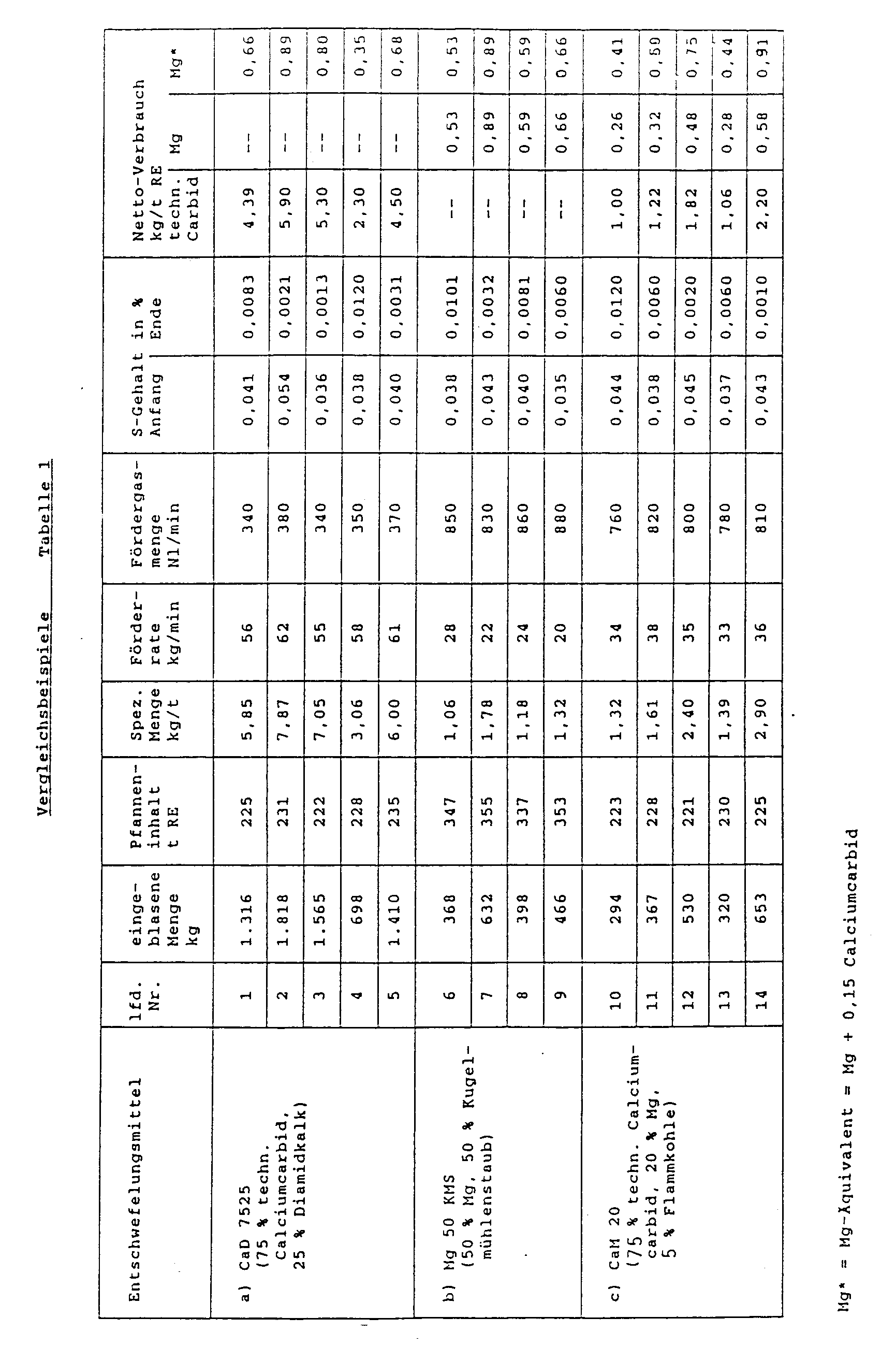
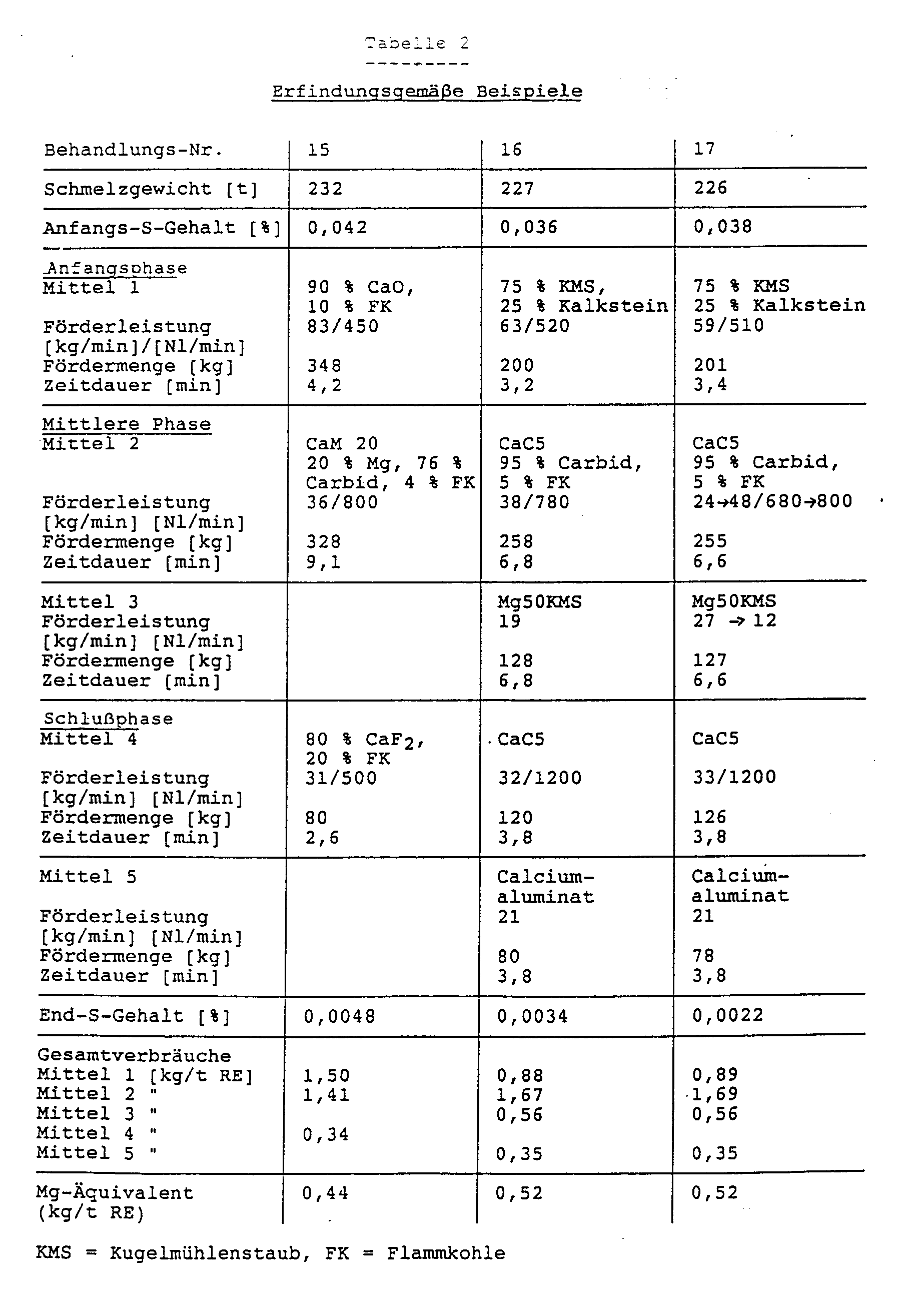
Die Erfindung wird nachfolgend durch Vergleichs- und Ausführungsbeispiele weiter erläutert, die sich auf den Entschwefelungsmittelverbrauch und die Entschwefelungswirkung beziehen, und zwar zeigt Tabelle 1 die Vergleichsbeispiele 1 bis 14, während die Tabellen 2 bis 5 die erfindungsgemäßen Beispiele 15 bis 25 zeigen.The invention is further explained below by means of comparative and exemplary embodiments which relate to the desulfurization agent consumption and the desulfurization effect, namely Table 1 shows Comparative Examples 1 to 14, while Tables 2 to 5 show Examples 15 to 25 according to the invention.
Bei den Behandlungen der Vergleichsbeispiele 1 bis 5 wurde getrocknete Druckluft als Fördergas verwendet. Bei Behandlungen der Vergleichsbeispiele 6 bis 14 war Argon das Fördergas. Trotz der unterschiedlichen Pfanneninhalte sind aufgrund annähernd gleicher Lanzentauchtiefe alle Behandlungen vergleichbar. Die angegebenen Feststoff- und Fördergas-Förderleistungen waren über die Dauer der Behandlung jeweils konstant. Die Roheisentemperaturen lagen bei allen Behandlungen im Bereich 1.300 bis 1.380°C. Zur Vergleichbarkeit der Entschwefelungsmittelverbräuche wurden die Anteile an Calciumcarbid nach Erfahrungswerten hinsichtlich der Entschwefelungswirksamkeit auf Magnesium umgerechnet. Dieses sog. Magnesiumäquivalent ist als spezifischer Verbrauch in der letzten Spalte angegeben.In the treatments of comparative examples 1 to 5, dried compressed air was used as the conveying gas. In the case of treatments of comparative examples 6 to 14, argon was the production gas. Despite the different pan contents, all treatments are comparable due to approximately the same lance depth. The stated solid and conveying gas delivery rates were constant over the duration of the treatment. The hot metal temperatures for all treatments were in the range of 1,300 to 1,380 ° C. To compare the desulfurization agent consumption, the proportions of calcium carbide were converted to magnesium based on experience with regard to the desulfurization efficiency. This so-called magnesium equivalent is specified as specific consumption in the last column.
In sämtlichen Behandlungen der Beispiele 15 bis 25 wurde Argon oder Stickstoff als Fördergas verwendet.
Roheisenmenge 232 t, ca. 1,2 t Pfannenschlacke vor der Behandlung, S-Gehalt vor der Beh.: 0,042 %
- Phase I:
- Einblasen von 1,5 kg/t = 348 kg eines Gemisches aus 90 % Feinkalk und 10 % Flammkohle (Körnung: < 0,1 mm) in 4,2 Minuten mit 450 Nl/min N₂.
- Phase II:
- Einblasen von 328 kg CaM 20 (76 % techn. Calciumcarbid,, 20 % Magnesium, 4 % Flammkohle) entspr. 1,41 kg/t, in 9,1 Minuten entspr. 36 kg/min (konstant). Fördergas: Argon, 800 Nl/min (konstant).
- Phase III:
- Einblasen von 80 kg eines feinkörnigen Gemisches aus 80 % Flußspat und 20 % Flammkohle in 2,6 Minuten mit 500 Nl/min. Die sehr leichte Schlacke mit offenbar geringem Eisengehalt war feinkrümelig und ließ sich gut abziehen. Der S-Gehalt nach der Behandlung betrug 0,0048 % bei einem Mg-Äquivalent von 0,44 kg/t.

- Phase I:
- Blowing in 1.5 kg / t = 348 kg of a mixture of 90% fine lime and 10% flame coal (grain size: <0.1 mm) in 4.2 minutes with 450 Nl / min N₂.
- Phase II:
- Injection of 328 kg CaM 20 (76% technical calcium carbide, 20% magnesium, 4% flame carbon) corresponds to 1.41 kg / t, in 9.1 minutes corresponds to 36 kg / min (constant). Conveying gas: argon, 800 Nl / min (constant).
- Phase III:
- Blowing in 80 kg of a fine-grained mixture of 80% fluorspar and 20% flame coal in 2.6 minutes at 500 Nl / min. The very light slag with apparently low iron content was finely crumbly and was easy to remove. The S content after treatment was 0.0048% with a Mg equivalent of 0.44 kg / t.
Roheisenmenge 227 t, SA = 0,036 %
- Phase I:
- Einblasen von 200 kg eines feinkörnigen Gemisches aus 75 % Kugelmühlenstaub und 25 % Kalksteinmehl in 3,2 Minuten mit 520 Nl/min.
- Phase II:
- Einblasen aus 2 verschiedenen Förderbehältern (Koinjektion) 258 kg CaC5 (95 % techn. Calciumcarbid, 5 % Flammkohle), mit 38 kg/min (konstant) sowie 128 kg Mg 50 KMS (50 % Mg, 50 % Kugelmühlenstaub) mit 19 Kg/min und 780 Nl Argon/min.
- Phase III:
- Der CaC5-Strom wurde beibehalten und sofort nach Abschalten des Mg-50-Stromes wurde aus einem 4. Förderbehälter, der ebenfalls in Reihe geschaltet war, Calciumaluminatstaub (< 0,3 mm, ca. 50 % CaO, 44 % Al₂O₃, Rest MgO + SiO₂) zugeschaltet. Insgesamt wurden 120 kg CaC5 und 80 kg Ca-Aluminat in dieser Phase eingeblasen. Der Argondurchfluß wurde zur Erhöhung der Rührleistung auf (konstant) 1.200 Nl/min erhöht. Die Roheisenprobe nach der Behandlung ergab 0,0034 % S; Mg-Äquivalent = 0,52 kg/t.
- Phase I:
- Blowing in 200 kg of a fine-grained mixture of 75% ball mill dust and 25% limestone powder in 3.2 minutes at 520 Nl / min.
- Phase II:
- Injection from 2 different conveying containers (co-injection) 258 kg CaC5 (95% technical calcium carbide, 5% flame carbon), with 38 kg / min (constant) and 128 kg Mg 50 KMS (50% Mg, 50% ball mill dust) with 19 Kg / min and 780 Nl argon / min.
- Phase III:
- The CaC5 stream was maintained and immediately after switching off the Mg-50 stream was calcium aluminate dust (<0.3 mm, approx. 50% CaO, 44% Al₂O₃, balance MgO) from a 4th delivery container, which was also connected in series + SiO₂) switched on. A total of 120 kg CaC5 and 80 kg Ca aluminate were blown in during this phase. The argon flow was increased to (constant) 1200 Nl / min to increase the stirring power. The pig iron sample after treatment gave 0.0034% S; Mg equivalent = 0.52 kg / t.
Roheisenmenge: 226 t, SA: 0,038 %
Dieser Versuch wurde in der gleichen Art wie Beh. Nr. 16 dürchgeführt, mit nur geringfügigen Abweichungen in Mengen und Zeiten. Im Unterschied jedoch zur Beh.-Nr. 16 wurden während der Phase II die Förderleistungen über die Zeit systematisch linear verändert: CaC5 anfangs 24 kg/min, am Ende 48 kg/min; Mg 50 KMS anfangs 27 kg/min, am Ende 12 kg/min. Die Fördergasmenge wurde entsprechend zwischen 680 und 800 Nl/min variiert.
Bei gleichem Mg-Äquivalent von 0,52 kg/t betrug der Endschwefelgehalt 0,0022 %.Pig iron quantity: 226 t, S A : 0.038%
This attempt was done in the same way as Beh. No. 16 carried out, with only minor deviations in quantities and times. In contrast to the Beh.-Nr. During phase II, the delivery rates were systematically changed linearly over time: CaC5 initially 24 kg / min, in the end 48 kg / min; Mg 50 KMS initially 27 kg / min, in the end 12 kg / min. The amount of feed gas was varied accordingly between 680 and 800 Nl / min.
With the same Mg equivalent of 0.52 kg / t, the final sulfur content was 0.0022%.
Die Daten der weiteren Versuchsbehandlungen (sowie die der bereits beschriebenen) sind in den Tabellen enthalten. Daher werden nachfolgend lediglich Besonderheiten der einzelnen Versuche beschrieben.
Große Anfangsschlackenmenge. Abgeteilt/desoxidiert mit Dolomit und metallischem Aluminiumgranulat. Linear variierte Förderleistungen in Phase II, analog Beh.-Nr. 17.
Die oxidierte Schlacke wurde vor Beginn der Behandlung weitgehend entfernt und durch Einblasen eines Kalk-Flußspat-Gemisches eine basische, desoxidierte Schlacke gebildet. Als Rühr- und Desoxidationsmittel diente Flammkohle.The oxidized slag was largely removed before the start of the treatment and a basic, deoxidized slag was formed by blowing in a lime-fluorspar mixture. Flame coal was used as a stirring and deoxidizing agent.
Es wurden 5 Förderbehälter in Reihe benutzt, wobei in der II. Phase 3 Komponenten variabel eingeblasen wurden, und zwar mit absinkender Mg-Leistung ein höherer Anteil an Carbid und Flammkohle bei gleichbleibender Fördergasmenge. Der Strom der beiden letzteren wurde zum Übergang in Phase III nicht unterbrochen.
Vor der Behandlung wurde die Schlacke weitgehend abgezogen. In der Endphase wurde mit vorgeschmolzenem Calciumaluminat gereinigt, die Rührenergie durch eine hohe Fördergasmenge eingebracht.
In allen 3 Phasen wurde Feinkalk eingeblasen in Koinjektion mit Flammkohle (I. Phase), Magnesium und Flammkohle (II. Phase) und Flußspat und Flammkohle (III. Phase). Die Förderraten wurden konstant gehalten.
Es wurde in allen 3 Phasen ununterbrochen CaC5 eingeblasen.
Die sauere, oxidische Schlacke wurde vorab weitgehend abgezogen und 200 kg Feinkalk, in Säcken verpackt, aufgegeben. Danach wurde die Lanze eingefahren und mit 1800 Nl/min Argon während 2,5 Minuten gerührt. Während der Phasen II und III wurde Feinkalk eingeblasen, zunächst salzbeschichtetes Magnesium zugeschaltet, danach Flußspat, wobei in dieser Phase die Gasmenge erneut zur Intensivierung der Rühreffekte erhöht wurde. Die Mg-Förderleistung wurde linear verringert, die Kalkrate konstant gehalten.
In dieser Behandlung wurde Kugelmühlenstaub zur Desoxidation, als Begleitstoff und zur Schlackenkonditionierung in allen 3 Phasen durchgehend eingeblasen. Es wurde Kalkstein (Phase I) und salzbeschichtetes Magnesium (Phasen II) zugeschaltet. In Phase III wurde mit erhöhtem Gasdurchsatz gearbeitet.
Zur Entschwefelung wurde kein Magnesium sondern CaD 7525 (75 % technisches Calciumcarbid und 25 % Diamidkalk) verwendet. Dieses Entschwefelungsmittel ist nicht so vorteilhaft wie z. B. CaC5 mit Magnesium (in Koinjektion), denn es erfordert lange Behandlungszeiten und es entsteht ein hoher Eisenverlust in der Endschlacke, durch die größere Schlackenmenge und ihren hohen Anteil an Eisengranalien. Ziel war es hauptsächlich, die Eisenverluste zu verringern.
Der günstige Effekt von Flußspat in diesem Sinne ist bekannt, bei Zumischung zum CaD wird jedoch der Entschwefelungseffekt verschlechtert. Dieses trat in diesem Falle nicht ein, wie das Ergebnis zeigt. Die Schlacke war leicht und krümelig und enthielt wenig Eisen.


The beneficial effect of fluorspar in this sense is known, but when added to the CaD, the desulfurization effect deteriorates. In this case, this did not occur, as the result shows. The slag was light and crumbly and contained little iron.
Claims (19)
- A process for the metallurgical treatment of pig iron melts in a container, more particularly a refill ladle, which contain an acid, oxidized initial slag, by the injection of fine-grained solids into the melt with a feed gas via an injection lance, the treatment being performed in three phases, characterized in thata) in the initial phase such solids are injected as deoxidize the initial slag and increase its basicity and also produce a circulatory movement of the melt,b) in the middle phase one or more desulphurization agents are injected for the main desulphurization, andc) in the final phase such solids are injected as purify the melt and produce a final desulphurization and also so influence the desulphurization slag formed that its iron granule content is low.
- A process for the metallurgical treatment of pig iron melts in a container, more particularly a refill ladle, by the injection of fine-grained solids into the melt with a feed gas via an injection lance after the removal of an acid, oxidized initial slag, the treatment being performed in three phases, characterized in thata) in the initial phase such solids are injected as form a basic, deoxidized slag covering the pig iron melt and produce a circulatory movement of the melt,b) in the middle phase one or more desulphurization agents are injected for the main desulphurization, andc) in the final phase such solids are injected as purify the melt and produce a final desulphurization and also so influence the desulphurization slag formed that its iron granule content is low.
- A process according to claims 1 or 2, characterized in thata) in the initial phase deoxidizing and/or lime-containing and/or gas-separating solids are injected,b) in the middle phase of the treatment magnesium-containing solids and/or calcium compounds, possibly with gas-separating solids are injected as desulphurization substances,c) in the final phase calcium components, possibly with gas-separating solids and fluxing agents are injected.
- A process according to claims 1 to 3, characterized in that the fine-grained solids are taken as a mixture and individual solids from separate pressurized feed vessels and injected down to the melt via a common feed line followed by an injection lance.
- A process according to claims 1 to 3, characterized in that each time two or three fine-grained solids are taken as a mixture and individual solids from separate pressurized feed vessels and injected down to the melt via a common feed line followed by an injection lance.
- A process according to claims 1 to 5, characterized in that the quantity of the injected feed gas in dependence on the quantity of the injected solids and the total quantity of stirring gas Vg are so controlled that a dissipated stirring energy EDdiss of at least 100 W/t of pig iron is obtained in the melt in accordance with the relation:
 Vg = sum of the quantity of injected feed gas, of the quantity of gas released by gas separation in the melt and of the quantity of gas due to the evaporation of metallic magnesium from magnesium-containing solidsT₁ = temperature of the melt in °Kg = terrestrial acceleration in m/sec²₁ = density of the melt in kg/m³Hb = height of the melt through which gas bubbles flow, in mPo = pressure of the melt in barGschm = weight of the treated melt in t.
 - A process according to claim 6, characterized in that the dissipated energy density EDdiss is adjusted to values between 200 and 1000 W/t pig iron.
- A process according to claims 1 to 7, characterized in that the dissipated energy density EDdiss is adjusted in the initial phase of the treatment to values between 600 and 1000 W/t pig iron and in the middle and final phases to values between 200 and 700 W/t pig iron.
- A process according to claims 3 to 9, characterized in that the quantity of the injected magnesium-containing solids is reduced as the sulphur content falls and the quantity of the injected calcium compounds and of the gas-separating solids and/or the quantity of the injected conveying gas is increased.
- A process according to claims 3 to 9, characterized in that the lime-containing solids are selected from the group:
lime (CaO), limestone (CaCO₃), dolomite. - A process according to claims 3 to 10, characterized in that the gas-separating solids for the initial phase are selected from the group:
bright-burning coal, gas-flame coal, lignite, limestone, dolomite. - A process according to claims 3 to 10, characterized in that the gas-separating solids for the second and third phases are selected from the group:
bright-burning coal, gas-flame coal, lignite, dyamide lime. - A process according to claims 1 to 12, characterized in that the deoxidizing solids are selected from the group:
aluminium, polyethylene. - A process according to claims 3 to 13, characterized in that the calcium compounds are selected from the group:
free-flowing reactive lime, technical calcium carbide. - A process according to claims 3 to 14, characterized in that the magnesium-containing solids are selected from the group:
metallic magnesium, with or without coatings, on its own or mixed with lime, CaC₂, calcium aluminates, alumina, magnesium oxide. - A process according to claims 3 to 15, characterized in that the fluxing agents are selected from the group:
fluospar, soda (sodium carbonate). - A process according to claims 3 to 16, characterized in that the lime-containing solids are mixed with an aluminium-containing solid.
- A process according to claim 14, characterized in that the technical calcium carbide is mixed with an aluminium-containing solid.
- A process according to claims 17 or 18, characterized in that the aluminium-containing solids are selected from the group:
aluminium, primary aluminium pig.
Applications Claiming Priority (2)
| Application Number | Priority Date | Filing Date | Title |
|---|---|---|---|
| DE4128499 | 1991-08-28 | ||
| DE4128499A DE4128499C2 (en) | 1991-08-28 | 1991-08-28 | Process for the treatment of pig iron melts for their desulfurization |
Publications (2)
| Publication Number | Publication Date |
|---|---|
| EP0530552A1 EP0530552A1 (en) | 1993-03-10 |
| EP0530552B1 true EP0530552B1 (en) | 1995-02-22 |
Family
ID=6439296
Family Applications (1)
| Application Number | Title | Priority Date | Filing Date |
|---|---|---|---|
| EP92113707A Revoked EP0530552B1 (en) | 1991-08-28 | 1992-08-12 | Process for desulfuration treatment of molten pig iron |
Country Status (14)
| Country | Link |
|---|---|
| US (1) | US5366539A (en) |
| EP (1) | EP0530552B1 (en) |
| AT (1) | ATE118825T1 (en) |
| CA (1) | CA2076743A1 (en) |
| CZ (1) | CZ281703B6 (en) |
| DE (2) | DE4128499C2 (en) |
| ES (1) | ES2071393T3 (en) |
| HU (1) | HU216171B (en) |
| PL (1) | PL169938B1 (en) |
| RO (1) | RO115651B1 (en) |
| RU (1) | RU2096484C1 (en) |
| SK (1) | SK281718B6 (en) |
| UA (1) | UA32411C2 (en) |
| ZA (1) | ZA926214B (en) |
Families Citing this family (14)
| Publication number | Priority date | Publication date | Assignee | Title |
|---|---|---|---|---|
| AT406690B (en) * | 1994-12-09 | 2000-07-25 | Donau Chemie Ag | AGENT FOR TREATING RAW IRON AND CAST IRON MELT FOR THE PURPOSE OF DESULFURATION |
| DE19535014C2 (en) * | 1995-09-21 | 1999-03-04 | Stein Ind Anlagen Inh Christel | Process for introducing granular solids into molten metals |
| US5873924A (en) * | 1997-04-07 | 1999-02-23 | Reactive Metals & Alloys Corporation | Desulfurizing mix and method for desulfurizing molten iron |
| DE19833036A1 (en) * | 1998-07-22 | 2000-01-27 | Krupp Polysius Ag | Process for the desulfurization of a pig iron melt |
| DE19833037A1 (en) * | 1998-07-22 | 2000-01-27 | Krupp Polysius Ag | Process for the desulfurization of a pig iron melt |
| AT407644B (en) * | 1999-06-08 | 2001-05-25 | Voest Alpine Ind Anlagen | METHOD FOR SLAG CONDITIONING AND APPARATUS THEREFOR |
| RU2164954C1 (en) * | 1999-10-22 | 2001-04-10 | Магнитогорский государственный технический университет им. Г.И. Носова | Method of slag desulfurization |
| US6372013B1 (en) | 2000-05-12 | 2002-04-16 | Marblehead Lime, Inc. | Carrier material and desulfurization agent for desulfurizing iron |
| US20050257644A1 (en) * | 2000-09-14 | 2005-11-24 | Nkk Corporation | Refining agent and refining method |
| US6808550B2 (en) | 2002-02-15 | 2004-10-26 | Nucor Corporation | Model-based system for determining process parameters for the ladle refinement of steel |
| RU2300441C1 (en) * | 2005-09-26 | 2007-06-10 | Юрий Апполинарьевич Караник | Method for producing cast pieces of blast-furnace cast iron |
| US7731778B2 (en) * | 2006-03-27 | 2010-06-08 | Magnesium Technologies Corporation | Scrap bale for steel making process |
| DE102009030190A1 (en) | 2009-06-24 | 2011-01-13 | Lischka, Helmut, Dr. | Injection-metallurgical process for blowing solid particles in metallic melt using conveying gas, comprises superimposing pneumatic particle-loaded gas conveying stream with an impulse frequency |
| EP2275580A1 (en) | 2009-07-06 | 2011-01-19 | SKW Stahl-Metallurgie GmbH | Method and agent for treating raw iron desulphurisation slags |
Family Cites Families (6)
| Publication number | Priority date | Publication date | Assignee | Title |
|---|---|---|---|---|
| US3955966A (en) * | 1974-03-06 | 1976-05-11 | August Thyssen-Hutte Ag | Method for dispensing a fluidizable solid from a pressure vessel |
| EP0070912B1 (en) * | 1981-07-27 | 1985-01-30 | Thyssen Aktiengesellschaft vorm. August Thyssen-Hütte | Process for lowering the iron content of slags rich in cao formed in the course of the desulphurisation of pig iron |
| FR2514368B1 (en) * | 1981-10-12 | 1987-07-31 | Siderurgie Fse Inst Rech | PROCESS FOR DESULFURIZING THE CAST IRON WITH MAGNESIUM |
| BR8606249A (en) * | 1985-12-17 | 1987-09-29 | Sueddeutsche Kalkstickstoff | FINALLY GRANULATED COMPOSITION FOR THE DESULFURATION OF CAST IRON AND PROCESS FOR ITS PREPARATION |
| CA1295485C (en) * | 1988-06-06 | 1992-02-11 | Lorne E. Murphy | Desulfurizing iron |
| DE3942405A1 (en) * | 1989-12-21 | 1991-06-27 | Krupp Polysius Ag | METHOD AND CONVEYOR FOR BLOWING IN POWDER-SHAPED TREATMENT AGAINST RAW IRON AND STEEL MELTS |
-
1991
- 1991-08-28 UA UA93003112A patent/UA32411C2/en unknown
- 1991-08-28 DE DE4128499A patent/DE4128499C2/en not_active Expired - Fee Related
-
1992
- 1992-08-12 EP EP92113707A patent/EP0530552B1/en not_active Revoked
- 1992-08-12 DE DE59201454T patent/DE59201454D1/en not_active Revoked
- 1992-08-12 ES ES92113707T patent/ES2071393T3/en not_active Expired - Lifetime
- 1992-08-12 AT AT92113707T patent/ATE118825T1/en not_active IP Right Cessation
- 1992-08-18 US US07/931,716 patent/US5366539A/en not_active Expired - Fee Related
- 1992-08-18 ZA ZA926214A patent/ZA926214B/en unknown
- 1992-08-21 PL PL92295696A patent/PL169938B1/en unknown
- 1992-08-24 CA CA002076743A patent/CA2076743A1/en not_active Abandoned
- 1992-08-26 CZ CS922638A patent/CZ281703B6/en not_active IP Right Cessation
- 1992-08-26 SK SK2638-92A patent/SK281718B6/en unknown
- 1992-08-27 RU SU925052484A patent/RU2096484C1/en active
- 1992-08-27 HU HUP9202762A patent/HU216171B/en not_active IP Right Cessation
- 1992-08-28 RO RO92-01141A patent/RO115651B1/en unknown
Also Published As
| Publication number | Publication date |
|---|---|
| UA32411C2 (en) | 2000-12-15 |
| CA2076743A1 (en) | 1993-03-01 |
| PL295696A1 (en) | 1993-04-05 |
| DE59201454D1 (en) | 1995-03-30 |
| RU2096484C1 (en) | 1997-11-20 |
| HUT65147A (en) | 1994-04-28 |
| CZ281703B6 (en) | 1996-12-11 |
| SK281718B6 (en) | 2001-07-10 |
| ZA926214B (en) | 1993-03-01 |
| RO115651B1 (en) | 2000-04-28 |
| DE4128499A1 (en) | 1993-03-04 |
| US5366539A (en) | 1994-11-22 |
| SK263892A3 (en) | 1996-05-08 |
| ATE118825T1 (en) | 1995-03-15 |
| HU216171B (en) | 1999-04-28 |
| CZ263892A3 (en) | 1993-03-17 |
| EP0530552A1 (en) | 1993-03-10 |
| HU9202762D0 (en) | 1992-12-28 |
| DE4128499C2 (en) | 1994-11-24 |
| PL169938B1 (en) | 1996-09-30 |
| ES2071393T3 (en) | 1995-06-16 |
Similar Documents
| Publication | Publication Date | Title |
|---|---|---|
| DE4128499C2 (en) | Process for the treatment of pig iron melts for their desulfurization | |
| EP0602540B1 (en) | Agent for desulphurization, dephosphorization, desiliconization and denitrification of molten pig or cast iron and of molten ferrochrome or ferromanganese as well as a process | |
| EP0164592B2 (en) | Fine-grained desulfurization agent forron melts, and process for the desulfurization of molten pig iron | |
| EP0166019B1 (en) | Method for desulfurizing pig iron | |
| DE2708522C2 (en) | Treatment of iron melts with alkaline earth, carbidic and metallic agents by blowing in with a carrier gas | |
| DE3118288C2 (en) | ||
| DE3120138C3 (en) | Powdered desulfurization agent | |
| EP0220522B1 (en) | Mixture for desulfurizing metal melts, process for manufacturing it and its use | |
| DE3836549C1 (en) | Process for desulphurising molten crude iron | |
| EP0175924B1 (en) | Process for refining pig iron | |
| EP0582970B1 (en) | Additive for desulfurization of liquid pig and cast iron and process for desulfurizing | |
| US4988387A (en) | Agent and process for desulfurizing molten metals | |
| DE2558263C3 (en) | Process for the treatment of liquid pig iron with magnesium | |
| EP0974673B1 (en) | Method for the desulfurization of molten pig iron | |
| EP0013550A1 (en) | Process and apparatus for the desulphurisation of molten ferrous metals | |
| DE3000927C2 (en) | Desulfurization of ferrous metals | |
| AT337238B (en) | PROCESS FOR DESULFURIZATION OF STEEL MELT | |
| DE1433598A1 (en) | Method and device for adding agents for forming or treating the slag of iron baths | |
| DE3644518A1 (en) | USE OF MAGNESITE AND METHOD FOR CARRYING OUT SUCH A USE | |
| EP0974674B1 (en) | Method for desulferization of molten pig iron | |
| AT255461B (en) | Process and fresh vessels for converting pig iron into steel | |
| DE2708403C2 (en) | Fine-grained desulfurization mixtures for iron melts based on alkaline earth carbonates, as well as processes for the desulfurization of iron melts using these desulfurization mixtures | |
| DE965040C (en) | Process for the rapid simultaneous separation of sulfur and silicon from molten pig iron | |
| DEU0002966MA (en) | ||
| DD233809A5 (en) | POWDER-FORMAL CALCIUM-ALUMINATE AGENT AND METHOD FOR THE PRODUCTION THEREOF |
Legal Events
| Date | Code | Title | Description |
|---|---|---|---|
| PUAI | Public reference made under article 153(3) epc to a published international application that has entered the european phase |
Free format text: ORIGINAL CODE: 0009012 |
|
| AK | Designated contracting states |
Kind code of ref document: A1 Designated state(s): AT BE DE ES FR GB IT LU NL SE |
|
| 17P | Request for examination filed |
Effective date: 19930320 |
|
| 17Q | First examination report despatched |
Effective date: 19930421 |
|
| 17Q | First examination report despatched |
Effective date: 19940527 |
|
| GRAA | (expected) grant |
Free format text: ORIGINAL CODE: 0009210 |
|
| AK | Designated contracting states |
Kind code of ref document: B1 Designated state(s): AT BE DE ES FR GB IT LU NL SE |
|
| REF | Corresponds to: |
Ref document number: 118825 Country of ref document: AT Date of ref document: 19950315 Kind code of ref document: T |
|
| GBT | Gb: translation of ep patent filed (gb section 77(6)(a)/1977) |
Effective date: 19950224 |
|
| REF | Corresponds to: |
Ref document number: 59201454 Country of ref document: DE Date of ref document: 19950330 |
|
| ITF | It: translation for a ep patent filed | ||
| ET | Fr: translation filed | ||
| REG | Reference to a national code |
Ref country code: ES Ref legal event code: FG2A Ref document number: 2071393 Country of ref document: ES Kind code of ref document: T3 |
|
| PLBI | Opposition filed |
Free format text: ORIGINAL CODE: 0009260 |
|
| PLBF | Reply of patent proprietor to notice(s) of opposition |
Free format text: ORIGINAL CODE: EPIDOS OBSO |
|
| 26 | Opposition filed |
Opponent name: SSAB TUNNPLAT AB Effective date: 19951120 |
|
| NLR1 | Nl: opposition has been filed with the epo |
Opponent name: SSAB TUNNPLAT AB |
|
| PLBF | Reply of patent proprietor to notice(s) of opposition |
Free format text: ORIGINAL CODE: EPIDOS OBSO |
|
| PLBF | Reply of patent proprietor to notice(s) of opposition |
Free format text: ORIGINAL CODE: EPIDOS OBSO |
|
| RDAH | Patent revoked |
Free format text: ORIGINAL CODE: EPIDOS REVO |
|
| APAC | Appeal dossier modified |
Free format text: ORIGINAL CODE: EPIDOS NOAPO |
|
| APAE | Appeal reference modified |
Free format text: ORIGINAL CODE: EPIDOS REFNO |
|
| APAC | Appeal dossier modified |
Free format text: ORIGINAL CODE: EPIDOS NOAPO |
|
| PGFP | Annual fee paid to national office [announced via postgrant information from national office to epo] |
Ref country code: LU Payment date: 20000725 Year of fee payment: 9 |
|
| PGFP | Annual fee paid to national office [announced via postgrant information from national office to epo] |
Ref country code: SE Payment date: 20000726 Year of fee payment: 9 |
|
| PGFP | Annual fee paid to national office [announced via postgrant information from national office to epo] |
Ref country code: FR Payment date: 20000728 Year of fee payment: 9 |
|
| PGFP | Annual fee paid to national office [announced via postgrant information from national office to epo] |
Ref country code: NL Payment date: 20000731 Year of fee payment: 9 |
|
| PGFP | Annual fee paid to national office [announced via postgrant information from national office to epo] |
Ref country code: GB Payment date: 20000801 Year of fee payment: 9 |
|
| PGFP | Annual fee paid to national office [announced via postgrant information from national office to epo] |
Ref country code: AT Payment date: 20000803 Year of fee payment: 9 |
|
| PGFP | Annual fee paid to national office [announced via postgrant information from national office to epo] |
Ref country code: ES Payment date: 20000809 Year of fee payment: 9 |
|
| PGFP | Annual fee paid to national office [announced via postgrant information from national office to epo] |
Ref country code: BE Payment date: 20000831 Year of fee payment: 9 |
|
| PGFP | Annual fee paid to national office [announced via postgrant information from national office to epo] |
Ref country code: DE Payment date: 20000927 Year of fee payment: 9 |
|
| APAC | Appeal dossier modified |
Free format text: ORIGINAL CODE: EPIDOS NOAPO |
|
| RDAG | Patent revoked |
Free format text: ORIGINAL CODE: 0009271 |
|
| 27W | Patent revoked |
Effective date: 20010123 |
|
| NLR2 | Nl: decision of opposition | ||
| APAH | Appeal reference modified |
Free format text: ORIGINAL CODE: EPIDOSCREFNO |