EP0524145B1 - Multifunktionelle Schmierstoff-Additive - Google Patents
Multifunktionelle Schmierstoff-Additive Download PDFInfo
- Publication number
- EP0524145B1 EP0524145B1 EP92810524A EP92810524A EP0524145B1 EP 0524145 B1 EP0524145 B1 EP 0524145B1 EP 92810524 A EP92810524 A EP 92810524A EP 92810524 A EP92810524 A EP 92810524A EP 0524145 B1 EP0524145 B1 EP 0524145B1
- Authority
- EP
- European Patent Office
- Prior art keywords
- alkyl
- tert
- butyl
- composition according
- compounds
- Prior art date
- Legal status (The legal status is an assumption and is not a legal conclusion. Google has not performed a legal analysis and makes no representation as to the accuracy of the status listed.)
- Expired - Lifetime
Links
- 0 C*O*(O**)=N Chemical compound C*O*(O**)=N 0.000 description 1
Classifications
-
- C—CHEMISTRY; METALLURGY
- C10—PETROLEUM, GAS OR COKE INDUSTRIES; TECHNICAL GASES CONTAINING CARBON MONOXIDE; FUELS; LUBRICANTS; PEAT
- C10M—LUBRICATING COMPOSITIONS; USE OF CHEMICAL SUBSTANCES EITHER ALONE OR AS LUBRICATING INGREDIENTS IN A LUBRICATING COMPOSITION
- C10M137/00—Lubricating compositions characterised by the additive being an organic non-macromolecular compound containing phosphorus
- C10M137/02—Lubricating compositions characterised by the additive being an organic non-macromolecular compound containing phosphorus having no phosphorus-to-carbon bond
- C10M137/04—Phosphate esters
- C10M137/10—Thio derivatives
- C10M137/105—Thio derivatives not containing metal
-
- C—CHEMISTRY; METALLURGY
- C07—ORGANIC CHEMISTRY
- C07F—ACYCLIC, CARBOCYCLIC OR HETEROCYCLIC COMPOUNDS CONTAINING ELEMENTS OTHER THAN CARBON, HYDROGEN, HALOGEN, OXYGEN, NITROGEN, SULFUR, SELENIUM OR TELLURIUM
- C07F9/00—Compounds containing elements of Groups 5 or 15 of the Periodic Table
- C07F9/02—Phosphorus compounds
- C07F9/06—Phosphorus compounds without P—C bonds
- C07F9/16—Esters of thiophosphoric acids or thiophosphorous acids
- C07F9/165—Esters of thiophosphoric acids
- C07F9/1651—Esters of thiophosphoric acids with hydroxyalkyl compounds with further substituents on alkyl
-
- C—CHEMISTRY; METALLURGY
- C10—PETROLEUM, GAS OR COKE INDUSTRIES; TECHNICAL GASES CONTAINING CARBON MONOXIDE; FUELS; LUBRICANTS; PEAT
- C10M—LUBRICATING COMPOSITIONS; USE OF CHEMICAL SUBSTANCES EITHER ALONE OR AS LUBRICATING INGREDIENTS IN A LUBRICATING COMPOSITION
- C10M2223/00—Organic non-macromolecular compounds containing phosphorus as ingredients in lubricant compositions
- C10M2223/02—Organic non-macromolecular compounds containing phosphorus as ingredients in lubricant compositions having no phosphorus-to-carbon bonds
- C10M2223/04—Phosphate esters
- C10M2223/047—Thioderivatives not containing metallic elements
-
- C—CHEMISTRY; METALLURGY
- C10—PETROLEUM, GAS OR COKE INDUSTRIES; TECHNICAL GASES CONTAINING CARBON MONOXIDE; FUELS; LUBRICANTS; PEAT
- C10N—INDEXING SCHEME ASSOCIATED WITH SUBCLASS C10M RELATING TO LUBRICATING COMPOSITIONS
- C10N2040/00—Specified use or application for which the lubricating composition is intended
- C10N2040/08—Hydraulic fluids, e.g. brake-fluids
-
- C—CHEMISTRY; METALLURGY
- C10—PETROLEUM, GAS OR COKE INDUSTRIES; TECHNICAL GASES CONTAINING CARBON MONOXIDE; FUELS; LUBRICANTS; PEAT
- C10N—INDEXING SCHEME ASSOCIATED WITH SUBCLASS C10M RELATING TO LUBRICATING COMPOSITIONS
- C10N2040/00—Specified use or application for which the lubricating composition is intended
- C10N2040/20—Metal working
Definitions
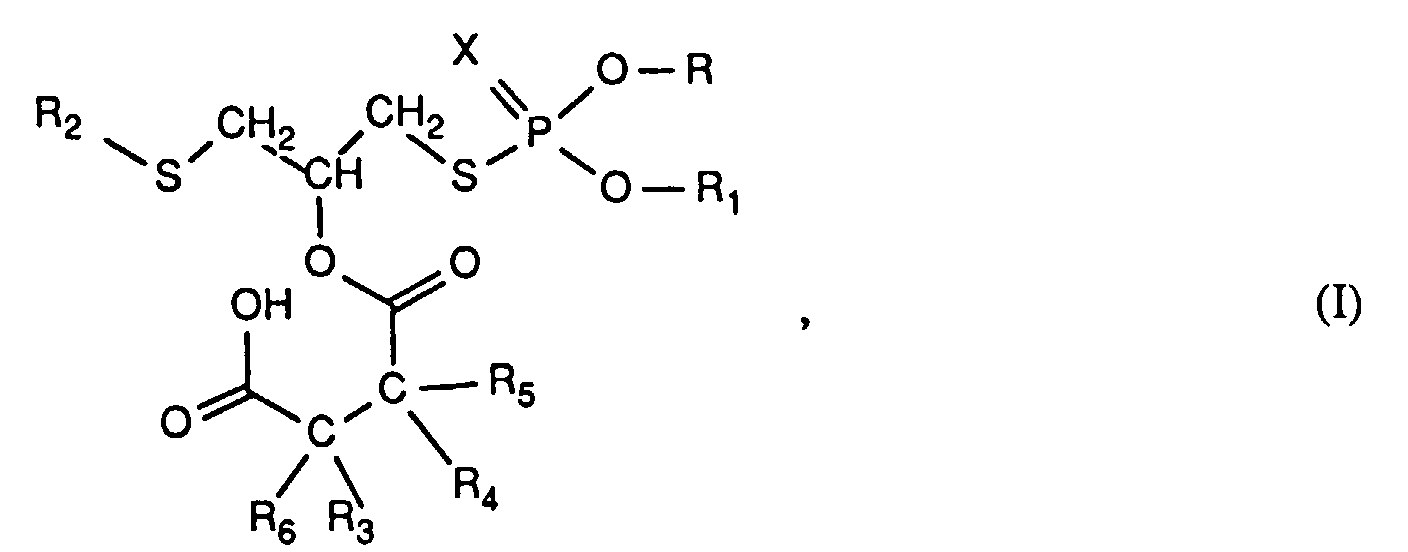
- the invention relates to new reaction products of S- (2-hydroxy-3-S-alkyl) propyl-O, O-dialkyl esters of mono- or dithiophosphoric acid with cyclic Anhydrides, their use as multipurpose additives, in particular as corrosion protection, High pressure and wear protection additives and antioxidants, in lubricants, Hydraulic or metal working fluids, as well as compositions that contain at least one of these compounds.
- Typical applications include lubricants, hydraulic and metalworking fluids in constant contact with the surface of metallic materials Exposed to temperatures and the influence of atmospheric oxygen and moisture. Longer Use therefore leads to oxidative degradation, which is catalytic due to contact with metal can be accelerated. In many cases this leads to an increase in acidity and Viscosity of the liquid so that corrosion of the material surface is promoted and the general performance characteristics are deteriorated.
- additives to the oils used in lubrication systems. From are of great importance e.g. Additives that reduce the oxidative degradation of lubricants prevent those that protect moving metal parts from wear, additives that over High pressure protection have or the as a corrosion or rust preventive Act. However, the different types of additives interfere in many cases mutual in their effect; for example, many corrosion inhibitors the effect of the High pressure additives.
- This antagonism can be overcome by using a multifunctional additive.
- Some classes of compounds have been described which are capable of achieving several of the desired effects; for example EP-A 398 843 describes triazine compounds which show both corrosion and wear-inhibiting activity; US Pat. No.
- the invention relates to new compounds that several of the above Have properties that make them particularly suitable multi-purpose additives.
- the compounds In addition to acting as a wear and corrosion protection agent, the compounds also have an effect and antioxidant properties also have properties that make them additives in high pressure protection make usable.
- the integration of wear protection, corrosion protection and high pressure protection in an additive is particularly surprising.
- the numerical range specified for the symbol C in the index refers to the number of possible carbon atoms.
- R, R 1 , R 2 , R 3 , R 4 , R 5 and R 6 are alkyl in the above formulas, these are branched or unbranched radicals. Within the definition given above as alkyl, they mean, for example, methyl, ethyl, propyl, isopropyl, n-butyl, sec-butyl, isobutyl, t-butyl, 2-ethylbutyl, n-pentyl, isopentyl, 1-methylpentyl, 1,3- Dimethylbutyl, n-hexyl, 1-methylhexyl, n-heptyl, isoheptyl, 1,1,3,3-tetramethylbutyl, 1-methylheptyl, 3-methylheptyl, n-octyl, 2-ethylhexyl, 1,1,3-trimethylhexyl, 1,1,3,3-tetramethylpentyl, nonyl, decyl
- R 3 , R 4 , R 5 and R 6 with the meaning C 3 -C 20 alkenyl can likewise be branched and unbranched radicals.
- This meaning includes propenyl, isopropenyl, 2-butenyl, 3-butenyl, isobutenyl, n-penta-2,4-dienyl, 3-methyl-but-2-enyl, n-oct-2-enyl, n-dec 2-enyl, n-dodec-2-enyl, iso-dodecenyl, n-octadec-2-enyl, n-octadec-4-enyl.
- R 3 , R 4 , R 5 and R 6 as phenyl substituted with C 1 -C 12 alkyl includes, for example, methylphenyl, dimethylphenyl, trimethylphenyl, ethylphenyl, diethylphenyl, isopropylphenyl, tert-butylphenyl, di-tert-butylphenyl, Methyl di-t-butylphenyl, 1,1,3,3-tetramethylbutylphenyl and 1,1,3,3,5,5-hexamethylhexylphenyl.
- the number of alkyl groups in the alkylphenyl radical is in particular 1-3, for example 1 or 2, especially 1.
- R and R 1 independently of one another are C 3 -C 18 alkyl, in particular C 3 -C 12 alkyl, for example propyl, isopropyl, 2-methylpropyl, sec-butyl, n-butyl, are preferred , n-pentyl, 2-methylbutyl, 3-methylbutyl, n-hexyl, 2-ethylhexyl, n-octyl, isooctyl, n-dodecyl; of particular interest are those compounds in which R and R 1 are the same and are isopropyl or 2-methylpropyl.
- R 2 preferably has the meaning C 4 -C 12 alkyl, particularly branched C 4 -C 12 alkyl, for example tertiary butyl, neopentyl, 1-methylheptyl, 1,1,3,3-tetramethylpentyl, tertiary nonyl, 1,1 , 3,3,5,5-hexamethylhexyl, tertiary dodecyl, especially tertiary nonyl and tertiary dodecyl.
- Tertiary nonyl (abbreviated t-nonyl) is understood to mean the mixture of isomers containing 1,1,3,3-tetramethylpentyl as defined for the tertiary nonyl mercaptan (Chemical Abstracts Reg. No. 25360-10-5). Accordingly, tertiary dodecyl (abbreviated t-dodecyl) is to be understood as the mixture of isomers containing 1,1,3,3,5,5-hexamethylhexyl as it is for tertiary dodecyl mercaptan (Chemical Abstracts Reg. No. 25103-58-6) is defined.
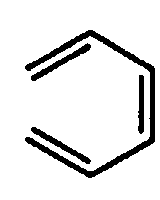
- R 3 or R 4 is H, C 1 -C 20 alkyl or C 3 -C 20 alkenyl which is other hydrogen, or R 3 and R 4 together are trimethylene, tetramethylene, mean and R 5 and R 6 are hydrogen or a direct bond, or R 3 , R 4 , R 5 and R 6 together mean.
- R 5 and R 6 preferably have the meaning of hydrogen or a direct bond, especially that of hydrogen.
- X preferably has the meaning of a sulfur atom.
- R and R 1 are each the same and isopropyl, 2-methylpropyl, n-butyl, n-pentyl, 2-methylbutyl, 3-methylbutyl or 2-ethylhexyl
- R 2 is tertiary -Nonyl or -dodecyl means one of the substituents R 3 or R 4 oct-2-enyl, C 12 alkenyl or octadecyl, the other being hydrogen and R 5 and R 6 are hydrogen.
- R and R 1 are each the same and is isopropyl or 2-methylpropyl
- R 2 is tertiary nonyl
- one of the substituents R 3 or R 4 C 12 alkenyl the other is hydrogen and R 5 and R 6 are hydrogen.
- Preferred compounds of the formula (I) are furthermore those in which X is sulfur means.
- Salts of compounds of formula (I) also form an object of this invention. These are understood to mean those compounds in which the proton of the free carboxyl group in formula (I) is equivalent to a metal cation, for example an alkali metal or alkaline earth metal or one of the metals zinc or copper, or by ammonium or one to three times C. 1 -C 18 alkyl substituted ammonium is replaced. Mixed salts are also possible.
- the alkyl substituents of ammonium are preferably at least one C 2 -C 18 alkyl radical and possibly further, identical or different C 1 -C 18 alkyl radicals.
- substituents for ammonium are C 2 -C 18 alkyl, especially C 8 -C 18 alkyl and of these in particular C 8 alkyl, C 13 alkyl and C 18 alkyl.
- Preferred among the metal salts of the compounds of formula (I) are lithium, sodium, potassium, magnesium, calcium and copper (II) salts, particularly preferred are lithium, magnesium and copper (II) salts.
- the alkali metal and the mono- or di-C 8 -C 18 alkyl-substituted ammonium salts are of particular practical interest.
- Preferred forms of component b) are the same as above described.
- Hydraulic and metal working fluids can become more or less easy under the influence of heat, electromagnetic radiation, mechanical stress (especially due to shear forces) and oxidizing substances (especially atmospheric oxygen) decompose. Decomposition products created in this way contribute as well as existing water Corrosion of the metal surfaces in contact with it.
- the compounds of the formula (I) which are used in the Compositions according to the invention expediently from 0.01 to 10, for example to 0.01 to 5, preferably 0.03 to 3, in particular 0.2 to 0.7 (when combined with other wear protection additives at 0.03 to 0.25) percent by weight. It can be one or more of these compounds.
- the percentages refer to the total weight of these connections, The basis for the calculation is the total weight of component a) and any further components without component b) (compounds of the formula (I)).
- the invention further relates to the use of compounds of the formula (I) as Multi-purpose additives, especially in lubricants, metalworking and Hydraulic fluids. Such use also means a method for Improving the performance properties of lubricants, metalworking and Hydraulic fluids.
- the use according to the invention also includes the protection of the metal parts to be lubricated before mechanical wear (wear protection).
- the lubricants, metalworking and hydraulic fluids in question are based, for example, on mineral or synthetic oils or mixtures from that.
- the lubricants are familiar to the person skilled in the art and in the relevant area Specialist literature, such as in Dieter Klamann, "Lubricants and related Products “(Verlag Chemie, Weinheim 1982), in Schewe-Kobek,” The Lubricant Paperback “ (Dr. Alfred Wilsonhig-Verlag, Heidelberg 1974) and in "Ullmanns Encyclopedia of Technical Chemistry ", Vol. 13, pages 85-94 (Verlag Chemie, Weinheim 1977).
- the lubricants are in particular oils and greases, for example based on a Mineral oil. Oils are preferred.
- Vegetable or animal oils, fats, tallow and waxes are, for example, palm kernel oil, Palm oil, olive oil, rape oil, rapeseed oil, linseed oil, peanut oil, soybean oil, cotton oil.
- the mineral oils are based in particular on hydrocarbon compounds.
- Examples of synthetic lubricants include lubricants based on the aliphatic or aromatic carboxy esters, the polymeric esters, the Polyalkylene oxides, phosphoric acid esters, poly- ⁇ -olefins or silicones, one Diesters of a dihydric acid with a monohydric alcohol, e.g. Dioctyl sebacate or dinonyl adipate, a triester of trimethylolpropane tricaprylate or Mixtures thereof, a tetraester of pentaerythritol with a monovalent acid or a mixture of such acids, e.g.
- Pentaerythritol tetracaprylate or a complex Esters of monohydric and dihydric acids with polyhydric alcohols, e.g. a complex ester of trimethylolpropane with caprylic and sebacic acid, or from one Mixture of them.
- polyhydric alcohols e.g. a complex ester of trimethylolpropane with caprylic and sebacic acid, or from one Mixture of them.
- mineral oils e.g. Poly- ⁇ -olefins, Ester-based lubricants, phosphates, glycols, polyglycols and polyalkylene glycols, and their mixtures with water.
- Metalworking fluids and hydraulic fluids can be based on the same substances are produced as described above for the lubricants. Often these are also emulsions of such substances in water or other liquids.
- Lubricant compositions according to the invention are used e.g. in Internal combustion engines, i.a. in motor vehicles.
- the compounds of formula (I) are good in lubricants, metalworking and Hydraulic fluids are soluble and are therefore special as additives to these substances suitable. It is particularly due to its surprisingly good wear and tear point out corrosion-inhibiting effect.
- the invention therefore also relates to a method for improving the performance properties of lubricants, metalworking and hydraulic fluids, thereby characterized in that one or more compounds of the formula (I) are added will.
- compositions of the invention may include several other additives such as e.g. Corrosion protection agents, rust inhibitors, metal deactivators, viscosity index improvers, Dispersants, antioxidants, pour point depressants, high pressure or Wear protection additives included to further increase their basic properties improve. Examples of such coadditives are listed below.
- metal deactivators e.g. for copper
- metal deactivators e.g. for copper
- rust inhibitors are:
- viscosity index improvers examples are:
- Polyacrylates polymethacrylates, vinyl pyrrolidone / methacrylate copolymers, polyvinyl pyrrolidones, Polybutenes, olefin copolymers, styrene / acrylate copolymers, polyethers.
- pour point depressants examples are:
- dispersants / surfactants examples are:
- wear protection additives are:
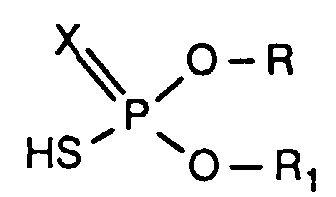
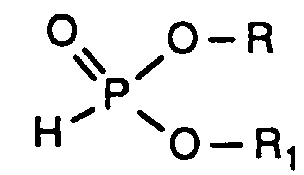
- the compounds of the formula (I) can be prepared by methods known per se, for example by reacting compounds of the formula (II) with corresponding cyclic anhydrides of the formula (III) produce.
- Some of the compounds of the formula (III) are commercially available and can be synthesized using known methods, described, for example, in: Encyclopedia of Polymer Science and Technology, Vol.1, pp. 117 u. 118, Interscience Publishers / Wiley, New York 1964.
- X, R, R 1 , R 2 , R 3 , R 4 , R 5 and R 6 each have the meaning given above.
- the compounds of the formula (II) known from EP-A 166 696 can be reacted with a corresponding diester of thiophosphoric acid with the desired 2,3-epoxypropyl thioether be preserved.
- the O, O-diesters of dithiophosphoric acid can be prepared by reacting corresponding alcohols with P 2 S 5 .
- Suitable solvents are e.g. Toluene or Dibutyl ether or mixtures of both.
- the reaction can take place in the presence of a Catalyst are carried out, which is presented with the starting compound or after about is added to half the reaction time.
- Suitable catalysts are e.g. 4-toluenesulfonic acid, methanesulfonic acid or 4-dimethylamino-pyridine. The mixture is useful at a constant temperature throughout the reaction held.
- the reaction temperature can e.g. 20 to 150 ° C, in general it is 50 to 120 ° C, preferably 50 to 80 ° C.
- the duration of the reaction can be 1 to 24 Hours, generally between 5 and 16 hours.
- the workup can be done by commonly used methods, e.g. by washing the organic phase, drying and removal of the solvent.
- the mixture of isomers obtained as a rule (except when using symmetrical anhydrides) (R 4 , R 5 not equal to R 3 , R 6 ) can, if desired, be separated using customary physico-chemical processes. In practice, a separation is not necessary.
- the mixtures of isomers can be added to the lubricants, metal working and hydraulic fluids as such.
- a stoichiometric amount of the corresponding amine is advantageously added to a solution of the desired compound and, after thorough mixing, the or. the solvents by applying negative pressure.
- Toluene for example, is suitable as a solvent.
- Metal salts of compounds of formula (I) can be obtained by reaction with corresponding metal hydroxides.
- the corresponding compound with a free acid function is advantageously placed in a solvent, the hydroxide is added and the water is then dragged out with the solvent by heating the reaction mixture under nitrogen.
- the copper salt is preferably prepared from Cu (II) acetylacetonate, which is added to the solution of the compound of the formula (I). After mixing, the released acetylacetone and the solvent used are removed in the same way as in the preparation of the ammonium salts.
- a suitable solvent is toluene.
- Iso-dodecenylsuccinic anhydride means the technical mixture of isomers with various C 12 H 23 isomers as substituents of succinic anhydride, described under CARN 25377-73-5 as 2,5-furandiones, dihydro-3- (tetrapropenyl).
- Di-iso-tridecylamine is a technical product (as defined under CARN 101012-97-9) with two C 13 H 27 alkyl substituents on the nitrogen atom.
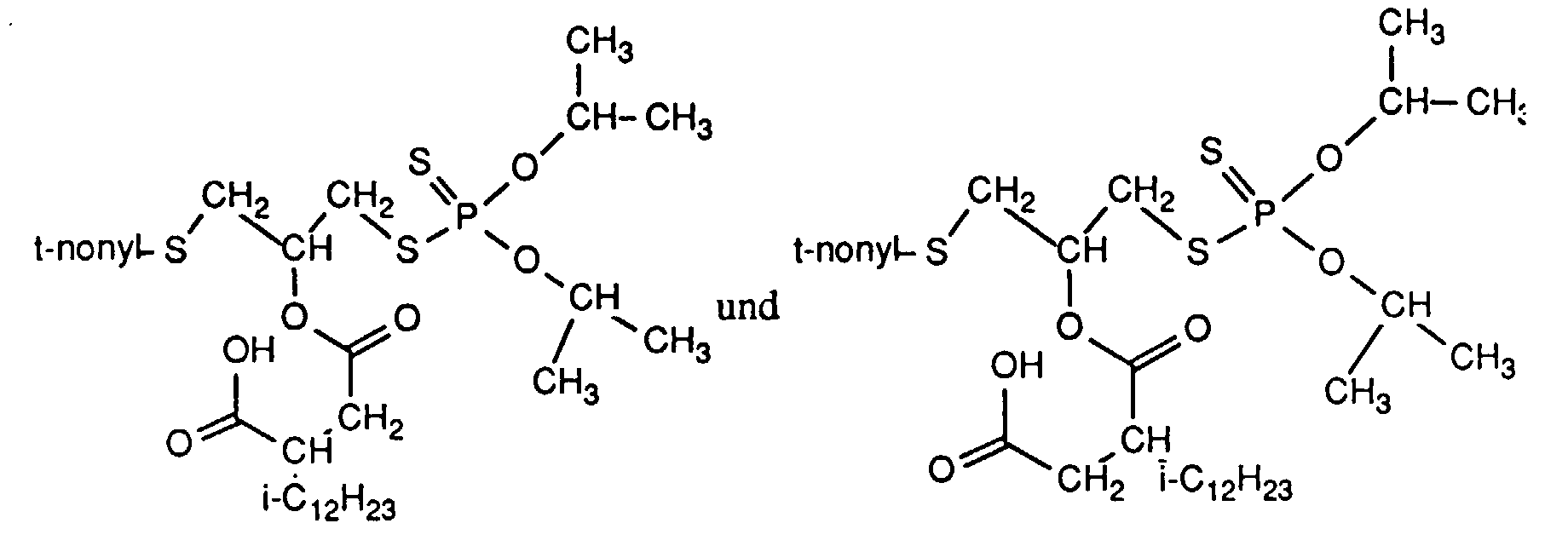
- Example 1 The same compounds as in Example 1 can also be obtained by the following synthesis variant: 88.6 g of tert-nonyl- (2,3-epoxypropyl) thioether are added dropwise to 88.0 g of O, O'-diisopropyldithiophosphoric acid in 100 ml of toluene over the course of about 30 minutes, during which the reaction mixture heats up. The reaction temperature is then kept at 70 ° C. for 3 h, cooled, 12 ml of a 5% hydrogen peroxide solution are added, the mixture is heated to 50 ° C.
- the aqueous phase is separated off, in succession with 30 ml of saturated sodium hydrogen carbonate solution and twice with 50 ml of water each washed, dried with sodium sulfate and the solvent removed by applying reduced pressure.
- 160 g of this product are then placed in 100 ml of toluene and 10 ml of dibutyl ether and mixed with 0.2 g of 4-toluenesulfonic acid.
- 104 g of isododecenyl succinic anhydride are then added dropwise. The mixture is kept at 70 ° C.
- a light gray waxy mass 118.6 g of this product are dissolved in 400 ml of toluene and washed successively with 100 ml of 5N hydrochloric acid and three times 100 ml of water.
- the organic phase is concentrated in vacuo, and 110.1 g of a light yellow liquid remain: 25.96 g of 2,3-epoxypropyl-tert-nonylthioether are added dropwise under nitrogen to a solution of 40.62 g of the O, O-di-n-octyl-monothiophosphoric acid obtained in 200 ml of toluene.
- the addition is complete, the mixture is heated to 60 ° C.
- the intermediate product is prepared from 28.0 g of O, O-didodecyldithiophosphoric acid and 13.0 g of tert-nonyl- (2,3-epoxypropyl) thioether in 50 ml of dibutyl ether. Then a total of 16.9 g of phenyl succinic anhydride and 3.4 g of triethylamine are added. heated to about 100 ° C. until the anhydride melted and stirred at about 25 ° C. for 48 h after the addition of 20 ml of tetrahydrofuran.
- Example 26 Diisotridecylammonium salt of the compound from Example 1
- Example 27 Lithium salt of the compound from Example 3
- Table 3 shows the results of 1% solutions of the respective compounds according to the invention in the base oil described above.
- Example No. Compound from example no. Wear protection (VKA) Corrosiveness ASTM D 130 WL / kg WSD / mm 28 1 160 0.35 2A 29 3rd 160 0.39 1B 30th 4th 160 0.37 1B 31 5 160 0.39 1B 32 6 140 0.38 2A 33 14 150 0.32 2A 34 20th 140 0.28 1B 35 15 150 0.30 1B 36 17th 140 0.34 1B 37 18th 150 0.29 1B 38 19th 150 0.31 1B 39 13 160 0.35 1B 40 21 140 0.40 1B 41 22 140 0.37 1B 42 23 150 0.35 1B 43 24th 140 0.38 1B 44 25th 140 0.40 1B without active ingredient 130 0.82 3B
- Products according to the invention are based on the ASTM standard method D 665 B. tested the rust-preventing properties in turbine oils in the presence of water.
- the test method is designed in such a way that 300 ml of the ISO VG class VG 46 oil to be tested, containing 0.25% of the compound according to the invention, and 30 ml of synthetic seawater in accordance with ASTM D 665 B are stirred at 60 ° C. for 24 hours in a vessel.
- a cylindrical steel sample is immersed in the oil to be tested.
- the degree of corrosion of the steel samples is measured, where 0 means no rust formation and 3 means strong rust formation. Accordingly, the numbers 1 and 2 indicate degrees of corrosion between these two extreme values.
- Table 4 Results of ASTM test D 665 B for rust preventive properties
Landscapes
- Chemical & Material Sciences (AREA)
- Organic Chemistry (AREA)
- Health & Medical Sciences (AREA)
- Life Sciences & Earth Sciences (AREA)
- Biochemistry (AREA)
- General Health & Medical Sciences (AREA)
- Molecular Biology (AREA)
- Chemical Kinetics & Catalysis (AREA)
- General Chemical & Material Sciences (AREA)
- Oil, Petroleum & Natural Gas (AREA)
- Lubricants (AREA)
Description
in US-A 2 836 564 sind neue Reaktionsprodukte von alpha-halogenierten aliphatischen Monocarbonsäuren und 2,5-Dimercapto-1,3,4-thiadiazol sowie deren Verwendung als Korrosions- und Rostschutzmittel beschrieben; die Verwendbarkeit der Reaktionsprodukte von alpha-halogenierten Halbestern oder Amiden der Brenztraubensäure und Thiazol-dimercaptiden als multifunktionelle Additive mit Schutzwirkung gegen Hochdruck, Verschleiß, Oxidation und Korrosion wird in EP-A 223 916 genannt;
in EP-A 291 236 wird die Verwendbarkeit von Carbonsäurederivaten, die über eine alphaständige Disulfidbrücke mit einem aliphatischen Rest verbunden sind, als Additive mit Korrosions- und Verschleißschutzfunktion erwähnt;
in EP-A 166 696 werden u.a Alkyl-thiaglycidyl-thiophosphate als Zusätze zu Schmierstoffen mit oxidations- und korrosionsverhindernder Wirkung sowie zur Verbesserung der Hochdruck- und Antiverschleißeigenschaften vorgeschlagen;
US-A 4 834 893 offenbart die Verwendbarkeit u.a. einiger von Dithiophosphaten abgeleiteter Halbester von Anhydriden, wie z.B. des Mono-[(O,O-di-2-ethylhexyl--S-2-hydroxypropyl)phosphorodithioat]dodecenylbernsteinsäureesters und dessen Metallsalzen, besonders des Li- und Cu-Salzes, als Zusätze zu Schmierstoffen und flüssigen Treibstoffen. Die Verbindungen besitzen eine Wirkung als Antioxidantien , Verschleiß- und Rostschutzmittel sowie eine potentielle Wirkung als Korrosionsinhibitoren. Ester, Amide und Aminsalze solcher Verbindungen werden in US-A-5,019,282 beschrieben.
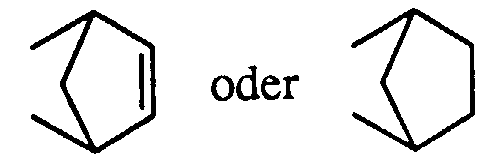

Bei R3, R4, R5 und R6 in der Bedeutung C3-C20Alkenyl kann es sich ebenfalls um verzweigte und unverzweigte Reste handeln. Diese Bedeutung umfaßt u.a. Propenyl, Isopropenyl, 2-Butenyl, 3-Butenyl, Isobutenyl, n-Penta-2,4-dienyl, 3-Methyl-but-2-enyl, n-Oct-2-enyl, n-Dec-2-enyl, n-Dodec-2-enyl, iso-Dodecenyl, n-Octadec-2-enyl, n-Octadec-4-enyl.
Die Bedeutung von R3, R4, R5 und R6 als mit C1-C12Alkyl substituiertes Phenyl umfaßt beispielsweise Methylphenyl, Dimethylphenyl, Trimethylphenyl, Ethylphenyl, Diethylphenyl, Isopropylphenyl, tert.-Butylphenyl, Di-tert.-butylphenyl, Methyl-di-t-butylphenyl, 1,1,3,3-Tetramethylbutylphenyl und 1,1,3,3,5,5-Hexamethylhexylphenyl. Die Zahl der Alkylgruppen im Alkylphenylrest beträgt insbesondere 1-3, z.B. 1 oder 2, vor allem 1.
Unter tertiär-Nonyl (abgekürzt t-Nonyl) ist das Isomerengemisch enthaltend 1,1,3,3-Tetramethylpentyl zu verstehen, wie es für das tertiär-Nonylmercaptan (Chemical Abstracts Reg. Nr. 25360-10-5) definiert ist. Entsprechend ist unter tertiär-Dodecyl (abgekürzt t-Dodecyl) das Isomerengemisch enthaltend 1,1,3,3,5,5-Hexamethylhexyl zu verstehen, wie es für tertiär-Dodecylmercaptan (Chemical Abstracts Reg. Nr. 25103-58-6) definiert ist.
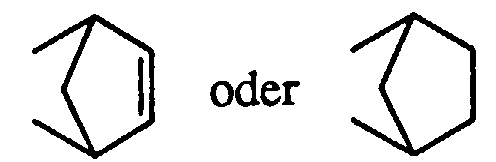
R5 und R6 Wasserstoff oder eine direkte Bindung bedeuten, oder R3, R4, R5 und R6 zusammen
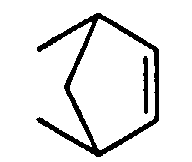
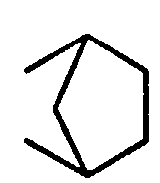
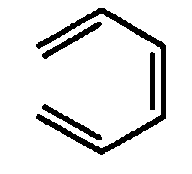
R5 und R6 Wasserstoff bedeuten.
einer der Substituenten R3 oder R4 C12Alkenyl, der andere Wasserstoff darstellt und R5 und R6 Wasserstoff bedeuten.
Bei den Alkylsubstituenten des Ammonium handelt es sich bevorzugt um mindestens einen C2-C18Alkylrest und eventuell weitere, gleiche oder verschiedene C1-C18Alkylreste. Besonders bevorzugt als Substituenten des Ammonium sind C2-C18Alkyl, vor allem C8-C18Alkyl und davon insbesondere C8Alkyl, C13Alkyl und C18Alkyl.
Bevorzugt unter den Metallsalzen der Verbindungen nach Formel (I) sind Lithium-, Natrium-, Kalium-, Magnesium-, Calcium- und Kupfer(II)-salze, besonders bevorzugt sind Lithium-, Magnesium- und Kupfer(II)-salze.
Von besonderem praktischem Interesse sind die Alkalimetall- sowie die mono- oder di-C8-C18-alkylsubstituierten Ammoniumsalze.
Substituierte Imidazoline und Oxazoline, 2-Heptadecenyl-1-(2-hydroxyethyl)imidazolin.
Aminsalze von Phosphorsäurepartialestern oder Phosphonsäurepartialestern, Zinkdialkyldithiophosphate.
Barium-dinonylnaphthalin-sulfonate, Calciumpetroleum-sulfonate, Alkylthio-substituierte aliphatische Carbonsäuren, Ester von aliphatischen 2-Sulfocarbonsäuren und deren Salze.
Glycerin-monooleat, 1-(Alkylphenoxy)-3-(2-hydroxyethyl)glycerine, 1-(Alkylphenoxy)-3-(2,3-dihydroxypropyl)glycerine, 2-Carboxyalkyl-1,3-dialkylglycerine.

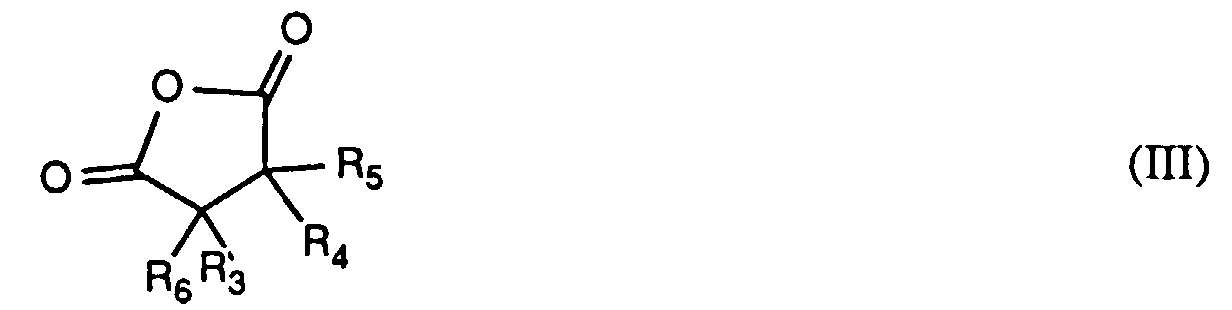
Die aus EP-A 166 696 bekannten Verbindungen der Formel (II) können durch Umsetzung eines entsprechenden Diesters der Thiophosphorsäure

Metallsalze von Verbindungen der Formel (I) können durch Umsetzung mit entsprechenden Metall-Hydroxiden erhalten werden. Die entsprechende Verbindung mit freier Säurefunktion wird zweckmäßig in einem Lösungsmittel vorgelegt, das Hydroxid zugesetzt und das Wasser anschließend durch Erhitzen der Reaktionsmischung unter Stickstoff mit dem Lösungsmittel ausgeschleppt.
Zur Herstellung des Kupfersalzes geht man bevorzugt von Cu(II)-Acetylacetonat aus, das der Lösung der Verbindung der Formel (I) zugesetzt wird. Nach Durchmischen wird das freigesetzte Acetylaceton und das verwendete Lösungsmittel in gleicher Weise entfernt wie bei der Herstellung der Ammoniumsalze. Ein geeignetes Lösungsmittel ist Toluol.
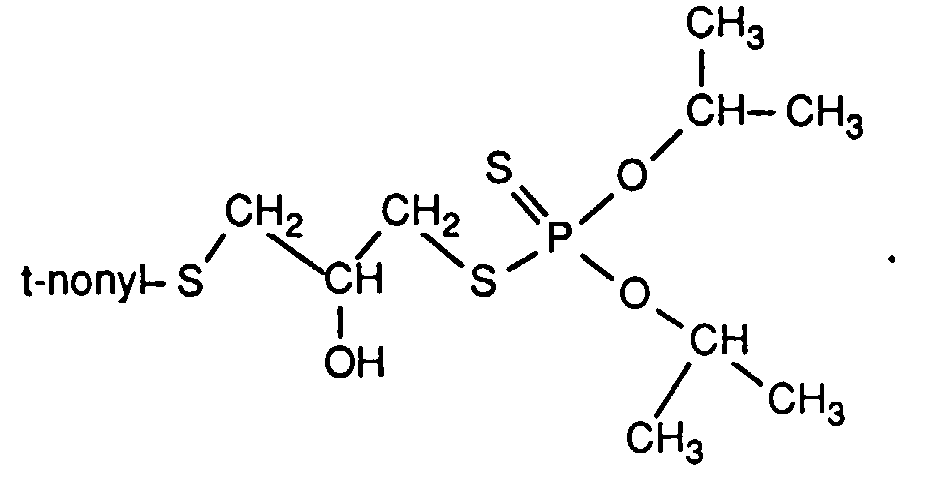
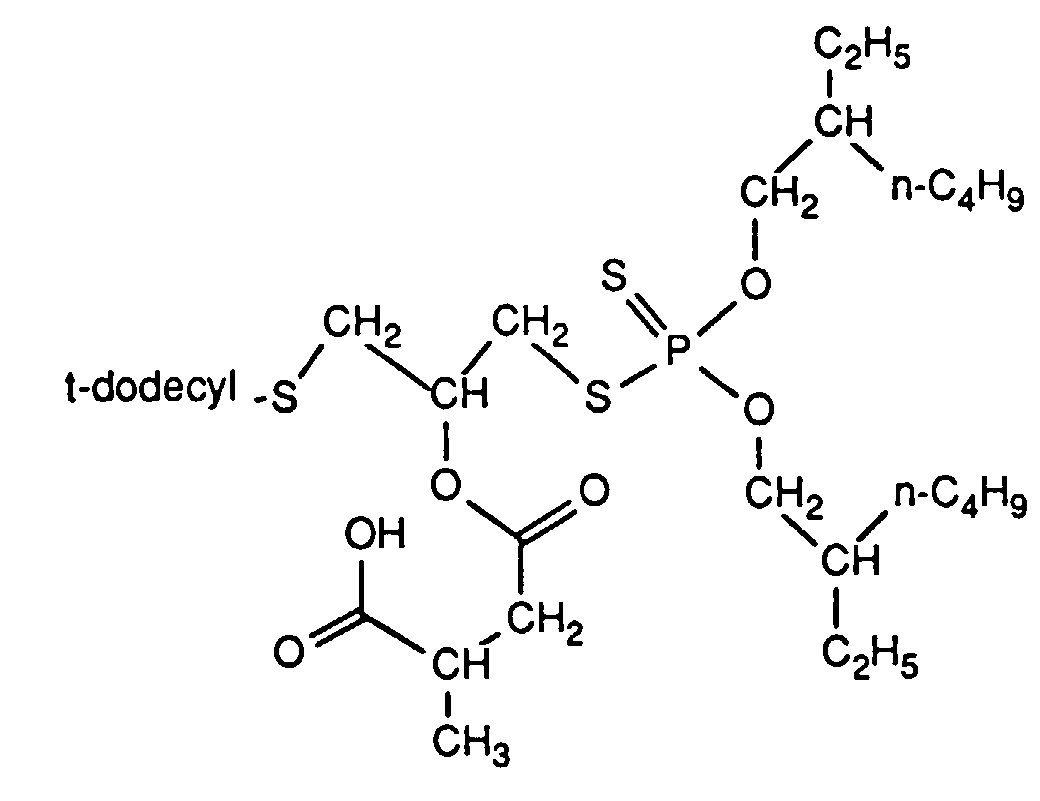
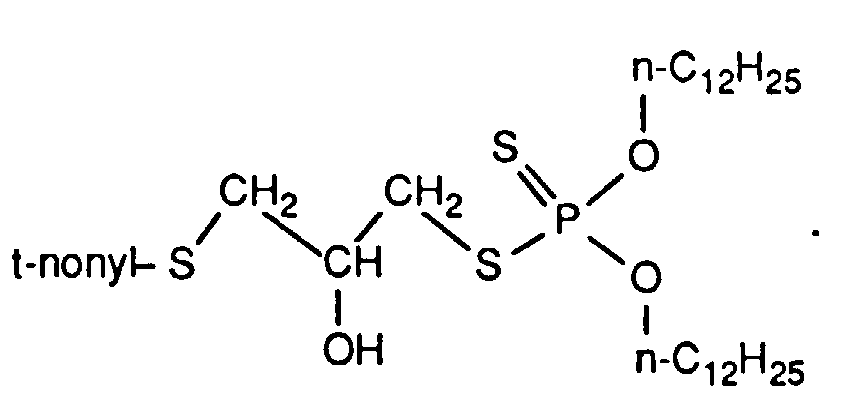
Zu 88.0 g O,O'-Diisopropyldithiophosphorsäure in 100 ml Toluol werden tropfenweise 88.6 g tert-Nonyl-(2,3-epoxypropyl)thioether binnen ca. 30 min zugesetzt, wobei sich die Reaktionsmischung erwärmt. Anschließend wird die Reaktionstemperatur für 3 h bei 70°C gehalten, abgekühlt, 12 ml einer 5%igen Wasserstoffperoxidlösung zugegeben, 10 min auf 50°C erwärmt, die wässrige Phase abgetrennt, nacheinander mit 30 ml gesättigter Natriumhydrogencarbonatlösung und zweimal mit je 50 ml Wasser gewaschen, mit Natriumsulfat getrocknet und das Lösungsmittel durch Anlegen von Unterdruck entfernt. Es bleiben 166.2 g (94% d. Th.) des Zwischenproduktes aus Beispiel 1 als viskose farblose Flüssigkeit mit einem Brechungsindex nD 20= 1.5132 zurück.
160 g dieses Produktes werden anschließend in 100 ml Toluol und 10 ml Dibutylether vorgelegt und mit 0.2 g 4-Toluolsulfonsäure versetzt. Tropfenweise werden dann 104 g iso-Dodecenylbernsteinsäureanhydrid zugegeben. Die Mischung wird für 5 h unter ständigem Rühren auf 70°C gehalten, anschließend wird abgekühlt, einmal mit 50 ml Wasser gewaschen und nach Trocknen über Natriumsulfat durch Anlegen von Unterdruck vom Lösungsmittel befreit. Es bleiben 244.2 g (94% d. Th.) der gemäß Beispiel 1 erhaltenen Endprodukte als viskose hellgelbe Flüssigkeit mit nD 20= 1.5001 zurück.
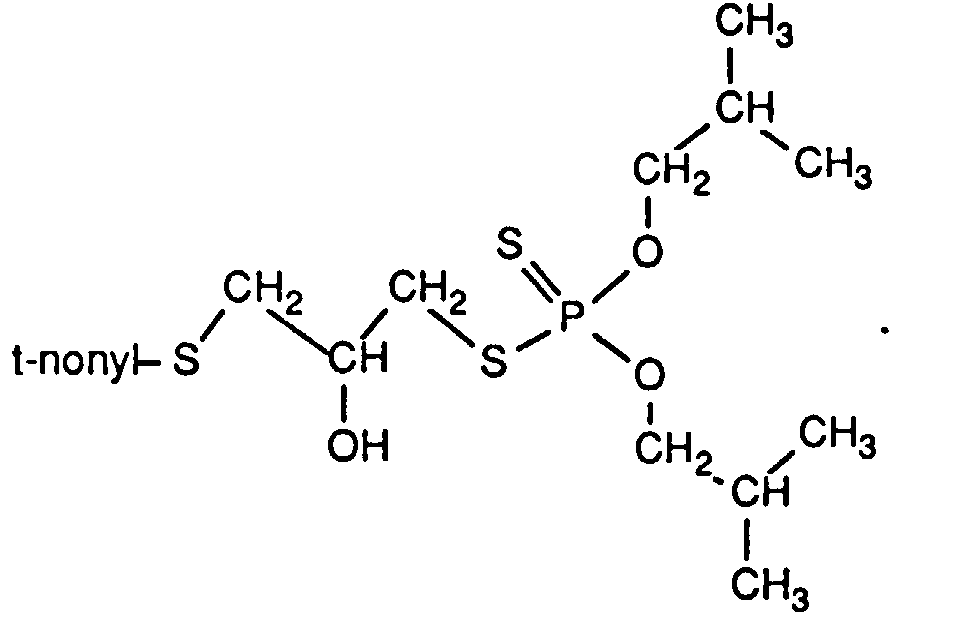

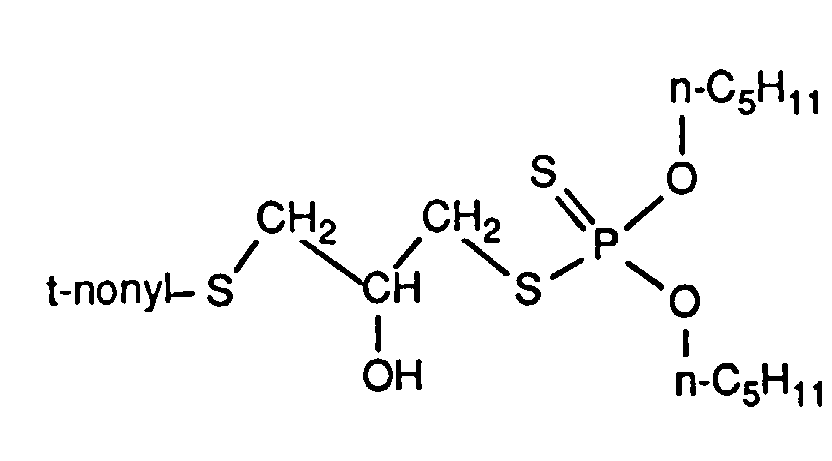
45.7 g dieses Produktes werden tropfenweise mit 26.3 g iso-Dodecenylbernsteinsäureanhydrid versetzt, wobei die Temperatur ansteigt. Nach Zugabe von 0.1 g 4-Toluolsulfonsäure wird die Reaktionsmischung für 3 h bei 50°C gehalten, abgekühlt und wie in Beispiel 1 beschrieben aufgearbeitet. Man erhält 66.2 g (93% d. Th.) eines Gemisches der Isomeren

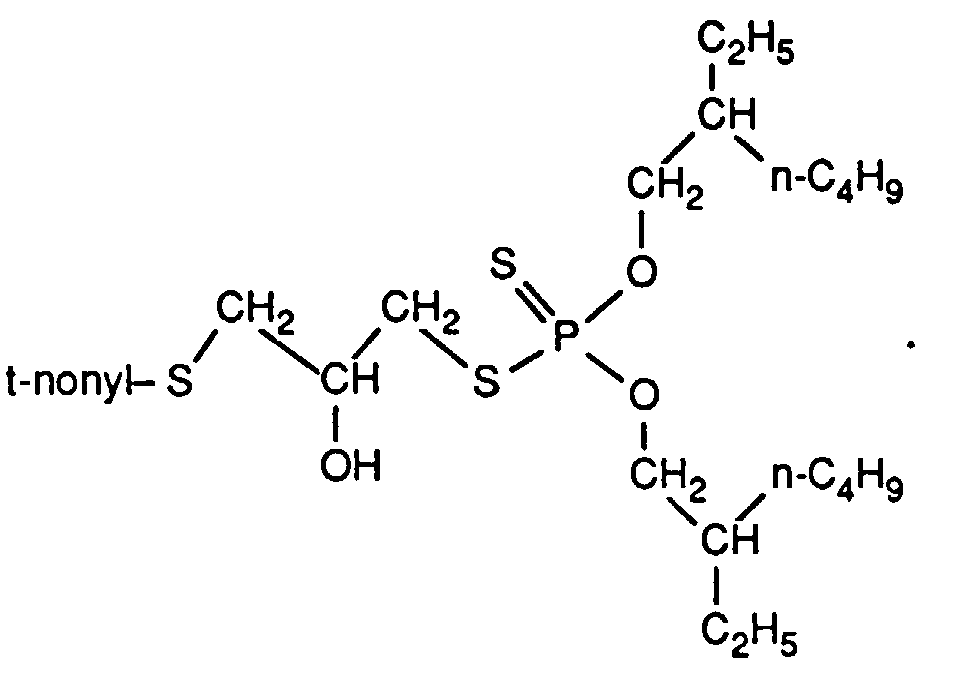
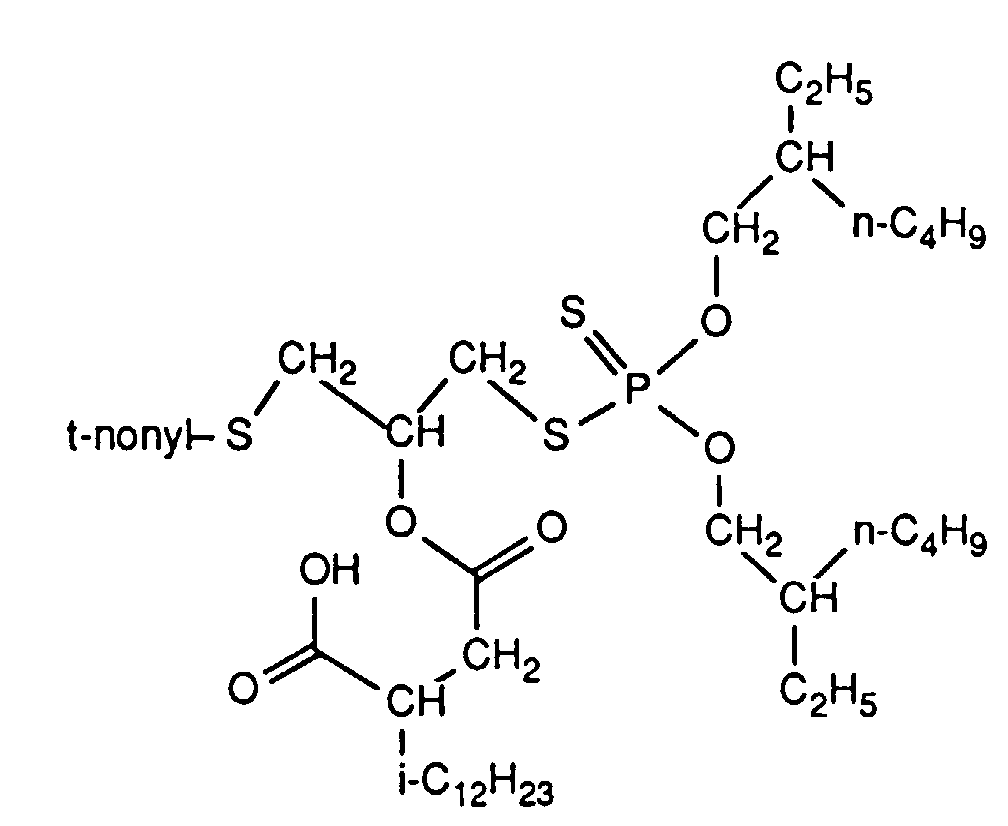


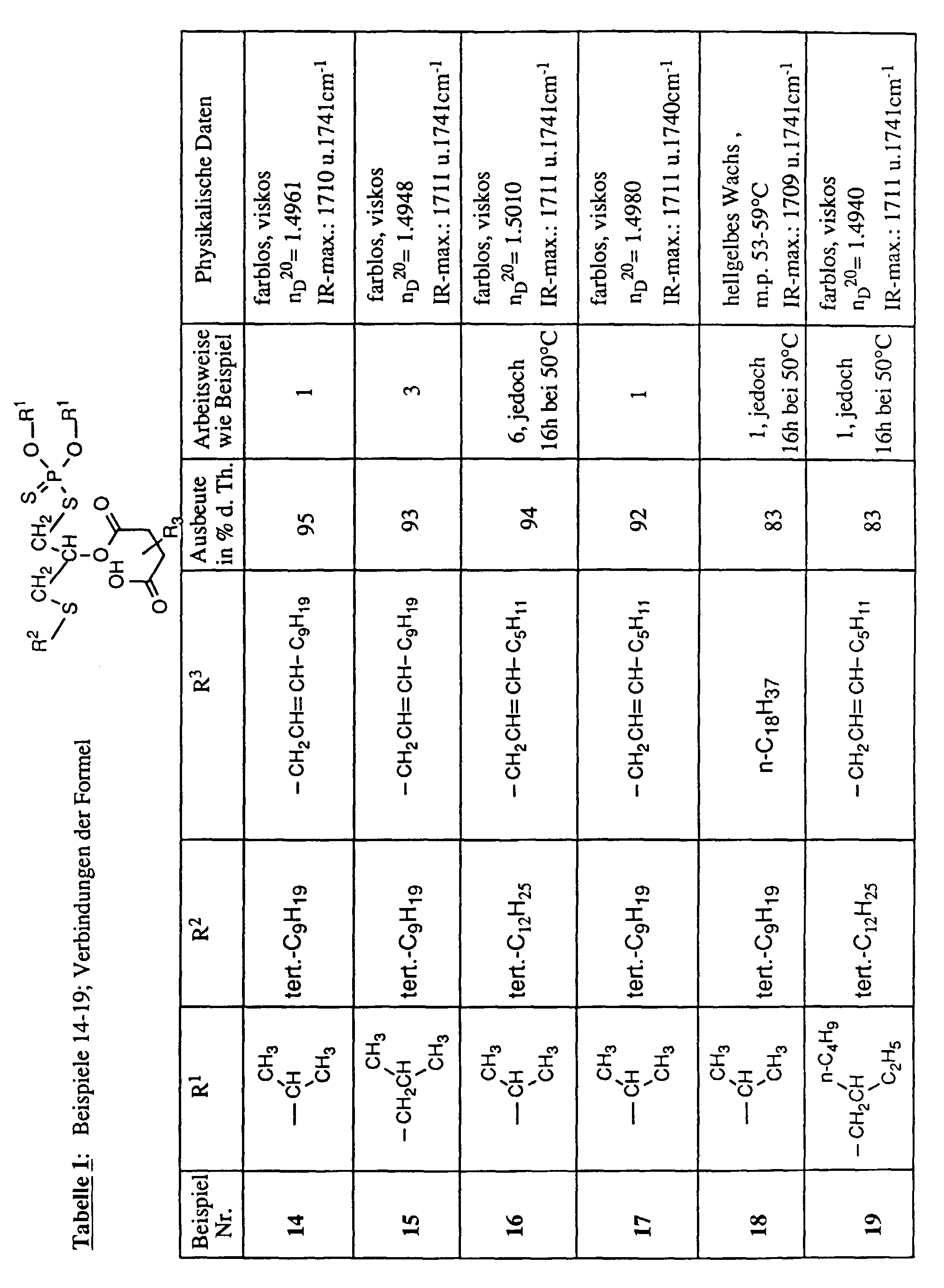
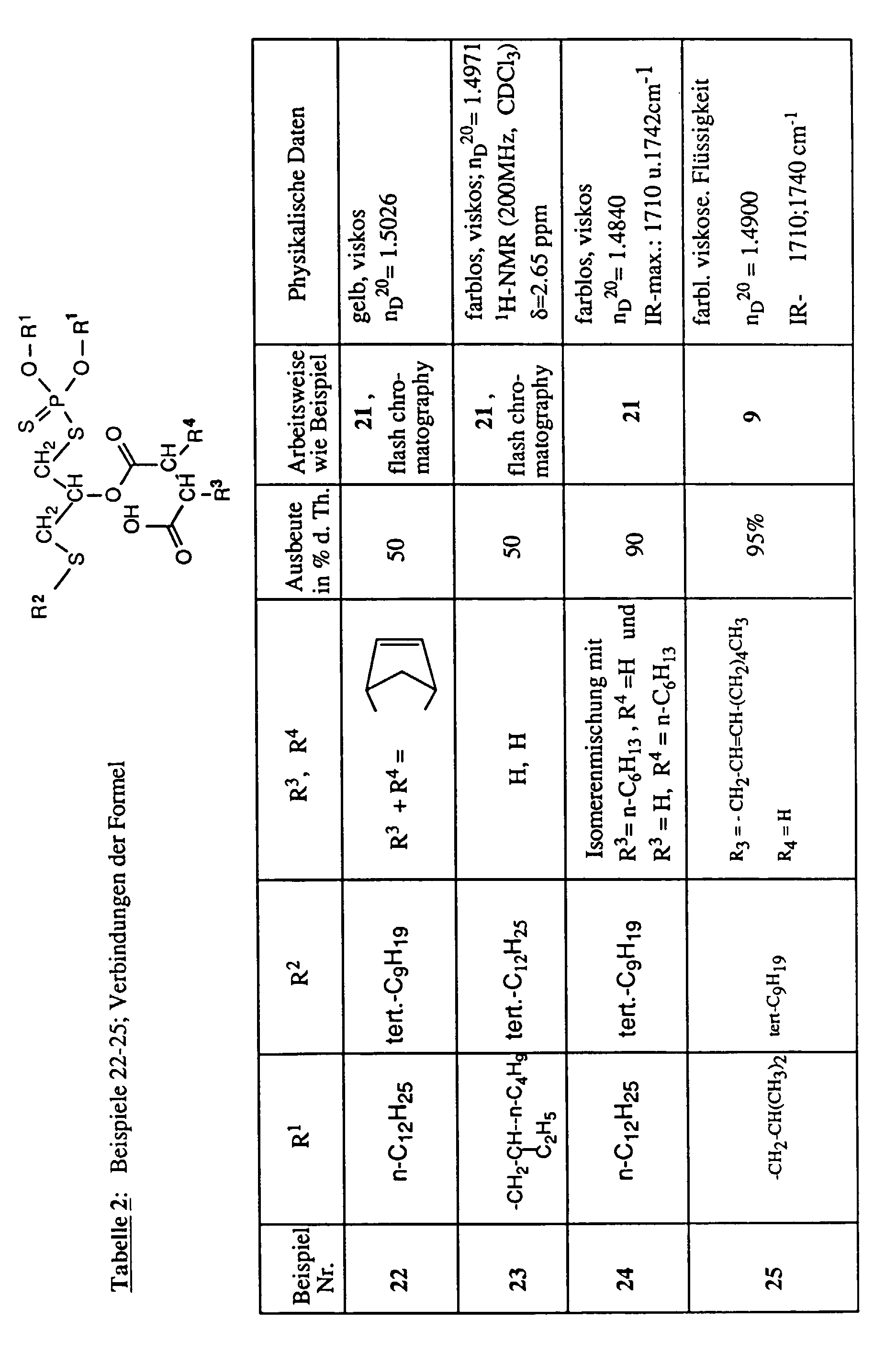
32.5 g dieses Produktes werden anschließend in 10 ml Toluol vorgelegt, mit 0.1 g 4-Dimethylaminopyridin und tropfenweise mit 19.2 g iso-Dodecenylbernsteinsäureanhydrid versetzt. Die Mischung wird für 7 h unter ständigem Rühren auf 50°C gehalten. Danach wird abgekühlt, mit Toluol verdünnt, mit Wasser gewaschen und die organische Phase nach Trocknen über Natriumsulfat durch Anlegen von Unterdruck vom Lösungsmittel befreit. Es bleiben 51 g (100% d. Th.) eines Gemisches der Isomeren

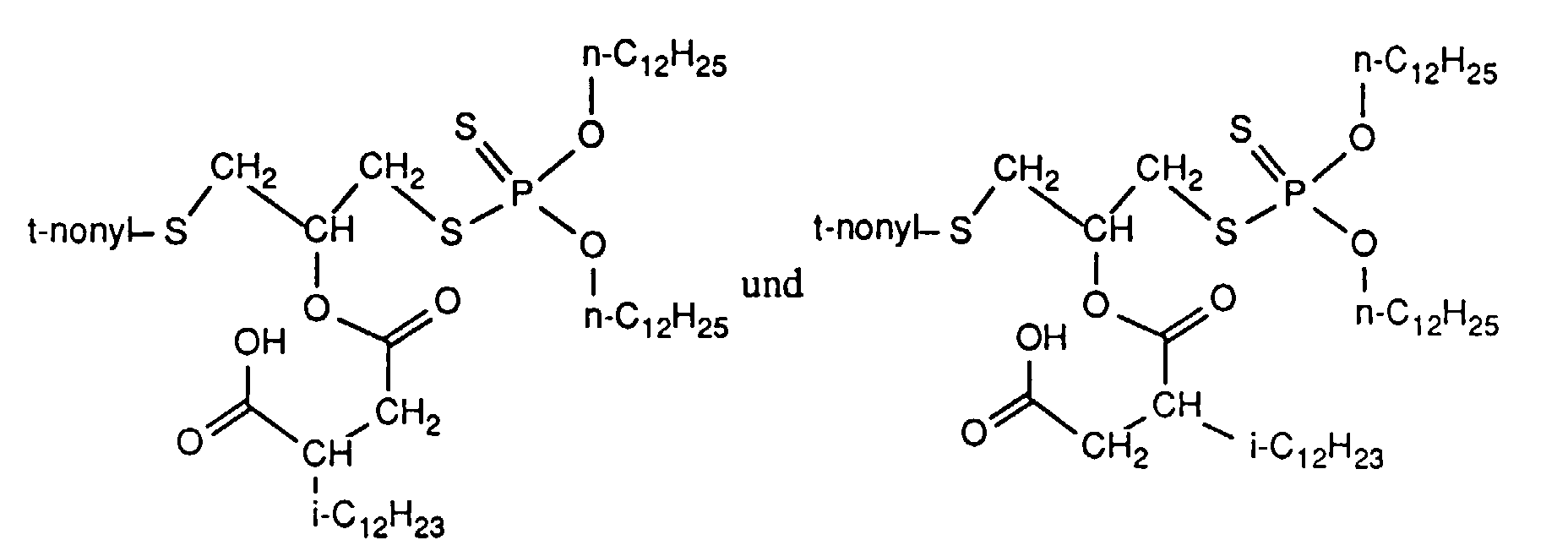
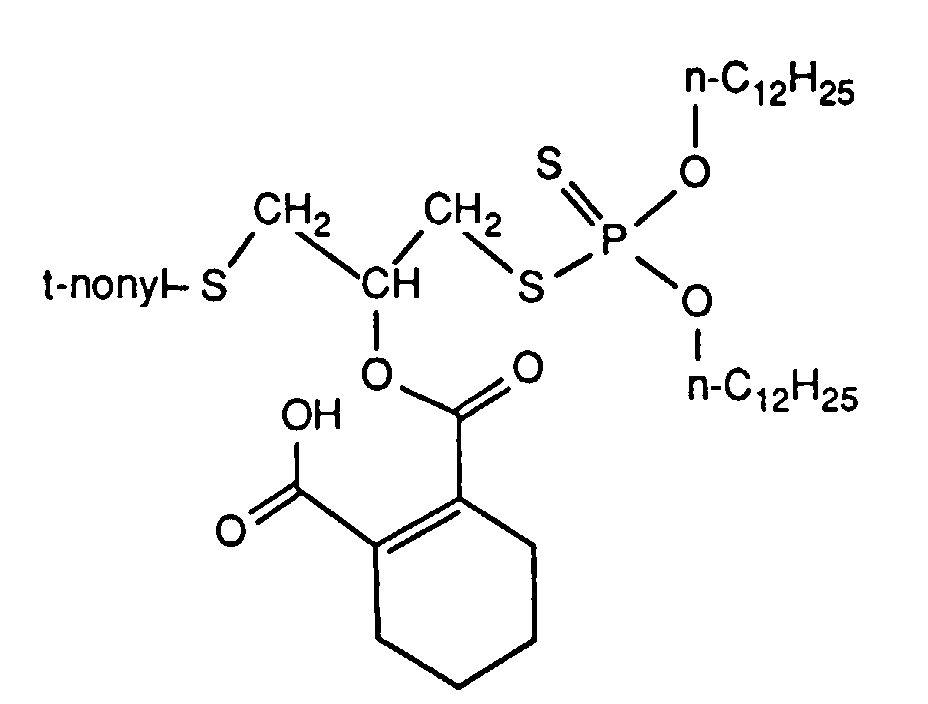
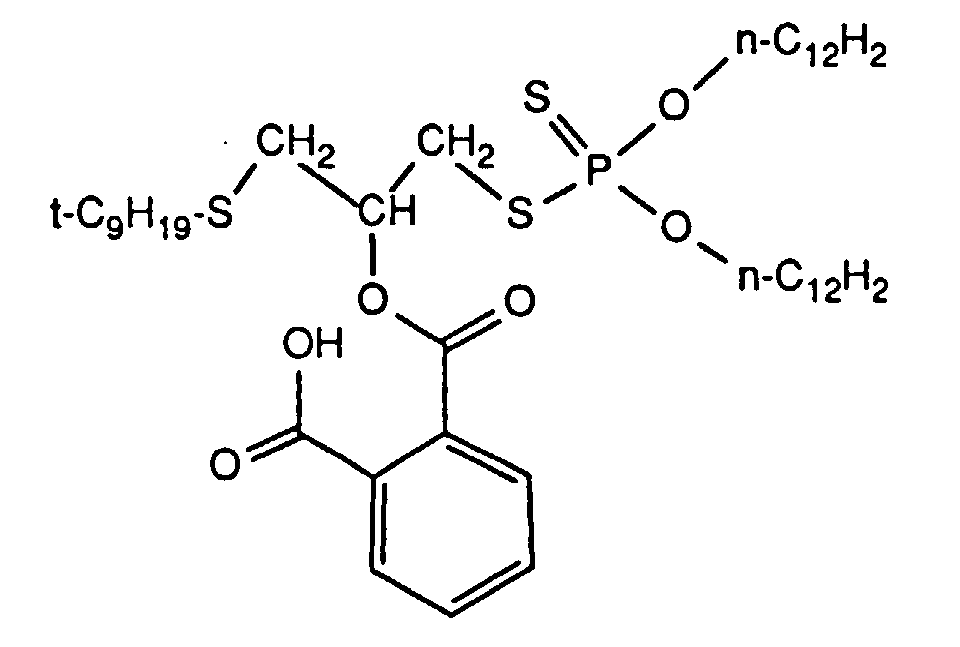

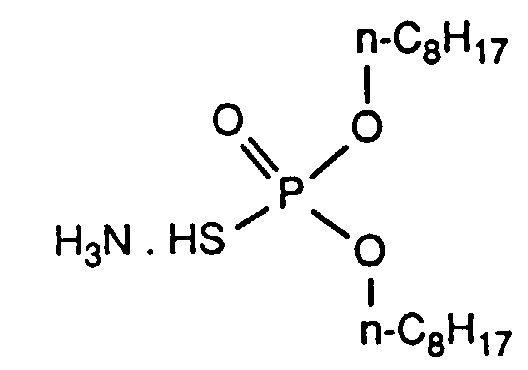


IR 1711, 1740 cm-1




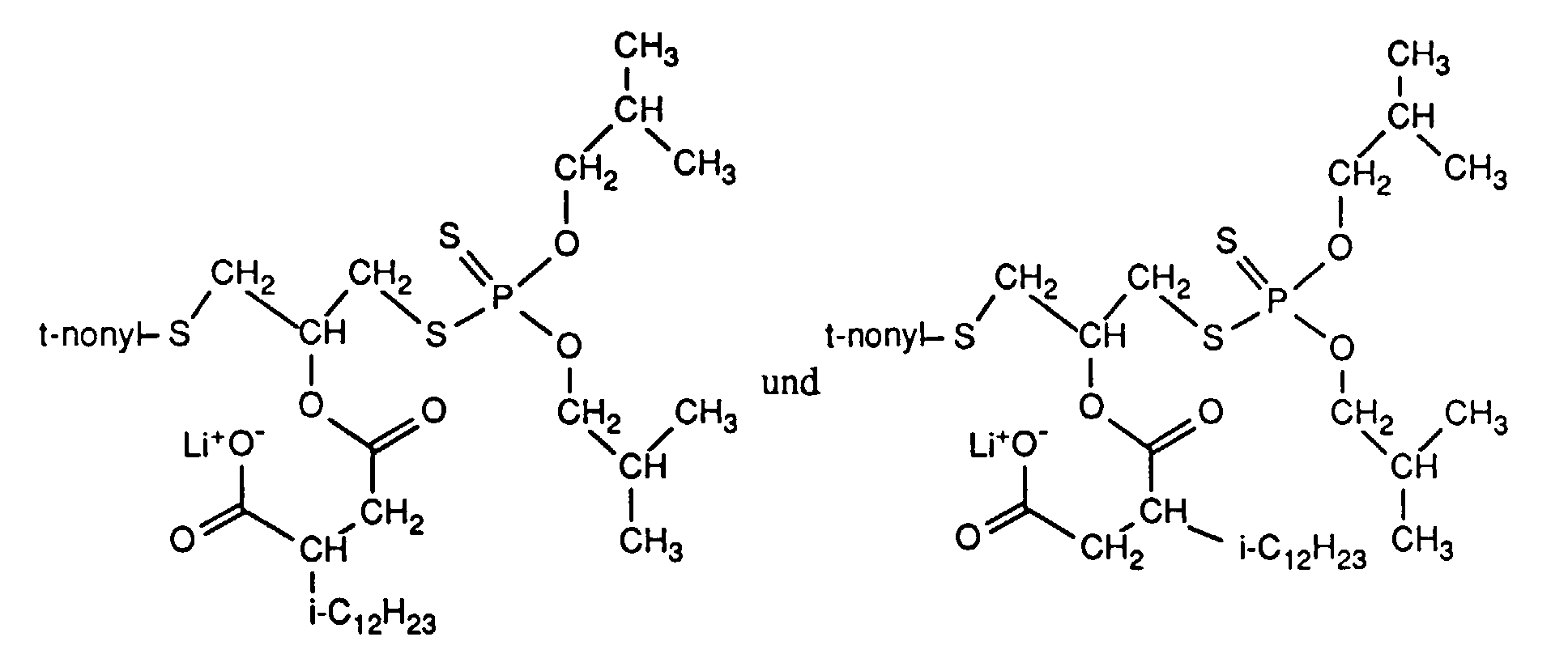
| Mikroanalyse: | C | H | S | P | Li |
| berechnet | 59.2% | 9.37% | 13.2% | 4.23% | 0.95% |
| gefunden | 60.5% | 9.13% | 12.2% | 4.02% | 0.93%. |
| Beispiel Nr. | Verbindung aus Beispiel Nr. | Verschleißschutz (VKA) | Korrosivität ASTM D 130 | |
| WL/kg | WSD/mm | |||
| 28 | 1 | 160 | 0.35 | 2A |
| 29 | 3 | 160 | 0.39 | 1B |
| 30 | 4 | 160 | 0.37 | 1B |
| 31 | 5 | 160 | 0.39 | 1B |
| 32 | 6 | 140 | 0.38 | 2A |
| 33 | 14 | 150 | 0.32 | 2A |
| 34 | 20 | 140 | 0.28 | 1B |
| 35 | 15 | 150 | 0.30 | 1B |
| 36 | 17 | 140 | 0.34 | 1B |
| 37 | 18 | 150 | 0.29 | 1B |
| 38 | 19 | 150 | 0.31 | 1B |
| 39 | 13 | 160 | 0.35 | 1B |
| 40 | 21 | 140 | 0.40 | 1B |
| 41 | 22 | 140 | 0.37 | 1B |
| 42 | 23 | 150 | 0.35 | 1B |
| 43 | 24 | 140 | 0.38 | 1B |
| 44 | 25 | 140 | 0.40 | 1B |
| ohne Wirkstoff | 130 | 0.82 | 3B |
| Resultate des ASTM-Tests D 665 B auf rostverhütende Eigenschaften | ||
| Beispiel Nr. | Verbindung aus Beispiel Nr. | Bewertung |
| 45 | 1 | 0 |
| 46 | 3 | 0 |
| 47 | 17 | 0 |
| 48 | 13 | 0 |
| 49 | 21 | 0 |
| 50 | 22 | 0 |
| 51 | 23 | 0 |
| 52 | 24 | 0 |
| 53 | 25 | 0 |
| Vergleich ohne erfindungsgemäßen Wirkstoff | 3 |
Claims (14)
- Zusammensetzung enthaltend a) einen Schmierstoff, eine Hydraulik- oder Metallbearbeitungsflüssigkeit und b) mindestens eine Verbindung der Formel (I) oder/und deren Salzworin X Schwefel oder Sauerstoff,
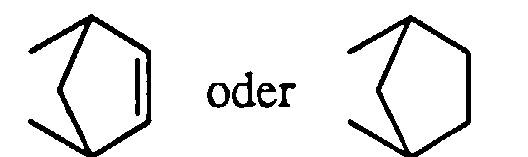
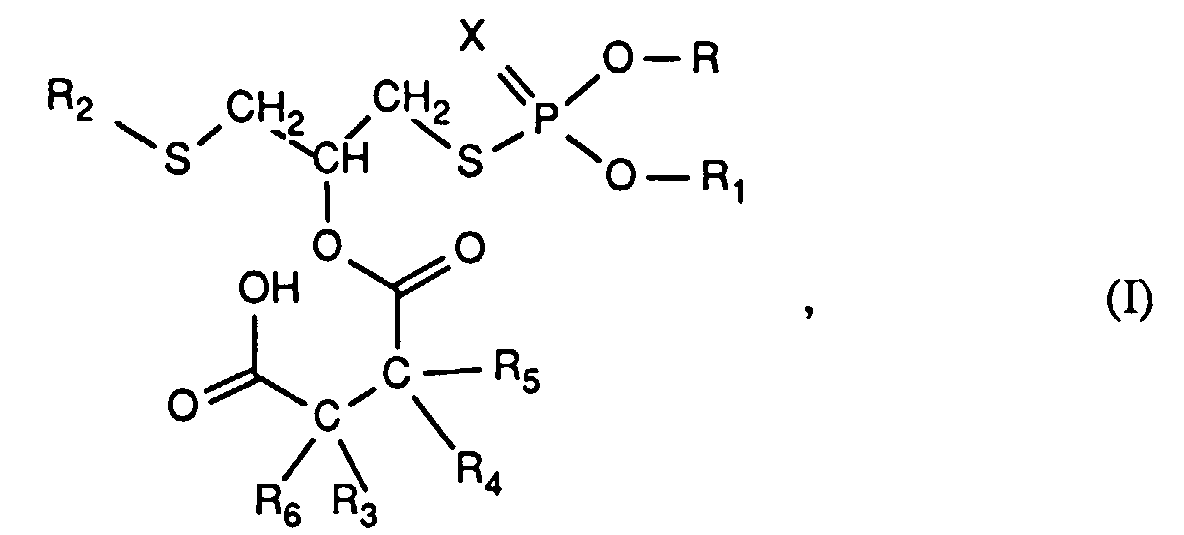 R und R1 unabhängig voneinander C3-C30Alkyl, R2 C4-C18Alkyl,R3, R4, R5 und R6 unabhängig voneinander H, C1-C20Alkyl, C3-C20Alkenyl, Benzyl, Phenyl oder mit C1-C12Alkyl substituiertes Phenyl bedeuten, wobei R5 und R6 zusammen auch die Bedeutung einer direkten Bindung haben können;oder R3 und R4 zusammen Trimethylen, Tetramethylen,bedeuten und R5 und R6 die Bedeutung von H oder zusammen einer direkten Bindung haben; oder R3 und R6 zusammen eine Gruppe =CH2 darstellen und R4 und R5 die Bedeutung H haben; oder R4 und R5 zusammen eine Gruppe =CH2 darstellen und R3 und R6 die Bedeutung H haben;
 oder R3, R4, R5 und R6 zusammenbedeuten.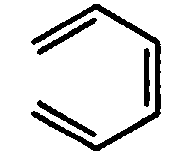
- Zusammensetzung gemäß Anspruch 1, worin
R und R1 unabhängig voneinander C3-C18Akyl und R2 C4-C18Alkyl bedeuten;
einer der Substituenten R3 oder R4 H, C1-C20Akyl oder C3-C20Alkenyl und der andere Wasserstoff darstellt; oder R3 und R4 zusammen Trimethylen, Tetramethylen,oder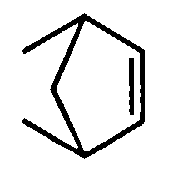 bedeuten; und R5 und R6 Wasserstoff oder eine direkte Bindung bedeuten;
oder R3, R4, R5 und R6 zusammenbedeuten.
- Zusammensetzung gemäß Anspruch 2, worin X Schwefel bedeutet,
R und R1 unabhängig voneinander C3-C12Akyl; R2 C4-C12Alkyl;
einer der Substituenten R3 oder R4 C1-C20Alkyl oder C4-C20Alkenyl und der andere Wasserstoff darstellt; oder R3 und R4 zusammen Trimethylen oder Tetramethylen darstellen; und
R5 und R6 Wasserstoff oder eine direkte Bindung bedeuten. - Zusammensetzung gemäß Anspruch 3, worin R und R1 jeweils gleich sind und Isopropyl oder 2-Methylpropyl bedeuten, R2 tertiär-Nonyl oder tertiär-Dodecyl bedeutet, einer der Substituenten R3 oder R4 C8-C12-Alkyl oder -Akenyl, der andere Wasserstoff darstellt, und
R5 und R6 Wasserstoff bedeuten. - Zusammensetzung gemäß Anspruch 1, worin R und R1 gleich sind.
- Zusammensetzung gemäß Anspruch 1, worin X Schwefel bedeutet.
- Zusammensetzung gemäß Anspruch 1, worin das Salz ein Alkalimetall-, Erdalkalimetall-, Zink- oder Kupfersalz oder ein Ammonium-, mono-, di- oder tri-C1-C18-alkylsubstituiertes Ammoniumsalz ist, wobei auch gemischte Salze möglich sind.
- Zusammensetzung nach Anspruch 7, worin das Salz ein Alkalimetallsalz oder ein mono- oder di-C8-C18-akylsubstituiertes Ammoniumsalz ist.
- Zusammensetzung gemäß Anspruch 1 enthaltend 0.01 bis 5 Gewichtsprozent mindestens einer Verbindung der Formel (I).
- Zusammensetzung gemäß Anspruch 1, worin die Komponente a) ein Schmierstoff ist.
- Zusammensetzung gemäß Anspruch 1, die zusätzlich ein oder mehrere weitere Additive, insbesondere Korrosionsschutzmittel, Rostinhibitoren, Metall-Desaktivatoren, Viskositätsindex-Verbesserer, Dispergiermittel, Antioxidantien, Stockpunkterniedriger, Viskositätsindex-Verbesserer, Dispergiermittel, Antioxidantien, Stockpunkterniedriger, Hochdruck- oder Verschleißschutzzusätze, enthält.
- Verfahren zur Verbesserung der Gebrauchseigenschaften von Schmierstoffen, Metallbearbeitungs- und Hydraulikflüssigkeiten, dadurch gekennzeichnet, daß diesen eine oder mehrere Verbindungen der Formel (I), wie in Anspruch 1 beschrieben, zugesetzt werden.
Applications Claiming Priority (2)
| Application Number | Priority Date | Filing Date | Title |
|---|---|---|---|
| CH212191 | 1991-07-17 | ||
| CH2121/91 | 1991-07-17 |
Publications (2)
| Publication Number | Publication Date |
|---|---|
| EP0524145A1 EP0524145A1 (de) | 1993-01-20 |
| EP0524145B1 true EP0524145B1 (de) | 1999-01-27 |
Family
ID=4226372
Family Applications (1)
| Application Number | Title | Priority Date | Filing Date |
|---|---|---|---|
| EP92810524A Expired - Lifetime EP0524145B1 (de) | 1991-07-17 | 1992-07-09 | Multifunktionelle Schmierstoff-Additive |
Country Status (8)
| Country | Link |
|---|---|
| US (1) | US5320764A (de) |
| EP (1) | EP0524145B1 (de) |
| JP (1) | JP3211037B2 (de) |
| BR (1) | BR9202709A (de) |
| CA (1) | CA2073926A1 (de) |
| DE (1) | DE59209625D1 (de) |
| ES (1) | ES2128345T3 (de) |
| MX (1) | MX9204129A (de) |
Families Citing this family (9)
| Publication number | Priority date | Publication date | Assignee | Title |
|---|---|---|---|---|
| JP3354024B2 (ja) * | 1994-12-22 | 2002-12-09 | 株式会社神戸製鋼所 | アルミニウム及びアルミニウム合金板の低温成形用潤滑剤 |
| CN1042743C (zh) * | 1996-06-05 | 1999-03-31 | 中国石化兰州炼油化工总厂 | 润滑油添加剂组合物 |
| CN1042644C (zh) * | 1996-06-05 | 1999-03-24 | 中国石化兰州炼油化工总厂 | 添加剂组合物 |
| US6278006B1 (en) * | 1999-01-19 | 2001-08-21 | Cargill, Incorporated | Transesterified oils |
| CA2457268A1 (en) * | 2001-08-14 | 2003-10-02 | United Soybean Board | Soy-based methyl ester high performance metal working fluids |
| WO2003020855A1 (en) * | 2001-09-05 | 2003-03-13 | United Soybean Board | Soybean oil based metalworking fluids |
| WO2005110375A1 (en) * | 2004-05-08 | 2005-11-24 | Paul Edward L Jr | Nutritional supplement for treatment of ocular diseases |
| EP1814969A2 (de) * | 2004-11-04 | 2007-08-08 | United Technologies Corporation | Multifunktionelle schmiermittelzusatzzusammensetzung |
| CN109415645A (zh) * | 2016-08-12 | 2019-03-01 | Jxtg能源株式会社 | 润滑油组合物 |
Family Cites Families (11)
| Publication number | Priority date | Publication date | Assignee | Title |
|---|---|---|---|---|
| US2836564A (en) * | 1954-10-28 | 1958-05-27 | Standard Oil Co | Corrosion inhibitors and compositions containing the same |
| US3591475A (en) * | 1968-12-09 | 1971-07-06 | Exxon Research Engineering Co | Preparation of unsymmetrical thiol-allene diadducts |
| DE3025277A1 (de) * | 1979-07-06 | 1981-01-08 | Ciba Geigy Ag | Schmiermittelzusaetze |
| US4544492A (en) * | 1983-05-09 | 1985-10-01 | Ciba-Geigy Corporation | Lubricant compositions |
| EP0166695B1 (de) * | 1984-06-29 | 1989-10-18 | Ciba-Geigy Ag | Verfahren zur Herstellung von Glycidythioethern |
| DE3571642D1 (en) * | 1984-06-29 | 1989-08-24 | Ciba Geigy Ag | Lubricant additives |
| EP0223916B1 (de) * | 1985-10-03 | 1991-09-11 | ATOCHEM NORTH AMERICA, INC. (a Pennsylvania corp.) | Mehrfach wirksame Thiadiazol-Additive für Schmiermittel |
| GB8711191D0 (en) * | 1987-05-12 | 1987-06-17 | Bp Chemicals Additives | Lubricating oil additives |
| US4834893A (en) * | 1987-12-31 | 1989-05-30 | Mobil Oil Corporation | Substituted phosphorodithioates and their metal salts as multifunctional additives |
| GB8911287D0 (en) * | 1989-05-17 | 1989-07-05 | Ciba Geigy Ag | Lubricant compositions |
| US5019282A (en) * | 1989-12-21 | 1991-05-28 | Mobil Oil Corporation | Organic ester, amide or amine salts of phosphorodithioate substitute carboxylic anhydrides as multifunctional additives |
-
1992
- 1992-07-09 EP EP92810524A patent/EP0524145B1/de not_active Expired - Lifetime
- 1992-07-09 DE DE59209625T patent/DE59209625D1/de not_active Expired - Fee Related
- 1992-07-09 ES ES92810524T patent/ES2128345T3/es not_active Expired - Lifetime
- 1992-07-14 US US07/914,165 patent/US5320764A/en not_active Expired - Fee Related
- 1992-07-15 CA CA002073926A patent/CA2073926A1/en not_active Abandoned
- 1992-07-15 MX MX9204129A patent/MX9204129A/es not_active IP Right Cessation
- 1992-07-16 BR BR929202709A patent/BR9202709A/pt not_active IP Right Cessation
- 1992-07-17 JP JP21363992A patent/JP3211037B2/ja not_active Expired - Fee Related
Also Published As
| Publication number | Publication date |
|---|---|
| JPH05194561A (ja) | 1993-08-03 |
| BR9202709A (pt) | 1993-03-23 |
| ES2128345T3 (es) | 1999-05-16 |
| MX9204129A (es) | 1993-01-01 |
| CA2073926A1 (en) | 1993-01-18 |
| JP3211037B2 (ja) | 2001-09-25 |
| US5320764A (en) | 1994-06-14 |
| DE59209625D1 (de) | 1999-03-11 |
| EP0524145A1 (de) | 1993-01-20 |
Similar Documents
| Publication | Publication Date | Title |
|---|---|---|
| DE4317943B4 (de) | Dithiophosphorsäurederivate als Schmiermitteladditive | |
| EP0819754B1 (de) | Beta-Dithiophosphorylierte Propionsäure in Schmierstoffen | |
| EP0160620B1 (de) | Neue Metalldesaktivatoren | |
| DE3446630C2 (de) | Stabilisator-Systeme, deren Verwendung und diese enthaltende Schmierstoffe | |
| EP0376889B1 (de) | Schmierstoffzusammensetzung | |
| EP0166696B1 (de) | Zusätze für Schmierstoffe | |
| DE68903468T2 (de) | Schmiermittelzusammensetzungen. | |
| BE1012345A5 (fr) | Thioethers heterocycliques comme additifs pour des agents lubrifiants. | |
| EP0737684B1 (de) | (Benz)Triazolreste enthaltende Verbindungen, deren Herstellung und deren Verwendung als Metalldesaktivatoren und Korrosionsschutzmittel | |
| EP0849282A2 (de) | Polymere multifunktionelle Schmierstoffadditive | |
| EP0524145B1 (de) | Multifunktionelle Schmierstoff-Additive | |
| EP0273868A2 (de) | N-substituierte Tetrahydrochinoline als Antioxidantien für Schmiermittel | |
| DE4317980B4 (de) | Bis-Dithiophosphorsäurederivate als Schmiermitteladditive | |
| DD299655A5 (de) | Schmiermittelzusammensetzungen | |
| EP0205398B1 (de) | Zusätze für funktionelle Flüssigkeiten | |
| EP0303569A2 (de) | 1,4-Oxathianone und 1,4-Oxathiepanone und deren Verwendung als Additive für funktionelle Flüssigkeiten | |
| EP0595771B1 (de) | Phosphorfreie Schmiermitteladditive | |
| EP0322362B1 (de) | Thiadiazolderivate als Schmierstoffadditive | |
| EP0368803B1 (de) | Schmierstoffzusammensetzungen | |
| EP0595770B1 (de) | Neue Dithiophosphate als Verschleissschutzadditive | |
| DE4317911A1 (de) | Trisamidodithionodiphosphate | |
| EP0682022B1 (de) | Kondensationsprodukte aus Melamin, (Benzo)triazolen und Aldehyden | |
| DE69007214T2 (de) | Butenylaromatische Aminstabilisatoren. | |
| EP0328488A2 (de) | Asymmetrische Disulfide in Schmierstoffzusammensetzungen | |
| EP0894793A1 (de) | Phosphorfreie multifunktionelle Schmiermitteladditive |
Legal Events
| Date | Code | Title | Description |
|---|---|---|---|
| PUAI | Public reference made under article 153(3) epc to a published international application that has entered the european phase |
Free format text: ORIGINAL CODE: 0009012 |
|
| AK | Designated contracting states |
Kind code of ref document: A1 Designated state(s): BE DE ES FR GB IT |
|
| 17P | Request for examination filed |
Effective date: 19930624 |
|
| 17Q | First examination report despatched |
Effective date: 19961011 |
|
| RAP1 | Party data changed (applicant data changed or rights of an application transferred) |
Owner name: CIBA SC HOLDING AG |
|
| RAP3 | Party data changed (applicant data changed or rights of an application transferred) |
Owner name: CIBA SPECIALTY CHEMICALS HOLDING INC. |
|
| GRAG | Despatch of communication of intention to grant |
Free format text: ORIGINAL CODE: EPIDOS AGRA |
|
| GRAG | Despatch of communication of intention to grant |
Free format text: ORIGINAL CODE: EPIDOS AGRA |
|
| GRAH | Despatch of communication of intention to grant a patent |
Free format text: ORIGINAL CODE: EPIDOS IGRA |
|
| GRAH | Despatch of communication of intention to grant a patent |
Free format text: ORIGINAL CODE: EPIDOS IGRA |
|
| GRAA | (expected) grant |
Free format text: ORIGINAL CODE: 0009210 |
|
| AK | Designated contracting states |
Kind code of ref document: B1 Designated state(s): BE DE ES FR GB IT |
|
| GBT | Gb: translation of ep patent filed (gb section 77(6)(a)/1977) |
Effective date: 19990202 |
|
| REF | Corresponds to: |
Ref document number: 59209625 Country of ref document: DE Date of ref document: 19990311 |
|
| ITF | It: translation for a ep patent filed | ||
| ET | Fr: translation filed | ||
| REG | Reference to a national code |
Ref country code: ES Ref legal event code: FG2A Ref document number: 2128345 Country of ref document: ES Kind code of ref document: T3 |
|
| PLBE | No opposition filed within time limit |
Free format text: ORIGINAL CODE: 0009261 |
|
| 26N | No opposition filed | ||
| PGFP | Annual fee paid to national office [announced via postgrant information from national office to epo] |
Ref country code: FR Payment date: 20010531 Year of fee payment: 10 |
|
| PGFP | Annual fee paid to national office [announced via postgrant information from national office to epo] |
Ref country code: DE Payment date: 20010608 Year of fee payment: 10 |
|
| PGFP | Annual fee paid to national office [announced via postgrant information from national office to epo] |
Ref country code: GB Payment date: 20010629 Year of fee payment: 10 |
|
| PGFP | Annual fee paid to national office [announced via postgrant information from national office to epo] |
Ref country code: ES Payment date: 20010704 Year of fee payment: 10 |
|
| PGFP | Annual fee paid to national office [announced via postgrant information from national office to epo] |
Ref country code: BE Payment date: 20010918 Year of fee payment: 10 |
|
| REG | Reference to a national code |
Ref country code: GB Ref legal event code: IF02 |
|
| PG25 | Lapsed in a contracting state [announced via postgrant information from national office to epo] |
Ref country code: GB Free format text: LAPSE BECAUSE OF NON-PAYMENT OF DUE FEES Effective date: 20020709 |
|
| PG25 | Lapsed in a contracting state [announced via postgrant information from national office to epo] |
Ref country code: ES Free format text: LAPSE BECAUSE OF NON-PAYMENT OF DUE FEES Effective date: 20020710 |
|
| PG25 | Lapsed in a contracting state [announced via postgrant information from national office to epo] |
Ref country code: BE Free format text: LAPSE BECAUSE OF NON-PAYMENT OF DUE FEES Effective date: 20020731 |
|
| BERE | Be: lapsed |
Owner name: *CIBA SPECIALTY CHEMICALS HOLDING INC. Effective date: 20020731 |
|
| PG25 | Lapsed in a contracting state [announced via postgrant information from national office to epo] |
Ref country code: DE Free format text: LAPSE BECAUSE OF NON-PAYMENT OF DUE FEES Effective date: 20030201 |
|
| GBPC | Gb: european patent ceased through non-payment of renewal fee |
Effective date: 20020709 |
|
| PG25 | Lapsed in a contracting state [announced via postgrant information from national office to epo] |
Ref country code: FR Free format text: LAPSE BECAUSE OF NON-PAYMENT OF DUE FEES Effective date: 20030331 |
|
| REG | Reference to a national code |
Ref country code: FR Ref legal event code: ST |
|
| REG | Reference to a national code |
Ref country code: ES Ref legal event code: FD2A Effective date: 20030811 |
|
| PG25 | Lapsed in a contracting state [announced via postgrant information from national office to epo] |
Ref country code: IT Free format text: LAPSE BECAUSE OF NON-PAYMENT OF DUE FEES;WARNING: LAPSES OF ITALIAN PATENTS WITH EFFECTIVE DATE BEFORE 2007 MAY HAVE OCCURRED AT ANY TIME BEFORE 2007. THE CORRECT EFFECTIVE DATE MAY BE DIFFERENT FROM THE ONE RECORDED. Effective date: 20050709 |