EP0519918B1 - Selbstklebende nagellackschichten - Google Patents
Selbstklebende nagellackschichten Download PDFInfo
- Publication number
- EP0519918B1 EP0519918B1 EP90907814A EP90907814A EP0519918B1 EP 0519918 B1 EP0519918 B1 EP 0519918B1 EP 90907814 A EP90907814 A EP 90907814A EP 90907814 A EP90907814 A EP 90907814A EP 0519918 B1 EP0519918 B1 EP 0519918B1
- Authority
- EP
- European Patent Office
- Prior art keywords
- nail
- nail polish
- layer
- fingernail
- paper
- Prior art date
- Legal status (The legal status is an assumption and is not a legal conclusion. Google has not performed a legal analysis and makes no representation as to the accuracy of the status listed.)
- Expired - Lifetime
Links
- 238000000576 coating method Methods 0.000 title claims abstract description 73
- 239000000853 adhesive Substances 0.000 title claims abstract description 15
- 230000001070 adhesive effect Effects 0.000 title claims abstract description 14
- 210000000282 nail Anatomy 0.000 claims abstract description 120
- 210000004905 finger nail Anatomy 0.000 claims abstract description 52
- 210000003298 dental enamel Anatomy 0.000 claims abstract description 44
- 239000007788 liquid Substances 0.000 claims abstract description 39
- 239000011248 coating agent Substances 0.000 claims abstract description 26
- 239000000463 material Substances 0.000 claims abstract description 15
- 238000004519 manufacturing process Methods 0.000 claims description 12
- 238000000034 method Methods 0.000 claims description 6
- 238000007649 pad printing Methods 0.000 claims description 2
- 230000000007 visual effect Effects 0.000 claims 3
- 238000007789 sealing Methods 0.000 claims 2
- 238000012856 packing Methods 0.000 claims 1
- 238000007639 printing Methods 0.000 claims 1
- 239000007787 solid Substances 0.000 abstract description 26
- 238000001035 drying Methods 0.000 description 14
- 230000001680 brushing effect Effects 0.000 description 4
- 239000004033 plastic Substances 0.000 description 3
- 229920003023 plastic Polymers 0.000 description 3
- 238000005498 polishing Methods 0.000 description 3
- 239000002320 enamel (paints) Substances 0.000 description 2
- 238000003475 lamination Methods 0.000 description 2
- 238000003825 pressing Methods 0.000 description 2
- 239000012790 adhesive layer Substances 0.000 description 1
- 125000003118 aryl group Chemical group 0.000 description 1
- 239000003205 fragrance Substances 0.000 description 1
- 239000010410 layer Substances 0.000 description 1
- 239000002184 metal Substances 0.000 description 1
- 238000004806 packaging method and process Methods 0.000 description 1
- 238000007790 scraping Methods 0.000 description 1
- 238000000926 separation method Methods 0.000 description 1
- 239000002904 solvent Substances 0.000 description 1
- 238000009966 trimming Methods 0.000 description 1
Images

Classifications
-
- A—HUMAN NECESSITIES
- A45—HAND OR TRAVELLING ARTICLES
- A45D—HAIRDRESSING OR SHAVING EQUIPMENT; EQUIPMENT FOR COSMETICS OR COSMETIC TREATMENTS, e.g. FOR MANICURING OR PEDICURING
- A45D29/00—Manicuring or pedicuring implements
- A45D29/001—Self adhesive nail coating blanks
Definitions
- the present invention relates to fingernail coatings or press-on nails which are intended to provide an attractive, finished-looking fingernail polished-looking coating. It is quite common today for women's fingernails to be coated with liquid enamel, which is dried by exposure to the air. The drying time requires, of course, that the nails not come into contact with any object, lest the nail coating become smudged or smeared. In addition, it is currently quite fashionable for French manicuring or polishing, i.e., applying a first coat of liquid nail polish to the nails, allowing them to dry and then superimposing thereon a partial second coat of liquid enamel to create a fanciful design.
- the first coat is ordinarily a solid background of a first color
- the second coating after the first is dried, is applied only to the tip of the nail, in a second color, or a set of diagonal stripes, across the dried first layer of nail polish is provided.
- the present invention relates to providing, in a simple and efficient, relatively inexpensively, manner, a product which allows fingernails to be quickly coated with a high-gloss, enamel-look.
- the product can be of a single color for ordinary looking fingernail polishing or, preferably, a fanciful design superimposed on a solid color background of nail polish enamel can be provided for a French manicure look.
- the manicure or freshly polished look is accomplished by directly adhering, by self-adhesive means, a fingernail coating to the nails, consisting of semi-solid nail enamel. This, then eliminates application of liquid enamel to the fingernails by manually brushing.
- the prior art method of applying a coat of liquid nail polish to the fingernails suffers from the disadvantage that uniformity of thickness of application is extremely difficult, often resulting in a portion or all of one nail being coated with more nail polish than another portion or all of another nail. This lack of uniformity often caused the wearer to remove the polish, after drying, and then reapply a new coat of liquid polish in an attempt to provide uniformity of nail polish application.
- US-A-2 688 331 discloses a nail coating in which a blank formed from plastics or metal film with an adhesive backing is applied to a nail to provide a coating.
- the blank is supplied upon a plastics support, from which it is removed, prior to application to a nail. Whilst overcoming certain of the above-discussed problems; the disclosed coatings do not provide the desired appearance.
- the invention provides a product for providing a fingernail polish coating to a fingernail according to one of Claims 1 to 6 and a method of manufacturing such a product according to Claims 7 to 10.
- the present invention relates to a method of manufacturing finger nail coatings in a semi-solid state.
- a set of fingernail coatings are provided for simple and inexpensive application to the nails which will not smudge or smear, need minimal time to dry and, yet, can be preprinted with a design to look like the "perfect" manicure and French manicure.
- the curing of the semi-solid fingernail coatings emits an aroma almost identical in smell, but on a reduced level (due to reduced volatility of the semi-solid nail enamel of the coatings) to that of the drying of ordinary liquid enamel and that, too, enhances the desirability, while retaining authenticity, of the semi-solid fingernail coating application process.
- the present invention relates to a method of manufacturing a set of fingernail coatings or a manicure film in semi-solid form which, until desirably used, is stored in an air-tight envelope and to a product so formed.
- the invention also relates to the product, itself, independent of the method of manufacture.
- the user removes the film from the package, if necessary separates the strip of film into individual nail coatings, removes the adhesive backing sheet from the film and places the film on an individual nail.
- the end or edge of the nail coatings are then trimmed to correspond precisely to the nail shape and dimensions.
- the nail film, now in individual nail shapes is adhesively secured to the nails, by pressing them firmly onto the nails.
- the nails are then further air dried or "cured" in a very short time period. During the drying time, however, the nail coatings will emit a pleasing aroma, quite similar to that generated by liquid nail enamel when it is drying but on a much reduced aromatic level.
- the nail coatings may be made by using a mold having a pour hole and a slot or passage for a sheet of adhesively-backed paper to pass through. Liquid nail enamel is poured onto the sheet of adhesively-backed paper as it is slowly drawn through the mold. A uniformly coated, adhesively backed nail coating sheet is thus provided. The sheet is then dried, for a predetermined time, at a predetermined temperature or, until, the sheet has the nail enamel coating in a semi-solid, yet not completely dried state. The strip is then preferably cut into sets of five fingernail coatings. Preferably, too, the sheet is provided with a ribbon or tear strip which serves to facilitate the individual application of the nail coatings to the fingernails by easing removal of the coatings from the adhesive-backed paper. The sets of coatings, after partial drying, are encased in a substantially air-tight envelope until used.
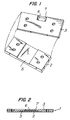
- Drawing 1 is an exploded view of the mold apparatus for manufacturing the nail coatings.
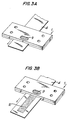
- Drawing 2 is a longitudinal cross-sectional view of the mold for manufacturing the nail coatings, shown in its assembled state.
- Drawing 3(A) is a perspective view of the mold apparatus for manufacturing the nail coatings, shown with the adhesive-backed strip of paper located in the mold yet, prior to passing the paper through the mold.
- the drawing also shows the mold fill-hole full of liquid nail enamel.
- Drawing 3(B) is a perspective view of the mold apparatus for manufacturing the nail coatings, shown with the adhesive-backed strip of paper having been partially pulled through the mold, and the liquid nail enamel having been uniformly coated onto a portion of the strip of paper; the level of liquid nail enamel, in the mold fill-hole being lower than that shown in Drawing 3(A), since a portion of the liquid has now been transferred to the strip of paper, as also shown in this drawing.
- Drawing 4(A) is a partial perspective view of the nail coating product or manicure film, after it has been appropriately cut and shows individual nail coatings.
- Drawing 4 (B) is a partial perspective view of the nail coating product or manicure film after it has been further coated or printed with an attractive design, superimposed on top of the initial colored background, of semi-solid, nail enamel.
- Drawing 5 is a partial cross-sectional view of the nail coatings, after drying on the adhesively-backed paper, i.e., the manicure film is coated on the adhesive-backed paper and some adhesive is transferred to the nail enamel on its bottom or underneath surface.
- Drawings 6 show the fingernail coatings, after application to an individual nail, and also shows a second finger and nail of the fingernail coating-applying individual, as it is used for further trimming of the fingernail coating to the shape and dimensions of the nail on which the coating is applied.
- the Drawings also show the finished "polished" look of the individual's fingernails, both with a solid color nail enamel and, in addition, shows the fingernail coating if it has the printed design superimposed on a solid color background.
- the present invention relates to fingernail coatings which are applied to an individual's nails in a minimum of time, with minimum effort, require a minimum of drying time and, yet, provide a visually pleasing look of "just polished,” high gloss, appear as if the nails were polished with liquid nail polish and, also, provide, where desired, the look of a French manicure, i.e., the look of a design of nail polish coated on top of a background of solid nail polish.
- the present invention provides, during the final curing or drying of the semi-solid nail coatings, the otherwise available and olfactory pleasing smell of liquid nail enamel as it dries but on a reduced level.
- a mold (best seen in Drawings 1, 2, 3 and 4) is used, generally referred to as 1, and comprises a bottom half or panel 2 and an upper half or panel 3.
- the bottom half or panel 2 has a center passage 5 recessed therein which serves to guide the passage of and hold a strip of adhesively-backed paper therethrough, when the mold is assembled together.
- the depth of the passage 5 is sufficient to allow the adhesive-backed strip of paper 4 to be easily pulled through the mold and to have the liquid nail polish become uniformly coated onto the strip of paper as it is pulled through the mold at a uniform rate.
- a set of alignment and mold securing holes are provided along with corresponding pegs to assemble the halves 2 and 3 together.
- the upper half or panel 3 is provided with a mold fill hole or aperture 6 which completely passes through the upper half or panel 3.
- liquid nail enamel can be poured into the mold fill hole 6 and as the paper strip 4, having an adhesive backing, is pulled through the passage 5 (with the adhesive material facing towards the bottom of the upper half or panel 3), the liquid nail enamel is uniformly coated onto the strip of paper.
- the strip of paper provides adhesiveness beneath the application of the liquid nail enamel so that upon separation of the adhesive backing sheet from the nail coatings, after initial drying of the liquid nail coatings into their semi-solid state, the nail coatings are themselves adhesively backed and thus capable of being easily secured, by location and pressing, onto the nail.
- the mold fill hole 6 downwardly expands, from the top of the upper half or panel 3 to the bottom thereof, i.e., it outwardly tapers from the top surface of the upper half or panel 3 to the bottom surface (the surface which is intended to be placed immediately over and in contact with the upper surface of the bottom half or panel 2).
- This allows the nail enamel liquid to spread out over a larger area than area of the top opening of the mold fill hole 6.
- the length of the bottom or enlarged portion 7 of the mold fill hole 6 corresponds to the length of the fingernails sought to be coated with the ultimate product produced by the mold, i.e., the fingernail coatings.
- Drawing 3(A) shows a strip of adhesive-backed paper 4, located between the upper half or panel 3 and the lower half or panel 2 of the mold 1, with the paper 4 secured within the confines of passage 5.
- This drawing also shows the mold, in its assembled state, with the mold fill hole 6 fully filled with liquid nail enamel 9.
- the arrow shown in Drawing 3(A) shows the intended direction of pulling the paper 4, during the manufacturing process.
- Drawing 3(B) shows the same assembled mold, after a portion of the adhesively-backed strip of paper 4 has been pulled through the passage 5 of the mold 1.
- This Drawing shows the paper 4 coated with a uniform thickness of nail enamel 10 of substantially the same length as the length of the large portion 7 of the fill up hole 6 (See Drawing 3(B)).
- this Drawing shows how the level of the liquid nail enamel 9 has become reduced down below the top surface of the upper half or panel 3, as the paper 4 has been pulled through the mold and as the nail enamel has become coated onto the paper 4.
- the downward decrease of the level of the liquid nail enamel 9 is directly related to the quantity of liquid nail enamel coated onto the adhesively-backed sheet of paper 4.
- the upper half or panel 3 overlies the lower half or panel 2.
- the liquid nail enamel 9 is injected into the mold fill hole 6. Then, the paper is slowly and at a uniform rate, pulled through the passage 5.
- the lamination of the paper 4 with the liquid nail enamel 9 is preferably to a thickness of about 0.04 mm (40 microns).
- the paper, with the liquid nail enamel coated thereon is dried at about 30° C. for about 5 minutes. It is then further cooled for about 2 to 3 minutes at about 0° C. This produces a semi-solid set of nail coatings which are adhesively-backed, when removed from the paper 4.
- the film turns into a semi-solid state as it is dried at about 30° C. for about 5 minutes.
- the adhesive layer of the adhesive-backed strip of paper 4 maintains its adhesion and yet, transfers it to the underside of the coatings because the nail enamel does not significantly volatilise there.
- the film 10 does not fully dry since it is cooled, after initial drying, at about 0° C. for about 2 to 3 minutes.
- Drawing 5 shows a partial cross-sectioned view of the nail coatings after drying on the adhesive-backed paper 4.
- the film 13 is coated on the adhesive-backed paper 4 and some of the adhesive 8 is transferred to the nail enamel 13 on its bottom or underneath surface.
- fanciful drawing patterns are pad printed onto the cooled and dried semi-solid nail coatings.
- the drawing patterns 11 are shown in Drawing 4(B) and also in Drawing 6.
- the enamel portion of the strips are scored and trimmed according to the size of the fingernails 12.
- the coatings are cut into sets of five fingernail coatings and stored or packaged in a semi-solid state in a closed container.
- the container is an air-tight plastic envelope.
- the fingernail coatings after drying can be handled rather cleanly and the coatings can be easily attached to fingernails.
- the attachment of the fingernail coatings to the fingernails is facilitated by the use of a ribbon or tear strip 14, attached at one side of the semi-solid nail enamel coatings.
- the semi-solid fingernail coatings when desirably attached to the fingernails, are removed from the packaging, as a set of five fingernails, i.e., enough for coating an entire hand, separated, if desired into individual nail coatings, removed from the adhesive-backed strip of paper (facilitated by the ribbon or tear strip 14) and initially secured to the nail. Then, the fingernail coatings are firmly pressed onto the nail. After securing it to the nail, the portion of the nail coating extending over the edge of the nail can be cut off, by scissor, or by using another nail and scraping it against the edge of the just-coated nail. It is then a short period of time for the fingernail coatings to completely dry.
Landscapes
- Cosmetics (AREA)
- Adhesives Or Adhesive Processes (AREA)
- Coating Apparatus (AREA)
Claims (10)
- Produkt zur Bereitstellung einer Nagellackschicht auf einem Fingernagel, umfassend:(a) ein Trägerblatt (4) aus Papier mit einer Haftschicht (8);(b) eine im wesentlichen einheitlich dicke, flache Schicht aus teilweise gehärtetem Nagellackmaterial (13) in der allgemeinen Form eines Fingernagels (12); und(c) eine im wesentlichen luftdichte Verpackung, in der das Trägerblatt aus Papier (4) und die Schicht aus Nagellackmaterial (13) vor der Verwendung gelagert werden, um eine weitere Härtung zu verhindern, bis die Verpackung geöffnet wirdwobei es so angeordnet ist, daß das Nagellackmaterial (13), wenn es von dem Trägerblatt entfernt wird, nicht flüssig, jedoch dreidimensional an die Krümmung eines Fingernagels anpaßbar ist und zumindest ein Teil der Haftschicht (8) auf seiner Bodenoberfläche (13') zur Befestigung auf einem Fingernagel (12) zurückbleibt.
- Produkt nach Anspruch 1, das weiter eine Bandeinrichtung umfaßt, die an das Trägerblatt aus Papier (4) zur Erleichterung der Entfernung der Schicht (13) aus dem Lackmaterial von dem Trägerblatt angebracht ist.
- Produkt nach Anspruch 1, worin die Schicht aus dem Nagellackmaterial (13) etwa 0,04 mm dick ist.
- Produkt nach Anspruch 1, worin die Schicht aus dem Nagellackmaterial (13) aus einem flüssigen, im Handel erhältlichen Nagellack gebildet werden kann.
- Produkt nach Anspruch 1, das weiter ein visuelles Designmuster (11) umfaßt, das direkt auf der Schicht aus Nagellackmaterial (13) aufgedruckt ist.
- Produkt nach Anspruch 5, worin das visuelle Designmuster (11) durch Klotzdruck auf der Schicht des Nagellackmaterials (13) erhältlich ist.
- Verfahren zur Herstellung eines Produkts zur Bereitstellung einer Nagellackschicht, umfassend:(i) Bereitstellen eines Trägerblatts (4) aus Papier mit einer Haftschicht (8);(ii) Aufbringen einer Schicht aus flüssigem Nagellackmaterial (13) in der allgemeinen Form eines Fingernagels (12) auf die Haftschicht (8);(iii) teilweise Härten lassen der Schicht aus Nagellackmaterial (13) zu einer im wesentlichen einheitlich dicken, flachen, nicht flüssigen Schicht, die, wenn sie von dem Trägerblatt (4) entfernt wird, zumindest einen Teil der Haftschicht (8) auf ihrer Bodenoberfläche (13') zurückbehält und dreidimensional an die Krümmung eines Fingernagels (12) anpaßbar ist; und(iv) Versiegeln der Struktur in einer luftdichten Verpackung, um ein weiteres Härten des Nagellackmaterials zu verhindern, bis die Verpackung geöffnet wird.
- Verfahren nach Anspruch 7, worin die Schicht aus Nagellackmaterial (13) aus flüssigem, im Handel erhältlichem Nagellack gebildet wird.
- Verfahren nach Anspruch 7 oder 8, das das Drucken eines visuellen Designmusters (11) auf der Schicht aus Nagellackmaterial (13) vor dem Versiegeln der Struktur in der Verpackung umfaßt.
- Verfahren nach Anspruch 9, worin das Design (11) durch Klotzdruck auf die Schicht aus Nagellack aufgebracht wird.
Applications Claiming Priority (1)
| Application Number | Priority Date | Filing Date | Title |
|---|---|---|---|
| PCT/US1990/000919 WO1991012747A1 (en) | 1990-02-23 | 1990-02-23 | Self adhesive nail coatings |
Publications (3)
| Publication Number | Publication Date |
|---|---|
| EP0519918A1 EP0519918A1 (de) | 1992-12-30 |
| EP0519918A4 EP0519918A4 (de) | 1994-03-30 |
| EP0519918B1 true EP0519918B1 (de) | 1997-07-16 |
Family
ID=22220695
Family Applications (1)
| Application Number | Title | Priority Date | Filing Date |
|---|---|---|---|
| EP90907814A Expired - Lifetime EP0519918B1 (de) | 1990-02-23 | 1990-02-23 | Selbstklebende nagellackschichten |
Country Status (6)
| Country | Link |
|---|---|
| EP (1) | EP0519918B1 (de) |
| AT (1) | ATE155323T1 (de) |
| CA (1) | CA2075912C (de) |
| DE (1) | DE69031081T2 (de) |
| ES (1) | ES2106733T3 (de) |
| WO (1) | WO1991012747A1 (de) |
Families Citing this family (3)
| Publication number | Priority date | Publication date | Assignee | Title |
|---|---|---|---|---|
| GB2354706A (en) * | 1999-09-28 | 2001-04-04 | Francesco Zoppi | Self-adhesive nail decoration |
| FR2870452B1 (fr) * | 2004-05-19 | 2008-10-03 | Oreal | Film de vernis a ongles a effet optique |
| US8539697B2 (en) | 2010-10-11 | 2013-09-24 | Tbl Licensing Llc | Suspension heel |
Family Cites Families (5)
| Publication number | Priority date | Publication date | Assignee | Title |
|---|---|---|---|---|
| US2688331A (en) * | 1949-08-03 | 1954-09-07 | Bogoslowsky Elizabeth | Nail coating blank and method of making same |
| US2581982A (en) * | 1950-03-07 | 1952-01-08 | Lila G Terry | Manicuring device |
| US2816555A (en) * | 1955-01-07 | 1957-12-17 | Charles A Klump | Decorative shield for finger nail |
| WO1988002227A1 (fr) * | 1986-10-01 | 1988-04-07 | Masayuki Hattori | Feuille de manucure |
| KR880013498A (ko) * | 1987-05-29 | 1988-12-21 | 소대섭 | 메니큐어용 필름의 성형장치 |
-
1990
- 1990-02-23 EP EP90907814A patent/EP0519918B1/de not_active Expired - Lifetime
- 1990-02-23 WO PCT/US1990/000919 patent/WO1991012747A1/en not_active Ceased
- 1990-02-23 ES ES90907814T patent/ES2106733T3/es not_active Expired - Lifetime
- 1990-02-23 CA CA002075912A patent/CA2075912C/en not_active Expired - Lifetime
- 1990-02-23 AT AT90907814T patent/ATE155323T1/de not_active IP Right Cessation
- 1990-02-23 DE DE69031081T patent/DE69031081T2/de not_active Expired - Lifetime
Also Published As
| Publication number | Publication date |
|---|---|
| CA2075912A1 (en) | 1991-08-24 |
| DE69031081D1 (de) | 1997-08-21 |
| EP0519918A4 (de) | 1994-03-30 |
| WO1991012747A1 (en) | 1991-09-05 |
| ATE155323T1 (de) | 1997-08-15 |
| ES2106733T3 (es) | 1997-11-16 |
| EP0519918A1 (de) | 1992-12-30 |
| CA2075912C (en) | 2000-05-09 |
| DE69031081T2 (de) | 1998-01-02 |
Similar Documents
| Publication | Publication Date | Title |
|---|---|---|
| US4903840A (en) | Self adhesive nail coatings | |
| US8826917B2 (en) | Method and product for attaining a french manicure using a dry nail applique | |
| US8061363B2 (en) | Method and product for attaining a French manicure using a dry nail polish applique | |
| US2288386A (en) | Method of manicuring and article for same | |
| KR101906154B1 (ko) | Uv젤의 네일 도포를 개선하는 방법과 장치 | |
| US5044384A (en) | Method of accomplishing rapid and durable manicure | |
| US4767648A (en) | Method of accomplishing rapid and durable french manicure | |
| US20110030712A1 (en) | Methods and devices for applying solid nail coating to mammalian and artificial nails | |
| US20130139840A1 (en) | Multiple Style Nail Applique | |
| US20070235051A1 (en) | Artificial nail kit and fluid dispenser | |
| US10702042B2 (en) | Apparatus and method for applying cosmetic eyebrows | |
| US9820553B2 (en) | Apparatus and method for applying cosmetic eyebrows | |
| US20220312930A1 (en) | Hybrid gel nail sticker | |
| US20130206157A1 (en) | Method and product for attaining a french manicure using a dry nail appliqué | |
| US10264867B2 (en) | Method and apparatus for nail foil adornment, repair, protection and strengthening of the nails' plate of the finger or toe | |
| EP0519918B1 (de) | Selbstklebende nagellackschichten | |
| US10820680B1 (en) | Stencil assembly and method of applying a cosmetic or other product using a stencil assembly | |
| US4913173A (en) | High efficiency wrap package, and process, for nails | |
| KR102226272B1 (ko) | 네일아트용 스티커 | |
| US20070246056A1 (en) | Method for fingernail decoration | |
| JP2688078B2 (ja) | 美爪用の自己接着性爪被覆材及びその製造方法 | |
| KR200213256Y1 (ko) | 향 발산 스티커형 매니큐어 | |
| JP2576293Y2 (ja) | ネイルカラー見本具 | |
| JPS5939934Y2 (ja) | スポツトフエイスペイント | |
| JPH08252113A (ja) | 口紅用の化粧補助シール |
Legal Events
| Date | Code | Title | Description |
|---|---|---|---|
| PUAI | Public reference made under article 153(3) epc to a published international application that has entered the european phase |
Free format text: ORIGINAL CODE: 0009012 |
|
| 17P | Request for examination filed |
Effective date: 19920819 |
|
| AK | Designated contracting states |
Kind code of ref document: A1 Designated state(s): AT BE CH DE DK ES FR GB IT LI LU NL SE |
|
| A4 | Supplementary search report drawn up and despatched |
Effective date: 19940209 |
|
| AK | Designated contracting states |
Kind code of ref document: A4 Designated state(s): AT BE CH DE DK ES FR GB IT LI LU NL SE |
|
| 17Q | First examination report despatched |
Effective date: 19950804 |
|
| GRAG | Despatch of communication of intention to grant |
Free format text: ORIGINAL CODE: EPIDOS AGRA |
|
| GRAH | Despatch of communication of intention to grant a patent |
Free format text: ORIGINAL CODE: EPIDOS IGRA |
|
| GRAH | Despatch of communication of intention to grant a patent |
Free format text: ORIGINAL CODE: EPIDOS IGRA |
|
| GRAA | (expected) grant |
Free format text: ORIGINAL CODE: 0009210 |
|
| AK | Designated contracting states |
Kind code of ref document: B1 Designated state(s): AT BE CH DE DK ES FR GB IT LI LU NL SE |
|
| PG25 | Lapsed in a contracting state [announced via postgrant information from national office to epo] |
Ref country code: NL Free format text: LAPSE BECAUSE OF FAILURE TO SUBMIT A TRANSLATION OF THE DESCRIPTION OR TO PAY THE FEE WITHIN THE PRESCRIBED TIME-LIMIT Effective date: 19970716 Ref country code: DK Effective date: 19970716 |
|
| REF | Corresponds to: |
Ref document number: 155323 Country of ref document: AT Date of ref document: 19970815 Kind code of ref document: T |
|
| REG | Reference to a national code |
Ref country code: CH Ref legal event code: EP Ref country code: CH Ref legal event code: NV Representative=s name: ARDIN & CIE S.A. |
|
| ET | Fr: translation filed | ||
| REF | Corresponds to: |
Ref document number: 69031081 Country of ref document: DE Date of ref document: 19970821 |
|
| ITF | It: translation for a ep patent filed | ||
| REG | Reference to a national code |
Ref country code: ES Ref legal event code: FG2A Ref document number: 2106733 Country of ref document: ES Kind code of ref document: T3 |
|
| NLV1 | Nl: lapsed or annulled due to failure to fulfill the requirements of art. 29p and 29m of the patents act | ||
| PG25 | Lapsed in a contracting state [announced via postgrant information from national office to epo] |
Ref country code: LU Free format text: LAPSE BECAUSE OF NON-PAYMENT OF DUE FEES Effective date: 19980223 |
|
| PLBE | No opposition filed within time limit |
Free format text: ORIGINAL CODE: 0009261 |
|
| STAA | Information on the status of an ep patent application or granted ep patent |
Free format text: STATUS: NO OPPOSITION FILED WITHIN TIME LIMIT |
|
| 26N | No opposition filed | ||
| PGFP | Annual fee paid to national office [announced via postgrant information from national office to epo] |
Ref country code: SE Payment date: 20010220 Year of fee payment: 12 |
|
| PGFP | Annual fee paid to national office [announced via postgrant information from national office to epo] |
Ref country code: AT Payment date: 20010226 Year of fee payment: 12 |
|
| PGFP | Annual fee paid to national office [announced via postgrant information from national office to epo] |
Ref country code: CH Payment date: 20010306 Year of fee payment: 12 |
|
| PGFP | Annual fee paid to national office [announced via postgrant information from national office to epo] |
Ref country code: BE Payment date: 20010314 Year of fee payment: 12 |
|
| REG | Reference to a national code |
Ref country code: GB Ref legal event code: IF02 |
|
| PG25 | Lapsed in a contracting state [announced via postgrant information from national office to epo] |
Ref country code: AT Free format text: LAPSE BECAUSE OF NON-PAYMENT OF DUE FEES Effective date: 20020223 |
|
| PG25 | Lapsed in a contracting state [announced via postgrant information from national office to epo] |
Ref country code: SE Free format text: LAPSE BECAUSE OF NON-PAYMENT OF DUE FEES Effective date: 20020224 |
|
| PG25 | Lapsed in a contracting state [announced via postgrant information from national office to epo] |
Ref country code: LI Free format text: LAPSE BECAUSE OF NON-PAYMENT OF DUE FEES Effective date: 20020228 Ref country code: CH Free format text: LAPSE BECAUSE OF NON-PAYMENT OF DUE FEES Effective date: 20020228 Ref country code: BE Free format text: LAPSE BECAUSE OF NON-PAYMENT OF DUE FEES Effective date: 20020228 |
|
| BERE | Be: lapsed |
Owner name: PARK HWA YOUNG Effective date: 20020228 |
|
| EUG | Se: european patent has lapsed |
Ref document number: 90907814.9 |
|
| REG | Reference to a national code |
Ref country code: CH Ref legal event code: PL |
|
| PGFP | Annual fee paid to national office [announced via postgrant information from national office to epo] |
Ref country code: ES Payment date: 20090204 Year of fee payment: 20 |
|
| PGFP | Annual fee paid to national office [announced via postgrant information from national office to epo] |
Ref country code: DE Payment date: 20090219 Year of fee payment: 20 |
|
| PGFP | Annual fee paid to national office [announced via postgrant information from national office to epo] |
Ref country code: GB Payment date: 20090119 Year of fee payment: 20 |
|
| PGFP | Annual fee paid to national office [announced via postgrant information from national office to epo] |
Ref country code: IT Payment date: 20090128 Year of fee payment: 20 |
|
| PGFP | Annual fee paid to national office [announced via postgrant information from national office to epo] |
Ref country code: FR Payment date: 20090129 Year of fee payment: 20 |
|
| REG | Reference to a national code |
Ref country code: GB Ref legal event code: PE20 Expiry date: 20100222 |
|
| REG | Reference to a national code |
Ref country code: ES Ref legal event code: FD2A Effective date: 20100224 |
|
| PG25 | Lapsed in a contracting state [announced via postgrant information from national office to epo] |
Ref country code: GB Free format text: LAPSE BECAUSE OF EXPIRATION OF PROTECTION Effective date: 20100222 |
|
| PG25 | Lapsed in a contracting state [announced via postgrant information from national office to epo] |
Ref country code: ES Free format text: LAPSE BECAUSE OF EXPIRATION OF PROTECTION Effective date: 20100224 |
|
| PG25 | Lapsed in a contracting state [announced via postgrant information from national office to epo] |
Ref country code: DE Free format text: LAPSE BECAUSE OF EXPIRATION OF PROTECTION Effective date: 20100223 |