EP0515485B1 - Verfahren zum hydrieren - Google Patents
Verfahren zum hydrieren Download PDFInfo
- Publication number
- EP0515485B1 EP0515485B1 EP91904435A EP91904435A EP0515485B1 EP 0515485 B1 EP0515485 B1 EP 0515485B1 EP 91904435 A EP91904435 A EP 91904435A EP 91904435 A EP91904435 A EP 91904435A EP 0515485 B1 EP0515485 B1 EP 0515485B1
- Authority
- EP
- European Patent Office
- Prior art keywords
- reactor
- reactors
- gas
- hydrogen
- fat
- Prior art date
- Legal status (The legal status is an assumption and is not a legal conclusion. Google has not performed a legal analysis and makes no representation as to the accuracy of the status listed.)
- Expired - Lifetime
Links
- 238000005984 hydrogenation reaction Methods 0.000 title claims description 11
- 239000007789 gas Substances 0.000 claims abstract description 27
- 239000001257 hydrogen Substances 0.000 claims abstract description 22
- 229910052739 hydrogen Inorganic materials 0.000 claims abstract description 22
- 239000003925 fat Substances 0.000 claims abstract description 21
- UFHFLCQGNIYNRP-UHFFFAOYSA-N Hydrogen Chemical compound [H][H] UFHFLCQGNIYNRP-UHFFFAOYSA-N 0.000 claims abstract description 17
- 238000000034 method Methods 0.000 claims abstract description 15
- 239000003921 oil Substances 0.000 claims abstract description 12
- 235000014113 dietary fatty acids Nutrition 0.000 claims abstract description 10
- 229930195729 fatty acid Natural products 0.000 claims abstract description 10
- 239000000194 fatty acid Substances 0.000 claims abstract description 10
- 150000002191 fatty alcohols Chemical class 0.000 claims abstract description 9
- -1 fatty acid esters Chemical class 0.000 claims abstract description 5
- 150000004665 fatty acids Chemical class 0.000 claims abstract description 5
- 239000000047 product Substances 0.000 claims description 11
- 239000007788 liquid Substances 0.000 claims description 10
- 239000007795 chemical reaction product Substances 0.000 claims description 8
- 150000002431 hydrogen Chemical class 0.000 claims description 5
- 239000012071 phase Substances 0.000 claims description 5
- 239000007791 liquid phase Substances 0.000 claims description 4
- 238000000926 separation method Methods 0.000 claims description 3
- 238000001816 cooling Methods 0.000 claims description 2
- 230000003134 recirculating effect Effects 0.000 claims 1
- 239000003054 catalyst Substances 0.000 abstract description 12
- OKKJLVBELUTLKV-UHFFFAOYSA-N Methanol Chemical compound OC OKKJLVBELUTLKV-UHFFFAOYSA-N 0.000 description 15
- 235000019197 fats Nutrition 0.000 description 10
- 238000006243 chemical reaction Methods 0.000 description 6
- 235000019198 oils Nutrition 0.000 description 5
- DNIAPMSPPWPWGF-UHFFFAOYSA-N Propylene glycol Chemical compound CC(O)CO DNIAPMSPPWPWGF-UHFFFAOYSA-N 0.000 description 4
- 235000019387 fatty acid methyl ester Nutrition 0.000 description 4
- 238000007127 saponification reaction Methods 0.000 description 4
- DNIAPMSPPWPWGF-GSVOUGTGSA-N (R)-(-)-Propylene glycol Chemical compound C[C@@H](O)CO DNIAPMSPPWPWGF-GSVOUGTGSA-N 0.000 description 3
- 241000196324 Embryophyta Species 0.000 description 3
- 239000003240 coconut oil Substances 0.000 description 3
- 235000019864 coconut oil Nutrition 0.000 description 3
- 229960004063 propylene glycol Drugs 0.000 description 3
- 235000013772 propylene glycol Nutrition 0.000 description 3
- ZCYVEMRRCGMTRW-UHFFFAOYSA-N 7553-56-2 Chemical compound [I] ZCYVEMRRCGMTRW-UHFFFAOYSA-N 0.000 description 2
- 229910052740 iodine Inorganic materials 0.000 description 2
- 239000011630 iodine Substances 0.000 description 2
- 239000000463 material Substances 0.000 description 2
- 239000012495 reaction gas Substances 0.000 description 2
- 239000004215 Carbon black (E152) Substances 0.000 description 1
- 238000009825 accumulation Methods 0.000 description 1
- 239000006227 byproduct Substances 0.000 description 1
- 238000009903 catalytic hydrogenation reaction Methods 0.000 description 1
- 238000010586 diagram Methods 0.000 description 1
- 239000007792 gaseous phase Substances 0.000 description 1
- 230000036571 hydration Effects 0.000 description 1
- 238000006703 hydration reaction Methods 0.000 description 1
- 229930195733 hydrocarbon Natural products 0.000 description 1
- 150000002430 hydrocarbons Chemical class 0.000 description 1
- 238000010327 methods by industry Methods 0.000 description 1
- 239000000203 mixture Substances 0.000 description 1
- 239000003346 palm kernel oil Substances 0.000 description 1
- 235000019865 palm kernel oil Nutrition 0.000 description 1
- 238000000746 purification Methods 0.000 description 1
- 239000011541 reaction mixture Substances 0.000 description 1
- 238000011144 upstream manufacturing Methods 0.000 description 1
- 230000035899 viability Effects 0.000 description 1
Images



Classifications
-
- C—CHEMISTRY; METALLURGY
- C07—ORGANIC CHEMISTRY
- C07C—ACYCLIC OR CARBOCYCLIC COMPOUNDS
- C07C29/00—Preparation of compounds having hydroxy or O-metal groups bound to a carbon atom not belonging to a six-membered aromatic ring
- C07C29/132—Preparation of compounds having hydroxy or O-metal groups bound to a carbon atom not belonging to a six-membered aromatic ring by reduction of an oxygen containing functional group
- C07C29/136—Preparation of compounds having hydroxy or O-metal groups bound to a carbon atom not belonging to a six-membered aromatic ring by reduction of an oxygen containing functional group of >C=O containing groups, e.g. —COOH
- C07C29/147—Preparation of compounds having hydroxy or O-metal groups bound to a carbon atom not belonging to a six-membered aromatic ring by reduction of an oxygen containing functional group of >C=O containing groups, e.g. —COOH of carboxylic acids or derivatives thereof
- C07C29/149—Preparation of compounds having hydroxy or O-metal groups bound to a carbon atom not belonging to a six-membered aromatic ring by reduction of an oxygen containing functional group of >C=O containing groups, e.g. —COOH of carboxylic acids or derivatives thereof with hydrogen or hydrogen-containing gases
-
- Y—GENERAL TAGGING OF NEW TECHNOLOGICAL DEVELOPMENTS; GENERAL TAGGING OF CROSS-SECTIONAL TECHNOLOGIES SPANNING OVER SEVERAL SECTIONS OF THE IPC; TECHNICAL SUBJECTS COVERED BY FORMER USPC CROSS-REFERENCE ART COLLECTIONS [XRACs] AND DIGESTS
- Y02—TECHNOLOGIES OR APPLICATIONS FOR MITIGATION OR ADAPTATION AGAINST CLIMATE CHANGE
- Y02P—CLIMATE CHANGE MITIGATION TECHNOLOGIES IN THE PRODUCTION OR PROCESSING OF GOODS
- Y02P20/00—Technologies relating to chemical industry
- Y02P20/50—Improvements relating to the production of bulk chemicals
- Y02P20/52—Improvements relating to the production of bulk chemicals using catalysts, e.g. selective catalysts
Definitions
- the invention relates to a process for the hydrogenation of native fats, oils and fat derivatives such as fatty acids and fatty acid esters to fatty alcohols in a fixed bed reactor, in particular in cocurrent, with hydrogen being circulated in a stoichiometric excess, in particular with a 10 to 100-fold excess, and the fat, oil or Fat derivative passes through the reactor only once.
- the actual hydrogenation reaction takes place in one or more fixed bed reactors connected in series at temperatures of 200 to 250 ° C and a hydrogen pressure of 200 to 300 bar.
- the fatty acid methyl ester is pressed into the system by means of press pumps, where it is mixed with compressed hydrogen, heated together with it to the reaction temperature and passed into the reactor from above.
- the reaction mixture After passing through the reactors, the reaction mixture is cooled and separated into the liquid phase and the gas phase in a separator.
- the liquid phase is decompressed and passed to the methanol separation, while the gas phase consisting mainly of hydrogen is circulated through a compressor.
- the methanol designed as an evaporator system removes the fatty alcohol from the methanol and can then be used without further purification (see H. Komp and HPKubersky in: "Fettalkohole", Henkel KGaA (ed.), Eigenverlag, 1981, pp. 51 to 79 ).
- the hydrogen is recirculated in technical plants for economic reasons.
- the hydrogen must be cooled from 230 ° C to about 50 ° C after passing through the reactor, compressed with the cycle gas compressor and heated again to the reaction temperature in the tip heater.
- the economic viability of such a hydrogenation process in terms of investment and operating costs is therefore largely determined by the specific cycle gas requirement (Nm3 H2 / t reaction product).
- the object of the invention is therefore to minimize the specific hydrogen requirement by means of process engineering measures, without having to accept significant losses in relation to specific reactor load, product selectivity and catalyst life.
- This object is achieved in a method of the type mentioned in that the hydrogen is passed through at least two fixed bed reactors in succession without that the gas emerging from the reactors and entering the subsequent reactors is cooled, and that the fat, oil or fat derivative is fed into the reactors in parallel.
- the process of the invention can be independent of the specific embodiment of the reactor, for. B. as a shaft reactor or tube reactor, and regardless of its mode of operation, for. B. operated adiabatically or isothermally.
- the specific amount of circulating gas is reduced to 1 / n.
- the accumulation of vaporizable fractions in the gas phase only leads to a slight loss in performance of about 5 to 10% for the second reactor and the subsequent reactors.
- the selectivity of the catalyst and its service life behavior are not significantly influenced.
- the liquid reaction products are separated from the gas emerging from the preceding reactors before the gas enters the respective subsequent reactor. It is particularly advantageous if the liquid reaction products separated from the gas are fed to the gas emerging from the last reactor, cooled together with the latter, separated into a liquid phase and a gaseous phase, and the latter is then returned to the first reactor.
- the invention also relates to a plant for the hydrogenation of feed products consisting of native fats, oils and fat derivatives such as fatty acid and fatty acid esters to form fatty alcohols, with at least a fixed bed reactor for passing the feed product and the hydrogen, with upstream heaters for the feed product and for the hydrogen, with a cooling device for the reactor outlet and a downstream separator for gas-liquid separation which is connected to the reactor for returning the gas.
- feed products consisting of native fats, oils and fat derivatives such as fatty acid and fatty acid esters to form fatty alcohols
- the object of the invention is achieved in this system by at least two fixed-bed reactors connected in series, each of which is connected to one another by a separator, the liquid outlet of which leads to the outlet of the last reactor, and by a parallel feed of the feed product to each of the reactors.
- each feed of the feed product has a pump and a heat exchanger.
- the feed quantity and feed temperature can be easily adjusted separately for each reactor.
- Exemplary embodiments of the process according to the invention were run in a 2 ⁇ 20 liter double reactor system.
- coconut oil was directly hydrogenated, producing fatty alcohols and 1,2-propanediol.
- FIG. 2 shows the catalyst loading for the first reactor by open squares and for the subsequent reactor, the second reactor, by filled squares. These LHSV values show that high catalyst loads can still be achieved in the subsequent reactor.
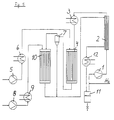
- Figure 5 shows the circuit of the reactors in a schematic representation. From a gas circulation pump 1, fresh hydrogen is fed into the first reactor 4 together with circulating hydrogen via the countercurrent heat exchanger 2 and the top heater 3. At the same time, the feedstock from the pump 5 is pressed into this reactor via the heater 6. The hot reaction gas is freed from the liquid reaction product by the centrifugal separator 7 and passed through the second reactor 10 together with the feed material via the pump 8 and the heater 9. Liquid and gaseous reaction products are fed into the high-pressure separator 11 via the counterflow heat exchanger 2 and the cooler 12. The Reaction gas is compressed together with the fresh hydrogen in compressor 1 and circulated.
- Reaction temperature 185 ° C
- Reaction pressure 250 bar
Landscapes
- Chemical & Material Sciences (AREA)
- Organic Chemistry (AREA)
- Organic Low-Molecular-Weight Compounds And Preparation Thereof (AREA)
- Fats And Perfumes (AREA)
- Low-Molecular Organic Synthesis Reactions Using Catalysts (AREA)
Abstract
Description
- Die Erfindung betrifft ein Verfahren zum Hydrieren von nativen Fetten, Ölen und Fettderivaten wie Fettsäuren und Fettsäureestern zu Fettalkoholen im Festbettreaktor, insbesondere im Gleichstrom, wobei Wasserstoff im stöchiometrischen Überschuß, insbesondere mit 10 bis 100fachem Überschuß, im Kreis gefahren wird und das Fett, Öl oder Fettderivat den Reaktor nur einmal durchläuft.
- Bei einem derartigen bekannten Verfahren, z. B. zum Hydrieren von Fettsäuremethylester, findet die eigentliche Hydrierreaktion in einem oder mehreren hintereinander geschalteten Festbettreaktoren bei Temperaturen von 200 bis 250 °C und einem Wasserstoffdruck von 200 bis 300 bar statt. Dazu wird der Fettsäuremethylester mit Preßpumpen in die Anlage gedrückt, wo er mit komprimiertem Wasserstoff vermischt, gemeinsam mit diesem auf Reaktionstemperatur erhitzt und von oben in den Reaktor geleitet wird.
- Nach Durchlaufen der Reaktoren wird das Reaktionsgemisch gekühlt und in einem Abscheider in die Flüssigphase und die Gasphase aufgetrennt. Die Flüssigphase wird entspannt und zur Methanolabtrennung geleitet, während die hauptsächlich aus Wasserstoff bestehenden Gasphase über einen Kompressor im Kreis geführt wird. In der als Verdampferanlage ausgelegten Methanolabtrennung wird der Fettalkohol vom Methanol befreit und kann dann ohne weitere Reinigung seiner Verwendung zugeführt werden (vgl. H.Komp und H.P.Kubersky in: "Fettalkohole", Henkel KGaA (ed.), Eigenverlag, 1981, S.51 bis 79).
- Jedoch ist bei der katalytischen Hydrierung von Fetten, Ölen und Fettderivaten zu Fettalkoholen im Festbettreaktor (Tricklebed-Fahrweise) insbesondere bei adiabatischer Reaktionsführung ein hoher, 10 bis 100fach über dem stöchiometrischen Bedarf liegender Wasserstoffüberschuß erforderlich, damit durch den hohen Gasüberschuß ein Großteil der Reaktionswärme abgeführt wird. Übertemperaturen im Katalysatorbett führen nämlich vermehrt zu Nebenprodukten und verkürzen die Standzeit des Katalysators.
- In technischen Anlagen wird der Wasserstoff aus wirtschaftlichen Gründen rezirkuliert. Hierzu muß der Wasserstoff nach Passieren des Reaktors von 230 °C auf ca. 50 °C abgekühlt, mit dem Kreisgaskompressor verdichtet und im Spitzenerhitzer erneut auf Reaktionstemperatur aufgeheizt werden. Die Wirtschaftlichkeit eines solchen Hydrierverfahrens in Bezug auf Investions- und Betriebskosten wird daher wesentlich durch den spezifischen Kreisgasbedarf (Nm³ H₂/t Reaktionsprodukt) bestimmt.
- Der Erfindung liegt daher die Aufgabe zugrunde, durch verfahrenstechnische Maßnahmen den spezifischen Wasserstoffbedarf zu minimieren, ohne hierbei wesentliche Einbußen in Bezug auf spezifische Reaktorbelastung, Produktselektivität und Katalysatorstandzeit hinnehmen zu müssen.
- Diese Aufgabe wird erfindungsgemäß bei einem Verfahren der Eingangs genannten Art dadurch gelöst, daß der Wasserstoff durch mindestens zwei Festbettreaktoren hintereinander geführt wird, ohne daß das aus den Reaktoren austretende und in die nachfolgenden Reaktoren eintretende Gas abgekühlt wird, und daß das Fett, Öl oder Fettderivat parallel in die Reaktoren eingespeist wird.
- Das erfindungsgemäße Verfahren kann unabhängig von der speziellen Ausführungsform des Reaktors, z. B. als Schachtreaktor oder Rohrbündelreaktor, sowie unabhängig von dessen Betriebsweise, z. B. adiabatisch oder isotherm betrieben werden. Bei Hydrieranlagen mit n Reaktoren wird die spezifische Kreisgasmenge auf 1/n verringert. Die Anreicherung verdampfbarer Anteile in der Gasphase führt nur zu einer geringen Leistungseinbuße von etwa 5 bis 10 % für den zweiten Reaktor und die nachfolgenden Reaktoren. Die Selektivität des Katalysators sowie dessen Standzeitverhalten werden nicht signifikant beeinflußt.
- Ferner wird vorgeschlagen, daß das Verfahren mit zwei Reaktoren betrieben wird.
- In einer weiteren vorteilhaften Ausführungsform des erfindungsgemäßen Verfahrens werden von dem aus den vorhergehenden Reaktoren austretenden Gas die flüssigen Reaktionsprodukte abgeschieden, bevor das Gas in den jeweils nachfolgenden Reaktor eintritt. Dabei ist es besonders vorteilhaft, wenn die von dem Gas abgeschiedenen flüssigen Reaktionsprodukte dem aus dem letzten Reaktor austretenden Gas zugeführt, zusammen mit diesem abgekühlt, in eine flüssige Phase und eine gasförmige Phase aufgetrennt werden und die letztere dann in den ersten Reaktor zurückgeführt wird.
- Die Erfindung betrifft zum anderen eine Anlage zum Hydrieren von aus nativen Fetten, Ölen und Fettderivaten wie Fettsäure und Fettsäureester bestehenden Einsatzprodukten zu Fettalkoholen, mit mindestens einem Festbettreaktor zum Hindurchleiten des Einsatzprodukts sowie des Wasserstoffs, mit dem Reaktor vorgeschalteten Erhitzern für das Einsatzprodukt und für den Wasserstoff, mit einer Kühleinrichtung für den Reaktorablauf und einem nachgeschalteten Abscheider zur Gas-Flüssigkeitstrennung, der zum Rückführen des Gases an den Reaktor angeschlossen ist.
- Die erfindungsgemäße Aufgabe wird bei dieser Anlage durch mindestens zwei hintereinandergeschaltete Festbettreaktoren, die über jeweils einen Abscheider miteinander verbunden sind, dessen Flüssigkeitsablauf zum Ablauf des letzten Reaktors geführt ist, und durch eine parallele Zuführung des Einsatzproduktes zu jedem der Reaktoren gelöst.
- Vorteilhaft sind zwei hintereinander geschaltete Festbettreaktoren.
- Insbesondere wird vorgeschlagen, daß jede Zuführung des Einsatzproduktes eine Pumpe und einen Wärmeaustauscher aufweist. Dadurch sind die Feedmenge und Feedtemperatur für jeden Reaktor auf einfache Weise getrennt einstellbar.
- Ausführungsbeispiele der Erfindung sind nachfolgend anhand der Figuren näher erläutert. Es zeigen
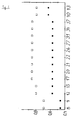
- Figur 1 die Katalysatorbelastung in einem Diagramm durch Angabe des Temperaturverlaufs über dem Verhältnis Feed-Volumen/Katalysator-Volumen,
- Figur 2 die Katalysatorbelastung, ausgedrückt in LHSV und aufgetragen über die Betriebstage bei der Direkthydrierung von Kokosöl,
- Figur 3 den Temperaturverlauf und die Ausbeute an 1,2-Propandiol bei der Kokosöldirekthydrierung, aufgetragen über die Betriebstage und
- Figur 4 die Verseifungszahl bei dieser Direkthydrierung, aufgetragen ebenfalls über die Betriebstage und
- Figur 5 ein Beispiel für die erfindungsgemäße Anlage, schematisch dargestellt.
- In einer 2 x 20-Liter-Doppelreaktoranlage wurden Ausführungsbeispiele des erfindungsgemäßen Verfahrens gefahren. Dabei wurde Kokosöl direkt hydriert, wobei Fettalkohole und 1,2-Propandiol entstehen.
- In Figur 1 sind die Ergebnisse hinsichtlich der Katalysator-Lebensdauer beim erfindungsgemäßen Verfahren, das mit LHSV = 0,71 betrieben wurde, durch Dreiecke dargestellt. Ein Vergleichsbeispiel in üblicher Fahrweise mit LHSV = 0,72 ist durch die Quadrate gekennzeichnet. Es ist ersichtlich, daß die Katalysator-Lebensdauer durch das erfindungsgemäße Verfahren nicht wesentlich verkürzt wird.
- In Figur 2 ist die Katalysatorbelastung für den ersten Reaktor durch offene Quadrate und für den nachfolgenden Reaktor, den zweiten Reaktor, durch ausgefüllte Quadrate dargestellt. Diese LHSV-Werte zeigen, daß bei dem nachfolgenden Reaktor noch hohe Katalysatorbelastungen erreichbar sind.
- In Figur 3 ist die Temperatur durch die offenen Quadrate und die Ausbeute an 1,2 Propandiol durch die ausgefüllten Quadrate dargestellt. Auch nach längerer Betriebsdauer erhält man noch eine gute Ausbeute. Dies wird auch in Figur 4 deutlich, in der die Verseifungszahl für den ersten Reaktor durch die offenen Quadrate und den zweiten Reaktor durch die ausgefüllten Quadrate dargestellt ist.
- Nähere Daten zum Ausführungsbeispiel finden sich in Tabelle 1.
- Figur 5 zeigt die Schaltung der Reaktoren in einer schematischen Darstellung. Von einer Gasumlaufpumpe 1 wird frischer Wasserstoff zusammen mit Kreis-Wasserstoff über den Gegenstromwärmeaustauscher 2 und den Spitzenerhitzer 3 in den ersten Reaktor 4 eingespeist. In diesen Reaktor wird gleichzeitig der Einsatzstoff von der Pumpe 5 über den Erhitzer 6 gedrückt. Das heiße Reaktionsgas wird durch den Zentrifugalabscheider 7 vom flüssigen Reaktionsprodukt befreit und zusammen mit dem Einsatzstoff über die Pumpe 8 und den Erhitzer 9 durch den zweiten Reaktor 10 geleitet. Flüssige und gasförmige Reaktionsprodukte werden über den Gegenstromwärmeaustauscher 2 und den Kühler 12 in den Hochdruckabscheider 11 geführt. Das Reaktionsgas wird zusammen mit dem Frischwasserstoff im Kompressor 1 verdichtet und im Kreis gefahren.

- Nachfolgend werden in tabellarischer Form die Ausgangsdaten und Ergebnisse einer Hydrierung von Fettsäuremethylester gemäß der Erfindung angegeben.
- C₁₂-C₁₈-Fettsäuremethylester (dest.) aus Palmkernöl
Kennzahlen Verseifungszahl 244 Jodzahl 16 -
Reaktorvolumen 2 x 20 1 Doppelrohranlage Länge 2 x 6 m -
Reaktionstemperatur 185 °C Reaktionsdruck 250 bar LHSV 0,5 (h⁻¹) Wasserstoff-Kreisgas-Menge 2,0 cbm/h (bei 250 bar/60°C) - C₁₂-C₁₈-Fettalkohol/Methanol-Gemisch
-
Verseifungszahl - Reaktor 1 0,2 - Reaktor 2 0,3 - Die Jodzahlen beider Proben lagen unter 1; der Kohlenwasserstoffgehalt lag unter 0,2 Gew.-%.
-
- 1
- Gasumlaufpumpe
- 2
- Gegenstromwärmeaustauscher
- 3
- Spitzenerhitzer
- 4
- erster Reaktor
- 5
- Pumpe
- 6
- Erhitzer
- 7
- Zentrifugalabscheider
- 8
- Pumpe
- 9
- Erhitzer
- 10
- zweiter Reaktor
- 11
- Hochdruckabscheider
- 12
- Kühler
Claims (7)
- Verfahren zum Hydrieren von nativen Fetten, Ölen und Fettderivaten wie Fettsäuren und Fettsäureestern zu Fettalkoholen im Festbettreaktor, insbesondere im Gleichstrom, wobei Wasserstoff im stöchiometrischen Überschuß, insbesondere mit 10 bis 100fachem Überschuß, im Kreis gefahren wird und das Fett, Öl oder Fettderivat den Reaktor nur einmal durchläuft,
dadurch gekennzeichnet,
daß der Wasserstoff durch mindestens zwei Festbettreaktoren (4, 10) hintereinander geführt wird, ohne daß das aus den Reaktoren (4) austretende und in die nachfolgenden Reaktoren (10) eintretende Gas abgekühlt wird, und daß das Fett, Öl oder Fettderivat parallel in die Reaktoren (4, 10) eingespeist wird. - Verfahren nach Anspruch 1,
dadurch gekennzeichnet,
daß das Verfahren mit zwei Reaktoren (4, 10) betrieben wird. - Verfahren nach Anspruch 1,
dadurch gekennzeichnet,
daß von dem aus den vorhergehenden Reaktoren (4) austretenden Gas die flüssigen Reaktionsprodukte abgeschieden werden, bevor das Gas in den jeweils nachfolgenden Reaktor (10) eintritt. - Verfahren nach Anspruch 3,
dadurch gekennzeichnet,
daß die von dem Gas abgeschiedenen flüssigen Reaktionsprodukte dem aus dem letzten Reaktor (10) austretenden Gas zugeführt, zusammen mit diesem abgekühlt, in eine flüssige Phase und eine gasförmige Phase aufgetrennt werden und die letztere dann in den ersten Reaktor (4) zurückgeführt wird. - Anlage zum Hydrieren von aus nativen Fetten, Ölen und Fettderivaten wie Fettsäure und Fettsäureester bestehenden Ein satzprodukten zu Fettalkoholen,
mit mindestens einem Festbettreaktor (4, 10) zum Hindurchleiten des Einsatzprodukts sowie des Wasserstoffs, mit dem Reaktor (4, 10) vorgeschalteten Erhitzern (2, 3, 6, 9) für das Einsatz produkt und für den Wasserstoff,
mit einer Kühleinrichtung (2, 12) für den Reaktorablauf und einem nachgeschalteten Abscheider (11) zur Gas-Flüssigkeitstrennung, der zum Rückführen des Gases an den Reaktor angeschlossen ist,
gekennzeichnet durch
mindestens zwei hintereinandergeschaltete Festbettreaktoren (4, 10) die über jeweils einen Abscheider (7) miteinander verbunden sind, dessen Flüssigkeitsablauf zum Ablauf des letzten Reaktors (10) geführt ist,
und durch eine parallele Zuführung des Einsatzprodukts zu jedem der Reaktoren (4, 10). - Anlage nach Anspruch 5,
gekennzeichnet durch
zwei hintereinandergeschaltete Festbettreaktoren (4, 10). - Anlage nach Anspruch 5,
dadurch gekennzeichnet,
daß jede Zuführung des Einsatzproduktes eine Pumpe (5, 8) und einen Wärmeaustauscher (6, 9) aufweist.
Applications Claiming Priority (3)
| Application Number | Priority Date | Filing Date | Title |
|---|---|---|---|
| DE4005629 | 1990-02-22 | ||
| DE4005629A DE4005629A1 (de) | 1990-02-22 | 1990-02-22 | Verfahren zum hydrieren |
| PCT/EP1991/000277 WO1991013050A1 (de) | 1990-02-22 | 1991-02-13 | Verfahren zum hydrieren |
Publications (2)
| Publication Number | Publication Date |
|---|---|
| EP0515485A1 EP0515485A1 (de) | 1992-12-02 |
| EP0515485B1 true EP0515485B1 (de) | 1994-11-30 |
Family
ID=6400761
Family Applications (1)
| Application Number | Title | Priority Date | Filing Date |
|---|---|---|---|
| EP91904435A Expired - Lifetime EP0515485B1 (de) | 1990-02-22 | 1991-02-13 | Verfahren zum hydrieren |
Country Status (7)
| Country | Link |
|---|---|
| US (1) | US5324871A (de) |
| EP (1) | EP0515485B1 (de) |
| JP (1) | JP2863005B2 (de) |
| DE (2) | DE4005629A1 (de) |
| ES (1) | ES2065009T3 (de) |
| MY (1) | MY107879A (de) |
| WO (1) | WO1991013050A1 (de) |
Families Citing this family (11)
| Publication number | Priority date | Publication date | Assignee | Title |
|---|---|---|---|---|
| US6683224B1 (en) * | 1995-05-03 | 2004-01-27 | Cognis Deutschland Gmbh & Co. Kg | Process for the production of fatty alcohols |
| US5536889A (en) * | 1995-09-29 | 1996-07-16 | Shell Oil Company | Process for the two-stage hydrogenation of methyl esters |
| US6979751B2 (en) * | 2002-12-23 | 2005-12-27 | Eastman Chemical Company | Processes for the preparation of higher molecular weight ketones |
| US20040265424A1 (en) * | 2003-06-27 | 2004-12-30 | Hayes Thomas M. | Feed ration for finishing swine |
| DE102007027374A1 (de) | 2007-06-11 | 2008-12-18 | Cognis Oleochemicals Gmbh | Verfahren zur Herstellung von 1,2-Propandiol |
| DE102007027371A1 (de) | 2007-06-11 | 2008-12-18 | Cognis Oleochemicals Gmbh | Verfahren zur Herstellung einer Verbindung aufweisend mindestens eine Ester-Gruppe |
| JP5334462B2 (ja) * | 2007-06-11 | 2013-11-06 | 花王株式会社 | 脂肪酸エステルの製造法 |
| JP5179107B2 (ja) * | 2007-07-24 | 2013-04-10 | 花王株式会社 | 水素添加用触媒 |
| DE102008016105A1 (de) | 2008-03-28 | 2009-10-01 | Cognis Oleochemicals Gmbh | Verfahren und Vorrichtung zur katalytischen Hydrierung ungesättigter Fettsäuren und Fettsäurederivate |
| US8766024B2 (en) * | 2009-11-20 | 2014-07-01 | Phillips 66 Company | Process to mitigate the corrosion of oils/fats |
| US11840670B2 (en) | 2020-12-22 | 2023-12-12 | Applied Technology Limited Partnership | Hydrogenation of oleochemical derivatives and systems |
Family Cites Families (7)
| Publication number | Priority date | Publication date | Assignee | Title |
|---|---|---|---|---|
| DE2724254A1 (de) * | 1977-05-05 | 1978-11-09 | Bbc Brown Boveri & Cie | Verfahren zur entfernung von geloestem phosphat aus abwaessern, mittel zur durchfuehrung des verfahrens und verfahren zur herstellung des mittels |
| DE3264280D1 (en) * | 1981-08-20 | 1985-07-25 | Davy Mckee London | Hydrogenation process |
| US4804790A (en) * | 1983-07-14 | 1989-02-14 | Henkel Kommanditgesellschaft Auf Aktien | Process for obtaining fatty alcohols from free fatty acids |
| DE3724254A1 (de) * | 1987-07-22 | 1989-02-02 | Henkel Kgaa | Verfahren zur hydrierung von fettsaeuremethylestern im druckbereich von 20 bis 100 bar |
| DE3724257A1 (de) * | 1987-07-22 | 1989-02-02 | Henkel Kgaa | Verfahren zur hydrierung von fettsaeuremethylestergemischen |
| DE3809270A1 (de) * | 1988-03-19 | 1989-09-28 | Henkel Kgaa | Verfahren zur katalytischen hydrierung von fluessigen fettsaeure-triglyceriden zur gleichzeitigen gewinnung von fettalkoholen und c(pfeil abwaerts)3(pfeil abwaerts)-diolen |
| DE3823457A1 (de) * | 1988-07-11 | 1990-01-18 | Henkel Kgaa | Verfahren zum hydrieren von fettsaeureestern, fetten, fettsaeuren und vorrichtung zum durchfuehren des verfahrens |
-
1990
- 1990-02-22 DE DE4005629A patent/DE4005629A1/de not_active Withdrawn
-
1991
- 1991-02-13 WO PCT/EP1991/000277 patent/WO1991013050A1/de not_active Ceased
- 1991-02-13 EP EP91904435A patent/EP0515485B1/de not_active Expired - Lifetime
- 1991-02-13 JP JP3504764A patent/JP2863005B2/ja not_active Expired - Fee Related
- 1991-02-13 ES ES91904435T patent/ES2065009T3/es not_active Expired - Lifetime
- 1991-02-13 DE DE59103699T patent/DE59103699D1/de not_active Expired - Fee Related
- 1991-02-13 US US07/920,439 patent/US5324871A/en not_active Expired - Fee Related
- 1991-02-19 MY MYPI91000257A patent/MY107879A/en unknown
Also Published As
| Publication number | Publication date |
|---|---|
| DE59103699D1 (de) | 1995-01-12 |
| MY107879A (en) | 1996-06-29 |
| ES2065009T3 (es) | 1995-02-01 |
| JPH05504570A (ja) | 1993-07-15 |
| WO1991013050A1 (de) | 1991-09-05 |
| EP0515485A1 (de) | 1992-12-02 |
| US5324871A (en) | 1994-06-28 |
| JP2863005B2 (ja) | 1999-03-03 |
| DE4005629A1 (de) | 1991-08-29 |
Similar Documents
| Publication | Publication Date | Title |
|---|---|---|
| WO1991013050A1 (de) | Verfahren zum hydrieren | |
| EP0334118B1 (de) | Verfahren zur katalytischen Hydrierung von flüssigen Fettsäure-Triglyceriden zur gleichzeitigen Gewinnung von Fettalkoholen und C3-Diolen | |
| EP1231198B1 (de) | Hydroformylierung | |
| DE3602525A1 (de) | Verfahren zur kontinuierlichen heterogenkatalytischen hydrierung von fetten, fettsaeuren und fettsaeurederivaten | |
| DE19601375C2 (de) | Verfahren zur Herstellung von Tetrahydrofuran | |
| DE60204464T2 (de) | Verfahren zur herstellung von ethern, vorzugsweise von thf | |
| DE69013429T2 (de) | Verfahren zur Herstellung von 2,2-Dimethyl-3-hydroxypropyl-2,2-dimethyl-3-hydroxypropionat. | |
| DE2247241A1 (de) | Katalytische hydrierende entschwefelung von rohoelen oder schweren erdoelfraktionen | |
| DE2513377C3 (de) | Verfahren zur Herstellung einfach ungesättigter höhermolekularer Fettalkohole | |
| EP0173107B1 (de) | Verfahren zur Herstellung von Reformerfeed und Heizöl oder Diesel aus Kohle | |
| EP0753502A2 (de) | Verfahren zur Herstellung von 3.3.5-Trimethylcyclohexanon | |
| DE4321837A1 (de) | Herstellung von Fettalkoholen durch Hydrieren von Fettderivaten, insbesondere Fettsäuremethylester | |
| EP0316761A2 (de) | Verfahren zur Herstellung von N,N-Dimethyldiaminopropan | |
| DE19936208A1 (de) | Kontinuierliches Verfahren zur Herstellung von 2-Phenylethanol aus Styroloxid | |
| EP1215194B1 (de) | Verfahren zum Herstellen eines Esters der Acrylsäure oder Methacrylsäure | |
| DE19843798C2 (de) | Verfahren zur Herstellung von Fettalkoholen | |
| EP0350763A1 (de) | Verfahren zum Hydrieren von Fettsäureestern, Fetten, Fettsäuren und Vorrichtung zum Durchführen des Verfahrens | |
| DE2937828C2 (de) | Verfahren zur gleichzeitigen Gewinnung von Düsenkraftstoff und Dieselkraftstoff | |
| EP0190424A2 (de) | Verfahren zur Herstellung reiner Dialkylsuccinate | |
| WO1996035654A1 (de) | Verfahren und anlage zur rückgewinnung von diolen | |
| DE2329700C3 (de) | Verfahren zur hydrierenden Raffination und/oder hydrierenden Spaltung kohlenwasserstoffhaltigem Einsatzmaterial | |
| EP1889825A1 (de) | Verfahren zur Herstellung von 1,2-Propandiol | |
| DE19950991A1 (de) | Verfahren zum destillativen Reinigen von rohem 1,4-Butandiol | |
| WO2025186008A1 (de) | Energieeffizientes verfahren der rohsynthesegasreinigung | |
| DE2653445C2 (de) | Verfahren zur Hydrierung von 4-Acetoxycrotonaldehyd enthaltendem 1,4-Diacetoxybuten-2 |
Legal Events
| Date | Code | Title | Description |
|---|---|---|---|
| PUAI | Public reference made under article 153(3) epc to a published international application that has entered the european phase |
Free format text: ORIGINAL CODE: 0009012 |
|
| 17P | Request for examination filed |
Effective date: 19920813 |
|
| AK | Designated contracting states |
Kind code of ref document: A1 Designated state(s): BE DE ES FR GB IT NL |
|
| 17Q | First examination report despatched |
Effective date: 19931210 |
|
| GRAA | (expected) grant |
Free format text: ORIGINAL CODE: 0009210 |
|
| AK | Designated contracting states |
Kind code of ref document: B1 Designated state(s): BE DE ES FR GB IT NL |
|
| REF | Corresponds to: |
Ref document number: 59103699 Country of ref document: DE Date of ref document: 19950112 |
|
| ET | Fr: translation filed | ||
| REG | Reference to a national code |
Ref country code: ES Ref legal event code: FG2A Ref document number: 2065009 Country of ref document: ES Kind code of ref document: T3 |
|
| ITF | It: translation for a ep patent filed | ||
| GBT | Gb: translation of ep patent filed (gb section 77(6)(a)/1977) |
Effective date: 19950221 |
|
| PLBE | No opposition filed within time limit |
Free format text: ORIGINAL CODE: 0009261 |
|
| STAA | Information on the status of an ep patent application or granted ep patent |
Free format text: STATUS: NO OPPOSITION FILED WITHIN TIME LIMIT |
|
| 26N | No opposition filed | ||
| REG | Reference to a national code |
Ref country code: GB Ref legal event code: IF02 |
|
| PGFP | Annual fee paid to national office [announced via postgrant information from national office to epo] |
Ref country code: FR Payment date: 20020212 Year of fee payment: 12 |
|
| PGFP | Annual fee paid to national office [announced via postgrant information from national office to epo] |
Ref country code: GB Payment date: 20020213 Year of fee payment: 12 Ref country code: ES Payment date: 20020213 Year of fee payment: 12 |
|
| PGFP | Annual fee paid to national office [announced via postgrant information from national office to epo] |
Ref country code: DE Payment date: 20020227 Year of fee payment: 12 |
|
| PGFP | Annual fee paid to national office [announced via postgrant information from national office to epo] |
Ref country code: NL Payment date: 20020228 Year of fee payment: 12 |
|
| PG25 | Lapsed in a contracting state [announced via postgrant information from national office to epo] |
Ref country code: GB Free format text: LAPSE BECAUSE OF NON-PAYMENT OF DUE FEES Effective date: 20030213 |
|
| PG25 | Lapsed in a contracting state [announced via postgrant information from national office to epo] |
Ref country code: ES Free format text: LAPSE BECAUSE OF NON-PAYMENT OF DUE FEES Effective date: 20030214 |
|
| PGFP | Annual fee paid to national office [announced via postgrant information from national office to epo] |
Ref country code: BE Payment date: 20030425 Year of fee payment: 13 |
|
| REG | Reference to a national code |
Ref country code: GB Ref legal event code: 732E |
|
| NLS | Nl: assignments of ep-patents |
Owner name: COGNIS DEUTSCHLAND GMBH & CO. KG |
|
| PG25 | Lapsed in a contracting state [announced via postgrant information from national office to epo] |
Ref country code: NL Free format text: LAPSE BECAUSE OF NON-PAYMENT OF DUE FEES Effective date: 20030901 |
|
| PG25 | Lapsed in a contracting state [announced via postgrant information from national office to epo] |
Ref country code: DE Free format text: LAPSE BECAUSE OF NON-PAYMENT OF DUE FEES Effective date: 20030902 |
|
| GBPC | Gb: european patent ceased through non-payment of renewal fee | ||
| PG25 | Lapsed in a contracting state [announced via postgrant information from national office to epo] |
Ref country code: FR Free format text: LAPSE BECAUSE OF NON-PAYMENT OF DUE FEES Effective date: 20031031 |
|
| NLV4 | Nl: lapsed or anulled due to non-payment of the annual fee |
Effective date: 20030901 |
|
| REG | Reference to a national code |
Ref country code: FR Ref legal event code: ST |
|
| PG25 | Lapsed in a contracting state [announced via postgrant information from national office to epo] |
Ref country code: BE Free format text: LAPSE BECAUSE OF NON-PAYMENT OF DUE FEES Effective date: 20040228 |
|
| REG | Reference to a national code |
Ref country code: FR Ref legal event code: TP |
|
| REG | Reference to a national code |
Ref country code: ES Ref legal event code: FD2A Effective date: 20030214 |
|
| BERE | Be: lapsed |
Owner name: *COGNIS DEUTSCHLAND G.M.B.H. & CO. K.G. Effective date: 20040228 |
|
| PG25 | Lapsed in a contracting state [announced via postgrant information from national office to epo] |
Ref country code: IT Free format text: LAPSE BECAUSE OF NON-PAYMENT OF DUE FEES;WARNING: LAPSES OF ITALIAN PATENTS WITH EFFECTIVE DATE BEFORE 2007 MAY HAVE OCCURRED AT ANY TIME BEFORE 2007. THE CORRECT EFFECTIVE DATE MAY BE DIFFERENT FROM THE ONE RECORDED. Effective date: 20050213 |